White Rose Research Online URL for this paper:
http://eprints.whiterose.ac.uk/89996/
Version: Accepted Version
Article:
Anderson, PR, Molina-Paris, C and Sanders, DH (2015) Breakdown of the semiclassical
approximation during the early stages of preheating. Physical Review D, 92 (8). ISSN
1550-7998
https://doi.org/10.1103/PhysRevD.92.083522
[email protected] https://eprints.whiterose.ac.uk/ Reuse
Unless indicated otherwise, fulltext items are protected by copyright with all rights reserved. The copyright exception in section 29 of the Copyright, Designs and Patents Act 1988 allows the making of a single copy solely for the purpose of non-commercial research or private study within the limits of fair dealing. The publisher or other rights-holder may allow further reproduction and re-use of this version - refer to the White Rose Research Online record for this item. Where records identify the publisher as the copyright holder, users can verify any specific terms of use on the publisher’s website.
Takedown
If you consider content in White Rose Research Online to be in breach of UK law, please notify us by
Paul R. Anderson,1,∗ Carmen Molina-Par´ıs,2,† and Dillon H. Sanders1, 3
1
Department of Physics, Wake Forest University,
Winston-Salem, North Carolina, 27109, USA
2
Department of Applied Mathematics, University of Leeds, Leeds LS2 9JT, UK
3
Department of Nuclear Engineering, North Carolina State University, Raleigh, NC 27695, USA‡
The validity of the semiclassical approximation is investigated during the preheating phase
in models of chaotic inflation using a modification of a criterion previously proposed for
semiclassical gravity. If the modified criterion is violated then fluctuations of the two-point
function for the quantum fields are large and the semiclassical approximation is not valid.
Evidence is provided that the semiclassical approximation breaks down during the early
stages of preheating, well before either scattering effects or backreaction effects are important.
PACS numbers: 98.80.Cq, 03.65.Sq
∗Electronic address: [email protected]
†Electronic address: [email protected]
The semiclassical approximation has been used to study the effects of quantized fields on a
classical background field in a wide variety of scenarios including black hole evaporation [1], the
decay of an electric field due to the Schwinger effect [2], heavy ion collisions in nuclear physics [3],
and preheating in chaotic inflation [4, 5]. It is expected to be valid in cases where quantum effects
are small, such as the initial stages of the evaporation of a solar mass black hole. At the opposite
end of the spectrum is the case of preheating in models of chaotic inflation. Preheating occurs
immediately after the inflationary phase and is a period in which the rate of particle production
is extremely rapid, resulting in strong backreaction effects upon the inflaton field [6, 7]. It is not
known whether the predictions of the semiclassical approximation can be trusted when quantum
effects are so large.
The semiclassical backreaction equations for quantum fields coupled to a classical background
field arise out of the one loop effective action for that field [8]. As such they would typically be
expected to break down when backreaction effects are large and terms coming from higher loops
may be important. One way around this is to use a large N expansion where N is the number
of identical quantum fields. The semiclassical backreaction equations become exact in the limit
N → ∞. This expansion has been used in cases such as preheating [5, 9] where backreaction effects
are significant.
For the semiclassical approximation to be valid, quantum fluctuations about the mean of
what-ever quantity couples the quantum fields to the classical background field(s) must be small. One
way to characterize these fluctuations in semiclassical gravity is through the two-point function for
the energy-momentum tensor. However, for the symmetric part of this two-point function there
can be state-dependent divergences [10], and different renormalization schemes can yield different
results when the points come together [11]. To overcome these difficulties a criterion was given
in [12] that relates the validity of the semiclassical approximation in gravity to the stability of
so-lutions to the linear response equation, which results when the semiclassical backreaction equation
is perturbed about a solution to that equation. The linear response equation has a term which
involves the perturbed energy-momentum tensor, so renormalization proceeds in the usual way and
there are no state dependent divergences.
The criterion states that the large N semiclassical approximation in gravity will break down
if any linearized gauge invariant quantity constructed from solutions to the linear response
equa-tions with finite non-singular initial data, grows without bound. It has been shown to be satisfied
for conformally invariant free fields in the expanding part of de Sitter space, when spatially flat
coordinates are used, the fields are in the Bunch-Davies state, and scalar perturbations are
consid-ered [13]. Tensor perturbations for conformally invariant free fields were investigated in [14] and it
was found that they are bounded, so the criterion is satisfied in that case as well.
In both flat space and the expanding part of de Sitter space the character of the solution to
the semiclassical backreaction equations does not change in time. However there are important
situations such as preheating where the question of the validity of the semiclassical approximation
becomes a time dependent one. There are two reasons for this in preheating. First, the damping of
the inflaton field due to the backreaction effects of the produced particles is not uniform in time and
in particular does not go on for an arbitrarily long period of time. Second, one of the approximations
that is usually made when the semiclassical approximation is used for preheating is that interactions
between the produced particles are neglected. This should be a good approximation at early times
but interactions become important at later times [4].
The above criterion needs to be modified in such cases in order to take the time dependence of
the background field into account. Since the criterion is related to the stability of the solutions it
is useful to consider situations in which there is an instability but the system is only observed for
a finite amount of time. For such systems one will find that perturbations grow rapidly during the
allotted time. However, they obviously cannot grow without bound and further, if the perturbations
are small enough initially then they will not have time to grow to a large enough size to become
significant. Thus it is the rapid growth of a perturbation rather than its size which indicates an
instability.
The criterion is also stated only for gravity and needs to be modified in a straight-forward
way to cover other cases. We propose the following: The large N semiclassical approximation
will break down if any linearized gauge invariant quantity constructed from solutions to the linear
response equation with finite non-singular initial data, grows rapidly for some period of time. By
linear response equation we mean the equation that is obtained by perturbing the semiclassical
backreaction equation about one of its solutions.
In this paper we continue an investigation begun in [15], where we adapted the criterion in [12] to
check the validity of the semiclassical approximation in models of preheating in chaotic inflation1, in
1 A different type of backreaction problem that is also relevant to inflation is the generation of density perturbations
which rapid damping of the inflaton field occurs, and found evidence that quantum fluctuations are
large in between the two periods of rapid damping. Here we study in great detail the relationship
between solutions to the linear response equation and quantum fluctuations, and use the results
to relate the size of the fluctuations to the particle production rate. We also include a case in
which there is no rapid damping. We find evidence that quantum fluctuations are large and the
semiclassical approximation breaks down whenever the particle production rate is high, including
during the early stages of preheating when scattering effects ignored in our model and backreaction
effects on the inflaton field are small.
We consider a model of chaotic inflation for which the inflaton field φis coupled toN identical
massless scalar fieldsψi with a coupling of the formP N
i=1g2φ2ψi2. Full backreaction effects for this
coupling have been investigated in detail in Refs. [4, 5, 18] (although not all of these were in the
context of the largeN expansion or for massless quantum fields). After a standard rescaling of the
coupling constant g [5], the problem reduces to the coupling of the inflaton field to a single scalar
fieldψ, and the semiclassical backreaction equation for the inflaton field isφ−(m2+g2hψ2i)φ= 0.
As in [5] we work in a flat space background and consider only homogeneous and isotropic solutions
forφ.
The mass of the inflaton field can be scaled out of the equations using t→ mt and φ →φ/m,
with similar changes of variable for other relevant quantities. (See [5] for details.) The result is
¨
φ+ (1 +g2hψ2i)φ= 0, (1a)
hψ2i= 1 2π2
Z ǫ
0
dkk2
|fk(t)|2− 1
2k
+ 1
2π2 Z ∞
ǫ
dkk2
|fk(t)|2− 1 2k +
g2φ2 4k3
−g 2φ2
8π2
1−log
2ǫ M , (1b) ¨
fk+ (k2+g2φ2)fk= 0. (1c)
Note thathψ2iis independent of the positive constantǫand thatM is a mass scale which typically
enters when computing renormalized quantities for massless fields [5].
The linear response equation can be derived as in [12] by taking a second variation of the effective
action. The result is
(−m2−g2hψ2i)δφ−g2δhψ2iφ= 0, (2a)
δhψ2i=−ig2
Z
d4x′φ(x′)δφ(x′)θ(t−t′)h[ψ2(x), ψ2(x′)]i+δhψ2iSD. (2b)
Here δhψ2i
SD comes from a variation in the state of the quantum field.
The linear response equation can also be derived by perturbing the semiclassical backreaction
equation about one of its solutions. We illustrate this for homogeneous and isotropic perturbations.
The equation for the inflaton field (1a) and the mode equation (1c) are perturbed in the usual way,
keeping quantities that are first order inδφand δfk. The perturbed mode equation is then solved
in terms of the solutions to (1) with the result:
δfk=Akfk+Bkfk∗+ 2g2i
Z t
0
dt′ φ(t′)δφ(t′)fk(t′) [fk∗(t)fk(t′)−fk(t)fk∗(t′)]. (3)
The coefficients Ak and Bk are related to a change of state and are fixed by the initial values of
δfk and its first derivative. Such a change in state (as pointed out in [19] for semiclassical gravity)
must occur if the original state is a second order or higher adiabatic state [8].
The linear response equation in this case is
δφ¨+ (1 +g2hψ2i)δφ+g2φδhψ2i= 0, (4a)
δhψ2i= 1 2π2
Z ǫ
0
dkk2(fkδfk∗+fk∗δfk)
+ 1
2π2 Z ∞
ǫ
dkk2
fkδfk∗+fkδfk∗ + g2φ δφ
2k3
−g 2φ δφ
4π2
1−log
2ǫ M
. (4b)
For the fourth order adiabatic states used in [5], we find thatAk= 0 to linear order. An explicit
expression for Bk can easily be obtained but we will not display it here.
If one can find solutions to (1) then it is easy to generate approximate solutions to (2a). One
simply takes two solutions, φ1 andφ2, which have nearly the same values at the initial time t= 0,
and evolves them numerically in time. If we define the difference between the solutions to be
δφe≡φ2−φ1, thenδφe satisfies the equation:
δφ¨e+ (1 +g2hψ2i1)δφe+g2(hψ2i2− hψ2i1)(φ1+δφe). (5)
The linear response equation (4a) in this case is
Here, and below, the square brackets after δhψ2i give instructions as to how this quantity, which
is given in (4b), is to be evaluated. Note that the first two terms in these equations have the same
form. Thus, δφe, which is a solution to (5), is also an approximate solution to (6) so long as the
amplitude of the oscillations of φ1 is much larger than the amplitude of oscillations of δφe and
δhψ2i[φ→φ
1, δφ→δφe]≈ hψ2i2− hψ2i1.
Given the structure of Eq. (6) it is possible to go further and separate out the part of the
perturbation driven byδhψ2i. For simplicity we choose the starting values for φ
2 andφ1 such that
φ2(0) =φ20,φ1(0) =φ10, and ˙φ2(0) = ˙φ1(0) = 0. Then let
δφe =φ2−φ1 =cφ1+δφc , (7)
withc= (φ20−φ10)/φ10. Substituting into (6) and using (1a) one finds that ifδφeis an approximate
solution to (6), thenδφc is an approximate solution to the equation
δφ¨c+ (1 +g2hψ2i1)δφc+g2φ1δhψ2i[φ→φ1, δφ→δφc, Ak→0, Bk→0]
=−g2φ1δhψ2i|[φ→φ1, δφ→cφ1]. (8)
The term on the right hand side is a source term which depends on δhψ2i in (4b) evaluated with
φ = φ1 and δφ = cφ1. Since the initial conditions are δφc(0) = δφc˙ (0) = 0, at early times the
growth of δφc is driven by the source term.
Given that the point of our criterion is that the semiclassical approximation breaks down when
quantum fluctuations are significant, for the specific case of preheating the criterion can be further
revised to state that the semiclassical approximation breaks down if either of the quantitiesδφeor
δφc grow significantly for some period of time. The reason it is important to includeδφc is because
δφe ∼ccos(t) at early times before backreaction effects due to the quantum fields are important.
However, quantum fluctuations can still be significant at this time.
An important question is, what does the breakdown of the semiclassical approximation mean if
backreaction effects are small? If the breakdown is due to quantum fluctuations then there will be
a sensitivity to initial conditions which will make it virtually impossible to determine in a detailed
manner the damping of the inflaton field using the semiclassical approximation even at early times
when there is only a small amount of damping.
As an illustration it is interesting to first look at a toy model in which hψ2i in (1a) is replaced
by the last term in (1b) with ǫ/M chosen so that this term is equal to −φ2/g2 and the resulting
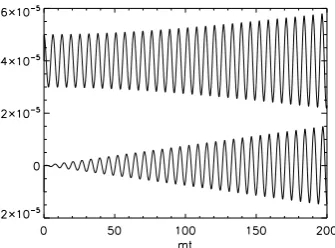
FIG. 1: Plotted areδφ(upper curve) andδφc for the toy model described in the text withφ(0) = 10
−1
and
δφ(0) = 10−5
. The upper curve has been offset by 4×10⁻⁵
.
The solutions for φare stable for the starting values 0 < φ(0)<1 and ˙φ(0) = 0. In this case it is
easy to solve the linear response equation directly. The results forφ(0) = 10−1 and δφ(0) = 10−5
are shown in Fig. 1. One sees that over the range shown there is linear growth in the amplitude of
δφc while the amplitude ofδφdoes not grow significantly initially. This pattern of early growth of
δφc is also seen in the solutions to the full set of backreaction equations.
In [6] it was predicted that there are two qualitatively different types of solutions to the
back-reaction equation for φ. For one there is a relatively slow damping of the inflation field while for
the other there is a period in which the inflaton field is rapidly damped. In [5] Eqs. (1) were
solved numerically and it was found for a flat space background that rapid damping of the inflaton
field occurs whenever g2φ2
0 >∼ 2 for models in which the starting values are φ0 = φ(t = 0) and
˙
φ(t = 0) = 0. Rapid damping does not occur for significantly smaller values such as g2φ2 0 = 1.
Whenever rapid damping does occur it is observed to happen twice and there appears to be no
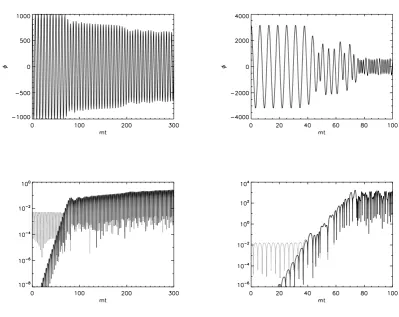
significant damping after that. These effects are illustrated in the upper panels of Fig. 2 where the
inflaton field is plotted as a function of time forg2φ2
0 = 1 and g2φ20 = 10.
Examination of the plots in Fig. 2 shows that in both cases δφe grows exponentially at about
the time that a significant amount of damping of φ first occurs, while δφc grows exponentially
starting at much earlier times. After δφc grows to be comparable in size to δφe the two quantities
are nearly identical and cannot be distinguished on the scale of the plots. For g2φ2
0 = 1 a small
amount of damping ofφoccurs very quickly followed by a much slower damping rate which goes on
for a long time. During this latter period δφgrows approximately linearly in time. For g2φ2 0 = 10
FIG. 2: Numerical solutions to the full set of equations (1) are shown for the inflaton field φin the upper
panels. In the lower panels|δφe|(dashed curves) and|δφc|(solid curves) are plotted. For each plotg= 10
−3
.
For the upper left panel g2 φ2
0 = 1 and the upper right one g 2
φ2
0 = 10. In the lower left panel δφe is the
difference between solutions to (1) withg2 φ2
0 = 1 + 10− 5
andg2 φ2
0= 1. In the lower right panelδφe is the
difference between solutions to (1) withg2 φ2
0= 10(1 + 10− 5
) andg2 φ2
0= 10.
then all growth appears to cease.
Using the detailed analysis of the particle production in [5] we find that the rate of growth of
δφc appears to be closely tied to the overall particle production rate. It is exponential when the
particle production rate is high, approximately linear in time during periods of slow damping when
the rate is much smaller, and is negligible after the second rapid damping phase when the particle
production rate is negligible (in cases where rapid damping occurs).
It is clear from the rapid growth ofδφcat early times that our revised criterion for the validity of
the semiclassical approximation during preheating is violated during the early stages of preheating,
well before either scattering effects or backreaction effects are important. This has been shown
not always give an accurate account of the details of the preheating process because the expansion
of the universe can have a significant effect on the parametric amplification process. Nevertheless
our results strongly suggest that during preheating whenever there is a period in which a lot of
parametric amplification occurs, the semiclassical approximation breaks down.
Given that the semiclassical approximation breaks down for preheating, one can ask what it
should be replaced with. Since the breakdown happens before significant damping of the inflaton
field occurs, one can legitimately solve the mode equation using solutions to the mode equation
when the g2hψ2iφterm is neglected. Thus one can investigate the amount of particle production
that occurs before backreaction effects become important and one can use that information to
determine the time at which they become important. What one cannot do is to follow the detailed
evolution of the inflaton field using the semiclassical approximation. Once backreaction effects
become important a significant amount of particle production will have taken place. This should
make it possible to compute the backreaction of the particles on the inflaton field by using a
different type of approximation in which the classical equations of motion for the quantum fields
are solved using random initial conditions [20–23]. This method has the additional advantage
that it is possible to include interactions between the fields. Interestingly, in at least one case2 the
results of a calculation using this method are similar in nature to those obtained in [5] by solving the
semiclassical backreaction equations. So even though the solutions to the semiclassical backreaction
equations cannot be trusted in detail for preheating, they may still give a good qualitative picture
of the initial and intermediate stages of the preheating process.
This is the first application that has been made of the criterion in [12] for the validity of the
semiclassical approximation when particle production effects are significant. We think it likely,
but cannot be certain, that our results generalize to similar situations. Thus the semiclassical
approximation may never be valid, at least in terms of its detailed predictions, when there is a high
rate of particle production.
Acknowledgments
P.R.A. and C.M-P. would like to thank Emil Mottola for helpful conversations. This work
was supported in part by the National Science Foundation under Grant Nos. 0556292,
PHY-0856050, PHY-1308325, and PHY-1506182 to Wake Forest University. The numerical computations
herein were performed on the WFU DEAC cluster; we thank the WFU Provost’s Office and
Infor-mation Systems Department for their generous support.
[1] S.W. Hawking,Commun. Math. Phys. 43, 199 (1975).
[2] Y. Kluger, J. M. Eisenberg, B. Svetitsky, F. Cooper, and E. Mottola,Phys. Rev. Lett.67, 2427 (1991);
F. Cooper, E. Mottola, B. Rogers, and P. Anderson, in the Proceedings of the Santa Fe Workshop on
Intermittency in High Energy Collisions, edited by F. Cooper, R. Hwa and I. Sarcavic (World Scientific,
1991) p. 399.
[3] F. Cooper, J. M. Eisenberg, Y. Kluger, E. Mottola, and B. Svetitsky, Phys. Rev.D48, 190 (1993); F.
Cooper, Y. Kluger, E. Mottola, and J. P. Paz,Phys. Rev.D51, 2377 (1995); F. Cooper, Y. Kluger, and
E. Mottola, Phys. Rev.C54, 3298 (1996).
[4] L. Kofman, A. Linde and A.A. Starobinsky, Phys. Rev. D56, 3258 (1997).
[5] P.R. Anderson, C. Molina-Par´ıs, D. Evanich, and G.B. Cook,Phys. Rev. D78, 083514 (2008).
[6] L.A. Kofman, A.D. Linde and A.A. Starobinsky, Phys. Rev. Lett.73, 3195 (1994);76, 1011 (1996).
[7] A. Dolgov and K. Freese,Phys. Rev.D51, 2693 (1995); Y. Shtanov, J. Traschen, and R. Brandenberger,
Phys. Rev.D51, 5438 (1995); R. Allahverdi and B.A. Campbell,Phys. Lett.B395, 169 (1997).
[8] See N. D. Birrell and P. C. W. Davies, Quantum Fields in Curved Space, Cambridge University Press
(Cambridge, 1982), and references therein.
[9] D. Boyanovsky, H.J. de Vega, R. Holman, D.S. Lee and A. Singh, Phys. Rev. D 51, 4419 (1995); D.
Boyanovsky, H.J. de Vega, R. Holman, and J.F.J. Salgado, Phys. Rev. D54, 7570 (1996); S.A. Ramsey
and B.L. Hu,Phys. Rev.D 56, 678 (1997); D. Boyanovsky, D. Cormier, H.J. de Vega, R. Holman, A.
Singh and M. Srednicki, Phys. Rev. D 56, 1939 (1997).
[10] C.-H. Wu and L.H. Ford,Phys. Rev. D60, 104013 (1999).
[11] N.G. Phillips and B.L. Hu, Phys. Rev. D62, 084017 (2000).
[12] P.R. Anderson, C. Molina-Par´ıs, and E. Mottola,Phys. Rev. D67, 024026 (2003).
[13] P.R. Anderson, C. Molina-Par´ıs, and E. Mottola,Phys. Rev. D80, 084005 (2009).
[14] J.-T. Hsiang, L. H. Ford, D.-S. Lee, and H.-L. Yu,Phys. Rev.D 83, 084027 (2011).
[15] P. R. Anderson, C. Molina-Par´ıs, and D. H. Sanders, in Proceedings of the Thirteenth Marcell
Gross-mann Meeting on General Relativity, edited by R. T. Jantzen, K. Rosquist, and R. Ruffini (World
Scientific, 2015), p. 1500., arXiv:1211.0247.
[16] A. Albrecht, P. Ferreira, M. Joyce, T. Prokopec,Phys. Rev.D50, 4807 (1994).
[17] D. Polarski and A. Starobinsky,Class. Quant. Grav.13, 377 (1996).
[18] S. Yu. Khlebnikov and I. I. Tkachev, Phys. Rev. Lett. 77, 219 (1996); T. Prokopec and T.G. Roos,
Felder and I. Tkachev, Comput. Phys. Commun.178929 (2008).
[19] G. Perez-Nadal, A. Roura, and E. Verdaguer, Phys. Rev. D 77, 124033 (2008); G. Perez-Nadal, A.
Roura, and E. Verdaguer, Class. Quant. Grav.25, 154013 (2008); M. B. Fr¨ob, D. B. Papadopoulos, A.
Roura, E. Verdaguer,Phys. Rev.D.87, 064019 (2013).
[20] S. Yu. Khlebnikov and I. I. Tkachev,Phys. Rev. Lett.77, 219 (1996).
[21] T. Prokopec and T.G. Roos,Phys. Rev. D55, 3768 (1997).
[22] S. Khlebnikov and I. I. Tkachev,Phys. Rev. Lett.79, 1607 (1997).