Understanding life-span developmental changes in decision-making competence
JoNell Strough West Virginia University
Andrew M. Parker
RAND Corporation, Pittsburgh, PA Wändi Bruine de Bruin
University of Leeds and Carnegie Mellon University
Chapter to appear in T. Hess, J. Strough, & C. Löckenhoff (Eds). Aging and decision making: Empirical and applied perspectives. Elsevier Academic Press. Do not cite or quote without permission
Summary
Because the median age of the population is increasing in the U.S. and other nations, it is important to consider how older adults can maintain and potentially improve their decision-making competence despite well-documented age-related cognitive declines. In this chapter, we integrate prior work defining decision-making competence as a set of skills, and show how competence can be measured using a portfolio of validated laboratory tasks developed by decision scientists. We trace evolving views of the deliberative and affective underpinnings of decision-making competence, reviewing research that has assessed age differences. We then present a life-span model of decision-making competence that focuses on the role of motivation for understanding how age-related changes in cognition, affect, and experience may influence decision-making competence and review relevant research. We conclude by identifying specific research challenges, gaps in the literature, and opportunities for improving decision making among individuals across the life span.
Understanding life-span developmental changes in decision-making competence
Overview
Decision-making competence is likely to be critical for making decisions emerging in later life, such as those pertaining to spending down wealth, health insurance, and end-of-life planning. This chapter reviews emerging research on age-related differences in decision-making competence. We begin by defining decision-making competence. We trace evolving views of the relative roles of deliberation and affect for decision-making competence within the behavioral decision-making literature. Next, we review how decision-making competence is influenced by deliberative, affective, and experience-based skills and the changing interplay of these skills with age. We then propose a conceptual model of decision making that uses insights from life-span theory to emphasize the importance of considering motivation when making predictions about decision-making skills that may decline, be maintained, or even improve across adulthood. We review research relevant to our predictions. Finally, we discuss challenges to understanding decision-making competence and aging, and offer suggestions for future research.
Defining Decision-Making Competence
Behavioral decision research involves normative, descriptive, and prescriptive
approaches.Normativetheories define “good” decisions as ones that are most likely to provide the decision maker with desired outcomes (Edwards, 1954; Yates, 1990).Descriptiveaccounts investigate how people’s actual decisions deviate from normative standards, thus identifying biases and errors.Prescriptiveapproaches aim to help people to make better decisions, by overcoming biases and errors.
outcomes if it is chosen;value assessment—judging how well outcomes meet one’s goals; integration—combining beliefs and values into coherent decisions, andmetacognition— understanding of the strengths and limits of one’s abilities. Evaluations of these processes typically focus onaccuracyor correspondence with external criteria andconsistencywith other beliefs, rather than decision outcomes (Keren & Bruine de Bruin, 2003). Because decision outcomes are affected by chance, good decision processes may sometimes yield undesired decision outcomes. However, across a large number of decisions, better decision processes should lead to better decision outcomes.
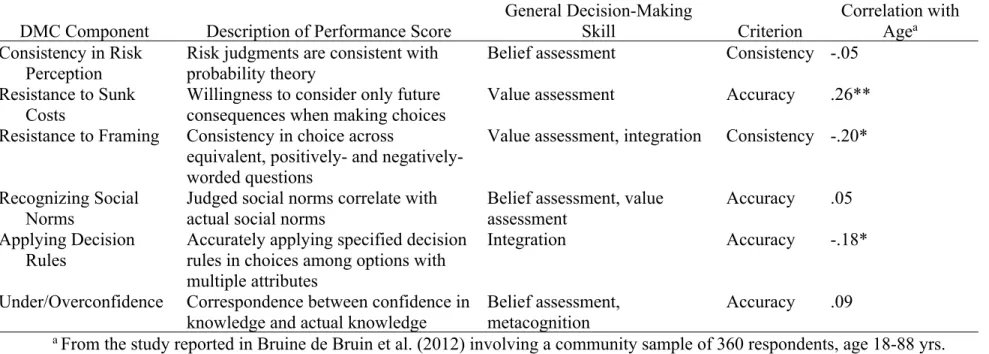
To measure the quality of the main decision processes identified by normative decision theories, we adapted six tasks from the behavioral decision-making literature to create the Adult Decision-Making Competence battery (Bruin de Bruine, Parker, & Fischhoff, 2007).
Performance on these tasks has been linked to real-world decision outcomes in age-diverse samples (Bruine de Bruin et al., 2007; Parker & Fischhoff, 2005). For each task, decision processes are judged foraccuracyor forconsistency(see Table 1).Consistency in Risk
Perceptionexamines consistency in paired risk judgments (e.g., judged likelihood of dying next year should be less than or equal to judged likelihood of dying within next five years).
social norms, which are compared for accuracy to actual social norms seen in mean responses to the first questions.Applying Decision Rulesassesses accuracy of use of specific decision rules for hypothetical choices (i.e., between Blu-ray players) varying on relevant features (e.g., sound quality).Under/overconfidencereflects appropriate confidence in one’s knowledge. After a series of true/false questions (e.g., “Alcohol causes dehydration”), we ask for confidence assessments, from 50% (just guessing) to 100% (absolutely sure). The score is the absolute difference between mean confidence and percent correct (Yates, 1990).
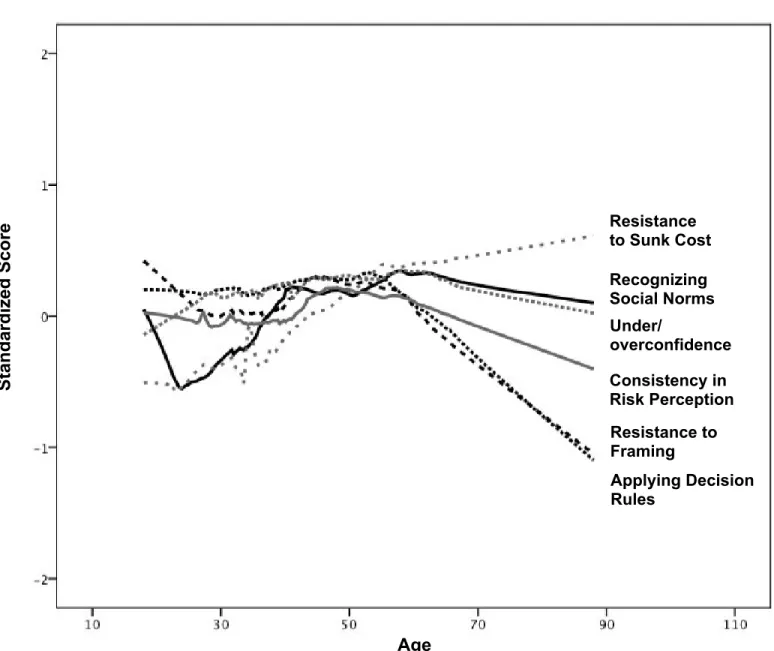
Most behavioral decision research is based on college students (Peters & Bruine de Bruin, 2012; Strough, Karns, & Schlosnagle, 2011a). However, initial findings from research using the A-DMC measure (see Figure 1) and other behavioral decision tasks with age-diverse samples (reviewed later), suggest that specific decision skills may decline, be maintained or even improve with age, highlighting the need to understand mechanisms contributing to decision-making competence across the life span. As background, we discuss the evolution of thinking about the relative roles of deliberation and affect in decision-making competence.
Deliberation, Affect, and Decision-Making Competence
Affect.Following from the idea that affective reactions often occur first in information processing (Zajonc, 1980), early decision research investigated how induced affect shaped judgments (e.g., Johnson & Tversky, 1983) and how anticipated affective consequences of decisions influenced preferences (e.g, Isen, Nygren, & Ashby, 1988). Later work recognized that incidental affect unrelated to the decision may undermine decision quality (e.g., Loewenstein, Weber, Hsee, & Welch, 2001). Along these lines, the idea that people rely on their feelings as a shortcut to make decisions, or use an “affect heuristic” was advanced (Slovic, Finucane, Peters, & MacGregor, 2002). The idea that affect facilitates analytical decision making has received less attention (cf., Damasio, 1994).
Dual-process models.“Dual-process” models describe the interplay of deliberation and affect in terms of two different systems (for reviews, see Evans, 2008; Mikels, Shuster, & Thai, this volume; Osman, 2004). Most dual-process models assume that the affective/experiential system is a source of systematic biases and errors, whereas the deliberative/analytic system results in unbiased, objective decisions (e.g., Kahneman, 2003). One function of the deliberative mode is to monitor and, as needed, edit “snap decisions” from the affective/experiential mode (Kahneman, 2003). Others suggest that decisions from the affective/experiential system are often “good enough” (Gigerenzer, 2008) or even superior, such as when essential meaning or “gist” is quickly extracted or rules are automatically applied(Reyna, 2004; Yates & Patalano, 1999). Hence, in some dual-process models there has been a shift away from conceptualizing good decision making solely as a deliberative process.
Aging and Decision-Making Competence
adults’ decision-making competence (e.g., Peters, Hess, Västfjäll, & Auman, 2007). Age-related declines in cognitive capacity may undermine deliberative decision making and fuel greater reliance on affect (e.g., Hanoch, Wood, & Rice, 2007; Peters et al., 2007). Such a shift may allow older people tocompensatefor age-related cognitive declines, or evenimprove performance (e.g., Peters & Bruine de Bruin, 2012; Strough et al., 2011a). In the following section, we review research that links age-related changes in deliberative, affective, and
experiential skills to declines, maintenance, and improvements in decision-making competence. Deliberation and age.Initial work on aging and decision-making competence showed that cognitive declines adversely affect older adults’ performance on cognitively-demanding decision tasks (Finucane, Mertz, Slovic, & Schmidt, 2005). Age-related declines in fluid
intelligence (e.g., Salthouse, 2004), processing speed (Salthouse, 1996), and short-term, working, and long-term memory (e.g., Park, Lautenschlager, Hedden, & Davidson & Smith, 2002) are well-documented. These skills have been described as the “mechanics” of cognition (Baltes, Lindenberger, & Staudinger, 2006).
Age differences in performance on several Adult Decision-Making Competence tasks (Bruine de Bruin et al., 2007) have been linked to age-related cognitive declines. Fluid
Finucane & Gullion, 2010; Henninger, Madden, & Huettel, 2010; Hess, Queen, & Patterson, 2012; Mata, Schooler, & Rieskamp, 2007; Wood, Hanoch, Barnes, Liu, Cummings,
Bhattacharya, & Rice, 2011). Hence, age-related declines in “cognitive mechanics” are clearly important for understanding why some aspects of decision-making competence decline with age (see also Del Missier, Mäntylä, & Nilsson, this volume).
Affect and age.Researchers have begun to consider the role of affect in decision-making competence across the life span. Improvement in affect regulation with age is increasingly well-documented (e.g., Blanchard-Fields, 2007; Charles & Carstensen, 2010). Positive emotional experience increases until about age 70, when it begins to level off and decline among those 80 years and older (e.g., Carstensen et al., 2011). These age-related changes have been posited both to facilitate and undermine decision-making competence (e.g., Mikels et al., this volume).
Adding affective, evaluative information to numerical information influences older adults’ preferences for hypothetical health care plans (Peters, Diekmann, Västjfäll, Mertz, & Slovic, 2009). Dispositional affect and anticipated affect are better predictors of age differences in discounting of gains and losses than are basic cognitive abilities (Löckenhoff, O’Donoghue, & Dunning, 2011). Older adults pay more attention than younger adults to affective cues when learning which deck of cards yields the highest payoff (Bauer, Timpe, Edmonds, Bechara, Tranel, & Denburg, 2013; Wood, Busemeyer, Koling, Cox, & Davis, 2005). Inducing positive affect improves older adults’ learning of which card decks result in gains versus losses
Cuing affective versus deliberative processing influences older adults’ decisions. Older adults make higher-quality decisions when affective processing is cued than when deliberative processing is cued; the opposite is true for younger adults (Mikels, Löckenhoff, Maglio, Carstensen, Goldstein & Garber, 2010). However, another study shows that cuing deliberative processing similarly influences older and younger adults’ choices about gambles with different expected values (Thomas & Millar, 2012). Differences in findings across studies may reflect that the optimal decision-making mode for a given task influences how well older adults perform. When decision quality requires processing information valence, older adults’ performance may benefit from relying on affective skills that improve with age. However, when decision quality requires deliberation based on expected value, older adults’ performance will be harmed by age-related cognitive declines (see Weller, Levin, & Denburg, 2011). Yet, more research is needed to understand the interplay between cognitive and affective skills in decision-making competence across the life-span.
greater general life experience is thought to explain why they perform similarly to younger adults on tasks that tap application of normative economic principles (i.e., temporal discounting tasks, financial literacy, debt literacy) despite their declining fluid intelligence (Li, Baldassi, Johnson, & Weber, 2013).
In addition to general life experience, domain-specific experience may give older adults an advantage over younger adults. Older adults’ greater consumer experience may explain why their preferences for shopping discount cards were more consistent than younger adults’
preferences (Tentori, Osherson, Hasher, & May, 2001). Social experience is thought to explain age differences in social judgments (Hess, Osowski, & Leclerc, 2005). Training in economics reduces the sunk-cost bias (Larrick, Morgan, & Nisbett, 1990; cf., Arkes & Blumer, 1985) and experts are less subject to the sunk-cost bias than nonexperts (Fennema & Perkins, 2008). However, in these studies, age and expertise were confounded. Moreover, experts may not always avoid decision biases (Reyna, Chick, Corbin, & Hsia, 2014; Shafir & LeBoeuf, 2002). Thus, the extent and conditions under which experience facilitates decision-making competence in later adulthood remain unclear.
Motivational Model of Aging and Decision-Making Competence
To predict how individual differences in deliberative, affective, and experiential skills may lead to declines, maintenance, or improvement in decision-making competence across the life span, we have developed a conceptual model that accords a key role to motivation (see Figure 2; see also Strough et al., 2011a). First, our model views decision making as a contextually-embedded process. Our conceptualization of context includes aspects of the
aging). Second, our model posits that individual characteristics such as age, personality, and cognitive style are important antecedents that affect the decision-making process (see also Bruine de Bruin, Parker, & Fischhoff, in press[a]). Third, our model emphasizes that people are
motivated by concerns reflecting both their personal characteristics and features of the decision context (see also Berg & Strough, 2011; Strough & Keener, 2014). Finally, a distinguishing feature of our model is that it recognizes developmental changes in deliberative, affective, and experiential skills, as well as developmental changes in the motivation to use those skills when making decisions.
Our model is based on conceptualizations of motivation taken from dual-process theories of decision making and from life-span theories of how motivation may change with age. First, dual-process theorists posit that motivation influences the thinking mode applied to the decision (Kahneman, 2003). Personally relevant decisions motivate use of the cognitively-taxing
deliberative mode. When lacking such motivation, people rely on the experiential/affective mode. Other theories of motivation used in the behavioral decision-making literature distinguish motivation to promote gains (“promotion-focused”) from motivation to avoid losses
(“prevention-focused”; e.g., Crowe & Higgins, 1997; Molden & Hui, 2011). “Action” versus “state” orientation, a person’s tendency to initiate and follow through with intentions versus engage in unproductive thoughts (Diefendorff, Lord, Hall, & Strean, 2000), has also been
investigated (e.g., van Putten, Zeelenberg & van Dijk, 2010). A limitation of these approaches is that they do not address how motivation changes with age.
Second, life-span theories address age-related changes in motivation and can be extended to understand age differences in decision making. For example, Carstensen’s (2006)
seek information changes with age as a function of life-span temporal horizons. Expansive time horizons in early adulthood motivate seeking new experiences and information. In later
adulthood, shortened time horizons due to awareness of life’s finitude motivate maximizing positive emotions in the “here and now”. In the following section, we show how taking motivation into account facilitates a better understanding of aspects of decision-making competence that may decline, be maintained, or even improve across adulthood.
Motivation and affect.Two lines of research provide initial insights about motivation and age differences in decision-making competence. The first focuses on “Resistance to
Framing,” (one component task of the Adult Decision-Making Competence (A-DMC) measure; Bruine de Bruin et al., 2007) which, as noted earlier, refers to the ability to be unaffected by whether options are described in positive or negative terms (Levin & Gaeth, 1998). Studies with college-age samples show violations of the normative principle that responses should be
consistent across frames (see Kuhberger, 1998 for a review), which has been attributed to greater attention to losses than to gains (Tversky & Kahneman, 1981; cf., Reyna, 2004). It has been suggested that, if older adults’ motivation to maximize positive emotion dampens attention to loss, they may be less subject to framing errors (e.g., Mikels & Reed, 2009). However, studies investigating age differences in framing errors yield inconsistent results (for reviews see Bruine de Bruin et al., in press[a]; Mata, Josef, Samanez-Larkin, & Hertwig, 2011; Peters, Dieckman, & Weller, 2011; Strough et al, 2011a).
often violate the normative rule of ignoring irretrievable losses due to loss aversion and concerns about waste (Arkes & Blumer, 1985).
Older adults’ motivation to maximize positive emotion and the strategies they use to facilitate positive affect (e.g., Charles & Carstensen, 2010) may give them an advantage over younger adults when dealing with sunk costs. We have found that older adults are better able than younger adults to resist sunk costs, even after taking into account fluid intelligence and education – suggesting that other skills play a role (Bruine de Bruin et al., 2012; Strough et al., 2008). Older adults’ decisions about sunk costs are less motivated by past losses than those of younger adults (Strough, Schlosnagle, & DiDonato, 2011b). Moreover, instead of engaging in unproductive rumination about irretrievable past losses, older adults choose to use action-oriented coping strategies (Bruine de Bruin, Strough, & Parker, in press[b]). Similarly, among people younger than 50, those who are motivated to promote gains (“promotion focus”), are better at ignoring sunk costs compared to those who are motivated to prevent loss (“prevention focus”, Molden & Hui, 2011). College students with an “action” orientation are less subject to the sunk-cost bias compared to those with a “state” orientation, presumably because those with a state orientation ruminate about past losses (van Putten et al., 2010). Together, these studies point to the importance of age-related changes in motivation for understanding decision-making competence, and suggest that coping strategies may lead to age-related improvements in
performance in one aspect of decision-making competence.
maximize positive emotions, in one study when asked to choose a physician and a health plan, adults 62 and older reviewed more positive than negative health-care information compared to adults age 22-39 (Löckenhoff & Carstensen, 2007). However, this age difference was eliminated when participants were motivated to focus on information-gathering goals (see also Depping & Freund, 2013). The sunk-cost bias decreases when younger adults’ usually expansive life-span temporal horizons are experimentally restricted to create a motivational orientation that mimics that of older adults (Strough, Schlosnagle, Karns, Lemaster, & Pichayayothin, 2014). These findings illustrate how contextual demands may modify age-typical motivational orientations to influence decisions.
Motivation and deliberation.Research reviewed earlier has established that age-related declines in deliberative skills are important for understanding why older adults perform worse on cognitively-demanding behavioral decision tasks. However, motivation may affect whether or not older adults apply their deliberative skills. Recent research shows that older adults may be less motivated to think about numbers, and this helps to explain why age is associated with lower scores on cognitively-demanding measures of numeracy (Bruine de Bruin, McNair, Taylor, Summers, & Strough, in press).
effort) when self-relevance was high; younger adults’ (21-41 yrs) search strategies were less influenced by self-relevance (Hess, Queen, & Ennis, 2012). Research on self-relevance suggests how the decision context may shape older adults’ motivation to apply deliberative skills.
Motivation and experience.A small number of studies begin to suggest how motivation may influence experiential processing among older adults and lead to either good or bad
consequences. When presented with hypothetical decisions about medical treatments, older adults tend to rely on personal experience instead of data about short and long-term rates of survival and mortality (Woodhead, Lynch, & Edelstein, 2011). Interestingly, relying on
experience buffers people of all ages against showing inconsistent preferences, but as the authors note, ignoring data when making a real-world medical decision could increase the risk of making an uninformed decision. Other research suggests that older adults are unwilling or even unable to ignore their experience (Horhota, Mienaltoski, & Blanchard-Fields, 2012). However, it has also been found that older adults switch from relying on experience to using a more analytical approach when information challenges their beliefs (Klaczynski & Robinson, 2000). These findings suggest that older adults’ reliance on experiential versus deliberative skills may vary depending on motivation.
Summary.Our review illustrates how motivation may influence the deployment of deliberative, affective, and experiential skills that facilitate or undermine different facets of decision-making competence across the life span. Our review also draws attention to the importance of considering both individual characteristics and contextual demands when
Current challenges and directions for future research
Linking lab to life.A central challenge for future research is to link performance on laboratory-based, behavioral decision making tasks to real-world health and financial decisions (Fischhoff, 1996). Many important real-world decisions people face across the life span are tied to developmental tasks (Erikson, 1969) and life events (Norris & Murrell, 1984). In the US, the transition to adulthood brings decisions about education, careers, long-term relationships, and starting a family. Midlife brings decisions about preventative health screening, health insurance, finances, caring for aging parents, and work-life balance. In later adulthood, medical decisions and putting one’s affairs in order gain importance. Prior research on these decisions has focused more on demographic correlates (e.g., education, income) than on psychological processes.
Better performance on our Adult Decision-Making Competence battery is associated with better life decision outcomes (e.g., not overdrawing bank accounts, not getting a DUI) as
measured by our Decision Outcomes Inventory (DOI; Bruine de Bruin et al., 2007). However, decision outcomes relevant to later adulthood are not well-represented on the DOI. Research would benefit from a revised DOI, which could include outcomes corresponding to
Another way to establish that performance on behavioral decision tasks is a valid
indicator of decision-making competence is to link performance to decision-making outputs (i.e., the decisions themselves), such as financial planning, insurance purchases, and health-promotion behavior using criteria from normative theories to determine decision quality. Parker et al. (2012) capitalized on an online panel of people of diverse ages, the American Life Panel
(https://mmicdata.rand.org/alp/), to show that people with greater confidence in their knowledge were more likely to engage in retirement planning, even after controlling for actual knowledge (a measure related, but not identical, to the under/overconfidence measure in the Adult Decision-Making Competence battery; Bruine de Bruin et al., 2007). Although useful, this approach is limited by the availability of data. Even though data on retirement and health decisions is
available in large, publicly available data sets (e.g., American Life Panel; Health and Retirement Study), information about performance on behavioral decision tasks is not. Adding behavioral decision tasks to Sweden’s longitudinal Betula study has facilitated understanding of how age-related memory declines affect decision-making competence (see Del Missier et al., this volume). Adding behavioral decision tasks to other national surveys could continue to address the gap in knowledge about how decision-making competence relates to real-world decisions. Data from national samples could then be used to establish norms for decision-making
competence to guide judgments about decision-making capacity (see Moye, Marson, & Edelstein, 2013).
phenomena observed in the laboratory translate into meaningful real-world consequences? Our initial work suggests that the answer to this questions is “yes”; however, further research is necessary to solidify this conclusion.
Developing effective interventions.By identifying motivational, and deliberative, affective, and experiential underpinnings of decision-making competencies, and linking these competencies to real-world outcomes, research can provide a basis for developing interventions to improve decisions about health and financial well-being across the life span. For example, since research shows that age-related memory declines are important for understanding age differences in some aspects of decision-making competence (e.g., Del Missier et al., 2013), reducing memory demands (e.g., by facilitating access to written information about options) and using memory training interventions (e.g., Rebok et al., 2014) could help older adults to make better use of the information provided to them. Moreover, if findings confirm that older adults pay more attention to affective information, decision aids and communication materials could aim to incorporate such information to benefit older adults’ decisions (e.g., Peters et al., 2009). Better understanding of the kinds of experiences people have had in particular decision-making contexts can inform interventions to improve decision making in those contexts (e.g., Bynum, Barre, Reed, & Passow, 2014). Ultimately, identifying individual differences in specific skills that predict different facets of decision-making competence will facilitate the development of behavioral skills training, and allow interventions to be tailored to a recipient’s specific needs.
2005). The portfolio of tasks that comprise our Adult Decision-Making Competence (A-DMC) battery were chosen to correspond to key processes implicated by normative decision theory (Parker & Fischhoff, 2005). Well-documented age differences in affective processes and life experience (e.g., Charles & Carstensen, 2010) suggest the need to further study the skills that contribute to better decision-making competence. Because hypothetical tasks may not elicit strong emotions, it is important to study decision-making competence with real-world tasks.
Tasks developed by decision scientists studying college students in laboratories provide a starting point for identifying tasks that tap affective dimensions of decision-making competence. One candidate is a task that measures use of the affect heuristic. Risks and benefits are positively correlated in the real world, butperceptionsof risks and benefits tend to be negatively correlated (Alhakami & Slovic, 1994). This correlation could be used as an affect-heuristic competence measure. Scores indicating higher negative correlations and greater differences in ratings of risks and benefits of technologies (e.g., nuclear power, chemotherapy) indicate greater use of the affect heuristic, signifying worse judgment (Alhakami & Slovic, 1994). Our recent work
suggests that greater reliance on the affect heuristic is associated with less financial risk tolerance (Lemaster & Strough, 2014). To the extent that less financial risk tolerance predicts making less risky financial investments and therefore perhaps accruing less money, an affect heuristic task could be a useful addition to the A-DMC.
outcome would have been equally unpredictable. Irrational judgments are posited to stem from regret over not avoiding the seemingly more predictable negative outcome. Because older and younger adults use different coping strategies for dealing with negative events (e.g., Bruine de Bruin et al., in press[b]) and avoiding decision regret is important to older adults (Bjälkebring, Västjäfll, & Johannsson, 2013) their judgments may differ from those of younger adults (see Horhota et al., 2012).
Assessing preferences for temporal sequences of payment gains and losses (Loewenstein & Prelec, 1993) could tap other age-related shifts in decision competencies. When deciding about gains (e.g., salary, dividends) that increase or decrease over time, normative theories recommend choosing sequences in which larger payments are received sooner so as to optimize financial gain. Similarly, when deciding about losses (e.g., loan payments) it is recommended to make the larger payments later. However, many people choose the opposite, preferring to get losses over with and savor pending gains. Restricted life-span temporal horizons might facilitate normative decisions about temporal sequences of gains and losses. Indeed, some research
suggests that older age is associated with being less likely to devalue delayed monetary outcomes (e.g., Löckenhoff et al., 2011). However, such effects may depend on the larger cultural context, as well as individual differences in perceived health, among other factors (e.g., Chao, Szrek, Pereira, & Pauly, 2009).
underrepresent older adults’ making competence. Age-related declines in decision-making competence (e.g., Bruine de Bruin et al., 2012) could also reflect negative cultural stereotypes about aging that induce “stereotype threat”, or concerns about confirming a negative stereotype. Such concerns influence older adults’ memory performance (Barber & Mather, 2014) and could have similar negative consequences when assessing decision-making competence. Finally, another avenue ripe for research is to understand the social context in which individuals make important financial and health decisions. Even if a person has poor decision competence, they may not experience bad outcomes if they are able to compensate by relying on competent others. Hence, work that investigates decision making as a process that is “shared” (e.g., Dillard, Couper, & Zikmund-Fisher, 2010) or “collaborative” (see Queen, Berg, & Lowrance, this volume) may yield important insights. For example, work on everyday problem solving shows that older adults prefer to collaborate with others in domains where they perceive they have worse ability than same-age peers (Strough, Cheng, & Swenson, 2002). Preferences for
collaborating with others to make decisions, for example, about health and finances, also may be domain specific and depend upon personal views of one’s ability relative to age peers.
competence during this age period.Research should also be directed toward understanding decision-making competence among those 60 and older. The “young old”, “old old”, and “oldest old” differ in important ways (Baltes & Smith, 2003), and decision-making competence may also vary among these groups (e.g., Finucane & Guillion, 2010).
Comparing college students to community-dwelling older adults introduces confounds that muddy the interpretation of age differences in decision-making competence. Because college students may come from different backgrounds (e.g., higher socio-economic status) than
community-dwelling adults, and people who reside in university towns may differ from adult populations more generally, such “town-gown” studies may lack external validity. Yet, this approach is common in many studies, including our own (e.g., Strough et al., 2008). Using community volunteers of all ages instead of college students (e.g., Bruine de Bruin et al., 2007) or obtaining representative samples within a given city (e.g., Mikels et al., 2010) begins to address this issue. Using existing participant panels to investigate decision making is another way to address this issue. For example, the American Life Panel (described above) was designed to be nationally-representative. In recent work, we leveraged this sample to examine knowledge, confidence in knowledge, and retirement planning decisions of a diverse group of adults age 18-91 (Parker et al., 2012) and age-related improvement in decisions about sunk costs in adults age 20-89 (Bruine de Bruin et al., in press[b]). Efforts to drag judgment and decision making tasks out of psychology laboratories and introduce them to more diverse samples should continue.
and the differences that have been identified may reflect cohort effects (e.g., Schaie, 1965), not developmental differences. Longitudinal-sequential studies are necessary to better understand developmental gains and losses in decision-making competence. Moreover, such efforts should focus on the entire life span, not just adulthood and aging (cf., Weller, Levin, Rose, & Bossard, 2012).
Summary and Conclusions
Efforts akin to Figure 2 are necessary to link judgment and decision-making research and life-span developmental theory. It is essential to obtain empirical evidence about the relative roles of motivational, experiential, and affective processes, considered as separate (although not unrelated) factors, in addition to deliberative processes. Future research should continue to investigate how performance on tasks that have been used in the judgment and decision making literature to compare deliberative and affective/experiential decision making differ as a function of age, and how the links between decision-making competencies and life outcomes vary by age.
Existing research shows maintenance and even optimization of some aspects of decision-making competence with age, which is in accord with a key tenet of life-span theory that
References
AARP. (2011). AARP Foundation National Fraud Victims Survey. Washington, DC: Author. Retrieved from: http://assets.aarp.org/rgcenter/general/fraud-victims-11.pdf
Abaluck, J., & Gruber, J. (2011). Heterogeneity in choice inconsistencies among the elderly: Evidence from prescription drug plan choice.American Economic Review: Papers & Proceedings, 101(3), 377-381. doi: 10.1257//aer.101.3.377
Agarwal, S., Driscoll, J. C. Gabaix, X. & Laibson, D. (2009). The age of reason: Financial decisions over the lifecycle with implications for regulation.Brookings Papers on Economic Activity (2)51-117. doi:10.1353/eca.0.0067 Retrieved from:
http://nrs.harvard.edu/urn-3:HUL.InstRepos:4554335
Alhakami, A. S., & Slovic, P. (1994). A psychological study of the inverse relationship between perceived risk and perceived benefit.Risk Analysis, 14,1085-1096. doi:
0272-4332/94/1U
Arkes, H. R., & Blumer, C. (1985). The psychology of sunk cost.Organizational Behavior and Human Decision Processes, 35(1),124-140. doi:10.1016/0749-5978(85)90049-4
Baltes, P. B., Lindenberger, U., & Staudinger, U. M. (2006). Life-span theory in developmental psychology. In R. M. Lerner & W. Damon (Eds.),Handbook of child psychology: Theoretical models of human development(6th ed., Vol. 1, pp. 569-664). Hoboken, NJ: John Wiley & Sons.
Baltes, P. B., & Smith, J. (2003). New frontiers in the future of aging: From successful aging of the young old to the dilemmas of the fourth age.Gerontology,49(2), 123-135.
Barber, S. J., & Mather, M. (2014). Stereotype threat in older adults: When and why does it occur, and who is most affected? In P. Verhaeghen & C. Hertzog (Eds.),The Oxford Handbook of Emotion, Social Cognition, and Everyday Problem Solving During Adulthood(pp. 302-319). New York: Oxford University Press.
Bauer, A. S., Timpe, J. C., Edmonds, E. C., Bechara, A., Tranel, D., & Denburg, N. L. (2013). Myopia for the future or hypersensitivity to reward? Age-related changes in decision making on the Iowa Gambling Task.Emotion, 13(1),19-24. doi:10.1037/a0029970 Berg, C. A., & Strough, J. (2011). Problem solving across the life span. In K. L. Fingerman, C.
A. Berg, J. Smith, & T. C. Antonucci (Eds.),Handbook of life-span development(pp. 239-267). New York, NY US: Springer Publishing Co.
Bernstein, D. M., Erdfelder, E., Meltzoff, A. N., Peria, W., & Loftus, G. R. (2011). Hindsight bias from 3 to 95 years of age.Journal of Experimental Psychology: Learning, Memory, and Cognition, 37(2), 378-391. doi: 10.1037/a0021971
Bjälkebring, P., Västfjäll, D., & Johansson, B. (2013). Regulation of experienced and anticipated regret for daily decisions in younger and older adults in a Swedish one-week diary study. Geropsych: The Journal of Gerontopsychology And Geriatric Psychiatry, 26(4),233-241. Doi:10.1024/1662-9647/a000102
Blanchard-Fields, F. (2007). Everyday problem solving and emotion: An adult developmental perspective.Current Directions in Psychological Science, 16(1), 26-31. Doi:
10.1111/j.1467-8721.2007.00469.x
Bruine de Bruin, W., Parker, A. M., & Fischhoff, B. (2007). Individual differences in adult decision-making competence.Journal of Personality & Social Psychology, 92(5), 938-956. doi: 10.1037/0022-3514.92.5.938
Bruine de Bruin, W., Parker, A.M., & Fischhoff, B. (2012). Explaining adult age differences in decision-making competence.Journal of Behavioral Decision Making,25, 352-360. doi: 10.1002/bdm.712
Bruine de Bruin, W., Parker, A. M., & Fischhoff, B. (in press[a]). Individual differences in decision-making competence across the lifespan. In E.A. Wilhelms, & V.F. Reyna (Eds.), Neuroeconomics, Judgment, and Decision Making.New York, NY: Psychology Press. Bruine de Bruin, W., Strough, J., & Parker, A. M. (in press[b]). Getting older isn’t all that bad:
Better decisions and coping when facing sunk costs. Psychology and Aging.
Bynum, J. W., Barre, L., Reed, C., & Passow, H. (2014). Participation of very old adults in health care decisions.Medical Decision Making, 34(2),216-230.
doi:10.1177/0272989X13508008
Carpenter, S. M., Peters, E., Västfjäll, D., & Isen, A. M. (2013). Positive feelings facilitate working memory and complex decision making among older adults.Cognition and Emotion, 27(1),184-192. doi:10.1080/02699931.2012.698251
Carstensen, L. L. (2006). The influence of a sense of time on human development.Science, 312(5782), 1913-1915. doi: 10.1126/science.1127488
Chao, L. W., Szrek, H., Pereira, N. S., & Pauly, M. V. (2009). Time preference and its
relationship with age, health, and survival probability.Judgment and Decision Making, 4, 1–19.
Charles, S., & Carstensen, L. (2010). Social and emotional aging.Annual Review of Psychology, 61,383-409. doi: 10.1146/annurev.psych.093008.100448
Crowe, E., & Higgins, E. (1997). Regulatory focus and strategic inclinations: Promotion and prevention in decision-making.Organizational Behavior and Human Decision Processes, 69(2),117-132. doi:10.1006/obhd.1996.2675
Damasio, A.R., (1994).Descartes’ Error: Emotion, Reason, and the Human Brain.Avon, New York.
Del Missier, F., Mäntylä, T., Hansson, P., Bruine de Bruin, W., Parker, A. M., & Nilsson, L. (2013). The multifold relationship between memory and decision making: An individual-differences study.Journal of Experimental Psychology: Learning, Memory, and
Cognition, 39(5),1344-1364. doi:10.1037/a0032379
Del Missier, F., Mäntylä, T, & Nilsson, L. (this volume). Aging, memory, and decision making. Depping, M. K., & Freund, A. M. (2013). When choice matters: Task-dependent memory effects
in older adulthood.Psychology and Aging, 28(4),923-936. doi:10.1037/a0034520 Edwards, W. (1954). The theory of decision making.Psychological Bulletin, 51(4),380-417.
doi:10.1037/h0053870
Ennis, G. E., Hess, T. M., & Smith, B. T. (2013). The impact of age and motivation on cognitive effort: Implications for cognitive engagement in older adulthood.Psychology and
Epstein, S., Lipson, A., Holstein, C., & Huh, E. (1992). Irrational reactions to negative outcomes: Evidence for two conceptual systems.Journal of Personality and Social
Psychology,62(2),328-339. doi: 10.1037/0022-3514.62.2.328 Erikson, E. H. (1969).Identity: Youth and crisis. New York, NY: Norton.
Evans, J. St. B. T. (2008). Dual-processing accounts of reasoning, judgment, and social cognition.Annual Review of Psychology, 59, 255-278. doi:
10.1146/annurev.psych.59.103006.093629
Fennema, M. G., & Perkins, J. D. (2008). Mental budgeting versus marginal decision making: Training, experience, and justification effects on decisions involving sunk costs.Journal of Behavioral Decision Making, 21,225-239. doi: 10.1002/bdm.585
Finucane, M. L., & Gullion, C. M. (2010). Developing a tool for measuring the decision-making competence of older adults.Psychology and Aging, 25(2), 271-288. doi:
10.1037/a0019106
Finucane, M. L., Mertz, C. K., Slovic, P., & Schmidt, E. (2005). Task complexity and older adults’ decision-making competence. Psychology and Aging, 20(1),71-84.
doi:10.1037/0882-7974.20.1.71
Finucane, M. L., Slovic, P., Hibbard, J. H., Peters, E., Mertz, C. K., & MacGregor, D. G. (2002). Aging and decision-making competence: An analysis of comprehension and consistency skills in older versus younger adults considering health-plan options.Journal of
Behavioral Decision Making, 15(2),141-164. doi:10.1002/bdm.407
Fischhoff, B. (1996). The real world: what good is it?Organizational Behavior and Human Decision Processes,65(3), 232-248.
Hanoch, Y., Wood, S., & Rice, T. (2007). Bounded rationality, emotions and older adult decision making: Not so fast and yet so frugal.Human Development, 50(6), 333-358. doi:
10.1159/000109835
Henninger, D. E., Madden, D. J., & Huettel, S. A. (2010). Processing speed and memory mediate age-related differences in decision making.Psychology and Aging, 25(2), 262-270. doi: 10.1037/a0019096
Hess, T. M., Leclerc, C. M., Swaim, E., & Weatherbee, S. R. (2009). Aging and everyday judgments: The impact of motivational and processing resource factors.Psychology and Aging, 24(3), 735-740. doi: 10.1037/a0016340
Hess, T. M., Osowski, N. L., & Leclerc, C. M. (2005). Age and experience influences on the complexity of social inferences.Psychology and Aging, 20(3),447-459.
doi:10.1037/0882-7974.20.3.447
Hess, T. M., & Queen, T. L. (2014). Aging influences on judgment and decision processes: Interactions between ability and experience. In P. Verhaeghen & C. Hertzog (Eds.), Emotion, social cognition, and everyday problem solving during adulthood(pp. 238-255).New York: Oxford University Press.
Hess, T. M., Queen, T. L., & Ennis, G. E. (2013). Age and self-relevance effects on information search during decision making.Journals of Gerontology Series B: Psychological
Sciences & Social Sciences, 68(5),703-711. doi: 10.1093/geronb/gbs108 Hess, T. M., Queen, T. L., & Patterson, T. R. (2012). To deliberate or not to deliberate:
Horhota, M., Mienaltowski, A. M., & Blanchard-Fields, F. (2012). If only I had taken my usual route...Age-related differences in counterfactual thinking.Age, neuropsychology and cognition, 19(3),339-361. doi:10.1080/13825585.2011.615904
Isen, A. M., Nygren, T. E., & Ashby, F. G. (1988). Influence of positive affect on the subjective utility of gains and losses: It is just not worth the risk.Journal of Personality and Social Psychology, 55,710-717.
Jacobs, J. E., Greenwald, J. P., & Osgood, D. W. (1995). Developmental differences in baserate estimates of social behaviors and attitudes.Social Development, 4, 165–181.
Johnson, E. J., & Tversky, A. (1983). Affect, generalization, and the perception of risk.Journal of Personality and Social Psychology 45,20–31.
Kahneman, D. (2003). A perspective on judgment and choice: Mapping bounded rationality. American Psychologist, 58(9),697-720. doi: 10.1037/0003-066X.58.9.697
Kahneman, D., Slovic, P., & Tversky, A. (1982).Judgment under uncertainty: Heuristics and biases.Cambridge, England: Cambridge University Press.
Kahneman, D., & Tversky, A. (1979). Prospect theory: Analysis of decision under risk. Econometrica, 47,263–291. doi:10.2307/1914185
Keren, G., & Bruine de Bruin, W. (2003). On the assessment of decision quality: Considerations regarding utility, conflict, and accountability. In D. Hardman, & L. Macchi (Eds.).
Thinking: Psychological Perspectives on Reasoning, Judgment and Decision Making(pp. 347-363). New York, NY: Wiley.
Klaczynski, P. A., & Robinson, B. (2000). Personal theories, intellectual ability, and
epistemological beliefs: Adult age differences in everyday reasoning biases.Psychology and Aging, 15(3),400-416. doi:10.1037/0882-7974.15.3.400
Kuhberger, A. (1998). The influence of framing on risky decisions: A meta-analysis. Organizational Behavior and Human Decision Processes, 75,23–55.
Lachman, M. E. (2004).Development in midlife.Annual Review of Psychology,55(1), 305-331. doi:10.1146/annurev.psych.55.090902.141521
Lemaster, P., & Strough, J. (2014). Understanding age differences in financial risk tolerance: Temporal horizons and affect. In Strough, J., & Löckenhoff, C.Age Differences in Decision Making: Balancing Affect and Reason in Financial and Healthcare Settings. Symposium submitted to the 2014 meeting of Gerontological Society of America, Washington, D.C.
Levin, I. P., & Gaeth, G. J. (1988). Framing of attribute information before and after consuming the product.Journal of Consumer Research, 15, 374–378.
Löckenhoff, C. E., O'Donoghue, T., & Dunning, D. (2011). Age differences in temporal discounting: The role of dispositional affect and anticipated emotions.Psychology and Aging, 26(2),274-284. doi:10.1037/a0023280
Loewenstein, G. W., & Prelec, D. (1993). Preferences for sequences of outcomes.Psychological Review, 100,91-108.
Mata, R., Josef, A. K., Samanez-Larkin, G. R., & Hertwig, R. (2011). Age differences in risky choice: A meta-analysis. [Special issue].Annals of the New York Academy of Sciences, 1235, 18-29. doi: 10.1111/j.1749-6632.2011.06200.x
Mata, R., Schooler, L. J., & Rieskamp, J. (2007). The aging decision maker: Cognitive aging and the adaptive selection of decision strategies.Psychology and Aging, 22,796-810.
Mather, M., & Carstensen, L. L. (2005). Aging and motivated cognition: The positivity effect in attention and memory.Trends in Cognitive Sciences,9(10), 496-502.
doi:10.1016/j.tics.2005.08.005
Mikels, J. A., Cheung, E., Cone, J., & Gilovich, T. (2012, November 19). The dark side of intuition: Aging and increases in nonoptimal intuitive decisions.Emotion.Advance online publication. doi: 10.1037/a0030441
Mikels, J. A., Loeckenhoff, C. E., Maglio, S. J., Carstensen, L. L., Goldstein, M. K., & Garber, A. (2010). Following your heart or your head: Focusing on emotions versus information differentially influences the decisions of younger and older adults.Journal of
Experimental Psychology: Applied 16(1), 87-95. doi: 10.1037/a0018500
Mikels, J. A., Reed, A. E., & Simon K. I. (2009). Older adults place lower value on choice relative to young adults.Journal of Gerontology: Psychological Sciences, 64B(4), 443-446. doi: 10.1093/geronb.gbp021
Molden, D., & Hui, C. (2011). Promoting de-escalation of commitment: A regulatory focus perspective on sunk costs.Psychological Science, 22(1), 8-12. doi:
10.1177/0956797610390386
Norris, F. H., & Murrell, S. A. (1984). Protective function of resources related to life events, global stress, and depression in older adults.Journal of Health and Social Behavior, 25, 424-437.
Osman, M. (2004). An evaluation of dual-process theories of reasoning.Psychonomic Bulletin & Review, 11(6), 988-1010.
Parker, A. M., Bruine de Bruin, W., Yoong, J., & Willis, R. (2012). Inappropriate confidence and retirement planning: Four studies with a national sample.Journal of Behavioral Decision Making,25, 382-389.
Parker, A. M., & Fischhoff, B. (2005). Decision-making competence: External validation through an individual-differences approach.Journal of Behavioral Decision Making, 18(1), 1-27. doi: 10.1002/bdm.481
Peters, E., & Bruine de Bruin, W. (2012). Aging and decision skills. In M. K. Dhami, A. Schlottmann, & M. Waldmann (Eds.),Judgment and decision making as a skill: Learning, development, and evolution. Cambridge University Press.
Peters, E., Dieckmann, N. E., & Weller, J. (2011). Age differences in complex decision making. In K. W. Schaie & S. L. Willis (Eds.),Handbook of the psychology of aging(7th ed., pp. 133-151). San Diego, CA: Elsevier Academic Press.
Peters, E., Hess, T. M., Västfjäll, D., & Auman, C. (2007). Adult age differences in dual
information processes: Implications for the role of affective and deliberative processes in older adults’ decision making.Perspectives on Psychological Sciences, 2(1),1-23. doi: 10.1111/j.1745-6916.2007.00025.x
Rebok, G., Ball, K, Guey, L. T., Jones, R. N., Kim, H., King, J., et al. (2014). Ten-year effects of the ACTIVE cognitive training trial on cognition and everyday functioning in older adults.Journal of American Geriatrics Society, 62,16-24.
Reyna, V. F. (2004). How people make decisions that involve risk: A dual-process approach. Current Directions in Psychological Science, 13(2),60-66.
Reyna, V. F., Chick, C. F., Corbin, J. C., & Hsia, A. N. (2014). Developmental reversals in risky decision making: Intelligence agents show larger decision biases than college students. Psychological Science, 25(1), 76-84.
Schaie, K. W. (1965). A general model for the study of developmental problems.Psychological Bulletin, 64(2), 92-107. doi: 10.1037/h0022371
Shafir, E., & LeBoeuf, R. A. (2002). Rationality.Annual Review of Psychology, 53, 491-517. Slovic, P., Finucane, M., Peters, E., & MacGregor, D. G. (2002). Rational actors or rational
fools: Implications of the affect heuristic for behavioral economics.The Journal of Socio-Economics, 31(4),329-342. doi:10.1016/S1053-5357(02)00174-9
Stanovich, K. E., & West, R. F. (2008). On the relative independence of thinking biases and cognitive ability.Journal of Personality and Social Psychology, 94(4), 672-695. doi:10.1037/0022-3514.94.4.672
Strough, J., Karns, T., & Schlosnagle, L. (2011a). Decision-making heuristics and biases across the life span. [Special issue].Annals of the New York Academy of Sciences, 1235,57-74. Strough, J., & Keener, E. J. (2014). Goals and strategies for solving interpersonal everyday
Strough, J., Cheng, S., & Swenson, S. (2002). Preferences for collaborative and individual everyday problem solving in later adulthood.International Journal of Behavioral Development,26(1), 26-35.
Strough, J., Mehta, C. M., McFall, J. P., & Schuller, K. L. (2008). Are older adults less subject to the sunk-cost fallacy than younger adults?Psychological Science, 19(7), 650-652. doi: 10.1111/j.1467-9280.2008.02138.x
Strough, J., Schlosnagle, L., & DiDonato, L. (2011b). Understanding decisions about sunk costs from older and younger adults' perspectives.The Journals of Gerontology: Series B: Psychological Sciences and Social Sciences, 66B(6), 681-686.
doi:10.1093/geronb/gbr057
Strough, J., Schlosnagle, L., Karns, T., Lemaster, P., & Pichayayothin, N. (2014). No time to waste: Restricting life‐span temporal horizons decreases the sunk‐cost fallacy.Journal of Behavioral Decision Making, 27(1),78-94. doi:10.1002/bdm.1781
Tentori, K., Osherson, D., Hasher, L., & May, C. (2001). Wisdom and aging: Irrational preferences in college students but not older adults.Cognition, 81(3), 87-96. doi: 10.1016/S0010-0277(01)00137-8
van Putten, M., Zeelenberg, M., & van Dijk, E. (2010). Who throws good money after bad? Action vs. state orientation moderates the sunk cost fallacy.Judgment and Decision Making, 5(1),33-36.
Weller, J. A., Levin, I. P., Rose, J. P., & Bossard, E. (2012). Assessment of decision‐making competence in preadolescence.Journal of Behavioral Decision Making, 25(4),414-426. doi:10.1002/bdm.744
Wood, S., Busemeyer, J., Koling, A., Cox, C., & Davis, H. (2005). Older adults as adaptive decision makers: Evidence from the Iowa gambling task.Psychology and Aging,20, 220-225. doi: 10.1037/0882-7974.20.2.220
Wood, S., Hanoch, Y., Barnes, A., Liu, P., Cummings, J., Bhattacharya, C., & Rice, T. (2011). Numeracy and Medicare Part D: The importance of choice and literacy for numbers in optimizing decision making for Medicare’s prescription drug program.Psychology and Aging, 26(2), 295-307. doi: 10.1037/a0022028
Yates, J. F. (1990).Judgment and decision making.Englewood Cliffs, NJ: Prentice Hall. Yates, J. F., & Patalano, A. L. (1999). Decision making and aging. In D. Park, R. Morrell, & K.
Shifren (Eds.),Processing of medical information in aging patients: Cognitive and human factors perspectives(pp. 31-54). Mahwah, NJ: Erlbaum.
Table 1. Six components of decision-making competence (DMC).
DMC Component Description of Performance Score General Decision-MakingSkill Criterion Correlation withAgea
Consistency in Risk
Perception Risk judgments are consistent withprobability theory Belief assessment Consistency -.05 Resistance to Sunk
Costs Willingness to consider only futureconsequences when making choices Value assessment Accuracy .26** Resistance to Framing Consistency in choice across
equivalent, positively- and negatively-worded questions
Value assessment, integration Consistency -.20*
Recognizing Social
Norms Judged social norms correlate withactual social norms Belief assessment, valueassessment Accuracy .05 Applying Decision
Rules Accurately applying specified decisionrules in choices among options with multiple attributes
Integration Accuracy -.18*
Under/Overconfidence Correspondence between confidence in
knowledge and actual knowledge Belief assessment,metacognition Accuracy .09
aFrom the study reported in Bruine de Bruin et al. (2012) involving a community sample of 360 respondents, age 18-88 yrs.
Stan
dard
ized
Sco
re
Figure 1. Age-spectrum trends in A-DMC component tasks on a convenience community sample, LOESS fit-line estimation. Data come from a cross-sectional sample, as first reported in Bruine de Bruin et al., 2007.
Resistance to Sunk Cost
Under/
overconfidence Consistency in Risk Perception
Applying Decision Rules
Resistance to Framing Recognizing Social Norms