This is a repository copy of Engaging with highly automated driving: To be or not to be in the loop?.
White Rose Research Online URL for this paper: http://eprints.whiterose.ac.uk/84892/
Version: Accepted Version
Proceedings Paper:
Louw, TL orcid.org/0000-0001-6577-6369, Merat, N orcid.org/0000-0003-4140-9948 and Jamson, AH (2015) Engaging with highly automated driving: To be or not to be in the loop? In: 8th International Driving Symposium on Human Factors in Driver Assessment, Training and Vehicle Design. 8th International Driving Symposium on Human Factors in Driver Assessment, Training and Vehicle Design, 22-25 Jun 2015, Salt Lake City, Utah. .
[email protected] https://eprints.whiterose.ac.uk/
Reuse
Items deposited in White Rose Research Online are protected by copyright, with all rights reserved unless indicated otherwise. They may be downloaded and/or printed for private study, or other acts as permitted by national copyright laws. The publisher or other rights holders may allow further reproduction and re-use of the full text version. This is indicated by the licence information on the White Rose Research Online record for the item.
Takedown
If you consider content in White Rose Research Online to be in breach of UK law, please notify us by
1
ENGAGING WITH HIGHLY AUTOMATED DRIVING: TO BE OR NOT TO BE IN THE LOOP?
Tyron Louw, Natasha Merat & Hamish Jamson Institute for Transport Studies
University of Leeds, UK Email: [email protected]
Summary: This desktop driving simulator study investigated the effect of engagement in a reading task during vehicle automation on drivers’ ability to resume manual control and successfully avoid an impending collision with a stationary vehicle. To avoid collision, drivers were required to regain control of the automated vehicle and change lane. The decision-making element of this lane change was manipulated by asking drivers to move into the lane they saw fit (left or right) or to use the colour of the stationary vehicle as a rule (blue – left, red – right). Drivers’ reaction to the stationary vehicle in manual control was compared to two automation conditions: (i) when drivers were engaged and observing the road during automation, and (ii) when they were reading a piece of text on an iPad during automation. Overall, findings suggest that drivers experiencing automation were slower to identify the potential collision scenario, but once identified, the collision was evaded more erratically and at a faster pace than when drivers were in manual control of the vehicle. Short (1-minute) periods of automation used in this study did not appear to impede drivers’ ability to complete simple operational and tactical-level driving tasks, following a system initiated take-over request. Results suggest that until there is an effective strategy to help drivers regain situation awareness during the resumption of control from Highly Automated Driving, they should be encouraged to remain in the driving loop.
INTRODUCTION
The promise of ‘driverless vehicles’ is slowly being realised, with testing underway by a number of major manufacturers who have committed to bringing the first generation of such systems to market by 2020 (Merat et al., 2014). Current Advanced Driver Assistance Systems (ADAS), such as Adaptive Cruise Control (ACC), still require the driver to be in the control loop. These Level 1, function-specific automation systems (see SAE, 2014), are evolving into Level 2, combined-function automation and on to more intelligent Level 3, limited self-driving
automation, or Highly Automated Driving (HAD), which will see necessary driver intervention only in certain situations that cannot be managed by the system. The concern from a human factors perspective is that this limited driver-state interaction may take drivers out-of-the-loop (OOTL), which Endsley and Kiris (1996) argue is a state induced by limited human-system interaction, causing an operator to lose awareness of the system state. The deleterious
2
should not be expected to continuously monitor the road (Jacoby and Schuster, 1997). These opposing views may be due in part to the lack of a clear definition of what constitutes an OOTL state. Also, it is not currently clear what the ‘loop’ refers to, an information processing control loop (attentive to the driving task) or a sensory-motor control loop (vehicle control), or both. Previous investigations into drivers’ ability to respond to Level 2 automation failures have
explored the effects of workload and situation awareness (Jamson et al., 2013; Merat et al., 2012) and time budgets for resuming control (Gold and Bengler, 2014; Damböck et al., 2012), but none have compared the above distinction, or considered possible effects of different degrees of driver engagement with the driving task during HAD. It is important to have a sound theoretical basis for the OOTL concept, as it is frequently referred to in studies on HAD to explain drivers’ ability to safely resume control from automation.
Another concern is the impact of scenario complexity on drivers’ return-to-manual performance, following system disengagement. With a few exceptions (e.g. Kircher, Larsson & Hultgren, 2013), studies have tended to examine take-overs for scenarios requiring operational-level responses, which are driving tasks that only require immediate longitudinal and lateral control by the driver (see Michon’s levels of driving tasks, Michon, 1985). Given that the system limits which enforce a manual take-over are likely to be derived from more complex scenarios than just those at an operational level (e.g. road works, exiting a busy motorway), it is relevant to examine how drivers respond to higher, more tactical-level scenarios, which involve an element of rule-based decision-making. However, there is only a very limited understanding of drivers’ behavioural response to these levels in the context of HAD. The objective of this study was, therefore, to investigate the effect of varying degrees of engagement with the driving task, on behavioural responses to a potential collision scenario, introducing rule-based scenarios of varying workload to assess whether there were any behavioural differences between operational and tactical-level driving tasks. As a result, two hypotheses are evaluated: (a) the further drivers are disengaged from the driving task the worse their ability to respond appropriately to a
potential collision scenario; (b) the greater the workload imposed on the driver during automation disengagement the worse their ability to resume control.
METHODS
Participants
Following approval from the University of Leeds Research Ethics Committee, 16 participants (8 male) between the ages of 19 and 26 (M = 21, SD = 1.54) were recruited via the driving simulator database and were paid £10 for taking part. No other particular criteria were used for recruiting participants, but they were required to have had a driving licence for at least one year and drive at least 500 miles per year.
Apparatus
3
During manual driving, participants were entirely responsible for the manipulation of standard longitudinal (accelerator and brake pedals) and lateral (steering wheel) controls. During HAD, the longitudinal controller was effectively anACC with a default target speed of 67mph (108 km/h) with target headway fixed at 1.5s, which could not be adjusted by the driver. The lateral controller resembled a Lane Keeping System (LKS) and, on activation, attempted to maintain the vehicle in the centre of the current lane occupied. HAD was activated and deactivated
automatically by the simulation.
Design and Procedure
A within-subjects 3x3 repeated-measures design was used, with all participants completing all conditions. The independent variables were Drive (manual, engaged automated, distracted automated) and Load (no rule, congruent rule, incongruent rule).
Upon arrival, participants were briefed on the requirements of the study and their ethical rights. After completion of
informed consent, participants were given the opportunity to practice manual driving
and HAD within a free-flowing 3-lane motorway. Drivers were asked to ensure safe operation of the vehicle, including timely take-over from HAD if necessary.
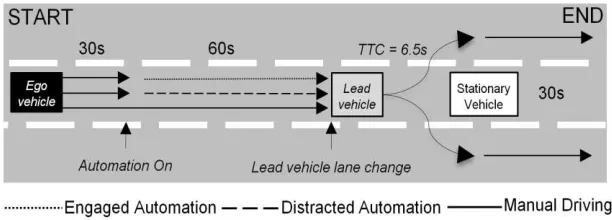
In the experimental session, drivers initiated a trial by depressing the accelerator pedal. All trials began in manual driving behind a lead vehicle travelling in the middle lane at 67mph (108km/h). As shown in Figure 2, after 30 seconds of manual driving, one of three 60 second conditions was presented in a counterbalanced order: In the manual condition, drivers had full manual control of the vehicle. In the engaged automation condition, participants took their hands away from the steering wheel and foot off the accelerator pedal while the automation was active but observed the driving scene throughout. In the distracted automation condition, however, drivers were asked to read aloud a selection of text that was displayed on an iPad located at the bottom left of the steering wheel (Figure 1). The objective of engaged automation was to disengage the driver from the driving task by removing sensory motor control, and more so for distracted automation, which also limits information processing control.
[image:4.612.289.534.172.323.2]After this 60 second period, the lead vehicle changed lane (to the right or left) to reveal a stationary vehicle obstructing the middle lane. Participants were instructed to change lane to avoid colliding with this stranded vehicle. The manoeuvre of the lead vehicle coincided with the deactivation of
Figure 1. Driving simulator set-up. The central display unit (inset) indicated automation status. A ‘beep' tone alerted drivers to changes in automation status
[image:4.612.245.551.587.697.2]4
automation. Drivers were notified of changes to automation state with a non-intrusive ‘beep’ tone. Four ‘ghost’ trials were also randomly assigned during the experiment, where there was no stranded vehicle in the middle lane.
To induce different loads after the lead vehicle changed lanes, drivers' lane-changing manoeuvre was governed by one of three differentially challenging rules. In the no rule condition,
participants were free to choose the direction of travel to avoid a collision with the stranded vehicle. This only entailed a control element and was therefore considered an operational-level driving task (Michon, 1985). In the congruous and incongruous rule conditions, participants were required to change lane in a particular direction, depending on the colour of the stationary vehicle (green = left, red = right). These were therefore considered to be tactical-level driving tasks. In the congruous rule condition, the direction in which the lead vehicle changed lane was the same as the direction instructed by the rule, while in the incongruous rule condition the opposite was true (Figure 3). After passing the stranded vehicle, manual driving continued for a further 30 seconds, after which the driving scene faded out and the trial was over. The next trial then began as soon as drivers depressed the accelerator pedal. All participants completed the trials involving the no rule condition first, followed by those involving the two rule conditions. This was to ensure that the rules for the congruous and incongruous rule conditions did not confuse participants during the no rule condition. Based on
estimations of future sensor ranges, and results from previous studies (Gold and Bengler, 2014; Damböck et al., 2012) the Time To Collision (TTC) between the stationary vehicle and the simulator vehicle was 6.5 seconds. In order to control for TTC in manual driving, drivers were required to maintain a set headway of 42m, using chevron markings on the
roadway as a guide. Participants completed 13 trials in total and the time taken to complete the experiment was around 1.5 hours.
A number of dependent variables were used to study performance; maximum lateral and longitudinal acceleration, time to first steer and time to lane change. A distribution of how drivers reacted to avoid the collision: steering, braking, steering and braking, was also noted. Measures of maximum lateral and longitudinal acceleration were taken from when the stationary vehicle was revealed, until the end of the trial, and were used as indicators of stability of control. Time to first steer considered the time from when the stationary vehicle was revealed, until the first steering input greater than2º was applied. Time to lane change refers to the time from when the stationary vehicle was revealed until all four corners of a driver’s vehicle were in an adjacent lane.
RESULTS AND DISCUSSION
A 3x3 repeated measures Analysis of Variance (ANOVA) was conducted on maximum lateral and longitudinal acceleration comparing the values in the three Drives (manual, engaged
automation and distracted automation) and at the three Load levels (no rule, congruous rule and incongruous rule). Results showed a significant main effect of Drive on maximum lateral
5
Table 1. Brake and Steer combinations for Drive
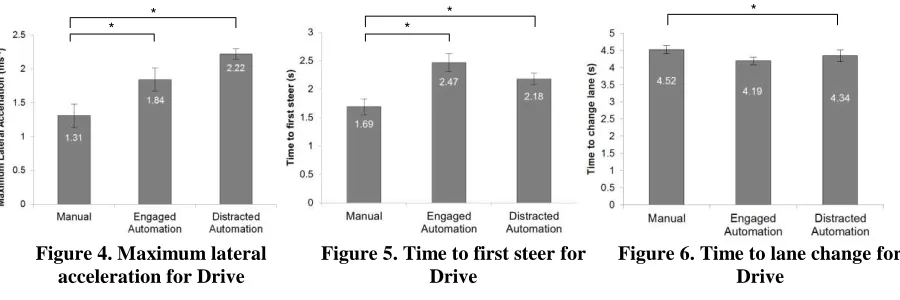
[image:6.612.77.527.156.306.2]higher maximum lateral accelerations for both engaged automation and distracted automation drives, compared to the manual drive (p=.008 and p<.001, respectively). Vehicle control, as revealed by lateral acceleration, was, therefore, more aggressive the further drivers were out-of-the-loop. Comparison between automation drives was not significant. There were no main effects of maximum longitudinal acceleration and also no interaction effects.
Figure 4. Maximum lateral acceleration for Drive
Figure 5. Time to first steer for Drive
Figure 6. Time to lane change for Drive
(Error bars = SE, * = significant interaction)
To observe how drivers responded to a potential collision, time to first steer and time to lane change were subjected to a 3x3 ANOVA, with the same factors as above. There was a significant effect of Drive on time to first steer [F(2,14) =9.98, p=.001, 2= .39; Figure 5] with post-hoc Bonferroni tests showing that, compared to manual driving, drivers took significantly longer to generate their first steering manoeuvre during both engaged automation (p=.002) and distracted automation (p=.037). There was no significant effect of Load and there was also no interaction effect present between Drive and Load on time to first steer.
The effect of Drive on time to lane change approached significance [F(2,14) =3.60, p=.058, 2= .19; Figure 6]. There was no significant effect of Load on time to lane change and no interaction
between Drive and Load. Taken together, these results suggest that, regardless of whether they were distracted or not, automation delayed drivers’ first control input. However, when observing the scene during automation, drivers’ response to the collision seems to have been more
calculated and more under their control, taking time to steer to the adjacent lane, with less lateral acceleration. When engaged in the reading task, drivers seem to have simply responded to the beep denoting the disengagement of automation, changing lane quickly and more erratically, as indicated by their maximum lateral deviation.
This difference in tactic between engaged and distracted automation is also shown in the steering and braking behaviour (Table 1), where similar results were seen between distracted automation and manual driving, different to that of engaged automation. Whilst in 71 and 73% of cases in the manual and distracted automation drives participants avoided the obstacle by only steering into the next lane, for engaged automation the proportion of cases where participants steered increased to 81.28%. Chi-square tests revealed that these differences were not significant, however. There were no collisions with the stationary vehicle across all trials.
Manual Engaged
Automation
Distracted Automation
Steer Only 72.9% 81.25% 70.8%
Steer and Brake 27.1% 18.75% 29.2%
* * *
6
In terms of decision-making behaviour based on the condition rules, for the no rule condition, in 95.8%% of cases drivers chose to follow the lead vehicle to avoid a collision, in line with similar findings by Malaterre et al. (1988). Drivers managed to adhere to the rule in 100% and 98% of cases for the congruent and incongruent rule conditions, respectively.
CONCLUSIONS
There has been a great deal of interest regarding how to safely re-engage drivers in manual driving following a period of HAD (Merat et al., 2014), with the out-of-the-loop phenomenon cited as a primary contributor to impaired performance. The main objective of the current study was to investigate the behavioural differences that might exist between different levels of engagement with a driving task, and whether and to what extent these interact with operational and tactical-level driving tasks (Michon, 1985).
Apart from drivers braking less often in the engaged automation than in distracted automation and manual conditions, which showed similar response profiles, our results showed that there was no difference between the manual and engaged automation conditions, across all variables. Though, since the trials were rather stereotypical, it is likely that, with repeated exposure, drivers increasingly learned how to deal with the critical events. However, as found in previous studies (Merat et al., 2012), compared to manual driving, drivers’ response was significantly slower following brief 1-minute periods of automated driving, even during engaged automation, where drivers were focused on the road scene immediately prior to the critical event. In addition, automation seems also to have impacted on the speed and quality of lane changes, with lane changes completed at a faster rate once initiated, and also with significantly higher maximal lateral accelerations for both automation conditions, compared to manual. This demonstrates that the key factor affecting the response is whether the driver is actively engaged in vehicle control (i.e., an active part of the sensory-motor control loop).
The OOTL concept seems, therefore, to encompass a strong element of physical control, with the effects of cognitive control possibly a more subtle addition. Certainly, the possible priming of the repeated-measures design suggests that any observed effects of being out of the cognitive control loop are conservative and, therefore, deserve more focused investigation. To assist in this, future studies on HAD making reference to the OOTL phenomenon should attempt to distinguish which loop is being addressed. Our results show that what is most important is whether the driver is in vehicle control and that this aspect should form the basis for any strategies to re-engage the driver in manual control. Nevertheless, humans are poor supervisors (Parasuraman & Riley, 2007) and therefore aspects of information processing control in HAD needs to be
7 REFERENCES
Carsten, O., Lai, F. C. H., Barnard, Y., Jamson, A. H. & Merat, N. (2012). Control task substitution in semi-automated driving: Does it matter what aspects are automated? Human Factors, 54, 747–761.
Damböck, D., Farid, M., Tönert, L. & Bengler, K. (2012). Übernahmezeiten beim
hochautomatisierten Fahren. Paper presented at 5. Tagung Fahrerassistenz, Munchen.
de Waard, D., Van der Hulst, M., Hoedemaeker, M. & Brookhuis, K. A. (1999). Driver behavior in an emergency situation in the Automated Highway System. Transportation Human
Factors, 1, 67–82.
Endsley, M.R. & Kiris, O.E. (1995). The out-of-the-loop performance problem and the level of control in automation. Human Factors, 37, 381–394.
Gold, C. & Bengler, K. (2014). Taking Over Control from Highly Automated Vehicles.
Proceedings of the 5th International Conference on Applied Human Factors and Ergonomics AHFE 2014, Kraków, Poland 19-23 July.
Jacoby, C. C. & Schuster, S. K. (1997). Issues of automated vehicles operating in mixed traffic. In IEEE Conference on Intelligent Transportation System 1997 (pp. 607–612). Boston, MA.
Jamson, A. H., Merat, N., Carsten, O. M. J. & Lai, F. C. H. (2013). Behavioural changes in drivers experiencing highly-automated vehicle control in varying traffic conditions. Transportation Research Part C: Emerging Technologies, 116–125.
Kircher, K., Larsson, A. & Hultgren, J. A. (2014). Tactical Driving Behavior With Different Levels of Automation. IEEE Transactions on Intelligent Transportation Systems, 15(1), 158– 167.
Malaterre, B., Ferrandez, F., Fleury, D., & Lechner, D. (1988). Decision Making in Emergency Situations. Ergonomics, 3 1(4), 643-655.
Merat, N., Jamson, A. H., Lai, F. F. C. H., Daly, M. & Carsten, O. M. J. (2014). Transition to manual: Driver behaviour when resuming control from a highly automated vehicle.
Transportation Research Part F: Traffic Psychology and Behaviour, 26, 1–9.
Merat, N., Jamson, H., Lai, F., & Carsten, O. (2012). Highly automated driving, secondary task performance and driver state. Human Factors, 54, 762–771.
Merat, N. & Lee, J. D. (2012). Preface to the special section on human factors and automation in vehicles designing highly automated vehicles with the driver in mind. Human Factors: The Journal of the Human Factors and Ergonomics Society, 54, 681–686.
Michon, J. A. (1985). “A critical view of driver behavior models: What do we know, what should we do?” In L. Evans and R. Schwing (Eds.), Human Behavior and Traffic Safety. New York, NY, USA: Plenum Press.
Parasuraman, R. & Riley, V. (1997). Humans and automation: Use, misuse, disuse, abuse. Human Factors, 39, 230–253.