This is a repository copy of
Secure D2D Communication in Large-Scale Cognitive Cellular
Networks with Wireless Power Transfer
.
White Rose Research Online URL for this paper:
http://eprints.whiterose.ac.uk/106831/
Version: Accepted Version
Proceedings Paper:
Liu, Y, Wang, L, Zaidi, SAR et al. (2 more authors) (2015) Secure D2D Communication in
Large-Scale Cognitive Cellular Networks with Wireless Power Transfer. In: ICC 2015 -
2015 IEEE International Conference on Communications. ICC 2015 - 2015 IEEE
International Conference on Communications, 08-12 Jun 2015, ExCel London, UK. IEEE ,
pp. 4309-4314. ISBN 9781467364324
https://doi.org/10.1109/ICC.2015.7249000
(c) 2015 IEEE. Personal use of this material is permitted. Permission from IEEE must be
obtained for all other users, including reprinting/ republishing this material for advertising or
promotional purposes, creating new collective works for resale or redistribution to servers
or lists, or reuse of any copyrighted components of this work in other works.
[email protected] https://eprints.whiterose.ac.uk/
Reuse
Unless indicated otherwise, fulltext items are protected by copyright with all rights reserved. The copyright exception in section 29 of the Copyright, Designs and Patents Act 1988 allows the making of a single copy solely for the purpose of non-commercial research or private study within the limits of fair dealing. The publisher or other rights-holder may allow further reproduction and re-use of this version - refer to the White Rose Research Online record for this item. Where records identify the publisher as the copyright holder, users can verify any specific terms of use on the publisher’s website.
Takedown
If you consider content in White Rose Research Online to be in breach of UK law, please notify us by
Secure D2D Communication in Large-Scale
Cognitive Cellular Networks with Wireless Power
Transfer
Yuanwei Liu
∗, Lifeng Wang
∗, Syed Ali Raza Zaidi
†, Maged Elkashlan
∗, and Trung Q. Duong
‡ ∗ Queen Mary University of London, London, UK† University of Leeds, Leeds, UK ‡ Queen’s University Belfast, Belfast, UK
Abstract—In this paper, we investigate secure device-to-device (D2D) communication in energy harvesting large-scale cognitive cellular networks. The energy constrained D2D transmitter harvests energy from multi-antenna equipped power beacons (PBs), and communicates with the corresponding receiver using the spectrum of the cellular base stations (BSs). We introduce a power transfer model and an information signal model to enable wireless energy harvesting and secure information transmission. In the power transfer model, we propose a new power transfer policy, namely, best power beacon (BPB) power transfer. To characterize the power transfer reliability of the proposed policy, we derive new closed-form expressions for the exact power outage probability and the asymptotic power outage probability with large antenna arrays at PBs. In the information signal model, we present a new comparative framework with two receiver selection schemes: 1) best receiver selection (BRS), and 2) nearest receiver selection (NRS). To assess the secrecy performance, we derive new expressions for the secrecy throughput considering the two receiver selection schemes using the BPB power transfer policies. We show that secrecy performance improves with increasing densities of PBs and D2D receivers because of a larger multiuser diversity gain. A pivotal conclusion is reached that BRS achieves better secrecy performance than NRS but demands more instantaneous feedback and overhead.
I. INTRODUCTION
Wireless power transfer (WPT) has recently received signif-icant attention for its attractive energy harvesting capabilities and prolonging the life-time of the wireless network [1]. The motivation behind it is the most devices surrounded by the ambient radio-frequency (RF) signals which can carry energy and information together during transmission. Two practical receiver designs namely time switching (TS) receiver and power splitting (PS) receiver were proposed in a multiple-input multiple-output (MIMO) system in [2], which laid a solid foundation on the research of WPT. In [3], a new concept based on power beacons (PBs) that deploy dedicated power stations to charge the nearby mobile devices with WPT was proposed. In [3], based on stochastic geometry, the uplink performance in cellular networks was investigated under an outage constraint.
Along with improving the energy efficiency through energy harvesting [4], another key design objective is to maximize the spectral efficiency. Cognitive radio (CR) [5] and device-to-device (D2D) technology [6], have rekindled the interest of researchers to achieve a more spectrally efficient cellular
networks. In [7], a wireless power transfer protocol for a two-hop decode-and-forward relay system is proposed in a cognitive radio network. In [8], D2D communication in en-ergy harvesting CR networks was proposed using stochastic geometry.
Furthermore, it is currently noted that CR networks are also confronted with security issues since the broadcast nature of the wireless medium is susceptible to potential security threats such as eavesdropping and impersonation. Physical (PHY) layer security, which is initialed by Wyner [9] and recently aroused wide-spread interest, has been considered in CR networks [10]. In [11], the authors revealed the impact of the primary network on the secondary network in the presence of a multi-antenna wiretap channel and presented closed-form expressions for the exact and the asymptotic secrecy outage probability in cognitive secure communications.
In this paper, we consider secure communication underlay cognitive cellular networks with an energy constrained D2D transmitter. A statistical model based on stochastic geometry is used to describe and evaluate the proposed D2D com-munication in energy harvesting large-scale cognitive cellular networks. Differing from [3] which neglects the small-scale fading and requires energy storage units at the mobile termi-nals, we deploy a battery-free design [12, 13] for the energy constrained D2D transmitter. Considering the impact of small-scale fading, we propose a new WPT policy, namely, best power beacon (BPB) power transfer, where the transmitter selects the PB with the strongest channel to harvest the energy. We also present a new comparative framework with the best receiver selection (BRS) and the nearest receiver selection (NRS) schemes. For the proposed BPB, we derive a new closed-form expression for the power outage probability. We also derive new analytical expressions for the secrecy throughput with BRS and NRS. Our analytical and numerical results show that BRS achieves higher secrecy throughput than NRS at the cost of more instantaneous feedback and overhead.
II. NETWORKMODEL A. Network Description
0
20
40
60
80
100
0
20
10
30
50
40
70
60
80
100
90
X (meters)
Y
(m
e
te
rs
)
[image:3.612.55.301.63.268.2]Alice
Fig. 1. An example of a part of a network snapshot considering that the spatial distributions of PBs (pink diamonds), Bobs (empty circles), BSs (blue five-pointed stars), and Eves (red stars) follow homogeneous poisson point processes (PPP).
malicious attempt of D2D eavesdroppers (Eves). The eaves-droppers are passive and interpret the signal without trying to modify it. It is assumed that Alice is energy constrained, i.e., the transmission can only be scheduled by utilizing power harvested from PBs. The spatial topology of all PBs, cellular base stations (BSs), Bobs, and Eves, are modeled using homogeneous poisson point process (PPP) Φp, Φℓ, Φb, and Φe with density λp, λℓ, λb, and λe, respectively. As shown in Fig. 1, we consider that Alice is located at the origin in a two-dimensional plane. For Alice, Bob, and Eve, each node is equipped with a single antenna. Each PB is furnished withM
antennas and maximal ratio transmission (MRT) is employed at PBs to perform WPT to the energy constrained Alice. All channels are assumed to be quasi-static fading channels where the channel coefficients are constant for each transmission block but vary independently between different blocks. In this network, we assume that the time of each frame is T, which includes two time slots: 1) power transfer time slot, in which Alice harvests the power from PBs during the(1−β)T
time, with β being the fraction of the information processing time; and 2) information processing time slot, in which Alice transmits the information signal to the corresponding Bob using the harvested energy during theβT time.
B. Power Transfer Model
We consider a simple yet efficient power transfer model. It is assumed that PBs operate on a frequency band which is isolated from the communication band where BSs and D2D transceivers schedule their transmission. Specifically, the power transmitted by PBs does not interfere with the cellular and D2D communication. We also consider that Alice is a battery-free user, which means that there is no battery storage
energy for future use and all the harvested energy during the power transfer time slot is used to transmit the information signal [12, 13].
We propose a new best power beacon (BPB) power transfer policy in the power transfer model, where Alice selects the strongest PB to harvest energy. The harvested energy of Alice from the PB can be obtained as follows
EH=ηPSmax p∈Φp
{
∥hp∥2L(rp)
}
(1−β)T, (1)
whereηis the power conversion efficiency of the receiver,PS is the transmit power of PBs. Here,hpisCM×1vector, whose entries are independent complex Gaussian distributed with zero mean and unit variance employed to capture the effect of small-scale fading between PBs and Alice.L(rp) =Krp−α is the power-law path-loss exponent. The path-loss function depends on the distance rp, a frequency dependent constant
K, and an environment/terrain dependent path-loss exponent
α≥2. All the channel gains are assumed to be independent and identically distributed (i.i.d.). Based on (1), the maximum transmit power at Alice is given by
PH= max p∈Φp
{
∥hp∥2L(rp)
}ηPS(1−β)
β . (2)
C. Information Signal Model
We consider the cognitive underlay scheme [14], and as-sume that the instantaneous CSI of the links between Alice and cellular BSs are available at Alice. Consequently, the transmit power PA at Alice is strictly constrained by the maximum transmit power Pt at Alice and the peak interference power
Ip at cellular BSs according to
PA= min
Ip
max ℓ∈Φℓ
{
|hℓ|2L(rℓ)
}, Pt
, (3)
where |hℓ|2L(rℓ) is the overall channel gain from Alice to the BS ℓ. Here,hℓ is the small-scale fading coefficient with
hℓ ∼ CN(0,1) and L(rℓ) = Kr−ℓα is the power-law path-loss exponent. The path-path-loss function depends on the distance
rℓ. All the channel gains are assumed to be i.i.d.. For D2D communication, we consider two receiver selection schemes.
1) Best Receiver Selection (BRS) scheme: Under BRS, Alice selects one Bob with the strongest channel as the desired receiver. The instantaneous signal-to-noise ratio (SNR) at the selected Bob is expressed as
γB =
PA
N0
max b∈Φb
{
|hb|2L(rb)
}
=ζmax b∈Φb
{
|hb|
2
L(rb)
}
, (4)
whereζ= min
{ ¯
γp
max
ℓ∈Φℓ{|hℓ| 2L(r
ℓ)},¯γ0
}
,N0is the noise power,
¯
2) Nearest Receiver Selection (NRS) scheme: Under NRS, Alice selects the nearest Bob as the desired receiver. The advantage of this scheme is that it reduces the system com-plexity since no instantaneous CSI and feedback from Bobs are required. Then the instantaneous SNR at the selected Bob can be expressed as
γB∗ =
PA
N0|
hb∗|2max
b∈Φb
L(rb)
=ζ|hb∗|2max
b∈Φb
L(rb), (5)
wherehb∗ is the small-scale fading coefficient of Alice to the
nearest Bob with hb∗ ∼ CN(0,1).
For the eavesdroppers, the instantaneous SNR at the most detrimental eavesdropper that has the strongest SNR between itself and Alice is expressed as
γE=
PA
N0 maxe∈Φe
{
|he|2L(re)
}
=ζmax e∈Φe
{
|he|2L(re)
}
, (6)
where he ∼ CN(0,1), re is the distance between Alice and Eves.
III. POWEROUTAGEPROBABILITY
We assume there exists a threshold transmit powerPt, below
which the transmission cannot be scheduled, the transmission cannot be scheduled and Alice is considered to be in a power limited regime. In order to characterize the power limited regime of Alice, we introduce power outage probability, i.e., probability that the harvested power is not sufficient to carry out the transmission at a certain desired quality-of-service (QoS) level. The objective of this section is to quantify the power outage probability using BPB policy. In practical scenario, we expect a constant power for the information trans-mission. Therefore, we also denote the power threshold Pt
as the transmit power of Alice when performing information transmission to Bobs.
A. Exact Analysis for Power Transfer
In this subsection, we provide exact analysis for the pro-posed BPB power transfer policy. In this policy, only the PB with the strongest channel transfers power to Alice.
Theorem 1: The power outage probability of BPB policy can be expressed in closed-form as
Hout =e
−λpπδ µδ
M∑−1
m=0( Γ(m+δ)
m! )
, (7)
whereµ= βPt
ηPSK(1−β),δ= 2/α, andΓ(.)is Gamma function. Proof:Based on (2), the power outage probability of BPB
policy can be expressed as
Pr{PH≤Pt}= Pr {
max p∈Φp
{
∥hp∥
2
rp−α
}
≤µ
}
=EΦp
∏
p∈Φp
Pr{∥hp∥2≤rpαµ
}
=EΦp
∏
p∈Φp
F∥hp∥2(rp αµ)
, (8)
whereF∥hp∥2 is the CDF of ∥hp∥
2
and is expressed as
F∥hp∥2(x) = 1−e
−x
(M−1 ∑
m=0
xm
m!
)
. (9)
Applying the generating functional given by [15], we rewrite (8) as
Hout = exp
[
−λp
∫
R2
(
1−F∥hp∥2(rp
αµ))dr p
]
. (10)
Then changing to polar coordinates and substituting (9) into (10), the power outage probability of BPB is given by
Hout= exp
[
−2πλp
M−1 ∑
m=0
µm∫∞
0 rp
mα+1e−rpαµdr p
m!
]
.
(11)
Then applying [16, Eq. (3.326.2)] and calculating the integral in (11), we obtain the closed form expression in (7).
B. large antenna array analysis for Power Transfer
In this subsection, we present large antenna array analysis for power transfer. We first examine the distribution of∥hp∥2 when M → ∞. Since ∥hp∥2 is i.i.d. exponential random variables (RVs), using law of large numbers, we have
∥hp∥2 a.s.
→M, (12)
wherea.s.→ denotes the almost sure convergence.
Theorem 2: The power outage probability of large antenna array analysis for the BPB power transfer policy is given by
Houtlarge=e
−λpπ
θδ , (13)
whereθ= βPt
M ηPSK(1−β).
Proof: The power outage probability of BPB for large antenna arrays analysis can be expressed as
Houtlarge= Pr{PH ≤Pt}= 1−Frp∗ (
1 α
√ θ
)
, (14)
whereFrp∗ is the cumulative distribution function (CDF) of
rp∗ and can be expressed as
Frp∗(x) = ∫ x
0
f(rp∗)drp∗ = 1−e−λpπx
2
, (15)
where rp∗ representing the distance from the nearest PB to
Alice and its probability density function (PDF) is given by
f(rp∗) = 2λpπrp∗e−λpπr
2
p∗
.
IV. SECRECYTHROUGHPUT
In this section, a comparative framework is presented with two receiver selection schemes, namely, best receiver selection scheme and nearest receiver selection scheme. We use secrecy throughput as a metric to characterize the secrecy performance.
A. New Statistics
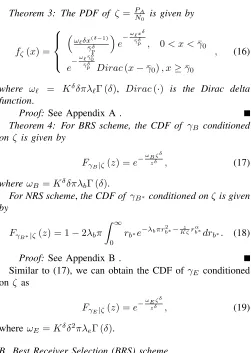
Theorem 3: The PDF of ζ=PA
N0 is given by
fζ(x) =
(
ωℓδx(δ
−1)
¯
γδ p
)
e−
ωℓxδ
¯
γδp , 0< x <¯γ
0
e−
ωℓ¯γδ0
¯
γδp
Dirac(x−γ¯0), x≥¯γ0
, (16)
where ωℓ = KδδπλℓΓ (δ), Dirac(·) is the Dirac delta
function.
Proof: See Appendix A .
Theorem 4: For BRS scheme, the CDF of γB conditioned
on ζis given by
FγB|ζ(z) =e
−ωB ζδ
zδ , (17)
where ωB=KδδπλbΓ (δ).
For NRS scheme,the CDF of γB∗ conditioned onζis given
by
FγB∗|ζ(z) = 1−2λbπ ∫ ∞
0
rb∗e−λbπr
2
b∗−Kζz rαb∗
drb∗. (18)
Proof: See Appendix B .
Similar to (17), we can obtain the CDF ofγE conditioned on ζas
FγE|ζ(z) =e
−ωE ζδ
zδ , (19)
whereωE =Kδδ2πλeΓ (δ).
B. Best Receiver Selection (BRS) scheme
In this scheme, the instantaneous secrecy rate is defined as
CsBRS= [log2(1 +γB)−log2(1 +γE)]+, (20)
where[x]+= max
{x,0}.
The secrecy throughput is the average of the instantaneous secrecy rate CsBRS over γB and γE. As such, the secrecy throughput using BPB power transfer policy is given by
¯
CBRS
s = (1−Hout)
β
ln 2
∫ ∞
0 ∫ ∞
0
FγE|ζ(x2) 1 +x2
×(1−FγB|ζ(x2)
)
fζ(x1)dx2dx1. (21)
where FγB and FγE can be obtained in (17) and (19), separately, Hout is the power outage probability in the power transfer model.
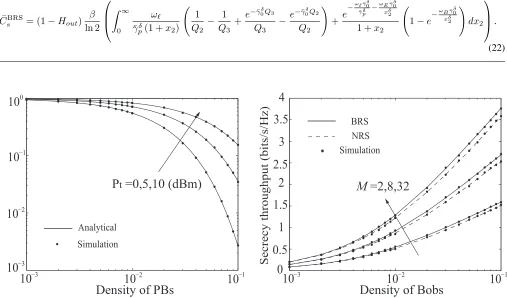
Substituting (16), (17), and (19) into (21), after some manip-ulation, the secrecy throughput is derived as (22) on the top of next page, whereQ2= ωxEδ
2 +
ωℓ
¯
γδ
p andQ3=
(
ωB xδ
2 +
ωE xδ
2 +
ωℓ
¯
γδ p
)
.
C. Nearest Receiver Selection (NRS) Scheme
In this scheme, the instantaneous secrecy rate is defined as
CsNRS= [log2(1 +γB∗)−log
2(1 +γE)]+. (23) As such, the secrecy throughput is given by
¯
CsNRS= (1−Hout)
β
ln 2
∫ ∞
0 ∫ ∞
0
FγE|ζ(x2) 1 +x2
×(1−FγB∗|ζ(x2) )
fζ(x1)dx2dx1. (24)
Substituting (16), (18), and (19) into (24), we can obtain the secrecy throughput of NRS scheme.
V. NUMERICALRESULTS
[image:5.612.50.301.143.496.2]In this section, representative numerical results are pre-sented to illustrate performance evaluations including power outage probability secrecy throughput for BPB power transfer policy in the power transfer model and two receiver selection schemes in the information signal model. In the considered network, we set the transmit power of PBs as PS = 43 dBm. The carrier frequency for power transfer and information transmission is set as 800 MHz and 900 MHz respectively. Furthermore, the bandwidth of the information transmission signal is assumed to be 10 MHz and the information receiver noise is assumed to be white Gaussian noise with average power -55dBm. In addition, we assume that the energy con-version efficiency of WPT isη = 0.8. In each figure, we see precise agreement between the Monte Carlo simulation points marked as “•” and the analytical curves, which validates our derivation.
Fig. 2 plots the power outage probability versus density of PBs with different power threshold Pt. The black solid
curve, representing the BPB policy, is obtained from (7). We observe that as density of PBs increases, the power outage probability dramatically decreases. This is because the multiuser diversity gain is improved with increasing number of PBs when charging with WPT. We also see that as the power threshold increases, the outage occurs more frequently.
Fig. 3 plots the power outage probability versus M of PBs using the exact analysis and the large antenna array analysis. The dashed curve, representing the large antenna array analysis of BPB is obtained from (13). We see that the power outage probability decreases with increasingM. This is because larger antenna array gain is achieved with increasing
M. AsM increases, the large antenna array analysis and the exact analysis have precise agreement. This is due to the fact that when M grows large, the effect of small-scale fading is averaged out.
¯
CBRS
s = (1−Hout)
β
ln 2
∫ ∞
0
ωℓ ¯
γδ
p(1 +x2) (
1
Q2 −
1
Q3
+e
−γ¯0δQ3
Q3 −
e−¯γ0δQ2 Q2
)
+e
−ωℓγδ¯0 ¯
γδp − ωE¯γδ0
xδ2 1 +x2
(
1−e−
ωB¯γδ0 xδ2
)
dx2
.
(22)
Density of PBs
10
−1
10
−210
−310
−310
−210
−110
0P
t=0,5,10 (dBm)
[image:6.612.58.565.61.359.2]Simulation Analytical
Fig. 2. Power outage probability versus density of PBs withM = 32, PS= 43dBm,Pt= 10dBm, andβ= 0.5.
P
ow
er out
age
proba
bi
li
ty
10−1 100
10−2
0 50 100 150
M
10−0.2
10−0.3
5 4 3 2
Exact analytical
Large analytical
Large simulation
Fig. 3. Power outage probability versusMfor large antenna array analysis withPS= 43dBm,Pt= 10dBm, andβ= 0.5.
probability is achieved with larger antenna array gain, which results in improving secrecy throughput; and 3) BRS achieves better secrecy performance than NRS but demands more instantaneous feedbacks and overheads.
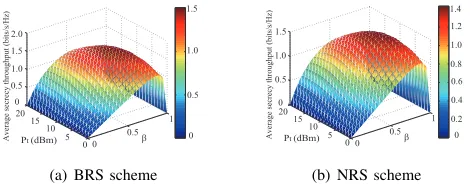
Fig. 5 shows the secrecy throughput versus Pt and β for
BRS and NRS schemes using BPB power transfer policy.
Density of Bobs
10
−1
10
−210
−30.5
1
0
1.5
2
2.5
3
3.5
4
S
e
c
re
c
y t
hroughput
(bi
ts
/s
/H
z
)
M
=2,8,32
BRS
[image:6.612.51.300.410.598.2]Simulation NRS
Fig. 4. Secrecy throughput versus density of Bobsλb with differentM, wherePS= 43dBm,Pt = 10dBm,β= 0.5,λp= 10−1, λe = 10−3,
andλl= 10−3.
We see that β and Pt have joint effects on the secrecy
throughput. By jointly consideringβ andPt, we observe that
there exits an optimal value for each of these two receiver selection schemes. This behavior is explained as follows: 1) as β increases, the time for power transfer decreases and the transmitter receives less power, but the time for information transmission increases; and 2) on the one hand, the power outage probability increases with increasing power threshold. On the other hand, the transmit power of Alice also increases since the power threshold is the transmit power of Alice, which results in a lower power outage probability. As such, there exits a tradeoff between the power outage probability and the transmit power. In this case, it is of significance to select a suitable Pt and β to transmit information to maximize the
secrecy throughput. These results provide us guidelines when proceeding the system parameters in the networks.
VI. CONCLUSIONS
β 0 0.5 1 0 5 10 15 20 Pt (dBm) A ve ra ge s ec re cy t hroughput (bi ts /s /Hz ) 0 0.5 1.0 1.5 2.0 1.5 1.0 0 0.5
(a) BRS scheme
0 0.5 1.0 1.5 0 5 10 15 20
Pt (dBm)
A ve ra ge s ec re cy t hroughput (bi ts /s /H z) β 0 0.5 1 1.4 1.2 1.0 0.8 0.6 0.4 0.2 0
[image:7.612.57.292.62.154.2](b) NRS scheme Fig. 5. Secrecy throughput of BRS and NRS versusβand power threshold Pt, withM = 32,PS= 43dBm,λp= 10−1, λb = 10−2, λe= 10−3,
andλl= 10−3.
approach to provide a complete framework to model, analyze, and evaluate the performance of the proposed network. New analytical expressions in terms of power outage probability and secrecy throughput are derived to determine the system security performance. Numerical results were presented to verify our analysis and provide useful insights into practical design. We concluded that by carefully setting the network design parameters, along with wireless power transfer, an acceptable secure transmission can be achieved in device-to-device networks without affecting the base stations.
APPENDIXA: PROOF OFTHEOREM3 We compute the CDF ofζ as follows:
Fζ(x) = Pr{ζ≤x}
= Pr min ¯ γp max ℓ∈Φℓ
{
|hℓ|2L(rℓ)
},γ¯0 ≤x = Pr { max ℓ∈Φℓ
{
|hℓ|2L(rℓ)
} ≥max { ¯ γp x, ¯ γp ¯ γ0 }} + Pr { max ℓ∈Φℓ
{
|hℓ|2L(rℓ)
}
≤ γγ¯¯p
0
,γ¯0≤x } =
1,¯γ0≤x
Pr
{
max ℓ∈Φℓ
{
|hℓ|2L(rℓ)
}
≥γ¯xp
}
| {z }
Gℓ
,¯γ0> x . (A.1)
Following the similar procedure getting (7), we obtain Gℓ as
Gℓ= 1−e
−Kδ δπλℓΓ(δ)xδ
¯
γδp .
(A.2)
Substituting (A.2) into (A.1), we obtain
Fζ(x) =
{ 1,γ¯ 0≤x
1−e−
Kδ δπλℓΓ(δ)xδ
¯
γδp ,γ¯
0> x
=1−U (¯γ0−x)e
−Kδ δπλℓΓ(δ)xδ
¯
γδp
, (A.3)
whereU (x)is the unit step function asU (x) =
{
1, x >0 0, x≤0 . By taking the derivative ofFζ(x)in (A.3), we obtain the PDF of ζ in (16).
APPENDIXB: PROOF OFTHEOREM4 The CDF ofγB conditioned onζis given by
FγB|ζ(z) = Pr{γB ≤z}= Pr
{
max b∈Φb
{
|hb|2L(rb)
}
ζ≤z
}
.
(B.1) Following the similar procedure getting (A.2), we obtain (17).
The CDF ofγB∗ conditioned onζ is given by
FγB∗|ζ(z) = Pr{γB∗ ≤z}= Pr {
|hb|2≤
rα b∗z
Kζ } = ∫ ∞ 0 (
1−e−
rαb∗z
Kζ
)
f(rb∗)drb∗
= 1−2λbπ
∫ ∞
0
rb∗e−λbπr
2
b∗−Kζz rαb∗
drb∗, (B.2)
whererb∗represents the distance form the nearest Bob to Alice
with the PDF given byf(rb∗) = 2λbπrb∗e−λbπr
2
b∗
. Thus, we can obtain (18).
REFERENCES
[1] T. Le, K. Mayaram, and T. Fiez, “Efficient far-field radio frequency energy harvesting for passively powered sensor networks,” IEEE J.
Solid-State Circuits, vol. 43, no. 5, pp. 1287–1302, 2008.
[2] R. Zhang and C. K. Ho, “MIMO broadcasting for simultaneous wireless information and power transfer,”IEEE Trans. Commun., vol. 12, no. 5, pp. 1989–2001, 2013.
[3] K. Huang and V. Lau, “Enabling wireless power transfer in cellular networks: architecture, modeling and deployment,”IEEE Trans. Wireless
Commun., vol. 13, no. 2, pp. 902–912, 2014.
[4] D. Liu, Y. Chen, K. K. Chai, and T. Zhang, “Optimal user association for delay-power tradeoffs in hetnets with hybrid energy sources,”In Proc. IEEE 25th Annual International Symposium on Personal, Indoor, and
Mobile Radio Communications (PIMRC), Washington, DC, USA 2014.
[5] A. Goldsmith, S. A. Jafar, I. Maric, and S. Srinivasa, “Breaking spectrum gridlock with cognitive radios: An information theoretic perspective,”
Proceedings of the IEEE, vol. 97, no. 5, pp. 894–914, 2009.
[6] K. Doppler, M. Rinne, C. Wijting, C. B. Ribeiro, and K. Hugl, “Device-to-device communication as an underlay to LTE-advanced networks,”
IEEE Commun. Mag., vol. 47, no. 12, pp. 42–49, 2009.
[7] S. A. Mousavifar, Y. Liu, C. Leung, M. Elkashlan, and T. Q. Duong, “Wireless energy harvesting and spectrum sharing in cognitive radio,”
in in Proc. IEEE Vehicular Technology Conference (VTC Fall), 80th,
2014, pp. 1–5.
[8] A. H. Sakr and E. Hossain, “Cognitive and energy harvesting-based D2D communication in cellular networks: Stochastic geometry modeling and analysis,”http://arxiv.org/abs/1405.2013, 2014.
[9] A. D. Wyner, “The wire-tap channel,”Bell Syst. Tech. J., vol. 54, no. 8, pp. 1355–1387, 1975.
[10] Y. Pei, Y.-C. Liang, L. Zhang, K. C. Teh, and K. H. Li, “Secure communication over MISO cognitive radio channels,” IEEE Trans.
Wireless Commun., vol. 9, no. 4, pp. 1494–1502, 2010.
[11] M. Elkashlan, L. Wang, T. Q. Duong, G. K. Karagiannidis, and A. Nal-lanathan, “On the security of cognitive radio networks,” Accepted by
IEEE Trans. Veh. Technol., 2014.
[12] I. Krikidis, S. Sasaki, S. Timotheou, and Z. Ding, “A low complexity antenna switching for joint wireless information and energy transfer in mimo relay channels,”IEEE Trans. Commun., 2014.
[13] Y. Liu, L. Wang, M. Elkashlan, T. Q. Duong, and A. Nallanathan, “Two-way relaying networks with wireless power transfer: Policies design and throughput analysis,”In Proc. IEEE Global Commun. Conf.
(GLOBECOM), Austin Texas, USA 2014.
[14] S. A. R. Zaidi, D. C. McLernon, and M. Ghogho, “Breaking the area spectral efficiency wall in cognitive underlay networks,” IEEE J. Sel.
Areas Commun., vol. 32, no. 11, 2014.
[15] W. K. D. Stoyan and J. Mecke,Stochastic Geometry and its Applications, 2nd ed. John Wiley and Sons, 1996.
[16] I. S. Gradshteyn and I. M. Ryzhik, Table of Integrals, Series and