UNIVERSITI TEKNIKAL MALAYSIA MELAKA
THE DEVELOPMENT OF SLITTING SHEET METAL
MACHINE FOR WIRE MESH USING TOTAL DESIGN
APPROACH
This document submitted in accordance with requirement of the Universiti Teknikal Malaysia Melaka (UTeM) for the Bachelor Degree of Manufacturing
Engineering (Design) (Hons.)
by
MUHAMMAD AMIR BIN MOHD ROHZAINI B051110239
900521-03-5449
UNIVERSITI TEKNIKAL MALAYSIA MELAKA
BORANG PENGESAHAN STATUS LAPORAN PROJEK SARJANA MUDA
TAJUK: The development of slitting sheet metal machine for wire mesh using Total Design Approach
SESI PENGAJIAN: 2014/2015 Semester 2
Saya MUHAMMAD AMIR BIN MOHD ROHZAINI
mengaku membenarkan Laporan PSM ini disimpan di Perpustakaan Universiti Teknikal Malaysia Melaka (UTeM) dengan syarat-syarat kegunaan seperti berikut:
1. Laporan PSM adalah hak milik Universiti Teknikal Malaysia Melaka dan penulis. 2. Perpustakaan Universiti Teknikal Malaysia Melaka dibenarkan membuat salinan
untuk tujuan pengajian sahaja dengan izin penulis.
3. Perpustakaan dibenarkan membuat salinan laporan PSM ini sebagai bahan pertukaran antara institusi pengajian tinggi.
4. **Sila tandakan ( )
SULIT
TERHAD
TIDAK TERHAD
(Mengandungi maklumat yang berdarjah keselamatan atau kepentingan Malaysia sebagaimana yang termaktub dalam AKTA RAHSIA RASMI 1972)
(Mengandungi maklumat TERHAD yang telah ditentukan oleh organisasi/badan di mana penyelidikan dijalankan)
Alamat Tetap: LOT PTB 2295,
KAMPUNG MEMBUNGA, 18500 MACHANG.KELANTAN
Tarikh: ________________________
Disahkan oleh:
Cop Rasmi:
Tarikh: _______________________
DECLARATION
I hereby, declared this report entitled “The development of slitting sheet metal machine for wire mesh using Total Design Approach” is the results of my own
research except as cited in references.
Signature : ………
APPROVAL
This report is submitted to the Faculty of Manufacturing Engineering of UTeM as a partial fulfillment of the requirements for the degree of Bachelor of Manufacturing Engineering (Design) (Hons.). The member of the supervisory is as follow:
………
i
ABSTRAK
ii
ABSTRACT
iii
DEDICATION
This report is dedicated to my parents, brothers and sisters for their endless love, support and encouragement. I also dedicate this work to my supervisor and friends
iv
ACKNOWLEDGEMENT
First of all, I would like to express my thankfulness to Allah S.W.T the
Almighty because I manage to finish this Final Year Project on time. With full of His
merciful, now I am writing this report of this project.
I also like to state my gratitude to my supervisor for his assistance and
guidance in producing this report and giving me his constructive comments,
guidance, patience and encouragement until the completion of this report. Besides
that, I would like to express my thankfulness to my parents and friends for their
continuous supports and advices in complete the report.
I hope that this project report will fulfill the conditions as requested in Final
Year Project in UTeM.
v
TABLE OF CONTENTS
Abstrak i
Abstract ii
Dedication iii
Acknowledgement iv
Table of contents v
List of Tables xiii
List of Figures xv
List of Abbreviations, Symbols and Nomenclatures xviii
CHAPTER 1: INTRODUCTION 1.1 Background of Project 1
1.2 Problem Statement 2
1.3 Objectives 3
1.4 Scope of project 3
CHAPTER 2:LITERATURE REVIEW 2.1 Introduction 4
2.2 Design method 6
2.3 What is Total Design? 6
2.4 Advantage of apply Total Design 8
2.5 Type of Design Process 8
2.5.1 Pugh Matrix (PM) 9
2.5.1.1 Pugh’s Model 9
2.5.2 Pahl and Beitz’ model 11
2.5.3 Otto and Wood methodology 13
2.5.4 Ulrich and Eppinger Product Design Development 15
vi
2.5.6 Comparison of Design method 18
2.6 Problem Solving Tool 19
2.8.1 Brainstorming 19
2.7 Finite Element Analysis (FEA) 19
2.7.1 Application of FEA and working principle 20
2.8 CES EduPack tools 20
2.9 Failure Mode and Effect Analysis (FMEA) 21
2.9.1 Type of FMEA 21
2.9.1.1 System FMEA 22
2.9.1.2 Design FMEA 22
2.9.1.3 Process FMEA 22
2.9.2 Element in FMEA 22
2.9.2.1 Severity (SEV) 22
2.9.2.2 Occurrence (OCC) 23
2.9.2.3 Detection (DET) 24
2.9.2.4 Risk Priority Number (RPN) 25
2.10 Designs for Manufacturing Assembly (DFMA) 25
2.10.1 Advantages of DFMA 26
2.10.2 Design for Manufacturing (DFM) 26
2.10.3 Design for Assembly (DFA) 26
2.10.4 Boothroyd-Dewhurst method 27
2.10.4.1 Guidelines for Manual Assembly 28
2.10.4.2 Part Handling 28
2.10.4.3 Insertion and Fastening 29
2.11 Slitting Machine 30
2.11.1 History of Slitting Machine 30
2.11.2 The function of Slitting Machine 31
vii
CHAPTER 3:METHODOLOGY
3.1 Introduction 33
3.2 Project planning 33
3.3 Project planning phase 35
3.3.1 Planning phase 35
3.3.1.1 Define the objective 35
3.3.1.2 Problem statement 35
3.3.1.3 Scope of project 36
3.3.1.4 Literature review 36
3.3.1.5 Methodology 36
3.4 Analysis Phase 36
3.3.2 Pugh’s Method flow chart 36
3.3.2.1 Market identification 37
3.3.2.2 Product Design Specification (PDS) 37
3.3.2.3 Criteria selection 38
3.3.2.4 Concept selection 38
3.3.2.5 Select best conceptual design 39
3.3.2.5.1 3D modelling 39
3.3.2.5.2 Detail Design 39
3.3.2.5.3 Detail Drawing 39
3.3.2.5.4 Bill of Materials (BOM) 40
3.3.2.6 Analysis of product 40
3.3.2.7 Final Decision 40
3.3.3 Failure Mode Effect Analysis (FMEA) Flow Chart 41
3.3.3.1 Introduction to FMEA 41
3.3.3.1.1 Item Function 41
3.3.3.1.2 Potential Mode Failure 41
3.3.3.1.3 Potential Effect Failure 41
3.3.3.1.4 Potential Cause Failure 42
3.3.3.1.5 Recommended Action 42
viii
3.3.3.1.7 Action Taken 42
3.3.3.2 Discussion on FMEA solution 42
3.3.3.3 How to apply FMEA method 43
3.3.3.4 FMEA result 43
3.3.4 Design For Manufacturing Assembly (DFMA) flow chart 43
3.3.4.1 Functional analysis 43
3.3.4.2 Manufacturing analysis 44
3.3.4.3 Handling analysis 44
3.3.4.4 Assembly Analysis 44
3.3.4.5 Optimized analysis 44
3.5 Result Phase 45
3.5.1 Results and Discussion 45
3.5.2 Fabrication of product 45
3.6 Preparation Report & Presentation 45
3.6.1 Preparation Report and Presentation Phase 45
CHAPTER 4: DEVELOPMENT OF SLITTING SHEET METAL MACHINE FOR WIRE MESH 4.0 Introduction 46
4.1 Market identification 47
4.2 Conceptual design stage 47
4.3 Concept evaluation or integrated the method of process design 48
4.3.1 Pugh Matrix (Pugh’s Method) 49
4.3.1.1 Proposed concept design of Slitting sheet metal machine 49
4.3.1.1.1 Datum Design 49
4.3.1.1.2 Product description of concept design A 50
4.3.1.1.3 Product description of concept design B 51
4.3.1.1.4 Product description of concept design C 52
4.3.1.2 Method of controlled convergence (Pugh’s Method) 53
ix
4.3.2.1 Failure Mode Effect and Analysis (FMEA) 56 4.3.2.1.1 Suitability of design (Ergonomic Design) 57 4.3.2.1.2 Manufacturing consideration 57
(Assembly operation)
4.3.2.2 Recommended Action and RPN 59 4.3.2.2.1 Risk Priority Numbers (RPN) 59 4.3.2.3 Product Design Specification (PDS) for FMEA designs 59 4.3.2.4 Improvement of part design 60 4.3.2.5 Determine new RPN value 61 4.3.3 Design for Manufacturing Assembly (DFMA) 63 4.3.3.1 Proposed original design of Slitting sheet metal machine 63
4.3.3.1.1 Product description for original design 63 4.3.3.1.2 Product structure and part quantity for original 65
design
4.3.3.1.3 Bill of materials for original design 69 4.3.3.1.4 Part functions and critics for original design 70 4.3.3.1.5 Design for Manufacturing (DFM) analysis for 73
original design
4.3.3.1.6 Design for Assembly (DFA) analysis for original 75 design
4.3.3.2 Proposed redesign of Slitting sheet metal machine 76 4.3.3.2.1 Part eliminations from proposed design 76 4.3.3.2.2 Product description for proposed design 77 4.3.3.2.3 Product structure and part quantity for proposed 79
design
4.3.3.2.4 Bill of materials for proposed design 84 4.3.3.2.5 Part functions and critic for proposed design 85 4.3.3.2.6 Design for Manufacturing (DFM) analysis for 88
proposed design
x
4.4 Concept development 91
4.5 Final design 93
4.6 Fabrication process 94
4.6.1 Flowchart of process fabrication 94 4.6.2 Fabrication process for Slitting sheet metal machine 95
4.7 Summary 103
CHAPTER 5: RESULT AND DISCUSSION
5.1 Introduction 104
5.2 Results 104
5.2.1 Pugh’s method result 104
5.2.1.1 Analysis on design concept C (DC-C) 105 5.2.1.2 Material selection for selection part 106 5.2.1.3 Finite Element Analysis (FEA) by using SolidWorks 107
Simulation
5.2.1.3.1 Load and Fixtures 107 5.2.1.3.2 Resultant Force 108
5.2.1.3.3 Stress 108
5.2.1.3.4 Resultant Displacement 109
5.2.1.3.5 Strain 110
xi
5.2.3.2 Result for redesign of Slitting Sheet Metal Machine 120 5.2.3.3 Results comparison between original and redesigned 121
5.3 Discussion 122
5.3.1 The comparison between design concepts in Pugh’s method 123 Approach
5.3.2 Finite Element Analysis (FEA) for top layer (shaft and blade) 123 5.3.3 Failure Mode Effect Analysis (FMEA) design concept selection 124 5.3.4 Improvement of redesign concept in Design for Manufacturing 124
Assembly (DFMA) method
5.3.5 The comparison between existing slitting machine and redesign 125 slitting machine.
CHAPTER 6: CONCLUSION AND RECOMMENDATION
6.1 Conclusion 126
6.2 Recommendation 127
6.2.1 Improvement on design concept 127 6.2.2 Potential on geometry interface part to be linked with the DFMA 127 software
6.2.3 Potential improvement of the fabrication product 128
REFERENCES 129
APPENDIX A PSM 1 Gantt Chart 134
APPENDIX B PSM II Gantt Chart 135
APPENDIX C FMEA team TR Technology Sdn Bhd 136 APPENDIX D 2D drawing for design concept of slitting sheet metal machine 137
APPENDIX E Manual handling table 150
xii
APPENDIX G Material and process selection table 152 APPENDIX H DFMA software report for original concept design of 153
Slitting sheet metal machine
APPENDIX I DFMA software report for improved concept design of 168 Slitting sheet metal machine
APPENDIX J DFMA software report for comparison of original and 181 improved design
APPENDIX L Workstation at TR technology Sdn.Bhd 186
xiii
LIST OF TABLES
2.1 Comparison of Design Method 18
2.2 Scale of Severity for Design FMEA 23 2.3 Scale of Occurrence for Design FMEA 23 2.4 Scale of Detection for Design FMEA 24
4.1 Improved parts from concept design A 51 4.2 Improved parts from concept design B 52 4.3 Evaluation chart for conceptual slitting sheet metal machine for wire mesh 55
4.4 Result of selection design 56
4.5 Design FMEA for Slitting Sheet Metal Machine 58 4.6 Prediction of Product Design Specification for the design concept 61 4.7 Recalculate the RPN of Design FMEA for Slitting sheet metal machine 62 4.8 Bill of materials for the original design 69 4.9 Part functions and description of each part for original design 70 4.10 Materials and process of each part in original design 73 4.11 Assembly difficulties and suggestion of redesign part 76 4.12 Improved part from original design 76 4.13 Bill of materials for the improved design 84 4.14 Part functions and description of each part for improved design 85 4.15 Materials and process of each part in improve design 88 4.16 Assembly difficulties for redesign part 90
4.17 Flow of process fabrication 95
5.0 Results of selection design 104
5.1 Properties of Stainless Steel 106
xiv
5.3 Reaction moments 108
5.4 Von mises stress 109
5.5 Resultant displacement 110
5.6 Maximum and minimum equivalent strain 110
5.7 Failure analysis result for shaft 112
5.8 Failure analysis result for blade 112
xv
LIST OF FIGURES
1.1 Conventional cutting method 2
2.1 Comparisons of Perspectives of the Academic Communities in Marketing, 5 Organizations, Engineering Design, and Operations Management
2.2 Product development general process 5
2.3 Design core 7
2.4 Pugh model of the design process 10
2.5 Pahl and Beitz’s design model 12
2.6 Reverse engineering and redesign methodology 14 2.7 Ulrich and Eppinger’s Design Methodology 15 2.8 Graphical representation of Product Design and Development 16 2.9 The design process of French model 17 2.10 Time to deliver comparison between DFMA+CE and the Traditional 26
Methods
2.11 Geometrical features affect part handling 28 2.12 Features that affect part handling 29 2.13 Incorrect geometry allow part to jam 29 2.14 Provision of air-relief to improve insertion 29
2.15 The first paper slitting machine 30
2.16 Examples of slitting machine in manufacturing industry 31
3.1 Project Planning Phase 34
4.1 Datum design 49
4.2 Concept design A 50
4.3 Concept design B 52
xvi
4.5 Concept design 1 of assemble blade and shaft 60 4.6 Concept design 2 of assemble blade and shaft 60 4.7 Concept design 3 of assemble blade and shaft 61 4.8 Concept design of slitting sheet metal machine and view of subassembly 64
4.9 Exploded view of subassembly 64
4.10 Product structure of original design 66 4.11 Full assemble of concept design of slitting sheet metal machine 67 4.12 Framework of concept design of slitting sheet metal machine 67 4.13 Top layer of concept design of slitting sheet metal machine 67 4.14 Front Side of concept design of slitting sheet metal machine 68 4.15 Back Side of concept design of slitting sheet metal machine 68 4.16 Left Side of concept design of slitting sheet metal machine 68 4.17 Right Side of concept design of slitting sheet metal machine 69 4.18 Top Side of concept design of slitting sheet metal machine 69 4.19 Designs for manufacturing window of conceptual design 74 4.20 DFA Windows for original design of slitting sheet metal machine 74 4.21 DFA analysis on framework of original design 75 4.22 Improved design of slitting sheet metal machine and view of subassembly 78
4.23 Exploded view of subassembly 78
xvii
4.36 Development of slitting sheet metal machine for wire mesh 92 4.37 Final design of slitting sheet metal machine for wire mesh 93 4.38 Process flow of fabrication process for slitting sheet metal machine 94
5.1 Evaluation of design concept C (shaft and blade) 105 5.2 Ashby’s chart of Fracture toughness versus Yield strength 106 5.3 Fixture position for assemble part 107 5.4 Load applied at the assemble part 107 5.5 Von mises stress on shaft and blade 109 5.6 Resultant displacement on shaft and blade 109 5.7 Equivalent strain on shaft and blade 110 5.8 Result analysis of blade and shaft 111
5.9 Comparison of severity for shaft 112
5.10 Comparison of severity for blade 113
5.11 Comparison of occurrence for shaft 113 5.12 Comparison of occurrence for blade 113 5.13 Comparison of detection for shaft 114 5.14 Comparison of detection for shaft 114
5.15 Comparison of RPN for shaft 115
5.16 Comparison of RPN for blade 115
xviii
LIST OF ABBREVIATIONS, SYMBOLS AND
NOMENCLATURE
UTeM = Universiti Teknikal Malaysia Melaka 2D = Two Dimensional
3D = Three Dimensional
PDP = Product development process PDS = Product Design Specification PM = Pugh Matrix
CPS = Creative Problem Solving FEA = Finite Element Analysis
CAD = Computer Aided Drawing Design FEM = Finite Element Method
BOM = Bill of Materials
FMEA = Failure Mode Effect Analysis SEV = Severity
OCC = Occurrence DET = Detection
RPN = Risk Priority Number
DFMA = Design for Manufacture Assembly DFM = Design for Manufacturing
DFA = Design for Assembly CE = Concurrent Engineering
1
CHAPTER 1
INTRODUCTION
This chapter discusses the background of the project, problem statement, objective and scope of the project.
1.1 Background of Project
This project is industry project with concerned of collaboration between UTeM committee and TR Technology to solves a problem that occurs in a factory. TR Technology Sdn. Bhd. is located at Seksyen 16, Shah Alam, Selangor. This factory runs a business based on the process of stamping and cutting. Among the activities run in this factory is the process of cutting wire mesh sheet metal. According to their problem, they are still using old-fashioned scissors wire for cutting process of wire mesh. By using this conventional method, it has had wasted the time and cost, the workers’ energy, productivity and the output of the product. To solve of the factory problems, the researcher used a framework of different approach which is Pugh matrix in Design Process method, Failure Mode Effect Analysis (FMEA) and Design for Manufacture Assembly (DFMA).
2 1.2 Problem Statement
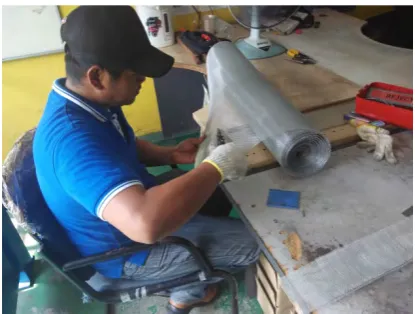
[image:24.595.199.407.318.475.2]TR Techonology Sdn. Bhd is the company of stamping machine industry, which also produces an automotive part. In industry we call as this factory as vendor company. This means that the vendor monitors the buyer’s inventory and makes periodic resupply decisions regarding order quantities, shipping, and timing (Matt et al., 2001). At the TR Technology Sdn. Bhd, the wire mesh sheets metal cutting process is still done by using the conventional method which is using metal scissor cutter. After trough cutting process, this part will be process to produce a mold for filter casting in car engine. Figure 1.1 shows the worker at the company stills using metal scissor cutter to cut the wire mesh.
Figure 1.1: Conventional cutting method
To overcome the problem in TR Technology Sdn. Bhd. Their manager has asked UTeM committee to assist in development of slitting sheet metal machine for wire mesh. This product will reduce the lead time and increase the productivity. The problem is to design the slitting machine that has not yet available in industry. It also must meet with customer requirement. There also other problem occurs in this factory which is:-
i. Ineffective cost production and strategies to increase the productivity. ii. Need to be competitive in market with further concerted effort.