Split Utterances in Dialogue: a Corpus Study
Matthew Purver, Christine Howes, andPatrick G. T. Healey Department of Computer Science Queen Mary University of London Mile End Road, London E1 4NS, UK
{mpurver,chrizba,ph}@dcs.qmul.ac.uk
Eleni Gregoromichelaki Department of Philosophy
King’s College London Strand, London WC2R 2LS, UK [email protected]
Abstract
This paper presents a preliminary English corpus study ofsplit utterances(SUs), sin-gle utterances split between two or more dialogue turns or speakers. It has been suggested that SUs are a key phenomenon of dialogue, which this study confirms: al-most 20% of utterances were found to fit this general definition, with nearly 3% be-ing the between-speaker case most often studied. Other claims/assumptions in the literature about SUs’ form and distribu-tion are investigated, with preliminary re-sults showing: splits can occur within syn-tactic constituents, apparently at any point in the string; it is unusual for the sepa-rate parts to be complete units in their own right; explicit repair of the antecedent does not occur very often. The theoretical con-sequences of these results for claims in the literature are pointed out. The prac-tical implications for dialogue systems are mentioned too.
1 Introduction
Split utterances(SUs) – single utterances split be-tween two or more dialogue turns/speakers – have been claimed to occur regularly in dialogue, espe-cially according to the observations reported in the Conversational Analysis (CA) literature, which is based on the analysis of naturally occurring di-alogues. SUs are of interest to dialogue theo-rists as they are a clear sign of how turns cohere with each other at all levels – syntactic, seman-tic and pragmaseman-tic. They also indicate the radi-cal context-dependency of conversational contri-butions. Turns can, in general, be highly ellip-tical and nevertheless not disrupt the flow of the
dialogue. SUs are the most dramatic illustration of this: contributions spread across turns/speakers rely crucially on the dynamics of the unfolding context, linguistic and extra-linguistic, in order to guarantee successful processing and production.
Utterances that are split across speakers also present a canonical example of participant coor-dination in dialogue. The ability of one partic-ipant to continue another interlocutor’s utterance coherently, both at the syntactic and the seman-tic level, suggests that both speaker and hearer are highly coordinated in terms of processing and pro-duction. The initial speaker must be able to switch to the role of hearer, processing and integrating the continuation of their utterance, whereas the ini-tial hearer must be closely monitoring the gram-mar and content of what they are being offered so that they can take over and continue in a way that respects the constraints set up by the first part of the utterance. In fact there is (anecdotal) ev-idence that such constraints are fully respected across speaker and hearer in such utterances (see e.g. Gregoromichelaki et al. (2009)). A large pro-portion of the CA literature on SUs tries to iden-tify the conditions under which SUs usually oc-cur (see section 2). However, this emphasis seems to miss the important generalisation, confirmed by the present study, that, syntactically, a speaker switch may be able to occur anywhere in a string.
mod-elling of this phenomenon as the switch of roles while syntactic/semantic dependencies are pend-ing can be taken as evidence for direct involve-ment of the grammar in the successful process-ing/production of such utterances. Indeed, Poesio and Rieser (to appear) claim that “[c]ollaborative completions . . . are among the strongest evidence yet for the argument that dialogue requires coor-dination even at the sub-sentential level” (italics original).
From a psycholinguistic point of view, the phe-nomenon of SUs is compatible with mechanis-tic approaches as exemplified by the Interactive Alignment model of Pickering and Garrod (2004) where it is claimed that it should be as easy to complete someone else’s sentence as one’s own (Pickering and Garrod, 2004, p186). According to this model, speaker and listener ought to be in-terchangeable at any point. This is also the stance taken by the grammatical framework of Dynamic Syntax (DS) (Kempson et al., 2001; Cann et al., 2005). In DS, parsing and production are taken to employ the same mechanisms, leading to a pre-diction that split utterances ought to be strikingly natural (Purver et al., 2006). However, from a pragmatic point of view, utterance continuation by another speaker might involve some kind of guessing1 or preempting the other interlocutor’s intended content. It has therefore been claimed that a full account of this phenomenon requires a complete model of pragmatics that can handle intention recognition and formation. Indeed, Poe-sio and Rieser (to appear) claim that “the study of sentence completions . . . may be used to com-pare competing claims about coordination – i.e. whether it is best explained with an intentional model like Clark (1996)’s . . . or with a model based on simpler alignment models like Pickering and Garrod (2004)’s.” They conclude that a model which includes modelling of intentions better cap-tures the data.
For computational models of dialogue, how-ever, SUs pose a challenge. While Poesio and Rieser (to appear) and Purver et al. (2006) pro-vide general foundational models for various parts of the phenomenon, there are many questions that remain if we are to begin automatic processing. A computational dialogue system must be able to identify SUs, match up their two (or more)
1Note that this says nothing about whether such a contin-uation is the same as the initial speaker’s intended continua-tion.
parts (which may not necessarily be adjacent), in-tegrate them into some suitable syntactic and/or semantic representation, and determine the over-all pragmatic contribution to the dialogue context. SUs also have implications for the organisation of turn-takingin such models (see e.g. Sacks et al. (1974)), as regards what conditions (if any) allow or prevent successful turn transfer. Additionally, from a socio-linguistic point of view, turn-taking operates (according to Schegloff (1995)) not on individual conversational participants, but on ‘par-ties’. Lerner (1991) suggests that split utterances can clarify the formation of such parties in that they reveal evidence of how syntax can be em-ployed to organise participants into ‘groups’.
Analysis of SUs, when they can or cannot oc-cur, and what effects they have on the coordina-tion of agents in dialogue, is therefore an area of interest not only for conversational analysts wish-ing to characterise systematic interactions in di-alogue, but also for linguists trying to formulate grammars of dialogue, psychologists and sociolin-guists interested in alignment mechanisms and so-cial interaction, and those interested in building automatic dialogue processing systems. In this pa-per we present and examine empirical corpus data in order to shed light on some of the questions and controversies around this phenomenon.
2 Related Work
Most previous work on what we call SUs has ex-amined specific sub-cases, generally of the cross-speaker type, and have referred to these vari-ously as collaborative turn sequences (Lerner, 1996; Lerner, 2004), collaborative completions (Clark, 1996; Poesio and Rieser, to appear), co-constructions (Sacks, 1992), joint produc-tions (Helasvuo, 2004), co-participant comple-tions (Hayashi, 1999; Lerner and Takagi, 1999), collaborative productions (Szczepek, 2000) and anticipatory completions (Fox and others, 2007) (amongst others). Here we discuss some of these views.
Conversation Analysis Lerner (1991) identifies various structures typical of SUs which contain characteristic split points. Firstly he gives a number of ‘compound’ turn-constructional units (TCUs), i.e., structures that include an initial con-stituent that hearers can identify as introducing some later final component. Examples include the
OFX-Y constructions:
(1) A: Before that then if they were ill
G: They get nothing. [BNC H5H 110-111] Other cues for potentialanticipatory completions include quotation markers (e.g.SHE SAID), paren-thetical inserts and lists, as well as non-syntactic cues such as contrast stress or prefaced disagree-ments. R¨uhlemann (2007) uses corpus analysis to examine sentence relatives as typical expansions of another interlocutor’s turn (see also (16)):
(2) A: profit for the group is a hundred and ninety thousand pounds.
B: Which is superb.[BNC FUK 2460-2461 ]
Opportunistic Cases Although Lerner focuses on these projectable turn completions, he also mentions that splits can occur at other points such as “intra-turn silence”, hesitations etc. which he termsopportunistic completions:
(3) A: Well I do know last week thet=uh Al was certainly veryhpause 0.5i
B: pissed off [(Lerner, 1996, p260)] As he makes no claims regarding the frequency of such devices for SUs, it would be interesting to know how common these are (insomuch as they occur at all and can be accordingly classified), es-pecially as studies on SUs in Japanese (Hayashi, 1999) show that although SUs do occur, they do not rely on compound TCUs.
Expansions vs. Completions Other classifica-tions of SUs often distinguish betweenexpansions andcompletions(Ono and Thompson, 1993). Ex-pansions are continuations which add, e.g., an ad-junct, to an already complete syntactic element:
(4) T: It’ll be an E sharp.
G: Which will of course just be played as an
F. [BNC G3V 262-263]
whilst completions involve the addition of syntac-tic material which is required to make the whole utterance complete:
(5) A: . . . and then we looked along one deck, we were high up, and down below there were rows of, rows of lifeboats in case you see B: There was an accident.
A: of an accident [BNC HDK 63-65] In terms of frequency, the only estimate we know of is Szczepek (2000), where there are ap-parently 200 cross-person SUs in 40 hours of En-glish conversation (there is no mention of the num-ber of sentences or turns this equates to), of which
75% are completions.2 As briefly outlined above, CA analyses of SUs tend to be broadly descriptive of what they reveal for conversational practices. Because such analyses present real examples they establish that the phenomenon is a genuine one; however, there is no discussion of its scale (with the exception of Szczepek (2000), which offers ex-tremely limited figures). Even though as a gen-uine phenomenon it is of theoretical interest, the lack of frequency statistics prevents generalisabil-ity. Therefore, any claims that SUs are pervasive in dialogue need empirical backing.
Linguistic Models Purver et al. (2006) present a grammatical model for split utterances, using an inherently incremental grammar formalism, Dy-namic Syntax (Kempson et al., 2001; Cann et al., 2005). This model shows how syntactic and se-mantic processing can be accounted for no mat-ter where the split occurs in a sentence; how-ever, as their interest is in grammatical process-ing, they give no account of any higher-level in-ferences which may be required. Poesio and Rieser (to appear) present a general model for col-laborative completions based in the PTT frame-work, using an incremental LTAG-based gram-mar and an information-state-based approach to context modelling. While many parts of their model are compatible with a simple alignment-based communication model like Pickering and Garrod (2004)’s, they see intention recognition as crucial to dialogue management. They conclude that an intention-based model, more like Clark (1996)’s, is more suitable. Their primary concern is to show how such a model can account for the hearer’s ability to infer a suitable continuation, but their use of an incremental interpretation method also allows an explanation of the low-level utter-ance processing required. Nevertheless, the use of an essentially head-driven grammar formalism suggests that some syntactic splits that appear in our corpus might be more problematic than oth-ers.
Corpus Studies Skuplik (1999), as reported by Poesio and Rieser (to appear), collected data from German two-party task-oriented dialogue, and an-notated for split utterance phenomena. She found that expansions (cases where the part before the split can be considered already complete) were
more common than completions (where the first part is incomplete as it stands). Given that this study focuses on task-oriented dialogue, it needs to be shown that its results can be replicated in nat-urally occurring dialogue. In addition, de Ruiter and van Dienst (in preparation) are also in the pro-cess of studying other-initiated completions, in the above sense, and their effect on the progressivity of dialogue turns; however no results are available to us at this point in time.
Dialogue Models We are not aware of any system/model which treats other-person splits, but same-person ones are now being looked at. Skantze and Schlangen (2009) present an incre-mental system design (for a limited domain) which can react to user feedback, e.g., backchannels, and resume with utterance completion if interrupted. Some related empirical work regarding the issue of turn-switch addressed here is also presented in Schlangen (2006) but the emphasis there centered mostly on prosodic rather than grammar/theory-based factors.
3 Method
3.1 Terminology
In this paper, as our interest is general, we use the termsplit utterances(SUs) to cover all instances where an utterance is spread across more than one dialogue contribution – whether the contributions are by the same or different speakers. We there-fore use the termsplit pointto refer to the point at which the utterance is split (rather than e.g. tran-sition point which is associated with a speaker change). Cases where speaker does change across the split will be called other-person splits; oth-erwise same-person splits. One of the reasons for including same-person splits is that there are claims in the literature that the initial speaker may strategically continue completing their own utter-ance, after another person’s intervention, as an al-ternative to acceptance or rejection of this inter-vention (delayed completion, (Lerner, 1996)). In addition, both grammatical formalisms (Purver et al., 2006) and psycholinguistic models (Picker-ing and Garrod, 2004) predict that SUs should be equally natural in both the same- and other- person conditions.
As not all cases will lead to complete contri-butions, and not all will be split over exactly two contributions, we also avoid terms like first-half,
second-half and completion: instead the contri-butions on either side of a split point will be re-ferred to as theantecedentand thecontinuation. In cases where an utterance has more than one split point, some portions may therefore act as the con-tinuation for one split point, and the antecedent for the next.
3.2 Questions
General Our first interest is in the general statis-tics regarding SUs: how often do they occur, and what is the balance between same- and other-person splits? Do they usually fall into the specific categories (with specific preferred split points) ex-amined by e.g. Lerner (1991), or can the split point be anywhere?
Completeness For a grammatical treatment of SUs, as well as for implementing pars-ing/production mechanisms for their processing, we need to know about the likely completeness of antecedent and continuation (if they are al-ways complete in their own right, a standard head-driven grammar may be suitable; if not, some-thing more fundamentally incremental may be re-quired). In addition, CA and other strategic anal-yses of dialogue phenomena predict that split ut-terances should occur at turn-transfer points that are foreseeable by the participants. Complete syn-tactic units serve this purpose from this point of view and lack of such completeness will seem to weaken this general claim. We therefore ask how often antecedents and continuations are them-selves complete,3and look at the syntactic and lex-ical categories which occur either side of the split.
Repair and Overlap Thirdly, we look at how often splits involve explicit repair of antecedent material, and how this depends on antecedent completeness. Although, sometimes, repair might be attributed to overlap or speaker uncertainty, it also might indicate issues regarding preemptive tactics on the part of the current speaker who needs to reformulate the original contribution in order to accommodate their novel offering or take into account feedback offered while constructing their utterance. Amount of repair also indicates the de-gree of attempt the current speaker is making to
3
Tag Value Explanation
end-complete y/n For all sentences: does this sentence end in such a way as to yield a complete proposition or speech act?
continues sentence ID For all sentences: does this sentence continue the proposition or speech act of a previous sentence? If so, which one?
repairs number of words For continuations: does this continuation explicitly repair words in the antecedent? If so, how many?
start-complete y/n For continuations: does this continuation start in such a way as to be able to stand alone as a complete proposition or speech act?
Table 1: Annotation Tags
integrate syntactically their contribution with the antecedent. However, we also examine how often continuations involve overlap, which also has im-plications for turn-taking management, and how this depends on antecedent completeness.
3.3 Corpus
For this exercise we used the portion of the BNC (Burnard, 2000) annotated by Fern´andez and Ginzburg (2002), chosen to maintain a balance be-tween context-governed dialogue (tutorials, meet-ings, doctor’s appointments etc.) and general con-versation. This portion comprises 11,469 sen-tences taken from 200-turn sections of 53 separate dialogues.
The BNC transcripts are already annotated for overlapping speech, for non-verbal noises (laugh-ter, coughing etc.) and for significant pauses. Punctuation is included, based on the original dio and the transcribers’ judgements; as the au-dio is not available, we allowed annotators to use punctuation where it aided interpretation. The BNC transcription protocol provides a sentence-level annotation as well as an utterance (turn)-sentence-level one, where turns may be made of several sentences by the same speaker. We annotated at a sentence-level, to allow self-continuations within a turn to be examined. The BNC also forces turns to be presented in linear order, which is vital if we are to accurately assess whether turns are continua-tions of one another; however, this has a side-effect of forcing long turns to appear split into sev-eral shorter turns when interrupted by intervening backchannels. We will discuss this further below.
Annotation Scheme The initial stage of manual annotation involved 4 tags: start-complete,
end-complete,continuesandrepairs– these are explained in Table 1 above. Sentences which somehow require continuation (whether
they receive it or not) are therefore those marked
end-complete=n; sentences which act as continuations are those marked with non-empty
continues tags; and their antecedents are the values of thosecontinuestags. Further specific information about the syntactic or lexical nature of antecedent or continuation components could then be extracted (semi-)automatically, using the BNC transcript and part-of-speech annotations.
Inter-Annotator Agreement Three annotators were used, all linguistically knowledgeable. First, all three annotators annotated one dialogue inde-pendently, then compared results and discussed differences. They then annotated 3 further di-alogues independently to assess inter-annotator agreement; kappa statistics (Carletta, 1996) are shown in Table 2 below.
Tag KND KBG KB0
end-complete .86-.92 .80-1.0 .73-.90
continues(y/n) .89-.81 .76-.85 .77-.89
continues(ant) .90-.82 .74-.85 .76-.86
repairs 1.0-1.0 .55-.81 1.0-1.0
Table 2: Inter-Annotatorκstatistic (min-max)
With the exception of therepairs tag for one annotator pair for one dialogue, all are above 0.7; the low figure results from a few disagreements in a dialogue with only a very small number of
repairs instances. The remaining dialogues were divided evenly between the three annotators.
4 Results and Discussion
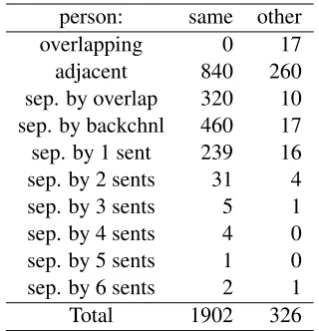
person: same other overlapping 0 17 adjacent 840 260 sep. by overlap 320 10 sep. by backchnl 460 17 sep. by 1 sent 239 16 sep. by 2 sents 31 4 sep. by 3 sents 5 1 sep. by 4 sents 4 0 sep. by 5 sents 1 0 sep. by 6 sents 2 1 Total 1902 326
Table 3: Antecedent/continuation separation
General Same-person splits are much more common than other-person; however, this is partly an artefact of the BNC transcription protocol (which forces contributions to be linearly ordered) and our choice to annotate at the sentence level. Around 44% of same-person cases are splits be-tween sentences within the same-speaker turn; and a further 17% are separated only by other-speaker material which entirely overlaps with the antecedent and therefore does not necessarily ac-tually interrupt the turn. Both of these might be considered as single utterances under some views. However, we believe that splits between same-turn sentences must be investigated in that the transcription into separate sentences does indicate some pause or other separating prosody and, from a processing/psycholinguistic point of view, it should be determined whether other-person splits occur in the same places as same-person split boundaries. Even in cases of overlap, one can-not exclude the fact that the shape of the current speaker’s utterance is influenced by receipt of the feedback. Nevertheless, we will examine these issues in further research and hence we exclude within-turn splits of this type from here on.
Many splits are non-adjacent (see Table 3), with the antecedent and continuation separated by at least one intervening sentence. In same-person cases, once we have excluded the within-turn splits described above, this must in fact always be the case; the intervening material is usually a backchannel (62% of remaning cases) or a sin-gle other sentence (32%, often e.g. a clarification question), but two intervening sentences are possi-ble (4%) with up to six being seen. In other-person cases, 88% are adjacent or separated only by over-lapping material, but again up to six intervening
person: same other and/but/or 748 116 so/whereas 257 39
because 77 3
(pause) 56 5
which/who/etc 26 4
instead of 4 1
said/thought/etc 14 0
if then 1 0
when then 1 1
(other) 783 161
Table 4: Continuation categories
sentences were seen, with a single sentence most common (10%, in half of which the intervening sentence was a backchannel).
Many utterances have more than one split. In same-person cases, a single utterance can be split over as many as thirteen individual sentence con-tributions; although such extreme cases occur gen-erally within one-sided dialogues such as tutori-als, many multi-split cases are also seen in general conversation. Only 63% of cases consisted of only two contributions. Antecedents can also receive more than one competing continuation, although this is rare: two continuations are seen in 2% of cases.
CA Categories We searched for examples which match CA categories (Lerner, 1991; R¨uhlemann, 2007) by looking for particular lex-ical items on either side of the split. Matching was done loosely, to allow for the ungrammatical na-ture of dialogue – for example, an instance was taken to match theIFX-THENY pattern if the
con-tinuation began with‘then’(modulo filled pauses and non-verbal material) and the antecedent con-tained ‘if ’ at any point) – so the counts may be over-estimates. For Lerner (1996)’sopportunistic cases, we looked for filled pauses (‘er/erm’ etc.) or pauses explicitly annotated in the transcript, so counts in this case may be underestimates.4 We also chose some other broad categories based on our observations of the most common cases. Re-sults are shown in Table 4.5
The most common of the CA categories can be
4In further research we will examine other features as spe-cialised laugh tokens, repetitions etc. as well as their particu-lar positioning
[image:6.595.340.493.61.216.2]seen to be Lerner (1996)’s hesitation-related op-portunisticcases, which make up at least 2-3% of both same- and other-person splits. R¨uhlemann (2007)’s sentence relative clause cases are next, with over 1%; the others make up only small pro-portions.
In contrast, by far the most common pattern (for both same- and other-) is the addition of an ex-tending clause, either a conjunction introduced by ‘and/but/or/nor’ (35-40%), or other clause types with ‘so/whereas/nevertheless/because’. Other less obviously categorisable cases make up 40-50% of continuations, with the most common first words being‘you’,‘it’,‘I’,‘the’,‘in’and‘that’.
Completeness and repair Examination of the
end-complete annotations shows that about 8% of sentences in general are incomplete, but that (perhaps surprisingly) only 63% of these get continued. For both same- and other-person tinuations, the vast majority (72% and 74%) con-tinue an already complete antecedent, with only 26-28% therefore being completionsin the sense of e.g. de Ruiter and van Dienst (in preparation). This does, however, mean that continuations are significantly more likely than other sentences to follow an incomplete antecedent (p < 0.001 us-ingχ2(1)). Interestingly, though, continuations are no more likely than other sentences to be complete themselves.
The frequent clausal categories from Table 4 are all more likely to continue complete antecedents than incomplete ones, with the exception of the
(other)category; this suggests that split points often occur at random points in a sentence, without regard to particular clausal constructions (see also A.1 for more examples and context):
(6) D: you know what the actual variations U: entails
D: entails. you know what the actual quality of the variations are.
[BNC G4V 114-117]
For the less frequent (e.g. ‘if/then’, ‘instead of ’) categories, the counts are too low to be sure.
Excluding all the clausal constructions (i.e. looking only at the general(other) category), and looking only at other-person cases, we see that antecedents often end in a complete way (53%) but that continuations do not often start in a complete way (24%). Continuations are more than twice as likely to start in a non-complete as opposed
to complete way, even after complete antecedents. Explicit repair of some portion of the antecedent is not common, only occurring in just under 5% of splits. As might be expected, incomplete an-tecedents are more likely to be repaired (13% vs. 2%, p < 0.001using χ2(1)). Other-continuations are also significantly more likely to repair their an-tecedents than same-person cases (10% vs. 4%,
p <0.001usingχ2(1)).
Problematic cases Examination of the data shows that SUs is not necessarily an autonomous well-defined category independent of other frag-ment classifications in the literature. Besides cases where it is not easy to identify whether a fragment is a continuation or not or what the antecedent is (see A.2), there are also cases where, as has already been pointed out in the literature (Gre-goromichelaki et al., 2009; Bunt, 2009), fragments exhibit multifunctionality. This can be illustrated by the following where the continuation could be taken also as request for confirmation/question (7) or a reply to a clarification request (8):
(7) M: It’s generated with a handle and J: Wound round?
M: Yes [BNC K69 109-112]
(8) S: Quite a good word processor. J: A word processor?
S: Which is vag- it’s basically a subset of
Word. [BNC H61 37-39]
In this respect, an interesting category is Lerner’s delayed completions where often the continuation also serves as some kind of repair or reformulation (see e.g. (6) and A.3 (26)).
5 Conclusions
the input. This is hampered though by the fact that the split can occur within any type of syn-tactic constituent, hence no reliable grammatical features can be employed securely. On the other hand, end-incompleteness of antecedents is not as common as would be expected and long distances between antecedent and continuation are possible. In this respect, locating the antecedent is not a straightforward task for automated systems, espe-cially again as this can be any type of constituent.
References
H. Bunt. 2009. Multifunctionality and multidimen-sional dialogue semantics. InProceedings of Dia-Holmia, 13th SEMDIAL Workshop.
L. Burnard. 2000. Reference Guide for the British Na-tional Corpus (World Edition). Oxford University Computing Services http://www.natcorp. ox.ac.uk/docs/userManual/.
R. Cann, R. Kempson, and L. Marten. 2005. The Dy-namics of Language. Elsevier, Oxford.
J. Carletta. 1996. Assessing agreement on classifica-tion tasks: The kappa statistic. Computational Lin-guistics, 22(2):249–255.
H. Clark. 1996. Using Language. Cambridge Univer-sity Press.
J. de Ruiter and M. van Dienst. in preparation. Com-pleting other people’s utterances: evidence for for-ward modeling in conversation. ms.
R. Fern´andez and J. Ginzburg. 2002. Non-sentential utterances: A corpus-based study. Traitement Au-tomatique des Langues, 43(2).
A. Fox et al. 2007. Principles shaping grammati-cal practices: an exploration. Discourse Studies, 9(3):299.
E. Gregoromichelaki, Y. Sato, R. Kempson, A. Gargett, and C. Howes. 2009. Dialogue modelling and the remit of core grammar. InProceedings of IWCS.
M. Hayashi. 1999. Where Grammar and Interac-tion Meet: A Study of Co-Participant CompleInterac-tion in Japanese Conversation. Human Studies, 22(2):475– 499.
M. Helasvuo. 2004. Shared syntax: the gram-mar of co-constructions. Journal of Pragmatics, 36(8):1315–1336.
R. Kempson, W. Meyer-Viol, and D. Gabbay. 2001. Dynamic Syntax: The Flow of Language Under-standing. Blackwell.
G. Lerner and T. Takagi. 1999. On the place of linguistic resources in the organization of talk-in-interaction: A co-investigation of English and
Japanese grammatical practices. Journal of Prag-matics, 31(1):49–75.
G. Lerner. 1991. On the syntax of sentences-in-progress. Language in Society, pages 441–458.
G. Lerner. 1996. On the semi-permeable character of grammatical units in conversation: Conditional entry into the turn space of another speaker. In E. Ochs, E. A. Schegloff, and S. A. Thompson, editors, Interaction and grammar, pages 238–276. Cambridge University Press.
G. Lerner. 2004. Collaborative turn sequences. In Conversation analysis: Studies from the first gener-ation, pages 225–256. John Benjamins.
T. Ono and S. Thompson. 1993. What can conversa-tion tell us about syntax. In P. Davis, editor, Alterna-tive Linguistics: DescripAlterna-tive and Theoretical Modes. Benjamin.
M. Pickering and S. Garrod. 2004. Toward a mech-anistic psychology of dialogue. Behavioral and Brain Sciences, 27:169–226.
M. Poesio and H. Rieser. to appear. Completions, co-ordination, and alignment in dialogue. Ms.
M. Purver, R. Cann, and R. Kempson. 2006. Grammars as parsers: Meeting the dialogue chal-lenge. Research on Language and Computation, 4(2-3):289–326.
C. R¨uhlemann. 2007. Conversation in context: a corpus-driven approach. Continuum.
H. Sacks, E. A. Schegloff, and G. Jefferson. 1974. A simplest systematics for the organization of turn-taking for conversation.Language, 50(4):696–735.
H. Sacks. 1992.Lectures on Conversation. Blackwell.
E. Schegloff. 1995. Parties and talking together: Two ways in which numbers are significant for talk-in-interaction. Situated order: Studies in the social organization of talk and embodied activities, pages 31–42.
D. Schlangen. 2006. From reaction to prediction: Ex-periments with computational models of turn-taking. InProceedings of the 9th International Conference on Spoken Language Processing (INTERSPEECH -ICSLP).
G. Skantze and D. Schlangen. 2009. Incremental dia-logue processing in a micro-domain. InProceedings of the 12th Conference of the European Chapter of the ACL (EACL 2009).
K. Skuplik. 1999. Satzkooperationen. definition und empirische untersuchung. SFB 360 1999/03, Biele-feld University.
B. Szczepek. 2000. Formal Aspects of Collaborative Productions in English Conversation. Interaction and Linguistic Structures (InLiSt), http://www.
A Examples
A.1 Split points
(6) D: Yeah I mean if you’re looking at quan-titative things it’s really you know how much actual- How much variation hap-pens whereas qualitative is hpausei you know what the actual variations
U: entails
D: entails. you know what the actual quality of the variations are.
[BNC G4V 114-117]
(9) A: All the machinery was G: [[All steam.]]6
A: [[operated]] by steam
[BNC H5G 177-179]
(10) K: I’ve got a scribble behind it, oh annual re-port I’d get that from.
S: Right.
K: And the total number of [[sixth form stu-dents in a division.]]
S: [[Sixth form
stu-dents in a division.]] Right.
[BNC H5D 123-127]
(11) M: 292 And another sixteen percent is the other Ne- Nestle coffee hpausei erm Blend Thirty Seven which I used to drink a long time ago and others hlaughi and twenty two percent is erhpausei
U: Maxwell.
M: Maxwell House, which has become the other local brand now seeing as how Maxwell House is owned by Kraft, and Kraft now own Terry’s.
[BNC G3U 292-294]
(12) A: Erm because as Moira said that Kraft is erm hpausei now what was she saying, what was she saying Kraft is the same as
hpausei
M: Craft? [BNC G3U 412-413]
(13) J: And I couldn’t remember whether she said at the end of the three months or A: End of the month. [BNC H4P 17-18]
6Overlapping material is shown in double square brackets, aligned with the material with which it co-occurs.
(14) G: Had their own men A: unload the boats?
G: unload the boats, yes. [BNC H5H 91-93]
(15) G: That’s right they had to go on a rota. A: Run by the Dock Commission? G: Run by the Dock Commission.
[BNC H5H 100-102]
(16) A: So I thought, oh, I think I’ll put lace over it, it’ll tone the lilac [[down.]]
B: [[down.]] Yes.
Which it is has done
[BNC KBC 3195-3198]
A.2 Uncertain antecedents
(17) C: Look you’re cleaning this hpausei
[[with erm]] G: [[That box.]] C: [[This.]]
G: [[With]] this. [[And this.]]
C: [[And this.]] [[And this.]]
G: [[And this.]]
Whoops! [BNC KSR 9-17]
(18) S: You’re trying to be everything hpausei
and they’re pushing it away cos it’s not what they really wanthpausei and they, I mean, all, all you can get from him is how marvellous, you’re right, how marvellous his brothers arehpauseiand yet, what I’ve heard of the brothers they’re not
C: Not much, [[yeah.]]
S: [[they’re]] not all that marvel-lous, they’re not really that much to look [[up]]
C: [[Ah]]. S: to.
C: No [BNC KBG 76-81]
(19) S: Well this is why I think he’d be better off, hi- his needshpauseiare not met by a class teacher. And I don’t think they have been for this last
C: Mm, we need a support teacher [[to go there.]]
S: [[for the
last]] year. But yo-, you need somebody who’s gonna work with him every day
hpausei and hpausei with an individual programme and you just can’t offer that
(20) M: I might be a bit biased, I think they still do that but I think ermhpausei
J: The television hashpausei
M: the television has made a difference. I think not only just at fire stations, I think in the whole of life, hasn’t it?
[BNC K69 51-54]
(21)A5: I’ll definitely use that U: hreadingi:[ Get a headache ]? A5: [[in getting to know]] A2: [[Year seven]] A5: new [[year seven]]
A2: [[Oh yeah]] for year seven
[BNC J8D 190-195]
(22) G: Well a chain locker is where all the spare chain used to like coil up
A: So ithunclearicame in and it went round G: round the barrel about three times round the barrel then right down into the chain locker but if you kept, let it ride what we used to call let it ride wellhuncleariwell now it get so big then you have to run it all off cos you had one lever, that’s what you had and the steam valve could have all steamed. [BNC H5G 174:176]
A.3 Multifunctionality of fragments
(7) Completion and confirmation request: J: How does it generate?
M: It’s generated with a handle and J: Wound round?
M: Yes, wind them round and this should, should generate a charge which rang bells and sounded bells and then er you lift up a telephone and plug in a jack and, and take a message in that way.
[BNC K69 109-112]
(23) Completion and confirmation request: G: Had their own men
A: unload the boats?
G: unload the boats, yes. [BNC H5H 91-93]
(24) Late completion and (repetitive) confir-mation:
N: Alistair [last or full name] erm he’s, he’s made himself er he has made himself co-ordinator.
U: And section engineer.
N: And section engineer.
N: I didn’t sign it as coordinator.
[BNC H48 141-144]
(25) Completion and clarification reply: John: If you press N
Sarah: N?
John: N for name, it’ll let you type in the docu document name. [BNC G4K 84-86]
(26) Expansion and reformulation/repair: S: Secondly er
J: We guarantee P five.
S: We we are we’re guaranteeing P five plus a noise level.
J: Yeah. [BNC JP3 167-170]
(27) Expansion and question:
I: I can’t remember exactly who lived on the right hand side, I’ve forgotten but th I know the Chief Clerk lived just a little way down [address], you see, er
A: In one of those little red brick cottages? [BNC HDK 124-125]
(28) Answer and expansion:
A: We could hear it from outsidehuncleari. R: Oh you could hear it?
A: Occasionally yeah. [BNC J8D 13-15]
(29) Answer/reformulation and expansion: G: [address], that was in the middle, more or
less in the middle of the town. A: And you called that the manual? G: The manual school, yes.