
This is a repository copy of Disaggregate path flow estimation in an iterated DTA microsimulation.
White Rose Research Online URL for this paper: http://eprints.whiterose.ac.uk/85162/
Version: Accepted Version
Article:
Flotterod, G and Liu, R (2014) Disaggregate path flow estimation in an iterated DTA microsimulation. Journal of Intelligent Transportation Systems: Technology, Planning, and Operations, 18 (2). 204 - 214. ISSN 1547-2450
https://doi.org/10.1080/15472450.2013.806854
[email protected] https://eprints.whiterose.ac.uk/
Reuse
Unless indicated otherwise, fulltext items are protected by copyright with all rights reserved. The copyright exception in section 29 of the Copyright, Designs and Patents Act 1988 allows the making of a single copy solely for the purpose of non-commercial research or private study within the limits of fair dealing. The publisher or other rights-holder may allow further reproduction and re-use of this version - refer to the White Rose Research Online record for this item. Where records identify the publisher as the copyright holder, users can verify any specific terms of use on the publisher’s website.
Takedown
If you consider content in White Rose Research Online to be in breach of UK law, please notify us by
Flötteröd, G. and Liu, R (2014) Disaggregate path flow estimation in an iterated DTA microsimulation. Journal of Intelligent Transportation Systems: Technology, Planning and
Operations. Vol 18(2), 204-214. DOI:10.1080/15472450.2013.806854
Disaggregate path flow estimation in an iterated DTA
microsimulation
Gunnar Flötteröd
KTH Royal Institute of Technology
Department of Transport Science
Teknikringen 72, 11428 Stockholm, Sweden
[email protected] (corresponding author)
Ronghui Liu
Institute for Transport Studies
University of Leeds
Leeds LS2 9JT, England,
Abstract
This text describes the first application of a novel path flow and origin/destination (OD)
matrix estimator for iterated dynamic traffic assignment (DTA) microsimulations. The
presented approach, which operates on a trip-based demand representation, is derived from an
agent-based DTA calibration methodology that relies on an activity-based demand model
(Flötteröd et al., 2011a). The objective of this work is to demonstrate the transferability of the
The calibration (i) operates at the same disaggregate level as the microsimulation and (ii) has
drastic computational advantages over conventional OD matrix estimators in that the demand
adjustments are conducted within the iterative loop of the DTA microsimulation, which
results in a running time of the calibration that is in the same order of magnitude as a plain
simulation. We describe an application of this methodology to the trip-based DRACULA
microsimulation and present an illustrative example that clarifies its capabilities.
1 Introduction
This section introduces a novel path flow and origin/destination (OD) matrix estimator
for iterated dynamic traffic assignment (DTA) microsimulations. The first part of this
introduction describes the basic concepts of these simulations and reviews some of the
existing implementations. The second part revisits existing OD matrix and path flow
estimators. Based on this review, the new approach is then motivated.
Iterated DTA microsimulations are characterized by the following features. They are
microscopic in that both travelers and vehicles are modeled at the disaggregate level. They are
iterative in that the simulation runs typically according to the logic outlined in Algorithm 1,
where a demand simulator and a supply simulator are alternately executed until a state of
mutual consistency is reached. Finally, they are usually stochastic in that at least the simulated
travel behavior is non-deterministic, whereas the traffic flow model may be either
deterministic or stochastic. The foundations of the iterated simulation approach have been laid
by Cascetta (1989) and Cascetta and Cantarella (1991), and their application to increasingly
complex model systems is still the topic of ongoing research (Nagel et al., 1998; Nagel and
Algorithm 1 leaves open which behavioral dimensions are represented by the demand
simulation (e.g., route choice, departure time choice, destination choice, mode choice, ect),
and, indeed, the iterative approach can in principle cope with any of these dimensions (Nagel
and Flötteröd, 2012). However, only few existing DTA microsimulations go beyond route
choice adjustments; amongst them are DynaMIT (Ben-Akiva et al., 1998; DynaMIT, accessed
2011), METROPOLIS (De Palma and Marchal, 2002), and DRACULA (Liu, 2005;
DRACULA, accessed 2011) which also adjusts departure time choice for independent trips,
and MATSim (Nagel et al., accessed 2011; Nagel and Flötteröd, 2012; Raney and Nagel,
2006) which in its current implementation adjusts route, departure time, and mode choice for
complete trip chains and is continuously being extended towards further demand dimensions
(Horni et al., 2008). Far more common are iterated microsimulations that constrain
themselves to the equilibration of route choice (and a strictly trip-based demand
representation). Amongst those are AIMSUN (TSS Transport Simulation Systems, 2006,
accessed 2011), DYNAMEQ (INRO, accessed 2011), and PARAMICS (Quadstone Paramics
Ltd., accessed 2011).
The usual representation of a trip-based demand is a (possibly time-dependent) OD
matrix that describes the number of trips from every origin zone to every destination zone in a Algorithm 1 Iterated DTA microsimulation
1. Initialization. Give every traveler an initial perception of the conditions in the
network.
2. Iterations. Repeat the following until stationary conditions are reached.
a. Demand simulation. Travelers select new mobility plans based on what
they have observed during previous iterations.
b. Supply simulation. The mobility plans of all travelers are simultaneously
traffic network. The traditional OD matrix estimation problem is to estimate an OD matrix
from traffic counts on network links and supplementary prior information. In lightly
congested conditions, link flows are linear combinations of path flows, yielding a
mathematically convenient setting, in which OD matrix estimation techniques such as entropy
maximization and information minimization (van Zuylen and Willumsen, 1980), Bayesian
estimation (Maher, 1983), generalized least squares (Bell, 1991; Bierlaire and Toint, 1995;
Cascetta, 1984), and maximum likelihood estimation (Spiess, 1987) have been applied. These
methods can be carried over at least approximately to congested networks (Maher et al., 2001;
Yang, 1995; Yang et al., 1992; Bierlaire and Crittin, 2006; Cascetta and Posterino, 2001). The
further addition of a time dimension, yielding various dynamic OD estimators, is also possible
(Cascetta et al., 1993; Ashok, 1996; Bierlaire, 2002; Sherali and Park, 2001; Zhou, 2004).
All of the above-mentioned demand estimators adjust OD matrices subject to a given
route choice model that is embedded in the traffic assignment procedure. Since route choice
modeling is an intricate task (Frejinger, 2008), modeling errors are likely to introduce biases
in the estimated OD matrices. This problem can be avoided through the use of path flow
estimators (PFEs). The first PFE, introduced by Bell (1995) and Bell et al. (1997), estimates
static path flows from link volume measurements based on a multinomial logit stochastic user
equilibrium (SUE) modeling assumption. Further developments along these lines allow for
multiple user classes and simplified traffic flow dynamics (Bell et al., 1996) as well as for the
incorporation of a deterministic user equilibrium (UE) modeling assumption (Sherali et al.,
2003, 1994; Nie and Lee, 2002; Nie et al., 2005). Summing up the path flows between an OD
pair yields its OD flow, which means that PFEs also estimate OD flows.
The new path flow and OD matrix estimator described in this work operates on a
trip-based demand representation, but it is derived from an agent-based DTA calibration
approach is mathematically developed in Flötteröd et al. (2011a), and its applicability for
large, real scenarios is demonstrated in Flötteröd et al. (2011b). The objective of this work is
to demonstrate the transferability of the agent-based approach to the more widely used OD
matrix-based demand representation. This complements previous presentations, where this
possibility is stated but not made concrete. Here, it is shown in terms of an operational
example how the new approach can be deployed for the estimation of OD matrices and path
flows in a microsimulation context. The used calibration software is freely available on the
Internet (Flötteröd, accessed 2011).
Transferring the originally agent-based approach to the OD/path flow domain also carries
over its advantages to this domain. The new approach goes beyond existing methods in that it
• estimates the trip-making of individually simulated travelers without any aggregation;
• is compatible with almost arbitrary demand and supply simulators; and
• has a computational complexity that is in the order of a plain simulation.
The reduction of an activity-based approach into the trip-based approach described in this
article is possible because a trip constitutes a subset of a trip chain, and a trip chain constitutes
the mobility-related side of an all-day travel and activity plan. Since the activity-based
calibration approach adjusts all-day travel plans to traffic counts, it is also applicable to the
basic case of travel plans consisting only of a single trip. The essential difference to all other
PFEs presented in the literature is that the presented approach does not aggregate
travelers/trip-makers into continuous flows but treats them as integer entities, consistently
with the individual representation of trip-makers in a microscopic DTA simulation.
This work is of particular relevance for Intelligent Transportation Systems (ITS).
Agent-based simulations of activity-based models may be computationally too heavy to be
deployed in real-time contexts, and hence the corresponding calibration methodology was so
Flötteröd (2008)). OD matrices and paths may be more suited for short-term and real-time
demand estimation, such that an operation transferral of the activity-based methodology to
these datastructures, as presented in this article, is likely to contribute to the real-time
monitoring of traffic conditions in ITS applications.
The remainder of this article is organized as follows. Section 2 introduces the two
software systems deployed in this study: the DRACULA microsimulation and the Cadyts
calibration tool, which implements the proposed methodology. A case study that clarifies the
workings of the new approach is given and discussed in Section 3. Finally, the article is
concluded in Section 4, and ongoing and future research work is described.
2 Framework and system components
The work presented in this article involves two software systems: the DRACULA
microsimulation and the Cadyts calibration tool. This section describes these systems and
their interactions. DRACULA is outlined in Subsection 2.1, and Cadyts is introduced in
Subsection 2.2. The interaction of both systems is described in Subsection 2.3.
2.1 DRACULA
–
a microscopic simulation DTA model
DRACULA (“Dynamic Route Assignment Combining User Learning and
microsimulAtion”) is a simulation tool to investigate the dynamics of demand and supply
interactions in road networks. The emphasis is on the integrated microsimulation of individual
trip-makers’ decisions, travel experiences, and learning. DRACULA complies with the
simulation structure given in Algorithm 1.
The system explicitly models individuals’ day-to-day route and departure time choices,
and how their past experience and knowledge of the network influence their future choices.
lane-changing rules. The system evolves continuously from one day to the next until a
pre-defined number of days or a broadly balanced state between the demand and supply is
reached. Simulation results can be obtained throughout the evolution and on not just the
means but also variances and probability distributions both within-day and between days. The
full details of the DRACULA suite of models and their applications have been reported
elsewhere (e.g., Hollander and Liu, 2008; Liu et al., 2006; Liu and Tate, 2004; Panis et al.,
2006) and will therefore not be detailed herein.
For the purposes of this article, DRACULA’s sophisticated supply simulator is coupled
with a simple, externally implemented multinomial logit (MNL) route choice model
(Ben-Akiva and Lerman, 1985), and departure time choice is neglected (in that fixed
departure times are assumed). The limitations of MNL route choice models, in particular with
respect to route overlap, are well understood and can to some extent be corrected for without
abstaining from the MNL’s convenient functional form (Ben-Akiva and Bierlaire, 2003;
Cascetta et al., 1996). However, the synthetic study presented in this article is sufficiently
served by a plain MNL model.
Formally, denote a single trip-maker by n and its choice set of available routes by C . n
The probability P i that n chooses route n( ) iCn follows a multinomial logit model
exp ( )
( )
exp ( )
n n n n j C V i P i V j
(1)where V i is the systematic utility of alternative n( ) i as perceived by n , and is a scale
parameter. Letting 0 results in a choice model that is insensitive to utility and hence
predicts a uniform choice distribution, whereas for only the alternative of maximum systematic utility is selected with positive probability. In all experiments, V i is set to the n( )
negative travel time one would have experienced on the considered route in the previous
for long-term driver memories with different weights on different days) are not exploited in
this study. Further investigations with more complex modeling assumptions are left as a topic
for future research.
The dynamics of the traffic assignment problem are comprised in this notation as follows:
• A time-dependent assignment problem requires to model path choice probabilities per
time slice. In such a setting, the model (1) is applied per time slice, and the utility
evaluated in this model is also computed time-dependently.
• Further choice dimensions can be incorporated in this notation by re-defining the
elements in the choice sets as tuples of choices. For example, adding departure time
would turn the elements of C into (route, departure time) tuples. n
The simplicity of the used notation reflects the flexibility of the calibration approach. As
long as there are trip-makers, (possibly time-dependent) utilities of alternatives, probabilistic
choice models, and (possibly time-dependent) traffic counts, the presented approach is
applicable.
Variability in the total demand levels is enabled by giving every replanning trip-maker an
additional empty route that represents the alternative of not making a trip. Assuming a total
number of N trip makers for a given OD pair (and departure time interval) and assuming
that on average a fraction of f(0,1) trip makers actually travels per day gives the no-travel
route a choice probability of 1 f and requires to scale down the choice probabilities of all
other routes by f . This turns the daily demand for the given OD pair into a binomial random
variable with mean fN and variance Nf(1 f). Although the stay-at-home alternative has
(again for simplicity) a fixed probability to be chosen, it can be formally accounted for within
(1) by solving exp[ (stay-at-home)] 1 exp[ (stay-at-home)] exp[ ( )]
n
n
n n
j C V
f
V V j
1 1 1
(stay-at-home) ln ln exp[ ( )]
n
n n
j C
f
V V j
f
(2)where the logsum term is computed only over the true route choice alternatives. Whenever the
following text speaks of route choice according to (1), this therefore comprises the additional
no-trip alternative.
2.2 Cadyts
–
Calibration of dynamic traffic simulations
Cadyts (“Calibration of dynamic traffic simulations”; Flötteröd, 2009; accessed 2011) is a
continuously developed software toolbox that allows to estimate activity based travel demand
models from traffic counts and vehicle re-identification data. Cadyts has been originally
developed for the calibration of agent-based DTA simulations, which do not use OD matrices.
In this subsection, a more specific perspective is adopted on a trip-based demand
representation with route choice and dropping a trip being the only choice dimensions.
For the sake of clarity, a somewhat simplified calibration setting is described in the
following, which results in a particularly interpretable formulation of the estimation: (i) the
network is assumed to be uncongested, (ii) the demand simulator is assumed to deploy an
MNL route choice model, (iii) the traffic count sensors are assumed to have univariate normal
error distributions, and (iv) the objective is to estimate the output (choice distribution) of the
demand model, not its parameters. See Flötteröd et al. (2011b) for a straightforward
derivation of these assumptions from the general approach; some explanation given in that
reference are summarized in this subsection.
Denote by y the traffic count obtained on link a in time interval ak k, by ak2 the respective sensor’s error variance, and by A the set of all sensor-equipped links. The
simulated counterpart of a measurement yak is denoted by qak . This quantity is
straightforwardly obtained from DRACULA by counting the number of simulated vehicles
in a Bayesian framework, where, essentially, the prior route choice distribution P i of (1) is n( )
combined with the measurements’ likelihood function into a posterior route choice
distribution P in( |{yak a A k} , ) given the sensor data. Under the above assumptions, the
following approximation of the posterior distribution can be obtained:
2 , ; ~
,
2 , ; ~ exp ( )
( | { } )
exp ( )
n
ak ak n a A k ak i
ak n ak a A k
ak ak n
j C a A k ak j
ak
y q
V i
P i y
y q V j
(3)where ak~i indicates that the network travel times are such that following route i, for a
given departure time, implies crossing the sensor on link a during simulation time step k.
Equation (3) is obtained from a consistent mathematical derivation (Flötteröd et al., 2011a),
but it also has a clear intuitive meaning.
The prior route choice probabilities are changed only through additive modifications of
the utilities. That is, the only affected elements of the behavioral model are the
alternative-specific constants (ASCs). This is plausible: the objective in the given setting is to
adjust the choices and not the choice model coefficients, and an ASC captures all effects on a
choice that are not reflected by the attributes of the alternatives (Ben-Akiva and Lerman,
1985).
Regarding the nature of the ASC modifications, consider a single addend (yakqak) /ak2
in the utility correction. If more vehicles are counted in reality than are simulated (yak qak),
the addend is positive and the utility of routes that cross the sensor on link a in time interval
k is increased. Hence, simulated drivers are encouraged to select routes that contribute to the
simulated count, which results in a lower deviation between reality and simulation. If, on the
other hand, the simulation generates a flow that is higher than the real count (yakqak), the
contribute to q . The scaling of the utility corrections by ak 2
1/ak ensures that more reliable
sensors take greater effect than unreliable ones. In summary, the calibration works like a
controller that steers the simulated drivers towards a reasonable fulfillment of the sensor data.
That is, the estimator (3) calibrates simulated behavior, but it does not calibrate the underlying
choice model parameters, such as f or in (2) This is exactly the type of problem also
tackled by an OD or path flow estimator, which does not explain why travelers select
particular routes, destinations or departure times, but only estimates this behavior as such.
Like in the OD matrix estimation problem, the amount of information that can be
extracted from (possibly time-dependent) traffic counts is limited, and supplementary
information is needed in order to state a well-posed estimation problem. The present
formulation solves this problem differently from traditional approaches in that the DTA
simulator itself constitutes the prior information. Even in the extreme case of observing no
traffic counts at all, the additive utility corrections in (3) become zero and the calibration falls
back to a plain simulation. That is, the approach functions with arbitrarily small amounts of
sensor data. However, it also needs to be acknowledged that using a limited amount of data
also reveals only a limited amount of information, and hence one is just as dependent on, e.g.,
carefully selected sensor locations as in the traditional OD matrix estimation problem.
In the traditional OD matrix estimation problem, an over-fitting to the sensor data is
avoided by carefully selecting the weights assigned to the sensor data and to the prior
information, e.g., in terms of inverse covariance matrices (Cascetta, 1984). The estimator
described here also incorporates such a balancing mechanism, where the “weighting
parameters” are the sensor data’s standard deviation in (3), the scale parameter in (1), and the traveling probability f in (2): The larger , the lower the utility correction in (3). The larger , the less the choice model (1) is spread out across alternatives, reflecting
closer f is to one, the less attractive becomes the stay-at-home alternative in (2), meaning
that the analyst is increasingly confident about the total demand level.
Cadyts can cope with more general settings than what is presented here. For example, the
experiments described in Section 3 rely on some additional features of the calibration that
enable its application in congested conditions (Flötteröd and Bierlaire, 2009).
2.3 Integration of DRACULA and Cadyts
This section describes how DRACULA and Cadyts are linked together. The next section
then deploys the technology described here for a series of experiments.
The communication between DRACULA and Cadyts is based on exchanging data
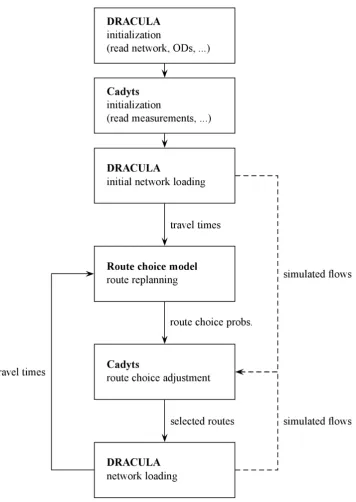
through files. The flow chart of Figure Error! Reference source not found. outlines the
interactions between the two systems. The program logic is implemented in a Python script
Figure 1: Interactions between DRACULA and Cadyts. The program flow is along the solid
After an initialization of both systems, DRACULA is executed once with an arbitrarily
selected route for each traveler. Hereafter, the iterations start. Given the most recent travel
times, the route choice model is evaluated for every single traveler, and the resulting prior
route choice probabilities are stored (recall that this includes the option of not making a trip).
This corresponds to an evaluation of (1). Cadyts then internally adjusts the route choice
probabilities according to (3), samples one route per trip-maker from the resulting posterior
distribution, and saves this route as the chosen alternative. DRACULA then loads all chosen
routes on the network. The resulting travel times are fed back to the route choice model, and
the iterations start anew.
Cadyts operates at the fully disaggregate level in that it deals with individual travelers
(trip makers) without associated OD pairs. The demand representation in DRACULA is based
on OD matrices (possibly separated by time slice and/or user class). In order to interact these
two approaches, DRACULA samples a population of trip-makers from the OD matrices in its
initialization step. Every trip-maker in this population is then maintained as a uniquely
identified entity throughout all following process steps, and its association to one particular
OD pair is also stored. This allows to re-aggregate estimated path flows and OD matrices
from the individually adjusted route choice behavior.
3 Experiments
We investigate the interactions of the Cadyts calibration with the DRACULA simulation
in a synthetic scenario. The purpose of these experiments is to clarify the functioning and the
capabilities of the approach. Experiments with real networks are the subject of future
research. The computational feasibility of the calibration methodology for large-scale
scenarios is demonstrated in Flötteröd et al. (2011b), where, however, a multi-agent
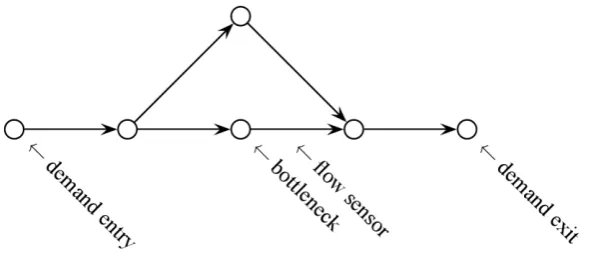
The experiments are run in the network shown in Figure 2. Demand enters the network at
the leftmost node, turns either left or goes straight at the diverge, and leaves the network at the
rightmost node. A traffic light is located in the center of the straight route, serving as a
bottleneck that generates congestion-dependent travel times. The link capacities and
geometrical layouts are chosen such that the traffic light constitutes the only bottleneck in the
system, and that free-flow travel is possible everywhere else. The two routes differ by 23
seconds under free-flow conditions (taking into account an average delay due to the signal)
and by 1 km in length. One may think of a straight route going through a city-center and of a
longer by-pass route. The difference in free-flow travel times corresponds to approximately
[image:16.595.159.457.352.488.2]17 % of the free-flow travel time on the straight route.
Figure 2: Test network
In this experiment, a population of 3000 drivers is considered. The stay-at-home probability
1 f is set to 1/3 in (2), which means that on average 2000 travelers decide to make a trip,
with a standard deviation of approximately 26 travelers. The scale parameter of the utility
function (negative travel time) in the logit choice model (1) is set to 0.01. Time is given in
seconds. This results in the following overall form of the utility function:
1
2
if is a route ( )
100 ln 1/ 2 100 exp 0.01 exp 0.01 if is stay-at-home
i n
t i
V i
t t i
where the second row results form an insertion of the concrete parameter values for and
f into (2). Considering both routes and the stay-at-home option, the choice set is hence
three-dimensional. The length of the analysis period is one hour, an the demand is distributed
uniformly over this time interval.
All calibration experiments follow the logic outlined in Figure 1. Plain simulations are
conducted by taking Cadyts out of the loop, which is the same as running the calibration with
an empty measurement file, i.e., with A{} in (3). All simulations and calibrations are run
for 100 iterations, which appears sufficient to reach stationary conditions by visual inspection
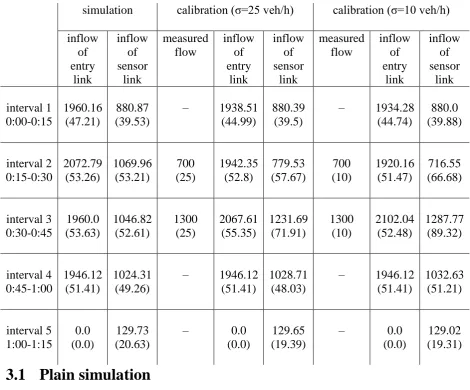
Table 1: Test results. Time intervals are written as “hours:minutes”, all other values are
vehicles per hour (veh/h).
simulation calibration ( =25 veh/h) calibration ( =10 veh/h)
inflow of entry link inflow of sensor link measured flow inflow of entry link inflow of sensor link measured flow inflow of entry link inflow of sensor link interval 1 0:00-0:15 1960.16 (47.21) 880.87 (39.53) – 1938.51 (44.99) 880.39 (39.5) – 1934.28 (44.74) 880.0 (39.88) interval 2 0:15-0:30 2072.79 (53.26) 1069.96 (53.21) 700 (25) 1942.35 (52.8) 779.53 (57.67) 700 (10) 1920.16 (51.47) 716.55 (66.68) interval 3 0:30-0:45 1960.0 (53.63) 1046.82 (52.61) 1300 (25) 2067.61 (55.35) 1231.69 (71.91) 1300 (10) 2102.04 (52.48) 1287.77 (89.32) interval 4 0:45-1:00 1946.12 (51.41) 1024.31 (49.26) – 1946.12 (51.41) 1028.71 (48.03) – 1946.12 (51.41) 1032.63 (51.21) interval 5 1:00-1:15 0.0 (0.0) 129.73 (20.63) – 0.0 (0.0) 129.65 (19.39) – 0.0 (0.0) 129.02 (19.31)
3.1 Plain simulation
A plain simulation in this setting results in the demand levels and simulated traffic counts
indicated in the first wide column (“simulation”) of Table 1. Every field of this table displays
two values: a mean value and a standard deviation (in brackets). All statistics are obtained
from the last 50 iterations of the respective runs.
The first simulation column displays the network entry flows. Their mean values are
consistent with the demand profile. Their standard deviations are higher than the 26 veh/h one
would expect from the binomial demand distribution, which is most likely a result of the link
after one hour, which means that no demand is held back at the network entry because of
congestion effects.
The second simulation column displays the simulated flows at the measurement location.
Roughly half of the total network entries take the straight route (and hence pass the sensor
location). Because it takes some time to reach the sensor link from the network entry, vehicles
enter the sensor link even after one hour. This effect is compounded by the traffic light right
upstream of the sensor link, which generates an additional delay for vehicles that take the
straight route.
Figures Figure 3 and Figure 4 show the evolution of the network and sensor link inflows
for two representative 15-min time interval over the iterations of the simulation. Since the
initial route assignment is a 50/50 split, the system stabilizes almost immediately around a
stationary distribution. The ongoing variability in the curves is due to (i) demand level
[image:19.595.114.481.426.652.2]fluctuations, (ii) route choice variations, and (iii) stochastic traffic flow dynamics.
Figure 4: Sensor link inflows [veh/h] over iterations of plain simulation
3.2 Calibration
The same one-hour peak period as before is considered, where the traffic counts (which
are arbitrarily constructed only in order to demonstrate the workings of the approach) are
given in four 15 min time intervals. We investigate the exploitation of this sensor data to the
adjustment of both the route choice and the total demand levels across all time slices. (Note
that the estimation takes place jointly for all time slices.) In summary, the calibrated
simulation adjusts to the measurements according to Algorithm 2 (which constitutes a
The second and third main column of Table 1 show the results of two calibration
experiments. In both experiments, the same measurement data is used: a measured flow that is
roughly 300 veh/h lower than the plain simulation in the second time interval, and a measured
flow that is roughly 300 veh/h higher than the plain simulation result in the third time interval.
Through this, we investigate the ability of the calibration to both increase and decrease
demand and path flow levels. No measurements are assumed to be available in the first and
fourth time interval in order to underline that the method functions with arbitrarily few
measurements. The two experiments differ in the standard deviation of the hypothetical sensor
data, which is 25 veh/h in the first calibration experiment (second main column) and 10 veh/h
in the second one (third main column).
In a nutshell, the calibration yields the effect one would expect from the sensor data: it
modifies both the demand levels and the route choice in a way that improves the measurement
reproduction, with the fit improving as the variance of the sensor data is reduced. This is
plausible in that the calibration is designed to generate a statistically consistent combination
of the prior information contained in the model system and the additional information
contained in the sensor data.
Algorithm 2 Iterated DTA microsimulation
1. Initialization. Give every traveler an initial perception of the conditions in the
network.
2. Iterations. Repeat the following until stationary conditions are reached.
a. Calibrated demand simulation. Trip-makers select new trips (or decide to
stay at home) based on Error! Reference source not found., using utilities
as defined in Error! Reference source not found..
Supplementary to Table 1, Figures Figure 5 and Figure 6 give the evolution of the
[image:22.595.115.479.151.373.2]calibrated network entry and sensor link entry flows over the iterations. Based on these
[image:22.595.119.480.421.643.2]figures and Table 1, three further observations can be made.
Figure 5: Network entries [veh/h] over iterations of calibration experiment 2 ( =10 veh/h)
Figure 6: Sensor link inflows [veh/h] over iterations of calibration experiment 2 ( =10 veh/h)
First, the adjustment of the demand levels is not as prominent as that of the route flows.
This is due to the behavioral distribution generated by the simulation system (without any
the relative variability in the route flows is higher than the variability in the demand levels.
Arguing in Bayesian terms (from which the calibration is indeed derived), this leaves greater
freedom for adjustments of the prior route choice distribution than for adjustments of the prior
demand level distribution, and hence the route flows are affected more strongly than the total
demand levels by the sensor data.
Second, the variability in the sensor link entry flows increases as the fit to the
measurements is increased. This is so because the measurements are selected to represent
out-of-equilibrium conditions (they differ substantially from the flows resulting from a plain
simulation): as the system is moved out of equilibrium, its sensitivity to the
bottleneck-induced delay on the straight route increases, hence the reaction of the route choice
model becomes stronger, and variability increases. This means that, although the calibration
only compares mean simulated and measured flows, it implicitly also adjusts the system
variability in a plausible way.
Third, the calibrated simulation attains quite rapidly a stationary state. Noting that the
behavioral adjustment process implemented by the calibration is embedded within the
iterative loop of the simulation, this indicates a vast computational advantage over usual
approaches where the iterative simulation is embedded within an outer adjustment loop of the
OD matrix. (The path flow estimator by Bell also is a one-step estimator, but it is yet to be
transferred to a microsimulation setting.) In the presented approach, no outer loop is present,
and the complexity of a calibration is in the order of a plain simulation: The computational
overhead of the calibration is limited to (i) calculating one utility addend per traffic count and
(ii) adding these numbers to the utilities of the alternatives each trip maker faces, cf. (3). The
memory complexity of the calibration is limited to storing these utility addends. Other
calibration is limited to a few percent of the total running time (Flötteröd et al., 2011a,
2011b).
Clearly, these results are conditional on the information obtainable with a single sensor.
Given that two only loosely couple path flows are to be estimated, one would expect a
supplementary sensor either on the detour link or at the network entry to provide more precise
estimates. In general, any sensor location strategy applicable to standard OD matrix
estimators can be deployed here as well.
4 Summary and outlook
This paper describes the first application of a novel OD matrix and path flow estimator
for iterated DTA microsimulations. The presented approach is derived from an agent-based
DTA calibration methodology that relies on an activity-based demand model. This work
explains how to apply the calibration in the trip-based domain and presents illustrative
examples that clarify its capabilities.
Summarizing, the following findings can be extracted from these experiments:
• the calibration interacts meaningfully with the simulation in that it improves the
measurement fit in the proper direction;
• the calibration accounts for the uncertainty assigned to the sensor data;
• the calibration accounts for the uncertainty in the prior system states (demand levels, route
choice) in that it adjusts such aspects more strongly that are represented a priori through a
wider distribution in the uncalibrated simulation;
• although the calibration directly evaluates only the mean deviation between simulated and
measured flows, the resulting shift of the system’s working point can come along with a
• the computational complexity of the calibration is in the order of a plain simulation.
Intelligent transportation systems are crucially dependent on efficient traffic monitoring
techniques. The proposed path flow estimator contributes to this field. Our ongoing work
focuses on the testing of the methodology for larger DRACULA networks that are based on
real scenarios. Future work will comprise various extensions of the Cadyts methodology,
including the incorporation of richer sensor data (vehicle re-identifications, smartphone data)
and the joint calibration of further demand and supply parameters along with the demand
estimation presented in this article.
References
Ashok, K. (1996). Estimation and Prediction of Time-Dependent Origin-Destination Flows,
PhD thesis, Massachusetts Institute of Technology.
Bell, M. (1991). The estimation of origin-destination matrices by constrained generalised least
squares, Transportation Research Part B 25(1): 13–22.
Bell, M. (1995). Stochastic user equilibrium assignment in networks with queues,
Transportation Research Part B 29(2): 125–137.
Bell, M.., Lam, W., Iida, Y. (1996). A time-dependent multi-class path flow estimator, in
Lesort (1996), pp. 173–193.
Bell, M., Shield, C., Busch, F., Kruse, G. (1997). A stochastic user equilibrium path flow
estimator, Transportation Research Part C 5(3/4): 197–210.
Ben-Akiva, M., Bierlaire, M. (2003). Discrete choice models with applications to departure
time and route choice, in R. Hall (ed.), Handbook of Transportation Science, 2nd edition,
Ben-Akiva, M., Bierlaire, M., Koutsopoulos, H., Mishalani, R. (1998). DynaMIT: a
simulation-based system for traffic prediction, Proceedings of the DACCORD Short
Term Forecasting Workshop, Delft, The Netherlands.
Ben-Akiva, M., Lerman, S. (1985). Discrete Choice Analysis, MIT Press series in
transportation studies, The MIT Press.
Bierlaire, M. (2002). The total demand scale: a new measure of quality for static and dynamic
origin-destination trip tables, Transportation Research Part B 36(9): 837–850.
Bierlaire, M., Crittin, F. (2006). Solving noisy large scale fixed point problems and systems of
nonlinear equations, Transportation Science 40(1): 44–63.
Bierlaire, M., Toint, P. (1995). MEUSE: an origin-destination estimator that exploits
structure, Transportation Research Part B 29(1): 47–60.
Cascetta, E. (1984). Estimation of trip matrices from traffic counts and survey data: a
generalised least squares estimator, Transportation Research Part B 18(4/5): 289–299.
Cascetta, E. (1989). A stochastic process approach to the analysis of temporal dynamics in
transportation networks, Transportation Research Part B 23(1): 1–17.
Cascetta, E., Cantarella, G. (1991). A day-to-day and within-day dynamic stochastic
assignment model, Transportation Research Part A 25(5): 277–291.
Cascetta, E., Inaudi, D., Marquis, G. (1993). Dynamic estimators of origin-destination
matrices using traffic counts, Transportation Science 27(4): 363–373.
Cascetta, E., Nuzzolo, A., Russo, F., Vitetta, A. (1996). A modified logit route choice model
overcoming path overlapping problems. Specification and some calibration results for
interurban networks., in Lesort (1996), pp. 697–711.
Cascetta, E., Posterino, N. (2001). Fixed point approaches to the estimation of o/d matrices
De Palma, A., Marchal, F. (2002). Real cases applications of the fully dynamic
METROPOLIS tool-box: an advocacy for large-scale mesoscopic transportation systems,
Networks and Spatial Economics 2: 347–369.
DRACULA (accessed 2011). DRACULA web site,
http://www.its.leeds.ac.uk/software/dracula/index.html.
DynaMIT (accessed 2011). DynaMIT web site, http://web.mit.edu/its/dynamit.html.
Flötteröd, G. (2008). Traffic State Estimation with Multi-Agent Simulations, PhD thesis,
Berlin Institute of Technology, Berlin, Germany.
Flötteröd, G. (2009). Cadyts – a free calibration tool for dynamic traffic simulations,
Proceedings of the 9th Swiss Transport Research Conference, Monte Verita/Ascona,
Switzerland.
Flötteröd, G. (accessed 2011). Cadyts web site, http://transp-or.epfl.ch/cadyts.
Flötteröd, G., Bierlaire, M. (2009). Improved estimation of travel demand from traffic counts
by a new linearization of the network loading map, Proceedings of the European
Transport Conference, Noordwijkerhout, The Netherlands.
Flötteröd, G., Bierlaire, M., Nagel, K. (2011a). Bayesian demand calibration for dynamic
traffic simulations, Transportation Science 45(4): 541–561.
Flötteröd, G., Chen, Y., Nagel, K. (2011b). Behavioral calibration and analysis of a
large-scale travel microsimulation, Networks and Spatial Economics.
Frejinger, E. 2008. Route Choice Analysis: Data, Models, Algorithms and Applications, PhD
thesis, École Polytechnique Fédérale de Lausanne.
Hollander, Y., Liu, R. (2008). The principles of calibrating traffic microsimulation models,
Transportation 35(3): 347–362.
Horni, A., Scott, D., Balmer, M., Axhausen, K. (2008). Location choice modeling for
geography, Technical Report 527, Institute for Transport Planning and Systems, Swiss
Federal Institute of Technology Zurich.
INRO (accessed 2011). Dynameq web site, http://www.inro.ca/en/products/dynameq/.
Lesort, J.-B. (ed.) (1996). Proceedings of the 13th International Symposium on
Transportation and Traffic Theory, Pergamon, Lyon, France.
Liu, R. (2005). The DRACULA dynamic traffic network microsimulation model, in
R. Kitamura M. Kuwahara (eds), Simulation Approaches in Transportation Analysis:
Recent Advances and Challenges, Springer, pp. 23–56.
Liu, R., Tate, J. (2004). Network effects of intelligent speed adaptation systems,
Transportation 31(3): 297–325.
Liu, R., van Vliet, D., Watling, D. (2006). Microsimulation models incorporating both
demand and supply dynamics, Transportation Research Part A 40: 125–150.
Maher, M. (1983). Inferences on trip matrices from observations on link volumes: a Bayesian
statistical approach, Transportation Research Part B 17(6): 435–447.
Maher, M., Zhang, X., Van Vliet, D. (2001). A bi-level programming approach for trip matrix
estimation and traffic control problems with stochastic user equilibrium link flows,
Transportation Research Part B 35(1): 23–40.
Nagel, K., Flötteröd, G. (2012). Agent-based traffic assignment: going from trips to
behavioral travelers, in C. Bhat, R. Pendyala (eds), Travel Behaviour Research in an
Evolving World, Emerald Group Publishing, Bingley, United Kingdom, chapter 12, pp
261–293.
Nagel, K., Rickert, M., Simon, P., Pieck, M. (1998). The dynamics of iterated transportation
simulations, Proceedings of the 3rd Triennial Symposium on Transportation Analysis,
San Juan, Puerto Rico.
Nie, Y., Lee, D.-H. (2002). An uncoupled method for the equilibrium-based linear path flow
estimator for origin-destination trip matrices, Transportation Research Record
1783: 72–79.
Nie, Y., Zhang, H., Recker, W. (2005). Inferring origin-destination trip matrices with a
decoupled GLS path flow estimator, Transportation Research Part B 39(6): 497–518.
Panis, L., Broekx, S., Liu, R. (2006). Modelling instantaneous traffic emission and the
influence of traffic speed limits, Science of the Total Environment 371: 270–285.
Quadstone Paramics Ltd. (accessed 2011). Paramics web site,
http://www.paramics-online.com.
Raney, B., Nagel, K. (2006). An improved framework for large-scale multi-agent simulations
of travel behavior, in P. Rietveld, B. Jourquin K. Westin (eds), Towards better
performing European Transportation Systems, Routledge, pp. 305–347.
Sherali, H., Narayan, A., Sivanandan, R. (2003). Estimation of origin-destination trip-tables
based on a partial set of traffic link volumes, Transportation Research Part B
37(9): 815–836.
Sherali, H., Park, T. (2001). Estimation of dynamic origin-destination trip tables for a general
network, Transportation Research Part B 35(3): 217–235.
Sherali, H., Sivanandan, R., Hobeika, A. (1994). A linear programming approach for
synthesizing origin-destination trip tables from link traffic volumes, Transportation
Research Part B 28(3): 213–233.
Spiess, H. (1987). A maximum likelihood model for estimating origin-destination models,
Transportation Research Part B 21(5): 395–412.
TSS Transport Simulation Systems (2006). AIMSUN 5.1 Microsimulator User’s Manual
TSS Transport Simulation Systems (accessed 2011). AIMSUN web site,
http://www.aimsun.com.
van Zuylen, H., Willumsen, L. G. (1980). The most likely trip matrix estimated from traffic
counts, Transportation Research Part B 14(3): 281–293.
Yang, H. (1995). Heuristic algorithms for the bilevel origin/destination matrix estimation
problem, Transportation Research Part B 29(4): 231–242.
Yang, H., Sasaki, T., Iida, Y. (1992). Estimation of origin-destination matrices from link
traffic counts on congested networks, Transportation Research Part B 26(6): 417–434.
Zhou, X. (2004). Dynamic Origin-Destination Demand Estimation and Prediction for
Off-Line and On-Line Dynamic Traffic Assignment Operation, PhD thesis, University of
![Figure 3: Network entries [veh/h] over iterations of plain simulation](https://thumb-us.123doks.com/thumbv2/123dok_us/7933191.194147/19.595.114.481.426.652/figure-network-entries-veh-h-iterations-plain-simulation.webp)
![Figure 4: Sensor link inflows [veh/h] over iterations of plain simulation](https://thumb-us.123doks.com/thumbv2/123dok_us/7933191.194147/20.595.117.478.68.288/figure-sensor-link-inflows-veh-iterations-plain-simulation.webp)
![Figure 5: Network entries [veh/h] over iterations of calibration experiment 2 (�=10 veh/h)](https://thumb-us.123doks.com/thumbv2/123dok_us/7933191.194147/22.595.119.480.421.643/figure-network-entries-veh-iterations-calibration-experiment-veh.webp)
