DECOMPOSABLE PERMUTATIONS
ALEXANDER BURSTEIN, V´IT JEL´INEK, EVA JEL´INKOV ´A, AND EINAR STEINGR´IMSSON
Abstract. We give a recursive formula for the M¨obius function of an interval [σ, π] in the poset of permutations ordered by pattern containment in the case whereπis a decomposable permutation, that is, consists of two blocks where the first one contains all the letters 1,2, . . . , kfor somek. This leads to many special cases of more explicit formulas. It also gives rise to a computationally efficient formula for the M¨obius function in the case whereσandπare separa-ble permutations. A permutation is separasepara-ble if it can be generated from the permutation 1 by successive sums and skew sums or, equivalently, if it avoids the patterns 2413 and 3142.
We also show that the M¨obius function in the poset of separable permu-tations admits a combinatorial interpretation in terms of normal embeddings among permutations. A consequence of this interpretation is that the M¨obius function of an interval [σ, π] of separable permutations is bounded by the num-ber of occurrences ofσas a pattern inπ. Another consequence is that for any separable permutationπthe M¨obius function of (1, π) is either 0, 1 or−1.
1. Introduction
Let Sn be the set of permutations of the integers {1,2, . . . , n}. The union of all
Sn forn= 1,2, . . . forms a posetP with respect to pattern containment. That is,
we define σ≤π in P if there is a subsequence of πwhose letters are in the same
order of size as the letters inσ. For example, 132≤24153, because 2,5,3 appear in
the same order of size as the letters in 132. We denote the number ofoccurrences
of σin π byσ(π), for example 132(24153) = 3, since 243, 253 and 153 are all the
occurrences of the pattern 132 in 24153.
A classical goal in the study of a combinatorially defined poset is to determine
its M¨obius function. For our poset P this seems to have first been mentioned
explicitly by Wilf [8]. The first result in this direction was given by Sagan and
Vatter [5], who showed that an interval [σ, π] oflayeredpermutations is isomorphic
to a certain poset of compositions of an integer, and they gave a formula for the M¨obius function in this case. A permutation is layered if it is the concatenation of decreasing sequences, such that the letters in each sequence are smaller than all letters in subsequent sequences. Further results were given by Steingr´ımsson
and Tenner [7], who showed that the M¨obius function µ(σ, π) is 0 whenever the
complement of the occurrences of σ in πcontains an interval block, that is, when
π has a segment of two or more consecutive letters that form a segment of values,
where none of these consecutive letters belongs to any occurrence of σin π. One
Key words and phrases. M¨obius function, pattern poset, decomposable permutations, separa-ble permutations.
Jel´ınek and Steingr´ımsson were supported by grant no. 090038012 from the Icelandic Research Fund. Jel´ınek was also supported by grant Z130-N13 from the Austrian Science Foundation (FWF).
example of such a pair is (132,598342617), where the letters 342 do not belong to any occurrence of 132 in 598342617. Steingr´ımsson and Tenner [7] also described
certain intervals where the M¨obius function is either 1 or−1.
In this paper, we focus on permutations that can be expressed as direct sums or
skew sums of smaller permutations. A direct sum of two permutationsα and β,
denoted by α⊕β, is the concatenationαβ0, whereβ0 is obtained by incrementing
each element of β by|α|. For example, 31426587 can be written as a direct sum
3142⊕2143. Similarly, a skew sum α β is the concatenation α0β where α0 is
obtained by incrementingαby|β|.
A permutation that can be written as a direct sum of two nonempty permutations isdecomposable, and a permutation that can be written as a skew sum of nonempty
permutations is skew-decomposable. The decomposition of a permutation π is an
expression π =π1⊕π2⊕ · · · ⊕πk in which each summand πi is indecomposable.
The summands π1, . . . , πk will be calledthe components ofπ. Every permutation
has a unique decomposition (including an indecomposable permutation π, whose
decomposition has a single component equal to π).
A permutation is separable if it can be obtained from the singleton permutation 1
by iterating direct sums and skew sums (for an alternative definition see Section 2).
Our main result is a set of recurrences for computing the M¨obius function µ(σ, π)
when π is decomposable. If π1⊕ · · · ⊕πk is the decomposition of π, then these
recurrences expressµ(σ, π) in terms of M¨obius functions involving the summandsπi.
In the special case whenπis separable, these recurrences provide a polynomial-time
algorithm to computeµ(σ, π). These recurrences also allow us to obtain an
alterna-tive combinatorial interpretation of the M¨obius function of separable permutations,
based on the concept of ‘normal embeddings’. This interpretation ofµ generalizes
previous results of Sagan and Vatter [5] for layered permutations.
Using these expressions of the M¨obius function in terms of normal embeddings, we
derive several bounds on the values of µ(σ, π) whereσandπare separable. In [7],
Steingr´ımsson and Tenner conjectured that for permutations σandπavoiding the
pattern 132 (or any one of the patterns 213, 231, 312) the absolute value of the
M¨obius function of the interval [σ, π] is bounded by the number of occurrences ofσ
inπ. We prove this conjecture for the more general class of separable permutations
(for non-separable σand πthis bound does not hold in general). In particular, if
π has a single occurrence of σ then µ(σ, π) is either 1, 0 or−1. We also prove a
generalization of another conjecture mentioned in [7], showing that for any separable permutationπ,µ(1, π) is either 1, 0 or−1.
For a non-separable decomposable permutationπ, our recurrences are not sufficient
to compute the value ofµ(σ, π). However, our results imply that the M¨obius
func-tion can be efficiently computed in any hereditary class of permutafunc-tions in which every sufficiently large element is decomposable or skew-decomposable.
Moreover, we are to give short simple formulas in many special cases. For instance,
suppose that σ is indecomposable and that π is decomposable and of length at
least 3. Then we show that µ(σ, π) can only be nonzero if all the components in
the decomposition ofπare equal to the same permutation π0>1, except possibly
the first and the last component, which may be equal to 1. In such cases, µ(σ, π)
equals (−1)iµ(σ, π0), wherei
∈ {0,1,2}is the number of components ofπthat are
equal to 1.
As another simple example, our results imply that when σ and π are
different from 1, then µ(σ, π) = µ(σ1, π1)µ(σ2, π2) if π1 6= π2, and µ(σ, π) =
µ(σ1, π1)µ(σ2, π2) +µ(σ, π1) ifπ1=π2.
The paper is organized as follows: In the next section we provide necessary defini-tions. In Section 3 we present the main results, the recursive formulas for reducing
the computation of the M¨obius function of decomposable permutations to that of
indecomposable permutations. Section 4 deals with the case of separable permu-tations and their normal embeddings. Finally, in Section 5 we mention some open problems, in particular questions about the topology of the order complexes of intervals in our poset, which we have not dealt with in the present paper.
2. Definitions and Preliminaries
An interval [σ, π] in a poset (P,≤) is the set {ρ: σ ≤ ρ ≤ π}. In this paper, we deal exclusively with intervals of the poset of permutations ordered by pattern containment.
The M¨obius function µ(σ, π) of an interval [σ, π] is uniquely defined by setting
µ(σ, σ) = 1 for allσand requiring that
(1) X
ρ∈[σ,π]
µ(σ, ρ) = 0
for every σ < π. Whenσ6≤π, we define µ(σ, π) to be zero.
An equivalent definition is given by Philip Hall’s Theorem [6, Proposition 3.8.5], which says that
(2) µ(σ, π) = X
C∈C(σ,π)
(−1)L(C)=X i
(−1)ici,
whereC(σ, π) is the set of chains in [σ, π] that contain bothσandπ,L(C) denotes
the length of the chain C, and ci is the number of such chains of length i in
[σ, π]. A chain of lengthiin a poset is a set ofi+ 1 pairwise comparable elements
x0< x1<· · ·< xi. For details and further information, see [6].
Recall that a permutation isseparable if it can be generated from the permutation 1
by iterated sums and skew sums. In other words, a permutation is separable if and only if it is equal to 1 or it can be expressed as a sum or skew sum of separable permutations.
Being separable is equivalent to avoiding the patterns 2413 and 3142, that is, con-taining no occurrences of either. Separable permutations have nice algorithmic
properties. For instance, Bose, Buss and Lubiw [2] have shown that when σand
π are separable, it can be decided whether σ ≤ π in time that is polynomial in
|σ|+|π|, while for general permutations the problem is NP-hard.
It is sometimes convenient to allow permutations to have zero length, while in other situations, the permutations are assumed to be nonempty. The unique permutation of length 1 is denoted by 1, and the unique permutation of length 0 is denoted
by ∅. We make it a convention that the permutation ∅ is neither decomposable
nor indecomposable. In other words, whenever we say that a permutation π is
decomposable (or indecomposable), we automatically assume that πis nonempty.
Suppose thatπis a nonempty permutation with decompositionπ1⊕ · · · ⊕πn. For
an integer i∈ {0, . . . , n}, we letπ≤i denote the sumπ1⊕π2⊕ · · · ⊕πi and letπ>i
denote the sum πi+1⊕ · · · ⊕πn. An empty sum of permutations is assumed to be
equal to ∅, so in particular π≤0=π>n =∅. Any permutation of the formπ≤i for
of π. Note thatµ(∅,∅) = 1, µ(∅,1) =−1, and it is easily seen thatµ(∅, τ) = 0 for any τ >1.
3. The Main Results
Throughout this section, we assume thatσis a nonempty permutation with
decom-positionσ1⊕· · ·⊕σmand thatπ=π1⊕· · ·⊕πn is a decomposable permutation (so
n≥2 and, in particular,πis nonempty). The goal in this section is to prove a set
of recurrences that allow us to express the M¨obius functionµ(σ, π) in terms of the
values of the formµ(σ0, π0), whereπ0
∈ {π1, . . . , πn}is a component ofπandσ0 is
a sum of consecutive components ofσ. Note that σmay itself be indecomposable,
in which casemis equal to 1 and σ1=σ.
There are two main recurrences to prove, dealing respectively with the casesπ1= 1
and π1>1.
Proposition 1 (First Recurrence). Let σ and π be nonempty permutations with decompositions σ =σ1⊕ · · · ⊕σm andπ =π1⊕ · · · ⊕πn, wheren ≥2. Suppose
thatπ1= 1. Letk≥1be the largest integer such that all the componentsπ1, . . . , πk
are equal to 1, and let ` ≥ 0 be the largest integer such that all the components σ1, . . . , σ` are equal to1. Then
µ(σ, π) =
0 ifk−1> `,
−µ(σ>k−1, π>k) ifk−1 =`,
µ(σ>k, π>k)−µ(σ>k−1, π>k) ifk−1< `.
Note that the suffixes σ>k−1,σ>k andπ>kin the statement of Proposition 1 may
be empty. This first recurrence shows how to compute the M¨obius function when
π starts with 123. . . k for some k ≥ 1. The second recurrence takes care of the
remaining cases, that is, when πdoes not start with 1.
Proposition 2 (Second Recurrence). Let σandπbe nonempty permutations with decompositionsσ=σ1⊕ · · · ⊕σmandπ=π1⊕ · · · ⊕πn, wheren≥2. Suppose that
π1>1. Letk≥1 be the largest integer such that all the componentsπ1, . . . , πk are
equal to π1. Then
(3) µ(σ, π) =
m X
i=1
k X
j=1
µ(σ≤i, π1)µ(σ>i, π>j).
Note that Propositions 1 and 2 remain true when all the direct sums are replaced with skew sums, and the decompositions are replaced with skew decompositions.
To see this, it is enough to observe that if ¯π denotes the reversal of π (i.e., ¯π is
the permutation obtained by reversing the order of elements ofπ), then µ(σ, π) =
µ(¯σ,π¯) for anyσandπ, since [σ, π] and [¯σ,π¯] are isomorphic posets.
Before we prove the above two recurrences, we give three corollaries to provide some
idea of how the second recurrence can be used. When we write k×π we mean a
sumπ⊕π⊕ · · · ⊕πwith ksummands.
Corollary 3. Let σ, π andk be as in Proposition 2, and suppose that σ is inde-composable, that is,m= 1. Then
µ(σ, π) =
µ(σ, π1), ifπ=k×π1 −µ(σ, π1), ifπ=k×π1⊕1
Proof. Sincem= 1, Equation (3) takes the form
µ(σ, π) = k X
j=1
µ(σ≤1, π1)µ(σ>1, π>j)
= k X
j=1
µ(σ, π1)µ(∅, π>j)
=µ(σ, π1)µ(∅, π>k),
where the last equality follows from the fact that µ(∅, π>j) is equal to 0 whenever π>j has more than one component.
We have µ(∅, π>k) = 1 when π>k = ∅, µ(∅, π>k) = −1 when π>k = 1, and µ(∅, π>k) = 0 otherwise. In particular,µ(∅, π>k) can only be nonzero either when
k=nandπ=k×π1, or when k=n−1 andπ=k×π1⊕1.
Corollary 3 implies that ifσis indecomposable andπis decomposable, then almost
always µ(σ, π) = 0, since the two exceptions for π given in the corollary are of
a proportion that clearly goes to zero among decomposable permutations as their length goes to infinity.
Corollary 4. With σ andπas in Proposition 2, assume that σand πdecompose into exactly two components, withσ=σ1⊕σ2 andπ=π1⊕π2, and thatπ1, π2>1.
Then
µ(σ, π) = (
µ(σ1, π1)µ(σ2, π2), if π16=π2
µ(σ1, π1)µ(σ2, π2) +µ(σ, π1) if π1=π2
Proof. Ifπ16=π2 (sok= 1), then the summation in Equation (3) expands into
µ(σ, π) =µ(σ1, π1)µ(σ2, π2) +µ(σ, π1)µ(∅, π2).
Sinceπ2>1, the second summand vanishes andµ(σ, π) =µ(σ1, π1)µ(σ2, π2).
If, on the other hand, π1=π2, then Equation (3) states thatµ(σ, π) is equal to
µ(σ1, π1)µ(σ2, π2) +µ(σ1, π1)µ(σ2,∅) +µ(σ, π1)µ(∅, π2) +µ(σ, π1)µ(∅,∅)
=µ(σ1, π1)µ(σ2, π2) +µ(σ, π1).
Remark 5. An obvious question to ask is whether the product formulaµ(σ, π) = µ(σ1, π1)µ(σ2, π2), in the case whenπ16=π2, is a result of the interval [σ, π] being
isomorphic to the direct product of the intervals [σ1, π1] and [σ2, π2]. Although this
seems to occur frequently, it does not hold in general. As an example, consider the
intervals I1 = [1,21] and I2 = [1,231]. The product I1×I2 has eight elements,
whereas the interval [1⊕1,21⊕231] has nine. More generally, for two
indecompos-able permutationsσ1andσ2, defineπ1=σ1 1 andπ2= (σ1⊕σ2) 1. Then the
product of the intervalsI1= [σ1, π1] andI2= [σ2, π2] has fewer elements than the
interval I = [σ1⊕σ2, π1⊕π2]. To see this, note that an element (α, β)∈I1×I2
can be mapped to an element α⊕β ∈ I, and this is easily seen to be an
injec-tive mapping; however, I also contains the permutation (σ1⊕σ2) 1 which is
indecomposable and therefore not in the image of this mapping.
The following corollary is an immediate consequence of Proposition 1 (the case
whenk−1 =`= 0).
Both recurrences (Propositions 1 and 2) are proved using arguments that involve cancellation between certain types of chains in the poset of permutations. Let us first introduce some useful notation. For a chain C ={α0 < α1 <· · · < αk} of
permutations let L(C) denote the length of C, which is one less than the number
of elements ofC. Theweight of C, denoted by w(C), is the quantity (−1)L(C). If
C is any set of chains, then theweight of Cis defined by
w(C) =X C∈C
w(C) =X C∈C
(−1)L(C).
Recall that C(σ, π) is the set of all the chains from σ to π that contain both σ
and π. We know thatµ(σ, π) =w(C(σ, π)), by Philip Hall’s Theorem.
For a chain C={α0< α1<· · ·< αk}and a permutation β, we let β⊕C denote
the chain{β⊕α0< β⊕α1<· · ·< β⊕αk}. The chainC⊕βis defined analogously.
3.1. Proof of the first recurrence. Let us now turn to the proof of Proposition 1.
Suppose thatσ,π,m,n,k, and`are as in the statement of the proposition. For a
permutationτ, define thedegree ofτ, denoted by deg(τ), to be the largest integerd
such thatτcan be expressed asd×1⊕τ0for some (possibly empty) permutationτ0.
In particular, we have k= deg(π) and`= deg(σ).
Let C={τ0 < τ1 <· · · < τp} be a chain of permutations. We say that a
permu-tation τi∈C is thepivot of the chain C, if deg(τi)<deg(τj) for each j > i, and
deg(τi) ≤deg(τj) for each j ≤i. In other words, the pivot is the element of the
chain with minimum degree, and if there are more elements of minimum degree, the pivot is the largest of them.
Let ρdenote the permutationπ>1. Obviously deg(ρ) =k−1 and 1⊕ρ=π. We
partition the set of chains C(σ, π) into three disjoint subsets, denoted by Ca, Cb
andCc, and we compute the weight of each subset separately. A chainC∈C(σ, π)
belongs toCaif its pivot is the permutationπ, the chainCbelongs toCbif its pivot
is the permutation ρ, and C belongs to Cc otherwise. We now separate the main
steps of the proof into independent claims.
Claim 7. If deg(σ)<deg(π)(so ` < k), thenCa is empty. Otherwise, w(Ca) = µ(σ>k, π>k).
Proof. Obviously, if deg(σ) < deg(π), then no chain from σ to π can have π for pivot, because the pivot must have minimal degree among the elements of the chain.
Thus,Ca is empty.
Assume now that deg(σ) ≥ deg(π). We show that there is a length-preserving
bijection between the set of chains C(σ>k, π>k) and the set of chains Ca. Indeed, take any chainC∈C(σ>k, π>k), and create a new chainf(C) = (k×1)⊕C. Then f(C) is a chain fromσtoπ, and since every element off(C) has degree at leastk, whileπhas degree exactlyk, we see thatπis the pivot off(C). Hencef(C)∈Ca.
On the other hand, if C0 is any chain from C
a, we see that each element of C0
has degree at least k, because πhas degree kand is the pivot of C0. Thus, every
element τ0
∈ C0 is of the form k
×1⊕τ for some τ, and hence there exists a
chain C ∈ C(σ>k, π>k) such that C0 = f(C). Since f is clearly injective and
length-preserving, we conclude that w(Ca) = w(C(σ>k, π>k)) = µ(σ>k, π>k), as
claimed.
Claim 8. Ifdeg(σ)<deg(ρ)(so` < k−1), thenCb is empty. Otherwise,w(Cb) =
Proof. If deg(σ)<deg(ρ) thenρcannot be the pivot of any chain containingσand
Cb is empty.
Assume now that deg(σ) ≥deg(ρ). We will describe a parity-reversing bijection
f between the set of chainsC(σ>k−1, π>k) and the set of chains Cb. Take a chain C∈C(σ>k−1, π>k). Define a new chainC0 byC0= ((k−1)×1)⊕C. Notice that
C0 is a chain fromσto ρwhose pivot isρand whose length is equal to the length
of C. Define the chain f(C) byf(C) =C0
∪ {π}. Then the chainf(C) belongs to
Cb and has length L(C) + 1. It is again easy to see that f is a bijection between
C(σ>k−1, π>k) andCb, which shows that
w(Cb) =−w(C(σ>k−1, π>k)) =−µ(σ>k−1, π>k),
as claimed.
Claim 9. We havew(Cc) = 0.
Proof. We construct a parity-reversing involution f:Cc → Cc. Let C be a chain fromCc, letτbe its pivot, and letτ0be the successor ofτ inC. By definition ofCc,
τ is not equal toπ, so τ0 is well defined. From the definition of a pivot, we know
that deg(τ)<deg(τ0). Let us distinguish two cases:
(1) Ifτ0 = 1
⊕τ, we define a new chainf(C) byf(C) =C\ {τ0
}. Note that in
this case, we know that τ0 is different from π, because otherwiseτ would
be equal to ρ, contradicting the definition ofCc. Thus, f(C)∈ Cc. Note
that τ is a pivot off(C).
(2) Ifτ0 6= 1⊕τ, then we easily deduce thatτ0 >1⊕τ (recall that deg(τ0)>
deg(τ)). We then define a new chainf(C) =C∪ {1⊕τ}, in which the new
element 1⊕τ is inserted betweenτ andτ0.
The mappingf is easily seen to be an involution on the setCc which preserves the
pivot and maps odd-length chains to even-length chains and vice versa. This shows
that w(Cc) = 0, as claimed.
From these claims, Proposition 1 easily follows. Indeed, Claim 9 implies that µ(σ, π) =w(Ca) +w(Cb). From Claims 7 and 8 we deduce the values ofµ(σ, π):
• Ifk−1> `then bothCa andCb are empty andµ(σ, π) = 0.
• Ifk−1 =` thenCa is empty andµ(σ, π) =w(Cb) =−µ(σ>k−1, π>k). • Ifk−1< `, thenµ(σ, π) =w(Ca) +w(Cb) =µ(σ>k, π>k)−µ(σ>k−1, π>k).
This completes the proof of Proposition 1.
3.2. Proof of the second recurrence. It remains to prove Proposition 2. The
proof is again based on cancellation among the chains fromσto π. Before stating
the proof, we need more terminology and several lemmas.
Letα,β andρbe any permutations. We say thatαis aρ-tight subpermutation of
β, denoted byα<ρβ, ifα < β butρ⊕αis not contained inβ. We say that a chain
{α0 < α1<· · ·< αk}is ρ-tight ifαi−1
ρ
<αi for everyi= 1, . . . , k. LetCρ(α, β) be the set of all theρ-tight chains fromαtoβ.
The following simple properties ofρ-tightness follow directly from the definitions.
Proof. This is an immediate consequence of the fact thatαis contained inβ if and
only ifα⊕γ is contained inβ⊕γ, and thatρ⊕αis contained inβ if and only if
ρ⊕α⊕γ is contained inβ⊕γ.
Lemma 11. If ρis a nonempty indecomposable permutation, and if α andβ are arbitrary permutations, then ρ⊕α<1ρ⊕β if and only if α
ρ <β.
Proof. Suppose first that we have ρ⊕α<1ρ⊕β. This implies α < β. If we also
hadρ⊕α≤β, this would mean that 1⊕ρ⊕α≤ρ⊕ρ⊕α≤ρ⊕β, contradicting
ρ⊕α<1ρ⊕β. Thereforeρ⊕αis not contained inβ, and henceα<ρβ.
Conversely, assume thatα<ρβ. This means thatρ⊕α < ρ⊕β. Sinceρis
indecom-posable, any embedding ofρ⊕αintoρ⊕β must embedρinto a single component
of ρ⊕β. Moreover, ρ⊕αis not contained in β because of the assumptionα<ρβ.
Consequently, any embedding of ρ⊕α into ρ⊕β must embed the leftmost
com-ponent ofρ⊕αonto the leftmost component ofρ⊕β (both these components are
equal to ρ). Consequently, there can be no embedding of 1⊕ρ⊕α into ρ⊕β,
showing that ρ⊕α<1ρ⊕β, as claimed.
The next lemma shows the relevance ofρ-tightness for the computation ofµ.
Lemma 12. Let β be a permutation with decomposition β =β1⊕β2⊕ · · · ⊕βp.
Let ρbe a nonempty indecomposable permutation, and let αbe any permutation.
(1) If ρ6=β1, thenµ(α, β) =w(Cρ(α, β)).
(2) If ρ=β1, thenµ(α, β) =w(Cρ(α, β))−w(Cρ(α, β>1)).
Proof. Let us first deal with the first claim of the lemma. Let us define bC =
C(α, β)\Cρ(α, β) to be the set of all the chains from αtoβ that are notρ-tight.
The first part of the lemma is equivalent to saying that w(Cb) = 0. To prove this,
we find a parity-reversing involutionf on the setbC.
Consider a chain C={α=α0< α1<· · ·< αq =β} ∈Cb. SinceC is notρ-tight,
there is an index isuch thatρ⊕αi ≤αi+1. Fix the smallest such value ofi. We
distinguish two cases: eitherρ⊕αi< αi+1, or ρ⊕αi=αi+1.
Ifρ⊕αi< αi+1, define a new chain
f(C) =C∪ {ρ⊕αi}={α=α0< α1<· · ·< αi < ρ⊕αi< αi+1<· · ·< αq =β}.
On the other hand, ifρ⊕αi=αi+1, define a new chain
f(C) =C\ {ρ⊕αi}={α=α0< α1<· · ·< αi< αi+2<· · ·< αq =β}.
Note that, since we assume that ρ 6= β1 and thatρ is indecomposable, we know
that ρ⊕αi is not equal to β. Moreover, in the chain f(C) the element αi is not
a ρ-tight subpermutation of its successor in the chain. Thus, we see thatf(C) is
a chain from bC. It is easy to see thatf is an involution, and that it reverses the
parity of the length of the chain, showing that w(Cb) = 0. This proves the first part
of the lemma.
Let us prove the second part. Assume that ρ=β1, that is,β =ρ⊕β>1. Consider
a chain C from αto β, and let α0, α1, . . . , αq be the elements of C. We say that
the chainC isalmost ρ-tight if its second largest elementαq−1is equal toβ>1and
if αi−1
ρ
<αi for eachi≤q−1. Note that an almostρ-tight chain is neverρ-tight,
We partition the setC(α, β) into three disjoint setsCa,Cb, andCc, whereCa is the setCρ(α, β) ofρ-tight chains,C
b is the set of almostρ-tight chains, andCc contains
the chains that are neither ρ-tight nor almostρ-tight.
Consider again the mapping f defined in the proof of the first part of the lemma.
This mapping, restricted to the setCc, is easily seen to be a parity-reversing
involu-tion onCc, which shows thatw(Cc) = 0. This means thatµ(α, β) =w(Ca) +w(Cb).
Furthermore, note that an almost ρ-tight chain from α to β consists of a ρ
-tight chain from α to β>1 followed by β, and conversely, any ρ-tight chain from
α to β>1 can be extended to an almost ρ-tight chain from α to β by adding
the element β. Thus, we see that w(Cb) = −w(Cρ(α, β>1)). This implies that
µ(α, β) =w(Cρ(α, β))−w(Cρ(α, β>1)), as claimed.
The next lemma is an easy consequence of Lemma 12.
Lemma 13. Letβ be a permutation with decompositionβ =β1⊕β2⊕ · · · ⊕βp. Let
ρ be an indecomposable permutation, and let α be any permutation. Let q≥0 be the largest integer such that the components β1, β2, . . . , βq are all equal to ρ. Then
w(Cρ(α, β)) = q X
i=0
µ(α, β>i).
Proof. Proceed by induction on q. If q = 0, the claim reduces to the identity
w(Cρ(α, β)) = µ(α, β), which follows from the first part of Lemma 12. Suppose
that q >0. Then the second part of Lemma 12 applies and we get that
µ(α, β) =w(Cρ(α, β))−w(Cρ(α, β>1)),
which is equivalent to
(4) w(Cρ(α, β)) =µ(α, β) +w(Cρ(α, β>1)).
By induction, we know that
w(Cρ(α, β>1)) =
q−1
X
i=0
µ(α,(β>1)>i) = q X
i=1
µ(α, β>i).
Combining this with (4), we obtain the desired identity.
Before we proceed towards the proof of Proposition 2, we need to introduce more
definitions. Letβbe a permutation with decompositionβ1⊕ · · · ⊕βpinto
indecom-posable components, let αbe any permutation. LetC be a chain of permutations,
with elements α= α0 < α1 <· · · < αq =β. We express each elementαi of the
chain as a sum of two permutations, called head andtail, denoted respectively as
hi(C) andti(C), with αi =hi(C)⊕ti(C). The head and tail are defined
induc-tively as follows: for i=q, we have αi =αq =β and we definehq(C) =β1 and
tq(C) =β>1.
Suppose now that the head and tail ofαihave been already defined, and let us define
head and tail ofαi−1. Let us putγ=αi−1, and assume that γhas decomposition
γ1⊕γ2⊕ · · · ⊕γr into indecomposable components. Letj be the smallest integer
such thatγ>j≤ti(C). It then follows thatγ≤j≤hi(C). We definehi−1(C) =γ≤j
and ti−1(C) = γ>j. In other words, the tail of αi−1 is its longest suffix that is
contained in the tail of αi.
If the chain C is clear from the context, we writehi and ti instead of hi(C) and
We say that the chain C of length q is split if there is an index s ∈ {0, . . . , q}
such that t0 =t1 =· · · =ts and hs=hs+1 =· · ·=hq. Such an indexs is then
necessarily unique. The next lemma demonstrates the relevance of these notions.
Lemma 14. Let β be a permutation with decomposition β1⊕β2⊕ · · · ⊕βp such
that β16= 1. Let αbe an arbitrary permutation. LetC∗ be the set of all the chains
from C(α, β)which are split and1-tight. Then µ(α, β) =w(C∗).
Proof. By the first part of Lemma 12, we know thatµ(α, β) is equal tow(C1(α, β)),
that is, to the total weight of all the 1-tight chains from αto β. Define the set
b
C=C1(α, β)
\C∗ of all the 1-tight, non-split chains fromαto β.
To prove the lemma, we need to show thatw(bC) = 0. To achieve this, we again use
a parity-reversing involutionf on the setbC. Consider a chainC∈bCwith elements
α0 < α1 <· · · < αq. Clearly, for any two consecutive elements αj−1 < αj of C,
one of these three cases occurs: eitherhj−1< hj and tj−1< tj, orhj−1< hj and
tj−1=tj, orhj−1 =hj andtj−1< tj. A chain is split if and only if the first case
never occurs, and all occurrences of the second case appear lower in the chain than
any occurrence of the third case. Since C is not split, there must exist an index
j ∈ {1, . . . , q} such that either
(1) hj−1< hj and tj−1< tj, or
(2) hj−1=hj < hj+1andtj−1< tj=tj+1.
Fix such an index j as large as possible and distinguish two cases depending on
which of the two above-mentioned possibilities occur for this indexj.
Case (1). Assume that hj−1 < hj andtj−1< tj. Let us writeh=hj−1, H =hj,
t=tj−1, andT =tj, so we haveαj−1=h⊕tandαj =H⊕T. Define a permutation
γ=h⊕T, and a new chainf(C) =C∪ {γ}. Note that sinceC is a 1-tight chain,
and in particularαj−1
1
<αj, we also haveαj−1 1
<γ<1αj, and hencef(C) is a 1-tight chain as well.
We need to prove thatf(C)∈bC, which follows easily from the following claim.
Claim 15. Each permutation of C has the same head and tail in f(C) as in C. The permutation γ=h⊕T has headhand tail T inf(C).
Proof of Claim 15. It is clear that the claim holds for all the permutations that are
greater thanγ.
It is also easy to see that the claim holds forγ. Indeed, the successor ofγ inf(C)
is the permutation H ⊕T, whose tail is T. Since the tail of γ cannot be greater
thanT and sinceγ=h⊕T, it follows that the tail ofγisT and its head ish.
Let us now consider the permutation αj−1=h⊕t. The successor ofαj−1 inC is
the permutationαj =H⊕T, and the successor ofαj−1inf(C) is the permutation
γ = h⊕T. Since the two successors have the same tail T, and since the tail of
a permutation only depends on the tail of its successor, we see that αj−1 has the
same tail (and hence also the same head) inf(C) as inC.
From these facts, the claim immediately follows.
We may now conclude that f(C)∈bC, and turn to the second case of the proof of
the lemma.
Case (2). Assume now thathj−1=hj < hj+1 andtj−1< tj=tj+1. Let us define
h=hj−1=hj,H=hj+1,t=tj−1, andT =tj=tj+1. In particular,αj−1=h⊕t,
We claim that f(C) is 1-tight. To see this, it is enough to prove h⊕t<1H⊕T.
Assume, for a contradiction, that 1⊕h⊕t≤H⊕T. In any occurrence of 1⊕h⊕t
insideH⊕T, the prefix 1⊕hmust occur insideH, otherwise we get a contradiction
with the assumption that t is the tail of αj−1. This shows that 1⊕h≤H, and
hence 1⊕h⊕T = 1⊕αj ≤αj+1=H⊕T, contradicting the assumption thatCis
1-tight. To finish the proof of the lemma, we need one more claim.
Claim 16. Each permutation off(C)has the same head and tail inf(C)as inC. Proof of Claim 16. It is enough to prove the claim for the permutationαj−1=h⊕t,
because any other permutation off(C) has the same successor inf(C) as inC. For
αj−1, the claim follows from the fact that the successor ofαj−1 inC has the same
tail as the successor ofαj−1in f(C). This completes the proof of the claim.
We now see that even in this second case, f(C) belongs tobC.
Combining the two cases described above, we see thatf is a parity-reversing
invo-lution of the setCb. This means thatw(bC) = 0, and consequently,µ(α, β) =w(C∗),
as claimed. This completes the proof of the lemma.
Finally, we can prove Proposition 2. Assume that σis a permutation with
decom-positionσ1⊕· · ·⊕σmand thatπis a permutation with decompositionπ1⊕· · ·⊕πn,
where n≥2 and π1 >1. Letk ≥1 be the largest integer such that all the
com-ponents π1, . . . , πk are equal toπ1. Recall that our goal is to prove identity (3),
which reads as follows:
µ(σ, π) = m X
i=1
k X
j=1
µ(σ≤i, π1)µ(σ>i, π>j).
Let C∗ be the set of 1-tight split chains from σ to π. From Lemma 14, we know
that µ(σ, π) = w(C∗). For a chain C ∈ C∗, let t0(C) be the tail of the element
σ∈C, which is the smallest element in the chain. By definition, t0(C) is a suffix
of σ, that is, it is equal to σ>i for some value of i∈ {0, . . . , m}. Define, for each i∈ {0, . . . , m}, the set of chains
Ci={C∈C∗, t0(C) =σ>i}.
The setsCi form a disjoint partition ofC∗. We will now compute the weight of the
individual sets Ci.
Claim 17. Let C be a chain from C∗. Every element of C has nonempty head. Consequently, t0(C)is never equal to σ, and henceC0 is empty.
Proof. Suppose thatChas an element with empty head. Letαbe the largest such
element. By definition, the element π ∈ C has head equal to π1, so α 6= π. In
particular, αhas a successor α0 in C, andα0 has nonempty head. Leth0 andt0 be
the head and tail ofα0. By assumption,h0 is nonempty, which means that 1
≤h0.
Moreover, α≤t0, becauseαis its own tail. This means that 1
⊕α≤α0, which is
impossible because the chains inC∗ are assumed to be 1-tight.
This shows that every element ofC has nonempty head, and the rest of the claim
follows directly.
Fix an integer i ∈ {1, . . . , m}. Define h=σ≤i, t =σ>i, H =π1, and T = π>1.
Note that in a chain C ∈ Ci, the permutation σ has head hand tail t, while the
permutationπhas headH and tailT.
Claim 18. With the notation as above,
w(Ci) =w(C1(h, H))w(CH(t, T)).
Proof. Let us writeC0 =C1(h, H) andC00=CH(t, T). We will provide a bijection
f: C0 ×C00 → Ci, which maps a pair of chains (C1, C2) ∈ C0 ×C00 to a chain
f(C1, C2)∈Ciwhose length is equal toL(C1)+L(C2). Such a bijection immediately
implies the identityw(Ci) =w(C0)w(C00) from the claim.
The definition of the mappingfis simple: forC1∈C0andC2∈C00, definef(C1, C2)
to be the concatenation of the two chainsC1⊕t andH⊕C2. This is well defined,
since the maximum ofC1⊕t is the permutationH⊕t, which is also equal to the
minimum of the chainH⊕C2. Thus,f(C1, C2) is a chain of lengthL(C1) +L(C2).
Let us denote this chain by C.
We now show thatCbelongs toCi. Let us call the two sub-chainsC1⊕tandH⊕C2
respectively thebottom partand thetop partofC. Note that the permutationH⊕t
is the unique element ofCbelonging both to the top part and to the bottom part.
By construction,Cis a chain fromσtoπ. The bottom part ofCis a 1-tight chain,
because C1 was assumed to be 1-tight (see Lemma 10). Similarly, by Lemma 11,
the top part ofCis a 1-tight chain, becauseC2isH-tight andH is indecomposable.
This shows that the chainC is 1-tight.
Our next step is to prove that every element in the top part of C has head equal
to H, and that every element in the bottom part of Chas tail equal to t. Assume
that this statement is false, and letαbe the largest element ofCfor which it fails.
Clearly, α6=π, so α has a successorβ in C. Suppose first that αbelongs to the
top part of C. Then α can be written as a sum H ⊕α0 for some α0
∈ C2, and
likewise β =H ⊕β0 forβ0
∈C2. By the choice of α, we know that the head ofβ
isH and hence its tail isβ0. Sinceα0< β0, the tail of αcontainsα0. On the other
hand, the only suffix of αlonger thanα0 is the permutationαitself, becauseH is
indecomposable. By Claim 17, the head ofαmust be nonempty, which means that
the head of αcan only be equal toH, which contradicts our choice ofα.
Suppose now thatαdoes not belong to the top part ofC. Thenβ belongs to the
bottom part of C (and possibly to the top part as well). Consequently, αcan be
written as α0
⊕t and β can be written asβ0
⊕t, with α0, β0
∈C1. We also know
that tis the tail ofβ. This makes it clear thatt is the tail ofαas well, which is a
contradiction.
This proves that all the elements of the top part of Cindeed have headH, and all
the elements in the bottom part have tailt. This shows thatCis a split chain and
also that t0(C) =t. We have shown thatC∈Ci.
It is clear that f is an injective mapping. To complete the proof of the claim, it
only remains to show thatf is surjective, that is, for everyC∈Ci there are chains
(C1, C2)∈C0×C00withf(C1, C2) =C.
Choose a chainC∈Ci. SinceCis split, it must contain the elementH⊕t. Call the
elements ofCcontained inH⊕tthebottom partofC, and the elements containing
H ⊕t thetop part of C. The definition of split chain further implies that all the
elements in the top part have the same headH and all the elements in the bottom
part have the same tail t. Hence, the bottom part of the chain C has the form
for a chain C2 ∈ C(t, T). Since C is 1-tight, we may use Lemmas 10 and 11 to
see that C1 is 1-tight and C2 is H-tight, showing that (C1, C2)∈C0×C00. Since
f(C1, C2) =C, we see thatf is the required bijection.
We now have all the necessary ingredients to finish the proof of Proposition 2. Let
us write H =π1 andT =π>1. From our results, we get
µ(σ, π) =w(C(σ, π))
=w(C∗) by Lemma 14,
= m X
i=1
w(Ci) by Claim 17,
= m X
i=1
w(C1(σ≤i, H))w(CH(σ>i, T)) by Claim 18,
= m X
i=1
µ(σ≤i, H)w(CH(σ>i, T)) by first part of Lemma 12,
= m X
i=1
µ(σ≤i, H) k−1
X
j=0
µ(σ>i, T>j) by Lemma 13,
= m X
i=1
k X
j=1
µ(σ≤i, π1)µ(σ>i, π>j) sinceT>j =π>j+1.
Thus, Proposition 2 is now proved.
We now present some consequences of Propositions 1 and 2.
Corollary 19. There is an algorithm that, given two separable permutationsσand π, computes the value ofµ(σ, π)in time polynomial in|σ|+|π|.
Proof. Let π=π1π2· · ·πn be a separable permutation. For two integers i, j with
1 ≤i≤j ≤n, let π[i, j] denote the subpermutation of π order-isomorphic to the
sequenceπi, πi+1, . . . , πj. Note that π[i, j] is also separable. We callπ[i, j] arange
subpermutation ofπ.
Suppose thatσ=σ1· · ·σmandπ=π1· · ·πn are two separable permutations. Our
goal is to compute µ(σ, π). We will use a straightforward dynamic programming
algorithm to perform this computation. We will compute all the values of the form µ(σ[i, j], π[k, `]), for all quadruples (i, j, k, `) satisfying 1≤i≤j≤mand 1≤k≤
`≤n. For each such quadruple (i, j, k, `) we store the value ofµ(σ[i, j], π[k, `]) once
we compute it1, so that we do not need to compute this value more than once, even
though we may need it several times to compute other values of µ.
There areO(m2n2) quadruples (i, j, k, `) to consider, and for each such quadruple,
we may use Propositions 1 and 2 to express µ(σ[i, j], π[k, `]) as a combination of polynomially many values of the formµ(σ[i0, j0], π[k0, `0]) whereσ[i0, j0] andπ[k0, `0] are range subpermutations of σ[i, j] and π[k, `] with π[k0, `0]
6
=π[k, `]. Therefore, we can in polynomial time compute all the values of the form µ(σ[i, j], π[k, `]),
includingµ(σ, π) =µ(σ[1, m], π[1, n]).
Note that the number of permutations belonging to an interval [σ, π] may in general
be exponential in the size of π, even when π and σ are separable. Therefore,
computing the M¨obius function µ(σ, π) directly from equation (1) would be much less efficient than the algorithm of the previous corollary.
Let us say that a class of permutations C is sum-closed if for each π, σ ∈ C, the
classCalso containsπ⊕σ. Similarly,Cisskew-closed ifπ, σ∈ Cimpliesπ σ∈ C.
For a set P of permutations, the {⊕, }-closure of P, denoted by cl(P), is the
smallest sum-closed and skew-closed class of permutations that containsP. Notice
that cl({1}) is exactly the set of separable permutations.
The next two corollaries are immediate consequences of Propositions 1 and 2 (see also Corollary 3), and we omit their proof.
Corollary 20. Suppose thatσ is a permutation that is neither decomposable nor skew-decomposable. LetP be any set of permutations. Then
max{|µ(σ, π)|; π∈ P}= max{|µ(σ, π)|; π∈cl(P)}.
Moreover, the computation ofµ(σ, π)forπ∈cl(P)can be efficiently reduced to the computation of the values µ(σ, ρ)forρ∈ P.
Corollary 21. Let P be a class of permutations that contains only finitely many elements that are both indecomposable and skew-indecomposable. Then for any π∈ P and anyσ, we can compute µ(σ, π)in time polynomial in|σ|+|π|.
4. The M¨obius function of separable permutations
Let us now consider the values of µ(σ, π) for separable permutationsσandπ. Our
goal is to show that the values of the M¨obius function in the poset of separable
permutations have a combinatorial interpretation in terms of the so-callednormal
embeddings, which we define below. This alternative interpretation of the M¨obius function generalizes previous results of Sagan and Vatter [5] for the M¨obius function of intervals of layered permutations, which we explain at the end of this section. As a consequence of this new interpretation of the M¨obius function, we are able
to relate the M¨obius function µ(σ, π) to the number of occurrences of σ in π, by
showing that |µ(σ, π)| ≤ σ(π). We also show thatµ(1, π) is equal to −1, 0 or 1
wheneverπis separable.
The recursive structure of separable permutations makes it convenient to represent a separable permutation by a tree that describes how the permutation may be obtained from smaller permutations by sums and skew sums. We now formalize
this concept. Aseparating tree T is a rooted treeT with the following properties:
• Each internal node of T has one of two types: it is either a direct node or
a skew node.
• Each internal node has at least two children. The children of a given internal
node are ordered into a sequence from left to right.
Each separating treeT represents a unique separable permutationπ, defined
recur-sively as follows:
• IfT has a single node, it represents the singleton permutation 1.
• Assume T has more than one node. LetN1, . . . , Nk be the children of the
root in their left-to-right order, and letTidenote the subtree ofT rooted at
the node Ni. Let p1, . . . , pk be the permutations represented by the trees
T1, . . . , Tk. ThenT represents the permutationp1⊕ · · · ⊕pk if the root ofT
is a direct node andp1 · · · pk if the root ofT is a skew node.
Note that the leaves of T correspond bijectively to the letters ofπ. In fact, when
order that corresponds to the left-to-right order of the letters of π. See Figure 1 for an example.
A given separable permutation may be represented by more than one separating
tree. A separating tree is called a reduced tree if it has the property that the
children of a direct node are leaves or skew nodes, and the children of a skew node
are leaves or direct nodes. Each separable permutationπis represented by a unique
reduced tree, denoted by T(π). We assume that each leaf of T is labelled by the
corresponding letter ofπ.
This slightly modified concept of separating tree and its relationship with separable permutations have been previously studied in algorithmic contexts [2, 9]. We will
now show that the reduced tree allows us to obtain a simple formula for the M¨obius
function of separable permutations.
Let [n] denote the set{1, . . . , n}. Letπ=π1π2. . . πn andσ=σ1σ2. . . σm be two
permutations, with σ ≤π. An embedding of σ into π is a functionf: [m] →[n]
with the following two properties:
• for everyi, j∈[m], ifi < jthenf(i)< f(j) (sof is monotone increasing).
• for everyi, j∈[m], ifσi< σj, thenπf(i)< πf(j)(sof is order-preserving).
Letf be an embedding ofσintoπ. We say that a leaf `ofT(π) iscovered by the
embedding f if the letter of π corresponding to ` is in the image of f. A leaf is
omitted byf if it is not covered byf. Aninternal nodeis a node that is not a leaf.
An internal nodeN ofT(π) isomitted byf if all the leaves in the subtree rooted at
N are omitted. A node is maximal omitted, if it is omitted but its parent inT(π)
is not omitted.
Assume that πis a separable permutation and T =T(π) its reduced tree. A clan
under a node N in T is a maximal sequenceN1, . . . , Nk of consecutive children of
N such that for each two nodes Ni and Nj in the sequence, the two subtrees of
T rooted atNi and Nj are isomorphic, that is, they only differ by the labeling of
their leaves, but otherwise have the same structure. In particular, any two adjacent leaves belong to the same clan.
Note that the sequence of children of each internal node is uniquely partitioned
into clans, each possibly consisting of a single node. A leaf clan is a clan whose
nodes are leaves, and anon-leaf clanis a clan whose nodes are non-leaves. The first
(leftmost) element of each clan is called the leader of the clan and the remaining
elements are called followers.
Using the tree structure of T(π), we will show that µ(σ, π) can be expressed as
a signed sum over a set of embeddings of σ into π that have a special structure.
Following the terminology Bj¨orner [3, 4] and of Sagan and Vatter [5], we call these
special embeddings normal.
Definition 22. Let σand π be separable permutations, letT(π) be the reduced
tree of π. An embeddingf ofσ intoπis callednormal if it satisfies the following
two conditions.
• If a leaf`is maximal omitted byf, then`is the leader of its corresponding
leaf clan.
• If an internal node N is maximal omitted byf, thenN is a follower in its
non-leaf clan.
Let N(σ, π) denote the set of normal embeddings of σ into π. The defect of an
embeddingf ∈N(σ, π), denoted byd(f), is the number of leaves that are maximal
We now present our main result.
Theorem 23. If σandπare (possibly empty) separable permutations, then µ(σ, π) = X
f∈N(σ,π)
sgn(f).
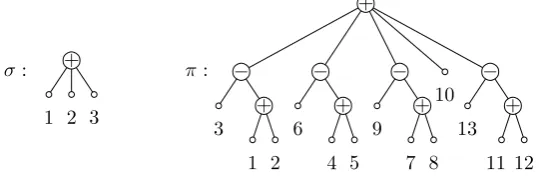
Consider, as an example, the two permutationsπandσdepicted on Figure 1. The
children of the root of T(π) are partitioned into three clans, where the first clan
has three internal nodes, the second clan has a single leaf, and the last clan has a
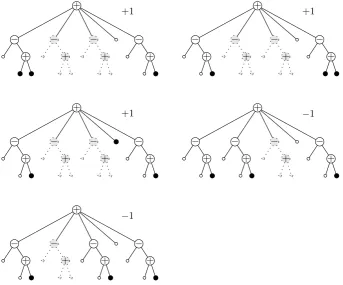
single internal node. Accordingly, there are five normal embeddings of σ into π,
depicted in Figure 2. Of these five normal embeddings, two have sign -1 and three have sign 1, giving µ(σ, π) = 1.
−
+
− −
−
+ +
+
+
+
σ: π:
1 2 3
1 2 3
4 5 6
7 8 9
10
[image:16.595.179.449.277.365.2]11 12 13
Figure 1. The separating trees of two permutationsσandπ
Proof of Theorem 23. Letµ(σ, π) denote the value ofP
f∈N(σ,π)sgn(f). Our goal
is to prove that µ(σ, π) is equal to µ(σ, π). We proceed by induction on |π|. For
σ = π, we clearly have µ(σ, π) = µ(σ, π) = 1, and if π does not contain σ, then
µ(σ, π) =µ(σ, π) = 0.
Suppose now that σ < π. Since π is separable, it is decomposable or
skew-decomposable. Assume, without loss of generality, that π is decomposable. Let
π1⊕ · · · ⊕πn be its decomposition. Since the values of µ(σ, π) are uniquely
de-termined by the recurrences of Proposition 1 and 2, it is enough to show that µ
satisfies the same recurrences.
Consider first the case when π1 = 1, which is treated by Proposition 1. Let σ1⊕
· · · ⊕σmbe the decomposition ofσ, letk= deg(π) and let`= deg(σ). This means
that the leftmost kleaves ofT(π) are all children of the root node, and they form
a leaf clan. Therefore, in any normal embedding, all the k−1 leaves representing
π2, . . . , πk are covered, because they are followers of π1. Necessarily, any element
ofσ that is embedded to one of the firstkelements ofπmust be one of the first`
elements of σ. Consequently, ifk−1> `, there is no normal embedding ofσinto
π, andµ(σ, π) = 0.
Suppose now that k−1 = `. Then, in any normal embedding f ∈ N(σ, π), the
element π1 is omitted, the elements representing σ1, . . . , σk−1 are embedded on
π2, . . . , πk, and the elements of σ>k−1 are embedded to the elements π>k. The
restriction off toσ>k−1is a normal embeddingf0from the setN(σ>k−1, π>k), and
conversely, a normal embeddingf0 fromN(σ>k−
1, π>k) can be uniquely extended
into an embedding f ∈N(σ, π). We then haved(f) = 1 +d(f0), becauseπ
1 is the
only maximal omitted leaf off that is not a maximal omitted leaf off0. This shows
that µ(σ, π) =−µ(σ>k−1, π>k).
Assume now that k−1 < `. Let N+(σ, π) denote the set of normal
−
+
− −
−
+ +
+
+
−
+
− −
−
+ +
+
+
−
+
− −
−
+ +
+
+
−
+
− −
−
+ +
+
+
−
+
− −
−
+ +
+
+
+1 +1
+1 −1
[image:17.595.130.474.116.401.2]−1
Figure 2. The normal embeddings of σ in π (see Figure 1),
to-gether with their signs. The leaves covered by the embedding are represented by black disks, the leaves that are maximal omitted are represented by empty circles. Dotted lines represent subtrees rooted at a maximal omitted internal node. Note that the leaves of such subtrees do not contribute to the sign of the embedding.
those that omit π1. By the same argument as in the previous paragraph, we
see that N+(σ, π) is mapped by a sign-preserving bijection to N(σ>k, π>k), and
N−(σ, π) is mapped by a sign-reversing bijection toN(σ>k−
1, π>k). Consequently,
µ(σ, π) =µ(σ>k, π>k)−µ(σ>k−1, π>k).
These arguments show that µsatisfies the recurrences of Proposition 1.
Assume now thatπ1>1, which corresponds to the situation of Proposition 2. Let
π1⊕· · ·⊕πnbe the decomposition ofπ, letσ1⊕· · ·⊕σmbe the decomposition ofσ,
and letk∈[n] be the largest integer such thatπ1=· · ·=πk. Thencomponents of
πcorrespond precisely tonchildren of the root of the treeT(π), and the leftmostk
components form a non-leaf clan. Therefore, each normal embedding f ∈N(σ, π)
must cover the leftmost child of the root, which representsπ1, but it may omit some
of its followers, which represent the components π2, . . . , πk. Note that the symbols
of σthat are embedded intoπ1 byf must form a prefix of the form σ≤i, for some
i∈[m].
For f ∈N(σ, π), letI(f)∈[m] be the largest number isuch that all the symbols
of σ≤i are embedded intoπ1, and letJ(f)∈[k] be the largest numberj such that
among the leftmost j children of the root of T(π), only the node representing π1
is covered. Let Ni,j be the set {f ∈ N(σ, π) :I(f) = i, J(f) = j}. Notice that
an embedding f ∈ Ni,j decomposes in an obvious way into a normal embedding
d(f) =d(f1) +d(f2), and hence sgn(f) = sgn(f1)sgn(f2). This decomposition is a
bijection between Ni,j and N(σ≤i, π1)×N(σ>i, π>j). Consequently, we have the
identity
X
f∈Ni,j
sgn(f) = X
f1∈N(σ≤i,π1)
X
f2∈N(σ>i,π>j)
sgn(f1)sgn(f2) =µ(σ≤i, π1)µ(σ>i, π>j).
Summing this identity for each i∈[m] and eachj∈[k], we conclude that
µ(σ, π) = m X
i=1
k X
j=1
µ(σ≤i, π1)µ(σ>i, π>j),
which is the recurrence of Proposition 2. Therefore,µ(σ, π) =µ(σ, π).
Let us now state several consequences of Theorem 23.
Corollary 24. Ifπ is separable, thenµ(1, π)∈ {0,1,−1}.
Proof. The permutation 1 can have at most one normal embedding intoπ. Namely, if|π|>1, thenT(π) has at least one leaf` that is not a leader of its leaf clan, but
each of its ancestors is a leader of its non-leaf clan. Such a leaf `must be covered
by any normal embedding of any permutation into π.
The next corollary confirms a (more general version of a) conjecture of Steingr´ımsson and Tenner [7].
Corollary 25. Ifπandσare separable permutations, then|µ(σ, π)|is at most the number of occurrences ofσ inπ.
Proof. This follows from the fact that the number of occurrences ofσinπis clearly
at least the number of normal embeddings ofσintoπ.
Recall that a permutation is layered if it is the concatenation of decreasing
se-quences, such that the letters in each sequence are smaller than all letters in subse-quent sequences. One example is the permutation 21365487, whose layers are shown by 21–3–654–87. Sagan and Vatter [5] gave a formula for the M¨obius function of intervals of layered permutations, and it is easy to see that layered permutations are special cases of separable permutations. Namely, a layered permutation is separa-ble, and its separating tree has depth 2 (except in the trivial cases of the increasing and decreasing permutations), where the children of the root are the layers of the permutation, and the grandchildren of the root are all leaves.
Using Theorem 23, it is easy to show that forπn= 214365· · ·(2n)(2n−1), we have
µ(12, πn) =n−1. Thus, the following result.
Corollary 26. The value of the M¨obius function on intervals[σ, π] is unbounded, even for layered permutations σandπ.
5. Concluding remarks, conjectures and open problems
We have shown in Corollary 19 thatµ(σ, π) can be computed efficiently whenσand
πare separable. In fact, by Corollary 21,µ(σ, π) can be computed efficiently within
any class of permutations generated from a finite set by sums and skew sums. We
do not know whether such an efficient computation ofµis possible for more general
Bose, Buss and Lubiw [2] have shown that it is NP-hard for given permutationsπ
andσto decide whetherπcontainsσ. In view of this, it seems unlikely thatµ(σ, π)
could be computed efficiently for general permutations σandπ.
Our results imply that for a separable permutationπ, the M¨obius functionµ(1, π)
has absolute value at most 1. In fact, the class of separable permutations is the unique largest hereditary class with this property, since any hereditary class not contained in the class of separable permutations must contain 2413 or 3142, and µ(1,2413) = µ(1,3142) =−3. It is natural to considerµ(1, π) as a function of π, and ask whether this function is bounded on a given class of permutations. By
Corollary 20, if a hereditary class C is a {⊕, }-closure of a finite set of
permuta-tions, then µ(1, π) is bounded on C. We do not know if there is another example
of a permutation class on which this function is bounded.
On the other hand, we do not have a proof that µ(1, π) is unbounded on the set
of all permutations, although numerical evidence suggests that this is the case.
According to our computations, the sequence of maximum values of |µ(1, π)| for
π ∈ Sn, starting at n = 1, begins 1,−1,1,−3,6,−11,15,−27,−50,−58,143, . . ..
For these cases (n≤11), there is, up to trivial symmetries, a unique permutation
for which the M¨obius function attains this value. These permutations are
1, 12, 132, 2413, 24153, 351624, 2461735, 35172846,
472951836, 4 6 8 1 9 2 10 3 5 7, 3 6 1 9 4 11 7 2 10 5 8
All of the above permutations are simple (except for 132, but there are no
sim-ple permutations of length 3). A permutation is simple if it has no segment
aiai+1. . . ai+k where 1≤k < n−1 and{ai, ai+1, . . . , ai+k} is a set of consecutive integers (see [1]). In particular, a simple permutation can neither be decomposed
nor skew decomposed. We are not able to compute µ(1, π) for all permutationsπ
of length 12, but for simple permutationsπthe maximum value ofµ(1, π) is−261,
forπ= 4 7 2 10 5 1 12 8 3 11 6 9.
In light of Corollary 6, to show that |µ(1, π)| is unbounded, it would suffice to
show that the maximum of |µ(1, π)| for permutations π of length n, for any n,
is attained only by a permutation π that does not start with 1. In that case
|µ(1,1⊕π)|=|µ(1, π)|, so there would be a permutationτ of lengthn+ 1 for which
|µ(1, τ)|>|µ(1,1⊕π)|=|µ(1, π)|.
Question 27. For which permutation classes C is the function µ(1, π) bounded on C? Is µ(1, π)unbounded on the set of all permutations? Can non-trivial upper or lower bounds be found for maxπ∈Sn|µ(1, π)|, as a function of n?
We have exhibited several types of intervals whose M¨obius function is zero (and more were presented in [7]). Can the following question be answered precisely?
Question 28. When is µ(σ, π) = 0?
For separable permutation π, we have shown that|µ(σ, π)| is at most σ(π), that
is, the number of occurrences ofσin π. This is not true for non-separableπ, even
when σ= 1, as shown above. However, it might be possible to bound|µ(σ, π)|as
a function ofσ(π).
Question 29. Is there an upper bound for|µ(σ, π)|that only depends on σ(π)?
Conjecture 30. The maximum value of the M¨obius functionµ(σ, π)for separable permutationsσ andπ, whereπhas length n≥3, is given by
max k
n
−1−k k
.
This maximum is attained by the permutation π that starts with its odd letters in increasing order, followed by the even letters in decreasing order, andσof the same form and length2· b(n+ 1/2)cif the length ofπis2n, and2· b(n+ 1/2)c −1 if the length ofπis2n−1 (such permutations are sometimes called wedge-alternations).
As an example,µ(13542,135798642) = 15 = 9−1−2
2
.
Finally, we mention some questions about the topology of the order complexes
of intervals in the poset P. (For definitions, see [6]). Given an interval [σ, π], let
∆(σ, π) be the order complex of the poset obtained from [σ, π] by removingσandπ.
Question 31. (1) For whichσandπ does ∆(σ, π)have the homotopy type of a wedge of spheres?
(2) Let Γbe the subcomplex of∆(σ, π)induced by those elementsτ of[σ, π]for whichµ(σ, τ) = 0. IsΓ a pure complex?
(3) If σ occurs precisely once in π, and µ(σ, π) = ±1, is ∆(σ, π) homotopy equivalent to a sphere?
(4) For whichσ andπis∆(σ, π) shellable?
We should mention that forσ= 231 andπ= 231564, the order complex ∆(σ, π) is
not shellable; it consists of two connected components, each of which is contractible.
However, removing from [231,231564] all elementsτ withµ(231, τ) = 0, we obtain
a shellable complex, namely a four-element boolean algebra. For parts (2) and (3) in Question 31, we know no counterexamples. Since we have so far only examined intervals of low rank, our evidence is not strong.
References
[1] M. H. Albert, M. D. Atkinson, and M. Klazar, The enumeration of simple permutations, J. Integer Seq.6(2003), 03.4.4.
[2] P. Bose, J. F. Buss, A. Lubiw, Pattern-matching for permutations,Information Processing Letters65(1998), 277–283.
[3] A. Bj¨orner, The M¨obius function of subword order, inInvariant Theory and Tableaux (Min-neapolis, MN, 1988), vol. 19 of IMA Vol. Math. Appdrl. Springer, New York (1990) 118-124. [4] A. Bj¨orner, The M¨obius function of factor order, Theoretical Computer Sci. 117 (1993),
91–98.
[5] B. E. Sagan and V. Vatter, The M¨obius function of a composition poset,J. Algebraic Combin.
24(2006), 117–136.
[6] R. P. Stanley,Enumerative Combinatorics, vol. 1, Cambridge Studies in Advanced Mathe-matics, no. 49, Cambridge University Press, Cambridge, 1997.
[7] E. Steingr´ımsson, B. E. Tenner, The M¨obius function of the permutation pattern poset, arXiv:0902.4011.
[8] H. Wilf, The patterns of permutations,Discrete Math.257(2002), 575–583.
Department of Mathematics, Howard University, Washington DC 20059, USA E-mail address: [email protected]
Fakult¨at f¨ur Mathematik, Universit¨at Wien, Garnisongasse 3, 1090 Wien, Austria E-mail address: [email protected]
Department of Applied Mathematics, Charles University in Prague, Malostransk´e n´am. 25, 110 00, Prague, Czech Republic
E-mail address: [email protected]
Department of Computer and Information Sciences, University of Strathclyde, Glas-gow G1 1XH, UK