City, University of London Institutional Repository
Citation
: Hadjichrysanthou, C., Broom, M. and Rychtar, J. (2011). Evolutionary Games on
Star Graphs Under Various Updating Rules. Dynamic Games and Applications, 1(3), pp.
386-407. doi: 10.1007/s13235-011-0022-7
This is the unspecified version of the paper.
This version of the publication may differ from the final published
version.
Permanent repository link:
http://openaccess.city.ac.uk/2164/
Link to published version
: http://dx.doi.org/10.1007/s13235-011-0022-7
Copyright and reuse:
City Research Online aims to make research
outputs of City, University of London available to a wider audience.
Copyright and Moral Rights remain with the author(s) and/or copyright
holders. URLs from City Research Online may be freely distributed and
linked to.
City Research Online:
http://openaccess.city.ac.uk/
[email protected]
(will be inserted by the editor)
Evolutionary games on star graphs under various updating
rules
M. Broom · C. Hadjichrysanthou · J. Rycht´aˇr
Received: date / Accepted: date
Abstract It is known that in homogeneous populations the choice of the update rule is not critical in the evolutionary process. In this paper we investigate an evolutionary game between two strategies, A and B, interacting on a star graph considering four important update rules. We find explicit expressions for the fixation probability of any number of mutants placed at any position on the star, and the time to absorption (elimination or fixation of mutants) and fixation (absorption conditional on fixation occurring). For each of the update rules, we find appropriate conditions under which one strategy is favoured over the other. Considering the case where individuals have fixed fitness and a specific example of a Hawk-Dove game we then examine the effect of the update rule on the three quantities we study, and we show that in contrast with homogeneous populations, the choice of the update rule might be crucial for the evolutionary process in a non-homogeneous population.
Keywords Fixation probability· Absorption time·Fixation time·Structured populations·Star graph
The research was supported by a research studentship to C. Hadjichrysanthou provided by the City Uni-versity of London and by the UNCG Regular Faculty Grant to J. Rycht´aˇr.
M. Broom
Centre for Mathematical Science, City University, London EC1V 0HB, UK Tel.: +44 (0) 20 7040 3672
Fax: +44 (0) 20 7040 8597 E-mail: [email protected]
C. Hadjichrysanthou
Centre for Mathematical Science, City University, London EC1V 0HB, UK E-mail: [email protected]
J. Rycht´aˇr
Department of Mathematics and Statistics, The University of North Carolina at Greensboro, Greensboro NC27402, USA
1 Introduction
Evolutionary models can be applied in a vast number of biological situations. It is generally assumed that populations are homogeneous, where all individuals are equally likely to meet all others. Heterogeneous populations are often studied by the interactions of pairs of individuals on a graph, starting with Lieberman et al.
(2005). There are a number of update rules (evolutionary dynamics) that can be ap-plied to such processes. This has not been of great importance historically, since the evolutionary process on homogeneous populations is not significantly affected by the update rule. However, recent studies suggest that different update rules might result in significant differences in the evolutionary process in populations with a non-homogeneous structure (for example, Antalet al.(2006), Soodet al.(2008), Masuda (2009)). In this document we consider analytically the stochastic evolutionary pro-cess following four commonly used update rules on the simplest irregular graph, the star graph.
The star graph is an irregular graph wherenvertices, the leaves, are connected with only one vertex, the centre. Evolution on a star-structured population has been commonly studied (for example, Liebermanet al.(2005), Nowak (2006), Broom & Rycht´aˇr (2008), Fuet al.(2009), Masuda (2009), Tarnitaet al.(2009), Broomet al.
(2010)). The fixation probability of a single mutant individual with relative fitness
rintroduced into a resident population structured as a star, was first considered in Liebermanet al.(2005) following the rules of the invasion process and assuming a large population size. An exact formula of the fixation probability was given later in Broom & Rycht´aˇr (2008) (see also Masuda (2009)). This has been extended in Broomet al.(2010) to the more complicated case of frequency dependent fitness by applying evolutionary game theory. In the same paper, the absorption and fixation time of a mutant under the invasion process have also been considered. In Broomet al.(2009), it is shown that at least for small graphs, under the invasion process the star is the structure in which a randomly placed mutant has the highest chance of fixation. On the other hand, in Broomet al.(2010) it is shown that in this process, the average time needed for the fixation of a mutant on a star is especially long.
In this paper, we investigate an evolutionary game involving two strategies, A and B, played among individuals on a star graph. The game played has a general payoff matrix
A B A a b
B c d
(1.1)
where, for example,cdenotes a payoff to a B individual from an interaction with an A individual.
The fitness of each individual, f, is assumed to be f = fb+wP, where fb is a constant background fitness andPis the average of the payoffs obtained from the games played against all the neighbouring connected individuals.w∈[0,1]represents the intensity of selection which determines the contribution ofP to fitness. When
w→0+, we talk about weak selection. In this case the payoffPof each individual
Denoting the fitness of an A (B) individual placed in the centre of a star withiAs and
n−iBs on the leaves by fAc(i) (fBc(i)), we obtain
fAc(i) =
iα+ (n−i)β
n , (1.2)
fBc(i) =
iγ+ (n−i)δ
n , (1.3)
where we have setα = fb+wa,β = fb+wb,γ = fb+wb andδ = fb+wd. The fitness of a player A (B) on the leaves is equal toα(γ) when playing against a player A in the centre andβ (δ) when playing against a player B in this position.
We assume a certain number of individuals playing one strategy is introduced into a population of individuals playing the other strategy. For four different update rules, we investigate the fixation probability and the mean absorption and fixation times. The mean absorption time (or unconditional fixation time) is the mean number of time steps needed to reach one of the two absorbing states of the dynamics, i.e. a state where the population consists of individuals playing one strategy only. The mean fixation time (or conditional fixation time) of individuals playing strategy X is the mean number of time steps needed for X individuals to take over the population given that this will happen, and the fixation probability of X individuals is the probability that it will happen.
In the next section, we first present the update rules we will consider and the transition probabilities under each of them on the star graph. We then derive the gen-eral formula of the fixation probability and the mean time to absorption and fixation on the star starting from any possible state, the first general formulae for absorption and fixation times on an irregular graph. In section 3, for each of the update rules we derive the appropriate conditions under which one strategy is favoured over the other. Finally, in section 4, we apply our results on two specific cases; the fixed fitness case where individuals have fixed fitness and the frequency dependent fitness case by considering a specific example of a Hawk-Dove game.
2 Formulae
In this section we present the general exact formulae for the fixation probability and the mean time to absorption and fixation starting from any possible state. The deriva-tion of the formulae is shown in Online Appendix A.
2.1 Transition Probabilities
Let pXYi,j denote the transition probability from a state with i A individuals on the leaves and anXindividual in the center to the state with jA individuals on the leaves and aY individual in the center; following the update rules we will consider, only
We consider four different update rules, called the invasion process (IP) (or birth-death process with selection on the birth), the birth-birth-death process with selection on the death (BD-D), the biased Voter model (VM) (or death-birth process with selection on the death) and the death-birth process with selection on the birth (DB-B).
In the IP (Liebermanet al., 2005), each time step consists of an individual being selected for reproduction with probability proportional to its fitness and placing its offspring at a randomly chosen neighbouring vertex. The transition probabilities in this process are given by
pAAi,i+1= fAc(i)
fAc(i) +iα+ (n−i)γ·
n−i n =
(n−i)(iα+ (n−i)β)
n((n+1)iα+ (n−i)(nγ+β)), (2.1)
pABi,i = γ
fAc(i) +iα+ (n−i)γ·
(n−i) = n(n−i)γ
(n+1)iα+ (n−i)(nγ+β), (2.2)
pBBi,i−1= fBc(i)
fBc(i) +iβ+ (n−i)δ ·
i n =
i(iγ+ (n−i)δ)
n(i(nβ+γ) + (n+1)(n−i)δ), (2.3)
pBAi,i = β
fBc(i) +iβ+ (n−i)δ ·
i= inβ
i(nβ+γ) + (n+1)(n−i)δ. (2.4)
The BD-D process (Masuda, 2009) is the process where at each time step an individual is chosen for reproduction at random and then its offspring replaces a neighbouring individual which is chosen with probability inversely proportional to its fitness. The transition probabilities under this process are
pAAi,i+1= 1
n+1· 1
γ
iα1+ (n−i)1γ ·(n−i) =
(n−i)α
(n+1)(iγ+ (n−i)α), (2.5)
pABi,i = n−i
n+1, (2.6)
pBBi,i−1= 1
n+1· 1
β
iβ1+ (n−i)δ1 ·i=
iδ
(n+1)(iδ+ (n−i)β), (2.7)
pBAi,i = i
n+1. (2.8)
neighbour. Thus, the transition probabilities are
pAAi,i+1=
1
γ
1 fAc(i)+i
1
α+ (n−i)1γ
·(n−i) = (n−i)
(
iα+ (n−i)β)α
nαγ+(iα+ (n−i)β)(iγ+ (n−i)α), (2.9)
pABi,i =
1 fAc(i)
1 fAc(i)+i
1
α+ (n−i)1γ
·n−i
n =
(n−i)αγ
nαγ+(iα+ (n−i)β)(iγ+ (n−i)α), (2.10)
pBBi,i−1=
1
β
1 fBc(i)+i
1
β+ (n−i)1δ
·i= iδ
(
iγ+ (n−i)δ)
nβδ+(iγ+ (n−i)δ)(iδ+ (n−i)β), (2.11)
pBAi,i =
1 fBc(i)
1 fBc(i)+i
1
β+ (n−i)1δ
· i
n =
iβδ
nβδ+(iγ+ (n−i)δ)(iδ+ (n−i)β). (2.12)
Finally, in the DB-B process (Ohtsukiet al., 2006), in each time step an individ-ual dies at random. Then, the gap is occupied by the offspring of a neighbouring individual chosen with probability proportional to its fitness. This process can be also described as follows: a random individual is chosen to update its strategy and chooses one of its neighbours’ strategies proportional to their fitness. Thus, the tran-sition probabilities in this process are given by
pAAi,i+1= n−i
n+1, (2.13)
pABi,i = 1
n+1·
γ
iα+ (n−i)γ ·(n−i) =
(n−i)γ
(n+1)(iα+ (n−i)γ), (2.14)
pBBi,i−1= i
n+1, (2.15)
pBAi,i = 1
n+1·
β
iβ+ (n−i)δ ·i=
iβ
(n+1)(iβ+ (n−i)δ). (2.16)
In all processes, at every time step an individual gives birth and an individual dies. Thus, the population size remains constant. Note that it is assumed that there is no mutation, just selection, i.e. each offspring is always a perfect copy of its parent. Hence, the evolutionary process lasts until one of the two strategies takes over the population replacing all the individuals playing the other strategy. It should also be noted that to be meaningful in the context of all of the above dynamics, and in discrete dynamics in general, the fitness of the individuals should be positive, and we assume this throughout the paper.
2.2 Fixation Probability
Denote byXPiA (XPiB) the probability that individuals playing strategyX ∈ {A,B}
(a B) individual in the centre. APA
i andAPiBare the solutions of the following system APA
i =pAAi,i+1APiA+1+pABi,iAPiB+ (
1−pAAi,i+1−pABi,i)APiA, 0≤i≤n−1, (2.17) APB
i =pBAi,iAPiA+pBBi,i−1APiB−1+ (
1−pBAi,i −pBBi,i−1)APiB,1≤i≤n, (2.18)
with conditions on the absorbing statesAP0B=0 andAPnA=1. Rearranging of (2.17)-(2.18) yields
APA
i =πiAA,i+1APiA+1+πiAB,i APiB,0≤i≤n−1, (2.19) APB
i =πiBA,i APiA+πiBB,i−1APiB−1, 1≤i≤n, (2.20) whereπ denotes the transition probability conditional on that the system does not remain in the same state, i.e.
πAA
i,i+1=1−πiAB,i =
pAAi,i+1 pAA
i,i+1+pABi,i
,0≤i≤n−1, (2.21)
πBA
i,i =1−πiBB,i−1=
pBAi,i pBA
i,i +pBBi,i−1
,1≤i≤n. (2.22)
Solving the system (2.19)-(2.20) inductively (see, Online Appendix A1), we find
APA i =
A(1,i)
A(1,n) (i̸=0), (2.23)
APB i =
i
∑
j=1
πBA j,jAPAj
i
∏
k=j+1
πBB
k,k−1, (2.24)
where
A(l,m) =1+ m−1
∑
j=l
πAB j,j
j
∏
k=l
πBB k,k−1
πAA k,k+1
. (2.25)
Using (2.19), the conditionAP0B=0 and (2.23) we find that fori=0,
APA 0 =
πAA 0,1
A(1,n). (2.26)
The average fixation probability of a single A individual randomly placed on the star,AP, is given by
AP= 1
n+1 (
nAP1B+AP0A)=nπ BA 1,1+π0AA,1
n+1 1
A(1,n) (2.27)
(see also Tarnitaet al.(2009) for an alternative formulae for the fixation probability of a single mutant on the star).
2.3 Mean time to absorption
Let us denote byTiA(TiB) the mean time to absorption starting fromiA individuals on the leaves and an A (a B) in the centre.TiAandTiBare the solutions of the system
TiA=pAAi,i+1Ti+A1+pABi,iTiB+(1−piAA,i+1−pABi,i)TiA+1,0≤i≤n−1, (2.28)
TiB=pBAi,iTiA+pBBi,i−1TiB−1+(1−pBAi,i −pBBi,i−1)TiB+1, 1≤i≤n, (2.29)
with conditions on the absorbing statesT0B=0=TnA.
Solving the system (2.28)-(2.29), (see, Online Appendix A2), we find
T0A= π AA 0,1
A(1,n) n
∑
l=2
A(l,n)B(l) +1, (2.30)
TiA=APiA
n
∑
l=2
A(l,n)B(l)− i
∑
l=2
A(l,i)B(l) (i̸=0), (2.31)
TiB= i
∑
j=1
πBA j,j
(
TjA+ 1
pBAj,j
) i
∏
k=j+1
πBB
k,k−1, (2.32)
where
B(l) =π AB l−1,l−1
πAA l−1,l
l−1
∑
j=1 (
∏l−1
k=j+1πkBB,k−1
pBBj,j−1+pBAj,j
)
+ 1
pAAl−1,l. (2.33)
The average time to absorption starting from a single A individual randomly placed on the star,AT, is given by
AT= 1
n+1 (
πAA 0,1+nπ1BA,1
A(1,n) n
∑
l=2
A(l,n)B(l) +1+ n
pBB 1,0+pBA1,1
)
. (2.34)
2.4 Mean fixation time
LetXFiA (XFiB) denote the mean fixation time of individuals playing strategyX ∈
{A,B}starting from the state withiAs on the leaves and an A (a B) in the centre. Following the same method as in Antal & Scheuring (2006),AFiAandAFiBare given by the solution of the system
AzA
i =pAAi,i+1AzAi+1+pABi,iAzBi + (
1−pAAi,i+1−pABi,i)AzAi +APiA,0≤i≤n−1, (2.35) AzB
i =pBAi,iAzAi +pBBi,i−1AzBi−1+ (
1−pBAi,i −pBBi,i−1)AzBi +APiB, 1≤i≤n, (2.36)
whereAzAi =APiAAFiAandAzBi =APiBAFiB. On the absorbing states,AzB0=0 (because APB
The solution of (2.35)-(2.36) is (see, Online Appendix A3)
AFA 0 =
n
∑
l=2
A(l,n)C(l) +1, (2.37)
AFA i =
n
∑
l=2
A(l,n)C(l)− 1 APA
i i
∑
l=2
A(l,i)C(l) (i̸=0), (2.38)
AFB i =
1 APB
i i
∑
j=1
πBA j,j
( AP
jAFjA+ APB
j
pBAj,j
) i
∏
k=j+1
πBB
k,k−1 (i̸=0), (2.39)
where
C(l) =π AB l−1,l−1
πAA l−1,l
l−1
∑
j=1 (
APB j
pBBj,j−1+pBAj,j
l−1
∏
k=j+1
πBB k,k−1
) +
APA l−1
pAAl−1,l. (2.40)
The average fixation time of a single A individual randomly placed on the star,AF, is given by
AF= 1
n+1 (
(n+1) n
∑
l=2
A(l,n)C(l) +1+ n
pBB1,0+pBA1,1
)
. (2.41)
Note that by symmetry, replacing pAAi,i+1bypnBB−i,n−i−1,pABi,i bypBAn−i,n−i,pBBi,i−1by
pAAn−i,n−i+1,pBAi,i bypABn−i,n−i,APiAby 1−APnB−i=BPnB−iandAPiBby 1−APnA−i=BPnA−i
in the above formulae, we find the respective formulae of the fixation probability and absorption and fixation times of B individuals when are introduced into a population of As.
3 Favoured strategies
In evolutionary games, the comparison of the fixation probability of a single mutant playing strategy A,AP, with that of a mutant playing B,BP, is of interest. In evolu-tionary processes where there is no mutation, ifAP>BPthen strategy A is favoured over B (strategy A is more abundant than B in the equilibrium). The conditions un-der which one strategy is favoured over the other have been found for several graphs and update rules under the assumption of weak selection (for example, Tarnitaet al.
(2009)). In this section, we derive the appropriate (general) conditions for strategy A to be favoured over strategy B on the star. We define
ρ= AP
BP (3.1)
and seek conditions onρT1.
Since Bs fixate if and only if As do not, we have that
BP= 1
n+1 (
1−APnB)+ n
n+1 (
Using (2.19)-(2.20), the fact thatπiAA,i+1+πiAB,i =1=πiBA,i +πiBB,i−1and also (2.23) for
i=n−1, (3.2) can be written as
BP= 1
n+1 (
πBB
n,n−1+nπnAB−1,n−1 )(n−1
∏
k=1
πBB k,k−1
πAA k,k+1
) 1
A(1,n). (3.3)
Using (3.3) and (2.27) we obtain
ρ= π AA 0,1+nπ1BA,1
πBB
n,n−1+nπnAB−1,n−1 n−1
∏
k=1
πAA k,k+1
πBB k,k−1
. (3.4)
In the IP, as shown in Online Appendix B1, for largenwe find
ln(ρIP)≈ln
αβγδ
(
α β
) β α−β
(
δ γ
) γ δ−γ
n
, (α̸=β, γ̸=δ). (3.5)
Therefore, for largen,
ρIP≷1⇔αβ
(
α β
) β α−β
≷γδ
(
δ γ
) γ δ−γ
. (3.6)
In the BD-D process, for largenwe find (see, Online Appendix B2)
ln(ρBD-D)≈ln
( δ β ) β δ−β
(
α γ
) γ α−γ
n
, (α̸=γ, β̸=δ). (3.7)
Therefore,
ρBD-D≷1⇔
(
δ β
) β δ−β
≷
(
α γ
) γ α−γ
. (3.8)
In the VM, for largenwe find (see, Online Appendix B3)
ρVM≈
α(β+δ)
δ(γ+α) (
α β
) γ β−α
(
δ γ
) β γ−δ
, (α̸=β,γ̸=δ). (3.9)
Thus,
ρVM≷1⇔α(β+δ)
(
α β
) γ β−α
≷δ(γ+α) (
δ γ
) β γ−δ
. (3.10)
Finally, in the DB-B process for largenwe find (see, Online Appendix B4)
ρDB-B≈
α(β+δ)
δ(γ+α) (
α γ
) γ γ−α
(
δ β
) β β−δ
Thus,
ρDB-B≷1⇔α(β+δ)
(
α γ
) γ γ−α
≷δ(γ+α) (
δ β
) β β−δ
. (3.12)
In the limit of weak selection, i.e. whenw→0+, from (3.6), (3.8), (3.10) and (3.12)
it follows that on a large star, under all dynamics As are favoured if and only if
a+b>c+d, which is in agreement with the results of Tarnitaet al.(2009) where the IP and the DB-B process in this case are considered.
It is shown (see, Online Appendix B5) that in the BD-D and DB-B processes,
ρBD-DT1⇔ρDB-BT1⇔αβTγδ, ∀n. (3.13)
In the case of weak selection, it follows from (3.13) that under the BD-D or the DB-B process, As are favoured if and only ifa+b>c+d,∀n; this agrees with Tarnitaet al.(2009) where the DB-B process is considered. In these dynamics, for
αβ=γδ,pAA
i,i+1=pnBB−i,n−i−1,pABi,i =pnBA−i,n−i,pBBi,i−1=pnAA−i,n−i+1andpBAi,i =pABn−i,n−i. Hence,APiA=BPnB−i,APiB=BPnA−i,TiA=TnB−i,TiB=TnA−iand thereforeAT=BT and AFA
i =BFnB−i,AFiB=BFnA−iand thereforeAF=BF,∀0≤i≤n.
Note that for two of the processes (the IP and the BD-D process) there is a step change inρ going from 0 to infinity in the limiting case of large n, so that for a small change in parameter values there is a huge change in the relative probabilities of fixation of the two strategies, whereas the change is gradual for the other two processes.
Following the same procedure on a large complete graph (where every vertex is connected to each other), we find that under the IP (which is equivalent to the VM)
ln(ρCG)≈ln
αδ
(
α β
)( β α−β
)
(
δ γ
)( γ δ−γ
) n
, (α̸=β, γ̸=δ), (3.14)
(Fudenberget al.(2006); Antal & Scheuring (2006)). Similarly, we find that ρ in the BD-D and DB-B processes also satisfy (3.14). Hence, As are favoured over Bs
if α (
α β
)( β α−β
)
>δ
(
δ γ
)( γ δ−γ
)
and the step change described above occurs, in all processes. Thus, in the two processes where births occur first, evolution on a large star has similar characteristics to that on the complete graph of the same size, with the interaction of the whole population occurring through the central individual, which is continuously replaced. Note that forβ =γ,ρIP=ρCG and forα=δ,ρBD-D=ρCG.
4 Examples
4.1 The fixed fitness case
In this case we assume that A individuals have fitness equal torand B individuals fitness equal to 1. This is a special case of an evolutionary game witha=b=r,
c=d=1,w=1 and fb=0. Here the fitness of each individual remains constant and thus the exact (relative) positions of As and Bs are irrelevant. In contrast to complete graphs where different dynamics yield same or similar results, the type of dynam-ics influences the outcome for a non-homogeneous structure and in particular a star graph.
4.1.1 The average fixation probability of a single mutant
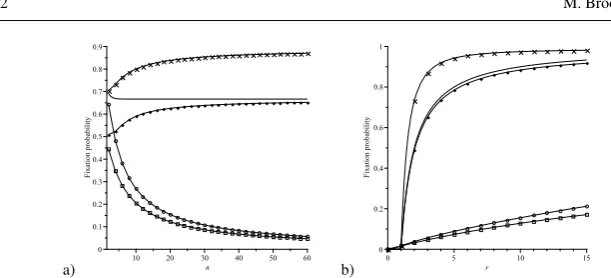
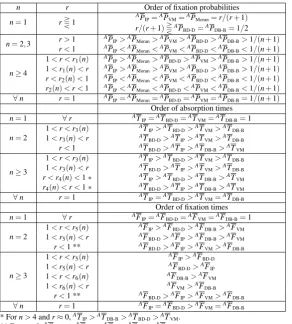
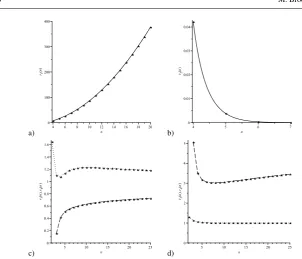
In all dynamics,APT1/(n+1)if and only ifrT1 and thus selection favours (does not favour) the fixation of As whenr>1(r<1). The relationship between fixation probabilities under the different dynamics we consider is shown in Table 1. Note that for n>3, there is one and only one value of r>1, r1(n), and one and only one value ofr<1, r2(n)(the exact values ofr1(n)andr2(n)depend on n), such that APBD-D=APVM. As n increases,r1(n) increases rapidly to infinity while r2(n) decreases rapidly to zero (the behaviour ofr1(n)andr2(n)as the population size increases is shown in Figure 3). Thus, except for values ofrmore extreme than these critical values, as observed from the Table 1, the birth-death processes yield higher chance of fixation for mutants withr>1 and less for mutants withr<1. The fixation probability in some specific cases is shown in Figure 1.
Whennis large we find that (see, Online Appendices C1 and C2)
AP
IP≈
1−1/r2
1−1/r2n,r̸=1, (4.1)
AP
BD-D≈
1−1/r
1−1/rn= AP
Moran,r̸=1, (4.2)
where APMoran is the fixation probability of a single mutant in the Moran process
(Liebermanet al., 2005). Substituting (2.21)-(2.22) into (2.27) and using (2.9)-(2.16) appropriately, we get (see, Online Appendix C3) that in this case,
AP
VM=
rn(r+1) (rn+1)(n+r)
r2−1
r2−( rn+1 r(n+r)
)n−1<
r+1
n+1, (4.3)
AP
DB-B=
1
n+1 (
1
n+1+
r n+2r−1
)
rn+1
r+1 <
r+1
n−1 (4.4)
and thus, in contrast to the birth-death processes, for the death-birth processes the increase of the population size decreases the chance of fixation to zero. Forr<1 the fixation probability of a mutant decreases withnin all dynamics.
a) b)
Fig. 1 The average fixation probability of a single mutant on a star graph under the IP (crosses), the BD-D process (diamonds), the VM (circles) and the DB-B process (boxes) in the fixed fitness case where (a) r=3 andnvaries, (b)n=60 andrvaries. The solid line represents the fixation probability in the Moran process.
0;APDB-Bconverges to 1/(n+1)2. Thus, following the DB-B process, even an invader
mutant with zero fitness has a small chance to fixate. Asrincreases to∞,APIPand
AP
VMtend to 1, whileAPBD-D converges to(1/(n+1)) (1/(n+1) +n)andAPDB-B to
(n/(n+1))(1/(n+1) +1/2). Hence, under the BD-D and the DB-B processes, even for an infinite fitnessr, the fixation of a mutant in a finite population is not guaran-teed. This case appears even in a homogeneous population of finite size under the DB-B process where the fixation probability of a single mutant tends to 1−1/(n+1) with the increase inr. This means that the concept of the parameterrrepresenting fitness (the relative fitness of mutants and residents) is questionable. In its simplest definition, fitness can be thought of as the lifetime reproductive success of an indi-vidual. This is not straightforward to interpret on a finite graph where the population is kept fixed, but it should have some basic properties. We contend that an individual with 0 fitness should be certain to be eliminated and one with infinite fitness should be certain to fixate. From this point of view, the IP and VM processes are consistent, but the BD-D and DB-B processes are not. In these processesrmight be thought of as a function of fitness, but not “fitness” as such.
4.1.2 Mean time to absorption starting from a single mutant
Although the fixation of advantageous mutants is more likely in the birth-death pro-cesses (except some special cases), absorption in these propro-cesses is reached slower than the death-birth processes (except some extreme cases ofn>4 andr≈0). The order of the absorption times in the different dynamics is shown in Table 1. Figure 2 shows the absorption times for some specific values ofrandn.
Here we show explicit approximation of the absorption times starting from a sin-gle mutant given by (2.34) for extreme values ofr.
Forr≈0+, in the IP and the VM,πiAB,i ≈πiBB,i−1≈1 and πiAA,i+1≈πiBA,i ≈0. In the BD-D process, fori̸=0, πiAB,i ≈1 andπiAA,i+1≈0. In the DB-B process, fori̸=n,
πBB
[image:13.595.76.382.70.209.2]a) b)
Fig. 2 The mean time to absorption starting from a single mutant on a star graph under the IP (crosses), the BD-D process (diamonds), the VM (circles) and the DB-B process (boxes) in the fixed fitness case where (a)r=3 andnvaries, (b)n=60 andrvaries.
as that shown in Online Appendix A2, we find that forr≈0+
AT
IP≈n(n−1) +1>ATDB-B, (4.5)
AT
BD-D≈
n2+1
n−1 + 1
n+1 > AT
VM, (4.6)
AT
VM≈1, (4.7)
AT
DB-B≈
n n+1
n−1
∑
i=1 (
1
i
) + 1
n+1+n> AT
BD-D(forn>4). (4.8)
Forr≫1, in the IP and the VM,πiAB,i ≈πiBB,i−1≈0 andπiAA,i+1≈πiBA,i ≈1. In the BD-D process, fori̸=n,πiBB,i−1≈0 andπiBA,i ≈1. Finally, in the DB-B process, fori̸=0,
πAB
i,i ≈0 andπiAA,i+1≈1. Using these approximations and the formula (2.34), we find that for larger≫n
AT
IP≈
n−1
∑
i=0
n(i+1)
n−i >
ATVM, (4.9)
AT
BD-D≈n
(
n+ 1
n+1 )n−1
∑
i=1 (
1
i
)
+n+ 1
n+1 >
ATIP, (4.10)
AT
VM≈n
2>AT
DB-B, (4.11)
AT
DB-B≈
n(n+3) 2(n+1)
n−1
∑
i=1 (
1
i
)
+n(n+1) +2
2(n+1) . (4.12)
Note that in the DB-B process once there is an A individual on a leaf and in the centre, then the mean absorption time does not depend onr; specifically, substituting (2.13)-(2.16) and (2.21)-(2.22) appropriately into (2.31) fori=1, after some calculations it is proved thatT1ADB-B= (n+1)∑ni=−111/i.
[image:14.595.133.407.455.559.2]O(n2lnn). However, in the death-birth processes, absorption is reached much faster, inO(n)time steps.
In a large population, Figure 2 suggests that following the birth-death processes, ab-sorption is reached slower for a value ofrclose to 1 (this value tends to 1 as the population size increases). Thus, in large populations neutral mutants yield higher absorption times. However, following the death-birth processes absorption time in-creases with the increase inr.
4.1.3 Mean fixation time of a single mutant
As the absorption time, apart for some special cases ofr≈0, whereAFVMfor
exam-ple, increases rapidly, the fixation time is generally higher in the birth-first processes than the death-first processes. The order of the fixation times for various scenarios is shown in Table 1.
In the limit of larger(r→∞), the fixation time of a single mutant in the IP and VM, AF
IPandAFVM, are equal toATIPgiven by (4.9) andATVMgiven by (4.11), respectively.
In the BDD and DBB processes we find that
AF
BD-D≈n(n+1)
n−1
∑
i=1 (
1
i
)
+n+ 1
n+1, (4.13)
AF
DB-B≈(n+1)
n−1
∑
i=1 (
1
i
)
+n(n+1) +2
2(n+1) . (4.14)
The fixation times in the limiting case ofr→0+are of less interest since in this case
the chance of fixation of the mutant individual is very small and we condition on its fixation.
In the limit of large population size, the fixation time in the birth-death processes isO(n3)while in the death-birth processes isO(nlnn).
Numerical examples suggest that in very large populations, following the birth-death processes, as the absorption time, the mean fixation time of a neutral mutant is the highest one.
It should be noted that, especially in large populations,AF
DB-Bis affected less by the
change inrthan the fixation times under other dynamics (same as seen forAPDB-Band
AT
DB-Babove).
4.2 The frequency dependent fitness case-A Hawk-Dove game on the star graph
In this section we apply the results of section 2 to a particular game, the Hawk-Dove game with the following payoff matrix
H D
Ha=4−2C b=4 D c=0 d=2
Table 1 Summary of the results for the average fixation probability and the mean times to absorption and fixation of a single mutant on a star graph in the fixed fitness case. The variation ofr1(n),r2(n),r3(n), r4(n),r5(n)andr6(n)withnis shown in Figure 3.
n r Order of fixation probabilities n=1 rT1
AP
IP=APVM=APMoran=r/(r+1)
r/(r+1)TAP
BD-D=APDB-B=1/2
n=2,3 r>1
AP
IP>APMoran>APVM>APBD-D>APDB-B>1/(n+1)
r<1 AP
IP<APMoran<APVM<APBD-D<APDB-B<1/(n+1)
n≥4
1<r<r1(n) AP
IP>APMoran>APBD-D>APVM>APDB-B>1/(n+1)
1<r1(n)<r AP
IP>APMoran>APVM>APBD-D>APDB-B>1/(n+1)
r<r2(n)<1 APIP<APMoran<APVM<APBD-D<APDB-B<1/(n+1)
r2(n)<r<1 AP
IP<APMoran<APBD-D<APVM<APDB-B<1/(n+1)
∀n r=1 AP
IP=APMoran=APBD-D=APVM=APDB-B=1/(n+1)
Order of absorption times n=1 ∀r AT
IP=ATBD-D=ATVM=ATDB-B=1
n=2
1<r<r3(n) ATIP>ATBD-D>ATVM>ATDB-B
1<r3(n)<r AT
BD-D>ATIP>ATVM>ATDB-B
r<1 AT
BD-D>ATIP>ATDB-B>ATVM
n≥3
1<r<r3(n) AT
IP>ATBD-D>ATVM>ATDB-B
1<r3(n)<r AT
BD-D>ATIP>ATVM>ATDB-B
r<r4(n)<1∗ AT
IP>ATBD-D>ATDB-B>ATVM
r4(n)<r<1∗ AT
BD-D>ATIP>ATDB-B>ATVM
∀n r=1 AT
IP=ATBD-D>ATVM=ATDB-B
Order of fixation times n=1 ∀r AF
IP=AFBD-D=AFVM=AFDB-B=1
n=2
1<r<r5(n) AF
IP>AFBD-D>AFDB-B>AFVM
1<r5(n)<r AF
BD-D>AFIP>AFDB-B>AFVM
r<1 ** AFBD-D>AFIP>AFVM>AFDB-B
n≥3
1<r<r5(n) AF
IP>AFBD-D
1<r5(n)<r AFBD-D>AFIP
1<r<r6(n) AF
DB-B>AFVM
1<r6(n)<r AF
VM>AFDB-B
r<1 ** AF
BD-D>AFIP>AFVM>AFDB-B
∀n r=1 AFIP=AFBD-D>AFVM=AFDB-B
* Forn>4 andr≈0,AT
IP>ATDB-B>ATBD-D>ATVM.
** Forr≈0,AFBD-D>AFVM>AFIP>AFVM>AFDB-B.
This is a game where individuals fight for a resource of valueV =4 with a varying cost of the fightC. All individuals have a constant background fitness fb=10, and we setw=1.
As shown in Online Appendix C4, similarly to the fixed fitness case, on the com-plete graph the updating rules do not influence the fixation probabilities, and absorp-tion and fixaabsorp-tion times much. Mutants have almost the same probability to fixate under the different dynamics with that in the IP and the VM being identical. In our example, for large population size we obtain a step change in the fixation probability in all dynamics; ifρCG>1, mutants fixate with a probability almost independent of
the fight costC. ForρCG<1, the fixation probability presents a rapid change and the
chance of mutants elimination becomes almost certain. Values of the payoffs such thatρCG≈1 lead to the highest times before fixation occur, in all dynamics. However,
a) b)
c) d)
Fig. 3 The behaviour of (a)r1(n), (b)r2(n), (c)r3(n)(dotted line) andr4(n)(dashed line) and (d)r5(n)
(dotted line) andr6(n)(dashed line) asnincreases.
4.2.1 The average fixation probability of a single mutant Hawk
The illustration of the dependence ofHPon the population size and fight costCis shown in Figure 4 for a Hawk-Dove type of game (4.15). We can observe two quanti-tatively different behaviours, one for birth-death processes and another for death-birth processes. In the birth-death processes, for largen,HPexhibits a step function be-haviour based onρ; in fact, for largen(n→∞) we find that (see, Online Appendices C1 and C2)
HP
IP≈
1−γδ
β2 1−
(
γδ β2
)n ≈1−γδβ2, ρIP>1
0, ρIP<1
(4.16)
HP
BD-D≈
1−βδ 1−
(
δ β
)n ≈1−δβ, ρBD-D>1
0, ρBD-D<1
(4.17)
On the other hand, in the death-birth processes, bothHP
VMandHPDB-B are bounded
above by(β+δ)/δ(n+1)(see, Online Appendix C3) and thus decrease to 0 asn
increases to∞.
[image:17.595.79.382.72.331.2]a) b)
Fig. 4 The average fixation probability of a single mutant Hawk on a star graph under the IP (crosses), the BD-D process (diamonds), the VM (circles) and the DB-B process (boxes) in the Hawk-Dove game with payoff matrix (4.15) in the case where (a)C=4 andnvaries, (b)n=60 andCvaries.fb=10 andw=1.
a) b)
Fig. 5 The mean time to absorption starting from a single mutant Hawk on a star graph under the IP (crosses), the BD-D process (diamonds), the VM (circles) and the DB-B process (boxes) in the Hawk-Dove game with payoff matrix (4.15) in the case where (a)C=22 andnvaries, (b)n=60 andCvaries.
fb=10 andw=1.
In the case where a mutant Dove invades into Hawks, all the above results can be easily obtained by interchanging the two strategies, i.e. by exchangingα andδ, and
β andγ.
4.2.2 Mean time to absorption and fixation starting from a single mutant Hawk
As in the fixed fitness case, in this example we observe that the speed to absorption and fixation might significantly vary following the four update rules. There is again a qualitative distinction between birth-death and death-birth processes. An example of the absorption time in a varying population size and a varying fight costCfor the game with payoff matrix (4.15) is shown in Figure 5 (in this example the fixation times behave in a similar way but they are higher than absorption times).
[image:18.595.76.408.74.209.2] [image:18.595.109.374.266.382.2]fixation times than the death-birth processes forn>1 (forn=1 the absorption and fixation times are equal to 1 in all dynamics independently of the elements of the payoff matrix). In large populations, both the absorption and fixation times in the two birth-death processes achieve local maxima for parameter values such thatρIP≈1
andρBD-D ≈1 since then the two strategies coexist for a long time before
absorp-tion/fixation occurs.
For the VM process, we can see that asC→24 (i.e. the fitness of an H individual when playing with just another H tends to 0+),HTVM (and similarlyHFVM) sharply
increases. An initial Hawk on a leaf can be eliminated by chance, but if it is not, eventually it will occupy the center. At that moment, the Hawk on the leave has a very very small fitness, so it will be eliminated and replaced by a copy of the center; This process will be repeated many times before absorption occurs.
5 Discussion
In this paper we have investigated analytically the evolutionary process of mutants on a simple irregular graph, the star. We have derived the exact general formulae for the fixation probability and absorption and fixation time starting from any possible state on a star of any size. Using the formulae and through numerical examples we have shown that although the update rule of the evolutionary process does not significantly affect the evolution of the invader mutants on homogeneous populations, it might cause significant changes if these invade in a population with a non-homogeneous structure. The influence of the update rule might significantly increase or decrease depending on the structure of the population, the size of the population and the payoff matrix of the game played among individuals.
On the star graph, we have seen important differences between the effect of the different update rules on the evolutionary process. However, in most of the cases, these differences are mainly due to the extreme structure of the graph rather than the dynamics themselves.
BD-D process amplifies the contribution of the fitness much more than the DB-B pro-cess. Finally, in the VM, although selection operates onn+1 individuals (as in the IP), the process on the star is a strong suppressor of fitness. In this process, especially in large populations, the individual in the centre is quite safe and occupying this posi-tion at the beginning of the process is highly advantageous. However, the most likely initial position is a leaf, a position from which the role of the fitness decreases.
For the BD-D and DB-B processes where the first event happens randomly, we have seen that even a mutant with infinite “fitness” might not fixate. On the other hand, in the DB-B process, even an invader mutant with zero fitness has a small chance to fixate. This seems nonsensical, and has shown up a problem with how fitness is currently defined on these processes. The measurement currently described as fitness can perhaps be thought of as an increasing function of the fitness, rather than the fitness itself. This issue certainly warrants some more attention elsewhere.
Most of the previous studies of evolutionary processes on graphs have considered the case of weak selection. It has been shown that in this case, following the rules of the IP and DB-B process, mutants on a large star playing strategy A are favoured over residents playing strategy B ifa+b>c+d (Tarnitaet al., 2009). It is shown that this condition holds for the BD-D process and the VM as well. In this paper, for each of the dynamics we have found appropriate conditions for strategy A to be favoured over strategy B for any density of selection. In the BD-D and DB-B processes we have shown that mutant individuals playing strategy A on a star of any size are favoured over Bs if the simple conditionαβ >γδ holds. In the case whereαβ =γδ it has been shown that the fixation probability and the absorption and fixation time of a number of individuals of either type in a population of the other type are identical for any population size.
Applying an example of a Hawk-Dove game we have seen that on a large star, as the fight cost,C, varies, a step change appears in the average fixation probability of a single mutant under the two birth-death processes, as also happens in the well mixed population. In the well-mixed population the step occurs when strategy A loses the advantage it has over B and Bs become favoured at the internal equilibrium point. At this point absorption time takes the highest value. Birth-death dynamics on a star effectively acts like a well-mixed population when population size is large, as the middle node is continuously replaced and all the others have the same relationship to each other through it. For death-birth dynamics this does not happen since the dynamics are very different. The central node is highly important, and occupying it is a great advantage. In both processes, the larger the population size, the smaller the contribution of the payoffs obtained from the games in the evolutionary process and the probability of fixation is close to 1/(n+1), as occupying the centre or not at the start is the key event. In particular, in the DB-B process, a single random event can have big changes in the evolutionary process on the star irrespective of the values of the payoffs.
likely that whilst other irregular graphs may display these properties, behaviour will in general not be as extreme as that observed on the star (see, Broomet al.(2009)). Similarly, games other than the Hawk-Dove game also will display different features on different graphs. Thus, it would be of interest to investigate whether, and to what extent, some of the observed phenomena hold for larger classes of graphs and games.
References
Antal, T., Redner, S., Sood, V. (2006) Evolutionary Dynamics on Degree - Heteroge-neous Graphs. Phys. Rev. Lett. 96. doi: 10.1103/PhysRevLett.96.188104.
Antal, T. & Scheuring, I. (2006) Fixation of strategies for an evolutionary game in fi-nite populations. Bull. Math. Biol. 68: 1923-1944. doi: 10.1007/s11538-006-9061-4.
Broom, M., Hadjichrysanthou, C., Rycht´aˇr, J. (2010) Evolutionary games on graphs and the speed of the evolutionary process. Proc. R. Soc. A 466: 1327-1346. doi: 10.1098/rspa.2009.0487.
Broom, M. & Rycht´aˇr, J. (2008) An analysis of the fixation probability of a mutant on special classes of non-directed graphs. Proc. R. Soc. A 464: 2609-2627. doi: 10.1098/rspa.2008.0058.
Broom, M., Rycht´aˇr, J., Stadler, B. (2009) Evolutionary Dynamics on Small Order Graphs. J. Interdisciplinary Math. 12: 129-140.
Fu, F., Wang, L., Nowak, M.A., Hauert, C. (2009) Evolutionary dynamics on graphs: Efficient method for weak selection. Phys. Rev. E 79. doi: 10.1103/Phys-RevE.79.046707.
Fudenberg, D., Nowak, M.A., Taylor, C., Imhof, L.A. (2006) Evolutionary game dy-namics in finite populations with strong selection and weak mutation. Theor. Popul. Biol. 70: 352-363. doi: 10.1016/j.tpb.2006.07.006.
Lieberman, E., Hauert, C., Nowak, M.A. (2005) Evolutionary Dynamics on Graphs. Nature 433: 312-316. doi: 10.1038/nature03204.
Masuda, N. (2009) Directionality of contact networks suppresses selection pressure in evolutionary dynamics. J. Theor. Biol. 258: 323-334. doi: 10.1016/j.jtbi.2009.01.025.
Nowak, M.A. (2006) Evolutionary Dynamics: exploring the equations of life. Cam-bridge, MA: Harvard University Press.
Ohtsuki, H., Hauert, C., Lieberman, E., Nowak, M.A. (2006) A simple rule for the evolution of cooperation on graphs and social networks. Nature 441: 502-505. doi: 10.1038/nature04605.
Sood, V., Antal, T., Redner, S. (2008) Voter models on heterogeneous networks. Phys. Rev. E 77. doi: 10.1103/PhysRevE.77.041121.