City, University of London Institutional Repository
Citation
:
Grandori, A. and Furnari, S. (2009). Types of Complementarity, Combinative Organization Forms and Structural Heterogeneity: Beyond Discrete Structural Alternatives. In: Morroni, M. (Ed.), Corporate Governance, Organization and the Firm: Co-operation and Outsourcing in a Globalised Market. (pp. 63-86). London, UK: Edward Elgar. ISBN9781847208200
This is the unspecified version of the paper.
This version of the publication may differ from the final published
version.
Permanent repository link:
http://openaccess.city.ac.uk/3065/Link to published version
:
Copyright and reuse:
City Research Online aims to make research
outputs of City, University of London available to a wider audience.
Copyright and Moral Rights remain with the author(s) and/or copyright
holders. URLs from City Research Online may be freely distributed and
linked to.
City Research Online: http://openaccess.city.ac.uk/ [email protected]
Types of Complementarity, Combinative Organization Forms and
Structural Heterogeneity: Beyond Discrete Structural Alternatives
1Anna Grandori, CRORA, Bocconi University
Santi Furnari, Cass Business School, City University London
Prologue
“If any approach to defining organizational forms can be regarded as standard, it is
one that regards forms as particular clusters of features. The example par excellence is
Weber’s specification of rational-legal bureaucracy in terms of the nature of authority
(...), procedures (...), and the employment relation of the official (…).” (Polos, Hannan,
Carroll 2002). In spite of the broad consensus on the above concept, originating in the
sociology of organization, apparently there has been much less effort and consensus on
a systematic definition of which are the fundamental ‘features’ of organization, and
according to which laws they are supposed to cluster. In the first Section, this paper
offers a critical re-reading of the notions of organization forms in organization theory
and organization economics aimed at singling out what has been established and what
stands up to scrutiny on those two important issuesi . In the second Section, building on
these elements and on earlier works by the present authors (Grandori 1997; 1999;
Grandori and Furnari 2008), the paper provides a typology of organizational ‘features’,
a theory of how they are expected to combine inspired by an analogy with chemistry,
1
and a formalized operationalization of the main propositions through an innovative
application of Boolean algebra.
Limits of the ‘discrete structural alternatives’ view of organization forms
A view of organization forms as discrete clusters of features or attributes has been
dominant in the major traditions of study concerned with organization internal structure
and external networks. Organization theory has characterized organization forms as, for
example, unitary-functional versus divisional forms, mechanistic versus organic forms,
adhocratic versus bureaucratic, and so on. Organizational features have been typically
conceived as devices for partitioning and coordinating activities, including the
Weberian features of specialization and distinct responsibility, legal authority and
formal procedures, enriched by a variety of ‘team-like’ and mutual adjustment devices
(Thompson 1967; Mintzberg 1979). Organizational economics has enlarged the notion
of organization and governance forms to include the division of labor and the modes of
coordination between firms, and has envisaged ‘discrete structural alternatives’ such as
markets, hierarchies and hybrids. The Weberian features of authority and rule-like
governance have been accompanied by price/incentive and exit mechanisms as they are
central for defining market governance forms, as well as by the informal coordination
mechanisms of teams and culture, employed for defining clan forms (Grandori 1999).
As to the laws of combination among the above mentioned features, classical
organization theory argued that each coordination mechanism is to be found in an
organized system, under conditions of effectiveness, conditional on the presence (or the
presence at some specified intensity) of some contingency variable, such as uncertainty,
1967; Thompson 1967; Pugh et al 1969; Van de Ven et al. 1976). As a corollary, in this
approach, features/mechanisms of various kinds cluster as they are cumulatively
employed in the same system to govern activities and transactions with different
characteristics (e.g. more or less uncertain and interdependent activities).
Organizational economics has more explicitly characterized organization forms as
bundles of attributes, supposed to be similar to each other within a form, and ‘different
in kind’ across forms: “alternative modes of governance (markets, hybrids, firms,
bureaus) differ in kind – which is to say in discrete structural ways” (Williamson 2004,
285). The author maintains that, as a corollary, features/mechanisms of different kinds
cannot cluster under conditions of effectiveness (the so-called ‘impossibility of
selective intervention’) (2004, 287): “selective intervention breaks down because the
internally consistent syndromes of incentive, control, and contract law attributes that
define markets and hierarchies differ”. Each internally consistent ‘syndrome of
attributes’ is presumed to be superior in the governance of transactions with different
characteristics (e.g. more or less uncertain and more or less specific transactions).
There are various limitations in these interpretations of the notion of discrete structural
alternatives.
- The term was originally used by Simon (as Williamson stresses) who pointed out
that organizational choices (like all social choices) are not based on judgments
focused “on how variables are equated at margin” but “focused on qualitative and
institutional alternatives” (Simon 1978, 6). Those choices among qualitatively
different structural devices has been interpreted in organizational economics as
choices among real, full ‘institutions’, such as ‘the market’ and ‘the firm’.
However, and this is the key difference between the approach taken here and that
of organizational economics, qualitative differences, and related choices, can be
referred to features or mechanisms themselves, not about packages or clusters of
features, i.e. organization form. Actually, Simon’s own examples of ‘structural
questions’ (1978, 6) tend to be referred to single governance mechanisms or
practices. In his words: “Not ‘how much flood insurance will a man buy’ but
‘what are the structural conditions that make buying insurance rational or
attractive’?” Not ‘at what levels will wages be fixed’ but when will work be
performed under an employment contract rather than a sale contract?’” Nothing
is really said on how these qualitatively different structural elements may or may
not combine into more complex, multi-feature, organization forms. Hence, the
proposition that qualitatively different elements cannot cluster together is not
really a corollary of Simon’s thesis. Nor does that proposition seem to have a
clear empirical basis: quite to the contrary, organizational solutions that combine
devices as different in kind as incentives, communities, rules and authority seem
to be more the rule than the exception in successful modern economic
organization.
Finally, what constitutes similarity and difference ‘in kind’ has not been clearly
quantitative marginal analysis (Simon’s concern); it is not clear when a structural
element is ‘different in kind’ from another element (Williamson’s concern).
- In the organization theory tradition, the clustering of features is considered as a
result of one-to-one correspondences between each feature and a context. There
has been little modeling, and especially theoretical modeling, of the interaction
effects of the application of various organizational mechanisms; i.e. whether the
employment of, say, programs, at some intensity, interacts positively or
negatively with, say, the use of teamwork, and at which intensity level.
- In both organization theory and organizational economics, it is supposed that
there is ‘one best way of organizing under any given circumstance’ (defined in
terms of the independent contextual variables), i.e. possible equifinalities among
forms are neglected.
The two last limitations have been to some extent overcome by more recent
configurational views of discrete structural alternatives - the ‘configurational’ approach
in organization studies; and the ‘complementarity-based’ approach in organizational
economics- especially because they have considered the interaction effects among
features.
The configurational approach has defined an organization form as “Any
multidimensional constellation of conceptually distinct characteristics that commonly
elements’ assuming that “what is crucial is that a relatively small number of these
configurations or types encompass a large fraction of the population of organizations”
(Miller, Friesen 1984, 1). Research in this perspective have looked at the actual,
observed combinations among wide arrays of organizational devices (actually, devices
of all sorts: from formal rules and policies in budgetary processes or in personnel
management, to task forces and committees, to environmental scanning procedures, to
central staff units, to the use of equity, and so on and so forth) and correlated these
combinations with indicators of performance. Typically, configurational approaches
posited “higher effectiveness for organizations that resemble one of the ideal types
defined in the theory. The increased effectiveness is attributed to the internal
consistency among the patterns of relevant contextual, structural and strategic factors"
(Doty, Glick and Huber, 1993, 1196).
The complementarity-based approach in organizational economics, has been
pointing in a similar direction. Organizational attributes are defined as ‘complementary’
if doing (more of) any one of them increases the returns to doing (more of) the others
(Milgrom and Roberts 1995). Organizational ‘features’ or ‘attributes’ have been
conceived as ‘practices’ of any sort: in empirical studies, large sets of practices have
been considered, such as teamwork and incentive pay, flexible job assignment and
knowledge management (Laursen and Mahnke 2001; Ichniowski et al. 1997); or
process and project organization, horizontal integration, delayering, outsourcing, and
alliances (Whittington et al. 1999); and the observed combinations among them have
These approaches have addressed some of the problems of the earlier notion of
organizational and governance form as discrete structural alternatives, but have opened
up new problems as well. Most notably, on the positive side, interactions among
organizational attributes are considered and are at center stage. Second, the notion of
complementarity is wider than that of consistency by ‘similarity in kind’, as
complementarities can also stem, in principle, from differences among the clustering
features. Third, equifinality is admitted: i.e. the possibility that more than one
configuration is effective under any given circumstance (Gresov and Drazin 1997).
However, the following problems remain or have emerged (Grandori and Furnari
2008):
- The lists of features or practices considered have been very extensive and
different according to the organization problem considered. Field-specific
operationalization is certainly fine, but is there any underlying common logic?
Content lists are infinite and prediction is impossible if some general properties
of elements, predicting the likelihood of different types of links or
combinations, are not formulated.
- Combinative laws have been rather post-hoc: whatever elements are observed to
be combined in practice and correlated to performance are said to be
‘complementary’ (i.e. any combination of elements found under positive
performance is defined as an "internally consistent" configuration); hence the
combination is provided, that would make it possible to predict and explain
effective combinations, let alone to design new ones.
- Configurational researchers have been using correlational methods that obscure
the possible equifinality and non-linearity relationships among organizational
attributes. In other terms, the methods applied can be deemed not well suited to
support configurational inquiry (Fiss, 2007).
- Forms are defined using each and all the features that appear in the initial list of
elements. This does not allow to ‘polish the list’, to detect which ‘features’ are
more or less relevant in affecting performance outcomes, which differences
make a difference.
Organization forms as chemical formulas
On the basis of the above discussion, it can be concluded that the two basic
ingredients for defining organization forms as ‘clusters of features’ – i.e. a general
notion of organizational ‘features’ or components; and general laws of combinations
among them - have not been satisfactorily defined thus far. They deserve further and
different attacks. The approach illustrated here does represent a rather different attack to
those problems. It is different because it shifts the unit of analysis from the ‘attributes’
of a whole entity to its constitutive ‘elements’. Differences and similarities may become
much clearer if analyzed at the level of the elementary building blocks of organization,
between classic zoology –observing and classifying animals into different species
because they have different ‘attributes’ (height and weight, blood temperature, hair or
skin, legs or wings) or evolutionary biology (how these attributes have been selected
over history) - and chemistry or genetics (what are the basic elements of which all
matter is composed and how they combine to generate different organic and inorganic
forms of life). The present contribution starts from what may constitute a basic analysis
of the latter type, namely, a ‘chemistry of organization’.
A table of organizational elements
Some basic qualitative distinctions among features can be defined by using the
classical, stylized, and generally agreed upon characterization of an organization form
as a set of modes of ‘division’ and of ‘connection’ among parts of a system (Mintzberg
1979; Marturana and Varela 1980). These ‘modes’ can be said to be qualitatively
different if:
- the system is partitioned into units that are vertically and horizontally differentiated
or is unsegmented;
- units are connected through partner-specific communication (either directly or
through brokering hubs), or through impersonal generally available information
(such as prices or rules and norms);
- actions are decided upon in an ad hoc way or in a programmed, rule-guided way;
- decision rights are evenly or unevenly distributed among units (to all of them in a
full democracy, or, at the other extreme, to one party only in a fully centralized
These fundamental properties can be used to define classes of organizational elements
(analogous to a ‘Table of elements’ in natural chemistry) that can be said to be different
in kind as the nature of the nodes and links is different (analogously, we believe, to the
grouping of natural elements into gases, metals and non metals according to their
atomic structure).
Four general classes of elements, in economic organization, can be defined as different
in kind according to the above general properties (Fiske 1992; Miller 1992; Grandori
1999)ii, and are adopted as a starting ‘table of elements’ for a ‘chemistry of
organization’ (Grandori and Furnari 2008):
- ‘market’ elements, whereby different parts of a system are connected by
value-based exchange devices (such as incentives, prices, stocks and exit); a converse
of non value-based, ‘resource pooling and associational’ elements;
- ‘bureaucratic’ elements (including all kinds of de-personalized rules and
specialized office systems); a converse of elements of ‘personalism, informality
and generalism’;
- ‘democratic’ elements: devices through which each node is ‘represented’ (e.g.
through vote and voice rights, or residual decision rights); a converse of
elements of ‘centralization’;
- ‘communitarian elements’, aligning knowledge and preference through identity
and community building, and knowledge sharing; a converse of elements of
Table 1 - adapted from Grandori and Furnari (2008) - shows the four fundamental types
of organizational elements, the single elements identifiable within each of the four
types, and a set of contemporary relevant organizational practices predominantly
containing each type of element, along with the references to the studies that have
discussed the use of these elements. This ‘Table’ is not exhaustive, but not even the
Table of elements in natural chemistry was so (many new elements have been identified
since its formulation). The important step is to specify elements in terms of general
structure and properties – so that new elements can be discovered and so that the
composition of any ‘dirty’ and noisy, more or less complex, observable practice (e.g.
‘MBO’, to quote one that typically includes multiple elements) can be understood. .A
fortiori, the ‘description’ of a whole organization and governance ‘form’ would no
longer be expressed as an array of features and practices, but as a compact chemical
‘formula’, specifying its ‘composition’ in terms of elements of community, democracy,
bureaucracy and market (see examples in next paragraph). This language is general
enough to describe the organization and governance forms of systems of economic
action at various levels: from the micro-system of work to entire firms, to the
organization of industries and networks.
TABLE 1 ABOUT HERE
Doses of an element
be defined in order to formulate meaningful combinatory laws. How can one say that a
particular element, for example ‘all to all direct mutual adjustment’ or ‘teaming’, can or
cannot combine with others? What is needed are doses of the element, e.g. low versus
high doses of teaming, as well as some indication of the doses of other elements it can
be combined with for generating different substances. In other words, an analogue of
the number of atoms of an element entering a chemical formula is required. Through
the analogy, it also clearly appears that complementarities can arise among elements
employed at any dose. low values are as interesting as high values. Indeed, there is
nothing interesting or valuable in employing ‘more of an element’.
In other terms, refining and generalizing Milgrom and Robert’s (1995) notion, rather
than definining complementarity only in reference to marginal increases in the
application of elements (‘more of’ X), we define complementarity as referred to any
variation in the intensity of application of an element. It may well be that ‘more of X’
is complementary with ‘less of Y’ or with an intermediate dose of Y. Hence, we will
analyze complementarity among elements in a state, or at a dose: two elements are
complementary, in certain doses, if the returns of applying them in these doses are
higher than in other combinations of doses.
Which levels of an element may be considered low, medium or high depends on the
type of system analyzed and the context – even the ‘normal’ level of iron in blood may
vary across climates, races and ages. Hence, in our organizational chemistry it seems
sensible to define these levels in empirical and relative terms, rather than in absolute
terms. Here, whatever the sample of systems considered, we have so far defined ‘high’
Types of complementarities and combinatory laws
Two goods are complementary if the demand for one increases the demand for the
other, because the value of their joint use is much higher than the value of their disjoint
use (for example, pasta and tomatoes or shoes and bag of the same style). In fact,
Milgrom and Roberts (1995) seminal contribution defines complementarity in an
unbounded set as V(x’,x’’)>V(x’)+V(x’’), where x’ and x’’ are any two organizational
devices.
We accept this definition, but a further question needs to be answered before a
complementarity based explanation of organization forms can be given: what is the
origin of the surplus value of the ‘joint application’ of two organizational devices, i.e.
where does complementarity come from? In addition, when, precisely, can an
application of organizational devices be said to be ‘joint’?
Answering these questions leads to a distinction among different possible sources of
complementarity. Looking at the gastronomy and fashion examples mentioned above,
one may notice that complementarity stems from different sources in the two cases. A
pair of shoes and a bag of the same style are complementary because they share similar
features but they deploy these features in different parts of a system. Pasta and tomato
sauce, on the other hand, have different attributes and their contributions to a good dish
are inseparable (i.e. the quality of the dish is basically due to interaction effects). Using
the notion of ‘difference in kind’ among organizational elements developed above, it is
possible to distinguish two types of organizational complementarities according to
should be clarified what ‘applied together’ means. As the above examples highlight,
here too there are at least two ways: the application is to the same system but in
different parts, or it is to the very same part (the same activity, transaction, resource
etc). Using the phrase “application domain” to designate the ‘part’ of a system to which
an element is applied its ‘application domain’, we have:
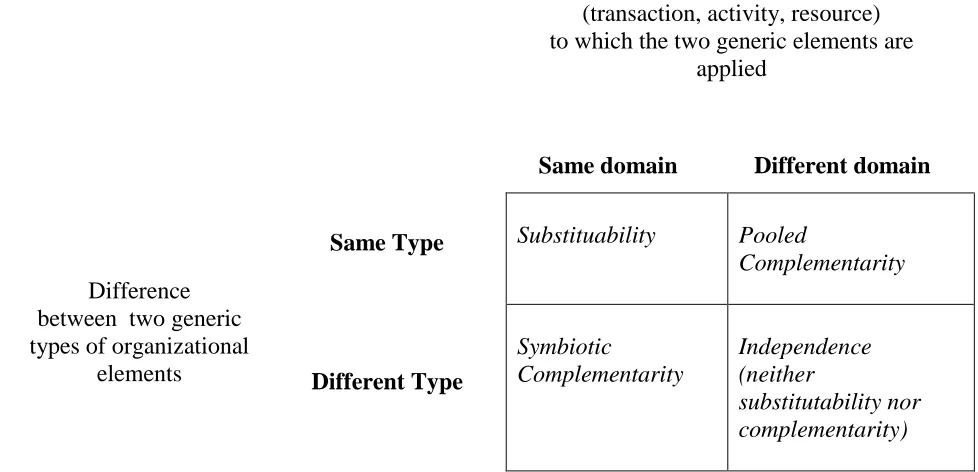
a) ‘symbiotic’ complementarity, if surplus value is generated by different elements
applied to the same application domain;
b) ‘pooled’ complementarity if surplus value is generated by similar elements
applied to different application domains.
Both types of complementarity involve interaction effects (by definition of
complementarity), in the sense that the value of the (symbiotic or pooled) sum is greater
than the sum of the values of the parts. The case of symbiotic complementarity is
obvious. A puzzle could be a good example of pooled interaction: puzzle pieces are all
similar, the value of any single piece alone is almost zero, only the pooling of all parts
has a positive value (see an image). As examples of pooled complementarity among
organizational practices, one may cite the use of incentives in line and staff units, or the
involvement in community building of all units and not merely of some units. Examples
of symbiotic complementarities among organizational practices are found when, say,
pay for performance, teamwork and formal standardized procedures of performance
evaluation are applied to the same people or units.
have different implications for the laws of combination of organizational elements. In
addition, the double distinction between similarity-/difference-based complementarity,
and of same/different application domain, implies that there are another two possible
combinations that do not generate complementarity:
c) elements that are similar in kind and have the same application domain, are
substitutes, i.e. their combinations are redundant;
d) elements that are dissimilar and have different application domains are
independent (neither substitutable nor complementary).
The four types of relationships among two generic types of organizational elements are
summarized in Table 2.
TABLE 2 ABOUT HERE
Evaluation functions and multifunctionality
In order to be substantively more precise in specifying which kind of differences
may generate complementarity, an evaluation function must be defined. What is a
‘good outcome’ with respect to which a combination of elements may be evaluated?
We propose to use distinct functions rather than one overall performance function (as it
has been typically been done in the assessment of discrete structural alternatives), for
- The relationship between the overall performance of a system and its
organizational configuration is too ‘noisy’;
- The performance of economic systems is usually measured financially, which is a
useful yardstick for some purposes; but it is not a good indicator of the utility or
value generated by a system, as no monetary single indicator is a good indicator
of the value of complex goods in general, in particular where multiple
beneficiaries and complex trade-offs are involved (Sen 1999). Hence, it is
preferable to use a portfolio of functions, as it is typically done in design theory in
other fields, such as architecture (Boland and Collopy 2004; March 1976);
- Operationalizing results into qualitatively different consequences allows detection
of counter-intuitive combinations between configurations and consequences. For
example, it is entirely conceivable to have highly communitarian, identity based
combinations generating brilliant economic results (and perhaps too oppressive
socialization); and highly market-like, incentive driven systems, generating very
poor economic results (but perhaps an exciting sports-like social atmosphere).
Among the qualitatively different, relevant parameters against which an organizational
combination may be evaluated, at least three seem to be important beyond any
reasonable doubt: efficiency, effectiveness and equity (Grandori 1999). Then, in the
laws presented below, all these three types of outcomes will be considered. It is worth
pointing out that these outcomes received also an initial test in the empirical study
(Grandori and Furnari 2008) mentioned below (the effectiveness parameter used in the
Here it can be further noticed that elements may be more or less specialized with
respect to particular outcomes. Some elements are more ‘generalist’ and
multifunctional, while others are more ‘specialist’ and mono-functional.. Possible
consequences of the different degree of multifunctionality of elements for combinatory
laws are:
- more generalist elements should more frequently be useful components in
organizational formulas, i.e. in formulas that are effective at producing different
types of results, while specialized elements should be useful in the production of
only one type of result;
- more generalist elements may be more ‘stable’, i.e. less in need of combination
with other elements, and be substitutable by other generalist elements or by a
combination of many specialist elements; by contrast, specialist elements should be
more ‘unstable’, i.e. they need complements in order to deliver good outcomes, and
more precisely they need complements of a different kind.
Expressing organizational formulas through Boolean Comparative Analysis
In an earlier paper (Grandori and Furnari 2008), we used Boolean Comparative
Analysis (Ragin, 1987; 2000) to formalize organization forms as chemical formulas and
test a set of basic combinatory laws on a medium-sized sample of firms. Here below,
we briefly introduce the language of Boolean Comparative Analysis (BCA hereafter),
illustrating only the technical features of this methodology that are strictly necessary to
Let us hypothesize that the adoption of one market-like element (say, monetary
incentives to human resources) will be per se sufficient to produce a level of firm
efficiency above the industry average. Labelling the causal condition “presence of one
dose of market” as M1 and the outcome “presence of efficiency above the average” as
E>A , this hypothesis can be translated into the following Boolean algebra statement:
M1 ---> E>A
where, according to standard Boolean algebra notation, ---> denotes the logical
implication operator and capital letters indicate the presence of a causal condition or
outcome .iv
The typical objective of BCA is to determine the simultaneous presence and absence of
causal conditions under which a certain outcome is present. To this end, cases are
formalized as combinations of elements through the use of Boolean algebra operators
"AND" ("*") and "OR" ("+"). These operators allow to specify the relations between
more than one causal condition: suppose for example that the adoption of highly
powered incentives is not sufficient per se to foster firm efficiency without the
application of one bureaucratic element (say, an adequate monitoring system). This
hypothesis can be formalized into the following Boolean statement:
where "*" denotes the logical Boolean operator "AND". The above statement reads as
"M1 AND B1 imply E>A ": the occurrence of outcome E>A requires the presence of one
element of both B and M, i.e. B and M in one dose are strictly complementary in the
achievement of that outcome. The Boolean operator “AND” therefore represents
relations of complementarity.
Let us now suppose that there are two other complementary elements of a different type
that can also produce the same outcome E>A: for example C1 and D1, representing
respectively a community-like element (say, teamwork) and an element of democratic
governance (say, the distribution of representation rights). The Boolean expression will
be:
M1*B1 + C1*D1 --> E>A
where "+" denotes the logical operator "OR". The above statement could be read as
"M1 AND B1 OR C1 AND D1 imply above average E": if any of the two
combinations is present, the outcome will occur. Hence the Boolean operator "OR"
represents relations of substitutability (equifinality). Using these operators, BCA
employs logical minimization algorithms and probabilistic tests in order to identify the
necessary and sufficient combinations of elements to achieve given outcomes (Ragin,
1987; 2000).
In using Boolean algebra language to formalize the hypothesized combinatory
laws presented below, we generalize the notations used in the example above.
B = Bureaucratic; C = Communitarian; D = Democratic) and the number of doses (or
atoms) for each type of element with a small subscript at the bottom of the letters, as in
chemical formulas. Thus, the generic organizational formula can be written in the form
Mm- Bb – Cc – Dd..
The empirical study presented in Grandori and Furnari (2008) proposes a way of
operationalizing and measuring the notion of ‘one dose’ or ‘one atom’ of an element. In
that study a dose of an element is measured as the number of practices (see Table 1)
employed beyond the average level. In some of the laws, a notion of ‘maximum’ level
of application is also used. One way to operationalize this general notion of maximum
is to consider the maximum average intensity of application across all the four elements
in systems of a certain type in a certain context, as is done in the above mentioned
empirical study (where this value is found to be 4).
The three organizational outcomes considered here will be indicated with capital letters
( E = efficiency; I = innovation; F = fairness). The subscript ‘>A’ at the bottom of these
letters indicates that the specific organizational outcome is achieved at a ‘high level’,
operationalized as above average (of course other thresholds may be used for
operationalizing ‘high’ performance).
Combination laws
Combination laws can be expressed as conditions that organizational formulas
should respect. The first four laws (conditions I to IV) have been formulated and
received an empirical test in Grandori and Furnari (2008); they are expressed in a more
structural heterogeneity presented here). The character of the first four conditions is that
of universal laws to which any high performing organizational formula should obey
(this obviously does not mean that only one high performing formula exists). The laws
of structural heterogeneity (conditions V to XII) are a distinctive contribution of the
present paper (only the initial conditions V and VI were conjectured in our former
study).
- It is extremely likely that in any system, even very simple ones, there are activities
of different kinds; and that elements of different kinds are superior in order to regulate
these activities (Grandori and Soda 2006). In addition, it is extremely likely that any
system, even a small system, that tries to coordinate everything using only one kind of
element, no matter which (say plans or incentives) is not viable (Stark 2007). Finally, it
is conjectured that, at least at low doses, the four elements entail positive symbiotic
complementarities (Grandori and Furnari 2008).
Hence: The presence of (at least one dose of) elements of different kind is a necessary
condition for an organizational formula achieving high performance of any sort (‘Law
of organizational core variety’). Thus, a testable, formalized proposition is the
following:
Condition I
M>1* B>1* C>1* D>1 E>A
M>1* B>1* C>1* D>1 I>A
Our discussion of the effects of similarity among mechanisms, leads to the observation
that mechanisms which are similar in kind are complementary above all if they are used
in different parts of the system, i.e. they can bring about pooled complementarity, not
symbiotic complementarity. If similar elements are employed at increasing doses in the
same domain, marginal benefits should decrease.
Hence: There are decreasing marginal returns, and, beyond some point, negative
returns, to increases in the intensity of the same kind of element in the same application
domain (‘Law of decreasing marginal returns to organizational homogeneity’).
In other words, a necessary condition for high performance is that each and every
element is not applied over and above a certain value that we thus define as
‘maximum’. Hence, a sufficient condition for low performance is the following:
Condition II
X>max Y<A,
where X indicates a generic type of element (M, B, C, D) and Y a generic type of
outcome (E, I, F).
People’s energy, cognitive capacity and behavioral flexibility is limited; hence,
individuals are unlikely to be able to attend and respond simultaneously to: strong
incentives; strong demands for identification; intense requirements of conformity to
need to be, at one and the same time, organizational citizens who are highly
entrepreneurial, highly solidaristic, highly compliant, actively and critically
participating to the life of the organization. In addition, practices are costly, and choice
among alternative investments in different practices may become an issue as the total
amount of investment increases.
Hence: There are decreasing marginal returns, and beyond some point, negative
returns, to increases in the intensity of all kinds of elements in the same application
domain. (‘Law of decreasing marginal returns to organizational variety’)
Formalized testable propositions deriving from the law are those expressed by the
following condition:
Condition III
M>max *B>max * C>max * D>max E<A
M>max *B>max * C>max * D>max I<A
M>max *B>max * C>max * D>max F<A
If only this condition III were valid (the simultaneous application of elements in high
doses predicts low performance) but not condition II ( the application of a single element
in a high dose predicts low performance), it would mean that there are negative
complementarities, beyond some level, among elements that differ in kind, and not
Through an empirical investigation on the combinatory laws expressed above in a
sample of 75 large Italian firms, Grandori and Furnari (2008) found strong evidence
supporting the hypothesized relationships among similar/different organizational
elements: 89% of highly efficient firms and 93% of highly innovative firms respect the
combinatory rule ‘all different types of organizational elements should be adopted in
the firm, with values comprised between a lower and an upper bound’ (operationalized
as 1 and 3 in the study). In other words, any high performing formula is internally
varied, at least at a base level, and the law of decreasing marginal returns applies to
each single type of element: i.e. the prime origin of the upper bounds is decreasing or
shows negative returns to one-sidedness and homogeneity, not the negative interactions
among elements of different kinds. Testing for the necessity and sufficiency of these
findings, the authors found respect of the laws to be a statistically significant, necessary
and sufficient condition for high efficiency and a significant necessary condition for
high innovationv.
Introducing types of outcomes
In Grandori and Furnari (2008) we also advanced the hypothesis that the optimal
intensity of each element in an organizational formula (within the lower and upper
bounds specified by the former laws) is contingent on the type of performance outcome
generated (‘Law of structural heterogeneity’).
As to efficiency and innovation, we hypothesized that bureaucratic elements are more
specialized in the achievement of internal efficiency of a system, while market,
innovation. The tested hypothesis tested was that highly efficient organizational
formulas are enriched in bureaucracy, while highly innovative organizational formulas
are enriched in one or more of the other elements. Hence, constraining all the doses of
elements (m, b, c, d) to be > 1 due to the first ‘law of organizational core variety’:
Condition IV
Bb*Mm*Cc*Dd - E>A if b > m* c * d
Condition V
Bb*Mm*Cc*Dd I>A if m + c + d > b
Fairness outcomes were not considered in our earlier study. Here, we hypothesize that
they should be generated by formulas enriched both in bureaucracy and communitarian
or democratic elements, as the former elements are specialized in generating
transparency and de-personalization, while the latter in reducing or resolving conflict.
Hence:
Condition VI
Bb*Mm*Cc*Dd F>A if b * (c + d) > m.
At this juncture, it should be noticed that there are still many formulas that satisfy these
conditions, i.e. formulas that are equifinal in generating high innovation or high
efficiency or high fairness. Here, we are going to further refine the laws of structural
heterogeneity by introducing further discriminating contingencies (non organizational
Introducing contingencies
The portfolio of equifinal formulas can be restricted if further conditions are added..
They can be represented by some contingencies to be met by the formulas. One
parsimonious way of doing so is to summarize those contingencies in terms of the
nature of tasks and interdependencies to be governed (as done in all research traditions
we are drawing on). In particular, the different elements of organizing are known to be
specialized to the level of uncertainty of tasks and inter-task relations.
Bureaucratic elements are good in generating static efficiency in stable tasks, hence the
proposition that formulas enriched in bureaucracy generate high efficiency contained in
our former study is likely to be valid only for static efficiency. A combination of
bureaucratic mechanisms with market elements (especially through outsourcing and
externalization of activities) is known to be good in generating dynamic efficiency in
variable tasks (Mariotti and Cainarca 1986).
Hence, denoting uncertainty as U, qualifying it as either low (L) or high (H) and
constraining all the doses of elements (m, b, c, d) to be > 1 due to the first law of
organizational core variety, the law of structural heterogeneity for static and dynamic
efficiency can be expressed as follows:
Condition VII
U L* Bb*Mm*Cc*Dd E>A if b > m* c * d
U H * Bb*Mm*Cc*Dd E>A if m*b > c*d
If the effective organization of innovation is considered, a distinction can also be made
between innovation in known tasks and techniques, versus innovation in settings where
tasks and techniques have to be discovered altogether. Taking into account both
classical works (Burns and Stalker 1961) and recent empirical works shading some
light on the ‘routinization of innovation’ and innovation in mature industries (Kilduff
and Sawyer 2003; Brusoni 2006), it can be hypothesized that in mature, known settings
the organization of innovation can be more modular, while in highly dynamic and
innovative settings it needs to be more integrated. Hence, organizational formulas for
innovation in less uncertain action fields could be richer in market and/ or
bureaucratic elements (both infuse modularity into a system), while in more uncertain
action fields, organizational formulas should be richer in community and/or democracy
(both infuse integration).
Condition IX
U L* Bb*Mm*Cc*Dd I>A if (m + b) > c*d + (m*b) > c*d
Condition X
U H* Bb*Mm*Cc*Dd I>A if (c+d) > m* b
If this were true, it would indicate that the set of formulas for high innovation under
high uncertainty (the intersection, i.e. the multifunctional formula, being the market and
bureaucracy enriched formulas).
Fairness in stable and known activities is also likely to be best achieved through
different mechanisms than in uncertain conditions. While transparency and equal
opportunities and treatment may generally associate fairness outcomes with some
elements of bureaucracy, the level of uncertainty may discriminate between community
and democracy as complements: communitarian elements are possibly sufficient in
stable setting, while democratic mechanisms and organizational justice provisions
should be more robust under uncertain conditions (Miller 1992; Grandori forth). Hence,
organizational formulas for fairness can be hypothesized to be richer in bureaucracy
and community in stable settings, richer in bureaucracy and democracy in dynamic and
uncertain settings.
Condition XI
U L* Bb*Mm*Cc*Dd F>A if c*b > m *d
Condition XII
U H*Bb*Mm*Cc*Dd F>A if d*b > m *c
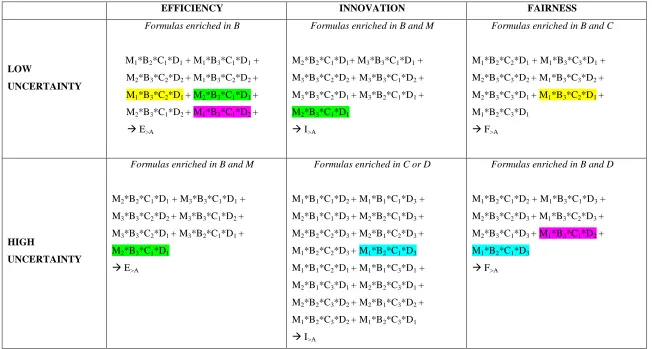
The organizational formulas generated by the above set of conditions are summarized
in Table 3, which shows all the equifinal formulas written in extended form, assuming
that the maximum number of each element is 4 (as found in our recent empirical study
type and number of contingent formulas resulting from the analysis (equifinal formulas
are indicated with the same color in different cells).
TABLE 3 ABOUT HERE
Conclusions
This work has revisited and revitalized the notion of organization forms as clusters
of attributes, providing a systematic classification of attributes as ‘organizational
elements’ – in analogy with natural elements in chemistry – and outlined a series of
laws of combinations on how elements can combine into organizational formulas. Some
notable features of the conjectured (and partially tested) combination laws are worth
noticing:
- they include both universal and contingency laws (i.e. specify which ‘features’
are generally necessary in order to have a high performing organization and
which are necessary only under particular circumstances);
- they admit equifinality and predict structural heterogeneity (e.g. it is argued that
more than one ‘cluster of features’ can achieve high performance under the
same circumstances, and it is specified which ones).
Among the substantive conclusions, it is worthwhile to highlight that:
- Bureaucratic elements are highly multifunctional , especially under low uncertainty
- Democratic elements are multifunctional under high uncertainty, especially in the
- Market elements are more specialized elements, especially with regard to
innovation and uncertainty.
- in stable settings, either efficiency and innovation or fairness and efficiency can be
achieved with the same formula (enriched in bureaucracy and either market or
community).
- There is no formula in common between efficiency and innovation in dynamic
settings or between fairness and innovation in stable settings. This result indicates
an area of trade-off for designers, giving an idea of the outcomes that are more
difficult to achieve simultaneously in the two settings.
- There are many ways of being innovative in highly uncertain settings (the set of
equifunctional formulas is particularly wide). This is an interesting result, that
provides a solution for a phenomenon that is currently considered a ‘puzzle’: how is
it possible, and is it ‘right’ or ‘wrong’, that diverse organizational arrangements, in
particular highly communitarian and highly market-rich arrangements, are
observable in the governance of knowledge – intensive activities? (Foss 2007).
The results also have implications for organization redesign and change. Some changes,
in terms of meeting different contingencies or of achieving different mixes of
outcomes, requires to change more elements, while others may imply changing just one
element. For instance, only one additional D element is required in order to find several
formulas able to achieve all three objective functions in uncertain settings. This is a
significant refinement with respect to the usual application of the notion of
set of practices that are changed together, the better (due to the presence of interactions
among practices) is too rough and resource wasting, and derives from not knowing
where complementarities lie. The organizational chemistry framework illustrated here
should help in making hypotheses on what elements are complementary, in what doses
and under what circumstances; hence, in enhancing our capacity of selective
intervention and ad hoc organization design, including a diagnosis of what elements
References
Boland, R. J. and F. Collopy (2004), Managing as designing, Stanford, US: Stanford
University Press.
Brusoni, S. (2005), ‘The limits to specialization: Problem solving and coordination in
modular networks’, Organization Studies, 26 (12), 1885-1907.
Burns, T. and Stalker G.M. (1961), The Management of Innovation, London, UK:
Tavistock Publications.
Doty, H. D., W. H. Glick and G. P. Huber (1993), ‘Fit, Equifinality, and Organizational
Effectiveness: A Test of Two Configurational Theories’, Academy of Management
Journal, 36 (6), 1196-1250.
Fiske, A. P. (1992), ‘The four elementary forms of sociality: Framework for a unified
theory of social relations’, Psychological Review,99, 689-723.
Fiss, P. C. (2007), ‘A set-theoretic approach to organizational configurations’, Academy
of Management Review,32 (4), 1180-1198.
Foss, N. J. (2007), ‘The Emerging Knowledge Governance Approach: Challenges and
Furnari, S. (2007), ‘Modeling Multidimensional Fit through Boolean Algebra: New
Methods for Combinative Organization Design’, in Luigi E. Golzio and Tommaso M.
Fabbri (ed.), ‘Relazioni di Lavoro e Forme Organizzative: Nuovi Modelli Progettuali’,
Roma, Italy: . Carrocci, pp. 19-38.
Grandori, A. (1997), ‘Governance structures, coordination mechanisms and cognitive
models’, Journal of Management and Governance,1 (1), 29-47.
Grandori, A. (1999), Organizzazione e comportamento economico, Bologna, Italy: Il
Mulino, (english edition, 2001, Organization and economic behavior, London: Routledge
).
Grandori, A. and G. Soda (2006), ‘A relational approach to organization design’, Industry
and Innovation, 13 (2), 151-172.
Grandori, A. (2006), ‘Innovation, Uncertainty and Relational Governance’, Industry and
Innovation, 13 (2), 127-133
Grandori A. (forth), ‘Poliarchic governance and the growth of knowledge’, in Nicolai J.
Foss and S. Michailova (eds.) Knowledge Governance. Oxford, UK: Oxford University
Grandori, A. and S. Furnari (2008), ‘A chemistry of organization: Combinatory analysis
and design’, Organization Studies,29 (2), 315-341.
Gresov, C. and R. Drazin (1997), ‘Equifinality: Functional equivalence in organization
design’, Academy of Management Review,22 (2), 403-428.
Gouldner, A. W. (1954), Patterns of industrial bureaucracy, New York, US: Free Press.
Harrison, J. S. and E. R. Freeman (2004), ‘Democracy in and around organizations’,
Academy of Management Executive, 18 (3), 49-53.
Hirschman, A. O. (1970), Exit, voice and loyalty: Responses to decline in firms,
organizations and states, Cambridge, US: Harvard University Press.
Hofstede, G. (1980), Culture’s consequences: International differences in work-related
values, London, UK: Sage Publications.
Kilduff, M. and S. Sawyer (2003), Economizing on Bounded Rationality: Networking
through the Machine in Extreme High Reliability Software Production, EGOS
Colloquium, Copenhagen.
Kogut, B. and U. Zander (1996), ‘What firms do? Coordination, identity and learning’,
Ichniowski, C., S. Kathryn, and G. Prennushi (1997), ‘The effects of human resource
management practices on productivity: A study of steel finishing lines’, American
Economic Review, 87 (3), 291-313.
Lammers, C. and G. Széll (1989), Organizational democracy: Taking stock.International
Handbook of Participation in Organizations, vol. I, Oxford, UK: Oxford University
Press.
Laursen, K. and V. Mahnke (2001), ‘Knowledge strategies, firm types and
complementarity in human resource practices’, Journal of Management and Governance,
5 (1), 1-22.
Marturana, H. R. and F. J. Varela(1980), Autopoiesis and cognition: The realization of
the living, London, UK: Springer.
March, L. (1976) (ed), The architecture of form, Cambridge, UK: Cambridge University
Press.
Mariotti S. and G. Cainarca (1986), ‘The evolution of transaction governance in the
Meyer, A. D., A. S. Tsui, and C.R. Hinings (1993), ‘Configurational approaches to
organizational analysis’, Academy of Management Journal, 36 (6), 1175-1195.
Milgrom, P. and J. Roberts (1995), ‘Complementarities and fit: Strategy, structure and
organizational change in manufacturing’, Journal of Accounting and Economics 19,
179-208.
Miller, G. J. (1992), Managerial dilemmas. The political economy of hierarchy,
Cambridge, UK: Cambridge University Press.
Miller, D. and P. H. Friesen (1984), Organizations: A quantum view, Englewood Cliffs,
US: Prentice Hall.
Mintzberg, H. (1979), The structuring of organizations, Englewood Cliffs, US: Prentice
Hall.
Ouchi, W. G. (1980), ‘Markets, bureaucracies and clans’, Administrative Science
Quarterly, 25, 129-141.
Polos L., M.T. Hannan, G.R. Carroll (2002), ‘Foundations of a theory of social forms’,
Pugh, D. S., D. J. Hickson, R. C. Hinings, and C. Turner (1969) ‘An empirical taxonomy
of structures of work organizations’, Administrative Science Quarterly,14, 115-26.
Ragin, C. C. (1987), The comparative method: Moving beyond qualitative and
quantitative strategies, Berkeley, US: University of California Press.
Ragin, C. C. (2000), Fuzzy-set social science, Chicago, US: University of Chicago Press.
Sen, A. (1999), Commodities and capabilities, Oxford, UK: Oxford University Press.
Simon, H. A. (1969), The sciences of the artificial, Cambridge, US: MIT Press.
Simon, H. A. (1978), ‘Rationality as Process and as Product of Thought’, American
Economic Review, 68 (2), 1-16.
Stark, D. (2007), ‘Entrepreneurship as the Exploitation of Uncertainty’, paper presented
at the Workshop on ‘Uncertainty: Economic Action with Partial Knowledge of the
World’, Center on Organizational Innovation, Columbia Business School, NYC,
September 7-8, 2007.
Van de Ven A.H., A.L. Delbecq, R. Koenig (1976), ‘Determinants of coordination modes
within organization’, American Sociology Review, 41, 322-338.
Von Hayek, F. (1945), ‘The use of knowledge in society’, American Economic Review,
35: 519-530.
Whittington, R., A. Pettigrew, S. Peck, E. Fenton, M. Conyon (1999), ‘Change and
complementarities in the new competitive landscape: A European panel study,
1992-1996’, Organization Science, 10 (5), 583-600.
Williamson, O. E. (1975), ‘Markets and hierarchies: Analysis and antitrust implications’,
New York, US: Free Press.
Williamson, O. E. (1991), ‘Comparative economic organizations: the analysis of discrete
structural alternatives’, Administrative Science Quarterly,36, 269-296.
Williamson, O. E. and W. G. Ouchi (1981), ‘The markets and hierarchies program of
research: origins, implication, prospects’ in Andrew H. Van de Ven and William F. Joyce
(eds), Perspectives on organization design and behavior, New York, US: Wiley, pp.
Williamson, O. E. (2004), ‘Herbert Simon and organization theory: Lessons for the
theory of the firm’ in Mie Augier and James G. March (eds), Models of a man,
Cambridge, US: MIT Press, pp. 279-297.
Zenger, T. R. and W. S. Hesterly (1997), ‘The disaggregation of corporations: Selective
intervention, high powered incentives and molecular units’, Organization Science,8 (3),
Table 1 – Organizational Elements and Practices
Types of organizational elements Single Elements Practices predominantly embodying the element References Market-like Elements
Price Pay for
performance (individual)
Pay for performance (team and firm- based)
Von Hayek 1945 Hirschman 1970 Williamson 1975; 1993
Zenger and Hesterly 1997
Exit Outsourcing
Internal labor mobility
Bureaucratic Elements
Formal Rules Evaluation System Formal procedures
and programs
Gouldner 1954 Blau and Scott 1962 Pugh et al 1969
Hierarchy Vertical
Articulation of formal structure (no authority implied)
Communitarian Elements
Knowledge Sharing Knowledge sharing techniques
Project-based self- organization
Hofstede 1980 Ouchi 1980 Kogut and Zander 1996
Preference Sharing (objectives alignment)
Teaming Community
building practices
Democratic Elements
Weighting of organizational members preferences
Competence- and/or preference-based job design Empowerment
Gouldner 1954 Lammers and Szell 1989
Blair 1995 Harrison and Freeman 2004 Diffusion of decision rights
holding
Responsibility Centers Diffusion of
Application Domain (transaction, activity, resource) to which the two generic elements are
applied
Same domain Different domain
Difference between two generic types of organizational
elements
Same Type Substituability Pooled
Complementarity
Different Type
Symbiotic
Complementarity
Independence (neither
[image:42.612.79.568.100.336.2]substitutability nor complementarity)
EFFICIENCY INNOVATION FAIRNESS
LOW
UNCERTAINTY
Formulas enriched in B
M1*B2*C1*D1 + M1*B3*C1*D1 +
M2*B3*C2*D2 + M1*B3*C2*D2 +
M1*B3*C2*D1 + M2*B3*C1*D1 +
M2*B3*C1*D2 + M1*B3*C1*D2 +
E>A
Formulas enriched in B and M
M2*B2*C1*D1+ M3*B3*C1*D1 +
M3*B3*C2*D2 + M3*B3*C1*D2 +
M3*B3*C2*D1 + M3*B2*C1*D1 +
M2*B3*C1*D1
I>A
Formulas enriched in B and C
M1*B2*C2*D1 + M1*B3*C3*D1 +
M2*B3*C3*D2 + M1*B3*C3*D2 +
M2*B3*C3*D1 + M1*B3*C2*D1 +
M1*B2*C3*D1
F>A
HIGH
UNCERTAINTY
Formulas enriched in B and M
M2*B2*C1*D1 + M3*B3*C1*D1 +
M3*B3*C2*D2 + M3*B3*C1*D2 +
M3*B3*C2*D1 + M3*B2*C1*D1 +
M2*B3*C1*D1
E>A
Formulas enriched in C or D
M1*B1*C1*D2 + M1*B1*C1*D3 +
M2*B1*C1*D3 + M2*B2*C1*D3 +
M2*B2*C2*D3 + M2*B1*C2*D3 +
M1*B2*C2*D3 + M1*B2*C1*D3
M1*B1*C2*D1 + M1*B1*C3*D1 +
M2*B1*C3*D1 + M2*B2*C3*D1 +
M2*B2*C3*D2 + M2*B1*C3*D2 +
M1*B2*C3*D2 + M1*B2*C3*D1
I>A
Formulas enriched in B and D
M1*B2*C1*D2 + M1*B3*C1*D3 +
M2*B3*C2*D3 + M1*B3*C2*D3 +
M2*B3*C1*D3 + M1*B3*C1*D2 +
M1*B2*C1*D3
[image:43.792.83.735.95.444.2] F>A
i
Recent and relevant contributions in organizational sociology concerned with organization forms, such as the just quoted article by Hannan et al or neo-institutionalism, are not considered. The reason is that in those approaches the definition of organizational features and the patterns of their clustering are seen as conforming to the expectations of reference groups and of the dispensers of legitimacy. Hence those approaches do not offer inputs for specifying elements and combinatory laws in a micro-analytic way.
ii These contributions are the only ones to our knowledge that conceive these types of elements as classes of mechanisms to be combined in order to explain or construct any organizational system, rather than as full institutions, that is, as ‘discrete structural alternatives’ themselves, e.g. ‘the market’, ‘the firm’, etc. (as they are in apparently similar typologies drawn up by others, such as Williamson, Lindblom, or Etzioni). Fiske’s ‘fundamental elements of sociality’ are ‘market pricing’, ‘authority ranking’, ‘equality matching’, and ‘communal sharing’; Grandori and Miller contribute to identifying single elements within each class, such as pricing, exit, voting, teaming, negotiation, authority and agency, rules and procedures, norms and culture, property rights.
iii The concepts and procedures employed in BCA are illustrated in greater detail in Ragin (1987; 2000) and
on the website www.fsqca.com. Two methodological papers (Fiss 2007; Furnari 2007) address specifically the motivations underlying the use of BCA in organization design studies.
iv In standard BCA notations, lower-case letters indicate the absence of a causal condition or of an outcome. Lower case notations will not be used in this paper for the sake of simplicity.
v