1876-6102 © 2015 The Authors. Published by Elsevier Ltd. This is an open access article under the CC BY-NC-ND license (http://creativecommons.org/licenses/by-nc-nd/4.0/).
Peer-review under responsibility of Applied Energy Innovation Institute doi: 10.1016/j.egypro.2015.07.322
Energy Procedia 75 ( 2015 ) 987 – 992
ScienceDirect
The 7
thInternational Conference on Applied Energy – ICAE2015
Solid Waste Mixtures Combustion in a Circulating Fluidized
Bed: Emission Properties of NOx, Dioxin, and Heavy Metals
Hanfei Zhang
a, Caixia Lv
a, Jun Li
b,*, Wu Qin
c, Yukun Hu
d, Changqing Dong
caState Nuclear Electric Power Planning Design & Research Institute, Beijing 100095,China bSystems, Power & Energy Research Division, University of Glasgow, Glasgow G12 8QQ, UK
cNational Engineering Laboratory for Biomass Power Generation Equipment, North China Electric Power University, Beijing
102206, China
dUniversity of South Walles, Llantwit Road, Pontypridd, CF371DL, UK
Abstract
To efficiently and environment friendly combust the domestic garbage, sludge, and swill waste fuels, five different fuels are prepared by mixing the waste fuels together with coal, and grass biomass at different mixing ratios, and finally those fuels were combusted in a circulating fluidized bed (CFB) reactor. The emission performances of NOx, dioxin, and heavy metal during the combustion tests are studied. The results showed that a stable furnace temperature can be reached at approximately 850 ºC when combusting all studied mixed fuels, benefiting the thermal processes of sludge and domestic garbage and thus realizing the purpose of waste-to-fuel. In addition, the dioxin emissions are much lower than the emission standards, and NOx emissions could be reduced significantly by adjusting the ratio of waste fuels. However, the emissions of mercury, lead, and the combinations of chromium, tin, antimony, cupper and manganese components all exceeded the pollution control standard for hazardous wastes incineration, a further technology is required for heavy metal reductions to achieve the emission standards.
© 2015 The Authors. Published by Elsevier Ltd.
Selection and/or peer-review under responsibility of ICAE
Keywords: Solid wastes; CFB; NOx; Heavy metal; Dioxin
1.Introduction
As one of the world’s fastest developing countries, China has experienced a high growth rate in economic development and urbanization[1]. Waste treatment of the steady rising Municipal Solid Waste
* Corresponding author. Tel.: +44 (0)141 3304327
E-mail address: [email protected].
© 2015 The Authors. Published by Elsevier Ltd. This is an open access article under the CC BY-NC-ND license (http://creativecommons.org/licenses/by-nc-nd/4.0/).
(MSW) generation becomes a challenge in China. Currently, there are about 660 cities in China that produce about 190 million tonnes of solid waste annually, accounting for 29% of the world’s MSW each year[2]. Most Chinese MSW usually includes residential, institutional, commercial, street cleaning and non-process waste from industries[2].
Fluidized bed combustion has been shown to be a versatile technology, capable of burning practically any waste combination with low emissions [3, 4]. Compared to conventional combustion, the fluidized bed combustors can efficiently process a wide variety of fuels, offering a relatively uniform temperature and benefiting a low NOx and dioxin emissions[3, 5].
To efficiently and environment friendly combust the domestic garbage, sludge, and swill waste fuels, five different fuels are prepared by mixing the waste fuels together with coal, and grass biomass at different mixing ratios, and finally those fuels were combusted in a circulating fluidized bed (CFB) reactor. The emission performances of NOx, dioxin, and heavy metal during the combustion tests are studied and discussed.
2.Fuel and test reactor
2.1.Fuel
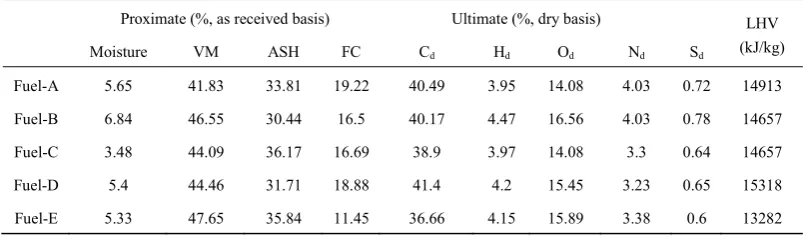
[image:2.544.133.398.370.468.2]5 fuel materials (Fuel-A, Fuel-B, Fuel-C, Fuel-D, and Fuel-E) are prepared by mixing of swill, domestic garbage, sludge, coal, and grass with varying mixture percentage, as shown in Table 1. The sludge is received as dry basis originally. The domestic garbage material is received without fermentation treatment. After mixture of raw materials, all 5 fuel materials are dried in air atmosphere for 15-20 days, their proximate and ultimate properties are presented in Table 2.
Table 1. Fuel preparing
Sludge (%)
Domestic garbage
(%)
Swill (%)
Coal (%)
Grass (%)
Others (%)
Fuel-A 40 20 0 10 20 10
Fuel-B 40 0 0 10 40 10
Fuel-C 30 40 10 10 0 10
Fuel-D 30 20 10 10 20 10
Fuel-E 40 40 10 0 0 10
Table 2. Proximate and ultimate analysis of prepared 5 fuels
Proximate (%, as received basis) Ultimate (%, dry basis) LHV
(kJ/kg)
Moisture VM ASH FC Cd Hd Od Nd Sd
Fuel-A 5.65 41.83 33.81 19.22 40.49 3.95 14.08 4.03 0.72 14913
Fuel-B 6.84 46.55 30.44 16.5 40.17 4.47 16.56 4.03 0.78 14657
Fuel-C 3.48 44.09 36.17 16.69 38.9 3.97 14.08 3.3 0.64 14657
Fuel-D 5.4 44.46 31.71 18.88 41.4 4.2 15.45 3.23 0.65 15318
[image:2.544.63.465.502.620.2]2.2.Test reactor
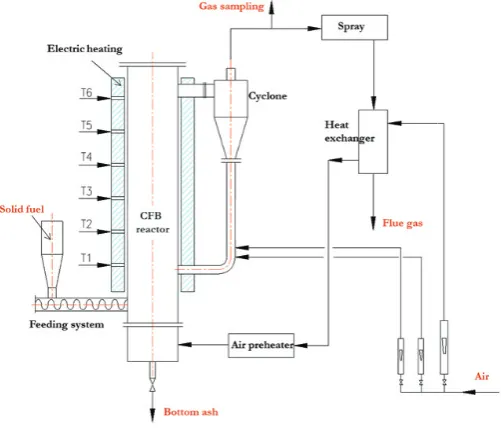
The test reactor is a 1.5 m long circulating fluidized bed (CFB) reactor with inner diameter of 114 mm for combustion characterizations of waste fuels. The scheme of CFB reactor is shown in Figure 1; electrically heated modules is installed for either ignition or furnace temperature control. A screw feeder is used to inject solid fuel into furnace from furnace bottom with a maximum capacity of 3 kg/h. 6 thermocouples are equally located along the furnace height to record the temperatures of the flue gas. Air is heated up to 350 °C for efficiency combustion. The excess air ratios for combustion processes of
[image:3.544.140.391.179.400.2]Fuel-A, Fuel-B, Fuel-C, Fuel-D, and Fuel-E are 1.72ˈ1.56ˈ1.56ˈ1.63ˈand 1.57, respectively.
Fig. 1. CFB reactor scheme
The dioxin and heavy metal emissions during the studied combustion tests have been investigated. It is assumed that the dioxin (or heavy metal) contents in fly ash is converted as the dioxin (or heavy metal) contents in flue gas, since the fly ash normally remains in flue gas as the main pollutant emissions source. The conversions of emission source is simply calculated by below equation:
(1)
where, is the contents in flue gas, mg/Nm3, i refers to either heavy metal or dioxin; is the
initial contents in solid fuel, mg/kg; e gaggggaas,ss
is the ash content in solid fuel in as received basis, %; is
i i
issss is i
isss iss th
is the volume of flue gas per kilogram solid fuel, Nm3/kg.
3. Results and discussions
3.1.Temperature profile
chamber for all studied fuels, which are slightly sensitive to the fuels. And the temperature at furnace exit is approximately 780 °C. The temperature is typical operating temperature for CFB reactor, which could effectively ensure a better combustion performances of the waste fuels, benefiting the thermal processes of sludge and domestic garbage and thus realizing the purpose of waste-to-fuel.
Fig. 2. Temperature profiles along furnace height of different fuels
3.2.NOx emissions
As mentioned above, the varying ratios of swill, domestic garbage, and sludge with coal and grass could achieve an expected combustion condition with a stable temperature. NOx, as one of typical emission during solid waste combustions, was investigated, the results are presented in Table 3, it should be noted that the NOx emissions in Table 3 refer to a basis of 11% O2 in flue gas. According to the pollution control standard for hazardous wastes incineration (GB 18484-2001) in China, the emission
limit for NOx is 500 mg/m3 at 11% O2 in flue gas. Obviously, NOx emissions from Fuel-A and Fuel-B
combustions are over the emission limits, while that of the other solid waste mixtures combustion satisfy the limits. This could be explained by considering a relative high furnace temperatures for Fuel-A and Fuel-B combustion when compared to other fuel mixture combustions, as shown in Figure 2, which means that the NOx emissions could be controlled and reduced by modifying solid waste mixture ratios. 3.3.Dioxin emissions
Table 3. NOx and dioxin emissions from different fuel combustion
NOx @ 11% O2 (mg/m3)
Dioxin contents in Flue gas @ 11% O2 (ng TEQ/Nm3)
Fuel-A 626.8 0.03̚0.06
Fuel-B 635.0 ̚0.09
Fuel-C 361.1 0.05̚0.08
Fuel-D 475.3 0.03̚0.06
Fuel-E 475.3 0.02̚0.06
CN standard[7] 500 0.5
EU standard[6] / 0.1
3.4.Heavy metal emissions
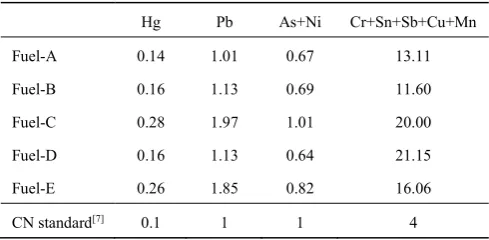
Heavy metals are environment forever[8]. This work also examined the heavy metal emissions during those mixed waste fuels combustions. From Table 4, apart of the arsenic and nickel components emissions, the emissions of mercury, lead, and the combinations of chromium, tin, antimony, cupper and manganese components all exceed the pollution control standard for hazardous wastes incineration. Those unexpected heavy metals emissions requires further technology application during the studied waste fuel combustions.
Table 4. Average heavy metal contents in flue gas (mg/Nm3, @11% O2)
Hg Pb As+Ni Cr+Sn+Sb+Cu+Mn
Fuel-A 0.14 1.01 0.67 13.11
Fuel-B 0.16 1.13 0.69 11.60
Fuel-C 0.28 1.97 1.01 20.00
Fuel-D 0.16 1.13 0.64 21.15
Fuel-E 0.26 1.85 0.82 16.06
CN standard[7] 0.1 1 1 4
4.Conclusions
[image:5.544.142.387.361.481.2]emissions of mercury, lead, and the combinations of chromium, tin, antimony, cupper and manganese components all exceeded the pollution control standard for hazardous wastes incineration, a further technology is required for heavy metal reductions to achieve the emission standards.
Acknowledgement
The authors would like to thank the financial support by the National Natural Science Foundation of China (51106051, 51206044, and 50976032) and National Key Technology R&D Program (2012BAA09B01)
References
[1] C. M. Nickolas J. THEMELIS, "MUNICIPAL SOLID WASTE MANAGEMENT AND WASTE-TO-ENERGY IN THE UNITED STATES, CHINA AND JAPAN," presented at the 2nd International Academic Symposium on Enhanced Landfill Mining, Houthalen-Helchteren, 2013.
[2] D. Q. Zhang, S. K. Tan, and R. M. Gersberg, "Municipal solid waste management in China: Status, problems and challenges," Journal of Environmental Management, vol. 91, pp. 1623-1633, 8// 2010.
[3] E. J. Anthony, "Fluidized bed combustion of alternative solid fuels; status, successes and problems of the technology," Progress in Energy and Combustion Science, vol. 21, pp. 239-268, // 1995.
[4] S. Patumsawad and K. R. Cliffe, "Experimental study on fluidised bed combustion of high moisture municipal solid waste," Energy Conversion and Management, vol. 43, pp. 2329-2340, 11// 2002.
[5] S. C. Saxena and C. K. Jotshi, "Fluidized-bed incineration of waste materials," Progress in Energy and Combustion Science, vol. 20, pp. 281-324, // 1994.
[6] A. Nzihou, N. J. Themelis, M. Kemiha, and Y. Benhamou, "Dioxin emissions from municipal solid waste incinerators (MSWIs) in France," Waste Management, vol. 32, pp. 2273-2277, 12// 2012.
[7] "Pollution control standard for hazardous wastes incineration (GB 18484-2001)," 2001. [8] http://www.stefanomontanari.net/sito/images/pdf/heavy_metals.pdf.
Biography