Mabrouk, Mohamed M. and McInnes, C.R. (2008) Potential field based navigation for planetary
rovers using internal states. In: 59th International Astronautical Congress, 29 Sep - 3 Oct 2008,
Glasgow, UK.
http://
strathprints
.strath.ac.uk/20151/
Strathprints is designed to allow users to access the research output of the University
of Strathclyde. Copyright © and Moral Rights for the papers on this site are retained
by the individual authors and/or other copyright owners. You may not engage in
further distribution of the material for any profitmaking activities or any commercial
gain. You may freely distribute both the url (
http://
strathprints
.strath.ac.uk
) and the
content of this paper for research or study, educational, or not-for-profit purposes
without prior permission or charge. You may freely distribute the url
(
http://
strathprints
.strath.ac.uk
) of the Strathprints website.
IAC-08-C1.1.4
Potential Field Based Navigation for Planetary Rovers Using
Internal States
Mohamed AbdelWahid
Department of Mechanical Engineering, University of Strathclyde, Glasgow, UK [email protected]
Colin McInnes
Department of Mechanical Engineering, University of Strathclyde, Glasgow, UK [email protected]
ABSTRACT
The work in this paper aims to introduce analysis and applications for the internal state model which is a new model for a swarm of rovers interacting via pair-wise attractive and repulsive potentials. The internal state model updates the state of the art in overcoming the local minima problem through solving the problem with comparatively lower computation cost than other methods. The simulations results show that using the internal state model, a swarm of planetary rovers, rather than moving in a static potential field, are able to manipulate the potential according to their estimation of whether they are moving towards or away from the goal, which allows them to escape from and maneuver around a local minimum in the potential field to reach a goal. An application of a swarm of rovers to solve the problem for different shaped obstacles is introduced to show the efficiency of the model. The model proves stable convergence to a goal and provides similarities with the behaviour of real groups of animals.
INTRODUCTION
Swarm robotics is a new and promising approach to the design and control of multi-agent robotic systems. It has a wide range of applications in numerous fields from space exploration to the deployment of teams of robots in maintenance1. Specific features of aggregations are striking in natural systems whose members have high rates of information exchange such as animal herds, insect swarms, bird flocks, and fish schools2. This leads us to use one of the most important phenomena in natural systems, which is the collective behaviour, to enhance the performance of a team of planetary rovers during operation.
In this paper we use a simple model of self-propelled rovers, which experience some dissipative frictional force. The swarm consists of Np individuals with mass mi, position ri and
relative distance |rij| between the ith and jth rover. A dissipative friction force with coefficient β is added to control the motion of the rovers. The rovers interact by means of a two-body generalized Morse potential, which decays exponentially at large distances and represents a realistic description of natural and artificial swarming robots. The equations of motion of the Np rovers are defined as:
i
i
r
v
=
&
(1))
(
iglobal i i i i
i
V
m
v
&
=
−
β
v
−
∇
r
(2)) ( )
( )
( )
( i interaction i goal ig obstacles io
global V V V
V r = r + r + r
(3)
he generalized Morse potential defines the T
interactions amongst the swarm rovers
Vgoal(rig) and the repulsive potential of the No obstacles Vobstacles(rio). Then, the global potential Vglobal(ri) is defined as
⎟
⎠
⎞
⎜
⎝
⎛
−
=
− − − −≠
∑
i j ajj j r j i
j p
l a
l r
N
i j i
global
C
e
C
e
V
(
r
)
r r r rg g i z
io z o i
z
o l
g l io
N
z
e C e
C −r−r −r−r
=
−
+
∑
1
(4)
here Cig, lig, and are the strength and
PROBLEM DEFINITION w
z
io
C
z
io
l
range constants of the goal attraction potential and the zth obstacle point repulsive potential that affects ith rover, respectively.
recent years new assumptions about In
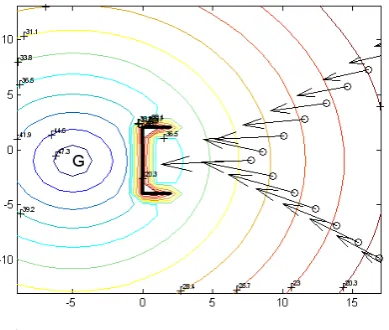
architectures needed for intelligence have emerged. These approaches attempt to emulate natural, rather than artificial intelligence and are based on, or at least inspired by, biology. The local minima problem has been a serious issue for potential field methods for robot path planning3. The problem of local minima, shown in fig(1), has been discussed by many researchers4,5. Our motivation is that most of these attempts are not suitable for real time applications5. The problem can be defined such that an artificial potential field at G induces the rovers’ motion towards a goal. In order to prevent collision with a static obstacle, an additional repulsive potential field is required. In general, a local minimum may form due to the superposition of the goal potential and that of the obstacles, resulting in a group of rovers, becoming partially or globally trapped in a state other than the goal.
[image:3.595.318.522.53.231.2]Fig. 1: t=36
Fig. 1: Classical reactive problem for a swarm of rovers with trapping in a local minimum
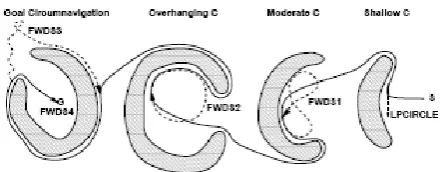
[image:3.595.78.273.570.735.2]For the scenario in fig(1), the swarm center velocity will increase as the swarm approaches the goal and decreases as an obstacle repels the swarm, while the swarm is again trapped if it enters a local minimum of the potential field. According to the local minimum survey4, forward chaining is indeed an efficient technique to solve the local minimum problem. The forward chaining technique development can be summarised in the following stages. The early version of forward chaining allows the potential surface to be manipulated so that the goal is temporarily replaced by a local subgoal6. By chaining the local subgoals in a sequence until eventually reaching the original goal, and then breaking the resulting path into steps, the agent can be gradually led to the original goal location. The method’s main disadvantage was the failure of the agent to reach the goal if the agent comes to a standstill. Therefore, the method was developed by introducing the forward chaining technique7 to keep the agent in motion through selection of the next subgoal target state to be the lowest potential value point on a circle whose center is at the current state. Although the disadvantage is covered, this transforms the local minimum problem into a local oscillation problem of various step lengths. To overcome the local oscillation problem, the back and forth motion was eliminated through restricting subgoal selection to the forward semi-circle corresponding to the last direction of movement. While this enables the agent to move forward along the obstacle boundary, for shallow C-shaped boundaries, further modifications that include more computations were made to overcome more curvature in difficult obstacle shapes.
Fig. 2: path of an agent uses the forward chaining technique for successive different types of C-shape
obstacles7
From the development of the method, it can be seen that the early version of the algorithm has been enhanced. A sample path using the final FWDS4 subgoal placement heuristic algorithm is shown in fig(2), together with the oscillatory path, shown in dashed line, according to one of the algorithm’s earlier versions for a single agent.
INTERNAL STATE MODEL
Inspired from escape from complex workspaces8, which can be seen in many natural systems, the use of dynamic internal states (potential field free parameters) is considered as a means of allowing rovers to manipulate the potential field in which they are manoeuvring to solve the local minimum problem.
The repulsion potential range affecting the ith rover (lio) is represented as a function of an obstacle constant (lo), which characterizes the physical nature of the obstacle, and the rover repulsion potential range (lri) which characterizes the rover internal state, while the repulsion potential strength affecting the ith rover (Cio) is represented as the obstacle constant (Co). The attraction potential range of the goal affecting the ith rover (l
ig) is also represented as the goal constant (lg), which characterizes the physical nature of the goal, while the attraction potential strength of the goal affecting the ith rover (Cig) is represented as the goal constant (Cg) such that
o
io
C
C
=
(5)ri o
io
l
l
l
=
+
(6)g
ig
C
C
=
(7)g
ig
l
l
=
(8)For the problem scenario shown in fig(1), the swarm will never attempt to manoeuvre around the fixed obstacle simply because the rovers
never know that they are trapped. The speed of the centre-of-mass of the swarm is used as an effective mechanism for the swarm to increase its perception about its progress through the workspace, and so avoid trapping in local minima. The function Qc is used to increase the perception of the group of rovers inspired from reward or punishment based perception in real biological systems9,10. The function is defined such that if the swarm is being repelled away from the goal, Qc will have a negative value that is viewed as punishment indicating that a part of or the entire swarm is moving away from the goal. If Qc ≥ 0, which is viewed as reward, the swarm senses collectively that it is moving towards the goal. The following set of first order differential equations are now used to express the internal states of the ith rover5
⎪⎩ ⎪ ⎨ ⎧ ≤ − ≥ < − = − ε λ λ | | or ) 0 ( if 0 0 if g c c c ri r Q r ri Q Q C e A C c q r r & (9) ⎪⎩ ⎪ ⎨ ⎧ ≤ − ≥ < − = − ε λ λ | | or ) 0 ( if 0 0 if g c c c ri r Q r ri Q Q l e B l c q r r & (10) ⎪⎩ ⎪ ⎨ ⎧ ≤ − ≥ < − = ε λ λ | | or ) 0 ( if 0 0 if | | g c c c ai a a ai Q Q C e A C i v r r v & (11) ⎪⎩ ⎪ ⎨ ⎧ ≤ − ≥ < − = ε λ λ | | or ) 0 ( if 0 0 if | | g c c c ai a a ai Q Q l e B l i v r r v & (12)
⎪⎩
⎪
⎨
⎧
≥
<
−
+
=
−0
if
0
0
if
1
| |c c i i
Q
Q
e
A
i
λ
β
β
&
β v β(13)
where coefficients Ar, Br, Aa, Ba, Aβ, λq, λr, λv, λa,
λβ are employed to scale the dynamics of the
internal states.
rover, according to the speed of each rover as well as the value of the function Qc, which depends on the speed of the center-of-mass of the swarm. When the rovers are repelled from an obstacle, the swarm center velocity decreases, lio then increases due to equation (6) and equation (10), which turns the workspace in the neighbourhood of the obstacles into a zone of maximum potential. This then leads to escape from the local minima because the potential field relaxes due to the damping terms in the differential equations for the internal states defining a gradient path which the aggregated swarm follows directly to the goal.
The cohesion generated by equation (9) – equation(10) ensures aggregation amongst the swarm’s rovers to face the local minimum problem. The net effect is then that the trapped swarm is forced to simultaneously explore escape paths. The damping terms in equation (9) – equation (12) ensure that the deviation of the rover internal state relaxes and returns to an equilibrium value as soon as the local minimum problem is solved.
Moreover, equation (13) ensures smooth manoeuvres around obstacles by linking the dissipation coefficient of each rover to its speed.
MODEL PERFORMANCE ANALYSIS
We compare our model performance with the most updated technique to solve the local minimum problem; the forward chaining technique7, by comparing the results obtained by the internal state model fig(3) to the published results7 obtained by forward chaining fig(2), for the same environment. In addition to single rover, we also consider cooperation amongst multiple rovers. It is shown that the swarm aggregation concept is used and the rovers prefer to aggregate when facing a problem in a way that matches the studies based on real animal group behaviour.
[image:5.595.306.538.54.146.2]The three disadvantages that have motivated the development of the forward chaining method are covered in the internal state model by using the perception function Qc along with the use of the squeeze effect8, which guarantee keeping the rovers in motion until reaching the global potential minimum position through emitting the rovers away from any obstacle region and ensure eliminating the oscillation problem (back and forth motion) by defining a gradient path around the obstacles through which the rovers are led directly to the goal.
Fig. 3: Path of a rover using the internal state model to escape from local minima for different types of C-shape
obstacles
SIMULATION RESULTS
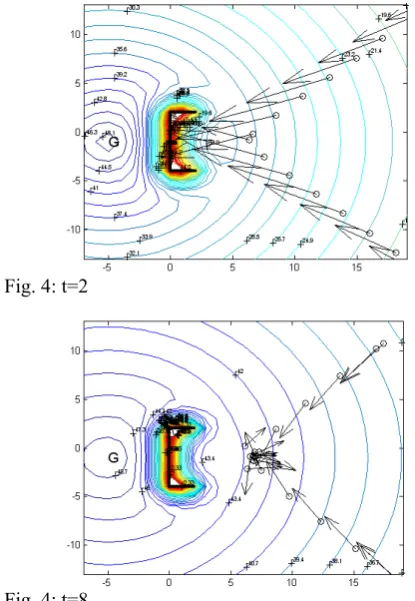
Using the new dynamic internal states for the same problem as used earlier, when a part of the swarm is repelled the function Qcswitches to a negative value. Therefore, the attraction potential equations in the algorithm are activated such that as the rovers’ speed increases, the inter-rover attraction potential increases and they gather to form a cohesive swarm. This has the advantage of magnifying the effect of the function Qc and making the swarm aggregate to solve the problem for the entire swarm. Weak aggregation may lead to part of the swarm remaining trapped in the local minimum. In addition, a cohesive swarm is required to ensure that the position and velocity of the centre-of-mass remains meaningful. Goal and obstacle interaction parameters used for the problem scenario are used again for the simulation results shown in fig(4).
Fig. 4: t=2
[image:5.595.304.512.473.774.2]Fig. 4: t=30
Fig. 4: t=37
Fig. 4: t=47
Fig. 4: t=50
Fig. 4: t=62
Fig. 4: Path of a rover using the internal state model to escape from local minima for different types of C-shape
obstacles5
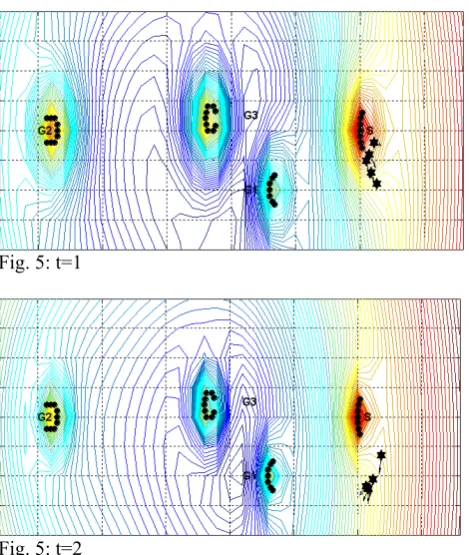
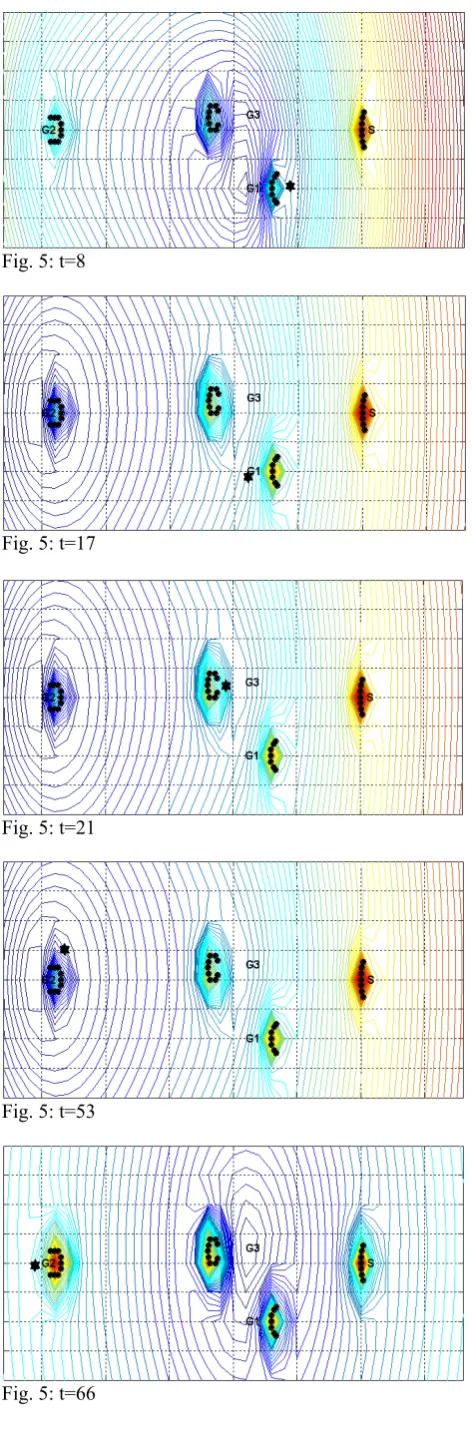
A Multiple goals application is now presented. A group of rovers are to move together in a multi-obstacle environment to visit three goals
G1, G2, and G3 and switching off each goal they visit. In this case, the robots are required to reach the goals with obstacle avoidance, and to move in a group without colliding with each other. The rovers during the mission are shown in fig(5), while fig(6) shows the swarm center path during the mission. The goal and obstacle interaction parameters are Co =4, Cg1 =70, Cg2 =50, Cg3 =20, lo =0.25 and lg =60, the rover’s initial interaction parameters are Ca =0.5, la =1,
Cr =0.5, lr =1, β =0.5 and the control parameters used are unit except Ar =0.6, Br =0.6, Aβ =1.3, ε =0.5, where ε is the goal
[image:6.595.54.263.55.703.2]proximity which if visited by any rover the goal will be switched off.
Fig. 5: t=1
[image:6.595.307.542.501.779.2]Fig. 5: t=8
Fig. 5: t=17
Fig. 5: t=21
Fig. 5: t=53
[image:7.595.305.540.55.185.2]Fig. 5: t=66
Fig. 5: t=97
Fig. 5: Path of swarm of rovers that aggregate during a mission
Fig. 6: Path of swarm of rovers that aggregate during a mission
The simulations results show that using the internal state model, a swarm of planetary rovers, rather than moving in a static potential field, are able to manipulate the potential according to their estimation of whether they are moving towards or away from the goal, which allows them to escape from and maneuver around a local minimum in the potential field to reach a goal. An application of a swarm of rovers to solve the problem for different shaped obstacles is introduced to show the efficiency of the model.
CONCLUSIONS
Using the internal state model, a swarm of planetary rovers, rather than moving in a static potential field, are able to manipulate the potential according to their estimation of whether they are moving towards or away from the goal, which allows them to escape from and maneuver around a local minimum in the potential field to reach a goal.
[image:7.595.307.539.229.333.2]in solving the problem along with comparatively lower computation cost.
REFERENCES
[1] Bonabeau E., Dorigo M. and Theraulaz G. (1999). Swarm intelligence: From natural to artificial systems. Oxford University Press, New York, 1999.
[2] S. Camazine, J. L. Deneubourg, N. R. Franks, J. Sneyd, G. Theraulaz, and E. Bonabeau, “Self Organization in Biological Systems”, Princeton University Press, Princeton, NJ, 2003. [3] Khatib, O. (1985). Real-Time Obstacle
Avoidance for Manipulators and Mobile Robots. IEEE International Conference, Vol. 2, pp.500 – 505.
[4] Weir M., Buck A. and Lewis J. (2006). POTBUG: A mind’s eye approach to providing BUG-like guarantees for adaptive obstacle avoiding navigation using dynamic potential fields. S. Nolfi et al. (Eds.): SAB 2006, LNAI 4095, 239 - 250.
[5] Mabrouk, M. and McInnes, C. (2007). Solving the potential field local minimum problem using internal agent states. To appear in the Journal of Robotics and Autonomous Systems.
[6] Lewis J. and Weir M. (2000). Using sub-goal chaining to address the local minimum problem. In Proc. of the International ICSC Symposium on Neural Computation.
[7] Bell G. and Weir M. (2004). Forward chaining for robot and agent navigation using potential fields. In Proceedings of Twenty-seventh Australasian Computer Science Conference (ACSC2004), pp. 265 – 274.
[7] Bell G. and Weir M. (2004). Forward chaining for robot and agent navigation using potential fields. In Proc. of Twenty-seventh Australasian Computer Science Conference (ACSC2004), 265 - 274.
[8] Mabrouk M. and McInnes C. (2007). Swarm robot social potential fields with internal agent dynamics. In Proc. of the 12th International Conference on Aerospace Sciences & Aviation Technology (ASAT12), ROB-02: 1-14. [9] Mackintosh N. (1983). Conditioning and
Associative Learning. Oxford: Oxford University Press.
[10] Lieberman D. (1990). Learning: Behaviour and Cognition. Belmont, CA:
Wadsworth Publishing Company.