The selection of case studies: Strategies and their applications to IS
implementation cases studies
Maha Shakir
Ph.D. candidate, Information Systems
Institute of Information and Mathematical Sciences, Massey University, Albany Campus
[email protected]
Abstract
Case study research by definition is well suited to the study of IS implementation, especially when context is important. Furthermore, its products are highly relevant and therefore they appeal to IS practitioners, an audience for which the IS literature has been critiqued of ignoring. While the value of single case research is methodologically viable in the study of critical cases, the multiple case study approach is believed to be more appropriate to the study of typical cases of IS implementations. However, the IS literature provides little guidance on strategies for case study selection, particularly for multiple case studies. More important, is the need to provide the rational for case selection that relates these suggested strategies to the particular objectives of the case research inquiry. The purpose of this study is to fill this gap by providing a review of strategies for single and multiple case study selection in the context of systems implementation. Furthermore, the application of these guidelines in a multiple case study of strategic decision making of enterprise systems implementations will be illustrated.
Key words:
Case studies, case selection strategies, multiple case studies, IS implementations
Introduction
Case study research is deemed suitable when the proposed research addresses a contemporary phenomenon, which the researcher has no control over; the research is largely exploratory; and addresses the "how" and "why" questions (Benbasat, et al., 1987; Darke, et al., 1998; Yin, 1994). The purpose of this study is to provide a review of the different strategies for case study selection. Furthermore, the study aims to suggest a classification framework to these strategies, which will provide a set of high level guidelines for researchers to both understand the differences between these strategies and further help the selection of the strategy most suitable in answering the particular questions the study addresses.
Case study research is becoming one of the most popular methodologies in IS research. An informal "raise of hands" survey of the methodological approaches among the ICIS' 2001 doctoral consortium members revealed that more than one third of these students were involved in a case study approach as part of their dissertation research. Commentaries by the faculty supervising the event highlighted that the situation was almost the opposite ten or fifteen years earlier. Furthermore, case research is gaining considerable popularity because of its ability to satisfy the need of increasing the value of IS research findings by making it more relevant, thus more appealing to practice (Applegate and King, 1999; Benbasat and Zmud, 1999; Davenport and Markus, 1999; Lee, 1999; Lyytinen, 1999).
The study is structured as follows. First, the literature on case study research design is reviewed. Specifically, the focus of this review is on the selection process of cases studies in the context of IS implementation. The differences In objectives that are related to choosing a single or a multiple case research design are further discussed. Second, a classification framework to the selection of IS implementation case studies is suggested. The importance of the alignment between research objectives and the different selection strategies is emphasized. Third, the application of these guidelines in the multiple case study selection for a study of the strategic decision making (SDM) process of enterprise systems (ES) implementations is illustrated. Fourth, an analysis of the use of these guidelines in the context of the aforementioned study is provided. Finally, the discussion in the conclusion section provides a brief summary to this study and it's implication for both IS research and practice.
Case Study Design: A Focus on Case Selection
Case study is deemed a suitable research strategy when the proposed research addresses a contemporary phenomenon, which the researcher has no control over; the research is largely exploratory; and it addresses the "how" and "why" questions (Benbasat, et al., 1987; Darke, et al., 1998; Yin, 1994). Furthermore, it is well suited when the contextual conditions are pertinent to the phenomenon of the inquiry (Yin, 1994, pp. 13). This makes the case study approach well suited to the study of IS implementations because context cannot be distinguishable from the IS phenomenon. Cases can have one or a combination of an exploratory, descriptive, or explanatory purpose (Yin, 1994, pp. 4). Both single and multiple case studies can equally serve each of the three purposes, however single case research is known for its descriptive power and attention to context.
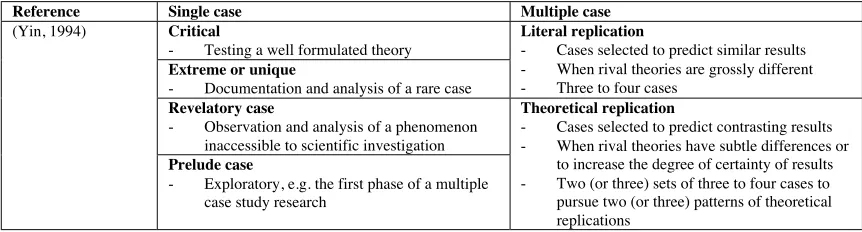
Methodological guidelines for case selection differ between single and multiple case designs. For single case selection, Yin (1994, pp. 38-41) proposed four strategies and matched these strategies to the purpose of the case inquiry. These are the critical case, the extreme case, the unique case and the prelude case strategies. A matching purpose for each of these strategies, in respective order is; testing a theory, documenting a rare case, analyzing a phenomenon that is inaccessible to scientific investigation, and exploring or piloting a case in preparation for a multiple case design. Table 1, lists these four strategies and relates each to the purpose it best serves.
Reference Single case Multiple case Critical
- Testing a well formulated theory
Extreme or unique
- Documentation and analysis of a rare case
Literal replication
- Cases selected to predict similar results
- When rival theories are grossly different
- Three to four cases
Revelatory case
- Observation and analysis of a phenomenon
inaccessible to scientific investigation (Yin, 1994)
Prelude case
- Exploratory, e.g. the first phase of a multiple
case study research
Theoretical replication
- Cases selected to predict contrasting results
- When rival theories have subtle differences or
to increase the degree of certainty of results
- Two (or three) sets of three to four cases to
[image:2.595.56.487.467.583.2]pursue two (or three) patterns of theoretical replications
Table 1, Selection strategies for single and multiple case designs (source (Yin, 1994))
When the study involves more than one case, the strategy for case selection changes because the focus shifts from that being the purpose of the study is to the issue of external validity of the case inquiry. External validation, in terms of the limited generalizability of the findings can be established through the replication logic of the multiple case study design (Creswell, 1994, pp. 158-159; Yin, 1994, pp. 35). Case studies, in contrary to surveys and experiments rely on analytical rather than statistical generalization. While statistical generalization is achieved when results from a correct sample are generalized to a larger universe, analytical generalization is the generalization of "a particular set of results to some broader theory," (Yin, 1994, pp. 36). The selection of multiple case studies therefore needs to follow this replication logic.
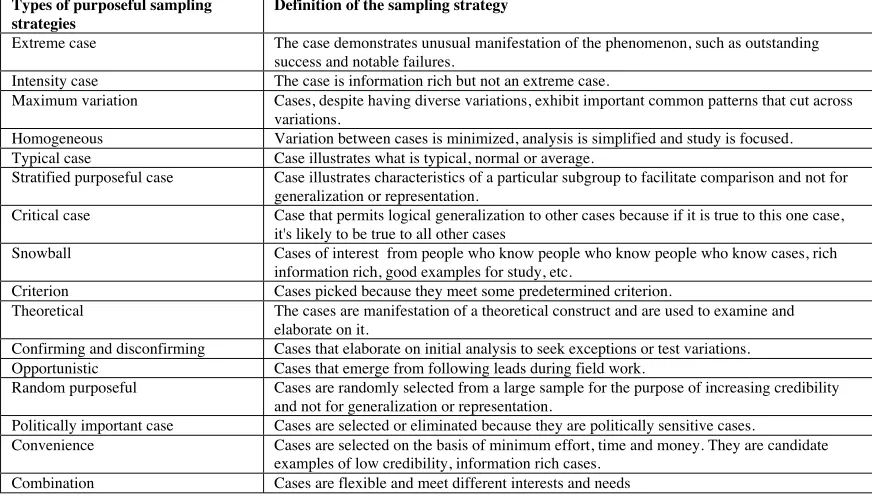
choosing cases that have similar settings and are expected to achieve similar results. The theoretical replication approach is used when cases have different settings and are expected to achieve different results. However, the replication logic on its own does not provide the methodological guideline for multiple case selection. To aid the process of multiple case selection, the use of Patton's (1990, p. 182-183) sixteen purposeful sampling strategies that are listed in Table 2 is suggested. In looking at Table 2, it is observed that some of these sampling strategies are more applicable to single-case designs while others are more appropriate to studies of multiple case designs. Furthermore, some of these strategies share similar objectives while others have contrasting objectives. Therefore, there is a need for a guiding framework that can suggest how these sixteen strategies can be compared and combined. The next section will try to synthesize these different strategies to provide a high level framework that aids case selection. Furthermore, it elaborates on how these strategies can be used to fulfill the overarching goal of design quality.
Types of purposeful sampling strategies
Definition of the sampling strategy
Extreme case The case demonstrates unusual manifestation of the phenomenon, such as outstanding
success and notable failures.
Intensity case The case is information rich but not an extreme case.
Maximum variation Cases, despite having diverse variations, exhibit important common patterns that cut across
variations.
Homogeneous Variation between cases is minimized, analysis is simplified and study is focused.
Typical case Case illustrates what is typical, normal or average.
Stratified purposeful case Case illustrates characteristics of a particular subgroup to facilitate comparison and not for
generalization or representation.
Critical case Case that permits logical generalization to other cases because if it is true to this one case,
it's likely to be true to all other cases
Snowball Cases of interest from people who know people who know people who know cases, rich
information rich, good examples for study, etc.
Criterion Cases picked because they meet some predetermined criterion.
Theoretical The cases are manifestation of a theoretical construct and are used to examine and
elaborate on it.
Confirming and disconfirming Cases that elaborate on initial analysis to seek exceptions or test variations.
Opportunistic Cases that emerge from following leads during field work.
Random purposeful Cases are randomly selected from a large sample for the purpose of increasing credibility
and not for generalization or representation.
Politically important case Cases are selected or eliminated because they are politically sensitive cases.
Convenience Cases are selected on the basis of minimum effort, time and money. They are candidate
examples of low credibility, information rich cases.
[image:3.595.113.549.261.510.2]Combination Cases are flexible and meet different interests and needs
Table 2, Purposeful sampling strategies and their operational definitions (source: (Patton, 1990, pp. 182-183)).
A Methodological Framework for Case Study Selection
It is widely agreed that the selection of case studies needs not be a haphazard activity (Yin, 1994). Furthermore, the selection and evaluation process needs to be justified, fully documented, and later reported to case study audience in order to provide the context for judging the sample. Particularly in multiple-case designs, it is suggested that in order to increase the quality of research design, the selection of cases needs to be driven by the two issues of appropriateness and adequacy (Kuzel, 1999). While appropriateness is related to demonstrating a fit to both the purpose of research and the phenomenon of inquiry, adequacy is concerned with how much is enough or how many cases (Kuzel, 1999; Miles and Huberman, 1994; Patton, 1990).
Purposeful sampling clusters
Purposeful sampling strategies
is contrasted to
Purposeful sampling strategies
Purposeful sampling clusters
Extreme case Intensity case Critical case Significant cases
Politically important case
Typical case Ordinary cases
Maximum variation Random purposeful
Different cases Stratified purposeful
case
Homogeneous Similar cases
Snowball Fieldwork determined
cases Opportunistic
Criterion Theoretical Priori theory
determined cases
Confirming and disconfirming
[image:4.595.57.501.136.330.2]Convenience Ad hoc cases selection
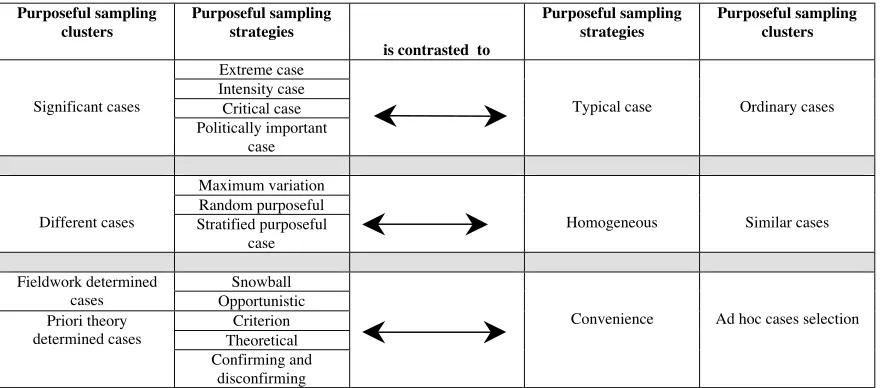
Table 3, A three-cluster framework encompassing the different strategies for case study selection
The first cluster is related to the significant vs. typical case dichotomy. Significant case selection strategies include the strategies of extreme case, intensity case, critical case and the politically important case. Significant case strategies are contrasted with the typical or ordinary case strategy to create the first cluster. The second cluster is constituted of the different vs. similar cases dichotomy. Strategies to help selecting different cases include the maximum variation, random purposeful or the stratified purposeful case strategies. The third cluster differentiates between sampling strategies on the basis of the existence vs. the absence of predetermined criteria for case selection. Two types of predetermined criteria of case selection exist. The first is fieldwork based while the second is theory based. Fieldwork determined cases make use of the snowball and the opportunistic sampling strategies, while priori theory determined cases use the criterion, theoretical and confirming-disconfirming strategies. Predetermined cases are contrasted to cases that are selected on the basis of convenience. The convenience strategy, despite being the most popular in case research is regarded as the "least desirable," (Patton, 1990, pp. 180) because it does not satisfy the appropriateness condition of design quality discussed earlier. To achieve appropriateness, a fit to both the purpose of research and the phenomenon under investigation needs to be demonstrated. The benefit of this classification framework is to facilitate the identification of a suitable strategy or a combination strategy for the case research inquiry. A combination strategy will include one choice in one of the contrasting parts of each cluster but may include more than one choice in that part. The application of this framework in facilitating the choice of a suitable selection strategy will be presented in the next section after explaining how the adequacy condition for design quality can be satisfied.
sample need not be representative of a larger population as is the case for experimental and survey studies, because for case studies the focus is on information richness (Kuzel, 1999; Patton, 1990).
The replication logic requirement of the multiple-case design provides suggestions to determining the number of cases. The initial decision regarding a satisfactory number of cases is between six to eight for a theoretical replication and three to four for a literal replication (Yin, 1994, pp. 46, 50). For a theoretical replication, that prescriptive number of cases is considered satisfactory when "rival theories are grossly different," however, the number needs to be increased when "rivals have subtle difference," (Yin, 1994, pp. 50). The final decision about the number of cases is usually a judgmental decision made by the researcher and is positively influenced by the indifference between rival theories, the high degree of certainty the researcher wishes to attain and the differences between the cases (Yin, 1994, pp. 50).
Replication logic strategies When the
---difference between rival theories is degree of certainty required is differences between the cases is
Initial number of cases
Literal replication Low 3-4
[image:5.595.114.539.246.306.2]Theoretical replication High 6-8
Table 4, Replication logic strategies for determining the number of cases in multiple-case designs
(source (Yin, 1994))
The application of the case selection strategy in the SDM study
This section provides an example of the application of the case selection strategy in a study of the strategic decision making (SDM) process of enterprise systems (ES) implementation. A brief background to this the study is first provided. Next, the choice for using a multiple case approach is justified and the strategy for case selection is identified with the aid of the three-cluster framework of Table 3. Finally, the process of applying these strategies in case study selection is reported.
The two questions the study addresses are; what are the strategic decisions in the implementation of ES? and how are these decisions made? The review of the ES implementation literature identified a list of fifteen strategic decisions that need to be addressed in the course of system implementation (Shakir, 2001). The list was validated with key experts of ES implementation during the pilot phase of the study. Using this list of strategic decisions, the study applies the two theoretical lenses of descriptive decision models and the communication network model to explore both the patterns and the network of the decision making process, respectively. Understanding will be achieved through the focus on the sequence of activities in order to explain how and why observed outcomes evolve over time. Therefore, the study will further attempt to understand the relationship between the SDM process and the ES implementation process. The main research objectives include the followings:
- To develop a theoretical framework for the description of alternative SDM approaches
- To explore empirically the framework with the description and analysis of the SDM process, particularly focusing on the fifteen decisions of ES implementation
- To understand and explain the relationship between the SDM process and the ES implementation process.
Miller and Crabtree (1999, pp. 6-7) identified five aims to the research inquiry, which are identification, description, explanation-generation, explanation-testing and control. Furthermore, they suggested a set of guidelines relating each to the type of; research objective, research questions, and the research strategy. This study seeks to satisfy the first three aims of the "identification" of strategic decisions of ES implementation, "description" of both the strategic decision process and the ES implementation process, and the "explanation" of how are strategic decisions made, what patterns in the SDM process exist and why these patterns differ between decisions, and across time.
because the proposed research addresses the contemporary phenomenon of ES implementation, which the researcher has no control over; it is largely exploratory; and addresses the "how" and "why" questions (Darke, et al., 1998; Yin, 1994). A multiple, comparative case study of four companies that have or are in the course of implementing an ES system is proposed. Multiple cases are suggested to satisfy the overarching question of "how are these decisions made?". Furthermore, multiple cases are suggested to increase the methodological rigor of the study and to enable the successful generation of theory (Eisenhardt, 1989; Miles and Huberman, 1994, pp. 29; Yin, 1994). Cases will be compared on the basis of their approach to the SDM process of their ES implementations.
To facilitate the identification of a case selection strategy to this study, the three-cluster framework of Table 3 was applied. Choices were iteratively negotiated to one of the two ends to each of the three clusters. The strategy adopted had to fulfill the two appropriateness conditions, which are the fit to both research purpose and phenomenon of inquiry (Kuzel, 1999; Miles and Huberman, 1994; Patton, 1990). The application of the framework resulted in a selection strategy that included the typical case, different cases with maximum variation, and a mix of field based and priori theory predetermined combination strategies. Justification of these choices is briefly explained. First, and because this study is exploratory and takes a multiple case study research design, the typical or ordinary case is found suitable to "describe and illustrate what is typical," (Patton, 1990, pp. 173) in the process of making strategic decisions during the course of ES implementation.
The second sampling strategy addressed the issue of maximum variation for the purpose of obtaining different cases. Although selecting cases that are different can sometimes be recognized as a problem, this feature has the potential to increase the strength of the results (Patton, 1990, pp. 172). Patton further contends that "any common patterns that emerge from great variation are of particular interest and value in capturing the core experiences and central, shared aspects, " of a case. The criterions used to select cases are different ERP vendors for each of the four cases and different industries for case study organizations. The aim is to report on emerging patterns that cut across the four cases however different they may be.
The third sampling strategy is a combination of field-determined cases and priori theory determined cases. Field-determined cases in both of the snowballing and the opportunistic strategies were pursued. Opportunistic strategies proved to be helpful during the iterative pilot phase of the research, especially in talking to ES consultants and ES vendors when links to various ES implementations were suggested. Furthermore, the snowballing strategies were also pursued during the pilot phase interviews to further investigate a case that seemed relevant. Relevant cases were these that satisfied the criterions proposed by the two strategies of "typical" and "maximum variation" explained earlier.
cycle. The main benefit of this criterion sampling is to ensure that "cases are likely to be information rich," (Patton, 1990), which is believed to be satisfied in establishing that period limit.
Analysis of the Case Selection Process
The previous section demonstrated the use of the three-cluster framework of case study selection in a multiple case research design approach. A brief review of the study background, research questions and main research objectives justified the application of the multiple case methodology. The number of cases was determined by the literal replication logic of the case inquiry. However, a strategy for selecting multiple cases needed to be defined and later implemented. The three-cluster framework provided a mean for evaluating the different alternative strategies of case selection. In particular, the framework facilitated the selection of strategies most suitable to fulfill the two appropriateness conditions of design quality, which are the fit to both the purpose of the research and the phenomenon of inquiry.
Conclusions
This study provided a review of the different strategies for case study selection. Furthermore, the study suggested a classification framework to these strategies. The three-cluster framework provides a set of high level guidelines for researchers to both understand the differences between these strategies and further facilitate the selection of the strategy most suitable in answering the particular questions a case research study would address. Further work is needed to investigate the validity of this framework when applied to the literature of IS implementation case studies. Furthermore, the application of three-cluster framework is not limited to multiple case research alone. The framework can also facilitate the identification of a selection strategy for single case research. Therefore, examples of its application to single case studies need to be demonstrated.
References
Applegate, L.M. and King, J.L. "Rigor and Relevance: Careers on the Line," MIS Quarterly (23:1), 1999, pp. 17-18.
Benbasat, I., Goldstein, D.K. and Mead, M. "The Case Research Strategy in Studies of Information Systems," MIS Quarterly (11:3), 1987, pp. 369-386.
Benbasat, I. and Zmud, R.W. "Empirical Research in Information Systems: The Practice of Relevance," MIS Quarterly (23:1), 1999, pp. 3-16.
Cavaye, A.L.M. "Case Study Research: a Multi-faceted Research Approach for IS," Information Systems Journal (6:3), 1996, pp. 227-242.
Creswell, J.W. Research Design: Qualitative and Quantitative Approaches, Sage Publications, London, 1994.
Darke, P., Shanks, G. and Broadbent, M. "Successfuly Completing Case Study Research - Combining Rigour, Relevance And Pragmatism," Information Systems Journal (8:4), 1998, pp. 273-289.
Davenport, T.H. and Markus, M.L. "Rigor Vs. Relevance Revisited: Response to Benbasat and Zmud," MIS Quarterly (23:1), 1999, pp. 19-23.
Eisenhardt, K.M. "Building Theories from Case Study Research," Academy of Management Review
(14:4), 1989, pp. 532-550.
Kuzel, A.J. "Sampling in Qualitative Inquiry," In Doing Qualitative Research, B. F. Crabtree and W. L. Miller (Ed.), Sage Publications, Thousand Oaks, CA, 1999, pp. 33-45.
Lee, A.S. "Rigor and Relevance in MIS Research: Beyond the Approach of Positivism Alone," MIS Quarterly (23:1), 1999, pp. 29-33.
Lyytinen, K. "Empirical Research In Information Systems: On the Relevance of Practice in Thinking of IS Research," MIS Quarterly (23:1), 1999, pp. 25-27.
Martin, I. and Cheung, Y. "SAP and Business Process Reengineering," Business Process Management
(6:2), 2000, pp. 131-121.
Miles, M.B. and Huberman, A.M. Qualitative Data Analysis: An Expanded Sourcebook, Sage Publications, Thousand Oaks, 1994.
Miller, W.L. and Crabtree, B.F. "Clinical Research: A Multi-Method Typology and Qualitative Roadmap," In Doing Qualitative Research, B. F. Crabtree and W. L. Miller (Ed.), Sage Publications, Thousand Oaks, CA, 1999, pp. 3-30.
Mintzberg, H.D., Raisinghani, D. and Theoret, A. "The Structure Of Unstructured Decision Process,"
Administrative Science Quarterly (21:2), 1976, pp. 246-275.
Parr, A., Shanks, G. andDarke, P. "The Identification of Necessary Factors for Successful Implementation of ERP Systems," Proceedings of the IFIP Working Group 8.2 Conference on New Information Technologies in Organisational Process: Field Studies and Theoretical Reflections on the Future of Work, 1999, pp. 99-120.
Patton, M.Q. Qualitative Evaluation and Research Methods, Sage Publications, Newbury Park, California, 1990.
Shakir, M. "An Enterprise System Process Framework for Understanding the Strategic Decision Making Process of ES Implementations," ICIS'2001 Doctoral Consortium Paper, New Orleans, Louisiana, 2001, pp. 1-27.