Basis Sets for the Calculation of Core-Electron Binding
Energies
Magnus W. D. Hanson-Heine,aMichael W. Georgea,band Nicholas A. Besleya* aSchool of Chemistry, University of Nottingham, University Park, Nottingham, NG7 2RD,
UK,bDepartment of Chemical and Environmental Engineering, University of Nottingham
Ningbo China, 199 Taiking East Rd., Ningbo 315100, Zhejiang, China.
Abstract
Core-electron binding energies (CEBEs) computed within a self-consistent
field approach require large basis sets to achieve convergence with respect to
the basis set limit. It is shown that supplementing a basis set with basis
func-tions from the corresponding basis set for the element with the next highest
nuclear charge (Z+1) provides basis sets that give CEBEs close to the basis set
limit. This simple procedure provides relatively small basis sets that are well
suited for calculations where the description of a core-ionised state is important,
such as time-dependent density functional theory calculations of X-ray emission
spectroscopy.
Keywords: Core electron binding energies, basis set, x-ray photoelectron
spectroscopy, density functional theory
1. Introduction
Calculations of core-electron spectroscopy have become increasingly
impor-tant because of advances in X-ray light sources, such as free electron lasers.
These sources can deliver short femtosecond pulses of X-rays which can probe
ultrafast chemical processes [1–3]. One widely used technique is X-ray
pho-5
toelectron spectroscopy (XPS) which involves the ionisation of core electrons.
XPS is a powerful analytical tool that can provide information on elemental
composition, as well as the chemical environment and electronic state of the
constituent atoms of a material. Computational simulations can often assist
in deciphering the information contained within an XPS spectrum. A
criti-10
cal component in calculations of XPS are the core-electron binding energies
(CEBEs). CEBEs correspond to the energy required to ionise a core electron,
and are usually calculated as the di↵erence between the energy of the ground
state of a molecule or material and the energy with a core electron removed.
The most common approach to calculating CEBEs is using a self-consistent
15
field ( SCF) approach [4–8].
For molecular systems, calculations of CEBEs most commonly use gaussian
basis functions. For these calculations, the calculated CEBEs are highly
depen-dent on the basis set used, and several groups have assessed the accuracy of
20
di↵erent basis sets for the calculation of CEBEs [7, 9–15]. One conclusion from
this work is that the inclusion of core-valence correlation functions is important
for the correlation consistent basis sets of Dunning and co-workers and that the
cc-pCVTZ basis set performs well. A recent study considered a wide range of
basis sets and CEBEs of molecules containing first and second row elements [15].
25
It was found that for first row elements a number of relatively small basis sets
gave CEBEs that were in close agreement with CEBEs calculated with much
larger basis sets. However, for the core ionisation of second row elements modest
sized basis sets performed poorly. The best performing basis sets in terms of
accuracy and size were the individual gauge for localised orbitals (IGLO-II and
30
IGLO-III) basis sets. These basis sets were developed for NMR spectroscopy
and their good performance in calculations of core-electron spectroscopies has
been identified previously [16, 17]. Other basis sets designed for NMR
spec-troscopy calculations, including the pcSseg-n basis sets of Jensen [18], have also
been shown to perform well in calculations of CEBEs [15]. A limitation of these
35
basis sets is that they are only available for the elements hydrogen, boron to
fluorine and aluminium to chlorine. For the study of elements outside of these,
be used. With standard, widely used families of basis sets it is necessary to use
very large basis sets to achieve convergence with respect to the basis set limit
40
in calculations of CEBEs. It is therefore desirable to have small or moderately
sized basis sets that are available for all (or most) elements that give CEBEs
that are near the basis set limit. It has been shown that it is only necessary
to use large basis sets for the core-ionised atom and that accurate CEBEs can
be computed using basis sets of cc-pCVTZ quality for the core-ionised atom
45
and much smaller basis sets for the remaining atoms, which represents a
com-putationally efficient scheme [19–21]. Another factor that is relevant for the
calculation of core-electron excitation energies, where the core electron is
ex-cited to a virtual orbital (rather than ionised), is that it is advantageous to have
additional features, such as di↵use basis functions, readily available.
50
In this work we propose a simple strategy that can be applied to all
com-monly used gaussian basis sets, and provides relatively small basis sets, that are
comparable in size to 6-31G* or cc-pVDZ, which reproduce the CEBEs
com-puted with much larger and extensive basis sets with a high degree of accuracy.
55
The modification proposed is predicated on the observation that to calculate
an accurate CEBE it is necessary to be able to describe both the neutral and
core-ionised species accurately. Large basis sets have the inherent flexibility to
achieve this, whereas smaller basis sets lead to an unbalanced treatment where
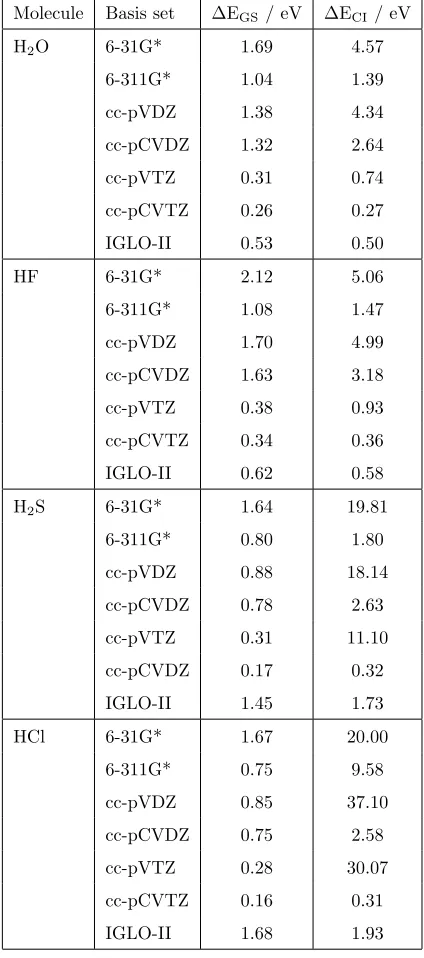
the core-ionised state is described relatively poorly. This is illustrated in Table
60
1, which shows the change in the total energy between a range of moderately
sized basis sets and the cc-pCVQZ basis set for several molecules calculated
using a SCF approach [8] and density functional theory (DFT) with the PBE
exchange-correlation functional [22]. The data shows that for the split-valence
and correlation-consistent basis sets the error is significantly greater for the
65
core-ionised state in comparison to the ground state. For the ground state, the
change in energy is not highly dependent on the molecule. In contrast for the
core-ionised state, the energy change is much larger for ionisation from the core
cc-Molecule Basis set EGS/ eV ECI/ eV
H2O 6-31G* 1.69 4.57
6-311G* 1.04 1.39
cc-pVDZ 1.38 4.34
cc-pCVDZ 1.32 2.64
cc-pVTZ 0.31 0.74
cc-pCVTZ 0.26 0.27
IGLO-II 0.53 0.50
HF 6-31G* 2.12 5.06
6-311G* 1.08 1.47
cc-pVDZ 1.70 4.99
cc-pCVDZ 1.63 3.18
cc-pVTZ 0.38 0.93
cc-pCVTZ 0.34 0.36
IGLO-II 0.62 0.58
H2S 6-31G* 1.64 19.81
6-311G* 0.80 1.80
cc-pVDZ 0.88 18.14
cc-pCVDZ 0.78 2.63
cc-pVTZ 0.31 11.10
cc-pCVDZ 0.17 0.32
IGLO-II 1.45 1.73
HCl 6-31G* 1.67 20.00
6-311G* 0.75 9.58
cc-pVDZ 0.85 37.10
cc-pCVDZ 0.75 2.58
cc-pVTZ 0.28 30.07
cc-pCVTZ 0.16 0.31
[image:4.595.139.351.175.654.2]IGLO-II 1.68 1.93
Table 1: Computed di↵erence in total DFT energy from the cc-pCVQZ basis set for the ground
pVTZ basis set where the energy change for the ground state is 0.28 eV, while
70
the corresponding energy change for the core-ionised state is 30.07 eV. This
will result in an error of about 30 eV in the computed CEBE compared with
the cc-pCVQZ value, and demonstrates why large basis sets are particularly
important for CEBEs of second row elements. The data also shows the reason
for the accuracy of the IGLO basis sets for the calculation of CEBEs. For the
75
IGLO-II basis set the energy variation from cc-pCVQZ is highly consistent for
the ground and core-ionised states. The inclusion of core-valence correlation
basis functions in the cc-pCVDZ and cc-pCVTZ basis sets [23–25] also leads to
a significant improvement in the description of the core-ionised state. However,
it is necessary to use the cc-pCVTZ basis set to achieve an accuracy comparable
80
with IGLO-II. This is consistent with earlier observations that the cc-pCVTZ
basis set is accurate for calculations of CEBEs. In this work we show that
accurate CEBEs can be computed with small basis sets, such as 6-31G* and
cc-pVDZ, by supplementing the basis set with basis functions for the element
with the next highest nuclear charge (Z+1) than the element being ionised. The
85
rationale for this is the core-ionised state has an e↵ective nuclear charge of Z+1
and these basis functions are better able to describe this state. In particular,
the exponents of the basis functions for the Z+1 element will be larger and more
suitable for the tighter orbitals of the core-ionised state.
90
2. Computational Details
The accuracy of the basis sets is assessed by considering the CEBEs for the
ionisation of the 1s electron of the following molecules: BF3, CH4, H2CO, NH3,
HCN, HCN, H2CO, CO, SiH4, PH3, PF3, H2S, SO2 and HCl, where the
un-derlined element is core-ionised. This set of molecules includes excitation from
95
first and second row elements. The molecular structures were optimised with
second-order Møller-Plesset perturbation theory (MP2) with the cc-pVTZ basis
func-tional. It has been shown elsewhere that the basis set dependence of computed
CEBEs is not sensitive to the functional used [15]. In addition to DFT, CEBEs
100
have also been computed with MP2. The core-ionised state is computed using
the maximum overlap method (MOM) [26] to prevent variational collapse and
maintain the core-ionised state during the SCF procedure. The CEBEs are
as-sessed by computing the mean absolute deviation (MAD) from values evaluated
with the cc-pCVQZ basis set, with the cc-pVQZ basis set used for hydrogen. A
105
number of studies have performed detailed comparisons between DFT and MP2
CEBEs and experiment[13, 14, 19, 27, 28]. This work shows that it is possible
to achieve an agreement to within about 0.2 eV if large basis sets are used, and
relativistic e↵ects are treated for heavier nuclei. Consequently, here we focus on
a comparison with values computed with a large basis set.
110
The standard basis sets considered include the split-valence basis sets 6-31G*
and 6-311G*, the cc-pVDZ correlation-consistent basis set, and the IGLO-II and
IGLO-III basis sets [29–37]. Several non-standard basis sets are also considered.
Previous studies have shown that uncontracting the core basis function can
im-115
prove calculated CEBEs [8], and we consider two such basis sets u6-31G* and
u6-311G* where the ’u’ denotes the core basis function has been uncontracted.
The objective of this study is to produce basis sets with relatively few basis
functions that reproduce CEBEs close to the basis set limit by supplementing
standard basis sets with basis functions from the Z+1 element. The first
vari-120
ant of these basis sets corresponds to adding just the core basis function from
the Z+1 element to give the (core Z+1)6-31G*, (core Z+1)6-311G* and (core
Z+1)cc-pVDZ basis sets. In the second variation of these basis sets, the core
and valence (but not polarisation) basis functions from the Z+1 element are
in-cluded to give (Z+1)6-31G*, (Z+1)6-311G* and (Z+1)cc-pVDZ basis sets. The
125
reason for not including Z+1 polarisation functions is to keep the size of the
ba-sis sets to a minimum. Examples of these baba-sis sets, highlighting the additional
basis functions included, are given for carbon and silicon in the Supporting
for all atoms. However, as discussed later, an alternative strategy is to use the
130
modified basis set only for the element that has a core electron ionised, while
retaining the standard basis set for the remaining elements. This approach is
more efficient since it reproduces the values of the calculations where the
mod-ified basis set is used throughout but with considerably fewer additional basis
functions. For transition metal complexes the cc-pwCVQZ basis set is used for
135
the transition metal atoms with the cc-pCVQZ for the remaining atoms, this
basis set is referred to as simply cc-pCVQZ for brevity. The basis sets were
obtained from the Basis Set Exchange [38, 39]. For some of the metal
com-plexes it was necessary to use orbitals generated for the core-ionised state using
the PBE0 functional as a starting guess in order to converge the calculation
140
for the PBE functional. The structures of the transition metal complexes were
optimised using the PBE0 functional with the Stuttgart Relativistic Small Core
basis set for the transition metal atoms[40] and the 6-311G* basis set for the
non-metal atoms. All calculations were performed with the Q-CHEM software
package [41].
145
3. Results and Discussion
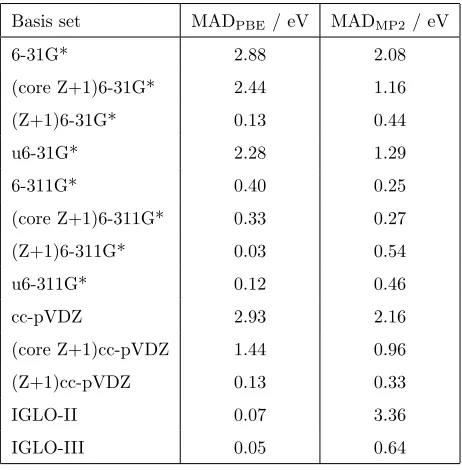
Table 2 shows the MADs for the CEBEs calculated with PBE and MP2 for
the first row nuclei, the maximum errors and standard deviations are included
in the Supporting Information. For the PBE calculations, the cc-pVDZ and
150
6-31G* basis sets perform poorly with a MAD of about 3 eV, while the 6-311G*
and IGLO basis sets are considerably more accurate. In particular, the IGLO
basis sets have an error of less than 0.1 eV compared with the cc-pCVQZ basis
set. These findings are consistent with previous studies of CEBEs of first row
nuclei [15]. For the non-standard basis sets, uncontraction of the core orbital
155
basis function for the 6-31G* only results in a modest reduction in the error with
a MAD of 2.28 eV, with a particularly large error for H2CO. Addition of the core
Basis set MADPBE/ eV MADMP2/ eV
6-31G* 2.88 2.08
(core Z+1)6-31G* 2.44 1.16
(Z+1)6-31G* 0.13 0.44
u6-31G* 2.28 1.29
6-311G* 0.40 0.25
(core Z+1)6-311G* 0.33 0.27
(Z+1)6-311G* 0.03 0.54
u6-311G* 0.12 0.46
cc-pVDZ 2.93 2.16
(core Z+1)cc-pVDZ 1.44 0.96
(Z+1)cc-pVDZ 0.13 0.33
IGLO-II 0.07 3.36
[image:8.595.140.371.171.406.2]IGLO-III 0.05 0.64
Table 2: Mean absolute deviations relative to the cc-pCVQZ basis set for CEBEs of first row
elements for the molecules BF3, CH4, H2CO, NH3, HCN, HCN, H2CO and CO computed
with DFT with the PBE exchange-correlation functional and MP2.
basis sets results in MADs that remain too high. We note that uncontraction
of the core orbital and addition of the Z+1 core basis function does improve
160
on the already low MAD for 6-311G*. Addition of the Z+1 core and valence
basis functions in the (Z+1)6-31G* and (Z+1)cc-pVDZ results in a low MAD
of about 0.1 eV which is comparable in accuracy to the IGLO basis sets. The
need to include both core and valence orbitals will be discussed in more detail
later. These trends are also observed for the MP2 calculations. In general the
165
MP2 basis set error is larger than for DFT. For MP2 the IGLO basis sets have a
significant error of 0.64 eV for IGLO-III and a particularly large error of 3.36 eV
for IGLO-II. However, the (Z+1)6-31G* and (Z+1)cc-pVDZ maintain a good
level of performance with MADs of 0.44 eV and 0.33 eV, respectively.
170
(Z+1) basis sets becomes more evident. It is for calculations of CEBEs of heavier
nuclei that the deficiencies of standard basis sets becomes increasingly apparent.
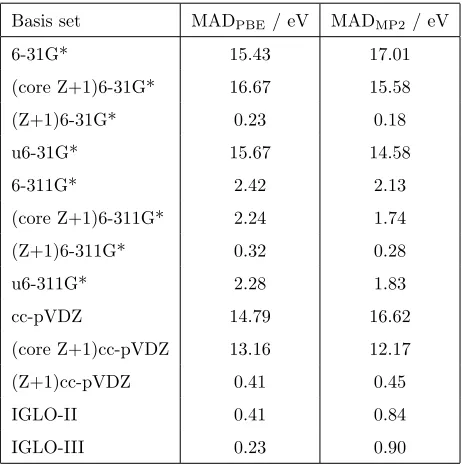
Table 3 shows the MADs for the CEBEs calculated with PBE and MP2 for the
second row nuclei, the maximum errors and standard deviations are included in
175
the Supporting Information. For the DFT calculations, standard small basis sets
have MADs of about 15 eV, and even the 6-311G* basis set that performed well
for the first row nuclei has a MAD of over 2 eV. The (Z+1)6-31G* and
(Z+1)cc-pVDZ basis sets show a remarkable improvement in accuracy compared with
their standard versions with MADs of 0.41 eV and 0.23 eV. These MADs are
180
comparable with those for the IGLO basis sets. The inclusion of just the Z+1
core orbital basis function or uncontraction of the core orbital basis functions do
not lead to a significant improvement for the ionisation of the second row core
electrons. For the MP2 calculations excellent performance of the Z+1 basis sets
is also observed, and for these calculations the MADs for the IGLO basis sets
185
are significantly greater than for the (Z+1)6-31G* and (Z+1)cc-pVDZ basis sets.
The preceding analysis has shown that for DFT calculations of CEBEs for
the first and second row p-block elements the (Z+1)6-31G* basis set are
con-siderably more accurate with respect to cc-pCVQZ then the standard 6-31G*
190
basis set, and comparable in accuracy to the IGLO basis sets. The MADs for
the MP2 calculations tend to be greater than the corresponding DFT values,
however, for these calculations the MADs for the (Z+1)6-31G* basis set are
lower than for the IGLO basis sets. We now consider CEBEs for first and
sec-ond row s-block elements. The IGLO basis sets have not been defined for these
195
elements and it is currently necessary to use large basis sets to calculate CEBEs
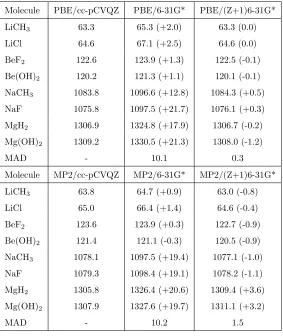
for these systems reliably [15]. Table 4 shows CEBEs for the 1s electrons of
molecules containing Li, Be, Na and Mg computed with PBE and MP2 with
the cc-pCVQZ, 6-31G* and (Z+1)6-31G* basis sets. For both PBE and MP2
calculations with the 6-31G* basis set, there is a large increase in the error with
200
respect to cc-pCVQZ for the Na and Mg K-edges compared with Li and Be,
com-Basis set MADPBE/ eV MADMP2/ eV
6-31G* 15.43 17.01
(core Z+1)6-31G* 16.67 15.58
(Z+1)6-31G* 0.23 0.18
u6-31G* 15.67 14.58
6-311G* 2.42 2.13
(core Z+1)6-311G* 2.24 1.74
(Z+1)6-311G* 0.32 0.28
u6-311G* 2.28 1.83
cc-pVDZ 14.79 16.62
(core Z+1)cc-pVDZ 13.16 12.17
(Z+1)cc-pVDZ 0.41 0.45
IGLO-II 0.41 0.84
[image:10.595.140.371.285.517.2]IGLO-III 0.23 0.90
Table 3: Mean absolute deviations relative to the cc-pCVQZ basis set for CEBEs of second
row elements for the molecules SiH4, PH3, PF3, H2S, SO2and HCl computed with DFT with
puted with PBE/(Z+1)6-31G* are in excellent agreement with the larger basis
set, and have a MAD of just 0.3 eV compared with 10.1 eV for 6-31G*. For the
corresponding MP2 calculations a similar trend is observed, although the MAD
205
for the (Z+1)6-31G* basis set has a larger value of 1.5 eV, primarily due to the
CEBEs for two Mg K-edges.
TiF4%
%%%%%cc'pCVQZ:%4942.9%eV% %%%%%%%%%6'31G*:%%5011.9%(+69.0)%eV% (Z+1)6'31G*:%%4940.5%('2.4)%eV%
VF5%
%%%%%cc'pCVQZ:%5456.3%eV% %%%%%%%%%6'31G*:%%5466.1%(+9.8)%eV% (Z+1)6'31G*:%%5456.8%(+0.5)%eV%
Ni(CO)4%
%%%%%cc'pCVQZ:%8252.1%eV% %%%%%%%%%6'31G*:%%8275.2%(+23.1)%eV% (Z+1)6'31G*:%%8250.9%('1.2)%eV%
CpMn(CO)3%
%%%%%cc'pCVQZ:%6488.6%eV% %%%%%%%%%6'31G*:%%6511.2%(+22.6)%eV% (Z+1)6'31G*:%%6486.8%('1.7)%eV%
H2Fe(CO)4%
[image:11.595.153.468.277.533.2]%%%%%cc'pCVQZ:%7071.7%eV% %%%%%%%%%6'31G*:%%7110.4%(+38.7)%eV% (Z+1)6'31G*:%%7070.4%('1.3)%eV%
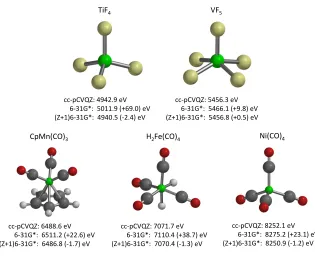
Figure 1: Calculated CEBEs for transition metal complexes.
We now consider CEBEs for the K-edge of transition metals from the first
row of the d-block. For these systems only DFT calculations have been
per-210
formed owing to its lower computational cost compared with MP2, and most
calculations of CEBEs in the literature use DFT. The energies presented have
not been corrected for relativistic e↵ects which are large for the K-edge of
Molecule PBE/cc-pCVQZ PBE/6-31G* PBE/(Z+1)6-31G*
LiCH3 63.3 65.3 (+2.0) 63.3 (0.0)
LiCl 64.6 67.1 (+2.5) 64.6 (0.0)
BeF2 122.6 123.9 (+1.3) 122.5 (-0.1)
Be(OH)2 120.2 121.3 (+1.1) 120.1 (-0.1)
NaCH3 1083.8 1096.6 (+12.8) 1084.3 (+0.5)
NaF 1075.8 1097.5 (+21.7) 1076.1 (+0.3)
MgH2 1306.9 1324.8 (+17.9) 1306.7 (-0.2)
Mg(OH)2 1309.2 1330.5 (+21.3) 1308.0 (-1.2)
MAD - 10.1 0.3
Molecule MP2/cc-pCVQZ MP2/6-31G* MP2/(Z+1)6-31G*
LiCH3 63.8 64.7 (+0.9) 63.0 (-0.8)
LiCl 65.0 66.4 (+1.4) 64.6 (-0.4)
BeF2 123.6 123.9 (+0.3) 122.7 (-0.9)
Be(OH)2 121.4 121.1 (-0.3) 120.5 (-0.9)
NaCH3 1078.1 1097.5 (+19.4) 1077.1 (-1.0)
NaF 1079.3 1098.4 (+19.1) 1078.2 (-1.1)
MgH2 1305.8 1326.4 (+20.6) 1309.4 (+3.6)
Mg(OH)2 1307.9 1327.6 (+19.7) 1311.1 (+3.2)
[image:12.595.141.425.241.577.2] [image:12.595.141.424.242.578.2]MAD - 10.2 1.5
Table 4: Computed CEBEs with the deviation from cc-pCVQZ in parenthesis for the K-edge
di↵erent basis sets. The calculations with the 6-31G* basis show a wide range of
215
errors compared with the cc-pCVQZ calculation, varying from +9.8 eV to +69.0
eV. Clearly calculations with this basis set would not be reliable. In contrast,
the corresponding errors for the (Z+1)6-31G* basis are reduced greatly and vary
between -2.4 eV and +0.5 eV. Taking Ni(CO)4 as an example, the calculation
with the cc-pCVQZ basis set has a total of 841 basis functions compared with
220
156 and 245 basis functions for 6-31G* and (Z+1)6-31G*, respectively.
Con-sequently, the (Z+1)6-31G* basis set reproduces the values of the cc-pCVQZ
basis set despite being less than one third of the size. In practice the
(Z+1)6-31G* basis set can be used more efficiently. In the calculations presented the
(Z+1)6-31G* basis set is used for all elements in the molecule or complex. An
225
alternative strategy is to use the (Z+1)6-31G* basis set just for the element that
has a core electron ionised while retaining the 6-31G* basis set for the
remain-ing elements. For Ni(CO)4, this calculation has a total of 173 basis functions
and the computed CEBE is essentially unchanged from the calculation with the
(Z+1)6-31G* basis set for all elements. Consequently, it is possible to greatly
230
improve the accuracy of the computed CEBE with the addition of relatively few
basis functions.
Molecules that have energetically equivalent core orbitals present an
interest-ing case for the calculation of CEBEs, in particular with regard to augmentinterest-ing
235
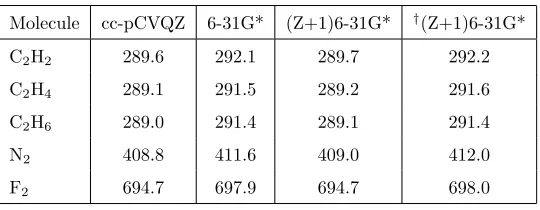
the basis set for the core-ionised atom only. Table 5 shows CEBEs computed
using DFT for a range of molecules that have symmetrically equivalent atoms.
For these systems, it can be necessary to break the symmetry of the
wavefunc-tion (or molecule) to allow the core hole to localise on one atom and achieve
convergence for the core-ionised state. The (Z+1)6-31G* basis sets works well
240
for these systems, with the calculated CEBEs within 0.2 eV of the values for
the cc-pCVQZ basis set, improving significantly the values for the 6-31G* basis
set. However, if the (Z+1)6-31G* basis set is used only for the atom being
ionised (i.e. just a single, carbon, nitrogen or fluorine atom) a significant error
is observed and the values are not an improvement on 6-31G*.
Molecule cc-pCVQZ 6-31G* (Z+1)6-31G* †(Z+1)6-31G*
C2H2 289.6 292.1 289.7 292.2
C2H4 289.1 291.5 289.2 291.6
C2H6 289.0 291.4 289.1 291.4
N2 408.8 411.6 409.0 412.0
[image:14.595.141.411.170.275.2]F2 694.7 697.9 694.7 698.0
Table 5: Computed PBE CEBEs for the K-edge molecules with energetically equivalent core
orbitals. Energies are in eV.†The (Z+1)6-31G* is used for one heavy atom only, 6-31G* used
for the remaining atoms.
Now we examine the molecular orbitals associated with the di↵erent basis
sets. SiH4 is used as an example, but the results are representative of other
systems. For the ground state there is only a small di↵erence (less than 0.007
a.u.) in the orbital energies of the occupied orbitals between the DFT
calcu-250
lations with the cc-pCVQZ, 6-31G* and (Z+1)6-31G* basis sets. However, for
the core ionised state some significant di↵erences in the orbital energies emerge
for the 6-31G* basis set for the silicon 1s, 2s and 2p orbitals. For example,
the energies of the occupied 1s orbitals for the cc-pCVQZ, (Z+1)6-31G* and
6-31G* basis set are -71.716, -71.719 and -73.071 a.u., respectively. Similarly,
255
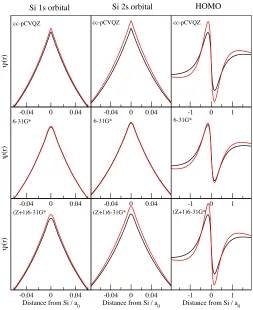
for the 2s orbitals the energies are -6.384, -6.394 and -6.784 a.u. Figure 2 shows
the radial behaviour of the core orbitals centred on the silicon atom. For the
cc-pCVQZ basis set the 1s and 2s orbitals have a greater amplitude at the
nu-clei in the core-ionised state, while the 6-31G* basis set shows no significant
di↵erence between the two states. The orbitals for the (Z+1)6-31G* basis set
260
are qualitatively correct with a distinctly larger amplitude for the core-ionised
state, although the orbitals are less sharply peaked. The poor description of the
2s orbital by the 6-31G* basis set provides an explanation for why adding just
the core orbital basis function for the Z+1 element was not sufficient, since the
additional basis functions will not improve the description of the 2s orbital. For
265
Molecule cc-pCVQZ (Z+1)6-31G* IGLO-II 6-31G*
HCN 401.6 (0.0356) 402.4 (0.0353) 401.8 (0.0355) 405.8 (0.0327)
401.2 (0.0341) 401.9 (0.0349) 401.4 (0.0339) 405.3 (0.0315)
394.2 (0.0008) 394.9 (0.0009) 394.5 (0.0008) 398.5 (0.0009)
H2S 2501.1 (0.0065) 2502.8 (0.0065) 2502.8 (0.0064) 2537.9 (0.0044)
2498.3 (0.0045) 2500.0 (0.0046) 2500.0 (0.0046) 2535.1 (0.0032)
2496.4 (0.0041) 2498.0 (0.0042) 2498.2 (0.0042) 2533.1 (0.0030)
TiF4 5005.4 (0.0002) 5002.4 (0.0002) - 5076.0 (0.0000)
5003.9 (0.0001) 5000.8 (0.0001) - 5073.9 (0.0001)
4986.8 (0.0003) 4983.7 (0.0003) - 5056.7 (0.0001)
Table 6: Computed X-ray emission energies for the PBE exchange-correlation functional with
oscillator strength in parenthesis. Energies are in eV.
the core orbital in the core-ionised state in the (Z+1)6-31G* calculation has a
large coefficient for the Z+1 2s basis function (for example, 0.2 in CH4). This
underlies the poor performance of the (core Z+1)6-31G* basis set for these first
row elements, since this basis function will not be included. For the highest
270
occupied molecular orbital (HOMO) the 6-31G* basis set does show the same
trend in the variation between the two states as the large basis set, but is not
as accurate as the (Z+1)6-31G* basis set.
Another area where an accurate description of the core-ionised state is
im-275
portant is the simulation of X-ray emission spectroscopy with time-dependent
density functional theory (TDDFT). X-ray emission spectra can be simulated
by applying TDDFT to a Kohn-Sham determinant with a core-hole [42–45].
This approach has been applied to study organic molecules and inorganic
com-plexes, and it has been shown that these calculations are highly dependent on
280
the basis set used [15, 42]. TDDFT is also commonly used to study X-ray
absorption spectroscopy [46, 47]. In contrast to X-ray emission spectroscopy,
the linear response of the ground state density. Table 6 shows X-ray emission
energies and the associated intensities computed with TDDFT with the PBE
285
functional for the cc-pCVQZ, 6-31G* and (Z+1)6-31G* basis sets. TDDFT
cal-culations with the PBE functional will not accurately reproduce experimental
vales, but here only the variation between the basis sets is of interest. The
tran-sition energies predicted by the 6-31G* basis set show a large variation from
the cc-pCVQZ basis set, in particular for TiF4 where a qualitatively incorrect
290
spectrum is predicted. The (Z+1)6-31G* basis set predicts values much closer
to cc-pCVQZ, and in close agreement with the IGLO-II basis set for HCN and
H2S. In calculations of X-ray emission spectroscopy it is common to shift the
computed spectrum to align with experiment. For the HCN and H2S molecules,
the 6-31G* basis set calculations do predict the energy di↵erences between the
295
transitions, but the relative intensity of the bands is predicted less accurately.
For the transition metal complex, TiF4, the spectrum is predicted poorly with
the smaller basis set. This illustrates that the choice of basis set is important
for these calculations.
4. Conclusions
300
The calculation of CEBEs is important in the simulation and interpretation
of XPS. Computed CEBEs converge slowly with respect to the basis set and
large basis sets are necessary for accurate CEBEs. This high dependence on the
basis set is associated with small basis sets not providing a balanced treatment of
ground and core-ionised states. Including basis functions from the basis sets for
305
the Z+1 element provides a simple solution to this problem that can be applied
generally. Furthermore, it is sufficient to include the additional basis functions
for the element where the core-ionisation occurs which means that relatively few
additional basis functions are required. It is shown that these modified basis
sets result in a large improvement in CEBEs computed with small basis sets
310
compared to those of much larger basis sets. CEBEs computed with DFT for
of 0.3 eV relative to cc-pCVQZ , while (Z+1)cc-pVDZ has a MAD of less than 0.5
eV. This represents an accuracy similar to the IGLO basis sets that are known
to be accurate for calculations of CEBEs. For MP2 calculations the error for the
315
(Z+1)6-31G* basis set was less than that for the IGLO basis sets. A limitation
of the IGLO basis sets is that they are only available for a subset of elements. It
is shown that the (Z+1)6-31G* basis set also performs well for s-block elements
and first row transition metals, for which IGLO basis sets are not defined. It is
also shown that these basis sets lead to a large improvement in performance for
320
calculations of XES with TDDFT. Overall, the inclusion of basis functions from
the Z+1 element, as exemplified by (Z+1)6-31G*, provides relatively small basis
sets that are well suited for calculations where the description of a core-ionised
state is important.
Acknowledgements
325
This work was supported by the Engineering and Physical Sciences Research
Council [Grant No. EP/N002148/1].
Appendix A. Supplementary material
Supplementary data associated with this article can be found, in the online
version, at
-0.04 0 0.04
(r)
-0.04 0 0.04
(r)
-0.04 0 0.04
Distance from Si / a0
(r)
-0.04 0 0.04
-0.04 0 0.04
-0.04 0 0.04
Distance from Si / a0
-1 0 1
-1 0 1
-1 0 1
Distance from Si / a0
cc-pCVQZ
(Z+1)6-31G* (Z+1)6-31G* 6-31G*
(Z+1)6-31G*
cc-pCVQZ cc-pCVQZ
6-31G* 6-31G*
[image:18.595.174.427.243.553.2]Si 1s orbital Si 2s orbital HOMO
Figure 2: Plot of the radial behaviour of the silicon 1s orbital in SiH4, (a) cc-pCVQZ, (b)
6-31G* and (c) (Z+1)6-31G*. The ground state is shown in black and the core-ionised state
References
[1] C. Bressler, M. Chergui, Ultrafast x-ray absorption spectroscopy, Chem.
Rev. 104 (2004) 1781–1812.
[2] L. X. Chen, X. Zhang, M. L. Shelby, Recent advances on ultrafast x-ray
spectroscopy in the chemical sciences, Chem. Sci. 5 (2014) 4136–4152.
335
[3] M. Chergui, E. Collet, Photoinduced structural dynamics of molecular
systems mapped by time-resolved x-ray methods, Chem. Rev. 117 (2017)
11025–11065.
[4] P. S. Bagus, Self-consistent-field wave functions for hole states of some
Ne-like and Ar-like ions, Phys. Rev. 139 (1965) A619–A634.
340
[5] P. Deutsch, L. Curtiss, Ab initio calculation of the K-shell excitation and
ionization energies of CH4, NH3, H2O, and HF, Chem. Phys. Lett. 39 (1976)
588 – 592.
[6] L. Triguero, O. Plashkevych, L. G. M. Pettersson, H. ˚Agren, Separate
state vs. transition state Kohn-Sham calculations of X-ray photoelectron
345
binding energies and chemical shifts, J. Electron Spectrosc. Relat. Phenom.
104 (1999) 195 – 207.
[7] Y. Takahata, D. P. Chong, DFT calculation of core-electron binding
ener-gies, J. Electron Spectrosc. Relat. Phenom. 133 (2003) 69 – 76.
[8] N. A. Besley, A. T. B. Gilbert, P. M. W. Gill, Self-consistent-field
calcula-350
tions of core excited states, J. Chem. Phys. 130 (2009) 124308.
[9] G. Cavigliasso, D. P. Chong, Accurate density-functional calculation of
core-electron binding energies by a total-energy di↵erence approach, J.
Chem. Phys. 111 (1999) 9485–9492.
[10] D. P. Chong, C. Bureau, Accurate density-functional calculation of
core-355
E↵ects of poorer geometry and poorer basis sets, J. Electron Spectrosc.
Relat. Phenom. 106 (2000) 1 – 6.
[11] S. Carniato, P. Milli´e, Accurate core electron binding energy calculations
using small 6-31G and TZV core hole optimized basis sets, J. Chem. Phys.
360
116 (2002) 3521–3532.
[12] D. P. Chong, Y. Takahata, Density functional theory calculation of electron
spectra of formaldehyde, Chem. Phys. Lett. 418 (2006) 286 – 291.
[13] I. Tolbatov, D. M. Chipman, Comparative study of gaussian basis sets
for calculation of core electron binding energies in first-row hydrides and
365
glycine, Theor. Chem. Acc. 133 (2014) 1560.
[14] I. Tolbatov, D. M. Chipman, Benchmarking density functionals and
Gaus-sian basis sets for calculation of core-electron binding energies in amino
acids, Theor. Chem. Acc. 136 (2017) 82.
[15] A. E. A. Fouda, N. A. Besley, Assessment of basis sets for density functional
370
theory-based calculations of core-electron spectroscopies, Theor. Chem.
Acc. 137 (2018) 6.
[16] A. Mijovilovich, L. G. M. Pettersson, S. Mangold, M. Janousch, J. Susini,
M. Salome, F. M. F. de Groot, B. M. Weckhuysen, The interpretation of
sulfur k-edge xanes spectra: A case study on thiophenic and aliphatic sulfur
375
compounds, J. Phys. Chem. A 113 (2009) 2750–2756.
[17] T. Fransson, I. Zhovtobriukh, S. Coriani, K. T. Wikfeldt, P. Norman,
L. G. M. Pettersson, Requirements of first-principles calculations of x-ray
absorption spectra of liquid water, Phys. Chem. Chem. Phys. 18 (2016)
566–583.
380
[18] F. Jensen, Segmented contracted basis sets optimized for nuclear magnetic
[19] J. Shim, M. Klobukowski, M. Barysz, J. Leszczynski, Calibration and
appli-cations of the MP2 method for calculating core electron binding energies,
Phys. Chem. Chem. Phys. 13 (2011) 5703–5711.
385
[20] B. Kovac, I. Ljubic, A. Kivimaki, M. Coreno, I. Novak, Characterisation
of the electronic structure of some stable nitroxyl radicals using variable
energy photoelectron spectroscopy, Phys. Chem. Chem. Phys. 16 (2014)
10734–10742.
[21] B. Kovac, I. Ljubic, A. Kivimaki, M. Coreno, I. Novak, The study of the
390
electronic structure of some N-heterocyclic carbenes (NHCs) by variable
energy photoelectron spectroscopy, Phys. Chem. Chem. Phys. 17 (2015)
10656–10667.
[22] J. P. Perdew, K. Burke, M. Ernzerhof, Generalized gradient approximation
made simple, Phys. Rev. Lett. 77 (1996) 3865–3868.
395
[23] D. E. Woon, T. H. Dunning Jr., Gaussian basis sets for use in correlated
molecular calculations. V. Core-valence basis sets for boron through neon,
J. Chem. Phys. 103 (1995) 4572–4585.
[24] K. A. Peterson, T. H. Dunning Jr., Accurate correlation consistent basis
sets for molecular core-valence correlation e↵ects: The second row atoms
400
Al-Ar, and the first row atoms B-Ne revisited, J. Chem. Phys. 117 (2002)
10548–10560.
[25] B. P. Prascher, D. E. Woon, K. A. Peterson, T. H. Dunning Jr., A. K.
Wilson, Gaussian basis sets for use in correlated molecular calculations.
VII. Valence, core-valence, and scalar relativistic basis sets for Li, Be, Na,
405
and Mg, Theor. Chem. Acc. 128 (2011) 69–82.
[26] A. T. B. Gilbert, N. A. Besley, P. M. W. Gill, Self-Consistent Field
Calcu-lations of Excited States Using the Maximum Overlap Method (MOM)., J.
[27] Y. Takahata, D. P. Chong, DFT calculation of core-electron binding
ener-410
gies, J. Electron Spectrosc. Relat. Phenom. 133 (2003) 69 – 76.
[28] M. Segala, D. P. Chong, K-shell core-electron binding energies for
phosphorus- and sulfur-containing molecules calculated by density
func-tional theory, J. Electron Spectrosc. Relat. Phenom. 182 (2010) 141 – 144.
[29] W. J. Hehre, R. Ditchfield, J. A. Pople, Self-consistent molecular orbital
415
methods. XII. further extensions of gaussiantype basis sets for use in
molec-ular orbital studies of organic molecules, J. Chem. Phys. 56 (1972) 2257–
2261.
[30] R. Krishnan, J. S. Binkley, R. Seeger, J. A. Pople, Self-consistent molecular
orbital methods. XX. A basis set for correlated wave functions, J. Chem.
420
Phys. 72 (1980) 650–654.
[31] M. M. Francl, W. J. Pietro, W. J. Hehre, J. S. Binkley, M. S. Gordon, D. J.
DeFrees, J. A. Pople, Self-consistent molecular orbital methods. XXIII. A
polarizationtype basis set for secondrow elements, J. Chem. Phys. 77 (1982)
3654–3665.
425
[32] V. A. Rassolov, J. A. Pople, M. A. Ratner, T. L. Windus, 6-31G* basis set
for atoms K through Zn, J. Chem. Phys. 109 (1998) 1223–1229.
[33] T. H. Dunning Jr., Gaussian basis sets for use in correlated molecular
calculations. I. the atoms boron through neon and hydrogen, J. Chem.
Phys. 90 (1989) 1007–1023.
430
[34] D. E. Woon, T. H. Dunning Jr., Gaussian basis sets for use in correlated
molecular calculations. III. the atoms aluminum through argon, J. Chem.
Phys. 98 (1993) 1358–1371.
[35] N. B. Balabanov, K. A. Peterson, Systematically convergent basis sets for
transition metals. I. all-electron correlation consistent basis sets for the 3d
435
[36] S. Huzinaga, Gaussian type functions for polyatomic systems. I, J. Chem.
Phys. 42 (1965) 1293–1302.
[37] M. Schindler, W. Kutzelnigg, Theory of magnetic susceptibilities and NMR
chemical shifts in terms of localized quantities. II. Application to some
440
simple molecules, J. Chem. Phys. 76 (1982) 1919–1933.
[38] D. Feller, The role of databases in support of computational chemistry
calculations, J. Comp. Chem. 17 (1996) 1571–1586.
[39] K. L. Schuchardt, B. T. Didier, T. Elsethagen, L. Sun, V. Gurumoorthi,
J. Chase, J. Li, T. L. Windus, Basis set exchange: A community database
445
for computational sciences, J. Chem. Inf. Model. 47 (2007) 1045–1052.
[40] A. Bergner, M. Dolg, W. K¨uchle, H. Stoll, H. Preuss, Ab initio
energy-adjusted pseudopotentials for elements of groups 13-17, Mol. Phys. 80
(1993) 1431–1441.
[41] Y. Shao, Z. Gan, E. Epifanovsky, A. T. B. Gilbert, M. Wormit, J.
Kuss-450
mann, A. W. Lange, A. Behn, J. Deng, X. Feng, D. Ghosh, M. Goldey,
P. R. Horn, L. D. Jacobson, I. Kaliman, R. Z. Khaliullin, T. Ku, A.
Lan-dau, J. Liu, E. I. Proynov, Y. M. Rhee, R. M. Richard, M. A. Rohrdanz,
R. P. Steele, E. J. Sundstrom, H. L. Woodcock III, P. M. Zimmerman,
D. Zuev, B. Albrecht, E. Alguire, B. Austin, G. J. O. Beran, Y. A. Bernard,
455
E. Berquist, K. Brandhorst, K. B. Bravaya, S. T. Brown, D. Casanova,
C.-M. Chang, Y. Chen, S. H. Chien, K. D. Closser, D. L.
Critten-den, M. Diedenhofen, R. A. DiStasio Jr., H. Do, A. D. Dutoi, R. G.
Edgar, S. Fatehi, L. Fusti-Molnar, A. Ghysels, A. Golubeva-Zadorozhnaya,
J. Gomes, M. W. Hanson-Heine, P. H. Harbach, A. W. Hauser, E. G.
460
Hohenstein, Z. C. Holden, T.-C. Jagau, H. Ji, B. Kaduk, K. Khistyaev,
J. Kim, J. Kim, R. A. King, P. Klunzinger, D. Kosenkov, T. Kowalczyk,
C. M. Krauter, K. U. Lao, A. D. Laurent, K. V. Lawler, S. V. Levchenko,
C. Y. Lin, F. Liu, E. Livshits, R. C. Lochan, A. Luenser, P. Manohar, S. F.
Manzer, S.-P. Mao, N. Mardirossian, A. V. Marenich, S. A. Maurer, N. J.
Mayhall, E. Neuscamman, C. M. Oana, R. Olivares-Amaya, D. P. ONeill,
J. A. Parkhill, T. M. Perrine, R. Peverati, A. Prociuk, D. R. Rehn, E. Rosta,
N. J. Russ, S. M. Sharada, S. Sharma, D. W. Small, A. Sodt, T. Stein,
D. Stck, Y.-C. Su, A. J. Thom, T. Tsuchimochi, V. Vanovschi, L. Vogt,
O. Vydrov, T. Wang, M. A. Watson, J. Wenzel, A. White, C. F. Williams,
470
J. Yang, S. Yeganeh, S. R. Yost, Z.-Q. You, I. Y. Zhang, X. Zhang, Y. Zhao,
B. R. Brooks, G. K. Chan, D. M. Chipman, C. J. Cramer, W. A. Goddard
III, M. S. Gordon, W. J. Hehre, A. Klamt, H. F. Schaefer III, M. W.
Schmidt, C. D. Sherrill, D. G. Truhlar, A. Warshel, X. Xu, A.
Aspuru-Guzik, R. Baer, A. T. Bell, N. A. Besley, J.-D. Chai, A. Dreuw, B. D.
475
Dunietz, T. R. Furlani, S. R. Gwaltney, C.-P. Hsu, Y. Jung, J. Kong, D. S.
Lambrecht, W. Liang, C. Ochsenfeld, V. A. Rassolov, L. V. Slipchenko,
J. E. Subotnik, T. V. Voorhis, J. M. Herbert, A. I. Krylov, P. M. W. Gill,
M. Head-Gordon, Advances in molecular quantum chemistry contained in
the Q-Chem 4 program package, Mol. Phys. 113 (2015) 184–215.
480
[42] I. P. E. Roper, N. A. Besley, The e↵ect of basis set and exchange-correlation
functional on time-dependent density functional theory calculations within
the Tamm-Danco↵ approximation of the x-ray emission spectroscopy of
transition metal complexes, J. Chem. Phys. 144 (2016) 114104.
[43] N. A. Besley, Equation of motion coupled cluster theory calculations of the
485
x-ray emission spectroscopy of water, Chem. Phys. Lett. 542 (2012) 42 –
46.
[44] J. D. Wadey, N. A. Besley, Quantum chemical calculations of x-ray emission
spectroscopy, J. Chem. Theory Comput. 10 (2014) 4557–4564.
[45] Y. Zhang, S. Mukamel, M. Khalil, N. Govind, Simulating
valence-to-490
core x-ray emission spectroscopy of transition metal complexes with
time-dependent density functional theory, J. Chem. Theory Comput. 11 (2015)
5804–5809.
calculations of the spectroscopy of core electrons, Phys. Chem. Chem. Phys.
495
12 (2010) 12024–12039.
[47] N. A. Besley, Fast time-dependent density functional theory calculations
of the x-ray absorption spectroscopy of large systems, J. Chem. Theory