Exact BER Performance of Asynchronous
DS-CDMA Systems Using Quadriphase Spreading
and QPSK Modulation over Rayleigh Channels
Xiang Liu and Lajos Hanzo
School of Electronics and Computer Science, University of Southampton, SO17 1BJ, UK, [email protected]
Abstract— An accurate closed-form expression is derived for calculating the average BER in an asynchronous DS-CDMA system using random complex-valued spreading sequences for transmission over Rayleigh channels. This accurate solution is based on the Characteristic Function (CF) approach and only requires a single numerical integration. Our numerical simulation results verify its accuracy, and also demonstrate the relative inaccuracy of the Gaussian approximation.
I. INTRODUCTION
CDMA systems have substantial benefits compared to FDMA and TDMA systems, and hence have found their way into the third generation wireless systems. The performance study of DS-CDMA systems using QPSK modulation has attracted substantial research interests [1]–[12].
In traditional QPSK modulated DS-CDMA systems the in-phase and quadrature-in-phase components are spreaded sep-arately [1]–[12]. Complex-valued spreading sequences have been applied in W-CDMA systems [13], [14]. As a benefit of their relative simplicity in comparison to other polyphase sequences [15], a number of complex-valued spreading se-quences, synonymously also referred to as quadriphase spread-ing sequences, have been designed in [16]–[21]. Some of them were claimed to outperform Gold and m-sequences in asynchronous DS-CDMA systems [20], [21]. Recently various receiver architectures using complex-valued spreading sequences and QPSK modulation were proposed in [22].
The average Bit Error Ratio (BER) performance of the family of DS-CDMA systems using complex-valued spread-ing and QPSK modulation has been investigated usspread-ing a variety of techniques, including accurate analyses [21], [22], approximations [21], [23], [24], bounding techniques [24] or simulations [20], [23]. The achievable BER performance over AWGN [20], [22]–[24] and Rayleigh [21] channels was also documented. The BER performance attainable using both deterministic complex-valued spreading sequences [20]–[22], [24] and random complex-valued spreading sequences [23] was also studied.
In contrast to the performance analysis of [21], [22], we provide an accurate BER analysis of asynchronous
DS-The financial support of the EPSRC, UK and the EU in the framework of the NEWCOM, NEXWAY and PHOENIX projects is gratefully acknowledged.
CDMA systems using random complex-valued spreading se-quences and QPSK modulation for transmission over Rayleigh channels, rather than employing deterministic complex-valued spreading sequences [21], [22] for transmission over AWGN channels [22]. Furthermore, we do not assume the indepen-dence of the real and imaginary parts, which was implicitly assumed in [22]. In contrast to the performance analysis of [24], [25], we use quadriphase data and matching quad-riphase spreading, rather than binary data.
This paper is organized as follows. In Section II a gen-eral asynchronous DS-CDMA system using complex-valued spreading sequences and QPSK modulation for transmission over Rayleigh channels is described. Then in Section III its exact BER performance using random complex-valued spread-ing sequences is investigated usspread-ing the characteristic function based approach of [26] as well as the approximate Gaussian approach. Our numerical results are discussed in Section IV and finally, our conclusions are provided in Section V.
II. SYSTEMMODEL
We consider a general asynchronous QPSK modulated DS-CDMA system using quadriphase spreading for transmission over a Rayleigh fading channel, and assume that there areK simultaneously transmitting users.
A. Notations
We distinguish symbols with a tilde, as inx, for denoting complex-valued variables, while symbols without a tilde de-note real-valued variables. Furthermore,x∗and|x|denote the complex conjugate and the modulo of the complex number
x, respectively, while {x} and {x} denote the real and imaginary parts of the complex numberx, respectively. Hence we have x= {x}+j {x}, where j =√−1 denotes the imaginary unit.
The rectangular pulse pT(t)of durationT is defined as: pT(t) =
1, t∈[0, T),
0, otherwise. (1)
The complex data signalbk(t)of thekth user is expressed as:
bk(t) = ∞
m=−∞
where bk,m∈ {±1±j} is the quaternary data sequence and Ts is the symbol duration. The quadriphase spreading signal
ak(t)of thekth user is expressed as:
ak(t) = ∞
m=−∞
ak,mpTc(t−mTc), (3)
where ak,m ∈ {±1 ±j} is the complex-valued spreading
sequence having L chips and Tc is the chip duration
sat-isfying Ts = LTc. The aperiodic cross-correlation function
between the pair of complex-valued spreading sequences {akm|m= 0,1, ..., L−1} and {aim|m= 0,1, ..., L−1}
both having a length of Lchips is defined as:
cki(ξ) =
L−1−ξ
m=0
ak,ma∗i,m+ξ, 0≤ξ≤L−1, L−1+ξ
m=0
ak,m−ξa∗i,m, −(L−1)≤ξ <0,
0, |ξ| ≥L.
(4)
The chip waveform Ψ(t)is expressed as:
Ψ(t) =
∞
m=−∞
ψTc(t−mTc), (5)
whereψTcis an arbitrary time-limited function, which satisfies ψTc(t) = 0ift /∈[0, Tc)and
Tc
0 ψTc(t) =Tc. The normalized
partial auto-correlation functions, RΨ(ν) and RˆΨ(ν), of the chip waveform ΨTc(t)are defined as:
RΨ(ν) = 1
Tc ν
0 ΨTc(t)ΨTc(t+Tc−ν)dt, (6)
ˆ
RΨ(ν) = 1
Tc Tc
ν
ΨTc(t)ΨTc(t−ν)dt. (7)
The complementary function erfc(x) and the Gaussian Q-functionQ(x)are defined as in [27].
B. Receiver Model
The received signal r(t) at the input of the matched filter receiver is given by:
r(t) =
K−1
k=0
1
√
2Ψ(t−τk)ak(t−τk)bk(t−τk)
×hkej[ωc(t−τk)+θk]
+η(t), (8) where η(t)is the zero-mean stationary white Gaussian noise with two-sided power density N0
2 , i.e. σ2η = N20. The am-plitudes {hk} are independent Rayleigh distributed random
variables having a Probability Distribution Function (PDF) of fhk(x)expressed as:
fhk(x) =
x σk2e
−x2
2σ2k, x≥0,
0, x <0.
(9)
The phase shifts {θk} and the time delays {τk} are
inde-pendently and uniformly distributed in [0, Ts) and [0,2π),
respectively, whileωc is the common carrier frequency.
Without loss of generality, we assume that the 0th user’s signal is the desired one and that we have τ0 = 0 as well as θ0 = 0. The decision statistic of Z at the output of the correlation receiver matched to the0th user’s signal is given by:
Z = 2
Tc Ts
0 r(t)
1
√
2a
∗
0(t)Ψ(t)e−jωctdt
= D+
K−1
k=1
Ik+η, (10)
whereD is the desired signal component,Ikis the co-channel
interference component incurred by thekth user andη is the noise component.
The desired signalD can be expressed as:
D=h0Lb0,0. (11)
The noise component η can be shown to be a zero-mean complex-valued Gaussian distributed variable having a variance of σ2η = 2NTc0L. Hence its real and imaginary
components, {η} and {η}, are independent, zero-mean real-valued Gaussian variables having a variance ofσ{2 η} =
σ2{η} =N0L Tc .
The co-channel interferenceIkincurred by thekth user can
be expressed as:
Ik= 1
2hke
j∆kb k,0
ck,0(ξk) ˆRΨ(νk) +ck,0(ξk+ 1)RΨ(νk)
+bk,−1
ck,0(ξk−L) ˆRΨ(νk) +ck,0(ξk+ 1−L)RΨ(νk)
, (12)
where ξk =τk−τ0
Tc modL
, νk = (τk−τ0
Tc modL)− ξk, and ∆k = −ωc(τk−τ0) + (θk −θ0) is the phase shift difference between thekth user and the0th user.
III. BER ANALYSIS
In this section, we analyze the BER performance of an asynchronous DS-CDMA system using a rectangular chip waveform and random complex spreading sequences condi-tioned on the0th user’s complex spreading sequence,{a0,m}.
Hence we have ψTc(t) =pTc(t), RΨ(ν) = ν and RˆΨ(ν) =
1 −ν for the rectangular chip waveform, {∆k} and {νk}
are independently and uniformly distributed in [0,2π) and
[0, Tc), respectively, for the asynchronous system, {ak,m}
are mutual independent and uniformly distributed, i.e. we have P{ak,m = ±1 ± j} = 1
4 for random quadriphase
spreading sequences. Furthermore, the QPSK data symbols {bk,m} are also assumed to be mutually independent and
uniformly distributed as {ak,m}.
since it implicitly assumes that the error probabilities of the real and imaginary components are independent. The exact SER calculation may lead to a double integration. However, the average BER can always be expressed as the average of the real and imaginary components’ BERs without the assumption of independence, which enables us to evaluate the average BER performance with the aid of the marginal distributions [28] of the real and imaginary statistics.
A. Accurate Analysis
We will follow a procedure similar to that of [29] for simplifying the expression characterizing the co-channel in-terference. It has been shown in [29] that the interference imposed by the(K−1)interfering users would be mutually independent, if and only if it was conditioned on the spreading sequence of the 0th user.
We will analyze the average BER Perof the0th user’s real
component. The average BERPei of its imaginary component
may be derived in the same way. For the sake of simplifying the expression ofIk in Equation 12, we define a set of(L+1)
complex-valued random variables Yk,m, m= 0, ..., L by:
Yk,m=
1
2bk,−1ak,m−ξka∗0,m, m= 0, ..., ξ−1,
1
2bk,0ak,m−ξka∗0,m, m=ξ, ..., L−2,
1
2bk,−1ak,L−1−ξka∗0,0, m=L−1,
1
2bk,0ak,L−1−ξka∗0,L−1, m=L.
(13) It can be shown [29] that these random variables{Yk,m} are
mutually independent and uniformly distributed as {ak,m} if
conditioned on{a0,m}. Hence the interference componentIk
in 12 can be rewritten as:
Ik=hkej∆kXk, (14)
where the random variable Xk is defined as:
Xk = L−2
m=0
Yk,m
(1−νk) +1
2a0,ma
∗
0,m+1νk
+Yk,L−1νk+Yk,L(1−νk), (15)
and where the (L − 1) possible chip combinations of 1
2a0,ma0∗,m+1, m= 0, ..., L−2 can be categorized into four sets according to the relative change of the chip value. Let A, B, C and D denote the number of the relative phase changes of 0◦, 180◦, 270◦ and 90◦ between the adjacent two chips’ values within the 0th user’s spreading sequence, respectively. Then we have A+B+C+D = L−1 and
(A−B) +j(C−D) =1 2
L−2
m=0
a0,ma∗0,m+1=12c0,0(1).
Since hk is a Rayleigh distributed random variable defined
in Equation 9 and ∆k is uniformly distributed in [0,2π),
the complex-valued random variable, hkej∆k, is complex
Gaussian distributed with zero-mean and variance of2σk2[26],
[28]. Hence
Ik
is Gaussian distributed conditioned onXk
as follows:
f{Ik}|Xk (x) =
1
√
2πσkXk
exp
− x2
2σk2Xk
2 . (16)
Following a similar derivation to that in [26], the characteristic function of
Ik
conditioned on A, B and C can be expressed as:
Φ{Ik}|A,B,C(y) = 2−2(L+1)
d1∈A
d2∈B
d3∈C
d4∈D
A {d1}+A
2
A {d1}+A
2
B {d2}+B
2
B {d2}+B
2
C {d3}+C
2
C {d3}+C
2
D {d4}+D
2
D {d4}+D
2
Yk,L−1,Yk,L
W(σky), (17)
where the setsA,B,C andDare defined as:
A = d1 d1 , d1
∈ {−A,−(A−2), ..., A}
, B = d2 d2 , d2
∈ {−B,−(B−2), ..., B}
, C = d3 d3 , d3
∈ {−C,−(C−2), ..., C}
, D = d4 d4 , d4
∈ {−D,−(D−2), ..., D}
. (18) The functionW(y)is defined as:
Wl(y) =
exp −1 2y 2λ 0
, ifλ1=λ2= 0,
1
y2λ1
1−exp−y2λ1exp −1 2y 2λ 0 ,
if λ1= 0, λ2= 0,
√
π y√2λ2exp
1 2y
2
λ21
λ2 −λ0 × erfc yλ1 √
2λ2 −erfc y λ2 2
1 +λ1
λ2 !
,
if λ2= 0,
(19) where the coefficientsλ0,λ1 andλ2are given by:
λ0=d1+d2+d3+d4+Yk,L
2
,
λ1=
"
d1+d2+d3+d4+Yk,L
#
×−2d2−(1−j)d3−(1 +j)d4+Yk,L−1−Yk,L
∗
,
λ2=−2d2−(1−j)d3−(1 +j)d4+Yk,L−1−Yk,L
2
. (20)
Since the co-channel interference contribution
Ik
of the users k = 1, ..., K − 1 conditioned on A, B and C are independent [26], [29], the characteristic function of the real
component of the total interference
I
=
K−1
k=1
Ik
conditioned onA,B andC is given by [26]:
Φ{I}|A,B,C(y) = K−$1
k=1
Φ{Ik}|A,B,C(y). (21)
Hence the BER of the 0th user’s real component conditioned on A,B andC can be shown to be [26]:
Pe|A,B,Cr = 12−√σ0L
2π
× ∞
0 Φ{I}|A,B,C(y)Φ{η}(y) exp
−1
2y
2σ2 0L2
dy, (22)
where Φ{η} (y) is the characteristic function of the noise’s
real component {η}:
Φ{η} (y) = exp
−1
2σ
2
{η} y2
. (23)
[image:4.612.319.547.65.244.2] [image:4.612.72.299.314.371.2] [image:4.612.317.546.338.516.2]Then the average BER of the 0th user’s real component is obtained by averaging Pr
e|A,B,C over all spreading
se-quences [26]:
Per= 4−(L−1) L−1
A=0 L−1−A
B=0
L−1−A−B
C=0
L−1
A
×
L−1−A B
L−1−A−B C
Pe|A,B,Cr . (24)
Following the same approach, we may conclude that the average BER of the 0th user’s imaginary component, Pei, has
the same value as the average BER of the real component,Pr e.
Finally, we arrive at the overall BER, Pe, averaged over both
the real and imaginary components of the 0th user, yielding: Pe=1
2(P
r
e +Pei) =Per. (25)
B. Standard Gaussian Approximation
Similar to the derivations found in [26], the average BER approximated by the SGA can be shown to be:
Per≈
1 2
1−%& 1
&
'1 +σ2{η}
σ20L2 +
4 3L
K−1
k=1 σ2k σ20
. (26)
IV. NUMERICALRESULTS
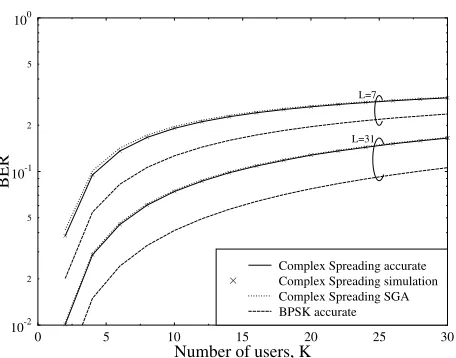
We will compare the BER results obtained by our accurate analysis provided in Section III-A to that by the SGA of Section III-B, to that of the BPSK system of [26] and to those of our simulations described in this section.
Figure 1 shows that the results obtained by our accurate analysis exactly match those obtained by simulations for two different-length random spreading sequences, when using L = 7 and 31. However, the SGA over-estimates the BER, especially in the scenario, where there is a low number of interfering users and when short spreading sequences are used.
0 5 10 15 20 25 30
Number of users, K
10-2
2 5
10-1
2 5
100
BER
L=7
L=31
BPSK accurate Complex Spreading SGA Complex Spreading simulation Complex Spreading accurate
Fig. 1. The BER versus the number of users K in an asynchronous DS-CDMA system using random complex spreading sequences and QPSK modulation. The length of the random complex spreading sequences isL= 7 and31, respectively, the average power of all users at the receiver is equal and the background noise is ignored, i.e. whenγSNR=∞.
0 2 4 6 8 10 12 14 16 18 20
SNR (dB)
10-2
2 5
10-1
2 5
100
BER
L=7
L=31 BPSK accurate Complex Spreading SGA Complex Spreading simulation Complex Spreading accurate
Fig. 2. The BER versus per-bit SNR in an asynchronous DS-CDMA system using random complex spreading sequences and QPSK modulation. The length of the random complex spreading sequences isL= 7 and31, respectively, the average power of all users at the receiver is equal. The number of users isK= 4.
The BER of the QPSK system is higher than that of BPSK systems due to the cross-talk between the real and imaginary components.
the cross-talk between the real and imaginary components.
V. CONCLUSION
In this paper we derived an exact closed-form expression for calculating the average BER of an asynchronous DS-CDMA system using QPSK modulation and random quad-riphase spreading sequences for transmission over Rayleigh channels. Our analysis was based on the CF technique. Our accurate solution required only a single numerical integration. Furthermore, our simulation results verified the accuracy of our derivation and also demonstrated the limited accuracy of the Gaussian approximation.
ACKNOWLEDGEMENT
The authors would like to thank Ms. Fang-Chun Kuo for her valuable suggestions for improving manuscript.
REFERENCES
[1] F. D. Garber and M. B. Pursley, “Performance of Offset Quadriphase Spread-Spectrum Multiple-Access Communications,” IEEE Transac-tions on CommunicaTransac-tions, vol. 29, no. 3, pp. 305–314, March 1981. [2] E. A. Geraniotis and M. B. Pursley, “Error Probability for
Direct-Sequence Spread-Spectrum Multiple-Access Communications–Part II: Approximations,”IEEE Transactions on Communications, vol. 30, no. 5, pp. 985–995, May 1982.
[3] E. Geraniotis and B. Ghaffari, “Performance of Binary and Quater-nary Direct-Sequence Spread-Spectrum Multiple-Access Systems with Random Signature Sequences,”IEEE Transactions on Communications, vol. 39, no. 5, pp. 713–724, May 1991.
[4] R. T. Hsu and J. S. Lehnert, “A Characterization of Multiple-Access Interference in Generalized Quadriphase Spread-Spectrum Communica-tions,”IEEE Transactions on Communications, vol. 42, no. 2/3/4, pp. 2001–2010, FEBRUARY/MARCH/APRIL 1994.
[5] D. Laforgia, A. Luvison, and V. Zingarelli, “Bit Error Rate Evaluation for Spread-Spectrum Multiple-Access Systems,”IEEE Transactions on Communications, vol. 32, no. 6, pp. 660–669, June 1984.
[6] J. S. Lehnert and M. B. Pursley, “Multipath Diversity Reception of Spread-Spectrum Multiple-Access Communications,” IEEE Transac-tions on CommunicaTransac-tions, vol. 35, no. 11, pp. 1189–1198, November 1987.
[7] T. M. Lok and J. S. Lehnert, “Error Probabilities for Generalized Quad-riphase DS/SSMA Communication Systems with Random Signature Sequences,”IEEE Transactions on Communications, vol. 44, no. 7, pp. 876–885, July 1996.
[8] A. Mirbagheri and Y. C. Yoon, “Performance Analysis of a Linear MMSE Receiver for Bandlimited Random-CDMA Using Quadriphase Spreading over Multipath Channels,” IEEE Transactions on Wireless Communications, vol. 3, no. 4, pp. 1053–1066, July 2004.
[9] J. E. Salt and S. Kumar, “Effects of Filtering on the Performance of QPSK and MSK Modulation in D-S Spread Spectrum Systems Using RAKE Receivers,”IEEE Journal on Selected Areas in Communications, vol. 12, no. 4, pp. 707–715, May 1994.
[10] M. O. Sunay and P. J. McLane, “Comparison of Biphase Spreading to Quadriphase Spreading in DS CDMA Systems that Employ Long PN Sequences,” inSixth IEEE International Symposium on Personal, Indoor and Mobile Radio Communications, vol. 1, Toronto, Canada, 27-29 September 1995, pp. 237–242.
[11] ——, “Effects of Carrier Phase and Chip Timing Errors on the Capacity of a Quadriphase Spread BPSK Modulated DS-CDMA System,” in
IEEE Global Telecommunications Conference, vol. 2, Singapore, 13-17 November 1995, pp. 1114–1120.
[12] Y. C. Yoon, “Quadriphase DS-CDMA with Pulse Shaping and the Accuracy of the Gaussian Approximation for Matched Filter Receiver Performance Analysis,” IEEE Transactions on Wireless Communica-tions, vol. 1, no. 4, pp. 761–768, October 2002.
[13] 3GPP TS 25.213 V6.3.0,Spreading and Modulation (FDD), 3rd Gen-eration Partnership Project, June 2005, http://www.3gpp.org/. [14] 3GPP TS 25.223 V6.0.0,Spreading and Modulation (TDD), 3rd
Gen-eration Partnership Project, December 2003, http://www.3gpp.org/.
[15] P. Fan and M. Darnell,Sequence Design for Communications Applica-tions. John Wiley, 1996.
[16] G. Mazzini, G. Setti, and R. Rovatti, “Chaotic Complex Spreading Sequences for Asynchronous DS-CDMA. I. System Modeling and Results,”IEEE Transactions on Circuits and Systems I: Fundamental Theory and Applications, vol. 44, no. 10, pp. 937–947, October 1997. [17] D. Chu, “Polyphase Codes with Good Periodic Correlation Properties,”
IEEE Transactions on Information Theory, vol. 18, no. 4, pp. 531–532, July 1972.
[18] R. Frank, S. Zadoff, and R. Heimiller, “Phase Shift Pulse Codes with Good Periodic Correlation Properties,”IEEE Transactions on Informa-tion Theory, vol. 8, no. 6, pp. 381–382, October 1962.
[19] S. Boztas, R. Hammons, and P. Kumar, “4-Phase Sequences with Near-Optimum Correlation Properties,” IEEE Transactions on Information Theory, vol. 38, no. 3, pp. 1101–1113, May 1992.
[20] S. Rahardja, W. Ser, and Z. Lin, “UCHT-Based Complex Sequences for Asynchronous CDMA System,”IEEE Transactions on Communications, vol. 51, no. 4, pp. 618 – 626, April 2003.
[21] S. Xie and S. Rahardja, “Performance Evaluation for Quaternary DS-SSMA Communications with Complex Signature Sequences over Rayleigh-Fading Channels,”IEEE Transactions on Wireless Communi-cations, vol. 4, no. 1, pp. 266–277, January 2005.
[22] T. G. Macdonald and M. B. Pursley, “The Performance of Direct-Sequence Spread Spectrum with Complex Processing and Quaternary Data Modulation,”IEEE Journal on Selected Areas in Communications, vol. 18, no. 8, pp. 1408–1417, August 2000.
[23] J. H. Cho, Y. K. Jeong, and J. S. Lehnert, “Average Bit-Error-Rate Performance of Band-Limited DS/SSMA Communications,”IEEE Transactions on Communications, vol. 50, no. 7, pp. 1150–1159, July 2002.
[24] A. Lam and F. Ozluturk, “Performance Bounds for DS/SSMA Commu-nications with Complex Signature Sequences,” IEEE Transactions on Communications, vol. 40, no. 10, pp. 1607–1614, October 1992. [25] L. Staphorst, M. Jamil, and L. Linde, “Performance Evaluation of a
QPSK System Employing Complex Spreading Sequences in a Fading Environment,” in IEEE Vehicular Technology Conference 1999 Fall, vol. 5, Amsterdam, Netherlands, 19-22 September 1999, pp. 2964–2968. [26] J. Cheng and N. Beaulieu, “Accurate DS-CDMA Bit-Error Probability Calculation in Rayleigh Fading,”IEEE Transactions on Wireless Com-munications, vol. 1, no. 1, pp. 3–15, January 2002.
[27] J. G. Proakis,Digital Communications, 4th ed. McGraw-Hill Compa-nies, Inc., 2001.
[28] A. Papoulis,Probability, Random Variables, and Stochastic Processes, 3rd ed. McGraw-Hill, Inc., 1991.