Summary
The world economy is quickly gaining complexity as a result of globalization, becoming an ever-larger, increasingly interconnected, more heterogeneous and more dynamic system. The risks in this globalized world consequently differ from the risks of the past, in terms of their potential damage, their temporal dimension, their geographical scope, the irreversibility of their potential damage, their potential for social conflict, and in their mutual interdependency. In turn, these new qualities also produce fundamental changes in the requirements for sustainable action strategies. Many precedent-setting economic policy decisions nevertheless remain based on principles that fail to fulfill these requirements:
The growth paradigm increasingly conflicts with the reality of globally limited resources, and no longer serves to increase overall welfare within post-industrial societies.
Explanations and predictions offered by standard economic models are increasingly diverging from reality.
In many critical areas, the pursuit of short-term, local objectives leads neither to long-term nor globally advantageous results.
Decision-making processes are increasingly unprepared to deal with rising levels of complexity and uncertainty.
The impetus for the development of alternatives comes primarily from interdisciplinary research:
There are suggestions as to how resource cycles can be kept in balance through the practice of rematerialization of old or discarded goods; happiness research has questioned the benefit of economic growth; various initiatives are seeking measures of welfare able to replace GDP as indices that can guide policy activity.
The findings of behavioral, evolutionary and complexity researchers are contributing to the development of new economic theories. The rapidly increasing power of computer simulations also helps in this regard.
The requirements for sustainable action strategies are undergoing fundamental change as a result of the rapidly increasing complexity of the global economy. Many of the conceptual underpinnings of economic policy-making must be radically rethought: from the paradigm of growth to standard economic models to local and short-term incentive systems to existing decision-making architectures. A sustainable global economic model should minimize risks, be resilient to crises, and provide future generations the opportunity to lead a fulfilled life on our planet. Doing so demands that we facilitate creative and well-founded ideas.
Globalization and its Complexity
Challenges to Economic Policy
Bertelsmann Stiftung, “Shaping Sustainable Economies” program Carl-Bertelsmann-Str. 256, D-33311 Gütersloh
Old risks in new bottles
Many of the risks addressed in the context of current debates regarding globalization are not in their essence new: the scarcity of resources critical to survival, speculative bubbles, extreme social inequality, mass migration, pandemics, terrorism and even state bankruptcies have long been a part of the fabric of human life.
In his book “Collapse,” Jared Diamond argues compellingly that the inhabitants of Easter Island handled their scarce timber resources so wastefully that the civil war triggered by the issue ultimately destroyed their entire culture (Diamond 2005).
The Netherlands’ notorious tulip mania ended in 1637 with the collapse of a speculative bubble. Previously, tulip bulb prices had soared as tulips became collectors’ items for which exorbitant amounts of money exchanged hands.
Triggered by the invasion of the Huns in the fourth century, mass migrations took place across Europe for the next 200 years.
The Black Death, the great plague pandemic that lasted from 1347 to 1353, spread across the whole of Europe and led to an estimated 25 million deaths, about one-third of the population at the time.
The “German Autumn” of 1977 marked the climax of a wave of terrorism in Germany. Among other events, this involved the murder of Hanns Martin Schleyer, president of the Confederation of German Employers’ Associations, and the hijacking of the Lufthansa airplane “Landshut.” Beyond Germany’s RAF, the 1970s saw the formation of terrorist groups in other European countries, such as the IRA in Ireland, the ETA in Spain and the BR in Italy.
At the end of 2001, Argentinian President de la Rúa declared his country unable to repay its debts. Three years previously, the country had been plunged into a recession that led to capital flight, a banking crisis, excessive government indebtedness and inflation.
Some crises have led to radical societal changes, while others have plunged whole cultures into collapse. It seems as though one would only have to look back precisely enough, carefully analyzing the past and drawing appropriate conclusions, in order to find the correct responses to the risks of modernity. However, there is a significant difference between the crises of the past and today’s threats. Indeed, the context has radically changed. At issue are no longer simply regional cultures, or catastrophes with primarily local economy considerations within supranational
mechanisms such as certificate trading or “commons trusts” aim at the development of enforceable strategies for the solution of global and long-term challenges that lie outside the state-market spectrum.
Clever algorithms are utilizing the broad availability of data and vast amounts of computing power to reduce complexity and provide a reliable basis for decision-making. At the same time, participatory processes – particularly those that are Internet-based – make available an important resource for intelligent decision-making architectures.
However, many fundamental questions remain, such as whether and how economic growth can
global redistribution mechanisms we need and how these can be implemented, what a better global decision-making architecture might look like, and how fundamental uncertainty can be dealt with in a systematic way.
effects. At stake today is all of humanity, as a look back at a century featuring two world wars, a cold war and a nuclear arms race illustrates. Today, global resource shortages loom, the entire world economy is shaken by finance crises, worldwide mass migrations due to climate change and severe developmental differences can be foreseen, and terrorist attacks like that on 11 September 2001 in New York shift perceptions of security worldwide. And it is virtually unimaginable what a global pandemic might mean, or what global implications the bankruptcy of a major economy such as that of the United States, Japan or significant European countries might hold.
Rapid technological developments have enabled human activities to have impacts as strong as those of natural influences; human-induced climate change is only the most prominent example. Atmospheric chemist and Nobel Prize winner Paul Crutzen goes so far as to speak of a new geological era, the “Anthropocene” (Crutzen 2002). Yann Arthus-Bertrand’s film “Home” illustrates in breathtaking images just how we humans have changed the planet in the last 60 years.1
In the 20 years since the end of the Cold War, the globalization process has once again accelerated immensely. The global interdependence of political, economic and social systems has produced unprecedented complexity. The risks of a globalized world are substantially different from the risks of the past – in terms of potential damage, temporal dimension, geographical scope, irreversibility, potential for social conflict and mutual interdependencies.
The interplay of global megatrends such as economic globalization, demographic development, climate change and technological progress amplifies the influence of local events through reciprocities and feedback effects. As a result, conventional problem-solving strategies are failing. In part due to the border-constrained nature of national policymaking, these strategies are generally effective at the regional level only. They are too often oriented toward specific trends, and are informed by models whose idealized assumptions are helpful under readily comprehensible conditions, but which lose legitimacy when confronted with the complexity of globally interconnected systems.
1 www.youtube.com/user/homeproject
The global economy as a dynamic
network
The structural changes in the global economy stand out when one sees economic activity as part of a dynamic network. The objects within this network are the market actors, the economic goods, the factors of production, the available information, etc.2 The quantity of these objects is a measure of the size of the network. The objects stand in varying relationships to one another: Market actors interact with one another, certain factors of production are needed to produce a good, market actors have access to certain bits of information, and so on.
These dependencies can be abstractly represented by links between the objects. The average number of links per object is a measure of the interconnectedness of the system as a whole3. Both the objects and the links between them have very widely varying properties. For example, market players have varying preferences, natural resources are distributed very unevenly from a geographical perspective, access to information is sometimes better and sometimes worse, etc. Indicators of this variance measure the heterogeneity of the network4. Of course, because we are dealing with a dynamic network, the objects and the links within the network change over time. Indicators of the rate of change measure the dynamics of the network.
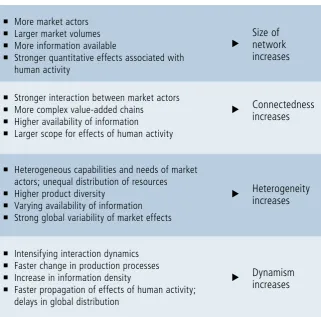
Table 1 outlines how the global economy changes in terms of size, complexity, heterogeneity and dynamism in the course of global transformation.
The Atlas of Economic Complexity (Hausmann et al. 2011) deals with these changes in great detail. In summation, the particular challenge lies in the fact that all of humanity today lives and interacts within a single large, highly networked, very heterogeneous and highly dynamic system.
2 We do not aim here to provide an exact definition of
the network model, but rather the idea of a meta-model illustrating structural changes.
3 This is a very simple measure of the degree of
interconnectedness. Other graph-theoretical indicators such as connectivity numbers or expansion properties describe other aspects of global networking.
4 For example, consider here indicators such as the
made in a given situation tends not to do so. This is because these decisions depend ultimately on actors’ brain structures, which change only marginally over time, at least if one assumes that the intergenerational evolution of the human brain is an extremely slow process.5
On the one hand, this means that the capacity of single individuals to deal with complex situations requiring decisions has its limits. On the other, this insight also offers cause for hope: The better the functioning of the brain can be understood, and thus the behavior of people under specific circumstances, the better that situations that demand decisions can be modeled, analyzed and simulated.
5 At the same time, research shows that over the course
of a full lifetime, the brain has a large, mostly untapped development potential that could be better exploited by new types of lifelong learning (Staudinger, Marsiske and Baltes 1995).
Decision-making in a complex world
The evolution of the global economy is determined by:
the decisions and actions of its actors (individuals, groups, institutions); and
the repercussions of these decisions and actions within the system.
[image:4.595.80.402.102.419.2]Decisions themselves are driven by individual needs and convictions, social norms, economic conditions, political environments and technological opportunities. These drivers in turn are endogenous components of the system, and are themselves likewise governed by the global dynamic. The focal point for the emergence of global risks is ultimately the interplay of individual and institutional decisions under a given set of conditions. Herein lies a paradox: While the environment increases in complexity, the manner in which individual decisions are
Table 1:
Global economic changes in four dimensions
¡ More market actors ¡ Larger market volumes ¡ More information available
¡ Stronger quantitative effects associated with human activity
¡ Stronger interaction between market actors ¡ More complex value-added chains
¡ Higher availability of information
¡ Larger scope for effects of human activity
¡ Heterogeneous capabilities and needs of market actors; unequal distribution of resources ¡ Higher product diversity
¡ Varying availability of information ¡ Strong global variability of market effects
¡ Intensifying interaction dynamics ¡ Faster change in production processes ¡ Increase in information density
¡ Faster propagation of effects of human activity; delays in global distribution
Size of network increases
Connectedness increases
Heterogeneity increases
Dynamism increases
The “big picture” in which individual decisions are made depends substantially on decisions that are made institutionally, in the sense that multiple people are involved in an institutionalized decision-making process. These include fiscal policies, business strategies, or supranational finance market regulations. In contrast to the way individual decisions are made, institutional decisions can be deliberately shaped. To be sure, individual choices form the basis for institutional decisions, as individual persons are ultimately involved in the shaping process. However, the process of institutional decision-making can make available problem-solving capacities that single individuals cannot possess. Institutional decisions are distinguished by the fact that they are rooted in the surrounding environment’s social systems, such as organizations or cultures, rather than solely in the brain structures of the individuals involved. Although these environmental features too possess a certain inertia, their underlying evolutionary processes are much faster than are their biological counterparts.
Decision-making processes must adapt themselves to globalization’s growing complexity. The point of leverage here lies in the shaping of institutional decision-making processes, in which the potential for achievement is greater than the sum of the individual participants’ potential, and which as sociocultural structures (as opposed to physiological brain structure), are malleable. The bottom line is that the development of the global economy is significantly influenced by decisions made at the level of governments, central banks, international organizations and multinational corporations. These decisions also form the framework that encompasses most global risks.6 However, many of the fundamental principles on which these institutional decisions depend are increasingly less appropriate within the complexity and dynamic shifts of the global economy. In what follows, we focus on four such challenges.
The growth paradigm increasingly conflicts with the reality of globally limited resources, and no longer promotes well-being within post-industrial societies. Worldwide consumer demand, and thus
6 This does not apply to risks of natural origin such as
pandemics or natural disasters. Nevertheless, institutional decisions can in these areas too have an influence on the quality of preparedness and safeguards.
resource requirements too, will climb rapidly in the years ahead. However, economic policy decisions relying wholly on economic growth are not indefinitely sustainable. On the one hand (at least under methods existing today), there is a limit to the amount that can be produced; on the other, the limited number of consumers and scarce time resources means that consumption cannot take place ad infinitum.7 But even as the possibility of unlimited growth is being called into question, so too is the concept’s basic sense. At a certain stage of growth, the contribution of economic growth to the increase in people’s levels of satisfaction seems to drop sharply.
Explanations and predictions offered by economic models are increasingly diverging from reality. Global amplification and feedback effects are enabling the development of phenomena such as the current financial crisis, which most economists failed to predict, and which even in retrospect has eluded convincing explanation within the framework of established economic theories. This is because central elements of traditional economics, such as the Homo economicus model, the efficient-market hypothesis, closed equilibrium systems or assumptions of homogeneity, do not account for aspects such as cognitive biases, information asymmetries, phase transitions with multiple unstable equilibria or heterogeneity. There is a risk that economic policy strategies will be based on theoretical assumptions that effectively blind policymakers to important aspects of reality. The global economy becomes more susceptible to risks as a result, and consequently more fragile.
In many critical areas, the pursuit of short-term, local objectives leads neither to long-term nor globally advantageous results. In large systems, which to a large extent consist of unrelated individual components, global target values can be optimized by optimizing the corresponding values at the individual component level. With increasing complexity, however, this is less and less true: The welfare of people in one location depends ever more on the actions of other people at a distant location. Feedback effects associated
7 However, the time horizons of an initially steady rise
with global interdependence lead to a divergence between short- and long-term goals, as well as between local and global targets.
Decision-making processes are increasingly inadequate to deal with rising levels of complexity and uncertainty. Increasingly complex systems become increasingly difficult to control, and develop what can sometimes be dangerous internal dynamics. The worldwide interdependence of political, economic and social systems, technological change, and the interaction of diverse global forces in the Anthropocene era create explosively climbing complexity, with which human capabilities are increasingly less able to cope. Furthermore, as the complexity of the systems in which we interact increases, structural uncertainties also deepen, and we are often forced to make decisions despite having only incomplete information available.
In order to avoid sliding with ever greater frequency from one global crisis to the next, it appears essential to reconsider the bases for our decisions in a radical manner and address the corresponding challenges:
Solving the growth dilemma
Developing appropriate economic models
Developing new strategies and mechanisms for long-term and globally oriented action
Developing new decision-making processes able to deal with complex challenges
In the next section, a number of future-oriented approaches show how these challenges can be met.
Future-oriented approaches
Solving the growth dilemma
The first question is whether growth per se serves human purposes at all, and whether the economy could somehow function even without growth. This question goes to the heart of so-called post-growth economics ( Jackson 2009, Paech 2005). The starting point is the
recognition that peoples’ well-being – at least in the industrialized nations – has already become decoupled from economic growth (Frey 2008, Oswald 1997). At the same time, happiness research has reported that economic contractions, particularly heterogeneous cases that affect some people more strongly than others, strongly reduce people’s sense of well-being. It remains unclear how a transition towards an economy without growth might manifest itself.
But even if continuous growth should prove essential for the economy, two fundamental constraints remain. On the production side, natural resources are globally limited, as the Club of Rome noted in its 1972 report “The Limits to Growth” and its subsequent updates (see Meadows et al. 1972, Meadows et al. 2004). And on the expenditure side, consumption capacity is similarly constrained by the number of consumers and the time available for consumption; these limits ultimately could lead to saturation and stagnation.
Of course, these limitations are only for specific types of growth based on the consumption of resources, and in which additional time is spent in the process of consumption. Thus, several ways out lie close to hand: On the one hand, fewer resources could be depleted (through more efficient production or targeted reuse of materials), alternative resources used (such as renewable energy or nuclear fusion) and growth oriented increasingly toward goods and services that require no non-renewable resources. On the other hand, efforts could be made to create growth not through more goods and services, but through better ones. Specifically targeted support of research and innovation seems to provide a persistent foundation for promising alternatives.
German process engineer Michael Braungart is of the opinion that the often-requested waiver is the wrong way to deal with production-side limits.8 Instead, he has proposed the “cradle-to-cradle” principle, which keeps the cycle of resources in balance through the reuse of materials (McDonough and Braungart 2002). The essential idea is to reuse raw materials after their processing and disposal, something that would require rethinking the design of processing and utilization processes.
With the rise of the emerging markets in the coming years, global consumer demand will rise rapidly, ensuring that a point of global saturation will certainly not be reached for some time. Economic stagnation thus remains initially a problem primarily for the developed countries. Prominent approaches aimed at replacing gross national product as an indicator used to guide activity include the OECD’s Better Life Index and the work of the Stiglitz-Sen-Fitoussi Commission (Stiglitz, Sen and Fitoussi, 2009), which has been used by the French government.9
New economic models
In 1936, John Maynard Keynes wrote: “The extraordinary achievement of the classical theory was to overcome the beliefs of the ‘natural man’ and, at the same time, to be wrong” (Keynes 1936). Now, it is the nature of models to employ abstractions, in order to reduce complexity while simultaneously deriving useful explanations and predictions. However, global change increases the relevance of influential variables that are not included or are given too little weight within traditional economic models. The search for better models has shown that the inclusion of ideas from other disciplines such as psychology, physics or biology can be profitable, often at a metaphorical level. For example, econophysics aims at applying the concept of phase transitions to dynamic economic systems; from biology, the idea of evolution has entered economic discourse.
In their book “Animal Spirits: How Human Psychology Drives the Economy, and Why it Matters for Global Capitalism” (Akerlof and Shiller 2009), George Akerlof and Robert Shiller adopt Keynes’ idea that human activity is driven largely by “animal spirits” rather than by rational considerations, as is assumed within (neo) classical economic theory. Akerlof and Shiller cite five aspects of the “animal spirits” intrinsic to us: confidence and its multipliers, fairness, corruption and antisocial behavior, the money illusion, and stories that shape our understanding of the world. The authors – along with many other prominent economists – see the fact that standard economic theories wholly ignore these aspects of human nature as a core reason for the emergence
9 www.oecdbetterlifeindex.org
of speculative bubbles (and hence also for the current financial crisis).
In addition, former IBM Chief Technologist Gunter Dueck explains how basic human tendencies lead to overreaction and thus exacerbate alternating boom and bust phases; he argues that underlying emotional reactions should thus be taken quite seriously (Dueck 2006). And Herbert Gintis, an economist at the University of Massachusetts, the Santa Fe Institute and the Central European University in Budapest notes that the assumptions of the various scholarly disciplines that study human behavior in fact diverge strongly. He has called for a unification of these intellectual fundaments within the fields of economics, sociology, anthropology and psychology (Gintis 2009).
In his book “Rethinking Macroeconomics: What Failed and How to Repair It,” Nobel prize-winning economist Joseph Stiglitz deals repeatedly with the effects of failing to assume heterogeneity within the standard economic model, and notes in particular that the heterogeneity of expectations among market participants is a key contributor to systemic imbalance (Stiglitz 2011).
The abundance of data available today (something that will increase even further in the future), along with the growing power of computers, for the first time offers the possibility to verify the validity of models on an empirical basis, and to use complex simulations to derive macroeconomic models from microeconomic principles – an idea that derives from the newly created area of agent-based computational economics (Tesfatsion and Judd 2006).
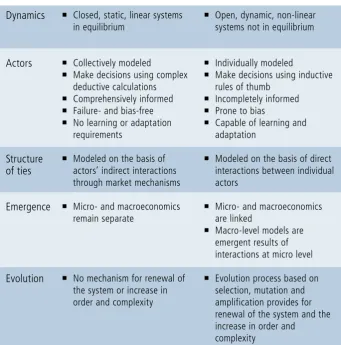
Table 2, taken from “The Origin of Wealth,” (Beinhocker 2006) summarizes the main differences between “traditional economics” and a new theory of “complexity economics.”
economic theory, the market’s “invisible hand” enables actors’ self-interested pursuit of profit to lead to the optimum macroeconomic state. However, individual decisions do have an effect on uninvolved market participants, through what are called externalities. These are external costs or external benefits which the market price does not – or at least does not sufficiently – take into account. Internalization is possible through the use of regulatory instruments such as the trading of certificates (for example, emissions or debt allowances) or the taxation of activities that cause externalities. In order for these instruments to be effective with regard to global externalities, they must be enforced at the global level, which is a major challenge due to the lack of global
New strategies for long-term and globally oriented action
The world economy is becoming increasingly irreducible, insofar as global problems are less amenable to solution through being broken into their local components and solved on an individual basis. Examples include collective CO2 emissions that exacerbate global climate change, or trade wars that arise because individual states put their selfish short-term interests ahead of long-term global solutions. In such a rapidly changing world, however, the danger arises that the fastest possible answers to daily events will be given ever-greater priority, while long-term consequences will drop from view.
[image:8.595.72.414.123.469.2]Individual preferences provide a starting point in addressing this dilemma. In classical
Table 2:
Traditional economics and complexity economics compared (Beinhocker 2006, Table 4-1)
¡ Closed, static, linear systems in equilibrium
¡ Collectively modeled
¡ Make decisions using complex deductive calculations ¡ Comprehensively informed ¡ Failure- and bias-free ¡ No learning or adaptation requirements
¡ Modeled on the basis of actors’ indirect interactions through market mechanisms
¡ Micro- and macroeconomics remain separate
¡ No mechanism for renewal of the system or increase in order and complexity
Dynamics
Actors
Structure of ties
Emergence
Evolution
¡ Open, dynamic, non-linear systems not in equilibrium
¡ Individually modeled
¡ Make decisions using inductive rules of thumb
¡ Incompletely informed ¡ Prone to bias
¡ Capable of learning and adaptation
¡ Modeled on the basis of direct interactions between individual actors
¡ Micro- and macroeconomics are linked
¡ Macro-level models are emergent results of interactions at micro level
¡ Evolution process based on selection, mutation and amplification provides for renewal of the system and the increase in order and
complexity
governance structures. In addition, it is often difficult or virtually impossible to quantify externalities in monetary terms. In the case of long-term externalities, this is made particularly difficult by complexities, uncertainties and inconsistent time preferences.
In addition, there are alternatives to market mechanisms that produce fewer externalities and are more efficient, wasting fewer resources. Nobel prizewinner Elinor Ostrom, an expert on environmental economics, has shown that so-called commons problems, in which there is a danger of depletion of freely available resources, are in certain contexts better solved by cooperative self-organization than by the market and state action (Ostrom 1990). Economist Peter Barnes has suggested the establishment of so-called commons trusts in order to facilitate a more equitable and sustainable usage of common goods (Barnes 2006).
New decision-making processes for dealing with complex challenges
One of the central insights of cybernetics is the “law of requisite variety,” also known as “Ashby’s law” (Ashby 1956). This states that as more possibilities for action are available to a system’s control mechanism, the better able it is to compensate for increases in the number of potential failure points (and thus for greater complexity). In short: Handling complex systems can only be performed successfully through the use of processes that are themselves complex. It is thus advisable to approach complex challenges with strategies that are sufficiently complex.
The most complex problem-solving tool available to us is the human brain. Particularly in the subconscious elements of the brain, many experiences are processed in such a way as to form the basis of evaluations, which in turn enable very complex problems encountered later to be decided quickly. For this reason, in periods of stable conditions, intuition and gut feelings often function surprisingly well. Problems arise, however, if conditions change abruptly. In periods of change, reliance on the intuition of individual decision makers is a risky proposition. As social scientist and Nobel economics prizewinner Herbert Simon writes in “Models of Bounded
Rationality”: “The capacity of the human mind for formulating and solving complex problems is very small compared with the size of the problems whose solution is required for objectively rational behavior in the real world – or even for a reasonable approximation to such objective rationality” (Simon 1982). This argument is given weight by the insight drawn from brain research that “objectively rational behavior” is in any case an illusion produced by the cortex – the brain region responsible for rational decisions – “after limbic structures and functions have already determined what is to be done,” as biologist and neuroscientist Gerhard Roth says (Roth 2003).
Conventional theories and processes too founder when confronted with the increasing complexity associated with globalization, and with the increases in the speed of development and information exchange associated with technological progress. As a result, even experts are often left perplexed, while decision makers find themselves overwhelmed and bereft of clear direction.
If the growing complexity has overwhelmed existing decision-making mechanisms, two possibilities exist: either to reduce the complexity with the help of other instruments, or devise new mechanisms that are better adapted to the complexity. Vast computing power can today be applied to the task of reducing complexity. Moreover, a huge amount of data is available for analysis and knowledge extraction, while highly complex simulations enable the discovery of fundamental patterns and the creation of comprehensive forecasts. Current examples include the IBM Smarter Planet Initiative10 or the FuturICT project which, though still in the planning phase, aims at large-scale simulations of social systems.11
Another form of complexity reduction is the visual representation of data, which has become the task of the relatively new field of data-driven journalism. Through the open and vivid presentation of data and facts, one of the basic conditions for dealing with complexity – transparency of dependencies – is fulfilled. Such
efforts are currently being promoted by the open data movement.
However, the automated reduction of complexities also has limits, as ascertaining the character of complex interdependencies is often impossible, a hurdle that in turn hinders the production of valid predictions. In such cases, a fundamentally different approach to dealing with future challenges must be found. This includes both the assessment of future risks, a task that no longer appears possible using statistical methods and rational expectations theory, and the preparation for several possible futures whose probabilities are not quantifiable.
Scenario planning techniques and other methods of futures research could gain in importance as providing the foundations for decisions. Dealing with fundamental uncertainty as opposed to calculable risks is an increasingly urgent challenge, and one which has not yet been explored deeply enough from a structural perspective.
With respect to new mechanisms, intelligent decision-making architectures are required. Networking is a key factor within this area. The Internet offers a valuable opportunity to share knowledge around the world, engage many people in conversation and draw on collective intelligence (Surowiecki 2004). The potential inherent in information and communications technologies extends well beyond majority decisions, average ratings and the endless comment threads in online forums; the intelligent analysis of social networks, elaborated discussion and evaluation platforms, and the automatic semantic processing of large-scale texts are on the way.
In their book “Nudge: Improving Decisions about Health, Wealth and Happiness,” economists Richard Thaler and Cass Sunstein write about decision architectures, and propose their concept of “libertarian paternalism” as a guiding principle in designing processes (Thaler and Sunstein 2009). The idea is to guarantee actors the largest possible freedom of choice, while at the same time “nudging” them toward deciding in a (societally) desirable manner.
Global rethinking required
The above-noted challenges to the foundations of global decision-making give rise to a whole series of fundamental questions:
To what extent does a market economic system – particularly in a highly complex society with a global division of labor – need economic growth in order to function?
How might economic incentives for sustainable growth look? How might growth and resource use be decoupled?
What are the “correct” microeconomic foundations on which to construct macroeconomic models?
How can systems be made resilient? How can they be both robust and adaptable?
Are local redistribution mechanisms enough, or do we need globally managed redistribution? What normative principles should be used to decide which distribution of resources is globally just? How might processes that produce these principles look? Are there realistic alternatives to compensatory redistribution, perhaps in the form of business models that automatically respond better to heterogeneous environments and produce “fairer” output distributions ?
What significance might be held by new mechanisms that fall outside the spectrum traditionally bounded by the market and planned economies? How can these be brought to scale?
Which problems can be solved by
“relocalization,” and which cannot? Where is global governance necessary, and how can it be effectively designed?
What would it look like to create networked knowledge and decision-making systems that enable a new level of quality in dealing with complex systems, thanks to the intelligent combination of individual human capacities and available information? What role can the Internet play in this process?
How can today’s data processing capacities and advanced algorithms help to create complex solutions that match the growing complexities of problems?
What new approaches to risk assessment and futures planning are emerging? How can fundamental uncertainty be dealt with in a systematic way?
Scientific engagement with the challenges described above is still in its infancy, and remains far from being regarded as “mainstream.” Some latent awareness that the classic foundations for decision-making must be fundamentally overhauled does exist today within scholarly, political and civil-society circles, but remains very shallow and weak. The lack of ideas on how to proceed and the focus on more immediately pressing phenomena make a fundamental examination of these issues difficult. While the identification of future-oriented approaches itself is no easy task, the next challenge will be to translate such ideas from academia into policy and economic practice. This is particularly true in those areas where global management is required, but no corresponding global structures suitable to the task are in place.
In addition, it is important to find new ways of dealing with risks, since – as described above – these are qualitatively changing. Linear, individual case studies are of increasingly less help. The rational assumption that a risk can be sufficiently precisely characterized through its probability of occurrence and potential for damage no longer holds in a networked, heterogeneous world; this is because the significance of other risk dimensions – the distribution of potential damage, irreversibility, and so on – has risen, and because the high level of complexity and uncertainty often renders probability and potential damage unquantifiable. The future will likely be characterized by increasingly unpredictable discontinuities, and we must find ways to deal with it by making our economic and social order accordingly resistant.
Already today, behavioral and evolutionary economics, statistical physics, the emerging interdisciplinary science of complex systems, and new agent-based models are contributing to a better understanding of the global economic order. The crucial question for the years ahead will be whether and how researchers’ ideas will show up in the shaping of finance and economic policy, and whether this will succeed in developing a sustainable global economic and social model able to minimize risks, resist crises and give future generations the opportunity to lead a fulfilled life on our planet. As Arthus-Bertrand says so strikingly in closing his documentary “Home”: “It’s too late to be a pessimist.”
Jan Arpe is Project Manager at the Bertelsmann Stiftung in the “Shaping Sustainable Economies” program. Mr. Arpe holds a PhD in Theoretical Computer Science from the University of Lübeck and studied mathematics at the Johannes-Gutenberg University Mainz and the Ludwig-Maximilian University in Munich. Following his studies, he was a research fellow at the Department of Statistics at the University of California in Berkeley (2007–2008).
Why It Matters for Global Capitalism. Princeton University Press. Ashby, W. Ross (1956). An Introduction to Cybernetics. Chapman and Hall.
Barnes, Peter (2006). Capitalismus 3.0: A Guide to Reclaiming the Commons. Berrett-Koehler Publishers, Inc. Beinhocker, Eric D. (2006). The Origin of Wealth: The Radical Remaking of Economics and What It Means for Business
and Society. Harvard Business School Press.
Crutzen, Paul J. (2002). Geolog y of mankind. Nature 415 (3): 23.
Diamond, Jared (2005). Collapse: How Societies Choose to Fail or Succeed. Viking Penguin.
Dueck, Gunter (2008). Abschied vom Homo oeconomicus. Warum wir eine neue ökonomische Vernunft brauchen. Eichborn.
Frey, Bruno S. (2008). Happiness: A Revolution in Economics. MIT Press.
Gintis, Herbert (2009). Bounds to Reason: Game Theory and the Unification of the Behavioral Sciences. Princeton University Press.
Hausmann, Ricardo, César A. Hidalgo, Sebastián Bustos, Michele Coscia, Sarah Chung, Juan Jimenez, Alexander Simoes und Muhammad A. Yildirim (2011). The Atlas of Economic Complexity. Mapping Paths to Prosperity. Harvard University, MIT. http://atlas.media.mit.edu/ (Download July 15, 2011).
Jackson, Tim (2009). Prosperity without Growth. Earthscan.
Keynes, John M. (1936). The General Theory of Employment, Interest and Money. Palgrave Macmillan.
McDonough, William und Michael Braungart (2002). Cradle to Cradle: Remaking the Way We Make Things. North Point Press.
Meadows, Donella H., Dennis L. Meadows und Jørgen Randers (2004). Limits to Growth: The 30-Year Update. Chelsea Green.
Meadows, Donella H., Dennis L. Meadows, Jørgen Randers und William W. Behrens III (1972). The Limits to Growth. Universe Books.
Ostrom, Elinor (1990). Governing the Commons: The Evolution of Institutions for Collective Action. Cambridge University Press.
Oswald, Andrew J. (1997). Happiness and Economic Performance. The Economic Journal 107 (445): 1815–1831. November 1997.
Paech, Niko (2005). Nachhaltiges Wirtschaften jenseits von Innovationsorientierung und Wachstum. Eine unternehmensbezogene Transformationstheorie. Metropolis.
Roth, Gerhard (2003). Fühlen, Denken, Handeln: Wie das Gehirn unser Verhalten steuert. Neue vollständig überarbeitete Ausgabe. Suhrkamp.
Simon, Herbert A. (1982). Models of Bounded Rationality, Volume 1: Economic Analysis and Public Policy: 235–244. MIT Press.
Staudinger, Ursula M., Michael Marsiske und Paul B. Baltes (1995). Resilience and reserve capacity in later adulthood: Potentials and limits of development across the life span. In: Dante Cicchetti und Donald J. Cohen (Hrsg.):
Developmental psychopatholog y, Vol. 2: Risk, disorder, and adaptation, Wiley series on personality processes: 801– 847. Wiley.
Stiglitz, Joseph E. (2011). Rethinking Macroeconomics: What Failed, and How to Repair It. Journal of the European Economic Association 9 (4): 591–645. August 2011.
Stiglitz, Joseph E., Amartya Sen und Jean-Paul Fitoussi (2009). Report by the Commission on the Measurement of Economic Performance and Social Progress. CMEPSP. www.stiglitz-sen-fitoussi.fr/documents/rapport_anglais. pdf (Download July 22, 2011).
Surowiecki, James (2004). The Wisdom of Crowds. Random House.
Tesfatsion, Leigh und Kenneth L. Judd (2006). Handbook of Computational Economics, Volume 2: Agent-based Computational Economics. Handbooks in Economics 13. North-Holland.