Preparing impact
submissions for REF 2014:
An evaluation
Findings and observations
Catriona Manville, Molly Morgan Jones, Michael Frearson,
Sophie Castle-Clarke, Marie-Louise Henham, Salil Gunashekar
and Jonathan Grant
Preparing impact submissions
for REF 2014: An evaluation
Findings and observations
Catriona Manville, Molly Morgan Jones, Michael Frearson,
Sophie Castle-Clarke, Marie-Louise Henham,
Salil Gunashekar and Jonathan Grant
Prepared for HEFCE, SFC and HEFCW – June 2014
For more information on this publication, visit www.rand.org/t/rr727
Published by the RAND Corporation, Santa Monica, Calif., and Cambridge, UK
R®is a registered trademark.
© Copyright HEFCE 2015
RAND Europe is a not-for-profit research institute whose mission is to help improve policy and decisionmaking through research and analysis. RAND’s publications do not necessarily reflect the opinions of its research clients and sponsors.
Support RAND
Make a tax-deductible charitable contribution at www.rand.org/giving/contribute
iii
The higher education funding councils for England and Wales and the Scottish funding council asked RAND Europe to review the preparation process for the impact element of the Research Excellence Framework (REF) 2014 within higher education institutions in the UK, in order to assess the process and understand how it could be further improved.
This report details our headline findings, and is sup-ported by an Approach and evidence report that provides further detail about the data gathered and analysis con-ducted. It is intended for those responsible for the REF and, more broadly, for those in the higher education sector. It may also be of interest to others working in the evaluation of research impact.
RAND Europe is an independent not-for profit policy research organisation that aims to improve policy and decisionmaking in the public interest, through research
and analysis. RAND Europe’s clients include European governments, institutions, non-governmental organisa-tions and firms with a need for rigorous, independent, multidisciplinary analysis. This report has been peer-re-viewed in accordance with RAND’s quality assurance standards.
For more information about RAND Europe or this document, please contact:
Catriona Manville RAND Europe Westbrook Centre Milton Road
v
Preface ... iii
Table of contents ... v
Table of figures ... vii
Table of tables and boxes ... ix
Executive summary ... xi
Acknowledgements ... xv
Abbreviations ... xvii
Chapter 1: Introduction ... 1
1.1 Origins and aims of this report ... 1
1.2 Methodology overview ... 2
1.3 The structure of this report ... 5
Chapter 2: The benefit and burden of assessing research impact
as part of REF 2014 ... 7
2.1 Participants saw a number of benefits from the increased focus on the assessment of impact as part of REF 2014, along with other policies (such as Research Council UK’s ‘Pathways to Impact’) and the broader ‘impact agenda’ ... 7
2.2 The assessment of impact as part of REF 2014 was a significant new burden for HEIs ... 9
Chapter 3: Implementing the assessment of research impact as
part of REF 2014 ... 13
3.1 HEIs were able to identify and articulate their impact as part of REF 2014. However, views on guidance from the HE funding bodies for demonstrating research impact ranged widely, from full support to great concern ... 13
3.2 The biggest challenges (and burdens) in preparing impact case studies (REF3b) were the requirement to ‘evidence’ impact and the need to develop an understanding of the concept of impact ... 14
3.3 HEIs perceived that the exercise had put an undue burden on research users, although this was not their experience... 18
3.4 There was uncertainty about how panels will assess impact and this has led to unease in the sector ... 20
Chapter 4: Attitudes to and consequences of assessing research impact as
part of REF 2014 ... 23
vi Preparing impact submissions for REF 2014: Findings and observations
4.2 There was as much diversity of views and attitudes towards the assessment of impact as
part of REF 2014 within HEIs as there was between them ... 23 4.3 The impact case studies (REF3b) submitted may not be representative of the actual impact
of research occurring within HEIs ... 24 4.4 There is a concern that the impact agenda may begin to undermine ‘blue skies’ research ... 26
Chapter 5: Improving the preparation and submission process
for future REF exercises ... 27
5.1 There is a strong desire among HEIs for the HE funding councils to indicate as soon aspossible whether and how impact will be assessed for the next round of the REF ... 27 5.2 There were examples of notable practices that HEIs identified as supporting the
preparation of the impact element of REF 2014 submissions ... 31
Chapter 6: Concluding observations ... 35
vii
Figure 1-1: Project schema ... 2 Figure 1-2: Distribution of the intended number of FTEs to be submitted to REF
2014 by HEIs, split into three sampling groups ... 3 Figure 1-3: Geographical location of selected HEIs ... 4 Figure 2-1: Estimated costs from 20 HEIs of producing impact case studies and
impact templates ... 10 Figure 2-2: The effect of submission size on the cost per impact case study ... 11 Figure 2-3: Effect of the number of impact case studies required on the number of FTEs ... 12 Figure 3-1: Challenges in operationalising the guidance identified by impact case
study authors in the survey... 14 Figure 3-2: Challenges identified by survey respondents in developing impact
case studies (above) and impact templates (below) ... 16 Figure 3-3: Breakdown of time spent developing the impact element of the
submission by type of activity for 18 HEIs ... 18 Figure 4-1: Attitude of interviewees at each HEI to the preparation process for
the impact element of REF 2014 ... 24 Figure 4-2: Positive and negative comments coded to central and faculty staff ... 25 Figure 4-3: Positive and negative comments about the submission process coded
to the four panels ... 25 Figure 5-1: Suggested improvements that HE funding councils could make to the
process, as identified by impact case study (above) and impact template
(below) survey respondents ... 28 Figure 5-2: Suggested improvements that HEIs could make in preparing impact
submissions, as identified by impact case study (above) and impact
ix
Table 1-1: Summary of data sources and approach ... 6 Table 2-1: The top five benefits referenced in the surveys of lead authors of the
impact case study (REF3b) and impact template (REF3a) documents ... 8 Table 3-1: Number of impact case studies submitted per panel ... 13 Table 3-2: Challenges associated with HE funding body rules identified at site visit
interviews ... 15
xi
Aims and approach
The Research Excellence Framework (REF) is a new nationwide initiative to assess the quality of research in UK higher education institutions (HEIs). For the first time, REF 2014 introduced an assessment of the wider impact of research, alongside an assessment of the quality of research outputs and the vitality of the research environment. HEIs were expected to submit examples of impact that occurred between 2008 and 2013, as impact case studies, as well as a more general description of how they were and would continue to facilitate impact, as an impact template. The impact of research is weighted at 20 per cent of the total assess-ment for 2014. Understanding how the impact eleassess-ment of the REF 2014 submission process worked for HEIs and research users will be important for future rounds of assessment.1
The higher education (HE) funding councils for England, Scotland and Wales commissioned RAND Europe to work with a sample of 21 HEIs to evaluate the submission process for the impact element of REF 2014.2 The project aimed to:
• Identify and describe the perceived benefits and burdens to HEIs and research users in preparing their impact submissions.
• Identify intended and unintended consequences of assessing research impact for different institutions and disciplines.
• Formulate evidence-based conclusions and recommendations for improving the processes of preparing submissions for impact assessment. • Highlight innovative and good practices for
institutions, research users, HE funding councils and other stakeholders.
This report summarises the approach adopted for the evaluation and describes the key findings and obser-vations arising from the analysis. It is accompanied by a second Approach and evidence report that provides a detailed account of methods used and associated evi-dence underpinning the analysis (Manville et al. 2015). The evaluation was based on a representative system-atically selected sample of 21 HEIs across the UK and involved consulting with three broad stakeholder groups: HEI research leadership teams; HEI impact case study and impact template authors; and non-ac-ademic research users. A mixed-methods approach was used including: 126 one-to-one and group interviews during 21 HEI site visits; an online survey of 2,153 authors of impact case studies (REF 2014 Section: REF3b) and impact templates (REF 2014 Section: REF3a) with a response from 1,248 (or 58 per cent); telephone interviews with 29 research users; and costs estimation analysis provided by 20 HEIs. Twelve key findings and observations were drawn from this evi-dence base.
Key findings and observations
Participants saw a number of benefits from the increased focus on the assessment of impact as part of REF 2014, along with other policies (such as Research Council UK’s ‘Pathways to impact’) and the broader ‘impact agenda’
Participants in REF 2014 identified a number of ben-efits resulting from their involvement in the process. This was evident from the site visits and surveys. Four
Executive summary
1 We use the terms ‘research user’ and ‘beneficiary’ as these were adopted in the guidance provided by the funding councils. However, it should be
noted that at our site visits participants were uncomfortable with this terminology and also research users did not identify with it.
2 From England 18 HEIs were selected to produce a systematic and representative sample. The Scottish and Welsh HEIs were nominated by their
xii Preparing impact submissions for REF 2014: Findings and observations
20 per cent more cases. Within our sample of HEIs, 1,997 impact case studies were submitted. The HEIs in our sample included submissions to all 36 Units of Assessment (UOAs), and interviews at the site visits covered 35 out of the 36 UOAs (with the exception of ‘Anthropology and Development Studies’ (UOA24)). Through the site visits and surveys, we established that HEIs were able to identify and articulate their impact. However, it is important to remember that whether they did so successfully will be determined by the panel assessment. Interviewees and survey respondents did identify a number of challenges in applying the ‘rules’ set out in the guidance documents provide by HE funding bodies.3 In particular, the requirement to
gather evidence to support claims, the definition and concept of ‘reach’ and ‘significance’ as the criteria for assessing impact, the timeframe within which impact activity could be claimed (1 January 2008 to 31 July 2013), and the concept of institutional ownership of impact all presented challenges for HEIs preparing for research impact assessment.4
The biggest challenges (and burdens) in pre-paring impact case studies (REF3b) were the requirement to ‘evidence’ impact and the need to develop an understanding of the concept of impact
While many challenges and burdens emerged over the course of our evaluation, two in particular came to the fore in our analysis: the requirement to ‘evidence’ research impact in the case studies and the process of developing a shared understanding of the concept of impact within HEIs. Evidencing impact was particu-larly challenging because (i) some types of impact were difficult to measure and evidence and (ii) the lack of records meant that evidence often had to be recon-structed. In addition, there was a perception among HEI staff that research users did not trust the confi-dentiality arrangements that had been put in place by the HE funding councils. It was acknowledged that these issues may have been exacerbated because this was the first assessment of impact for a REF cycle and in future information management systems will be in place to capture data on an ongoing basis. Hence we key benefits were identified: the ability to identify and
understand impact; the stimulation of broader strategic thinking about impact; the increased recognition within HEIs of those academics undertaking impact activities; and the opportunity to review and reaffirm relationships with external stakeholders. However, it should also be noted that about one in eight survey respondents stated that there were no benefits to undertaking the exercise. Furthermore, there were noticeable differences in atti-tudes within institutions. Staff responsible for managing institutional preparations for REF 2014 research impact assessment were considerably more positive about the process and identified more benefits than faculty staff, who held more equivocal views.
The assessment of impact as part of REF 2014 was a significant new burden for HEIs
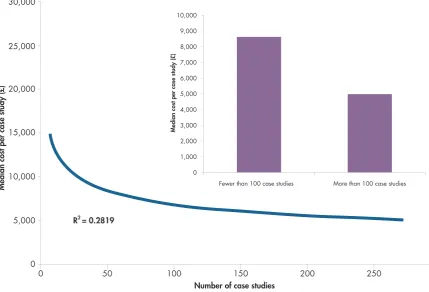
It cost UK HEIs around £55m to prepare impact sub-missions as part of REF 2014. This is our ‘best estimate’ derived from data provided by 20 of the 21 HEIs and scaling that up, based on the number of submitted impact case studies and impact templates, for all UK HEIs. The estimated median costs of producing an impact case study were around £7,500 (median cost was £7,360, the range: £3,216–£26,890; interquar-tile range: £4,899–£11,011) and around £4,500 for an impact template (the median cost was £4,368, the range: £1,318–£13,523; interquartile range: £2,745–£6,631). There was evidence of economies of scale: the median cost per impact case study for HEIs producing 100 or more of them was £4,983, compared to £8,630 for those with less than 100. Although HEIs reported low levels of start-up cost at around 5 per cent, training accounted for about one-third of all labour costs and less training may be required for future iterations of the REF.
HEIs were able to identify and articulate their impact as part of REF 2014. However, views on guidance from the HE funding bodies for demonstrating research impact ranged widely, from full support to great concern
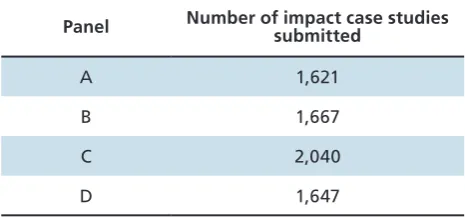
Across the sector, 6,975 impact case studies were sub-mitted for assessment as part of REF 2014, split evenly across Panels A, B, and D, but with Panel C generating
3 ‘Rules’ within the context of this report are the eligibility criteria against which the impact documents were produced. These were presented in the
guidance to the sector provided by the funding bodies.
4 Institutional ownership is the concept that impact can be claimed by the institution at which the underpinning research was done, rather than the
xiii
the outset and throughout the research life cycle. In some cases, institutions have raised the profile of research impact through inclusion of impact within their institutional research strategy or by the creation of a dedicated research impact strategy. Research impact strategies are also being developed at depart-mental and faculty levels, and some HEIs are using the REF 2014 impact templates (REF3a) to shape ongoing strategies within departments.
There was as much diversity of views and attitudes towards the assessment of impact as part of REF 2014 within HEIs as there was between them
HEIs within our sample had different attitudes towards the preparation process and were positive or negative in their attitude to varying extents. It was apparent through our visits that within HEIs there were a variety of attitudes towards the preparation process for the impact element of REF 2014. In general, central staff regarded the process as a positive experience. The benefits of the process were also per-ceived by some faculty staff, but there were propor-tionally fewer comments identifying these positive aspects and many more identifying negative aspects. In particular, they felt the process was disproportion-ately burdensome on a few individuals upon whom fell the work required to produce the impact element of the REF submission. The divergence in the views and attitudes presented here suggest that there is a risk that if the HE funding councils do not deal with the issues at the faculty level the culture shift and change in behaviour (described in the paragraph above) will not be sustained.
The impact case studies (REF3b) submit-ted may not be representative of the actual impact of research occurring within HEIs
A recurring theme that was reported in the site visits was a concern that the impact case studies submitted were not representative of the actual impact occurring within HEIs. For example, it was reported that in some HEIs impact case studies were not included in the submission where there was uncertainty about their eligibility. This limited the range of research impacts presented. Staff at some HEIs expressed the view that their institution’s might reasonably expect both of these burdens to lessen
in future.
HEIs perceived that the exercise had put an undue burden on research users, although this was not their experience
Through the site visits we observed widespread concern that providing evidence and testimonials put an undue burden on the research user community. There was a per-ception in HEIs that engaging research users and ben-eficiaries had (often adversely) changed the dynamics of the relationship with key stakeholders. Interestingly, research users did not report that engagement in REF 2014 had been overly burdensome. However, it is important to note that we spoke to a limited sample of research users in this study.5
There was uncertainty about how panels will assess impact and this has led to unease in the sector
There was a concern from the sector that the guidance provided by the HE funding councils could be inter-preted in different ways by the panels when assessing HEIs’ impact submissions. HEIs have been working with the REF 2014 definition of impact and the rules associated with its assessment since the guidance was published in July 2011. There was a feeling that the panels may be less familiar with the guidance and its intricacies and therefore may not follow the ‘rules’ when assessing impact case studies, or could decide that an impact case study was ineligible without proper consideration. In some instances uncertainty about panel behaviour when assessing the impact element of the submission encouraged risk-averse behaviour in the selection of case studies, as well as the exclusion of case studies where HEIs were concerned they might be ruled ineligible.
As a result of the impact agenda and chang-ing culture, HEIs are changchang-ing their practices
There is evidence of cultural change within HEIs. Institutional strategies and processes have been or are being put in place to maximise and evidence the impact of current and future research. There is a rec-ognition that impact needs to be thought about from
Executive summary xiii
xiv Preparing impact submissions for REF 2014: Findings and observations
arose across multiple HEIs and which appeared likely to be helpful to others.
Concluding comment
Based on our key findings and observations, and looking across all the evidence collected during this evaluation and other studies we have been involved in (e.g. Grant et al. 2010; Grant & Wooding 2010; Morgan Jones et al. 2013; Morgan Jones & Grant 2013), and also with a view to future assessments, we make the following con-cluding comments:
Based on our experience, our overall judgment is that preparations for the assessment of impact as part of REF 2014 appear to have worked, with HEIs able to articulate the wider impacts of their research. Clearly the definitive answer will only be known once the panel deliberations are published. However, the addition of the impact element has doubled the absolute costs of the exercise for the sector (although overall ‘transac-tion costs’ remain low at less than 4 per cent). Whether the costs of assessing research impact as part of REF provide value for money is a strategic question for the HE funding bodies to address.
Going forwards, success will be measured by the cul-tural change that occurs and whether HEIs exhibit a sustainable shift in their strategies relating to and focussing on their broader contribution to society. The strategic focus on research impact through the REF and Research Council UK’s ‘Pathways to Impact’ is also incentivising HEIs to be more focussed on their broader impact.
To ensure progress continues to be made, there is a need for transparency from HE funding councils on the panels’ assessment of research impact. In addition, there is a need for funders to engage with all stakehold-ers (including the academic community and research users) to create understanding, value and buy in. Looking to the future, and assuming that assessment of impact continues through the REF, it is our opinion that the use of impact case studies remains the most appro-priate means of assessment. The challenge for assessing and evidencing research impact is in understanding what kinds of impact categories and (qualitative and quantitative) indicators will be most appropriate, and in what contexts.
submission did not capture all the impact they felt their research was having.
There is a concern that the impact agenda may begin to undermine ‘blue skies’ research
Interviewees at the site visits noted (to varying degrees) that the broader ‘impact agenda’ (including Research Councils UK’s ‘Pathways to Impact’) has implications for the types of research undertaken at UK universities. Specifically there was a concern that applied research will be promoted over basic ‘blue skies’ research. A more subtle concern was that the assessment of impact in the REF will prioritise research that can more easily demonstrate impact.
There is a strong desire among HEIs for the HE funding councils to indicate as soon as possible whether and how impact will be assessed for the next round of the REF
It was clear from our site visits that HEIs want to know as soon as possible how impact will be assessed for the next round of the REF, so they can put in place the appropriate management systems. There are two interrelated concerns: a desire for clear guidance from the HE funding councils, and a desire for stability and minimal changes to the ‘rules’ for demonstrating impact. Although there was not consensus on which ‘rules’ should be changed and how, the majority of HEIs in our sample felt that improvements or changes to the ‘rules’ should not be radical in nature. HEI staff felt they have invested time and financial resource in demonstrating research impact for REF 2014 and they want to retain the benefits of that investment.
There were examples of notable practices that HEIs identified as supporting the prepa-ration of the impact element of REF 2014 submissions
xv
RAND Europe would like to thank Steven Hill, Alex Herbert and Kim Hackett at HEFCE for their guid-ance throughout this project, as well as the REF Impact Steering Group (Michelle Coupland, Claire Craig, Alice Frost, Laura Gibson, Roger Kain, Ian Leslie, Albert Rodger, Malcolm Skingle, Robert Slater, Jeremy Watson). We are also very grateful to all the institutions in our sample, in particular the interviewees and impact case study and impact template survey respondents. In addition, we would like to thank the research users who spoke to us about their impressions of the process. The authors are grateful for the interest and assis-tance of all those who contributed to this report, in particular Jessica Plumridge, Claire O’Brien, Siobhán Ni’Chonaill, Jennie Corbett, Morgan Robinson, Emma Harte and Susanne Sondergaard. In particular, we would like to acknowledge the valuable input provided by our Quality Assurance reviewers, Steven Wooding and Linda Butler.
Authors’ contributions
On this study JG was the project leader and CM the project manager. MMJ and MF were senior research-ers and SG, SCC and MLH junior researchresearch-ers on the project. The analysis of the site visit data was led by MF and CM. The development and analysis of the survey was conducted by CM and MLH. The research user interview task was led and analysed by MMJ and SCC. The analysis of the cost estimations was undertaken by JG and SG. During the course of the project, JG was appointed to and took up the position of Director of the Policy Institute at King’s and Professor of Public Policy at King’s College London. He continued to lead the project through his ongoing affiliation with RAND Europe as an honorary senior research fellow.
xvii
EIA Excellence in Innovation for Australia
ERiC Evaluating Research in Context
FTE Full-Time Equivalent
HE Higher Education
HEFCE Higher Education Funding Council for England
HEFCW Higher Education Funding Council for Wales
HEI Higher Education Institution
PART Program Assessment Rating Tool
PIRLS Principal Investigator and Research Leader Survey
QR Quality-Related
RAISS RAND/ARC Impact Scoring System
RAE Research Assessment Exercise
RCUK Research Councils UK
REF Research Excellence Framework
REF3a REF 2014 section for the impact template document
REF3b REF 2014 section for the impact case study document
RQF Research Quality Framework
R&D Research and Development
SFC Scottish Funding Council
UOA Unit of Assessment
1
The Research Excellence Framework (REF) is a new system for assessing the quality of research in UK higher education institutions (HEIs).6 It replaces the Research
Assessment Exercise (RAE), which has occurred on a (near) quinquennial basis since 1986. The outcomes of REF 2014 will be published in December 2014. The REF is being undertaken by the four UK higher education (HE) funding bodies,7 but is being managed by the REF
team based at the Higher Education Funding Council for England (HEFCE) and overseen by the REF Steering Group, consisting of representatives from the UK HE funding bodies.
The REF has three main purposes:
• To inform the selective allocation of funding body research funding to HEIs, with effect from the academic year 2015–16.
• To provide accountability for public investment in research and produce evidence of the benefits of this investment.
• To provide benchmarking information and establish reputational yardsticks.
The REF is a process of expert review. HEIs are invited to make submissions to 36 units of assessment (UOAs) across four main panels (A, B, C and D) and each sub-mission is assessed by an expert sub-panel, working under the guidance of the four main panels.8 Sub-panels
apply a set of generic assessment criteria to produce an overall quality profile for each submission (REF, 2011b). The allocation of research funding based on non-aca-demic impact is relatively new, with the REF being the first example of its application across a research system
(Morgan Jones & Grant 2013). In 2006 a pilot exercise was carried out during the development of the national Research Quality Framework (RQF) in Australia. The RQF was to have introduced impact assessment into the national research assessment exercise (Roberts et al, 2005; Peacock et al, 2006), but the impact element was dropped with a change of government in 2007. The Australians have recently reconsidered adopting an impact assessment exercise (ATN & Group of Eight 2012; Morgan Jones et al. 2013).
The REF will assess universities on the basis of the
quality of research outputs, the wider impact of research and the vitality of the research environment. Following a pilot exercise (Technopolis 2010), the HE funding bodies concluded that peer review of research impact case studies was a workable approach. The weighting for the impact assessment part of the REF will be 20 per cent of the total assessment in 2014. Documentation from the HE funding bodies has stated ‘a weighting of 25 per cent for impact would give due recognition to the economic and social benefits of excellent research. However, given that the impact assessment in the 2014 REF will still be developmental, the weighting of impact in the first exercise will be reduced to 20 per cent, with the intention of increasing this in subsequent exercises’ (REF 2011a). Indeed some have already begun to call for impact weighting to be increased to 25 per cent in the future (Witty 2013).
1.1. Origins and aims of this report
This report, commissioned by HEFCE, presents the findings of an evaluation of the institutional submissionChapter 1 Introduction
6 A higher education institution is a university or higher education college. All HEIs across the UK are eligible to submit to the REF, which leads to
funding allocation. Submissions are organised by subject areas, defined as Units of Assessment.
7 The Higher Education Funding Council for England (HEFCE), the Higher Education Funding Council for Wales (HEFCW), the Scottish Funding
Council (SFC), and the Department for Employment and Learning, Northern Ireland.
2 Preparing impact submissions for REF 2014: Findings and observations
1.2. Methodology overview
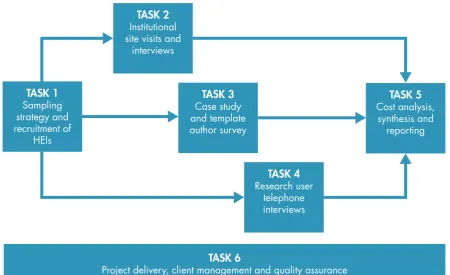
Our overall approach to this evaluation is summarised in Figure 1-1 and Table 1-1 and described in more detail in the accompanying Approach and evidence report. The evaluation was divided into six tasks: (i) determining the sampling strategy and recruitment of HEIs; (ii) HEI site visits and interviews with those associated with the leadership and administration of the impact assessment element of REF 2014 in HEIs; (iii) a survey of those involved in developing the case studies within HEIs; (iv) telephone interviews with end users of the research who have been engaged in the impact case study process; (v) a cost analysis for the REF 2014 impact process and (vi) project delivery, management and quality assurance. process for the impact assessment element of REF 2014.
[image:22.595.68.519.490.765.2]It should be noted that the reports from this evaluation were finalised in June 2014 but publication has been delayed until the results and feedback of REF 2014 have been published, in order to avoid affecting panel decisionmaking. It should be stressed from the outset that this study does not evaluate how panels assess impact, nor does it look at the other elements of REF (that is the preparation, submission and assessment of outputs and environment statements). A separate eval-uation has been commissioned to review the assessment of impact by the panels. The aims of this evaluation are set out in Box 1-1.
Figure 1-1: Project schema Box 1-1: Aims of the evaluation
TASK 1
Sampling strategy and recruitment of
HEIs
TASK 2
Institutional site visits and
interviews
TASK 3
Case study and template author survey
TASK 4
Research user telephone interviews
TASK 5
Cost analysis, synthesis and
reporting
TASK 6
Project delivery, client management and quality assurance
• Identify and describe the perceived challenges and benefits to HEIs and research users in preparing impact
submissions to REF 2014
• Identify and describe the intended and unintended consequences of assessing research impact for HEIs and
disciplines
• Formulate sound, evidence-based conclusions and recommendations to improve the process for preparing and
submitting impact assessments for future REF exercises
• Ensure that innovative and good practices in research impact assessment as used during the submission process
3
Introduction 3
HEI from Wales (Cardiff University, nominated by the Higher Education Funding Council for Wales) and two from Scotland (the University of Stirling and the University of Highlands and Islands, both nominated by the Scottish Funding Council in consultation with Universities Scotland), resulting in a total sample of 21 HEIs (Figure 1-3).
We collected data from three stakeholder groups from within our evaluation sample of 21 HEIs across England, Wales and Scotland:
• Those associated with the leadership and
administration of the impact assessment element of REF 2014 in HEIs.
• Those who were the lead authors (generally research academics) of the submission documents (impact case studies and impact templates). • Research users (i.e. the beneficiaries of research). We used a multi-method evaluation approach, includ-ing face-to-face and telephone interviews with key informants, an on-line survey, and a cost analysis using estimated cost data from HEIs (see Table 1-1 and the
Approach and evidence report for details). Data were analysed using a systematic and structured approach to To arrive at the sample of HEIs in England we selected
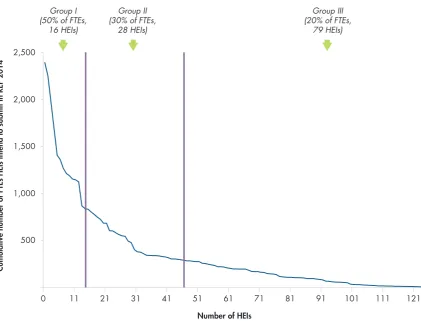
18 HEIs from the population of 123 who indicated their ‘intention to submit’ to REF 2014 (thus the sample represented about 15 per cent of HEIs in England). HEIs were selected to oversample institutions making larger submissions, but also ensuring representation of the smaller ones (Figure 1-2).
To ensure balanced representation, we then assessed our initial selection of HEIs in England against a series of pre-defined quotas. These were:
• At least one HEI from each of the nine regions used by HEFCE (North East, North West, Yorkshire and the Humber, East Midlands, West Midlands, East of England, London, South East, and the South West).
• One monotechnic HEI, defined as submitting in only one UOA.
• No institutions from the same location outside London, or two institutions from the University of London within a group.
[image:23.595.74.496.461.782.2]The sample was then checked for a representative mix of the four main panels i.e. within 15 per cent of expected number of submissions. In addition, we included one
Figure 1-2: Distribution of the intended number of FTEs to be submitted to REF 2014 by HEIs, split into three sampling groups
0 11 500
1,000 1,500 2,000 2,500
21 31 41 51 61 71 81 91 101 111 121
Cumulative number of FTEs HEIs intend to submit in REF 2014
Number of HEIs
Group I (50% of FTEs,
16 HEIs)
Group II (30% of FTEs,
28 HEIs)
Group III (20% of FTEs,
4 Preparing impact submissions for REF 2014: Findings and observations
Gr
oup I - first 50%
Gr
oup II - next 30% Brunel University Royal Holloway
,
University of London University of Central Lancaster University of Kent University of Nor
thumbria
at Newcastle
Gr
oup III - final 20% Leeds Metropolitan Sheffield Hallam University University of Chichester Royal College of Ar
ts
Other
Cardiff University University of the Highlands and Islands University of Stirling
University of Por
tsmouth
5 15
13
University College London
1
University of Birmingham
2
University of Bristol
3
University of Cambridge
4
University of Durham
5
University of Liverpool
6
University of Nottingham
7
9 10 11
12 13
15 16
17
19 20 21
18
14
University of Oxford
8 20 6 11 21 16 7 19 91 8 2 10 17 4 12 8 14 3 1 Fi g u re 1-3 : G eo g ra p h ic al lo ca ti on o f se le ct ed H EI s 9 9 Th e n um be rs a ss ig ne d t o u ni ve rs iti es i n t hi s fi gu re w er e r an dom ly a ss ig ne d f or t he p ur po se
s of i
llu st ra tio n o nl y. Th ey a re n ot i nd ic at iv
e of a
[image:24.595.97.501.99.783.2]5
key theme that came across in our evaluation; however where they were touched on this is noted in the text and picked up on in the conclusion. Recommenda-tions to improve the process are discussed in Chapter 5 (i.e. Box 1-1, aim 3). On reflection the fourth ob-jective (to identify innovative and good practice) was very difficult without knowing the outcome of REF 2014. We do, however, highlight in Chapter 5 good practices that HEIs identified as supporting their pro-cess (i.e. Box 1-1, aim 4). We finish this report with concluding comments that are broader in scope than our findings, and which draw on the wider knowledge of impact in the policy context (Chapter 6).
Full accounts of the analyses of each workstream are provided in the accompanying Approach and evidence
report, which is a longer and more detailed account of our evaluation structured around the methodological tasks. It is aimed at those who wish to better understand the underlying evidence of our key findings and how we collected and collated that evidence, and should be read alongside this report. It should be noted that the reports from this evaluation were finalised in June 2014 but publication was delayed until the results and feed-back of REF 2014 had been published in order to avoid affecting panel decisionmaking.
coding and synthesising across data sources by stake-holder group, institution type, respondent characteris-tics, etc. As summarised in Table 1-1, this approach is not without its limitations and caveats; however, by triangu-lating different data sources we identified 12 key findings and observations and an associated set of conclusions.
1.3. The structure of this report
The report is organised around our 12 key findings and observations. These are presented in four themes: the first addresses benefits and burdens (Chapter 2); the second looks at implementing the process (Chap-ter 3); the third reviews HEI staff and research user at-titudes to the implementation of the process (Chapter 4); and the fourth discusses suggested improvements to the preparation and submission process (Chapter 5). While it is clear that these themes do not have a one-to-one relationship to the aims of the evaluation listed in Box 1-1, they are a logical way to present the findings of our multi-method approach. Chapters 2 and 3 relate to the benefits and challenges of the process (i.e. Box 1-1, aim 1). Consequences of the process are discussed in Chapter 4 (i.e. Box 1-1, aim 2). The subject of unintended consequences was not a
6 Preparing impact submissions for REF 2014: Findings and observations
Table 1-1: Summary of data sources and approach
Site visits Surveys Research user telephone
interviews Cost estimations Data synthesis
Process and
purpose Individuals and group interviews with those responsible for impact submission during day-long site visits to each of the 21 HEIs
To gain a qualitative insight into the process that HEIs went through in preparing submissions and to understand their perception of the benefits, challenges and consequences
Two online surveys for leads of impact case studies (REF3b) and impact templates (REF3a) To capture the perspective and views of those who worked directly on the case studies and impact templates (and may not have been present during site visits)
Short (20 minute) telephone interviews or email correspondence with research users To ascertain how research users engaged with REF 2014 and whether the process of providing evidence to researchers produced any particular benefits or challenges
Completion of a cost estimation worksheet by 20 HEIs
To estimate the costs of preparing submissions for the impact assessment element of REF 2014
Independent generation of five key themes by researchers for each of the 21 HEIs and analysis across all evidence streams To provide a cross-cutting analysis of the key themes that emerge from a ‘top-down’ perspective on the data and to triangulate across all evidence streams
Sample size 21 higher education institutions invited to participate
1,793 impact case study ‘lead’ authors and 456 impact template ‘lead’ authors invited to respond
57 individual research users and 9 organisations invited to be interviewed
20 HEIs 210 themes identified by the evaluation team from site visits
Volume of
evidence 327 interviewees during 126 interviews
964 impact case study and 259 impact template survey responses; 58 per cent survey responses in total
23 individual and 6 organisational interviews were conducted; 29 interviews in total (44 per cent response rate)
18 fully completed cost estimation worksheets, 2 partially completed worksheets
12 key findings and observations identified
Analysis 126 interview memos coded in QSR NVivo using 48 codes, tagging 12,567 phrases
Quantitative analysis was conducted in Excel Qualitative responses were analysed in QRS NVivo using 110 codes, tagging 10,978 phrases
Qualitative analysis used to synthesise and extract key themes from the interviews
Data analysed in
Excel NVivo analysis of themes
Limitations
and caveats Contradictory points could be raised within an HEI and views are not necessarily representative of an institution
Different coding styles of the evaluation team Semi-structured interview protocol meant not all questions were asked at all interviews
Self-reported data Sample may have been incomplete Accuracy of time estimations may vary
Not all individuals interpreted all questions in the same way Small sample size relative to the entire pool of research users Sampling bias
Exact data relating to time spent were not available and we requested indicative estimates from HEIs. Our analysis therefore does not provide a precise estimate
7
This chapter provides an overview of the benefits and burdens experienced by HEIs in preparing impact sub-missions for REF 2014. In particular it provides detail about the following two key findings:
• Participants saw a number of benefits from the increased focus on the assessment of impact as part of REF 2014, along with other policies (such as Research Council UK’s ‘Pathways to Impact’) and the broader ‘impact agenda’.
• The assessment of impact as part of REF 2014 was a significant new burden for HEIs.
2.1. Participants saw a number of
benefits from the increased focus
on the assessment of impact as
part of REF 2014, along with other
policies (such as Research Council
UK’s ‘Pathways to Impact’) and the
broader ‘impact agenda’
I noticed my perception of research changing slightly and my passion to make an impact with my research enhanced; this was due to constant in-depth thinking about what we (and I) do in the unit and why we do it. I can say that I became totally immersed in the topic of impact and became fascinated by the area.10
Participants in REF 2014 identified a number of bene-fits resulting from their involvement in the process. This was evident from the site visits and surveys completed by
lead authors of the impact documents that contributed to the submission. The results illustrated in Table 2-1 come from the survey; four key benefits are identified: the ability to identify and understand impact; the stimulation of broader strategic thinking about impact; increased recog-nition within HEIs of those academics undertaking impact activities; and the review and reaffirmation of relationships with external stakeholders. Affirming relationships, under-standing impact and recognition were benefits that were also identified in the Excellence in Innovation for Australia (EIA) trial (Morgan Jones et al. 2013).
These benefits were also confirmed in our site visit inter-views. The salient themes identified in these interviews are listed in Table 2-1. It should also be noted, however, that 7 per cent of ideas relating to the impact case study and 6 per cent relating to the impact template stated that there were no benefits to undertaking the exercise, and on average survey respondents provided fewer benefits than chal-lenges in their responses.11 Furthermore, and as discussed
in Section 4.2 and in the Approach and evidence report in more detail, there were noticeable differences in attitudes within institutions. Central staff, with responsiblity for managing institutional preparations for REF 2014 research impact assessment, were consistently more positive about the process and identified more benefits than faculty staff. The most frequently mentioned benefit in both the impact case study and impact template surveys was being able to identify and understand the impact of research, with over a quarter of the ideas associated with this type of benefit.12 Nearly half of the respondents
Chapter 2
The benefit and burden of assessing research
impact as part of REF 2014
10 Quotations used throughout this report are taken from the site visits and survey responses. 11 None of the fields was mandatory and therefore data were not always entered for each question.
12 In the results of the survey presented below we use the following terminology: analytical categories refer to the main questions asked in the survey;
8 Preparing impact submissions for REF 2014: Findings and observations
being able to think about a strategy and plan individ-ual research and future impact strategies at a faculty and HEI level. Whilst some individuals stated that the process ‘helped [them] develop more impactful future project plans’ others noted that it helped them to ‘think carefully about future plans for generating impact’ in regards to ‘clarifying the future impact strategy for the uni[versity]’. Interviewees at our site visits also acknowl-edged that there had been evidence of culture change within their institution through strategies and processes put in place to ‘capture’ impacts. As one person told us, ‘It’s been like a shot in the arm for universities, academ-ics will have been trained up, they will understand lan-guage and will have proper data collection exercises in place and will start thinking about impact at the outset of projects’. And another said, ‘[It] forced you to think more strategically about how you were going about achieving impact and what you needed in place stra-tegically in order to develop [impact] going forwards’. The role of impact assessment in promoting and rec-ognising the work of colleagues came up in both the impact case study and impact template surveys as well as the site visits. This accounted for 17 per cent of the ideas and was mentioned by one-third of respondents in the impact case study survey. Fewer respondents (20 to the impact case study survey and two-thirds of the
respondents to the impact template survey mentioned it, and the idea was confirmed in the site visit interviews (Box 2-1). Individuals noted the value of being able to identify and document what impacts had led from the research they or their faculty had been involved in. Many respondents noted that it allowed researchers to comprehend the impact of their work to a greater extent than before the exercise. As one impact case study survey respondent noted:
[It] highlight[ed] the broader way in which [their] research had impacted on society, sometimes quite unexpectedly.
[image:28.595.55.539.127.397.2]Two-thirds of respondents to the impact template survey (27 per cent of ideas) related to authors being afforded the opportunity to reflect on strategy. Again this was confirmed as a key theme at our site visits (Box 2-1). Some respondents said that the process helped them to reflect on their own research and strategy for impact, whilst others noted that it helped them to think about the wider faculty or HEI’s strategy. Two-thirds of the total comments relating to strategy from the impact template survey were specifically about the benefit of
Table 2-1: The top five benefits referenced in the surveys of lead authors of the impact case study (REF3b) and impact template (REF3a) documents
Impact case studies (REF3b) Impact templates (REF3a)
Types of benefit % of total ideas about benefits (n=2338)
% of total respondents to survey (n=962) Number of institutions (n=21) Types of benefit % of total ideas about benefits (n=635)
% of total respondents to survey (n=259) Number of institutions (n=21) Identifying and understanding impact
25% 48% 21
Identifying and understanding
impact
29% 66% 20
Promotion or
recognition 17% 33% 21 about strategyThinking 27% 66% 20
Review and affirm
relationships 9% 22% 21
Promotion and
recognition 8% 20% 19
Benefits for
the next REF 7% 17% 21 Gathering data 6% 15% 14
No benefits 7% 12%13 20 No benefits 6% 15% 9
13 Due to the nature of the analysis of the survey response data, this figure includes every time a respondent stated there was no benefit regardless of
9
The benefit and burden of assessing research impact as part of REF 2014 9
2.2. The assessment of impact as
part of REF 2014 was a significant
new burden for HEIs
During the past year, I have written zero papers, I have not given the usual attention to gaining research funding and I believe that the process… has been disastrous for my research and potential, and potentially my own growing international reputation.
We estimate that it cost UK universities around £55 million to prepare impact submissions as part of REF 2014.15 This was our ‘best estimate’,16 derived from
scaled-up data provided by 20 of the 21 HEIs,17 and
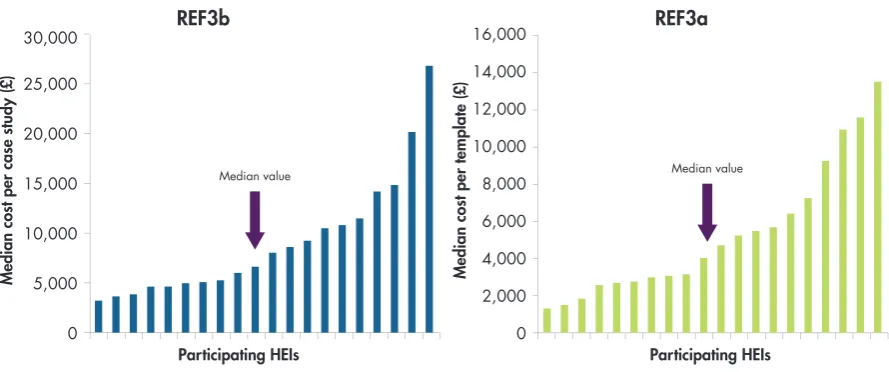
based on the number of submitted impact case studies and impact templates for all UK HEIs. As illustrated in Figure 2-1, the estimated costs of producing an impact case study are around £7,500 and those for an impact template £4,500. The median cost per impact case study was £7,360 (range: £3,216–26,890; interquartile range: £4,899–11,011) and the median cost per impact tem-plate was £4,368 (range: £1,318–13,523; interquartile per cent) felt this was a benefit of preparing the impact
template documents. Some individuals commented that the process enabled the value of their own work to be recognised by colleagues and more widely within the HEI, as well as by funders and those in society. Individuals said that ‘[it] made [me] feel good about my research [and gave me an] opportunity to demon-strate the value of [my] research to [my] institution’ and was ‘good for promotion prospects’. Others noted that the process had enabled their faculty or institu-tion to be more widely recognised, suggesting that it ‘enhance[d] the reputation of the School [and the] status [of] the university’.
A common benefit referenced in the impact case study survey (9 per cent of the ideas from 22 per cent of respondents) highlighted that the drafting process enabled HEIs to review and affirm relationships. With regards to research users, individuals noted that it ‘further developed [their] contact with those [they] impacted’ and that a ‘stronger relationship with users’ was built up. This was also a benefit identified by research users.14 Others survey respondents described
benefits to relationships with research collaborators and within the HEI.
Box 2-1: Salient benefits of preparing impact submissions identified in site visit interviews
The impact submission process:
• Alerted researchers to previously unknown impact arising from their research
• Provided insight into what colleagues do, which in future could lead to increased collaborations and
interdisciplinary research
• Helped to bring together areas of the support services and link academic and academic support departments to
work more closely, through the acceptance that research and impact are a continuum
• Placed impact on the HEIs’ agenda and informed strategy development
• Attached value to impact-related activities, which has benefitted applied subject areas as well as staff who were
already undertaking engagement activities
• Encouraged greater awareness of and engagement with research users, strengthened relationships and helped
HEIs to identify groups to work with
• Allowed researchers to articulate and evidence the value of research, which is important in forming
collaborations and justifying public sector funding
• Provided useful information for advocacy and marketing materials
14 Mentioned by five individuals and two organisations in our research user interviews.
15 The approach we used for estimating costs is detailed in Chapter 5 of the accompanying Approach and evidence report.
16 In the Approach and evidence report, we undertake one-way sensitivity analysis of key assumptions; this would suggest the most optimistic cost
estimate per impact case study is £7,000 and the most pessimistic £8,000.
10 Preparing impact submissions for REF 2014: Findings and observations
assessment. The transaction costs for the impact element – that is comparing the costs of impact submissions (£55m) with 20 per cent of QR funding determined by impact (£1.6bn) – were 3.4 per cent. By means of comparison, the proportion of the funds awarded by UK Research Councils to universities spent on administration costs was historically estimated to be around 10 per cent, but this figure may have declined in recent years (DTZ Consulting & Research 2006; Morgan Jones & Grant 2013).
The costs or effort of preparing impact case studies can be compared with the REF Impact Pilot Evaluation (Technopolis 2010) and the evaluation of the Excellence in Innovation Australia (EIA) trial (Morgan Jones et al. 2013). In both cases, the estimated costs/effort are lower than those we have estimated for REF 2014. For example, the REF Impact Pilot Evaluation esti-mated that it took 3.2 staff-days on average to prepare an impact case study and 2.1 ‘coordination days per output’. In our cost analysis it took a median of 30 days per impact case study, but that includes training and other activities that may not have been included in the REF pilot.20 In the EIA trial, the median length of time
taken to produce an impact case study was 3 days21 and
range: £2,745–6,631).18 There was evidence of
econ-omies of scale, with the median costs per impact case study being lower for larger submissions, as illustrated in Figure 2-2: the median cost per impact case study for HEIs producing 100 or more of them was £4,983, com-pared to £8,630 for those with less than 100. Although in cost breakdowns HEIs reported low levels of start-up cost at around 5 per cent, training accounted for about one-third of all labour costs and less training may be required for future iterations of the REF.
Combined with previous estimates of the costs of RAE 2008 (PA Consulting Group 2008), this would suggest overall REF 2014 costs to the sector (excluding the work of panels, which in 2008 was about 10 per cent of the total) of about £121m.19
[image:30.595.62.507.109.295.2]The ‘transaction costs’ – that is the cost of preparation versus the funding allocated from quality-related (QR) funding – were 1.5 per cent (i.e. £121m of £8.2bn, where the latter figure is conservatively estimated as six years of QR funding at 2013–14 levels for the UK). It is important to note that some other aspects of recurrent research funding are informed by the outcome of research
Figure 2-1: Estimated costs from 20 HEIs of producing impact case studies and impact templates
REF3b REF3a
Participating HEIs Participating HEIs
0 5,000 10,000 15,000 20,000 25,000 30,000
0 2,000 4,000 6,000 8,000 10,000 12,000 14,000 16,000
Median cost per case study (£) Median cost per template (£)
Median value Median value
18 There was substantial difference in the estimated time spent on preparing impact case studies by institutions from the cost analysis (30 days)
compared with survey estimates from impact case study authors (8 days). This may in part be because the case study authors did not account for other activities organised centrally. Either way, to err on the side of caution (i.e. a possible overestimate of burden), we used the higher institution estimates in our analysis.
19 The RAE 2008 Accountability Review estimated the total sector cost to HEIs in England to be approximately £47m. For comparative purposes we
removed costs associated with ‘RAE national panels and consultation’ and then applied a multiplication factor to arrive at a figure for all of the UK. This was increased by the rate of inflation, resulting in a comparable estimate of £66m. This is discussed in detail in Chapter 5 of the Approach and evidence report.
20 It is also worth noting that the survey of authors of case studies and impact templates estimated a median time spent of 8 days (interquartile range:
4–15 days) and 15 days (interquartile range: 9–29 days) respectively. However this is focused on one element of preparation and does not include, for example, central support and management.
21 It is important to note here that institutions that participated in the EIA trial noted lack of time as a challenge due to the limited timeframe
11
The benefit and burden of assessing research impact as part of REF 2014 11
who were at times very negative towards the process. Those responsible for developing impact case studies invested a lot of time and effort in both understand-ing the new requirements and then perfectunderstand-ing the final impact case study narrative. However, as around one impact case study was required for every 10 Full-Time Equivalents (FTEs) submitted to the REF, this meant that in effect one person (or team) was ‘carrying’ the workload of nine other people.
We also came across anecdotal evidence that the ‘rules’ on the number of impact case studies submitted also influenced the number of people submitted to REF 2014 by HEIs (see Figure 2-3), despite guidance from the HE funding bodies to promote fair and transpar-ent selection of staff for submission (REF, 2011c). As one interviewee noted: ‘We didn’t want to submit weak or ineligible [impact] case studies just to include more people’. Conversely, HEIs may have added extra staff so that additional impact case studies could be showcased. Figure 2-3 shows, across the whole HE sector, the number of UOAs that submitted a given number of staff and impact case studies. At the thresh-old for including a new impact case study there is a discontinuity, indicating that UOAs did not submit the estimated costs per impact case study were between
AU$5,000 and AU$10,000 (or £2,740 to £5,490 at current exchange rates).22 The difference between these
estimates may provide some upper bound indication of the costs associated with ‘gold plating’ of impact case studies, a cost driver identified in the Accountability Review of RAE 2008 and evident from our site visits. Gold plating is driven by the competitive dynamics of the REF process, resulting in repeated reviews and rewrites, often irrespective of the marginal associated benefits. For example, on our site visits we were told of many instances of impact case studies being rewrit-ten more than rewrit-ten times, and in one extreme example 30 times. Such gold plating would not necessarily have been seen to the same extent in the REF Impact Pilot Evaluation or the EIA trial, as monetary benefits were not associated with either.
[image:31.595.61.491.118.410.2]In addition to the monetised costs, and as discussed in more detail in Section 3.2, it was evident that there were a number of intangible burdens largely associ-ated with personnel issues. At our site visits it become evident that the workload in preparing impact case studies and impact templates was concentrated into a small proportion of people who felt overworked, and
Figure 2-2: The effect of submission size on the cost per impact case study
Number of case studies
Median cost per case study (£)
0 5,000
0 50 100 150 200 250 300
10,000 15,000 20,000 25,000 30,000
R2 = 0.2819
0 1,000
Fewer than 100 case studies More than 100 case studies
2,000 3,000 4,000 5,000 6,000 7,000 8,000 9,000 10,000
Median cost per case study (£)
12 Preparing impact submissions for REF 2014: Findings and observations
noting that the consequences of selecting staff for previous rounds of RAEs have consistently arisen in other evaluations and therefore this is not a new issue (Farrant at al. 2003; PA Consulting Group 2008). The novelty is the association of this behaviour with the impact element of the REF.
[image:32.595.75.522.110.299.2]numbers of staff around the boundaries. Although not a dominant issue, this was confirmed by some inter-viewees who acknowledged that the required number of impact case studies influenced the number of FTEs they submitted, and these individuals also acknowl-edged the sensitivities of such behaviours. It is worth
Figure 2-3: Effect of the number of impact case studies required on the number of FTEs
0 0 5 10 15 20 25 30 35 40 45 50
100 200 300 400 500 600 700 800 900 1000 1100 1200 1300 1400 1500 1600 1700 1800
Number of CA
T A FTEs
Cumulative number of UOAs submitted 2 case
13
Our interviewees raised a number of issues relating to the implementation of the guidance provided by HE funding councils and also raised queries around the process of producing documentation for the impact element of the REF 2014 submission. This chapter dis-cusses the following key findings:
• HEIs were able to identify and articulate their impact as part of REF 2014. However, views on guidance from the HE funding bodiesfor demonstrating research impact ranged widely, from full support to great concern.
• The biggest challenges (and burdens) in preparing impact case studies were the requirement to ‘evidence’ impact and develop an understanding of the concept of impact.
• HEIs perceived that the exercise had put an undue burden on research users, although this was not their experience.
• There was uncertainty about how panels will assess impact and this has led to unease in the sector.
3.1. HEIs were able to identify and
articulate their impact as part
of REF 2014. However, views on
guidance from the HE funding
bodies for demonstrating research
impact ranged widely, from full
support to great concern
We have been able to re-gather and show what has been done when you write it down on paper. The recording has been valuable to stimulate a positive feeling about research… its potential… and [in particular its] impact.
Across the sector, 6,975 impact case studies were sub-mitted for assessment as part of REF 2014. These were
evenly split across Panels A, B, and D, but with Panel C generating 20 per cent more case studies (Table 3-1).23
Within our sample of HEIs, 1,997 impact case studies were submitted. During discussions at the site visits, interviewees provided examples of the impact case studies that they had submitted. Through these dis-cussions, as well as through the surveys conducted, we established that HEIs believed that they were able to identify and articulate their research impact. The HEIs in our sample included submissions to all 36 UOAs, and interviewees at the site visits covered 35 out of the 36 UOAs (the exception was ‘Anthropology and Development Studies’). However, it is important to remember that ultimately the success with which HEIs identified and articulated their impact will be decided by the panels. Our evaluation of the EIA trial, which reviewed a sample of the case studies submitted, also found that researchers could identify, communicate and articulate impact through case studies (Morgan Jones et al. 2013).
Although they were able to articulate impact, interview-ees and survey respondents identified challenges relating to the application of the ‘rules’ within the guidance doc-uments. The ‘rules’ provided detail on eligibility crite-ria (for example, what could be counted as impact, the
Chapter 3
Implementing the assessment of research impact
[image:33.595.305.538.284.393.2]as part of REF 2014
Table 3-1: Number of impact case studies submitted per panel
Panel Number of impact case studies submitted
A 1,621
B 1,667
C 2,040
D 1,647
14 Preparing impact submissions for REF 2014: Findings and observations
[image:34.595.64.519.114.355.2]timeframes within which claims could be made and what level of evidence was required). In the survey, impact case study respondents identified some of the rules for prepar-ing impact case studies as more challengprepar-ing than others (Figure 3-1). In particular, the requirement to gather evi-dence to support claims of impact (discussed in further detail in Section 3.2), the definition and concept of reach and significance as the criteria for assessing impact (par-ticularly in Panels C and D), and the timeframe within which impact activity could be claimed (1 January 2008 to 31 July 2013) were thought to be somewhat or very challenging in the production of impact case study doc-uments. Notably, the criteria of reach and significance were also found to be problematic in the REF pilot (Technopolis 2010). This assessment of the main chal-lenges was also reflected in our site visits, where inter-viewees raised concerns about aspects of the guidance as well as timeframes and the implications for interdisci-plinary and multi-institutional research.
A number of the challenges identified focussed on the effect of the impact element of the REF on smaller or newer UOAs within institutions. The need for institutional own-ership of research, the requirement for 2* quality, and the relationship between the number of case studies and FTEs were all thought to be particularly challenging for smaller or new units to overcome, as a broader track record was required. For new UOAs, the issues were compounded by the fact that they did not have a 20-year history of under-pinning research to draw on.
Not everything was thought to be challenging, and some rules were thought to be relatively easy to opera-tionalise by most interviewees and survey respondents (e.g. the 2* threshold for the quality of underpinning research). From our interviews it is clear there was no single voice on any given rule, and there were as many different views within an institution as between them (see Section 5.2). Nevertheless, through the interviews we gained a more nuanced understanding of the chal-lenges associated with various elements of the guidance (Table 3-2). Further detail can be found in Chapter 2 of the Approach and evidence report. Where challenges were described, we also asked interviewees to suggest improvements and changes. These are discussed in more detail in Section 5.
3.2. The biggest challenges (and
burdens) in preparing impact case
studies (REF3b) were the requirement
to ‘evidence’ impact and the need
to develop an understanding of the
concept of impact
Evidence was the most difficult element of creating the [impact case study] document and as a result, you ended up thinking more about the evidence rather than the impact. The question was, can I evidence this?
[It] took 12–18 months to understand what impact was. [It was] not an easy process.
Figure 3-1: Challenges in operationalising the guidance identified by impact case study authors in the survey
Very challenging Somewhat challenging Neither helpful nor challenging Somewhat helpful Very helpful The requirement of gathering of evidence to support impact claims
The definition and concept of reach as a criterion
The definition and concept of significance as a criterion
5-year timeframe for claiming impact
The concept of institutional ownership of impact
Engaging with research users
The clarity of REF’s definition of impact
2* threshold for quality of research
20-year timeframe for underpinning research
-80 -60 -40 -20 0 20 40 60 80
15
Implementing the assessment of research impact as part of REF 2014 15
While many challenges and burdens emerged over the course of our evaluation (discussed in Section 3.1), two in particular came to the fore in our analysis: the requirement to ‘evidence’ impact case studies and the process of developing a shared understanding of the concept of impact across the HEI. Interestingly, these were also significant challenges identified in the REF pilot exercise (Technopolis 2010).
One of the key requirements of the guidance was to evidence the impact claims presented: ‘Each case study
[image:35.595.53.536.105.579.2]must include evidence appropriate to the type(s) of impact that supports the claims, including who or what has benefitted, been influenced or acted upon’ (REF, 2012). Although an assessment of impact requires evi-dence of impact to be presented, our evaluation found that evidencing impact was particularly challenging because some types of impact were difficult to measure and evidence, and the lack of records meant that evi-dence had to be reconstructed. In addition, there was a perception among HEIs that research users did not trust the confidentiality arrangements that had been put in
Table 3-2: Challenges associated with HE funding bodies’ rules identified at site visit interviews
Rule Challenges
Definition of impact
• Understanding what impact is
• Types of impact not covered by the definition
• Linear definition of impact
• Differences between the definition used by the REF and that used by
RCUK in ‘Pathways to Impact’
• Weighting of types of impact
Criteria of reach and significance • • Understanding what reach and significance areUnderstanding how the criteria will be assessed and weighted
• Evidencing the criteria
Linking the number of case studies to FTEs
• In large or small UOAs
• In newly established subject areas
• In departments with a high turnover
Institutional ownership of impact • • In new departments or those with a high turnover Getting input from academics who had left the HEI
Underpinning research quality
• Requirem