Use of collaborative platform to facilitate informal
design communication: a case study
Gulnaz AKSENOVA1, Souha TAHRANI1, Daniel FORGUES1 et Arto KIVINIEMI2
1
Ecole de Technologie Supérieure - Canada 2
The University of Liverpool - United Kingdom
Abstract. Construction projects are becoming increasingly complex and multidisciplinary; they involve a constant exchange and coordination of information between different specialists and stakeholders. There is a lack of tools to support the informal collaborative activity in situ and remotely [1]. This research aims to introduce a new remote synchronous e-platform to the architectural design team to bridge the gap of work between office and construction site. The paper presents two experimentations conducted in offices and on-site. Notwithstanding technical issues resulting from an unstable Internet connection during the experiments, results show the tool’s potential to improve communication between teams, especially for teams on construction sites. The implementation of the tool requires a clear work protocol and efforts to convince other stakeholders.
connexion Internet instable, l’outil offre le potentiel pour améliorer la communication entre les équipes, notamment celle au chantier. La mise en place de cet outil nécessite de développer un protocole de travail bien établi et de travailler à convaincre les autres parties prenantes d’utiliser cette plateforme.
1. Introduction
Design and construction activities require a constant exchange of information across boundaries, specialists and stakeholders. Work on-site is complex in terms of information requirements and exchange for the execution of work. The exchange of information between architects on-site and the design team at the office may require several roundtrips to fulfil this exchange of information. The information is often incomplete; it sometimes requires some corrective actions that can result in additional costs for trips and spent time. Using non-traditional medium for communication, developers of information technologies have expanded and transformed conventional space for teams' interaction. Novel Information and Communication Technologies (NICTs) targeting collaboration and integration, such as Building Information Modelling (BIM), allow project members to use data through one digital shared model [2]. However, these tools do not address the need for informal data exchange in situ and remote work, which are essential for the realisation of a project [1], and are considered as tools for problem finding and not problem-solving tasks. Work between local and remote teams of professionals is considered a challenge for a successful communication and collaboration.
Design and construction activities are strongly based on drawing and sketching culture. Particularly, architectural practice is socio-historically grounded in the fine arts heritage. Hand drawings and sketching are a medium for knowledge exchange and problem-solving activities. Therefore, there is a need for tools that can support informal and tacit information and knowledge exchange, in situ and remotely, to maintain competitive advantages in construction [1]. However, successful tacit knowledge exchanges do not merely rely on the introduction and adoption of ICTs, but also on social and organisational processes around technologies.
new remote synchronous e-platform 'SketSha' [4] to improve collaborative work between office and construction sites in an architectural firm. The objectives of this introduction are to increase productivity, reduce design cycles and roundtrips between construction site and office. The 'SketSha' platform is used to study architectural and engineering collaboration between offices in human-computer interaction field [5] as well as for design education, but it was never tested on-site to measure its ability to enhance spontaneous communications between the construction site and the office.
1.1. Collaborative platform: SketSha
BIM fosters formal and passive communication. However, there is a need for “messy talks” (tacit knowledge exchange) [1] to support collaborative problem-solving during design activities. There are a number of emerging platforms that may support messy talks and tacit communication. On construction sites, professionals tend to prefer simpler tools as their work involves complex coordinative activities. Therefore, tools that require less time for learning are at an advantage for a successful implementation. Professionals tend to forget tools' functions if the work with the tool is irregular, therefore tools used during complex and multitasking activities are suggested to have shortest possible learning curves.
The proposed platform, SketSha, is of interest for this research regarding its ability to combine a short learning curve with an environment similar to reality and the daily practice of architectural work. SketSha enables the sharing of annotations and graphic documents remotely and in real time. The notion of the platform is made of a digital surface on which users interact graphically with an electronic stylus. It also has additional monitor for visualising graphical documents. The conversations are facilitated via video, writing, drawing and any digital document. Separated participants may be connected via the Internet and work on the same documents in real time. The platform allows free-hand sketching and provides support for a more dynamic human interaction with least number of actions [5]. This platform is anticipated to boost the knowledge and information exchange at the distances.
1.2. Context of the architectural firm
and sustainable development departments, as they were considered to be the most integrated ones. The firm's team was aware of the difficulties of establishing an informal and spontaneous communication with employees and partners located outside of the office, as well as with its representatives on construction sites. Participants were architects and architectural technicians.
2. Methodology
In order to acquire a comprehensive impact of the improved communication between a construction site and an office with the use of the collaborative platform, a novel framework was proposed. The framework was based on the identification of past and present practices with the practitioners in order to build a vision for future practice [6] and effective integration of the collaborative platform. The research framework was organised in five stages:
1. Vision of the established practice. Analysis of the current practices by articulating trends in a past work practice. Observations, interviews and shadowing meetings were conducted to identify contradictions in the practice [7];
2. Passive exploration. Training session to introduce the platform to the participants;
3. Active exploration. Experimentations in offices and on-site in a situated practice;
4. Implementation. Modeling a shared vision of the technology adoption collaboratively with the practitioners. Re-evaluation of the emerging practice and implementation of the proposed strategy.
3. Two case studies: collaboration between site and office
As mentioned in the research framework, the first stage of this research was based on the analysis of the current practices of the firm in order to better understand the context and its needs. The outcomes of this stage showed contradictory challenges: the architect must produce quality work that meets the client’s needs, despite the constraints of the context in terms of contracts, budgets, project team, etc. [7].
The use of technology is considered as an important factor that challenges the practices of the firm to answer to contextual issues. The concern of the firm was on employment of technology as a production tool versus technology as creative tool. Physical proximity and work methods are seen as the main aspects to be addressed to ensure a collaborative and creative work: “…Physical proximity allows a permanent collaborative work ...”, "… Finding a good marriage between technology and conventional methods." (Stage 1- Quotes from interviews about current practices) [7]. Data analysis of the Experimentation is based on these two aspects in addition to the tools' appropriation analysis.
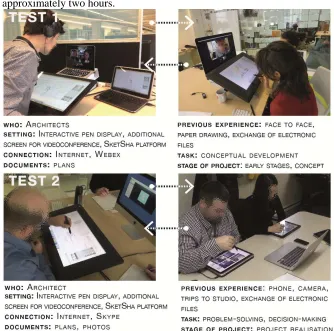
A training session took place in a meeting office of the architectural firm in order to introduce the platform to participants, and to get a first vision of the tool use. Then two Experiments have been conducted with the tool. Fig. 1 shows differences between Experiments in terms of tasks, settings, background of groups, and documents prepared.
3.1. Experiment 1. Conceptual design stage
The Experiment was conducted between teams situated in two adjacent offices. Three architects participated in this Experiment; they chose to work on a conceptual design at the early stages of the project. Two themes have been discussed during the meeting. Several documents were prepared for the meeting such as plans and sections. Prior to the Experiment this group used to work in small groups at physical proximity during the conceptual phases of the project. Paper was used between members of the team as a medium for discussion. Overall, the Experiment took approximately two hours.
3.2. Experiment 2. Project realization stage
Usually, the on-site architect detects problems, takes photos, comes back to the office and prepares documentation related to the problem, then sets a meeting with his colleagues to discuss the issues. Thus, time between problem detection and solving could take more than two days depending on team members' availability. Overall, the Experiment took approximately two hours.
Fig. 1 Settings of the Experiments 1 and 2
4. Discussion
4.1. Active exploration analysis
impact on the experimentations and generated feelings of frustration: the Internet connection was not stable and the network bandwidth was not large enough for the needs of the Experiments. Participants lost their connection several times and activities were sometimes not synchronous. Participants also felt isolated because of a frequent loss of sound. A robust connection seems an important component to ensure a better interaction between participants. Video conference was considered irrelevant for such activities, as participants mentioned sufficiency of voice exchange for an effective communication. The following sections will explain the analysis of Experiments.
4.2. Proximity
SketSha offers a single shared virtual workspace, where three types of interaction were observed: individual, coordination and collaboration. Individual interactions represented when the participants 'forget' about the co-presence of their colleagues and work individually or separately, each on their own space. Coordination interaction is a second level of interaction representing emergence of coordinative activities between participants. Collaboration represents the third and the higher degree of interaction where participants are aware of the co-presence of their colleagues and work in the same space.
The nature of the project and the discussed tasks influenced the emergence of these types of activities. In Experiment 1, these three types of interaction were observed and an evolution in the interactions was seen as each subject was discussed; in the beginning, the participants worked in separate workspaces, then an emerging joint work was observed at the end of the Experiment 1. In Experiment1, the cycle of making decisions on the project in its early stages of design was: ideas emerging individually, then coordinating ideas with colleagues, and validating ideas collectively. In Experiment 2, strong collaborative and coordinative activities were observed as well. Tasks for Experiment 2 appeared to have an impact on the collaborative activity as they required coordinative initiatives and collaborative decision-making at the project realization stage.
4.3 . Methods and rules of work
anything, I will explain by drawing”. On the other hand, despite the fact that they did not agree on the rules from the beginning, some rules started to emerge informally.
A comparison between Experiments 1 and 2 showed that participants in Experiment 2 had a clear strategy for the Experiment they participated in; they also were agile in creating and following rules to perform platform operation. Participants in Experiment 1 were less organized in terms of creation and following the rules. This fact could be explained by the nature of the tasks as well: Experiment 1 was a conceptual and creative design task, while Experiment 2 was a set of problem-solving tasks, where participants would annotate problem areas in the drawings.
4.4. Tool use and appropriation
The collaborative platform offers the capability of hand drawing by using a stylus on a virtual workspace. The tool is simple to use and has a short learning curve. However, time is essential for the appropriation of the tool in order to benefit from all its functions, and to establish a method of work. For both Experiments, an evolution of tool use has been observed; participants tried to improve their use of the tool during Experiments. Performance improvements were noticed at the end of the Experiments: participants were more confident and the number of interactions was increased as well.
Experiments 1-2 were the first attempts by participants to use the tool in a real situation; therefore, the basic functions were the one primarily used: drawing, moving around the workspace and zooming in an out. Unlimited virtual workspace was seen as an advantage comparing to traditional paper drawing. Combination of virtual and real environment was observed as well. For example, one participant pointed with his finger to the screen to indicate a specific element forgetting that his partner on the other side of the screen does not see his actions.
4.5. Feedback and tool limitation
exposed the tools' potential to coordinate tasks remotely; they saw advantages of the tool use for informal communication with external partners, such as the structural engineer or the contractor which can avoid having multiple files and to solve a problem immediately. For them, the use of SketSha could save time and costs, such as reduction of unnecessary trips and additional actions. It allows remote connection with a colleague to solve a problem or to make a decision at any time. The team from Experiment 1 suggested that the tool's potential lies in the formal meetings with the higher direction or with a client. Both teams agreed on the fact that SketSha offers real time collaboration, flexible location and work schedule, and tracking of a project evolution. 2) The opportunities of using the platform: all participants considered the tool as a medium to democratize conceptual work and to help people to listen to each other. Participants felt a need for an establishment of rules and protocols to be used. 3) Limitations: Beside connection problems, participants emphasized the need for additional features as found in a classical software design, such as undo, text messaging, measurements, etc. The type of the device and the scale of the screen had an influence on the work too. 4) Obstacles for the implementation: change resistance was observed amongst some people internally. Issues with interaction with external stakeholders were also considered a challenge or even a barrier for successful implementation of the tool.
5. Conclusion and future work
improves, SketSha could allow the firm to save time and resources on a global scale.
Future work will involve collaborative sessions with the firm by further analysis of present contradictions and tensions existing in the practice and by 'modeling' a collective vision for SketSha implementation in collaborative sessions. Moreover, the problems identified during the experiments such as absence of protocol or insufficient network connectivity will be solved and discussed during the sessions. More Experiments are anticipated to be conducted between offices and construction sites involving external stakeholders and decision-makers.
References
1. Dossick, C.S. & Neff, G. , (2011). Messy talk and clean technology: communication, problem-solving and collaboration using Building Information Modelling. Engineering Project Organization Journal. 1(2): 83-93. 2. Eastman, C., et al. (2011). BIM handbook: A guide to building information modeling for owners, managers, designers, engineers and contractors. Wiley. com.
3. Carlile, P. (2004). Transferring, Translating, and Transforming: An Integrative Framework for Managing Knowledge Across Boundaries. Organization Science. 15(5): p. 555-568.
4. Elsen, C. & Leclercq, P. (2008). “SketSha” - the Sketch Power to Support Collaborative Design. in Cooperative Design, Visualization, and Engineering. 5th International Conference, CDVE 2008. Calvià, Mallorca, Spain.
5. Rajeb, S.B. & Leclercq, P.(2013). Using Spatial Augmented Reality in Synchronous Collaborative Design Applications in architectural design training.
6. Engestrom, Y. & Sannino, A. (2011). Discursive manifestations of contradictions in organizational change efforts. A methodological framework. Journal of Organizational Change Management. 24(3): p. 368-387.
7. Aksenova, G., Tahrani, S. & Forgues, D. (2014). Cultural-Historical Activity theory for introducing transformations in architecture and construction. A case study, in 30th EGOS Colloquium. Rotterdam, Netherlands.
8. Engestrom, Y. (1987). Learning by expanding. An activity-theoretical approach to developmental research.