Dissertations
2008
A concept virtual harp with physical string
vibrations using augmented reality for therapy
Tanasha A. Taylor Iowa State University
Follow this and additional works at:https://lib.dr.iastate.edu/rtd
Part of theComputer Sciences Commons,Music Therapy Commons, and theRehabilitation and Therapy Commons
This Thesis is brought to you for free and open access by the Iowa State University Capstones, Theses and Dissertations at Iowa State University Digital Repository. It has been accepted for inclusion in Retrospective Theses and Dissertations by an authorized administrator of Iowa State University Digital Repository. For more information, please [email protected].
Recommended Citation
Taylor, Tanasha A., "A concept virtual harp with physical string vibrations using augmented reality for therapy" (2008).Retrospective Theses and Dissertations. 15480.
by
Tanasha A Taylor
A thesis submitted to the graduate faculty
in partial fulfillment of the requirements for the degree of
MASTER OF SCIENCE
Major: Human and Computer Interaction
Program of Study Committee: Shana Smith, Major Professor
Kris Bryden Robert McQueeney
Iowa State University
Ames, Iowa
2008
TABLE OF CONTENTS
ABSTRACT ... iii
CHAPTER 1. OVERVIEW ... 1
THERAPY ... 3
VIRTUAL AND AUGMENTED REALITY REHABILITATION ... 4
VIRTUAL HARP PROJECT ... 6
THESIS ORGANIZATION ... 8
CHAPTER 2. A VIRTUAL HARP WITH PHYSICAL STRING VIBRATIONS IN AN AUGMENTED REALITY ENVIRONMENT... 9
ABSTRACT... 9
INTRODUCTION ... 10
VIRTUAL HARP WITH HAPTIC INTERACTIONS ... 15
STRING VIBRATION MODEL... 19
AUGMENTED REALITY ... 26
CONCLUSION AND FUTURE WORK ... 28
NOMENCLATURE ... 29
ACKNOWLEGDEMENTS... 30
REFERENCES ... 30
CHAPTER 3. A VIRTUAL HARP FOR THERAPY IN AN AUGMENTED REALITY ENVIRONMENT ... 33
ABSTRACT... 33
INTRODUCTION ... 34
ARTOOLKIT INTEGRATION ... 38
HARP STRING NODE AND VIBRATION MODEL ... 41
REALISTIC HARP DESIGN AND SOUND ... 48
VIRTUAL THERAPIST ... 50
USER STUDY... 51
STUDY RESULTS... 54
CONCLUSION AND FUTURE WORK ... 57
NOMENCLATURE ... 58
ACKNOWLEGDEMENTS... 59
REFERENCES ... 59
CHAPTER 4. SUMMARY AND DISCUSSION... 61
FUTURE WORK... 62
APPENDIX A. EVALUATION INSTRUMENTS ... 63
APPENDIX B. STATISTICAL RESULTS ... 67
ACKNOWLEDGEMENTS ... 91
ABSTRACT
This thesis presents a multimodal three-dimensional harp for interactive musical
experiences for use in therapy for individuals with disabilities. A preliminary harp model in
OpenGL with user interaction being a mouse and keyboard tested on special education
children lead the Virtual Harp program on a new design approach to provide more interaction
and stimuli. This system provides individuals with three forms of feedback visual, audio, and
haptic during interaction using a Sensable Phantom Omni haptic device and immersion in a
portable augmented reality-based system using a video see-through head mounted display.
Modeled as a realistic harp, the virtual harp uses realistic harp string vibrations modeled from
Fourier analysis physics equations. The individuals play the virtual harp with the Phantom
Omni haptic device by plucking or strumming the strings of the harp. They have the freedom
to move the harp around the environment giving the feeling of playing a traditional musical
instrument. A virtual therapist feature was developed to allow a therapist without musical
knowledge to observe the individual during therapy exercises and allow the individual to
engage in a self-motivating therapy exercises outside the therapy room by following a simple
sequence of notes by following the color-coded strings. User testing was performed to
measure usability and therapeutic effectiveness: development of skills, improvement in range
of motion, and entertainment value. Results showed that there were no major usability issues
CHAPTER 1. OVERVIEW
The United State has between thirty-four and forty-three million people who have some
type of disability, with physical, sensory, mental, and self-care effects ranging from mild to
severe. Nearly 13.9 million people or thirty-five percent of persons over the age of sixty-five
have some level of disability [1]. According to the US Department of Commerce, a person
has a disability when that person has difficulty with any of the following [1, 2]:
1. Normal body functions, such as seeing, hearing, talking, or walking
2. Activities of daily living (ADLs), such as bathing or dressing
3. Instrumental activities of daily living (IADLs), such as shopping or doing laundry
4. Certain expected roles, such as doing housework, schoolwork, or working at a job
5. Performing usual activities, such as driving or taking a bus
In the United States, an estimated 9.2 million or four percent of the non-institutionalized
population at the age five and over need personal assistance with one or more activities.
There are over 5.8 million people that need assistance in instrumental activities of daily
living (IADL), which is independent living activities, while 3.4 million need assistance in
activities of daily living (ADL), which is personal functioning activities [2]. Several different
factors can contribute to getting some level of disability; to name a few factors, people can
have strokes, arthritis, injuries, or congenital disabilities like cerebral palsy. Stroke is a
leading cause of long-term, severe disability in Americans. Currently there are 5.5 million
United States adults living with the effects from a stroke [1]. When a blood clot blocks or
breaks an artery or a blood vessel in the brain it causes a decreased blood flow and lack of
blockage of a blood vessel supplying the brain and hemorrhagic which is bleeding into or
around the brain [3]. About eight out of ten strokes are ischemic strokes and are the most
common type of stroke in older adults, while the hemorrhagic strokes are less common but
more deadly than ischemic strokes [4]. A common disability that results from stroke is
complete paralysis on one side of the body, called hemiplegia. A related disability that is not
as debilitating as paralysis is one-sided weakness or hemiparesis [4]. Other conditions
experienced by a person who have had a stroke are depression, memory loss, communication
problems, difficulties in performing daily tasks, muscle tightness or spasticity, and pain [5].
Cerebral palsy could be caused by infections, birth injuries and poor oxygen supply to
the brain before, during, and immediately after birth. The United Cerebral Palsy Association
estimates that more than five hundred thousand Americans have cerebral palsy [6]. Common
conditions experienced by a person who has cerebral palsy are paralysis or weakness to
limbs, communication problems, seizures, muscle tightness or spasticity, and other
disabilities with hearing, vision or learning.
Musculoskeletal disorders, including carpal tunnel syndrome, are among the most
prevalent medical conditions in the U.S., affecting seven percent of the population
accounting for fourteen percent of physician visits and nineteen percent of hospital stays.
According to the National Institute for Occupational Safety and Health, sixty-two percent of
the persons with musculoskeletal disorders report some degree of limitation on activity,
compared with fourteen percent of the population at large [7]. Currently, carpal tunnel
syndrome affects over eight million Americans being reported as the number one medical
work-related musculoskeletal disorder known as repetitive motion or strain injuries is an injury to
the muscles, tendons and/or nerves of the upper body either caused or aggravated by work.
There are many different methods to reduce or correct any conditions from disabilities.
The first method involves taking medications; the most common conditions that use this
method are muscle tightness or spasticity, depression, memory loss, and pain. Another
method is having a surgical procedure to correct or reduce a disability condition such as
injuries, pain, muscle tightness or weakness, and seizures. The most common method is
having the individual registered in some type of therapy program such as physical,
occupational, recreational, musical and speech therapy.
THERAPY
Many traditional therapeutic interventions used in a rehabilitation program promote
functional recovery and have demonstrated that intensive massed and repeated practice may
be necessary to modify neural organization and effect recovery of functional motor skills [8].
When traditional therapy is provided, individuals are usually seen for half hour sessions once
or twice a day dropping to once or twice a week as outpatients. Access to therapy is
terminated once the individual reaches a predetermined level of function even if residual
deficits remain and while in sessions it has been reported that there are low interaction levels
between the patient and environment from common problems including boredom, fatigue,
lack of motivation and cooperation [9]. Music therapy goals and objectives are consistent
with the treatment goals of other therapeutic modalities including counseling [10]. It not only
helps to stimulate and motivate, but also provides opportunities to convey feelings without
to appreciate and respond in terms of pulse, rhythm, breathing and movement, and the whole
range of emotions to music, which can remain despite disability, illness, injury and does not
depend on music training [10, 11]. Music therapy is a means of opening new channels of
personal development and humanness, and opening paths for expression and learning for
persons who are limited in their ability to relate to themselves, others, and their environment
because of mental or physical disorders or limitations [10]. The Virtual Harp system is
coupled with music to increase the therapeutic goals from music therapy and to help
stimulate and motivate the use of therapy exercises.
VIRTUAL AND AUGMENTED REALITY REHABILITATION
Computer simulations have become more common over the last decade due to decreasing
equipment costs and increasing processor speed. This technology is currently being explored
for the potential benefit as a therapeutic intervention for retraining coordinated movement
patterns [8]. Virtual reality provides the capability to create an environment in where the
intensity of feedback and training can be systematically manipulated and enhanced in order
to create the most appropriate, individualized treatment needs and training protocols [8, 9,
12]. In addition VR-based rehabilitation systems can be made similar to computer games
providing a unique experience that is engaging, functional, and purposeful which is important
in terms of patient motivation. Additionally, having precise feedback in real time increases
the motivating effect for patients [12]. The sensor technology can also be used to fully
quantify any progress made by the patient, especially in terms of motor control improvement
[8]. Primarily most rehabilitation applications have used visual and auditory sensory input,
[9]. Haptics provide users with a sense of touch allowing the user to feel a variety of textures,
weights, and forces. There is increasing evidence that haptic information is an effective
addition towards the accomplishment of certain treatment objectives such as increasing joint
range of motion and force, which can be used as assistive technology tools [9, 12].
The following paragraphs explain rehabilitation applications that are currently being
developed and researched using this technology. To enhance spatial awareness and to
successfully teach children with cerebral palsy to operate motorized wheelchairs a virtual
reality training program using three virtual scenarios that progress in difficulty level and
complexity allowed the children to be motivated to learn and subsequently improved their
driving skills [8].
A PC based desktop Virtual Reality system was developed for rehabilitating hand
function in stroke patients [8]. The system uses two hand input devices, a CyberGlove and a
RMII force feedback glove where each exercise is designed to work on one specific
parameter of hand movement on range, speed, fractionation, or strength. Each exercise takes
the form of a simple interactive game to motivate the user to continue the exercise program
where the patient performs a number of trials to reach a particular goal using target-based
trials, and all the exercises are driven by the user’s own performance. The therapy program is
semi-automated and personalized to each user using performance-based target levels that are
adapted between sessions in order to induce the user to improve [8].
A haptic application used a virtual reality system to improve the training of blind and
visually impaired people in the use of the white cane. The system was designed as an
alternative method for training adding the value of studying various cases such as an outdoor
environment. The virtual cane with parameters of size, grasping forces, collision forces
adjusted so that it feels similar to a real cane was an extension of the user’s index finger with
force feedback applied to the user’s hand depending on the virtual object collision. A force is
applied to the thumb with collisions on its right side and to the middle ring and pinky fingers
simultaneously on its left side. The user wears the CyberGrasp and a waistcoat for carrying
the Force Control Unit (FCU) for the CyberGrasp have the type of forces applied to the users
being a constant continuous force that simulates the force provided by grasping a real cane, a
jolt effect force and buzzing [13].
VIRTUAL HARP PROJECT
In its initial implementation the Virtual Harp project was designed to be integrated into a
children’s musical therapy program led by special education teachers or therapists. This
project was an effort to make learning fun and motivational to help children become
independent in remembering name of colors, musical instruments, and using the computer
equipment along with developing physical, attentive, and listening skills. Through
collaboration with an elementary special education classroom, it was determined that the
most important aspect of our program was using both visual and audio sensory cues to keep
the children engaged. This directed the Virtual Harp program to a new design approach to
provide more interaction and stimuli. As new technologies and knowledge were implemented
into the Virtual Harp program, this led tothe implementation of the Virtual Harp system that
could be applied towards interactive musical experiences and development of skills during
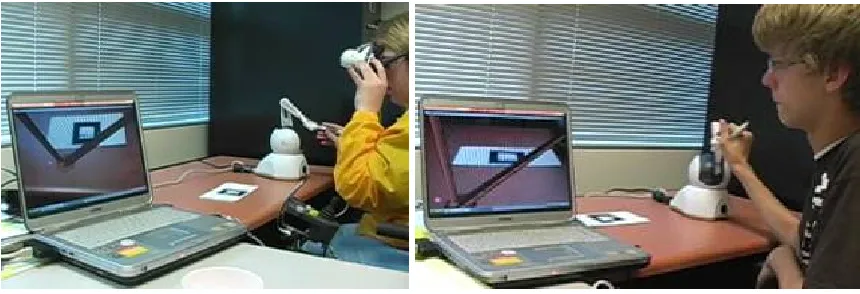
Figure 1. Users using the virtual harp system
This system uses a Sensable Phantom Omni haptic device and provides individuals with
three forms of visual, audio, and haptic feedback during interaction. The individuals are
immersed in an augmented reality environment using a video see-through head mounted
display to provide the unique capabilities of having a portable augmented reality-based
system. The virtual harp model was developed using a realistic harp guide, and it used
realistic harp string vibrations modeled from Fourier analysis physics equations as a
continuous system having multiple elements distributed continuously throughout the string.
The individuals play the virtual harp with the Phantom Omni haptic device by plucking or
strumming the strings of the harp. They have the freedom to move the harp around the
environment with a feeling of playing a traditional musical instrument. A virtual therapist
feature was developed to allow a therapist without musical knowledge to observe the
individual during therapy exercises and allow the individual to engage in a self-motivating
therapy exercises outside the therapy room. The virtual therapist feature allows individuals to
identify the notes. This thesis describes the development stages of the Virtual Harp system
and includes user testing to evaluate the effectiveness of the implementation.
THESIS ORGANIZATION
This thesis includes one paper written during the initial development and testing of
the virtual harp system. The first paper, published in the Proceedings of the ASME 2007
International Design Engineering Technical Conferences & Computers and Information in
Engineering Conference IDETC/CIE 2007, describes the initial system development and a
pilot study that was performed with disabled children. The second paper, submitted to
Proceedings of the ASME 2008 International Design Engineering Technical Conferences &
Computers and Information in Engineering Conference IDETC/CIE 2008, discusses the
newest version of the virtual harp system as a therapy application which includes the
CHAPTER 2. A VIRTUAL HARP WITH PHYSICAL STRING
VIBRATIONS IN AN AUGMENTED REALITY ENVIRONMENT
A paper published in the Proceedings of the ASME 2007 International Design Engineering
Technical Conferences & Computers and Information in Engineering Conference
IDETC/CIE 2007
Tanasha Taylor, Shana Smith, David Suh
Virtual Reality Applications Center
Human Computer Interaction Graduate Program
Iowa State University
ABSTRACT
This research provides a prototype of a computer-generated harp, using physical string
vibrations with haptic feedback in an augmented reality environment. The individuals,
immersed in an augmented reality environment using a head mounted display, play the
virtual harp with the Phantom Omni haptic device receiving realistic interactions from the
strings of the harp. Most previous musical instruments research only provides feedback in the
form of visual and audio cues, but not haptic cues. The proposed project is designed to
provide individuals with all three forms of cues for interacting with a computer-generated
harp. This computer-generated harp is modeled as a realistic harp and includes physics for
prototype will be applied towards interactive musical experiences and development of skills
during music therapy for individuals with disabilities.
KEYWORDS:VIRTUAL REALITY, HAPTICS, MUSICAL INSTRUMENT
INTRODUCTION
Computers are readily available to the public and have become a new way to produce
music. The computer is becoming its own musical instrument for use in music therapy,
virtual applications, education, and providing new ways to play traditional instruments.
Humans are inborn with the ability to appreciate and respond in terms of pulse, rhythm,
breathing and movement, and the whole range of emotions to music, which can remain
despite disability, illness, injury and does not depend on music training [1, 2]. Since humans
have this ability, music therapy can help individuals in a wide range of needs from causes
such as disabilities, stress, abuse, illnesses, and developmental needs by providing interactive
musical experiences [2]. Virtual reality can provide many different human senses to an
individual by providing a computer generated object that can be interacted with. Individuals
with special needs benefit from the use of virtual reality in cases such as training, education,
gaining experience in real world situations, and developing communication, motor control,
and cognitive skills [3, 4].
Mäki-Patola et al. [5] developed virtual reality interfaces for sound control using
interfaces presented that are “instrument-like”. They used a variety of input devices such as
data gloves, magnetic trackers, computer vision, and MIDI controllers with visual feedback
in the forms of a 270-degree virtual reality view and stereoscopic computer graphics. They
aimed at analyzing professional instruments based on efficiency and the learning curve. They
playing in the beginning, but it is not easy to play the instrument in new ways such as using
different input devices to interact with the instrument in a virtual environment. However,
their research did not incorporate the use of haptic devices and the instruments were not
modeled as a traditional instrument.
Gerard [6] designed a MIDI-based music player called Fakeplay to allow users with
minimal training on musical instruments to actively appreciate and learn about music. This
program allows users to express themselves through tempo and intensity of notes by tapping
note by note with the keyboard to play the music. The tapping provides partial haptic
feedback to the users in which they believe they are controlling the music. The visualizations
provided are floating virtual notes in a score-reading format. This program is limited to
following along the piece rhythmically and does not allow the user the ability to freely play
any music outside the selected piece.
These articles only discuss applications for computer-generated musical instruments that
provide a visual output on a computer monitor display or cave display. Their programs only
provide to the individual visual and audio feedback cues during interactions but not any
haptic feedback. Providing haptic feedback to users improves how they interact with the
musical instrument. This prototype of a computer-generated harp will provide individuals use
of a haptic device giving them all three forms of feedback during interaction.
A study conducted by O'Modhrain and Chafe [7] tests the hypothesis that adding haptic
feedback to computer based musical instrument would improve the playability of these kinds
of instruments using the musicians’ unconscious use of auditory and haptic cues. They made
a simple feedback controller to model the performer and instrument interaction. They use a
using the haptic display device called the Moose for six different force feedback conditions.
The study showed support for their hypothesis that adding haptic feedback improved the
players’ ability to control the instrument and that force conditions correlated with auditory
feedback resulted in a better performance.
Nichols [8] improved the violin MIDI musical controller for interactive computer music.
There were difficulties to get an accurate or expressive translation from performance gesture
to synthesized sound and latencies. He designed an expressive violin bow controller called
the vBow to improve the expressiveness and playability of the bowed-string physical model
by making an instrument with an array of sensors, which mapped physical bowing gestures
to parameters of the bowed-string physical model. The vBow instrument was testing the
expressiveness of the bowed-string physical model and the efficacy of adding haptic
feedback to a musical controller system. This instrument can be used for interactive computer
music performance as a versatile and expressive electronic musical instrument.
Wang et al. [9, 10] designed a real-time simulation of a thread for knot tying in use for
virtual reality training in laparoscopy. The simulation provides a thread that has dynamic
motion from physical equations and two haptic devices to manipulate the thread for knot
tying. The thread is modeled as a spline of linear springs with self-collision handling. It uses
second order dynamics with physically plausible stretch/compression, bending, twist,
friction, gravity and contact forces to simulate thread motion and self-collision running at
haptic speed. This thread model provides improved motion compared to the geometry model
and a more realistic visual display. Other forces and thread properties can be used with this
The authors also created a preliminary harp model in OpenGL where the user interaction
was with a mouse and keyboard. The sounds were produced using the software MIDIShare.
During playing, the harp string would produce a certain harp sound starting from middle C to
note B before the C an octave above. This harp model was placed into a virtual 3-D room
where the user had to view the computer monitor for interactions. This preliminary program
presented the users feedback in the form of audio cues and very little visual cues. These
visual feedback cues were in the form of viewing the harp model moving around in the room
and viewing the mouse cursor moving over the harp model strings. The preliminary program
was tested on students that have severe disabilities classified at level three who are visual and
active learners. Most of the students liked the program and could make the note sounds with
the mouse with having a little help. The students only interacted with the program for short
periods of time. The results influenced the study on a new design approach to provide more
interaction and stimuli with the virtual harp.
Although a virtual musical instrument has many advantages, most prior research only
renders the virtual instruments on a computer monitor. The virtual instruments are not
portable and, thus, are not realistic compared to the physical instruments in the way of
playing. The proposed study will use the unique capabilities of portable augmented
reality-based systems to meet the unique requirements of certain musical instruments. Augmented
reality technologies can mix or overlap computer generated 3D virtual objects with
real-world scenes, unlike virtual reality, which totally replaces the physical real-world with a virtual
world. Augmented reality technology simply attempts to enhance the existing physical world
by integrating virtual objects into the physical environment, so that the virtual objects
Most recent augmented reality applications use see-through head mounted displays
(HMDs) to deliver 3D images to the users’ eyes. There are two types of see-through HMDs:
video based and optical based. Since optical see-through HMDs are currently very expensive,
in the project, video see-through HMDs will be used for augmenting real environments to
create virtual musical instruments.
In order to provide users with force feedback while they are playing a virtual instrument,
a haptic device will be used. Most applications for haptic feedback have not been used in
conjunction with augmented reality environments. Brown and Vallino [11] have designed an
alternative method for integrating haptics with augmented reality. Users use their finger on
the Phantom to manipulate and feel the forces of the virtual object; their example was a
globe. In addition, users could use the virtual object to interact with the real part of the
display; their example was placing a virtual cube on top of the background wall.
This paper presents a prototype of a computer-generated harp, using the Sensable
Phantom Omni haptic device to provide force feedback in an augmented reality environment.
The harp model will use realistic harp string vibrations from physics equations after the
release of the initial string pluck. The harp string is modeled as a continuous system in one
dimension having multiple elements distributed continuously throughout the string. The
individuals play the virtual harp with the Phantom Omni haptic device receiving realistic
interactions from the strings of the harp immersed in an augmented reality environment using
a head mounted display. The augmented reality environment enhances the interaction with
the harp by providing freedom to move around with a feeling of playing a traditional musical
instrument. This prototype will be applied towards interactive musical experiences and
VIRTUAL HARP WITH HAPTIC INTERACTIONS
Most of the current research does not consider adding realistic interactive physical
motion to computer animated virtual instruments. Here, a physics-based harp model is
created to concurrently simulate the string vibrations of a harp while playing with force
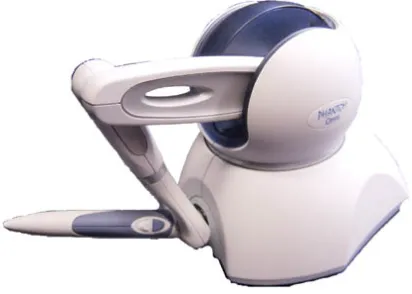
feedback. This program will allow users to play a virtual computer harp with the Sensable
[image:20.612.205.411.317.464.2]Phantom Omni haptic device as shown in Fig. 1.
Figure 1. Sensable Phantom Omni
A harp model using the open source program H3D was created. H3D uses Sensable’s
OpenHaptics program to run the Phantom Omni’s haptics toolkits and OpenGL to display the
graphics. The main H3D harp program is made using H3D’s nodes in a scene graph format.
Drawing the harp and providing haptic effects used different types of Shape Nodes such as
boxes, cylinders, and spheres. Figure 2. shows the individual shapes used for designing the
Figure 2. Expended Harp Model
This program created the haptic feeling of touching the harp frame and the strings. Since
the harp is in a 3D space, it is sometimes difficult to find the harp’s strings with the haptic
device endpoint. The haptic effect from the MagneticSurface Node, makes the strings as
magnetic lines, helps the user find the harp’s string by pulling the haptic device endpoint to
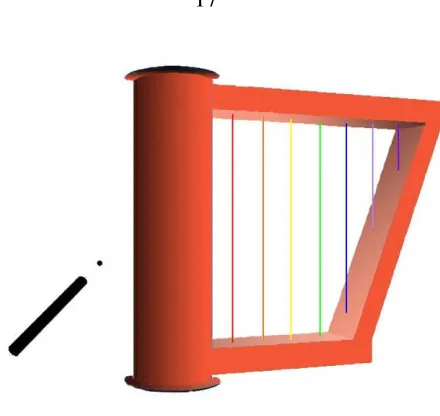
the string’s location. The completed simple model of a concert harp with haptic effects is
Figure 3. A Simple Harp Model
This model is able to produce harp sounds when the harp string is touched with the
Phantom haptic device. The sound output is programmed with Python to produce the MIDI
harp sound. Assigned to each harp string is a particular note in the Python code, which the
main program reads from the haptic touch to initiate the Python code. The users are able to
play the harp by touching individual strings or doing a strumming motion on the strings with
the haptic device. The force felt by the user from the haptic device are the small magnetic
pulling force toward the strings.
Preliminary testing was preformed where users tried to play the virtual harp with the
haptics device. The users were having problems locating the harp string in the 3-D space.
Most users were either too far into the screen of 3-D space (behind the string) or too far out
of the screen (above the string). The stylus was made with a sphere for the contact point and
a cylinder rod for pen orientation. The rod did not have any collision detection and confused
shape having collision detection for the whole shape and the ability to show the pen
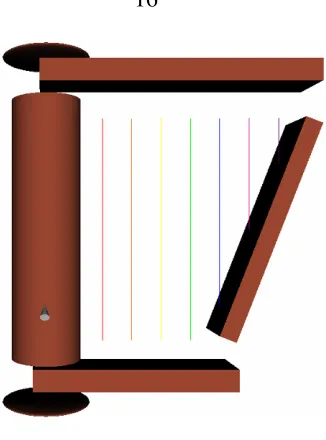
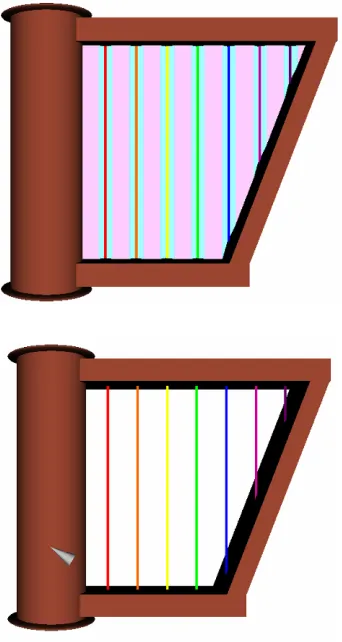
orientation. To help the users find the strings easier and faster, a hidden haptic plane was
added inline with the strings with ridges around the string to know when the stylus is near the
string. This plane was made using multiple box Shape Nodes in different positions and
rotations. Using the ToggleGroup Node, the graphics and haptics properties could be turned
on and off allowing the plane to be hidden with haptic feedback. In addition, the string’s line
width was increased to see the strings better. Figure 4. shows these additions made with the
[image:23.612.231.402.341.662.2]plane shown and hidden.
STRING VIBRATION MODEL
The model for adding realistic string vibrations needs to have the vibration movement
decease as the string length deceases. The model needs the harp strings to vibrate similar to
sinusoidal waves and triangular waves. The use of physics equations on string vibrations and
waves would be used to model the harp’s strings movements after the release of the initial
string pluck. Considered are mechanical vibrations for the vibrations in a harp string. Based
on Fletcher and Rossing [12] definition of mechanical vibrations, it needs two properties, “a
stiffness or spring like quality to provide a restoring force when displaced and inertia, which
causes the resulting motion to overshoot the equilibrium position.” This fits the string model
since the string has a stiffness or spring like quality.
Considering the harp’s vibrating body will follow Hooke’s law; the restoring force should
be proportional to the displacement from the equilibrium depending on the elasticity or
compressibility of the harp string material. To provide a more realistic vibration motion in the
harp string, a continuous system in one dimension is used. The harp string would have
multiple elements distributed continuously throughout the string creating a system of
composed discrete elements. The string can be modeled as a mass-spring system, as shown in
[image:24.612.185.441.626.678.2]Fig. 5.
Figure 6. Transverse oscillations of mass-spring system [12]
Figure 6. shows the transverse oscillations of three different mass-spring systems which
can be considered for the motion of the string’s length. This figure illustrates three of the
modes; since there are three masses there should only be three modes of transverse
oscillations, but if there are N number of masses there would be N number of modes of
transverse oscillations. The first mass-spring system follows the fundamental mode of
oscillation. This mode follows the transverse oscillation motion of a half a sinusoidal wave,
which occurs when the string is plucked from the center. The second mass-spring system
follows the second mode of oscillation. This mode follows the transverse oscillation motion
of a sinusoidal wave along the string’s length. The third mass-spring system follows the third
mode of oscillation. This mode follows the transverse oscillation motion of a sinusoidal wave
along the string’s length with a different period. The second and third modes of transverse
oscillation motions can occur when the string is plucked away from the center of the string.
In this prototype of a computer-generated harp the first six modes of oscillation are
Each mass-spring section will be considered as a mass point along the string and can only
move in one plane. This motion creates a transverse wave, and as the number of mass points
increases along the string, a wavelike appearance takes shape on the string as shown in Fig.
[image:26.612.193.440.216.364.2]7.
Figure 7. Transverse vibration for N masses of N modes [12]
For each individual mass-spring mass point, the equation of motion would need to be
found along the string. If the length of the string has N number of mass points along the
string, there will be N number of equations to use to model the motion of each mass point. So
instead of taking equations for each individual mass-spring mass points along the string the
equations used to model the mass point’s motion will take the string as a whole. On a concert
harp, the strings are fixed at both ends of the instrument and tension is applied to each string
with different material properties. The vibration motion of the string depends on the tension
applied, string properties like the linear density, the length of the string, and the end
conditions. String damping will occur from internal, air, and support damping [12]. Since the
harmonically with the same frequency [13]. The vibrations created are from standing waves.
The vibration motion will be analyzed using a Fourier analysis for each point along the line.
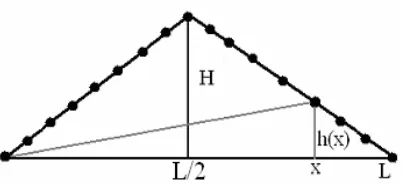
As shown in Fig. 8. to simulate the realistic pulling motion limit in the string Eq. (1) will
[image:27.612.215.417.226.318.2]provide the pulling limit along the string.
Figure 8. String pulling limit diagram
String pulling limit:
( )
(
)
(
)
< < − − < < = L x L L x L H L x x L H x h 2 , 2 2 0 , 2 )( (1)
Next the periodic function of the string needs to be defined based on the pluck location to
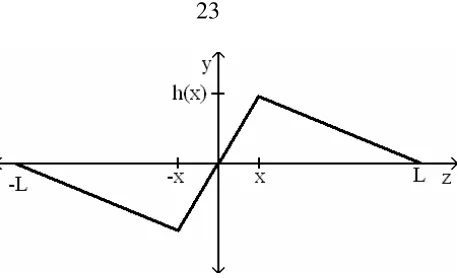
use in the Fourier analysis. The fundamental frequency has a wavelength of 2L giving the
Figure 9. Periodic motion diagram
This diagram leads to three sets of equations based on the pluck location in the periodic
function Eq. (2).
Periodic Function: ) ( ) ( : , ) ( ) ( , ) ( ) ( , ) ( ) ( x L L x h y Where x z L y z x L x h L z x y z x L x h x z x z x x h z y o o o − ∗ = − < < − − − − < < + − − < < − = (2)
The periodic function is then used to do the analysis of the Fourier coefficients in Eq. (3)
for the first six modes of oscillation considered for the string vibration animation interaction.
These Fourier coefficient values are then used in the Fourier analysis Eq. (4) to simulate the
vibration motion for each time frame for each node along the string.
∫
−= L
L n
n x L y z nk z dz
C ( )sin( )
2 1 )
( (3)
Fourier analysis: t n N n n
n k z v t e
C t
z
y −Γ
=
∗
=
∑
sin( )cos(2 )) , (
1
π (4)
Where the string properties, speed Eq. (5), wavelength Eq. (6), wavenumber Eq. (7), and
eigenfrequency Eq. (8) also known as harmonics would be defined in a table to use in the
Python code. Speed:
= Tµ
c (5)
Wavelength:
n
n πk
λ =2 (6)
Wavenumber:
L n
Eigenfrequency:
L nc vn
2
= (8)
Here, a string was modeled by a vertical line with three points equally space in the
direction of the y-axis. To manipulate the line’s points, a Python script was made to the
Python code. In the Python code, it would run all the string animation for making the string
vibrate and move during plucking. First, the haptic device knows if the IndexedLineSet was
touched from a route in the X3D code and this starts the animation. The haptic device’s
position is recorded to a variable, and this position point replaces the middle point in the line.
This allows the user to touch the line and view the motion of the line moving during the
touching in the x, y, and z directions with the haptic device as shown is Fig. 10. During the
plucking of the string, there would be a spring effect to give the users the feeling of string
tension that activates at the string position when the line is touched using the Phantom
Figure 10. Plucking Harp String
Once the user reaches the defined pulling limit, the string would snap back to its original
position removing the spring effect to a position away from the string and producing the
appropriate MIDI harp note sound.
AUGMENTED REALITY
The ARToolKit allows a developer to overlay virtual objects on the marker detected in a
real visual environment (http://www.hitl.washington.edu/artoolkit/download). Since the
original 3D harp model for haptic application was written in an X3D format, it needed to be
converted to VRML encoding .WRL file. One change was to put the rotation angle 90.0
degree toward x-axis 1.0, so that the harp body could be standing perpendicular to the floor,
as shown in Fig. 11. In order to locate the harp in the center of the marker, translation
Figure 11. Harp using Augmented Reality
The augmented harp is interfaced with the haptic feedback to provide users with the
feeling of forces while seeing the harp in a real scene. To enhance the interaction with the
harp and to provide the user freedom to move around with a feeling of having an immersive
environment, a head mounted display is used as shown in Figs. 12. and 13.
[image:32.612.224.405.494.610.2]Figure 13. User wearing Head Mounted Display
Using a head mounted display, the user will be able to play the harp similar to playing an
actual concert harp. The marker to display the augmented harp on will need to be placed so
that the maker will not be blocked from the camera. To work with this problem, the
augmented harp will be displayed a distance away from the marker to minimize the blockage
with the camera view.
CONCLUSION AND FUTURE WORK
The presented prototype of a computer-generated harp allows the individuals play the
harp with the Omni Phantom haptic device by touching individual strings or doing a
strumming motion on the strings. The virtual harp uses realistic harp string vibrations models
and has sound after playing the strings. This provides individuals with three forms of
feedback improving how they interact with the musical instrument by visually receiving
realistic vibrations from the strings of the harp, hearing the harp sound afterward, and feeling
harp by providing freedom to move around with a feeling of playing a traditional musical
instrument. There is still some future work to be done before the prototype of a
computer-generated harp will be ready for use in testing.
The graphical display of the computer-generated harp will be redesigned to resemble a
small sized concert harp. The harp would consist of thirty-six strings and the frame designed
slim and semi-transparent to allow the users easy viewing of the strings. The strings would
have the properties of the concert harp and be scaled down to a reasonable viewing and
playing size. The animation of the vibrations on the string will be implemented on all
thirty-six strings. The sound will still use MIDI as the output but the string properties will have
effects on how the sound will be heard to the users. The users will have control over the
loudness of the sound from the plucking of the string. The strings will have a limit for the
distance of stretching the string based on their properties. The distance the users’ stretches the
string will determine how loud the sound will be heard and the amount of time the sound will
last. Other features such as musical songs, colored strings for a specific note and other
needed features to help users play the harp will be implemented as users test playing the
harp.
NOMENCLATURE
H Defined pulling limit value (m)
L Length of string (m)
N Number of mass points on string
T Tension of string (N)
h(x) Pulling limit based from position (m)
n Number of mode
t Time (s)
x Position (m)
y(z) Node position along y and z-axis (m)
z Node position along z-axis (m)
Γ Damping term
µ Linear Density (kg/m)
ACKNOWLEGDEMENTS
I would like to thank Robert McQueeney for his kind contributions with the physics
equations and the string vibration model section.
REFERENCES
[1] Hill, S. A., 1997. “The relevance and value of music therapy for children with Rett
Syndrome,” British Journal of Special Education, 24(3), pp.124-128.
[2] Hadley, R. T., Hadley, W. H., Dickens, V. and Jordon, E. G., 2001, “Music therapy: A
treatment modality for special-needs populations,” International Journal for the
Advancement of Counseling, 23(3), pp.215-221.
[3] Brown, D. J., Kerr, S., Wilson, J. R., 1997, “Virtual Environments in Special-Needs
Education,” Communications of the ACM, 40(8), pp.72-75.
[4] Kuhlen, T. and Dohle, C., 1995, “Virtual Reality For Physically Disabled People,”
Computers in Biology and Medicine, 25(2), pp.205-211.
[5] Mäki-Patola, T., Laitinen, J., Kanerva, A., and Takala, T., 2004, “Experiments with
Virtual Reality Instruments,” Proceedings of the 2005 Conference on New interfaces For
Musical Expression, New Interfaces For Musical Expression, National University of
Singapore, Singapore, pp. 11-16.
[6] Gerard, K. J., 2002, “Active Music Appreciation with Fakeplay,” Virtual System and
Multimedia, Kyongju, Korea.
[7] O'Modhrain, S. and Chafe, C., 2000, “Incorporating Haptic Feedback into Interfaces for
Music Applications,” Proceedings of the International Symposium on Robotics with
Applications, World Automation Conference, Maui.
[8] Nichols, C., 2002, “The vBow: Development of a Virtual Violin Bow Haptic
Human-Computer Interface,” Proceedings of the 2002 Conference on New interfaces For
Musical Expression, National University of Singapore, Singapore, pp. 1-4.
[9] Wang, F., Burdet, E., Dhanik, A., Poston, T., and Teo, C.L., 2005, “Dynamic thread for
real-time knot-tying,” First Joint Eurohaptics Conference and Symposium on Haptic
Interfaces for Virtual Environment and Teleoperator Systems, IEEE Computer Society,
Los Alamitos, CA, pp.507-508.
http://ieeexplore.ieee.org/iel5/9655/30512/01406986.pdf?isnumber=30512&prod=STD&
arnumber=1406986&arnumber=1406986&arSt=+507&ared=+508&arAuthor=Wang%2
C+F.%3B+Burdet%2C+E.%3B+Dhanik%2C+A.%3B+Poston%2C+T.%3B+Teo%2C+C
.L
[10]Wang, F., Burdet, E., Vuillemin, R., and Bleuler, H., 2005, “Knot-tying with Visual and
Force Feedback for VR Laparoscopic Training,” 27th Annual International Conference
Alamitos, CA, pp. 5778-5781.
http://ieeexplore.ieee.org/iel5/10755/33900/01615801.pdf?isnumber=33900&prod=STD
&arnumber=1615801&arnumber=1615801&arSt=+5778&ared=+5781&arAuthor=+Wa
ng%2C+F.%3B++Burdet%2C+E.%3B++Vuillemin%2C+R.%3B++Bleuler%2C+H
[11]Brown, C. and Vallino, J., 1999, “Haptics in augmented reality,” International
Conference on Multimedia Computing and Systems, IEEE Computer Society, Los
Alamitos, CA,pp.91-95.
[12]Fletcher, N. H. and Rossing, T. D., 1991, The physics of musical instruments,
Springer-Verlag, New York, pp.1,25,34, Chap. 1,2,11.
[13]Main, I. G., 1993, Vibrations and Waves in Physics, Cambridge University Press, New
York, Ed. 3, pp. 143, Chap. 1-4,9,11,12
[14]Freedman and Young, 2000, Sears and Zemansky’s University Physics, Addison-Wesley,
Vol. 1, Ed. 10, pp.593-665, Chap. 19-20.
[15]Takkar, U., 1990, “Ethics in the Design of Human Computer Interfaces for the
Disabled,” SIGCAPH Computers and the Physically Handicapped, (42), pp.1-7.
CHAPTER 3. A VIRTUAL HARP FOR THERAPY IN AN
AUGMENTED REALITY ENVIRONMENT
A paper submitted to the Proceedings of the ASME 2008 International Design Engineering
Technical Conferences & Computers and Information in Engineering Conference
IDETC/CIE 2008
Tanasha Taylor
Virtual Reality Applications Center
Human Computer Interaction Graduate Program
Iowa State University
Shana Smith
Department of Mechanical Engineering
National Taiwan University
Taipei, Taiwan
Karljohan L. Palmerius
Norrköping Visualization and Interaction Studio
Linköping University, Sweden
ABSTRACT
The goal of this research study was to develop a music therapy tool using a
computer-generated harp, which could provide users with visual, audio, and haptic feedback during
interaction with the virtual instrument. Realistic 3D visual and haptic feedback was provided
through immersion in a portable augmented reality-based system composed of a video
see-through head mounted display (HMD) and a Sensable Phantom Omni haptic device. Users
of the harp. Users can also freely move the harp in the augmented reality environment to
provide a more realistic experience, similar to that of playing a traditional musical
instrument. The system will be used to provide interactive musical experiences and to
develop motor skills among individuals with disabilities through music therapy. A virtual
therapist feature was developed which can be used by a therapist without musical knowledge
to observe a user during therapy exercises or by a user to engage in self-motivated therapy
exercises outside the therapy room. With the virtual therapy feature, users can follow a
simple pre-determined sequence of notes using color-coded strings. User testing was
completed to measure usability and therapeutic effectiveness: development of skills,
improvement in range of motion, and entertainment value.
KEYWORDS:VIRTUAL REALITY, HAPTICS, MUSICAL INSTRUMENT, THEARPY
INTRODUCTION
In the United States, between thirty-four and forty-three million people have some type of
disability, with physical, sensory, mental, and self-care effects ranging from mild to severe.
For people over age sixty-five, nearly 13.9 million people, or thirty-five percent, have some
level of disability [1]. According to the U.S. Department of Commerce, a person is
considered to have a disability when that person has difficulty with any of the following tasks
[1, 2]:
1. Normal body functions, such as seeing, hearing, talking, or walking
2. Activities of daily living (ADLs), such as bathing or dressing
3. Instrumental activities of daily living (IADLs), such as shopping or doing laundry
4. Certain expected roles, such as doing housework, school work, or working at a job
In the U.S., an estimated four percent of the non-institutionalized population age five and
over, that is 9.2 million individuals, need personal assistance with one or more activities.
People who need assistance with instrumental activities of daily living, also considered
independent living activities, number over 5.8 million, while 3.4 million people need
assistance in activities of daily living, which are personal functioning activities [2]. Several
different factors can contribute to developing some level of disability, for example, strokes,
arthritis, or injuries, or individuals may be born with disabilities such as cerebral palsy.
There are many different treatment methods to reduce or correct disabilities. The most
common treatment method is to enrolling the disabled individual in some type of therapy
program, such as physical, occupational, recreational, musical, or speech therapy.
Many traditional therapeutic interventions used in rehabilitation programs have
demonstrated that intensive and repeated practice may be necessary to modify neural
organization, effect recovery of functional motor skills, and promote functional recovery [3].
With traditional therapy, patients usually visit a therapist once or twice a day for half hour
sessions. Their visit frequency drops to once or twice a week when they become outpatients.
Finally, when they reach a predetermined level of function, their access to therapy is
terminated even if residual deficits remain. It has been reported that while in sessions,
common problems during therapy, such as boredom, fatigue, lack of motivation, or
cooperation, result in low interaction function between the patient and the environment [4].
Due to decreasing equipment costs and increasing processor speed, computer simulations
have become more common over the last decade. Such technology is currently being
explored for potential benefits in therapeutic intervention for retraining coordinated
treatment needs and training protocols by providing an environment in which the intensity of
feedback and training can be systematically manipulated and enhanced [3-5]. In addition,
VR-based rehabilitation systems can provide a unique experience that is engaging,
functional, and purposeful, in a manner similar to computer games, which is important for
stimulating patient motivation. Additionally, VR systems can provide precise real-time
feedback, which further increases the motivating effect for patients [5].
As an example, Todorov et al. used a VR system to create a computer animation of a
table tennis task for training a difficult multi-joint movement [6]. The system had a virtual
ball and virtual paddles which provided the teacher and the trainee the movement variables
most relevant for successful performance of the task by the trainee. The system also used
augmented feedback. Their results showed that virtual environment training provided better
training for the task compared to a comparable amount of training in a real environment.
In a different virtual environment training study, two patients with hemiplegia were
trained on an upper-extremity reaching task [7]. The two patients were evaluated pre- and
post-VR training using motor recovery and functional ability tests and a real-world test.
During the training, subjects practiced a virtual task similar to the real task, trying to imitate a
virtual teacher's performance. Post-training, reaching errors during real-world performance
were reduced by 50%. Both subjects improved in the trained task, indicating transfer of skills
from the virtual environment to real world performance. On the other hand, motor recovery
and functional scores showed little to no change. However, one subject acquired the ability to
perform several functional tasks. The results suggest that virtual environment training has a
Reiss and Weghorst used augmented reality to help patients with akinesia Parkinson's
disease overcome difficulties stepping over objects in their paths when initiating and
sustaining walking. They found that a stable cue appearing about six inches in front of the
toes was required to initiate the first step, while cues scrolling toward the feet were needed to
sustain walking. In addition, the effectiveness of the visual cue was dependent on the degree
and type of akinesia, showing that more realistic cues are needed as the severity of akinesia
increases [8].
For individuals with spinal cord injuries, A VR-enhanced orthopedic appliance was
developed linking a gait-inducing exoskeleton to a HUD. The exoskeleton used a semi-rigid
sling to support the bust and lower limbs of the user and move the lower extremities to
support and induce human gait. In preliminary study results, a 26-year old with complete
paraplegia showed improvements in self confidence, increased relaxation, and activity
scores, and higher levels of optimism and motivation [9].
VR assessment and intervention tools have also been developed. A hand system with
force feedback was developed in a virtual environment to complete various tasks such as a
virtual PegBoard and reach-to-grasp exercises. The system was useful for augmenting
rehabilitation chronic-phase patients following strokes. Skills also transferred to a functional
clinical outcome measure as well as improvement on a variety of movement parameters [10].
In our study, we created a prototype computer-generated harp to be used for interactive
musical experiences and development of skills during music therapy for individuals with
disabilities. A colored 36-stringed harp was designed and force feedback was provided using
haptic device and thereby experienced feeling string tension when pulling strings and heard
appropriate harp note sounds afterward.
The virtual harp was modeled as a realistic harp using realistic harp string vibrations
modeled from Fourier analysis physics equations. Users were provided the freedom to move
the harp around the environment to simulate the feeling of playing a traditional musical
instrument. A virtual therapist feature was developed to allow users to engage in
self-motivated therapy exercises, and user testing was conducted to examine the effectiveness of
the virtual harp, skills development, improvements in range of motion, and entertainment
value.
ARTOOLKIT INTEGRATION
One challenge in the study was integrating ARToolkit features with an H3D program to
provide users with the ability to position the harp freely for best use. A default viewpoint
position and orientation was established so that the user was on the positive Z-axis looking in
Figure 1. Viewpoint
Users of the prototype system wear a video-see-through type HMD, which produces the
same image as a computer monitor image produced by a camera mounted on the HMD.
When users interact with a marker, which represents the virtual harp, without head
movement, the camera remains stationary, and movement between the marker object and
camera creates the following virtual harp movements:
1. As the marker is moved away or towards the camera, the virtual harp deceases or
increases in size, respectively, giving the user a zooming effect along the Z-axis.
2. As the marker is moved left, right, up, and down, the virtual harp moves left, right,
up, and down, respectively, the virtual harp pans along the X and Y-axes.
3. As the marker rotates, the virtual harp rotates about its axis giving the user a method
for exploring or examining the harp from different angles; for example, when the
marker lies flat on the table and spins, the virtual harp rotates about the Y-axis.
When users move their heads and the marker remains stationary, head movements cause
1. When the camera moves away from or toward the marker, the virtual harp deceases or
increases in size, respectively. As a result, users experience a zooming effect along
the Z-axis.
2. When the camera moves left or right, the virtual harp moves right and left,
respectively. When the camera moves up and down, the virtual harp moves down and
up, respectively. The movement provides users with a navigation mode for viewing
different parts of the harp.
3. Rotating the camera about the marker’s axes provides a rotation mode for viewing the
virtual harp from different directions.
The interactions were taken into consideration when creating ARToolKit nodes in C++
for H3D. The design provides a bridge between the H3D API and ARToolKit, so that
augmented reality applications can be easily built which take advantage of all the power
provided by the H3D API. The ARToolKit portion of the program was developed as an
independent library add-on for H3D that contains only a few nodes, which integrates the
basic marker handling capability of ARToolKit.
ARToolKit has four stages that run in a loop. A node named ARToolkit was created as the
main node which runs all of the ARToolKit’s functions in the H3D API. The ARToolkit node
was designed as a bindable node. One instance is created at application initialization as a
singleton which provides all communication with the ARToolKit.
ARToolKit uses computer vision algorithms to track the users’ viewpoint, using video
tracking libraries to calculate, in real time, the real camera position and orientation relative to
physical markers [11]. ARToolKit tracking works by capturing camera video of the real
it calculates the position of the camera relative to a black square, which draws a computer
graphics model from that position to render graphics overlaid on the real world.
The SeeThroughViewpoint node is a Viewpoint node that uses the marker to determine
the position and orientation of the view. The users are able to interact with the virtual scene
since they can translate and rotate the virtual harp based on marker movements. The
SeeThroughBackground node is a background node that renders the ARToolKit camera
image to the background to provide a see-through Augmented Reality environment. Using
the SeeThroughViewpoint node together with the SeeThroughBackground node produces an
[image:46.612.203.445.364.544.2]augmented reality environment, as shown in Fig. 2.
Figure 2.Playing harp in augmented environment
HARP STRING NODE AND VIBRATION MODEL
A spring effect was activated at the string position when the line is touched using the
Phantom Omni’s haptic device and deactivated when reaching the defined pulling limit,
MIDI harp note sound. This allows the user to touch the line and view the motion of the line
during the touching in the x, y, and z directions with the haptic device, providing the users
the feeling of string tension during pulling the line with the Phantom Omni’s haptic device.
Originally a Python code was used to produce the string vibration animations. However,
the first limitation was the code needed to have each string coded with all the necessary
properties to do the animations and routed to the X3D file. The next limitation was caused by
the fact that each string and their properties had to be written in the Python code; any change
to the strings properties in the X3D file or movement to the harp’s placement on the screen
would cause the haptic device to be unable to pluck the harp strings. This code did not have
any of the vibration model equations implemented, and the code was limited in which
mathematical functions it had to use. The final harp design required the use of thirty-six
strings and realistic real-time vibrations. These limitations in Python would have made the
code very long and confusing for using thirty-six strings, resulting in the loss of the ability to
allow the users to move the harp in any position without providing the real-time vibrations.
Therefore, a H3D node for the string animation was written in C++ to eliminate the
limitations found in using the Python code.
The string is modeled as a mass-spring system where having N number of masses would
produce N number of modes of transverse oscillations. For this computer-generated harp, the
first six modes of oscillation are considered for the string vibration animation interaction to
minimize the computation time. Each mass-spring section will be considered as a mass point
along the string and can only move in one plane. On a harp, the strings are fixed at both ends
of the instrument and since the string is modeled with many mass points along the line, the
Since the strings on a realistic harp are not positioned on a starting base location, it was
needed to take into account a starting position and an ending position in order to draw the
strings in the proper location as a realistic harp. Using the y-axis starting point position (P2)
and the y-axis ending point position (P1) the string length L will be P1-P2. As shown in Fig.
3, this simulates the realistic pulling motion limit variables in the string to provide the
[image:48.612.267.365.282.517.2]calculation of the pulling limit along the string.
Figure 3. String pulling limit diagram
The string pulling limit now needs to take into account the y-axis starting point position
and the y-axis ending point position in order to use this equation for any string in any
position on the harp model. The maximum pulling limit (H) is an arbitrary number based on
half the distance between two strings along the x-axis, and the string pulling limit equation
String pulling limit:
( )
(
)
(
)
(
)
≤ ≤ − − ≤ ≤ − = 1 2 , 1 2 2 2 , 2 2 ) ( P y L P y L H L y P P y L H yh (1)
The periodic function of the string was defined based on the pluck location with the
fundamental frequency having a wavelength of 2L giving the limit on the y-axis of –L and L
as shown in Fig. 4. This diagram leads to three sets of equations based on the pluck location
in the periodic function used to do the analysis of the Fourier coefficient for the first six
To simulate the vibration motion for each time frame for each node along the string, the
Fourier coefficient values are calculated in the Fourier analysis Eq. (3). The string properties,
wavenumber Eq. (4), and eigenfrequency Eq. (5), also known as harmonics would be defined
as function calls to be used during the Fourier analysis calculation. The damping term (Γ)
value was defined on a trial and error basis by matching the vibration decay to the sound
decay, and the frequency (f) value in the eigenfrequency equation was defined using the midi
note frequency definition for each string. The string’s note frequency is placed in a list and
selected based on the user’s string number input.
Fourier analysis:
t n N
n
n
n y k z v t e
C t
y
x −Γ
=
∗
=
∑
( )sin( )cos(2 )) , (
1
π (3)
Wavenumber:
L n
kn = π (4)
Eigenfrequency:
f n
![Figure 5. Mass-spring system for continuous system [12]](https://thumb-us.123doks.com/thumbv2/123dok_us/8119462.239014/24.612.185.441.626.678/figure-mass-spring-system-for-continuous-system.webp)
![Figure 6. Transverse oscillations of mass-spring system [12]](https://thumb-us.123doks.com/thumbv2/123dok_us/8119462.239014/25.612.201.461.123.256/figure-transverse-oscillations-of-mass-spring-system.webp)
![Figure 7. Transverse vibration for N masses of N modes [12]](https://thumb-us.123doks.com/thumbv2/123dok_us/8119462.239014/26.612.193.440.216.364/figure-transverse-vibration-n-masses-of-n-modes.webp)