Int. J. Electrochem. Sci., 8 (2013) 5621 - 5634
International Journal of
ELECTROCHEMICAL
SCIENCE
www.electrochemsci.org
Current Density Maximization in Palladium-Based Gas
Diffusion Electrode in Proton Exchange Membrane Fuel Cell
Rafael Nogueira Bonifácio*
, Almir Oliveira Neto and Marcelo Linardi.
Hydrogen and Fuel Cell Center, Nuclear and Energy Research Institute - IPEN/CNEN - SP. Av. Prof. Lineu Prestes, 2242, Cidade Universitária, 05508-000 São Paulo - SP, Brazil.
*
E-mail: [email protected]
Received: 19 February 2013 / Accepted: 17 March 2013 / Published: 1 April 2013
In this study the influence of polymeric ionomer concentration on the performance of gas diffusion electrode containing Pd/C as a substitute for usual Pt/C electrodes in PEMFC was verified. Values between 56 and 59 % of ionomer related to the mass of the catalyst layer resulted in the highest current densities. It was found that the optimum value was strongly dependent on the work potential and temperature. Current density values of 214 mA.cm-2 were obtained at 500 mV, 85 °C and 1 atm for MEAs with Pd/C on both electrodes of PEMFC. With commercial Pt/C only on the cathode side, a value of 745 mA.cm-2 was reached. For comparison, platinum anodes running under the same conditions showed only 13.9 % higher performance than palladium, indicating that improvements in the synthesis method can enhance the performance for palladium getting to be similar to platinum on the hydrogen oxidation reaction. Indeed, these results proved that, from an economic point of view, it is feasible to apply palladium on anodes to replace platinum, although an adequate assessment of durability is still to be investigated.
Keywords: Nafion, Polymeric ionomer concentration, Membrane Electrode Assembly (MEA), Catalytic Layer, Palladium catalyst, Cost reduction, Proton Exchange Membrane Fuel Cell (PEMFC).
1. INTRODUCTION
has aroused interest in alternative catalysts [5]. As alternative, palladium and its alloys have been widely studied [6-14], being favorable in terms of cost and nature reserves when compared to platinum [6-7,11,14-15]. However, palladium gas diffusion electrodes (Pd-GDE) have shown performances between only 12 and 32 % of those compared to platinum in most publications [6-7,12,14-16]. This fact makes their use unattractive, despite the relative lower cost, and their implementation unfeasible until now.
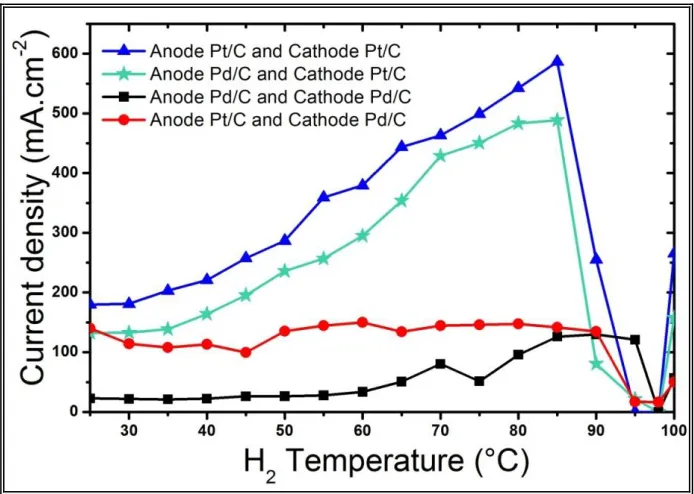
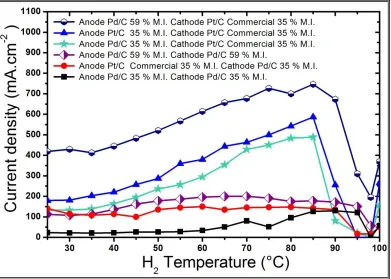
Bonifacio et al. [17] have shown that palladium carbon supported catalyst (Pd/C) can reach performances around 83 % compared to those using platinum for the hydrogen oxidation reaction (HOR), under the same operating conditions. This performance level exceeds all studies verified in the literature [6-7,10,12,14-16]. Figure 1 shows these previous results in a diagram of current densities at 500 mV versus temperature for MEAs, with anodes and cathodes prepared with combinations of platinum and palladium electrodes.
Figure 1. Diagram of current density versus temperatures at 500 mV of MEAs prepared with Pt/Pt, Pd/Pt, Pd/Pt and Pd/Pd (anode/cathode) electrodes, with 35 % of mass ionomer related to catalyst layer. Active-areas of 5 cm², anode 0.4 mg metal per cm², supplied with 160 mL.min-1 H2 at 1 atm, cathodes 0.4 mg metal per cm ², supplied with 80 mL.min-1 at 1 atm. Both reactive gases saturated with high pure water [17].
[image:2.596.125.472.290.537.2]
It is well known [2,19] that the operation of the MEA occurs efficiently through the maximization of a triple phase reaction on the interfaces among electrode material, reactants and the polymeric electrolyte. The polymeric ionomer on the C.L. therein has the function of connecting the metal sites of catalysts to the membrane, and it also has the function of retaining moisture by keeping the membrane and the C.L evenly moistened, favoring the MEA performance [2,19]. If the percentage of mass ionomer (% M.I.) in the C.L. is below an optimum value, the performance will decrease, due to failures in proton conductivity in the bulk of the electrode. In addition, if % M.I. in the C.L. is above the optimum value, a performance decrease will occur, due to limitations imposed in the mass transport of fuel cell reactants and products. Therefore, it is very important to use the correct mass ionomer quantity to obtain the best electrode performance[2,10,19]. According to ALCAIDE et al [10], this adjustment allows better utilization of metallic particles. This results in greater overall efficiency of fuel cells, thus allowing the reduction of the amount of metals applied and, therefore, the reduction of costs[1,5,10].
According to Sasikumar [19] et al several authors have already studied the relationship between catalyst and ionomer. These authors obtained values between 30 and 36 % M.I. as the best formulation [19]; however, their experiments have not considered a wide operating temperature range. Alcaide et al[10] set the content of Nafion ionomer to 30 % by mass in cathodes with platinum (Pt/C) and studied the variation between 10 and 40 % M.I. in anodes with palladium (Pd/C) and with platinum and palladium equal atomic alloy (PtPd/C 50:50) [10], but the experiments were conducted only at 80º C. Sasikumar et al [19], studying platinum electrodes with different metal and support (carbon) ratios, found that the Nafion mass ionomer of maximum performance is not constant [19]. Finally, Gasteiger et al [5] warn, "It is inappropriate to assume that quite different catalysts are equally affected by the experimental conditions." This statement explains questionable results reported from such comparisons.
In the present work the percentage of mass ionomer (% M.I.) was studied between 20 and 70 % relative to the mass of the catalyst layer. Experiments were conducted between 25 and 100 °C, allowing comparisons of best performances of each composition, independent of the operational conditions.
2. EXPERIMENTAL PART
Pd/C catalyst with 20 %wt. metal was prepared by sodium borohydride reduction method [16] and adequately characterized in previous work [17], showing FCC crystal structure, a mean particle size of 4.4 nm, presence of some agglomerates and the synthesis method efficiency that resulted in metallic loading of 19.88 %.
This catalyst and the suitable Nafion D520 solution quantities were mixed by ultrasound and then applied to GDL by hand painting. Firstly, values between 30 and 70 % M.I. were used, varying 5 by 5 %wt. to find the range of higher performance. After those experiments a variation of 1 in 1% among the values obtained was made. By the membrane electrode assemblies (MEAs) preparation, Nafion 115 membrane and gas diffusion layer (GDL) called MF15 (IPEN Patent PI 1106530-3) were used. For each MEA composition until tree assemblies were evaluated. In all experiments MEAs were evaluated in single cell experiments using pure H2 and O2 at 1 atm with temperatures between 25 and 100 °C.
3. RESULTS AND DISCUSSION
[image:4.596.116.484.344.605.2]The % M.I. adjustment was initiated ranging from 20 to 70 % with increments of 5 %. Figure 2 shows the current densities at 500 mV, obtained at each 5 °C interval, between 25 and 100 °C operating temperatures.
Figure 2. Current densities obtained at 500 mV with Nafion ionomer, ranging from 20 to 70 % M.I. with increments of 5 %wt. The electrodes active-areas were 5 cm ², with metal load of 0.4 mg.cm-² on each of them. Anodes were supplied with 160 mL.min-1 H2 1 atm and cathodes with 80 mL.min-1 1 atm, both reactive gases saturated with high pure water.
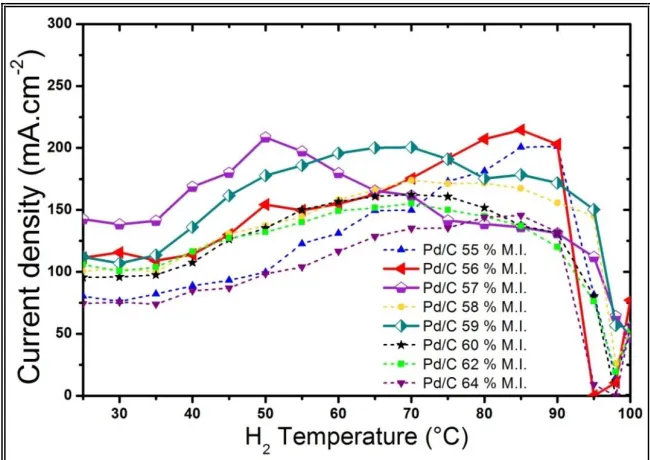
studied. These variations are probably associated with the transition in which the amount of ionomer ceases to be adequate, becoming excessive and resulting in polarization by mass transport, due to the higher water accumulation that occurs with increasing temperature. This observation is coherent with the literature [2,10,19]. Another important conclusion from Figure 2 is that above 90 ºC the cell performance falls. Upon opening the cell, it was observed that this fact was due to water accumulation. Looking for better understandings of the observed transition, without forgetting the desired maximum performance, experiments between 55 and 60 % M.I. and MEAs with 62 and 64 % M.I. were also evaluated. Figure 3 shows the performance of electrodes with Nafion concentration between 55 and 64 % M.I.
Figure 3. Current densities at 500 mV obtained with mass ionomer ranging from 55 to 60 % M. I. and 62 and 64 % M.I. for comparison. The electrodes active-areas were 5 cm ², with metal load of 0.4 mg.cm-² on each of them. Anodes were supplied with 160 mL.min-1 H2 1 atm and cathodes with 80 mL.min-1 1 atm, both reactive gases saturated with high pure water.
From Figure 3 it can be seen that the performance peak of the MEA, with compositions ranging from 56 to 59 % M.I. was higher than the previous one. It is worth noting that the differences in weight of Nafion ionomer applied from the electrodes with 56 to others, with 57 and 59 % M.I., are only 106 and 333 micrograms of ionomer per square centimeter. Although small, these differences resulted in MEA with higher current densities at different temperatures, below 55 ºC for MEAs with 57 % M.I., above 75 °C for MEAs with 56 % M.I. and between 60 and 75 °C in the case of MEAs with 59 % M.I. One can conclude that the ionomer concentration can be used for a specific configuration of the desired working temperature for a PEMFC system, according to specific applications. A maximum performance value of 214 mA.cm-2 at 85 °C to 56 %.M.I. was reached.
[image:5.596.135.460.250.480.2]
performance loss can be noticed in comparison to 56 and 57 % M.I., which can result from losses by mass transport. However, MEAs with 59 % M.I. presented a quite different behavior, with a broad range of temperatures without great variations in performance. Since the experiments were duly repeated to ensure reproducibility of the results, it is believed that the change in the profile of the curves with different compositions is related to each microstructure formed. The performance decrease at 58 % M.I. and the further increase with 59 % M.I. must be attributed to several factors, among which protons transport, flow of reactants and water accumulation may be mentioned [2,10]. To verify the raised hypothesis, samples of each MEA were analyzed by scanning electron microscopy (SEM). Electrodes micrographs obtained of 56, 57, 58 and 59 % M.I. are shown in Figure 4 for compositions.
(a1)
(b1)
(d1)
(a2)
(b2)
[image:8.596.201.394.68.227.2]
(d2)
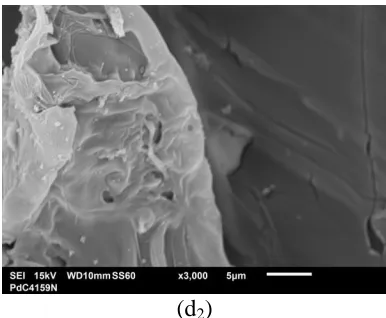
Figure 4. Scanning electron micrographs (SEM) of electrodes with (a) 56 % M.I., (b) 57 % M.I., (c) 58 % M.I. (d) 59 % M.I., all with magnifications of (1) 500 and (2) 3,000 times.
Some difficulties in this analysis were attributed to the cut of the samples and their interaction with the electron beam. Above 20 keV, the beam heated the sample and deformed the Nafion membrane, as can be seen at the bottom of Figure 4c2. This limited the experiment to low beams energies, impeding the acquisition of images with good resolution at magnifications up to 3,000 times. However, within what was possible to visualize by these images, the increase in mass of ionomer between 56 and 58 % slightly reduces the porosity of the C.L. as expected[19]. This can be seen by comparing Figures 4 (a), (b) and (c).
MEAs with 59 % M.I. have so low porosity that SEM images show only a uniform structure on the C.L., which is better visualized at the left side of Figure 4d2. This supports the hypothesis that the concentration of ionomer causes reduction on porosity and a transition in the C.L. structure, which seems to happen above 58 % M.I.
Since electrodes with 59 % M.I. have no apparent porosity, it is quite probable that mass transport occurs through the carbon support micropores. This possible explanation is consistent with the performance decrease that occurs above 65 ºC, when the drag of steam from humidifiers and the accumulation of water from reaction increase with temperature. The same effect seems to happen in electrodes with 57 and 58 % M.I. Apparently the mass transport by micropores of carbon support only operates efficiently when the macropore structure of C.L. is blocked. However, a better assessment of this behavior is beyond the aim of this work. Figure 5 presents a comparison between the open circuit potentials (O.C.P.) of electrodes between 55 and 60 % M.I.
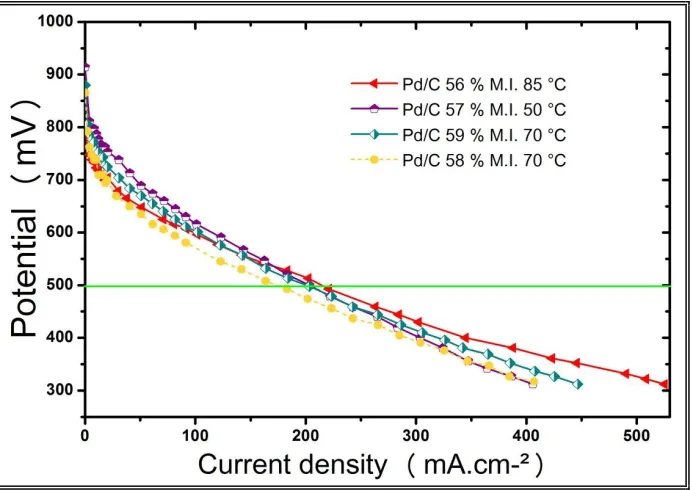
all of these can be properly standardized. Figure 6 shows the polarization curves of electrodes with 56, 57, 58 and 59 % M.I. with best performance conditions.
[image:9.596.132.466.120.359.2]Figure 5. Open circuit potential of electrodes prepared with mass ionomer ranging from 55 to 60 % M.I. The electrodes active-areas were 5 cm ², with metal load of 0.4 mg.cm-² on each of them. Anodes were supplied with 160 mL.min-1 H2 1 atm and cathodes with 80 mL.min-1 1 atm, both reactive gases saturated with high pure water.
[image:9.596.127.473.445.690.2]
By means of Figure 6 one can observe that electrodes with 57 and 59 % M.I. have shown better performance, when compared to 56 and 58 % M.I., from the beginning of the polarization curve until about 550 mV. At this point, electrodes with 56, 57 and 59 % M.I. present the same current densities, and below this potential the behavior starts to reverse gradually. This is consistent with the results displayed in Figures 3 and 5. These differences are related to polarization by mass transport as already discussed. Thus, in this situation, the catalyst layer with 56 % M.I. performs better for having larger pores, compared to the others, resulting in fewer performance losses. However, since the cell potential operation range is located between 500 and 700 mV, a selection between 56, 57, and 59 % M.I. must be made, according to the operating temperature and also to the applied potential.
[image:10.596.105.496.377.656.2]Comparing electrodes using the same catalyst eliminates this variable. Thus, once the humidification system inserts additional moisture in the unit cell, by an increase in temperature, it was found that the variation in Nafion ionomer content on the catalyst layer interferes in cell performance and modifies the necessity of membrane hydration, establishing an "equilibrium point," in which more or less water is required to achieve efficient proton transport. Whereas a time period is necessary for a power module to achieve its maximum performance and since a wider range of working temperature facilitates its control, anodes with 59 % M.I. were selected for comparison with the results obtained in previous work[17], as shown in Figure 7.
From Figure 7 it can be seen that the performance obtained with Pd/C on anodes C.L. with 59 % M.I. is far superior to that obtained with 35 % M.I. for MEAs with palladium electrodes and for MEAs with cathode using commercial Pt/C prepared with 35 % M.I. ( according to standardized Pt/C commercial C.L. composition[4,18]). A gain of 27 % was obtained in the current density, and the value of 745 mA.cm-2 at 95 ºC was achieved using Pd/C 59 % M.I. versus 586 mA.cm-2 for commercial Pt/C. At room temperature the current densities obtained were, respectively, 418 and 179 mA.cm-2, which means a gain of 133 % in performance. Considering the fact that using Pd/C on both electrodes the current density obtained was only 214 mA.cm-2, the necessity of alloying in cathodes is evident.
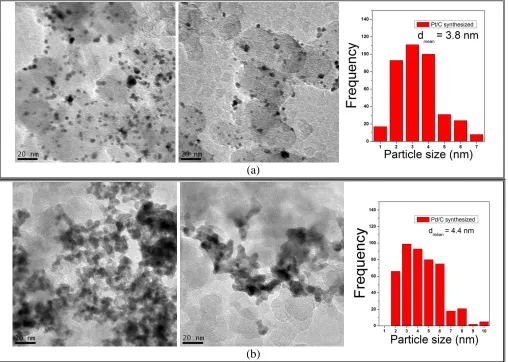
To prove the activity of palladium catalyst for the hydrogen oxidation reaction (H.O.R.) compared to platinum, Pt/C was synthesized on the same support (Vulcan XC72) with the same metal load (20 %wt.), using the same method, reduction via sodium borohydride, and used in anode preparation. Figure 8 shows the difractograms of Pt/C and Pd/C catalysts synthesized.
Figure 8.X-ray diffractogram of Pd/C and Pt/C catalysts.
[image:11.596.115.483.292.546.2]
(a)
(b)
Figure 9. Transmission electron microscopy and particle size distribution of (a) Pt/C and (b) Pd/C catalysts.
From Figure 9 it can be seen that metal particle distribution on carbon support was more homogeneous and efficient by the platinum catalyst synthesis than by the palladium catalyst synthesis regarding particle size, resulting in lower agglomerates concentration and mean particle size of 3.8 and 4.4 nm, respectively. The Pt/C system was used in anodes preparation with 59 % M.I. in MEAs with commercial Pt/C at cathode side, according to the standard used [4,18]. Figure 10 shows a comparison of performances, obtained at 500 mV.
[image:12.596.45.553.71.433.2]
Figura 10. Current densities at 500 mV of MEAs prepared with anodes of Pt/C and Pd/C synthesized, using 59 % M.I. and cathodes of Pt/C with 35 % M.I., compared to the results obtained[17] using electrodes of platinum or palladium with 35 % M.I. in all combinations, as shown. The electrodes active-areas were 5 cm ², with metal load of 0.4 mg.cm-² on each of them. Anodes were supplied with 160 mL.min-1 H2 1 atm and cathodes with 80 mL.min-1 1 atm, both reactive gases saturated with high pure water.
Since the price of palladium is between 20 and 35 % of that of platinum [4,8], it can be concluded that, from the economic point of view, the application of Pd/C catalyst in replacement of Pt/C in the anodes is feasible, whereas the evaluation of the durability of MEAs prepared with Pd/C catalyst is still necessary. Before concluding it is worth noting that an electrode evaluation in a narrow temperature range would not have allowed the comparison among the best conditions of each one of them, and most of the results of this work could not be observed.
4. CONCLUSIONS
among these formulations can be seen over all polarization curves studied. Starting from the open circuit potential, such adjustments must be made, depending on the operating temperature and potential, to obtain high values of current density. A current density value of 214 mA.cm-2 was obtained at 85 °C for MEAs with Pd/C on both electrodes, reaching 745 mA.cm-2 with Pt/C commercial on cathode side. This result proved the necessity of alloying on the cathode side. It was also found that platinum anodes produced under the same conditions and with bigger surface areas exposed showed performance only 13.9 % higher than that with palladium, indicating that improvements in the synthesis method can result in similar performance at H.O.R. Thus, from an economic point of view it is feasible to apply palladium to replace platinum in PEMFC anodes. However, an adequate assessment of durability still has to be properly addressed.
ACKNOWLEDGMENTS
To The Foundation for Research Support of the State of São Paulo (FAPESP 2010/10028-1) for the financial support, to the Energy and Nuclear Research Institute – IPEN/CNEN-SP for the infrastructure, especially the laboratories of the Center for Fuel Cell and Hydrogen (CCCH) and the microscopy lab at the Center for Science and Materials Technology (CCTM).
References
1. M. Linardi, Economia e energía, 66 (2008) 15. 2. M. Linardi, ArtLiber ed., São Paulo, 2010.
3. H. Wendt, M. Götz, M. Linardi, Quim. Nova. 23 (2000) 538-546. 4. R. N. Bonifacio, R. Cuenca, M. Linardi. Quím. Nova, 34 (2011) 96.
5. H. A. Gasteiger, S. S. Kocha, B. Sompalli, F. T. Wagner, Applied Catalysis B: Environmental, 56 (2005) 9.
6. E. Antolini, S. C. Zignani, S. F. Santos, E. R. Gonzalez, Electrochimica Acta, 56 (2011) 2299. 7. M. Shao, J. Power Sources, 196 (2011) 2433.
8. C. Bianchini, P. K. Shen, Chem. Rev. 109 (2009) 4183. 9. E. Antolini, Energy Environ. Sci., 2 (2009) 915.
10.10.F. Alcaide, G. Álvarez, P. L. Cabot, O. Miguel, A. Querejeta, Int. J. Hydrogen Energy, 35 (2010) 11634.
11.Zhou, Zhi-min; Shao, Zhi-Gang; Qin, Xiao-Ping; Chen, Xu-Guang; Wei, Zi-Dong; Yi, Bao-Lian; Int. J. Hydrogen Energy, 35 (2010) 1719.
12.R. Rego, M. C. Oliveira, F. Alcaide, G. Alvarez, Int. J. Hydrogen Energy, 37 (2012) 7192. 13.G. F. Alvarez, M. Mamlouk, S. M. S. Kumar, K. Scott, J. Appl. Electrochem, 41 (2011) 925. 14.M. Mougenot, A. Caillard, P. Brault, S. Baranton, C. Coutanceau, Int. J. Hydrogen Energy, 36
(2011) 8429.
15.J. Zhao, A. Sarkar, A. Manthiram, Electrochimica Acta, 55 (2010) 1756.
16.R. S. Henrique, R. F. B. Souza, J. C. M. Silva, J. M. S. Ayoub, R. M. Piasentin, M, Linardi, E. V. Spinacé, M. C. Santos, A. O. Neto, Int. J. Electrochem. Sci., 7 (2012) 2036.
17.R. N. Bonifacio, A. O. Neto, M. Linardi. Int. J. Electrochem. Sci., 8 (2013) 159.
18.A. B. Andrade, M. L. M. Bejorano, E. F. Cunha, E. Robalinho, M. Linardi. J. Fuel Cell Sci. and Technology, 6 (2009) 1.
19.G. Sasikumar, J.W. Ihm, H. Ryu. J. Power Sources 132 (2004) 11.