COMMISSION OF THE EUROPEAN COMMUNITIES
Brussels, 12.4.2005 SEC(2005) 453
COMMISSION STAFF WORKING DOCUMENT
Annex to the
:Communication from the Commission
Accelerating progress towards achieving the Millennium Development Goals
F
INANCING FORD
EVELOPMENT ANDA
IDE
FFECTIVENESSEU follow – up to the Barcelona Commitments and operationalisation of the Monterrey consensus
COMMISSION STAFF WORKING PAPER
ANNEX: EU follow – up to the Barcelona Commitments and operationalisation of the Monterrey consensus
Summary of replies to a survey with Member States (January 2005)
1. Commitment I: Increase the volume of EU Official Development Assistance to
0.39% of GNI by 2006, and eventually to 0.7% of GNI... 3
2. Commitment II: Coordination and Harmonisation ... 4
3. Commitment III: Untying ... 4
4. Commitment IV: Trade Related Assistance... 5
5. Commitment V: Global Public Goods. ... 5
6. Commitment VI: Innovative Sources of Financing ... 6
7. Commitment VII: Reform of the International Financial System ... 6
8. Commitment VIII: Debt relief ... 6
Executive Summary - The 2005 Monterrey Monitoring Survey
1. COMMITMENT I: INCREASE THE VOLUME OF EU OFFICIAL DEVELOPMENT
ASSISTANCE TO 0.39% OF GNI BY 2006, AND EVENTUALLY TO 0.7% OF GNI BY
2015
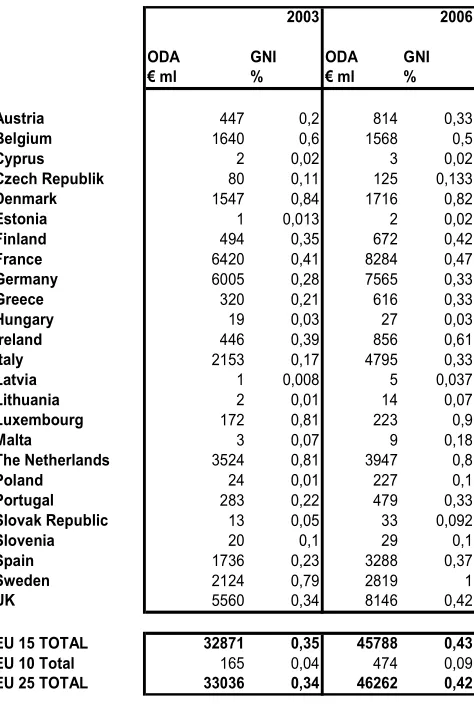
The latest ODA projections provided by Member States1 show that the EU is largely on track to deliver on most of the commitments made in 2002, including those to be honoured by 2006. In this context, the current declining trend of Italian ODA from an already low level remains of particular concern.
In 2003 the EU reached an average of 0.34% of ODA/GNI - above the average of OECD/DAC countries (excluding Norway and Switzerland).
– -If Member States' commitments are confirmed over time, the EU would collectively reach an ODA of 0.42% of GNI in 2006.
– -Between 2002 and 2003, ODA volume rose in 12 of the 25 Member States (additional €4.5 billion).
– -The new Member States increased their collective contribution by 53%.
A majority of Member States is either in favour or took no position on the idea of defining a new interim EU target for additional ODA increases by 2010.
1
2. COMMITMENT II:COORDINATION AND HARMONISATION
The 2004 Barcelona follow-up report contained substantial proposals for concrete action building on existing political commitments. It led to the establishment of an Ad Hoc Working Party on Harmonisation (AHWPH), which came up with a list of eight recommendations which were endorsed by the Council of Ministers (GAERC) of November 2004. The EU reinforced its commitments at the second High Level Forum on Aid Effectiveness in Paris, in March 2005. In addition to the official declaration of this meeting, agreed by all participating donor and beneficiary countries, the EU committed itself unilaterally to concrete further targets2.
The Survey of late 2004 shows that the main challenge ahead lies in effective implementation of the comprehensive framework, to ensure the qualitative jump and concrete steps forward in the complementarity of aid delivery.
Furthermore, Survey responses overall revealed that the concept of coordination of policies and harmonisation of procedures is not yet well rooted in the Headquarters administrations of EU Member States. There seems to be scope for improved information flow between Member States capitals and their field offices, to bolster the EU’s joint coordination efforts.
2
3. COMMITMENT III:UNTYING
Untying aid was recognised in Monterrey as one significant means to improve aid effectiveness, and as agreed in Barcelona the EU has made significant progress on obtaining “better value for money” from its ODA. Member States have untied their aid to Least Developed Countries (LDCs) in line with the DAC recommendation, and a majority of Member States are progressing towards further untying. Moreover, single market and competition rules also apply to untying procurement between the EU-25 and to granting mutual access.
Based on the Survey, a majority of Member States seems to be in favour of untying aid further. In practice, however, few Member States have taken further concrete steps forward in thisregard.
4. COMMITMENT IV:TRADE RELATED ASSISTANCE
The EU has stepped up commitments for TRA. Accounting for 50% of total TRA, the EU is by far the largest contributor worldwide, and the main donor to key multi-donor TRA initiatives such as the Integrated Framework for LDCs and the Doha Global Trust Fund, where it also accounts for more than 50% of the pledges. In addition, Member States are making efforts to integrate trade more systematically in their development cooperation programmes.
5. COMMITMENT V:GLOBAL PUBLIC GOODS.
Two EU Member States (France and Sweden), in collaboration with the UNDP, launched the informal International Task Force on GPGs in April 2003; several EU Member States participate in the work of the TF a members of the Group of Friends.
Taking into account the preliminary nature of the outcomes of the International Task Force on Global or International Public Goods, the Survey suggests a need for a new definition of IPGs that broadens the scope of the work to include regional and transnational public goods.
6. COMMITMENT VI:INNOVATIVE SOURCES OF FINANCING
Perhaps the two most prominent innovative finance mechanisms proposed have been: (i) the International Finance Facility (IFF) (a front-loaded pledge system for aid increases), and (ii) a range of proposals for international taxation and levies.
A handful of Member States are already involved in studies, analysis and development of options on various types of innovative financing mechanisms and/or are considering involvement from 2005. The Survey also produced a mixed picture with regard to current or possible engagement in Public Private Partnerships (PPPs).
7. COMMITMENT VII:REFORM OF THE INTERNATIONAL FINANCIAL SYSTEM
By presenting a single European position as often as possible, the Union would increase its visibility and influence in the IFIs. There has been some modest progress over the past few years pertaining to enhanced EU coordination, but the EU commitment of 2002 is considered vague, making effective monitoring difficult. Concerning the specific question of “enhancing the voice of developing and transition countries” in the IMF and World Bank, only limited progress has been achieved.
In reply to the Survey, a majority of Member States expressed general satisfaction with the improved informal EU coordination. Several Member States expressed the wish to go further (e.g. improved information sharing, more harmonised approach, etc.). Some Member States would be in favour of extending this kind of collaboration to the regional development banks where collective EU shareholding is significant.
8. COMMITMENT VIII:DEBT RELIEF
All EU Member States had made the necessary provisions to ensure their participation in the HIPC initiative by May 2003. Overall the ten new Member States are fulfilling their financial commitments, some contributing already to the HIPC Trust Fund.
Introduction
• Background
The Monterrey Consensus, adopted by the International Conference on Financing for Development (FfD) in Mexico, 18-22 March 2002, reflected a number of critical commitments “to address the challenges of financing for development around the world, particularly in developing countries.”
The FfD Conference emphasised that trade, finance and development are closely interrelated and underlined the shared responsibility of donors and recipient countries in achieving the Millennium Development Goals (MDGs). It addressed the two parallel issues of ensuring the necessary “means “(i.e. financing) and the most effective “ways” (i.e. aid effectiveness) of achieving the Millennium Development Goals (MDG)3. These are two mutually reinforcing objectives, and progress should be made on both.
The European Union, collectively representing more than 50% of worldwide Official Development Assistance (ODA)4, is a key partner in the FfD process. At Monterrey the EU contributed significantly to the overall positive result of the Conference, through the so-called “Barcelona commitments”5– composed of:
• Commitments on ODA volume and sources (Nos 1, 5, 6, 8) – increased ODA volumes, innovative sources of financing, initiatives concerning GPG and debt relief for Heavily Indebted Poor Countries (HIPC);
• Commitments on aid effectiveness (Nos 2, 3, 4, 7) – closer coordination of policies, harmonisation of procedures, untying of aid, trade-related assistance (TRA), reform of the international financial system.
In September 2005, five years after the Millennium Declaration, the UN High Level Event (HLE) will take stock of progress towards meeting the MDGs by 2015. This event will include a separate meeting on financing for development and will be prepared by the UN High-level Dialogue on Financing for Development. The EU is aware that the international community has high expectations of a substantial European contribution to the HLE, and is committed to stimulating the international debate.
To this end, the European Council of December 2004 mandated the Commission to present to the Council “concrete proposals on setting new and adequate ODA targets for the period 2009-2010, while taking into account the position of the new Member States”. These proposals must be based on consultations with individual Member States. The EU leaders also decided to “explore innovative ways of financing” and asked the Commission to submit relevant proposals with a view to the 2005 HLE. The annual report on the implementation of the Barcelona commitments is a useful tool to provide a factual basis for such proposals.
3
In the G8 Africa Action Plan, endorsed by the Kananskis Summit of 2002, it was expected that the Monterrey pledges would trigger an additional US$ 12 bn/yr by 2006: “ in aggregate half or more of our new development assistance could be directed to African nations that govern justly, invest in their own people and promote economic freedom.”
4
The Council of Ministers meetings in spring 2005 and the European Council in June will provide the opportunity to prepare the EU’s contribution to the stocktaking event. Among the
key challenges are: (i) a persistent financing gap, (ii) the effective use of ODA and (iii) the continuing, unsustainable debt burdens of many poor countries.
• Monitoring – mandate, methodology and structure
The Commission is mandated to report annually on the degree of implementation of EU commitments6, and to propose corrective measures wherever progress is insufficient. The Commission monitors progress in implementing the “Barcelona commitments” via annual questionnaires to the Member States (MS). This provides a good opportunity for collective benchmarking and ensures that action taken by the Union is transparent.
The first monitoring report of 2003 fed into the preparations for the first UN High Level Dialogue on FfD in October 20037, while the 2004 report8 focused on the coordination of policies and harmonisation of procedures. Its recommendations triggered the EU report “Advancing coordination, harmonisation and alignment: The contribution of the EU”, endorsed by the Council in November 20049. This EU Report has in turn become an essential input into the international harmonisation and alignment debate at the OECD/DAC High Level Forum II (HLF II) in Paris in March 2005.
This year’s Survey was based on questions relating to developments on the implementation of the eight EU commitments of 2002, at the international and EU level. It provides a detailed description of the state of play on each individual commitment, as expressed in the replies to the questionnaire.
Overall, the Commission is satisfied with the response to the questionnaires10. Some Member States provided more detailed replies, while others preferred not to take a position on all questions. The contribution of the new Member States is particularly impressive and demonstrates their efforts to take on the acquis communautaire in the area of development policy and with regard to the EU’s contribution to the FfD. All these contributions provide a solid basis for drafting the proposals to be incorporated in the Commission Communication. The report is divided into eight chapters on each of the Barcelona commitments, including: (i) background, (ii) a description of the EU state of play on the given commitment, and (iii) the results of the survey.
The compilation of the answers given by Member States is annexed to this Staff Working Paper.
In addition, some matrices allow the specific answers, comments and/or suggestions of individual Member States to be compared on a few selected topics.
6
Conclusions adopted by the General Affairs and External Relations Councils in November 2002 and May 2003 respectively. 7
The Commission Staff Working Paper “Follow-up to the International Conference on Financing for Development (Monterrey – 2002) - Monitoring the Barcelona Commitments” SEC (2003) 569, 15.05.2003; Council Conclusions of the GAERC of 20.05.2003, document 9379/03 (Presse 138) p.20.
8
The Communication from the Commission to the Council and the European Parliament “Translating the Monterrey Consensus into practice: the contribution by the European Union” COM(2004)150 final of 05.03.2004; Council Conclusions of the GAERC of 29.04.2004; Council Doc.8973/04 of the 29.04.2004.
9
Council conclusions of the GAERC 22-23.11.2004; 14724/04 (Presse 325) p.37 10
1. COMMITMENT I: INCREASE THE VOLUME OF EU OFFICIAL DEVELOPMENT
ASSISTANCE TO 0.39% OF GNI BY 2006, AND EVENTUALLY TO 0.7% OF GNI
Commitment: “In pursuance of the undertaking to examine the means and timeframe that will allow each of the Member States to reach the UN goal of 0.7% ODA/GNI, those Member States that have not yet reached the 0.7% target commit themselves – as a first significant step – individually to increase their ODA volume in the next four years within their respective budget allocation processes, whilst the other Member States renew their efforts to remain at or above the target of 0.7% ODA, so that collectively an EU average of 0.39% is reached by 2006. In view of this goal, all the EU Member States will in any case strive to reach, within their respective budget allocation processes, at least 0.33% ODA/GNI by 2006.”
1.1. Background
The UN Millennium Project report (J. Sachs) calls for each donor to reach 0.7% by 2015, and calculates that the following global ODA increases are required to meet the MDGs:
• 0.44% by 2006 (probable EU collective average: 0.42%), and
• 0.54% by 2015.
As stated in the Commitment, the Member States promised in Barcelona to generate sufficient financial resources to achieve the MDGs and, in this context, to reach the UN goal of 0.7% ODA/GNI in 2015. The Member States that had not yet reached the 0.7% target committed themselves, as a first significant step, to increasing their ODA to at least 0.33% of GNI by 2006. This individual commitment was coupled with a collective obligation to reach an EU average of 0.39% ODA/GNI by 2006.
1.2. EU performance
Diagram 1: EU ODA levels by Member State in 2003 0,0 0,1 0,2 0,3 0,4 0,5 0,6 0,7 0,8 0,9 %O DA /G N I
DK LU NL SE BE FR IE FI UK DE ES PT EL AT IT New MS > 0.7% ODA/GNI < 0.7% ODA/GNI < 0.33% ODA/GNI
Data source: OECD/DAC Annual report 2004, statistical annexes.
Diagram 2: ODA/GNI contributions in 2003: The EU compared to other DAC Members
0 0,1 0,2 0,3 0,4 0,5 0,6 0,7 0,8 0,9 1
EU 25
United
States Japan New Ze
aland CanadaAustralia
Switzerland Norw ay % O D A /G N
I Gap to
UN target 2015 ODA level 2003
Data source: OECD/DAC Annual report 2004, statistical annexes.
In terms of actual volume, ODA rose in 2003 in 12 of the 25 Member States compared to 200211. EU-25 ODA flows increased from €28.4 billion in 2002 to €33 billion in 2003, representing an additional €4.6 billion. The new Member States increased their collective contribution by 53% in real terms.
While ODA flows have grown, a sizeable proportion of the increase is due to debt relief operations. This is not in keeping with the spirit of the Monterrey consensus, which stated that the HIPC initiative “should be fully financed through additional resources”. In this respect, the effect of debt relief efforts, such as the one for Iraq, is a matter that may deserve further discussion among Member States.
11 Belgium (by 62.9%), France (by 30.5%), Sweden (by 27.6%), Luxemburg (by 26.3%), United Kingdom (by 23.4%), Ireland (by
Diagram 3: EU ODA flows and debt relief 2000-2003 0 5 000 10 000 15 000 20 000 25 000 30 000 35 000 40 000
2000 2001 2002 2003 2005
-Iraq i Deb
t
2006 -Iraq
i Deb t € m ill io n Paris Club Commitme nt HIPC Non HIPC Debt
RE:Data source: OECD/DAC Annual report 2004, statistical annexes.
1.3. Results of the Survey
The Survey showed that a majority of Member States are either in favour or took no position regarding the idea of defining a new interim EU target for additional ODA increases by 2010 – twelve Member States were in favour (nine unconditionally, three conditionally), nine Member States took no position or did not answer the question, while only two were against. On preparedness to define a new intermediate target ODA increase for new Member States (NMS), the survey showed a similar picture, with nine Member States in favour (including one new Member State), ten taking no position, and four Member States against the idea.
Question YES YES conditionally NO No reply / No position
Ready to define new EU interim target for additional ODA increases by 2010
DK, ES, FI, FR, LU, NL, PT, SE, UK
CZ, EE, PL LI, LV AT, BE, DE, EL, HU, IE, IT, MT, SI, SK
Prepared to define an interim target ODA increase for NMS
DK, FI, FR, LU, LV, SE, SK
AT, UK CZ, EE, HU, LI
Table 1: EU ODA levels 2003-2006
2003 2006
ODA GNI ODA GNI
€ ml % € ml %
Austria 447 0,2 814 0,33
Belgium 1640 0,6 1568 0,5
Cyprus 2 0,02 3 0,02
Czech Republik 80 0,11 125 0,133
Denmark 1547 0,84 1716 0,82
Estonia 1 0,013 2 0,02
Finland 494 0,35 672 0,42
France 6420 0,41 8284 0,47
Germany 6005 0,28 7565 0,33
Greece 320 0,21 616 0,33
Hungary 19 0,03 27 0,03
Ireland 446 0,39 856 0,61
Italy 2153 0,17 4795 0,33
Latvia 1 0,008 5 0,037
Lithuania 2 0,01 14 0,07
Luxembourg 172 0,81 223 0,9
Malta 3 0,07 9 0,18
The Netherlands 3524 0,81 3947 0,8
Poland 24 0,01 227 0,1
Portugal 283 0,22 479 0,33
Slovak Republic 13 0,05 33 0,092
Slovenia 20 0,1 29 0,1
Spain 1736 0,23 3288 0,37
Sweden 2124 0,79 2819 1
UK 5560 0,34 8146 0,42
EU 15 TOTAL 32871 0,35 45788 0,43
EU 10 Total 165 0,04 474 0,09
EU 25 TOTAL 33036 0,34 46262 0,42
Data sources: OECD/DAC Annual report 2004, statistical annexes and replies of EU Member States to the Monterrey questionnaire
While the Survey indicates important positive developments, in terms of the readiness to define new commitments on ODA volumes, past experience has shown that the “heavyweights” Germany and Italy are of particular importance to the collective achievement of the Barcelona commitments; both countries replied “No position/decision” to the above two questions.
2. COMMITMENT II:COORDINATION AND HARMONISATION
Commitment: “To take concrete steps on coordination of policies and harmonisation of procedures before 2004, both at EC and Member States level, in line with internationally agreed best practices including by implementing recommendations from the OECD Development Assistance Committee Task Force on donor practice
2.1. Background
The 2004 Barcelona follow-up report contained substantial proposals for concrete action, building on existing political commitments. It underlined the discrepancies between political commitment at Council level and implementation. This led to the establishment of an Ad Hoc Working Party on Harmonisation (AHWPH) with a mandate to examine the Commission’s recommendations and other relevant proposals in detail with a view to putting this Barcelona commitment into practice.
2.2. EU performance
The AHWPH agreed to the following eight recommendations, which were endorsed by the Council of Ministers (GAERC) of November 2004:
– Follow these basic principles: focus on a country-based and country-led approach, avoid duplication and work in a complementary way, aim for a wide coverage of aid modalities and procedures, use agreed guidelines on coordination and focus on implementation, openness of all donor initiatives.
– Set time-bound objectives and monitoring mechanisms. For most of the agreed actions implementation is expected in 2006.
– Establish an EU roadmap in every recipient country, offering a menu of actions, to be decided by a common assessment of needs by all EU local representatives.
– Use common EU guidelines based on existing EC guidelines for horizontal issues (such as operational coordination or Sector Support) and for a few selected sectors.
– Establish joint multi-annual programming on the basis of revised Country Strategy Papers (CSP).
– Establish complementarity as an operational objective, by discussing the division of labour at country level and starting a debate at cross-country level on the basis of the Donor Atlas.
– Establish a common framework for implementation procedures in the form of Joint Financial Agreements, covering such issues as reducing the number of missions, operating through budget support, enhancing sector coordination, making aid flows predictable, harmonising Technical Assistance, reinforcing joint evaluations, promoting joint auditing, establishing common cost norms, and strengthening delegated cooperation.
development aid with national development priorities and procedures”; “Member States should discuss initiatives that can support the decentralisation process in the Council before the end of 2005.”
The results of the process should be the basis for a real step forward at EU level. The EU will, however, also have to quickly follow up and implement several of the recommendations and deliver qualitative outputs.
The results have also been put before the Second High Level Meeting on Aid Effectiveness in Paris in March 2005, as the EU collective contribution to the international harmonisation agenda. Experience so far indicates that progress is uneven. Administrative costs for the entire DAC membership exceeded €3.5 billion in 2003.
2.3. Results of the Survey
2.3.1. At Headquarters/international level
With regard to involvement in coordination/harmonisation initiatives at headquarters/ international level, a majority of Member States (13) said that they were participating actively;eight were not (of which seven were new Member States) and three did not reply. As to the type ofspecific coordination/harmonisation initiativesMember Stateswere involved in,
a majority referred to work within: (i) the OECD/DAC, (ii) likeminded groups and (iii) the United Nations, Bretton Woods institutions and other international finance institutions.
Question Yes No No reply
Countries involved in coordination/ harmonisation initiatives among headquarters
AT, BE, DE, DK, FI, FR, IE, LU, NL, PL, SE, SK, UK
CZ, EE, ES, HU, IT, LI, LV, MT, PL
EL, PT, SI
For more specific answers, we refer to the attached country fiches and matrices, which provide more detailed information per country.
2.3.2. At country/field level
The Survey shows that a majority of Member States were involved in various types of coordination/harmonisation initiatives at country/field level – ranging from participating in local harmonisation and coordination processes and structures among donors and/or led by the recipient government, through involvement in the PRSP process, to increased use of joint programme-based sector support.
Question Yes No No reply
Countries involved in coordination/ harmonisation initiatives at field/country level
AT, BE, DE, DK, ES, FI, FR, HU, IE, IT, LU, NL, SE, SI, SK, UK
CZ, EE, EL, LI, LV, MT, PL
Complementarity: Proposal to work through 1 of the 5 “lead donors”
Agrees if within a sector approach
Agrees if within a country approach IT, PT Globally disagrees Globally agrees In some countries
In all countries
In some countries In all countries No position No reply AT, MT,
CZ, FR, LV, PL, NL, SE, UK
BE, EL; SK DE BE,HU, SK. DE, EL EE, IE,
SI
From the Survey one could also sense a general need for further clarification of the concept of complementarity. On the question as to what criteriashould be used for the development of operational elements of complementarity (country/sector level), most MS believed that: (i)
donors’ comparative advantage overall in a country or sector, and (ii) availability of staff and expertise in a given sector or country, were either very important or important. Very few believed (iii) size of financial allocation to a given sector or country to be very important. Criteria for the development of operational elements of complementarity (country/sector level)
Criteria: Very Important Important Less Important Irrelevant
Comparative advantage of donors at global level of a country or sector
BE, DE, EE, EL, FI, HU, IE, IT, PT, NL
CZ, ES, LI, LV, PL, SK, UK
AT, DK, FR, LU, SI
Availability of staff and expertise in a given sector or country
AT, CZ, DE, DK, EE, FI, FR, IE, IT, PL, NL
BE, ES, HU, LV, LI, PT, SI, SK, UK
EL, LU
Size of financial allocation to a given sector or country
BE, UK CZ, DK, FR, EL, HU, IT, LI, NL, PL, SK
AT, DE, EE, ES, FI, IE, LU, LV, PT, SI
2.3.3. Experience from the EU’s four pilot countries
Regarding coordination and harmonisation in the four EU pilot countries (Morocco, Mozambique, Nicaragua and Vietnam), the Survey indicated broadly positive developments in three out of the four:
• Mozambique: particularly positive developments and an advanced level of donor harmonisation, including:
(a) alignment around the Government’s Poverty Reduction Strategy,
(b) joint Memorandum of Understanding with 15 donors leading to coordinated and untied budget support,
(c) wide use of SWAP/sectoral programmes, joint performance assessment framework.
• However, improvements can still be made in the predictability of aid, complementarity and selectivity among donors.
(d) an annual "Blue Book" directory of all EU cooperation activities in Vietnam; (e) establishment of EU norms for local costs in development activities (also
followed by other donors);
(f) Framework Agreement on cooperation covering issues like tax status for consultants;
(g) joint EU statements and pledges at the Consultative Group meetings; (h) EU working groups on how to work more effectively in key sectors; (i) EU system of delegated co-representation in policy dialogue discussions; (j) making available the services of a harmonisation adviser to the Government.
• However, Member States expressed the need a need to further refine the EU Action Plan, and establish targets for closer coordination such as a reduction in the number of EU projects and the identification of specific joint actions. In February 2005 the Member States active in Vietnam agreed on such a concrete roadmap including time-bound targets.
• Nicaragua: the Survey showed a positive, albeit qualified picture:
(a) A 10-donor budget framework (Joint Financing Agreement) to support the Government’s National Development Plan is being negotiated, and is expected to produce a positive result for the 2005 budget.
(b) Opportunities for greater harmonisation will improve as the Plan becomes better linked with the national budget.
(c) The organisation of – so far - six sector coordination round tables organised.
• On areas which need improvements, the Survey showed that despite progress in harmonisation, alignment with Government policies seems often to be lacking. The Government of Nicaragua’s leadership in harmonisation and alignment should be respected, instead of creating parallel structures for donor coordination.
• At the same time, stronger government leadership in policy development is necessary; this partly explains why sector coordination activities and initiatives on budget financing in the framework of the National Development Plan have been mainly donor driven up to now.
• Institutional capacity is still weak and implementation is falling behind.
• The Nicaraguan Government has expressed concern that complementarity (leading to a reduction in the number of donors per sector) may increase vulnerability where aid is not sufficiently predictable. It would prefer to maintain some choice over partners and focus on donor quality and a reduction in financing instruments.
• Despite the holding of regular donor meetings, progress is slow on coordination and harmonisation activities (despite some positive developments in the water sector).
Countries involved in bilateral programmes in the four EU pilot countries
Pilot Country Yes No
Morocco BE, DE, FR, IT AT, EL, ES, FI, HU, IE, LI,
LU, LV, MT, NL, PL, PT, SK, SI, UK
Mozambique AT, BE, DE, FI, FR, IT, PT,
NL, UK
ES, HU, IE, LI, LU, LV, MT, PL, SI, SK
Nicaragua AT, DE, FI, FR, IT, NL, PT,
UK
BE, ES, HU, IE, LI, LU, LV, MT, PL, PT, SI, SK
Vietnam BE, CZ, DE, FI, FR, HU, LU,
NL, SE, UK
AT, ES, IT, LI, LV, MT, PL, PT, SK, SI,
Overall the responses revealed that the concept of coordinating policies and harmonising procedures is not yet well rooted in all Headquarters administrations of EU Member States. Moreover, some replies imply that Headquarters is not aware of involvement (via their Embassies) in enhanced coordination activities in the EU pilot countries (e.g. Vietnam). There seems to be scope for improved information flow between Member States capitals and their field offices, to bolster the EU’s joint coordination efforts.
3. COMMITMENT III:UNTYING
Commitment: To implement the DAC recommendation on untying of aid to Least Developed Countries and continue discussions in view of further untying bilateral aid. The EU will also consider steps towards further untying of Community aid while maintaining the existing system of price preferences of the EU-ACP framework.
3.1. Background
Untying aid was recognised in Monterrey as one significant means to improve aid effectiveness. In order to support its added value, the European Union agreed in Barcelona:
• to implement the DAC recommendation on untying aid to Least Developed Countries,
• to continue discussions with a view to further untying bilateral aid, and
• to consider steps towards further untying Community aid.
In addition, two recent studies commissioned by the OECD/DAC and the Commission have simultaneously highlighted the added benefit and positive impact of further untying – in particular untying food aid and food aid transport – in terms of aid effectiveness and coherence.
3.2. EU performance
Furthermore, single market and competition rules also apply to procurement for the purpose of implementing the Member States’ development policy. Under these rules, Member States are obliged to untie aid between the EU-25 and grant mutual access, and any infringement is an offence. So by law, all EU aid is untied and mutual access is granted between the EU-25.
In line with the conclusions adopted by the General Affairs Council in May 2003 and the European Parliament in September 2003, the Commission submitted two proposals on untying EC aid to the Council and Parliament and that are currently in the legislative process: (i) for a Regulation on untying EC-funded aid and tentatively for adoption in 2005 and (ii) for the renegotiation of Annex IV to the Cotonou Agreement. The EU and ACP partners concluded the renegotiations of the Cotonou Agreement in February 2005.
3.3. Results of the Survey
On the question of whether they had introduced new proposals/policy papers in 2003/2004 relating to untying aid (reality check), the survey showed relatively little concrete action over the last two years – only four Member States said “Yes”, while another twenty Member States answered that no action had been taken. It is worth noting that four Member States’ development aid is already fully untied - excusing them from further policy reform in this area, while another four countries claim that their aid is mostly untied.
Have you introduced further proposals/policy papers in 2003/2004 on untying bilateral aid beyond OECD/DAC recommendations?
Yes No No reply Comments/reservations
DE, FI; FR; NL, SE, AT, BE, CZ, DK, EE, EL, ES, HU, IT, LV, LI, MT, PL, PT, SK, SI
IE, LU, SE, UK aid is already fully untied
NL food aid is already untied. Proposal calling for further untying under study
FR, FI, PT
The Survey also showed a willingness among most Member States to discuss broadening the scope of and simplifying OECD/DAC recommendation on untying – thirteen Member States were willing (nine unconditionally, four only after 2007), while seven Member States were against it, and one did not reply. In this context, it is worth noting that only four of the new Member States have observer status in the OECD/DAC (Czech Republic, Hungary, Poland and Slovakia), and that none of the new Member States, therefore, are legally bound by OECD/DAC recommendations.
Ready to enter a discussion with OECD on the broadening of the scope and simplification of the OECD/DAC recommendation on untying?
Yes Yes but after 2007 No No reply Comments/reservations
DK, FI, FR, LU, PT, SK, NL, SE, UK,
BE, DE, HU, IT, LI,
AT, EL, LV, MT, PL, ES
CZ, IE EE, LV, PL (not members
of the OECD-DAC)
The Survey also showed that there was broad support among Member States for discussing
If YES the following amendments to the scope of the DAC recommendations should be discussed:
Amendments: Agrees Disagrees No position
Extend beyond the LDCs BE, DE (after 2007), DK, FI, LI, LU, PT, NL, SE, UK
FR, HU
Cover food aid BE, DK, FI, FR, DE, HU, LI, SK, PT, NL, SE, UK
LU
Cover Technical
Assistance
BE, DE (after 2007), DK, FI, LI, LU (under conditions), NL, SE, SK, UK
FR, HU, PT
Provide access for
recipient countries
BE, DK, FI, HU, IT, LI, NL, PT, SE, SK, UK
FR DE, LU
So, based on the feedback from the Survey, a majority of Member States is in favour of broadening the discussion on and the scope of untying of aid. In practice, however, few Member States have lately taken concrete steps forward in thisregard.
4. COMMITMENT IV:TRADE-RELATED ASSISTANCE
Commitment: To increase assistance for long-term trade-related capacity building, productive capacity and measures addressing supply-side constraints in developing countries, as well as to provide immediate support for trade-related technical assistance in order to improve the negotiating capacity of developing countries in trade negotiations, including by commitments made at the WTO pledging Conference in Geneva on 11 March 2002.
4.1. Background
Since the launching of the Doha Development Agenda (DDA) in November 2001, and the WTO pledging conference in Geneva of March 2002 the EU - Commission and Member States - has seriously taken up the commitment to increasing the quantity and quality of trade-related assistance and capacity building (TRA/CB) for developing countries. For that purpose the Commission Communication on Trade and Development of 200212 outlines the EC’s trade and development strategy and contains proposals for action at three different levels: (a) intensifying the dialogue with partner countries; (b) enhancing the effectiveness of EU support; (c) contributing to international effectiveness and coordination.
4.2. EU performance
The Communication has become the main reference for the European Commission, and increasingly the EU Member States, in guiding development cooperation on trade. Accordingly, the EU has stepped up commitments for TRA/CB and is by far the largest contributor worldwide as reported in the Doha Development Agenda Trade Capacity Building Database (TCBDB). The figures have increased over time: the EU provides about 50% of
total TRA, and the annual budget committed for TRA in the last four years is around €1 billion13.
The EU is also by far the main donor to key multi-donor TRA initiatives, such as the Integrated Framework for LDCs and the Doha Global Trust Fund, where it also accounts for over 50% of the pledges. A sizeable part of the EU’s TRA is channelled through regional integration organisations. Regional initiatives can create trade opportunities that are not available in the multilateral context. It is to be noted, however, that the increased focus on TRA in development aid is different across EU Member States: some countries have taken up the commitment more systematically than others.
In terms of quality, the EU has taken seriously the issue of improving delivery and obtaining concrete results. In 2004 the EC undertook a comprehensive evaluation of TRA. Despite some shortcomings (EC procedures are not always well suited to the fast changing trade area; and trade assistance has not always been based on a detailed assessment) the conclusion is that Commission TRA has resulted in improved knowledge and awareness of trade-related issues in the central institutions of partner countries, and it has contributed to increased export performance and improved productivity among local enterprises. Efforts are being made to deliver more systematic training in that field.
Some Member States (UK, Netherlands) have also carried out external evaluations of their TRA activity. As far as the EC is concerned, its development policy has progressively integrated trade into its assistance programmes. The mid-term reviews of the Country and Regional Strategy Papers have to some extent allowed it to give a more prominent trade focus to the development dialogue with our partners, but the results vary considerably from country to country and from region to region. Developing countries face many competing challenges. Member States are also making efforts to integrate trade more systematically in their development cooperation programmes.
4.3. Results of the survey
Some replies to the survey on trade-related assistance (TRA) are strikingly inconclusive. This may indicate that: (i) TRA is not a core priority in many Member States; (ii) different instruments which have emerged in the context of the Doha Development Agenda (DDA) have not yet found their way into Member States’ cooperation programmes and/or (iii) the questions were not sufficiently focused to trigger clear answers.
There is no systematic use of a single set of TRA-related policy guidelines. Whereas the OECD/DAC guidelines of 2001 are frequently used by eleven Member States, neither the Council Conclusions of 2002 on the EC Trade and Development Communication14 nor the EC TRA Guidelines of 2003 have – so far – broadly impacted on Member States’ TRA. This is remarkable in so far as they take full account of the DDA, decided in 2002.
13 If we take the EC alone, since the Doha Conference it has scaled up its TRA funding considerably. Between 1996 and 2000 the
EC allocated around € 700 million. Although these data may be underestimates, because before the establishment of the Doha database, trade-related projects were not recorded systematically, there has been a sizeable increase since the Doha Declaration in 2001. Between 2001 and 2004, the global allocation totalled € 2.9 billion, i.e. an average of more than € 700 million annually. 14
Eight Member States refer to the Council Conclusions and five Member States to the EC guidelines frequently. The broad picture seems to be that coherent guidelines acceptable for all Member States and the EC programmes still need to be developed. The EU Informal Trade and Development Experts Group could play a key role in triggering progress towards a coordinated TRA approach at EU level. This seems even more important as the EU is globally the largest provider of TRA.
The most important policy guidelines for delivery of bilateral TRA are:
Policy guidelines: Binding Frequently used Not relevant No reply
Your national policy guidelines CZ, DE, DK, EE, FI, IT, SE
FR, EL, IE, LI, NL, UK
BE, EC, LU, LV, PL
Council Conclusions of 20.11.2002 on Communication on Trade and Development (COM 513)
EC BE, DK, FI, FR,
EL, IT, LI, NL,
LU, PL
EC Guidelines on TRA of 2003 EC BE, EL, FI, FR, IT
DE, DK, LU, PL
OECD/ DAC guidelines
“Strengthening trade capacity for development (2001)”
BE, DE, DK, FI, FR, EL, IE, IT, PL, SE, UK
LU
Other, please specify FR
MT, PT, SI, SK, ES.
No national guidelines on TRA: AT, HU
Actions taken/planned as from 2005 to facilitate the mainstreaming of trade in your aid programmes
Training Manuals/ Guidelin.
Instruct. Organis. change Monitoring / evaluations Other IN DEVELOPING COUNTRIES’ INSTITUTIONS: CZ, DE, DK, EE, IE, IT, LI, MT, PL, UK
MT, UK DE, MT,
NL
DE, FR, UK
CZ, DE, IT NL
IN YOUR ADMINISTRATIONS EC, IT, UK
EC, IE, UK
EC, BE, EC,
DK, EE, FR
DE, EC, IT, MT, UK
DK, EC, UK
- at Ministerial level LI, FI, DE,
IE, SE,
SE, DK, EE,
FI, FR, LI, SE
DK
- in the headquarters EC, HU, IT, NL, SE, UK
EC, FI, IE, SE, PL
EC, EL, BE, EC, EE, DK, FI, FR, IE, IT, NL, SE
EC, IT, NL, UK
DK
- at field level EC, HU,
IT, NL, SE, UK EC, FI, IE, SE EC, EL, PL, NL EC, FR, IT,
-- headquarters EC, DE, IT, SE
EC, SE EC, EL,
SE,
EC, FR, IT
EC, IT, PL DK
a t field level EC, IT EC, SE, EC, EL FR, IT EC, IT DK
Main beneficiaries within Member States’ TRA for 2005/2006
International institutions
Regional organisations Individual countries
NGO Other
AT, BE, CZ, DE, DK, FI, IT, MT, NL, PL, SE, SK, UK.
DE, DK, SE, UK. CZ, DK, EE, FI,
DE, NL, SE, UK.
BE EC IT PL NL SE UK
DK
Some fifteen Member States stated that they used or were in process of evaluating future use of the Integrated Framework (IF) Diagnostic Trade Integration Study (DTIS) as their main tool for TRA planning and delivery. Another eight Member States replied that they did not use it, while three did not reply. To the extent that coordination of TRA with other donors took place, many Member States stated that it was mainly undertaken at country level.
Question on the Integrated Framework (IF) Diagnostic Trade Integration Study (DTIS)
Yes Will start soon using
it
Evaluate future use
No No reply
Have you effectively used or are you prepared to use the IF as the main tool for TRA planning and
delivery? DK, EC,
DE, FR, FI, SE, UK
CZ EE, EL, IE, IT, MT, NL, SE
AT, BE, ES, HU, LI, LU, LV, PL
PT, SK, SI
Only two Member States were unconditionally ready to apply the IF DTIS approach to non-LDCs as well, while another four were ready to do so if certain conditions were in place. Ten Member States answered that they were not ready, while another seven did not reply – most of these were New Member States, who gave lack of human resources rather than political will as the main reason.
Yes Yes, conditionally No No reply
Are you ready to use the approach of the IF DTIS also for non-LDCs?
DE, DK FR, IT, NL, SE AT, BE,
CZ, EE, HU, IE, LI, LU, LV, PL
EL, ES, FI, MT, PT, SI, SK,
A majority of Member States said they were contributing to the Doha Development Agenda Trade Capacity Building Database (TCBDB), or would start reporting to it soon – thirteen Member States were already contributing, while another three were planning to soon. Eight Member States stated that they did not contribute, while one did not reply.
Question on the Doha Development Agenda Trade Capacity Building Database
Do you contribute to the Doha Development
Yes Not yet, will start
reporting to it soon
Agenda Trade Capacity Building Database (TCBDB)?
AT, BE, EC, DE, DK, EL, ES, FI, FR, IE, SE, NL, UK.
EE, IT, PL CZ, HU, LI, LU, LV, MT, SK, SI
PT
A majority of Member States also expressed their readiness to intensify information exchange, coordination of TRA policies and activities in the Trade and Development Expert Group – thirteen Member States unconditionally and one conditionally, while eight Member States expressed no position and one was opposed to the idea. There was also a call for improved in-country coordination of concrete TRA activities.
Question on information exchange
Yes Yes, conditionally No No position / not
decided Are you prepared to
intensify information exchange, coordination of TRA policies and activities in the Trade and Development Expert Group?
BE, CZ, DK, EE, EL, IE, LI, LU, MT, ES, NL, SE, UK
IT FI AT, FR, HU,
LV, PL, PT, SK, SI
A majority of Member States said that TRA had been relevant to achieving the goal of improved integration of developing countries into the world economy – fourteen Member States found it to be either “highly relevant” (8) or “relevant” (6). Only two Member States found it to be either “less relevant” or “irrelevant”, while another six expressed no opinion. Some replies pointed out that the concept of TRA was still fairly new, and that there yet was not enough experience on hand to assess the effect of TRA on developing- and transition countries’ integration into the world economy.
Has TRA been relevant to achieve the goal of improved integration of developing countries into the world economy?
Highly relevant Relevant Less relevant Irrelevant No reply
EE, DK, EC, EL, ES, LV, PL, SE, UK
AT, EC, FI, FR, IT, LI, LU
NL BE CZ, HU, MT,
PT, SI, SK
Most Member States took no position or did not reply as to their readiness to actively participate in the OECD/DAC work towards establishing a common monitoring/evaluation framework for TRA. Thirteen Member States had not yet decided or did not reply. Seven Member States said they were prepared to participate, while four said they were not.
Are prepared to actively participate in the OECD/DAC work towards establishing a common monitoring/ evaluation framework for TRA
Yes No No position / not decided No reply
AT, DE, DK, IT, SK, SE, UK
FI, LV, LI, LU BE, CZ, EC, EE, FR, EL, HU, PT, SI, NL.
5. COMMITMENT V:GLOBAL PUBLIC GOODS
Commitment: To further work towards a participatory process at the global level, including the proposal of setting up a task force open to all actors on a temporary basis, designed to lead to the identification of relevant Global Public Goods.
5.1. Background
A crucial element of Global Public Goods is that individual countries or entities cannot, or will not, by themselves act to ensure that they are adequately provided, therefore collective multilateral action is needed.
In the Council Conclusions on Monterrey and the World Summit on Sustainable Development (WSSD) in Johannesburg, the EU confirmed its commitment to tackling the issue of Global Public Goods (GPGs). Even though its proposal for the establishment of a global, participatory process on GPGs was not taken up in the final outcome documents of either event, an informal International Task Force on GPGs was launched at the WSSD by two EU Member States (France and Sweden), in collaboration with the UNDP in April 2003. The Secretariat of the Task Force has kept the process open by involving other stakeholders, the so-called “Group of Friends of the Task Force”
5.2. EU performance
The Commission and several EU Member States have been active members of the Group of Friends. The Commission hosted the Regional Consultation for Europe in February 2005 as part of its support. This event provided a key opportunity to discuss the Task Force’s draft findings and feed into its final recommendations.
The Task Force’s output should be widely disseminated in order to accelerate the provision of public goods vital to development. For this reason the EC questionnaire sent to MS this year centred on the Task Force’s preliminary outcomes – a definition of International Public Goods (IPGs) that broadens the scope of the work to include regional and transnational public goods, and the selection of six priority IPGs for enhanced action.
5.3. Results of the Survey
The 2004 questionnaire focused on the Task Force’s definition of International Public Goods (IPGs), which seems widely accepted, and six priority IPGs that it selected for enhanced action. All Member States agreed that the selected IPGs (trade, knowledge, peace and security, financial stability, global commons , and eradication of communicable diseases) are relevant, although obviously perceptions of their importance differ.
A majority of Member States (14) and the EC agreed with the Task Force’s definition of IPGs; nine had no position, while only one Member State expressed the need for a more precise/concrete definition.
Agree with the definition of IPGs recently agreed by the International Task Force on GPG?
In favour/Yes Against/No No position/not decided
BE, CZ, DE, DK, EC, EL, ES, FI, FR, IT, NL, PL, SE, SK, UK
However, a majority of Member States considered further analysis of all the proposed areas as either extremely or very important. Peace and security scored highest, with seventeen Member States considering it extremely important, followed by the eradication of communicable diseases and global commons. Member States also made some suggestions on new or other IPGs which could be added to the list (see the country fiches in Annex 1 for further details).
These views reinforce the concept of complementarity between Member States: it means that the whole Union can increase its weight in the debate and the global governance mechanisms through action promoted by several constituencies of Member States in all priority IPGs.
The most important IPGs areas for further analysis
Extremely important Very important Important Less important No position
Trade DK, EC, FR, IE, MT, SE, NL,
EE, FI, DE, HU, IT, LV, SK, ES, UK,
CZ, EL, PL, BE,
Knowledge FR, IE, LV, NL, SE BE, CZ, DE, EC, EE, ES, FI, IT, MT, SK,
DK, EL, HU, PL, UK,
Peace and security BE, CZ, DK, EC, FI, FR, DE, HU, IE, IT, MT, PL, SK, ES, SE, NL UK,
EE, LV EL
Financial stability FI, FR, IE, ES, SE, NL CZ, EE, DE, EL, IT, MT, PL, SK,
BE, DK, EC, HU, LV, PL, UK,
Global commons, in particular natural resources
EC, FR, DE, EL, IE, IT, SE, NL UK,
EE, FI, MT, PL, SK, ES
CZ, DK, HU, LV BE,
Eradication of communicable diseases
BE, FR, DE, EL, IE, SK, ES, SE, NL
CZ, DK, EC, EE, FI, IT, UK
HU, LV, MT
AT, LI, LU, PT, SI,
On the question of their involvement in either the Task Force or the Group of Friends, ten Member States said they were actively involved, while eleven were not involved (mostly new Member States), and three did not reply. Most countries that did not participate in the Group of Friends of the Task Force said this was due to lack of human resources.
Yes No No reply
AT (Secretariat of the TF), BE, DK, EC, DE, FI, FR, IE, SE, NL, UK
CZ, EE, EL, HU, LV, LI, LU, MT, PL, SI, SK,
IT, PT, ES,
A sizeable majority of Member States was in favour of analysing the Task Force Action Plan with a view to using it as a basis for establishing an EU common platform on the provision and financing of GPGs/IPGs.
Agree to analyse the Task Force Action Plan with a view to using it as a basis for elaborating an EU common platform on the provision and financing of GPGs/IPGs
Yes No No position/not
decided
Rationale for not participating/comments AT, BE, DK, EC,
DE, FI, FR, IE, LU, MT, PL, SI, ES, SE, UK
CZ, EE, EL, HU, LV, LI, PT, SK, NL
Finally, a majority of fourteen Member States replied that IPGs should be financed from ODA only if especially linked to the MDGs/other objectives of development. Another seven Member States took no position, while one Member State was against financing IPGs from ODA.
Question on the provision of IPGs: Do you agree with the argument that provision of IPGs should not be financed through ODA?
Yes Yes, in context of joint initiative
No No replied/ not position
IE BE, CZ, DK, DE,
EL, ES, FI, IT, LV, LU, MT, NL, PT, SK
AT, EE, HU, LI, PT, SI, SE
6. COMMITMENT VI:INNOVATIVE SOURCES OF FINANCING
Commitment: To further explore innovative sources of financing and taking into account the conclusions of the Commission Globalisation Report.
6.1. Background
With reference to the above Barcelona commitment, six Member States stated in 2002 that they were pursuing such initiatives. Their effort focused on international taxation mechanisms, public/private partnership and the HIPC initiative for the cancellation of the poorest countries’ debt.
6.2. EU performance
The search for innovative sources of finance must not distract from the primary task of increasing ODA directly. At the same time as agreeing and implementing ODA increases we should, however, explore innovative mechanisms that contribute to additional, stable, predictable financing for development. Whatever the source of funding, new delivery mechanisms will be needed to make it fully effective in helping countries to reach the MDGs. A number of initiatives have been launched to support the provision of adequate resources to meet the MDGs. Perhaps the two most prominent innovative finance mechanisms proposed have been:
– (i) The International Finance Facility (IFF) – a UK proposal for a front-loaded pledge system for aid increases, which would allow borrowing from the markets against binding pledges from donors (with repayments coming from aid budgets), and deliver the resulting funding as grants to developing countries. It is claimed that the UK proposal could double existing ODA (roughly $50bn/year) by 2010, with flows winding down after 2015 and ending by 2020. Payments to the IFF would come from ODA budgets for the next thirty years. However, the UK claims that the proposal should leave total ODA flows (net of repayments to the IFF) from 2015 onwards at least as high as they are now.
such a long-term binding budgetary commitment, even if its accounting status were clear. Also, this technical device may free politicians from the political challenge of increasing aid directly, leaving politicians and tax payers after 2015 to tackle the issue.
– (ii) A range of proposals for international taxation and levies, drawn together most powerfully perhaps in the “Landau Report” to the French President and – most recently - the work of the “Lula Group” (comprising the Presidents of Brazil, Chile, France and the Prime Minister of Spain) are currently under discussion. A staff paper by the IMF and World Bank to the 2004 Development Committee assessed a range of options.
– The higher-yielding proposals (such as a carbon tax, a tax on multinational corporations, or a “Tobin tax” on currency transactions) pose problems of political acceptability or economic efficiency. Easier options (such as taxing satellite orbits or sea-bed mining) are likely to have modest yields.
– Most examples require widespread – some effectively global – consensus to operate effectively (or to operate at all). However, despite these challenges the Development Committee mandated the International Financing Institutions to continue their work and “report on how to take such options forward”. It is clear that, in view of the long time necessary to reach agreement on such proposals, any initiative is likely to be relevant only in the medium term and will not reduce the necessity of providing more ODA from the budget in the short term.
– Various such initiatives have found favour at national level. The Belgian parliament, for example, has adopted a “Spahn tax” (a variant of the “Tobin tax” on currency transactions) subject to adoption by other EU countries. The European Central Bank has, however, issued an opinion15 indicating that in its view the “Spahn tax” as passed may be incompatible with the Treaty.
– The Commission Staff Working Paper ‘Innovative sources of financing for development – a review of options’, currently under preparation, examines the most important questions.
6.3. Results of the Survey
A handful of Member States answered that they were already involved in studies, analysis and development of options on various types of innovative financing mechanisms and/or considering involvement from 2005 – basically with regard to the following mechanisms (some Member States are active on more than one mechanism):
• six on a currency transaction tax,
• four on the International Financing Facility for ODA,
• three on other international taxes and levies (e.g. on deep sea minerals),
• two on an international carbon tax,
• two on an aviation fuel tax,
• two on a global lottery.
On whether they were prepared to implement some of these innovative financing mechanisms from 2005, most Member States answered that they were not willing or had no position yet. Broadly speaking, only those Member States who are already actively involved in the analytical work are willing to consider implementing the mechanisms.
Prepared to implement from 2005 the following innovative financing mechanism
Financing mechanism: Yes Yes given
support
Yes globally
No No position yet No reply
International carbon tax IT, UK FR, SE, NL AT, CZ. DK,
EC, EE, FI, HU, IE, LV, MT, PL
BE, DE, EC, EL, ES, SI, SK
Tax on aviation fuel IT, FR, SE, NL AT, CZ, DK,
EC, EE, FI, HU, IE, LV, MT, PL
BE, DE, EC, EL, SI, SK, ES, UK
Currency Transaction Tax IT, BE, FR, ES, NL AT, CZ., DK,
EC, EE, FI, HU, IE, LV, MT, PL, SE,
EC, DE, EL, SI, SK, UK
Other international taxes and levies,
e.g. on deep sea mineral
extraction/satellite orbits
IT, FR, ES,
NL, SE
AT, CZ., DK, EC, EE, FI, HU, IE, LV, MT,
BE, DE, EC, EL, PL, SI, SK, UK
Global lottery for ODA IT, FI, FR, DK PL,
SE,NL
AT, CZ., EC, HU, LV, MT,
BE, EC, EE, DE, EL, SI, SK
International Financing Facility IT, FR, UK AT, CZ, DK,
EC, ES, FI, HU, LV, MT, PL, SE, NL,
BE, DE, EC, EE, EL, IE, SI, SK
PT, SI, SK
Other DK: Public Private Partnership; FR & ES : Emission of SDRs (given support)
As to the possible areas in which additional resources resulting from these financing proposals should be used, replies ranged across the spectrum of mechanisms for either ODA, IPGs or both (no clear trend/inconclusive).
Purpose envisaged for the above-mentioned proposals
Financing mechanism: ODA IPGs Both ODA+IPGs No opinion No reply
International carbon tax NL FR, SE, IE,
Tax on aviation fuel NL FR, SE, IE,
Currency Transaction Tax ES, NL IE, SE,
Other international taxes and levies, ES FR, SE, IE, NL
Global lottery for ODA PL FR, SE, the NL IE,
International Financing Facility ES, SE, NL, UK
FR, IE,
AT, BE, DK, EE, FI, DE, EL, IT, PL, PT, SI, SK,
PPPs (ranging from business partnerships to infrastructure to environment and climate change), while four Member States are not engaged and eleven did not take a position.
Are you currently engaged in, or considering engagement in PPPs?
Yes No No position / not decided
AT, BE, DK, FI, FR, IT, SE, NL, UK, HU, IE, LV, LU, CZ, EE, DE, EL, LI, MT, PL, PT,
SI, SK, ES,
If YES, specify according to the following PPP purposes:
Engaged by end-2004 Considering engagement from 2005
Development BE, DK, IT, NL, SE, UK AT, DK, IT, NL, UK GPGs, based in developing
or transition countries
DK, FI, SE, UK DK, SE, UK
7. COMMITMENT VII:REFORM OF THE INTERNATIONAL FINANCIAL SYSTEM
Commitment: to influence the reform of the international financial system by combating abuses of financial globalisation, strengthening the voice of developing countries in international decision making and, while respecting their respective roles, enhancing the coherence between the UN, international financial institutions and the WTO. The 2003 report concluded that the uncoordinated initiatives by several MS in the preparation for the governing boards of the WB and IMF have not produced good results.
7.1. Background
If the EU wants to be effective on the international scene and generate changes on the issues covered by this commitment, more needs to be done. By presenting a single European position as often as possible, the Union would increase its visibility and influence in the IFIs. A joint position by the EU Member States is crucial to moving towards a credible solution which honours the Monterrey commitment to developing countries.
Measuring progress on the 2002 EU commitment is difficult due to the general and complex nature of the undertaking, which requires long-term efforts to achieve progress. Nevertheless, there has been some modest progress over the past few years pertaining to enhanced EU coordination.
Concerning the specific question of “enhancing the voice of developing and transition countries” in the IMF and World Bank, only limited progress has been achieved.
7.2. EU performance
The informal EU consultation and cooperation processes and mechanisms in the Governing Boards of the IFIs have seen improvements over the last couple of years, in the form of regular coordination meetings with which the Commission is associated. Moreover, the
Economic and Financial Committee (EFC) has established a special sub-committee (SCIMF) to coordinate the EU position on IMF and related issues. This kind of EU collaboration has also been extended to the Regional Development Banks, where collective EU shareholding is significant.
7.3. Results of the Survey
The Survey prompted a range of replies. There does not seem to be a single line among Member States – some stressed informal coordination, others called for Brussels-based coordination to complement that of Washington. One could perhaps even say that there still seems to be limited willingness among Member States to improve coordination and the development of an EU profile in the IFIs.
In accordance with the Council Conclusions of April 2004, should EU seek a systematic coordination mechanism and joint EU statements at the governing boards of the IFIs?
In favour/Yes Against/No No position/not decided No reply
AT, EC, IE IT, LV, LU
DK, EE, FR, HU, SE, NL, UK
BE, CZ, DE, EL, FI, LI, PL, SI,
A majority of Member States, however, expressed general satisfaction with the improved informal EU coordination at the level of EU Executive Directors of the IMF and the World Bank, and other Governing Boards of the IFIs, over the past few years.
Several Member States expressed a wish to go further (e.g. improved information sharing, more harmonised approach, etc.). A first visit by the EU Executive Directors of the World Bank to the European institutions in January 2004 had a catalytic effect on cooperation. Such meetings in Brussels are intended to be held annually, and the second meeting took place in March 2005.
8. COMMITMENT VIII:DEBT RELIEF
Commitment: to pursue the EU efforts to restore debt sustainability in the context of the enhanced Heavily Indebted Poor Countries (HIPC) initiative, so that developing countries, and especially the poorest ones, can pursue growth and development unconstrained by unsustainable debt dynamics.
8.1. Background
The EU’s contribution to the HIPC initiative consists of different strands:
• the EU collectively provides the largest contribution to the HIPC Trust Fund as creditor and donor (with a total pledge > €1.6 billion);
• the EC pledge also includes additional assistance to cope with an unfavourable debt sustainability outlook, stemming from external shocks (so-called ‘topping up’);
• special loans owed to the EC are cancelled in full after full application of the HIPC terms for LDCs.
However, major concerns regarding the debt levels/situation of poor countries remain and require further reflection16 and action. The more short-term aspect pertains to the overall funding of the HIPC initiative, which is not fully secured as long as non-Paris Club creditors do not deliver their part of debt relief. The other more long-term and increasingly pressing aspect concerns the emerging consensus that despite several extensions the HIPC initiative will not suffice to ensure sustainable debt levels for poor countries in the long run.
8.2. EU performance
By May 2003, all the Member States of the Union had already made the necessary provisions to ensure their own participation in the HIPC initiative. The ten new Member States have made the necessary contribution to HIPC as creditors, and some have contributed to the HIPC Trust Fund.
Most of the EU-25 are committed to going beyond the requirements of the HIPC scheme by providing 100% debt relief on their pre-cut-off-date claims. EU support for the implementation of the extended HIPC initiative, now with the sunset clause extended until 2006, is well on track, and the EU is fully delivering on this commitment.
8.3. Results of the Survey
Concerning the implementation of the extended HIPC Initiative for the ten new Member States, five had already made provisions to fulfil their financial HIPC commitments, while the other five had not (three of them had no bilateral debt with HIPC countries).
Question for the 10 new Member States
Have you already made provisions to YES NO No reply
16 See the EC funded study “Beyond the HIPC Initiative” of March 2004:
http://europa.eu.int/comm/development/body/theme/hipc/docs/Beyond_HIPCen.pdf.
17 The financial commitment of creditors is to grant debt relief according to the debt reduction factor defined by the Debt