DRAFT
EU
I
VANUATU 2006 JOINT ANNUAL REPORT
AusAID BSE CDE CRP CSP EC EDF EIA EIB EPA ETR EU GIP FP GRT IMF JAR JICA MCA MDG MFEM MIPU MoE MoL MSG MTEF MTR NAC NAO NSA
PAA
PFMRBV
SERP SOE SWAP VANGO VCMB VESS VEU AbbreviationsAustralian Agency for International Development Bovine Spongiform Encephalopathy
Center for Development of Enterprises Comprehensive Reform Programme Country Strategy Paper (EU)
European Commission European Development Fund Environment Impact Assessment European Investment Bank Economic Partnership Agreement End of Term Review
European Union
Government Investment Project Financing Proposal
Government Remuneration Tribunal International Monetary Fund
Joint Annual Report
Japan International Cooperation Agency Millenium Challenge Account
Millennium Development Goals
Ministry of Finance and Economic Management Ministry of Infrastructure and Public Utilities Ministry of Education
Ministry of Land
Melanesian Spearhead Group
Medium Term Expenditure Framework Mid-Term Review
National Aids Committee National Authorizing Officer Non State Actors
Prioritized Action Agenda Public Finance Management Reserve Bank of Vanuatu
Support to Economic Reform Programme State Owned Enterprise
Sector Wide Approach
1. Update on the political, economic, and social situation
1.1 Update of the political situation
In the past, the rapid political turnover of governments hindered reform processes as, though policies had been formulated, few had a chance to "settle" and be taken up for implementation. The political climate in Vanuatu stabilized during 2006, and Vanuatu consolidated a moderating role in the regional sphere in contrast with its neighbours' tensions, first in Solomon Islands, and then in Fiji.
The last months of 2006 consolidated major policy challenges in different key sectors: a National Women Forum in September confirmed the need of a Family Protection Bill; the Land Summit in October paved the way for a reform in land management which improve the chaotic current situation; the Education National Consultation in November approved the new Vanuatu Education Sector Strategy (from which government and donors will develop a SWAP in Education); and finally the presentation of the updated Prioritized Action Agenda (the Poverty Reduction Strategy of Vanuatu). Gender inequality, unclear land tenure legislation and the government leadership in development policies are certainly essential issues for the stability and prosperity of Vanuatu.
The Prioritized Action Agenda (P AA) is a very important document that clearly sets out the government priorities for medium term development plan and medium term budget formulation; its title is "An Educated, Healthy and Wealthy Vanuatu 2006-2015". The 2007 Budget submissions will be made in line with the P AA. These are PAA's priorities:
·1. Private Sector Development and Employment Creation 2. Macroeconomic Stability and Equitable Growth
3. Good Governance and Public Sector Reform 4. Primary Sector Development
5. Provision of Better Basic Services, especially in rural areas 6. Education and Human Resource Development
7. Economic Infrastructure and Support Services
A new Police Commissioner, Mr Patu Lui was nominated in June 2006. The post had been vacant for several years. His position supervises both Police forces and Vanuatu Mobile Force.
The Head of State Mr Kalkot Mataskelekele initiated discussions in favour of a move from the Westminster system to a full Republican system of governance. When he made the recommendation, Mr Mataskelekele said that if the country makes the transitional move then it would be fitting for the country to go through a presidential election in May 2008 -the date of the next general election. This initiative was received with discretion by major political parties.
disbursement to the government budget (cheque book direct budget support) and promises about projects in education, agriculture and health. Close observers to this visit identified tbe issue of tbe regional Melanesian Spearhead Group (MSG) as the clear target of Mr Zhaoxing's visit (China is funding tbe MSG Secretariat building to open in Port Vila around September 2007).
Regional trade regional integration efforts between Fiji, Papua New Guinea, Solomon Islands and Vanuatu have so far been concentrated on the MSG Free Trade Agreement, which was extended in 2005 to cover virtually all products and will lead to free trade in goods in 2013. Progress towards service agreements has been slow.
Vanuatu made no progress towards ratification of four of the UN core human rights conventions (tbe International Covenant on Civil and Political Rights, the International Covenant on Economic, Social and Cultural Rights, the Convention for the Elimination ofAll Forms of Racial Discrimination and tbe Convention against Torture) nor the Rome Statute of tbe International Criminal Court.
The "Happy Planet Index" based on environmental impact and well-being placed Vanuatu as the world's happiest place in 2006. The report highlighted the low population and large area, the extended 2500 km of coastline, tbe life expectancy of age 69, unique rainforests, little logging, no carbon emissions and fair democracy records.
In May 2006, the European Commission led the 4001h years' celebrations of first encounter between European explorers and ni-Vanuatu; tbe motto: "1606-2006 Vanuatu - Europe, meeting between two cultures".
1.2. Update of the economic situation
Recent economic indicators suggest that Vanuatu's economic growtb for the medium term is projected to experience positive economic growth. Since the drastic negative growtb of 7.4% in 2002, growth continued to increase and reached peaked level of 6.8 % in 2005 with a soft landing in 2006 to 4.7 %. Growth is projected to continue at the rate of 4.2 % in 2007 and is projected to remain positive over 2008-2010. The major contribution to this increase, beside the main contributing factors of tbe services sector (see table below), is sourced mainly from increase in tbe construction sector growth resulting from the Millennium Challenge Account's (MCA) construction of infrastructure projects as well as other Government Investment Projects (GIP) (outer island airport construction, the Northern District Hospital, schools around Efate, the EU funded School of Tourism or the new MSG Head Office in Port Vila). Vanuatu's GDP growtb trend is shown on the graph below (actual trend is up to 2005 while 2006-2008 are estimates).
Assuming an annual rate of growth in population of around 2.6%, real incomes per capita is expected to slightly rise over the medium term.
The structure of the economy, by looking at the share of each sector as a percentage of overall GDP as of2006, is as shown below:
o Agriculture, Fishing and Forestry accounting for 16.6%
o Industry, including manufacturing, construction, and utilities representing 8.8%. o Services, compnsmg retail trade, hotels and restaurants, transport and
communications, finance and insurance, real estate, accounting for 71.5%
Agriculture is still the social backbone of the economy with copra, cocoa, kava and cattle continuing to dominate the sector. Although the sector only accounted for 16.6% of Gross Domestic Product, this sector represents 80% of the exports sector. Around 70% of the population are still exclusively dependent on the land for food. The main cash crops are copra (with beef cattle grazed beneath coconuts) cocoa and kava, with coffee being developed in the Southerly Islands of Efate and Tanna. However most of the coconut groves are way beyond their production peak and little replanting is taking place. Vanuatu has a great potential and comparative advantage in the production of organic beef, which is highly demanded in the international markets. Recently, Vanuatu beef has been certified organic as well as BSE free, an opportunity for creating employment opportunities for the rural people and smallholder farmers but so far Vanuatu has not been in position to produce the quantity needed to meet the demand from neighbouring countries.
Although world market price of major agricultural produce remained high, production figures of major export commodities showed decline over the fourth quarter of 2006, due mainly to low domestic price of copra and the closure of the main coconut oil mill which once contributed significantly to the coconut industry in 2004 and 2005 (Reserve Bank, Quarterly Review, Dec. 2006). Total coconut oil exports dropped from 12,967 tons in 2005 to 3,696 in 2006. Production of cocoa for the year 2006 improved significantly due to harvesting of new major plantations. This was reflected in the increase in export tonnage from 926 tons in 2005 to I ,314 tons in 2006. Kava export in 2006 still remains a major export commodity, although it experienced a decline in both quantity and value. Meanwhile demand from major export markets (New Caledonia and Fiji) remains high, despite the rising export price. Earnings from beef and timber registered some increases in 2006.
The development of primary commodity export crops is constrained by world market price fluctuations, a poorly developed private sector, and an inappropriate institutional structure such as the outdated statutory Vanuatu Commodities Marketing Board (VCMB) whose role is contested by the sector and the donor community. IMF Article IV Consultation mission report 2007 highlighted again Vanuatu's need to broaden and diversify its agricultural sector to avoid major risks of natural disasters and external price shocks.
Efate ring road and rehabilitation of outer island airstrips, wharves, and warehouses). Additionally, the upgrade of three airports funded by Agence Fran\!aise de Developpement
(AFD) is well underway. The three airports are Lonoror and Longana (Penama province) and
Norsup airport (Malampa province).
The service sector continues to form the largest sector in the economy; accounting for three -quarters to total nominal GDP and contributing significantly to total GDP growth. Despite the downward revisions in 2006, the sector continues to experience positive growth and Hotels and Restaurants growth increased dramatically from 7.5 percent in 2005 to 11 percent in 2006. The latter is contributed for by the increase number of tourist arrivals both from cruise ship and air arrivals. Hotel occupancy rates also increased.
The completion of the Pekoa International Airport in Espiritu Santo also contributed and will contribute to further increase in tourism activities and revenue over the coming years. According to the Reserve Bank (RBV), the increase in tourist arrivals was reflected in the influx of tourists in the last two quarters of 2006, when Air New Zealand introduced a code-sharing deal with Air Vanuatu in October. Furthermore, Solomon Airlines introduced flights between Honiara and Espiritu Santo in November 2006. The uncertainty in the current political situation in Fiji after the December coup also contributed to the inflow of tourists, especially from Australia and New Zealand.
As the political climate in Vanuatu is stabilizing, the Ministry of Finance and Economic Management (MFEM) Ministry of Infrastructure & Public Utility (MIPU) and the Ministry of Lands (MoL) are driving regulatory and market reform in Vanuatu. Bills have been prepared and will be presented to parliament in 2007 to establish a regulatory authority covering water supply, electricity, and telecoms. The existing Government Business Enterprise Unit, which currently provides limited supervision of State Owned Enterprises (SOEs), will be re-established as a Public Enterprise Unit with broader powers and firmer legal footing. Regulatory authority will initially be placed under the MFEM.
With SOP AC assistance, the MoL is developing a national water policy (under its Geology and Mines Division), and a national energy policy that includes electricity sector regulatory arrangements to be adopted by the regulatory authority.
In 2006, the monopoly telecom provider, Telecom Vanuatu Ltd (TVL) filed legal action against a decision by the Minister for Public Utilities to grant a license to Pacific Data Solutions Ltd to conduct interactive gaming services in Vanuatu in 2005. In 2006, TVL lost the case and appealed to the Supreme Court; in April 2007, TVL lost the appeal. The Court's decision included the finding that the Government is now free to issue telecom licenses to telecom operators in competition with TVL. Though legal contention continues, the government is firm in its intention to open the telecom market
Monetary developments: Commercial Banks holdings ofNF A (Net Foreign Assets) depicted
Total domestic credit contracted by merely 0.3 % during the fonrth quarter of 2006. Private sector credit continued to form the bulk of total domestic credit, and continues to maintain a slow growth of just 0.6 percent during the quarter, which has been recorded for the fourth consecutive quarter in a row. The slow growth in the rate of lending was more related to the Banks ability to lend; as their lending capability were hindered by the slow process in obtaining required documents and the delay in executing legal actions from certain agencies. Despite this slow growth a stronger growth of 9.6 percent was recorded against the same quarter of 2005, this signified that the economy is hitherto growing at a positive rate since last year.
The current surge of liquidity into the banking system prompted commercial banks to adjust their interest rates on term-deposit accordingly. Interest rates ranges on loans were maintained throughout the year. However interest rates adjustments within respective banks caused the movement in the weighted average interest rate on total
The improving economic conditions and political stability had contributed to the continuous expansion of official reserves, closed at around 11,195 MVT (100 million USD) by end December 2006. This is sustainable enough to cover an equivalent of 8.5 months of projected imports. The level of import cover is one of the key indicators of monetary stability for the country.
About the exchange rates, development over the year showed that the Vatu appreciated against the USD, JPY and NZ dollar, while it depreciated against the EUR, British Sterling andAUD.
In March 2007 there is a sudden increase in inflation rate to 2.8% from 1.8% in March 2006. This seems a result of the influx of the GRT (Government Remuneration Tribunal) which has been imposed by the government of Vanuatu in mid 2006.
Trade issues - On the two other major regional trade agreements currently facing the Pacific - the Economic Partnership Agreements (EPA) with the EU and a potential new agreement with Australia and New Zealand- Vanuatu participated more actively in regional negotiations during 2006. Although it continues to maintain an open stance, the government recognises the importance of gradual integration of its economy into the regional and global market.
Although the Government has adopted the Outward Looking Trade Policy, major challenges continue to be faced in implementing regional trade agreements as well as in domestic policy reforms. These are demonstrated by continuing protectionist concerns which threaten to limit the benefits from trade liberalization.
The tables in Annex I show Vanuatu's social, fiscal and monetary statistics.
Government fiscal policy - The Government maintains its Policy of prudential Fiscal
In terms of fiscal performance, the trend since 2004 has improved significantly with sizeable surpluses compared to the deficits incurred from the period 2001 to 2003. The surpluses incurred at the end of fiscal year 2006, which amounted to 765.5 million vatu, were sourced mainly from increase in revenue and grants over budgeted figure and also the reduction in total actual expenditure from the budgeted figure by 4.4%.
Development Expenditure - The Government is devoted to the improvement of
infrastructural development such as roads, airports, wharves, bridges and telecommunications as it will form the backbone to the private sector development which will eventually increase economic growth, improve the standard of living and provide basic services to the rural people in the Provinces. This has been well reflected with the Millennium Challenge fund: towards the end of year 2007, work will commenced on the construction of the Efate ring road and the construction of Santo roads.
1.3. Update of the social situation
According to the latest Agricultural Census (2006) the total population of Vanuatu is 221,507. Life expectancy at birth is 67.4 for male and 70.4 for females. Vanuatu is ranked the third poorest country in the Pacific.
Over 48% of Vanuatu's human resources are women. Family arrangements are changing and there are a growing number of women-headed households. The number of reported cases of domestic and others cases of violence dealt with by the Vanuatu Women's Centre has increased for the last 1 0 years and some of this increase may reflect improvements in getting the issue more openly discussed. Vanuatu does not have a Family Law Act. It is within such Acts that discrimination is defined and grounds identified on which people cannot be discriminated against. This situation contravenes both the Constitution of Vanuatu and the Convention on the Elimination of all Discrimination against Women. Women in Vanuatu are also under-represented in higher-level politics and administration.
The population structure of Vanuatu is young with 43% under the age of 15. In situations of limited resources, especially in rural areas, girls are more likely than boys to suffer from limited access to education. But basic education is widely accepted and distributed all over the country and overall emolment is high. The pattern is similar in higher education, but still with relevant differences between the two genders.
The pressing issues affecting young people today involve identity and self-expression, uncertainty about their future, unemployment I underemployment, and education. Many school leavers do not have adequate or appropriate skills to secure one of waged jobs available or the skills needed for agricultural work or alternative livelihood options. Approximately 81 % of youth commencing a life of subsistence farming have only reached as far as primary school, with little opportunity to upgrade skills.
Youth problems in Port Vila and Luganville are increasing. Youth migration to Port Vila is high from Tongoa and other Shepherd islands as well as Tanna and Paama. This is due to land pressure, the desire/hope to find employment and also to escape the constraints of a rigid customary environment. Pressure on housing in the outskirts of Port Vila and Luganville is rising. For every 10 pregnancies, 5 are teenagers.
into the education sector and concerns have been raised as to whether those resources have reached the remote rural areas and were used effectively or not. The Vanuatu Education Sector Strategy (VESS) approved in 2006 contains all significant elements contributing to achieving the above goal.
Additionally, 2006 marked a new era in the education sector: the usual 6 years of basic education were extended to year 8. This policy was implemented to provide children with at least 2 more years of basic education before progressing into upper junior and senior secondary level of education or entering the non formal system. Most of the infrastructural requirements are provided from assistance received through the EU (EDUTRAIN project) and other donors.
Access to good health care is the major national issue for children closely followed by access to good quality education. The poorest services for children are in rural areas, where children are more vulnerable and susceptible to diseases due to inadequate health facilities and relative poverty. Deaths below !-year result mainly from neonatal conditions, respiratory infections followed by diseases of the nervous system (such as meningitis, paraplegia and epilepsy) and infectious/parasitic diseases. For children 1-4 years old, the most common causes of death are infections and parasitic diseases, though these are also common in children aged 5 - 14 years (UNICEF).
HIV prevalence among Vanuatu's society is not well assessed. Only 2 cases are officially reported (a reported third case died in August 2006- a member of the Police Force who had served on a UN Mission overseas). Statistics from the Ministry of Health and/or WHO office in Port Vila are poor. It is a common understanding among Vanuatu's civil society that religious factors, geographical dispersion and strong community ties are blocking HIV in Vanuatu. These are also some of the factors that contribute to ignorance and lack of awareness ofHIV. Experiences for other countries with high prevalence ofHIV/AIDS (i.e. PNG) show that risk is underestimate when women experience significant discrimination in traditional communities together with very high levels of sexual violence. As in PNG, in Vanuatu there is a great deal of unprotected sexual activity happening, combined with high levels of sexually transmitted infections (the use of condoms or other contraception methods are still biased by traditional practices).
The National AIDS Committee (NAC) is the national co-ordinating body for HIV in Vanuatu. It involves a broad representation of people from across the country and from a variety of sectors. At the end of 2006, NAC has defined a new national strategy which should make more feasible for the Government of Vanuatu (Ministry of Health particularly) to meet MDG objective about HIV I Aids.
Millennium Development Goals (MDG) - The table 2 (Annex I) shows Vanuatu's Social
Indicators covering the core MDG.
The Government of the Republic of Vanuatu endorsed the Millennium Declaration at the UN Millennium Summit in September 2000. The Declaration sets out the overall goals and specific targets with a view to reducing human poverty in the world. Towards their attainments, the Government of Vanuatu is strongly committed to implementing its Prioritised
& Action Agenda (P AA) as a policy that has integrated MDG indicators in sector objectives and priorities.
analysis, progress to date and challenges, as well as priorities to address in order to achieve the MDG in Vanuatu.
Even though some significant progress was made in several areas, Vanuatu is yet to overcome some obstacles and challenges in order to achieve its MDGs.
In terms of statistics and the Vanuatu National Statistics office, both the Household and Income Expenditure survey as well as Phase 1 of the Agriculture Census have been completed in 2006 and phase 2 of the agricultural census is in progress.
The Government is still committed to its main strategic priorities as can be assessed through its P AA. The Government aims at increasing equity in access to income and economic opportunities by all members of the community, especially through: ongoing support to schools and health facilities in terms of government grant support; training of teachers and nurses; and the growth of income-earning opportunities for schoolleavers and graduates 1
1.4. Update of the environmental situation
Vanuatu's P AA stresses the importance of sustainable environmental development. The Environmental Management and Conservation Act No.l2 of 2002 enables Vanuatu to maintain environmental quality through the sustainable management of natural resources for the security and benefits of the future generations. The task of sustainable environmental development is embedded on three major departments (1) the Environment Unit (VEU) which is responsible for researching, raising awareness, formulating and implementing government policies on the management of Vanuatu's environment in an ecologically sustainable manner (this includes enforcement of the necessity to carry out EIA), (2) The Department of Forestry which is responsible for the management of Vanuatu's forest resources with more emphasis on reforestation and Agro forestry to achieve greater social and economic benefits as well as protecting the environment (3) The Energy Unit, which is responsible for the identification, implementation management and evaluation of energy projects, as well as monitoring petroleum and electrification activities in Vanuatu. The Vanuatu Government has clearly recognized the importance of sustainable development and environmental conservation but the process of integration is a major challenge. Vanuatu remains under the threat over the rapid rate of loss of its bio-diversity, which results from the clearing of vegetation and agricultural activities, poor management of land and urban development.
VEU is currently implementing three (3) projects:
• Local Conservation Initiative:
The Local Conservation Initiative project is being piloted in 3 islands: Gaua, Santo and Tanna. Its primary objective is to strengthen land holders initiative in conserving biodiversity. The project is significantly focusing in directly involving communities in recognizing and conserving important biodiversity resources. In line with this focus, the Expedition SANTO 2006, a global biodiversity assessment, took place in the second part of the year. This expedition which involved over 1 00 scientists from various countries in the world was designed to achieve a comprehensive assessment of the living organisms, both marine and non-marine, of a tropical oceanic island. Results from this expedition have been widely publicized in both scientific journals and layman's publications.
• International Waters Programme:
1
The Vanuatu International Waters Project is working with the Crab Bay community on Male kula Island to find practical, low-cost, ways to improve the management of their coastal fisheries resources, particularly crabs. The significant developments from this project were the launching and communication to stakeholders and wider community of the Amal-Crab Bay Management Plan and development of a National Monitoring and Evaluation Plan for Sustainable Fisheries Development in Vanuatu.
• National Capacity Self-Assessment Project
The main objective of the National Capacity Self-Assessment project is to enhance the capacity of Vanuatu in addressing global environment management issues, particular in the areas of Biodiversity, Climate Change and Land Degradation. The above issues are being addressed within their respective international conventions. A significant development from project is the preparation of a Draft National Capacity Building Action Plan for Environmental Management in Vanuatu.
Four proposals from Vanuatu to the Energy Facility have been shorlisted to the final stages of eligibility checks. Both proposals addressed the issue of access to energy by populations in remote areas through the use of renewable energy (coconut oil in three cases and wind in the fourth one). Concretization of these proposals will lay the foundation of a major progress towards the rural electrification agenda of the Government.
No major cyclone hit the country in 2006 and the most significant environmental event has been the disposal of a large quantity of oily sludge from a visiting cruise ship into the Port Vila dump. The reaction from both the public and the local authorities has been strong and the matter is on the way to being resolved. This demonstrated the good level of awareness about environmental issues in Vanuatu.
An interesting new development is the recent focus on a Vanuatu Carbon Credit Project. This project funded by the British Government's Global Opportunities Fund and Victoria University (New Zealand) saw its first phase implemented in 2006. The aim is to assess Vanuatu's potential into accessing the international carbon market and earning money from forest conservation, agro-forestry and sustainable energy projects. Vanuatu could eventually aim at becoming carbon neutral which could represent a significant marketing draw card in the current global awareness about global warming.
2. Overview of past and on-going co-operation
An end-of-term review (ETR) of the Country Strategy Paper (CSP) and National Indicative Programme (NIP) for Vanuatu was carried out during 2006. Following the completion of the ETR, an increase of € 3 million was decided. This increase will ensure the successful completion and sustainability of programmes in the focal sector (possibly with a view to advance towards a long-term strategy in Education) and will continue to support the macroeconomic reform programme of the Government with a view to: extend support to economic reform programme for the period 2007-2010, improve predictability of inflows of budget support and maintain a substantial proportion of the budget for the social sectors and stability in government's fiscal management.
Expenditure and Finance Accountability (PEFA) exercise, launched by the EC in 2006, paved the way for a well-sequenced reform program defined by the government.
Programming and implementation continued appropriately during 2006. There is still the concern of the lack of capacity in the NAO office to support the programming and implementation processes. Refresher courses and greater capacity building in EDF procedures were organized for PMU staff. Most of 9th EDF interventions will end or be about to end in
2007. This gives particular importance to the coordination with 10 EDF future activities. Total disbursements in 2006 remain stable at 2005 level. Old projects were closed and no significant decommitments remained.
2.1. Focal sector (and macro-economic support) 2.1.1. Focal sector EDUCATION
2.1.1.1. 9ACP VA 03 EducationandTrainingProgramme
The purpose of this project is to assist the implementation of basic years 7 and 8 as well as the quality of its management.
a) Results (see table in Annex 4)
At the end of 2006, EDUTRAIN programme was in full implementation, presenting an adequate rhythm of objectives' completion. The positive dynamic encouraged inside the Ministry of Education to tum into practice the objective of increasing primary education by year 7 and 8 should be highlighted. Another positive EDUTRAIN outcome is the standardization of classrooms: EDUTRAIN new classrooms have become the accepted models for the country.
b) Progress in activities
Result 1, the Education Management Education System (EMIS), the project elaborated a software development strategy and developed a technical assistance project (the latest in coordination with NZAID). It took around 12 months for the technical assistance contract to reach its final stages, with an Australian company, Uniquest, winning the tender. Their first Technical Assistant (TA) arrived for work in December 2006. In the meantime, EduTrain funded local technical expertise, and supported the salary of the Department's senior technician. In addition the project funded the extension and improvement of the Department's network and hardware. By the end of 2006 networking of Department buildings and upgrading of equipment in Port Vila was basically complete.
Result 2, Provincial Education Offices (PEO) rehabilitation has reached design stage. This
component was given second priority to centre school construction, but will be completed in 2007.
Result 3, the training of teachers for years 7 & 8 is implemented by the Department of Teachers' Training of the Ministry of Education. Issues of clarity on curriculum and methodology have meant that funds have been underutilised. During 2006 the project began funding the Department's 'Leftemap' literacy project. Leftemap developed literacy materials for basic education, and trained teachers of years 7 & 8 in these materials.
Result 5, Building works at centre schools have progressed well. The design of the double classroom storage and administrative block was completed and build methodology piloted and revised. At the end of 2006 the project had completed seven schools; a further five were at finishing stage; and communities were being prepared at another seven schools in Northern provinces.
c) Degree of integration of cross-cutting themes
Although the project document does not mention specific cross-cutting issues, the project makes every effort ensure that the gender balance is guaranteed in staff and in access to training. School design and choice of location takes into consideration the environmental requirements. When needed, EIA study is conducted.
2.1.1.2 8 ACP VA 23- 9 ACP VA 08 Tourism Education and Training Programme
The purpose of this project is an improved capacity in VIT, training service providers and VIBA to deliver quality manpower standards and services for the T &H industry in Vanuatu.
a) Results (see table in Annex 4)
In 2006, significant gains were made in the achievement of results as the project moved into its consolidation stage. Emphasis was placed on the completion and equipping of the Hospitality and Tourism Training Centre (HTTC). Inconsistent proposals from Vanuatu's Tourism Office did not help to dedicate more energies and resources to marketing, promotion or small business commercial sustainability.
b) Progress in activities
Result 1 - Improvement in pre-service and in-service training capacity was 80% completed at
December 2006. Significant progress was made in the area of formal training particularly with the revision of curricula and the recruiting and retraining of staff and in the area of rural training despite the decision taken to curtail the mentoring activities. By December 2006, over 300 persons in the outer islands benefited from short courses delivered by rural trainers across three provinces.
Result 2 (support to Vanuatu Bungalows Associations VIBA) and Result 3 (support to Vanuatu Tourism Organization VTO) were discontinued due to lack of co-operation in the former case and inappropriate proposals (inconsistent with project objectives) in the latter.
Result 4 - After reviewing the designs for the new training centre, the Training Adviser recommended an increase in the capacity of the training kitchen to accommodate 50% more workstations and facilities for butchery, bakery and the preparation of cold desserts. This resulted in increased costs (redesign and re-engineering) and an eventual delay of four ( 4) months. The Ministry of Education through the Vanuatu Institute for Technology (VIT) funded the additional costs arising. On 31/12/06, the building was about 90% completed.
c) Degree of integration of cross-cutting themes
Gender I youth: tourism related activities offer good work opportunities regardless of gender. The project ensures that a gender balance is maintained in the training, whether academic or non formal (rural training),
culture: Vanuatu has a rich culture which is an asset for the development of tourism. Awareness of cultural aspects is included in the training curricula.
Capacity building and institutional development : the project work closely to build up the capacity of the stakeholders in the public and private sector
2.1.2. 9 ACP VA 06 SERP I Macro-economic support
The purpose of this project is to provide support to Vanuatu's ongoing Comprehensive Reform Programme (CRP) started in 1997 and reaffirmed in the Government's Development Policy: the Priority and Action Agenda (P AA).
a) Results
The release of the second tranche of the budgetary support of this project was foreseen in 2005. However this was not done until September 2006.
The recruitment of an international expert was launched in October 2005 under framework contract to carry out a thorough assessment of the various indicators. Eventually field work started in January 2006. Upon reception of the assessment, the lengthy process that led to the release of the funds generated some macro-economic difficulties for the Government who had budgeted the second tranche in its 2005 budget. To cover for this lack of planned income the Ministry of Finance had to borrow money on the commercial market. The seemingly multiplication of indicators in SERP I led the Ministry of Finance to becoming wary of the implementation of Aid through budgetary support. Lessons learned from this project have contributed in an improved design of a new budgetary support exercise under EDF 9 following ETR.
b) Progress in activities
Assignment of the internal auditor who was working with the Ministry of Education came to an end in 2006. The achievement of this activity was to provide the level of accountability and policy orientation needed to support both budgetary support and the sector wide approach in which many donors demonstrated accrued interest in 2006.
In Jan/Feb 2006, at the request of the SERP Steering Committee, the internal auditor carried out an IT audit review of the Government's computerised Financial Management Information System (FMIS). The auditor provided some support as well to the costing of the Education Medium Term Economic Framework (MTEF) and, by implication, part of the Vanuatu Education Sector Strategy (VESS). This activity has not been finalized by the MOE and should come to an end by mid-2007.
Overall, significant progress has been made in the establishment and development of an Internal Audit Unit for the MoE. An embryonic audit infrastructure is in place that is capable of development in the forthcoming Education Restructuring. Audit planning processes have been defined although their full benefit will not be realized until an expanded internal audit unit is in place. Internal audit procedures and capability have also been developed.
c) Degree of integration of cross-cutting themes
Through the monitoring of the agreed indicators, the Government's undertakings in respect of moving towards the realization of several MDG are being promoted.
This project is significant for women who figure prominently in education as is reflected by the near parity in school enrolments by boys and girls.
2.2. Project and programmes outside focal sectors
2.2.1. 9 ACP VA 02 Public Work Department Maintenance Training Programme
The project intends to reinforce planning, procurement and maintenance in 2 provinces of Vanuatu: Tafea and Malampa.
a) Results
Public Works divisions' offices in Tafea and Malampa are rehabilitated and functional. All heavy equipment are commissioned and in use.
A new technical assistant (TA) was appointed in Nov. 2006 to facilitate implementation of the final Programme Estimate (PE). The TA has been organising on-the-job trainings on surveying techniques for basic labour-based road maintenance, equipment-based rehabilitation and maintenance works, road inventories and road network management.
b) Progress in activities
Road maintenance, including basic routine activities and labour-based works, is gradually being adopted by Public Works Department (PWD) staff at all levels. Staff has to adapt to contracting out the works, acquiring skills in surveys and design, computing bill of quantities and cost estimates, control of works and reporting.
The PWD maintenance and training programme is helping PWD to comply with other donors requirements in road network management and is helping PWD to make an efficient use of public funds, either from recurrent budget or from development I donors budgets.
c) Degree of integration of cross-cutting themes
The Maintenance Training Programme is not particularly focused on gender or other cross-cutting issues but has a strong interest in motivating road users and communities in its works. Most labour-based work contracts are performed through communities agreements, at least until the private sector develops and is able to compete openly.
2.2.2. 8 ACP VA 16/9 ACP VA 09 Producers' Organisation Project (POPACA)
a) Results: (see Annex 4 for further details)
An end-of-term review ofPOPACA carried out in January 2007 has shown that the assistance and advisory services to Producers' Organizations (PO) are having a significant impact. The Project is currently supporting a total of33 PO's, 17 in the cocoa, 4 in copra I root crops, 1 in coffee, 1 in spices, 5 in livestock and 5 in fishing.
The end-of-term review also indicated that the international TA Marketing (who ended in June 2006) did not manage to create a sustainable marketing service and/or local capacity to provide an agency marketing service. The review recommended that priority will be focused on the operation of the Project Information System which is undergoing.
b) Progress in activities:
POPACA activities will come to an end 31/12/2007. 2006 was characterized by:
Support to PO's: i) To secure financial & technical sustainability of PO's and Umbrellas' organizations ii) To get a better access to niche market, through Fair Trade certification (and Organic if required.
Project & Marketing Information System Unit (P&MISU): i) To facilitate access to both domestic & overseas markets for PO's.
Project Management: To transfer the implementation of 2007 Programme Estimate to the staff of the Ministry of Agriculture.
c) Degree of integration of cross-cutting themes
The Project, being directed at the agricultural sector, and market orientated, is seeking to access environmentally friendly and socially responsible markets for its beneficiaries crops, eg, the organic and fair trade sectors. Also, the agricultural sector employs a high percentage of women, both directly and indirectly. Improved fanner incomes will assist in providing needed cash to pay school fees and thus improve overall children's education
2.2.3 9 ACP VA 11- Technical Assistance to the NAO I Technical Cooperation Facility
The new TCF and TA to the NAO project was signed in March 2006.
a) Results:
The TCF component of the project has been used extensively as a programming tool and to respond to good governance requests under the framework of our 9 EDF CSP. The TA to the NAO component has concentrated in the selection and training of proper local counterpart at the level of the NAO Office (the lack of counterpart has been major cause of concern). To this effect a counterpart has been recruited by the Department of Foreign Affairs and actively involved into day to day running ofNAO matters.
b) Progress in activities:
The NAO Office provided support to the projects' management units in terms of training in EDF procedures, procurement and administrative and financial management in 2006.
Several short contracts were funded, whether through the direct labour component of the PE (local service contracts), or through the framework contracts (international expertise). Expertise was contracted for project identification and formulation, and for audit and evaluation of EDF 9 projects. Grants have been awarded to foster the visibility of EC-V anuatu cooperation and in response to specific request in regards to good governance, gender, awareness of cultural heritage and environmental issues.
c) Degree of integration of cross-cutting themes
The project management unit is well integrated within the Department of Foreign Affairs. Good working relations have been developed with the line Ministries and other donors. The project currently supports several initiatives relating to cross-cutting issues (gender, good governance, environment) and to trade promotion and development of the private sector (in collaboration with the CDE sub-regional office in Port Vila and the Chamber of Commerce and Industry).
2.2.4. 9 ACP VA 12 Support to Non State Actors (NSA) and Community-Based Organization (CBO)
2.3. Utilisation of envelop B
Three Financing Decisions committed the total of€ 3.3 million ofVanuatu's B-envelope:
2.3.1 9 ACP VA 01 Reconstruction of the Lycee Antoine de Bouganiville
An amount of € 1,350,000 was allocated for these works. Rehabilitation works has been completed on 31 March 2006. The balance of funds has been used to rehabilitate the electrical installation of the old buildings of the LAB that did not get destroyed in the earthquake. Provision of equipment (tables, chairs) was procured through the remaining funds as well. Below standard supervision has however contributed to some delays and to date various issues are still pending (such as quality of the overall construction, electrical installation, effectively addressing some of the defects highlighted during the provisional acceptance).
2.3.2 Support to Economic Reform Programme (2004- 2006)
See 2.1.2. 9 ACP VA 06 SERP I Macro-economic support
2.3.3 Emergency school repairs
This intervention is managed by the Peace Corps volunteers. In 2006, around 15 primary schools (of a total foreseen of 30) achieved the rehabilitation/preparedness to natural disasters throughout Vanuatu. Lessons during the implementation should be used in the implementation of the new Support to NSA and CBO Project.
2.4. Other instruments
2.4.1. ST ABEX
STABEX activities ended in Vanuatu in 2005 and final reports and closure were done in March2006.
2.4.2 Regional Cooperation
Vanuatu is benefiting from a number of projects funded under the Pacific Regional Fund. These projects are handled by the Forum Secretariat in Fiji and the EC Delegation also in Fiji. Consultants involved in these projects contact the EC Delegation in Port-Vila whenever they are on missions to Vanuatu but this does not seem enough to take maximum advantage of complementarities and visibility with other EC actions at national level. Effective participation of Vanuatu in co-operation at Regional level continues therefore to be a challenge.
2.4.3 European Investment Bank
The implementation of the two former budget line projects (LEARN and V ANPID) finished in 2005. However closure of these projects proves difficult due to the fact that no final audits were provided in 2006. These projects will be closed in 2007.
3 Performance and dialogue
3.1 Assessment of performance indicators
EC cooperation in Vanuatu under 91h EDF CSP (2002-2007) has no Intervention Framework
and the development of co-operation was not linked to a defined set of key indicators for which annual targets were agreed. This will be corrected in the next CSP.
Policy issues, in particular in the focal sector EDUCATION, have however been prioritised and the EC was very active in the discussions which led to the adoption of a Vanuatu Education Sector Strategy (VESS) by the Council of Ministers in March 2006. An Education Summit -a kind of "participatory democracy
a
la Melanesienne "-with stakeholders from the administration and the civil society met in November 2006 to endorse the new VESS.Another significant step was the adoption by the Goverrnnent of Vanuatu of its national development strategy - the Prioritised Action Agenda (P AA). The P AA covers the period 2006-2015 and acknowledges that reducing poverty over this period will require an accelerated programme of structural reforms with a view to providing an enabling environment for private sector growth. In a general meeting with donors, the EC engaged to use P AA performance indicator as reference for the new CSP EDF 10.
3.2 Donor coordination and harmonisation
The major external donors in Vanuatu are the European Commission, Australia, New Zealand, the USA (via the Millennium Challenge Corporation) and France. China and Japan make also significant contributions through infrastructure, aid-in-kind and/or volunteers.
All donors also run a wide variety of projects across a range of sectors, although Education, Governance and Economic Growth are core themes in most programs. The main exception to this is the US MCC which is focused solely on the infrastructure sector.
France is the only MS present in Vanuatu. The Document cadre de cooperation 2006-2010 approved in 2006 targeted two focal sectors: Education and Agriculture/Food Security. There are regular coordination meetings and synergies in both sectors (education and agriculture) were discussed, in particular for EDF 10. The main result is the co-funded POPACA project since 2003.
There are also a range of large NGO in country including VSO and Peace Corps and also small representative groups from regional organizations such as the UN and WHO. Multilateral agencies such as the IMF, World Bank and Asian Development Bank generally play a minor role via the provision of specific technical assistance.
has encouraged the creation of sector partner groups in Education and Public Finance Management (PFM). The EC has been leading the donor discussions to reduce the number of un-coordinated missions and encourage the use of country systems.
The work of these groups has also shown the practical difficulties to implement international commitments (i.e. the Paris Declaration). Still more efforts should be one in Vanuatu about quality and timeliness of aid information to the government, budget estimates for disbursement of project aid as well actual disbursements, the use of coordinated international technical assistance, etc.
The preparation of EDF 10 will give the opportunity to share analysis and exchange information: this should give concrete results (extensive use of government budget, replication to other sectors of SWAP-in-education model, co-funding initiatives, etc) during the EDF 10 implementation.
3.3 Dialogue in country with the NAO and the NSAs
This JAR 2006 was drafted by the two key Ministries of Foreign Affairs and Finance within the Government of Vanuatu, in close collaboration with the Delegation of the European Commission. This included wide range consultations within government.
The need to involve non state actors (NSA) was recognized by the Government in light of its commitments under Cotonou. In Vanuatu recent projects that have targeted NSA have identified V ANGO as the umbrella body that has been chosen by the NSA to help coordinate their activities. The Vanuatu Government has also signed a Memorandum of Understanding with the NSA through V ANGO.
In light of these developments V ANGO was selected as being the most appropriate vehicle to utilize when trying to ensure NSA involvement in the programming process. It is accepted as well that a workshop for the key NSA should be organized regularly, which lately has been done to explain the drafting process of the I
o'h
EDF (2006) and the design of the new NSA project (2005). Those workshops normally comprise a large representation of different civil society views and opinions. The views expressed covered the analysis, response strategies as well as the future involvement ofNSA's in the process of implementation and monitoring.4 Conclusion
Stability in Vanuatu during 2006, compared to its neighbours, consolidated the moderating image of the country in the region. Political stability encouraged reforms in Vanuatu which have had a clear influence on the quantity and quality of aid assistance.
Recent economic indicators suggest that Vanuatu's economic growth (4.7 % in 2006) will continue and should remain positive over 2008-2010. However, it should be noted that this growth rate is mostly driven by major donors-funded infrastructure projects (MCA, EU, others). Assuming an annual rate of growth in population of around 2.6%, real incomes per capita is expected to slightly rise over the medium term
MCA (and other donors') infrastructure projects. The service sector continues to form the largest sector in the economy; accounting for 75% of total nominal GDP) and contributing significantly to total GDP growth.
Regarding utilities, regulatory and market reforms are under ways to establish a regulatory authority covering water supply, electricity, and telecoms. The govermnent is also firm in its intention to open the telecom market.
According to the latest Agricultural Census (2006) the total population of Vanuatu is 221,507. Life expectancy at birth is 67.4 for male and 70.4 for females. The population of Vanuatu is young with 43% under the age of 15. The pressing issues affecting young people today involve identity and self-expression, uncertainty about their future, unemployment and underemployment, and education.
In development terms, the govermnent approved an update of the Prioritized Action Agenda (P AA). The Ministry of Education is now embarking on a Sector Wide Approach (SWAP) as a way to foster efficiency and effectiveness within the education system. Access to good health care is a major issue, in particular in rural areas.
9th EDF activities in Vanuatu ran at full implementation during 2006. Projects' actions were completed with cross-cutting interventions in the field of good governance: Women in Decision Making, National Integrity Report, transparency in tax information exchanges. Overall it was a very fruitful year in terms of project's achievements.
Donor coordination continued in the field of Education and Public Finance Management. Some clear advances were obtained in issues like coordination of missions or sharing analysis but the work of these groups also showed the practical difficulties in recipient countries to implement general commitments.
As a conclusion, even though some significant progress was made in several areas, Vanuatu is yet to overcome some obstacles and challenges in order to achieve its MDGs.
Conclusion
La stabilite politique retrouvee a permis au Vanuatu de renforcer son image et son role de moderateur regional et de continuer sa politique de reforme.
Les indicateurs economiques recents suggerent le maintien d'un bon taux de croissance pour Ia periode 2008-2010. En 2006, le taux fut de 4.7 %. II convient cependant de noter que ce taux de croissance resulte en grande partie d'un influx de fonds pour des grands projets d'infrastructure par les bailleurs (principalement le MCA americain mais aussi l'UE et d'autre cooperation bilaterale). Sur base d'un taux de croissance de Ia population projete de l'ordre de 2.6%, le revenu moyen per capita devrait croitre legerement dans le moyen term e.
Le recensement agricole conduit en 2006 indique que Ia population totale du Vanuatu est de 221,507 habitants. L'esperance de vie it Ia naissance est de 67.4 pour les hommes et de 70.4 pour les femmes. La population du Vanuatu est jeune (43 % ont moins de 15 ans). Des problemes de delinquance et d'insecurite commencent it apparaitre en milieu urbain. Les jeunes viennent en ville avec l'espoir d'y trouver du travail, un meilleur acces aux services mais aussi pour echapper aux contraintes d'un systeme coutumier ressenti comme pesant.
Dans Ia politique du developpement, I' Agenda d' Actions et de Priorites (AAP) approuvee par le gouvemement constitue une feuille de route pour les armees 2006-2015. Le Ministere de !'Education met en place une approche sectorielle (SWAP) afin de rationaliser le secteur educatif et d'ameliorer son efficacite et efficience. L'acces aux soins de sante reste preoccupant, surtout en matiere de sante infantile et plus particulierement en zones rurales.
Les activites dans le cadre du 9ieme FED ont progresse de maniere tres satisfaisante. Aux projets s'ajoutent des interventions transversales dans le domaine de l'appui it Ia bonne gouvemance, les droits et Ia representation des femmes, Ia transparence en matiere de finance publique. Dans !'ensemble l'annee s'est achevee sur un bilan particulierement positif.
Une bonne coordination s' est etablie entre les bailleurs, particulierement au niveau de !'Education et des Finances Publiques, et des avancees ont ete enregistrees en matiere de Ia coordination des missions, du partage de I 'information. Mais ces groupes de travail ont aussi permis de mettre en lumiere les difficultes pratiques du pays beneficiaire it mettre en ~uvre
ses engagements en matiere de coordination de I' aide.
1. General Annex
Table 1 Summary of Macro-Economic Indicators
I. Population
2. Population growth (in%)
3. GDP per capita (in USD) 4. Growth ofGDP/capita (in%) 5. Gross capital formation as% ofGDP of which FDI
6. External debt as% ofGDP 7. arrears on domestic debt
8. Exports as share of GDP of which ... (main sectors of concentration I main export markets)
9. Trade balance as % of GDP
10. Government recurrent revenue as % of GDP(main sources of income)
II. Government recurrent expenditures as % GDP
(main areas of expenditure - social sectors versus
military expenses; debt service as % budget)
12. Budget deficit
(effective data rather than budgeted data where possible) in million Vatu
13. Consumer Price Index
14. Exchange rate (average Exrate: Vatu!USD
Source(s): Ministry of Finance and Economic Management.
Note: 2005, 2006 are estimates, 2007-2008 forecast 2004 212,228 2.6% 1597.95 -3% 22% 2355 25% 0 9% 25% 20.0 19.9 334.9 112.6 111.83
2005 2006
217,746 221,407
2.6% 2.6%
1814.57 1942.88
-3% -3%
23% 24%
2800 3100
23% 21%
0 0
8% 8%
23% 21%
19.8 20.6
18.9 19.5
-92.7 -36.1
113.9 116.1
109.47 110.36
2007 2008
229,216 235,176
2.6% 2.6%
2056.66 2189.17
-3% 26% 3500 20% 0 8% 20%
20.9 19.8
21.9 19.9
295.0
118.1
2002 2003 2004. 2005 2006 2007 2008
forecast forecast
Real GDP Growth(%) -7.4 3.2 5.5 6.8 4.7 4.2 5.0
Trade Balance (millions
-8089 -7912 -8291 -10095 -10336 -
-Vatu)
Current Account Balance -2646 -3450 -2702 -3964 -3639 -
-Gross Official reserves 4854 4954 6615 7596 11195
-
-Months oflmport Cover 5.0 4.5 5.5 5.8 7.0 7.0 7.0
Consumer Price inflation
(%change 2.3 2.9 0.8 1.7 1.8 2.8 2.5
over previous year)
Tax Revenue
5,671.3 6,021.5 6,621.7 7,095.0 8,125.6 9,266.3 9,696.5
(millions Vatu)
Total Recurrent Revenue 6,333.7 6,658.4 7,380.1 7,954.5 9,151.9 10,342.4 10,839.3
Total Recurrent
7229.8 7192.5 7331.5 7575.6 8638.5 I 0839.2 10907.2
Expenditure
Total Payments 9220.1 8715.9 8717.4 9,513.3 10,322.4 14207.6 16155.2
(as% ofGDP) 28.0 25.3 24.5 23.6 23.3 29.2 30.5
Total Revenue & Grants
7088 7061.7 8129.7 8795.8 10008.6
(millions Vatu)
-
-Total Expenditure & Net
8410.2 7574.1 7914.9 7943.2 9664.5 13754.3 14212.8
Lending
Deficit I Surplus -1322 -620.7 443.9 831.6 427.2
-
-(as% ofGDP) -3.9 -1.7 0.9 -0.3 -0.1
External Debt-Bilateral
1044 1025 974.3 496.9 485.6 465.5 428.3
(millions Vatu)
External
Debt-8791 8077 7554.3 7219.9 7178.7 7312.5 7090.0
Multilateral
Total Domestic debt 3432 3632 3884.1 3328 3328 3328
Total Stock of Debt
13267 12734 12,724.0 11,762.9 11,586.5 11,374.7
(as% ofGDP)
40.5 37.8 36.0 32 30 28
T bl 2 I d" a e n 1cators f or e en th T
c
ore MDGI d" n Icators plus I Oth S . II d" er OCia n 1catorsType Indicator 2003 2004 2005 2006 2007 2015
Impact 1. Proportion of population below $1 per daY: N/A N/A N/A N/A N/A N/A
2. Prevalence of underweight children (under-five 23% 23% 22% 21% 20% 12% years of age)
3. Under-five mortality rate 42/1000 41/1000 39/1000 37/1000 35/1000 21/1000 Outcome
4. Net enrolment ratio in primary education 38388 38960 39739 40500 41300 48279
5. Primary Completion Rate 64% 67% 68% 69% 70% 80%
6. Ratio of girls to boys in:
primary education 49:51 49:51 49:51 49:51 50:50 50:50
secondary education 50:50 50:50 50:50 50:50 49:51 50:50 tertiary education 60:40 60:40 60:40 60:40 58:42 50:50 7. Proportion of births attended by skilled health 83% 88% 89% 90% 90% 90%
personnel
8. Proportion of 1 year old children immunised 77% 80% 82% 84% 86% 95% against measles
9. HIV prevalence among 15-24 year old pregnant N/A N/A N/A N/A N/A N/A
women
10. Proportion of population with sustainable access 76% 78% 80% 82% 84% 95% to an improved water source
Source(s): Department of Economic and Sector Planning (DESP) Note: 2007, 2015 are professional estimates.
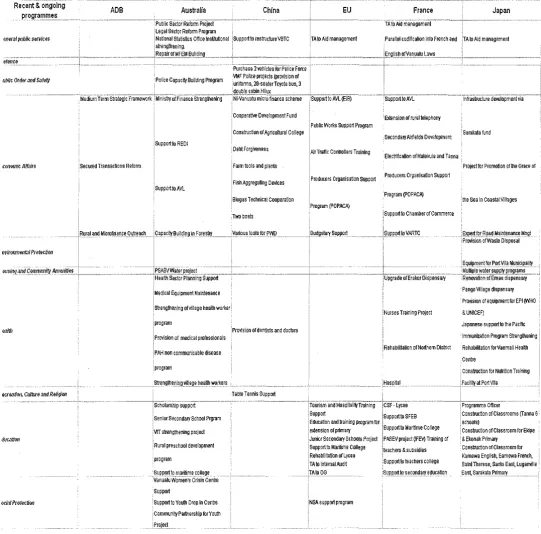
Annex 2: Financial Donor Matrix
This matrix summarises the known interventions of other donors, including the Member States and multilateral donors.
Recent& ongoing
pro_~;~r~.~~~~~--- ADB Australia
----~~---fiu-bl-iC-SSciOiRefumi-Project
~-~---China EU France Japan
ublic Order andSdlety
CWiflllliC Aff<1if5
Legal Sector Reform Program
National statistics Office lnstilulional :Supportlo restructureVBTC
Purchase 2 vehicles for Police Force
Cooperative DeYelopment Fund
Construction of Agrtcultural College
Supporlto REDI
DebtForgivanass
Secured Transacuons Reform Farm tools and plants
SupporttoAVl Fish;\;Jgregating Devices
8iogas Technical Cooperation
Two boats
.Rur~!_and Micronn_ance_Q!-!_Ir~a_ch__ Qapactly8uilding in Fmesby ____ y_a_riou~ tools for f_'yvp _
• PSABVWaterproject
Health Sectoi'Piiinli-iilg-su-PPort_" __ _
Medical Equipmenl Maintenance
strengthening of'oillage health worker
TAtoAidmanagement
Public Works Support Program
Air Traffic Conlrollers Training
Producers Organisa~on Suppa~
Program (POPACA)
-·Budgetary Support
Parallel corlilicafion into French and -TAioAid management
SupporttoAVL
E:llsnsion of rural telephony
Secondary Airtields O!Nelopment
Electrification ofMalekula and Tanna
Producers Organisation Support
Program (POPACA)
Suppa~ to Chamber or commerce ___ §upport\oVARTC
Sarakalafund
Project for PromoMn oflhe Grace of
the sea in Coastal Villages
E_):!:l~~ (~r_Bf)ad Maintenan~~ Mngt Provision of Waste Disposal
Equipment for Port VIla Municipalrt')' ·MultiPle-Witer suppl'f program-s-Upgrade ofErakcrOiSP-eOSa/Y --- -- "RalloVation of Em au dispens·a;y--··
PangoVillaga dispensary
Provision of equipmentforEPI ~0
Nurses Training Project &UNICEF)
program Japanese support\o the Pacific
e.1/lfr Provision of dentists and doctors
~cr~>aliOt4 Qt/lure,?JrdRelil}ioo ·~··· -~·
od1/ Protection
Provision of medical professionals Immunization Program Strengthening
PAH non communicable disease
program
·~~~,~,h~oiafSiiiPSUPP-ort~~·~·
Senior Secondal)' School Prgram
VlT strengthening pro jet!
Rural preschool development
program
Support to maritime college ·vanuatUWonleri's Crisis centre
Support
Support to Youth Drop In Centre
Communitj Partnership for Youth
;Pr_oj_~c!__
[image:25.599.11.552.177.711.2]Rehabimauon of North em District Rehabil~ation rorvaemali Health
Table Tennis Support
··~~.--~~~~·- -TOUriSirlaiid-HilspitalitHiiiiiiiig-~l:YCIJe~
Support Support to SFE8
Education and training program for
eldension of primary Support to Maritime College
JuniorSecondal)' Schools Project PASEVproject QFEV) Training of Support to Maritime College
Rahabilitallon ofLycee TA to Internal Audtt TAtoDG
NSA support program
teachers &subsidies
Supporttolllachers college
S_upp_o~to sec~~d~l'f e~ucatlon
Centre
Constructlon for Nutrition Training
faciltlyatPortVila
Programme Officer-·
--Construction ofCiassrooms (Tanna 6 schools)
Construction of Classroom for H:ipe & Ekonak Primary
Recent & ongoing _pr_<?grammes
elretal prrblic servftes
rll!lic Oldet a11d S<lfely
MCC NZ
·support to Court Rules Program
Support to Municipal Council
Support to VBTC Equipment ]SupportWPollce
SupporttoJurlitiary- Supreme Court
Other donors Other NGO UN WHO
... ---- --ErateRfngROad-(Uii!lradeso
t<.mi-emromicAtr."Jirs
uvironment11 Prot&tiM
rhreali()JI
oda/Protedion
S~nto East Coast road (upgrade 70kmlrom Lugarwileto Port Oltn Santo South Coast Road Bridges (15 km)
Male kula Norsup Lakatoro LilsUts
Road (reconstruct t 1 fan)
Revenue AdVIser
Malekula SouthWest Say Airstrip Support to REOI Pentecos!Lol!ongWharf & N-S road
(8km)
TannaWMes~nds Road Epi Lam en bay Wharf Arnbae Road Cree~ Crossings (for 50
km)
Malo Road upgrade drainage &coral surfacing (15fan)
Warehouses (5 inti L~katoro,
Lena!re~
Support to Island Bungalows
Training for air traffic controllers B~nk)
improve ace ass to health and
Mulfiple hand pump projects
(Canada) CommunrlyBased education services
Capacfty building VaiiWllods Fishing {FFA) lnsti!ulional
WW-Comrn-based business stren(!lhening (RED I) (VSO)
opportuntty{Farm products Peace Corps-Youth Agriculture and
___ !l!~_!i_tytional stren(!lhening PWQ __ ---~!!__rl!l_f!l_i_c ppp~r)l.mity lniffative E!Mmnmen!(YAE) Project ______ p~~essrng &Marketing) Santo Various erMronmental management
plans (SPREP)
Urban Squatter Settlement Survey (Escap)
UNOP(Landholders Initiative
Projecl)-8iotlNersity conservation (fanna,
Gaua, Santo)
- ---~- Operation Mosquilo (ROla!Y) --MatemityWard Emnston (Rolal'l') Supportto HIVprogram (VSO)
VFHA F amity Heanh- roprMuctt;e health in all provinces
UNFPA- ReproduCiFve Health --- --~NOrih-e"iii'biStiicfi·lrisPrti("'
Support to Ambul~nce Ser.ice
Peace Corps -MemorandumwllloH for Public Health (Shefa)
(Strengthening RH lnfnrrnation &
Service)
UNICEF -Integrated Mgml of Child
Illness VFHA Reprod healtll & Youth D8'11wilh UNICEF
fishing (Pentecos~ Gaua, Matekuta, Brest Feeding Hospital
Development Plan Malaria, othervector-bome and parasitic diseases Stop TB and Leprosy elimination Communicable diseases surverllance and response Heallh Sys d8'11&financlng Stood safety & cllnlcaltechnology Human Resources for health Others: Non-communicable Arnbi'JTTl, Toka)
WW-HMAiOS Rolal"f- construction ofTORBA
lniliatiVe (?V, lenaket (fafea))
diseases control, Mental Helatll, UNICEF- Nutrition Education Tafea & Health Insurance, Gender &
hos_p~1_(21_~~-d~) __
S~pporl tu Customary Land Tribunals
Malam~a Support to Cuilural Centre UNESCO-Cuilural centre (PentecosQ
~~,,~,h~ol~.,;s,hip s~ppo-rt - ---Edilc""aii(iii-SUPPo·rt·MtOriil~s~.oMk)~CiVRiiDTCA Support DNESCo."indT>IFinOi.isLa"ngi.iiiie···
-Educotian Assistance Program
(Primary and Junior Seconda/'1)
PSABV Capacity Building Project
Peace Corps-Formal education
(2ndal\'l Math, Science, Business
sludies
RevitalisaMn & PreseMitlon UNICEF- AdVocacy & Protection for Children (CRC & CEDAW)
WW-Functional UteracyinTafea & ~~~~EF-Disability Awareness In UNICEF- Early Childhood Education (PSNN Pre-skiJIAssn) Tanna UNOP- Non formal education
-~~-~j!l_e_~_s_M_a_n.a~~-l:rJ.!!.~! I~il11i!L~C~ Corps -Rural Trainin~l!J!~-"~-n_f!l~ J?_~_U!.~.§~n_!!l,I_a_~,£~n3.~ strengtllenin!l:J!!:Eiect C'1l1!1!1L_ SupporttoWan Smol !lag FSPNSO Pacific Skills Unk projectto WSByouth community centres Population policy development
UNDP- VAM'iODS Micro1iMncefor slren(!lhen NGOs (VSO) WW-Community based disasrer women
TafeaWomen'sArts ano Crafts UNESCO- Tradrtlonal Money Sanks w
Voices &Choices, Community 1m I preparedness project in Sanma, Vanuatu Cred~Union League, Reveluate &use kaditlonalform of _ Sanma counselling Centre _good govern~nce research (VSO) Tale a, Torba money