This is a repository copy of
Metamorphic testing of constraint solvers
.
White Rose Research Online URL for this paper:
http://eprints.whiterose.ac.uk/141633/
Version: Accepted Version
Proceedings Paper:
Akgun, Ozgur, Gent, Ian Philip, Jefferson, Christopher Anthony et al. (2 more authors)
(2018) Metamorphic testing of constraint solvers. In: Hooker, John, (ed.) Principles and
Practice of Constraint Programming:24th International Conference, CP 2018, Lille, France,
August 27-31, 2018, Proceedings. Lecture Notes in Computer Science . Springer ,
Netherlands , pp. 727-736.
https://doi.org/10.1007/978-3-319-98334-9_46
[email protected] https://eprints.whiterose.ac.uk/ Reuse
Items deposited in White Rose Research Online are protected by copyright, with all rights reserved unless indicated otherwise. They may be downloaded and/or printed for private study, or other acts as permitted by national copyright laws. The publisher or other rights holders may allow further reproduction and re-use of the full text version. This is indicated by the licence information on the White Rose Research Online record for the item.
Takedown
If you consider content in White Rose Research Online to be in breach of UK law, please notify us by
Metamorphic Testing of Constraint Solvers
Özgür Akgün, Ian P. Gent, Christopher Jefferson, Ian Miguel, Peter Nightingale
School of Computer Science, University of St Andrews, St Andrews, UK {ozgur.akgun, ian.gent, caj21, ijm, pwn1}@st-andrews.ac.uk
Abstract. Constraint solvers are complex pieces of software and are notoriously difficult to debug. In large part this is due to the difficulty of pinpointing the source of an error in the vast searches these solvers perform, since the effect of an error may only come to light long af-ter the error is made. In addition, an error does not necessarily lead to the wrong result, further complicating the debugging process. A major source of errors in a constraint solver is the complex constraint propaga-tion algorithms that provide the inference that controls and directs the search. In this paper we show that metamorphic testing is a principled way to test constraint solvers by comparing two different implementa-tions of the same constraint. Specifically, specialised propagators for the constraint are tested against the general purpose table constraint propa-gator. We report on metamorphic testing of the constraint solverMinion.
We demonstrate that the metamorphic testing method is very effective for finding artificial bugs introduced by random code mutation.
1
Introduction
Metamorphic testing [24] involves generating new test cases from existing ones, where the expected result of a new test case can be generated from the result of an existing test via ametamorphic relation. By comparing the results of the original test with the new one we can identify cases where the metamorphic relations are broken, indicating the presence of errors in the implementation. As an illustrative example in the context of a constraint satisfaction problem (CSP), given any unsolvable CSP, adding a constraint or removing domain values from a variable should result in another unsolvable CSP.1
Metamorphic testing cannot be used completely in isolation — a solver that immediately returns that a problem is unsolvable would pass all of the meta-morphic tests given in this paper. However, the big advantage of metameta-morphic testing of a constraint solver is that it transforms the relatively hard problem of validating the behaviour of a constraint solver against an independent oracle into comparing a solver against its own behaviour on a different problem.
One major area of constraints research is the creation of new propagation algorithms for constraints. Here metamorphic testing shines — we can check
1 The authors have experienced both of these conditions being violated in both their
the correctness and propagation level of a new propagation algorithm for a con-straint by comparing it with a previously existing algorithm. Assuming the two algorithms do not contain exactly the same bug (which is unlikely, if the two al-gorithms were independently designed and implemented), comparing one against the other provides us with a high level of confidence that both are correct.
The central argument of this paper is that metamorphic testing is a good fit for constraint solving. While it can be difficult to solve a constraint problem, it is easy to generate one randomly, and there are simple transformations that can take one constraint problem and produce another with the same set of solutions.
2
The Constraint Solver
Minion
Throughout this paper, we use theMinionconstraint solver to illustrate meta-morphic testing in constraint solvers. We begin with an overview of the most important features of Minion’s input language, for a more extensive discussion of Minion’s features see [10].
Variable Types: Minionprovides four implementations of integer variables.
BOOL(Initial domain must be {0,1}),DISCRETE andBOUND (Initial domain must be a range {x..y}) and SPARSEBOUND. BOUND and SPARSEBOUND only support changing the bounds of a variable during search.
Constraints: The current release of Minion features 72 constraints, includ-ing arithmetic and logical constraints, element [8], alldiff [11] and gcc [19]. Constraints can also be combined, either disjunctively or conjunctively [14].
Reification : Every constraint in Minion can be reified or reifyimplied [14] (also called half reification [6]): these combine a constraintC and a Boolean
binto the new constraintb ⇐⇒ C andb =⇒C respectively.
Search Orders: Minion provides ten variable orderings, including static or-derings, smallest domain first, conflict ordering [18] and weighted degree [2].
Global Propagation Level: Minioncan perform higher levels of consistency, including Singleton Arc Consistency [5].
Some ofMinion’s features make testing particularly challenging. Several con-straints have different implementations for the different types of variables. Also, Minion allows propagators to dynamically change the set of variables whose changes they are informed of. Further, these changes can either automatically revert when search backtracks, or remain in their new location [8]. This means testing must verify how a propagator behaves over an entire search.
3
Instance-based Testing in
Minion
The original method of testingMinioninvolved a set of small test instances, for which the following information was derived by hand:
Metamorphic Testing of Constraint Solvers 3
NODECOUNT n The number of search nodes until the first solution under Min-ion’s default search strategy isn.
CHECKONESOL sol The first solution with Minion’s default search strategy is
sol(given as a list).
SOLCOUNTtests are used to test variable and value ordering heuristics, while
NODECOUNTis used to check that a constraint propagator achieves an expected
level of consistency. At the time of writing, this test suite includes 312 instances. New tests are added whenever a bug is discovered inMinion.
For illustration, the bugs found in the inequality constraint (Pci×xi≤yfor constantsci and variablesxiandy) before metamorphic testing was introduced include: Summing a list of Boolean variables to ≥ −1; summing variables to greater than 65,536 (which overflowed theunsigned shorttype in C); crashing
if anyci= 0; and sums where all variables were assigned at the root node. This test-based approach is effective at preventing the reintroduction of pre-viously identified bugs. However, we still found users discovering a large number of errors. This motivates the adoption of the more proactive metamorphic ap-proach. Instance-based testing remains in use to complement the metamorphic tester described in the following section, and remains the primary means of test-ing variable and value ordertest-ing heuristics.
4
Metamorphic Testing in
Minion
In this section we explain howMinionuses metamorphic testing for propagators. Given a constraint propagator to test, testing begins by generating a problem instance consisting of a single occurrence of that constraint with a random do-main for each variable in its scope. As an example, considerdifference(x,y,z),
which implements the constraint |x−y| = z. The leftmost instance in Fig. 1 shows a corresponding instance. The tester adds several random additional con-straints, as presented in the middle instance of Fig. 1. These extra constraints are necessary because many bugs only occur when multiple propagators inter-act. Optionally, the tester may at this stage create an optimisation problem by MAXIMISING or MINIMISING a randomly chosen variable. Finally, the tester transforms this instance into another instance with the same set of solutions by replacing the constraint being tested with an equivalent table constraint, as presented in the rightmost instance of Fig. 1. The tester then compares the searches of the middle and rightmost instances.
We test the reified version of each constraint propagator separately. The production of metamorphic instances proceeds similarly, but differs in the con-struction of the table constraint. The scope of the table constraint includes that of the reified constraint, and the reification variable.
The rationale for using a table constraint is that it can represent any other constraint and many propagators for the table constraint achieve GAC [15].
MINION 3 **VARIABLES** DISCRETE x1 {-3..0} DISCRETE x2 {0..4} DISCRETE x3 {0..1} **CONSTRAINTS** difference(x1,x2,x3) **EOF**
MINION 3 **VARIABLES** DISCRETE x1 {-3..0} DISCRETE x2 {0..4} DISCRETE x3 {0..1} **CONSTRAINTS** difference(x1,x2,x3) diseq(x1,x3)
eq(x2,x3) **EOF**
MINION 3 **VARIABLES** DISCRETE x1 {-3..1} DISCRETE x2 {-0..4} DISCRETE x3 {0..1} **TUPLELIST** tab 3 3
-1 0 1 0 0 0 0 1 1 **CONSTRAINTS** table([x1,x2,x3],tab) diseq(x1,x3)
eq(x2,x3) **EOF**
Fig. 1: Stages of production of metamorphic instances.
The testing process is automated in Python. For each propagator, there is a Python function that, given a list of domains for each variable, returns the list of allowed tuples.Minionis run on the original and transformed instances with the default static variable ordering. The search trees of both instances are compared according to the metamorphic relations described in the following section.
5
Tree Comparison
The tester compares the search trees explored byMinionin solving two different instances, which differ only in the expression of the constraint being tested. If the tested propagator achieves GAC,Minionwill explore identical search trees for both instances. If the propagator achieves less than GAC then the search tree may include extra nodes and values but will still find the same set of solutions. We begin with a formal definition of a two-way branching search tree, which is commonly employed in modern constraint solvers, including Minion:
Definition 1. Consider a CSP with a list of variablesV and a functionDwhich gives the initial domain of every variable. A search node contains a functionN
which maps each v∈V to a subset of D(v)and one of the following labels:
Fail : A fail node has no children and represents no solutions. In this case
∀v∈V.|N(v)|= 0(some solvers do not empty all domains at a failure node. We require this to make node comparison easier)
Solution : In asolution node, |N(v)|= 1for all v∈V.N then represents a single assignment to every variable, which is a solution to the CSP.
Branch : In a branch node, there is a branching literal hv, xi, where v ∈ V
andx∈D(v) and two child nodes, where in the leftv is assignedx, and in the rightxis removed from the domain ofv.|D(v)| must be>1.
Metamorphic Testing of Constraint Solvers 5
When the tester compares two propagators which achieves GAC, comparing search trees is easy – check the search trees are identical, including equality of the variable domains at each node. For weaker propagators we need a more complex method of comparing trees, which is given in Definition 2.
Definition 2. Consider a set of variables V with initial domainsD and search nodesN1, N2from two search trees of CSPs with variablesV with initial domains
D (but possibly different constraints). The tree rooted on N1 is a subtree of the tree rooted onN2 if∀v∈V.N1(v)⊆N2(v) and the following are true:
– IfN2 is asolution node, so isN1, similarly ifN2 is afailnode, so is N1.
– IfN2is abranchnode with branch literall=hv, xi, then one of the following cases is true:
• N1 is also a branchnode, N1 also branches on l, andN1’s left child is a subtree ofN2’s left child (and similarly for right child).
• x /∈N1(v), there are no solutions in the subtree underN2’s left child and
N2’s right child is a subtree ofN1.
The most complex part of Definition 2 is the final branching case. In this case, we branch on a literal inN2that does not occur inN1. All we know about the left branch of this node is that it will contain no solutions. We will show later this is equivalent to being a supertree of a fail node.
We also need to define propagators, and how they change search states. The property the tester uses to compare search trees is given in Lemma 1 below. Intuitively, Lemma 1 shows that if we run propagators on a search state, then either adding more literals to the search state, or replacing one or more propa-gators with weaker propapropa-gators, never leads propagation removing more literals. This lemma uses the fact that a GAC propagator removes every literal which can correctly be removed and that propagators are inflationary (they never add literals to the search state). This lemma applies to a wide range of propaga-tors, including non-monotonic propagators or propagators which use randomised algorithms[23]. This paper does not contain a full discussion of propagators: for a general overview see [1,22].
Lemma 1. Consider two search states N and M on the same set of variables
V, where ∀v ∈V.N(v)⊆M(v)(from here denoted by N ⊆V M), and two lists of inflationary propagators P =hp1, . . . , pniand Q=hq1, . . . , qni where for all i,pi andqi are both propagators for a constraintci and the pi achieves GAC. If
NP is a result of applying elements ofP toN until a fixed point is reached, and similarly for MQ, thenNP ⊆V MQ.
Proof. We proceed by induction. Consider a search stateS whereNP ⊆V S⊆V
M, and a propagator qi ∈ Q. Then the result SQ of applying qi to S must be contained in M as qi is inflationary, and must satisfyNP ⊆V SQ, because
NP ⊆S, andNP is a fixed point for P and therefore all of the pi.
Lemma 2. Consider a set of variablesV with initial domains D, and two lists of propagators P =hp1, . . . , pni andQ=hq1, . . . , qni, where for alli pi andqi are both propagators for a constraintci, and thepi achieves GAC. Given a static variable and value ordering, a search tree generated byP is a subtree of a search tree generated by Q.
Proof. We will proceed inductively. To begin, applyPandQtoDto get the root nodes of the search states. By Lemma 1 we know that ∀v ∈ V.P(D)⊆ Q(D), and as correct propagators never remove solutions, the set of assignments to
P(D)andQ(D)which are solutions will be the same. Now consider any pair of search statesNP andNQ where∀v∈V.NP(v)⊆NQ(v)and the assignments to
NP andNQ which are solutions are the same. We then continue our induction by considering the possible types ofNQ.
If NQ is a branch node with branching literal l = hv, xi, there are two possibilities: eitherx∈NP(v)orx6∈NP(v). Ifx6∈NP(v), then the left child of
NQ is created from NQ by reducing the domain ofv to {x} and then applying
Q. None of the assignments to this search state will be solutions, asx6∈NP(v) and the set of assignments to NP and NQ which are solutions are the same. Therefore this child and all of its children are notsolutionnodes.
Ifx∈ NP(v), then the branching literal we pick for NP must also be l, as the value and variable order is static. The left child ofNP is created by reducing the domain of v to {x} and then running P to a fixed point. The left child of
NQis created similarly, and by Lemma 1 these children will satisfy our inductive hypothesis. Similarly, the right children also satisfy the inductive hypothesis.
IfNQ is a failnode, then as∀v∈V.NP(v)⊆NQ(v),NP is also afailnode. Similarly, if NQ is a solution node, then as the assignments to NQ and NP which are solutions are the same, then NP must also be asolution node.
6
Practical Experience
Metamorphic testing was introduced into Minion in 2007. It is impossible to measure reliably the number of bugs it has discovered over time, as it has been used during the development of every constraint [13,14,20,15,19,11,12,9] added toMinionsince 2007 and many bugs will be found at this stage. We can say no bug has been reported in any propagator which was published after development in Minion, except for one which was not added to the metamorphic tester.
6.1 Mutation Testing
In order to test the robustness of metamorphic testing, we performed muta-tion testing [4,16]. We tested three constraints: strict (lexless) and non-strict
(lexleq) lexicographic ordering, difference, and the reified and reifyimplied
variants of these three constraints. difference is an example of a
propaga-tor with complex arithmetic, whilelexlessandlexleqare global constraints.
Metamorphic Testing of Constraint Solvers 7
and the lexconstraints for 100 tests (the metamorphic tester tests global
con-straints less as tests take much longer to run). We ran the tester 10 times on each mutation. After filtering out non-compiling mutations, for each constraint we have 20 mutations generated by changing a random Boolean operator (an ROR mutation [17]) and 10 mutations generated by removing a random line of code (an SDL mutation [17]).
The tester found each bug in at least one out of the ten test runs. The non-buggy mutations fall into three groups. Five mutations introduced inefficiencies without changing propagation. Three mutations changed the propagation level of a non-GAC propagator, which is not currently be detected. Finally, one mutation improved performance by removing unnecessary code!
Three mutations were only detected in some runs of the tester. Two lex bugs passed more than half of the time, each passing six out of ten test runs. These bugs only affected the first invocation of the constraint, and required several variables already to be assigned by other constraints. This demonstrates the importance of introducing extra constraints to the models. One difference instance passed eight out of ten times. This bug introduced a problem in reifying the constraint, by acting as if the domain of the first variable had no holes in it. This problem only very occasionally resulted in an incorrect solution.
0 10 20 30 40 50 60 70 80 90 100
0 20 40 60 80 100 120 140 160 180 200
First failing test
Mutation
[image:8.595.143.408.380.536.2]First failing test for code mutations that introduced bugs
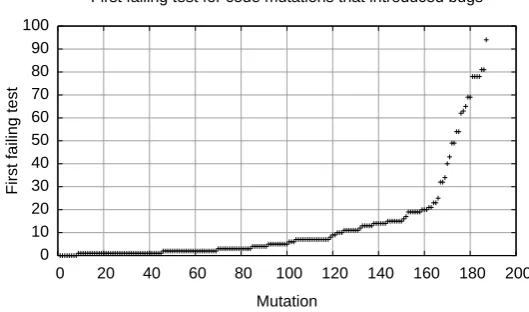
Fig. 2: Number of tests before detecting a bug introduced by a code mutation
Figure 2 shows the median number of tests that were needed before detecting a bug that was introduced by a source code mutation, sorted by first failing test. In many cases bugs are detected with less than 25 test instances.
6.2 Limitations of Metamorphic Testing
was not added to the metamorphic tester. The other two involved large domains – the first involved domain values larger than 230, the second searches with more than 231 search nodes. Another source of occasional bugs has been bad behaviour on inputs which were supposed to be rejected – the tester only tests valid constraint problems.
6.3 Related Work
Many large A.I. systems have developed similar test frameworks, where many problems, sometimes randomly generated, are tested for correctness. We discuss a few of the most relevant here.
Testing of the Gecode solver [7] has evolved similarly toMinion’s. Gecode has an extensive list of fixed tests and a tester which uses random problems. Gecode’s random tests creating a random search state which contains a known solution. Literals not in the known solution are removed one by one and the propagator is run, checking no literals from the known solution are ever removed. Other properties of propagators (such as if reaching a fixed point) are also checked. This approach has some limitations compared to Minion, such as not testing multi-solution problems, optimisation problems, or if the propagator works when backtracking. Also, search-tree comparison metamorphic testing should be easier to add to other solvers, as it only requires solvers to output their search tree.
Brummayer and Biere [3] generate random inputs for SMT solvers. Tthey compare the results of multiple solvers looking for inconsistencies. This was very successful, but not useful for solvers like Minion with a unique input format. Also, their technique could not be used to detect the level of propagation achieved.
Reger, Suda and Voronkov discuss the testing of the Vampire theorem prover [21]. They use a fixed set of benchmarks, testing the solver’s many configuration options against each other, and also validating the generated proof.
7
Conclusions
Overall, metamorphic testing has been a great success forMinion. It is impossi-ble to measure the number of bugs it has discovered, as it is used by developers when creating new propagators, when large numbers of bugs are found and fixed during development.
While metamorphic testing has been very useful inMinion, it is not imme-diately applicable to all solvers. One major limitation is learning solvers, where new constraints are added during search. Significant metamorphic tests could still be performed in such solvers by checking that the solver produces the same set of solutions, and optimisation problems achieve the same optimal solution. It would be interesting to investigate if more subtle forms of metamorphic testing would be beneficial in such cases.
Acknowledgements We thank EPSRC for funding this work via the grants
Metamorphic Testing of Constraint Solvers 9
References
1. Apt, K.: Principles of Constraint Programming. Cambridge University Press, New York, NY, USA (2003)
2. Boussemart, F., Hemery, F., Lecoutre, C., Sais, L.: Boosting systematic search by weighting constraints. In: ECAI 04. pp. 482–486 (2004)
3. Brummayer, R., Biere, A.: Fuzzing and delta-debugging SMT solvers. In: Proceed-ings of the 7th International Workshop on Satisfiability Modulo Theories. pp. 1–5. SMT ’09, ACM, New York, NY, USA (2009)
4. Budd, T.A.: Mutation Analysis of Program Test Data. Ph.D. thesis, New Haven, CT, USA (1980)
5. Debruyne, R., Bessière, C.: Some practicable filtering techniques for the constraint satisfaction problem. In: Proc. 15th International Joint Conference on Artificial Intelligence (IJCAI 97). pp. 412–417 (1997)
6. Feydy, T., Somogyi, Z., Stuckey, P.J.: Proceedings of the 17th International Con-ference Principles and Practice of Constraint Programming, chap. Half Reification and Flattening, pp. 286–301. Springer, Berlin, Heidelberg (2011)
7. Gecode Team: Gecode: Generic constraint development environment (2006), avail-able fromhttp://www.gecode.org
8. Gent, I., Jefferson, C., Miguel, I.: Watched literals for constraint propagation in minion. In: Proceedings of the Twelfth International Conference on Principles and Practice of Constraint Programming (CP 2006). vol. 4204, pp. 182–197. Springer Berlin / Heidelberg (2006)
9. Gent, I.P., Jefferson, C., Linton, S., Miguel, I., Nightingale, P.: Generating custom propagators for arbitrary constraints. Artificial Intelligence 211, 1 – 33 (2014), http://www.sciencedirect.com/science/article/pii/S000437021400023X 10. Gent, I.P., Jefferson, C., Miguel, I.: Minion: A fast scalable constraint solver. In:
ECAI. vol. 141, pp. 98–102 (2006)
11. Gent, I.P., Miguel, I., Nightingale, P.: Generalised arc consistency for the alldif-ferent constraint: An empirical survey. Artificial Intelligence 172(18), 1973–2000 (2008)
12. Gent, I., Jefferson, C., Miguel, I., Nightingale, P.: Data structures for generalised arc consistency for extensional constraints. AAAI (CPPOD-19-2006-A), 191–197 (2007),http://www.aaai.org/Papers/AAAI/2007/AAAI07-029.pdf
13. Jefferson, C., Kadioglu, S., Petrie, K.E., Sellmann, M., Živný, S.: Same-relation constraints. In: Proceedings of the 15th International Conference on Principles and Practice of Constraint Programming (CP’09). No. 5732 in LNCS (2009),http: //zivny.cz/publications/jkpsz09cp-preprint.pdf
14. Jefferson, C., Moore, N.C.A., Nightingale, P., Petrie, K.E.: Implementing logical connectives in constraint programming. Artificial Intelligence 174(16-17), 1407– 1429 (11 2010)
15. Jefferson, C., Nightingale, P.: Extending simple tabular reduction with short sup-ports. In: IJCAI (2013)
16. Jia, Y., Harman, M.: An analysis and survey of the development of mutation testing. IEEE Transactions on Software Engineering 37(5), 649–678 (Sept 2011) 17. King, K.N., Offutt, A.J.: A fortran language system for mutation-based
soft-ware testing. Softsoft-ware: Practice and Experience 21(7), 685–718, https:// onlinelibrary.wiley.com/doi/abs/10.1002/spe.4380210704
19. Nightingale, P.: The extended global cardinality constraint: An empirical survey. Artificial Intelligence 175(2), 586–614 (2011)
20. Nightingale, P., Gent, I.P., Jefferson, C., Miguel, I.: Short and long supports for constraint propagation. J. Artif. Int. Res. 46(1), 1–45 (Jan 2013),http://dl.acm. org/citation.cfm?id=2512538.2512539
21. Reger, G., Suda, M., Voronkov, A.: Testing a saturation-based theorem prover: Ex-periences and challenges. In: Gabmeyer, S., Johnsen, E.B. (eds.) Tests and Proofs. pp. 152–161. Springer International Publishing, Cham (2017)
22. Rossi, F., van Beek, P., Walsh, T. (eds.): Handbook of Constraint Programming. Elsevier (2006)
23. Schulte, C., Tack, G.: Weakly monotonic propagators. In: Gent, I. (ed.) Fifteenth International Conference on Principles and Practice of Constraint Programming. Lecture Notes in Computer Science, vol. 5732, pp. 723–730. Springer-Verlag (2009), http://www.gecode.org/paper.html?id=SchulteTack:CP:2009