Int. J. Electrochem. Sci., 8 (2013) 10396 - 10423
International Journal of
ELECTROCHEMICAL
SCIENCE
www.electrochemsci.org
Theoretical Study Of The Structural, Electronic Structure,
Fermi Surface, Electronic Charge Density and Optical
Properties of the of LnVO
4(Ln= Sm, Eu, Gd and Dy)
A. H. Reshak1,2, Sikander Azam1,*
1
Institute of complex systems, FFPW, CENAKVA, University of South Bohemia in CB, Nove Hrady 37333, Czech Republic
2
Center of Excellence Geopolymer and Green Technology, School of Material Engineering, University Malaysia Perlis, 01007 Kangar, Perlis, Malaysia
*
E-mail: [email protected]
Received: 18 May 2013 / Accepted: 7 July 2013 / Published: 1 August 2013
We present first-principles calculations of the electronic structure, Fermi surface, electronic charge density and optical properties of LnVO4 (Ln= Sm, Eu, Gd and Dy)based on density-functional theory
using the local density approximation (LDA), generalized-gradient approximation (GGA) and the Engel Vosko GGA formalism (EV-GGA). The calculated band structure and density of states show that LnVO4 compound is metallic. The total DOS at Fermi level N(EF) were 1.49, 0.95, 1.93 and 4.69
states/eV unit cell, and the bare electronic specific heat coefficient (γ) are 0.26, 0.16, 0.33 and 0.81 mJ/mol-K2 for SmVO4, EuVO4, GdVO4 and DyVO4, respectively. The Fermi surface of EuVO4
compound is composed of one band and SmVO4, GdVO4 and DyVO4 composed of two bandscrossing
along the Γ−A direction of Brillion zone. The bonding features are analyzed by using the electronic charge density contour in the (1 0 1) crystallographic plane. We found that Ln-O and V-O atoms forms a strong covalent. For further insight information about the electronic structure, the optical properties are derived and analyzed.
Keywords: FPLAPW calculations; Electronic structure; Fermi surface; Charge density; Optical properties; DFT:
1. INTRODUCTION
form LnVO4. This situation was cured, at least in fraction, by the fresh report by Chakounmkos et al.
[I] of the bursting profile Rietveld structural scrutiny of neutron powder-diffraction data for the zircon-structure LnVO4 compounds with Ln = Sc, Cc, Y, Pr, Nd, Tb, Yb, Er, He, Tin and Lu. Preceding to
this investigation, high-precision X-ray diffraction single-crystal structure results were only existing for CeVO4 [2] and NdVO4,[3] whereas lower precision refinements, centered on neutron powder
diffraction data, had been accounted for TbVO4, DyVO4, ErVO4, HoVO4 and YbVO4 [4-6].
Whereas the full-profile Rietveld assessments of Chakoulllakos et al. [I] granted accurate crystallographic data for numerous of the rare-earth orthovanadate compounds (plus ScVO4 and
YVO4), neutron-powder diffraction data could not be attained for the lanthanide compounds EuVO4,
SmVO4, EuVO4and GdVO4, due to their soaring cross sections for neutron absorption.
Neither experimental nor theoretical details regarding the electronic structure, Fermi surface, electronic charge density and optical properties are available in the literature. The reasons mentioned above motivate us to perform these calculations, using the full potential linear augmented plane wave (FP-LAPW) method in order to provide reference data for the experimentalists and to complete existing theoretical works on this material.
The rest of the paper has been divided in three parts. In Section 2, we briefly describe the computational techniques used in this study. The most relevant results obtained for the electronic structure, Fermi surface, electronic charge density and optical properties for EuVO4, SmVO4, EuVO4
and GdVO4 compounds are presented and discussed in Section 3. Finally, in Section 4 we summarize
the main conclusions of our work.
2. CALCULATION METHODOLOGY
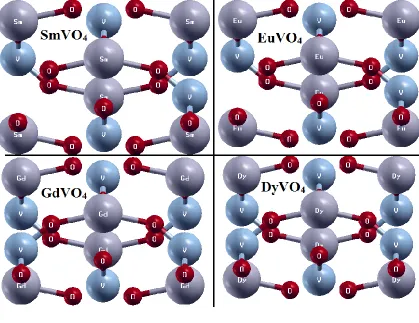
The crystal structure of EuVO4, SmVO4, EuVO4 and GdVO4 are shown in Fig.1. The scrutinize
compounds have the tetragonal symmetry with space group I41/amd (No. 141). The lattice constant for EuVO4 are a=7.2647(9) Å and c= 6.384( 1 ) Å, for SmVO4 area=7.2358(7) Å and c= 6.362( 1 ) Å, for
EuVO4 are a=7.2122(7) Å and c=6.346(2) Å and for GdVO4 are a=7,1429(8) Å and c=6.300(2) Å. The
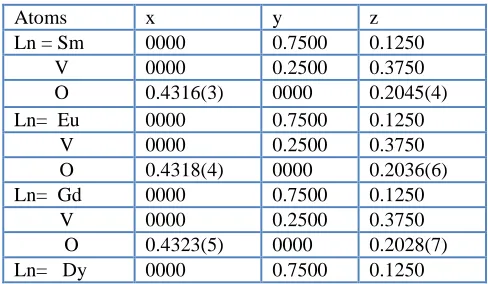
[image:2.596.176.420.618.760.2]atomic position in sequence for EuVO4, SmVO4, EuVO4 and GdVO4 are given in Table 1.
Table 1. Atomic positions of the LnVO4 compound.
Atoms x y z
V 0000 0.2500 0.3750 O 0.4340(7) 0000 0.2016(6)
We have executed the calculations using the full-potential linear augmented plane wave [FPLAPW] as incorporated in WIEN2K code [7]. This is an implementation of the density functional theory (DFT) [8,9] with different possible approximations for the exchange correlation (XC) potentials. The XC potential were the local density approximation (LDA) of Ceperley–Alderas parameterized by Perdew–Zunger [10], generalized gradient approximation (GGA) of Perdew–Burke– Ernzerhof (PBE) [11], which is based on exchange-correlation energy optimization to calculate the total energy. Also we have used the Engel–Vosko GGA formalism (EVGGA) [12], which optimizes the corresponding potential for band structure calculations. In order to achieve energy eigenvalues convergence, the wave functions in the interstitial region were expanded in plane waves with a cut-off Kmax = 7/RMT, where RMT denotes the smallest atomic muffin-tin sphere radius and Kmax gives the
magnitude of the largest K vector in the plane wave expansion. The RMT were taken to be 2.24, 2.23, 2.22 and 2.14 atomic units (a.u.) for Sm, Eu, Gd and Dy respectively and for V and O were 1.62 and 1.43 a.u. A mesh of 2000 k points was used in the irreducible Brillion zone integration. In the self consistent field for electronic structure, Fermi surface and optical properties convergence was checked through self consistency. The valence wave functions inside the muffin-tin spheres are expanded up to lmax = 10, while the charge density was Fourier expanded up to Gmax = 12 (a.u.)−1.
3. RESULTS AND DISCUSSION
3.1. Electronic structure
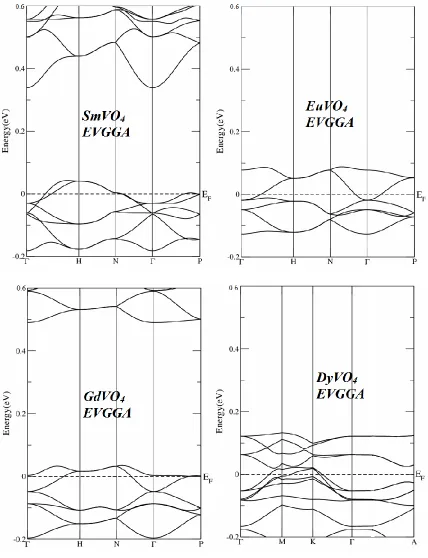
Fig. 2 shows the calculated energy band structure of LnVO4 compounds at equilibrium lattice
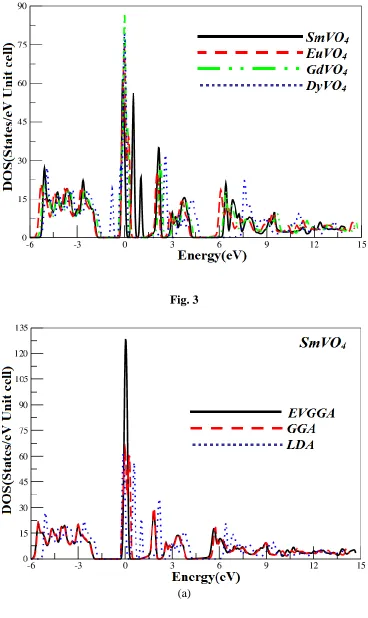
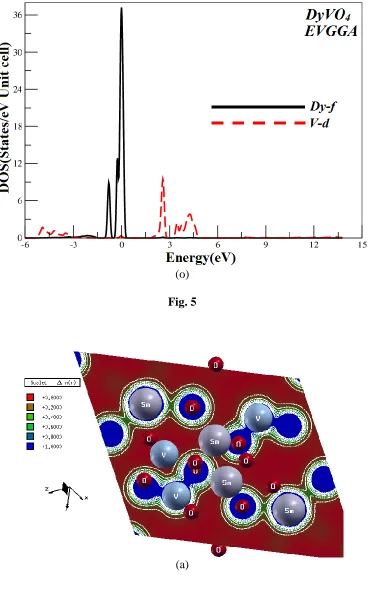
parameters along the high symmetry directions in the Brillion zone. The valence and conduction bands overlap considerably at the Fermi level as a result these would exhibit metallic properties. More understanding can be achieved from the total and partial density of states (TDOS and PDOS) which are also depicted for the investigated compounds in Fig. 4 and 5. We displayed the calculated results by the EVGGA approximations. With the reason that this approximation gives better band splitting as well optical transition as is clear from the Fig. 4 and 5, that when we replace Sm by Eu and Gd so the peaks shift towards the lower energies and when we replace Gd by Dy again the peaks shifts towards the higher energies.
At the Fermi level EF, the values of TDOS (EVGGA) for SmVO4, EuVO4, GdVO4 and DyVO4,
were 1.49, 0.95, 1.93 and 4.69 states/eV unit cell, respectively. Hence one may to conclude that DyVO4 is more conducting than SmVO4, EuVO4, and GdVO4.
The electronic specific heat coefficient (γ), which is a function of the density of states, can be calculated using the expression 2
23 1
F K , where N(EF) is the DOS at the Fermi energy EF
and kB is the Boltzmann constant. The calculated density of states at the Fermi energy N(EF) enables us
to calculate the bare electronic specific heat coefficient, which is 0.26, 0.16, 0.33 and 0.81 mJ/mol-K2 for SmVO4, EuVO4, GdVO4 and DyVO4, respectively.
Electron charge density denotes the nature of the bond character. In order to predict the chemical bonding and also the charge transfer in SmVO4, EuVO4, GdVO4 and DyVO4 compounds, the
charge-density behaviors in 2D are calculated in the (1 0 1) plane and displayed in Figs 6. The result shows that the substitution of the Sm by Eu, Gd and Dy leads to redistribution of electron charge density i.e. the bond distances increase. As an atom is interchanged by the others the VSCC (valence shell charge carrier) properties changes (Badar et. al ). By investigating the influence of replacing Sm by Eu, Gd and Dy in SmVO4, EuVO4, GdVO4 and DyVO4 compounds, it has been found that the
charge density around ‘Sm’ and ‘Eu’ is greater than both of Gd and Dy atoms. From the calculated electron density it is clear that Ln and O, and also V and O atoms forms a strong covalent bond.
3.2. Fermi surface
It is well established that electronic states crossing the Fermi level are primarily responsible for the Fermi surface (FS) structure and always considered as a key quantity to understand the electronic structure of any metallic material. The conventional way to find out the Fermi surface is to measure energy distribution curves (EDC) for distinct points of the Brilliouin zone and to ascertain the k-locations where bands traverse the Fermi energy. The electrons adjacent to the Fermi level are responsible for conductivity, the electronic structure of any metallic material is understandable from the Fermi surface (FS). Fermi surfaces can also be inspected by using de Haas van Alphen (dHvA) experiments, the exact determination of the shape of the FS depends on models using easy geometries to define the magnetic field angle dependency of the measured frequencies, but the accurate shape of the FS can of course be much further complex. Therefore we figured the FS of SmVO4, EuVO4,
GdVO4 and DyVO4 using the FPLAPW method outlined above. The results are shown in Fig 7.
The Fermi surface of EuVO4 compound is composed of one band while SmVO4, GdVO4 and
DyVO4 composed of two bands crossing along the Γ−A direction of Brillion zone. The SmVO4,
EuVO4, GdVO4 and DyVO4 Fermi surface consist of a set of holes and electronic sheets, where the
empty areas contain holes and shaded areas electrons.
velocity of electron. The structure of the four compounds are considerably the same but the changes occur in the color which resulting the change in velocity of electron.
3.3. Optical Properties
Study the optical properties of solids has been an interesting research topic in basic research as well as for industrial applications. In basic research the origin and nature of different excitation processes are of fundamental interest and in the industrial applications can make use of them in many optoelectronic devices. Therefore optical properties bring together experiment and theory. The calculation of 2
requires energy eigen-values and electron wave functions. These are natural outputs of a band structure calculation. The interband transitions of the dielectric function can be split into direct and indirect transitions. We overlook the indirect inter-band transitions involving scattering of phonons that are expected to give a small contribution to
[13]. To compute the direct inter-band contributions to the imaginary part of the dielectric function2
, it is essential to operate summation up all likely transitions from the occupied to the unoccupied states. These compounds are crystallized in the I41/amd (#= 141) space group. This symmetry group has two dominant independent components of the dielectric tensor. The corresponding dielectric functions are 2xx
and
zz
2 corresponding to the applied electric field (corresponding to light polarization) parallel and perpendicular to the crystallographic c-axis. Taking the appropriate transition matrix elements into account, we calculated the imaginary part of the dielectric functions 2
using the expressions given in the Refs. [14–16]:
BZ nn nm
k m n y m n x xx k dS k P k P m ` 2 2 2 2 §
……. (1)
BZ nn nm
k m n z zz k dS k P m ` 2 2 2 12
……… (2)
The above terms are written in atomic units with e2 =1/m=2 and ћ=1, where is the photon energy. Pxnm
k and Pznm
k are the X and Z component of the dipolar matrix elements betweeninitial nk and final nk states with their eigenvalues En(k) and n
k respectively. nn
k is theenergy difference, where nn
k = En(k) -n
k and Sk is a constant energy surface with
k k
Sk ; nn . The integration is done over the first irreducible Brillion zone (IBZ).
Since the investigated compounds have metallic nature thus we have to include the intra band transitions (Drude term). Therefore both of the intra-band and inter-band transitions are contribute:
2 2inter 2intra
……….. (3) where
2 2
int 2
1
xxp ra
xx
…… (4)
2int
2 2
1
zzp
ra zz
where and p[51] is mean free time and mean frequency amongst the collisions.
kn kn knp
2 2
3 8
……… (6)
As knis n
k F and kn is the velocity of electron.The calculated valves of p corresponding to two polarizations parallel and perpendicular to c-axis are given in Table. 2.
Table 2. The calculated plasma energy in eV of the LnVO4 compound.
Compounds xx p zz p SmVO4 0.40 8.21 EuVO4 0.68 8.27 GdVO4 0.42 8.32 DyVO4 0.65 0.73
For the metallic materials there are two contributions to
, namely intra-band and inter-band transitions. Fig. 8, illustrates the variation of the imaginary part of the frequency dependent electronic dielectric function2
. The calculated imaginary part 2
can be used to describe the transitions between the occupied and unoccupied bands. It can be seen from 2
spectra that the spectral features of the optical properties for the investigated compounds are looking different that is ascribed to the fact that the band structures of these compounds acquire different dispersion as a consequence the allowed optical transition are occurs between different states, resulting in different dispersion of the spectral features of the optical susceptibilities suggesting that moving through the periodic table from left to right replacing the element Sm by Eu, Gd and Dy, show there is a considerable change in the dispersion of the spectral features of the optical properties. We should emphasize that there is a considerable anisotropy between 2xx
and
zz
2 components. The peaks in the optical response are caused by the allowed electric-dipole transitions between the valence and conduction bands. In order to identify these structures we should consider the magnitude of the optical matrix elements. The observed structures would correspond to those transitions which have large optical matrix dipole transition elements. From the imaginary parts of the dielectric function 2xx
and 2zz
the real parts
xx
1 and
zz
1 can be calculated using Kramers–Kronig relations [17]. Our calculated real parts are illustrated in Fig. 9. Again we find a considerable anisotropy between 1xx
and1zz
.4. CONCLUSION
In summary, we calculate the electronic structure, Fermi surface, charge density and optical properties of EuVO4, SmVO4, EuVO4, GdVO4 and DyVO4 compounds by means of DFT within LDA,
GGA and EVGGA. The investigated compounds possess metallic nature, the values of DOS at EF
coefficient (γ) are 0.26, 0.16, 0.33 and 0.81 mJ/mol-K2
for SmVO4, EuVO4, GdVO4 and DyVO4,
respectively. The Fermi surface of EuVO4 compound is composed of one band while SmVO4, EuVO4,
GdVO4 and DyVO4 composed of two bandscrossing along the Γ−A direction of Brillion zone. The
bonding features are analyzed by using the electronic charge density contour in the (101) crystallographic plane. The bonding features are analyzed by using the electronic charge density contour in the (101) crystallographic plane. We found that Ln-O and V-O atoms forms a strong covalent. There exists a strong hybridization between V-s and V-p in the energy range -6.0 eV and -3.0 eV. Whereas there is strong hybridization around the Fermi level between V-s, V-p and O-s states and also at 2.0 eV there is also a strong hybridization between Ln-d and O-p states. We also present the dielectric function of SmVO4, EuVO4, GdVO4 and DyVO4 and the imaginary part 2
of the dielectric function is discussed in detail.AKNOWLEDEGMENT
This work was supported from the project CENAKVA (No. CZ.1.05/2.1.00/01.0024), the grant No. 134/2013/Z/104020 of the Grant Agency of the University of South Bohemia. School of Material Engineering, Malaysia University of Perlis, P.O Box 77, d/a Pejabat Pos Besar, 01007 Kangar, Perlis, Malaysia
Refrences
1. B.C. Chakoumakos, M.M. Abraham and L.A. Boatner, J. Solid State Chem., 109 (1994) 197. 2. K.-J. Range, H. Meister and U. Klement, Z. Naturforsch., Teil B, 45 (1990) 598.
3. J.A. Baglio and O.J. Sovers, J. SolidState Chem., 3 (1971) 458. 4. E. Pattscheke, H. Feuss and G. Will, Chem. Phys. Leg., 2 (1968) 47. 5. G. Will and W. Schafer, J. Phys. C, 4 ( 1971 ) 811.
6. H. Feuss and A. Kallel, .L Solid State Chem. 5 (1972) 1.
7. P.Blaha, K. Schwarz, J. Luitz WIEN97, A full potential linearized augmented plane wave package for calculating crystal properties, Karlheinz Schwarz, Techn. Universit at Wien, Austria,
1999.ISBN:3-9501031-0-4.
8. P. Hohenberg, W. Kohn, Phys. Rev. 136 (1964) B864. 9. W. Kohn, L. J. Shom, Phys. Rev. 140 (1965) A1133. 10.J. P. Perdew, A. Zunger, Phys. Rev. B23 (1981) 5048.
11.J. P. Perdew, K. Burke, M. Ernzerhof, Phys. Rev. Lett. 77(1996)3865. 12.E. Engel, S. H. Vosko, Phys. Rev. B50 (1994)10498.
13.N.V. Smith, Phys. Rev. B 3 (1862) 1971.
14.S. Hufner, R. Claessen, F. Reinert, Th. Straub, V.N. Strocov, P. Steiner, J. Electron Spectrosc. Relat. Phenom. 100 (1999) 191; R. Ahuja, S. Auluck, B. Johansson, M.A. Khan, Phys. Rev. B 50 (1994) 2128.
15.A.H. Reshak, I.V. Kityk, S. Auluck, J. Chem. Phys. 129 (2008) 074706.
16.M.B. Kanoun, S. Goumri-Said, A.H. Reshak, Comput. Mater. Sci. 47 (2009) 491. 17.H. Tributsch, Z. Naturforsch. 32a (1977) 972.
© 2013 by ESG (www.electrochemsci.org)
Figure 1. Unit cell structure for LnVO4 compound.
Figure 3. Calculated combined total density of state for LnVO4 compound (State/eV unit cell)
Figure 4. Calculated total density of state for LnVO4 compound (State/eV unit cell)
Figure 5. Calculated Partial density of state for LnVO4 compound (State/eV unit cell)
Figure 6. Calculated Fermi surface for LnVO4 compound.
Figure 7. Calculated electron charge density for LnVO4 compounds
Figure 8. Calculated imaginary part of dielectric tenser component for LnVO4 compound
2
[image:8.596.91.510.300.623.2]Figure 9. Calculated real part of dielectric tenser component for LnVO4 compound
1
Fig. 3
(b)
(d)
Fig. 4
[image:12.596.107.490.74.699.2]
(b)
(d)
(f)
(h)
(i)
(k)
(m)
[image:20.596.116.484.72.681.2]
(o)
Fig. 5
(b)
(d)
Fig. 6
(a)
(b)
Fermi surface for EuVO4
(c)
(d)
Fermi surface for DyVO4
Fig. 7
(b)
[image:26.596.106.488.71.695.2]
(d)
Fig. 8
(b)
(d)