EUSA Review Fall 2013 1
Inside the Fall 2013
EUSA Review
:
EUSA Review Forum: Taking Stock of the TTIP Talks
Gauging the Potential of the Transatlantic Trade and Investment Partnership
David L. Cleeton 2
The TTIP and the Extraterritoriality of Post Crisis Financial Services Regulation
Lucia Quaglia 5
The Geopolitics of the TTIP as Seen from Beijing Miguel Otero-Iglesias 7
EUSA Political Economy Interest Section
The Painful Path to Recovery David L. Cleeton 9
Book Reviews 11
Ruano, Lorena (ed.). The Europeanization of National Foreign Policies Towards Latin America Reviewed by Martyn de Bruyn
Lavenex, S., and F. Schimmelfennig (eds.). Democracy Promotion in the EU’s Neighbourhood: From Leverage to Governance?
Reviewed by Yannis Karagiannis
McCormick, John. Why Europe Matters: The Case for the European Union
Reviewed by Leif Johan Eliasson
Zimmermann , Hubert and Dür. Andreas (eds.). Key Controversies in European Integration Reviewed by Paul Simon Adams
EUSA Review Fall 2013 3 2 Fall 2013 EUSA Review
Taking Stock of the TTIP Talks
The Transatlantic Trade and Investment Partnership (TTIP) is a trade agreement that is being negotiated be-tween the European Union (EU) and the United States (US). The goal of the TTIP is to remove trade barriers in a variety of economic sectors, including technical regulations, standards and commercial approval proce-dures. The TTIP negotiations also aim to open markets for services, investment, and public procurement. Both the EU and the US have optimistically touted that the
successful conclusion of the TTIP will promote signifi -cant economic growth and create thousands of jobs on both sides of the Atlantic. The formal negotiations on the TTIP began in July 2013, but the second round of talks were initially cancelled in October due to the temporary shut-down of the US federal government. Although the TTIP negotiations have only just begun, three members of the EUSA interest section on Political Economy have taken up the challenge of examining a few important dimensions of the ongoing talks. David Cleeton, a co-chair of the section, presents an overview of the existing transatlantic trade and in-vestment relations and examines the potential effect of the TTIP. In her contribution to this forum, Lucia Quaglia
looks specifically at why new regulations on financial
services were left out of the TTIP negotiations and how this will cause extraterritorial issues in this policy domain to endure. Finally, the other co-chair of the Political Economy section, Miguel Otero Iglesias, considers the TTIP from the perspective of China, particularly its view that the TTIP is an attempt by the United States to thwart improved relations between Brussels and Beijing. .
John D. Occhipinti EUSA Review Editor
Gauging the Potential of the Transatlantic Trade and Investment Partnership
David L. Cleeton
In 2012, EU-US trade and investment flows con
-tinued to rebound and significantly outstrip domestic
growth. With over $1 trillion of trade in goods and ser-vices, the transatlantic trade partnership remains the strongest bilateral link in the global economy. The ratio between trade in goods and services stands at about 2-to-1. Table 1 shows the rebound since 2010 from
the depths of the financial crisis induced downturn in the global economy with trade flows in 2012 standing
around ten percent higher than in 2008. Table 2 shows the comparative position, in 2012, of the EU and US in the larger trade relations conducted by each. More than 17 percent of all EU exports are destined for the United while EU imports from the US are 11.5 percent of total EU imports. This combination makes the United States the most important trade partner for the European Union,
associated with 14.3 percent of all the EU’s trade flows.
The EU is the second leading source of US imports, standing at 15.8 percent of all imports and the second largest buyer of US exports with 16.5 percent. These
figures make the European Union the prime trade partner
of the United States, comprising 16.1 percent of its total trade.
As foreign direct investment (FDI) outflows from the EU to the US have slowed significantly in the post-crisis
period, the cumulative stock of FDI remains high with 61.8 percent of the total EU FDI stock, or a level of $1.57 trillion, invested in the US at the end of 2011. The level of US FDI located in the EU at the end of 2011 stood at 50.4 percent of the total, or at a level of $2.10 trillion. These high degrees of investment in each other’s economies demonstrate the symbiotic long-run relationship which exists within the transatlantic business community (See
Table 3). The level of investment reflects the depth of
the global nexus of production, distribution, and supply-chain management centered in the EU-US trade and investment infrastructure.
While the EU continues to struggle to build a growth-oriented macroeconomic policy mix and the US con-fronts a sustained period of slow growth in the face of
significant deficit spending and expansionary monetary
policy, the steady expansion of trade and investment
flows offers a potential for interactive growth without direct governmental fiscal or monetary policy expansion. A significant new trade and investment agreement has the potential to add significant expansionary growth in
an era of extremely low growth. The negotiations for TTIP have been launched.
These talks follow on efforts completed last year by trade envoys under the EU-US High Level Working Group (HLWG) on Jobs and Growth. The strategy is to
significantly expand the domain of bargaining over trade
in goods and services into related realms of investment protocols and regulatory regimes. As the scope of
ne-gotiations grows significantly there should be improved
opportunities to balance and trade off concessions across various elements of the broad agenda.
The seven comprehensive areas outlined by the HLWG focus on the following:
• Reducing or eliminating tariffs with provisions
for sensitive sectors
• Regulatory issues and non-tariff barriers (e.g.,
EUSA Review Forum
Table 1. EU-US Goods Trade Flows
EuropeanUnion Trade with UnitedStates
millionsofeuro,%
Period Imports Variation(%,y-o-y) EUImports(%)Shareoftotal Exports Variation(%,y-o-y) EUExports(%)Shareoftotal Balance Trade
2008 2009 2010 2011 2012
182,351 3.0 154,858 -15.1
173,067 11.8 191,515 10.7 205,778 7.4
11.5 12.5 11.3 11.1 11.5
247,818 -4.5
203,589 -17.8
242,451 19.1
263,791 8.8
291,880 10.6
18.8 18.5 17.8 16.9 17.3
65,467 48,731 69,385 72,276 86,102
430,168 358,446 415,518 455,306 497,658
Source: EUROSTAT
Table 2.
EU Trade with Main Partners (2012)
MAIN PARTNERS (2012)
The Major Imports Partners The Major Exports Partners The Major Trade Partners
Rk Partner Mio euro % Rk Partner Mio euro % Rk Partner Mio euro % Extra EU27 1,791,727 100.0% Extra EU27 1,686,774 100.0% Extra EU27 3,478,501 100.0% 1 China 289,915 16.2% 1 US 291,880 17.3% 1 US 497,658 14.3% 2 Russia 213,212 11.9% 2 China 143,874 8.5% 2 China 433,789 12.5% 3 US 205,778 11.5% 3 CH 133,341 7.9% 3 Russia 336,474 9.7% 4 CH 104,544 5.8% 4 Russia 123,262 7.3% 4 CH 237,885 6.8% 5 Norway 100,437 5.6% 5 Turkey 75,172 4.5% 5 Norway 150,258 4.3%
US Trade with Main Partners (2012)
The Major Imports Partners The Major Export Partners The Major Trade Partners
Rk Partner Mio euro % Rk Partners Mio euro % Rk Partner Mio euro % World (all
countries) 1,916,210 100.0% World (all countries) 1,252,984 100.0% World (all countries) 3,169,195 100.0% 1 China 346,358 18.1% 1 Canada 227,067 18.1% 1 EU27 510,196 16.1% 2 EU27 303,078 15.8% 2 EU27 207,118 16.5% 2 Canada 482,809 15.2% 3 Canada 255,742 13.3% 3 Mexico 168,404 13.4% 3 China 432,357 13.6% 4 Mexico 217,959 11.4% 4 China 85,999 6.9% 4 Mexico 386,362 12.2% 5 Japan 117,055 6.1% 5 Japan 54,523 4.4% 5 Japan 171,577 5.4%
[image:2.1224.690.1137.554.742.2]Source: EUROSTAT (Comext, Statistical regime 4)
EUSA Review Fall 2013 5 4 Fall 2013 EUSA Review
sanitary and phytosanitaryissues) (See Cadot and Malouche 2012)
• Services • Investment
• Government procurement • Intellectual property rights
• Rule-making for the 21st century, e.g., trade fa
cilitation, competition policy
• Labor and environmental issues
The first two items focus on the trade in goods and
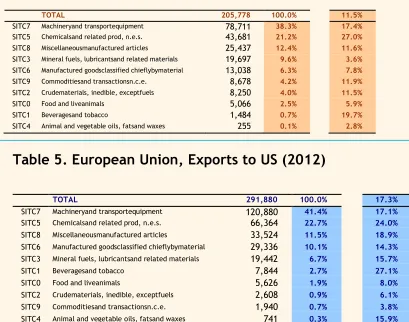
will explore innovated solutions to market access reforms including potential breakthroughs in the mutual setting or recognition of product standards. These have been some of the most controversial area of trade policy in the recent past, particularly in the area of food safety, live-animal imports, GMOs, and biofuels. Tables 4 and 5 show the importance of these and closely related concerns by listing the top-10 industrial categories for EU imports and exports of goods. For example, in the sensitive area of agriculture, the TTIP negotiations will combine efforts toward reducing tariffs with reconciling non-tariff measures to broadly improve market access.
In doing so, difficult issues regarding existing agricultural
subsidies and border practices will arise.
In service trade and investment, market access restrictions remain widespread and regulatory policies in key sectors including insurance, telecommunications,
and financial services remain problematic in producing a
comprehensive solution to bolster trade and investment
flows. Likewise, intellectual property rights regimes and
public procurement policies are complex and contra-dictory and present major obstacles to growth of trade and investment in these critical global growth sectors. The Peterson Institute for International Economics has prepared an excellent policy brief which gives a compre-hensive overview of all seven of the TTIP agenda areas and offers insights into possible negotiated settlements of the primary issues via reference to how the recently concluded US and EU free trade agreements with Japan and South Korea have approached similar issues and controversies (Schott and Cimino 2013).
In evaluating the potential benefits from the suc -cessful conclusion of the TTIP bargaining, the European Commission contracted with the Centre for Economic Policy Research to conduct a comprehensive modeling exercise (European Commission 2013). A summary of
the findings are that an inclusive and wide-ranging TTIP agreement could benefit the EU to the magnitude of
approximately €120 billion a year and €95 billion a year
for the US. These figures translate to €545 in disposal income for a family of 4 in the EU and a per-family figure
of €655 in the US. Beyond the partnership a similar magnitude, €100 billion per year, would accrue to the rest of the world as the liberalizing effects and cost sav-ings potential from EU-US trade and investment feed through the global goods and services business network and supply-chain system.
The study’s estimated effects on trade are impres-sive. EU exports to the US are predicted to increase by nearly 30 percent generating additional demand of the magnitude of €187 billion. In comparison to the totals, exports from the EU would grow by 6 percent and from the US by 8 percent. A decomposition of the sources of the gains produces an estimated 80 percent of growth to be associated with lowering non-tariff barriers which produce cost savings from fewer regulations and the liberalization of trade in services and governmental procurement.
The study further demonstrates that both EU and US labor markets are not expected to be adversely im-pacted. Overall wage levels and additional positions for both high and low skilled workers would be realized with labor displacement falling within common labor market adaptations and regular bounds from adjustments to economic trends.
EU and transatlantic scholars should continue to pay close attention to the evolving TTIP negotiations. The successful conclusion of these landmark
negotia-tions portends significant implicanegotia-tions for the bonding
and growth of the EU-US economic partnership and the direction of future multilateral trade and investment agreements. With the cooling of emerging economies around the globe and a slowdown of the Asian economy, the strengthening of the transatlantic relationship offers important additional opportunities to maintain and grow the economic capacities and leadership role of the deeply linked EU-US economies.
David L. Cleeton (Illinois State University)
References
Cadot, O. and M. Malouche (editors) (2012), Non-Tariff Measures – A Fresh Look at Trade Policy’s New Frontier, Centre for Economic Policy Research and The World Bank, 2012.
European Commission (2013) Transatlantic Barriers to Trade and Investment: An Economic Assessment, (Joseph Francois, project leader), Centre for Economic Policy Research, March 2013.
Schott, J. and C. Cimino (2013) Crafting a Transatlantic Trade and Investment Partnership: What Can be Done, Peterson Institute for International Economics, Policy Brief, No. PB13-8, March.
The TTIP and the Extraterritoriality of Post Crisis Financial Services regulation
Lucia Quaglia
(This contribution draws on ‘The politics of extraterritorial-ity in post-crisis financial services regulation in the European Union’; presented at the Conference on ‘Power, Finance and the Crisis’ in Berlin, 12-13 September 2013. I wish to acknowledge financial support from the British Academy and Leverhulme Trust (SG 120191.)
Interviews conducted by the author in the summer of 2013, reveal that the EU, unlike the US, has been keen
to include financial regulation in the TTIP negotiations
for a variety of reasons. First, the European Commis-sion argued that post crisis regulatory reforms in the EU and the US have made it necessary to including
financial services under TTIP talks with a view toward fine-tuning rules in these jurisdictions and preventing
overlaps or ‘underlaps’. Second, the EU authorities preferred to negotiate with one set of US authorities (namely, trade authorities) in the context of the TTIP,
rather than negotiating transatlantic financial regula
-tory issues with a multitude of US financial regulators.
Third, the EU authorities hoped that US negotiators in TTIP would be more amenable to compromise than
US financial regulators, whose primary mission was securing financial stability and consumer protection in
the US. While the US authorities recognized the need
for a US-EU regulatory dialogue on finance, primarily to
deal with the extraterritorial effects of US and EU
post-crisis legislation, they were reluctant to include financial
regulation under the TTIP. The main opposition came
from US financial regulators, who opposed the discus -sion of regulatory matters that were their responsibility as part of trade negotiations.
In the end, financial regulation was not included in
TTIP. Yet, the problem remains of how to deal with the
extraterritorial effects of post-crisis financial regulation
in the EU and US, which has the potential to trigger transatlantic regulatory disputes. Whereas
extraterri-toriality is nothing new in US financial regulation, it is a
relatively recent regulatory trend in the EU. There are
several meanings and definitions of extraterritoriality. Al -though lawyers (and the European Commission) might
find the following definition unsatisfactory, in a broad
sense, it refers to national laws that ‘whether intended or not, have an impact upon persons or activities out-side their borders. Extraterritoriality may be therefore
defined as a situation in which regulations adopted in
[image:3.1224.98.507.430.752.2]one jurisdiction affect directly or indirectly, and to a ma-terial extent, activities or entities in other jurisdictions’ (Dallara 2013: 48). To this end, the main legal instru-ment used by the EU is the concept of ‘equivalence’ (see Ferran 2012). By and large, equivalence means
Table 5. European Union, Exports to US (2012)
TOTAL 291,880 100.0%
17.3%
SITC7 Machineryand transportequipment 120,880 41.4%
17.1%
SITC5 Chemicalsand related prod, n.e.s. 66,364 22.7%
24.0% SITC8 Miscellaneousmanufactured articles 33,524 11.5%
18.9% SITC6 Manufactured goodsclassified chieflybymaterial 29,336 10.1%
14.3% SITC3 Mineral fuels, lubricantsand related materials 19,442 6.7%
15.7%
SITC1 Beveragesand tobacco 7,844 2.7%
27.1%
SITC0 Food and liveanimals 5,626 1.9%
8.0%
SITC2 Crudematerials, inedible, exceptfuels 2,608 0.9%
6.1%
SITC9 Commoditiesand transactionsn.c.e. 1,940 0.7%
3.8%
SITC4 Animal and vegetable oils, fatsand waxes 741 0.3%
15.9%
Table 4.European Union, Imports from US (2012)
TOTAL 205,778 100.0%
11.5%
SITC7 Machineryand transportequipment 78,711 38.3%
17.4%
SITC5 Chemicalsand related prod, n.e.s. 43,681 21.2%
27.0%
SITC8 Miscellaneousmanufactured articles 25,437 12.4%
11.6%
SITC3 Mineral fuels, lubricantsand related materials 19,697 9.6%
3.6%
SITC6 Manufactured goodsclassified chieflybymaterial 13,038 6.3%
7.8%
SITC9 Commoditiesand transactionsn.c.e. 8,678 4.2%
11.9%
SITC2 Crudematerials, inedible, exceptfuels 8,250 4.0%
11.5%
SITC0 Food and liveanimals 5,066 2.5%
5.9%
SITC1 Beveragesand tobacco 1,484 0.7%
19.7%
EUSA Review Fall 2013 7 6 Fall 2013 EUSA Review
that EU regulators recognize a third-country regime as
being of a sufficiently comparable standard, without
being identical. When an entity is established in a ju-risdiction deemed equivalent or which grants reciprocal access to EU entities, it is not required to comply with
EU regulation when dealing with EU firms.
Although some equivalence clauses had already been included in a couple of EU pre-crisis directives (notably, the Financial Conglomerates directive), this
trend intensified after the global financial crisis. The
Regulation on Credit Rating Agencies (CRAs) (2009), the Directive on Alternative Investment Fund Managers (AIFMs) (2011), the European Markets Infrastructure Regulation (EMIR) (2012), the revision of the Markets in Financial Instruments Directive (MiFID II) and the Markets in Financial Instruments Regulation (MiFIR) all contain equivalence clauses, designed to establish
the equivalence of financial services regulation in third
countries with EU rules. Furthermore, the EMIR and the MiFID II/MiFIR also include ‘reciprocity’ provisions, promoting the concept of ‘equivalent reciprocal recog-nition’. Finally, some provisions do not apply only to
third-country firms doing business in the EU or with EU
counterparts. They also apply to transactions between counterparties in third countries, if they have a ‘direct, substantial and foreseeable’ effect within the EU.
To be fair, the EU is neither the first nor the only jurisdiction whose legislation has significant extrater
-ritorial effects for third countries and firms. In the past,
US securities markets legislation had considerable extraterritorial reach (see the Securities Act of 1933). More recently, the Sarbanes-Oxley Act (2004) contained extraterritorial provisions concerning, amongst other things, the regulation and monitoring of auditing. The Dodd-Frank Act also has potential extraterritorial effects especially the Volcker rule concerning the structure of the banking industry, the Collins amendment, regarding the treatment of foreign banking operations in the US and over-the-counter (OTC) derivatives trading and clearing (these were issues that the European Com-mission was keen to include in the TTIP).
Yet, the extraterritorial impact of post-crisis financial
services regulation in the EU is puzzling for several reasons. First, the EU, unlike the US, has traditionally favored a multilateral approach to global governance,
including in financial services (Posner and Veron 2010).
It is quite unusual for the EU to take a unilateralist
stance, like the one adopted after the crisis in financial services. Second, prior to the global financial crisis,
the US had toned down its extraterritorial approach in
financial regulation. Third, financial globalization has
increased the political and economic costs of unilater-alism, making extraterritoriality less feasible (Brummer 2012). Moreover, this approach leaves the unilateralist (in this case, the EU) vulnerable to the retaliations of
other jurisdictions.
What explains the EU’s treatment of third coun-tries and the extraterritoriality of most post-crisis EU financial regulation? The starting point is the age old-dilemma between stability and competitiveness in
designing financial regulation, where more regulation
may promote stability but has the potential to reduce
the competitiveness of domestic firms because they are subject to competition from foreign firms that are less strictly regulated. The global financial crisis was an external shock to financial stability in the EU, as
elsewhere, and the extraterritorial approach of EU post-crisis legislation is mostly determined by the EU’s
attempt to restore financial stability in its territory while maintaining the competitiveness of its financial industry.
It allows additional regulation while it prevents the loss of competitiveness that results from increased
regula-tion in the EU financial sector by imposing the new stricter rules on foreign as well as domestic firms. This conflict between stability and competition in financial
regulation is further complicated in a regional (multi-level) jurisdiction, such as the EU, where different countries experience somewhat different trade-offs under this dilemma, depending on their domestic
po-litical economy, primarily the structure of their financial industry and approach to financial regulation, or model of financial competitiveness. The global financial crisis
has changed the balance of regulatory power in the EU, empowering those member states most keen to project EU regulatory power externally (Pagliari 2012). The result has been a shift in policy whereby the EU has attempted to externalize its regulatory dilemma.
Lucia Quaglia (University of York) References
Brummer, C. (2012) Soft Law and the Global Financial Sys-tem: Rule Making in the 21st Century, New York: Cambridge University Press.
Dallara, C. (2013) ‘Containing extraterritoriality to promote financial stability’, Banque de France, Financial Stability Review 17 (April): 47–59.
Ferran, E. (2012) ‘Crisis-driven regulatory reform: where in the world is the EU going?’ In: Ferran, E. et al. (eds) The Regulatory Aftermath of the Global Financial Crisis, Cam-bridge: Cambridge University Press, 1–110.
Pagliari, S. (2013) ‘A wall around Europe? The European regulatory response to the global financial crisis and the turn in transatlantic relations’, Journal of European Integration 35(4): 391–408.
Posner, E. and N. Véron (2010) ‘The EU and financial regu -lation: Power without purpose’, Journal of European Public Policy 17(3): 400–415.
The Geopolitics of the TTIP as Seen from Beijing Miguel Otero-Iglesias
(The article draws on interviews with Chinese officials and experts at think tanks conducted during a fieldwork trip to Beijing in June/July 2013.)
Gradually, over the past decade, China has worked hard to be on the winning end of the multilaterally-conceived World Trade Organization (WTO) framework. Based on its large domestic market, its break-neck
double figure growth rates, its comparative advantage in
labor-intensive manufacturing and its increased sophis-tication in international diplomacy, the Middle Kingdom is starting to use the WTO to its own advantage. For example, when it has considered that proposals ema-nating from Western powers would harm its national interests, China has been able to form alliances against the European Union (EU) and the United States (US) with other emerging markets, such as India and Brazil, (the stalemate of the Doha Round epitomizes this). In doing so, China has made increasingly good use of the WTO’s dispute settlement mechanism (DSM) and appeal procedures to protect its export and import-substitution sectors. Indeed, after some learning, China has become smarter in the game of the multilateral governance of trade. Arguably, globalization is currently working in its favor.
However, the announcement by the US and the EU to start negotiations toward a Transatlantic Trade and Investment Partnership (TTIP) might be a game
changer. Precisely at the time when an official from an
emerging economy, in this case the Brazilian Roberto Carvalho de Azevêdo, will be leading the WTO, the US and the EU appear to be fed up with the gridlock in the Doha Round and have started favoring the bilateral over the multilateral route to establish the new rules for international trade and investment. This approach has drawn criticism from convinced European multilateral-ists, such as the former head of the WTO Pascal Lamy, who thinks that it can undermine the trend towards global liberalization.
Moreover, it has raised concerns in Beijing. Chinese
officials have the suspicion that both the currently ne
-gotiated Trans-Pacific Partnership (TPP) agreement
and the TTIP project pushed forward by the Obama Administration have economic but also geopolitical objectives. With these new treaties, the US wants to upgrade regulations in trade and investments so as to make Chinese products less competitive and the Chi-nese market less attractive. China also suspects that America wants simultaneously to reassert its
geopoliti-cal dominance both in the Pacific and the Atlantic.
Regarding the European Union, the view among certain strategic thinkers in Beijing is that the United
States is concerned about the tightening of commercial, investment and political ties between the European Union and China in the wake of the Eurozone crisis. As a consequence, Washington wants to use the TTIP negotiations to redirect the attention of European lead-ers back toward the US. Their interpretation of American strategic maneuvering is as follows. Washington is well aware that China has a strong interest in strengthening its strategic relations with the EU in order to counter-balance US hegemony. Hence, every time there are real rapprochement efforts between the two sides, the United States steps in to weaken the partnership. This has happened twice in the past decade.
The first occurred between 2003 and 2005 when,
under the leadership of German Chancellor Gerhard Schröder and French President Jacques Chirac, the EU started to deepen its strategic partnership with China. At the time, the Europeans started to collabo-rate with the Chinese in sensitive sectors such as the aerospace project Galileo and considered the option of lifting the arms embargo against Beijing (Casarini 2009).These moves raised major concerns among US policymakers and, in response, Washington activated its powerful state machinery to dissuade the Europe-ans from furthering their strategic alliance with Beijing. Under this diplomatic pressure, the EU discontinued its
contracts with Chinese firms within the Galileo project
and dropped the possibility of lifting the arms embargo. This was the end of the so called honeymoon period between the European Union and China.
However, the second US interference in EU-China affairs is occurring now. In the view of Chinese
of-ficials, the Eurozone crisis revived again the potential
to deepen the strategic partnership between the two partners. In recent years, China helped Europe in its moment of need, and European countries have in-creased substantially their exports to China, helping them overcome the deep recession. Furthermore, and more importantly, China has propped up – through both rhetorical support and concrete investments – the single currency every time it was in danger. In contrast, the
US government has provided no direct financial assis -tance to the Eurozone, and the US press and pundits have scare-mongered about a possible break-up of the single currency (Otero-Iglesias 2014). Meanwhile, Chinese investments to the Eurozone have increased substantially.
EUSA Review Fall 2013 9 8 Fall 2013 EUSA Review
The Painful Path to Recovery David L. Cleeton
On November 5th the European Commission released the Autumn 2013 economic forecast for the
European Union.1 In the aggregate, growth resumed
during the second quarter of 2013 and there are clear signals that a mild recovery will continue over the inter-mediate term. While this uptick is expected to leave the performance of the EU economy over the calendar year
perfectly flat, this is a slightly better performance than
the -0.5% drop recorded during 2012. Looking ahead a continuing modest improvement in economic activity is forecasted to produce annual growth rates of 1.4% in 2014 and 1.9% in 2015. The Eurozone continues to underperform relative to these modest expectations with a 2013 decline of 0.4% and out-year growth forecasts of only 1.1% in 2014 and 1.7% in 2015.
Beneath the aggregates is substantial variation across individual member state performance. During 2013 within the 17-member Eurozone, real GDP growth covers a range from -8.7% in Cyprus to +4.0% in Latvia with eight Eurozone members recording declines. The 2014 forecasts show turnarounds for all but two of the countries in recession, Cyprus and Slovenia.
On the whole, inflationary pressures are only mildly problematic in a few Member States. Overall inflation
across the EU is expected to hold below the 2% an-nual upper end of the target range coming in at 1.5% in 2013 and holding nearly steady at 1.5% in 2014 and 1.4% in 2015. One Eurozone country, Estonia, and three non-Eurozone countries, Hungary, Romania, and the United Kingdom are forecasted to see persistently
higher inflation rates above the target, in the range from
2.1% to 3.4%, over the 2013-15 forecast period. Labor market performance is expected to remain dismal as continuing adjustment processes mean un-employment trends will lag GDP growth by at least half a year. But the stabilization of employment levels rather than declines will eventual produce a drop in unemploy-ment rates. The overall forecast shows a slight decline to an EU unemployment level of 10.7% and 11.8% in the Eurozone in 2015. However, in this case as well, there will be a wide range of unemployment levels recorded within individual Member States. During 2013 Austria is expected to record an overall unemployment rate of 5.1% while Greece will post an astonishingly high rate of 27.0%.
While fiscal consolidation continues within the EU, as reflected in governmental deficits, continued growth
will become more dependent on other sources of do-mestic demand. The international economic environ-ment has several important dynamic eleenviron-ments. The
United States has seen modest fiscal tightening after
EUSA Political Economy Interest Sec
tion
possibility of lifting the arms embargo was again raised by the head of the European External Action Service (EEAS), Catherine Ashton, who reportedly argued in
a confidential strategy paper presented to EU leaders
that the embargo is a “major impediment for developing stronger EU-China co-operation on foreign policy and security matters” (Kirkup 2011).
From Beijing’s perspective, clear evidence points to the fact that the Europeans were again inclined to deepen their strategic partnership with China, but yet again, US interference stopped the rapprochement. First it was Japan, Washington’s main ally in East Asia, which criticized Europe’s proposal to eliminate the arms ban to China (Willis 2011). A few months later it was the UK, the main ally of the US in Europe, which declared that it would oppose the lifting of the embargo (Kirkup 2011). Now it is Washington ´s turn, which through the TTIP wants to send a clear message to policymakers in Brussels that the interest of Europe still lies across the Atlantic and not in the Far East.
For many in China, it is doubtful whether the TTIP will be signed. There are strong protectionist forces both in the US and in Europe that can derail the negotiations. But one thing is clear: with the TPP and TTIP initiatives the United States has regained its leadership role inset-ting the new rules for global trade and investment. Now Beijing needs to think how it responds to these moves. It needs to show that it can be an alternative power to the US. Trying to close the Investment Partnership Agreement with the EU could be a good start. It could also be a great opportunity for the Europeans to come of age and play a broker role in the geopolitical game of determining the new rules for global trade and invest-ment.
Miguel Otero-Iglesias ESSCA School of Management, Paris
References
Casarini, N. (2009) Remaking Global Order: The Evo-lution of Europe-China Relations and its Implications for East Asia and the United States, Oxford, Oxford University Press.
Kirkup, J. (2011) ‘Britain Prepared to Block Eurozone Move to Relax Arms Embargo on China’, The Telegraph, 4 November.
Otero-Iglesias, M. (2014) ‘The Euro for China: Too Big
to Fail and Too Difficult to Rescue’, The Pacific Review
(forthcoming).
Willis, A. (2011) ‘Japan: Ashton Was Wrong on China Arms Ban’, euobserver.com, 19 May.
EUSA Review
The EUSA Review (ISSN 1535-7031) [formerly the ECSA Re-view] is published three times yearly by the European Union Studies Association, a membership association and non-profit organization (founded in 1988 as the European Community Studies Association) devoted to the exchange of information and ideas on the European Union. We welcome the submission of scholarly manuscripts.
Editor: John Occhipinti Book Reviews Editor: Susanne Schmidt Managing Editor: Joseph Figliulo 2013-2015 EUSA Executive Committee
Michelle Egan, Chair
(American University) Michelle Chang, Vice Chair
(College of Europe) Alasdair Young, Vice-Chair
(Georgia Institute of Technology) Nicolas Jabko
(Johns Hopkins University) John Occhipinti
(Canisius College) Susanne K. Schmidt
(University of Bremen) Mitchell Smith
(University of Oklahoma) Alberta Sbragia, ex officio member
(University of Pittsburgh) Immediate Past Chair (2011-2013) Amy Kreppel
(University of Florida) European Union Studies 415 Bellefield Hall University of Pittsburgh Pittsburgh, PA 15260 www.eustudies.org
EUSA Review Fall 2013 11 10 Fall 2013 EUSA Review
a prolonged period of expansionary deficits and con -tinues to struggle with the determination of the optimal scenario for winding down the Federal Reserve’s un-conventional monetary stimulus policy while attempting
to hold down financial market volatility. Japan recently has been a positive source of significant monetary and fiscal expansion. But overall, with the global weakening
of emerging market economies, externally produced growth opportunities for the EU are shrinking.
All in all, the projected growth of domestic demand remains subdued as continued balance sheet restruc-turing occurs in the private sector. Investment and private consumption will continue a gradual expansion
over the short term. Positive trends in financial markets and profit margins combined with continued reductions
in excess capacity will boost investment demand. On the household consumption side growth will be more constrained as employment and wage growth remains weak.
The current status of the Franco-German engine of the Eurozone serves to illustrate the challenges and divergences limiting overall economic growth in the EU. In Germany real GDP growth in 2013 is expected to come in at only 0.5% but to rise to 1.7% in 2014. In the past six months export-growth expansion has been turned back slightly by a combination of a general slow-down in the global economy and the continued strength of the euro. This has been offset by a brighter outlook for domestic demand with continued low interest rates and positive wage and employment supporting house-hold consumption. These trends are starting to feed
through to boost investment as profit margins rise and
excess capacity shrinks.
In France, real GDP growth of 0.2% in 2013 is set to only move up slightly to 0.9% in 2014. France
enjoys a significantly higher rate of population growth
than does Germany but this growth factor is offset by increasing unemployment and taxation. It is expected
that the lagged upturn in employment in 2015 will finally
produce a boost to household consumption. While
stability in companies’ financing has returned, improved profit margins and lowered excess capacity will not feed
through to boost investment until beyond 2014.
On the fiscal side, the German general govern -ment balance which moved to breakeven in 2012-13 is expected to remain near a zero balance going forward through 2015. France on the other hand continues to
struggle with its deficit which is expected to come in at -4.1% of GDP during 2013 even after a significant
revision upward of the revenue package. While hold-ing down expenditure growth, tax revenue increases have not grown rapidly enough in a slow-growth
envi-ronment to improve the overall balance. Deficit fore -casts continue close to the -3.75% level going forward
through 2014-15. Of course further concessions and compromises with the Commission will be needed going forward with the budget.
The overall EU GDP growth forecast for 2014 dropped to 1.1% from a projected 1.2% in the Spring 2013 forecast and is down from 1.4% at the beginning
of the year. Combined with a current low inflation rate,
an annualized rate of 0.7% in the Eurozone during Oc-tober, and concerns about the high value of the euro, the new forecasts are sure to stir renewed debate about the proper direction of movement in ECB interest rate policy.2
David L. Cleeton Illinois State University
Notes
1 European Economic Forecast, Autumn 2013, European Economy, No. 7, 2013, European Commis-sion, Directorate-General for Economic and Financial Affairs.
2 Eurozone Growth Revision Raises Fears, Finan-cial Times, 6 November 2013, p. 4)
The EUSA Executive Committee is pleased to
announce the online publication of the first EUSA
Biennial Conference Special Issue of the Journal of European Public Policy (JEPP). This Special Issue includes seven (revised) papers selected by peer review from amongst those nominated by discussants and chairs as among the best pre-sented at 2011 Biennial EUSA conference. The Special Issue can be found at http://www.tand-fonline.com. The paper version is now available.
We look forward to continuing this collaboration between JEPP and EUSA in the future and ex-pect that 6-8 papers from the 2013 EUSA Con-ference, May 9-11, 2013, in the Baltimore/Wash-ington DC metro area, will again be selected for publication in a future special JEPP/EUSA issue.
EUSA members interested in reviewing recent
EU-related books, please fill out the form for po
-tential reviewers located on our website-www. eustudies.org.
Publishers should send a review copy
of books directly to the EUSA office, 415 Belle
-field Hall, University of Pittsburgh, Pittsburgh, PA 15206, USA
Book Reviews
Ruano, Lorena (ed.). The Europeanization of Nation-al Foreign Policies Towards Latin America. London and New York: Routledge, 2013.
The literature on Europeanization has so far largely focused on EU member states’ domestic policy convergence and the ability of individual members states to align EU policies with their national policy preferences. The Europeanization of National Foreign Policies Towards Latin America produces a system-atic framework for studying Europeanization of foreign policy with seven in depth case studies. Each chap-ter analyzes the role of member states in shaping the EU’s Latin America policy and discusses how member states’ national policies have been affected by the EU policy in return. Each contributor characterizes the dy-namic of the member state’s Latin America policy – so called “upload, download, or crossload (sideways) Eu-ropeanization,” as well as variation over policy areas, and the level of EU competence that comes with them, and time. The expectation is that the degree to which states will download EU policy towards Latin America depends on the EU competency in the policy area un-der question. That is to say, this study has replaced the “low to high” dichotomy of the variable “pressure to adapt” with the categories “social,” “legal,” and “mixed.” In policy areas in which the EU has exclusive compe-tency states have a legal obligation to adapt, while in policy areas in which the national government has ex-clusive competency, or where competency is shared, social forces such as peer pressure can lead states to adapt their domestic policy. Additionally, goodness
of fit, as the compatibility of EU and national policy
preferences, also affects if and how states download EU policy. Regarding the uploading of national policy preferences to the EU there are also two major vari-ables to consider: interest and power. States are ex-pected to be more successful in shaping EU policy in accordance with national policy preferences when the policy issue is considered a national priority, and when
states have the resources and capacity to build a co-alition around a policy issue.
The cases presented in this volume represent EU member states with different levels of interest in and historical connections with Latin America. Spain is the only case discussed that has made EU – Latin American relations a clear priority in its foreign policy. The editor made the conscious decision not to include other cases of EU member states with strong histori-cal tries to Latin America, such as Portugal or Italy. Instead, the other cases selected are representing the main movers in European foreign policy, France and the UK, Europe’s largest economy, Germany, and three cases that represent Nordic states, Swe-den, Eastern states, Poland, and small states, Ireland. The editor has chosen cases that show the greatest variance on the dependent variables of change in na-tional policy (download) and the shaping of EU policy (upload). This is understandable if the goal of the vol-ume is to explain the different factors that determine whether states act as policy uploader or downloader. At the same time it may seem a bit obvious that large and powerful states, France, the United Kingdom, and Germany are more likely to upload their foreign poli-cy preferences in the EU polipoli-cy making process. It is equally expectable that Spain, also one of the larger member states, and the only state with a clear foreign policy preference for Latin America, would also try to upload its policy preferences to the EU. If states such as Italy or Portugal were part of this volume it would have been interesting to assess the different rates of success in uploading one’s national foreign policy preferences by states that are driven by interest rather than power. The present volume suggests among the policy uploaders only Spain as interest driven, while France, the United Kingdom, and Germany because of their sheer power in EU policy making are affecting the process even when Latin America ranks fairly low as a foreign policy priority.
Spain is analytically the most interesting case because as it joined the EU only in 1986 and was forced to download EU external relations policy that,
under the influence of France and the United King -dom, focused on ACP states. Spain was successful in uploading its policy preferences not because it was able to rekindle interest in Latin America among other EU member states (crossload), but rather because the lack of interest coincided with the absence of strong opposition to more EU engagement with Latin Amer-ica. The cases of Sweden, Poland, and Ireland, that are neither powerful foreign policy players, nor have a particular interest in Latin America due to colonial history or cultural and identity factors, are marked as
downloaders as Europeanization amplifies their voice
EUSA Review Fall 2013 13 12 Fall 2013 EUSA Review
Latin America remains a region of low foreign policy priority for most EU member states. All cases presented in this volume show an interest in expand-ing trade relations with countries in Latin America, es-pecially with Brazil, but because trade relations are an exclusive EU competency, most nations have already successfully downloaded the EU policy and national policies are already aligned. Crossloading in policy areas such as development cooperation, democracy,
and human rights promotion, is difficult to pinpoint and
hard to distinguish from efforts of uploading national policy preferences. Overall, this volume represents an important contribution to the area of Europeanization of foreign policy. The conceptual framework is well de-veloped and can be used with different cases and or regions.
Martyn de Bruyn Northeastern Illinois University
Lavenex, S., and F. Schimmelfennig (eds.). Democ-racy Promotion in the EU’s Neighbourhood: From Le-verage to Governance? Abingdon: Routledge, 2013.
This edited volume offers a reproduction of Democratization 18(4). It is about the constrained attempts of the EU to promote democracy in neigh-bouring countries, including when conditionality instru-ments fail. Quite fortunately for tired readers of
inco-herent edited volumes, the editors have done a fine
job in focusing all contributions on exactly that theme. This, and the sheer information contained in the chap-ters, makes the book a very welcome and enlightening addition to the literature on Europe’s foreign policy.
In the introductory chapter, Lavenex and Schim-melfennig review the evolution of the EU’s
democracy-promotion policy, define the three models of external
democracy promotion (bottom-up linkage, top-down leverage, and functional cooperation between ad-ministrations – note that these do not exactly corre-spond to the three models of external governance in Schimmelfennig and Sedelmeier 2004) which the EU can use to achieve its goals, and argue that functional cooperation between administrations may certainly be less ambitious than top-down leverage, but is also
probably more efficacious than pure stick-and-carrot
policies when dealing with countries which are not candidates to EU accession. In chapter 2, Kubicek, an expert in Turkish politics, argues that Turkey is a case where top-down leverage worked well throughout the
first half of the 2000s, but then failed as soon as the
EU’s commitment to the two-way deal with the target country appeared to be waning. He concludes that “the EU’s application of leverage and linkage to foster
democracy in Turkey will remain contested and prob-lematic.” (p. 42) In chapter 3, Del Sarto and Schum-acher offer a refreshingly critical assessment of the
Union’s superficial (and therefore either hypocritical or
naïve) benchmarking policy, with case studies on Jor-dan and Tunisia. Unfortunately, their contribution was written before the Arab spring, which allowed them to base their analysis on the observation that “with more than seven years into the ENP, both the Maghreb and the Mashreq have proven to remain, broadly speak-ing, immune to wide-ranging and sustainable political reforms.” (p. 50) In chapter 4, Casier uses the case of the Ukraine to investigate why the EU has been more successful in promoting formal democracy rather than substantive democracy. His explanation resembles Del Sarto and Schumacher’s argument: the structure of the EU’s policies allows elites in the target country
to get by complying at a superficial level (i.e. without
really taking ownership of the reforms). In chapter 5, Wetzel offers a particularly interesting “political”
expla-nation for the policy failures identified in the preced -ing chapters: policy incoherence may be the result of successful mobilization on behalf of negatively af-fected domestic constituencies in the EU. In chapter 6, Freybourg presents the results of a very
interest-ing quantitative analysis of Moroccan state officials’
attitudes towards democratic governance. Using ex-planatory factor analysis, she is able to show that joint
problem-solving does make Moroccan officials more
pro-democratic. (Though, of course, she does not
re-port any findings about EU officials becoming more
authoritarian!) Finally, in chapter 7, Freybourg et alias use comparative case studies to argue that the pro-democracy impact of functional sectoral cooperation is enhanced by mostly sectoral (as opposed to polity-wide) attributes.
Against this background, three thoughts spring to mind of this reviewer. First, this volume is in many ways an exploration of the limits of, and alternatives to, the top-down leverage model – i.e. of conditional-ity policies. The implicit assumption is that condition-ality fails when either (a) the stick or the carrot is not big enough, or (b) when the commitment to using it is not credible. In other words, a familiar upward-sloping supply curve obtains: target countries produce demo-cratic reforms as a function of the price the EU is truly willing to pay. Although this “economistic” assumption is intuitive, it is not openly discussed in the book. Yet it is conceivable that (some) nations are not as
incen-tivisable as your rank-and-file economic agent (e.g.
pin-, shoe-, or lecture-makers). Some may not need external incentives to produce the goods in question (in this case, democratic reform). If that were the case, then top-down leverage might fail, not because it is
not powerful enough (as the contributors to the vol-ume assvol-ume), but simply because it exists (see the general argument in Bénabou and Tirole 2003).
Second, some contributions seem to conceive of the three models of external democracy promotion as alternatives whose combined causal impact can be easily disentangled. Yet these models belong to outright different theoretical worlds (or, in the realm of real-world policy-making, they have outright different temporalities). Any “test” of a rationalistic hypothesis (such as the top-down leverage model) that relies on a longitudinal story of political development over a decade is as bound to commit a type-II error as any test of a constructivist hypothesis that relied on one-dimensional cross-sections.
Finally, although all the qualitative chapters are written by scholars who are obviously very knowl-edgeable about their cases, most contributions would have gained if cast in a more methodologically self-conscious manner. For example, in the face of some backlashes in Turkish reforms even before 2005, the story about the causal role of external incentives might need to be re-examined using explicit counterfactual thought experiments (Fearon 1991). Similarly, the comparative studies of Jordan/Tunisia and of
envi-ronmental/fisheries policies are both based on case
studies chosen on the basis of the variation of each author’s preferred independent variable, without any discussion of how they controlled for other, potentially causal variables.
Of course, none of these tentative thoughts should be enough to discourage interested readers from buying and reading this book. The analytical rigour of the editors, and the substantive knowledge of the contributors, makes it easily one of the best books written to date on an important and topical issue.
Yannis Karagiannis Institut Barcelona d’Estudis Internacionals
References
Bénabou, R., and J. Tirole (2003), ‘Intrinsic and Ex-trinsic Motivation.’ Review of Economic Studies 70(3): 489-520.
Fearon, J. (1991), ‘Counterfactuals and Hypothesis Testing in Political Science.’ World Politics 43(2): 169-195.
Schimmelfennig, F. and U. Sedelmeier (2004), ‘Gover-nance by Conditionality: EU rule transfer to the candi-date countries of Central and Eastern Europe.’ Journal of European Public Policy 11(4): 661-679.
McCormick, John. Why Europe Matters: The Case for the European Union. New York: Palgrave MacMil-lan, 2013.
In Zurich in 1946 Winston Churchill spoke of making all Europeans happy and free, by re-creating “the European Family…and to provide it with a struc-ture under which it can dwell in peace, in safety and in freedom . . . [t]hrough a type of United States of Europe.” He asked “why should there not be a Eu-ropean group which could give a sense of enlarged patriotism and common citizenship to the distracted peoples of this turbulent and mighty continent?” Near-ly seven decades later that vision has materialized; attributable, according to McCormick, primarily to the development of the European Union. His main argu-ment is that European integration – here McCormick also includes other pan-European organizations such as the Council of Europe and the European Court of Human Rights – has improved the lives of Europeans more than they tend to recognize and appreciate.
Explaining the EU as a confederacy with sepa-ration of powers, including elected legislators, national government representatives, an independent judiciary, and stronger laws on transparency and easier access to public documents than in most member states, Mc-Cormick argues that such a structure enhances both direct and indirect democracy (26-29, 70-71, 130ff). In laying out the many ways in which citizens can hold EU
officials accountable he also effectively counters the longstanding claim of a European democratic deficit.
Yet European citizens remain largely ignorant of what the EU is and how it works, with myths and mispercep-tions about extraordinary EU powers proving ubiqui-tous throughout Europe. This, McCormick argues, is not only due to the massive distortions of EU policies and power prevalent in the media and amongst pun-dits (especially in the US and UK), but also European leaders’ poor communication skills, and citizens dis-mal efforts at accessing more information themselves (152-155). One example is that 74% of French citi-zens knew little or nothing about the EU Constitution when voting it down in 2005 (80). Yet McCormick ap-pears more forgiving of citizens than euroskeptic pun-dits and the press. His frequent invocation of polls and surveys showing widespread public support for more rather than less Europe in most policy areas, along with his persuasive (though frequently repetitive)
ex-planation of the limited independent influences EU in -stitutions possess, delivers a blow to anti-European forces and the many exaggerated claims of EU impo-sition of laws, while appealing to citizens: “see, you actually say you want more EU level policies.”
EUSA Review Fall 2013 15 14 Fall 2013 EUSA Review
areas to convince the reader of how and why Europe matters. First, integration has made Europeans less nationalistic, insular, and militant; instead they have become more communitarian, multilateral, and sup-portive of an integrated European structure. These
are part of what McCormick sees as an identifiable
“europeaness”, which complements and supplements national and regional identities (8-15; 89-101). Sec-ond, most of the problems plaguing the EU today,
from wasteful spending, limited foreign policy influ -ence, or the crisis in the Eurozone, are the result of poor or inadequate decisions by member states, not EU institutions. Unwillingness to erect common EU
fiscal policies and banking rules to accompany the
common currency, along with irresponsible national
policies, was largely to blame for Europe’s fiscal, sov -ereign debt, and banking problems. Assertive ECB policies and the Fiscal Compact (2012) were EU level responses that helped mitigate the crisis. Third, EU integration is argued to have has solved many prob-lems and overcome many challenges since the EU’s inception. European citizens are safer, healthier, and richer thanks to European-level cooperation and inte-gration, which also enables member states to achieve more social progress and exert greater international
influence than they could on their own. Improved cli -mate policy, improved labor standards, no currency exchange or border controls, stronger intra-EU trade, and common peacekeeping operations are among the
many enumerated benefits. Thus, the argument goes,
more integration is (almost) always better than indi-vidual state action.
There are nevertheless some shortcomings. Public support for more EU level action (113) is not equitable with support for integration (sharing sover-eignty). The section on the euro crises could also have been expanded beyond six pages; merely stating that it was a political project and that its current malaise will
somehow be solved is insufficient for all but those who
already possess a good understanding of the euro cri-sis. One can also quibble with some of his most pro-vocative statements such as there being little attention paid to EU’s success in international trade (180). Any browsing of the EU literature shows otherwise. Finally, some will doubtlessly view McCormick’s conspicuous misgivings about much of American economic and military policy as exemplifying an overtly normative bias for European integration and the welfare state. This would be missing the point. Though the scholar’s criticism of US policies at times equals his unbridled enthusiasm for Europe’s accomplishments and poten-tial, he does not shy away from highlighting numerous weaknesses in EU institutions, or criticizing EU poli-cies (ch. 8). However, those seeking detailed policy
ideas or specific proposals for reform will be left want -ing. Solutions to Europe’s problems are left for others to present – his vague and brief attempts thereto not-withstanding (156-162).
Despite the aforementioned problems this is truly an excellent exposé of European accomplish-ments. McCormick does us all a great favor by re-minding us of how much good has come from the Eu-ropean project, for that reason it is well worth reading – especially by Europeans.
Leif Johan Eliasson East Stroudsburg University
Zimmermann, Hubert and Dür, Andreas (eds.). Key Controversies in European Integration. Houndsmills and New York: Palgrave MacMillan, 2012.
In light of the crises of the European Union since 2008, teaching the European Union has become even more an endeavor of not merely discussing the development and process of European integration and European-level institutions but one of articulating, illuminating, and discussing the often contentious prin-ciples, procedures, policies, and outcomes of Europe-an integration. Beyond primary textbooks, additional readings and scholarship that concisely and decisively illustrate the many contending arguments regarding European integration and the European Union have
often been difficult to find in any one location or have proven difficult to digest for primarily undergraduate
audiences. This edited volume by Hubert Zimmer-mann and Andreas Dür quite ably and successfully
fills such a role for use in courses on the politics and
development of the European Union.
The format of the book is similar to the Tak-ing Sides series of supplemental texts produced by McGraw-Hill for use in many introductory and inter-mediate level undergraduate political science courses in that the chapters are divided between a pair of op-posing or competing arguments about a particularistic issue or debate. A great asset of this text beyond the debates themselves are that they are authored by top scholars of many facets of European integration in-cluding John McCormick, Karen J. Alter, Amy Verdun, Desmond Dinan, Christopher Lord, and many others. The book is not necessarily exhaustive nor
necessar-ily intended to provide introductory definitions of key
concepts or terms related to the EU and European integration, however used in conjunction with a pri-mary textbook or other introductory readings the vol-ume provides an intellectually deeper and excellent
spectrum of debate of arguably the most important, contentious, and current issues. Further, the textual material and extensive bibliography provide an excel-lent resource for more detailed research for students and scholars alike.
One innovative and important role for this vol-ume is the nesting of the European Union and integra-tion within a framework as a political process. As Dür and Zimmermann adeptly argue in the introduction, they begin with an “assumption that the European Union is an open-ended and strongly contested
proj-ect” with both remarkable successes and deep flaws
and that “it always has been” (2,3). Hence, the text begins with an a priori conception of philosophical and political debate, compromise, and contention that is sometimes absent from others texts on the EU and integration which focus far too much on the historical and institutional development of the union distinct from the political contestation that surrounded such devel-opments. One of the added strengths of the introduc-tion and conclusion is a brief but useful encapsulaintroduc-tion of the development of the scholarly debate of Europe-an integration beginning with Haas’ neofunctionalism and Hoffman’s intergovernmentalism leading to liberal intergovernmentalism and multi-level governance ap-proaches and beyond. In conjunction with primary textbooks and other course materials this works well to rather basically and cogently lay out the develop-ment of integration literature and scholarship in just a few pages.
The first few chapters are dedicated to me -ta-level European integration debates including as-sessment of the successes and failures of the EU as
a whole, patterns of EU efficiency, and propriety of
centralization versus decentralization of the union’s regulatory, market, and political governance. In chap-ter 1, John McCormick and John Gillingham argue at the highest level of abstraction as to whether the EU has been a “success”. While one could accuse both of over-selectivity of evidence in defending their posi-tions, combined they demonstrate the very mixed re-sults of the integration experience and process with all its highs and lows. Even more insightful is the chapter 2 exchange between Desmond Dinan and Mats
Pers-son over the efficiency of the EU in which both authors
skillfully argue is an inherently complex and rather
unique system of governance with both benefits and flaws. Chapter 3 debates the propriety of centraliza -tion of authority in Brussels versus na-tional
govern-ments and fits quite nicely into the overarching and
longstanding debates between intergovernmentalists and supranationalists especially in light of the Lisbon Treaty and subsequent developments. Perhaps one of the most thought-provoking debates appears in
chapter 4 as Richard Bellamy and Christopher Lord
argues the democratic deficit of the union. Lord’s brief
and concise analysis of the quality of European Union democracy is ripe with concise reason and possible routes of reform.
The remaining ten chapters tend to deal with
more specific policy or problematic issues including
the role of the European Court of Justice (ECJ), the creation of a European identity, the future of the Euro,
regulation of finance, Cohesion Policy, Common Agri -cultural Policy (CAP), foreign policymaking, the global role of the union, enlargement, and the Common Se-curity and Defense Policy (CSDP). In some cases the
authors focus on one specific or well-trodden issue
or problem as emblematic of a broader phenomenon or take a fairly narrow polemic or scholarly-oriented tact in making their argument. Some of the chapters or portions of chapters on Cohesion Policy, CAP, and the role of interest groups in making foreign economic policy fall into this category. Others such as chapter 5 by Karen J. Alter and Jeremy Rabkin on the role of the ECJ create complimentary bookends on the credits
and deficits of the EU, its institutions, and the process
of integration. Important chapters in the wake of the
seemingly never-ending currency, financial, banking,
employment, and growth crises include the chapter 7 debate over the future of the Euro by Amy Verdun and Tal Sadeh and the chapter 8 discussion of the
EU’s ability to regulate financial markets between Jörn
Carsten Gottwald and Daniel Mügge. Both provide a quite useful and additional set of arguments over the role of the EU and its responses to the post-2008 cri-ses. The last four chapters focus on EU external policy through foreign economic and trade policy, the EU’s normative power in global affairs, enlargement, and CSDP. Again while some of the chapters cover fairly common turf they do so in an engaging and adversar-ial manner which lends to greater conceptualization and thinking about these debates.
In the conclusion, co-editor Andreas Dür ulti-mately does leave the volume on an optimistic note regarding the future of the union and integration stat-ing that the union has “weathered too many storms to be written off easily” (234). But importantly Dür also explicitly addresses the scholarly changes that have occurred in the study of European integration having moved beyond an “either/or” schism between supra-nationalism and intergovernmentalism which this vol-ume also ably encompasses (233).
One of the strengths of this volume is that the
authors often stake out fairly identifiable and strong claims about the propriety and efficacy of the EU, its
policies, and the integration process in a way that can
16 Fall 2013 EUSA Review
divergent positions more clear. Sometimes this leads to occasional generalizations, omissions, and some-times overstretching philosophic or policy positions. In other cases the debate is so nuanced or policy
spe-cific that it could be considered as having missed the
forest for the trees which could elude many under-graduate students. Nonetheless, with such few weak-nesses in mind and caution put forth, the overall utility
and success of the text in fulfilling its primary goals is
quite well done and a remarkable addition to potential course readings.
Paul Simon Adams University of Pittsburgh at Greensburg