Disorders of the Nervous System
GABA-B Agonist Baclofen Normalizes
Auditory-Evoked Neural Oscillations and Behavioral
Deficits in the
Fmr1
Knockout Mouse Model of
Fragile X Syndrome
D. Sinclair,1 R. Featherstone,1 M. Naschek,1 J. Nam,1 A. Du,1 S. Wright,1 K. Pance,1 O. Melnychenko,1 R. Weger,1S. Akuzawa,2 M. Matsumoto,2 and S. J. Siegel1
DOI:http://dx.doi.org/10.1523/ENEURO.0380-16.2017
1Translational Neuroscience Program Department of Psychiatry, University of Pennsylvania, Philadelphia, PA 19104, USA, and2Neuroscience Research Unit, DDR, Astellas Pharma Inc., Tsukuba-Shi, Ibaraki 305-8585, Japan
Abstract
Fragile X syndrome is a genetic condition resulting from FMR1 gene mutation that leads to intellectual disability, autism-like symptoms, and sensory hypersensitivity. Arbaclofen, a GABA-B agonist, has shown efficacy in some individuals with FXS but has become unavailable after unsuccessful clinical trials, prompting interest in publicly available, racemic baclofen. The present study investigated whether racemic baclofen can remediate abnormalities of neural circuit function, sensory processing, and behavior inFmr1knockout mice, a rodent model of fragile X syndrome.
Fmr1 knockout mice showed increased baseline and auditory-evoked high-frequency gamma (30 – 80 Hz) power relative to C57BL/6 controls, as measured by electroencephalography. These deficits were accompanied by de-creased T maze spontaneous alternation, dede-creased social interactions, and inde-creased open field center time, suggestive of diminished working memory, sociability, and anxiety-like behavior, respectively. Abnormal auditory-evoked gamma oscillations, working memory, and anxiety-related behavior were normalized by treatment with baclofen, but impaired sociability was not. Improvements in working memory were evident predominantly in mice whose auditory-evoked gamma oscillations were dampened by baclofen. These findings suggest that racemic baclofen may be useful for targeting sensory and cognitive disturbances in fragile X syndrome.
Key words:EEG; fragile X syndrome; GABA; gamma; racemic baclofen; working memory
Introduction
Fragile X syndrome (FXS) is a debilitating neurodevel-opmental disorder that results from mutation of theFMR1
gene (Verkerk et al. 1991) and loss of fragile X mental retardation protein (FMRP). It affects ⬃1 in 4000 males and 1 in 8000 females (Turner et al. 1996) and is
charac-Received December 20, 2016; accepted February 13, 2017; First published February 17, 2017.
SJS is a consultant to, and receives grant support from, Astellas Pharma
Inc., Zynerba Pharmaceuticals, and Boehringer Ingleheim. SA and MM are full-time employees of Astellas Pharma Inc. All other authors declare no competing financial interests.
Significance Statement
terized by cognitive deficits, hyperactivity, attention prob-lems, social communication deficits, and increased anxiety (Bailey et al. 2008). Approximately 40% of individ-uals with FXS display symptoms of autism spectrum dis-order (ASD;Bailey et al. 2008). Treatment options for FXS are currently limited and have historically focused on symptoms such as anxiety (Bailey et al. 2012). More recently, evidence-based FXS pharmacotherapies (Healy et al. 2011;Lozano et al. 2014) have emerged. Some such therapies have targeted the␥-aminobutyric acid (GABA) neurotransmitter signaling pathway, based on evidence of GABAergic deficits inFmr1knockout (KO) mice (Gantois et al. 2006;Adusei et al. 2010;Paluszkiewicz et al. 2011), a rodent model with strong construct validity for FXS.
The GABA-B agonist arbaclofen (STX209) has shown promise preclinically, rescuing behavioral abnormalities in Fmr1KO mice (Henderson et al. 2012;Qin et al. 2015) and mouse models of ASD (Silverman et al. 2015). Studies on the effects of arbaclofen in individual with FXS have shown mixed results (Lozano et al. 2014). In adults and children with FXS, arbaclofen did not improve overall symptom severity (Berry-Kravis et al. 2012). However, improvement in select symptom domains was seen in some individuals, consistent with anecdotal evidence of efficacy provided by families of individuals with FXS ( Lo-zano et al. 2014). In the face of these results, arbaclofen trials in FXS were ceased in May 2015, and the drug was made unavailable for clinical research.
The overall failure of arbaclofen in human FXS trials may have occurred because arbaclofen is beneficial for only a subset of individuals or is effective for only a limited subset of symptoms. Furthermore, although arbaclofen is currently unavailable for research or treatment, racemic baclofen is available and may be used off-label for FXS. As a result, it is critical to establish the usefulness of racemic baclofen for treating key FXS symptom domains and behaviors.
Sensory abnormalities are key symptoms of FXS and ASD (Sinclair et al. 2016) that may differentiate individual responses to baclofen. Sensory abnormalities can be ob-jectively assessed using electroencephalography (EEG) in both humans with FXS andFmr1KO mice. Humans with FXS show evidence of auditory hypersensitivity, disrupted preattentive stimulus recognition, and altered novelty de-tection by EEG (St Clair et al. 1987;Castrén et al. 2003;
Van der Molen et al. 2012a, b;Ethridge et al. 2016), as do Fmr1 KO mice (Chen and Toth, 2001; Frankland et al. 2004;Gibson et al. 2008;Lovelace et al. 2016). Because abnormalities of sensory processing are likely to contrib-ute to sensory hypersensitivity and other deficits in FXS, they are an important potential target for baclofen treat-ment.
Therefore, we had three primary aims. First, we set out to determine the extent of sensory processing abnormal-ities inFmr1 KO mice, particularly at the level of in vivo neural oscillations. Although EEG has been used previ-ously in Fmr1KO mice (Gonçalves et al. 2013;Radwan et al. 2016), to our knowledge auditory-evoked oscilla-tions have not been investigated. Second, we explored whether EEG oscillation abnormalities and behavioral def-icits inFmr1KO mice could be rescued by acute racemic baclofen treatment.Fmr1KO mice show abnormal loco-motor activity, anxiety-like behavior, reduced social inter-actions, and impaired working memory (Bakker et al. 1994;Kramvis et al. 2013;Hébert et al. 2014;Oddi et al. 2015), but the amenability of these deficits to racemic baclofen treatment is unclear (Pacey et al. 2009). Finally, we investigated whether rescue of specific EEG oscilla-tion abnormalities at an individual level was associated with improvement in behavior or cognition, as a proof of concept for the possible future use of EEG to predict treatment responsiveness in individuals with FXS.
Materials and Methods
Study design
This study compared inbred adult Fmr1 KO mice to wild-type (WT) controls using a within-subject design, testing the hypothesis that sensory hypersensitivity in Fmr1KO mice would be reflected in abnormal stimulus-evoked neural activity and would relate to behavioral deficits. Neural oscillations (at baseline and in response to auditory stimulus), open-field behavior, social interac-tions, spatial working memory, and spatial episodic mem-ory were quantified sequentially in the same mice. Each test was conducted on four separate days. Vehicle was administered on test day 1, then 1 mg/kg baclofen on test day 2, 2.5 mg/kg baclofen on test day 3 and 5 mg/kg baclofen on test day 4, with 48 h washout between test days. Based on previous experience of the sample size required to reveal biologically relevant differences in EEG and behavior (Gandal et al. 2012a, b; Billingslea et al. 2014;Tatard-Leitman et al. 2015), 15–23 mice per geno-type and sex were used.
Animals and drug preparation
Homozygous female Fmr1 KO mice and hemizygous male Fmr1 KO mice on a C57BL/6 background (strain Author contributions: D.S., R.F., S.A., M.M., and S.J.S. designed research;
D.S., R.F., M.N., J.N., A.D., S.W., K.P., O.M., and R.W. performed research; D.S., R.F., M.N., J.N., A.D., S.W., K.P., O.M., R.W., and S.J.S. analyzed data; D.S., R.F., and S.J.S. wrote the paper.
Department of Health | National Health and Medical Research Council (NHMRC) [APP1072878]; Astellas Pharma (Astellas).
D. Sinclair’s present address: Wicking Centre, University of Tasmania, Pri-vate Bag 143, Hobart, TAS 7001, Australia; R. Featherstone’s present address: Department of Psychiatry and Behavioral Science, University of Southern California, Los Angeles, CA 90033; O. Melnychenko’s present address: De-partment of Psychiatry and Behavioral Science, University of Southern Cali-fornia, Los Angeles, CA 90033; S. J. Siegel’s present address: Department of Psychiatry and Behavioral Science, University of Southern California, Los Angeles, CA 90033.
Acknowledgments: We thank A/Prof. Tim Karl and Don Brown for advice. Correspondence should be addressed to either of the following: Steven J Siegel, Department of Psychiatry and Behavioral Science, University of Southern California, 2250 Alcazar St, Ste 2200, Los Angeles, CA 90033. E-mail:[email protected]; or Duncan Sinclair, Wicking Centre, University of Tasmania, Private Bag 143, Hobart, TAS 7001, Australia. E-mail:
DOI:http://dx.doi.org/10.1523/ENEURO.0380-16.2017
Copyright © 2017 Sinclair et al.
name B6.129P2-Fmr1tm1Cgr/J, stock no. 003025; RRID: MGI:4950026; Bakker et al. 1994), along with WT C57BL/6 controls, were received from The Jackson Lab-oratory at 28 d of age. Littermates did not serve as WT controls, since the required breeding strategy for homozy-gous femaleFmr1KO mice does not generate WT mice. Animals were group-housed in standard cages (Allentown Inc.) with food and waterad libitum,in a room maintained on a 12 h light-dark cycle. Mice were habituated to the colony environment for 4 weeks before electrode implan-tation and underwent surgery at postnatal day⬃56. Ani-mals were singly housed for the remainder of the study to prevent postoperative complications. All protocols for an-imal care and use were undertaken in accordance with University Laboratory Animal Resources and NIH guide-lines and were approved by the Institutional Animal Care and Use Committee (University of Pennsylvania protocol #803572). Racemic baclofen (cat. #5399; Sigma-Aldrich) was dissolved in 0.9% saline immediately before use and administered intraperitoneally at 1, 2.5, or 5 mg/kg in 100 l injection volume. Testing was conducted 5 min after injection.
Electroencephalography
Animals were anaesthetized with isoflurane and im-planted unilaterally with a tripolar electrode assembly. The recording electrode was placed 1.8 mm posterior, 2.65 mm right lateral, and 2.75 mm deep relative to Bregma to detect changes in the electrical field emanating from the hippocampus and cortex. Reference and ground elec-trodes were placed transversely onto the surface of the ipsilateral neocortex, 0.8 mm deep (Featherstone et al. 2015). Electrodes were secured to the skull with ethyl cyanoacrylate and dental cement. Mice were allowed a 10 d period of recovery before testing. Neural oscillations were recorded within a Faraday cage using a high-impedance differential AC amplifier (model #1800, A-M Systems) and Spike 2 software (Cambridge Electronic Design). Baseline oscillations were recorded in the first minute of the session, 5 min after IP injection. Thereafter, 120 broadband white-noise stimuli (10 ms duration, 85 dB with an 8 s interstimulus interval) were administered. Raw EEG was filtered between 1 and 500 Hz, and individual sweeps were rejected for movement artifact based on a criterion of 2⫻root mean squared amplitude per mouse. For event-related potentials (ERPs), the P20 peak was defined as the largest positive voltage deflection between 15 and 30 ms and the N40 peak as the largest negative voltage deflection between 30 and 100 ms. Baseline power was derived by fast Fourier transformation (FFT) using the FFT function native to Spike2. Baseline absolute gamma power was quantified as the average gamma power (30 – 80 Hz) across the 60 s prestimulus period. Baseline relative gamma power was expressed as the proportion of gamma power (30 – 80 Hz) relative to total power (0 –120 Hz). Event-related power from 0 to 200 ms after stimulus was baseline-corrected and derived using time-frequency decomposition methods native to the EEGLAB toolbox (Delorme and Makeig, 2004; RRID: SCR_007292) within Matlab (Mathworks; RRID: SCR_001622)
as previously described (Billingslea et al. 2014;Tatard-Leitman et al. 2015).
Behavioral tests
Behavioral testing was performed with Fmr1 KO and WT mice at 6 –10 weeks of age. Testing took place during the light phase. Each test was repeated on four separate sessions for administration of vehicle or 1, 2.5, or 5 mg/kg baclofen, with a 48 h washout between sessions. There was a break of 4 –5 days between each behavioral test. The chronological order of tests was open field, continu-ous T-maze, three-chamber social interaction, and mod-ified radial water maze.
For the open-field test, mice acclimated in the testing room for 15 min before recording. Five minutes after IP injection with saline or baclofen, mice were placed in a clear Perspex open-field recording chamber (40⫻40 cm) divided into a 16⫻16 photobeam grid (Photobeam Ac-tivity System, San Diego Instruments). Locomotor acAc-tivity (the number of photobeam breaks in 10 min), time spent in the center of the chamber (central area, 15⫻15 cm), and time spent in the periphery (peripheral area, 25 cm zone flanking chamber walls) were the measures of inter-est, quantified using Photobeam Activity System software (San Diego Instruments). Two mice at 5 mg/kg baclofen (one female WT and one female KO) were omitted be-cause of technical problems recording the test.
The apparatus used for assessing social interaction consisted of two interaction chambers (19 cm wide, 26 cm deep, and 22 cm tall), each containing a wire mesh cylinder (8 cm in diameter, 12 cm tall) as previously de-scribed (Sankoorikal et al. 2006;Ehrlichman et al. 2009). The interaction chambers were separated by a central chamber (13 cm wide, 26 cm deep, and 22 cm tall). The walls between chambers had an opening 11 cm wide. The testing room was maintained under dim light. At the start of the test the mesh cylinders were empty, and test mice were placed in the apparatus to habituate for 10 min. Mice were then injected with saline or baclofen and returned to their home cages for 5 min. For the interaction test, a female A/J stimulus mouse was placed in one mesh cylinder and an inanimate object (tennis ball) was placed in the other. Test mice were then reintroduced into the testing apparatus and the experimenter left the room. Social interaction was quantified as the number of sniffing bouts at the mesh cylinder containing the stimulus mouse (social) versus the inanimate object (nonsocial). The num-ber of social and nonsocial interactions was scored man-ually and expressed as a percentage of the total number of interactions. Seven mice (three female WT and four male WT) were assessed in the vehicle condition but not included in further analyses because of technical difficul-ties with recording during one baclofen test session.
10 cm wide, and 12 cm tall), which contained 1 cm of fresh bedding. Navigation of the mouse in the maze was recorded for 5 min with a Sony NightShot digital camera. Arm entries were scored manually, with an entry recorded if the mouse progressed more than halfway into the arm and a correct alternation recorded if the entry occurred in the most novel (least recently visited) arm. The number of correct entries, as a percentage of total entries during the 5 min test, was scored manually. One male WT mouse was assessed in the vehicle but did not complete the test at 1 mg/kg baclofen and was excluded. Testing took place in a dimly lit room.
Finally, episodic memory was assessed on a modified radial water maze task. The apparatus consisted of four transparent plastic arms (arm dimensions 30 cm long, 10 cm wide, and 24 cm tall), with a 20 cm square central zone contained in a room under white light with distal visual cues (wall posters). The maze was filled to a depth of 1 cm with an opaque mixture of room temperature water and white tempura paint. This depth of water was sufficient to motivate the mice to find the platform and also to hide the platform. At the end of one arm, a white platform was placed level with the water surface. Mice were trained for three consecutive days, and on each day were given five trials (training trials) to locate the platform. Mice were gently shepherded to the platform if they were unable to locate the platform after 60 s. Mice were dried and al-lowed to recuperate for 15 min on a heated home cage-like enclosure between trials. On each sequential trial, the arm in which the mouse started the test was varied. Test days commenced 48 h after the last training day. Each mouse was habituated to the testing room for 10 min, injected IP with saline or baclofen in its home cage, and commenced testing (test trials) 5 min later. Mice were tested in each arm in random order, and the latency to find the platform recorded manually. The latency across the three test trials was averaged. Three mice (one female WT, one male WT, one male KO) did not complete the test on one of the baclofen testing days and were included in the vehicle, but not baclofen, analysis.
Statistical analysis
Data from each test were approximately normally dis-tributed (skewness between –1 and 1) with the exception of open field percentage center time and radial water maze latency, for which all data were log transformed to achieve normality. Analyses were conducted in two stages. First, analyses of genotype and sex differences were performed in the vehicle condition using factorial ANOVA. Second, main effects of genotype, sex, and baclofen dose (within-subject factor) were assessed across baclofen conditions using repeated-measures ANOVA. Post hoc comparisons were performed using the least-significant difference test when significant main ef-fects or interactions were found. Correlations between continuous variables were investigated using Pearson’s correlations. No outliers were removed. All analyses were performed using Statistica (Dell Inc.; RRID: SCR_014213).
Results
Effects ofFmr1KO and baclofen on ERP measures P20
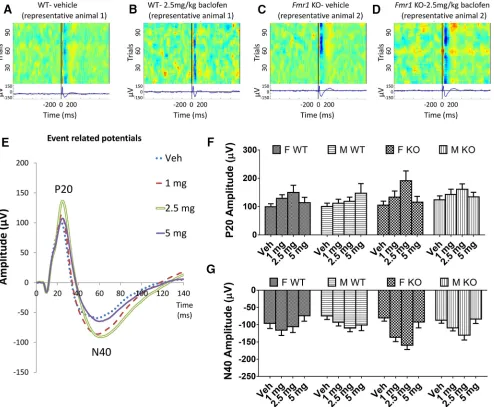
Amplitude of the P20 did not differ betweenFmr1KO and WT mice (p⫽0.26;Fig. 1A,C,F) nor between male and female mice (p⫽0.45;Fig. 1F) in the vehicle condi-tion. Baclofen increased P20 amplitude at all doses [F(3,204) ⫽ 8.30, p ⫽ 0.00003; Fig. 1B, D–F], with the
greatest effect at 2.5 mg/kg. Across baclofen doses, P20 amplitude did not differ across genotypes or sexes (p⫽ 0.31 and p ⫽ 0.98 respectively; Fig. 1F). The effect of baclofen on P20 amplitude did not differ betweenFmr1 KO and WT mice (genotype⫻drug interaction,p⫽0.11) but was larger in female than male mice [sex ⫻ drug interaction,F(3,204)⫽3.14,p⫽0.026;Fig. 1F].
N40
A similar pattern was observed with N40 amplitude, with no significant main effects of genotype or sex with vehicle (genotype,p⫽0.86; sex,p⫽0.51;Fig. 1A,C,G) or during baclofen treatment (genotype,p⫽0.11; sex,p
⫽0.30;Fig. 1B,D,G). There was a significant main effect of baclofen [F(3,204)⫽ 11.75,p ⬍ 0.000001; Fig. 1E, G].
N40 amplitude was increased at 1 mg/kg (p⫽0.001) and 2.5 mg/kg (p⫽0.000002) baclofen relative to vehicle, but not at 5 mg (p ⫽ 0.53). The effect of baclofen on N40 amplitude did not differ betweenFmr1KO and WT mice (genotype ⫻ drug interaction, p ⫽0.07) or between fe-male and fe-male mice (drug⫻sex interaction,p⫽0.23).
Effects ofFmr1KO and baclofen on high-frequency neural oscillations
Baseline power
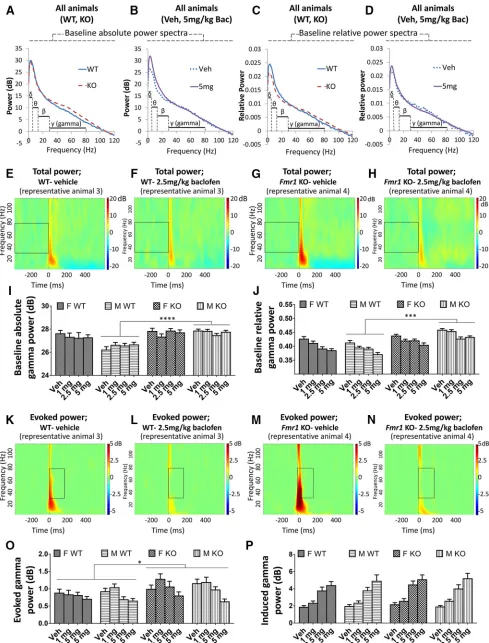
The absolute power of gamma (30 – 80 Hz) frequency neural oscillations (Fig. 2A,B,E–I), and the relative power of gamma oscillations [as a proportion of total (0 –120 Hz) power;Fig. 2C,D,J] were quantified, because oscillations at this frequency are thought to relate to cognitive func-tion (Salinas and Sejnowski, 2001; Buzsáki and Wang, 2012) as well as being driven by the activity of GABAergic interneurons (Buzsáki and Wang, 2012) that are impli-cated in FXS (Adusei et al. 2010; Paluszkiewicz et al. 2011). For baseline absolute gamma power in the vehicle condition, there was greater power inFmr1KO than in WT mice overall [F(1,68) ⫽ 11.73, p ⫽ 0.001; Fig. 2I]. This
genotype difference was present in males (p⫽0.00002;
Fig. 2I) but not in females (p ⫽ 0.61) [genotype ⫻ sex interaction:F(1,68)⫽7.07,p⫽0.013]. Across all baclofen
doses, the overall genotype difference was still evident [F(1,68)⫽ 11.34,p ⫽ 0.001]. Again, this genotype
differ-ence trended toward a significant differdiffer-ence in males (p⫽ 0.0001;Fig. 2I) but not females [p⫽0.35; genotype⫻sex interaction,F(1,68)⫽3.85,p⫽0.054]. In the vehicle
con-dition, there was greater baseline absolute gamma power in females than males [F(1,68)⫽6.44,p⫽0.013], driven by
For baseline relative gamma power after vehicle, there was also greater power inFmr1KO mice than in WT mice [F(1,68)⫽10.99,p⫽0.001;Fig. 2J] and a trend
toward a significant genotype sex interaction [F(1,68)⫽
3.89,p ⫽0.053] with an effect of genotype in males (p
⫽ 0.0002; Fig. 2J) but not females (p ⫽ 0.38). This genotype effect held across baclofen treatment condi-tions [F(1,68) ⫽ 37.06, p ⬍ 0.000001], and as seen in
vehicle, maleFmr1 KO mice had greater elevations of relative baseline gamma power compared with WT than females [genotype⫻sex interaction,F(1,68)⫽9.23,p⫽
0.003;Fig. 2J]. In contrast to absolute gamma power, there was no overall sex difference (vehicle,p ⫽0.56; baclofen, p ⫽ 0.26). Baseline relative gamma power was strongly decreased by baclofen [F(3,204) ⫽ 27.21,
p ⬍0.000001;Fig. 2J].
Auditory stimulus–related power
Changes to gamma power in response to auditory stim-uli were also investigated (Fig. 2K–N). In the vehicle con-dition, the absolute power of evoked gamma oscillations, which are time-locked to the stimulus, did not differ be-tween genotypes (p⫽0.15;Fig. 2O). However, across all baclofen treatment groups together, evoked gamma power was significantly increased inFmr1KO mice com-pared with WT mice [F(1,68)⫽5.28,p ⫽0.025;Fig. 2O].
There were no sex differences in evoked gamma power (vehicle, p ⫽ 0.39; baclofen, p ⫽ 0.88). A significant decrease in evoked gamma power was observed after baclofen [F(3,204)⫽ 13.96, p⬍ 0.000001;Fig. 2K–N, O],
[image:5.585.49.543.65.472.2]which was strongest at 5 mg/kg (p⫽0.000003) relative to vehicle. A marginal effect was also observed at 2.5 mg/kg (p⫽0.054). Baclofen had the same effect in WT andFmr1
KO mice (genotype ⫻ drug interaction, p ⫽ 0.17) and across sexes (sex⫻drug interaction,p⫽0.21;Fig. 2O). The power of induced gamma oscillations, which are not time-locked to the stimulus, was not influenced by geno-type (vehicle,p⫽0.59; baclofen,p⫽0.35;Fig. 2P) or sex (vehicle,p⫽0.69; baclofen,p⫽0.99). However, induced gamma power was strongly increased by baclofen at all doses [F(3,204)⫽73.59,p⬍0.000001;Fig. 2P]. This effect
was equivalent in Fmr1 KO and WT mice (genotype ⫻ drug interaction,p⫽0.81) and female and male mice (sex
⫻drug interaction,p⫽0.67).
Effects ofFmr1KO and baclofen on behavior
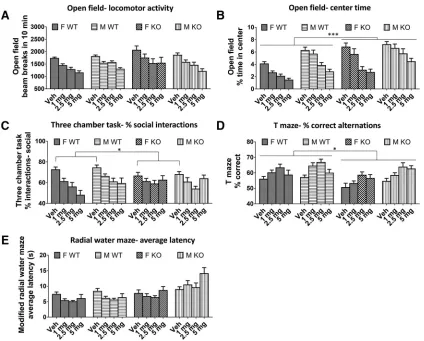
There was no difference between Fmr1 KO and WT mice in the number of beam breaks in 10 min with vehicle (p⫽0.33) or during baclofen treatment (p⫽0.28;Fig. 3A) in the open-field test. There was also no effect of sex (vehicle,p⫽0.67; baclofen,p⫽0.77). However, baclofen significantly decreased locomotor activity at all doses [F(3,213)⫽39.38,p⬍0.000001;Fig. 3A] in both genotypes
and sexes (genotype⫻drug interaction,p⫽0.52; sex⫻ drug interaction,p ⫽ 0.44). For center time in the open field, there were significant main effects of genotype, sex, continued
[image:7.585.82.506.325.666.2]F-KO,n⫽15; M-WT,n⫽23; M-KO,n⫽18).A,B, Baseline absolute power spectra inFmr1KO and WT mice (A), and vehicle and 5 mg/kg baclofen treatment conditions (B).C,D, Baseline relative power spectra (normalized to total 0 to 120 Hz power).E–H, Heat maps showing total power of EEG oscillations at baseline across 2 to 120 Hz frequencies from representative WT (E,F) andFmr1KO (G,H) mice after vehicle and 2.5 mg/kg baclofen administration. Boxes highlight baseline gamma oscillations.I, Baseline absolute gamma power.J, Baseline relative gamma power.K–N, Heat maps showing evoked power of EEG oscillations after stimulus across 2 to 120 Hz frequencies from representative WT (K,L) andFmr1KO (M,N) mice after vehicle and 2.5 mg/kg baclofen administration. Boxes highlight auditory-evoked gamma oscillations.O, Evoked gamma power.P, Induced gamma power. F, female, M, male, Veh, vehicle. Error bars represent SEM.ⴱp⬍0.05,ⴱⴱⴱp⬍0.0005,ⴱⴱⴱⴱp⬍0.00005.
and baclofen treatment. Fmr1 KO mice spent a signifi-cantly greater proportion of the total time in the center than WT mice [vehicle: F(1,73) ⫽ 17.70, p ⫽ 0.00007;
baclofen: F(1,71) ⫽ 12.49, p ⫽ 0.0007; Fig. 3B]. Males
spent significantly more time in center than females [ve-hicle:F(1,73)⫽7.62,p⬍0.007; baclofen:F(1,71)⫽28.68,p ⫽ 0.000001; Fig. 3B]. Baclofen significantly decreased percentage center time [F(3,213)⫽ 50.11,p ⬍ 0.000001;
Fig. 3B], reversing the Fmr1 KO phenotype. This effect was similar in both genotypes (genotype⫻drug interac-tion,p ⫽ 0.51) but was greater in females [sex ⫻ drug interaction,F(3,213)⫽3.23,p⬍0.05;Fig. 3B].
BothFmr1KO and WT mice displayed a preference for interactions with the target mouse rather than the object (percentage social interactions⬎50%;Fig. 3C) during the three-chamber social interaction test. In the vehicle con-dition, social preference was decreased inFmr1KO mice compared with WT [F(1,63) ⫽ 4.58, p ⫽ 0.036; Fig. 3C].
However, during baclofen treatment, this main effect was not significant (p ⫽ 0.87). There was no difference be-tween males and females following either vehicle or baclofen (vehicle,p⫽0.59; baclofen,p⫽0.28). Baclofen significantly reduced sociability [F(3,168) ⫽ 10.43, p ⫽
0.000002;Fig. 3C] to a similar extent in both genotypes (genotype⫻drug interaction,p⫽0.11) and sexes (sex⫻ drug interaction,p⫽0.70).
Significant main effects of genotype, sex, and treatment were found on spontaneous alternation in the T-maze. Fmr1 KO mice had a significantly lower proportion of correct alternations than WT mice across baclofen doses [F(1,70)⫽5.84,p⫽0.018;Fig. 3D]. This was less evident
in the vehicle condition, which failed to reach significance (p ⫽ 0.057). Males made more correct alternations than females across baclofen doses [F(1,70)⫽9.16, p⫽0.003],
but this was not significant in the vehicle condition alone (p ⫽ 0.22). The working memory of all mice was signifi-cantly improved by baclofen [F(3,210) ⫽ 10.71, p ⫽
0.000001;Fig. 3D], with no significant genotype⫻drug (p
⫽0.10) or sex⫻drug (p ⫽0.84) interactions.
No effects of genotype or sex on latency to find the platform were observed on the radial water maze during test trials following vehicle (genotype,p⫽0.67; sex,p⫽ 0.17). However, across baclofen doses, significant main effects were found for genotype [F(1,65) ⫽ 21.70, p ⫽
0.00002;Fig. 3E] and baclofen [F(3,195)⫽3.55,p⫽0.015;
Fig. 3E], which were moderated by a genotype ⫻ drug interaction [F(3,195)⫽3.56,p⫽0.015]. The main effect of
genotype arose because there were contrasting effects of baclofen in WT andFmr1KO mice (Fig. 3E). In WT mice, baclofen at all doses decreased latency compared with vehicle (all at leastp⬍0.05), whereas inFmr1KO mice, baclofen had no significant effect. Finally, across baclofen doses, latency to approach the platform was lower in female mice than male mice [F(1,65)⫽8.64,p ⫽0.005].
Relationship between baclofen gamma response and T-maze performance improvement
To explore the plausibility of using EEG to predict be-havioral treatment responsiveness, we investigated whether rescue of specific EEG abnormalities (baseline
relative gamma power and evoked gamma power) at an individual level was associated with improvement in T-maze spontaneous alternation or open-field center time inFmr1KO and WT mice. These parameters were inves-tigated at 2.5 mg/kg baclofen, the dose at which most consistent improvement of electrophysiological and be-havioral deficits inFmr1KO mice was seen.
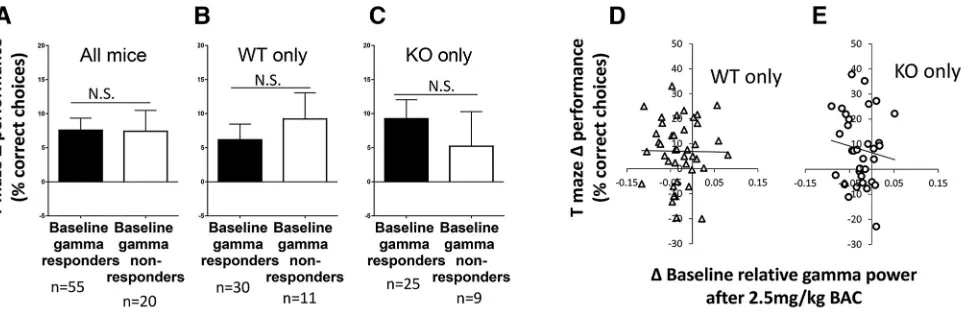
First, mice were grouped into baseline-relative gamma responders, whose baseline relative gamma power de-creased with baclofen (inFmr1KO mice, this represented rescue of their abnormal baseline relative gamma power), and baseline relative gamma nonresponders, whose baseline relative gamma power increased with baclofen. There was no difference in ⌬ T-maze performance (the change in percentage correct alternations after 2.5 mg/kg baclofen treatment compared with vehicle) between baseline relative gamma responders and nonresponders (all mice,p⫽0.79; WT only,p⫽0.26;Fmr1KO only,p⫽ 0.51; Fig. 4A–C). There was also no correlation of ⌬ baseline relative gamma power with ⌬ T-maze perfor-mance in WT orFmr1KO mice (WT only,p⫽0.77;Fmr1 KO only, p ⫽ 0.50; Fig. 4D, E]. Second, mice were grouped into evoked gamma responders, whose evoked gamma power decreased with baclofen (inFmr1KO mice, this represented rescue of their deficit), and evoked gamma nonresponders, whose evoked gamma power increased with baclofen. In contrast to baseline gamma, there was a significant difference in postbaclofen T-maze performance between evoked gamma responders and nonresponders (Fig. 4F–H). These effects reached signif-icance in all mice together (t⫽3.16, df⫽66,p⫽0.003;
Fig. 4F) and in WT mice (t⫽3.40, df⫽33,p⫽0.002;Fig. 4G), but failed to do so inFmr1KO mice (t⫽1.35, df⫽31, p ⫽0.19; Fig. 4H).There was an inverse correlation be-tween⌬evoked gamma power responses and⌬T-maze performance in all mice (r⫽– 0.33,p⫽0.006) and in WT mice (r⫽– 0.43,p ⫽0.010;Fig. 4I) but not in Fmr1KO mice (r ⫽ – 0.26, p ⫽ 0.14; Fig. 4J). Collectively, the animals that displayed the greatest baclofen-induced de-crease in evoked gamma power showed the greatest improvement in T-maze performance. None of the above relationships were evident for open-field center time, in that there were no relationships between changes in baseline relative gamma power or evoked gamma power and open-field center time after 2.5 mg/kg baclofen (data not shown). Similarly, there were no significant correla-tions between changes in induced power and behavior after 2.5 mg/kg baclofen, or between changes in EEG measures and sociability (data not shown).
Discussion
power and improves working memory (T-maze perfor-mance), and (c) at an individual level, normalization of evoked gamma oscillations was associated with improve-ment in working memory. Our study also suggests that someFmr1KO–related deficits, such as impaired socia-bility and episodic memory (radial water maze perfor-mance), may be impervious to rescue by baclofen. Overall, these findings indicate that racemic baclofen may have benefit for remediating sensory hypersensitivity and some cognitive deficits in FXS and suggest that evoked gamma oscillations may have potential utility for predic-tion of treatment responsiveness in some behavioral do-mains in the condition.
Increased evoked gamma power in Fmr1 KO mice is consistent with sensory hypersensitivity (Karaka and Baar, 1998), which is also seen inFmr1KO mice in the form of diminished ERP N1 habituation (Lovelace et al. 2016), neuronal hyperexcitability in the auditory cortex (Rotschafer and Razak, 2014), and increased prepulse
inhibition (Chen and Toth, 2001). Increased sensitivity to sensory stimuli is also often observed in individuals with FXS (Kogan et al. 2004;Baranek et al. 2008). The dimi-nution of evoked gamma power by racemic baclofen suggests that this agent may be particularly valuable in targeting the specific sensory hypersensitivity endophe-notype in FXS.
[image:9.585.52.538.64.221.2]A key finding of this study was that changes in evoked gamma power after 2.5 mg/kg baclofen were related to changes in T-maze performance, such that evoked gamma responders showed greater T-maze performance improvement than nonresponders. Baclofen-induced EEG changes, rather than predrug EEG measures, were analyzed because of their greater clinical potential. They enable a within-subject absolute criterion (evoked gamma decrease, yes/no) to be used to classify individual sub-jects and do not require normative reference data. In contrast, use of predrug evoked gamma power (analo-gous to vehicle treatment) would involve determination of
Figure 4.Relationships between changes in gamma power and improvements in T-maze performance after 2.5 mg/kg baclofen.A–C, Differences in T-maze performance between baseline relative gamma responders and baseline relative gamma nonresponders.D,E, Correlation of changes in relative baseline gamma power after 2.5 mg/kg baclofen with changes in T-maze performance in WT and
Fmr1KO mice.F–H, Differences in T-maze performance between evoked gamma responders and evoked gamma nonresponders. I,J, Correlation of changes in evoked gamma power after 2.5 mg/kg baclofen with changes in T-maze performance in WT mice and
normative ranges and collection of extensive reference data. Between genotype groups, there was a less strong relationship between baclofen-induced changes in evoked gamma oscillations and T maze performance in Fmr1KO mice than in WT mice. This was expected, since baclofen targets a neurotransmitter system known to be dysregulated in Fmr1 KO mice. However, our findings suggest that further preclinical study of the possible link between evoked power changes and drug effectiveness for other pharmacotherapies is warranted given the po-tential benefit of this approach for individuals with FXS.
Increased baseline gamma power in FXS is a robust feature of the disorder, indicative of increased network noise and network hyperexcitability (Gandal et al. 2012a). It is observed in humans with FXS (Ethridge et al. 2016) and ASD (Orekhova et al. 2007;Wang et al. 2013). It is also seen in Fmr1KO mice in vivo(in this study) andin vitroin thalamocortical slices fromFmr1KO mice (Gibson et al. 2008). Racemic baclofen did not alter absolute power of baseline gamma oscillations in our study, in contrast to a prior study in whichL-baclofen decreased absolute power of oscillations between 21 and 50 Hz (Marrosu et al. 2006). However, baclofen did decrease the relative power of baseline gamma oscillations as a pro-portion of total oscillatory activity. Further work is required to determine whether the importance of high-frequency oscillations lies in their absolute power or their power relative to other oscillatory activity. If absolute gamma power is more neurobiologically relevant, the failure of baclofen to rescue increased absolute baseline gamma power inFmr1KO mice may represent a limitation of this pharmacotherapy. If relative power of baseline oscilla-tions has particular relevance, then investigation of other frequencies in Fmr1 KO mice is warranted, given that differences in relative upper alpha (10 –12 Hz) and theta (4 – 8 Hz) power have been described in FXS (Van der Molen and Van der Molen, 2013). Nonetheless, as a po-tential translational biomarker, baseline gamma power may be a useful tool for designing and evaluating future therapeutic strategies for FXS.
The behavioral effects of baclofen reported here are partially consistent with prior studies. Improvement of spatial working memory by systemic baclofen has previ-ously been reported in a similar T-maze task (Gandal et al. 2012b) and is in line with other cognition-enhancing prop-erties of baclofen, including increased behavioral flexibil-ity in rats (Beas et al. 2016). Because loss of FMRP results in abnormally increased open-field center exploration, it has been argued that the decrease in open-field center time by baclofen represents a beneficial, anxiety-normalizing effect (Bhogal and Jongens, 2010). Interest-ingly, this effect was not seen with arbaclofen at 1.5 mg/kg (Qin et al. 2015). Together with these beneficial effects of baclofen, there were indications of other effects that may not be therapeutically helpful. In particular, baclofen decreased sociability at all doses. This contrasts with two previous studies, one that found a beneficial effect of baclofen on sociability (Gandal et al. 2012b) and another that found no effect, but reported an increase in
preference for social novelty (preference for novel over familiar stimulus mouse;Qin et al. 2015).
Although Fmr1 KO mice effectively mimic the loss of FMRP protein in FXS, they do not display a highly con-sistent behavioral phenotype. Some studies have re-ported spatial memory deficits inFmr1KO mice (Bakker et al. 1994; D’Hooge et al. 1997), but others have not (Peier et al. 2000;Leach et al. 2016). Deficits in working and episodic memory in Fmr1 KO mice are consistent with the clinical picture in FXS, in which intellectual dis-ability is commonly seen. Decreased anxiety-like behavior and hyperactivity in the open field inFmr1KO mice are very often observed (e.g.,Uutela et al. 2012;Dolan et al. 2013;Ding et al. 2014) but not always (Veeraragavan et al. 2011). A possible reason for this discrepancy is that the hyperactivity phenotype may diminish with repeated test-ing (Kramvis et al. 2013). Decreased social interactions by Fmr1KO mice have been reported in free-interacting tests (Hébert et al. 2014;Oddi et al. 2015). However, when the three-chamber social interaction test is used, abnormali-ties are often not seen in sociability (Liu et al. 2011;Hébert et al. 2014), although other work has even shown in-creased sociability inFmr1KO mice (Gantois et al. 2013). A possible reason for this inconsistency across studies withFmr1KO mice could involve stress, sinceFmr1KO mice appear to show enhanced corticosterone secretion in response to acute stress (Markham et al. 2006;Ghilan et al. 2015, but seeQin and Smith, 2008). The differential effects of acute stress onFmr1KO compared with con-trols may contribute to theFmr1KO behavioral phenotype in some tests, such as the T-maze or radial arm maze. Consequently, this phenotype may be particularly im-pacted by differences in the testing environment between studies. Furthermore, the animals in this study were indi-vidually housed after surgery and are likely to have expe-rienced some longer-term stress associated with sustained social isolation that was not experienced by animals in other studies. Heightened adaptive or mal-adaptive responses of Fmr1 KO mice to chronic stress (Qin et al. 2011) may have further influenced genotype effects in this study. Future studies are warranted to clarify the role of stress inFmr1-related pathology in mice and determine whether social isolation or socialization impacts the expression of functional deficits in humans with FXS.
Sex⫻genotype interactions were observed for abso-lute and relative baseline gamma power, with increased baseline gamma power seen in male but not femaleFmr1 KO mice. This is consistent with the increased severity of FXS in human males (Crawford et al. 2001). However, unlike in humans, sex differences in the expression of FXS-related phenotypes in this study are unlikely to relate to variable penetrance of the genetic manipulation/muta-tion, since this study used complete knockout ofFmr1for both sexes. Instead, they are more likely to reflect the interaction of FMRP signaling with sex differences in other pathways.
with the NMDA subunit 1 receptor selectively removed from parvalbumin-expressing GABAergic interneurons show a similar EEG profile to Fmr1 KO mice, including increased basal gamma EEG, and display several autism-like behavioral changes (Carlén et al. 2012; Saunders et al. 2013; Billingslea et al. 2014). Increased gamma oscillations are thought to be due to a loss of the normal inhibitory control typically exerted by GABAergic cells, leading toward a loss of excitatory/inhibitory balance. This suggests that the primary pathology underlying the EEG abnormalities reported here inFmr1KO mice may reflect a loss of GABA integrity. Baclofen stimulates GABA-B receptors both presynaptically, resulting in decreased glutamate release (Isaacson and Hille, 1997), and post-synaptically, resulting in decreased excitability due to voltage gated potassium channel activation (Lüscher et al. 1997). GABA-B agonism by baclofen may compensate for GABAergic pathology in Fmr1 KO mice, such as de-creased GABA receptor abundance (Gantois et al. 2006;
Adusei et al. 2010). Additionally, arbaclofen has also been shown to decrease protein synthesis (Henderson et al. 2012; Qin et al. 2015), potentially counteracting excess protein production due to FMRP loss (Darnell et al. 2011). This study had a number of limitations. A within-subject design was used, enabling assessment of the acute ef-fects of baclofen across multiple domains. However, later behavioral tests (such as social interaction and radial water maze) may have been influenced by lingering ef-fects of prior baclofen exposure despite the 4 to 5 d washout. In the open-field test and other tests, habitua-tion to the test environment may also have modified the behavioral measures and confounded the effects of baclofen. Furthermore, findings at the highest baclofen dose (5 mg/kg) may have been influenced by the sedative effect of the drug, accounting for its diminished efficacy in T-maze and water maze tests at that dose. Ultimately, the value of the findings described in this study will be deter-mined by the extent of their translatability and predictive validity for individuals with FXS.
References
Adusei DC, Pacey LK, Chen D, Hampson DR (2010) Early develop-mental alterations in GABAergic protein expression in fragile X knockout mice. Neuropharmacology 59:167–171.CrossRef Med-line
Bailey DB, Raspa M, Olmsted M, Holiday DB (2008) Co-occurring conditions associated with FMR1 gene variations: findings from a national parent survey. Am J Med Genet Part A 146:2060 –2069. CrossRef
Bailey DB, Jr., Raspa M, Bishop E, Olmsted M, Mallya UG, Berry-Kravis E (2012) Medication utilization for targeted symptoms in children and adults with fragile X syndrome: US survey. J Dev Behav Pediatr 33:62–69.CrossRef Medline
Bakker CE, Verheij C, Willemsen R, Vanderhelm R, Oerlemans F, Vermey M, Bygrave A, Hoogeveen AT, Oostra BA, Reyniers E, Deboulle K, Dhooge R, Cras P, Vanvelzen D, Nagels G, Martin JJ, Dedeyn PP, Darby JK, Willems PJ (1994) Fmr1 knockout mice: a model to study fragile X mental retardation. Cell 78:23–33. Baranek GT, Roberts JE, David FJ, Sideris J, Mirrett PL, Hatton DD,
Bailey DB Jr. (2008) Developmental trajectories and correlates of sensory processing in young boys with fragile X syndrome. Phys Occup Ther Pediatr 28:79 –98.Medline
Bartos M, Vida I, Jonas P (2007) Synaptic mechanisms of synchro-nized gamma oscillations in inhibitory interneuron networks. Nat Rev Neurosci 8:45–56.CrossRef Medline
Beas BS, Setlow B, Bizon JL (2016) Effects of acute administration of the GABA(B) receptor agonist baclofen on behavioral flexibility in rats. Psychopharmacology (Berl) 233:2787–2797.CrossRef Med-line
Berry-Kravis EM, Hessl D, Rathmell B, Zarevics P, Cherubini M, Walton-Bowen K, Mu Y, Nguyen DV, Gonzalez-Heydrich J, Wang PP, Carpenter RL, Bear MF, Hagerman RJ (2012) Effects of STX209 (arbaclofen) on neurobehavioral function in children and adults with fragile X syndrome: a randomized, controlled, phase 2 trial. Sci Transl Med 4:152ra127.CrossRef Medline
Bhogal B, Jongens TA (2010) Fragile X syndrome and model organ-isms: identifying potential routes of therapeutic intervention. Dis Model Mech 3:693–700.CrossRef Medline
Billingslea EN, Tatard-Leitman VM, Anguiano J, Jutzeler CR, Suh J, Saunders JA, Morita S, Featherstone RE, Ortinski PI, Gandal MJ, Lin R, Liang Y, Gur RE, Carlson GC, Hahn CG, Siegel SJ (2014) Parvalbumin cell ablation of NMDA-R1 causes increased resting network excitability with associated social and self-care deficits. Neuropsychopharmacology 39:1603–1613.CrossRef Medline Buzsáki G, Wang XJ (2012) Mechanisms of gamma oscillations.
Annu Rev Neurosci 35:203–225.CrossRef Medline
Carlén M, Meletis K, Siegle JH, Cardin JA, Futai K, Vierling-Claassen D, Rühlmann C, Jones SR, Deisseroth K, Sheng M, Moore CI, Tsai LH (2012) A critical role for NMDA receptors in parvalbumin in-terneurons for gamma rhythm induction and behavior. Mol Psy-chiatry 17:537–548.CrossRef Medline
Castrén M, Pääkkönen A, Tarkka IM, Ryynänen M, Partanen J (2003) Augmentation of auditory N1 in children with fragile X syndrome. Brain Topogr 15:165–171.Medline
Chen L, Toth M (2001) Fragile X mice develop sensory hyperreactivity to auditory stimuli. Neuroscience 103:1043–1050.Medline Crawford DC, Acuña JM, Sherman SL (2001) FMR1 and the fragile X
syndrome: human genome epidemiology review. Genet Med 3:359 –371.CrossRef Medline
D’Hooge R, Nagels G, Franck F, Bakker CE, Reyniers E, Storm K, Kooy RF, Oostra BA, Willems PJ, DeDeyn PP (1997) Mildly im-paired water maze performance in male Fmr1 knockout mice. Neuroscience 76:367–376.Medline
Darnell JC, Van Driesche SJ, Zhang C, Hung KY, Mele A, Fraser CE, Stone EF, Chen C, Fak JJ, Chi SW, Licatalosi DD, Richter JD, Darnell RB (2011) FMRP stalls ribosomal translocation on mRNAs linked to synaptic function and autism. Cell 146:247–261. Cross-Ref Medline
Delorme A, Makeig S (2004) EEGLAB: an open source toolbox for analysis of single-trial EEG dynamics including independent com-ponent analysis. J Neurosci Methods 134:9 –21.CrossRef Medline Ding Q, Sethna F, Wang H (2014) Behavioral analysis of male and female Fmr1 knockout mice on C57BL/6 background. Behav Brain Res 271:72–78.CrossRef Medline
Dolan BM, Duron SG, Campbell DA, Vollrath B, Shankaranarayana Rao BS, Ko HY, Lin GG, Govindarajan A, Choi SY, Tonegawa S (2013) Rescue of fragile X syndrome phenotypes in Fmr1 KO mice by the small-molecule PAK inhibitor FRAX486. Proc Natl Acad Sci U S A 110:5671–5676.CrossRef Medline
Ehrlichman RS, Luminais SN, White SL, Rudnick ND, Ma N, Dow HC, Kreibich AS, Abel T, Brodkin ES, Hahn CG, Siegel SJ (2009) Neuregulin 1 transgenic mice display reduced mismatch negativ-ity, contextual fear conditioning and social interactions. Brain Res 1294:116 –127.CrossRef Medline
Ethridge LE, White SP, Mosconi MW, Wang J, Byerly MJ, Sweeney JA (2016) Reduced habituation of auditory evoked potentials indi-cate cortical hyper-excitability in fragile X syndrome. Transl Psy-chiatr 6:e787.CrossRef Medline
nega-tivity: implications for schizophrenia prodromal population. Neu-robiol Dis 73:289 –295.CrossRef
Frankland PW, Wang Y, Rosner B, Shimizu T, Balleine BW, Dykens EM, Ornitz EM, Silva AJ (2004) Sensorimotor gating abnormalities in young males with fragile X syndrome and Fmr1-knockout mice. Mol Psychiatry 9:417–425.CrossRef Medline
Gandal MJ, Edgar JC, Klook K, Siegel SJ (2012a) Gamma synchrony: towards a translational biomarker for the treatment-resistant symptoms of schizophrenia. Neuropharmacology 62:1504 –1518. Gandal MJ, Sisti J, Klook K, Ortinski PI, Leitman V, Liang Y, Thieu T, Anderson R, Pierce RC, Jonak G, Gur RE, Carlson G, Siegel SJ (2012b) GABAB-mediated rescue of altered excitatory-inhibitory balance, gamma synchrony and behavioral deficits following con-stitutive NMDAR-hypofunction. Transl Psychiatry 2:e142. Gantois I, Vandesompele J, Speleman F, Reyniers E, D’Hooge R,
Severijnen LA, Willemsen R, Tassone F, Kooy RF (2006) Expres-sion profiling suggests underexpresExpres-sion of the GABA(A) receptor subunit delta in the fragile X knockout mouse model. Neurobiol Dis 21:346 –357.CrossRef Medline
Gantois I, Pop AS, de Esch CE, Buijsen RA, Pooters T, Gomez-Mancilla B, Gasparini F, Oostra BA, D’Hooge R, Willemsen R (2013) Chronic administration of AFQ056/Mavoglurant restores social behaviour in Fmr1 knockout mice. Behav Brain Res 239:72– 79.CrossRef Medline
Ghilan M, Hryciw BN, Brocardo PS, Bostrom CA, Gil-Mohapel J, Christie BR (2015) Enhanced corticosteroid signaling alters syn-aptic plasticity in the dentate gyrus in mice lacking the fragile X mental retardation protein. Neurobiol Dis 77:26 –34. CrossRef Medline
Gibson JR, Bartley AF, Hays SA, Huber KM (2008) Imbalance of neocortical excitation and inhibition and altered UP states reflect network hyperexcitability in the mouse model of fragile X syn-drome. J Neurophysiol 100:2615–2626.CrossRef Medline Gonçalves JT, Anstey JE, Golshani P, Portera-Cailliau C (2013)
Circuit level defects in the developing neocortex of Fragile X mice. Nat Neurosci 16:903–909.CrossRef Medline
Healy A, Rush R, Ocain T (2011) Fragile X syndrome: an update on developing treatment modalities. ACS Chem Neurosci 2:402–410. CrossRef Medline
Hébert B, Pietropaolo S, Même S, Laudier B, Laugeray A, Doisne N, Quartier A, Lefeuvre S, Got L, Cahard D, Laumonnier F, Crusio WE, Pichon J, Menuet A, Perche O, Briault S (2014) Rescue of fragile X syndrome phenotypes in Fmr1 KO mice by a BKCa channel opener molecule. Orphanet J Rare Dis 9:124.CrossRef Medline Henderson C, Wijetunge L, Kinoshita MN, Shumway M, Hammond
RS, Postma FR, Brynczka C, Rush R, Thomas A, Paylor R, Warren ST, Vanderklish PW, Kind PC, Carpenter RL, Bear MF, Healy AM (2012) Reversal of disease-related pathologies in the fragile X mouse model by selective activation of GABAB receptors with arbaclofen. Sci Transl Med 4:152ra128.CrossRef Medline Isaacson JS, Hille B (1997) GABA(B)-mediated presynaptic inhibition
of excitatory transmission and synaptic vesicle dynamics in cul-tured hippocampal neurons. Neuron 18:143–152.Medline Karaka S, Baar E (1998) Early gamma response is sensory in
origin: a conclusion based on cross-comparison of results from multiple experimental paradigms. Int J Psychophysiol 31:13–31. CrossRef
Kogan CS, Bertone A, Cornish K, Boutet I, Der Kaloustian VM, Andermann E, Faubert J, Chaudhuri A (2004) Integrative cortical dysfunction and pervasive motion perception deficit in fragile X syndrome. Neurology 63:1634 –1639.Medline
Kramvis I, Mansvelder HD, Loos M, Meredith R (2013) Hyperactivity, perseveration and increased responding during attentional rule acquisition in the fragile X mouse model. Front Behav Neurosci 7:172.CrossRef Medline
Leach PT, Hayes J, Pride M, Silverman JL, Crawley JN (2016) Normal performance of Fmr1 mice on a touchscreen delayed nonmatching to position working memory task. eNeuro 3:ENEURO.0143– 15.2016.CrossRef
Liu ZH, Chuang DM, Smith CB (2011) Lithium ameliorates pheno-typic deficits in a mouse model of fragile X syndrome. Int J Neuropsychopharmacol 14:618 –630.CrossRef
Lovelace JW, Wen TH, Reinhard S, Hsu MS, Sidhu H, Ethell IM, Binder DK, Razak KA (2016) Matrix metalloproteinase-9 deletion rescues auditory evoked potential habituation deficit in a mouse model of fragile X syndrome. Neurobiol Dis 89:126 –135.CrossRef Lozano R, Hare EB, Hagerman RJ (2014) Modulation of the GABAe-rgic pathway for the treatment of fragile X syndrome. Neuropsy-chiatr Dis Treat 10:1769 –1779.CrossRef Medline
Lüscher C, Jan LY, Stoffel M, Malenka RC, Nicoll RA (1997) G protein-coupled inwardly rectifying K⫹channels (GIRKs) mediate postsynaptic but not presynaptic transmitter actions in hippocam-pal neurons. Neuron 19:687–695.CrossRef
Markham JA, Beckel-Mitchener AC, Estrada CM, Greenough WT (2006) Corticosterone response to acute stress in a mouse model of fragile X syndrome. Psychoneuroendocrinology 31:781–785. CrossRef Medline
Marrosu F, Santoni F, Fa M, Puligheddu M, Barberini L, Genugu F, Frau R, Manunta M, Mereu G (2006) Beta and gamma range EEG power-spectrum correlation with spiking discharges in DBA/2J mice absence model: role of GABA receptors. Epilepsia 47:489 – 494.CrossRef Medline
Oddi D, Subashi E, Middei S, Bellocchio L, Lemaire-Mayo V, Guzmán M, Crusio WE, D’Amato FR, Pietropaolo S (2015) Early social enrichment rescues adult behavioral and brain abnormali-ties in a mouse model of fragile X syndrome. Neuropsychophar-macology 40:1113–1122.CrossRef
Orekhova EV, Stroganova TA, Nygren G, Tsetlin MM, Posikera IN, Gillberg C, Elam M (2007) Excess of high frequency electroen-cephalogram oscillations in boys with autism. Biol Psychiatr 62: 1022–1029.CrossRef Medline
Pacey LK, Heximer SP, Hampson DR (2009) Increased GABA(B) receptor-mediated signaling reduces the susceptibility of fragile X knockout mice to audiogenic seizures. Mol Pharmacol 76:18 –24. CrossRef Medline
Paluszkiewicz SM, Olmos-Serrano JL, Corbin JG, Huntsman MM (2011) Impaired inhibitory control of cortical synchronization in fragile X syndrome. J Neurophysiol 106:2264 –2272. CrossRef Medline
Peier AM, McIlwain KL, Kenneson A, Warren ST, Paylor R, Nelson DL (2000) (Over)correction of FMR1 deficiency with YAC transgenics: behavioral and physical features. Hum Mol Genet 9:1145–1159. Medline
Qin M, Smith CB (2008) Unaltered hormonal response to stress in a mouse model of fragile X syndrome. Psychoneuroendocrinology 33:883–889.CrossRef Medline
Qin M, Xia Z, Huang T, Smith CB (2011) Effects of chronic immobi-lization stress on anxiety-like behavior and basolateral amygdala morphology in Fmr1 knockout mice. Neuroscience 194:282–290. CrossRef Medline
Qin M, Huang T, Kader M, Krych L, Xia Z, Burlin T, Zeidler Z, Zhao T, Smith CB (2015) R-baclofen reverses a social behavior deficit and elevated protein synthesis in a mouse model of fragile X syndrome. Int J Neuropsychopharmacol 18:pii:pyv034.CrossRef
Radwan B, Dvorak D, Fenton AA (2016) Impaired cognitive discrim-ination and discoorddiscrim-ination of coupled theta-gamma oscillations in Fmr1 knockout mice. Neurobiol Dis 88:125–138.CrossRef Medline Rotschafer SE, Razak KA (2014) Auditory processing in fragile X
syndrome. Front Cell Neurosci 8:19.CrossRef Medline
Salinas E, Sejnowski TJ (2001) Correlated neuronal activity and the flow of neural information. Nat Rev Neurosci 2:539 –550.CrossRef Medline
Sankoorikal GM, Kaercher KA, Boon CJ, Lee JK, Brodkin ES (2006) A mouse model system for genetic analysis of sociability: C57BL/6J versus BALB/cJ inbred mouse strains. Biol Psychiatry 59:415–423.CrossRef Medline
interneurons recreates autism-like phenotypes. Autism Res 6:69 – 77.CrossRef Medline
Silverman JL, Pride MC, Hayes JE, Puhger KR, Butler-Struben HM, Baker S, Crawley JN (2015) GABAB receptor agonist R-baclofen reverses social deficits and reduces repetitive behavior in two mouse models of autism. Neuropsychopharmacology 40:2228 – 2239.CrossRef Medline
Sinclair D, Oranje B, Razak KA, Siegel SJ, Schmid S (2016) Sensory processing in autism spectrum disorders and fragile X syndrome: from the clinic to animal models. Neurosci Biobehav Rev pii: S0149-7634(15)30318-3.
St Clair DM, Blackwood DH, Oliver CJ, Dickens P (1987) P3 abnor-mality in fragile X syndrome. Biol Psychiatry 22:303–312.Medline Tatard-Leitman VM, Jutzeler CR, Suh J, Saunders JA, Billingslea EN, Morita S, White R, Featherstone RE, Ray R, Ortinski PI, Banerjee A, Gandal MJ, Lin R, Alexandrescu A, Liang Y, Gur RE, Borgmann-Winter KE, Carlson GC, Hahn C-G, Siegel SJ (2015) Pyramidal cell selective ablation of N-methyl-D-aspartate receptor 1 causes in-crease in cellular and network excitability. Biol Psychiatr 77:556 – 568.CrossRef Medline
Traub RD, Whittington MA, Colling SB, Buzsáki G, Jefferys JG (1996) Analysis of gamma rhythms in the rat hippocampus in vitro and in vivo. J Physiol 493(Pt 2):471–484.CrossRef
Turner G, Webb T, Wake S, Robinson H (1996) Prevalence of fragile X syndrome. Am J Med Genet 64:196 –197.CrossRef Medline Uutela M, Lindholm J, Louhivuori V, Wei H, Louhivuori LM,
Per-tovaara A, Akerman K, Castrén E, Castrén ML (2012) Reduction of
BDNF expression in Fmr1 knockout mice worsens cognitive defi-cits but improves hyperactivity and sensorimotor defidefi-cits. Gen Brain Behav 11:513–523.CrossRef Medline
Van der Molen MJ, Van der Molen MW (2013) Reduced alpha and exaggerated theta power during the resting-state EEG in fragile X syndrome. Biol Psychol 92:216 –219.CrossRef Medline
Van der Molen MJ, Van der Molen MW, Ridderinkhof KR, Hamel BC, Curfs LM, Ramakers GJ (2012a) Auditory change detection in fragile X syndrome males: a brain potential study. Clin Neuro-physiol 123:1309 –1318.
Van der Molen MJ, Van der Molen MW, Ridderinkhof KR, Hamel BC, Curfs LM, Ramakers GJ (2012b) Auditory and visual cortical ac-tivity during selective attention in fragile X syndrome: a cascade of processing deficiencies. Clin Neurophysiol 123:720 –729. Veeraragavan S, Bui N, Perkins JR, Yuva-Paylor LA, Carpenter RL,
Paylor R (2011) Modulation of behavioral phenotypes by a mus-carinic M1 antagonist in a mouse model of fragile X syndrome. Psychopharmacology 217:143–151.CrossRef
Verkerk AJ, Pieretti M, Sutcliffe JS, Fu YH, Kuhl DP, Pizzuti A, Reiner O, Richards S, Victoria MF, Zhang FP, et al. (1991) Identification of a gene (FMR-1) containing a CGG repeat coincident with a break-point cluster region exhibiting length variation in fragile X syn-drome. Cell 65:905–914.Medline