Truthmaker Semantics for Epistemic Logic
∗Peter Hawke & Ayb¨uke ¨Ozg¨un
ILLC, University of Amsterdam & Arch´e, University of St Andrews
1
Introduction
Can truthmaker semantics offer an improvement on Hintikka-style semantics for epistemic logic?1 That depends on the answers to various questions:
• What is one’s purpose in designing a system for epistemic logic? For instance, is it to capture
ordinary knowledge ascription; principle knowability relative to a given body of empirical in-formation; or knowledge-level warrant transmission?
• What are the limitations, if any, of the Hintikkan approach relative to the selected goal? In
partic-ular, do cogent philosophical arguments bear against the validities that fall out of this approach?
• What are the unequivocal successes of the Hintikkan approach, and can a truthmaker approach
emulate them without incurring large costs in complexity?
Our purpose is to briefly explore the scope of a truthmaker approach to epistemic logic and the ex-tent to which it can best the Hintikkan approach. §2 identifies three possible targets of analysis for the epistemic logician. Then, we offer a list of candidate epistemic principles and review the arguments that render some controversial. §5.2 presents the Hintikkan approach and notes - as per its well-known susceptibility to the ‘problem of logical omniscience’ - that it validates all of the aforementioned princi-ples, controversial or otherwise. §4 lays out a truthmaker framework in the style of Fine (2016, 2017a, forthcoming). §5 presents six different ways of extending this semantics with a (conditional) knowl-edge operator, drawing on notions of implication and content that are prominent in Fine’s work. We demonstrate that different epistemic logics are thereby generated, bearing on the principles from§2.§6 offers preliminary observations about the prospects for each logic, relative to (i) a target of analysis for epistemic logic and (ii) philosophical commitments that bear on the candidate principles in§2. Proofs of propositions are omitted from the main text and presented for reference in a technical appendix.
∗This is an in-progress draft. Please do not cite without permission.
1Hintikka (1962) kick-started the Hintikkan tradition. See (Fagin et al., 1995), (van Ditmarsch et al., 2008), (van Benthem,
2
Principles of Interest
We introduce an epistemic languageLe that is sufficient to frame our target (controversial and
uncon-troversial) epistemic principles.Leis defined by the grammar:
ϕ:=p| ¬ϕ|ϕ∧ψ |Aϕ|ϕ⇒ψ|Kϕψ,
wherep∈Prop={p,q, . . .}, the countable set of atoms. We employ the usual abbreviation for disjunc-tion ϕ∨ψ :=¬(¬ϕ∧ ¬ψ), material conditionalϕ ⊃ψ :=¬(¬ϕ∨ψ), and bi-conditionalϕ ≡ψ := (ϕ⊃ψ)∧(ψ⊃ϕ). ReadAϕas ‘ϕis knowable a priori’;Kϕψas ‘knowingϕis sufficient for knowing
ψ’;ϕ⇒ψas ‘ψ is an a priori implication ofϕ’ i.e. ‘it is knowable a priori thatϕimpliesψ’.2
Since a priori knowabilityis a relatively standard philosophical notion, we offer little clarification of the intended reading forAϕandϕ⇒ψ, besides standard examples: that 1+1=2 is knowable a priori, as are other mathematical truths; that Jon is a bachelor has the a priori implication that he is unmarried; and so on.
What, however, is it for knowledge ofφto besufficientfor knowledge ofψ? We focus on three elab-orations, relative to three possible goals in designing an epistemic logic. First, one may aim to capture the logic of ordinary (though conditional) knowledge ascription. In this case, readKϕψ as: ‘knowing
ϕ entails knowingψ’. Second, one may aim for a logic of in-principle knowability, relative to a given body of evidence. That is: the logic of ordinary (though conditional) knowledge ascription as applied to cognitively ideal agents. In this case, readKϕψas: ‘knowingϕrendersψknowable in principle, without
accrual of further evidence’. Third, one may aim to capture knowledge-level warrant transmission. The term ‘epistemic warrant’ has labeled various (subtly distinct) notions in the epistemology literature.3 We use it as follows: an agent has(strong) warrantto believeϕexactly when she has all-things-considered propositional justification to believeϕ- as opposed to, say,prima faciedoxastic justification - to the de-gree necessary for knowingϕ. In this case, readϕ⇒ψas: ‘knowingϕprovides strong warrant forψ’. Note that it shouldnotbe read as: ‘Knowingϕentails having strong warrant forψ’. As Wright (1985, 2004) points out, knowingϕ may entail having warrant forψ because coming to knowϕ presupposes havingpriorwarrant to believe ψ; in this case, it is one’s warrant forψ that (at least partly) provides warrant forϕ, rather than vice versa.
To get an intuitive grip on the target phenomena, consider some examples:
(1) Knowing Jane is a lawyer is sufficient for knowing Jane is a fisherman.
(2) Knowing that Jane is an expert lawyer is sufficient for knowing Jane is a lawyer.
(3) Knowing that Jane is a lawyer is sufficient for knowing Cantor’s theorem.
(4) Knowing the conjunction of the ZF axioms (and basic logical principles) is sufficient for knowing Cantor’s theorem.
2Another approach would include an appropriate conditional>in the language so as to render
ϕ⇒ψdefinable asA(ϕ>
ψ). The nature of the underlying conditional>is peripheral to our current interests, however - including the statement of our principles of interest.
3For instance, Plantinga (1993) uses it to refer to whatever knowledge adds to true belief, Gettier examples in mind; Pryor
Claim (1) seems false on any of our three readings of ‘sufficient’. An agent can know Jane is a lawyer without knowing Jane is a fisherman. Nor is she therebypositionedto know Jane is a fisherman without accrual of further knowledge. Nor does this knowledge provide warrant (strong or otherwise) for believing Jane is a fisherman. Further, only (2) seems true when paraphrased in terms of ordinary knowledge ascriptions. An agent that knows that Jane is an expert lawyer also knows, presumably, that Jane is a lawyer, since the latter is part of knowing the former. However, (2), (3) and (4) all represent inviting claims of relative in-principle knowability: if one’s evidence positions one to know that Jane is a lawyer, then one is also positioned, in principle, to know Cantor’s theorem. After all, the latter is a priori, so presumably no further (empirical) information is needed to establish it, just requisite conceptual mastery and some hard thinking. In contrast, only (4) is immediately inviting as a claim of knowledge-level warrant transmission. Suppose one is strongly warranted in believing the conjunction of the ZF axioms. Presumably, onetherebyhas strong warrant for believing Cantor’s theorem. On the other hand, if one is strongly warranted in believing that Jane is a lawyer, one is not thereby warranted in believing Cantor’s theorem. The latter may be knowable in-principle, but the requisite warrant cannot be provided by knowledge about Jane’s profession. Claim (2), meanwhile, raises interesting issues: even if it is impossible to know Jane is an expert lawyer without knowing Jane is a lawyer, it is not clear that the knowing the former always provides warrant for believing the latter. It is tempting to sometimes merely claim the partialconverse: knowing Jane is a lawyer provides one with warrant for believing Jane is an expertlawyer(warrant for believing that she is anexpertlawyer might well have a further source).
We turn to candidate logical principles, organized in three groups. In what follows,ϕshould be read asϕ(i.e. ϕis valid) andϕ1, . . . ,ϕnψ as logical consequence.
Uncontroversial:
Simplification:Kp∧qp,Kp∧qq
Reflexivity:Kpp
Cautious Transitivity:Kpq,Kp∧qrKpr
Cautious Strengthening:Kpq,KprKp∧qr
Relatively uncontroversial:
Double Negation:Kp(¬¬p)
Weak Simplification:Kp∧q(p∨q)
Weak Omniscience:Kp(p∨ ¬p)
Apriority:ApKϕp
Controversial:
Disjunctive Syllogism:Kϕ¬p,Kϕ(p∨q)Kϕq Strengthening:KprKp∧qr
Gabbay (1985) advocatesCautious TransitivityandCautious Strengtheningfor any serious con-ditional logic. Concon-ditional epistemic logic seems no exception.4
We proceed on the assumption that an epistemic logician should accept all of the uncontroversial principles. This seems obvious for logics of knowledge ascription and in-principle knowability. The case of warrant transmission, however, requires comment: Reflexivity andSimplificationmight here seem questionable. Isn’t the claim that knowledge of pprovides strong warrant for pan admission of objectionable epistemic circularity? Since knowledge that pcan plausibly provide (partial) warrant for p∧q, shouldn’t we resist taking it as a general rule thatp∧qprovides warrant for p? These concerns deserve serious discussion. However, for simplicity, we put them aside for this paper. We will assume that ifϕentailsψthen knowledge of the former provides (perhaps degenerate) warrant for believing the latter,unlesseither (i) it is clear that the subject matters ofϕ andψ are entirely disjoint or (ii) warrant for the latter is a prerequisite for learning the former i.e. unless one cannot come to knowϕ without prior warrant forψ. Note that warrant for pis not a prerequisite for learning p, nor a prerequisite for learningp∧q: consider coming to knowporp∧qdirectly via testimony, without prior warrant forp.
Our ‘relatively uncontroversial’ principles are only controversial, or otherwise problematic, rela-tive to certain interpretations of the logic. Apriority, for instance, is uncontroversial for a logic of in-principle knowability; uncontroversially wrong for a logic of knowledge ascriptions; and (at least) controversial for a logic of warrant transmission. The other relatively uncontroversial principles are, we take it, only questionable for a logic of knowledge ascription - and here the issue is murky. Suppose that an ordinary agent knows that Jane is a lawyer. Does it follow that she knows that Jane either is a lawyer or not a lawyer? On one hand, our agent might not be familiar with classical formal logic and, in particular, unaware that p∨ ¬pis a tautology. Even if she is familiar with this principle, perhaps her knowing pneedn’t include her knowing p∨ ¬p, with the latter knowledge only available only via a (simple) inference that she has failed to draw. On the other hand, it is difficult to say what coming to know Jane is either a lawyer or not a lawyeraddsto knowing Jane is a lawyer. Indeed, the former seems to bevacuousknowledge about Jane and her profession. Can an agent lack vacuous knowledge?
Similar remarks apply to, say, Double Negation. Suppose one knows Jane is friendly. Does one also then know that Jane is not unfriendly? If not, what exactly does onelearnabout Jane, that one did not know before, when one then infers that Jane is not unfriendly?
As for the controversial principles: though the debates are unresolved, arguments exist for rejecting these, for all three interpretations of the logic. In brief, the line is: various (alleged) philosophical paradoxes are best understood, on reflection, as identifying counter-examples to the offered principles.5
• Preface counter-example to Agg:6 A historian can know every claimp
1, . . . ,pnin her new book,
but rightly acknowledge that books of this length frequently have at least one error. Hence, she isn’t positioned to know, or anyway thereby warranted to believe, p1∧. . .∧pn.
4Cautious Strengtheningis sometimes called ‘Cautious Monotonicity’ in the literature.
5Going forward, we often abbreviate the names of our candidate principles:Simp,Refl,C-Trans,C-Strength,DN,
W-Simp,W-Omni,Apriority,Neg Add(or justNA),Agg,SPC,DS,Strength.
6The preface paradox was introduced by Makinson (1965). It is usually framed and debated as concerning rational belief,
• Cartesian counter-example to Neg Add and SPC:7 Agent A knows that she has hands. Not
being a (handless) brain-in-vat is an apriori implication of having hands. Yet our agent is not positioned to know, or anyway thereby warranted to believe, that she is not a (handless) brain-in-vat.
• Dogmatism counter-example to Neg Add and SPC:8Suppose agent A knows empirical claim
p. Letebe any true claim such that: (i) A doesn’t knoweand (ii)eis evidence againstp. Hence,e is, as it happens, misleading on the question ofp. However, it seems that A may not be positioned to know (or warranted to believe) thate is misleading on the question of p. That is: she may not be positioned to know, without further ado, that ¬(e∧ ¬p). For, if A were so positioned, it would presumably be reasonable for her to ignore the usual evidential implications ofewere she to come to knowe. At least, it would be reasonable for her toresist coming to knowe, on the grounds that such inquiry threatens her current state of knowledge. Upon generalization, it follows, counter-intuitively, that agents are right to adopt an attitude of extreme dogmatism: it is always epistemically appropriate to ignore or at least actively avoid counter-evidence to claims that one knows (or believes with strong warrant). Further, bearing onSPC: let mbe the claim thateis misleading with respect to p. Thenmis an a priori implication of p. Yet A may not be positioned to know, or anyway warranted in believing,m.
• Criterion counter-example to Neg Add:9 Agent A knows empiricalpon the non-deductive basis of knowinge, describing her total empirical evidence. However, she isn’t positioned to know, or anyway thereby warranted in believing, that it isn’t the case thate∧ ¬pi.e. that it isn’t thateis misleading on the question ofp. After all, this is an empirical claim, and it is perfectly consistent with her empirical evidence.
• Criterion counter-example to DS: Agent A knows ¬p - that she is not disembodied - on the basis of her empirical evidence. She also knows p∨a: either she is disembodied or her empirical evidence supports an accurate verdict on the question of p. But she is not thereby positioned to know, or thereby warranted in believing, that her empirical evidence supports an accurate verdict on the question of p. If she were, she would presumably be so positioned on the basis of her empirical evidence, sinceais a contingent, empirical claim. However, it is objectionably circular to claim that an agent’s total empirical evidence supports knowledge or warranted belief about the accuracy of verdicts drawn from that agent’s total empirical evidence.
• Surprise exam counter-example to DS:10A teacher announces that there will be a surprise exam the following week. The students thereby know p∨q: either the exam is on Friday (p) or earlier in the week (q). They may also conclude¬p: if the exam were left for Friday, then they would 7Dretske (1970) and Nozick (1981) pioneered the rejection of ‘epistemic closure’ as a solution to the skeptical conundrum.
See Stine (1976), Lewis (1996) and Hawthorne (2004, 2005) for spirited defenses of epistemic closure. Wright (2004) rejects the necessary transmission of warrant across implication; see Pryor (2004) for push-back.
8The dogmatism paradox is due to Kripke, in a work that eventually appeared as (Kripke, 2011). The paradox first appeared
in the literature in a discussion by Harman (1973). It is explicitly waged against ‘epistemic closure’ by Sharon and Spectre (2010, 2017). Recent discussions include Sorensen (1988), Lasonen-Aarnio (2014) and Beddor (forthcoming).
9For a classic discussion of the problem of the criterion, see Chisholm (1973). The puzzle has re-emerged in recent
discussions on the issue of ‘easy knowledge’: see, for instance, Cohen (2002) and Sosa (2009).
10See Sorensen (2018, Sect. 1) for an overview of the paradox and some responses in the literature. Kripke (2011) offers
not be surprised when it arrived. But the students cannot pool this knowledge to come to know (or be warranted in believing) q: if they could, they could iterate the reasoning to arrive at the paradoxical conclusion that either there will be no exam after all, or when it arrives it will not be a surprise.
• Defeasibility counter-example to Strength:11 Agent A knows f that there is a fire on the
non-deductive basis of knowinge: that there is smoke and smoke typically indicates fire. However, A would not be positioned to know, or anyway thereby warranted in believing, f on the alternative basis of knowing e∧c, wherec is the claim that there is a nearby cabin that can emit smoke through its chimney. Forcdefeats the prima facie conclusions that follow fromealone.
Of course, one does not need elaborate or controversial arguments to raise doubts about many of our controversial principles for a logic of ordinary knowledge ascription: rather, one just reminds oneself that ordinary agents sometimes fail to draw inferences, even ready ones.Neg AddandSPC, for instance, might seem obviously incorrect for such a logic, whileDSseems readily questionable.
To emphasize: we do not claim that the above (alleged) counter-examples are universally accepted by philosophers, nor that rejection of the controversial principles is a popular or cost-free resolution of the associated epistemic paradoxes (indeed, an obvious cost is that the controversial principles tend to have pre-theoretic appeal, at least for logics of knowability and warrant transmission). Rather, our point is that treating the paradoxes as yielding such counter-examples deserves serious discussion: the associated paradoxes are not, it seems, amenable to a cost-free resolution, and it is striking that giving up the controversial principles provide us with one such resolution. Hence, epistemic logics that accommodate the invalidity of these principles can serve as a neutral tool for framing the philosophical debate and, in particular, a tool for epistemologists that accept the force of certain alleged counter-examples.
3
A Classical Approach to Epistemic Logic
It is well-known12 that the classic approach to epistemic logic - taking it as a normal modal logic, in the spirit of Hintikka (1962) - does not accommodate the nuances of the previous section: it validates every relatively uncontroversial principle and controversial principle. This rules it out as a plausible logic of ordinary knowledge ascription or warrant transmission. Taken as a logic of knowability, it is controversially strong.
We spell out classical epistemic logic - both its semantics and syntax - somewhat unusually to facil-itate presentation as a logic of conditional knowledge. We do not depart from its core ideas, however: an agent’s total body of knowledgeκat worldwis modeled as a set of possible worlds, and knowledge ofϕ is rightly ascribed to the agent just in case (the proposition expressed by)ϕ is entailed byκ. A key underlying idea is that content - i.e. a proposition - is well modeled as a set of possible worlds and entailment, therefore, as set containment.
11For a recent defense of the possibility of defeasible knowledge, and extensive references to the literature, see Brown
(2018).
12The relevant set of issues is usually collected, somewhat unhelpfully, under the umbrella of the ‘problem of logical
Definition 1(Hintikka Model). AHintikka modelis a pairM =hW,viwhere W is a non-empty set of possible worlds andv:Prop→2W is a valuation function that assigns a subset of W (a proposition) to each atom.
Definition 2(Hintikka Semantics). Given a Hintikka modelM =hW,viand a possible world w∈W , the-sementics forLeis recursively defined as:
wp iff w∈v(p) w¬ϕ iff w2ϕ
wϕ∧ψ iff wϕand wψ wAϕ iff uϕfor all u∈W
wϕ⇒ψ iff for all u∈W(if uϕ then uψ) wKϕψ iff for all u∈W(if uϕ then uψ)
Truth in a model, logical consequenceandvalidityare defined in standard ways: withϕ1, . . . ,ϕn,ψ∈
Le:
• ψ is true inM, denoted byM ψ, iffwψ for everyw∈W,
• ψ is a logical consequence of{ϕ1, . . . ,ϕn}, denoted byϕ1, . . . ,ϕnψ, iffwϕ1∧. . .∧ϕn
mate-rially implieswψ for everywin everyM, and
• ψ is logically valid, denoted byψ, iffM ψ for allM.
The above modal components exhibit various redundancies: ϕ⇒ψ andKϕψ have exactly the same
interpretation; andAψ andKϕψ (and, thus,ϕ⇒ψ) are interdefinable via the equivalencesAψ≡K>ψ andKϕψ≡A(ϕ⊃ψ), where>is a propositional tautology. However, we prefer using the full language Le since: (1) the truthmaker semantics examined in§4 can discern these elements of the language, and
(2) we would like to keep the object language fixed throughout.
Thus, the Hintikkan approach formalizes both conditional knowledge and apriori implication as strict implication. Though this gives a relatively easy way of modeling epistemic logics, it is well known that it yields notions of knowledge that are highly idealized.
Proposition 1. The classical approach validates every principle, controversial or uncontroversial. Thus, someone who both adopts certain goals for epistemic logic and is sympathetic to certain philosophical arguments has cause to seek a refinement of the Hintikkan approach. In some cases, this is obvious: for instance, a logic for warrant transmission should not validateApriority.
4
An Exact Truthmaker Semantics
ϕ⇒ψare included and given a natural semantics. The proceeding sections introduce six possible treat-ments ofKϕψ, exploiting ideas of particular salience in the recent literature on truthmaker semantics. Along the way, we observe the various outcomes for the principles listed in§2.
We again utilizeLeand various fragments thereof. The fragment without the conditional knowledge
modalityKϕψ is denoted byL, and the fragment also withoutϕ⇒ψ andAϕis denoted byLpl (plfor
propositional logic). We use the so-called “inclusive” semantics of Fine (2016, Sect. 3) forLpl.
Definition 3(State Space). Astate spaceis a tuplehS,≤iwhere S is a non-empty set of states and≤is a partial order on S. In other words, a state space is a non-empty poset.
Relation≤is theparthoodrelation onS:s≤treports that statesis a part of (‘contained in’) statet. Given a state spacehS,≤iand a subsetT ⊆S, we says∈Sis anupper boundofT ifft≤sfor all t∈T. We calls∈S the least upper bound of T ifs is an upper bound ofT and for any upper bound s0∈SofT,s≤s0. We call a state spacehS,≤icompleteif every subsetT ⊆Shas a least upper bound. For anyT ⊆Swe denote the least upper bound ofT by F
T and call it thefusionofT. In particular, the least upper bound of a two-element set{s,t} ⊆Sis denoted bysttand called the fusion ofsandt. Finally, we call a subsetT ⊆S downward closediff for alls,t∈S,s∈T andt≤simpliest∈T.
Definition 4(Modalized State Space). Amodalized state space is a tuplehS,P,≤iwhere hS,≤iis a complete state space and P is a non-empty, downward closed subset of S.
Set Pis the subspace ofpossiblestates. States s,t are called compatiblewhen stt∈P. On this picture, a ‘world’w (if such exists) is taken to be a ‘maximal’ possible state, in the following sense: ifs is compatible withwthen s≤w, for all s∈S. We here understand ‘possibility’ (primarily) in an epistemic sense. In particular, P is understood to containbasic empirical possibilities: each requires (non-degenerate) empirical information to be ruled out. States inS−Pare thus thought of as ruled out a priori i.e. without any requirement of empirical information. Thus, a claim that is true at every world in P(if such there be) is a priori (an ‘epistemic necessity’), knowledge of which does not require empirical information.
A (unilateral) propositionis a subset ofSthat is closed under fusions. Abilateral propositionis a pair of propositions. PropositionsA,Bare incompatible whenstt∈/Pfor everys∈Aandt∈B.13
Definition 5(Model). A model is a tupleM=hS,P,≤,viwherehS,P,≤iis a modalized state space and
v:Prop→(2S×2S)assigns a bilateral propositionhp+,p−ito each atom p∈Prop, with p+and p− incompatible.
Definition 6(Exact verification & falsification). Given a modelM=hS,P,≤,viand a state s∈S, exact verification`and exact falsificationaforL is recursively defined as:
• s`p iff s∈p+ • sap iff s∈p−
13Fine (2017a, Sect. 2) considers three natural conditions on unilateral propositions in the state-based setting: closure under
• s` ¬ϕ iff saϕ • sa ¬ϕ iff s`ϕ
• s`ϕ∧ψ iff there exists t,u∈S such that s=tts and t`ϕand u`ψ
• saϕ∧ψ iff saϕor saψor there exists t,u∈S such that s=tts and taϕand uaψ • s`Aϕiff for all t∈P there is t0∈S such that t0tt∈P and t0`ϕ
• saAϕiff there is t∈P such that for all u∈S either ttu6∈P or uaϕ
• s`ϕ⇒ψ iff for all t∈P (if there is t0∈S such that t0≤t and t0`ϕ, then there is u∈S such that ttu∈P and u`ψ)
• saϕ⇒ψiff there is t∈P such that there exits t0∈S with t0≤t and t0`ϕ and there is no u∈S such that ttu∈P and u`ψ
We say that s exactly verifiesϕ (ormakes exactlyϕ true) whens`ϕ; thats exactly falsifiesϕ (or makes exactlyϕ false) whensaϕ; thats verifiesϕ (orinexactlyverifiesϕ, for emphasis) when there existst≤ssuch thatt`ϕ; and thats falsifiesϕ(orinexactlyfalsifiesϕ, for emphasis) when there exists t≤ssuch thattaϕ.
The `-clause forAϕ is intended to echo the definition of a necessary state in (Fine, forthcoming, Sect. 5) i.e. a state is necessary just in case it is compatible with every possible state. For us, Aϕ is made true just in case every possible state is compatible with a state that makes exactly ϕ true. In particular, every possible world will be compatible with aϕ verifier, and so will inexactly verify ϕ. The`-clause forϕ⇒ψ, meanwhile, relativizes that forAϕ to the possibleϕ verifiers. Claimϕ⇒ψ is made true just in case: every possible state that (inexactly) verifiesϕ can be extended to a possible state that (inexactly) verifies ψ. This is intended to echo the definition of loose verification(and so loose/classical consequence) in the appendix of (Fine, 2017a): a statesloosely verifiesϕ just in case any state compatible withsis compatible with a state that verifiesϕ.
The a-clauses forAϕ andϕ⇒ψ will not bear on the central points of our discussion. We regard them as a reasonable first pass.
As we define ϕ∨ψ :=¬(¬ϕ∧ ¬ψ), we obtain the following exact verification and falsification clauses for disjunction:
• s`ϕ∨ψ iffs`ϕors`ψ ors`ϕ∧ψ
• saϕ∨ψ iff there existst,u∈Ssuch thats=ttuandtaϕanduaψ
Exact verification in a model, logical consequenceandvalidityare defined as follows: withϕ1, . . . ,ϕn,ψ∈
L:
• ψ is exactly verified inM, denoted byMψ, iffs`ψfor everys∈S,
• ψ is a logical consequence of{ϕ1, . . . ,ϕn}, denoted byϕ1, . . . ,ϕnψ, iffs`ϕ1, . . . ,s`ϕn
• ψ is logically valid, denoted byψ, iffMψ for allM.14
Theexact unilateral contentofϕis the proposition:
|ϕ|={s∈S:sexactly verifiesϕi.e.s`ϕ}
Theinexact unilateral contentofϕis the proposition:
||ϕ||={s∈S:shas a parttthat exactly verifiesϕ}
Then, the exact and inexact bilateral contents for ϕ are, respectively, the bilateral propositions h|ϕ|,|¬ϕ|iandh||ϕ||,||¬ϕ||i. We here ape the introduction of unilateral and bilateral content in (Fine,
2017a).
5
Possible Definitions of Conditional Knowledge
5.1 Bodies of Knowledge
We now aim to capture claimsKϕψ in the truthmaker setting, to the effect that a body of knowledge described byϕ is sufficient for knowingψ.
To start: how to think about a body of knowledge in the truthmaker setting - in particular, that associated with interpreted sentenceϕ? Echoing the Hintikkan approach, we take a body of knowledge to be a proposition - in particular, a set ofpossiblestates closed under fusion.
Four unilateral propositions are naturally associated with sentenceϕ:
|ϕ|,|¬ϕ|,||ϕ||,||¬ϕ||
Two bilateral propositions are naturally associated withϕ:
h|ϕ|,|¬ϕ|i,h||ϕ||,||¬ϕ||i
The second last -h|ϕ|,|¬ϕ|i- is best viewed astheproposition associated withϕ, since the rest can be derived from it.
In this case, we primarily think of the body of knowledge described byϕ - whatan agent knows when she knowsϕ- as the set|ϕ| ∩P, and derivatively as the set||ϕ|| ∩P.
The restriction to possible states is natural for the capturing of knowability-in-principle or strong warrant: these are well understood as describing a cognitively idealized agent that rules out all epistemi-cally impossible states.15 For such an agent, no body of knowledge includes impossible states i.e. states that require no empirical information for their elimination. The restriction is less natural for a logic of ordinary knowledge ascriptions. Nevertheless, it is interesting to see how far we can get in locating an appropriate logic of this type under this restriction, and a uniform assumption simplifies our discussion. So we proceed.
14These definitions extend to the whole languageL
ein the same way.
5.2 Hintikka-Style Conditional Knowledge
We now introduce four accounts of conditional knowledge. They are naturally grouped into pairs. Ac-count (1) is a ‘ruling in’ acAc-count: roughly,Kϕψis (made) true because restriction to the possibleϕstates
amounts to a restriction to the possibleψ states. Account (2) is the corresponding ‘ruling out’ account: roughly,Kϕψ is (made) true because elimination of the possible¬ϕstates amounts to elimination of the possible¬ψstates. Similar remarks apply to accounts (3) and (4).
We label this selection ‘Hintikka-style’ since, as we see it, each translates one of two (equivalent) conceptions of the classic Hintikkan account ofKϕψ into the truthmaker setting: everyϕ world is aψ
world; and every¬ψ world is a¬ϕ world. In contrast, their analogues come apart in the truthmaker setting: in particular, they generate different logics.
Here follow the accounts:
(1) MKϕψ iff every possible state that makesϕ true can be extended to a possible state that also
makesψtrue.
To achieve this effect, we adopt the following definitions for the exact verification and falsification clauses:
• s`Kϕψ iff for allt∈P(if there ist0∈Ssuch thatt0≤tandt0`ϕthen there isu∈Ssuch thatttu∈Pandu`ψ)
• saKϕψ iff there ist∈Psuch that there exitst0∈Switht0≤t andt0`ϕ and there is no
u∈Ssuch thatttu∈Pandu`ψ
(2) MKϕψ iff every possible state that makesψ false can always be extended to a possible state that also makesϕfalse.
To achieve this effect, we adopt the following definitions for`anda:
• s`Kϕψ iff for allt∈P(if there ist0∈Ssuch thatt0≤tandt0aψ, then there isu∈Ssuch
thatttu∈Panduaϕ)
• saKϕψ iff there ist∈Psuch that there exitst0∈Switht0≤t andt0aψ and there is no
u∈Ssuch thatttu∈Panduaϕ
(3) MKϕψ iff every possible truthmaker forϕ has a part that makesψtrue.
We use the following definitions for`anda:
• s`Kϕψ iff for allt∈P(ift`ϕthen there ist0∈Ssuch thatt0≤tandt0`ψ)
• saKϕψ iff there ist∈Psuch thatt`ϕ and there is not0∈Switht0≤tandt0`ψ.
(4) MKϕψ iff every possible falsemaker forψ has a part that makesϕfalse.
We use the following definitions for`anda:
• s`Kϕψ iff for allt∈P(iftaψ then there ist0∈Ssuch thatt0≤tandt0aϕ) • saKϕψ iff there ist∈Psuch thattaψ and there is not0∈Switht0≤tandt0aϕ.
(1) Definition (1) validates everything: uncontroversial, relatively uncontroversial and controversial. (2) Definition (2) validates everything exceptSPCandDS.
(3) Definition (3) validates everything exceptSPCandApriority. (4) Definition (4) validates everything exceptSPCandDS.
5.3 Immanent Conditional Knowledge
We now introduce two final accounts ofKϕψ. We label both under the heading ofimmanentaccounts
of conditional knowledge. Yablo (2014, Sect. 7.3) observes that, for someϕ andψ, knowingψ is part of knowingϕ. In this case, we have an instance ofimmanent closure: knowingϕ entails knowingψ because knowledge is closed under parts. It is natural to elaborate as follows: knowingψ is part of knowingϕ just in case content ψ is part of contentϕ. To know Jane is a lawyer and a fisherman is to know she is a lawyer, since the proposition that Jane is a lawyer is part of the proposition that Jane is a lawyer and a fisherman. To know Jane is an expert lawyer is to know she is a lawyer, since the proposition that Jane is a lawyer is part of the proposition that Jane is an expert lawyer.
Yablo (2014) and Fine (2016, 2017a) offer similar accounts of content parthood: roughly, contentψ is part of contentϕ just in case bothϕ entailsψ and the subject matter of ϕ includes that ofψ. Fine explicates this sentiment in terms of partial verification. LetAandBbe unilateral propositions on Fine’s account: each a set of states, thought of as exact verifiers. Then, by Fine’s lights,Bis part ofAjust in case (i) every exact verifier forAhas an exact verifier forBas a part and (ii) every exact verifier forB is contained in some exact verifier forA. By (i), ifAis (made) true thenBis (made) true; by (ii), ifB is (made) true, thenAis partly (made) true. The connection to subject matter is drawn by way of the account in Fine (2017b) of the subject matter of a unilateral proposition:A’s subject matter is the fusion of the verifiers forA. It follows that ifBis part ofAthenB’s subject matter is contained inA’s subject matter.
Fine (2017a, Sect. 5) extends his definition of content parthood to the bilateral case: B=hB,Biis part ofA=hA,Aijust in case (i)Bis part ofAand (ii)B⊆Ai.e. every falsifier ofBis a falsifer ofA.
All this suggest an account ofKϕψ: Kϕψ holds just in case the content (expressed by)ψ is part of
the content (expressed by)ϕ, by Finean lights. This serves, roughly, as our fifth account ofKϕψ.
A variation is nearby. Fine (2017b) defines the subject matter of abilateralcontentA=hA,Aias the fusion of the states inA∪Ai.e. the fusion of all ofA’s exact verifiers and falsifiers. This is naturally explicated further as: the subject matter ofBis contained in that ofAexactly when every exact verifier ofBis contained in either an exact verifier or exact falsifier ofA; ditto forB’s exact falsifiers. Then we may develop an ‘immanent’ account ofKϕψ as: Kϕψ holds exactly whenϕ impliesψ and the subject
matter ofψ is contained in that ofϕ, by the lights of the forgoing account. This serves, roughly, as our sixth account ofKϕψ. Notably, the logic thereby generated is significantly different to that generated by
the fifth account.
Corresponding exact verification and falsification clauses are obtained by strengthening and weak-ening, respectively, the third truthmaker semantics for Kϕψ (given as the first items above) as follows16:
s`Kϕψ iff(1)for allt∈P(ift`ϕthen there ist0∈Ssuch thatt0≤tandt0`ψ), and (2)for allt∈P(iftaψ thentaϕ), and
(3)for allu∈S(ifu`ψthen there isu0∈Ssuch thatu≤u0andu0`ϕ).
saKϕψ iff(1)there ist∈Psuch thatt`ϕ and there is not0∈Switht0≤tandt0`ψ, or (2)there ist∈P(taψ andt6aϕ), or
(3)there isu∈S(u`ψand there is nou0∈Ssuch thatu≤u0andu0`ϕ).
(6) MKϕψiff (i) for every possible truthmaker forϕthere is a compatible state that exactly verifies
ψ and (ii) the subject matter ofψis contained in the overall subject matter ofϕ.
Corresponding exact verification and falsification clauses are obtained by strengthening and weak-ening, respectively, the first truthmaker semantics for Kϕψ (given as the first items above) as follows:
s`Kϕψ iff(1) for allt∈P(if there ist0∈Ssuch thatt0≤tandt0`ϕthen
there isu∈Ssuch thatttu∈Pandu`ψ)), and
(2)for allu∈S(ifu`ψ then there isu0∈Ss.t.u≤u0andu0`ϕ∨ ¬ϕ), and (3)for allu∈S(ifuaψ then there isu0∈Ss.t.u≤u0andu0`ϕ∨ ¬ϕ)
saKϕψ iff(1) there ist∈Psuch that there exitst0∈Switht0≤tandt0`ϕ,
and there is nou∈Ssuch thatttu∈Pandu`ψ, or
(2)there isu∈S(u`ψand there is nou0∈Ss.t.u≤u0andu0`ϕ∨ ¬ϕ), or (3)there isu∈S(uaψand there is nou0∈Ss.t.u≤u0andu0`ϕ∨ ¬ϕ)
Now that all six accounts ofKϕψ are on the table, we can state a result that partially vindicates our choices for the exact falsification conditions proposed forAϕ,ϕ⇒ψandKϕψ.
Proposition 3. Given a modelM=hS,P,≤,viandϕ∈Le:|ϕ|and|¬ϕ|are propositions - in particular,
closed under fusions, for all six interpretations of Kϕψ. Proposition 4.
(1) Definition (5) invalidates everything exceptRefl,C-Trans,DN, andAgg.
(2) Definition (6) invalidates everything exceptRefl,C-Trans,DN,W-Omni, andAgg.
16We uses6`
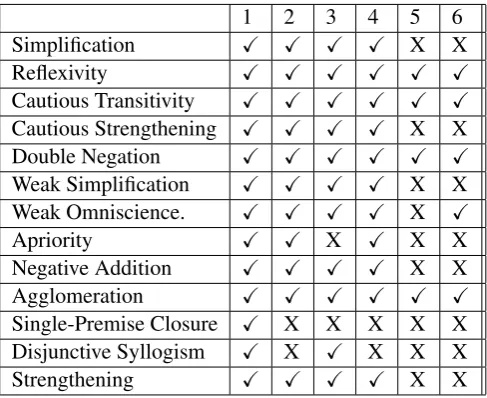
1 2 3 4 5 6 Simplification X X X X X X Reflexivity X X X X X X
Cautious Transitivity X X X X X X
Cautious Strengthening X X X X X X Double Negation X X X X X X
Weak Simplification X X X X X X Weak Omniscience. X X X X X X
Apriority X X X X X X
Negative Addition X X X X X X Agglomeration X X X X X X
[image:14.595.176.420.70.269.2]Single-Premise Closure X X X X X X Disjunctive Syllogism X X X X X X Strengthening X X X X X X
Table 1: Validities (X) and invalidities (X) in models given in Definition 5. Numbers in the top row refer to the proposed truthmaker accounts ofKϕψ in§5.
Table 1 summarizes Propositions 2 and 4. It turns out that our ‘immanent’ definitions of condi-tional knowledge (unlike the previous ‘Hintikka-style’ ones) are sensitive to whether or not an important constraint is imposed on our models.
Definition 7(Atomic Verfiability). A proposition isverifiableif it is non-empty. A modelM=hS,P,≤,vi
hasatomic verifiabilityif for each atom p∈Prop, p+ and p−are verifiable.
Proposition 5. In models with atomic verifiability,
(1) Definitions (1)-(4) (in)validate exactly the same principles given in Proposition 2, (2) Definition (5) validates everything exceptW-Omni,Apriority,NA,SPS, andDS, (3) Definition (6) validates everything exceptApriority,NA,SPS.
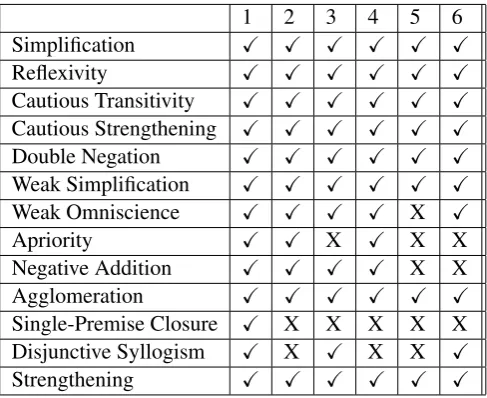
(Moreover, a close inspection of the proof of Proposition 5 shows that having p+ and p− closed under fusions affects the list of validities and invalidities only for definitions (5) and (6).) Table 2 provides a summary of the results in Proposition 5.
This is foreshadowed in the literature. Fine (forthcoming, Sect.4) notes the sensitivity of his account of partial content to whether or not empty sets of verifiers are admitted, observing that the content of
ϕ∧ψneed not contain that ofϕifϕ∧ψ has no verifiers.
6
Discussion
With the summaries in Tables 1 and 2 at hand, we offer preliminary remarks on the capacity of truth-maker semantics to help epistemic logic escape Hintikkan confines.
1 2 3 4 5 6 Simplification X X X X X X
Reflexivity X X X X X X
Cautious Transitivity X X X X X X
Cautious Strengthening X X X X X X
Double Negation X X X X X X
Weak Simplification X X X X X X
Weak Omniscience X X X X X X
Apriority X X X X X X
Negative Addition X X X X X X Agglomeration X X X X X X
Single-Premise Closure X X X X X X Disjunctive Syllogism X X X X X X
[image:15.595.176.420.70.269.2]Strengthening X X X X X X
Table 2: Validities (X) and invalidities (X) in models with atomic verifiability.
uncontroversial validities of§2. Further, those suspicious ofNeg Add,SPCandDSwill mark progress: various natural set-ups in the truthmaker setting invalidate these principles. What’s more, we have located a number of set-ups that reject Apriority: if validating Apriority is a dividing line between logics that are candidates for a logic of knowability, on one hand, and those that are candidates for a logic of knowledge ascription or warrant transmission, on the other, then the truthmaker setting opens the door to serious investigation of the latter. Indeed, our fifth account ofKϕψ holds attraction as an account of conditional knowledge ascription: it violates all of Neg Add, SPC andDS. Good news, some might think: ordinary knowledge ascription should not be closed under inference (even simple ones), only content parthood. On the other hand, the sixth account ofKϕψ will appeal to some as an account of strong warrant transmission:Neg AddandSPCfail, as one might hope (if one is sympathetic to, say, Cartesian and Criterion counter-examples). Meanwhile, that the sixth account validates DS
holds attraction for one who accepts certain general principles marking warrant transmission failure: conclusionqneither (apparently) introduces new subject matter relative to premises¬pand p∨q, nor (apparently) is knowledge ofqa prerequisite for learning¬porp∨q.
Now for remarks on the ‘negative’ side. None of our candidate systems invalidateAggorStrength. Those sympathetic to alleged counter-examples to these principles will see little progress here. Of course, we did not expend serious effort in designing systems with such effects, so the present concern is best understood as impetus for further investigation. (Indeed, if Agg or Strength are rejected, a natural thought is that these effects are products of probabilistic features of knowledge ascription, as has received recent discussion in, for instance, (Brown, 2018).)
Further, thecombinationof validities/invalidities generated by some of our systems might give one pause. The second, third and fourth accounts of Kϕψ all invalidate SPC without invalidating Neg Add. Some will find this objectionable: as per §2, the alleged counter-examples SPCandNeg Add
mostly go hand-in-hand. Conjoined with the view that the logic of knowability observes Apriority, this problematizes our candidates forKϕψ that depart significantly from the classic Hintikkan approach.
principles when restricted to models with atomic verifiability. These accounts are apparently at odds with an appealing view: atomic mathematical claims like ‘3 is prime’ have no falsemakers. Compare p∨ ¬p, where p is contingent: as Fine (forthcoming) points out, we can make sense of a falsemaker for this claim as a (virtual) fusion of two possible states: a truthmaker for pand a truthmaker for¬p. In contrast, situations that make ‘3 is prime’ false seem hard to get an intuitive grip on, even if granted as impossible. (Though see Fine (forthcoming, Sect. 5) for a proposed method for constructing such states out of possible states). Resistance to admitting such situations amounts to a resistance to accepting accounts five and six. Hence, the most promising candidates we’ve canvassed for the logic of knowledge ascription or warrant transmission are subject to serious dispute.
7
Conclusion
As they stand, the considerations of the last section are obviously not decisive. Hence, the firmest conclusions we can draw are as follows. First, truthmaker semantics allows for the development of various logical systems that are worth taking seriously as candidate epistemic logics. Second, the sample we consider in this paper establishes that such logics can depart from a normal modal logic (and each other), yielding patterns of validities and invalidities that bear on longstanding epistemic paradoxes.
Much work remains. We have barely scratched the surface in assessing the relative merits of our candidate logics. Further, we have said nothing on the subject of meta-logical results. Finally, subtle variations of our candidate systems can no doubt be produced by tweaking various technical parameters. The costs and gains of such tweaks remain to be seen.
References
B. Beddor. The Toxin and the Dogmatist. Australasian Journal of Philosophy, forthcoming. J. Brown. Fallibilism: Knowledge and Evidence. Oxford University Press, 2018.
R. Chisholm. The Problem of the Criterion. Marquette University Press, 1973.
S. Cohen. Basic Knowledge and the Problem of Easy Knowledge. Philosophy and Phenomenological Research, 65(2):309–329, 2002.
I. Douven. The Preface Paradox Revisited. Erkenntnis, 59(3):389–420, 2003. F. Dretske. Epistemic Operators. Journal of Philosophy, 67(24):1007–1023, 1970.
R. Fagin, J. Halpern, Y. Moses, and M. Vardi. Reasoning about Knowledge. MIT Press, Cambridge, MA, 1995.
K. Fine. Angellic content. Journal of Philosophical Logic, 45(2):199–226, 2016.
K. Fine. A Theory of Truthmaker Content I: Conjunction, Disjunction and Negation. Journal of Philo-sophical Logic, 46(6):625–674, 2017a.
K. Fine. Constructing the Impossible. In Walters and Hawthorne, editors,Conditionals, Probability, and Paradox: Themes from the Philosohy of Dorothy Edgington. Oxford University Press, forthcoming. D. Gabbay.Theoretical Foundations for Non-monotonic Reasoning in Expert Systems. Springer, Berlin,
1985.
G. Harman. Thought. Princeton University Press, 1973.
J. Hawthorne. Knowledge and Lotteries. Oxford University Press, 2004.
J. Hawthorne. The case for closure. In E. Sosa, editor, New Directions in Semantics, pages 26–43. Blackwell, Oxford, 2005.
J. Hintikka. Knowledge and Belief. An Introduction to the Logic of the Two Notions. Cornell University Press, Ithaca, NY, 1962.
L. Humberstone. Philosophical Applications of Modal Logic. College Publications, 2016.
S. Kripke. On Two Paradoxes of Knowledge. InPhilosophical Troubles: Collected Papers, Volume 1. Oxford University Press, 2011.
M. Lasonen-Aarnio. The Dogmatism Puzzle.Australasian Journal of Philosophy, 92(3):417–432, 2014. H. Leitgeb. A Way Out of the Preface Paradox? Analysis, 74(1):11–15, 2013.
D. Lewis. Elusive Knowledge. Australasian Journal of Philosophy, 74(4):549–567, 1996. D. Makinson. The Paradox of the Preface. Analysis, 25(6):205–207, 1965.
L. Moretti and T. Piazza. Transmission of justification and warrant. In Edward N. Zalta, editor,The Stanford Encyclopedia of Philosophy. Metaphysics Research Lab, Stanford University, winter 2018 edition, 2018.
R. Nozick. Philosophical Explanations. Harvard University Press, 1981. A. Plantinga. Warrant and Proper Function. Oxford University Press, 1993. J. Pryor. The Skeptic and the Dogmatist. Nous, 46:517–549, 2000.
J. Pryor. What’s Wrong With Moore’s Argument? Philosophical Issues, 14:349–378, 2004. S. Roush. Closure on Skepticism. Journal of Philosophy, 107(5):243–256, 2010.
A. Sharon and L. Spectre. Dogmatism repuzzled.Philosophical Studies, 148(2):307–321, 2010. A. Sharon and L. Spectre. Evidence and the openness of knowledge. Philosophical Studies, 174:1001–
1037, 2017.
R. Sorensen. Dogmatism, junk knowledge, and conditionals. Philosophical Quarterly, 38:433–454, 1988.
E. Sosa. Reflective Knowledge: Apt Belief and Reflective Knowledge, Volume II. Oxford University Press, 2009.
G. Stine. Skepticism, Relevant Alternatives and Deductive Closure.Philosophical Studies, 29:249–261, 1976.
J. van Benthem. Logical Dynamics of Information and Interaction. Cambridge University Press, 2011. H. van Ditmarsch, W. van der Hoek, and B. Kooi.Dynamic Epistemic Logic. Springer, Dordrecht, 2008. C. Wright. Facts and Certainty.Proceedings of the British Academy, 71:429–472, 1985.
C. Wright. Warrant For Nothing (and Foundations for Free)? Proceedings of the Aristotelian Society, LXXVIII:167–212, 2004.
Proofs
Proof of Proposition 2
Lemma 1. Given a modelhS,P,≤viand s,t∈S: if s6∈P then stt6∈P.
Proof. Lets,t∈Ssuch thats6∈Pand supposestt∈P. This implies, sincePis downward closed and s≤stt, thats∈P, contradicting the assumption.
Proof of Proposition 2:
Counter-models are given in figures immediately below the corresponding explanations. In figures of models, white diamonds represent impossible states and black dots represent possible states. Exact ver-ification and falsver-ification are given by labelling nodes together with symbols`anda, respectively.
LetM=hS,P,≤,vibe a model ands∈Sbe a state. (1) Recall the exact verification and falsification clauses:
• s`Kϕψ iff for allt∈P(if there ist0∈Ssuch thatt0≤tandt0`ϕthen there isu∈Ssuch
thatttu∈Pandu`ψ)
• saKϕψ iff there ist∈Psuch that there exitst0∈Switht0≤t andt0`ϕ and there is no u∈Ssuch thatttu∈Pandu`ψ
Note that none of the (in)validities depends onp+orp−being closed under fusion.
Simplification:Kp∧qp,Kp∧qq:
We prove only the former, the latter follows similarly: lett∈Psuch that there ist0∈Switht0≤t andt0`p∧q. Thus, by the exact verification clause for∧, there areu,u0∈Ssuch thatutu0=t0, u` p, and u0 `q. Sinceu≤t0 ≤t, we have ttu=t∈P. Asu` p as well, we obtain that s`Kp∧qp.
Reflexivity:Kpp
Lett∈Psuch that there ist0∈Switht0≤tandt0`p. Sincettt0=t∈Pas well, we obtain that s`Kpp.
Cautious Transitivity:Kpq,Kp∧qrKpr
Suppose (a)s`Kpqand (b)s`Kp∧qr, and lett∈Psuch that there ist0∈Switht0≤tandt0`p.
Then, by (a), there isu∈Ssuch thatttu∈Pandu`q. Thus, by the exact verification clause for ∧, we obtaint0tu`p∧q. Then, ast0tu≤ttu∈P, by (b), we have that there isu0∈Ssuch that (ttu)tu0∈Pandu0`r. Now considerttu0. Sincettu0≤(ttu)tu0∈P, we havettu0∈P. Sinceu0`ras well, we conclude thats`Kpr.
Cautious Strengthening:Kpq,KprKp∧qr
Suppose (a)s`Kpqand (b)s`Kpr, and lett∈Psuch that there ist0∈Switht0≤tandt0`p∧q.
Hence, by the exact verification clause for∧, there areu,u0∈Swithutu0=t0,u`p, andu0`q. Then, sinceu≤t0≤t,u` p, by (b), we obtain that there iss0∈Ssuch thats0tt∈Pands0`r. Therefore,s`Kp∧qr.
Double Negation:Kp(¬¬p)
Weak Simplification:Kp∧q(p∨q)
Lett∈Psuch that there ist0∈Switht0≤tandt0`p∧q. This implies, by the exact verification clause for∨, thatt0`p∨q. Sincet0tt=t∈P, we obtain thats`Kp∧q(p∨q).
Weak Omniscience:Kp(p∨ ¬p)
Lett∈Psuch that there ist0 ∈S witht0 ≤t andt0 `p. This implies, by the exact verification clause for∨, thatt0`p∨ ¬p. Sincet0tt=t∈P, we obtain thats`Kp(p∨ ¬p).
Apriority:ApKϕp.
Suppose s`Ap. This means that for all t∈P there is t0 ∈S such that t0tt∈P andt0 ` p. Therefore,s`Kϕp.
Negative Addition:KϕpKϕ¬(¬p∧q)
Suppose s`Kϕp and let t∈P such that there is t0∈S with t0 ≤t and t0 `ϕ. Then, by the
assumption thats`Kϕp, there isu∈Ssuch thatttu∈Pandu`p. This means thatua ¬p, and
thatua ¬p∧q. Therefore,u` ¬(¬p∧q). Asttu∈Pas well, we conclude thats`Kϕ¬(¬p∧q).
Agglomeration:Kϕp,KϕqKϕ(p∧q)
Suppose (a)s`Kϕpand (b)s`Kϕqand lett∈Psuch that there ist0∈Switht0≤tandt0`ϕ.
Then, by (a), there isu∈S such thatttu∈Pandu`p. Sincet0≤t≤ttuwe obtain by (b) that there isu0∈S such that(ttu)tu0∈Pandu0 `q. Then, utu0`p∧q. Astt(utu0) = (ttu)tu0∈P, we obtain thats`Kϕ(p∧q).
Single-Premise Closure:Kϕp,p⇒qKϕq
Suppose (a)s`Kϕpand (b)s`p⇒qand lett∈Psuch that there ist0∈Switht0≤tandt0`ϕ. Then, by (a), there isu∈Ssuch thatttu∈Pandu`p. Sinceu≤ttu∈P, we obtain by (b) that there isu0∈Ssuch that(ttu)tu0∈Pandu0`q. Sincettu0 ≤(ttu)tu0∈P, we have ttu0∈P. Asu0`qas well, we conclude thats`Kϕq.
Disjunctive Syllogism:Kϕ¬p,Kϕ(p∨q)Kϕq
Suppose (a)s`Kϕ¬pand (b)s`Kϕ(p∨q)and lett∈Psuch that there ist0∈Switht0≤tand
t0`ϕ. Then, by (b), there isu∈Ssuch thatttu∈Pandu`p∨q. Sincet0≤ttu∈P, we have by (a) that there isu0∈Ssuch that(ttu)tu0∈Pandu0` ¬p. Therefore, there is nos0≤usuch thats0` p: otherwise(ttu)tu0 6∈P, by Lemma 1. Then, sinceu`p∨q, we have thatu`q. Sincettu∈Pas well, we conclude thats`Kϕq.
Strengthening:KprKp∧qr
Same as the proof for Cautious Strengthening.
(2) Recall the exact verification and falsification clauses:
• s`Kϕψ iff for allt∈P(if there ist0∈Ssuch thatt0≤tandt0aψ, then there isu∈Ssuch
thatttu∈Panduaϕ)
• saKϕψ iff there ist∈Psuch that there exitst0∈Switht0≤t andt0aψ and there is no u∈Ssuch thatttu∈Panduaϕ
Note that none of the (in)validities depends onp+orp−being closed under fusion.
Simplification:Kp∧qp,Kp∧qq
andt0ap. Thus, by the exact falsification clause for∧, we havet0ap∧q. Sincettt0=t∈Pas well, we conclude thats`Kp∧qp.
Reflexivity:Kpp
Lett∈Psuch that there ist0∈Switht0≤tandt0ap. Sincettt0=t∈Pas well, we have that s`Kpp.
Cautious Transitivity:Kpq,Kp∧qrKpr
Suppose (a)s`Kpqand (b)s`Kp∧qr, and lett∈Psuch that there ist0∈Switht0≤tandt0ar.
Then, by (b), there isu∈S such thatttu∈Psuch that ua p∧q. This means that, either (1) uap, or (2)uaq, or (3) there aret0,s0 such thatu=t0ts0,t0a pands0 aq. If (1) is the case, we are done. If (2) is the case: sinceu≤utt we obtain by (a) that there is at00∈Ssuch that (utt)tt00∈Pandt00ap. Sincettt00≤(utt)tt00∈P, we havettt00∈P. If (3) is the case: sincet0≤u, we havettt0≤ttu∈P. We therefore havettt0∈Pandt0ap. Therefore, we can conclude thats`Kpr.
Cautious Strengthening:Kpq,KprKp∧qr
Suppose (a)s`Kpqand (b) s`Kpr, and lett∈Psuch that there ist0∈Switht0≤tandt0ar.
Then, by (b), there isu∈Ssuch thatttu∈Panduap. Then, by the exact falsification clause of ∧, we haveuap∧q. This implies thats`Kp∧qr.
Double Negation:Kp(¬¬p)
Similar to the proof of Reflexivity, note that|¬p|=|¬¬¬p|.
Weak Simplification:Kp∧q(p∨q)
Lett∈Psuch that there ist0∈Switht0≤tandt0ap∨q. Thus, by the exact falsification clause for∨, there areu,u0∈Ssuch thatutu0=t0,uap, andu0aq. This implies thatt0ap∧q. Since ttt0=t∈P, conclude thats`Kp∧q(p∨q).
Weak Omniscience:Kp(p∨ ¬p)
Since no possible state exactly falsifiesp∨ ¬p, weak omniscience is vacuously valid.
Apriority:ApKϕp
Supposes`Ap. This means that for allt∈Pthere ist0∈Ssuch thatt0tt∈Pandt0` p. This implies that there is not∈Psuch thattap, thus,s`Kϕpis vacuously the case.
Negative Addition:KϕpKϕ¬(¬p∧q)
Supposes`Kϕpand lett∈Psuch that there ist0∈Switht0≤t andt0a ¬(¬p∧q). The latter
means, by the exact falsification of¬, thatt0` ¬p∧q. Thus, there areu,u0∈Ssuch thatutu0=t0, u` ¬p, andu0`q. Sinceu≤t0≤tanduap, we obtain by the first assumption that there iss0∈S such thattts0∈Pands0aϕ. We then conclude thats`Kϕ¬(¬p∧q).
Agglomeration:Kϕp,KϕqKϕ(p∧q)
Suppose (a)s`Kϕpand (b)s`Kϕqand lett∈Psuch that there ist0∈Switht0≤tandt0ap∧q.
Single-Premise Closure:Kϕp,p⇒qKϕq
Counterexample: Since none of the possible states exactly falsifies or verifiesp, we haveKrpand
p⇒q exactly verified at every state. However,taq andt≤tbut there is no statet0 such that ttt0∈Pandt0ar. Therefore, no state exactly verifiesKrq.
taq
s`p,q,r,¬p,r,¬r
Disjunctive Syllogism:Kϕ¬p,Kϕ(p∨q)Kϕq
Counterexample: Since none of the possible states exactly falsifies¬porp∨q, we haveKr¬p,Kr(p∨
q) exactly verified at every state. Moreover, t0 aq andt0 ≤t0 but there is no state s0 such that s0tt0∈Pands0ar. Therefore, no state exactly verifiesKrq.
t0aq t`r
s`p,q,¬p,¬r
Strengthening:KprKp∧qr
Same as the proof for Cautious Strengthening.
(3) Recall the exact verification and falsification clauses:
• s`Kϕψ iff for allt∈P(ift`ϕthen there ist0∈Ssuch thatt0≤tandt0`ψ)
• saKϕψ iff there ist∈Psuch thatt`ϕ and there is not0∈Switht0≤tandt0`ψ. Note that none of the (in)validities depends onp+orp−being closed under fusion.
Simplification:Kp∧qp,Kp∧qq
Lett∈Psuch thatt`p∧q. This means that there areu,u0∈Ssuch thatutu0=t,u`p, and u0`q. Sinceu≤tandu0≤t, we conclude thats`Kp∧qpands`Kp∧qq.
Reflexivity:Kpp
Follows from the fact that for allt∈P,t≤t.
Cautious Transitivity:Kpq,Kp∧qrKpr
Suppose (a)s`Kpqand (b)s`Kp∧qr, and lett∈Psuch thatt`p. Then, by (a), there isu∈S
such thatu≤tsuch thatu`q. This means thatutt=t`p∧q. Thus, by (b), there ist0∈Ssuch thatt0≤tandt0`r. Therefore, we conclude thats`Kpr.
Cautious Strengthening:Kpq,KprKp∧qr
Suppose (a)s`Kpqand (b)Kpr, and lett∈Psuch thatt`p∧q. The latter means that there are
Double Negation:Kp(¬¬p)
Similar to the proof of Reflexivity, note that|p|=|¬¬p|.
Weak Simplification:Kp∧q(p∨q)
Lett∈Psuch thatt` p∧q. This implies, by the exact verification clause of∨, thatt`p∨q. Sincet≤t, we obtain thats`Kp∧q(p∨q).
Weak Omniscience:Kp(p∨ ¬p)
Lett∈Psuch thatt`p. This means, by the exact verification clause of∨, thatt`p∨ ¬p. Since t≤t, we obtain thats`Kp(p∨ ¬p).
Apriority:ApKϕp
Counterexample:Apis exactly verified everywhere in the model since the only possible states are tandt0, andt`p,t0tt=ttt=t∈P. However, althought0`rthere is nou≤t0such thatu`p. Therefore, no state exactly verifiesKrp.
t0`r t`p
sap,r
Negative Addition:KϕpKϕ¬(¬p∧q)
Supposes`Kϕpand lett∈Psuch thatt`ϕ. Then, by the assumption, there ist0≤tsuch that t0`p. Then, following the exact verification and falsification clauses for¬and∧, we obtain that t0` ¬(¬p∧q). Therefore, ast0≤t, we obtain thats`Kϕ¬(¬p∧q).
Agglomeration:Kϕp,KϕqKϕ(p∧q)
Suppose (a)s`Kϕpand (b)s`Kϕq and lett∈P such thatt`ϕ. Then, by (a), there isu∈S
such that u≤t andu` p. And, by (b), there isu0 ∈S such that u0≤t and u0`q. Therefore, utu0`p∧q. Moreover,utu0≤tsince bothu≤tandu0≤t. Therefore,s`Kϕ(p∧q).
Single-Premise Closure:Kϕp,p⇒qKϕq
Counterexample: The only possible state that exactly verifiesriss3ands5≤s3 such thats5`p.
Thus,Krpis exactly verified everywhere on the model. Moreover, only the possible statess2,s3
ands5 are such that s5≤s2,s5≤s3, s5≤s5 ands5` p, and s4`q, s2ts4,s3ts4,s5ts4 ∈P. Therefore, p⇒q is exactly verified everywhere in the model. However, s3`r but there is no
u∈Ssuch thatu≤s3andu`q. Therefore, no state exactly verifiesKrq.
s5`p
s3`r s4`q
s2
s1ap,q,r
Disjunctive Syllogism:Kϕ¬p,Kϕ(p∨q)Kϕq
u∈Ssuch thatu≤tandu` ¬p. This implies, sincet∈P, that there is not0≤tsuch thatt0`p (by Lemma 1). Moreover, (b) and the fact thatt`ϕ imply thatt`p∨q. Therefore, we obtain thatt`q. Hence, ast≤t, we conclude thats`Kϕq.
Strengthening:KprKp∧qr
Same as the proof for Cautious Strengthening.
(4) Recall the exact verification and falsification clauses:
• s`Kϕψ iff for allt∈P(iftaψ then there ist0∈Ssuch thatt0≤tandt0aϕ)
• saKϕψ iff there ist∈Psuch thattaψ and there is not0∈Switht0≤tandt0aϕ.
Note that none of the (in)validities depends onp+orp−being closed under fusion.
Simplification:Kp∧qp,Kp∧qq
We prove only the former, the latter follows similarly: lett∈Psuch thattap. This implies, by the exact falsification clause of∧, thattap∧q. Sincet≤t, we conclude thats`Kp∧qp.
Reflexivity:Kpp
Follows from the fact that for allt∈P,t≤t.
Cautious Transitivity:Kpq,Kp∧qrKpr
Suppose (a)s`Kpqand (b)s`Kp∧qr, and lett∈Psuch thattar. Then, by (b), there ist0∈S
such thatt0 ≤t andt0a p∧q. This means that either (1)t0a p, or (2)t0aq, or (3) there are u,u0∈Ssuch thatutu0=t0,uapandu0aq. Sinceu,u0≤t0≤t∈P, we have thatt0,u,u0∈P. If (1) is the case, sincet0≤t, we have the desired result. If (2) is the case, by (a), there iss0∈S such thats0≤t0ands0ap. Ass0≤t0≤tand≤is transitive, we have thats0≤t. If (3) is the case: sinceu≤t0≤t, we haveu≤t. Then, asuap, we obtain that the desired conclusion. Therefore, s`Kpr.
Cautious Strengthening:Kpq,KprKp∧qr
Suppose (a)s`Kpqand (b)Kpr, and lett∈Psuch thattar. Then, by (b), there ist0∈Ssuch that
t0≤t∈Pandt0ap. Then, by the exact falsification clause for∧, we havet0ap∧q. Therefore, s`Kp∧qr.
Double Negation:Kp(¬¬p)
Similar to the proof of Reflexivity, note that|¬p|=|¬¬¬p|.
Weak Simplification:Kp∧q(p∨q)
Lett∈Psuch thattap∨q. This means that there areu,u0∈Ssuch thatutu0=t,uap, and u0aq. This implies thattap∧q. Sincet≤t∈, we obtain thats`Kp∧q(p∨q).
Weak Omniscience:Kp(p∨ ¬p)
Since no possible state exactly falsifies(p∨ ¬p), weak omniscience is vacuously valid.
Apriority:ApKϕp
Supposes`Ap. This means that for allt∈Pthere ist0∈Ssuch thatt0tt∈Pandt0` p. This implies that there is not∈Psuch thattap, thus,s`Kϕpis vacuously the case.
Negative Addition:KϕpKϕ¬(¬p∧q)
there areu,u0∈Ssuch thatutu0=t,u` ¬p, andu0`q. Sinceu≤t∈P,u∈P. Therefore, by the first assumption, we have that there isu00≤usuch thatu00aϕ. Sinceu00≤u≤t, we also obtain thats`Kϕ¬(¬p∧q).
Agglomeration:Kϕp,KϕqKϕ(p∧q)
Suppose (a)s`Kϕpand (b)s`Kϕqand lett∈Psuch thattap∧q. Therefore, eithertap, or
taq, or there areu,u0∈S such thatutu0=t,uap, andu0aq. Iftap, then, by (a), there is t0∈Ssuch thatt0≤tandt0aϕ. Iftaq, then by (b), there ist0∈Ssuch thatt0≤tandt0aϕ. If there areu,u0∈Ssuch thatutu0=t,uap, andu0aq, we obtain the same results by (a) and (b) sinceu,u0≤t. Therefore,s`Kϕ(p∧q).
Single-Premise Closure:Kϕp,p⇒qKϕq
Counterexample: Since none of the possible states exactly verifies or falsifiesp, we haveKrpand
p⇒qexactly verified at every state. However,taqbut there is no statet0such thatt0≤t∈Pand t0ar. Therefore, no state exactly verifiesKrq.
taq
s`p,q,r,¬p,r,¬r
Disjunctive Syllogism:Kϕ¬p,Kϕ(p∨q)Kϕq
Counterexample: Since none of the possible states exactly falsifies ¬p, we have Kr¬p exactly
verified at every state. Similarly, since none of the possible states exactly falsifies p∨q (since there is no possible state exactly falsifying p), we haveKr(p∨q)exactly verified at every state.
However,taqbut there is no statet0 such thatt0≤t∈Pandt0ar. Therefore, no state exactly verifiesKrq.
taq
s`p,q,r,¬p,r,¬r
Strengthening:KprKp∧qr
Same as the proof for Cautious Strengthening.
Proof of Proposition 3
Lemma 2. Given a modelM=hS,P,≤,viandϕ∈Le: |¬ϕ|={s∈S:saϕ}.
Lemma 3. Given a modelM=hS,P,≤,viandϕ,ψ∈Le, the following hold for all six interpretations
of Kϕψ:
(1) if|Aϕ| 6=/0then|Aϕ|=S, (2) if|¬Aϕ| 6=/0then|¬Aϕ|=S, (3) if|ϕ⇒ψ| 6=/0then|ϕ⇒ψ|=S, (4) if|¬(ϕ⇒ψ)| 6=/0then|¬(ϕ⇒ψ)|=S, (5) if|Kϕψ| 6=/0then|Kϕψ|=S, and
(6) if|¬Kϕψ| 6=/0then|¬Kϕψ|=S.
Proof. Easy consequence of the corresponding exact truthmaker semantics since none of the exact veri-fication and falsiveri-fication clauses forAϕ,ϕ⇒ψ, andKϕψ is state dependent.
Proof of Proposition 3:The proof follows by induction on the structure ofϕ. Case forp∈Prop: holds by the definition of a model (Definition 5).
Now suppose inductively that the statement holds forψ,χ∈Le.
Case for ¬ψ: By the induction hypothesis (IH), we already have that |¬ψ| is closed under fusion. Moreover, observe that|¬¬ψ|=|ψ|, by the exact verification and falsification clauses for¬. Therefore, again by IH,|¬¬ψ|is a proposition.
Case for ψ∧χ: Let /06=T ⊆ |ψ∧χ|. This means, by the exact verification clause for ∧, that for all t ∈T, there are u,u0 ∈S such that utu0 =t, u` ψ, and u0 ` χ. Denote Tψ ={u ∈S :u `
ψ and there isu0∈Ssuch thatutu0∈T andu0`χ}, and similarly,
Tχ ={u0∈S:u0 `χand there isu∈Ssuch thatutu0∈T andu`ψ}. SinceT 6= /0, we haveTψ 6= /0
andTχ6= /0. Moreover, by IH,F
Tψ ∈ |ψ|andFTχ ∈ |χ|. Finally, sinceT ⊆ |ψ∧χ|, we also have that F
T =F
Tψt F
Tχ. Therefore, by the exact verification clauses for∧, we obtain that F
T∈ |ψ∧χ|. For |¬(ψ∧χ)|: let /06=T ⊆ |¬(ψ∧χ)|. This means, by Lemma 2 and the exact falsification clause for∧, that for allt∈T, eithertaψ ortaχ, or there areu,u0∈Ssuch thatutu0=t,uaψ, andu0aχ. Denote Tψ={u∈S:u`ψ and eitheru∈T or there isu0∈Ssuch thatutu0∈T andu0`χ}, and, similarly,
Tχ={u0∈S:u0`χand eitheru0∈T or there isu∈Ssuch thatutu0∈T andu`ψ}. The rest follows similarly to the case for|ψ∧χ|.
Case forAψ, ψ ⇒χ, and Kψχ: Follows from Lemma 3 and the fact thathS,≤i is a complete state
space.
Proof of Proposition 4
In figures of models, white diamonds represent impossible states and black dots represent possible states. Exact verification and falsification are given by labelling nodes together with symbols`anda, respec-tively.
(1) Recall the exact verification and falsification clauses:
s`Kϕψ iff(1)for allt∈P(ift`ϕthen there ist0∈Ssuch thatt0≤tandt0`ψ), and
(2)for allt∈P(iftaψ thentaϕ), and
(3)for allu∈S(ifu`ψthen there isu0∈Ssuch thatu≤u0andu0`ϕ).
saKϕψ iff(1)there ist∈Psuch thatt`ϕ and there is not0∈Switht0≤tandt0`ψ, or
(2)there ist∈P(taψ andt6aϕ), or
(3)there isu∈S(u`ψand there is nou0∈Ssuch thatu≤u0andu0`ϕ).
Simplification:Kp∧qp,Kp∧qq
Counterexample: Consider the one-state model in the following figure. t ` p but there is no u∈Ssuch thatt≤uandu`p∧q. This violates item (3) in the above exact verification clause. Therefore, Kp∧qp is not exactly verified byt. If we taket `q (instead oft` p) in the same
structure, we obtain thatKp∧qqis not exactly verified.
t`p
Reflexivity:Kpp
Item (1) is proven for the third definition of knowledge. Item (2) is vacuously true. Item (3) follows from the fact thatu≤ufor allu∈S.
Cautious Transitivity:Kpq,Kp∧qrKpr:
Suppose (a)s`Kpqand (b)s`Kp∧qr. Item (1) is proven for the third definition of knowledge.
For (2): lett∈Psuch thattar. Then, by (b), we have thattap∧q. Then, either (a∗)tap, or (b∗)taq, or (c∗) there areu1,u2 such thatt=u1tu2,u1ap, andu2aq. If (a∗) is the case, we
are done. If (b∗) is the case, by (a), we have thatta p. If (c∗) is the case, by (a), we have that u2ap. Then, since|¬p|is closed under fusion, we obtain by Lemme 2, thatt=u1tu2ap. For
(3): lett∈Ssuch thatt`r. Then, by (b), there ist0≥tsuch thatt0`p∧q. This means that there areu,u0∈Ssuch thatt0=utu0,u`p, andu0`q. Then, by (a), there iss0∈Ssuch thats0≥u0 ands0`p. Observe that, sincet0=utu0 ands0≥u0, we have thatuts0≥t0≥t. And, since|p| is closed under fusion,uts0`p. Therefore,s`Kpr.
Cautious Strengthening:Kpq,KprKp∧qr
Counterexample: It is easy to check that bothKpqandKprare exactly verified in the model given
below. However, no state exactly verifiesKp∧qr, sincet`rbut there is nousuch thatt≤uand
u`p∧q. This violates item (3) in the above exact verification clause.
Double Negation:Kp(¬¬p)
Similar to the proof of Reflexivity.
Weak Simplification:Kp∧q(p∨q)
Counterexample: Consider the one-state model in the following figure:t`p, therefore,t`p∨q. However, but there is nou∈Ssuch thatt≤uandu`p∧q. This violates item (3) in the above exact verification clause. Therefore,Kp∧qpis not exactly verified byt.
t`p
Weak Omniscience:Kp(p∨ ¬p)
Counterexample: Fort` ¬p, we havet`p∨ ¬p. However, there is not0∈S such thatt0 ≥t andt0`p. This violates item (3) in the above exact verification clause. Therefore, no state in the model exactly verifiesKp(p∨ ¬p).
s2` ¬p,p
tap s1
Apriority:ApKϕp:
Counterexample:Apis exactly verified everywhere in the model since the only possible states are t andt0, andt` p,t0tt=ttt=t∈P. However,t is the only state that exactly verifies pbut there is nousuch thatu≥tandu`r. This violates item (3) in the above exact verification clause. Therefore, no state in the model exactly verifiesKrp.
s0` ¬p,¬r
t0`r t`p s
Negative Addition:KϕpKϕ¬(¬p∧q)
Counterexample: Krp is exactly verified at every state of the model. However, for example,
s2`q,¬p,¬r taq t0`p,r s1
Agglomeration:Kϕp,KϕqKϕ(p∧q)
Suppose (a)s`Kϕpand (b)s`Kϕq. Item (1) is proven for the third definition of knowledge. To
prove item (2), lett∈Psuch thattap∧q. Then, either (a∗)tap, or (b∗)taq, or (c∗) there are u1,u2 such thatt=u1tu2,u1ap, andu2aq. If (a∗) is the case, by (a), we havetaϕ. If (b∗) is the case, by (b), we have thattaϕ. If (c∗) is the case, by (a) and (b), we have thatu1aϕand u2aϕ. Then, by Proposition 3, we obtain thatt=u1tu2aϕ. To prove (3) supposet∈Ssuch
thatt`p∧q. Then, there areu,u0∈Ssuch thatt=utu0,u`p, andu0`q. Then, by (a) and (b), there ares0,t0∈Ssuch thatu≤s0ands0`ϕ, andu0≤t0 such thatt0`ϕ. Then, by Proposition 3, s0tt0`ϕ. Ast=utu0,u≤s0, andu0≤t0, we also havet≤s0tt0, which proves item (3).
Single-Premise Closure:Kϕp,p⇒qKϕq
Counterexample: It is easy to check thatKrpand p⇒qare exactly verified everywhere on the
model. However,s3`rbut there is nou∈Ssuch thatu≤s3andu`q. This violates item (1) in
the above exact verification clause. Therefore, no state exactly verifiesKrq.
3 s5`p
s3`r s4`q
s2
s1ap,q,r
Disjunctive Syllogism:Kϕ¬p,Kϕ(p∨q)Kϕq
Counterexample: It is easy to check that both Kr¬pandKr(p∨q)are exactly verified at every
state of the model. However,t∈Pandtaq butt6ar. This violates item (2) in the above exact verification clause. Therefore, no state exactly verifiesKrq.
taq
s`p,q,¬p,r,¬r
Strengthening:KprKp∧qr
(2) Recall the exact verification and falsification clauses:
s`Kϕψ iff(1) for allt∈P(if there ist0∈Ssuch thatt0≤tandt0`ϕthen
there isu∈Ssuch thatttu∈Pandu`ψ)), and
(2)for allu∈S(ifu`ψ then there isu0∈Ss.t.u≤u0andu0`ϕ∨ ¬ϕ), and (3)for allu∈S(ifuaψ then there isu0∈Ss.t.u≤u0andu0`ϕ∨ ¬ϕ)
saKϕψ iff(1) there ist∈Psuch that there exitst0∈Switht0≤tandt0`ϕ,
and there is nou∈Ssuch thatttu∈Pandu`ψ, or
(2)there isu∈S(u`ψand there is nou0∈Ss.t.u≤u0andu0`ϕ∨ ¬ϕ), or (3)there isu∈S(uaψand there is nou0∈Ss.t.u≤u0andu0`ϕ∨ ¬ϕ)
Simplification:Kp∧qp,Kp∧qq
Counterexample: see the counterexample for Simplification for definition (5). It violates item (2) forKp∧qp.
Reflexivity:Kpp
Item (1) is proven for the first definition of knowledge. (2) and (3) follows from the facts that for allt∈S:t≤t, and ift`port` ¬p, we havet`p∨ ¬p.
Cautious Transitivity:Kpq,Kp∧qrKpr
Suppose (a)s`Kpqand (b)s`Kp∧qr. Item (1) is proven for the first definition of knowledge. For
(2): lett∈Ssuch thatt`r. Then, by (b), there ist0∈Ssuch thatt0≥tandt0`(p∧q)∨ ¬(p∧q). We then have three cases:
Caset0` p∧q: This means that there are u,u0∈S such thatutu0=t0, u` p, andu0 `q. The former implies thatu`p∨ ¬p. Moreover,u0`qimplies by (a) there iss0∈Ssuch thats0≥u0and s0` p∨ ¬p. Sinces0≥u0, we obtain thats0tu≥utu0=t0≥t. Since|p∨ ¬p|is closed under fusion (by Proposition 3), we also have thats0tu`p∨ ¬p.
Caset0` ¬(p∧q): Then, we have three subcases.
Ift0` ¬p, thent0`p∨ ¬p. Sincet0≥t, we obtain the desired result.
Ift0` ¬q, then by (a), there iss0≥t0such thats0`p∨ ¬p. Sinces0≥t0≥t, we obtain the desired result.
If there areu,u0∈Ssuch thatutu0=t0,u` ¬p, andu0` ¬q, it follows similar to the first case. Case t0 `(p∧q)∧ ¬(p∧q): Then, there are u,u0 ∈S such that utu0 =t0, u`(p∧q), and u0 ` ¬(p∧q). By a similar argument as in the first case, there iss0 ∈S such thats0 ≥u and s0`p∨ ¬p. Again, by a similar argument as in the second case, there iss00∈Ssuch thats00≥u0 ands00` p∨ ¬p. Since s0 ≥u ands00≥u0, we have s00ts0 ≥utu0 =t0 ≥t. Moreover, since |p∨ ¬p|is closed under fusion, we also have thats00ts0`p∨ ¬p. Therefore, we have proven (2). Item (3) follows similarly.
Cautious Strengthening:Kpq,KprKp∧qr