R E S E A R C H
Open Access
High degree of mitochondrial gene
heterogeneity in the bat tick species
Ixodes
vespertilionis
,
I. ariadnae
and
I. simplex
from Eurasia
Sándor Hornok
1*, Agustín Estrada-Peña
2, Jen
ő
Kontschán
3, Olivier Plantard
4,5, Bernd Kunz
6, Andrei D. Mihalca
7,
Adora Thabah
8, Sne
ž
ana Tomanovi
ć
9, Jelena Burazerovi
ć
10, Nóra Takács
1, Tamás Görföl
11,12, Péter Estók
13,
Vuong Tan Tu
14, Krisztina Sz
ő
ke
1, Isabel G. Fernández de Mera
15, José de la Fuente
15,16, Mamoru Takahashi
17,
Takeo Yamauchi
18and Ai Takano
19Abstract
Background:Phylogeographical studies allow precise genetic comparison of specimens, which were collected over large geographical ranges and belong to the same or closely related animal species. These methods have also been used to compare ticks of veterinary-medical importance. However, relevant data are missing in the case of ixodid ticks of bats, despite (1) the vast geographical range of both Ixodes vespertilionis and Ixodes simplex, and (2) the considerable uncertainty in their taxonomy, which is currently unresolvable by morphological clues.
Methods: In the present study 21 ticks were selected from collections or were freshly removed from bats or cave walls in six European and four Asian countries. The DNA was extracted and PCRs were performed to amplify part of the cytochrome oxidase I (COI), 16S and 12S rDNA genes, followed by sequencing for identification and molecular-phylogenetic comparison.
Results: No morphological differences were observed between Ixodes vespertilionis specimens from Spain and from other parts of Europe, but corresponding genotypes had only 94.6 % COI sequence identity. AnI. vespertilionis specimen collected in Vietnam was different both morphologically and genetically (i.e. with only 84.1 % COI sequence identity in comparison with I. vespertilionis from Europe). Two ticks (collected in Vietnam and in Japan) formed a monophyletic clade and shared morphological features with I. ariadnae, recently described and hitherto only reported in Europe. In addition, two Asiatic specimens of I. simplex were shown to differ markedly from European genotypes of the same species. Phylogenetic relationships of ticks showed similar clustering patterns with those of their associated bat host species.
Conclusions: Although all three ixodid bat tick species evaluated in the present study appear to be widespread in Eurasia, they exhibit pronounced genetic differences. Data of this study also reflect that I.
vespertilionis may represent a species complex.
Keywords: Chiroptera, Ixodes, Cytochrome oxidase gene, 12S rRNA, 16S rRNA
* Correspondence:[email protected] 1
Department of Parasitology and Zoology, Faculty of Veterinary Science, Szent István University, Budapest, Hungary
Full list of author information is available at the end of the article
Background
Bats (Chiroptera) are the second largest order of mam-mals. Besides the high number of their species, they form the largest known mammalian aggregations (colonies) in which they may reach extremely high individual numbers [1]. Thus, frequently being the most abundant group of the local vertebrate fauna, their epidemiological role as pathogen reservoirs is also increasingly recognized [2]. Owing to their adaptability, i.e. large variety of their for-aging habitats (forests, plains, along water surfaces, urban areas), roosting places (caves, tree holes, buildings) and prey animals (insects, arachnids, even vertebrates), micro-bats occur on all continents, except the Antarctica [1].
Apart from birds, bats are the only vertebrates that are able to actively fly. Consequently, during their (seasonal) migration, bats may even cover a few hundred kilometers. However, (unlike birds) they are unable to cross high mountain ranges, frequently rendering their populations geographically isolated. Such isolation may serve as the basis of bat speciation [3, 4] and may also have an impact on the evolution of bat parasites, including ticks.
Hard ticks (Acari: Ixodidae) that are specific to bats are only known to occur in the Old World. In Eurasia, for more than a century, only three species of ixodid ticks were known to infest bats: Ixodes vespertilionis Koch, I. simplexNeumann andI. kopsteiniOudemans [5, 6]. How-ever, recently a new species,I. ariadnaeHornok has been described and molecularly characterized [7]. These four species appear to differ in their host preferences, i.e. I. vespertilionisoccurs predominantly onRhinolophusspp. [5, 8], I. ariadnaemainly onMyotisspp. [7], whereas I. simplex on Miniopterus schreibersii [5] andI. kopsteini
on Molossidae [6]. Thus, the geographical range limit, the migration habit, the various habitat preferences and hibernating behavior of relevant bat species will signifi-cantly influence the geographical distribution of their ticks. BothI. vespertilionisandI. simplexare among the tick species with the largest known geographical range, encompassing much of the Old World (from Europe to the south in Africa and Australia, and to the east in Asia, including Japan). However, despite this, phylogeo-graphical studies have not yet been conducted to inves-tigate the morphological and/or genetic uniformity of these two tick species throughout their vast range.
Formerly, allopatric genotypes of I. vespertilionis were shown to exist between distant caves within a country [7]. To extend the scope of such observations, the present study was initiated in order to evaluate the mitochondrial gene heterogeneity of ixodid bat ticks over a larger range in the Old World, including ticks that showed the mor-phological characteristics ofI. vespertilionis,I. simplexand
I. ariadnae. In Southern and Eastern Asian countries in-volved in the present study the sample number was lim-ited, because ixodid bat ticks are rare (e.g. [9]).
The 5’region of the mitochondrial cytochrome oxidase subunit I (COI) gene was chosen as the primary target for molecular analyses. This is the standard marker for tick species identification by DNA barcoding, with con-firmatory or supportive value of 16S and 12S rDNA se-quences [10]. These methods were found to be suitable to distinguish between the three ixodid bat tick species that occur in Europe [11]. Therefore, phylogenetic ana-lyses in the present study are based on the COI gene, with additional testing of part of the 16S and/or 12S genes in the case of highly divergent specimens.
Methods
Ticks were collected from bats captured for ringing and monitoring purposes, or from cave walls near bats (Table 1). All specimens were stored in 70 % ethanol. The morph-ology of ticks was compared according to the length/shape of palps, shape and index (length/width) of the scutum, density of alloscutal setae, arrangement of coxal setae. DNA was extracted with the QIAamp DNA Mini Kit (Qiagen, Hilden, Germany) according to the manufac-turer’s instructions; when possible, only from 1–4 legs.
In the case of Japanese samples, the COI PCR, that amp-lifies an up to 710 bp long fragment of the gene with the primers HCO2198 (5’-TAA ACT TCA GGG TGA CCA AAA AAT CA-3’) and LCO1490 (5’-GGT CAA CAA ATC ATA AAG ATA TTG G-3’), was performed according to [12]. Two further PCRs were used to amplify an approx. 460 bp fragment of the 16S rDNA gene of Ixodidae with the primers 16S + 1 (5’-CTG CTC AAT GAT TTT TTA AAT TGC TGT GG-3’) and 16S-1 (5’-CCG GTC TGA ACT CAG ATC AAG T-3’) [13]; and to amplify an approx. 420 bp fragment of the 12S rDNA gene of hard ticks with the primers 12S + 1 (5’-TAC TAT GTT ACG ACT TA-3’) and 12S-1 (5’-AAA CTA GGA TTA GAT ACC C-3’) [14].
For the remaining samples PCR conditions were slightly modified. The COI primers were used in a reaction vol-ume of 25 μl, containing 1 U (0.2 μl) HotStarTaq Plus DNA polymerase, 2.5 μl 10× CoralLoad Reaction buffer (including 15 mM MgCl2), 0.5 μl PCR nucleotid Mix (0.2 mM each), 0.5 μl (1μM final concentration) of each primer, 15.8 μl ddH2O and 5 μl template DNA. For amplification, an initial denaturation step at 95 °C for 5 min was followed by 40 cycles of denaturation at 94 °C for 40 s, annealing at 48 °C for 1 min and ex-tension at 72 °C for 1 min. Final exex-tension was per-formed at 72 °C for 10 min. In the case of selected specimens that were highly divergent according to the COI analysis, the 16S and 12S rDNA gene PCRs were also performed. Reaction components other than primers, as well as cycling conditions were the same, except for annealing at 51 °C.
GenBank (accession numbers KR902756-77). Phylogenetic analyses were conducted as reported [11], including that for bat host species of ticks based on cytochrome b se-quences retrieved from GenBank. Phylogenetic trees were compared in the R development framework [15].
The partial 12S rDNA gene amplification and sequen-cing with the above primer pair was not successful in the case of theI. vespertilionisnymph from Vietnam and
I. simplexfrom India (Table 1), consistently with the se-lective success of primers reported by Norriset al.[14]. Ethical approval
Authorization for bat capture was provided by the National Inspectorate for Environment, Nature and Water. Bat banding licence numbers are TMF-493/3/2005 (TG) and 59/2003 (PE).
Results
Comparison of ixodid bat ticks from Europe
No morphological differences were noted between speci-mens ofI. vespertilioniscollected in four different countries of Central-Eastern (CE) Europe. The amplified part of the
COI gene showed a maximum of eight nucleotide dif-ference, i.e. 98.7 % identity between isolates. In the phylogenetic tree these genotypes clustered together, but separately from Western European I. vespertilionis
specimens collected in France (Fig. 1a). The latter dif-fered with up to 15 nucleotides, and in that case had only 97.6 % sequence identity with CE European genotypes.
The specimens of I. vespertilionis from Spain also ap-peared to be morphologically identical to those from CE Europe. However, the COI genotypes of these South-Western European isolates showed up to 34 nucleotide dif-ferences when compared to CE Europe, i.e. only 94.6 % identity between genotypes of the two regions. In the phylogenetic analysis the South-Western European iso-lates formed a distinct cluster, a sister group of all other evaluated European specimens (Fig. 1a), similarly to ge-notypes of R. hipposideros, the main host ofI. vesperti-lionis(Fig. 1b).
[image:3.595.55.540.123.429.2]Accordingly, based on the amplified part of its 16S rDNA gene, the French isolate (accession number: KR902772) clustered together with CE European isolates, but
Table 1Collection data of bat ticks processed in this study. DNA extraction was attempted from all samples, but GenBank accession number is provided only in the case of successful COI gene amplification. 16S and 12S rDNA sequence accession numbers are provided in the text
tick species acc. to morphology
tick stage/sex host species date of collection place of collection: country (city or region)
COI GenBank accession number
I. vespertilionis F Myotis mystacinus 20-05-2010 Serbia (Zlot) KR902765
N Rhinolophus hipposideros 03-05-2013 Serbia (Dimitrovgrad) KR902764
F, F (cave wall) 1907a Serbia (Novi Pazar)
-N Rhinolophus ferrumequinum 07-09-2014 Bosnia-Herzegovina (Šipovo) KR902763 N Rhinolophussp. 1899a Bosnia-Herzegovina
(43.2° N, 17.8°E)
-N Rhinolophus euryale 22-09-2013 Montenegro (Rijeka Crnojevića) KR902766 F Rhinolophus hipposideros 19-09-1913a Czech Republic
(Hranice na Morave)
-M, F nearRhinolophus hipposideros 21-02-2008 France (Ruillé en Champagne) KR902757-8
F Rhinolophussp. ca. 1992 Spain - Vasque Country KR902759
N Rhinolophussp. ca. 1992 Spain - Vasque Country KR902760
N Rhinolophussp. ca. 1992 Spain - Vasque Country KR902761
L Rhinolophussp. ca. 1992 Spain - Vasque Country KR902762
M (cave wall) 1890a Russia (Caucasus - Labinsk)
-N Rhinolophus affinis 20-10-2014 Vietnam (Cao Bang - Phia Oac) KR902756
I. ariadnae-like L Myotisn. sp. (undescribed) 17-10-2014 Vietnam (Thanh Hoa - Ban Vin) KR902767
F Murina leucogaster 09-03-2013 Japan (Okayama) LC036330
I. simplex F nearMiniopterus schreibersii 09-07-2008 France (Rancogne) KR902768
N Miniopterus magnater 19-02-2015 India (Meghalaya - Jaintia Hills) KR902769
L Miniopterus fuliginosus 09-09-2013 Japan (Wakayama) LC055099
a
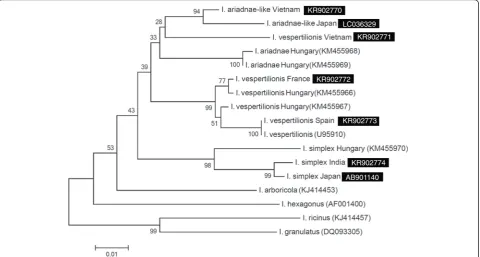
separately from the Spanish one (KR902773), although the bootstrap support for the latter was low (Fig. 2). The distinct phylogenetic position of a Spanish I. ves-pertilionis isolate was further confirmed by analysis of part of the 12S rDNA gene, because the genotype from
France (KR902776) showed three nucleotide differences from (i.e. 99 % sequence identity to) specimens collected in CE Europe, whereas the Spanish isolate (KR902777) had nine nucleotide differences and thus only 97.5 % se-quence identity.
Fig. 1aPhylogenetic relationships of bat ticks collected in the present study (accession number in inverse colour) based on COI gene and related data from the GenBank. Light yellow background indicates isolates ofI. vespertilionis, with overlaying background colours according to geographical regions as indicated. Purple background colour stands for genotypes ofI. ariadnae, and pink for those ofI. simplex.bPhylogenetic relationships of bat species that were hosts of the tick species (according to the colour code of the tick phylogenetic tree) analysed in the present study. Branch lengths correlate to the number of substitutions inferred according to the scale shown
KR902771 KR902770
KR902772
KR902773 LC036329
KR902774
AB901140
[image:4.595.57.538.89.304.2] [image:4.595.59.540.448.705.2]Comparison of ixodid bat ticks from Southern and Eastern Asia
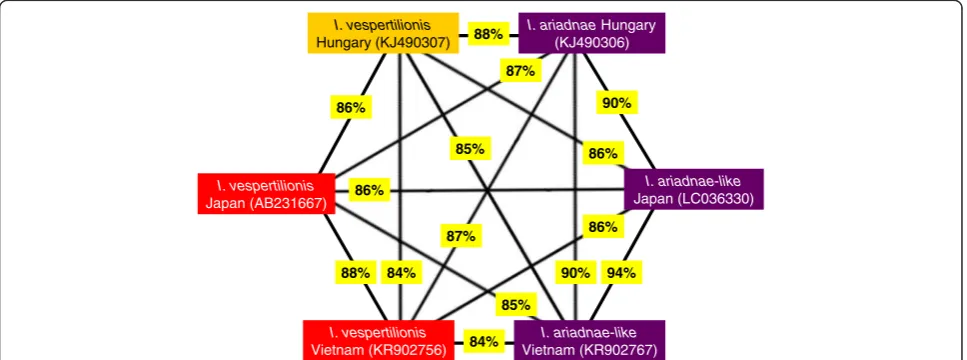
TheI. vespertilionisnymph collected in Vietnam had con-vex posterolateral margin of the scutum, as contrasted to the concave shape in the case of European specimens. The COI sequence of this tick (KR902756) also had the highest level of intraspecific genetic divergence observed in this study: it differed from the CE EuropeanI. vespertilionis ge-notypes with up to 101 nucleotides, i.e. showed only 84.1 % sequence identity and clustered distantly on the phylogen-etic tree (Fig. 1a). This nymph from Vietnam had the closest sequence identity (88 %) to a formerly pub-lished Japanese genotype (AB231667) (Fig. 3). Based on its partial 16S rDNA gene sequence (KR902771) this tick clustered separately from all European I. vespertilionis
specimens and as the sister group of the two Asiatic ticks resemblingI. ariadnae(Fig. 2).
Another tick was collected from an undescribed species of Myotis in Vietnam. This larva showed morphological similarities toI. ariadnae. Consistently with this, the COI sequence of this specimen (KR902767) had the highest (89.5 %) identity with the CE EuropeanI. ariadnae geno-type (62 nucleotide differences), and only 85.2 % identity with the CE EuropeanI. vespertilionisgenotypes (i.e. up to 87 nucleotide differences). Based on COI phylogenetic ana-lysis thisI. ariadnae-like genotype from Vietnam clustered close toI. ariadnae, but separately fromI. vespertilionis col-lected in CE Europe (Fig. 1a). This finding was only partly confirmed by the analysis of the 16S gene (although poorly supported by low bootstrap values), because the Vietnam-ese I. ariadnae-like specimen (KR902770) clustered separ-ately from CE European specimens of both I. ariadnae
andI. vespertilionis(Fig. 2). The partial 12S gene sequence of this larva (KR902775) showed only 12–14 nucleotide differences from (96–96.6 % identity with) I. ariadnae,
whereas 19–20 nucleotide differences from (94.3–94.6 % identity with)I. vespertilionis.
One female tick collected from Murina leucogaster in Japan also resembled morphologically to I. ariadnae. The COI sequence of this specimen (LC036330) differed from the CE European I. ariadnae genotype in 65 nucleotides (amounting to 89.7 % identity), but from CE European I. vespertilionisgenotypes in up to 85 nucleotides (meaning only 86.4 % identity). The COI phylogenetic analysis showed that thisI. ariadnae-like genotype from Japan clus-tered together with the above I. ariadnae-like tick from Vietnam and close toI. ariadnaefrom Hungary, but separ-ately fromI. vespertilioniscollected in CE Europe (Fig. 1a). This finding was also confirmed by the phylogenetic tree based on the amplified part of the 16S gene (LC036329, Fig. 2). The partial 12S gene sequence of this tick (LC036328) showed 15–17 nucleotide differences from (95.4–95.9 % identity with)I. ariadnae, whereas 20–21 nucleotide differences from (94.3–94.6 % identity with)
I. vespertilionis. The genetic distances based on partial COI sequences between highly divergent I. vespertilio-nisandI. ariadnaegenotypes are summarized in Fig. 3. One nymph, collected from Miniopterus magnater in India, showed a similar morphology toI. simplex. However, the partial COI sequence of this specimen (KR902769) had 55–58 nucleotide differences from two European genotypes (i.e. 90.8–91 % identity), from which it also clustered apart in the phylogenetic analysis (Fig. 1a). Similarly, the separ-ation of this IndianI. simplex genotype (KR902774) from the Hungarian one was supported by high bootstrap value in the 16S phylogenetic analysis (Fig. 2).
A female I. simplex, collected from Mi. fuliginosus in Japan, was also included in the present study. The partial COI sequence of this isolate (LC055099) had only 25 nu-cleotide differences from (i.e. 96 % identity with) the above
86%
84%
87%
85%
86%
87% 86%
85% 90% I. vespertilionis
Japan (AB231667)
88%
I. vespertilionis
Vietnam (KR902756) 84%
I. ariadnae-like Vietnam (KR902767)
94%
I. ariadnae-like Japan (LC036330) 90%
I. ariadnaeHungary (KJ490306) 88%
I. vespertilionis
Hungary (KJ490307)
86%
[image:5.595.57.541.524.704.2]genotype from India, and in the phylogenetic analysis these two Asiatic I. simplex specimens clustered together, but separately from two European (French and Hungarian) genotypes (Fig. 1a). The same grouping pattern was seen on the basis of the partial 16S rDNA gene (AB901140) of this isolate (Fig. 2). At the same time, its partial 12S rDNA sequence (LC055100) showed 24 nucleotide differences from (93.6 % identity with)I. simplexfrom Hungary. Discussion
The results of the present study can be interpreted in the light of evolutionary factors and events as well as eco-logical traits that influence the intra- and inter-specific genetic diversity of animal populations, in this case of ticks and their bat hosts. In this context the geographical range of bat species, geographical barriers and glacial periods (that may isolate related bat populations) may be particu-larly important as driving forces of disruptive selection. We acknowledge that the reduced number of samples and stages used in the present study prevent conclusions about the precise taxonomic status of collected specimens. How-ever, the low number of samples is compensated by an adequate representation of the territories and a high similarity of the samples within-sites. We could not ex-plicitly calculate the amount of phylogenetic diversity at each node of the phylogenetic tree because the pres-ence of singletons, or isolated taxa that produced only a single edge in the tree. However, the relative distances among the tips of the tree are an indirect measure of the similarity within and between sites.
The main host ofI. vespertilionisin Europe isR. hipposi-deros[5, 8]. During post-glacial periods this bat species reco-lonized central and northern Europe from refugia either in the Balkan or the northern Mediterranean (Southern France) [16]. This may account for the relative genetic homogeneity of CE European and FrenchI. vespertilionisisolates, as re-ported here.
Considering all I. vespertilionis analyzed in the present study from Europe, specimens collected in Spain were shown to differ markedly (and to cluster apart phylogenetic-ally) from other evaluated genotypes. Probably the most im-portant underlying factor of this phenomenon is that bat hosts of I. vespertilionis represent isolated populations on the Iberian peninsula, prevented from mixing with northern populations by the Pyrenees which act as a barrier to gene flow [16]. This is also well reflected by the phylogenetic pos-ition ofR. hipposiderosfrom Spain and CE Europe (Fig. 1b). The level of sequence divergence between Spanish and CE European genotypes of I. vespertilionis (5.4 % in the COI gene) approached the proposed sequence difference as species boundary for ticks (6.1 % COI: [10]). In contrast to this, another member of the genus, I. ricinus was demonstrated to show only 0.5 % COI sequence diver-gence between specimens from CE Europe or France
and Spain (e.g. GU074908 or GU074941 vs. GU074910: [17]), explained by gene flows due to dispersal and con-tinuous exchange of ticks between populations connected by migrating hosts.
The homologies of COI sequences were reported to be above 93.9 % within a species, and below 94.4 % between species of ixodid genera [18]. Similarly, in another study the percentage of species boundary was deemed to be 6.1 % sequence divergence for the COI gene, only in exceptional cases amounting to higher values [10]. Accordingly, in comparison with I. vespertilionis genotypes from Europe (KR902757-66), the high (16 %) genetic divergence of I. vespertilionis from Vietnam (KR902756) and of a similar genotype in Japan (AB231667), together with their well separated and distant phylogenetic position, suggest that they probably represent a distinct tick species. This is partly confirmed by the morphological difference ob-served between the European and the Vietnamese variant. In addition, the degree of partial COI sequence divergence between the European and VietnameseI. vespertilionis ge-notypes (101 nucleotide differences, i.e. 84.1 % identity) was similar to that observed between the latter and I. ricinus (e.g. in comparison with KF197132: 102 nu-cleotide differences, i.e. 83.9 % identity). At the same time, the two South-East Asiatic genotypes (KR902756, AB231667) clustered together and showed 88 % similarity to each other (Fig. 3).
The host of the I. vespertilionisnymph collected in the present study in Vietnam was R. affinis, and of that re-corded previously in Japan was R. cornutus ([19]: AB231667). Based on phylogenetic analysis of mitochon-drial (cytochromeb) sequences these two bat species clus-tered separately from other representatives of the genus (that harbored ticks in the present study), similarly to the phylogenetic position of associated ticks (Fig. 1a-b). These two AsiaticRhinolophusspp. are closely related phylogen-etically toR. ferrumequinum(Fig. 1b). which appears to be the most important host of I. vespertilionisin Japan and Eastern Asia [5, 9]. Although the Palearctic geograph-ical range of R. ferrumequinum extends from Western Europe to Eastern Asia, the spatial separation of glacial refugia and temporal shift of recolonization events (in Europe vs. East Asia) may have helped to maintain the genetic diversity in both the bat hosts (as reported by Flanderset al.[20]) and theirI. vespertilionisticks (as sup-ported by data of the present study).
which the I. ariadnae-like genotype was collected in Japan, are also closely related to Myotis spp. [4]. This lineage (consisting of hosts ofI. ariadnaeand similar ge-notypes) shows clearly a separate position on the bat phylogenetic tree (Fig. 1b).
The taxonomy of the preferred host ofI. simplex, Mini-opterus schreibersii, has recently undergone revision. While previously it was considered as a uniform species widely distributed across the Old World, it turned out to be a complex comprising several species [21]. Among them, in the present study I. simplexwas collected from both Mi. magnater(in India) andMi. fuliginosus(in Japan), allowing phylogeographical comparison with the ticks collected from Mi. schreibersii in Europe. In the phylogenetic analysis not only did the fourI. simplexgenotypes clus-ter separately from other bat tick isolates (Fig. 1a), but also their three respective bat host species from other bat species involved in the present study (Fig. 1b). Again, gla-ciation and resultant geographic isolation might be con-sidered as major mechanisms underlying the genetic differentiation of these closely related AsiaticMiniopterus
spp. [21], and may have also served as the basis for the relative genetic heterogeneity (96 % COI sequence similar-ity) of their ticks as demonstrated in the present study.
It has been suggested that in the case of an exophilic, generalist tick species, likeI. persulcatus(which has a simi-larly broad, but northern Eurasian geographical range), gla-ciation events may have caused the loss of significant genetic variation because of genetic mixing during refuge formation [22]. On the contrary, populations of bat ticks and their hosts in the southern parts of Asia may have remained relatively unaffected by ice age(s), maintaining drivers in formerly initiated species divergence. Moreover, separation from other parts of Eurasia during the glacial periods might fulfill the role of geographical barrier forma-tion for South-Eastern Asia, where the biodiversity could be maintained or was even enhanced during ice ages [23].
Conclusions
Strict morphological criteria of all tick developmental stages and genotyping from a larger number of samples may help to clarify the precise taxonomical status of highly divergent genetic variants of ixodid bat ticks reported here. This will also compensate for the lack of voucher speci-mens in the case of some South East Asiatic bat tick geno-types tested molecularly in the present study or reported previously. Data of this study also reflect thatI. vesper-tilionismay represent a species complex, given the strong bootstrap support for the exclusion of two specimens from Japan and Vietnam from the clade that contains all specimens from Europe.
Competing interests
The authors declare that they have no competing interests.
Authors’contributions
SH initiated and organized the study, did most of the DNA extractions, wrote the manuscript. JK performed phylogenetic analyses. AEP and OP provided tick samples and contributed significantly to the manuscript. BK, ADM, AdT, ST, JB, TG, PE, VTT, MT and TY provided important samples for the study. NT performed most of the PCRs. KS prepared and helped in DNA extractions. IGFM and JF provided PCR protocols and partly supervised the molecular studies. AiT performed analyses of Japanese samples. All authors read and approved the manuscript.
Acknowledgements
Financial support was provided by OTKA 115854, by OTKA K112440, by the 9877-3/2015/FEKUT grant of the Hungarian Ministry of Human Resources and by the national project grant from the Ministry of Education, Science and Technological Development of the Republic of Serbia (Project No. 173006). The authors are grateful to Dr. Jason Dunlop at the Natural History Museum of Berlin (Museum für Naturkunde Berlin, Germany) for lending old specimens for the study. The collaborative work of Sándor Hornok, Agustín Estrada-Peña, Andrei D. Mihalca and Snežana Tomanovićwas done under the frame of EurNegVec COST Action TD1303. We would also like to thank Caving in Abode of the Clouds Project, Oana Mirela Chachula and Ioana Adriana Matei for providing the field help in the tick collection in India. The authors are grateful to the Forest and Environment Department (Government of Meghalaya) for permission and to Prof. Gareth Jones and Manuel Ruedi for their support.
Author details
1Department of Parasitology and Zoology, Faculty of Veterinary Science, Szent István University, Budapest, Hungary.2Department of Animal Pathology, University of Zaragoza, Zaragoza, Spain.3Plant Protection Institute, Centre for Agricultural Research, Hungarian Academy of Sciences, Budapest, Hungary.4INRA, Biologie, Epidémiologie et Analyse de Risque en santé animale, Nantes, France.5LUNAM Université, Oniris, Ecole nationale vétérinaire, agroalimentaire et de l’alimentation Nantes-Atlantique, Nantes, France.6Independent researcher, Langenburg, Germany.7Department of Parasitology and Parasitic Diseases, University of Agricultural Sciences and Veterinary Medicine, Cluj-Napoca, Romania.8Solar View Cottage, Upper Mawprem, Shillong, Meghalaya, India.9Laboratory for Medical Entomology, Centre of Exellence for Food and Vector-Borne Zoonoses, Institute for Medical Research, University of Belgrade, Belgrade, Serbia.10Chair of Animal Ecology and Zoogeography, Institute of Zoology, Faculty of Biology, University of Belgrade, Belgrade, Serbia.11Department of Zoology, Hungarian Natural History Museum, Budapest, Hungary.12Institute for Veterinary Medical Research, Centre for Agricultural Research, Hungarian Academy of Sciences, Budapest, Hungary.13Department of Zoology, Eszterházy Károly College, Eger, Hungary.14Institute of Ecology and Biological Resources, Vietnam Academy of Science and Technology, Hanoi, Vietnam.15SaBio. Instituto de Investigación en Recursos Cinegéticos IREC, Ciudad Real, Spain. 16Center for Veterinary Health Sciences, Oklahoma State University, Stillwater, USA.17Department of Anesthesiology, Saitama Medical University, Iruma-gun, Japan.18Toyama Institute of Health, Imizu, Toyama, Japan.19Department of Veterinary Medicine, Joint Faculty of Veterinary Medicine, Yamaguchi University, Yamaguchi, Japan.
Received: 16 June 2015 Accepted: 26 August 2015
References
1. Kunz TH, Pierson ED. Bats of the world: an introduction. In: Nowak RM, editor. Walker’s bats of the world. Baltimore: The John Hopkins University Press; 1994. p. 1–46.
2. Calisher CH, Childs JE, Field HE, Holmes KV, Schountz T. Bats: important reservoir hosts of emerging viruses. Clin Microbiol Rev. 2006;19:531–45. 3. Biollaz F, Bruyndonckx N, Beuneux G, Mucedda M, Goudet J, Christe P.
Genetic isolation of insular populations of the Maghrebian bat,Myotis punicus, in the Mediterranean Basin. J Biogeograph. 2010;37:1557–69. 4. Ruedi M, Stadelmann B, Gager Y, Douzery EJ, Francis CM, Lin LK, et al.
5. Arthur DR. TheIxodesticks of Chiroptera (Ixodoidea, Ixodidae). J Parasitol. 1956;42:180–96.
6. Robbins RG, Bangs MJ. First report ofIxodes kopsteiniOudemans (Acari: Ixodida: Ixodidae) from the Kingdom of Cambodia, with a summary of known hosts of this tick in continental southeastern Asia. Proc Entomol Soc Wash. 2004;106:472–4.
7. Hornok S, Kontschán J, Kováts D, Kovács R, Angyal D, Görföl T, et al. Bat ticks revisited:Ixodes ariadnaesp. nov. and allopatric genotypes ofI. vespertilionis in caves of Hungary. Parasit Vectors. 2014;7:202.
8. Piksa K, Górz A, Nowak-Chmura M, Siuda K. The patterns of seasonal activity ofIxodes vespertilionis(Acari: Ixodidae) onRhinolophus hipposiderosin nursery colonies. Ticks Tick-Borne Dis. 2014;5:69–74.
9. Yamauchi T, Funakoshi K. Ticks (Acari: Ixodoidea) from Chiroptera (Mammalia) of the Kyushu mainland, Japan. J Acarol Soc Japan. 2000;9:51–4.
10. Lv J, Wu S, Zhang Y, Chen Y, Feng C, Yuan X, et al. Assessment of four DNA fragments (COI, 16S rDNA, ITS2, 12S rDNA) for species identification of the Ixodida (Acari: Ixodida). Parasit Vectors. 2014;7:93.
11. Hornok S, Kontschán J, Estrada-Peña A, Fernández De Mera IG, Tomanovic S, De La Fuente J. Contributions to the morphology and phylogeny of the newly discovered bat tick species,Ixodes ariadnaein comparison withI. vespertilionisandI. simplex. Parasit Vectors. 2015;8:47.
12. Folmer O, Black M, Hoeh W, Lutz R, Vrijenhoek R. DNA primers for amplification of mitochondrial cytochrome C oxidase subunit I from diverse metazoan invertebrates. Mel Marine Biol Biot. 1994;3:294–9.
13. Black WC, Piesman J. Phylogeny of hard and soft-tick taxa (Acari: Ixodida) based on mitochondrial 16s rDNA sequences. Proc Natl Acad Sci U S A. 1994;91:10034–8.
14. Norris DE, Klompen JSH, Black WC. Comparison of the mitochondrial 12S and 16S ribosomal DNA genes in resolving phylogenetic relationships among hard ticks (Acari: Ixodidae). Ann Entomol Soc Am. 1999;92:117–29. 15. R Development Core Team: R. A language and environment for statistical computing. Vienna, Austria: R Foundation for Statistical Computing; 2012. ISBN 3- 900051-07-0, URL http://www.R-project.org/
16. Dool SE, Puechmaille SJ, Dietz C, Juste J, Ibáñez C, Hulva P, et al. Phylogeography and postglacial recolonization of Europe byRhinolophus hipposideros: evidence from multiple genetic markers. Mol Ecol. 2013;22:4055–70. 17. Noureddine R, Chauvin A, Plantard O. Lack of genetic structure among
Eurasian populations of the tickIxodes ricinuscontrasts with marked divergence from north-African populations. Int J Parasitol. 2011;41:183–92. 18. Lu X, Lin XD, Wang JB, Qin XC, Tian JH, Guo WP, et al. Molecular survey of hard ticks in endemic areas of tick-borne diseases in China. Ticks Tick Borne Dis. 2013;4:288–96.
19. Mitani H, Takahashi M, Masuyama M, Fukunaga M.Ixodes philipi(Acari: Ixodidae): phylogenetic status inferred from mitochondrial cytochrome oxidase subunit I gene sequence comparison. J Parasitol. 2007;93:719–22. 20. Flanders J, Jones G, Benda P, Dietz C, Zhang S, Li G, et al. Phylogeography
of the greater horseshoe bat,Rhinolophus ferrumequinum: contrasting results from mitochondrial and microsatellite data. Mol Ecol. 2009;18:306–18. 21. Li S, Sun K, Lu G, Lin A, Jiang T, Jin L, et al. Mitochondrial genetic
differentiation and morphological difference ofMiniopterus fuliginosusand Miniopterus magnaterin China and Vietnam. Ecol Evol. 2015;5:1214–23. 22. Kovalev SY, Mukhacheva TA. Phylogeographical structure of the tickIxodes
persulcatus: a novel view. Ticks Tick Borne Dis. 2012;3:212–8.
23. Woodruff DS. Biogeography and conservation in Southeast Asia: How 2.7 million years of repeated environmental fluctuations affect today’s patterns and the future of the remaining refugial-phase biodiversity. Biodivers Conserv. 2010;19:919–41.
Submit your next manuscript to BioMed Central and take full advantage of:
• Convenient online submission
• Thorough peer review
• No space constraints or color figure charges
• Immediate publication on acceptance
• Inclusion in PubMed, CAS, Scopus and Google Scholar
• Research which is freely available for redistribution