Rochester Institute of Technology
RIT Scholar Works
Theses
Thesis/Dissertation Collections
3-1-2003
A Study of the development of higher education
programs in graphic arts technology according to
the needs of the printing industry
Mahadzir Mohamad
Follow this and additional works at:
http://scholarworks.rit.edu/theses
This Thesis is brought to you for free and open access by the Thesis/Dissertation Collections at RIT Scholar Works. It has been accepted for inclusion
in Theses by an authorized administrator of RIT Scholar Works. For more information, please contact
.
Recommended Citation
A
Study
ofthe
Development
ofHigher Education Programs in Graphic
Arts
Technology
According
to the
Needs
ofthe
Printing
Industry
by
Mahadzir Mohamad
A
thesis
submittedin
partialfulfillment
ofthe
Requirements for
the
degree
ofMaster
ofScience in
the
School
ofPrint Media
in
the
College
ofImaging
Arts
andSciences
ofthe
Rochester Institute
ofTechnology
March
2003
School of Print Media
Rochester Institute of Technology
Rochester, New York
Certificate of Approval
Master's Thesis
This is to certify that the Master's Thesis of
MAHADZIR MOHAMAD
With a major in Printing Technology
Has been approved by the Thesis Committee as satisfactory
for the thesis requirement for the Master of Science degree
at the convocation of
date
Thesis Committee
Edward Granger
.Jh-
~
3
Thesis Advisor
Taylor
J.
Cummings
3/2-1/0-2-Graduate Program Coordinator
Acknowledgement
This
thesis
would nothave been
possiblewithout great contributions ofmy
thesisadvisor,
Prof. Dr. Edward Granger
andhis
wifeMrs.
Mary
Granger
and alltheprofessors atthe
School
ofPrint Media (2001-2002).
In
addition,
I
wouldlike
to
thankthe
following
peoplefor
theirhelp
andsupport:My
motherandmy
family
Jerry
J.
Waite,
Ed.D.
Associate Professor
ofTechnology:
University
ofHouston
President:
International
Graphic Arts Education Association
Distinguished
Educator:
Apple Computer
Department
ofPrinting
Technology,
MARA
University
ofTechnology,
Malaysia
Mr. Rob
Semsey
GATF
Regis J.
Delmontagne,
President,
Graphic Arts Education
andResearch Foundation
Gary
Walton, Co-Chair,
Graphic/Flexographic
Communications
Program,
Cincinnati State Technical &
Community
College
Malcolm G.
Keif,
Assistant
Professor
ofGraphic
Communication,
California Polytechnic State
University,
andBoard
Member
ofThe
Association
for Graphic Arts Trainers
Permission Granted
A Study of the Development of Higher Education Programs in Graphic Arts
Technology according to the Needs of the Printing Industry
I, Mahadzir Mohamad, hereby grant permission to the Wallace Memorial
Library of the R.I.T to reproduce my thesis in whole or in part. Any
reproduction will not be for commercial use or profit
Signature of Author:
Date:
eO,
b-i
Ie:; ,
Contents
List
ofFigures
I
List
ofTables
II
Abstract
III
Chapter 1 Introduction
1
1.1 Background
1
1.2 Research Objective
10
1.3 Problem Statement
12
1
.4The Definition
ofthe
Title
1 5
1.5 Overview
ofthe
Goals
ofthe
Thesis Project
18
Chapter 2 Theoretical Basis
ofthe
Study
21
2.1 The
Philosophy
21
2.2 Education
andQualifications
23
2.2.1
Printing
as a career25
2.2.2 Weakness
orOpportunity
26
2.2.3
One
ofthe
mosttolerant
industry
27
2.3 Educational Requirements
andOptions
29
2.3.1 Vocational
Training
andEducation
System
30
Chapter
3 Review
ofLiterature
Chapter 4 Hypotheses
39
51
52
53
Chapter
5
Methodology
5.1
Experiment Procedure
andData
Collection
5.1.1
Questionnaire
for
Printing Company
5 3
5.1.2
Questionnaire
for
Association
60
5.1.3
Questionnaire
for
Universities
andColleges
62
5.1.3 Data
Analysis
64
Chapter
6
The Results
69
6.
1
Graphical
Display
ofQualitative
Data
69
6.1.1 Section
1
ofthe Questionnaires
69
6.1.2 Section
2
ofthe
Questionnaire
85
Chapter
7
Conclusion
99
7. 1
Suggested
Areas
ofConcentration
103
7.2 Future
Study
105
Bibliography
* *
*
Appendix
A: The
Questionnaire
1 1 3
List
ofFigures
Figure 1
.Size
ofCompanies
thatResponse
70
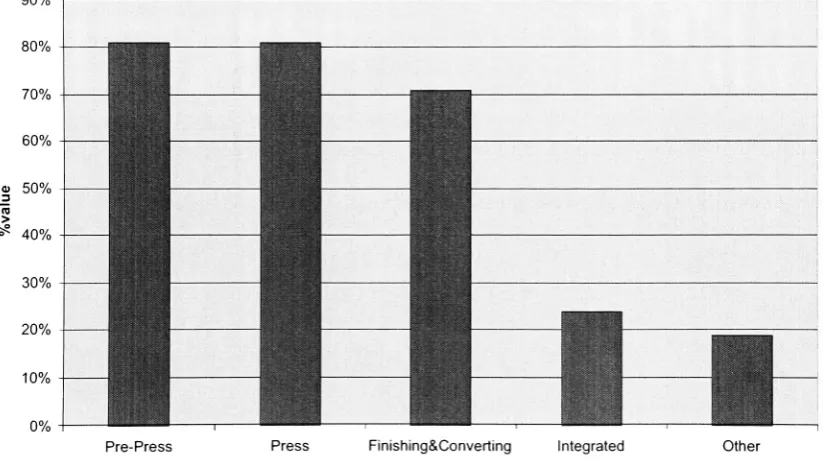
Figure 2. Production Sections/Areas
71
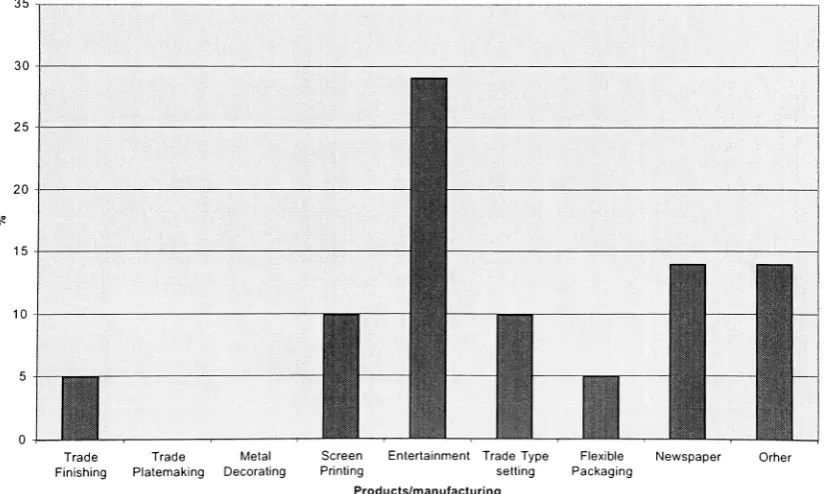
Figure 3a. Main
sectorsthat
identified
by
the
respondents(1)
73
Figure 3b. Main
sectorsthat
identified
by
therespondents(2)
73
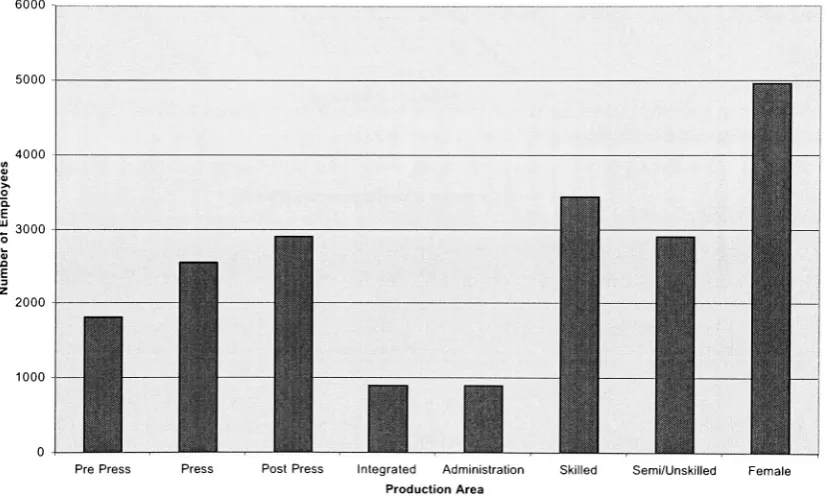
Figure 4a. Number
ofEmployees in Various Categories
(1)
74
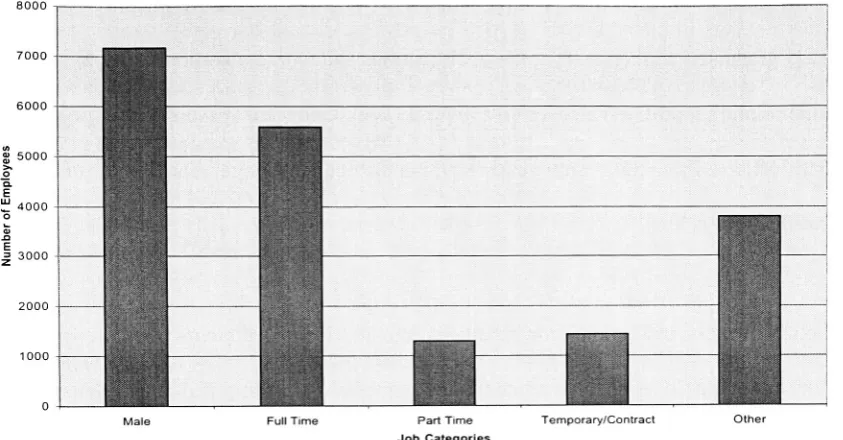
Figure 4b. Number
ofEmployees in Various Categories
(2)
75
Figure 4c. Number
ofEmployee in Various Categories
(3)
75
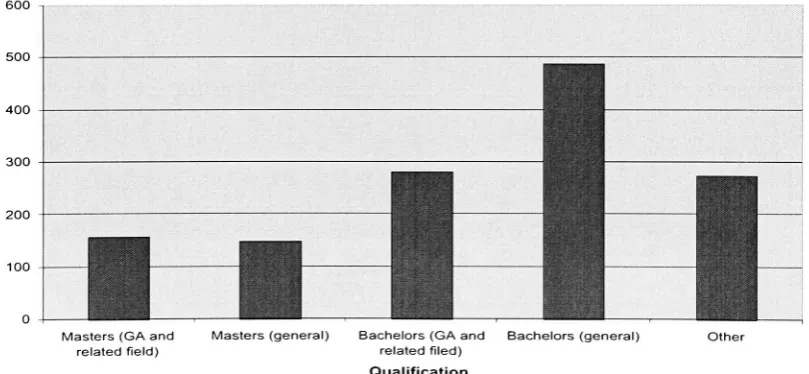
Figure 5. The Workers
andtheQualification
76
Figure 6. Main Areas
ofActivities
ofGA Responded Association
78
Figure 7. Field
ofInterest
among
theGA Associations
79
Figure 8. Main Sector
80
Figure 9: Number
ofEmployee
andtheQualifications
80
Figure 10. Type
ofDegree That
Offered
by
theUniversities
andColleges
81
Figure 1 1
.The Main Area
ofStudy
in Graphic Arts Programs
82
Figure 12. Main
Concentration
ofStudy
83
Figure 13. The Skills
thoseStudents Should Have
84
Figure 14. Number
ofStudents in Degree Offered
84
Figure 15. The
knowledge
graduates shouldhave
87
Figure 16. Graduates
preferredby
theindustry
89
Figure 17. Type
of skills preferredby
theindustry
90
Figure 18. The
mostimportant
areas92
Figure 19. Qualifications
preferredby
theIndustry
94
Figure 20. The Important
areasofstudy
96
List
ofTable
Table 1
:"
1
"and"0"
plotted
in
the spreadsheets65
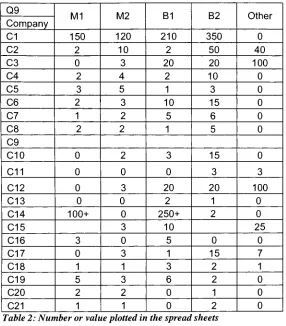
Table 2: Number
or value plottedin
the spreadsheets66
Table 3. ANOVA for Question
1
87
Table 4. ANOVA for Question 2
88
Table 5
.ANOVA
for Question 3
90
Table
6. ANOVA for Question
4
9 1
Table 7. ANOVA for
Question
5
93
Table 8. ANOVA for Question 6
95
Table 9. ANOVA
for Question 7
97
Table
10. The
list
ofGA
schoolby
Rank
102
Chapter
1
Introduction
1.1 Background
The printing
industry
is
avery important
industry
andit
provides themain sourcefor
education, communication,
dissemination
ofknowledge
andinformation. Print is
stillby
far
thecheapest and mostdirect
source ofinformation
and communication.Besides
being
themostconvenient,
it is
also,by
andlarge,
easily
retrievable.It is
alsothemain mediumfor packaging food
and consumer products.Thus
theprinting
industry
is
avery
essentialindustry
in
ourdaily
lives.
Printing
is
one oftheelementsthatcovers and supports theneeds of
many
otherindustries
suchasgraphic communication,advertising,
publishing
and packaging.
The
creation of advanceddegrees in
graphic artseducationbecomes very
crucialin
orderindustries
thatmentionedabove,
andit is important
toproduce graduates withtheability
tocope with problems
in
theprinting
industry
itself
andtherelatedfields.
Offset
andpackaging
printing
aloneemploy between 65,000
to70,000
people, the tinmanufacturing
sector employs morethan5,000
to7,000
workers andtheplastics sectorhas
more than25,000
workers.The Malaysian Government is very
supportive towardsthe
printing
industry
in removing
variousforms
oftaxesandoffering
incentives
tohelp
the
industry
upgrade.It
alsohelps
theindustry
find
new marketsby
periodically
conducting
trademissions overseas.The Malaysia External Trade
Development
Corporation1
(MATRADE)
was established onMarch
1, 1993,
as theexternal tradepromotion arm of
Malaysia's
Ministry
ofInternational Trade
andIndustry
(MITT)
whichfunctions
as a sourcefor
traderelatedinformation for Malaysian
exporters andforeign
importers.
By
providing
market researchinformation
and relevantadvice,MATRADE
assists
Malaysian
exporterstobetter
position theirproducts and servicesin
thehighly
competitive global markets
The
wide and multi-facetedprinting
industry
in Malaysia
canbe
broadly
classifiedinto
major market segments2:
namely Pre-Press
companieslike Color
Separation,
DTP
andimagesetters,
typesetters,
gravure cylinderstradehouse;
commercial printers such aspublicationprinters,
label
printers,
security
printers,
newspaperprinters,
electronicnonimpact
imaging
companies,computerform
printers;
packaging/converting
companiesincluding
flexible packaging
orplasticbags,
paperbags,
corrugatedmanufacturing
andfolding
andcollating
books,
binding
andfinishing,
UV
coating,
lamination,
paperconverters and
die
cutters; screenprinting;
flexo printing
andmetal printing.In
thisPre-Press
group,
thenumber ofemployeesusually
rangesfrom 10
to200
depending
on the size ofthecompany.Far East Offset
(M)
Sdn. Bhd &
Engraving
employ
about300
employees,
has 9
scanners,
6 high
end electronicpagemaking
andretouching
systems aswell as acomprehensivedesktop
publishing
section.A high
percentageofwork
done is for
export such asproducing
advertising, magazines,coffeetable
books
and generalpublication.The
Pre-Press
companies will alwaysinvest in
thelatest high
tech equipmentto achievethelevel desired
ofbusiness.
They
areusually
dedicated
and give a valueaddedservice.Today
the graphic artandprinting
industry
is
atan aspect oftechnical
versatility
never achievedbefore. Excellence
means morethanhaving
advancedtechnology.Regular
training
andretraining
plus adedicated
workforce
are a mustto
keep
abreast and ahead of changesin
theprinting industry.
The
commercialprinters, apartfrom
thenewspaper printers areusually very
aggressivewithadvance state oftheart.
A majority
ofthemhave
multi color offsetprinting
machines, and some ofthemeven
have
multicolor web offsetprinting
machines.They
employ from 20
to50
workers.The
technology
is
multicolor, andtheirfinishing
serviceis done
by
outsidecontractors.However,
there are companieswhich ownin house
binding
equipment.Fewer
thanfive
companies use computertoplateprinting in
Newspaper
printersemploy
webtechnology
toprintthedaily
newspaper.They
employ
in
house DTP
publishing
systems and operatetheirownnetwork ofdistribution.
Some
ofthemeven
have
thelatest ISDN
transferoffiles
tooffsitelocations.
The
workis
carriedout
in
shifts andthe
workforceis huge.
The
packaging/converting
industry
for flexible
or plasticbags,
paperbags,
corrugatedmanufacturing
andconverting
cartonpackaging is very large
and uses afew
multi colormachinesto caterto the market.
Investment
is
usually
morethanRM 2
million andabove.
A majority
oftheminstall
specializeddie
cutmachines,folder
gluerandembossing
machines toeaseup
thefinishing
work.In
this category,many
ofthemhave
theirown
factories
and areusually
concentratedin
urban areas.They
employ
about150
workers
depending
onthe size ofthecompanies.Currently
thepackaging
printers aredoing
very
wellto supportstrong indirect
export markets.The
post press companiesusually have
automaticbinding
machines,
trimmers,
stitches,
sewing
machines,folding
machines,hard
covercase makers andcasing in
machines.Employment
rangesfrom 10
to40
workers.Normal
timefor
binding,
depending
onthevolumeofwork,will
be 2
to3 days. In
finishing
workusing
calendering,
UV
coating,
spotcoating,pearl coating,water
base
varnish,
lamination
andpatternembossing,
mostcompanies
employ
thelatest
technology
tocopeup
withthehigh
customerdemand.
They
Silk
screenprinting
andflexography
printing
operate on a small scaleandthey
caterfor
theneeds of
locals
only.Usually
they
employ 10
to20
workers.(Malaysian
Printers
Directory
website)
The Malaysian printing
industry
affectedby
the economic slowdown sinceJuly
1997
is
now
bouncing
back quickly
as evidencedby
therecentinternational printing
exhibitionheld in
August3, 2002,
andbacking by
the supportivegovernmentto encouragedevelopment.
Malaysia's GDP has been growing
at animpressive
rate ofapproximately 1 1.7%. The
economy
ofthecountry is gradually returning
to asteady
growth path.As
with otherrapidly
developing
nations,
Malaysia's
demand for
printing, packaging,
and paperboardproducts
has
grownin
tandemwithits'GDP
growth.Along
withMalaysia's
growthin
GDP,
demand for
and consumption of paper&
paperboard productshas
risendue
tothese
factors:
1
.Increased
per capitaincome has
created a pushfor
consumergoods andthepackaging
thatgoeswiththem.2.
Education
andliteracy
rateshave
improved,
creating
andfurther
needfor
books
andprinting
paperin
schoolsand ademand for
literacy
material.3.
Growth
ofthemanufacture and export of goodshas
requiredincreased
In
America,
printing is
the
thirdlargest
manufacturing
industry,employing
over1
.2million people
in
almost46,000
establishments,
andselling
over$160
billion
ofproductsin 2001 (PIA). But
that's
just
the
beginning
ofthestory.is
the originalinformation
technology
that
has
spanneda millennium.It
represents andremains themostwidely
adopted, portable,
flexible,
economicalinformation
technology
everinvented.
It
literally
touches
every human's life like
no otherinformation
technology.Familiarity
with print as a mediumhas devalued its
reputation,but
notits impact
orsignificance.
Without
print,
otherrevolutionary
information
technologies suchas thetelephone,
thecomputer,
television,
andtheinternet
couldnothave been invented. Print
is
atthecore of allhuman
communication.Educational
institutions
rely
onprintto
begin
theprocess of
building
literate,
learned
members of our society.Industries
rely
on printtodevelop
and markettheirproductsand services.Governments rely
on printtocommunicate witheach and
every
citizen andtofuel
theeconomy
withasecure,
reliablecurrency.
Our
media useprint todirectly
inform
thepublic atlarge
of news andhappenings.
Religious
institutions
emphasizetheprinted wordin
theirpracticesandbeliefs.
The
arts and sciencesdisseminate
theirgreat works anddiscoveries
viathis
medium with ease and acceptance.
This is
a good examplehow
big
theprinting
industry
is,
andhow
very
important
it is
to educatepeopleto
serve thisindustry.
Despite
the commonperceptionof anantiquated,
dirty
conventionalprocess,
printis
atechnologically
diverse
industry
wheredigital
andanalog
worlds cometogether to
collateral,
financial
documents,
instrumentation for
vehicles, catalogs,
aswellasfine
artlithographs.
technology
workers.The printing
processdemands
workers whooperate sophisticatedequipment
from
computerworkstationstodigital
colorproofing
devices
and web pressesthatrunthousands
offeet
per minute.The
typical prepressemployeemust
be knowledgeable in
atleast 13 different kinds
of software.A
pressoperator runs andmaintainsmulti-million
dollar
piece equipment andis
requiredtohave
strong
computer, math,
and science skillsin
additionto mechanical and electricalabilities.
is driven
by
skilled workersusing
sophisticatedtechnology
which arecreatedthesescenarios:
Printers
spendbillions
ofdollars
each yearin
newtechnologies such asprepress equipment andprocesses,press
technologies,
business
andprocesscontrolsand
Internet
technologies.A
modern,high
performanceprinting company
provides anaverageofaround$100,000 in
technology
and equipmentper employee.Payroll
per employeein
theprinting
industry
averagesaround$50,000
perPrint is
acornerstone ofthe
US
andworld economies.Like many
industries,
printing has
undergone a
technological
revolution overthepastdecade. In transitioning from
analog
technology
to
digital
technology,
printing
firms
have
takenadvantageof new equipmentand processes
to
increase
theirproductivity.Industry
suppliers- pressmanufacturers,paper and
film companies,
computermanufacturers,and others-arestill
investing
in
sustainable
technology
thathelps
printers providetheircustomerswithfaster,
cheaperand
higher quality
productsand servicesto compete with andcomplimentother media.Although
printis
now a maturemedia,
thereare still some printsegmentsthatareprojectedto grow at rates
exceeding GDP
growthfor
theforeseeable future. With
totalannual
industry
shipments of over$160
billion,
growthis
predictedat3-4
percent peryear with yields of
approximately
$4 billion
to$7 billion
of new print sales each yearfor
printing firms.
In
addition,
printers arerapidly moving into ancillary
servicesbeyond
traditionalink
onpaper.
These
servicesinclude data
assetmanagement,
fulfillment
andinventory
management,
design
services,
andnewe-commerce services.This
expansionhas
enabledmany
printers tobecome
full-service
communications providersfor
theircustomers,
include:
Direct marketing
Specialty
magazines and periodicalsShorter
run andspecialty
catalogsCollateral marketing
materials.Variables
data printing
Ancillary
services providedby
many
printersinclude:
Graphic design
andpublishing
servicesFulfillment,
inventory
management andwarehousing
Digital
database
managementElectronic
file
and photographicimage
storage.CD ROM
and webbased
servicesThe
largest
tradeassociationdedicated
toprinting in
theworld,
Printing
Industries
ofAmerica
(PIA),
andits
partner,
theGraphic Arts Technical Foundation
(GATF),
launched
this campaign
to
unite anindustry
and championvalue of printin
oursociety.PIA/GATF
has
calledon26
other printing-relatedindustries
andtheirassociationsto
join
forces
in
In
realization oftheimportance
of skilled personnelin
ensuring
continuous growth oftheindustry,
theMalaysian
government alsohas
playedits
vital rolein
establishing
variouseducational centers
to
enhancetheknowledge
ofprinting in
thecountry.Courses
from
certificatesto
degree levels
are offeredat vocationalinstitutions
andatinstitutions
ofhigher learning. For
instance,
diploma
anddegree
courses areconductedby
MARA
University
ofTechnology. Certificate
coursesin printing
are nowavailablein
Pusat
Giat
Mara,
Bangi,
Selangor. Basic
machine operationandmaintenancecourses are alsoavailableat
Industrial
Training
Institutes
in Kuala
Lumpur
and othertowns,
andatMonfort Boys School in Shah
Alam,
Selangor.
The
private sectornamely
theEAC Graphics
(now
known
asHeidelberg
Sdn.
Bhd)
andIntergrafica
&
Pact
(M)
Sdn. Bhd
(formerly
known
asVotra
(M)
Sdn.
Bhd)
has
alsoplayed a role
dynamic
tofurther
strengthenthedevelopment
and growth oftheindustry.
The
centersserveto providetraining
and educationfor its
customersby
upgrading
theirskills, and
by introducing
totalquality
control systemsfor
sensitometry,
production plantlayout
and systemsdesign,
andprinting investment
consultancy.With
somuch oftechnologicaland
training
backed
by
thepublic and privatesector,
withoutdoubt
theMalaysian
printing
industry
willbe
technologically
advancedandin
the nearfuture
should
be
one oftheleaders in
theAsia Pacific
region.1.2 Research Objective
It is very
clearthatstudentsin printing
school must preparethemselves
with someunderstanding
of and skillsin
management willbe
anextra valueto thestudent.These
are
the
mostimportant
elementsrequiredby
theprinting
industry
and shouldbe
masteredby
thestudentsduring
theirstudies.This
research,by investigating
threemainelements,the
industry,
GA
associations andthe universities,is
trying
toidentify
whatis
being
taught
in US
thatarenottaughtin Malaysia
andwhat employer requirements are notbeing
metby
any
universities.This is
apreliminary study
which willbe
usedasaguideline
for future
research onthedevelopment
of graphic artsprograms.The
results ofthis
study
willbe
usedtoreformatthe curriculum oftheuniversity
in Malaysia (UiTM).
This
research willstudy
thedevelopment
of graphic arts educationby
looking
athow
thegraphicarts environment
in
theUS
canbe
an examplefor
thedevelopment
of graphicartseducation
in Malaysia. The Malaysian
governmentfor
thepastthirty
yearshas
sentpeopleto the
UK
andtheUS
to gainknowledge
in printing
andtobuild
a good graphicarts education
base
thatcan servetheindustry
in
terms ofsharing knowledge
anddoing
aresearchand
development. MARA
University
ofTechnology (UiTM)
is
thebiggest
university in Malaysia
thatis
trying
tobuild
an education centerfor
graphic artsandprinting in Malaysia. UiTM is
theonly university
that offersahigher degree in printing
technology
and management.The
School
ofPrinting Technology
or, asit's known
theDepartment
ofPrinting
Technology
is
underthefaculty
ofArt
andDesign. The
Printing
department
wasestablishedin
January
1
993
afterthegovernmentrealizedtheprinting
industry
needed people withknowledge
and skillsto servethisindustry.
It
was plannedMalaysia,
theNational Vocational
Training
Council
ofMalaysia,
the MalaysianPrinting
Association,
Malaysian National
Printers
andtheLondon College
ofPrinting,
UK. Afteralmostten
years,
thisschoolhas
givenasignificantcontributionto theprintingindustry
in Malaysia. What
is
being
taughtin Malaysia is
basically
thesamein
theUS,
but
weneedto
identify
field
ofconcentration andhow
todesign
anddevelop
newfields,
orcourses
for
graphic arts programs.This
research willbe
abasic
to thedevelopmentofgraphic artseducation
in Malaysia
and willdemonstrate how
graphic artseducationin
the
US
can contributeto thisdevelopment
generally.1.3 Problem Statement
The
problemsbecame
apparentduring
the authoris
experience as aneducatorin
graphicarts
technology
in Malaysia for four
years.Since
becoming
astudent attheSchool
ofPrinting
Management
andSciences
atRIT,
there was aproblem ofidentifying
courserequirements and which coursestochoose.
I
amvery
clear aboutwhatkind
of coursewassuitable
for
me.For
a student withoutexperiencein
thisindustry,
like
most ofthegraduate students
in
themastersprogramin
this school,it is
avery
hard
decision
tomakebecause
they
have
toidentify
theirown needs, whatthey
wanttobe in
theindustry
and,most
important,
whataretheneeds oftheindustry. In
otherwords,whatthey
willThe
trends
in
graphic artstechnology
orprinting
technology,
theterm thathas been
usedin Malaysia
andtheUK
aredifferent
in
certainways,
but
thesamein
generalneeds oftheprinting
graphicartsindustry. Since
theSchool
ofPrinting Technology
attheLondon
College
ofPrinting,
have
change theirdegree
titlefrom B.A
(Hons) Printing
Management
to
B.A
(Hons)
Print Media
Management,
andalsotheSchool
ofPrinting
Management
and
Sciences
atRIT,
has
changedits
nameto theSchool
ofPrinting
Media;
it
seemschanges
in
theneeds oftheindustry
alsowill changetheprogramthatwillsupply
thegraduates who will
become
the technocratsin
thisindustry
willcreate a new paradigmin
theircurrent program.
The
rapidchangeoftechnology
requires graduates with amulti-skill
knowledge
ofthedirection
ofthetechnology
changes.A
changein
graphicartsprograms
in
termof concentration andanalyzing
thenewtechnology
in
theindustry
is
also required.
In
theU.K,
most ofthe students enrolledin
graphic arts programsare maturestudents.
The
numbers ofinstitutions
thatoffer programsin
graphic artstechnology
orprinting
technology
are alsovery limited
comparedtotheUnited
States. In
Malaysia,
most studentsthatenrollfor
adiploma
or undergraduateprogramarerecent
high
school graduates.This is
similarto the trendin
theUnited
States,
where most oftheundergraduate studentsthatenrollfor freshman
yearare
directly
from high
school.The similarity between Malaysia
andthehigher
institutions involved
in
this
field.
My
experiencewithU.K
andU.S
trendsof graphic arts educationwill
be
the
basis for
thisresearch.It
perhaps, canbe
aguideline
for creating
ahigher degree
programin
graphic artstechnology
thatcanbe
usedin
Malaysia.
The United State
willbe
aprimary
researchreference, andThe United Kingdom
willbe
asecondary
researchreference andMalaysia,
represented
by
the university4that sent me
here
togetmy
masters.There
areplenty
oftraining
optionstohelp
combat a skills shortagein
theindustry
created
by
technological change andglobal competition.Printing
education andtraining
have
changedconsiderably in
recent years.The entry
profile of studentsindicates
that theaverage age of a new entrant
is 18+
with25
year-olds notbeing
uncommon5.At
thesametime,
rapidtechnologicalchangeshave led
collegesto undertakecurriculumreviews,
almost on an annual
basis,
toensurethat students are aware of and receive appropriateinformation
onthetechnology
thatthey
will needtomaintaintheiremploymentin
theindustry.
New
entrantsand olderemployees areawarethatif
they
wish tomaintaintheirplacein
the
job
marketthey
mustcontinually
updatetheir skills.Employers
unabletoattractnewskilled personnel are
looking
tocolleges andothertraining
providersto offerup-skilling
Most
ofthesecourses willbe linked
to aqualification structure.For
thoseemployedin
acompany
the mainchoiceis
the certificatefrom
theMalaysian National
Vocational
Training
Council.
Printing
colleges and some privatetraining
providersin
Malaysia
arenow equipped to
deliver
thecourses that the studentand employer want.These include
pre-press,
web pagedesign,
CD-ROM
production,
printing,finishing
andmailroomdistribution.
The
industry
is
facing
a skillscrisis.Companies
now must recruit and support atraining
andeducationstructurethatwill
carry
usforward for
thenexttwenty
years.That's why it
is important
toidentify
thebasic
needs oftheindustry
before
designing
theprogram.If
we
do
not worktogether,
theskillbase
will continuetodecline
withtheinevitable loss
ofwork to
foreign
sources.1.4 The Definition
ofthe
Title
Terminology
is
animportant factor
whendiscussing
themeaning
of certain words orphrases.
This
sub-chapterwill addressthedefinition
ofthe title ofthisthesis, how it is
applied, and
why
this particularwordhas been
chosen.The meaning
ofthis andageneralThe
titleofthis thesis
is A
Study
ofthe
Development
ofHigher Education Programs
in Graphic Arts
Technology
according
to the
Needs
ofthe
Printing
Industry.
This is
a
basic study
ofthehigher degree in
graphicarts,
which willinvolve
otherterminology
such as
printing
technology,
graphic artstechnology,
graphiccommunicationsandpublishing
technology.Graphic
communicationsis
aterm thatrepresentsthemany different industries involved
in
thereproduction ofanimage. The
image,
aword, photograph, orillustration
canbe
transferred to paper, cloth,
metal, glass,
plastic or avariety
of other materials sothatthemessage can
be widely
seen.This
reproduction of messagesis
mostoften accomplishedwith a
printing
press,but
graphiccommunicationsinvolves many
otheraspects ofprinting.
This
industry
is
madeup
of notonly
printers,but
alsopublishers, packagers,papermakers,
ink
makers,equipmentmanufacturers,andin-house design
andprinting
departments
withincorporations,banks,
and evendepartment
stores.The
highly
technicalyet craft-related graphics
industry
employsmen and womenworking
aschemists,
engineers, computerprogrammers,
writers,
editors,artists,
designers,
desktop
publishers,
marketing
specialists, researchers, pressoperators,
technicians,
educators,salespeople,
managers, photographers,
bindery
workers,
andadministrators;
as well as avariety
ofotherpositions.
The
educationalrequirementsfor
thesecareersvary according
to the typeGraphic
Arts
Technology
is
thefield in
whichtextandimage
areputtogether,
multipliedand
distributed. In
additionto verbalcommunication,
printedmediahave been
dominant
overthe
last five
centuries.With
theevolutionofelectronics new mediahave been
createdand established which
has
meantnew conditionsfor
theprinting industry.
Graphic Arts
Technology
is
today
afast evolving field.
Technology
andproductionhave
changed
from
being
mechanical andmanualtocomputerintense
and moredemanding
toadministrate.
Much is
happening
in
prepress,orprepublishing, where more computersandmodern
information
technology
arebeing
usedtoproduce originalsready
toprintand where customers ofthe
printing
industry
participatein
alarger
part ofthe productionthemselves.
The
moretraditionalprinting
and post press technologies are alsobeing
improved
withcomputerizedfacilities,
new materials and new methods.Printing
meansthe art and methodsby
which an originalis
reproducedin
quantity6.In
thephotomechanical processthis
is generally
accomplishedby
applying
aninked image
carrierto the substrateas
it
travels throughahigh-speed
press6.(Glossary
ofgraphiccommunication,
GATF). That
meanit is
a process ofmanufacturing
a printed matterin
high
volume,in
acertainform
andin
an appropriatemethod and process ofproduction.It
is
clearthatprinting is
one oftheassociatefields,
as well as graphic arts whicharerecoveredmore
widely
definition
ofthisindustry. The
graphic communicationsindustry
is bigger
thanwe mightimagine.
In
fact,
printing
andpublishing
companies alone areindustry
had
revenues of$228
billion in 1998(PIA Source). The
industry
includes
small,medium,
andlarge
establishmentsin both
smalltownsandlarge
metropolitancities.Graphic
communicationsis
as much a partof ourlives
aswritten and spokenlanguage.
When
choosing
theircareers students cannotaffordtooverlook anindustry
thatemploysapproximately
1,600,000
peoplein
over60,000
establishments.Since
2000,
totalemployment
in printing
andgraphiccommunicationshas
increased
by
16%
to1,740,000.
The ongoing
rapidtechnologicaladvancementsmadein
thisindustry
are another reasonfor
theexistence ofsomany
opportunitiesfor
college andvocational graduates.1.5
Overview
ofthe
Goals
ofthe
Thesis Project
A study
ofthedevelopment
of graphic artsunderstandably
represents thestudy
ofthegraphic arts
industry. This
researchfocused
ontheneeds oftheprinting
industry,
because
the
printing
industry
is
themainmanufacturing
industry
thatsupports thegraphic artsindustry
and graphic communicationas a whole.Without
printing,
allforms
of graphicmedia would not
be
published ordelivered
tocustomers.This
researchis designed
toinvestigate
how
theneeds oftheprinting
industry
canbe
metby
graphic artshigher
degree
programs offeredby
universitiesandcolleges.The
purposes ofthisresearchstudy
are,
first,
to
determine
the
needs oftheeducationprograms;
second,
toidentify
areasofconcentrationwhich canbe
useto
design
and create abase
model of ahigher degree
program(master's
degree)
ofgraphicarts education
that
perhapscanbe implemented in
theMARA
University
of
Technology
in Malaysia. This
research willbe
usedas a generaloutlinefor
adevelopment
ofgraphicarts educationin
the
future;
andthird,
to
correlatebetween
whatis
found
in
terms
ofindustry
needs and whatis currently
being
taught
in
universities.In
otherwords,
tofind if
the
current course work offered atEndnotes
for Chapter 1
1
Annual Report 1999-2001. Malaysian External
Trade Development Coporation.
(Homepage).
http.V/www.matrade.
gov.my/about-matrade/reports.html
2Yong,
K.S. (1999). The Professional Class Structure
andtheFundamental
Technology
oftheMalaysian
Printing
Industry.
Paper
Presented
in Malaysia Printers
Association Information Exchange
Meeting
andSeminars,
Petaling
Jaya,
Malaysia
3Printing
&
Packaging
Malaysian
International
Printing
andPackaging
Equipment
andMaterials Exhibition. Kuala
Lumpur, Malaysia,
6
Nov-9Nov2002
4Draft
Report
onScholarship
Application for Overseas Studies (U.K
andU.S).
Printing Technology
Department,
Faculty
ofArt
andDesign,
UiTM. MARA
University
ofTechnology
(UiTM),
Shah Alam
Selangor,
Malaysia
5Curriculum
Revised
andStudent Registration Report 2000-2001.
Printing
Technology
Department,
Faculty
ofArt
andDesign,
UiTM. MARA university
ofTechnology
(UiTM),
Shah
Alam
Selangor,
Malaysia
Chapter 2
Theoretical Basis
of
the
Study
2.1 The
Philosophy
The
needsfor updating
education programin
the graphicarts areincreasing
withthegrowth ofthe
industry. The development
of newtechnology
andthescientificapproachin business
andmanagement ofthe
industry
require suitable personnel with extraknowledge
and skillstocope with thefast
anddynamic
changesin
theprinting industry.
Production
and application oftheprinting
processis
nolonger
amatter ofcraftsmanship.The printing
process now arerelies ontechnology.Technology
helps
transform
theprinted matter
from
a piece of artto atoolofadvertising,
of publicationand more oftenof commercials
in
thebusiness
and communication era.The printing
industry
needspersonnel thatcan adaptto the
development
oftechnology
in printing
and graphicarts,
who
know
thebasic
criteriaoftheoriginaltheory
ofprinting reproduction,
whounderstands
the
technology
from
thevery basic
conventionalprinting
methodsto the
Graphic
arts educationbegan
when peopleinvolved
in
theindustry
realizedthatthey
should
know
the
theory
behind
printing.It
wasbegun
withatraining
approach, whichis
still
being
appliedin
theindustry
nowadays.The
development
oftraining
in
theprinting
industry is
parallelwiththe
development
oftechnology.
When
theprinting
industry
became
acompetitivebusiness,
educational efforts concentratedmore onbusiness,
management,
marketing
andfinancial
aspects.Without
ignoring
technicalknowledge,
graphic arts needpersonnel withmore
balance
andmoreknowledge
tocompetein
thebusiness.
Training
needsto
become
moreorganized,
andtheindustry
must startlooking
for
and recognize personnel with certainqualificationsfrom
thedevelopment
of acertificationprogram
to
ahigher degree. These
sortsof qualificationlevels
werecreatedbecause
ofthedevelopment
oftheprinting
industry
itself,
whichis
becoming
morecomplex.
Students
notonly
must preparethemselvesfor
theprinting
orgraphic artsindustry,
but
alsofor
graphic communications andnew media applications.Graphic
arts education now canbe divided
into
threemainareas:technology,
business
and
management,
and scientific research.This
is
themainphilosophy
of graphicartseducation
in
generalwhichcomesfrom
thedevelopment
ofthe
industry
andthebusiness.
An important
aspectof graphic arts educationtoindustry
is
tofind
suitablepersonnelto2.2 Education
andQualifications
In
the
modern world oftheprinting
industry,
qualificationshave become very important.
In every
industry
orbusiness,
qualifiedstudents musthave knowledge
and anunderstanding
ofaparticularfield. Since
the
printing business is
alarge business
thatproduces profit
in
avery
competitivemarketplace,
qualifications are neededto ensureproperly
filling
thevarious ranksin
theorganization.According
toSteve
Hayden1,
managing
partner ofSelection,
afterfifteen
yearsthe graphic artsindustry
found
there
is
always a greatdemand for
goodcandidates, particularly
in
sales,
technology
andmanagement.
Recruitment
specialistsfrom
avariety
ofindustries grossly
under-estimatethe
importance
oftheprinting
and graphic arts sector.It
is important
to goroundthe tableat atypical
industry
forum
anddiscuss
thematterfrom
atypicalindustry
perspective.The
graphicarts
industry
aswell asthe otherindustries
needs capable candidates whocangiveextra value and extra
benefit
to theorganization.The
following
exampletakenfrom Harrison Scott Associates
UK2,
willillustrate
this
idea. "John
specializesin IT
-everyoneatthe table
knows
atleast
twenty
softwarehouses
andsolutions providers.
James
runs aheadhunting
organizationspecializing in
financial
services - we all thinkof
Scottish
Widows,
Friends
Provident,
Clerical Medical
andmany
others"
George
Thompson,
Harrison Scott Associates
-specialist
area,
print."A
puzzledthe
silence,
my
standard responseis
totell them that
you cannotmovefive
feet
in
any
direction
withoutcoming
into
contact with someofthe
items
producedby
theindustry
I
serve.The group is
stillconfused, but
atleast
I
have
their
attention'.This
is
whatI
say:"When
youopen your eyesin
the
morning
and get outofbed,
the
first
thing
youmightsee
is
wallpaper-it's
printed.
You
gointo
the
bathroom;
look
aroundyou- yourtoothpaste,
yourtrendy
metallic shampoobottle,
the
flora
andfauna
on yourKleenex
Ultra
-are allprinted.
Let's
head
offdownstairs for
somebreakfast
- thebacon,
eggs,
cornflakes andtheorange
juice
-these all come
in
printedpackaging
of various materialsand
design. You
might read your newspaper-it's
printed.You
goto
yourcar and
look
atyour speedometer- a
type
ofprint.
You
arriveatthe
office-the
company brochure
yousend
to
theclient,
letters
you senddaily,
business
cards you give outandthestampsonthe mail are all
printed3
At
this
pointsomeonein
the
group
willsay:"I've
neverthoughtaboutit like
that-1
had
no
idea
the
industry
was sobig."From
this example,
it is
clearthatthis
industry
is really
big.
So,
it is important
to
find
a good personthatunderstandsthe
industry
well.That
is
why in
the
printing
industry,
experienced personnel are valuable andwhy knowledge
must
be
themain requirementfor every
graphic arts graduate.It
is
also clearthatagood andbalanced
graphic arts programis
essentialto
preparethe studentsfor
the
industry
and2.2.1
Printing
as a careerFrom
the example,
if
agroup
ofmature and successfulbusiness
people showsalack
ofappreciation
for
the
sheersize andscale oftheprinting
industry,
it begs
the questionwhat
does
the average schoolgraduate,
student oryoung
personembarking
on a careerthinkofthe
printing industry?
For
someonestarting
a new career andconsidering
whichindustry
they'dlike
toworkin,
normal considerationsare:
Is
it
astimulating
industry
in
which towork?Is
there a reasonable chance ofsecuring
alternative employment shouldI
lose
my job?
Will
I
be
paid well?Does
theindustry
have
afuture?
Will I
have
employmentin
later
years orbe
consideredemployable after age45?
The printing
industry
is
one ofthefew industries
that
can answer'yes'to
allthese
2.2.2
Weakness
orOpportunity
Under
closerexamination, it
appearsthat
whatmay be
the
printing
industry'sgreatestweakness,
thefact
that
it is very
fragmented,
actually
presentsa greatopportunity.For
example,
in
pharmaceuticalsthe
marketis
madeup
ofa smallnumber oflarge
players.A
small
company in
the
pharmaceuticalbusiness
mighthave
an annualprofitof$40m,
whereas a small
company in
printwould make$1.5m.
In
the
pharmaceuticalindustry
the
staff
generally
receives ahigher level
oftraining.
In
fact,
initial
researchhas
shownthat
the
30-year-old
salesexecutive,
whohas
spentten
yearsworking in
the
pharmaceuticalindustry,
willhave
received seventimes moretraining
thana sales executiveofthe
sameage and
length
of servicein
the
printing
industry
.Ironically
whencomparing
the
sametwo30-year-old
examples,
theprint executive willachieve earnings of anywhere
from 20%
to
70%
morethan theexecutivein
thepharmaceutical
industry. (Harrison Scott Associates: http://www.harrisonscott.net/). It
almost
defies belief
that someonewhois
trained to ahigher
standard receivesless
money
than
his/her
print counterpart.The
main reasonfor
this
is
thatif
aprint sales executiveleaves company A in any city in
theUS
tojoin company
B,
he/she has
alikelihood
ofgenerating business from
pastcontacts.However,
if
apharmaceuticalrepresentativeleaves Glaxo
andjoins Unichem
thereis
nopossibility
ofbringing
clients,
who areloyal
By
understanding
thecharacteristics oftheindustry
andanalyzing
one'spersonality
typeand skills
base,
one candetermine if
executivesaremore suitedto theprinting
industry
than to
amore structured marketsuchas pharmaceuticals.The fragmentation
oftheprinting
industry
allows opportunitiesfor
self-motivated,
more entrepreneurialindividuals
who cantake
it
uponthemselves
towidentheir
rangeof skillsthrough theirown efforts.
One
factor
a number ofyoung
peopledo
not often consider whenchoosing
a careeris
what
is
the general opinion ofthatindustry
towards age.It
mightbe
thelast
thing
ayoung
personthinks about.
2.2.3 One of
the
mosttolerant
industry
In
asurvey
organizedby
theresearchdepartment
ofHarrison
Scott Associates
with anumber of major recruitment companies
in
theUK
andtheUS
found
thefollowing,
"Printing
wasfound
tobe
the
thirdmosttolerantindustry,
withpackaging first
andfinancial
services second.At
the
bottom
ofthelist
wereIT
andtelecommunications.
Many
recruitmentcompanies recognizethisfact
"One
ofthe
advantages oftheprinting
industry
is
thefact
thatmost printersaredecent,
most
technologically
advancedin
Europe
andUnited
States,
two
examplesmarkets - andgives
its
employeestheopportunity
tobe
attheforefront
ofthecommunicationsrevolution.
Above
all,
it
is
friendly
and convivial.People
whojoin
theprint sectorbecome hooked
and seldomleave
it.
An
analysis oftheprinting industry's
educationandtraining
system requiresthat
oneexamine thecharacteristics ofthe
industry
of whichthemostnotable are:High labor
and capitalintensity
Small
tomedium-sizedbusiness
structure.Printing
couldcertainly
be
classedasmanufacturing,
although as an operationthattakes
on orders
it
couldbe
classedas aborderline
service sectorindustry.
Furthermore,
the
greatand
fast
changein
productiontechnologies,
systems,
andmarketsfor
communication productsshould
be highlighted
as a specialcharacteristicofthis
industry.
The printing
industry
is very
diverse,
andtheprinting
industry
is
labor-intensive,
whichconsequently
reflectsthehigh
contributionoflabor
coststo
theoveralltotalcomparedto
the
averagefor
industry
as a whole.The
main reasonfor
this
high level
ofemploymentis
the
stillrelatively low
degree
oflabor-intensive
are prepress andfinishing. The relatively high
wagespaidin
theprinting
industry,
attributableto the
traditionally
high
wagelevel
andthe
large
proportionofemployees withspecializedvocational
qualifications,
notably
printers and prepressemployees,
addfurther
to
thelevel
of personnel costs.According
to
PIA,
printing
industry
is
notonly
labor-intensive,
but
also capital-intensive.The
six orsevenpercent,
investment
(share
ofinvestment
toturnover)
withinthe
printing
industry
is clearly higher
than the averagefor
industry
overall.This primarily involves
investment in
modernization aimed atachieving
a competitive edge overdirect
rivals,
investment
to
exploit new production methodsthatasadaptto
thegrowing
number ofsuppliers
providing
alternativeproducts,
suchaselectronicmedia5
Survey
by
PIA
showsbusinesses in
theprinting
industry
is
characteristically
small tomedium-sized company.
In
otherwords,
around85%
of companieshave fewer
than
20
employees and
26%
of all employees workin
companies with a workforce ofless
thantwenty6.
2.3 Educational Requirements
andOptions
When
looking
attraining
requirements one must rememberthatworkstructures,
fundamental
changes asaresultofthe
consolidation of mediaproductiontechnologies.Traditional,
single-functionproductionis ostensibly
breaking
down.
Text,
images,
graphics,andmost
recently
sound, video,
andanimation arebrought
togetherby
multi-skilled
individuals. It
shouldbe
takeninto
accountthat,
in reality
we are notlikely
tosee"Media
Generalists"who are skilled
in
all aspects of mediaproduction,
startingwithwriting
thestoryboard,
viaCD-ROM
and videoproduction,
through togravure cylinderproduction.
Thus,
asbefore,
production requires specialistswho act asinformation
processors
but
are also gearedtowards teamworkand cooperation.Therefore,
whatis
needed
is
amixture ofbroad-based
and specializedtraining.In
additiontospecialistexpertise,
broader
based
qualifications such as creativeproblemsolving,
flexibility,
teamwork,
to
mentionjust
afew,
are conceptsthatcanaidreceptivenessto
technicaldevelopments
andcomplex organizational structures.2.3.1
Vocational
Training
andEducation System
In England
andWales
theNVQ
(National Vocational
Qualification)
systemwasintroduced in
the1980s
andhas been widely
acclaimedon aninternational
level.
In
1997,
3%
ofthe employed population qualified viathis system.The
NVQ
andSVQ
(Scottish
Vocational
Qualification)
systemsdefine
requirementsatfive
levels in
approximately
eight
hundred
occupationsspanning
elevenindustries7. The
idea is for
the
candidateto
be
how
orin
what ordertherequiredmoduleshave been
attained.However,
in
mostcases,
training
is
precededby
one-to-oneconsultation.The
candidateis free
tochoosetheplaceof
study,
whichcanbe in
or nearhis
orher
workplace,
at acollege,
apublic orprivatetraining
center,
or a similarinstitution.
Trainees may be
groupedin
courses ofinstruction;
however,
this
is
not anecessity
andin
thissensethey
aredissimilar
to school orcollegestudents.
The
sequence offlexible
modulesis
gearedin
essenceto currenttraining
offersorto
individual
needs.Training
canbe
suspended andresumed at will.Critics
ofthesystem
find fault
withthe
amount oftime spent onexams,
especially for
small andmedium scale
companies,
andthe
lack
oftransparency.Universities in Great Britain
andNorthern Ireland
areindependent,
self-governing
institutions.
Accordingly
they
are entitledtomaketheirowndecisions regarding
notonly
theadmissionof applicants andtheappointmentof
teaching
staff,
but
alsothedevelopment
andintroduction
of new courses andtheawarding
oftheirowndegrees.
Courses
atBritish higher
education establishments aredivided into yearly
levels8,
atthe
end of whichthe student
is
awarded a professional qualification.One
year'sstudy leads
to the
Certificate ofHigher Education
andtwoyears'
study
to theDiploma ofHigher
Education. On
completion of afull
threeyears'
study
theBachelor's
degree
is
awarded,
for
instance,
Bachelor
of
Engineering
(B.Eng)
orBachelor of
Science
(B.Sc). This
first
degree
canbe
awarded either as anordinary
degree
or asanHonors
degree
(Hons);
degree (Honors
degree)
there
is
the
optionto takea"postgraduate
course"
of
varying
length.
This
cantake the
form
of avocational courseofbetween
nine andtwelvemonths,
at
the
end ofwhicheitheraPostgraduate
Certificate,
aPostgraduate
Diploma,
oraMaster's degree is
awarded.With
aMaster's degree
thechoiceis between
ataughtMaster's
degree
and aresearchMaster's degree. The
research master'sdegree includes
the
preparation of athesisin
additionto
the taughtcourse element.This
is
correspondingly
longer,
lasting
aroundtwoyears,
attheend of which anM.Phil (Master
of
Philosophy)
is
awarded.More
recently
a number of universitieshave
also startedproviding
science-based andtechnicalfour-year
coursesleading directly
toa master'sdegree.
Some
universitiesprovidetheopportunity
to graduate one year earlier with abachelor's
degree,
and others offer a separate programfrom
the thirdyear,
whichleads
to
a master'sdegree.
The
final level
of academicstudy is
thedoctorate,
whichleads
tothe
Doctor
of
Philosophy
(PhD
orDPhil). The entry
requirementis usually
avery
goodmaster'sdegree. The
academic yearin Great Britain is
traditionally
broken up into
three terms
often to twelveweeks.
However,
anincreasing
number ofuniversitiesareturning
tosemesters with
lecture-free
periodsaroundChristmas
andEaster. The
academicyearbegins in September/
October,
andadmissionto thespring,
or summerterms
is only
position
is held
by
theLondon
College
ofPrinting
(LCP). The LCP is
the
largest
offive
Colleges
(faculties)
thatwere mergedin 1986
undertheumbrellaof"The
London
Institute". The London Institute itself is
internationally
one ofthelargest
training
institutions
for Business
Studies,
Graphic
Design,
Media
(Film, Video,
andJournalism),
Distributive
Trades,
andProfessional
Studies
(Tourism, Marketing,
andAdvertising).
The
requiredlevel
ofEnglish depends
onthe
purposeofthestudy
period.On
anexchange schemeunderthe
Socrates/Erasmus European
University
Co-operation
Program,
this
is less
thanfor
afull
study-period.Students
admittedcanimprove
theirlanguage
skillsby
taking
free language
classesin
theLanguage
Center both
before
andduring
theirstudies.The IELTS (International English Language
Testing System)
testmay be
usedto assess generallanguage
skills as well as thoserequiredfor
study
purposes.
These
testscanbe
takenatvarying
timesandlocations in
thestudent'scountry
ofresidence.
Institutions
in Great
Britain
arefunded partly
through tuitionfees
totaling
a maximum of1000
per annumfor
ahome
studentor a studentfrom any
otherEU country for
a"Full-Time Undergraduate
Course"In
thecase ofBritish
native studentsit actually
depends
onthe
parents'
income. The increased level
offees for
international
students reflectstheactual costof
study,
set atbetween
5000
and10000
per annumfor
courses withintensive
tuitionin
workshops andlaboratory
work.its broad
base
andvariety
ofstudy
requirementsin
thestateaccreditedinstitutions ofhigher
education9.At
theend ofhigh
schooltheHigh School
Graduation
Diploma
is
awarded.A
prerequisite
for
this
is
the election of atleast
sixteen unitsofstudy,
as wellaspassing
afinal
written exam.A
unitlasts
anhour
eachday,
five days
aweek,
for
thirty-six weeksofthe school
year,
in
other words180 hours. The
examsareassessedasfollows:
A
excellent,
B
good,
C
average,
D
pass,
F
fail.
Grade C is
theminimum requirementfor
admissiontostudy
at aninstitution
ofhigher
education.
On graduating from high
schoolat seventeento eighteenyears,
theoptions areeither
Two
years offurther
education,
possibly
leading
to achangeoverto aninstitution
ofhigher
education,
orto
aprofessionalqualification(two
yearcolleges orvocational andoccupational
institutions)
or
-Four-year liberal
arts colleges or
-Universities.
While
collegesonly
cover undergraduatecourses,
universities also offerpost-Bachelordegree
education,
in
other words postgraduatecourses,
leading
to
aMaster 's degree
orPhD (Doctor
of
Philosophy).
Awards. There
aretwo
awards:Bachelor's degree. A Bachelor's degree
requiresfour
study
elements:
-A
major orconcentrated areaofstudy,
-
General
education,
generally encompassing
mathematics, physics,
English
and perhapsa modem
language,
and a social science andhumanities
subject,
-A compulsory
subject as part ofthemajor,
-An
elective.The
student choosesthe subjects,
which mustthenbe
approvedby
theinstitution.
Master's
degree. Admission
to aMaster's
degree
program requires arelevantBachelor's degree. In many
casesthe
candidatemustalsotake astandardizedtest,
perhaps produce evidence of relevant work
experience,
and submit anacademictestimonial.
The study
periodis
usually
one year which oftenextending
to
two,
andThe Master's degree usually
involves deeper exploration,
through
acombinationofseminarsand
independent
work,
of a subjectalready
coveredby
aBachelor'sdegree.
The
study
period concludes with afinal