
Policy change and learning: Implementing EU environmental policies affecting agriculture
48
0
0
Full text
(2) 2. Policy change and learning: Implementing EU environmental policies affecting agriculture Doctoral Dissertation Laura Kröger. Academic Dissertation: To be presented, with the permission of the Faculty of Economics and Administration of the University of Tampere, for public examination in Auditorium Paavo Koli, Kanslerinrinne 1, Tampere on August 24th 2009, at 12 o’clock..
(3) Supervisors:. Professor Yrjö Haila Department of Regional Studies University of Tampere, Finland. ISBN 978-952-487-239-3 (Print) ISBN 978-952-487-240-9 (Electronic) ISSN 1798-1824 (Printed version) ISSN 1798-1840 (Electronic version) http://www.mtt.fi/mtttiede/pdf/mtttiede2.pdf Copyright MTT Agrifood Research Finland Laura Kröger Distribution and sale MTT Agrifood Research Finland, Media and Information services, FI-31600 Jokioinen, phone +358 3 41881, e-mail [email protected] Printing year 2009 Cover picture “European farmers protest at milk quotas in Brussels”, Photo credit: www.andycarling.com used with permission Printing house Tampereen Yliopistopaino Juvenes Print Oy 2. MTT SCIENCE 2. Professor Pekka Jokinen Natural Resources Policy University of Joensuu, Finland Pre-reviewers:. Doctor Kristine Kern Environmental Policy Group Wageningen University, The Netherlands Professor Mikael Hildén Marine Research Centre Finnish Environment Institute, Finland Opponent:. Doctor Kristine Kern Environmental Policy Group Wageningen University, The Netherlands Custos:. Professor Yrjö Haila Department of Regional Studies University of Tampere, Finland.
(4) Policy change and learning: Implementing EU environmental policies affecting agriculture Laura Kröger MTT Agrifood Research Finland, Luutnantintie 13, 00410 Helsinki, [email protected]. Abstract. E. uropean policy initiatives represent a very significant external effect to national policy systems in Europe. The adaptation of the environmental policy of the European Union (EU) has been a demanding task for the member states, especially in situations where a member state must implement a new EU regulation which differs significantly from the existing system. This thesis aims to show whether and how the implementation of the EU environmental policy could be improved through policy learning. The results are based on two case studies: the development of agri-environmental policy in Finland and the implementation of the Water Framework Directive (WFD) in Ireland. Having become a member of the EU in 1995, Finland was required to implement the EU agri-environmental regulation (No. 2078/92). As a result, the national agrienvironmental policy changed in terms of content and style. In this thesis, the agrienvironmental policy process is examined by applying historical institutional analysis, the advocacy coalition framework (ACF) and the policy learning approach. These three theoretical approaches are combined in order to obtain a comprehensive picture of policy development. This thesis shows that these approaches are complementary, each contributing to the explanatory power.. The institutional analysis shows that the institutional structures changed due to the membership: the formal structures changed almost overnight and, as a result of increased cross-sectoral cooperation and policy learning, the informal structures also changed. By applying the ACF, it is shown utilising interview data and policy documents that a new agri-environmental policy subsystem was established. The changes in coalition structures over a decade were also identified. The results show that traditionally there were two distinct coalitions, namely agricultural and environmental, but after years of co-operation and mutual learning, a new agri-environmental coalition was gradually established. However, even if three coalitions can now be identified at policy formation level, only two can be identified at policy implementation level. The implementation of agri-environmental policy was studied in one administrative region, namely Uusimaa, located in southern Finland. Institutional structures were examined and their relationship with observed ‘new ways of doing things’ were analysed. Finally, the effects of their interaction to the policy process are assessed. It was shown that informal institutions can promote policy learning but, for improving implementation, they can be used only up to a certain level. When this level is MTT SCIENCE 2. 3.
(5) 4. reached, formal institutional constraints prevent further development occurring. The study on the implementation of the WFD in Ireland examines whether policy learning can improve implementation. The results show that promoting learning affects implementation through greater networking both at local and national levels. However, as in the Finnish case, results show that only a certain degree of learning can be encouraged before formal institutional constraints are encountered that limit learning.. volved. These actors and contexts are not only found in Finland and Ireland, they are common when radical policy changes occur. Therefore, the results will yield some lessons for wider applicability. This thesis shows evidence that during policy processes actors can change their policy beliefs as a result of policy learning, and yet the role of learning is of central importance in policy development.. The adaptation of EU environmental policies is an interesting research topic, not only because of the policy process itself but also because of the actors and context in-. agri-environmental policy, implementation, policy learning, advocacy coalition framework, institutional analysis. MTT SCIENCE 2. Key words:.
(6) Politiikkamuutos ja oppiminen: Maatalouteen vaikuttavan EU:n ympäristöpolitiikan toimeenpano Laura Kröger MTT (Maa- ja elintarviketalouden tutkimuskeskus), Luutnantintie 13, 00410 Helsinki, [email protected]. Tiivistelmä. E. uroopan unionin (EU) lainsäädäntö ja politiikka aiheuttavat muutos paineita jäsenvaltioiden institutio naalisille rakenteille ja päätöksentekojärjes telmille. Se, kuinka paljon EU vaikuttaa jäsenmaihin, vaihtelee maittain esimerkiksi maan koon, yhteiskunnallisen rakenteen ja päätöksentekomekanismien mukaan. Tästä seuraa, että EU:n tekemät päätökset saatetaan eri jäsenmaissa voimaan hyvin eri tavoin. On arvioitu, että jopa 80 prosenttia jäsenmaiden uudesta ympäristölainsäädännöstä on peräisin EU-elimistä. Ympäristöpolitiikka onkin yksi laajasti eurooppalaistumistutkimuksessa käsitelty teema. Tässä tutkimuksessa tarkastellaan EU:n maatalouden ympäristöpolitiikan vaikutuksia Suomessa EU-jäsenyyden aikana sekä vesipuitedirektiivin toimeenpanon valmistelua Irlannissa. Tarkoituksena on selvittää, voidaanko EU:n ympäristöpoli tiikan toimeenpanoa parantaa politiikkaoppimisen avulla. EU:n maatalouden ympäristöasetus (No. 2078/92) edellyttää jäsenmaita laatimaan maatalouden ympäristöohjelman. Ohjelman toimeenpanosäädökset puolestaan edellyttävät maataloushallinnon toimivan yhteistyössä ympäristöhallinnon kans-. sa. Koska ennen EU-jäsenyyttä Suomessa ei ollut viljelijöitä sitovaa ympäristö ohjausta eikä viranomaisyhteistyötä juuri tehty, jäsenyys vaikutti merkittävästi sekä Suomen maatalouden ympäristöpolitiikan sisältöön että hallinnon rakenteisiin. Tässä tutkimuksessa maatalouden ympäristöpolitiikan muotoutumista ja toimeenpanoa tarkastellaan historiallisen institutionaali sen analyysin, Paul Sabatierin kehittämän kannatusryhmämallin (Advocacy coalition framework) sekä politiikkaoppimisen teorioiden avulla. Nämä kolme teoreettista lähestymistapaa yhdistämällä pyritään saamaan kokonaisvaltainen kuva politiikan kehittymisprosessista. Institutionaalinen analyysi keskushallinnon tasolla osoittaa, että EU-jäsenyys muutti formaaleja institutionaalisia raken teita kuten lainsäädäntöä ja hallinnollisia proseduureja hyvinkin nopeasti. Lisääntynyt hallinnonrajat ylittävä yhteistyö, uusi tutkimustieto ja kertyneet kokemukset puolestaan vaikuttivat vähitellen myös epävirallisiin rakenteisiin kuten toimijaverkostoihin ja käytännön toimintamal leihin. Kannatusryhmämalli puolestaan osoittaa, että maataloussuuntautuneen ja ympäristöpainotteisen kannatusryhmän rinnalle on muodostunut kolmas, maataMTT SCIENCE 2. 5.
(7) louden ympäristöpolitiikan kannatusryhmä. Tämän uuden kannatusryhmän jäsenet korostavat sektoreiden välisen yhteistyön tärkeyttä. Heidän tavoitteenaan on suojella ympäristöä ottaen samalla huomioon myös maatalouden taloudelliset reuna ehdot. Uuden kannatusryhmän syntymi nen on selvä merkki siitä, että toimijoiden asenteet ja preferenssit ovat muuttuneet, mikä puolestaan indikoi politiikkaoppimista tapahtuneen.. Suomen osalta. Yleistäen voidaan todeta, että uudet yhteistyömallit ja muut epäviralliset rakenteet tukevat politiikkaoppimista, mutta politiikan muutoksen näkökulmasta niillä päästään ainoastaan tietylle tasolle asti. Kun tämä taso on saavutettu, olemassa olevat institutionaaliset rakenteet ja hallinnolliset proseduurit estävät muutoksen etenemisen. Politiikkaoppiminen ei siis automaattisesti tarkoita politiikan kehittymistä ja paranemista.. Maatalouden ympäristöpolitiikan toimeenpanoa tarkastellaan yhden hallinnollisen alueen, Uudenmaan tasolla. Ensin kartoitetaan toimeenpanon institutionaaliset rakenteet ja niissä tapahtuneet muutok set, minkä jälkeen otetaan tarkempaan tarkasteluun havaitut ”uudet tavat tehdä asioita”, ja lopuksi arvioidaan uusien toimintatapojen vaikutuksia toimeenpano prosessiin. Tulokset osoittavat että maatalous- ja ympäristöviranomaisten alueel linen yhteistyö on vakiintunut. Alueelliset toimijat ovat kehittäneet uusia käytännön toimintamalleja ja yhteistyömuotoja, jotka helpottavat toimeenpanoa.. EU politiikan toimeenpanon vaikutukset ovat kiinnostava tutkimuskohde, ei aino astaan ympäristöpolitiikan tutkimuksen vaan mukana olevien toimijoiden ja kontekstien näkökulmasta. Samat toimijat ja kontekstit ovat löydettävissä, ei ainoastaan Suomesta ja Irlannista, vaan useimmista tilanteista, joissa tapahtuu merkittävä politiikkamuutos. Siksi nämä tulokset ovat ainakin osittain yleistettävissä muihin vastaaviin tilanteisiin. Tämä tutkimus osoittaa, että politiikkaoppimi nen voi muuttaa toimijoiden näkemyksiä ja preferenssejä, joten sen merkitys poli tiikkaprosessien kehittämisessä on erittäin keskeinen. Uusien toimintatapojen vahvistuminen tarvitsee tuekseen monitasoista politiikkaoppimista.. Analyysi vesipuitedirektiivin toimeenpanon valmistelusta Irlannissa osoittaa, että politiikkaoppimisen avulla voidaan lisätä eri toimijoiden verkottumista ja siten parantaa sekä horisontaalista, eri sektoreiden välistä että vertikaalista, eri hallinnon tasojen välistä yhteistyötä. Johtopäätökset EU:n ympäristösäädöksen toimeenpanosta ovat hyvin samanlaisia sekä Irlannin että. 6. MTT SCIENCE 2. Avainsanat:. maatalouden ympäristöpolitiikka, ympäristötuki, toimeenpano, politiikka oppiminen, institutionaalinen analyysi.
(8) Acknowledgements. D. uring this research process, many colleagues and friends have provided support, assistance and encouragements. I hope that it would be possible to thank you all individually, but for practical reasons I have to confine myself to mentioning only those who have been the most influential.. policy and agriculture. Many thanks also go to my colleagues in Ireland, particularly to Henrike Rau; we share the interest in research as well as in many other things. I also want to thank Professor Paul Sabatier (University of California, Davis) for very fruitful theoretical discussions and for commenting on my papers.. First, I want to thank my supervisors Professor Yrjö Haila and Professor Pekka Joki nen, who have continuously provided me constructive comments and professional guidance. I also wish to thank Professor Mikael Hildén and Doctor Kristine Kern for their careful pre-examination of the thesis and very valuable comments. I am very grateful for this.. Many thanks go to my colleagues at MTT for their support and also for their friendship. A special delight were lunches with Elina Kohonen. I would also like to thank Jaana Ahlstedt for the technical editing and Jaana Hokkanen for revising the English language of this publication. I would hardly have become a researcher without the influence of Dr. Jyrki Aakkula, who recruited me for a research project in MTT while I was still a Master’s student. He has encouraged me ever since and I owe him a great debt of gratitude for pushing me to completing this research. I have also been greatly motivated and inspired by Professor Hilkka Vihinen, who has supported me and made very valuable comments when finalising this dissertation. I would also like to thank Minna Kaljonen (Finnish Environment Institute) for her co-operation and valuable comments. During my visit in National University of Ireland, Galway, Dr. Brendan Flynn offered me excellent supervision and encouraging support. He familiarized me with the interesting aspects of environmental. I am very grateful to MTT for giving me opportunity to work on the topic and also for providing facilities for this research. This dissertation is based on research projects funded by the Ministry of Agriculture and Forestry, the National University of Ireland, the European Commission and the Academy of Finland. I acknowledge with gratitude all these organisations. Special thanks go to my mother and my father and Anu for their encouragement and support for this process. I also want to thank my brother and sister, relatives, Liukumiinat curling team and other friends for being part of my life. Finally, my dearest thanks go to my own family, to Mitri for bringing love and companionship and to my daughter Anna for being herself.. MTT SCIENCE 2. 7.
(9) List of original publications. This thesis consists of the Summary and the following five articles. The Roman numerals (I–V) are used when referring to these articles in the text. I Kröger, L. 2008. Institutional Change of the Agri-environmental Governance in Finland. International Journal of Organizational Theory and Behavior 11(1): 65–87. II Kröger, L. 2005. Development of the Finnish Agri-environmental Policy as a Learning Process. European Environment 15: 13–26. III Kröger, L. 2008. Searching for New Ways of Doing Things: Agri-environmental Policy Implementation in Uusimaa, Southern Finland. Submitted manuscript. IV Kröger, L. & Sabatier, P. 2008. Changing Structures of Advocacy Coalitions: The Case of Finnish Agri-environmental Policy. Submitted manuscript. (*) V Flynn, B. & Kröger, L. 2003. Can policy learning really improve implementation? Evidence from Irish responses to the Water Framework Directive. European Environment 13(3): 150–163. (**) (*) Kröger is the responsible author of this article. She collected and analysed the empirical data and wrote the manuscript. Professor Paul Sabatier contributed to the article in the form of discussions during a PhD course at the University of Southern Denmark, October 4–11, 2006 and afterwards by commenting different versions of the manuscript. (**) Dr. Brendan Flynn from the University of Ireland, Galway, is the responsible author of this article. Kröger carried out the interviews and analysed the data under his supervision. The manuscript for the article was written in collaboration.. 8. MTT SCIENCE 2.
(10) Contents 1 Introduction....................................................................................................10 2 Aims and objectives of the thesis......................................................................13 3 Theoretical framework — the problem of policy change.................................14 3.1 Historical institutional analysis.................................................................... 16 3.2 Advocacy coalition framework..................................................................... 17 3.3 Policy learning............................................................................................. 19 3.4 Strengths and weaknesses of the approaches................................................. 20 4 Methodology...................................................................................................21 4.1 Data sources................................................................................................ 21 4.2 Methods of analysis..................................................................................... 23 5 Results.............................................................................................................26 5.1 Institutional changes and their significance for policy development............. 26 5.2 Dynamics of policy change.......................................................................... 28 5.3 Role of learning in policy process................................................................. 31 5.4 Theoretical implications............................................................................... 33 6 Conclusions.....................................................................................................34 References.............................................................................................................37 Appendices...........................................................................................................42. MTT SCIENCE 2. 9.
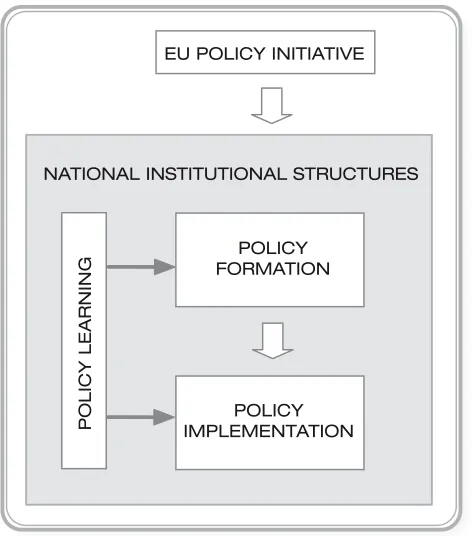
(11) 1. Introduction. T. he implementation of the environmental policies of the European Union (EU) is a demanding task for the member states (e.g. Jordan et al. 2002, Page 2003, Jordan and Liefferink 2004, Börzel 2007). Therefore, studies on the implementation processes of the EU environmental policy offer interesting cases as examples of policy change from the perspective of policy analysis. For analysing policy processes in the EU, the concept of Europeanisation has recently become fashionable in European Studies (for a comprehensive overview of literature see e.g. Graziano et al. 2007). Europeanisation is often defined as the process of European integration which implies a shift in decision making from national member state level to collective decision making at EU level (Schmidt 2002). Such decision-making generates the economic, institutional and conceptual forces for change in the politics, policies and practices of the member states. It has been widely agreed that, as national administrative structures and policy styles are concerned, the adaptation of EU policies appears to have taken place according to the pre-existing national institutions of the member states (e.g. Bennett 1991, van Waarden 1995, Knill and Lenchow 2000, Hèritier 2001, Jordan and Liefferink 2004). However, the impact of the EU on the policies of member states is different. Some member states have undergone deeper changes than others have. The more institutional congruence between the EU and domestic ways of doing things, the fewer requirements for institutional change and adaptation usually exist (Börzel and Risse 2006). As Schmidt and Radaelli (2004) put it, the better the ‘fit’ of national policies with EU policies, the more likely the country will have fewer problems adopting the EU policy.. 10. MTT SCIENCE 2. During the past 20 years, environmental problems in agriculture have increased. These problems are mostly due to the greater intensification, higher productivity and concentration of production. In the middle of the 1980s, the European Commission underlined in its Green Paper (EC 1985) that environmental policies must set the framework in which agricultural production takes place. The idea of combining environmental and agricultural policies was then an important pillar in the reform of the Common Agricultural Policy (CAP) in 1992. The main instrument for harmonising these two policy sectors is the agri-environmental regulation 2078/92 (in 1999 moved into regulation 1257/99; and in 2005 moved into regulation 1698/2005) (Whitby et al. 1996, Brouwer et al. 1998, Buller et al. 2000). Each member state must implement an agri-environmental support scheme. Schemes must be drawn up for a minimum period of five years and they shall reflect the diversity of environmental situations, natural conditions, agricultural practices, and the types of farming of the region. The environmental priorities of the EU should also be taken into account in the schemes. The implementation of agri-environmental policy reflects the interaction between agricultural and environmental policy sectors. Differences in implementation thus reflect the differences in national systemic factors (Weale 1991) or in policy belief systems (Sabatier 1986). When a new member joins the EU, it faces an enormous challenge to implement the whole of the EU legislation during a relatively short transition time. For example, as a result of Finland having become a member in 1995; the Finnish agri-environmental policy has quite recently undergone significant changes, both in terms of content and institutional structures. Finland has had to accommodate its national agricultural policies.
(12) to the principles and objectives of the CAP, its accompanying measures, such as the agri-environmental regulation, and to the environmental legislation of the EU. From that moment on, the Finnish agricultural policy was based on the EU principles and objectives. From the economic perspective, the changes for agriculture were considerable. During the first week of 1995, the market prices for agricultural products fell to less than half the prices of the previous year due to the opening of the markets. The decrease of market prices was compensated with financial support schemes. The agri-environmental programme 1995– 99 was one of the schemes to help Finnish farms from falling to financially unsustainable conditions of the EU market. This income support aspect was an important element of the programme. However, as Siikamäki (1996) noted, despite also having other than environmental objectives, the agri-environmental programme was expected to cause a shift towards environmentally sound production methods. Another environmental regulation concerning agriculture is the Water Framework Directive (2000/60/EC) agreed on by the European Parliament and the Council of Europe in 2000. The overall objective of the Water Framework Directive (WFD) is to achieve a ‘good’ ecological status for all water in Europe by the end of 2015. Given the past improvements in reducing point source pollution, the emphasis of the WFD will be on minimising non-point source pollution, which will cause additional challenges for agriculture. The directive is a combination of voluntary and command-and-control approaches and it represents a shift from a sectoral top-down to a horizontal policy style. The key activities include co-ordination of administration within river basin districts, public participation and recovery of costs for water services. It embodies a number of requirements for co-operation between different water use sectors, including agriculture. Because of very demanding policy objectives. and other requirements, the WFD embodies many provisions which specifically encourage policy learning at the implementation stage. Implementation of the WFD in Ireland offers an interesting case study. As in Ireland there is very limited tradition on horizontal co-operation and public participation in environmental policy, new administrative structures and participatory practices needed to be established. Policy style The adoption of the EU agri-environmental regulation 2078/92 changed the Finnish agri-environmental policy style (see also Jokinen 1997, 2000, Niemi-Iilahti and Jokinen 1999, Yliskylä-Peuralahti 2003, Kaljonen 2006) i.e. the procedures of policy formation and implementation (Richardson et al. 1992). The transformation of the highest decision-making power to the EU Commission and Parliament reduced the political and administrative power at national level. The regulation required cooperation between agricultural and environmental administration. Since there was hardly any history of such cross-sectoral co-operation, it led to changes in national decision-making processes, administrative procedures and operational practices. The administrative traditions between the sectors have been and still are rather different. The agricultural administration has centralised hierarchical tradition, while environmental administration has more decentralised, co-operative and cross-sectoral tradition (Sairinen 2000, Joas 2001). The key issue here is how well the national institutional structures ‘fit’ to the new policy context and, furthermore, how much the national policy style and institutional structures actually changed as a result of the EU’s influence. Policy content The formation of national agri-environmental programmes was left to the member states (Whitby 1996). As a consequence, MTT SCIENCE 2. 11.
(13) the programmes varied substantially from country to country with regard to policy priorities, measures and implementation (Buller et al. 2000). The Finnish agri-environmental programme 1995–99 had comprehensive and ambitious environmental objectives; it aimed to reduce the load of nutrients on watercourses, manage the rural landscape and preserve biodiversity in the rural environment. In addition to the environmental objectives, the programme also had income support elements. The programme introduced, for the first time, voluntary economic environmental policy instruments to the agricultural sector (Vehkasalo et al. 1999). While the agricultural sector emphasises the importance of economically profitable production and yet favours subsidies, the environment sector demands more regulative control-andcommand types of policy instruments. Yet to understand policy the policy content, it is crucial to identify which actors were involved in the policy preparation, which strategies they used to incorporate their policy beliefs into the scheme and how the policy content was decided upon. Policy learning Policy processes can be viewed as learning processes. To define policy learning, a seminal definition by Heclo (1974) is often referred to in literature. He defined learning as relatively enduring alterations of thought or behaviour resulting from experience. Most of the learning literature shares the view that experience from which lessons can be drawn is the most central aspect of learning. Another important aspect is time, as the adoption of new paradigms and changing values and beliefs (i.e. learning) may take years. Therefore, learning approaches underline that to understand learning-based policy change a relatively long time perspective is needed, even a decade. Recently with the emergence of the new governance, learning is presented in official documents as an essential component of EU governance (Radaelli 2008). 12. MTT SCIENCE 2. In order to assess the role of policy learning, the development of Finnish agri-environmental policy and the implementation of the WFD in Ireland are examined. Agri-environmental policy development in Finland presents an opportunity to examine how and what the policy actors have learned during the past decade and then to assess the role of learning in policy development. Ireland has faced serious problems in implementing EU environmental policies. In fact, Irish efforts of implementing EU environmental policies have been remarkably poor (OECD 2000, Lehane et al. 2002). There is a demand for change in environmental policy structures and practices. The initial response to implementing the WFD presents an opportunity to identify favourable and discouraging features for the improvement of implementation from the perspective of policy learning. These two cases aim to show whether and how EU environmental policy implementation processes could be improved through policy learning. The summary essay is organised in six chapters. In this introductory chapter, the thesis is placed in the wider context of the discussion on Europeanisation, but at the same time its scope is narrowed down to policy content and style and to policy learning. The next chapter introduces the aims and objectives of the thesis. Chapter 3 then discusses the choice of theoretical approaches and how different approaches are linked. This chapter consists of three parts, each one introducing one approach, its strengths and weaknesses and relations with the other approaches used. Next, Chapter 4 describes the sources of data and the methods used for analysis. In Chapter 5, the main results of the articles (I–V) are summarised. In the final chapter, some suggestions are made with respect to theoretical implications. The thesis consists of the summary essay and five articles (I–V). The first article describes and interprets institutional devel-.
(14) opment of the Finnish agri-environmental policy in the theoretical framework of historical institutionalism (I). The second article examines the agri-environmental policy formation process through the lens of the ACF complemented with the categorisation of policy learning into different orders based on Hall (1993) (II). The third article examines the implementation of agri-environmental policy in the Uusimaa region in southern Finland to see which structures. and practices support the implementation process (III). The fourth article is based on the findings of the previous articles. It is more theoretical in nature and it proposes a new hypothesis to the ACF (IV). The fifth article examines the implementation of the WFD in Ireland by using the learning based theories of policy change in order to look at evidence on policy learning (V).. 2 Aims and objectives of the thesis. T. he objective of this study is to analyse the role of learning in policy process, focusing on EU environmental policies which have effects on agriculture. The research question is whether and how policy learning affects the implementation of the EU environmental policy. The research question can be divided into four more specific research tasks and questions: 1. Examining institutional changes and the significance of these changes for policy development by applying the historical institutional analysis as the theoretical approach. How do changes in institutional structures affect policy development? 2. Understanding the dynamics of policy change, looking particularly at the coalition structures by applying the advocacy coalition framework as the theoretical approach. Can Finnish agrienvironmental policy change be understood better by using the ACF as a contextual reference? 3. Searching for empirical evidence on policy learning to assess whether and how policy learning can improve policy processes by applying the policy learn-. ing approaches as analytical tools. Can any causal links between learning and policy change be traced? 4. Assessing the strengths and weaknesses of the three approaches for environmental policy analysis and making recommendations for theoretical development if necessary. The research is based on two case studies. The first case study describes and interprets the changes in the Finnish agri-environmental policy formation and implementation processes brought by the EU membership. It aims to examine the effects of institutional changes and the roles of different actors in the policy development process. The second case study analyses the implementation of the WFD in Ireland. The aim is to see how policy learning can be encouraged through procedural requirements. However, this research is not comparative in nature, the cases are used as a means to understand policy processes and to search empirical evidence on policy learning. Based on the findings and their reflections to the theoretical framework, more general conclusions on the role of learning in policy development will be drawn.. MTT SCIENCE 2. 13.
(15) The development of Finnish agri-environmental policy is an interesting research topic, not only because of the policy development itself, but because of the actors and context involved. The study shows evidence that, during the policy process, actors changed their policy beliefs as a result of policy learning. In terms of context, the national policy changed as a result of an external effect which in this case was brought by the EU membership. These actors and contexts are not only found in the case of Finnish agri-environmental policy. They are common in situations of major policy changes, for example when member states must implement a new EU regulation which differs significantly from their existing system, as the case of implementing the WFD in Ireland shows. The results could then yield some lessons for wider practical applicability. The time span of the Finnish case begins when Finland started preparing for the first national agri-environmental programme in the early 1990s and ends when the peri-. od of the second agri-environmental programme finishes in 2006. The study is restricted to the development of agri-environmental policy on the Finnish mainland1. The focus is on policy formation at central governmental level and on policy implementation at regional level. Since the local (municipality) level only performs executive tasks relating to agri-environmental programme, it is left outside of the focus of this research. The scale of the Irish case is different, because instead of administrative regions the implementation of the WFD is based on the water catchment areas. Therefore, the study covers actors from central governmental level to individual actors at local level. The study focuses on the initial implementation responses of a directive which has a very long implementation time frame extending as far as 2015. The initial responses are, however, very significant because the policy process is path-dependent, therefore the initial decisions structure will inform later implementation.. 3 Theoretical framework — the problem of policy change. P. olicy change is usually a gradual process, which makes it difficult to distinguish the impacts of different causes of change. There is wide theoretical literature which describes and explains policy changes in various ways. A very interesting aspect of these analyses concerns how to establish a link between institutions and policy change. Schmidt and Radaelli (2004) pointed out that in the EU context there are risks involved in such an analysis. First, there is a risk of prejudging the significance of EU policy, whether in terms of the constraints it places on member states or in terms of effect on a member state. Second, the approach may lead a re14. MTT SCIENCE 2. searcher to adopt a top-down perspective, in which the problem of national policymakers is all about putting EU policy into practice while the process is much more complex than that. To avoid these risks, the pre-existing national institutional structures and their changes are first examined through a historical institutional analysis. After that, the The Swedish-speaking island, the province of Åland, enjoys considerable autonomy, including its own agri-environmental programme which was left outside of this research. 1.
(16) national policy actors at each level of governance and their effects on policy change are identified through the lens of the advocacy coalition framework (ACF). Policy actors are tied to the institutional structures which define the resources and constraints they face and as such directly affect the range of their actions. Actors’ ability to dominate the policy system is thus determined by institutional structures. The historical institutional analysis is used for describing the institutional context and the evolution of institutions. The approach embraces the idea that institutional change is a path-dependent process. Path-dependency means that the institutions which guide decision-making reflect historical experience. As a result, the institutional structure which existed before determines the limits of possible changes. The historical institutional analysis presents a good methodology for understanding the evolution of institutions over time and how institutional structures constrain and refract policies (Hall 1986, March and Olsen 1989, Thelen and Steinmo 1992, Hall and Taylor 1996). The advocacy coalition framework is an actor-based framework developed for analysing policy change (e.g. Sabatier and Jenkins-Smith 1993). It focuses on ideologically based advocacy coalitions which consist of actors from a variety of public and private institutions who share a set of basic beliefs and show co-ordinated activity over time. The advocacy coalition framework assumes that each coalition seeks to influence the policy process in order to achieve their policy goals. The competing advocacy coalitions thus work to materialise their belief systems through a policy change. According to the advocacy coalition framework, policy change is a result of policy learning and external effects to the subsystem, such as the EU membership.. idea of bounded rationality as the model of individual behaviour (I–V). Bounded rationality refers to the limited capacities of actors to collect and process information and use it to make decisions (Jones 1999). Both approaches then accept the proposition that, due to insufficient information, actors’ perceptions are guided by their beliefs (see e.g. March and Olsen 1984, Simon 1984, Leach and Sabatier 2005). Besides limited cognitive capacity, there are other limitations to rationality in real-life policy-making (Hogwood and Gunn 1984). These limitations could arise from multiple values, given that there is no purely rational way of resolving a conflict of interests. Moreover, even if an individual policy-maker could overcome his personal limitations, the organisation in which he belongs can limit his behaviour. Other things could also cause limitations to rationality in policy-making, for example resources, time, precedents, and expectations. While policy-makers seek to be as ‘rational’ as possible, policy learning becomes of central importance. It is seen as a prerequisite for a policy change in the advocacy coalition framework, whereas the historical institutionalism sees it as a means of change. Both approaches assume that learning is instrumental: that is, the actors of a policy system seek to understand the world better in order to further their policy objectives. The concept of policy learning is used to bridge the gap between institutional and actor -centred approaches. In the following paragraphs, the historical institutional analysis, the advocacy coalition framework and the policy learning approaches are described in more detail. At the end of the theoretical chapter, the strengths and weakness of each approach are summarised.. The historical institutional analysis and the advocacy coalition framework share the MTT SCIENCE 2. 15.
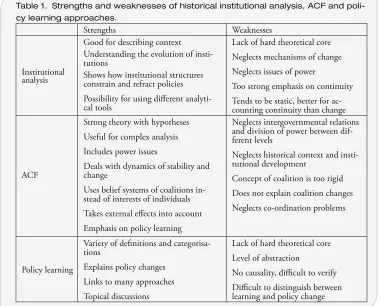
(17) 3.1 Historical institutional analysis. Institutions in this research are examined through the lens of the historical institutionalist approach (Steinmo et al. 1992, Campbell 2004, Sanders 2006)2. The core assumption of this approach is that ‘institutions matter’. According to Thelen and Steinmo (1992), institutions are considered to constrain and refract policies, but they are never the sole ‘cause’ of outcomes. The concept of path-dependence is of central importance of the historical institutionalist approach. Path-dependence refers to the process in which each step in a particular direction makes it harder to reverse the taken course. Feedback mechanisms in a way reinforce decisions which have been made in an early stage of a process (Thelen 1999, Mahoney 2000, Pierson 2000). Decision-makers tend to make decisions which lead only to marginal changes from the status quo. As a consequence, the institutional structure which existed before determines the limits of possible changes.. New institutionalism is usually divided into three schools of thought: rational choice, organisational and historical institutionalism (see e.g. Hall and Taylor 1996, Campbell 2004, Rhodes et al. 2006).. Historical institutionalism argues that institutional context shapes both the strategies and the goals which actors pursue. Seemingly neutral rules and structures actually embody values and thus determine participants’ behaviour within given context. However, as Majone (1989) pointed out, policy makers not only pursue their goals within existing institutional structures, but they also strive to change those existing limits in their favour. While the institutional structures affect policy outcomes, according to March and Olsen (1989), there are also other aspects which matter, such as organisational cultures and administrative practices. On the other hand, the same institutions can have different consequences under different conditions. This disentanglement of institutional effects is particularly difficult in multilevel settings (March and Olsen 2006).. The term institution has been used in many ways to refer to a range of different things. It is used in everyday language to refer to entities as seemingly disparate as bands, nation’s constitutions or even persons such as a president. Most definitions of institutions are descriptive and encompass diverse social entities. One of the most widely used theoretical definitions of institutions is that of North (1990): “Institutions are the rules of the game in a society, or more formally, are the humanly devised constraints that shape human interactions.”. The pattern of institutional change is seen as being incremental and evolutionary in nature, which makes it difficult to distinguish the impacts of different causes of change. Change is seen as the consequence of action, filtered through perceptions of an institutional context which favours certain strategies, actors and perceptions over others. The organisational structures, internal processes and other specific features help to explain policy outcomes. Since ac-. Historical institutionalists view institutions as formal and informal rules, procedures and norms which structure conduct3. This definition enables analysis of how these dimensions affect each other, and how their 2. 3. 16. interaction is affecting institutional change. Formal institutions include legal systems, administrative structures and procedures whereas informal institutions include cooperation, networks and norms. North (1990) argued that different dimensions change at different speeds in ways which have significant effect on institutional outcomes. More specifically, he argued that formal institutions can change more rapidly than informal institutions which are embedded in the customs, norms and traditions. In other words, legislation, regulations and administrative structures can be changed more easily than the way people think and act in their everyday life.. MTT SCIENCE 2.
(18) tors are knowledgeable and reflexive, they monitor the consequences of their action. Doing so, they learn gradually which policies and institutions best suit their purposes (Heclo 1974, Pierson 2000). There is thus the possibility that lessons may be drawn from past experience, resulting in new strategies being put forward (Bulmer 1998). This strategic learning then yields to the revision of perceptions of what is feasible, possible and desirable in the light of actors’ assessments of their own ability to realise goals as they assimilate new information and as they reorient future strategies in the light of such knowledge of the context as a structured terrain of opportunity and constraints (Hay and Wincott 1998). This is as far as the historical institutionalists have emphasised the importance of policy learning. Historical institutionalism is not a grand theory. On the contrary, it engages in continuous dialogue between different theoretical approaches and empirical settings searching to arrive at understanding how political and economic decision-making is affected by institutional arrangements. Thelen and Steinmo (1992) pointed out that the use of different theoretical angles, broad perspectives and a large array of analytical tools is an advantage of historical institutionalism. On the other hand, this quite eclectic approach can also be considered a weakness, the lack of a single parsimonious theoretical core4. Sanders (2006) noted that the place to look for answers to great questions of society is in the institutions and over longer landscapes of history. Institutional analysis has been criticised for having an inadequate understanding of change (Thelen and Steinmo 1992, Scott 2001, Lieberman 2002). The critics have pointed at, for example, mistaking evoDue to this feature, historical institutionalism is particularly vulnerable to criticism from many standpoints. 4. lutionary developments for revolutionary shifts and failing to identify the continuity during the episodes of institutional changes (Schmidt 2002). It is quite evident that there are problems in explaining rapid, revolutionary changes with an analytical framework where the emphasis is on pathdependence. Campbell (2004) pointed out that the problem of explaining changes is because institutionalists rely on causal concepts but often without specifying the underlying mechanisms or processes by which change occurs. Hirsch (1997) claimed that neglecting mechanisms undermines the empirical and theoretical credibility of the arguments of institutionalists. 3.2 Advocacy coalition framework. The advocacy coalition framework (ACF) deals with the dynamics of both stability and change in the policy process. Since both aspects are of central importance in policy development, it was chosen as the basic theoretical framework for analysing the change of the Finnish agri-environmental policy. The use of the ACF to examine the policy process is based upon three precepts (Sabatier and Jenkins-Smith 1993). First, actors are assumed to hold a certain set of policy beliefs and seek though the policy process to translate these beliefs into policies and programmes. Sabatier (1998) offered a list of normative and empirical components of the policy belief systems. The idea of such belief systems is preferred to the concept of interest on the basis that it is easier to determine actors’ beliefs than their interests. Furthermore, while belief systems can incorporate self-interest and organisational interests, they also allow actors to establish goals in different ways and are therefore more inclusive than interests. Second, actors holding similar beliefs tend to work together as a coalition. The belief systems of these coalitions reflect those of their constituent members. The coalitions MTT SCIENCE 2. 17.
(19) constitute a good means to aggregate actors and are superior to the alternative of considering organisations as dominant actors or of considering actors individually which could be unmanageable. Third, governmental policies and programmes incorporate normative values and implicit theories about how to achieve their objectives, and can therefore be conceptualised in the same manner as belief systems. This correspondence of belief systems and governmental policies provides a means by which the influence of various coalitions on policy process can be assessed. According to the ACF, different coalitions compete with each other to dominate the policy process within the subsystem and incorporate their policy beliefs into policies by using different strategies and guidance instruments. The balance of power of the competing coalitions within the subsystem can vary, and shifts in this balance can result in changes in policy. A coalition’s ability to dominate the policy subsystem is determined by the resources it possesses and the constraints it faces. Schlager (1999) pointed out that the most important constraint of policy-making is the institutional position of an actor, in other words the amount of power to affect the course of policy. The major source of power in subsystems is the formal decision-making authority, which is law-bound and legitimated by others (Ostrom 1990). This type of authority also includes the power not to make decisions. Having the authority to decide on procedural and administrative issues is another important source of power. The degree to which a coalition can dominate a subsystem is a function of a coalition’s power relative to that of other coalitions (Sewell 2005). Fenger and Klok (2001) pointed out that interdependency is also related to the role which resources play in enabling actors to take actions. Actors’ pre-existing beliefs influence the filtering of new information. Furthermore, actors may have different types of belief 18. MTT SCIENCE 2. systems relating to the different institutional contexts to which they belong. Public organisations usually tend to be dominated by the members of a particular profession or discipline who favour policies which are consistent with best practices as defined by their profession. Peters (1989) pointed out that a professional has an internalised value structure promulgated, inculcated and policed by the profession itself. Usually, an organisation also has a mission which tells its members how to prioritise some values over others. The individuals who join the organisation generally come to accept those priorities, whether out of self-selection or gradual indoctrination. Public officials generally ally themselves with the coalition, holding beliefs which are consistent with the mission of their organisation. Timmermans and Bleiklie (1999) pointed out that policy actors and public authorities may have policy beliefs, but the core beliefs for other actors such as businesses, interests groups or scientists may not concern policy but profit or truth. Mintrom and Vergari (1996) noted that core beliefs can be manipulated to some extent, for example by strategic timing or exploiting the institutional settings in which policies are designed. The ACF assumes that policy beliefs can change over time via policy learning. Time and computational constraints limit the ability of actors to process and analyse information, while the pre-existing policy beliefs act as filters on their perceptions of new information. As a result, actors in separate coalitions perceive the world through different ‘lenses’ and can have differing interpretations of a given piece of evidence. These lenses also inhibit the receiving of information by coalition members which challenges their policy core beliefs and thus prevent learning from taking place. However, regarding so-called secondary aspects, actors are more willing to revise their beliefs on the basis of new information, the accumulation of experience or changes in conditions. Therefore, when learning takes.
(20) place, it affects the secondary aspects rather than policy core beliefs (Jenkins-Smith and Sabatier 1994). These ideas are consistent with different categorisations of policy learning (e.g. Hall 1993, Glasbergen 1996). The ACF has been criticised in that it neglects the intergovernmental relations, particularly the division of authority between national governmental and regional levels (see e.g. Sewell 2005). The approach deals mainly with policy formation and does not pay attention to policy implementation. Actually, the original approach does not deal with multi-level context, which could be considered as one of its main weaknesses. Fisher (2003) noted that by neglecting the historic context, the ability of the ACF to explain why and how policy change comes about is questioned. The coalition concept is too rigid (Hysing and Olsson 2008), lacking differentiation between types of coalitions and dynamics within coalitions (Peters, 1998) and there is an analytical problem in explaining how the advocacy coalitions themselves change (Dudley 2007). Institutional heterogeneity within coalitions may create co-ordination problems when different institutional positions of the actors limit their ability and willingness to co-operate with one another (Schlager 1995). These criticisms pointed out that the relationship between subsystem dynamics and resources allocation, which is defined by institutional structures, is another aspect of the ACF which needs further development. 3.3 Policy learning. There are different approaches to policy learning, but they share the basic view that learning takes place in complex arrangements of state and societal actors, in various types of domestic and transnational policy networks and policy communities (Bennett and Howlett 1992). Policy learning occurs in the context of political proc-. ess. The first learning-based theory of policy change developed by Heclo (1974) described ‘political learning’ as relatively enduring alterations of thought or behavioural intentions which result from experience. In addition to policy-makers’ experience, the existing policy matters (Sacks, 1980). However, learning does not always have to draw on one’s own past experience; it can also be comparative in focus. Rose (1991) used the concept of lesson-drawing to describe the process by which policies and programmes developed in one country are emulated by others. Busenberg (2001) noted that the accumulation of policy experience over time and continuing advances in science and technology also create learning opportunities for policymakers. Learning process requires particular institutional arrangements, such as certain procedures and customs which promote individual learning (II, V). There is substantial literature promoting the view that administrative systems which promote learning can be preferable to traditional regulatory approaches (e.g. Sabel 1994, Teague 2001). However, while some arrangements act to promote learning, other institutional arrangements can act as constraints. A fragmented administrative structure, for instance, prevents a flow of information to other departments, thereby inhibiting wider learning. However, as Majone and Wildavsky (1979) pointed out, institutional structures need not be planned to promote learning in order to provide a basis for policy learning; trial-and-error is also a common basis for learning. Furthermore, as Hall (1993) pointed out, learning does not necessarily mean that policy becomes better or more efficient; rather it reflects an attempt to adjust policy in the light of past experience and policy-relevant knowledge. The difference between learning and adaptation is that in policy-learning the principles, objectives and values underlying MTT SCIENCE 2. 19.
(21) the policy are examined and questioned by actors, whereas adaptation is the ability to change behaviour in order to meet the challenges of new demands without having to evaluate the existing policy and reason its legitimacy (Haas 1990). Adaptation is thus a more practical application of legal and procedural changes corresponding to new policies and programmes. Adaptation may require the re-allocation of administrative competences, establishment of new administrative structures or restructuring the existing procedures and rules. Policy adaptation can happen quite rapidly, e.g. through enforcement from a higher level, while policy learning is a slow cumulative process which requires a longer time period and suitable institutional arrangements to occur. The problem is to verify that policy learning has occurred. In literature, there are different approaches to this problem. May (1992) noted that, as learning implies improved understanding about policy problems, objectives or instruments, the verifying of learning requires evidence of increased intelligence and sophistication of thought. Eising (2002) suggested that first it has to be shown that actors have changed their preferences and then a policy change indicates that policy learning has occurred. The difficulty of these approaches is to show that actors’ preferences or thoughts have changed (V). In their review of literature, Bennett and Howlett (1992) structured the notion of learning according to three questions: who is learning, what is learned and to what effect. Then in order to identify learning, it is often categorised into different types (e.g. May 1992, Hall 1993, Glasbergen 1996, Connor and Dovers 2004) and then features of each type are looked for. Mosher and Trubek (2003) proposed a more practical two-step model for the assessment of learning in policy process. The first step is to look at the process itself to see which institutional arrangements there exist to promote learning. The second is to assess the 20. MTT SCIENCE 2. relationship between these arrangements and observed policy changes. The learning theories of policy change have often been criticised for not distinguishing between policy learning and policy change (e.g. Bennett and Howlett 1992, Mintrom and Vergari 1996). However, one important observation found in literature on this topic is that, rather than offering an explanation of change, learning is seen as an instrument to facilitate a policy change to occur. Hence, policy learning is not an instrument to search for truth. As Jordan and Greenway (1998) put it, learning is a means of getting preferred ideas or beliefs reflected in public policy programmes. 3.4 Strengths and weaknesses of the approaches. This thesis combines three different theoretical approaches in order to get a comprehensive picture of policy development. The different approaches are complementary, each contributing to the explanatory power. The strengths and weaknesses of each approach are presented in Table 1. In the Finnish case study, the historical institutional analysis is used to describe the context and the evolution of institutions of the Finnish agri-environmental policy system. It also shows how institutional structures constrain and refract policies. Because the historical institutional analysis is better for accounting continuity rather than change, the ACF is used to examine the policy change. As the model of the individual behind both approaches is the same, theoretically there should be no obstacles to use them in concert. Both approaches assume that perceptions are guided by beliefs and therefore consider learning instrumental. Policy learning approach with the categorisation of learning into different types is used as an analytical tool to assess which elements affect the policy process both in the Finnish and Irish cases..
(22) Table 1. Strengths and weaknesses of historical institutional analysis, ACF and poli cy learning approaches.. Institutional analysis. Strengths Good for describing context Understanding the evolution of institutions Shows how institutional structures constrain and refract policies. Weaknesses Lack of hard theoretical core. Possibility for using different analytical tools. Tends to be static, better for accounting continuity than change Neglects intergovernmental relations and division of power between different levels. Strong theory with hypotheses Useful for complex analysis Includes power issues ACF. Deals with dynamics of stability and change Uses belief systems of coalitions instead of interests of individuals Takes external effects into account. Neglects mechanisms of change Neglects issues of power Too strong emphasis on continuity. Neglects historical context and institutional development Concept of coalition is too rigid Does not explain coalition changes Neglects co-ordination problems. Emphasis on policy learning Variety of definitions and categorisations Policy learning. Explains policy changes Links to many approaches Topical discussions. Lack of hard theoretical core Level of abstraction No causality, difficult to verify Difficult to distinguish between learning and policy change. 4 Methodology. A. s described, this thesis consists of several separate studies. In conducting these studies, different methods for data collection and analysis were used. In this section, first the data sources and the methods of analysis are described. 4.1 Data sources. The empirical data concerning agri-environmental policy process was derived from primary and secondary literature reviews supplemented with oral data enquiries and semi-structured interviews with the key actors of policy formation at central govern-. mental level and of policy implementation in the Uusimaa region. The primary literature included official documents on policy and administration, such as acts, decrees and decisions, ministry circulars, committee and working group reports, target setting programmes etc. The official documents used are listed in Appendix 1. The goal of collecting official documents was to gather as comprehensive a set of material concerning agri-environmental policy formation and implementation processes as possible (I, III). The collation of information started with Internet searches. EU regulations MTT SCIENCE 2. 21.
(23) as well as Finnish legislative procedures can be traced back in electronic form to the early 1990s. Committee and working group reports are published in the publication series of the Ministry of Agriculture and Forestry (MAF) and the Ministry of the Environment (ME), and many of them can be found on the Internet. The other documents were gathered from a variety of sources. Ministry circulars, guidance material and annual reports of numerous bodies were available in the archives of the MTT Agrifood Research Finland. The material for preparing the proposals for national agri-environmental programmes, including minutes of meetings, drafts from various stages, explanatory documents, and other background material, were available in the personal files of a person who has been appointed as a member in several agri-environmental preparing committees. Information was also obtained from other documents such as leaflets, guides and seminar presentations given by the administrative officials. The governmental policy documents and other official material are regarded as reliable in terms of factual information in this research. Statements given on policy proposals were very important source of data (II, IV). The statements cover different aspects of proposals and are given by different parties involved in or influenced by the policy or governmental programme. These parties include different sectors of administration at all levels, agencies, organisations, businesses, researchers, and other stakeholders, and even individuals. Since statements are meant to influence the policy in question, they are often very detailed and provide reasoned justifications. Therefore, the statements offer a particularly good source of information concerning the policy beliefs of different actors. The secondary literature sources included agricultural, environmental and administrative research reports, evaluation reports and statistics, to which references are made 22. MTT SCIENCE 2. when used in the text. Other studies concerned with the Finnish agri-environmental policy formation and/or implementation (e.g. Jokinen 1995, 2000, Juntti and Potter 2002, Kaljonen 2003, 2006, Soini and Tuuri 2000) are used as secondary data sources, mainly relating to the analysis of manifest events, but also to reflect the findings of this study (I–IV). All the information needed for analysing policy formation and implementation processes was not available though literature. In order to find out the missing facts, several supplementary data enquiries (interviews) were made. The questionnaire for each interview was prepared individually depending on the information needs and the organisation of the informant, which were chosen amongst those involved in the policy process in the stage of preparing for the EU membership. These informants included leading civil servants in the MAF and the ME and long-standing representatives of MTK (Central Union of Agricultural Producers and Forest Owners), ProAgria (Rural Advisory Centres) and SLL (Finnish Association for Nature Conservation). In addition to the actors of the central level, senior officials in the regional environment administration (Uusimaa Regional Environment Centre) and agricultural administration (T&E Centre Uusimaa) were interviewed. The region of Uusimaa was selected for practical reasons as it is situated in southern Finland. Each interview (total 7 interviews) lasted for less than an hour. The interviews were carried out either face-to-face (5) or over the telephone (2). Notes were taken during the interviews. The informants (Appendix 2) for semistructured interviews (II, IV) were identified first amongst those who were appointed as members (22 November 1991) in the preparation committee of the rural environmental programme. These informants were asked to recommend some more informants, and the second group was cho-.
(24) sen based on these recommendations with so-called snowball sampling. Two of the informants had not participated in any of the policy formation processes. The interviewees are listed in Appendix 2. Interviews usually lasted one to two hours, sometimes even four hours. All the interviews were recorded and transcribed afterwards. In total 13 semi-structured face-to-face interviews were carried out. Uusimaa region was selected as a case study to analyse informal institutional arrangements, such as horizontal co-operation, networks and voluntary practices (III). First, a literature review was carried out including regional documents, such as administrative regulations, reports and minutes of meetings, as well as non-official documents, such as project reports, Internet pages and brochures (see Appendix 1). In addition to the literature review, semi-structured interviews were carried out. Different actors in Uusimaa region were interviewed, a total of 14 face-to-face interviews. The interviewees included officials from the regional agricultural and environmental administration and from selected municipalities as well as representatives from the provincial associations and projects (Appendix 2). Empirically, the study of implementation of the WFD in Ireland (V) is based on literature reviews and semi-structured interviews with key persons. The literature consisted of primary and secondary sources. Literature reviews were done through the libraries of the Environmental Protection Agency and the University of Galway and by contacting other bodies in Ireland. Both published and non-published material was used. The key informants for semi-structured interviews were chosen amongst the members of the National Co-ordination Group including officials of different government departments, agencies, local authorities and associations, and on the basis of local knowledge i.e. recommendations from the project leader Dr. Brendan Flynn.. Since most of the interviewees refused to be recorded, the data is based on notes which were made during the interviews. 4.2 Methods of analysis. The multi-theoretical approach applied several methods for data analysis which are described in detail in this section The evolution of institutional structures The institutional analysis took a retrospective look at the institutional structures of Finnish agri-environmental policy (I). The time span begins in the early 1990s when Finland started preparing for the EU membership and finishes in 2006 when the second programming period ends. The data collection and analysis techniques of qualitative historical analysis, as represented by historical institutionalism, appeared to be suited for the examination of agri-environmental policy development. Although the historical institutional analysis has been developed in a macro-level comparative context, this study was not comparative. It aimed to describe and interpret the institutional changes and the significance of these changes for the Finnish agri-environmental policy development over time. This was done by tracing, on the one hand, the elements of path-dependency and, on the other hand, the institutional changes in the policy process. The study followed the procedures proposed by historical institutionalism: qualitative historical analysis, pattern recognition and comparisons over time (Thelen 2004). The events of episodes were used to determine significant institutional changes occurred and the nature of those changes. The method of analysis relied on historical analysis borrowed from historical research aiming to distinguish between manifest and latent events, and to adhere to principles regarding the examination of primaMTT SCIENCE 2. 23.
(25) ry and secondary source materials (Thies 2002). The manifest events refer to those events which actors were aware of as they occurred, whereas latent events refer to events which actors were not fully aware as they happened and which we can describe only in retrospect. The preparation stage and the beginning of the membership between 1994 and 1995 represent mostly the period of manifest events through which the latent events of policy development are examined. This period encompasses the first stage of the implementation of agri-environmental policy in Finland. According to historical institutionalism, this was the beginning of a process which determined the institutional settings in which subsequent actions take place in a path-dependent way. This period, according to March and Olsen (1989), also determines the attention given to problems, and influences decision-making as much as the assessment of the importance of those problems. The analysis started by establishing the background and the importance of prior events mostly through secondary literature. After that, based on the content analyses of official documents and supplementary enquiries, the manifest events were identified and put into chronological order and each event was then examined more closely. The aim here was to determine persistence and changes in institutional structures of decision-making, administration and implementation during the preparation stage and in the beginning of the membership. The manifest events were described in detail and then latent events were analysed by examining the processes following the manifest events. The focus of the latter analysis was on institutional arrangements which promote cross-sectoral co-operation and successful implementation. Special attention was paid on the interplay between formal and informal institutions. The latter part relied more on informal documents and supplementary interviews, because of-. 24. MTT SCIENCE 2. ficial documents do not generally contain details of such matters. Policy formation The agri-environmental policy formation process was analysed with the ACF by concentrating on three separate but interconnected policy formation processes, namely the agri-environmental programme, the Nitrates Directive and the Water Framework Directive (II). By concentrating on these three policy processes, it was possible to examine the changes in policy belief systems, analyse the evolution of the agrienvironmental policy subsystem over time and finally assess what role policy learning played in these policy processes. Since governmental policies or programmes, according to the ACF, can be conceptualised in the same manner as belief systems, it can be assumed, as policy beliefs are difficult to change, that a governmental policy, or a programme in a specific policy subsystem, will not be significantly revised as long as the coalition which instituted the policy remains dominant within that subsystem. This correspondence of belief systems and policies provides a means by which the influence of various actors on policy process can be assessed. As the policies arising from the subsystem reflect the belief system of the dominating coalitions, policy change over time can be determined by the degree to which these beliefs change. Because the processes though which belief system change are often slow and incremental, policy changes tend to be driven by shifts in power resulting from external effects to the subsystem. The following research questions were identified based on the elements of the ACF: • What are the boundaries of the subsystem and who are the actors participating in it and what are the policy beliefs of these actors?.
(26) • Which coalitions could be identified and how do they interact in the subsystem? • Which coalitions influenced policy process and what were their resources and constraints (i.e. political power)? • Which strategies did the coalitions use to when trying to incorporate their policy beliefs into policies? • Have policy beliefs of actors changed, how and why? • What were the external effects which have affected the policy domain? First, the literature review was carried out in the light of these questions. In addition to official documents on policy and administration, an important source of data was the statements given on policy proposals which included information on the policy beliefs of different actors. The interviews with the key persons were then carried out (Appendix 2). To prepare the questionnaire for semi-structured interviews, the research questions above were used. The questionnaire for interviews is in Appendix 3. All information from the interviews was recorded and transcribed afterwards and then cross-checked and compared with the material from the literature reviews to improve the validity and reliability of the results. The data collected from literature reviews and interviews was qualitative. The use of qualitative analysis is consistent with the majority of previous applications of the ACF to policy change. Policy implementation The aim here was to look for empirical evidence on policy learning by focusing on ‘new ways of doing things’ in agri-environmental policy implementation (III). The analysis followed the two-step model for the assessment of learning in a policy proc-. ess by Mosher and Trubek (2003). First, the institutional arrangements were examined to see whether they promote learning, and then the relationship between these arrangements and observed policy learning was assessed. The analysis started by describing the requirements of implementation based on the regulations and guidelines given by the MAF, and the formal institutional structures for supporting policy learning. This part was based on the previous institutional analysis, supplemented with some additional administrative documents on implementation. After the literature review, a general questionnaire for semi-structured interviews was designed in order to obtain empirical data on new forms of co-operation, networks and practices. However, as the interviewees represented a very heterogeneous group of actors, the questionnaire for each interview needed to be adjusted depending on the organisation and the duties of the interviewee. The content of interviews thus varied, but the following issues were discussed in each interview. • Agri-environmental problems and policies in Uusimaa: Importance? Conflicts? • Involvement in agri-environmental policy issues: How? Role? • Co-operation: With whom? How? Problems? • New forms practices: Objectives? Participants? Finance? • Learning: Information? Education? Experiences? Other arrangements? • Have others learned? Have you? • Future: Agri-environmental policy development? Co-operation? Etc.. MTT SCIENCE 2. 25.
Figure
Outline
Related documents
Druhou kategorií jsou sekundární náklady spojené s protiteroristickým opatřením (finance na bezpečnost společnosti). Terciální náklady lze zařadit do
[r]
The finding concerning social status confirmed the findings of Richardson and Watt (2005), stating that social status was less important in order to decide to
In this paper, the general relations that determine conic sections in a curved differential manifold M is applied by observers of the 3D space (free observers).. From this
Static stretching is gentler than ballistic or dynamic methods, so it is less likely to cause muscle, tendon or muscle connective tissue tears or
This is why it is important to study both child soldier reintegration and terrorist deradicalization and rehabilitation, as the intersection of those two
It not only helps the crew to develop a shared mental model of the problems which need to be resolved in the course of the flight, thereby enhancing situational awareness, but it
Out of all these studies five individual gaps not previously combined in one study have been identified within the service quality context including; the lack of
