University of Southern Queensland
Faculty of Engineering and Surveying
The Development and Implementation of a
Knowledge Management System for the NDCG
Access Line of Business
A dissertation submitted by
Anthony Ellis Delisser
In fulfilment of the requirements
Courses ENG4111 and ENG4112 Research Project
Towards the degree of
Bachelor of Engineering (Electrical and Electronic)
Abstract
Today’s commercial environment dictates the way companies must operate. In a world where knowledge means success, an organisation must leverage as much out of its knowledge assets as is possible. NDCG is no different. In an effort to capture new knowledge, and to make the best possible use of their existing knowledge assets, a knowledge management system has been developed and implemented throughout the Access Line of Business.
This dissertation investigates the development and implementation of a knowledge management system in the NDCG Access LOB, a business unit of Telstra. This organisation was increasingly relying on a small group of technical specialists to both create new knowledge, and share and distribute knowledge throughout the organisation. This project developed the means of divesting a large amount of the responsibility for sharing knowledge away from this central group, and placed it with the general staff.
University of Southern Queensland Faculty of Engineering and Surveying
ENG4111/2 Research Project
Limitations of Use
The council of the University of Southern Queensland, its Faculty of Engineering and Surveying, and the staff of the University of Southern Queensland, do not accept any responsibility for the truth, accuracy or completeness of material contained within or associated with this dissertation.
Persons using all or any part of this material do so at their own risk, and at the risk of the Council of the University of Southern Queensland, its Faculty of Engineering and Surveying, and the staff of the University of Southern Queensland.
This dissertation reports an educational exercise and has no purpose or validity beyond this exercise. The sole purpose of the course pair entitled “Research Project” is to contribute to the overall education within the student’s chosen degree program. This document, the associated hardware, software, drawings and other material set out in the associated appendices should not be used for any other purpose: if they are so used, it is entirely at the risk of the user.
Prof G Baker
Dean
Certification
I certify that the ideas, designs and experimental work, results, analyses and conclusions set out in this dissertation are entirely my own effort, except where otherwise indicated and acknowledged.
I further certify that the work is original and has not been previously submitted for assessment in any other course or institution, except where specifically stated.
Anthony Ellis DELISSER
Student Number: 0019520345
________________________________ Signature
Acknowledgments
I would like to thank my associate supervisor, Rodney Walke, who provided me with the opportunity and the incentive to undertake a project of this scale. Thanks also go to the management of NDCG Access Line of Business, for allowing me to implement these changes in the workplace.
I thank my parents, for bringing me up with the persistence and doggedness to keep going no matter what. I would also like to thanks all those around me who have supported my endeavours leading to this point, convincing me that I would make it.
To my children, Amber and Heath, I can only say, “Daddy can play with you at last”. To Julia, my wife, I can’t imagine what it has been like to put up with me, not just for this project, but for the nine years leading up to it. I’m sorry for all those nights, late home from work, only to disappear into the study.
Tony Delisser
Contents
ABSTRACT i
ACKNOWLEDGMENTS iv CONTENTS v
LIST OF FIGURES ix GLOSSARY xii
CHAPTER 1 INTRODUCTION 1 1.1 PROJECT AIM...2
1.2 DISSERTATION OVERVIEW...2
CHAPTER 2 KNOWLEDGE MANAGEMENT AND TODAY’S BUSINESS 5 2.1 KNOWLEDGE...5
2.2 KNOWLEDGE VS.INFORMATION VS.DATA...6
2.3 KNOWLEDGE TYPES...7
2.3.1 Tacit Knowledge ...8
2.3.2 Explicit Knowledge...8
2.4 TODAY’S ORGANISATION...9
2.5 WHAT IS KNOWLEDGE MANAGEMENT? ...11
2.7 THE KNOWLEDGE MAP...13
2.8 TECHNOLOGY...14
2.9 SHARING KNOWLEDGE...15
2.10 KNOWLEDGE WORKERS...17
2.11 LEARNING AND TRAINING...17
2.12 CREATING KNOWLEDGE...18
CHAPTER 3 NDCG ACCESS LINE OF BUSINESS 20 3.1 NDCG ...20
3.2 ACCESS LINE OF BUSINESS...21
3.2.1 History...21
3.2.2 The Future ...23
3.3 ORGANISATIONAL CULTURE...23
3.4 SURVEY RESULTS...24
CHAPTER 4 THE ISSUES 26 4.1 WHY NDCGACCESS LINE OF BUSINESS? ...26
4.2 THE DRIVERS...27
4.2.1 The Role of the Technical Specialist...28
4.2.2 Communication Paths ...29
4.2.3 Knowledge Lost ...29
4.3 KNOWLEDGE AS AN ASSET...30
CHAPTER 5 FINDING NEW INFORMATION 31 5.1 WHY FIND NEW INFORMATION? ...31
5.2 THE PROCESSES INVOLVED IN FINDING NEW KNOWLEDGE...32
5.2.1 Technical Specialists...32
5.2.2 New Knowledge from the Shop Floor ...33
5.3 HOW DO WE GAIN THE ADVANTAGE?THE TECH.SUPPORT PROCESS...34
CHAPTER 6 INVENTING ONLY ONE WHEEL 39 6.1 WHY ONLY ONE WAY? ...40
6.2 INFORMATION DISTRIBUTION PROCESS...41
6.3 KNOWLEDGE MANAGEMENT INTRANET SITE...44
6.3.2 Auditing & NCRs...47
6.3.3 Technical Links...47
6.3.4 Project Management...48
6.3.5 FAQs ...48
6.3.6 Technical Support Process ...48
6.3.7 Local Technical Support ...48
6.3.8 Useful Links and Information ...48
6.3.9 Special Projects ...49
6.4 KNOWLEDGE MAPS...49
6.4.1 Knowledge Audit ...50
6.4.2 Knowledge Source Map ...50
6.4.3 Knowledge Process Map...51
6.5 DESIGN REVIEW FORUMS...52
6.6 THE KNOWLEDGE MANAGER...52
CHAPTER 7 A KNOWLEDGE MANAGEMENT PROJECT 54 7.1 PROJECT CONCEPTION...55
7.2 PROJECT MANAGEMENT FRAMEWORK...55
7.3 PROJECT MANAGEMENT IMPLEMENTATION PLAN...57
7.4 DEVELOPMENT OF THE SYSTEM...57
7.5 IMPLEMENTATION PHASE...58
7.6 ROADBLOCKS AND RESISTANCE TO CHANGE...59
CHAPTER 8 EARLY RESULTS 61 8.1 WHY MEASURE? ...61
8.2 HOW TO MEASURE? ...62
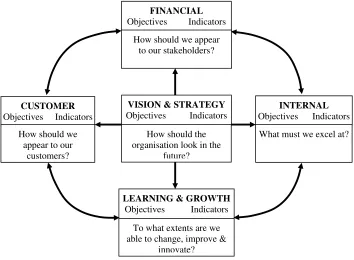
8.2.1 Balanced Scorecard ...62
8.2.2 Specific Measures ...63
8.3 RESULTS SO FAR...64
CHAPTER 9 CONCLUSIONS AND FURTHER WORK 66 9.1 CONCLUSIONS...66
9.2 FURTHER WORK...68
LIST OF REFERENCES 71
BIBLIOGRAPHY 75
APPENDIX A PROJECT SPECIFICATION 77
APPENDIX B COMMUNICATION FLOW PROCESS 79
APPENDIX C REQUEST FOR TECHNICAL SUPPORT TEMPLATE 88
APPENDIX D KNOWLEDGE MANAGEMENT INTRANET
WEBSITE 90
APPENDIX E THE ROLE OF THE CHIEF KNOWLEDGE OFFICER
(KNOWLEDGE MANAGER) 100
List of Figures
2.1 Data plus meaning gives information. Information plus purpose gives knowledge. (Telstra, 2003) ...7
2.2 Knowledge Flow (Chamorro et al. 2003). This diagram shows the flow of knowledge from the creation, for a use, then the capture of the knowledge to be stored, retrieved and re-used...12
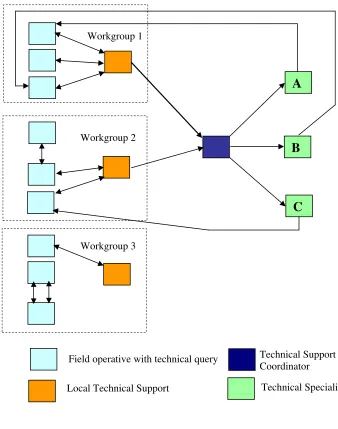
5.1 Technical support prior to the introduction of the Technical Support Process. This shows the situation where technical specialist A has been inundated with requests, while B and C have received far fewer requests and would be available to assist. ...35
5.2 Technical Support Process using the new process. Of the nine queries, only 6 were escalated to the LTS, and only 3 were escalated to the technical specialists. The technical specialist’s workload can also be spread. ...36
6.1 The original distribution method for technical information. There can be doubling up of notifications to staff, and gaps where no project manager has notified staff...43
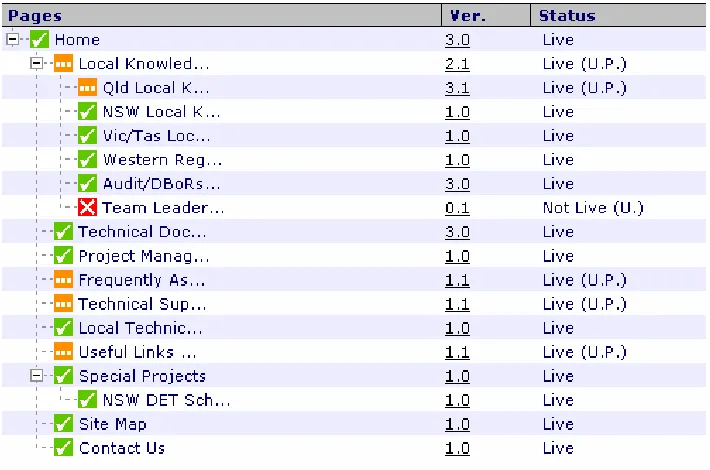
6.3 Knowledge Management Intranet Site map. This map shows sites currently under review (orange) and sites still to be published (red)...45
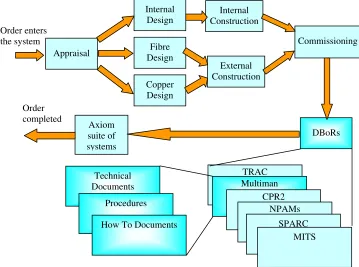
6.4 Knowledge Process Map. This map shows each of the process domains associated with the wide-band process. The DBoRs domain is opened to reveal individual tasks in the domain, which can then be further expanded to show the separate knowledge items that associated. ...51
8.1 Balanced Scorecard Measures (Hanley & Malafsky 2003). This scorecard makes us look at the other things important to an organisation, not just the financial measures. ...62
B.1 Technical Documentation Flow ...82
B.2 Technical Support Process. ...84
C.1 Technical Support Request e-mail template. This template shows the information field staff enter to provide the technical specialist with the information required to provide assistance. ...89
D.1 Knowledge Management Intranet Site Home Page. Links are from here to each of the pages on the site in logical sequence in the left margin field. ...92
D.2 Local Knowledge Page. This page links to the local knowledge pages for each state. ...92
D.3 Qld Local Knowledge Page. This page contains links to sites needed by Qld staff, and informal work documents staff use to make their work easier. ...93
D.5 The WTL Page provides links to the sites the WTLs require in their daily duties leading teams. These include Safety, HR, Environment and contact lists...95
D.6 Technical Documents Page. This page gives users links to the five sites that contain technical documents relating to Access LOBs work...96
D.7 Technical Support Page. This page provides staff with details on the technical support process, the roles of the LTS & TSC, and a copy of the Request for Technical Support email template, and a list of all LTSs...96
D.8 The Useful Links & Information Page links staff to the various home pages of the systems they use, the databases used, and some downloads available to assist their work. It also provides information on the services that staff are providing. This information has previously been unavailable to staff in this short form, and is invaluable in presenting a competent appearance to the customer. ...97
D.9 The Special Projects pages give staff the project specific information they require for large projects. This allows non-standard processes to be published in an area that won’t see them used for other projects. ...98
D.10 Contact/Feedback Page. This allows users to give feedback on problems or possible improvements to the site...99
Glossary
CSD
Company Standard Document. These are the work instructions and standardised documents that are written by NDCG.
DBoR
Database of Reference. These are the databases Telstra use as their main references for network infrastructure.
FAQ
Frequently asked question.
Field Operatives
These are the design and construction staff working for Access LOB.
IT
Information Technology
KM
Knowledge Management
LOB
LTS
Local Technical Support. As part of the communication flow process, these people act as local support to a regionally and technically discrete group.
NCR
Non-Conformance Report. An external-contracting group audits completed services. An NCR is issued each time a defect is found with a completed service.
NDC
Network Design & Construction. This group was involved in the network infrastructure build for Telstra in the 1990s and was then separated as a wholly owned subsidiary of Telstra in 1999.
NDCG
Network Design & Construction Group. NDC became NDCG after reintegration back into Telstra.
PIP
Project Implementation Plan. A project management tool that lays out how a project is to be implemented.
Project Director
This person controls the Access LOB staff for an entire geographic region, such as Queensland.
Project Manager
This person controls either a major project, or a program of work, ensuring it is managed efficiently to completion.
TQM
TSC
Technical Support Coordinator. As part of the communication flow process, this person coordinates technical support and information distribution.
WTL
Work Team Leader. A WTL supervises a workgroup of up to thirty staff.
WPI
Work Package Instruction. NDCG formerly worked under contract conditions for Telstra. Any change to these conditions was initiated through a superintendent’s instruction. Since re-entering Telstra, they work under a work package rather than a contract, and changes to conditions are managed with work package instructions.
Wide-band
Chapter 1
Introduction
In today’s economic climate, efficient use of an organisation’s resources is a prerequisite of success. Unlike last century, physical resources such as raw materials and machinery are not the only resources that count. Today, knowledge and the ability to create and use new knowledge is just as important, or in many industries even more. This is true of the telecommunications industry, where knowledge is evolving constantly, and unless an organisation can create, translate, and share knowledge efficiently, it will flounder in the competition.
Knowledge Management is a field of management that has grown over the past decade to become a priority in businesses around the globe. Providing staff with the knowledge and information they require to efficiently carry out their jobs to their fullest potential is the primary focus of any knowledge management (KM) initiative.
1.1
Project Aim
The aim of this project was to develop and implement a KM system for the Access Line of Business in NDCG, and to foster a workplace culture that promoted sharing. This aim was derived from the regard higher management had for the abilities of the staff, and the difficulties they saw these staff face in acquiring all the knowledge and information they required to perform the tasks that contributed to their jobs. Hand in hand with this aim went the productivity and quality improvements that would be realised upon successful completion.
The project was to set in place a means for the sharing of technical information throughout the geographically and technologically diverse areas of the company, and to control the flow of information between the technical specialists and the field operatives.
1.2
Dissertation Overview
This overview of the dissertation will help the reader to understand the various sections and how they fit together. Chapter 1 gives a brief outline of the aims of this project. For the project aim, and an overview of the milestones and objectives set out for this project, refer to Appendix A.
Chapter two gives the reader a background to the field of knowledge management. It focuses on many of the definitions of the various aspects of knowledge management, and looks at the findings from some of the literature on the subject. The background literature covered in this chapter provides the understanding required to continue through the work covered in the project.
provides an insight into some of the problems that led to, and were likely to affect the project from the outset.
Chapter four investigates the drivers behind the project. It looks at the role of the technical specialist, and where that role should be, and at the flow of knowledge and information in the organisation. This chapter also looks at the knowledge that has left the company, and briefly at what this could be costing the company.
In Chapters five and six, the major KM initiatives developed during this project are investigated, along with some of the theory behind them. These are grouped into two areas. Chapter five looks at the initiatives implemented to assist in the creation of new knowledge, where-as Chapter six concentrates on those initiatives set in place to assist the flow of knowledge and information throughout the organisation. Reference is also made to Appendices B, C, D and E, which provide some of the documentation associated with these initiatives.
Chapter seven focuses on the management of the project. It gives insight into how a project like this is managed, from conception, through to hand over. The project management methods employed by NDCG are utilized for this project, so they are also briefly studied. The Project Implementation Plan developed for this project is attached as Appendix F. Chapter seven also takes a closer look at some of the roadblocks encountered, and how, as part of a major project, they were dealt with.
Chapter 2
Knowledge Management and Today’s Business
In the never-ending search for a competitive edge, businesses are looking for new tools to improve their management techniques. Sometimes these tools are popular for a brief period, sometimes for discrete areas, but occasionally one comes along that will change the way management looks at the world. TQM came along in the early 1990s, and more recently knowledge management has arrived.
2.1 Knowledge
2.2 Knowledge vs. Information vs. Data
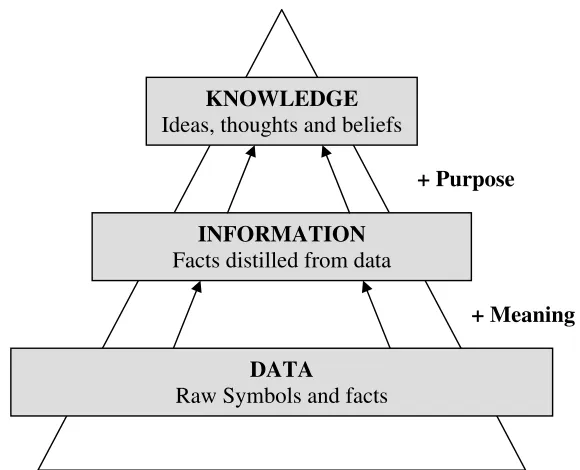
Knowledge, information and data are linked, but cannot be viewed as the same thing. Data are the raw facts and symbols, which on their own provide no real meaning. Information is the raw data, organised in such a way as to give it meaning. Knowledge takes this one step further and assumes a purpose to the information. Figure 2.1 below shows the path data takes to become information and then knowledge.
Figure 2.1: Data plus meaning gives information. Information plus purpose gives knowledge. (Telstra, 2003)
2.3 Knowledge Types
Now that we know what knowledge is, we can further define it by type. Knowledge exists in many forms. Yahya and Goh (2002) define two broad classifications of knowledge. Individual knowledge, that which resides in the minds of individuals, and organisational knowledge. Organisational knowledge is the knowledge that is formed through the interactions between technologies, techniques and people. Whilst individual knowledge is strictly tacit knowledge, organisational knowledge can be either tacit or explicit. It is this organisational knowledge that is the main focus of knowledge management.
KNOWLEDGE
Ideas, thoughts and beliefs
INFORMATION
Facts distilled from data
DATA
Raw Symbols and facts
+ Purpose
[image:22.612.178.468.88.323.2]2.3.1 Tacit Knowledge
Tacit Knowledge is “Knowledge that resides in a person’s mind and may include aspects of culture or ways of doing things” (SA 2003) Sanderson takes it further in that tacit knowledge is not only in the mind, but is in the physical skills of an individual. Tacit knowledge is not a new term. As far back as 1958, Michael Polanyi was writing about tacit knowledge, and the methods of sharing and transferring this knowledge to become explicit (Polanyi 1958).
Survey research by Delphi, quoted in Sanderson (2001), indicated that tacit knowledge is of almost equal importance to organisations as explicit knowledge. The survey of 400 CEOs showed they considered 42% of an organisation’s knowledge to be in the heads of the employees, that 61% of respondents agreed that tacit knowledge sharing was not to an acceptable standard, and 83% thought that it would benefit the company to improve tacit knowledge sharing.
2.3.2 Explicit Knowledge
2.4 Today’s Organisation
Peter Drucker (1999) provides a view on the path today’s organisation is moving along. He sees the knowledge worker, along with the knowledge business taking over from the manual worker and the manufacturing business. Burnstein and Linger (2003) contend that it is the transformation of organisational knowledge into outcomes that creates value. The value of many of the world’s largest companies is not in their physical assets, but in their intangible assets such as knowledge.
The economic world is becoming interdependent. What were once separate companies, merged to become larger companies, or worked together in networks. These then combined again such that the size of these corporations and networks span the globe (Skyrme, 1999). This globalisation of the economy has meant that what happens in one corner of the world, can now affect the rest of the world in a matter of minutes.
What has led to this change has been the increase in communication capacity. The telegraph was seen as a major breakthrough in the nineteenth century when it opened communication channels across continents. Today’s high-speed communication channels can transfer almost limitless amounts of data and information across the world in seconds. Air and freighter transport allows human and cargo transport to flow quickly around the world. Companies no longer need to base their centre of production near their markets, nor with the changing commercial laws around the world, do they need to base their offices near their traditional homes. Many of these giant corporations have diversified to such an extent, they no longer resemble the companies or the products on which they were founded.
years. The traditional “top companies” in USA such as General Motors, have been overtaken by others such as Microsoft and IBM.
Many of the traditional labour intensive industries have either contracted, or modified practices to enable a shrinking of their workforce. The new industries are often knowledge and technology intensive, and therefore do not require a large concentrated workforce. This has lead to the growth of many smaller companies and self-employed people. Between 1980 and 1990 in the USA, around three million jobs were shed by the top five hundred companies. During the same time over nineteen million were created by smaller companies (Skyrme, 1999).
Skyrme notes five major trends in today’s economy.
• Every industry is becoming more knowledge intensive.
• Smarter products are being produced that can do more and provide value adding.
• Higher information to weight ratios. For example, the value of the electronics in goods is often worth more than the traditional item.
• Higher value of intangibles. The market value of a company is higher than the value of its assets. This is even more so in the more knowledge intensive industries.
• There is now a trade in these intangibles. Finance and futures markets are huge, but there are no physical assets traded.
2.5 What is Knowledge Management?
Standards Australia defines Knowledge Management as:
‘A multi-disciplined approach to achieving organisational objectives by making best use of knowledge. It involves the design, review and implementation of both social and technological processes to improve the application of knowledge, in the collective interest of stakeholders.’
If we examine this definition, it contains the basic parameters of the many other definitions found in articles and texts on the subject. It defines Knowledge Management as multi-disciplined. Both Yahya and Goh (2002), and Meso and Smith (2000), refer to a combination of technology infrastructure, organisational infrastructure, corporate culture, knowledge and people. To develop these areas, requires work in both technical and human resource management disciplines.
The achievement of organisational objectives is important. Unless there are specific objectives laid out which align with the organisation’s objectives, there will be difficulty making the staff understand the importance of the system. Chourides et al. (2003) found in one of their studies that unless the Knowledge Management strategy followed traditional strategic planning activities, such as defining missions and objective, and conducting internal audits, the knowledge management system could very well fail.
Technology must also be adapted to suit the organisation. Edenius and Borgerson (2003) study the usefulness of an Intranet system to knowledge management. Their methods are quite successful in smaller companies, but with an organisation of over one thousand staff, NDCG could not use the same methods, such as free (i.e. no restrictions on who can upload) and encouraged uploading to the Intranet. Binney (2003) lists a large number of the technologies in use to assist Knowledge Management. Some of these will be covered in section 2.8.
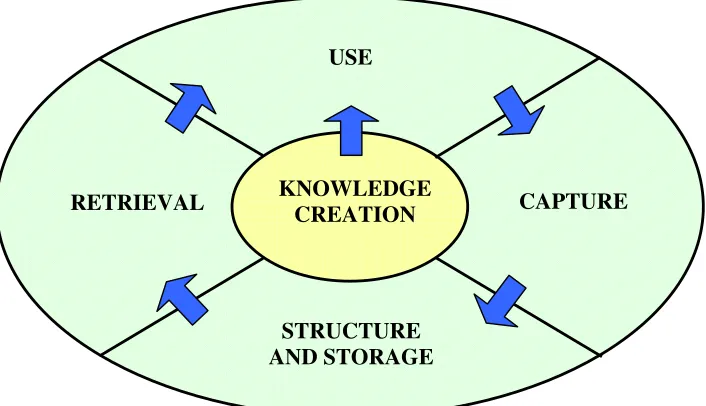
[image:27.612.143.496.400.603.2]The final part of the definition is to improve the application of knowledge, in the collective interest of stakeholders. This is the main purpose of adopting a KM framework. The aim of the system is to allow the creation and adoption of new knowledge in the organisation, and to allow the unhindered flow of this and existing knowledge, both tacit and explicit, throughout the organisation, to those areas that require it. The following diagram provides a visual interpretation of the ideal knowledge flow in an organisation.
Figure 2.2: Knowledge Flow (Chamorro et al. 2003). This diagram shows the flow of knowledge from the creation, for a use, then the capture of the knowledge to be stored, retrieved and re-used.
USE
RETRIEVAL
STRUCTURE AND STORAGE
CAPTURE KNOWLEDGE
2.6 Why is it so Important?
Section 2.4 highlighted the importance of knowledge in today’s economic environment. Knowledge is now a crucial component of successful organisations. Burnstein and Linger (2003) state that the management of this knowledge must become an explicit part of an organisation’s strategy. Drucker (1999) contends that the knowledge worker must now be managed as an asset of the company, rather than a cost.
In many organisations today, the knowledge worker is a contractor, working for a labour hire company. There are no loyalties to the company. Workers are looking for a workplace where they are happy. Because of these factors, workers are now changing employer more often than ever before. If the knowledge that they have created, and are using is not managed correctly, it will be lost to the company, probably to a competitor. It is for this reason that knowledge management is taking such an important role in companies today.
2.7 The Knowledge Map
The knowledge map is a tool used by KM practitioners to provide a visual guide to knowledge areas and knowledge flows in the organisation. It is usually developed using knowledge audits, and can serve two purposes. It can provide a detailed reference for the practitioner to find where there are blockages in knowledge flow, or areas of knowledge isolated, or it can be used as one of the knowledge distribution tools (Eppler 2003) available.
2.8 Technology
Technology can become a major part of knowledge management. It is not though, the only tool of knowledge management. Technology can provide the means to transfer tacit knowledge to explicit, or provide staff with the means of reaching others who can provide them with tacit knowledge to share, but it is in the locating and distributing of explicit knowledge that it finds its most valuable use.
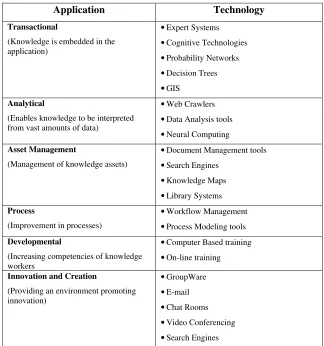
[image:29.612.157.481.367.713.2]Standards Australia (2003) highlights workflow programs, Intranets, electronic records, document management systems and information systems. Binney (2001) goes further and lists numerous technologies as enablers, the tools that assist in the management of knowledge. Table 1.1 below groups them into the elements of the KM spectrum
Table 2.1: Enabling Technologies (Binney 2001)
Application Technology
Transactional
(Knowledge is embedded in the application)
•Expert Systems
•Cognitive Technologies
•Probability Networks
•Decision Trees
•GIS
Analytical
(Enables knowledge to be interpreted from vast amounts of data)
•Web Crawlers
•Data Analysis tools
•Neural Computing
Asset Management
(Management of knowledge assets)
•Document Management tools
•Search Engines
•Knowledge Maps
•Library Systems
Process
(Improvement in processes)
•Workflow Management
•Process Modeling tools
Developmental
(Increasing competencies of knowledge workers
•Computer Based training
•On-line training
Innovation and Creation
(Providing an environment promoting innovation)
•GroupWare
•Chat Rooms
•Video Conferencing
2.9 Sharing Knowledge
There are several methods of sharing knowledge. These are dependent upon the type of knowledge we wish to share. If it is tacit knowledge that we wish to share, demonstration, and storytelling become the most powerful of tools. It is while the knowledge is still tacit that social and cultural factors are important. According to McDermott and O’Dell (2001), a culture of knowledge sharing is one of the most important factors in a successful KM system. Culture can be viewed as ‘the shared values, beliefs and practices of the people in the organisation’ (McDermott & O’Dell, 2001). Aligned strategies and the support of all levels of management are important in creating a positive culture.
Karhu (2002) and Leistner (2001) prescribe the use of knowledge stewards to gather the tacit knowledge from others. These people through interview and observation, will transfer the tacit knowledge from individuals or groups to explicit knowledge, and refine it to a form that is usable to others. This method has some application to the project, but with the added expense, and the specialisation of many of the areas, it is often best left to staff in the individual areas to make this transfer, and provide the information in explicit form to all.
Most literature espouses the benefits of capturing and sharing this tacit knowledge, although not all. Although Karhu (2002) does believe in the value of this transfer, he does warn of the limitations in the traditional methods of sharing, such as observation and imitation. He believes that experts are continually modifying, developing and improving their methods (tacit knowledge), so plain observation is limited in its value. He believes mentoring to be a much more powerful tool, although this provides limitations, such as the number of people that can receive the knowledge and the need to be in the same place at the same time.
can put into words. Sanderson also cites authors that give reasons such as the context dependency of tacit knowledge, and the constraint that explicating the knowledge may have on learning and innovation. The argument that best transfers to the NDCG situation is that of creating information overload through the gathering of too much irrelevant information.
Even with these arguments, the case for knowledge transfer and sharing is important. McDermott and O’Dell (2001) found that companies studied saw sharing knowledge as the way to solve business problems. Malik (2004) also found that knowledge must be shared across the organisation to become a potential asset.
Peter Drucker provides a valuable view of knowledge sharing. Drucker is well known for the many management texts he has authored over the past fifty years. Drucker (1999) proposed that to acquire the information and knowledge that a knowledge worker requires for their work, they must ask two questions. The first is what information do I owe those with whom I work? The second question is what information do I need myself, from whom and in what timeframe? By asking the first question, they open the communication channels, which allows information to flow back to answer the second.
2.10 Knowledge Workers
The Knowledge worker can be defined as a worker who relies on his knowledge, rather than his manual dexterity to perform his job. He should know more about his job than his manager, perhaps more than anyone else in the company does (Drucker 1999). The knowledge worker is not a subordinate to his supervisor, but is now an associate. This is in stark contrast to last century, when the manual worker was reliant upon management to provide him with the tools and machinery to produce. Knowledge worker productivity is dependent upon the worker being seen as an asset, rather than the traditional view of a cost. Innovation must be a part of the work, as must continual learning and teaching.
Drucker (1999) defines the “Technologist” as someone between the manual and the knowledge worker. This is the category most of the NDCG staff would fall into. A great deal of the function of their jobs is of a manual nature, but they require the skills of a knowledge worker in preparation to do the manual work. Drucker provides a good analogy with the role of the surgeon. The actual operation itself is manual work, simple cutting and stitching, but there is a great deal of knowledge work that has gone into the preparation, such as the diagnosis and determining what and where to cut.
The knowledge worker or technologist is dependent upon a well-managed knowledge system, much more so than the manual worker was. He relies on access to the knowledge required to perform his work due to its changing nature.
2.11 Learning and Training
easier for this type of transfer to take place face to face, but certain technologies such as video conferencing do allow it to take place over diverse geographic regions.
Explicit to tacit transfer is that which occurs to the individual, when there is an understanding of something that is read or viewed, and the knowledge is learned by the individual. This type of knowledge transfer can be achieved easily over geographic and time differentials between the knowledge giver and receiver.
With the increase in the knowledge intensity of most industries, there has been a focus on training and development of the worker. When the typical job involved standing on a production line and bolting a widget to panel, training was simple, and once completed, was not required again until the employee changed jobs. Today, knowledge intensive industries continually provide training, to allow staff to keep abreast of the knowledge they require for their work. Learning outside of the workplace is also important, for the tendency to outsource jobs has meant the employer will often be looking for the prospective contractor to come with the required knowledge already learned.
2.12 Creating Knowledge
Chapter 3
NDCG Access Line of Business
3.1 NDCG
NDCG stands for Network Design and Construction Group. NDCG is a division of the Infrastructure Services business unit of Telstra. Infrastructure Services is, as the name implies, concerned with Telstra’s infrastructure build and maintenance. NDCG has historically been responsible for the design and construction of a major portion of Telstra’s network, nationwide.
Today, NDCG has broadened its outlook, and provides the following services to both Telstra and the rest of the telecommunications industry.
• Consultancy services for any aspect of communication networks • Project Management
• New Generation IP/Data solutions such as GWIP, Blackberry, WiFi, WLAN, Video Conferencing and VOIP.
• Design, construction and maintenance of copper, wide-band, broadband and fibre optic networks
• Switch and router network design, installation and support. • Service management
• Customer backbone cabling • Managed network services
• Wireless network solutions, including GSM, CDMA, satellite, fixed radio, broadcasting and wireless broadband.
• Systems integration
It is obvious by the broad range of services, especially high technology services, how important knowledge is to the organisation.
NDCG is broken into a number of lines of business, which look after specialised areas of expertise, under separate contracts from within and outside of Telstra.
3.2 Access Line of Business
Access Line of Business is a group of over one thousand staff concerned at least in part with nearly all of these services. The main focus is wide-band work, the provision of high-speed (2Mb/s and above) services to business and government organisations. There are many different wide-band services, which can be provided on both fibre and copper infrastructure. Services other than wide-band are now making up more than 30% of the groups work, with around 50% of Queensland staff now requiring the knowledge to complete this other work.
The group nationally is made up of twelve hundred staff, with major design and construction offices in each capital city, as well as small design groups in Townsville, Newcastle, and Ballarat. There are also small construction depots in many of the regional cities around the country.
3.2.1 History
Customer Wide-band, and Data & IP groups. During the late nineteen nineties, wide-band work was growing at rates of around 30% per year. During this period the group grew rapidly. It was during this rapid growth that NDC were separated from Telstra as a wholly owned subsidiary. Staff were given the option of moving to the new company, attempting to find another job elsewhere in Telstra, or leaving Telstra with redundancy.
In the ensuing years, wide-band work fell away, with the collapse of the “tech-bubble” driving customer demand down. For the first time in many years, work levels dropped. Access was not the only area to suffer these problems. Other areas of NDC, which were reliant upon all of their work from Telstra or other carriers, were also experiencing drops in work levels. Telstra were in the process of placing a greater portion of their work on the open market, and NDC was not winning some of these contracts.
It reached a point in 2002 that NDC Limited was forced to lay off a number of staff across various lines of business. This process was repeated another three times over the next eighteen months. Access LOB lost a number of experienced staff during this period, and the workplace culture changed markedly. A culture of knowledge hoarding and mistrust developed which has only recently started to change.
3.2.2 The Future
The area in which the Access LOB operates is technology driven. As new technologies develop, customers start to demand them, thus ensuring a constant demand for new knowledge in the group. This area of Telstra is at the forefront of technology, and as such, the creation and translation of new knowledge is essential to ensure the group can meet expectations.
The wide-band technologies, although shrinking, are still a major portion of the group’s workload. A portion of this work is currently being offered under contract to external companies. This will be used to ascertain any gains possible through contracting out the work. For this reason, Access LOB must make every effort to maintain, and improve efficiencies.
NDCG is still in the process of reintegrating into Telstra. As a part of its mission, it is to provide all possible assistance to other areas of Infrastructure Services. This will mean even more products and systems for staff to become familiar with. For this reason, a reliable method of distributing information and an easy to use method of finding documented knowledge is essential.
3.3 Organisational Culture
Organisational culture is one of the greatest determining factors in the success of a knowledge management program (McDermott & O’Dell 2001). Kayworth and Leidner (2003) cite numerous authors and studies, naming organisational culture as a major barrier to knowledge management initiatives.
third hinders innovation and knowledge creation. The area this knowledge management project focuses on is that of knowledge sharing. The organisational culture of NDCG, and in particular, the Access LOB is therefore going to be a major determining factor in the success of the initiatives introduced.
3.4 Survey Results
Every six months, Telstra conduct an employee opinion survey that asks staff to answer questions relating to leadership, job satisfaction and local work environment factors. The most recent survey results available, April 2004, were used to gauge elements of workplace culture, and the staff’s feelings towards knowledge flow in their area.
There were a number of questions that provide an indication of facets of the workplace environment. Access LOB are a group focused on customer delivery, and doing whatever it takes to get a service working. This has been brought out in some of the survey results. Access LOB recorded responses well above Australian cross-industry norms for questions regarding using initiative and being responsive to provide for customer needs. This type of attitude embedded into a culture leads to a positive environment to introduce changes that will improve the staff’s access to knowledge and improve their ability to provide for the customer.
Another notable point from the survey was in the learning and development area. Staff in Access LOB in Qld recorded a response well below the national norm for being provided with opportunities for learning and development. This was a very low result, and falls short of the organisation’s priorities of having a well-trained and knowledgeable staff.
them, and the company’s future. They also expressed concern over receiving the information required to perform their jobs effectively. This result confirms the comments made by staff when interviewed at the commencement of this project. There was concern amongst staff that they often did not receive the Work Package Instructions (WPIs) that were sent through the project managers. These were important documents laying out changes to work practices.
Survey results showed a high level of staff involvement in local decision making. The new Technical Support Process discussed in section 5.3 aims to build on this trait, by using this local workgroup as a first level of escalation for technical support. This prescribes to the theories of Kayworth and Leidner (2003) and Bhatt (2001), of developing initiatives around workplace cultures, rather than drastically changing workplace cultures to suit KM initiatives.
Chapter 4
The Issues
4.1 Why NDCG Access Line Of Business?
As stated earlier, the Access LOB is at the forefront of Telstra’s technology. Their work ranges from simple cabling through to developing network solutions for major corporations and government departments. The large suite of products, and the geographic diversity of the business, means that individual staff must possess a wide range of skills and knowledge, to provide a number of different types of services in their areas. They must also have knowledge of other geographic areas, as some projects cross state boundaries.
4.2 The Drivers
It was becoming obvious to the senior management of the group, that a larger proportion of the technical specialists’ time was being spent answering technical queries from the design and construction operatives. Although this was an integral part of the technical specialists’ function, it was becoming so time consuming, that other duties, such as developing new knowledge and transforming existing knowledge into usable technical manuals, was being pushed aside. Their workload was climbing, and there was no noticeable difference to their output. What was also noticeable, after interviewing one of the technical specialists, and looking through a list of the requests for technical support handled over the past few months, was that most of the knowledge and information required by the field staff was available to them in some form. It was also expressed that local, experienced operatives, could have quickly responded to many of the queries.
The second driver was that Telstra was focusing on the quality of the work being done by NDCG, and although standards were high (less than 1.5% defect ratio for DBoRs), many of the defects that did occur were due to staff not knowing what the relevant standards were. These standards, along with other technical information, were often difficult to find, and were not always provided to those that required them.
4.2.1 The Role of the Technical Specialist
The technical specialists in Access Line of Business had a number of roles. The first was to create new knowledge within the organisation. Whether this was through research into new fields, or simply bringing new knowledge into the group from outside, it was important for the continued growth of new product suites, and it opened new markets for the group. A very good example of this was the “fibre to the premises” product. Whilst still separated from Telstra, NDC sought to increase its knowledge in the field, and through marketing this knowledge to the wider business community, began negotiations with property developers for the provision of fibre networks into housing estates in S. E. Queensland. After coming back into Telstra, contracts have been signed and developed into large projects.
The technical specialist is also required to interpret technical manuals and contractual requirements that come from Telstra and vendors. These documents are scrutinised, and after assessment, either accepted for use by the design and field operatives, or adapted into company standard documents (CSDs) for the staff to use.
The third job of the technical specialist is to assist the design and field operatives with technical queries. Before this project, the method was ad hoc, with staff from various regions usually contacting a technical specialist from their region, regardless of that specialist’s workload or area of expertise. This often led to the specialist having to pass the work on, and staff often not knowing who was dealing with their query, or even worse, having it passed over by mistake.
4.2.2 Communication Paths
There are a number of communication paths throughout the Access LOB. Not all are addressed in this project due to the sheer complexity of such a task. The first path that this project does address is the flow of technical information and knowledge from the technical specialists to the design and field operatives, and feedback back to the technical specialists. The next is the request for technical support from the design and field operatives, and the corresponding response. The third is the communication and transfer of knowledge between peers. This latter is of great importance, as this is where the experience of key team members can be used to improve the overall knowledge base of the organisation.
4.2.3 Knowledge Lost
As discussed earlier, NDCG has been through a number of major changes over the past 5 years. Through each of these periods, there has been movement of experienced staff out of the organisation. When the company was separated, a number of staff decided to stay with Telstra, and a number of staff left the company. Unfortunately, due to the nature of redundancy systems in place in large organisations throughout Australia, it was more attractive for experienced staff to leave than newer staff. When the technology boom slowed, and competition grew in an ever-decreasing market, costs became a focus. Through four rounds of resource rebalancing, it was often the more expensive staff that were forced to leave the company. This too meant that a number of experienced staff left the organisation. Finally, when NDCG moved back into the wider Telstra environment, job opportunities opened for those more competent staff, where previously there were limited openings. Many valued staff were promoted into other areas of Telstra.
there was no management initiative in place at the time to transfer the tacit knowledge to explicit knowledge, it was simply lost. NDC later won back some of these contracts. Design and construction groups faced major difficulties moving back into these areas when new contracts were won, as there were very few experienced staff, and very little of the know-how type knowledge required to interpret and implement the formal work instructions.
4.3 Knowledge as an asset
Chapter 5
Finding New Information
5.1 Why Find New Information?
The telecommunications industry is a constantly evolving field. Over the past fifteen years, the industry has moved from analogue transmission, to digital, increasing speeds from 2 Mb/s standard high-speed transmission rates to gigabit transmission rates. The types of services too have changed markedly. Six years ago, the maximum high-speed data service available to a customer of Telstra was 2Mb/s. Today these are being overshadowed by 100Mb/s services, being used by customers in integrated networks across wide geographical regions.
Competitors are also entering into this market. Before the opening of the telecommunications market to competitors, Telstra were able to dictate what technologies were available. With rival carriers offering their own products, Telstra has had to keep abreast of changing technologies, and develop new products. It is for this reason that the creation of new knowledge and the adaptation of external knowledge to the Telstra environment are so important.
The creation and collecting of commercial knowledge can allow the organisation to follow best practice in the industry, align supply with demand, and concentrate on more potentially profitable areas of the business. A great deal of this knowledge is gathered through the field operatives, who meet with these external players on a day to day basis. The organisation must work on this area of knowledge creation along with the traditional technical knowledge areas.
5.2 The Processes Involved in Finding New Knowledge
This section looks at the processes involved in the creation of new knowledge for the organisation, particularly in the technical areas. Access LOB has a group of 7 technical specialists who are involved in the creation and conversion of knowledge for the staff of the organisation. The design and construction operatives and the project managers are also involved in the creation of new knowledge for the organisation
5.2.1 Technical Specialists
The technical specialists occupy what can be regarded as the knowledge core of the organisation. If we were to use Drucker’s (1999) definitions of knowledge and manual workers, we would place the technical specialists clearly in the domain of the knowledge worker. He considered one of the overriding tasks of the knowledge worker to be continuous learning throughout their career. This is especially true of the technical specialists.
inside the organisation. A great deal of their work is to convert Telstra and vendor documentation into useable work instruction for the field operatives.
Discussions with technical specialists revealed that a great deal of their time was occupied answering technical queries from construction and design staff. Some of these questions were of a nature that required the assistance of these higher level staff, but many were of a nature that could have been answered with the assistance of other field staff and the relevant documentation. What was required was a process to be developed and put into place which placed the technical specialists behind the first line of assistance.
Investigations into the make-up of the design and construction teams found that most of these teams consisted of a team leader, a number of experienced staff, and some less experienced staff. Many of these less experienced staff were still very experienced in some areas, though they may have only moved to a new area and were still acquiring the necessary knowledge to work efficiently, or to solve problems in that new area.
To make use of this existing experience and knowledge, and to facilitate knowledge sharing throughout the organisation, the Technical Support Process was developed. Once implemented, this process defined the steps staff go through when they have a technical query. The Technical Support Process formalised the assistance given by the local experienced staff, and provided a channel through which all requests for assistance must flow. The Technical Support Process is covered more fully in section 5.3.
5.2.2 New Knowledge from the Shop Floor
customers, competitors and vendors. Drucker (1999) would refer to these staff as technologists. They work in a knowledge intensive industry, but must also have some of the manual dexterity and abilities of the manual worker.
Although there was little extra that could be done to increase the learning capacity at this level, what was noted, was that this knowledge should be shared throughout the organisation, rather than kept as tacit knowledge in the heads of a individual staff. What this project provided was a means of gathering this knowledge and storing it in a manner that enabled it to be found and retrieved when required by anyone in the country. This was part of the knowledge sharing initiative of the project, but also lays claim to assisting knowledge creation, as staff are more inclined to search for more knowledge and make it available to others if they see that others are doing the same for them. The Knowledge Management Intranet site examined in section 6.3 allowed the capture and retrieval of this knowledge nationally.
5.3 How do we gain the Advantage? The Technical Support
Process.
As discussed above, the creation of new knowledge is integral to the success of an organisation. In a knowledge intensive, and continually advancing industry such as the telecommunications industry, this new knowledge is required to enter into the new markets as they appear. As mentioned in section 4.2.1 this new knowledge can lead to significant gains in market share and entry into new markets.
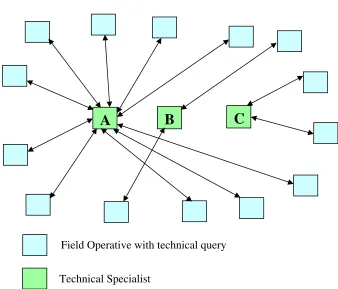
Figure 5.1: Technical support prior to the introduction of the Technical Support Process. This shows the situation where technical specialist A has been inundated with requests, while B and C have received far fewer requests and would be available to assist.
This new process provided for staff to attempt to solve the problem in the local workgroup first. This was through the assistance of experienced peers and relevant documentation. The access to this required documentation is another issue that will be discussed in section 6.3 when the Knowledge Management Intranet site is covered. This part of the new process was already happening in some areas, but in many, especially those areas that were located at the same site a technical specialist, such as design areas, this was bypassed. An overview of the new process is shown in figure 5.2 and the published documentation for NDCG staff is in Appendix B.
By far a majority of the queries and problems encountered by inexperienced staff could now be solved at this first level. If the problem could not be solved at this
C
B
A
Field Operative with technical query
[image:50.612.146.484.74.363.2]stage, what is referred to as “level 1” escalation occurs. There is no strict time limit as to when this escalation should occur, but it is expected that it should be escalated once it is realised the problem will not be solved quickly on site, or after around one hour.
Figure 5.2: Technical Support Process using the new process. Of the nine queries, only 6 were escalated to the LTS, and only 3 were escalated to the technical specialists. The technical specialists’ workload can also be spread.
Field operative with technical query
Local Technical Support
Technical Support Coordinator
Technical Specialist
A
B
C
Workgroup 1Workgroup 2
The escalation at this point is still within the local workgroup. A Local Technical Support person (LTS) has been nominated for each workgroup. This LTS will usually be the Work Team Leader (WTL) or another very experienced operative. Some areas that deal with diverse technologies were allocated two LTSs. A great deal more technical queries can be solved at this point, through the sharing of the tacit knowledge of the experienced team member. These first two steps in the process are more important to the entire knowledge management system than they first appear. By promoting the sharing of knowledge throughout the team, it is hoped that the culture of knowledge hoarding that developed during the period of downsizing and redundancies can be turned around.
The third step in the escalation process occurs when the LTS, together with the originator of the query decide that they will not find the solution, or that it will take too long. At this point, the LTS will formalise the process. A “Request for Technical Support” e-mail template is available on the Knowledge Management Intranet site. The LTS completes the template, advising details of the problem, contact details for the staff involved, urgency of the problem, and what progress has been made to date. A copy of a completed request is in Appendix C. This template is also used when the solution is found by the LTS, and he feels that this problem could be an issue elsewhere, and his knowledge could be of use elsewhere.
All the requests are sent to a common point, the Technical Support Coordinator (TSC). The TSC works closely with the technical specialists, and knows each of their areas of expertise. The TSC also keeps abreast of their movements and their workloads. For these reasons the TSC is able to assign the request to the most appropriate specialist, considering their specialties, workload and availability.
the details are entered into the database against the query, and both the query and response are entered on the FAQ page on the Knowledge Management Intranet site.
As mentioned previously, the LTS still forwards some resolved queries to the TSC. This is to allow them to be posted to the FAQ page to assist others that may be having the same difficulty.
This process was developed to address two issues of knowledge management in the organisation. The first, and the initial reason for the implementation of the entire program, was to enable the technical specialists to concentrate on their most important role. That role was to create new knowledge for the organisation. The second issue was that of attempting to turn around a culture of knowledge hoarding that existed amongst many of the staff. This culture had developed over the preceding few years, due in part to the rounds of resource rebalancing that the staff had been through.
Chapter 6
Inventing Only One Wheel
Yahya and Goh (2002) define two approaches to Knowledge Management. The first, a centralised approach, concentrates on developing a central core of knowledge. This becomes the focal point of the entire system, acting as the repository for the knowledge, the tool for gathering it, and the means of distributing it.
The second is the decentralised method. This approach does not concentrate on the transfer of tacit knowledge to explicit knowledge in a central core. Instead it puts the emphasis on promoting knowledge sharing activities amongst the employees and managers. Methods employed range from peer group meetings, to cross business unit sharing.
6.1 Why Only One Way?
Due to the history of NDCG, many methods of practice developed for the same work throughout the country. Having operated as a regionally based organisation for a number of years, each region developed their own software tools, and their own processes. Once coming under a national structure, and working on national contracts, it was decided to develop a national “best practice” methodology. The idea was to look at work practices in each state, and develop a single “best practice” using the better parts of each regional variant.
The first area to come under this scrutiny was the design area. Six Sigma processes were employed to develop a single best design methodology, and to promulgate its use throughout the country. This was called Project Roadmap. Unfortunately due to the radical changes it imposed on some groups, without careful explanation of the total benefits, the project seemed to fail. Some areas adopted the new processes, but these were the areas that had minimal change to existing processes. The areas that would have faced major changes to their work methods simply did not adopt the new practices.
McDermott and O’Dell (2001) found the same type of resistance to new KM initiatives in their studies. To introduce management change, you should adapt to suit the culture, rather than attempt to force major change quickly.
was not surprising that the change failed in Queensland and the old tool continues to be used.
There had been a culture of pride in this design tool amongst Queensland designers that was too strong for the roadmap group to overcome. Belgard and Rayner (2004) note that culture is the major barrier to organisational change. What this knowledge management project had to be wary of was falling into the same traps as Project Roadmap. Many of the objectives were similar, so the approach would have to differ.
With the implementation of a national line of business, overseeing a national contract, it became important to offer Telstra a common product nationally. Like roadmap, it was decided the best place to start this was in design. Work instructions and CSDs were already national documents, and with a common design process, it would be easier to achieve a common installation process.
6.2 Information Distribution Process
The distribution of knowledge and information is important to a technologically diverse organisation like NDCG. There were many different work instructions and CSDs, and even more Work Package Instructions (WPI). These were the changes that Telstra wished NDCG and other contractors to make to their current procedures. Management had to ensure that these documents reached all staff required to use them, in a time frame quick enough to ensure compliance.
Firstly, some of these instructions were quite lengthy. It was impractical for all the Project Directors to read all the instructions. This meant that often the instructions were simply broadcast to all the Project Managers, even if the instruction did not relate to their area. The Project Managers were also under similar time pressures as the Project Directors, which meant many instructions were broadcast to all the work team leaders. Due to the workplace structure, and the fact that a team leader could be working with more than one Project Manager, some were receiving two or three copies of the one instruction. During the information gathering stage of this project, one WTL commented that he regularly received the same information from four different sources, sometimes more than once each. Others would occasionally not receive important instructions at all.
The length of these instructions would also mean that a team leader could then spend an hour scanning and reading a document, only to find that it had little or no impact on his work. If lucky, the team leader would then file away the document rather than send it on to his team. If not, the whole team could go through this same time wasting procedure.
What was required was a process that ensured all relevant information was passed on to those that required it, but not to those who didn’t.
Figure 6.1: The original distribution method for technical information. There can be doubling up of notifications to staff, and gaps where no project manager has notified staff.
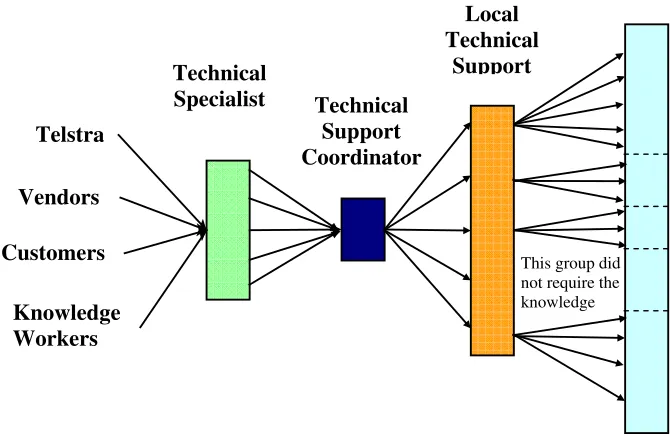
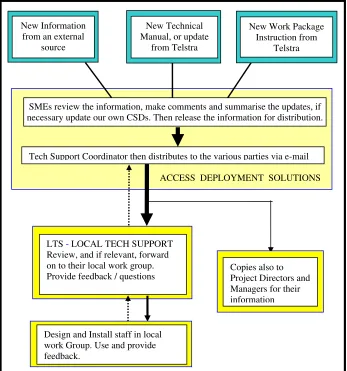
Figure 6.2: The Information Distribution Process. New knowledge enters the organisation through the Technical Specialists, and is funnelled through the TSC to the areas that require the knowledge only.
Telstra
Vendors
Customers
Knowledge Workers
Technical Specialist
s Technical Support Coordinator
Local Technical
Support Telstra
Vendors
Customers
Knowledge Workers
Technical Specialist
s
Project Directors
Project Managers
[image:58.612.152.487.404.624.2]The new process continues from there. Once accepted, the technical specialist would forward the instruction, with a brief overview of its areas of relevance and implications, to the TSC. He would also provide a courtesy copy to the project directors, who could then forward it to the project managers with instructions not to forward to their operatives.
The TSC now has the document, together with a brief description and a list of the areas it will impact. The TSC maintains a database of the LTSs, and the work that each are involved in. He uses this to distribute the document to the LTSs working in the areas listed as relevant. This way, only those areas requiring the information will receive it, and only once.
The LTS will receive the document via email, and if in an area where staff have access to email, will forward it to those requiring it. If no email is available, the information will be distributed during the weekly toolbox talks, or monthly team briefs. If appropriate, the team leader will provide a concise statement of relevance with the document, to outline to his staff what effect it will have, and how it is to be implemented. At this point, the LTS can also send feedback to the technical specialists and project managers regarding any unforeseen impact the instruction will have. Figure 6.2 shows a diagrammatic overview of the process, and the entire Information Distribution Process documentation is attached as a part of the Communication Flow Process in Appendix B.
6.3 Knowledge Management Intranet Site
This website is the focal point of the entire project. Through its use, it is intended that documentation will be found locally, to answer many of the queries raised by staff. It will enable knowledge sharing between groups nationally. It will also provide other useful information and knowledge, which until now has been difficult to obtain.
constructed using the Telstra Intranet Site Manager Tool, which aids in the development and standardisation of sites on the Telstra Intranet.
Figure 6.3: Knowledge Management Intranet Site map. This map shows sites currently under review (orange) and sites still to be published (red).
6.3.1 Local Knowledge Pages
These are the pages that have been developed to enhance knowledge sharing throughout the organisation. It is hoped that through this, regional practices can be aligned, possibly to the point of a single best practice.
[image:60.612.138.493.124.359.2]worked into it. Some sections were struggling with tasks that others had automated. Once all groups knew of these improvements, they were only too happy to adopt these practices.
Most staff in each section of each region maintained their own small library of “how to” documentation. These were the small items of tacit