Stratified Protocols for Mobile Gaming
Sunny Koh
ii
Acknowledgments
I have to say that this has been a very long process with many years in the making. Starting out with the goal to implement a Massive Multiplayer Online Role Playing Game on a Palm PDA became this look into how to work with the networking issues for any multiplayer mobile game. (And some dare say, even for non-mobiles as well)
I would like to first thank Associate Professor Ron Addie for having to endure working with me to complete this project. We have our disagreements over many issues but as it stands, I believe that both are happy that we are able to break new ground in the project.
Credit also has to go to Camelot Hobbies Private Limited for supporting my re-search project and allowing me to take time off instead of doing my job managing the technology and creative teams. I need to mention Thomas Lim which has worked with me through out the project giving me advice and pointing me to where the tasty points of research and so on.
To Anna Dobritt and Ting Chai Hing, thanks for your time discussing ideas and concept not necessary in direct relation to my project but just the same. Of course Bevis CyberRat Yeo for encouraging me to try out the Apple Mac Platform, without it, I would think I would be still trying to get Windows to work. Much thanks to Eugene O. Kolobov President of Stone Falcon, Russia for online discussions about computer Meta-gaming.
I also have to acknowledge the many volunteers which helped during the experi-ments in my research. I am unable to name them due to privacy requireexperi-ments but they know who they are and thanks for all the help.
To my mentor Professor Andy Koronios, encouraging me to get into the Masters Program and inspiring me to contribute to society through research. We should get together more often like we use to.
And Finally and Most Important of all, many thanks and my eternal gratitude to My parents for supporting me all the way from young, letting me go overseas to study and to allow me to achieve my dreams in education.
iii
Declaration
This report and the project documented by it were a requirement of Courses CSC8404 and CSC8405, Master of Computing Project A and Master of Computing Project B, Master of Computing, Department of Mathematics and Computing, University of Southern Queensland (USQ), Toowoomba, Australia.
A certify that the work reported in this thesis is entirely my own effort, except where otherwise acknowledged. This report is original and contains no material of-fered for the award of any other academic qualification at this or any other institution, or material previously published, except where due reference is made in the text.
Signature of Candidate Date
Contents
1 Introduction 3
2 Existing and future Mobile Games 7
2.1 Introduction to Mobile Games . . . 7
2.2 Mobile Gaming Devices . . . 7
2.2.1 Mobile Consoles . . . 8
2.2.2 Notebook Computers . . . 8
2.2.3 Tablet Computers . . . 9
2.2.4 PDA . . . 9
2.2.5 Mobile Phones . . . 13
2.3 Multiplayer Games . . . 14
2.3.1 Types of Multiplayer Games . . . 14
2.4 Current Product Offerings . . . 15
2.5 Mobile Networking Technologies . . . 18
2.6 Mobile Software Development . . . 20
2.7 Historical Comparison between old PC games and Current Mobile Games . . . 21
3 Gaming Communications 23 3.1 Historical Game Communication Methods . . . 23
3.2 IPX . . . 26
3.3 Brief overview in TCP/IP and UDP . . . 27
3.4 Current Game Communications Models . . . 28
3.5 Game Communication Life-Cycle . . . 32
3.6 Types of Data Communicated . . . 33
4 Middleware 35 4.1 Middleware Description . . . 35
4.2 Gaming Middleware . . . 35
4.3 Specific Gaming Network Middleware . . . 36
4.3.1 DirectPlay/xBox Life . . . 36
4.3.2 TerraZona . . . 36
4.3.3 GameSpy Arcade . . . 36
vi CONTENTS
4.3.4 Demonware . . . 38
4.3.5 Quazal Net-Z . . . 38
4.3.6 Massiv . . . 38
4.3.7 MUPE . . . 40
5 Requirements for Game Communications 41 5.1 Reliability . . . 41
5.2 Quality of Service . . . 42
5.3 Processor . . . 43
5.4 Responsibility . . . 44
5.5 Network Compatibility . . . 45
5.6 Platform Compatibility . . . 45
5.7 Security . . . 47
6 Proposed Gaming Protocol 49 6.1 Proposed Solution . . . 49
6.1.1 Game Data Grouping . . . 49
6.2 How does a Stratified Protocol Address the Issues . . . 52
6.3 Problems Not Solved using the Stratified Approach . . . 52
6.4 Roaming and Recovery . . . 52
6.5 The Unified Approach . . . 53
7 Design 55 7.1 The TCP and UDP API . . . 55
7.2 Buffering . . . 56
7.3 Packet Discard . . . 57
7.4 I.P. Address Hopping . . . 59
8 Player’s Satisfaction under Network Stress 61 8.1 Hypotheses Considered . . . 61
8.2 Supporting Literature . . . 63
8.3 Model . . . 63
8.4 Games Selected . . . 64
8.4.1 Battlefield 1942 . . . 64
8.4.2 Mechwarrior:4 Mercenaries . . . 65
8.4.3 Age of Mythology . . . 66
8.5 Experiment . . . 67
8.5.1 Client Computers . . . 67
8.5.2 Router Computer Specification . . . 68
8.5.3 Software Used . . . 68
8.6 Methodology . . . 68
8.7 Questions . . . 68
CONTENTS vii
8.8.1 Age of Mythology Survey Response . . . 71
8.8.2 Battlefield 1942 Survey Response . . . 71
8.8.3 Mechwarrior 4: Mercenaries Survey Response . . . 71
8.8.4 Regression Results for Player Response against Technical Qual-ity . . . 73
8.8.5 Student’s t-Test . . . 75
8.8.6 Response Curves . . . 79
8.9 Analysis . . . 115
8.9.1 Confirmation of Hypotheses . . . 115
8.9.2 General Observations . . . 116
8.10 Conclusions . . . 117
9 Conclusion 119 9.1 Remarks . . . 119
9.2 Further Work . . . 120
Bibliography 121 A Background 125 A.1 Genres of Computer Games . . . 125
A.1.1 Action Games . . . 125
A.1.2 Adventure Games . . . 127
A.1.3 Puzzle . . . 129
A.1.4 Role Playing Games . . . 129
A.1.5 Simulation . . . 132
A.1.6 Sports . . . 133
A.1.7 Strategy . . . 133
B Installation and Configuration of Nist.Net 137 B.1 Hardware Design . . . 137
B.2 Operating System Installation . . . 137
B.2.1 Disk Partitioning . . . 137
B.2.2 Base Installation . . . 138
B.2.3 Kernel Installation . . . 138
B.2.4 System Utilities Installation . . . 138
B.2.5 X-Windows Configuration . . . 139
B.3 Network Configuration . . . 142
B.4 Nist.Net Installation . . . 143
B.4.1 Configuration Details . . . 143
viii CONTENTS
D Network Traffic Plots 159
D.1 Age of Mythology . . . 159
D.1.1 Session 1 . . . 159
D.1.2 Session 2 . . . 162
D.1.3 Session 3 . . . 165
D.1.4 Session 4 . . . 168
D.1.5 Session 5 . . . 171
D.2 Battlefield 1942 . . . 175
D.2.1 Session 1 . . . 175
D.2.2 Session 2 . . . 178
D.2.3 Session 3 . . . 181
D.2.4 Session 4 . . . 184
D.2.5 Session 5 . . . 187
D.2.6 Session 6 . . . 190
D.2.7 Session 8 . . . 193
D.2.8 Session 9 . . . 196
D.2.9 Session 10 . . . 199
D.2.10 Session 11 . . . 202
D.2.11 Session 12 . . . 205
D.2.12 Session 13 . . . 208
D.2.13 Session 14 . . . 211
D.3 Mechwarrior:4 Mercenaries . . . 215
D.3.1 Session 1 . . . 215
D.3.2 Session 3 . . . 218
D.3.3 Session 4 . . . 221
D.3.4 Session 5 . . . 224
List of Figures
1.1 Nokia N-Gage QD (Second Generation Nokia Phone/Mobile Console
Hydrid) . . . 3
1.2 Simcity Class for the Palm . . . 4
1.3 Nintendo Gameboy DS . . . 5
2.1 OQO . . . 8
2.2 Sony’s PSP . . . 9
2.3 Alienware 51m . . . 10
2.4 Fujitsu’s Tablet PC . . . 11
2.5 Tapwave’s Zodiac . . . 12
2.6 Nokia’s 7600 . . . 14
2.7 Screenshot from Bejeweled for PocketPC . . . 16
2.8 Screenshot from Warfare Inc for Palm OS . . . 17
2.9 Screenshot from Everquest for Pocket PC . . . 17
2.10 Screenshot from Tibia ME for Mobile Phone . . . 18
2.11 Mobile Phone Gaming Model . . . 19
3.1 Modem Connection . . . 24
3.2 Null-Modem 25 pin Wiring Diagram . . . 25
3.3 Screenshot from Baron Realms Elite . . . 26
3.4 Ethernet . . . 27
3.5 ARPA Network 1971 from “Casting the Net”, page 64 . . . 28
3.6 Open System Interconnect verse TCP/IP Layers . . . 29
3.7 I.P. Header . . . 29
3.8 TCP Header . . . 30
3.9 UDP Header . . . 30
3.10 Client/Server . . . 31
3.11 Peer to Peer . . . 32
3.12 Game Communication Types . . . 33
4.1 TerraZona Architecture . . . 37
4.2 Gamespy Arcade Screenshoot . . . 38
4.3 Demonware Middleware Architecture . . . 39
x LIST OF FIGURES
5.1 Packet Loss . . . 42
5.2 An ARM Processor . . . 44
5.3 Network Address Translation . . . 46
6.1 Game Communication Matrix . . . 50
6.2 Area of Interest for Stratification . . . 51
7.1 API Connection . . . 56
7.2 SCL Block Diagram . . . 57
7.3 SCL State Transition . . . 58
7.4 Stratification for Message Series . . . 59
8.1 Response Curve Example . . . 62
8.2 Nist.Net Network Diagram . . . 67
8.3 Age of Mythology Question 2 . . . 79
8.4 Age of Mythology Question 3 . . . 80
8.5 Age of Mythology Question 4 . . . 81
8.6 Age of Mythology Question 5 . . . 82
8.7 Age of Mythology Question 6 . . . 83
8.8 Age of Mythology Question 7 . . . 84
8.9 Battlefield 1942 Question 2 . . . 85
8.10 Battlefield 1942 Question 3 . . . 86
8.11 Battlefield 1942 Question 4 . . . 87
8.12 Battlefield 1942 Question 5 . . . 88
8.13 Battlefield 1942 Question 6 . . . 89
8.14 Battlefield 1942 Question 7 . . . 90
8.15 Mechwarrior 4:Mercenaries Question 2 . . . 91
8.16 Mechwarrior 4:Mercenaries Question 3 . . . 92
8.17 Mechwarrior 4:Mercenaries Question 4 . . . 93
8.18 Mechwarrior 4:Mercenaries Question 5 . . . 94
8.19 Mechwarrior 4:Mercenaries Question 6 . . . 95
8.20 Mechwarrior 4:Mercenaries Question 7 . . . 96
8.21 Client Question 2 . . . 97
8.22 Client Question 3 . . . 98
8.23 Client Question 4 . . . 99
8.24 Client Question 5 . . . 100
8.25 Client Question 6 . . . 101
8.26 Client Question 7 . . . 102
8.27 Server Question 2 . . . 103
8.28 Server Question 3 . . . 104
8.29 Server Question 4 . . . 105
8.30 Server Question 5 . . . 106
LIST OF FIGURES xi
8.32 Server Question 7 . . . 108
8.33 Overall Question 2 . . . 109
8.34 Overall Question 3 . . . 110
8.35 Overall Question 4 . . . 111
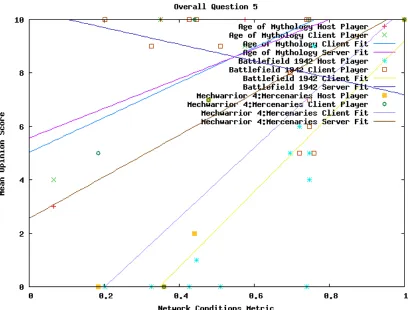
8.36 Overall Question 5 . . . 112
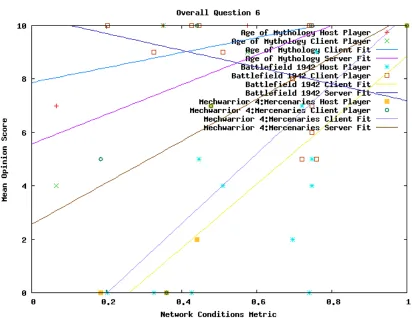
8.37 Overall Question 6 . . . 113
8.38 Overall Question 7 . . . 114
A.1 Spacewar! on the PDP-1 . . . 126
A.2 Screenshot from Wolfenstein 3D . . . 126
A.3 Screenshot from Far Cry . . . 127
A.4 Screenshot from King’s Quest : Mask of Eternity . . . 128
A.5 Screenshot from Myst . . . 129
A.6 Screenshot from Tetris . . . 130
A.7 Screenshot from Ultima Online . . . 131
A.8 Screenshot from Star Wars Racer . . . 132
A.9 Screenshot from FIFA 2004 (Playstation) . . . 133
A.10 Screenshot from Deer Hunter 2004 . . . 134
A.11 Screenshot from Dune 2 . . . 135
C.1 USQ Ethics Clearance Page 1 . . . 150
C.2 USQ Ethics Clearance Page 2 . . . 151
C.3 USQ Ethics Clearance Page 3 . . . 152
C.4 USQ Ethics Clearance Page 4 . . . 153
C.5 USQ Ethics Clearance Page 5 . . . 154
C.6 USQ Ethics Clearance Page 6 . . . 155
C.7 USQ Ethics Clearance Page 7 . . . 156
C.8 USQ Ethics Clearance Page 8 . . . 157
D.1 Age of Mythology Traffic Chart . . . 160
D.2 Age of Mythology Packets Chart . . . 161
D.3 Age of Mythology Traffic Chart . . . 163
D.4 Age of Mythology Packets Chart . . . 164
D.5 Age of Mythology Traffic Chart . . . 166
D.6 Age of Mythology Packets Chart . . . 167
D.7 Age of Mythology Traffic Chart . . . 169
D.8 Age of Mythology Packets Chart . . . 170
D.9 Age of Mythology Traffic Chart . . . 172
D.10 Age of Mythology Packets Chart . . . 173
D.11 Battlefield 1942 Traffic Chart . . . 176
D.12 Battlefield 1942 Packets Chart . . . 177
D.13 Battlefield 1942 Traffic Chart . . . 179
xii LIST OF FIGURES
D.15 Battlefield 1942 Traffic Chart . . . 182
D.16 Battlefield 1942 Packets Chart . . . 183
D.17 Battlefield 1942 Traffic Chart . . . 185
D.18 Battlefield 1942 Packets Chart . . . 186
D.19 Battlefield 1942 Traffic Chart . . . 188
D.20 Battlefield 1942 Packets Chart . . . 189
D.21 Battlefield 1942 Traffic Chart . . . 191
D.22 Battlefield 1942 Packets Chart . . . 192
D.23 Battlefield 1942 Traffic Chart . . . 194
D.24 Battlefield 1942 Packets Chart . . . 195
D.25 Battlefield 1942 Traffic Chart . . . 197
D.26 Battlefield 1942 Packets Chart . . . 198
D.27 Battlefield 1942 Traffic Chart . . . 200
D.28 Battlefield 1942 Packets Chart . . . 201
D.29 Battlefield 1942 Traffic Chart . . . 203
D.30 Battlefield 1942 Packets Chart . . . 204
D.31 Battlefield 1942 Traffic Chart . . . 206
D.32 Battlefield 1942 Packets Chart . . . 207
D.33 Battlefield 1942 Traffic Chart . . . 209
D.34 Battlefield 1942 Packets Chart . . . 210
D.35 Battlefield 1942 Traffic Chart . . . 212
D.36 Battlefield 1942 Packets Chart . . . 213
D.37 Mechwarrior: 4 Mercenaries Traffic Chart . . . 216
D.38 Mechwarrior: 4 Mercenaries Packets Chart . . . 217
D.39 Mechwarrior: 4 Mercenaries Traffic Chart . . . 219
D.40 Mechwarrior: 4 Mercenaries Packets Chart . . . 220
D.41 Mechwarrior: 4 Mercenaries Traffic Chart . . . 222
D.42 Mechwarrior: 4 Mercenaries Packets Chart . . . 223
D.43 Mechwarrior: 4 Mercenaries Traffic Chart . . . 225
D.44 Mechwarrior: 4 Mercenaries Packets Chart . . . 226
D.45 Mechwarrior: 4 Mercenaries Traffic Chart . . . 228
Abstract
Mobile Games are becoming very popular. Players play games under various condi-tions and so we need protocols which can adapt. However, unlike the desktop, there are many issues with that of mobile communication. This dissertation proposes a strat-ified protocol to be implemented in order to solve these communication problems more effectively.
The protocol itself dynamically adapts to the changing bandwidth capacity of the network. The term stratified means that the payload in the protocol packets is subdi-vided into different categories, or strata, of data which are handled differently depend-ing on network conditions.
Such a protocol needs to be responsible as it must make decisions which do not worsen the problem of network congestion when it arises.
An experiment was conducted with a view to determining whether it is important to address difficulties with technical quality of communication. This experiment showed that gaming satisfaction of players does depend on technical quality of communication and that the way in which this dependence on technical quality is exhibited depends upon the particular gaming genre. This dependence on genre and the fact that different games make use of communication services differently suggests that stratification of communication protocols could be useful.
Chapter 1
Introduction
Games have come a long way since MIT Lab’s SpaceWar! in 1961 [Mar01]. Computer games have became a multi-billion dollar industry with game publishers pumping in millions of dollars per software title. [MP03]
Personal digital assistants (PDAs) & mobile phones are becoming a part of every-day life. The ease of use and the convenience makes it an indispensable tool for people on the go. Evolving from an address book, date planner and to do list or phone, the lat-est PDAs & mobile phones in the market offer processing capabilities that rival most first and second generation desktop computers. (The first generation of Nokia 9000 series communicator PDA/phone hyrid runs on 80386 platform with NEOS-DOS as the operating system.) Some run at an amazing 800MHz in a RISC format which is comparable to desktops today. From a purely grayscale LCD and touchpad, today we see PDAs & mobile phones with amazing 16 million color displays, vast amounts of storage and expandability (With more than 4 GB of data with the addition of the com-pact flash thumb drive same as the one found in the iPod Mini.) Applications are made for every conceivable field including entertainment.
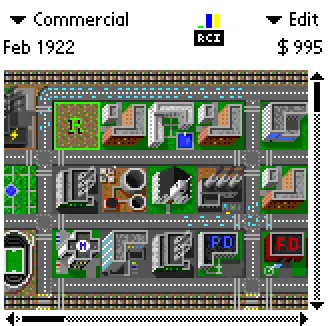
Entertainment on a PDA & mobile phones can be described as following the progress of the computer gaming scene. From the crude puzzle games to the current graphical adventures. Simple games like card games have now given way to Sim City Clas-sic for the Palm Pilot (A full copy of priginal Sim City game) and sprint based RPG games. As proof of a growing market, we see big players in the entertainment indus-try like Sony launching a handheld RPG product titled after their popular Everquest
Figure 1.1: Nokia N-Gage QD (Second Generation Nokia Phone/Mobile Console Hy-drid)
4 CHAPTER 1. INTRODUCTION
Figure 1.2: Simcity Class for the Palm
series. With more developers joining the bandwagon, we can see enhancements and development in these types of games.
The next generation of mobile devices will include peer to peer multiplayer capi-bilites through technologies like Bluetooth and WiFi. Devices like The game Boy DS boast peer to peer play with up to 16 players and even the current Tapwave Zodiac supports 8 player via Bluetooth. Clearly there is a reach into the multiplayer mode.
With the expansion into these areas, it can be said that overcoming the network protocol issues with wireless technology will be a major factor. There is a need for an adaptive protocol as there are highly variable operating conditions in mobile gaming. As these are the early days of mobile multiplayer gaming, it is important to find the ideal solution to solve these problems. The quality of communications at the moment is patchy at best. This dissertation hopes to address some of the issues in this operating environment.
In Chapter 2, we survey the background of the mobile computing environment in general, including considerations of mobile computing and the technologies support-ing this computsupport-ing environment. In Chapter 3, we discuss the history and background of game communication, including the methods and protocols used and what is com-municated in order to support multiplayer gaming.
In Chapter 4, a brief introduction to middleware is given, including a discussion of what gaming middleware in general and some analysis on current network middle-ware systems being offered today. In Chapter 5, based on the understanding gained from the previous chapters, a set of requirements are drawn up for mobile gaming. Technical, social and commercial aspects are discussed and why they should be given consideration.
5
6 CHAPTER 1. INTRODUCTION
software is presented.
Chapter 8 describes a series of experiments in which games are played over a communication network with deliberately impaired technical quality and the results of these experiments are analysed. A series of hypotheses concerning the response of players to poor technical quality of communication are tested.
Chapter 2
Existing and future Mobile Games
In this chapter, we would examine the devices that people play mobile games with, the technologies for having multiplayer games, some popular games and the methods to create them.
2.1
Introduction to Mobile Games
What is a mobile game? Why are people focusing on them? Why is it “different”? Quite simply, a mobile game is a game which can be played on a reasonably portable device. Many would argue that this is a rather new market of game devel-opment but in effect, it has been around for some time now. Many can remember the simple electronic toys that have only a single game which you can carry from place to place. These devices form the beginnings of the mobile games industry.
As the PC and console markets become more competitive, more and more money is spent by the big players to attract the customer base. As it is, it costs more then US $10 Million to produce a Massively Multiplayer Online Game (MMOG). [MP03] Small players are being muscled out of the market as they don’t have the budgets to keep up with these companies. However as the demand for “mobile” and portable games grow, these small companies are finding themselves a niche to be filled. Not only that, we are beginning to see major players advance the mobile gaming platform with new technologies. [SC04]
The issue about mobile gaming is that due to the platform they are to be played on, there are real design limitations. Mobile gaming platforms are designed compromised with one feature is traded off for another for the sake of mobility. Not only the platform has these issues, but the communication technology too has similar issues.
2.2
Mobile Gaming Devices
To start on the discussion existing mobile games, we should first look at existing mo-bile gaming devices. We limit this discussion to devices which can support multiplayer
8 CHAPTER 2. EXISTING AND FUTURE MOBILE GAMES
Figure 2.1: OQO
games as opposed to single player or virtual multiplayer.
2.2.1
Mobile Consoles
The gaming console is considered a little brother to those machines that you connect to your television. Such devices allow players to “game on the go”. Almost all devices in this heading are purely for entertainment.
Popular current devices include The Gameboy (Figure 1.3 shows the next gener-ation Gameboy) and others. Games are stored on cartridges with a single game per cartridge.
It should be noted that the next generation of mobile consoles will have wireless connectivity. For example, the Sony PSP (Figure 2.2) has both WiFi and an InfraRed communications port. This is to allow for more multiplayer options.
2.2.2
Notebook Computers
Notebooks and laptops don’t have the same limitations as most other mobile device but still are subject to the same communication issues faced by their less powerful cousins. (This is in regards to the wireless communications methods. Wired communication methods are similar to those of desktops.)
2.2. MOBILE GAMING DEVICES 9
Figure 2.2: Sony’s PSP
are so heavy that it is a “portable” desktop computer. (These systems are designed specifically for gaming and use Desktop components for the extra performance at the cost of almost no battery life and weight.)
2.2.3
Tablet Computers
Tablet computers can be defined as a notebook with a writable screen. These system differ slightly from laptops as in order to use them you don’t need to use a keyboard. Instead similar, to a PDA, you can simulate key presses using an on-screen keyboard. Some tablets can be converted to notebook mode by opening the system and twisting the screen 180 degrees. The communication profile for this class of devices is the same as the notebook computer.
More commonly found in the enterprise market, tablet computers are slowly filter-ing down the line. Many educational institutions are or have considered Tablets as a suitable replacement for the textbooks that students carry from place to place. With that in mind, it should be noted that this is largely a untapped market with no games specifically designed to make use of the tablet’s unique features.
2.2.4
PDA
10 CHAPTER 2. EXISTING AND FUTURE MOBILE GAMES
2.2. MOBILE GAMING DEVICES 11
12 CHAPTER 2. EXISTING AND FUTURE MOBILE GAMES
2.2. MOBILE GAMING DEVICES 13
The PDA market is dominated by 2 operating systems, namely Palm OS by Palm-source and Windows CE by Microsoft. Palm has been in the market since 1996. [Myk00] It should be noted that the games written for the Palm started as a hobby-ist industry and this is growing as more companies get involved. However, with the late arrival of Windows CE, major entertainment companies have been releasing titles for that platform like Sony’s Everquest (Figure 2.9)
It is very important to note that as there are many different models of PDAs, there are many different modes of networking. (These connectivity options are sometimes more expensive than other devices of similar functionality due to size.)
The other issue to note is that almost all of these devices do not contain a GPU. And in order to keep the PDA power up longer, most don’t have a fast processor either. However, Tapwave’s Zodiac (Figure 2.5) is one of the exceptions where we can see a convergence device. This device has an onboard 3D GPU and is primary designed for gaming.
2.2.5
Mobile Phones
A mobile phone by definition is a telephone which uses wireless technology to place a phone call. These devices have become very common place and the rate of adoption is always increasing. With lots of people carrying mobile phones, manufacturers must find a new reason for people to upgrade their phones. In addition to upgrades for technologies, handset makers try to pack more functions into the phone.
Games on mobile phones can be played over the SMS system. (Very common as a tie in with another medium like radio.) Games on the mobile can be embedded into the firmware or in some sort of removable storage. With the possibility of wireless internet with WAP, GRPS or 3G, we can have multiplayer games over wide distances on the go.
The current crop of new mobile phones offer functions similar to that of a PDA. In fact, there is one segment of the market called the smart-phone, which is a PDA / Mobile hybrid. There are three operating systems of note, Microsoft smartphone, Palm OS & Symbian OS. These devices provide the same platform as that of a PDA but with phone functions. (And connectivity via the phone network.)
The smart-phone is not only a convergence device, Nokia has came out with the “second generation” of convergence phone: N-Gauge. (Figure 1.1) This is a mobile phone cum mobile game console which has functions like Bluetooth and an analog controller. With this device Nokia has successfully manage to get big name titles onto the platform.
14 CHAPTER 2. EXISTING AND FUTURE MOBILE GAMES
Figure 2.6: Nokia’s 7600
2.3
Multiplayer Games
The lure of a real thinking opponent is better then a computer’s scripted Artificial Intel-ligence. This draw of competition is creating new industries from internet cafes which specialized purely in network gaming (Within a local area network, the response time between computers communicating is minimized) to service industries like subscrip-tion based massively multiplayer online games.
2.3.1
Types of Multiplayer Games
There are many classifications for multiplayer games. Here, the context to describe the different types is that of the number of human opponents. This maybe slightly different from convention, but by placing them in this context, one can identify the different issues faced by each one.
Peer to Peer
2.4. CURRENT PRODUCT OFFERINGS 15
Network Play
Network play would refer to having 2 or more opponents in the same game. Starting with IPX networking in the past, we have seen it move to TCP/IP. Usually there is a host computer which other clients connect to which manages the synchronizing of the clients. This might or might not be a dedicated server.
Massively Multiplayer
The last type is that of the massively multiplayer. This can be define as having about 2000 to 3000 or more simultaneous clients connected to a server cluster in which all the players interact in the same virtual environment. [MP03] These clusters are mirrored to support many more users on the internet. One of the first MM game is Ultima Online. See Section A.1.4.
2.4
Current Product Offerings
In this section we survey some of the more popular and noteworthy mobile games which are in the market today. This is to allow us to gain an understanding of the direction in which the mobile gaming industry is heading.
Bejeweled is shown in Figure 2.7. In this game, you are to match a series of shapes by switching over 2 shapes next to each other. When 3 or more shapes match, those shapes which match up disappear and more shapes are added to the top to fill the screen. This represents the major portion of mobile games. Having simple repeating puzzles seems to be very popular in the market.
The next game we would want to consider is Warfare Inc. (Figure 2.8) There are 2 very important concepts demonstrated with this game. The first is that this is the first real time strategy game for the PDA platform. Players familiar with the gather, build, fight game play would feel right at home with this game. It is achieved in a very limited platform. The second item of note is that the game supports multiplayers. This is also another first. (With their version 2) players can connect using Bluetooth to fight each other.
Another very popular genre which made it to the PDA is that of the RPG. Sony has created a series based on their Everquest line of products as a single player game for the Pocket PC. (Figure 2.9) Players have the same functionality as in a full RPG on the computer with the same elements. It should be noted that the graphics used are not of the 3D type but of sprites.
16 CHAPTER 2. EXISTING AND FUTURE MOBILE GAMES
2.4. CURRENT PRODUCT OFFERINGS 17
Figure 2.8: Screenshot from Warfare Inc for Palm OS
18 CHAPTER 2. EXISTING AND FUTURE MOBILE GAMES
Figure 2.10: Screenshot from Tibia ME for Mobile Phone
2.5
Mobile Networking Technologies
There are many methods for connecting devices with each other or with a server. In this section we briefly go over the main technologies. It should be noted that the Push-Pull concept is very common for Mobile Phones while other devices like the PDA and notebooks use the client/server model.
InfraRed
Using the InfraRed spectrum of light, data can be exchanged between two devices. Used in the mobile platform as a fast method to exchange small packets of data like business cards, it has a very short range and needs line of sight between the 2 devices which want to communicate with each other. InfraRed is often used in 2 player games in the Palm OS. This only allowed for a turn based game in which a update is sent via the InfraRed link.
Wired
2.5. MOBILE NETWORKING TECHNOLOGIES 19
Figure 2.11: Mobile Phone Gaming Model
SMS/MMS
Short Message Service is a system in which mobile phones can exchange text messages with one another. Multimedia Message Service is graphical and multimedia version of SMS. These 2 protocols are not often used in player to player games but are common in wide scaled contests. Strictly speaking, these barely qualifiy as a game however, there are some systems out there that allow a game to be played over SMS.
Bluetooth
Bluetooth is a wire replacement technology for the creation of Personal Area Net-works.(PAN) Common found in mobile phones, it is the communication method of choice to link the laptop or PDA to the mobile phone system. It should be noted that it has a very limited range depending on the rating of the device. However, we can see multiplayer games implemented using Bluetooth like Warfare Inc (Figure 2.8).
Mobile Phone Systems
20 CHAPTER 2. EXISTING AND FUTURE MOBILE GAMES
WAP
Wireless Access Protocol can be said to be the equal of HTTP in the web browsing arena. WAP uses similar techniques to get and post data over wireless link taking into account the difference in the network. Games similar to those using the web browser can easily be implemented using WAP [Sep01]. WAP is, of course, not actually a communication medium. WAP relies on other protocols used by the mobile phone systems to provide the communications link.
WiFi
Wireless Fidelity is another name for the 802.11 family of protocols to provide ethernet-like technologies over the wireless link. This very popular technology is enjoyed by mainly laptop users and PDAs. (It should be noted that the PalmOne Palm OS PDAs are always trailing behind of their Sony counterparts due to power issues.) Users can connect to the Internet through “Hotspots” in which WiFi networking is provided. WiFi can support fairly high data rates, up to 54 Megabits per second, although this varies depending upon the environment conditions.
2.6
Mobile Software Development
The profitable development of mobile games is difficult as best. This is because of the wide number of platforms each with a slightly different implementation of the same standard, yet different enough that a port for each platform is created. This does not make business sense as it is a very time consuming application [Bik03].
On top of the lack of a common platform standard across the board for mobile phones, there is a mess of developing options include items like BREW or J2ME and so on [Pal03]. The common midlet standard can be used in the development of mobile software but it is slow and unable to make use some optional advanced equipment like graphical processor and the like. [Fox01]
On the Palm OS platform we don’t have many of the these problems as C is the language of choice for the development of Palm software. With a well establish API with numerous books and online references, it is not a surprise that they are many third party developers for this platform. Even with Tapwave’s addition of a gaming engine, developers can create software applications that would run on almost any Palm OS Device and use the gaming engine on the Zodiac if there is one.
The story is similar for the Microsoft environment. The Visual series of IDE pro-vide a consistent and unified approach to development of software titles. As Visual C and Visual Basic are the primary development platforms for Windows CE, applications can be ported from the desktop environment to the PDA quite readily.
2.7. HISTORICAL COMPARISON BETWEEN OLD PC GAMES AND CURRENT MOBILE GAMES21
an alternative to the big 3 OSes in the market place. Development for this platform is exactly the same as that for the desktop version of linux.
The transfer of software for debugging and distribution depends on the platform developed for. This can be as simple as a cable to link the device to the computer or using some wireless links.
2.7
Historical Comparison between old PC games and
Current Mobile Games
Trends are an important part of any industry. Looking for such trends before it becomes mainstream can be the difference between being a market leader or a market follower. Short of a crystal ball, one must rely on the analysis of the information at hand.
It very interesting to note the progress of PC games over the years. From simple games which run under DOS to the impressive titles that tax even the fastest gaming rig, one can see the evolution in hardware and software development as games push the envelope.
And yet, what is the progression path for mobile games? Can we predict what is going to happen? Well, we can make an educated guess in what is going to happen. As the trend of the development of PC games and mobile games are very similar in terms of stages.
How is this so? Well, lets start with the Palm OS. Programming for the Palm seems a throw back the the good (or was that bad) old days of DOS programing. This is a time in which you would have to do most of the coding by hand and implement the complex functionality that Windows now provide. With this set of tools, we notice that games create have a striking resemblance with their ancient DOS counterparts. Simple games, not so much in graphical details and the like,
Of course the style of the game does not really underline the inner workings. Again with the Palm train of thought, we see that multiplayer games started with the use of the Infrared port. Wait a second, InfraRed port? A serial device in which data can be send and received. That would remind us about modems and games which require modems to play each other.
Okay, since we have established that the past of both platforms are similar, how about the programming techniques? Sprites anyone? In the past when there is no GPU on the PC platform, most graphics on screen are sprites, that is, a shape in graphical memory that can simulate movement by fast switching. Some of these sprites give the appearance of 3D using their detail. This was before the first true 3D system came out. Sprites are now being used in mobile gaming platforms again as having the same limitations as when game development was in those old days.
22 CHAPTER 2. EXISTING AND FUTURE MOBILE GAMES
graphics unit now but now new models are coming out with one.
Chapter 3
Gaming Communications
In order to include multi player capabilities in a game, there are always a few options. The simple one that has been effective in the past is that of having players take turns on the same computer or having a split screen view.
With the advancement of technology, such methods are dated as players demand real time interfaces in games that they play. As such Communications between differ-ent instances of games has become an important issue to be discussed and researched.
3.1
Historical Game Communication Methods
Short of having both players connected to the same computer, there are many ways in which games connect to each other. This section discuss some of the methods used historically.
Peer Client
A Peer Client can be described as a computer running the same game software in every instance where the game is being played. Typically, one client would become the host to which all the other clients are connected.
We begin first with the modem link (Figure 3.1). This is when one client calls another machine to establish a 2 player environment where each player uses his or her own machine to play the game. The state update of the game is sent through the modem. Some games also allow users to establish a modem hookup without even connecting to the POTS (Plain Old Telephone System) through a phone wire. This still remains as an option in games today.
The second method is to use a null-modem cable. This simple cable is shown in Figure 3.2 connects 2 nearby computers using the serial port of both. What happens is that the transmit and receive wires are crossed so on one end it is transmit and the other receive. This however has a limitation in terms of length as the longer the cable,
24 CHAPTER 3. GAMING COMMUNICATIONS
Figure 3.1: Modem Connection
the less reliable it is. Still, it is possible to connect 2 computers up to 100 meters apart using this method.
It can be noted that this method can only connect 2 computers together to provide multiplayer service in a peer to peer model. However, Blizzard Entertainment in Di-ablo allows 3 computers to connect through cabling, this is done using a mixture of a null-modem cable and a lap-link parallel cable. What if you need to connect more players? You would then need a network.
A Computer Network is a series of linked computers using a common set of proto-cols. The most popular standard used to be the Novell Network IPX protocol family. This was used by many games until TCP/IP became popular dominant. The details of this protocol are discussed in the next section.
Server based Gaming
Discussions about multiplayer games often concentrate on the peer client model. It is also worth to mentioning Server based Gaming. This form of games existed earlier than the above mentioned games. [Kos02] These are games which are stored on a server, and accessible through generic terminals.
Included in this category are Multi-User Dungeons (MUDs) and other forms of games. An interesting point to make is that not only people who have access to big mainframe type computers can play such games but the rise of the online service like Compuserve (Now part of AOL) and BBSes (Bulletin Board Services) provided access to the everyday masses.
In such services, people typically use a modem and terminal emulation software to dial up and connect to them. They then select from an option and they are placed into these games. These services may provide a single player or multiplayer environment depending on the game. These dialup services were very popular before the rise of the Internet as we know it today. In fact, cyberspace can be said to have evolved from such services.
3.1. HISTORICAL GAME COMMUNICATION METHODS 25
26 CHAPTER 3. GAMING COMMUNICATIONS
Figure 3.3: Screenshot from Baron Realms Elite
Game. (Door Games are standalone software that the BBS software runs as in a shell.) Which allows multiplayer not only in a single Bulletin Board but allows multiple Bul-letin Boards to link up via the Fidonet Mail Exchange System to allow “fighting” across systems.
3.2
IPX
Created by Novell in the 1980s as a protocol for provision of Networking Services across clients and server through their popular NOS Novell Netware, [Cis03] IPX is the protocol of choice to support more then 2 players. As the most common networking protocol used in DOS, most multiplayer games support it.
One of the issues with IPX at least during the DOS era was the difficultly of setup. As Games are memory intensive software, it is hard to balance the requirements to load the different layers and the lower memory requirements. With the advance of Windows 95, the memory is handled by the operating system.
3.3. BRIEF OVERVIEW IN TCP/IP AND UDP 27
Figure 3.4: Ethernet
play infrastructure.
3.3
Brief overview in TCP/IP and UDP
With his paper “Information Flow in Large Communication Nets” (July, 1961), Leonard Kleinrock proposed the idea of packet switching which later developed into the TCP/IP Suit of protocols and subsequently laid the foundations of the Internet Today. [Kle04] Packet Switching is a computer network protocol that breaks one big message into very small packets and then sends them through a forwarding network and the des-tination reassembles the messages. The DARPA network was designed as a network which can survive an attack which can take out some parts of the network.
The TCP/IP Suit has 4 layers which correspond to the 7 layer Open System Inter-connect Model. These are the Link Layer, which happens the physical and electrical link between nodes, the network layer which handle basic communications through IP (Internet Protocol), the Transport layer which uses mainly TCP (Transmission Control Protocol) and UDP (Unreliable Datagram Protocol) and finally the application layer. See Figure 3.6 for more details.
In his book TCP/IP ILLUSTRATED, VOLUME 1, THE PROTOCOLS, Stevens defined that each layer of the TCP/IP Network Protocol has headers. [Ste94] Starting with IP, this header serves as the routing layer of the TCP/IP suit, it is used by routers to forward the packets from one part of the network to another. The header can be defined in figure 3.7.
28 CHAPTER 3. GAMING COMMUNICATIONS
Figure 3.5: ARPA Network 1971 from “Casting the Net”, page 64
control can be defined as sending as many packets as the network and the source & destination can handle. This is dependent on the available capacity in the network. Common uses of TCP include the application Telnet, FTP or File Transfer Protocol, HTTP (for the World Wide Web) and SMTP (for mail). The TCP Header is defined in Figure 3.8.
UDP is a datagram protocol which is message based. It is unreliable as packets can be discarded for any reason, so there is no guarantee that packets will arrive. De-spite this flaw, UDP is fast and is commonly use in applications like video and audio streaming. The UDP Header is defined in Figure 3.9.
3.4
Current Game Communications Models
Most Game Communications use either the client/server model the peer to peer model of communication. However, some games use both approaches at the same time.
Client/Server Model
3.4. CURRENT GAME COMMUNICATIONS MODELS 29
Figure 3.6: Open System Interconnect verse TCP/IP Layers
30 CHAPTER 3. GAMING COMMUNICATIONS
Figure 3.8: TCP Header
3.4. CURRENT GAME COMMUNICATIONS MODELS 31
32 CHAPTER 3. GAMING COMMUNICATIONS
Figure 3.11: Peer to Peer
It should be noted that with this approach that should there be an issue with one of the clients, the effect can be cascaded onto the rest of the clients. Games using the client-server model would need to be using this model even when there are only two active players. One of the machines would act as the server.
Peer to Peer
The second model is a peer to peer connection. (Figure 3.11) This is when clients discover each other and run the game with the information directly from other clients. This model is typically used in the console market. (Consoles being items like Sony’s Playstation and Microsoft’s X-Box) Many games also use this method for broadcasting and voice communications between players.
3.5
Game Communication Life-Cycle
3.6. TYPES OF DATA COMMUNICATED 33
Figure 3.12: Game Communication Types
3.6
Types of Data Communicated
And finally, we come to the types of data communicated by games. There are many types of data communicated, these are used to synchronized the communication be-tween game environments or provide communication bebe-tween clients.
Game State Update
34 CHAPTER 3. GAMING COMMUNICATIONS
Player/Server Communication
This refers to text chatting between users and the server sending system messages. This can be Peer to Peer for between users and client/server for system messages. Some games now support Voice over I.P. to allow for better communication between users.
Administration
This refers to traffic like authentication and billing. This is almost always in the clien-t/server model.
Game Program Updates
Chapter 4
Middleware
4.1
Middleware Description
Middleware can be described as a software engine that provides translation between the backend server software and the front end application. This would be the clas-sical definition of middleware. It allows systems which speak different protocols to understand each other.
An example of this would be ODBC or Open Database Connectivity. ODBC pro-vides a standard programming interface for database client applications to commu-nicate with a number of database server back-ends. These allows for the software developer to write database independent code and the end user to use any data source.
4.2
Gaming Middleware
The term gaming middleware can be very deceptive as it often describes third party or in house software libraries in which game developers can use to form the main bulk of code in a complex game. This is done as many functions and procedures as similar from game to game like graphical routines and input handling that it makes sense to have a base code which would be reused from game to game. This is commonly referred to as the Game Engine.
There are many types of Game Engines available, though the most common type would be that of the graphics engine in which the graphical representation of the gam-ing simulation is modeled for the screen. Other types include the Artificial intelligence which provides the computer player actions, the physics engine in which the game world is model.
36 CHAPTER 4. MIDDLEWARE
4.3
Specific Gaming Network Middleware
Gaming Network Middleware refers to the sub class of middleware used for multi-player games. These started out as simple connections in which data is exchange in a simple duplex method. There are many types of middleware to support the different aspects and types of Multiplayer Games. These can be broadly divided to 3 types.
The first type would be that of the communication interface. This type of middle-ware is used as a low level link between computers. This type of middlemiddle-ware gives the game developer a simplified and standard approach to develop multiplayer games. Features include error recover and in some of them encryption.
The second middleware of note would be the Game Lobby or Matchmaker Mid-dleware. In this type of Middleware, players are brought together in a user friendly method. This middleware allows players to find each other over the Internet or in Local Area Networks.
The last type of middleware would be the integrated game engine. In this type of middleware, middleware developers provide a full programming framework in which game developers can add game content. (Game content would be the game world physics, graphics and game-play) This is mainly use in Massive Multiplayer Games as the programming of the network engine is the most complex.
4.3.1
DirectPlay/xBox Life
Microsoft DirectPlay is a subset of the Microsoft DirectX library of game API. Direct-Play is the most popular middleware engine for multiplayer games. It uses UDP on a retransmit if not received model. It also supports other protocols and game communi-cation channels like IPX or Modem play.
4.3.2
TerraZona
TerraZona is a Windows based Massive Multiplayer Middleware framework in which developers add their own game content to it. The solution is based on Microsoft Win-dows and Java Technology in the servers. TerraZona hopes to provide a full end to end solution for smaller game developers to deploy their own Massively Multiplayer Products with their managed services.
4.3.3
GameSpy Arcade
4.3. SPECIFIC GAMING NETWORK MIDDLEWARE 37
38 CHAPTER 4. MIDDLEWARE
Figure 4.2: Gamespy Arcade Screenshoot
4.3.4
Demonware
Demonware is a network communication middleware which supports cross platform between the PC and Game Consoles. It uses an encrypted UDP channel to communi-cate between clients. It also has its own matchmaking middleware software.
4.3.5
Quazal Net-Z
Quazal Net-Z is a network communication middleware system for between 2 to 32 players using an object passing model instead message passing. Features include Play Station Portable compatibility and it has it own match-making middleware called Rendez-Vous. Game Developers include Red Storm Entertainment makers of the fa-mous Splinter Cell series of games.
4.3.6
Massiv
4.3. SPECIFIC GAMING NETWORK MIDDLEWARE 39
40 CHAPTER 4. MIDDLEWARE
4.3.7
MUPE
Chapter 5
Requirements for Game
Communications
In the search for the best solution for the game communication problem facing de-signers, we must decide on what are the requirements of game software and game developers. In this chapter, we identify some key communications requirements to support a multiplayer game. Some of these considerations might not seem important or even trivial, but in order to support an engaging game, most if not all must be met in the design process.
The concept of fairness and balance also comes into game play. This is because in order to have a fair game in which no one player has an advantage over the others due to network or hardware differences. Players do not like items like phantom bullets where due to a game state update being delayed, a “killed” character is able to act due to the fact that that client is not informed of the new state until after that action.
5.1
Reliability
The first item we need to consider is reliability, and in particular the ability to deal with failure in the network.
Recovery from failure is an important issue in the implementation of a gaming communication protocol. This is because almost all channels of communication be-tween the client and server will have multiple potential points of failure.
Networks may have different levels of reliability at different times. One of the design features of TCP is that it is capable of slowing down or speeding up depending on the state of the network. Therefore, simply by using TCP/IP we are able to provide a more reliable game communication service.
42 CHAPTER 5. REQUIREMENTS FOR GAME COMMUNICATIONS
Figure 5.1: Packet Loss
5.2
Quality of Service
Throughput
Throughput is the amount of data that a communication channel can carry. The appetite of a game for throughput should be kept low in order that it can continue to function under the widest possible range of conditions. The opposite is in effect for the clients in which they want to get as big of a pipe as possible.
This is important as in order give a high level of throughput for games, business have setup Internet Cafe type operations where users rent computers just to play games. The term describe for this is “Lan Shop”. In such an establishment, reasonably pow-erful computers couple with a low latency network (Ethernet 100 Base-T) is used to provide for the type of throughput needed for these types of games.
Another interesting point would be that of “LAN Parties”, these are events in which participants bring their own computer to a location to play such games.
On the other extreme of the spectrum, we notice the cost of communications via Mobile Networks to be still rather high for data communications. Thus it makes a lot of sense to lower the throughput requirements to that which is acceptable to the budget of players.
5.3. PROCESSOR 43
Loss
Packet loss is when a data packet disappears and does not arrive at its destination. It is important to measure the rate of loss in order to establish the quality of service of the network. A high amount of loss indicates serious problems with the network while a low level is acceptable. It should be said that loss cannot be eliminated com-pletely and a low level of loss is normal in the Internet. The two ways to deal with lost packets are: to retransmit until it is received, or ignore the packet completely.
Delay
There are four main types of delay, propagation delay, transmission delay, queueing delay and processing delay. We have limited control over most of these however we do have some ability to control delay due to queueing. Queueing delay at buffers on the path to the server, and also at the games server are both potentially a problem which could be alleviated by reducing the volume of packets sent. Hence, if we can find a way to send more data when conditions are good and less when conditions are bad, it could be an advantage in the control of delay.
Delay is commonly refered to in gaming circles as lag and is typically measured by the ping rate between client and server. This actually measures round-trip-time, i.e. the delay between a packet being sent and a reply being received. Note that this includes processing delays at the server. The main point to make here is not to add to the problem of delay. This can be done via reducing the need to transmit and to do it only when needed.
5.3
Processor
A Computer Game can be a very complex application which takes up lots of resources. There may be many types of resources, but in this section we refer mainly to that of the CPU.
There are two types of computers in discussion here, the client and the server. All computers have limited processing power. The company hosted and owned server has more strategies involved in scaling upwards to meet the demands of the player base by spending more capital. This is done either by making the code more efficient or buying more servers. This is referred to by some members of the industry as a “happy problem” as it would mean that the business of the actual game is booming, thus creating the need for more processing resources. However, the player hosted server would fall under the same requirements as that of a client.
44 CHAPTER 5. REQUIREMENTS FOR GAME COMMUNICATIONS
Figure 5.2: An ARM Processor
The next item of note contributing to processor load would be that of Artificial In-telligence. This refers to the ability to in an “intelligent” way game’s software reaction to the player’s actions. This is fast becoming the main processor hungry point in the game’s resource requirements.
With the 2 above needs, we still have to squeeze in items like the game world simulation engine (Physics and Environment), audio capabilities, operating systems, user input and other requirements. It is no wonder that communications is not taken into consideration in a major way.
With all of this processor load on top of the current and next generation desktop and console systems, one would wonder if the crop of mobile devices can keep up. The typical mobile device now use a Advanced RISC Microprocessor with a internal clock speed that is a fraction of the above mention devices. We can observe that the games of yesteryear had to deal with the same limitations but the consumer demands the same standard of entertainment pleasure. (The Palm Pilot System only used a 33Mhz Motorola Dragonball VZ processor for its top of the line m515 PDA before switching to a ARM Processor for later systems.)
The inference from this section is that the communications API and Protocol must not take a significant amount of processing power. In fact, it should be kept to the absolute minimum in order to preserve resources for use elsewhere.
5.4
Responsibility
Designing a responsible communication systems can be divided into 2 parts, ethical responsibility and network responsibility. We need have to leave it to the end users and network administrators to decide on the ethics of the where and when to use game software. (For instance, playing computer network games in the office environment.) But we as developers can influence the network responsibility.
5.5. NETWORK COMPATIBILITY 45
in a few ways, chief among which is not to add to the current problem whatever it is. Responsible protocol design dictates that you do not retransmit unless you have a congestion avoidance strategy.
The use of UDP therefore means that you would not retransmit. Game Developers would want to use UDP in their systems due to their high throughput performance but sometimes poorly implement it [GZBS02]. Despite the need for retransmission, they still use UDP. The use of TCP is better because it has a congestion avoidance strategy for such data packets which must arrive at their destination.
5.5
Network Compatibility
The term “Network Compatibility” is highlighted here for a number of reasons. It may seem trivial to say that we should support the most common protocol in use but there are many layers of Compatibility.
The first issue is that of Network Address Translation. This can be termed as a firewall or routing. NAT refers to the usage of a single public I.P. Address shared among a number of computers using private addresses. A packet would be sent from one of these internal private computers with its I.P. address to the router or gateway. This gateway would then replace the private address with its public one and make a note on a table for referencing. Once the reply comes in, the incoming packet is checked against the table and forwarded to the correct computer by the router.
The use of NAT is very widespread, especially in broadband networks. Names like LinkSys and D-Link Broadband routers dominate this market to “share” a broadband connection with more then one computer. Leading Industry Sources recommand this as a method of protection, even on a single computer installation. This also comes into the wireless field where many providers and companies use NAT in this application.
Most applications do not support NAT well. Poorly setup streaming servers cannot piece through the NAT “firewall”. While some applications would support NAT, others fail to consider this popular technology. (Chief suspects are V.o.I.P. solutions.)
The other issue of note to bring up is connection failure. Many links fail and this means that a new connection must be establish. When a new link is created, a new I.P. Address will probably be used. This with NAT in combination would mean that the route to the server will be lost and thus failing the game.
These two issues must be considered before any large scale game implementation over the internet is created.
5.6
Platform Compatibility
46 CHAPTER 5. REQUIREMENTS FOR GAME COMMUNICATIONS
5.7. SECURITY 47
The Palm OS for the PDA and smartphone in their API can support the full range of socket API but is limited to 4 sockets [Pal04]. This is to reduce the memory require-ments.
Another Platform Limitation to be aware of is Sun’s J2ME (Java 2 Micro Edition) limitations. The Midlet 1.0 interface only supports HTTP as the communications pro-tocol [Mic00]. The newer standard, Midlet 2.0 implements UDP. [Mic02] This is a concern as not all mobile phones which have java supports the later standard.
Another consideration is that most mobile platforms don’t have that much memory or internal/external storage and in relationship to the processor, most mobile platforms don’t have a GPU. (Notable exceptions include the Nokia N-Gauge & Tapwave Zodic) These design considerations have a major impact not only on the protocol design but of the game itself.
5.7
Security
Security is an important area in the field of design. Key among them is keeping the game up and fair. Keeping the game up can be left to the security methods that apply to keep servers up. However the issue of keeping games fair is a major concern. [Way03] Developers should keep in mind that are there people who are willing to exploit bugs or low security in a game to gain an unfair advantage over others. This can be done through the sending of false packets or scripting. Attacks of this nature doesn’t go well with the company’s image or other players out there to have fun.
Chapter 6
Proposed Gaming Protocol
Once the requirements are identified, the problem should be analyzed. As we can see in the previous chapter, there are many constraints that have been identified for as ap-plying to the protocol implementation. Understanding the impact of these constraints we should be able to find the right solution.
6.1
Proposed Solution
The proposed solution is a dynamic, stratified protocol. The protocol dynamically adapts to the changing bandwidth capacity of the network. The term stratified means that the payload in the protocol packets is subdivided into different categories, or strata, of data. In our case, the overall division is shown in Figure 6.1. This is possible because of the different types of data communicated within the games. By stratifying or having different layers of data, it is possible to control the amount of data being sent out.
6.1.1
Game Data Grouping
As described earlier, game communications data can be divided into different types. We can classify data according to its performance requirements in two ways. The way of classifying data is by its urgency, and by whether the data must be received. We shall make use of the term mandatory for data which must be received for correct game operation. Other data will be referred to as non-mandatory. Non-mandatory data may be discarded.
The second method would be that of the urgency. This could be divided cleanly using levels. Data with a higher level must be sent and received very quickly while those at lower levels could be delayed. If we reduce the number of levels to two, data can then be referred to as urgent and non-urgent data.
From the two dividing methods we can draw Figure 6.1. All types of game com-munication can be reflected by the matrix. Key Game Updates would fall under the
50 CHAPTER 6. PROPOSED GAMING PROTOCOL
6.1. PROPOSED SOLUTION 51
Figure 6.2: Area of Interest for Stratification
Urgent Mandatory Sphere while Voice over I.P. communication would fall under the Urgent Non-Mandatory Sphere. Game Patching and Updates would fall under the Non-Urgent Mandatory sphere.
Game State Update Stratification
While the other types of data are important. The most bandwidth consuming part of any game would be that of the Game State Update. This is a key area for Stratification. With reference to Figure 6.2, we can see how this could be stratified. Firstly the Figure would refer to the environment in which a player of the game is in. The charac-ter that the player controls is that of the “Player Characcharac-ter” represented by the White Box and Man Shape. The Green Part would represent the field of vision that the Player has in this environment. The blue portion would refer to that of movable area in which the Player Character can move. There are 3 monsters in this environment.
52 CHAPTER 6. PROPOSED GAMING PROTOCOL
of the current map to the client. As we can see a Single Monster is in this Area of Interest. Information about this monster is transmitted over to the client. While the other 2 monsters are not in this Area of Interest and therefore do not be required to be transfered to the client.
The size of this circle can depend on a number of factors. The best approach would be that of a dynamic circle size with the smallest to be that of slightly larger then the player’s field of vision. This size would then grow bigger when there is enough bandwidth to support the increase in size. The decision to increase the circle size is dependent on the performance of the network. This is the dynamic adaptive part of the protocol.
6.2
How does a Stratified Protocol Address the Issues
By assigning different levels of service. The communication system can decide on what type of data to be sent instead of sending all the data as and when needed. It can delay certain packets until the network can support it.
By using a Stratified Protocol, developers can address the issue of Quality of Ser-vice and Reliability. This approach is highly responsible in which data is transmitted only when required and the network can support it.
6.3
Problems Not Solved using the Stratified Approach
Security is one issue not solved by the Stratified Approach. This can be left to the developer to implement as part of the system by encapsulating the data with encryption before stratification. [Ise02]
The other issue not solve using stratification would be that of bandwidth. Strat-ification cannot increase the bandwidth capacity of a channel but it can make more efficient use of the bandwidth provided.
6.4
Roaming and Recovery
Wireless Channels of communication are known to be prone to failure for what ever reason. When there is a failure it is important to get back as soon as possible. But when getting reconnected, you might not be having the same I.P. Address as before. This is even more true when you are on a traveling machine. The connection point can change as you roam from one place to another.
6.5. THE UNIFIED APPROACH 53
6.5
The Unified Approach
Chapter 7
Design
A Good Design allows expansion and reliability. Once programs are coded, it is harder to change the functionality of the system. A Stratified Network Protocol Approach was proposed in the last chapter. This chapter describes how the protocol can be implemented.
An Application Program Interface (API) provides standards for the game devel-oper. By using standards, it separates the communication library implementation from the game which can be developed separately. By using a separate library provides for the code reuse in other software development. Improvements can flow back to the original software when the API implementation is updated.
7.1
The TCP and UDP API
We need to use both TCP and UDP in the design. This is because each has its strengths and weaknesses. In Figure 6.1, there are two main classification on the horizontal axis, namely is Mandatory and Non-Mandatory.
TCP should be used for all Mandatory Data because UDP must not be used for data which will be resent. This is an inviolable principle of responsible network protocol design. UDP on the other hand should be used for Non-Mandatory Packets as the network can discard them when the need arises.
As for the Vertical differentiation, it is possible to use the Type Of Service field which in the I.P header. to give the protocol the different levels of stratification. There is no consistent use of this across the Internet. This might become an option in the fu-ture. However, already the Type Of Service is used to provide performance differation in internal networks and routers.
In order to simplify the task of application developers, a common API should be developed to handle communication for all strata. This would act as a “datagram” type socket but would be implemented using both TCP & UDP. A Datagram message is used as to allow easy differentiation of types of data and in game programming communication normally occurs in messages. In Addition to this, most developers in
56 CHAPTER 7. DESIGN
Figure 7.1: API Connection
their haste to provide faster communication currently use UDP with a retransmission function for lost packets, so they clearly know how to use the datagram interface. [GZBS02]
As we can see in Figure 7.1, the use of TCP and UDP is encapsulated in the Strati-fied Communications Library (SCL) Black box. It makes use of 2 links to the opposite side via both the TCP Channel and a UDP Channel then through the SCL API pro-vides a single unified datagram interface. As the I.P. Address is also encapsulated in this design, it is possible