© 2014, IJCSMC All Rights Reserved
779
Available Online atwww.ijcsmc.com
International Journal of Computer Science and Mobile Computing
A Monthly Journal of Computer Science and Information Technology
ISSN 2320–088X
IJCSMC, Vol. 3, Issue. 6, June 2014, pg.779 – 784
RESEARCH ARTICLE
Analysis on Optimization of Computation
Load in Mobile Device using Mobile Cloud
Vishal Tiwari
1, Prof.(Mrs.)
L.H.Patil
2#
M.Tech IIyr (Computer Science & Engineering), PIET, Nagpur, India1
1
*
Assistant Professor Computer Science & Engineering Department, PIET, Nagpur, India2
2
Abstract— Now a day's mobile devices have made many pervasive computing dreams which come true. Still such mobile applications do not perform well due to the shortage of resources for computation data storage, network bandwidth, and battery backup. Along with the rapid growth of various cloud services and network technologies and increasing number of mobile devices use cloud storage services to enlarge their capacity and share data in our daily lives. We generally use cloud service client-side software in a serial fashion. With worldwide shipments of smartphones around 500 million exceeding PCs 400 million including tablets in 2011, and in the US alone, more users predicted to access the Internet from mobile devices than from PCs clearly there is a desire to be able to use mobile devices and networks like we use PCs and wire line networks today. After span of few years mobile phones may replace the Laptops & PC. However in spite of advantages in the capabilities of mobile devices a gap will continue to exist there and may even widen, with the requirements of vast multimedia applications.
To overcome such difficulties Mobile cloud computing can help bridge this gap providing mobile applications the capabilities of cloud servers and storage together with the benefits of mobile devices and mobile connectivity which possibly enabling a new generation of truly huge multimedia applications on mobile devices. Normally when any file is to be used from local storage the Processor utilization is more & RAM utilization is low, this is true in case of Multimedia files. Due to this Mobile devices which are coming with single core will be accommodated with that task. In that case giving any other task to mobile device will be more time consuming. To improve its performance we can make use of mobile cloud, so that the core's utilization will be decreased as compare to above case. With this we will be optimizing the computational load over mobile devices.
Keywords—Mobile cloud, Processor utilization, Mobile Cloud Computing, task distribution, mobile games, optimizing computation load
I. INTRODUCTION
There are various definitions for “The Cloud”, although cloud computing is generally considered as follows:
© 2014, IJCSMC All Rights Reserved
780
All though computer science history many attempts has been made to users from computer hardware needs, from time-sharing utilities envisioned in the network computers of the commercial grid systems.. This abstract is becoming a reality as a number of academic and business leading modules in this field of science are spiralling towards cloud computing.
Mobile Cloud is the combination of Cloud computing and mobile networks. This brings more benefit to the mobile user, network operator & cloud provider. With this it enables to use rich mobile application with rich mobile user experience. Over past few years there has been rise in the users of cloud computing .In coming two years the usage of cloud computing will be replaced by mobile cloud computing users.
Over the last few years, there have been an increased number of applications that have migrated to the cloud and new cloud-based applications that has been become most popular. Recent adopters of cloud had been enterprise applications and IT departments according to Research; revenue from mobile enterprise cloud-based applications and services is expected to rise from nearly $2.6 billion in 2011 to $40 billion in 2016.
The storage and download services, highly to mobile consumer cloud services will become from a key shift in the mobile applications market from primary native applications to ones based on mobile cloud computing utilizing the computing and storage resources available in the cloud. The use of cutting edge multimedia technologies that are much more complex and storage intensive than what mobile devices can offer and thus enabling much higher media experiences than what current native applications can offer. [5] While according to one of the marketing websites, the global mobile applications market is expected to be worth $25.0 billion by 2015, use of mobile cloud computing will enable more powerful applications and significant growth.
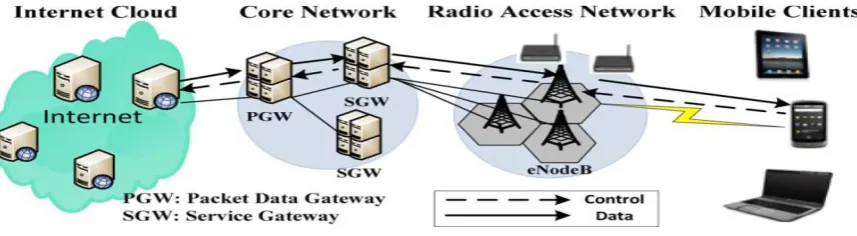
Simple structure of Mobile Cloud Computing is shown in figure below. Which shows how the Mobile devices interact with the cloud & how the flow of information takes place from Mobile devices to Cloud Servers.
In cloud computing, the available service models are:
Infrastructure as a Service. Provides the consumer with the capability for storage, networks and other
fundament computer resources. Which allow the consumer to develop and run arbitrary software, which can be included operating system and user applications The consumer has control over operating systems, storage, develop applications, and possibly limited control of select network components.
Fig: Mobile Cloud
© 2014, IJCSMC All Rights Reserved
781
Software as a Service. Provides the consumer with the capability to use the provider’s applications running on a cloud infrastructure. The applications are accessible from various clients. Through a client interface such as a web browser (e.g. web-based e-mail). The consumer not manage nor control the underlying cloud infrastructure including network, servers operating systems and storage, or even individual applications capabilities, with possible exception or limited user specific application configuration settings.
Here we focus on Cloud Mobile Media (CMM) applications and services which will not permit mobile users to not only access rich media from any mobile device and platform, but even more important which will not able mobile users to engage in new rich media experiences through the use of mobile cloud, that are impossible otherwise from their mobile devices. CMM will also enable service provider’s and network operators to offer services more efficient with lower cost and better user experience. Consumers adopt smartphones and tablets as one of their primary media experience platforms. Cloud Mobile Media has the potential of significantly boosting the revenue of cloud Software-as-a-Service providers. Some of the media rich CMM services will require new and richer platform and infrastructure capabilities.
Fig : Cloud Mobile Media Architecture
Above figure shows the CMM architecture. CMM offers new type opportunities for mobile network operators to close the growing gap between growth in data usage and data revenue by offering innovative CMM services and experiences outside of conventional applications stores where their participation has not been strong so far.
II. EXISTINGSYSTEM
[2] With the evolution of mobile devices and networks, and the fast developing trend of mobile Internet access rich, multiplayer gaming using mobile devices, similar to system based Internet games which have potential and interest. Such the current client-server architecture for system based Internet games where most of the storage and lumber of the game lies with the client device which will not work with mobile devices processing mobile gaming to downloaded single player games, or very light non-interactive versions of Internet games. In this paper we will study a cloud server based approach, termed Cloud Mobile Gaming where the burden of executing the gaming engines is put on cloud servers, and the mobile devices just communicate with the users' gaming commands to the servers. We analyse the factors affecting the quality of user experience using the CMG approach, including the game generate, video encoding & decoding factors, and the conditions of the wi-fi network. Based on the analysis, there was development of a model for Mobile Gaming User Experience (MGUE), and develop a prototype for real-time measurement of MGUE that can be used in real networks. We approved MGUE model using control subjective testing and by using to characterize user experience achievable using the CMG approach in wireless networks.
© 2014, IJCSMC All Rights Reserved
782
common method becomes less feasible in a hybrid cloud setting due to very high effective solve time variances.
The cloud paradigm appeared on the computing scene in 2005 with the Amazon Elastic Compute Cloud (EC2). [4] After this date, a large set of related technology have been developed. In the academic world and special in the HPC area cloud computing is way in competition with the GRID model which uses a middleware based approach. One of the proposed solutions is the integration of the two paradigms, in order to use the enormous potential of the existent computational GRIDs in a new different ways. One of the most tremendous problems on this system is the choice of the correct programming paradigm many different approaches exist and it is difficult to define which approach that best fit with the cloud paradigm. In this paper we develop the integration of a Cloud on GRID architecture with a mobile agent platform. The architecture we propose to develop Virtual clusters with full administrative control to the users, adopting an existent GRID architecture and its security infrastructure. The mobile agent platform is able to dynamically added and configuring services on the virtual clusters. The experience here presented shows that the mobile agent paradigm well fulfils the dynamic properties of the Cloud paradigm and could be a choice to simply develop application and services able to dynamically adapt themselves to the virtualized environment.
Cloud Mobile Rendering (CMR), where compute intensive rendering is performed on cloud servers instead of on mobile devices, can be a complete result oriented approach to enable rich rendering based multimedia applications on battery and CPU constrained mobile devices. However the video rendered in the cloud has been to be transmitted the mobile device over a wireless network with fluctuating and constrained bandwidth the resulting user experience can be impacted. In an adaptive rendering approach was proposed, where multiple factors can be adapted such that the bit rate of the encoded rendered video is compatible with the available network bandwidth. However, changing the rendent factors may itself have adverse impact on user experience. In this paper, we analyze the impairment of rendering factors on the quality of user experience and added to the rendering impairments with impairments due to video encoding factors (like bit rate and frame rate) and network factors (like bandwidth and delay) to formulate a model to measure the user experience during a Cloud Mobile Rendering session. We use this model CMR-UE in this paper. We use this method to derive the CMR-UE model, and demonstrate its accuracy and efficiencies through subjective testing using participants at UCSD. We use the CMR-UE model to study and develop the trade-off between the impact of rendering and video encoding factors on user experiences and finding the optimal rendering settings that maximize CMR-UE for any given network condition. Then we will use the CMR-UE model to measure user experience during CMR sessions on a live cellular network. We have demonstrate how user experience can be significantly enhanced by using appropriate and correct rendering settings under fluctuating network bandwidth conditions.
© 2014, IJCSMC All Rights Reserved
783
III. OPTIMIZATIONOFCOMPUTATIONLOAD
From the above section we can conclude that the usage of mobile cloud is increased and every mobile user wants to have rich application experience .So for this Mobile cloud computing can be used. Normally mobile users stores most of their favourite videos, pictures , songs etc. in mobile memory itself.
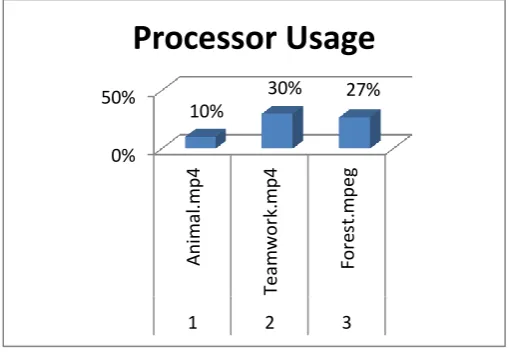
Whenever user want to perform multiple operations in mobile device the usage of core (Processor) is more. Due to this there is major effect on its computation. To prove it we take example of video. In this analysis of the Processors utilization is considered. When we make use of the mobile for playing video through it consumes the processor. Its analysis is mentioned below. :
Fig : CPU Utilization for Local Storage Graph
From this it can be analysed the utilization of mobile processors for playing video file from its local memory. From this it is clear that multiple task performance will take time for computation.
To overcome this computation problem for mobile devices, we make use of mobile cloud computing. It requires that all the mostly used videos, pictures, songs etc. have to be stored in Cloud. Once those file are uploaded in that cloud we can play those videos , pictures , songs etc. from anywhere if we have the access to cloud were those file are stored.
Now to analyse it observation of processors usage during playing of video files is done .It is found that the usage of CPU is comparatively less when it was being used directly from local storage.
Fig:CPU Utilization for Cloud Graph
0% 50%
A
ni
m
al
.m
p4
Team
wo
rk.
m
p4
Fo
re
st.
m
peg
1 2 3
10%
30% 27%
Processor Usage
0% 20%
A
ni
m
al
.m
p4
Tea
m
wo
rk
.m
p4
Fo
re
st.
m
peg
1 2 3
6% 15%
13%
Processor Usage
© 2014, IJCSMC All Rights Reserved
784
Now if it is compared with the output we are getting for two different methods is prominent. There less usage of processor is done when using it from mobile cloud. Overall it can be observed that nearly 45-50% downfall is there on Processors usage. This effort is only at the mobile device end further optimization can be performed by using multiple cloud concepts with proper load balancing.
IV.CONCLUSIONS
In this paper we have presented a novel approach for mobile cloud computing to address the challenges associated with cloud mobile which protecting the confidentiality and integrity of uploaded files or data in mobile storage cloud computing system. In current situation we have observed the usage of Processor. The usage of RAM, No. of Cores & Network Delay can be the other parameters to which we can observe & make a mobile device ready for Rich mobile Applications. Further after doing this task at mobile end, we can move toward mobile cloud load balancing, i.e no. of cloud server will be available for utilization. But proper utilization by using multiple cloud servers, switching from one cloud server to other. So for that in this focus will be required on some task distribution techniques on Cloud end which will give better output. Here we can make use of Round Robin algorithm for it. With this we will be optimizing the computational load over mobile devices as well as at cloud end.
REFERENCES
1. Shaoxuan Wang and Sujit Dey ,” Adaptive Mobile Cloud Computing to Enable Rich Mobile Multimedia Applications” IEEE Transactions On Multimedia, Vol. 15, No. 4, June 2013.
2. Yao Liu ,Shaoxuan Wang ; Dey, S., “Modeling, characterizing, and enhancing user experience in
Cloud Mobile Rendering” Computing, Networking and Communications (ICNC), 2012, IEEE International Conference
3. Dimitrios Zissis , Dimitrios Lekkas, “ Addressing cloud computing security issues”, IEEE, Future
Generation Computer Systems 28 (2012) 583–592.
4. Huajian Mao, Nong Xiao , Weisong Shi , Yutong Lua “A cloud-oriented file service for mobile Internet devices” IEEE , J. Parallel Distrib. Comput. 72 (2012) 171–184
5. G. Lee, B. Chun, and R. Katz, “Heterogeneity-aware resource allocation and scheduling in the cloud,”
in Proc. 3rd USENIX Workshop Hot Topics in Cloud Comput., Jun. 2011.
6. Zaheer Ahmad a, Keith E. Mayes b, Song Dong a, Kostas Markantonakis “Considerations for mobile
authentication in the Cloud” ,IEEE, information security technical report ( 2011 ) 1-8
7. S. Wang and S. Dey, “Addressing response time and video quality in remote server based internet
mobile gaming,” in Proc. IEEE WCNC, Sydney, Australia, Mar. 2010.
8. Aversa, R. Di Martino, B. ; Rak, M. ; Venticinque, S.,” Cloud Agency: A Mobile Agent Based Cloud System” Complex, Intelligent and Software Intensive Systems (CISIS), 2010 , IEEE , International Conference.
9. R. Bossche, K. Vanmechelen, and J. Broeckhove, “Cost-optimal scheduling in hybrid IaaS clouds for
deadline constrained workload,” in Proc. IEEE Int. Conf. Cloud Comput., Miami, FL, USA, Jul. 2010
10. ZhenJiang Li and Cheng Chen, “Cloud Computing for Agent-Based Urban Transportation
Systems”Chinese Academy of Sciences Kai Wang, National University of Defense Technology
11. S. Wang and S. Dey ,” Modelling and Characterizing User Experience in a Cloud Server Based Mobile Gaming Approach ” Proc. IEEE GLOBECOM, 2009
12. Jensen M, Schwenk J, Gruschka N, Iacono LL. On technical security issues in cloud computing. In: Proceedings of the IEEE international conference on cloud computing; 2009, pp. 109e116.
13. S. Wang and S. Dey, “Modeling and characterizing user experience in a cloud server based mobile
gaming approach,” in Proc. IEEE GLOBECOM, Honolulu, HI, USA, Dec. 2009.
14. F.-Y. Wang, “Parallel System Methods for Management and Control of Complex Systems,” Control and Decision, vol. 19, no. 5, 2004, pp. 485–489.
15. M. Satyanarayanan, J. Kistler, P. Kumar, M. Okasaki, E. Siegel, D. Steere, Coda:” a highly available