https://doi.org/10.1038/srep36307
[email protected]
https://eprints.whiterose.ac.uk/
Reuse
This article is distributed under the terms of the Creative Commons Attribution (CC BY) licence. This licence
allows you to distribute, remix, tweak, and build upon the work, even commercially, as long as you credit the
authors for the original work. More information and the full terms of the licence here:
https://creativecommons.org/licenses/
Takedown
If you consider content in White Rose Research Online to be in breach of UK law, please notify us by
www nature com scientificreports
Time-resolved imaging of magnetic
vortex dynamics using holography
with extended reference
autocorrelation by linear
di erential operator
N. Bukin , C. McKeever , E. Burgos-Parra , P. S. Keatley , R. J. Hicken , F. Y. Ogrin ,
G. Beutier , M. Dupraz , H. Popescu , N. Jaouen , F. Yakhou-Harris , S. A. Cavill &
G. van der Laan
The magnetisation dynamics of the vortex core and Landau pattern of magnetic thin lm elements has been studied using holography with extended reference autocorrelation by linear di erential operator
HERALDO Here we present the rst time resolved x ray measurements using this technique and
investigate the structure and dynamics of the domain walls after excitation with nanosecond pulsed
magnetic elds It is shown that the average magnetisation of the domain walls has a perpendicular component that can change dynamically depending on the parameters of the pulsed excitation In
particular, we demonstrate the formation of wave bullet-like excitations, which are generated in the domain walls and can propagate inside them during the cyclic motion of the vortex core. Based on numerical simulations we also show that, besides the core, there are four singularities formed at the corners of the pattern. The polarisation of these singularities has a direct relation to the vortex core, and
can be switched dynamically by the wave bullets excited with a magnetic pulse of speci c parameters The subsequent dynamics of the Landau pattern is dependent on the particular con guration of the
polarisations of the core and the singularities.
In recent years, vortex closure domains in magnetic thin-ilm elements have become the focus of great attention due to their intriguing dynamic properties. As well as being fascinating model objects – in many aspects the vortices behave like classical harmonic oscillators – they are considered as promising new magneto-electronic components, which could provide a wide range of functionalities, stretching from static non-volatile high-density data storage1 to dynamic skyrmion excitations2–4 and magnetic vortex generators5–7. he latter have
particu-larly attracted much interest ater it was demonstrated that, similar to spin-torque oscillators (STOs), a magnetic vortex can be driven by either AC or DC currents and perform as a microwave oscillator7–15. In comparison
to an STO device, a magnetic vortex is a natural and more coherent resonating system, which is less afected by imperfections in the geometry of the material and its intrinsic parameters. However, the understanding of vortex dynamics remains complex, especially in matters regarding nonlinear efects. In case of thin ilm pat-terned magnetic elements, such as microscopic permalloy (Py, Ni81Fe19) squares or dots, the focus of research
has been covering a number of topics including the understanding of the eigen-modes of gyration in single elements1,11,12,15–17, coupled oscillations in assemblies or patterns of elements18–24, non-linear efects24–27,
manip-ulation of core dynamics11–13,15 and their practical application7,8,12,13. In many cases the investigations have been
based on time-resolved imaging using optical28–31 or x-ray techniques17,32–35. he spatial resolution in the best case
School of Physics and Astronomy University of Exeter Exeter EX QL United Kingdom CNRS SIMAP F Grenoble France Paul Scherrer Institute Villigen Switzerland SOLEIL Synchrotron Saint Aubin France European Synchrotron Radiation Facility F Grenoble Cedex France Department of Physics, University of York York YO DD United Kingdom Diamond Light Source Harwell Science and innovation Campus Didcot Oxfordshire OX DE United Kingdom Correspondence and requests for materials should be addressed to FY O email f y ogrin exeter ac uk
Received August
Accepted October
is limited to the wavelength of the optical probe convoluted with the speciics of the particular techniques and their limitations. For example, in the case of sot x-ray imaging the typical values are in the region of 20–50 nm. his is insuicient to clearly resolve the vortex core or domain walls with dimensions (~10–15 nm). In the major-ity of investigations these limitations were compensated by simulation studies using micromagnetic numerical tools, such as Mumax36, from which one can further assess the efects that may not be clearly resolved in spatial
imaging. his also facilitated study of the iner structure of the vortex closures and its dynamics11,26,37,38 and to
investigate non-linear efects and spin-wave phenomena associated with both the excitation and the steady states of the vortex gyration. he latter are of particular importance in technological applications, where vortex core manipulation underpins their operation (e.g. polarisation switching). Numerical work is also invaluable to under-stand the 3D structures of the domain closures, as these are normally ‘hidden’ for the experimental probes (e.g., in x-ray transmission experiments), because of averaging or insensitivity to in-depth magnetisation.
Here we report the irst demonstration of time-resolved imaging of vortex gyration using holography with extended reference autocorrelation by linear diferential operator (HERALDO). his relatively new technique39 has
recently been adopted for imaging of magnetic materials40–43. Similar to most synchrotron-based magnetic probes,
it uses x-ray magnetic circular dichroism (XMCD)44,45 to probe the magnetisation with element-speciicity, for
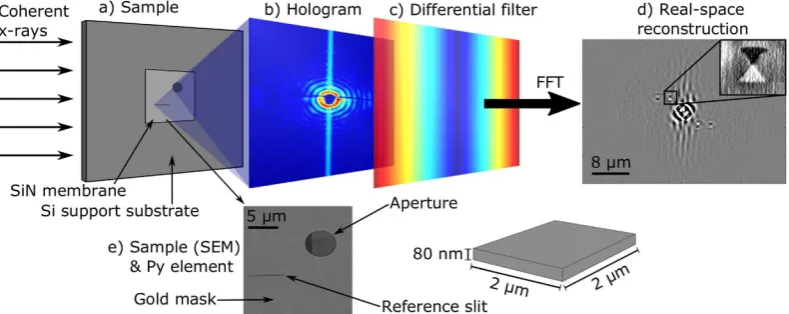
which magnetic contrast is observed for magnetic moments aligned parallel or anti-parallel to the x-ray wave vector. Based on the principles of holography, HERALDO uses the interference between the reference beam and the scattered light from the sample to reconstruct the real-space magnetic contrast. Compared to standard Fourier transform holography (FTH)46–48, in HERALDO the reference beam is produced by a slit rather than a
hole (see Fig. 1). One of the advantages of this modiication is the ability to image both out-of-plane and in-plane magnetic components by performing measurements at normal (90 degrees) and acute (e.g. 45 degrees) angles of x-ray incidence with respect to the sample respectively. Here we employ HERALDO for time-resolved imaging of the magnetic vortex gyration in thin-ilm magnetic Py squares. Similar to circular elements, in these structures the vortex is formed as a result of minimisation of the magnetostatic energy, forcing the magnetic moments to stay preferably in-plane of the element. However, due to the inluence of the straight edges, as well as creating the vortex core, the square elements tend to form 90° domain walls, breaking the sample into four equi-sized triangular domains, forming a so-called Landau Flux Closure pattern29,49,50. he dynamics of the core is in this
case also afected by the mobility of the domain walls and the associated magnetostatic energy. Furthermore, it was shown51 that the structure of the core itself and its dynamics can be greatly afected by the ilm thickness of
the elements. Here we present a study on relatively thick (80 nm) Py elements. As well as the gyration of the core studied by x-ray imaging and micromagnetic simulations, we also examine the overall 3D structure of the mag-netic coniguration and its dynamics during the irst cycles of excitation. In particular we focus on the associated spinwave phenomena and investigate the wave propagations localised within the domain walls of the element.
Results
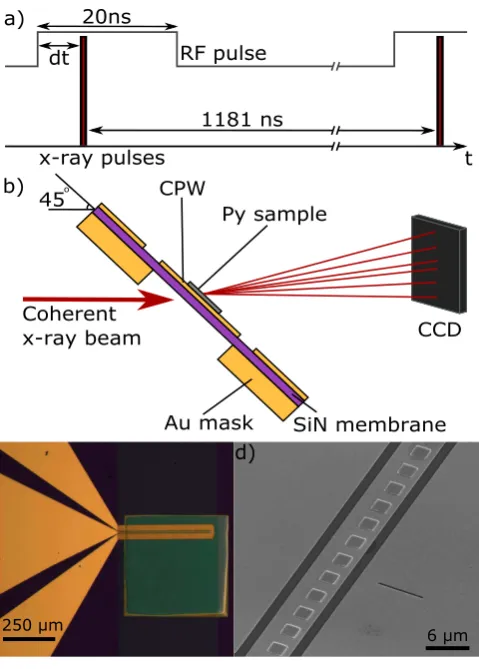
he experiments were carried out in the stroboscopic regime12,16,17. he overall schematics of the pump-probe
[image:3.595.157.552.47.204.2]www.nature.com/scientificreports/
available beamtime and the substantial acquisition time (a typical hologram took 30–40 min) a particular focus was given to the initial stage of vortex actuation and the irst two cycles of gyration. Overall, we imaged 29 points starting from t0 and ending at t0 + 10 ns, with a typical step size of 250 ps and an average spatial resolution of
30 nm (40 nm) in vertical (horizontal) direction.
For imaging in perpendicular orientation (see Fig. 3a) an enhanced spatial resolution of 20 nm in both vertical and horizontal directions was achieved by moving the CCD camera closer to the sample. he reconstruction of the magnetic contrast was performed in the same way as previously reported40,41. he diference between the
difraction patterns for the two polarisations of opposite circularly polarised light was multiplied by the inten-sity matrix representing the diferential ilter. he resulting image was then Fourier transformed to obtain the real-space magnetic contrast (see Fig. 1). Figure 3 shows the results of the reconstructions from the data obtained at diferent delay times between t0 and the x-ray probe pulse. Imaging was carried out at two diferent x-ray angles
of incidence (90° and 45°) with respect to the sample surface, and for two diferent pulse amplitudes (7.7 mT and 10 mT), respectively. Figure 3a,b depict typical images of the magnetic contrast in the area of the vortex core acquired at 90° and 45°. he overlaid lines trace the positions of the core at diferent delay times. Figure 3c shows the vertical displacement of the core as a function of delay time, as well as the results of micromagnetic simula-tions, modelled using the same geometric and material parameters. Figure 3d shows the spatial positions of the core extracted from all frames imaged at perpendicular (90°) orientation of the x-rays with respect to the sample. Supplementary movies S1, S2, and S3 show the combined time-resolved images for both sample orientations.
Figure 3c shows that, as time progresses from t0, the core of the vortex is irst vertically displaced (along the
CPW) ater which it follows a continuous precession around a new equilibrium position. his new position is determined by the amplitude of the magnetic pulse and, once the gyration is fully damped (ater ~30 ns), it has the same vertical displacement as would have been induced by a constant applied ield with the same magnitude as that of the pulsed ield. As in experiments on circular elements (e.g.,20,27), suicient bandwidth (∆f≈ 1/∆t) for
[image:4.595.156.396.42.377.2]excitation of eigen-modes of the vortex gyration was provided by a pulse with a rise time of ∆t≈ 1 ns. To match the amplitude of gyration with that produced in the simulation we used a Gaussian smoothing of the pulse, which leads to a further reduction of the dynamic bandwidth, but more realistically describes the experimental capabil-ities of the generator and the transmission lines. In the simulation, we also assumed a non-uniform structure of
the ield, which was inversely proportional to the distance r from the antenna according to the relation B = B0r0/
(r0 + r), where B0= 7.7 mT is the ield at the surface of the antenna, and r0= 40 nm is the half-thickness of the
antenna. As shown below, this non-uniform nature of the ield plays an important role in the dynamics of the domain walls. Based on previous studies, the gyration frequency is mainly determined by the geometric param-eters of the element and is proportional to the thickness to length aspect ratio of the square51,52. In our
measure-ments on a square of 2 µ m long and 80 nm thick, the period of the irst cycle of gyration was found to be ~4.5 ns. his value is in good agreement with that obtained by the micromagnetic simulations. he reduction in the amplitude of gyration is also in agreement with the simulation, in which the damping coeicient of Py is set to its standard value of α = 0.008.
Core structure.
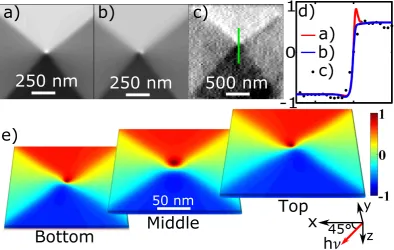
As mentioned above, to obtain the in-plane magnetisation contrast, which is predominant in this case, the imaging is performed at 45°, providing the required non-zero in-plane projection of the x-ray wave vector. However, regions with out-of-plane components will also result in a non-zero magnetic contrast, thereby providing more information about the overall domain structure. In particular this is important for thicker elements, in which the increased aspect ratio leads to non-linear regions with large variations of the magnetisa-tion vector. Figure 4 shows the magnetic contrast in the vicinity of the vortex core obtained experimentally, and extracted from micromagnetic simulation. Two particular aspects arising from of-normal imaging are related to the angle of observation. Firstly, the maximum (zero) magnetic intensity is found for moments forming 45° (135°) with the surface (Fig. 4a). hese are the moments that are at opposite sides of the core centre and either parallel or at 90° to the x-ray beam. heoretically, the extension between the maximum intensity and its zero can be taken as the average dimension of the core.Secondly, imaging at 45° results in averaging of the magnetic contrast along the lines inclined at this angle. For thicker elements this means that a projection of the vertical structure will also be present in the image. Figure 4b shows the simulation result of the experimental data in Fig. 4c, in which the averaging is taken at 45°. he area of the core shows a certain structure arising from the horizontal non-uniformity of the Mx component. A further
examination of the simulation results for diferent layers of the element (Fig. 4e) reveals that the structure of the core is asymmetric towards the top and bottom layers, which are respectively mapped at their inclined projection. However, this structure is diicult to resolve, and experimentally it is exhibited only in the horizontal broadening of the core area (Fig. 4d). Examining diferent phases of gyration shows a similar structure, indicating that this structure is a result of the static magnetic coniguration. From previous numerical studies on thick elements53, it
is known that the structure of the core can be non-uniform, and this is generally related to the minimisation of the dipole-dipole energy across the thickness of the sample. Although this efect is relatively small, we speculate that it may play a role in the asymmetric dynamic efects of the domain walls described below.
[image:5.595.157.553.45.213.2]Domain wall dynamics.
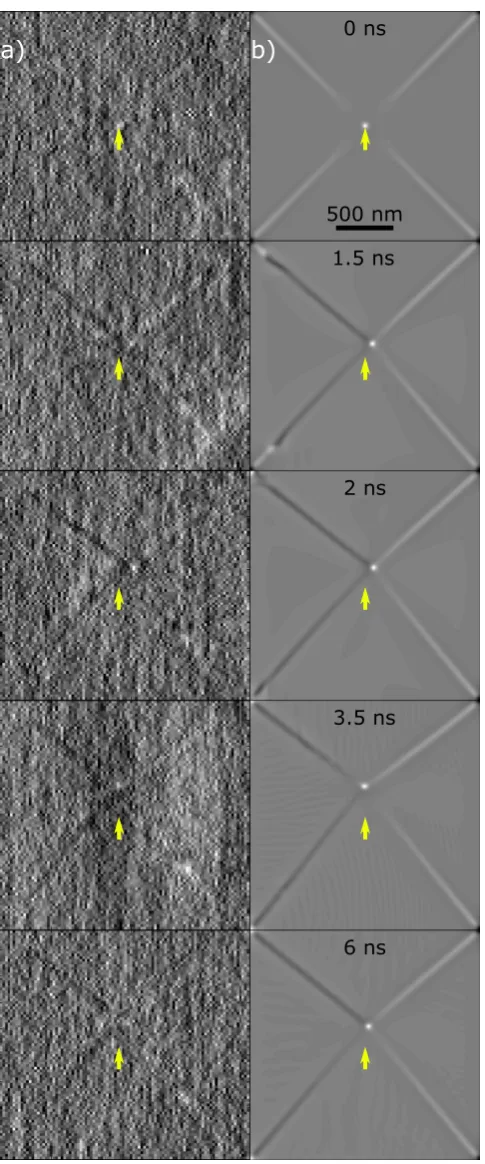
Figure 5 displays the experimental and simulated images obtained for perpendicular orientation of the x-ray beam. he contrast clearly indicates a point at the core, which was used to trace the gyra-tion trajectory. his is particularly useful to identify the horizontal displacement, which cannot be easily extracted from the ‘in-plane’ imaging. he images are also of suicient quality to resolve the magnetisation structure of the area around the core as well as the domain walls. Analysing the contrast of the domain walls compared to those produced in the simulations, one can see the following dynamic efects. Before the magnetic pulse is triggered, all four domain walls show a small out-of-plane magnetisation component, which has the same polarisation as thewww.nature.com/scientificreports/
core. Once the magnetic ield begins to rise ater t0, two of the walls reverse to opposite polarisation. his happens
through the formation of a ‘bullet-like’ excitation that propagates from the core towards the corners of the element and switches the positive component entirely or leaves a small domain close to the corners (not shown here).
he exact scenario depends on the magnitude and form of the applied magnetic pulse. A reasonably low pulse (B0≈ 4 mT) can switch the polarisation of both domains walls together with their corresponding corner
singularities (see Figs 5 and 6). A smaller pulse amplitude can lead to switching of only one corner singularity or none at all. In the latter case all four corner singularities maintain the same polarisation, but the domain walls will partially change theirs. Once the magnetic pulse reached its maximum, the core continues along its gyration trajectory. Once the core has passed its maximum displacement, the polarisation of the domain walls typically remain the same. Generally, if the magnetic ield is non-uniform, all domain walls will maintain their polarisation (two up and two down) and continue to oscillate with the core. However if the ield is uniform, the bullets are still formed, but they cannot switch polarisation in the corners and ater some period of sporadic motion the polari-sation of all domain walls returns to its initial state (see supplementary videos S4 and S5).
It should be noted that in our simulation study the corners of the elements are ‘ideal’, so the efect of singulari-ties is signiicantly pronounced. In the experiment however, due to lithographic imperfections these singularisingulari-ties are broadened and therefore less intense than the vortex core. his is also a likely reason why the polarisation of the corners can be switched by the onset of the pulsed magnetic ield, thus leaving the combination of two black domain walls and two white domain walls that are unchanged during the core gyration (Fig. 5a). Based on the simulation results, we also note that, similar to the vortex core, the 3D structure of the domain walls is also non-uniform. Figure 6d shows how it changes across the thickness of the square. he larger contrast corre-sponds to the middle layers of the structure, whereas at the surfaces the efect is mostly suppressed. It was found that the formation of the bullets and their propagation strongly depends on the ield gradient. If the amplitude of the ield is larger at the bottom layers of the element (as is the case in our experiment), the bullets are formed in the let-hand domain walls. However, if the sign of the gradient is reversed, the bullets will be formed in the right-hand domain walls and a similar dynamic scenario is obtained, but only with opposite polarisations of the let-hand and right-hand domain walls and their singularities in the corners.
[image:6.595.157.552.46.296.2]We speculate that other factors will also likely afect the demonstrated dynamics, including the initial polari-sation of the core and the singularities in the corners, the vertical structure of the core, the chirality of the vortex and the temporal structure of the magnetic ield pulse. Here we simulate a particular case that provides good agreement with the experimental observations. However, further combined studies of experiments and micro-magnetic simulation are required to understand the phenomenon in more detail.
Figure 4. he core structure. Simulated normalised magnetic contrast with averaging out the thickness in (a) perpendicular orientation and (b) over 45° direction. (c) Reconstructed experimental image obtained for the same delay time. (d) Vertical intensity proiles through the centre of the core for all three images a, b and c. Positive values correspond to magnetisation vector parallel to the x-ray wave vector. (e) Simulated images of the magnetic contrast for diferent layers within the structure. From let to right, the images represent the bottom 1st, middle 8th and top 16th layer of a 16-cell thick simulation grid (cell size is 3.9 × 3.9 × 5 nm3). Colour coding:
Conclusions
[image:7.595.156.399.41.624.2]In summary, we have demonstrated time-resolved imaging of vortex gyration using a novel technique based on x-ray holography with extended references. Using micromagnetic simulations we have conirmed the eigen fre-quency of the principal mode of gyration and explored the dynamics of the Landau closure domains at the onset
www.nature.com/scientificreports/
of excitation and during the precession of the core. We showed that the 3D structure and the dynamics of the core have a direct efect on the domain walls, which can change their out-of-plane polarisation and follow the gyra-tion of the core depending on the state of the singularities in the corners of the Landau pattern. We also showed that the change in polarisation is accomplished via the formation of ‘bullet-like’ excitations, which propagate within the domain walls and can also lead to switching the singularities at the corners. he latter are energetically related to the polarisation of the core and can reduce the energy required for switching its state. hese efects are important for further understanding these systems because the manipulation of the core and its dynamics are key factors in the prospective technology utilising vortex gyration.
Methods
Sample preparation.
he samples were prepared on a 500 µ m × 500 µ m × 200 nm Si3N4 membrane, whichserved as substrates for lithographically produced CPWs and Py squares. In both cases, the standard elec-tron-beam lithography (EBL), metal deposition and lit-of techniques were used to obtain free standing Py ele-ments. A dual Focussed Ion beam (FIB) system was used to form the apertures and reference slits. he Py squares were 2 µ m × 2 µ m × 80 nm and had an edge-to-edge separation of 2 µ m which ran along the entire length of the CPW core. A 600 nm thick gold ilm served as a mask and was evaporated onto the underside of the sample in order to block the x-rays in the imaging measurements. Each device had a 3.5 µ m aperture milled through the gold mask with a FIB down to the silicon nitride membrane. Each CPW contained 5 devices separated 100 µ
[image:8.595.158.482.42.421.2]m apart from each other along the CPW core (see Fig. 2(d)). Reference slits were milled throughout the mask,
Figure 6. Simulated images of the domain wall structure. (a) Perpendicular component of the magnetisation at diferent delay times t0+ : 0.3, 1.3, 1.8 and 2.3 ns. (b) 3D depiction of the out-of-plane magnetic component
he transmitted x-rays were recorded on a CCD camera positioned on the optical axis behind a beam stop for the direct, undifracted beam. he distance from the camera to the sample was set to 25 cm, resulting in a minimum spatial resolution of 20 nm. To obtain holographic images the sample had a reference slit that was isolated from the imaged area by a distance corresponding to twice the aperture diameter, and within the x-ray coherence length (~25 µ m). he interference pattern of the direct and difracted x-rays was recorded on the CCD for let- and right-circularly polarised x-rays, which were subtracted and then operated on by the directional derivatives and Fourier transformed to obtain the real-space image. he magnetic images were taken at a photon energy of 707 eV coinciding with the Fe L3 absorption edge.
Micromagnetic Simulations.
Micromagnetic simulations of 2 μm permalloy squares with thickness 83 nm were performed using the MuMax micromagnetic solver33. Parameters for permalloy (saturation magnetisation Ms= 8 × 10⁵ A m−1, exchange constant = 1 × 10⁻¹¹ J m−3 and Gilbert damping = 0.008) were chosen with cell-size x = 2000/512 nm, y = 2000/512 nm, z= 83/16 nm and negligible magnetocrystalline anisotropy. Vortex precession was induced by a step pulse with maximum amplitude(s) of 7.7 mT and 10 mT and rise-time ~1 ns. he ield pro-ile decays as 1/(r0+ r) through the thickness of the square element with r0= 40 nm representing the half thicknessof the antenna. he lateral variation of the ield (close to the edges of the central CPW conductor) was neglected. he dot product of the vector magnetisation was calculated with respect to a 135 degree (see Fig. 4b) and perpen-dicular (see Figs 5 and 6) orientation of the x-ray and the magnetisation was averaged across the thickness at the corresponding angle.
References
1. Bolte, M. et al. Time-resolved x-ray microscopy of spin-torque-induced magnetic vortex gyration. Phys. Rev. Lett 100, 176601 (2008).
2. Muhlbauer, S. et al. Skyrmion lattice in a chiral magnet. Science 323, 915 (2009).
3. Butner, F. et al. Dynamics and inertia of skyrmionic spin structures. Nature Physics 11, 225 (2015).
4. Mulkers, J. et al. Cycloidal versus skyrmionic states in mesoscopic chiral magnets. Phys. Rev. B. 93, 214405 (2016). 5. Pribiag, V. S. et al. Magnetic vortex oscillator driven by d.c. spin-polarized current. Nature Physics 3, 498–503 (2007). 6. Ruotolo, A. et al. Phase-locking of magnetic vortices mediated by antivortices. Nat. Nanotechnol. 4, 528–532 (2009).
7. Dussaux, A. et al. Large microwave generation from current-driven magnetic vortex oscillators in magnetic tunnel junctions. Nat. Commun. 1, 1006 (2010).
8. Stiles, M. D. & Miltat, J. Spin-transfer torque and dynamics In Spin dynamics in conined magnetic structures III. 225–308 (Springer, 2006). 9. Kiselev, S. I. et al. Microwave oscillations of a nanomagnet driven by a spin-polarized current. Nature 245, 380–383 (2003). 10. Katine, J. A., Albert, F. J. & Buhrman, R. A. Current-driven magnetization reversal and spin-wave excitations in Co/Cu/Co pillars.
Phys. Rev. Lett. 84, 3149–3152 (2000).
11. Kammerer, M. et al. Magnetic vortex core reversal by excitation of spin waves. Nat. Commun. 2, 1277 (2011).
12. Waeyenberge et al. Magnetic vortex core reversal by excitation with short bursts of alternating ield. Nature 444, 461–464 (2006). 13. Bohlens, S. et al. Current controlled random-access memory based on magnetic vortex handedness. Appl. Phys. Lett. 93, 142508
(2008).
14. Bisig, A. et al. Direct imaging of current induced magnetic vortex gyration in an asymmetric potential well. Appl. Phys. Lett. 96, 152506 (2010).
15. Weigand, M. et al. Vortex core switching by coherent excitation with single in-plane magnetic ield pulses. Phys. Rev. Lett. 102, 077201 (2009).
16. Puzic, A. et al. Spatially resolved ferromagnetic resonance: Imaging of ferromagnetic eigenmodes. J. Appl. Phys. 97, 10E704 (2005). 17. Stoll, H. et al. High-resolution imaging of fast magnetization dynamics in magnetic nanostructures. Appl. Phys. Lett. 84, 3328
(2004).
18. Barman, A., Barman, S., Kimura, T., Fukuma, Y. & Otani, Y. Gyration mode splitting in magnetostatically coupled magnetic vortices in an array. J. Phys. D: Appl. Phys. 43, 422001 (2010).
19. Sukhostavets, O. V., Gonzalez, J. M. & Guslienko, K. Y. Magnetic vortex excitation frequencies and eigenmodes in a pair of coupled circular dots. Appl. Phys. Express 4, 065003 (2011).
20. Jung, H. et al. Logic operations based on magnetic-vortex-state networks. ACS Nano. 6, 3712–3717 (2012).
21. Han, D.-S. et al. Wave modes of collective vortex gyration in dipolar-coupled-dot-array magnonic crystals. Sci. Rep. 3, 2262 (2013). 22. Jung, H. et al. Tunable negligible-loss energy transfer between dipolar-coupled magnetic disks by stimulated vortex gyration. Sci.
Rep. 1 59 (2011).
23. Jung, H. et al. Observation of coupled vortex gyrations by 70-ps-time- and 20-nm-space-resolved full-ield magnetic transmission sot x-ray microscopy. Appl. Phys. Lett. 97, 222502 (2010).
24. Koop, B. C. et al. Static and dynamic properties of vortex pairs in asymmetric nanomagnets. AIP Advances 6, 056406 (2016). 25. Drews, A. et al. Nonlinear magnetic vortex gyration. Phys. Rev. B 85, 144417 (2012).
www.nature.com/scientificreports/
27. Guslienko, K. Y., Heredero, R. H. & Chubykalo-Fesenko, O. Nonlinear gyrotropic vortex dynamics in ferromagnetic dots. Phys. Rev. B. 82, 014402 (2010).
28. Keatley, P. S., Kruglyak, V. V., Gangmei, P. & Hicken, R. J. Ultrafast magnetization dynamics of spintronic nanostructures. Phil. Trans. R. Soc. A 369, 3115–3135 (2011).
29. Raabe, J. et al. Quantitative analysis of magnetic excitations in Landau flux-closure structures using synchrotron-radiation microscopy. Phys. Rev. B 94, 217204 (2005).
30. Antos, R., Otani, Y. & Shibata, J. Magnetic vortex dynamics. J. Phys. Soc. Jpn 77, 031004 (2008). 31. Raabe, J. et al. Magnetization pattern of ferromagnetic nanodisks. J. Appl. Phys 88, 4437 (2000).
32. Chembrolu, V. et al. Time-resolved x-ray imaging of magnetization dynamics in spin-transfer torque devices. Phys. Rev. B 80, 024417 (2009).
33. Vogel, A., Martens, M., Weigand, M. & Meier, G. Signal transfer in a chain of stray-ield coupled ferromagnetic squares. Appl. Phys. Lett. 99, 042506 (2011).
34. Ewald, J. et al. A full-ield transmission x-ray microscope for time-resolved imaging of magnetic nanostructures. AIP Conf. Proc. 1696, 020005 (2016).
35. Wessels, P. et al. Time-resolved imaging of domain pattern destruction and recovery via nonequilibrium magnetization states. Phys. Rev. B 90, 184417 (2014).
36. Vansteenkiste, A. et al. he design and veriication of MuMax3. AIP Adv. 4, 107133 (2014).
37. Van de Wiele, B., Vansteenkiste, A., Kammerer, M. & Van Waeyenberge, B. Micromagnetic simulations on GPU, a case study: Vortex core switching by high-frequency magnetic ields. IEEE T. Magn. 48, 2068–2072 (2012).
38. Estévez, V. & Laurson, L. Head-to-head domain wall structures in wide permalloy strips. Phys. Rev. B 91, 054407 (2015). 39. Guizar-Sicairos, M. & Fineup, J. R. Holography with extended reference by autocorrelation linear diferential operation. Optics
Express 15, 17592–17612 (2007).
40. Duckworth, T. A. et al. Magnetic imaging by x-ray holography using extended references. Optics Express 19, 16223–16228 (2011). 41. Duckworth, T. A. et al. Holographic imaging of interlayer coupling in Co/Pt/NiFe. New J. Phys. 15, 023045 (2013).
42. Liu, T.-M. et al. Nanoscale coninement of all-optical magnetic switching in TbFeCo – competition with nanoscale heterogeneity. Nano. Lett. 15, 6862–6868 (2015).
43. Burgos-Parra, E. O. et al. Holographic magnetic imaging of single-layer nanocontact spin-transfer oscillators. IEEE T. Magn. 52, 6500304 (2016).
44. Van der Laan, G. et al. Experimental proof of magnetic x-ray dichroism. Phys. Rev. B 34, 6529 (1986). 45. Van der Laan, G. Applications of sot x-ray magnetic dichroism. J. Phys. Conf. Ser. 430, 012127 (2013).
46. Schlotter, W. F. et al. Multiple reference Fourier transform holography with sot x rays. Appl. Phys. Lett 89, 163112 (2006). 47. Scherz, A. et al. Phase imaging of magnetic nanostructures using resonant sot x-ray holography. Phys. Rev. B 76, 214412 (2007). 48. Müller, L. et al. Ultrafast dynamics of magnetic domain structures probed by coherent free-electron laser light. Synchrotron
Radiation News 26, 27–32 (2013).
49. Landau, L. & Lifshits, E. On the theory of the dispersion of magnetic permeability in ferromagnetic bodies. Phys. Zeitsch. Der Sow. 8, 153–169 (1935).
50. Kittel, C. heory of the structure of ferromagnetic domains in ilms and small particles. Phys. Rev. 70, 965 (1946).
51. Vansteenkiste, A. et al. Inluence of domain wall pinning on the dynamic behavior of magnetic vortex structures: Time-resolved scanning x-ray transmission microscopy in NiFe thin ilm structures. Phys. Rev. B 77, 144420 (2008).
52. Novosad, V. et al. Spin excitations of magnetic vortices in ferromagnetic nanodots. Phys. Rev. B 66, 052407 (2002).
53. Verba, R. V. et al. Spin-wave excitation modes in thick vortex-state circular ferromagnetic nanodots. Phys. Rev. B 93, 214437 (2016). 54. Sacchi, M. et al. IRMA-2 at SOLEIL: a set-up for magnetic and coherent scattering of polarized sot x-rays. Journal of Physics
Conferences Series, 425, 072018 (2013)
Acknowledgements
his research was partly supported by Engineering and Physical Sciences Research Council (EPSRC), UK (Grant No: EP/M001016/1). N.B. acknowledges support from Diamond Light Source and University of Exeter. E.B-P and C.M. acknowledge support via the EPSRC Centre for Doctoral Training in Metamaterials (Grant No. EP/ L015331/1) and CONICYT-Becas (Chile). One author, P. S. Keatley was supported by EPRSC grant EP/I038470/1.
Author Contributions
F.Y.O. led the project and conceived the main idea along with G.v.d.L., G.B. and S.A.C. N.B., E.B.-P., C.M., G.v.d.L., G.B., F.Y.-H. and F.Y.O. obtained preliminary experimental results of time-resolved imaging using HERALDO in Py samples with ID32 beamline (at European Synchrotron Radiation Facility, Grenoble, France). N.B. and F.Y.O. prepared the samples discussed in the manuscript. R.J.H., P.S.K. and E.B.-P. provided equipment for growth and characterisation of samples using time-resolved Kerr microscopy (P.S.K.) and VNA-FMR (E.B.-P.) to explore resonance gyration frequencies and other associated dynamic efects in the samples used for these experiments. G.v.d.L. provided the pulse generator and other necessary RF equipment to carry out time-resolved measurements at synchrotron facilities. G.B. and M.D. created and optimised the reconstruction sotware. F.Y.O., H.P., N.J., N.B., E.B.-P. and G.v.d.L. conducted the experimental measurements of vortex gyration in the Py squares described in this manuscript using IRMA-2 end station at the SEXTANTS beamline (at SOLEIL synchrotron radiation source, Saint-Aubin, Paris). C.M. carried out micromagnetic modelling and together with F.Y.O., N.B. and E.B.-P. interpreted the experimental results. N.B. and F.Y.O. wrote the manuscript. C.M., E.B.-P., G.v.d.L., S.A.C., N.J. and P.S.K. discussed the results and commented on the manuscript.
Additional Information
Supplementary information accompanies this paper at http://www.nature.com/srep
Competing inancial interests: he authors declare no competing inancial interests.
How to cite this article: Bukin, N. et al. Time-resolved imaging of magnetic vortex dynamics using holography with extended reference autocorrelation by linear diferential operator. Sci. Rep.6, 36307; doi: 10.1038/srep36307 (2016).