ISSN 0252-8266
%
eurostat
EUROSTATISTIK
Daten zur Konjunkturanalyse
EUROSTATISTICS
Data for short-term economic analysis
EUROSTATISTIQUES
Données pour l'analyse de la conjoncture
Monatlich D Monthly D Mensuel
6 D 1991
ma
eurostat
OFICINA ESTADÍSTICA DE LAS COMUNIDADES EUROPEAS
DE EUROPÆISKE FÆLLESSKABERS STATISTISKE KONTOR
STATISTISCHES AMT DER EUROPÄISCHEN GEMEINSCHAFTEN
ΣΤΑΤΙΣΤΙΚΗ ΥΠΗΡΕΣΙΑ ΤΩΝ
ΕΥΡΩΠΑΪΚΩΝ ΚΟΙΝΟΤΗΤΩΝ
STATISTICAL OFFICE OF THE EUROPEAN COMMUNITIES
OFFICE STATISTIQUE DES
COMMUNAUTÉS EUROPÉENNES
ISTITUTO STATISTICO DELLE COMUNITÀ EUROPEE
BUREAU VOOR DE STATISTIEK DER EUROPESE GEMEENSCHAPPEN
SERVIÇO DE ESTATÍSTICA DAS COMUNIDADES EUROPEIAS
L2920 Luxembourg Tél. 43011 Télex: Comeur Lu 3 4 2 3
B1049 Bruxelles, bâtiment Berlaymont, rue de la Loi 2 0 0 (bureau de liaison) Tél. 2351111
Las publicaciones de Eurostat están clasificadas por temas y por series. La clasificación se encuentra al
final de la obra. Para mayor información sobre las publicaciones, rogamos se pongan en contacto con
Eurostat.
Para los pedidos, diríjanse a las oficinas de venta cuyas direcciones figuran en la página interior de la
contracubierta.
Eurostats publikationer er klassificeret efter emne og serie. En oversigt herover findes bag i hæftet.
Yderligere oplysninger om publikationerne kan fås ved henvendelse til Eurostat.
Bestilling kan afgives til de salgssteder, der er anført på omslagets side 3.
Die Veröffentlichungen von Eurostat sind nach Themenkreisen und Reihen gegliedert. Die Gliederung ¡st
hinten in jedem Band aufgeführt. Genauere Auskünfte über die Veröffentlichungen erteilt Eurostat.
Ihre Bestellungen richten Sie bitte an die Verkaufsbüros, deren Anschriften jeweils auf der dritten
Umschlagseite der Veröffentlichungen zu finden sind.
Οι
εκδόσεις της Eurostat ταξινομούνται κατά θέμα και κατά σειρά. Η ακριβής ταξινόμηση αναφέρεται στο
τέλος κάθε έκδοσης. Για λεπτομερέστερες πληροφορίες σχετικά με τις εκδόσεις, μπορείτε να απευθύνεσθε
στην Eurostat.
Για τις παραγγελίες μπορείτε να απευθύνεσθε στα γραφεία πώλησης, των οποίων οι διευθύνσεις αναγράφονται
στη σελίδα 3 του εξωφύλλου.
Eurostat's publications are classified according to themes and series. This classification is indicated at the
end of the publication. For more detailed information on publications, contact Eurostat.
Orders are obtainable from the sales offices mentioned on the inside back cover.
Les publications d'Eurostat sont
classées par thème et par série. Cette classification est précisée à la fin
de l'ouvrage. Pour des informations plus détaillées sur les publications, contactez Eurostat.
Pour les commandes, adressez-vous aux bureaux de vente dont les adresses sont indiquées à la page 3
de la couverture.
Le pubblicazioni dell'Eurostat sono classificate per tema e per serie. Tale classificazione è precisata alla
fine dell'opera. Per informazioni più dettagliate sulle pubblicazioni rivolgersi all'Eurostat.
Per eventuali ordinazioni rivolgersi a uno degli uffici di vendita i cui indirizzi figurano nella 3
apagina
della copertina.
De publikaties van Eurostat zíjn ingedeeld naar onderwerp en serie. Deze indeling is achter in het boek
opgenomen. Voor nadere informatie over de publikaties kunt u zich wenden tot Eurostat.
EUROSTATISTIK
Daten zur Konjunkturanalyse
EUROSTATISTICS
Data for short-term economic analysis
EUROSTATISTIQUES
Données pour l'analyse de la conjuncture
ACHTUNG: Analyse und Kommentar auf S. 7
ATTENTION: Analysis and commentary on p. 11
Luxembourg: Office des publications officielles des Communautés européennes, 1991
Kat./cat.: CA-BJ-91-006-3A-C
© EGKS-EWG-EAG, Brüssel — Luxemburg, 1991
Nachdruck — ausgenommen zu kommerziellen Zwecken — mit Quellenangabe gestattet.
© ECSC-EEC-EAEC, Brussels — Luxembourg, 1991
Reproduction is authorized, except for commercial purposes, provided the source is acknowledged.
© CECA-CEE-CEEA, Bruxelles — Luxembourg, 1991
Reproduction autorisée, sauf à des fins commerciales, moyennant mention de la source.
EUROSTATISTICS
ON DISKETTE
The Statistical Office of the
European Communities ¡n
collaboration with the
company DSI, is offering all
the historical data and the
monthly updating of
Eurostatistics on floppy disks,
so you can consult these data
on your personal computer.
L'Office statistiques des
Communautés européennes,
avec la compagnie DSI, offre
sur disquettes toutes les
données historiques et les
mises à jour mensuelles·
d'Eurostatistiques, que vous
pouvez consulter sur votre
ordinateur personnel.
Das Statistische Amt der
Europäischen Gemeinschaften
in Zusammenarbeit mit der
Firma DSI bietet Ihnen alle
historischen Daten sowie
deren monatliche
Aktualisierung auf Diskette
an, so daß Sie dieselben
jederzeit auf Ihrem PC
abrufen können.
Bureau d'information :
Division A3
Office statistique des Communautés européennes
Bâtiment Jean Monnet
L-2920 Luxembourg
Name/Nom
Company/Entreprise/Gesellschaft
Vorwort
Mit der monatlich erscheinenden Veröffentlichung ,,Eurostatistik" - Daten zur
Konjunk-turanalyse werden innerhalb kürzester Frist die neuesten statistischen Daten über die
Europäische Gemeinschaft als Ganzes (EUR 12), über jedes Mitgliedsland sowie über
die Vereinigten Staaten und Japan bekanntgegeben.
„Eurostatistik" enthält nicht die Gesamtheit des bei Eurostat verfügbaren statistischen
Materials, sondern eine Auswahl der relevantesten Reihen über die konjunkturelle
Ent-wicklung.
Die Reihen werden jeweils für die letzten 15 Monate, die letzten fünf Quartale und die
letzten vier Jahre veröffentlicht, um eine kurz- oder mittelfristige Analyse -
gegebenen-falls mit überarbeiteten Zahlen - zu ermöglichen.
Schnelligkeit und Pünktlichkeit sind die wichtigsten Vorzüge dieser Veröffentlichung.
Aus diesem Grunde wurde sie im Umfang bewußt klein gehalten und enthält keine
Anmerkungen zur Methodik, die im übrigen in den spezialisierten Veröffentlichungen
von Eurostat zu finden sind.
„Eurostatistik" besteht aus vier Teilen:
- Die Rubrik „kurz notiert" gibt die wichtigsten Ereignisse und Entwicklungen der
jüngsten Zeit im wirtschaftlichen, finanziellen und sozialen Bereich wieder.
- Im Schaubilderteil werden die wichtigsten Reihen über die wirtschaftliche
Entwick-lung in der Gemeinschaft, den Mitgliedstaaten, den Vereinigten Staaten und Japan
veranschaulicht.
- Im Konjunkturdatenteil werden die Daten, die von Eurostat auf der Grundlage
gemeinsamer Kriterien harmonisiert wurden, für sämtliche Mitgliedstaaten
darge-stellt und mit den Daten der Vereinigten Staaten und Japans verglichen.
- Der Ländertabellenteil schließlich gibt für jedes Land auf je einer Seite die
wirt-schaftliche Entwicklung auf der Grundlage einer Anzahl von Indikatoren wieder, die
übrigens immer im Konjunkturdatenteil veröffentlicht werden.
Die in „Eurostatistik" veröffentlichten Daten stammen aus dem „ICG"-Bereich der
On-Iine-Datenbank „Cronos" von Eurostat.
Wer Zugang zu Cronos besitzt, kann jederzeit die Tabellen dieser Veröffentlichung
abfragen, wobei die Daten täglich auf den neuesten Stand gebracht werden. Hinweise
zur „on-line"-Benutzung finden sich auf S. 111.
Weitere Informationen über „Eurostatistik" können bei folgender Stelle angefordert
werden:
Eurostat - Direktion A
L-2920 LUXEMBURG
Telephon: (352) 4301-2046
4301-2038
Inhaltsverzeichnis
Zeichen und Abkürzungen
„KURZ NOTIERT"
SCHAUBILDER
. .
KONJUNKTURDATEN
1. Volkswirtschaftliche Gesamtrechnungen
2. Beschäftigung
3. Arbeitslosigkeit
4. Industrielle Produktion
5. Meinungsumfrage in der Industrie
6. Industrieerzeugnisse
7. Einzelhandel
8. Landwirtschaftliche Erzeugnisse
9. Außenhandel
10. Verbraucherpreise
11. Landwirtschaftliche Erzeugerpreise
12. Löhne und Gehälter
13. Finanzstatistiken
14. Zahlungsbilanz
LÄNDERTABELLEN
Titel (vollständiges Verzeichnis)
1. BR Deutschland
2. France
3. Italia
4. Nederland
5. Belgique/België
6. Luxembourg
7. United Kingdom
8. Ireland
9. Danmark
10. España
11. Hellas
12. Portugal
13. United States of America
14. Japan
7
17
37
41
44
47
54
58
62
63
65
86
89
90
91
95
98
99
100
101
102
103
104
105
106
107
108
109
110
111
112
%,T4/T0
%,T12/T0
%,T/T12
%,SALDO
1985 = 1 0 0
EUR 1 0 = 100
EUR 12 = 100
MIO
MRD
Τ
TR0EE
GWH
M3
Β
DK
D
GR
E
F
IRL
I
L
NL
Ρ
UK
USA
JAP
USD
ECU
SZR
EG
Eurostat
EUR 10
EUR 12
UEBL/BLEU
ACP
ESVG
NACE
SITC
Weniger als die Hälfte der verwendeten
Einheit
Prozent
Prozentualer Zuwachs eines Vierteljahres
gegenüber dem entsprechenden Vierteljahr
des Vorjahres
Prozentualer Zuwachs eines Monats
gegenüber dem entsprechenden Monat
des Vorjahres
Saldo zwischen den positiven Antworten
(Zunahme, Verbesserung der Situation) und
den negativen Antworten (Abnahme,
Verschlechterung der Situation) der
Konjunkturbefragung bei den
Unternehmern in der Gemeinschaft,
saisonbereinigt (Ländertabellen)
Basisjahr
Prozentuale Angaben im Verhältnis zur
Gemeinschaft der 10 oder 12 ( = 100)
Million
Milliarde
Metrische Tonne
Tonne Rohöleinheiten
Gigawattstunde = 10
6kWh
Kubikmeter
Belgique/België
Danmark
BR Deutschland
Ελλάδα/Griechenland
España
France
Ireland
Italia
Luxembourg
Nederland
Portugal
United Kingdom
United States of America
Japan
US-Dollar
Europäische Währungseinheit
Sonderziehungsrechte
Europäische Gemeinschaft[en]
Statistisches Amt der Europäischen
Gemeinschaften
Gesamtheit der Mitgliedsländer der
Europäischen Gemeinschaften vor bzw.
nach dem Beitritt Spaniens und Portugals
Belgisch-luxemburgische Wirtschaftsunion
Länder Afrikas, der Karibik und des Pazifiks
— Abkommen von Lomé
Europäisches System Volkswirtschaftlicher
Gesamtrechnungen
Allgemeine Systematik der
Wirtschaftszweige in den Europäischen
Gemeinschaften
KURZ NOTIERT
Soweit nicht anders angegeben, beziehen sich die Angaben auf den Gebietsstand der Bundesrepublik Deutschland vor dem 3.10.1990; sie schließen Berlin (West) ein
WECHSELKURSE: Peseta weiterhin stärkste Währung im
Wech-selkursmechanismus
Die spanische Peseta bleibt trotz der Senkung der spanischen Zinssätze in den letzten beiden Monaten weiterhin die stärkste Währung im EWS.
Wechselkursmechanismus. Die letzte dieser Zinssatzsenkungen fand am 16. Mai statt, als die Banco de Espana die Herabsetzung ihres Interventionssatzes um 0,75 % bekanntgab, der nunmehr bei 12,75 % liegt. Die spanischen Zinssätze sind damit seit Mitte Februar um fast 2 % gesunken, ohne daß sich dies wirklich auf die Stärke der Peseta ausgewirkt hätte, denn sie erreicht in regelmäßigen Abständen immer wieder ihre Obergrenze gegenüber dem französischen Franken.
In Italien sind in den letzten Wochen die kurzfristigen Zinssätze ebenfalls gesunken, und zwar kündigte die Banca d'Italia am 12. Mai eine Senkung ihres Diskontsatzes um 1 % an, der damit Jetzt bei 11,5 % liegt. Diese Maßnahme erfolgte, nachdem man sich im Italienischen Kabinett auf eine Verringerung des Haushaltsdefizits 1991 geeinigt hatte. Die Lira hat gegenüber dem Ecu in den ersten vier Monaten 1991 eine leichte Wertsteigerung erfahren.
Ansonsten war die stärkste Bewegung innerhalb des Wechselkursmechanismus im April beim Pfund Sterling zu verzeichnen, dessen Wert gegenüber dem Ecu um 1,2 % stieg, so daß in den ersten vier Monaten des Jahres 1991 insgesamt eine Kurssteigerung von mehr als 2,4 % stattgefunden hat. Das Pfund Sterling gehört inzwischen zu den stärkeren Währungen Im Wechselkursmechanismus. Die zur Zeit schwächste, der französische Franc, erfuhr Im April ebenfalls eine Wertsteigerung gegenüber dem Ecu, wenngleich sich seine Position gegenüber der Peseta innerhalb des Wechselkursgitters aufgrund der noch stärkeren Wertsteigerung der Peseta leicht verschlechterte.
Am 17. Mal wurde bekanntgegeben, daß die schwedische Krone mit unmittelbarer Wirkung an den Ecu gekoppelt werde. Bis zu diesem Zeitpunkt war sie an einen Korb von 15 Währungen gekoppelt, In dem der Dollar das größte Gewicht (etwa 21 %) hatte. Dieser Schritt brachte einige Bewegung in die Währungsmärkte, da es bis dahin ein umfangreiches Anleihevolumen in Dollar gegeben hatte, das dann in Kronen weiterverliehen wurde, um das starke Gefälle zwischen amerikanischen und schwedischen Zinssätzen zu nutzen. Die Abkoppelung der Krone vom Dollar bedeutete, daß diese Transaktionen keine wirksamen Instrumente mehr waren, und so kam es zu umfangreichen Dollarkäufen, was dazu führte, daß die Dollarkurse nach oben kletterten und die Zentralbanken Schwedens, Amerikas und Deutschlands sich zum intervenieren auf den Devisenmärkten veranlaßt sahen. Diese Änderung in bezug auf die Bindung der Krone war eine der Ursachen für die Wertsteigerung des Dollar in Jüngster Zelt, die auch durch die Bekanntgabe des US-Handelsbilanzdefizits für März am 7. Mai unterstützt wurde, das mit etwas über 4 Mrd. Dollar den niedrigsten monatlichen Wert seit fast acht Jahren auswies. Im April hatte sich der Dollar, wie im letzten Monat an dieser Stelle gemeldet, gegenüber allen EG-Währungen gefestigt, wobei sein Kurs gegenüber dem Ecu in den ersten vier Monaten des Jahres um fast 13 % gestiegen war. Die US-Zinssätze wurden am 30. April nochmals gesenkt; der Diskontsatz liegt nunmehr mit 5,5 % um 1 % niedriger als Ende 1990.
RENDITEN VON STAATSANLEIHEN: Rückgang der Renditen
Die Renditen von Staatsanleihen sind im April In allen Ländern, für die Daten zur Verfügung stehen, gesunken. Am stärksten war der Rückgang in Italien (0,9 %) und in Spanien (0,7 %). In Dänemark, In Luxemburg und Im VK fielen die Renditen nur um 0,1 %. Diese Entwicklung folgt in Italien und Spanien der Jüngsten Entwicklung bei den kurzfristigen Zinssätzen, die in den letzten beiden Monaten in beiden Ländern rückläufig waren. In Spanien sind die Renditen für Staatsanleihen seit ihrem Höchststand im September 1990 um mehr als 2,5 % gefallen, und in Italien, wo der Höchststand von 12,9 % später erreicht wurde (Dezember 1990), sind sie bereits um 1,5 % gefallen.
GELDVOLUMEN: Weitere Verlangsamung des
Geldmengen-wachstums
In diesem Monat stehen nur wenige Daten zur Verfügung, doch sie lassen weitere Anzeichen der Verlangsamung des Geldmengenwachstums in Frankreich, im VK, in Italien und Belgien erkennen. Das M2-Wachstum in Frankreich war im Januar gegenüber Dezember negativ, und Im Jahresvergleich ergab sich ein Rückgang von 2,6 %; das M4-Wachstum Im VK ging weiterhin stetig zurück und erreichte im März 1991 eine jährliche Rate von 9,9 %; das M2-Wachstum In Italien betrug gerechnet über ein Jahr bis März lediglich 6,7 % gegenüber 8,4 % in den zwölf Monaten bis Februar. In Belgien erreichte das M2-Wachstum 1990 4,1 % gegenüber 13,1 % Ende 1989 und 9,2 % Im Juni 1990.
Der von den portugiesischen Währungsbehörden verwendete währungspolitische Indikator L- zeigt seit kurzem eine beschleunigte Wachstumsrate, doch in den zwölf Monaten bis Januar 1991 verlangsamte sich sein Wachstum leicht und betrug nur noch 19,0 % gegenüber 19,4 % Im Dezember. In Spanien dagegen beschleunigte sich das ALP-Wachstum weiter und erreichte 13,9 % Im Februar (auf Jahresbasis).
AMTLICHE WÄHRUNGSRESERVEN: Zuflüsse im März
Alle hier beobachteten Länder, für die Daten für den Monat März verfügbar sind, zeigen einen Zufluß an amtlichen Währungsreserven Im Lauf dieses Monats. Die Zunahme für diese Länder war im ersten Quartal 1991 In einigen Fällen beträchtlich. Zum Beispiel hatte Spanien einen Zufluß an Reserven in Höhe von 14 %, Irland in Höhe von 15 % und das VK in Höhe von 18 % zu verzeichnen.')
Ende 1990 machten die amtlichen Währungsreserven in EUR 12 ohne Gold etwa 35 % der weltweiten Reserven aus. Danach folgten Japan mit 9 % und die USA mit 8 %, Taiwan mit 8 % und die OPEC-Länder mit 7 %, während 31 % auf .Sonstige" entfielen. Dieser Stand kann verglichen werden mit dem Stand von Dezember 1981, als die Zahlen wie folgt lauteten: EUR 12 35 %, OPEC 21 %, Japan 7 %, USA 5 % und „Sonstige" 31 %. Die
lung weg von den mineralölproduzierenden Ländern und hin zu den aufstrebenden asiatischen Volkswirtschaften, wobei Asien insgesamt 1990 20 % der Weltreserven gegenüber etwa 9 % im Jahre 1981 hielt.
VIERTELJÄHRLICHE KONTEN: Im dritten Quartal
Wirtschafts-entwicklung
in der Gemeinschaft weiterhin nicht eindeutig.
Kennzeichnend für die wirtschaftliche Entwicklung in der Gemeinschaft insgesamt war im dritten Quartal 1990 eine Neubelebung des Wirtschaftswachstums (BIP +0,6 %). Diese leichte Wiederbelebung, die im Widerspruch zu den wichtigsten Konjunkturindikatoren zu stehen scheint, bedarf einer eingehenderen Betrachtung. Zunächst gilt es darauf hinzuwei-sen, daß das dritte Quartal wegen der Sommerurlaubszeit in starkem Maße durch die Saisonbereinigungsverfahren, beeinflußt ist, die in Phasen einer unklaren Wirtschaftsent-wicklung zu einer Überbewertung der Wirtschaftstätigkeit führen können.
Daneben darf nicht vergessen werden, daß der wirtschaftliche Aufschwung im dritten Quartal zumindest teilweise auf das bei den Volkswirtschaften häufig zu beobachtende Phänomen zurückzuführen ist, daß nach einer negativen Entwicklung, wie sie im zweiten Quartal zu verzeichnen war, eine gewisse Erholung stattfindet. Nicht unerwähnt bleiben sollte schließlich die Tatsache, daß die Währungsunion in Deutschland zu einer merklichen Erhöhung der finanziellen Ressourcen in der Bundesrepublik Deutschland geführt hat. Angesichts dieser Sachlage, die außerdem durch die ersten Ergebnisse für das vierte Quartal bestätigt wird, ¡st bei der Interpretation der derzeitigen wirtschaftlichen Entwicklung beträchtliche Vorsicht geboten, auch wenn eine Verlangsamung im Vergleich zum Vorjahr nur zu offensichtlich scheint.
Was die durch den impliziten BIP-Deflator gemessene Inflation angeht, so ist auf Quartalsbasis ein leichter Rückgang ( + 1,0 % ) , auf Jahresbasis dagegen ein Anstieg ( + 5 , 1 %) festzustellen. Der Wertverlust des Dollars auf dem Devisenmarkt hat den seit der Golfkrise noch ausgeprägteren Anstieg der Ölpreise praktisch ausgeglichen.
In den einzelnen Mitglledstaaten stellte sich die Situation folgendermaßen dar:
- In der Bundesrepublik Deutschland, aus der Daten für das vierte Quartal vorliegen: spürbare Verlangsamung von Produktionstätigkeit und Inflation (+0,3 % bzw. +3,5 %), merkliche Belebung der Investitionstätigkeit ( + 1,6 % ) ,
- in Frankreich, aus dem die ersten volumenmäßigen Ergebnisse für das vierte Quartal vorliegen: leichter Rückgang der Produktion und der Investitionen ( - 0 , 1 % bzw. 0,8 %),
- in Italien: leichte Belebung der Produktionstätigkeit (+0,7 %), Rückgang sowohl der vierteljährlichen als auch der jährlichen Inflationsrate (+0,7 % bzw. +6,9 %), Stagnation der Investitionen (+0,0 % ) ,
- im Vereinigten Königreich: beträchtlicher Rückgang von Produktion und Investitionen (-1,3 % bzw. - 3 , 8 %), starker Anstieg sowohl der vierteljährlichen als auch der Jährlichen Inflationsrate (+1,9 % bzw. +7,0 % ) .
In den Vereinigten Staaten, aus denen Daten für das vierte Quartal vorliegen, ist eine merkliche Abschwächung der Produktionstätigkeit ( - 0 , 5 %) bei einem gleichzeitigen leichten Rückgang sowohl der vierteljährlichen als auch der jährlichen Inflationsrate (+0,6 % und +4,0 %) festzustellen. Bei den Komponenten des BIP waren interessanter-weise ein beträchtliches Nachlassen der Investitionstätigkeit ( - 1 , 9 %) und ein nicht ganz so ausgeprägter Rückgang des privaten Verbrauchs ( - 0 , 8 %) zu beobachten, während der Staatsverbrauch in starkem Maße zugenommen hat (+1,2 % ) .
In Japan war das dritte Quartal durch eine positive Entwicklung des BIP ( +1,0 %) bei einer Inflationsrate von 0,0 % gekennzeichnet.Bei den Komponenten der Nachfrage war eine unvermindert rasche Zunahme derlnvestitionstätigkeit (+2,2 %) zu beobachten, während der private Verbrauch und der Staatsverbrauch nur wenig gestiegen sind (+0,4 % bzw. +0,1 %).
PREISE: Merkliche Steigerung für EUR 12 im April ( + 0,6 %)
jährliche Inflationsrate auf 5,0 % gesunken
Bedeutende Preissteigerungen Im Vereinigten Königreich, in Griechenland und In Portugal haben dazu geführt, daß der Verbraucherpreisindex für die gesamte Gemeinschaft zwischen März und April 1991 um 0,6 % gestiegen ¡st.
Der Index des VK spiegelt wie immer im Monat April die Folgen der ¡m Haushaltsplan angekündigten Maßnahmen wider. Die Anhebung der Verbrauchssteuern auf Alkohol, Tabak und Treibstoffe sowie die Erhöhung des Mehrwertsteuersatzes von 15 % auf 17,5 % haben den Index nach oben gedrückt. Diese Erhöhungen wurden allerdings zum Teil durch eine Senkung der Kommunalsteuern um 30 % und durch niedrigere Zinssätze für Hypothekendarlehen kompensiert. Alles zusammen hat zu einer Erhöhung des Index um 1.3 % geführt.
Griechenland hatte im April eine besonders starke Erhöhung zu verzeichnen, nämlich 3.4 %; dabei gab es in allen Verbrauchssektoren Steigerungen, und zwar hauptsächlich aufgrund von Saisoneinflüssen beispielsweise durch den Winterschlußverkauf bei Kleidung und langlebigen Konsumgütern sowie aufgrund der Erhöhung der öffentlichen Tarife. Der portugiesische Index ist zwischen März und April um 0,8 % gestiegen, und in den übrigen Mitgliedstaaten gab es folgende Erhöhungen: Deutschland 0,5 %. Italien 0,4 %, Niederlande 0,3 %, Frankreich, Spanien und Dänemark 0,2 %, Belgien 0,1 %; ein Rückgang um 0,4 % war In Luxemburg zu verzeichnen.
Der vierteljährliche Index für Irland wird Im kommenden Monat zur Verfügung stehen. Die jährliche Inflationsrate für EUR 12, die durch Vergleich des Verbraucherpreisindex für April 1991 mit dem Index von April 1990 ermittelt wurde, beträgt 5,0 %; vor einem Jahr lag diese Rate bei 5,4 %.
Die entsprechenden Raten für die USA und Japan betragen 4,9 % bzw. 3,6 %. Die Inflationsraten der Mitgliedstaaten liegen gerechnet über 12 Monate für April 1991 und April 1990 bei folgenden Werten:
Dänemark Niederlande Irland
April 91 April 90 2,6 % 2,6 % 2,6 %*
April 90 April 89 2,4 % 2,2 % 4,2 %*
Frankreich Spanien Italien
April 91 April 90 3,0 % 5.9 % 6,4 %
1
ARBEITSLOSIGKEIT IN DER GEMEINSCHAFTEurostat schätzt die Arbeitslosenquote in der Gemeinschaft für März 1991 auf 8,5 % . Dieser Wert ist saisonbereinigt, Einflüsse der unterschiedlichen nationalen Methoden zur Erfassung der Arbeitslosigkeit sind weitgehend ausgeschaltet. Gegenüber dem Vormonat ¡st die Quote gleich geblieben.
Wie bereits im Februar ist jedoch auch für März ein Anstieg der Arbeitslosigkeit in der Gemeinschaft im Vergleich zum Vorjahresmonat festzustellen ( + 0,2 Punkte). In den Vereinigten Staaten beträgt der Anstieg über den gleichen Zeitraum 1,5 Punkte (von 5,3 % auf 6,8 %).
In den einzelnen Mitglledstaaten ist die Entwicklung weiterhin unterschiedlich. Im Vereinig-ten Königreich hält die steigende Tendenz seit sieben MonaVereinig-ten an ( + 1,6 Punkte), ¡n Irland ( + 1,4 Punkte) seit vier Monaten und auch in Frankreich ( + 0 , 3 Punkte), jeweils im Vergleich zum Vorjahr. In Belgien und Dänemark schwächt sich diese Tendenz ab, wohingegen in der alten Bundesrepublik Deutschland ( - 0 , 7 Punkte) und in Spanien ( - 0 , 4 Punkte) die Arbeitslosenquote weiter sinkt.
Für die Jugendlichen von unter 25 Jahren ist die Entwicklung ähnlich wie bei der Gesamtheit der Arbeitlosen. Es ist allerdings für die Mitgliedstaaten mit generell ansteigen-der Arbeitslosigkeit auf die starke Zunahme ansteigen-der Arbeitlosenquote bei den jungen Männern hinzuweisen. Sie beträgt im Vereinigten Königreich +3,6 Punkte und In Irland + 2 , 6 Punkte im Vergleich zum Vorjahr.
INDUSTRIEKONJUNKTUR: Weiterhin Konjunkturabschwächung in der Industrie
Der Produktionsindex wird für März 1991 für die Europäische Gemeinschaft (EUR 12) derzeit auf 121,0 geschätzt (1985 = 100); dies entspricht einer Steigerung von - 1 , 0 % gegenüber März 1990.
In den Vereinigten Staaten war Im gleichen Monat eine Änderungsrate von - 3 , 4 % zu beobachten, in Japan +3,9 %. Somit ist In Japan nach wie vor erhebliches industrielles Wachstum zu beobachten, während sich in den USA der Abwärtstrend der Industriekon-junktur deutlich fortsetzt.
Nach Saisonbereinigung beträgt der geschätzte Index im März 114,8 für die Europäische Gemeinschaft (Februar: 114,9), 111,5 für die USA (Vormonat 112,0) und 127,3 für Japan (Vormonat 129,2).
FOür die letzten drei Monate Januar bis März 1991 beläuft sich die Steigerung des Produktionsindex für EUR 12 gegenüber dem gleichen Vorjahreszeitraum auf 0,3 %. Betrachtet man die letzten drei verfügbaren Monate des saisonbereinigten Produktionsindex und vergleicht diese mit den drei davor liegenden Herbstmonaten, so kann man einen Stillstand des Produktionsniveaus konstatieren (0,1 % ) .
Aufgegliedert nach Verwendungszwecken sind für die Europäische Gemeinschaft in den letzten drei Monaten (Dezember 1990 bis Februar 1991) folgende Veränderungen gegen-über den drei davor liegenden Monaten festzustellen:
+0,4 % bei Grundstoffen und Produktionsgütern (USA: - 3 , 6 %, Japan 0,1 %), - 0 , 3 % bei Investitionsgütern (USA: - 2 , 2 %, Japan - 0,6 % ) ,
- 0 , 3 % bei Verbrauchsgütern (USA: - 1 , 8 %, Japan - 1 , 0 % ) .
Somit muß für die Europäische Gemeinschaft nach wie vor für alle Güterbereiche eine stagnierende Produktionsentwicklung festgestellt werden. Dabei findet im Vergleich zu den Herbstmonaten noch Wachstum statt in Bereichen wie der Energie- und Wasserwirtschaft (3 %) und der Nahrungsmittelindustrie (1 %). Nullwachstum herrscht In der elektrotechni-schen Industrie ( - 0 , 6 %). Sinkende Produktionsentwicklungen sind dagegen zu beobach-ten in der chemischen Industrie ( - 1 , 3 %), im Bereich der Metallerzeugnisse ( - 1 , 6 % ) , des Maschinenbaus ( - 3 , 0 %), der Automobilindustrie ( - 3 , 6 %) und der Textilindustrie ( - 2 , 7 %).
Für den Produktionsindex der gesamten Industrie (NACE 1-4) ist im Vergleich zum Herbst 1990 nur in Irland ( + 1,5 %), in den Niederlanden ( + 1,4 %) und in Spanien ( + 0,7 %) Wachstum zu verzeichnen. Stagnation ist zu beobachten in Deutschland (0,6 % ) , Italien (0,5 %), Dänemark ( - 0 , 2 % ) , und Frankreich ( - 0,2 %). Nach wie vor am stärksten bemerkbar ¡st die Rezession im Vereinigten Königreich mit - 0 , 7 %
Im Jahresvergleich 1990 mH 1989 ¡st bei einer Analyse der Wachstumsraten für die drei großen Gütergruppen Grundstoffproduktion, Investitionsgüterproduktion und Konsumgüter-produktion festzustellen, daß sehr häufig die Konsumgüterindustrie den Motor des Produktionswachstums darstellte: Deutschland 7,2 %, Luxemburg 6,8 %, Niederlande 5,3 %, Spanien 2,6 %, Dänemark 2,4 %, Frankreich 2,0 % (jeweils Jahreswachstumsra-ten). In allen genannten Ländern ist die Wachstumsrate der Konsumgüterindustrie die höchste der drei großen Gütergruppen. Ein weiteres sehr häufig auftretendes Wachstums-muster ¡st für die Industrie der Grundstoffe und Produktionsgüter zu beobachten: In allen EG Mitgliedstaaten (außer Spanien) war hier das Wachstum 1990 am geringsten, häufig sogar negativ. Dieser Bereich verlor demnach welter an Bedeutung.
ZAHLUNGSBILANZ
GESAMTTENDENZEN: Ergebnisse für das Jahr 1990 - negative Leistungsbilanz der Gemeinschaft, deutlicher Rückgang des US - Defizits und des japanischen Überschusses
Die Leistungsbilanz der Gemeinschaft weist nach den jüngsten Schätzungen 1990 ein Defizit von etwa 1,5 Mrd. ECU aus, gegenüber einem Überschuß von 4 Mrd. In 1989. Verantwortlich dafür war mit einem Defizit von 4,4 Mrd. ECU die Dienstlelstungs- und Übertragungsbilanz, die sich ¡m ersten Halbjahr 1990, verglichen mit dem gleichen Vorjahreszeitraum, erheblich verschlechtert, dann aber In der zweiten Jahreshälfte wieder
erholt hatte. Die Handelsbilanz hat sich gegenüber 1989 ebenfalls verschlechtert (um 1 Mrd. ECU), wobei jedoch der Gesamtwert die zum Teil deutlichen Unterschiede zwischen den Ergebnissen der einzelnen Mitgliedstaaten verschleiert.
Das Leistungsbilanzdefizit der USA war 1990 erheblich niedriger als 1989: 76,1 Mrd. ECU (108,7 Mrd. $), gegenüber 100,1 Mrd. ECU (114,9 Mrd. $) in 1989. Dies ist zum größten Teil auf die Verringerung des Außenhandelsdefizits um 20,1 Mrd. ECU zurückzuführen. Eine leichte Verbesserung war auch für die Dlenstleistungs- und Übertragungsbilanz zu verzeichnen. Es war ein deutlicher Rückgang bei den US-Zahlungen von Erträgen aus Direktinvestitionen an das Ausland sowie ein ausgleichender starker Anstieg der staatlichen Nettoübertragungen an das Ausland im 4. Quartal festzustellen.
Der Leistungsbilanzüberschuß Japans schrumpfte 1990 auf 28,4 Mrd. ECU (5206 Mrd. Yen), gegenüber 51,7 Mrd. ECU (7853 Mrd. Yen) in 1989. Verantwortlich für diesen Abwärtstrend ist in erster Linie der Rückgang des japanischen Außenhandelsüberschusses um 20,1 Mrd. ECU. Im gleichen Zeitraum stieg das Defizit der Dienstleistungs- und Übertragungsbilanz jedoch leicht an - mit deutlichen Veränderungen in der Verkehrs- und der Fremdenverkehrsbilanz und einer Zunahme der unentgeltlichen Übertragungen am Jahresende aufgrund der Golfkrise.
EINZELNE MITGLIEDSTAATEN: Ergebnisse für das Jahr 1990 -einige große Veränderungen sowohl in den Handelsbilanzen als auch in den Dienstleistungs- und Übertragungsbilanzen
Bei den Handelsbilanzen ist insbesondere der um 11,5 Mrd. ECU gesunkene deutsche Überschuß zu erwähnen sowie die Verringerung des VK-Deflzits um 11 Mrd. ECU. Bei den Dienstleistungs- und Übertragungsbilanzen verzeichneten mehrere Mitgliedstaaten (Deutschland, Spanien, Frankreich und Italien) deutlich niedrigere Ergebnisse als 1989. Die entsprechenden Veränderungen der Leistungsbilanzen waren unterschiedlich. Deutschland, Spanien, Frankreich und Italien verzeichneten Insgesamt niedrigere Ergebnisse als im Vorjahr, während Dänemark, die Niederlande, Portugal und das Vereinigte Königreich ihre Ergebnisse verbessern konnten,
AUSSENHANDEL
Gesamttendenzen: Endgültige Ergebnisse des Jahres 1990
Im Jahre 1990 hat das Handelsdefizit der Gemeinschaft, nach einem Stand von 33,7 Milliarden ECU im Jahre 1989, eine Höhe von 42,9 Milliarden ECU erreicht.
In der Zahl für 1990 ist die Eingliederung der ehemaligen DDR in die Bundesrepublik Deutschland ab Oktober 1990 berücksichtigt.
Die Ausweitung des Gemeinschaftsdefizits wurde dadurch verursacht, daß einem Anstieg der Einfuhren um 3,6 % nur eine Erhöhung der Ausfuhren um 1,6 % gegenüberstand. 3 Hauptfaktoren haben dabei zusammengewirkt: Mehrausgaben für Erdöleinfuhren (SITC 3) in Höhe von 6,8 Milliarden ECU; eine geringere Preiswettbewerbsfähigkeit aufgrund des Wertverlustes des US- Dollars gegenüber dem Ecu um 13,5 %; und eine lebhaftere binnenwirtschaftliche Tätigkeit als In den wichtigsten Partnerländern, Japan ausgenommen. Die beiden letztgenannten Faktoren haben zu einer auseinanderstrebenden Entwicklung der Handelsvolumen geführt: Die Einfuhren stiegen um 5,3 % an, während die Ausfuhren stagnierten (Volumenindizes, außergemeinschaftlicher Handel, SITC 0 bis 8). Es ist somit ein deutlicher Stillstand im Wachstum des Ausfuhrvolumens eingetreten, das sich 1989 noch um 4,3 % erhöht hatte. Bei den Einfuhren ist eine leichte Verlangsamung zu verzeichnen, Ihr Anstieg hatte 1989 noch 6,4 % betragen. 1990 liegt das Wachstum der Gemeinschaftseinfuhren etwas über der Zunahme des Welthandelsvolumens, die, nach Angaben des GATT, bei 5 % lag (1989: 7 % ) .
Die Vereinigten Staaten konnten hingegen einen Rückgang des Wertverlustes des Dollars und ein verlangsamtes Wachstum im Jahre 1990 (etwas weniger als 1 %) verzeichnen. Dadurch hat sich, trotz einer um 10 Milliarden Dollar höheren Erdölrechnung, das Gesamtdefizit von 127,9 Milliarden Dollar im Jahre 1989 auf 120,3 Milliarden Dollar 1990 verringert (bzw. von 116,1 Milliarden auf 94,5 Milliarden ECU).
Der japanische Überschuß setzte 1990 seine rückläufige Entwicklung fort. Er verringerte sich von 58,4 Milliarden ECU im Jahre 1989 auf 41,4 Milliarden 1990. Dieser Rückgang ¡st im wesentlichen dem Defizit bei den Energieerzeugnissen zuzuschreiben, das sich 1990 um 13,6 Milliarden Dollar erhöhte.
Die Salden der EG-Mitgliedstaaten gegenüber Extra-EUR 12 sind konstant geblieben bzw. haben sich zum größten Teil geringfügig verschlechtert. Die Niederlande verzeichnen im Handel mit Drittländern eine Verschlechterung um annähernd 3 Mrd. ECU, Deutschland eine Verschlechterung um 2 Mrd., Frankreich und Spanien um jeweils 1 Mrd. ECU. Diese Entwicklungen sind überwiegend das Ergebnis der gestiegenen Kosten für Erdöleinfuhren. Ohne Einbeziehung des Handels der ehemaligen DDR hätte die Verschlechterung für Deutschland 5,5 Mrd. ECU betragen.
Foreword
Eurostatistics - data for short-term economic analysis -
is a monthly publication aimed
at providing, as rapidly as possible, the latest statistical data on the European
Com-munity as a whole (EUR 12), each Member State, the United States and Japan.
Eurostatistics
does not present all the statistics held by Eurostat, but a selection of the
most relevant series on the economic situation.
The series are published for the last 15 months, the last five quarters and the last four
years, thus permitting short- or medium-term analysis with figures that may have been
revised where necessary.
Speed of publication and punctuality are the main features of this publication; that is
why it is deliberately streamlined and does not contain any methodological notes, which
are given in Eurostat's specialized publications.
Eurostatistics
comprises four sections:
- The 'In brief' section outlines the main recent events and trends in the economic,
financial and social fields.
- The 'Graphs' section illustrates the most significant economic series for the
Com-munity, its Member States, the United States and Japan.
- The 'Short-term trends' section presents data harmonized by Eurostat on the basis
of common criteria for the Member States as a whole, with comparisons with the
USA and Japan.
- Lastly, the 'Tables by country' section shows on one page the trends in the
econo-mic situation in each country on the basis of a number of indicators, which are not
always published in the 'Short-term trends' section.
The data published in
Eurostatistics
are taken from the ICG domain of Eurostat's
on-line data bank, Cronos.
By linking up to Cronos it is possible to obtain daily the tables presented in this
publica-tion, containing data updated daily. The method of consultation can be found on p. 111
of this publication.
Further information about
Eurostatistics can
be obtained from the following address:
Eurostat - Directorate A
L-2920 Luxembourg
Tel.: (352)4301-2046
4301-2038
Contents
Symbols and abbreviations
Page
'IN BRIEF'
GRAPHICS
SHORTTERM TRENDS
1. National accounts
2. Employment
3. Unemployment
4. Industrial production
5. Opinions in industry
6. Industrial products
7. Retail sales
8. Agricultural products
9. External trade
10. Consumer prices
11. Producer prices of agricultural products
12. Wages and salaries
13. Financial statistics
14. Balance of payments
TABLES BY COUNTRY
Titles (complete list)
1. BR Deutschland
2. France
3. Italia
4. Nederland
5. Belgique/Belgie
6. Luxembourg
7. United Kingdom
8. Ireland
9. Danmark
10. España
11. Hellas
12. Portugal
13. United States of America
14. Japan
11
17
37
41
44
47
54
58
62
63
65
86
89
90
91
95
0
%
%,
T4/T0
%,T12/T0 1
%,T/T12 J
%,BALANCE
*
1985 = 1 0 0
EUR 1 0 = 1 0 0
EUR 1 2 = 100
MIO
MRD
Τ
TOE
GWH
M3
Β
98
99
100
101
102
103
104
105
106
107
108
109
110
111
112
DK
D
GR
E
F
IRL
I
L
NL
Ρ
UK
USA
JAP
USD
ECU
SDR
EC
Eurostat
EUR 10
EUR 12
UEBL/BLEU
ACP
ESA
NACE
SITC
Data less than half the unit used
Percent
Percentage increase on the corresponding
quarter of the previous year
Percentage increase on the corresponding
month of the previous year
Balance between positive replies (increase,
improvement in the situation) and negative
replies (reduction, worsening of the
situation) in the shorttermtrends inquiry
conducted among heads of enterprises in
the Community
Seasonally adjusted (Tables by country)
Reference year
Data for countries expressed as a
percentage of the Community of
10
or 12
( = 100) '
Million
Thousand million
Tonne
Tonne of oil equivalent
Gigawatt hour ( = 10
6kWh)
Cubic metre
Belgique/Belgie
Danmark
BR Deutschland
Ελλάδα/Greece
España
France
Ireland
Italia
Luxembourg
Nederland
Portugal
United Kingdom
United States
Japan
US dollar
European currency unit
Special Drawing Right
European Communities
Statistical Office of the European
Communities
Total of the member countries of the EC
before and after the accession of Spain and
Portugal
Belgo-Luxembourg Economic Union
African, Caribbean and Pacific countries of
the Lomé Convention
European System of Integrated Economic
Accounts
General Industrial Classification of
Economic Activities within the European
Communities
IN BRIEF
Unless otherwise stated, data for the Federal Republic of Germany, including West Berlin, as constituted prior to 3 October 1990.
Q
EXCHANGE RATES: Peseta remains the strongest ERM
cur-rency
The Spanish peseta continues to be the strongest currency in the exchange rate mechanism (ERM) of the EMS, despite the reductions in Spanish interest rates which have occurred in the last two months. The most recent of these reductions took place on May 16 when the Banco de Espana announced a fall of 0.75% in its intervention rate, which now stands at 12.75%. Spanish rates have thus fallen almost 2% since mid-February, without there being any real effect on the peseta's strength, since it continues to periodically touch its' upper limit against the French franc.
There has also been a reduction in short term Interest rates in Italy in recent weeks, the Banca d'Italia announcing a fall of 1 % in its discount rate on May 12th. It now stands at 11.5%. This cut came after an agreement had been reached by the Italian cabinet for a reduction In the 1991 budget deficit. The lira has appreciated slightly against the ecu in the first four months of 1991.
Elsewhere In the ERM, the largest currency movement during April was of sterling, which appreciated by 1.2% against the ecu., giving a total appreciation of over 2.4% in the first four months of 1991. Sterling is now one of the stronger ERM currencies. The current weakest, the French franc, also appreciated against the ecu In April, although because of the greater appreciation of the peseta, its position relative to the peseta within the exchange rate grid weakened slightly.
It was announced on May 17 that the Swedish krona would be linked to the ecu, with immediate effect. Previously, it was linked to a basket of fifteen currencies, in which the dollar had the largest weighting (around 21%). This move caused some movement In the currency markets, since there had previously been a large volume of borrowing in dollars which was then lent on in Kronas, in order to take advantage of the large interest rate differential between US and Swedish rates. The cutting of the currency link with the dollar meant that these asset substitutions were no longer effective instruments, and thus there was widescale buying of the dollar, forcing dollar exchange rates up and leading to foreign exchange market intervention on the part of the Swedish, American and German central banks.
This change in the linkage of the Krona was one cause of recent dollar appreciation, which was also helped by the release on May 17th of the US trade deficit for March, which, at slightly over $4 billion, was the lowest monthly figure for almost eight years. In April, as reported here last month, the dollar was stronger against all EC currencies, with its appreciation against the ecu in the first four months of the year reaching almost 13%. US interest rates were reduced once again on April 30; the discount rate now stands at 5.5%, one per cent lower than at the end of 1990.
because of the summer holidays, the third quarter is considerably affected by seasonal adjustments which, in a period of uncertainty, can easily lead to an overestimation of economic activity.
Secondly, we must consider that the slight upturn recorded in the third quarter derives, at least In part, from the usual tendency of an economy to return to its previous level of performance after a downturn such as that recorded in the second quarter. Lastly, we think that it is worth emphasizing that the economic unification of Germany has brought about a significant increase in resources in the Federal Republic of Germany. These factors, which are also reflected in the initial data for the fourth quarter, indicate that the present economic phase should be interpreted with great caution, even though the year-on-year slowdown seems fairly obvious.
The rate of inflation, as measured by the implicit deflator of GDP, fell slightly on a quarterly basis ( + 1.0%), although on an annual basis it is accelerating ( + 5.1%). The fall in the value of the dollar In fact offset to some extent the rise in prices of petroleum products, which became even more marked following the Gulf crisis.
The situation in the various Member States was as follows.
- In the- Federal Republic of Germany, for which data are available on the fourth quarter, there was a marked slowdown in production and inflation ( - 0 . 3 % and +3.5% respective-ly), and a strong rally In investment (+1.6%).
- In France, for which preliminary volume data are available on the fourth quarter, there was a slight drop in production and investment ( - 0 . 1 % and - 0 . 8 % respectively). - In Italy there was a slight upturn in production (+0.7%), a drop in inflation on both a quarterly and an annual basis (+0.7% and +6.9% respectively), and stagnation in investment (+0.0%).
- In the United Kingdom there was a marked drop in production and investment ( - 1 . 3 % and - 3 . 8 % respectively), and a sharp increase in inflation on both a quarterly and an annual basis ( + 1.9% and +7.0% respectively).
In the United States, for which data are available on the fourth quarter, there was a marked drop in production (-0.5%), accompanied by a slight slowdown In inflation on both a quarterly and an annual basis (+0.6% and +4.0% respectively).
Among the components of GDP, it is interesting to note the marked drop in investment (-1.9%), accompanied by a lesser drop in private consumption (-0.8%), whereas public consumption increased considerably (+1.2%).
In Japan GDP rose in the third quarter ( + 1.0%), and was accompanied by zero inflation (+0.0%). Of the components of demand, Investment continued to rise sharply (+2.2%), but the growth rates for private and public consumption both slowed down (+0.4% and + 0 . 1 % respectively).
GOVERNMENT BOND YIELDS: Decreases in yields
Government bond yields fell In all countries In April for which data are available. The largest falls occurred in Italy (0.9%) and Spain (0.7%). Yields in Denmark, Luxembourg and the UK fell by just 0 . 1 % .
The falls in Italy and in Spain follow the recent falls in short term interest rates which have occurred In both economies in recent months. In Spain, government bond yields have fallen by over 2.5% since their peak in September 1990, and whilst the peak in Italian bond yields occurred later (December 1990), yields have already fallen by 1.5% from their peak of 12.9%.
MONEY SUPPLY: Continued monetary slow-down
There are little new data available this month, but on the basis of what Is available there are continuing indications of contractions in monetary growth In France, the UK and Italy and Belgium. M2 growth in France was negative for January over December, giving an annualisée! decrease of 2.6%; the growth of M4 in the UK continued its steady decline, reaching an annualised rate of 9.9% in March 1991; Italy's M2 grew by only 6.7% in the ' year to March, down from 8.4% in the twelve months to February and Belgium's M2
growth during 1990 was 4 . 1 % , as compared to 13.1% at the end of 1989 and 9.2% In June 1990.
The monetary policy indicator used by the Portuguese monetary authorities, L-, has had an accelerating growth rate recently, but its growth decreased slightly in the year to January 1991 to 19.0%, down from 19.4% in December. However, in Spain, the growth of the measure 'ALP' continues to accelerate, reaching 13.9% In February (annualised).
FOREIGN OFFICIAL RESERVES: inflows in March
All countries surveyed here for which data for March are available show an Inflow of foreign official reserves during March. The Increases for these countries in the first quarter of 1991 were in some cases substantial: for example, Spain experienced an inflow of reserves of 14%, Ireland one of 15% and the UK 18%.1
At the end of 1990, EUR 12 accounted for around 35% of world foreign official reserves, excluding gold. Japan accounted for a further 9%, followed by the US (8%), Taiwan (8%), the OPEC countries (7%) with 3 1 % held by Others'. This position can be compared with that of December 1981, when the figures were: EUR12 35%, OPEC 2 1 % , Japan 7%, US 5% and Others' 3 1 % . The reserves of the EC countries reserves have thus remained relatively constant, although there has been a re-distribution away from the oil producing countries towards the emergent Asian economies, with Asia as a whole accounting for 20% of total world reserves in 1990, compared with around 9% in 1981.
QUARTERLY ACCOUNTS: Uncertainty for the Community's
economy continues in the third quarter.
The third quarter of 1990 was marked by an upturn In the economic growth of the Community as a whole (GDP +0.6%). This slight upturn, which appears to contradict the main short-term indicators, requires closer analysis. First of all, it should be noted that,
PRICES: Significant increase for EUR 12 in April ( + 0.6
%)
Annual inflation rate down to 5.0%
Sharp rises in the United Kingdom, Greece and Portugal caused an Increase of 0.6% in the CPI for the Community as a whole between March and April 1991.
As usual, the UK index for the month of April reflects the consequences of the measures announced in the budget. Rises in excise duties on alcohol, tobacco and petrol, as well as the rise in VAT from 15% to 17.5%, pushed up the index. On the other hand, a 30% reduction in the Community Charge and reduced mortgage interest rates partly offset these rises. All these elements together led to a growth in the index of 1.3%.
Greece recorded a particularly large price increase In April of 3.4%, with rises across all groups of consumption due mainly to seasonal factors, such as the end of winter sales for clothing and durable goods, as well as rises in public tariffs.
The Portuguese index rose by 0.8% between March and April, and rises in the other Member States were as follows: Germany 0.5%, Italy 0.4%, Netherlands 0.3%. France, Spain and Denmark all 0.2%, Belgium 0 . 1 % and a decrease of 0.4% for Luxemburg. The quarterly Index for Ireland will be available next month.
The inflation rate over the year for EUR 12 as measured by comparing the CPI for April 1991 with that for April 1990 is 5.0%; a year ago it was 5.4%.
The corresponding rates for the USA and Japan are respectively 4.9% and 3.6%. The inflation rates over 12 months for the EC Member States for April 1991 and April 1990 were as follows:
Denmark Netherlands Ireland Germany Belgium Luxemburg
April '91 April '90 2.6% 2.6% 2.6%* 2.8% 2.9% 2.9%
April '90 April '89 2.4% 2.2% 4.2%* 2.3% 3.2% 3.6%
France Spain Italy
United Kingdom Portugal Greece
April '91 April '90 3.0% 5.9% 6.4% 6.4% 11.8% 21.5%
April '90 April '89 3.2% 7.0% 6.2% 9.4% 12.9% 17.9%
* For Ireland: Feb.'91/Feb.'90 and Feb.'90/Feb.'89.
UNEMPLOYMENT IN THE COMMUNITY
The seasonally-adjusted unemployment rate in the European Community is estimated by Eurostat, after correction of the differences between national methods of recording unemployment, at 8.5% for the month of March 1991. This represents the same level as the previous month.
For the second month running, the rate of unemployment in the Community has risen (+0.2%) in relation to the corresponding month of the previous year. In the United States, the increase is 1.5% for the same period (5.3%-6.8%).
INDUSTRIAL PRODUCTION: Continuing downward trend in industry
The production Index for the European Community (EUR 12) is currently estimated at 121.0 for March 1991 (1985 = 100), which represents a - 1 . 0 % decrease on March 1990. In the United States and Japan the figures for the same month were - 3 . 4 % and +3.9% respectively. This indicates that, while industrial growth in Japan remains strong, the downward trend in the USA is clearly continuing.
After seasonal adjustment the estimated March index is 114.8 for the European Community (February: 114.9), 111.5 for the USA (February: 112.0) and 127.3 for Japan (February: 129.2).
For the three-month period from January to March 1991 the year-on-year increase in the production index for EUR 12 was 0.3%. Comparing the last three months of the seasonally adjusted production index for which data are available with the preceding three-month autumn period, a stagnation at production level can be noticed (0.1%).
As regards the various types of goods, in the last three months (December 1990 to February 1991) the changes In the European Community compared with the preceding three months were as follows:
+0.4% for commodities and intermediate goods (USA: - 3 . 6 % , Japan: +0.1%); - 0 . 3 % for capital goods (USA: - 2 . 2 % , Japan: - 0 . 6 ) ;
- 0 . 3 % for consumer goods (USA: - 1 . 8 % , Japan: - 1 . 0 % ) .
Thus production in the European Community continues to stagnate, although compared to the autumn month there is still some growth In sectors such as energy and water ( + 3 %) and the food, drink and tobacco industry (1 %). There is zero growth in the electrical industry ( - 0 . 6 %), while production has fallen in the chemical industry ( - 1 . 3 %), the metal products sector ( - 1 . 6 %), mechanical engineering ( - 3 . 0 %), the European motor vehicle industry ( - 3 . 6 %) and the textile industry ( - 2 . 7 %)
Compared with autumn 1990, there was growth in the production index for industry as a whole only In Ireland ( + 1.5 %), the Netherlands ( + 1.4 %) and Spain ( + 0.7%). Stagnation occurred in Germany (0.6 %), Italy (0.5 %), Denmark ( - 0 . 2 %) and France ( - 0.2 %). United Kingdom experienced the greatest decline with - 0.7 %. Comparing 1990 with 1989 an analysis of growth rates for the three biggest categories of goods: intermediate, investment and consumption; states that the consumption industry is the driving force: Germany 7.2%, Luxembourg 6.8%, the Netherlands 5.3%, Spain 2.6%, Denmark 2.4%, France 2.0% (year-on-year growth). In all the aforementioned countries the growth rate of the consumption industry is the highest of the three categories of goods. Another pattern is that In all EC countries (except Spain) the lowest level (often negative) of growth for 1990 is in the intermediate goods category. This category is becoming less significant.
BALANCE O F PAYMENTS
GLOBAL TRENDS : Results for the year 1990 - Community current account in deficit; US current deficit and Japanese surplus both fall significantly.
Latest estimates of the Community's current account balance for the year 1990 show a deficit of 1.5 billion ecus, compared with a 4 billion surplus recorded ¡n 1989. 4.4 billion ecus of this drop occurred on the invisibles balance, which registered a large year-on-year fall during the first two quarters of 1990, but which recovered during the second half of the year. The trade oalance was also lower than in 1989 (down 1 billion ecus), although the aggregate figure conceals some significant differences between Member States' results. The current account deficit of the USA was significantly lower in 1990 than in 1989: 76.1 billion ecus ($108.7 billion) compared with 100.1 billion ecus ($114.9 billion) ¡n 1989. Most of this was due to an improvement on the trade deficit (down 20.1 billion ecus). Some improvement was also recorded on the invisibles balance. Notable developments were a significant reduction in US payments abroad of direct Investment income and a counter-balancing large fourth quarter increase in net US government transfers abroad. Japan's current account surplus contracted during 1990, ending at a level of 28.4 billion ecus (5206 billion yen) compared with 51.7 billion ecus (7853 billion yen) in 1989. This
downward trend stems primarily from the decline In the Japanese trade surplus (down 20.1 billion ecus). However, the invisibles deficit increased slightly over the same period, with marked changes on the balances of transportation and tourism, and an end-of-year rise in unrequited transfers due to the Gulf crisis.
INDIVIDUAL MEMBER STATES : Results for the year 1990: some large movements on both trade and invisibles balances.
On the trade balances the most notable developments were the 11.5 billion ecus fall on Germany's surplus and the 11 billion reduction of the UK deficit. For invisibles, several Member States (Germany, Spain, France and Italy) registered considerably lower invisibles balances than In 1989. The resulting current account movements were mixed. Germany, Spain, France and Italy all recorded lower current balances than the year before, while Denmark, Netherlands, Portugal and UK all registered improvements.
EXTERNAL TRADE:
Global trends: Results for 1990
In 1990 the Community's trade deficit rose from ECU 33.7 billion In 1989 to ECU 42.9 billion. The 1990 figure takes account of the unification of the former German Democratic Republic with the Federal Republic of Germany as from October 1990.
The increase in the Community deficit is due to a growth of 3.6% in imports but only 1.6% in exports. Three main factors were jointly responsible, i.e. an increase in the oil bill (SITC 3) of ECU 6 8 billion, a loss of competitiveness on prices following a drop of 13.5% in the US dollar against the ecu, and more sustained domestic activity than on the part of the main trading partners except for Japan. These latter two factors brought about a difference in the trends for trade by volume, in that imports Increased by 5.3% whereas exports stagnated (volume indices, external trade, SITC 0-8). There was therefore a definite halt to the volume growth in exports, whereas in 1989 there had been 4.3% growth. There was a slight slow-down in imports, which had increased by 6.4% in 1989. In 1990 the growth in Community imports was slightly above the growth by volume in world trade, which, according to GATT, was 5% after being 7% In 1989.
The United States, on the other hand, benefited from increased competitiveness on prices and from a slower rate of growth in 1990 (slightly less than 1%). Thus, in spite of a worsening of the oil bill by $10 billion, the global deficit was, reduced from $127.9 billion in 1989 to $120.3 billion In 1990 (ECU 116.1 billion and ECU 94.5 billion respectively). In 1990 the Japanese trade surplus continued to dwindle. It sank from ECU 58.4 billion in 1989 to ECU 41.4 billion in 1990 ($64.3 billion and $52.7 billion and yen 8 872 billion and 7 603 billion respectively). This reduction was due mainly to energy products, the deficit in which increased by $13.6 billion in 1990.
The Community's balances against the non-EUR 12 countries either remained stable or, In the great majority of cases, deteriorated slightly. Against non-Community countries the Netherlands' balance deteriorated by ECU 3 billion, Germany's by 2, and France's and Spain's by 1. This reflects to a great extent the Increase in the oil bill. Germany's balance would have deteriorated by ECU 5.5 billion without the trade of the former GDR. On the other hand, there was a profound change in intra- Community trade. The German surplus was reduced by ECU 14.6 billion and was only ECU 24 billion. The chief country to benefit from this was the United Kingdom, which reduced its intra-Community deficit by ECU 8.5 billion. Italy's deficit was reduced by ECU 2.5 billion and that of France by ECU 0.5 billion. On the other hand, the BLEU's surplus decreased, coming back into balance after rising to ECU 2.7 billion ¡n 1990.
Avant-propos
«Eurostatistiques - Données pour l'analyse de la conjoncture» est une publication
men-suelle qui a comme but de fournir dans les meilleurs délais les données statistiques les
plus récentes pour la Communauté européenne en tant qu'ensemble (EUR 12), pour les
pays membres ainsi que pour leurs principaux partenaires extracommunautaires
(États-Unis d'Amérique et Japon).
«Eurostatistiques» ne publie pas d'une manière exhaustive toutes les statistiques
dispo-nibles auprès d'Eurostat, mais les importantes parmi celles-ci.
Afin de permettre des analyses diverses et, si nécessaire, à plus long terme, sont
publiées généralement des données annuelles sur une période de quatre ans, des
don-nées trimestrielles pour les cinq derniers trimestres et des dondon-nées mensuelles pour
les quinze derniers mois disponibles.
Cette publication se veut rapide et facilement maniable. Pour cette raison, elle ne
comporte pas de notes méthodologiques, disponibles d'ailleurs dans les publications
spécialisées d'Eurostat.
«Eurostatistiques» contient quatre types d'informations, actualisés mensuellement:
- la rubrique «en bref» commente les principaux événements et tendances résultant
des évaluations récentes;
- la partie «Graphiques» illustre les séries économiques les plus importantes pour la
Communauté, les États membres, les États-Unis et le Japon;
- la partie «Données conjoncturelles» présente des données harmonisées par Eurostat
sur la base des critères communs, pour l'ensemble des États membres et avec des
comparaisons avec les États-Unis et le Japon;
- la partie «Tableaux par pays» présente enfin en une page l'évolution de la situation
économique dans chaque pays sur base d'un certain nombre d'indicateurs qui ne
sont d'ailleurs pas toujours publiés dans la partie «Données conjoncturelles».
Les données publiées dans «Eurostatistiques» proviennent du domaine «ICG» de la
base de données Cronos.
En se connectant à Cronos, il est possible de suivre la mise à jour des tableaux de
cette publication journellement en consultant les données en temps réel. Le mode de
consultation «on line» se trouve à la page 111 de cette publication.
De plus amples informations concernant «Eurostatistiques» peuvent être obtenues à
l'adresse suivante:
Eurostat - Direction A
L-2920 Luxembourg
Tél.: (352)4301-2046
4301-2038
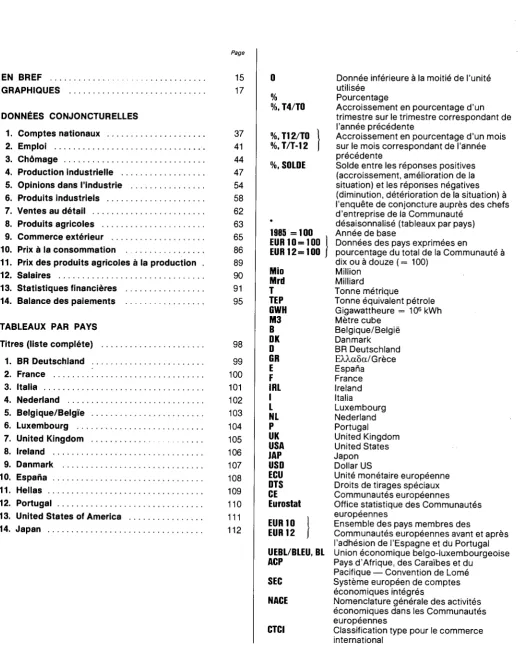
Table des matières
Signes et abréviations
m
EN BREF
GRAPHIQUES
DONNÉES CONJONCTURELLES
1. Comptes nationaux
2. Emploi
3. Chômage
4. Production industrielle
5. Opinions dans l'industrie
6. Produits industriels
7. Ventes au détail
8. Produits agricoles
9. Commerce extérieur
10. Prix à la consommation
11. Prix des produits agricoles à la production
12. Salaires
13. Statistiques financières
14. Balance des paiements
TABLEAUX PAR PAYS
Titres (liste complète)
1. BR Deutschland
2. France
3. Italia
4. Nederland
5. Belgique/Belgie
6. Luxembourg
7. United Kingdom
8. Ireland
9. Danmark
10. España
11. Hellas
12. Portugal
13. United States of America
14. Japan
Page
15
17
37
41
44
47
54
58
62
63
65
86
89
90
91
95
98
99
100
101
102
103
104
105
106
107
108
109
110
111
112
0
%
%,
T4/T0
%,T12/T0
%,T/T12
%,SOLDE
1985 = 1 0 0
EUR 10 = 100
EUR 1 2 = 1 0 0
Mio
Mrd
Τ
TEP
GWH
M3
Β
DK
0
GR
E
F
IRL
I
L
NL
Ρ
UK
USA
JAP
USD
ECU
DTS
CE
Eurostat
EUR 10
EUR 12
UEBL/BLEU, BL
ACP
SEC
NACE
CTCI
Donnée inférieure à la moitié de l'unité
utilisée
Pourcentage
Accroissement en pourcentage d'un
trimestre sur le trimestre correspondant de
l'année précédente
Accroissement en pourcentage d'un mois
sur le mois correspondant de l'année
précédente
Solde entre les réponses positives
(accroissement, amélioration de la
situation) et les réponses négatives
(diminution, détérioration de la situation) à
l'enquête de conjoncture auprès des chefs
d'entreprise de la Communauté
désaisonnalisé (tableaux par pays)
Année de base
Données des pays exprimées en
pourcentage du total de la Communauté à
dix ou à douze ( = 100)
Million
Milliard
Tonne métrique
Tonne équivalent pétrole
Gigawattheure = 10
6kWh
Mètre cube
Belgique/België
Danmark
BR Deutschland
Ελλαδα/Grèce
España
France
Ireland
Italia
Luxembourg
Nederland
Portugal
United Kingdom
United States
Japon
Dollar US
Unité monétaire européenne
Droits de tirages spéciaux
Communautés européennes
Office statistique des Communautés
européennes
Ensemble des pays membres des
Communautés européennes avant et après
l'adhésion de l'Espagne et du Portugal
Union économique belgoluxembourgeoise
Pays d'Afrique, des Caraïbes et du
Pacifique — Convention de Lomé
Système européen de comptes
économiques intégrés
Nomenclature générale des activités
économiques dans les Communautés
européennes
[image:16.595.45.567.128.775.2]EN BREF
Sauf Indications contraires, les données portent sur le territoire de la République fédérale d'Allemagne avant le 3.10.1990, BerlinOuest Inclus.
TAUX DE CHANGE: La peseta reste la monnaie la plus forte du
MTC
Malgré les baisses des taux d'Intérêts observées ces derniers mois en Espagne, la peseta reste la monnaie la plus forte du mécanisme des taux de change (MTC) du SME. La dernière en date de ces baisses est intervenue le 16 mal lorsque la Banque d'Espagne a annoncé une diminution de 0,75 % de son taux d'intervention, le ramenant ainsi à 12,75 %. SI les taux espagnols ont perdu pratiquement 2 % depuis la mifévrier, cela n'a eu aucune incidence réelle sur la fermeté de la peseta puisque celleci continue de revenir périodiquement à son cours supérieur d'intervention visàvis du franc français. En Italie également, les taux d'intérêt à court terme ont diminué ces dernières semaines, la Banque d'Italie annonçant le 12 mal une baisse de 1 % à 11,5 % de son taux d'escompte. Cette diminution s'est produite après qu'un accord a été trouvé au sein du gouvernement italien en vue d'une réduction du déficit budgétaire en 1991. Sur les trois premiers mois de 1991, la lire s'est légèrement appréciée par rapport à l'écu. Parmi les autres monnaies participant au MTC, c'est la livre sterling qui a enregistré la variation la plus importante au cours du mois d'avril, s'appréciant de 1,2 % par rapport a l'écu. Depuis le début de l'année, la livre a ainsi gagné plus de 2,4 % par rapport au panier de devises européennes et est devenue une des monnaies les plus fortes du MTC. La plus faible, le franc français, s'est également appréciée par rapport à l'écu au cours du mois d'avril, même si du fait de la plus forte appréciation de la peseta, sa position relative par rapport à cette dernière au sein de la grille des taux de change s'est légèrement affaiblie.
Le 17 mai, l'annonce a été faite que la couronne suédoise serait désormais liée à l'écu, avec effet immédiat. Précédemment, la monnaie suédoise suivait un panier de 15 monnaies au sein duquel la pondération la plus importante revenait au dollar (environ 21 % ) . Ce changement a provoqué un certain nombre de mouvements sur les marchés monétaires du fait qu'il était courant précédemment de conclure des emprunts en dollars et de reprêter immédiatement les capitaux récoltés en couronnes de façon à tirer avantage du fort différentiel de taux d'intérêt entre les taux US et suédois. La couronne suédoise n'étant plus liée au billet vert, ces substitutions d'actifs n'ont subitement plus eu aucune raison d'être et l'on a assisté à des achats massifs de dollars qui ont eu pour effet de pousser les taux de change de la monnaie américaine vers le haut et ont contraint les banques centrales suédoises, américaines et allemandes à intervenir sur les marchés des changes. Si la fin de ce lien entre couronne suédoise et dollar est une des causes de la récente appréciation du billet vert, celleci s'explique également par la publication le 17 mal du déficit du commerce américain pour le mois de mars qui, avec un peu plus de 4 milliards de dollars, est le chiffre mensuel le plus bas depuis pratiquement huit ans. En avril comme nous l'avons déjà indiqué le mois passé le dollar s'est montré plus fort par rapport à toutes les monnaies européennes. Visàvis de l'écu, il a gagné quasiment 13 % sur les quatre premiers mois de l'année. Les taux d'intérêt US ont été réduits une nouvelle fois le 30 avril. Le taux d'escompte se situe maintenant à 5,5 %, soit 1,1 % de moins qu'à la fin de l'année 1990.
RENDEMENTS DES OBLIGATIONS D'ETAT: Baisse des rende
ments
Dans tous les pays pour lesquels on dispose de données pour le mois d'avril, on observe des baisses des rendements des obligations d'Etat, les plus importantes en Italie (0,9 %) et en Espagne (0,7 %) et les moins élevées au Danemark, au Luxembourg et au RoyaumeUni (juste 0,1 % ) .
Les diminutions observées en Italie et en Espagne font suite aux récentes baisses des taux d'intérêt à court terme qu'ont enregistré ces deux économies les derniers mois. En Espagne, les rendements des obligations d'Etat ont perdu 2,5 % depuis le maximum qu'ils avaient atteint en septembre 1990, tandis qu'en Italie, ils ont baissé de 1,5 % depuis leur sommet de décembre 1990.
MASSE MONETAIRE: Poursuite du ralentissement de la crois
sance
Peu de données nouvelles sont disponibles pour ce mois, mais celles qui sont parvenues semblent indiquer un nouveau ralentissement de la croissance monétaire en France, au RoyaumeUni, en Italie et en Belgique. En France, la croissance de M2 en janvier a été négative par rapport à décembre, ce qui donne une diminution sur une base annuelle de 2,6 %. La croissance de M4 au RoyaumeUni a continué à faiblir, le taux annuel revenant en mars à 9,9 %. En Italie, M2 a crû de seulement 6,7 % de mars 1990 à mars 1991, contre 8,4 % de février 1990 à février 1991, tandis qu'en Belgique, la croissance de M2 pour 1990 s'est établie à 4,1 % contre 13,1 % à la fin de 1989 et encore 9,2 % en juin 1990.
L'indicateur de politique monétaire utilisé par les autorités portugaises (L) a connu récemment une croissance accélérée; toutefois, le taux de croissance sur une base intraannuelle observé à la fin de janvier 1991 était de 19,0 % contre 19,4 % le mois précédent. En Espagne par contre, la croissance de l'agrégat «ALP» se poursuit et a atteint 13,9 % en février (base intraannuelle).
RESERVES DE CHANGE: Accroissements en mars
Dans tous les pays étudiés pour lesquels on dispose de données pour le mois de mars, on observe un accroissement des réserves de change. Pour certains de ces pays, la hausse constatée au cours du premier trimestre 1991 est substantielle. C'est ainsi que l'Espagne a vu ses réserves s'accroître de 14 %, l'Irlande de 15 % et le RoyaumeUni de 18 %'. A la fin de 1990, EUR 12 totalise quelque 35 % des réserves de change mondiales, or exclu. Viennent ensuite le Japon avec 9 %, les EtatsUnis et Taiwan avec chacun 8 % et les pays de ΓΟΡΕΡ avec 7 %, les 31 % restants étant détenus par les «autres». Il est intéressant de comparer ces chiffres avec ceux de décembre 1981: EUR 12: