This is a repository copy of Do production patterns influence the processing of speech in prelinguistic infants?.
White Rose Research Online URL for this paper: http://eprints.whiterose.ac.uk/54631/
Version: Accepted Version
Article:
DePaolis, Rory A, Vihman, Marilyn orcid.org/0000-0001-8912-4840 and Keren-Portnoy, Tamar orcid.org/0000-0002-7258-2404 (2011) Do production patterns influence the processing of speech in prelinguistic infants? Infant Behavior and Development. pp. 590-601. ISSN 0163-6383
https://doi.org/10.1016/j.infbeh.2011.06.005
[email protected] https://eprints.whiterose.ac.uk/
Reuse
Items deposited in White Rose Research Online are protected by copyright, with all rights reserved unless indicated otherwise. They may be downloaded and/or printed for private study, or other acts as permitted by national copyright laws. The publisher or other rights holders may allow further reproduction and re-use of the full text version. This is indicated by the licence information on the White Rose Research Online record for the item.
Takedown
If you consider content in White Rose Research Online to be in breach of UK law, please notify us by
Running Head: Production and processing in prelinguistic infants
Do production patterns influence the processing of speech in prelinguistic infants?
Rory A. DePaolis
Communication Sciences and Disorders James Madison University
MSC #4304
Harrisonburg, VA 22807 e-mail: [email protected] tel: (540) 568-3869
Marilyn M. Vihman & Tamar Keren-Portnoy Language and Linguistic Science
University of York
V/C/210, 2nd Floor, Block C, Vanbrugh College University of York
Heslington York YO10 5DD
e-mail: [email protected] tel 01904 433612
*Manuscript
Abstract
The headturn preference procedure was used to test 18 infants on their response to three different
passages chosen to reflect their individual production patterns. The passages contained nonwords
with consonants in one of three categories: (a) often produced by that infant (ÔownÕ), (b) rarely
produced by that infant but common at that age (ÔotherÕ), and (c) not generally produced by
infants. Infants who had a single ÔownÕ consonant showed no significant preference for either
ÕownÕ (a) or ÔotherÕ (b) passages. In contrast, infantsÕ with two ÔownÕ consonants exhibited
greater attention to ÔotherÕ passages (b). Both groups attended equally to the passage featuring
consonants rarely produced by infants of that age (c). An analysis of a sample of the
infant-directed speech ruled out the mothersÕ speech as a source of the infant preferences. The
production-based shift to a focus on the ÔotherÕ passage suggests that nascent production abilities
combine with emergent perceptual experience to facilitate word learning.
Keywords: Infant Speech Perception, Infant Speech Production, Headturn Preference Paradigm,
1.0 Introduction
One factor often overlooked in the research into infant speech perception is the effect that
early pre-lexical production or babble may have on perception of and/or attention to incoming
speech, even though infants typically begin rhythmic production of adult-like syllables Ð
'canonical babbling' Ð between six and eight months (Oller, 2000), the period of the first major
advances in speech perception (cf., e.g., Jusczyk & Aslin, 1995; Tincoff & Jusczyk, 1999; Shi &
Werker, 2001; Soderstrom, Seidl, Kemler-Nelson, & Jusczyk, 2003; Jusczyk, Houston, &
Newsome, 1999; Nazzi, Jusczyk, & Johnson, 2000; Soderstrom, Kemler-Nelson, & Jusczyk,
2005). This study tests the idea that increasing use of consonants in production will directly
affect the processing of running speech.
From a Dynamic Systems perspective, language development can be viewed as a process
in which relatively simple skills interact to create more complex ones (Thelen, 1991). Babble is
one such simple skill. Its effect on speech perception has not yet been seriously investigated
despite the fact that there is ample evidence that motoric experiences affect perception, with
wide-ranging effects on social as well as cognitive development. For example, Piaget (1952)
emphasized the importance of the child experiencing and acting on the world, suggesting that
intelligence is derived from sensorimotor activity. Recent work with locomotion has also
highlighted the way in which secondary effects of self-produced locomotion can initiate more
complex cognitive advances (see Campos et al., 2000 for a review). In brief, the onset of
self-produced locomotion leads to improvements in communicative gesturing, attention, spatial
search, visual-vestibular coupling and depth perception. Thus, a notable consequence of this
There is evidence that babble produces a similar ripple effect. McCune and Vihman
(2001) tracked the emergence of frequently used consonants (Ôvocal motor schemesÕ: VMS), on
the assumption that repeated practice with a particular phonetic form might lessen the processing
load of recognizing or categorizing sound sequences (or word forms) that contain such a
consonant, freeing up processing resources for the pairing of form and meaning. This would
facilitate the learning of referential words. McCune and Vihman defined a VMS as a supraglottal
consonant (stop, nasal, fricative, excluding /h/, or affricate) that the infant produced consistently
and stably over several observational sessions. They found that the use of at least two VMS was
a prerequisite for the transition into referential word use in the 20 children they observed. In the
same way that self-produced locomotion facilitates the development of spatial awareness, the
ability to produce consistent patterns in babble can be taken to support memory for word forms
(Keren-Portnoy, Vihman, DePaolis, Whitaker, & Williams, 2010), which in turn facilitates the
recognition that a word form can symbolize events or entities in the world.
This relationship between VMS and referential word use raises the possibility that babble
might be an early steppingstone that has effects on other aspects of cognitive development. For
example, as babbling begins to systematically and consistently incorporate one or more
adult-like consonants, it could potentially speed the processing of these practiced sounds when heard
in input speech as well as when self-produced. Logically, a childÕs knowledge of the speech
sounds that he or she has produced might well be stronger and richer than that the knowledge of
sounds not yet produced. Babbling necessarily involves hearing oneÕs own vocal output and
integrating auditory and proprioceptive percepts, although the process need not be considered
Thus, sounds produced by the child provide the double information afforded by both
auditory and articulatory experience. This suggests that babbling that leads to regularly produced
consonants should boost the perceptual salience of practiced sounds in adult (input) speech as
well as in self-produced vocalizations (see Elbers, 1997, who emphasizes the importance of
Ôoutput as inputÕ). It has been suggested that an infant develops an individually fashioned
Ôarticulatory filterÕ, based on the particular sound patterns that the infant has mastered
motorically (Vihman, 1993, 1996). According to the articulatory filter hypothesis, familiarity
with speech sounds from an infantÕs own production implicitly enhances the salience of those
same sound patterns when they occur in surrounding speech (see also Locke, 1993, p. 204). The
articulatory filter was proposed to account for the finding that infants' first words tend to be
produced accurately as well as being comprised of consonants that the infant is experienced in
producing.
The purpose of this study was to test the hypothesis that there is a direct influence of
production on what is salient in input speech. We do not mean to suggest that this is the only
direction of causality between production and perception. On the contrary, the effect of
perception on early infant production has already been demonstrated in several studies.
Specifically, acoustic analysis has shown early ambient language effects on babbling (at 6-12
months for prosody: Whalen, Levitt & Wang, 1991 and at 10 months for vowel and consonant
production: Boysson-Bardies, HallŽ, Sagart & Durand, 1989, Boysson-Bardies & Vihman,
1991). In each case the findings reflect a biasing of the childÕs output in the direction of the
ambient language. However, this study was designed to explore the possibility of the reverse
effect, that is, the idea that a childÕs production experience might also affect the way he or she
It is important to recognize that we do not know how an infant settles upon his or her own
well-practiced (or favorite) consonants. This process must be, at the very least, a combination of
biological predisposition (Davis & MacNeilage, 1995), perceptual salience (Lindblom, 1992),
input frequencies and their effect on the development of speech categories (Jusczyk, 1993) and
the particular history of production practice of the individual child (Thelen & Smith, 1994).
1.1 The current study
We examined the interplay between production and perception after well-practiced
consonants have emerged, intending this study to be a first step in the search for an effect of
production on the way infants listen to input speech. In order to test this complementary
possibility of production affecting perception we developed a procedure using individual infant
production patterns adaptively in a headturn experiment. This is a novel paradigm that fills a gap
resulting from the fact that typical infant speech perception experiments are based upon large
numbers of infants seen in the lab for a single session, while infant vocal production studies
typically involve a small number of infants followed intensively over a long period of time. In
the current study production was documented with multiple observations of infant-caregiver
interactions via recordings and transcription (following Vihman, Macken, Miller, Simmons &
Miller, 1985) and perception was tested using the Headturn Preference Procedure (HPP)
(Kemler-Nelson et al., 1995), which quantifies infantsÕ response to speech as either a familiarity
or a novelty effect reflected in looking times. This enabled us to identify well-practiced
consonants in individual infants and, through the use of individually designed stimuli, to test for
To this end, we presented nonword stimuli embedded in three contrasting passages, each
nonword highlighting a consonant belonging to one of the following three categories: (a) a VMS
stop consonant produced by the infant being tested (ÔOwn-VMSÕ), (b) a common VMS stop
consonant produced by many infants but not by the infant being tested (ÔOther-VMSÕ), and (c) a
fricative consonant that was rarely produced by any of the infants (ÔNon-VMSÕ).
We chose to embed nonwords in passages instead of using isolated nonwords as stimuli
since previous studies have shown that by 7.5 months infants can extract words from passages
(Jusczyk & Aslin, 1995, Jusczyk et al., 1999). All infant tested in this study were older than 9
months. In addition, we felt that the presentation of lively passages was likely to capture the
attention of the infants, leading to a lower attrition rate than might result from the use of isolated
words. Also, since this work was designed to test the salience in input speech of consonants that
are either produced or not produced by the infant, essentially a test of the Articulatory Filter
hypothesis, passages are the more appropriate stimuli.
We included a fricative passage to test the infantsÕ response to consonants that no infant
could be expected to produce to any significant extent. This makes it possible to contrast a
signal-based vs. a production-based infant response to the stimuli. In the absence of a production
effect, infant interest in the fricatives might be expected, based on the salient acoustic differences
between stops and fricatives. In effect, without a production effect the stop passages would all
sound similar and the fricative passages would stand out and prompt a novelty effect. This would
be worth noting only if no production-based effect were to be found, however. In contrast, if a
difference in looking times is found in response to the produced vs. not-produced consonants,
that difference will be all the more compelling since the Own and Other consonants in this study
Succinctly stated, our hypothesis was that infants would show a difference in looking
time between Own- and Other-VMS passages Ð that is, we tested for a production-based
difference in the salience of the nonwords embedded in the passages. When we began the study
we did not intend to use number of VMS as an independent variable, and we therefore had no
a-priori hypothesis regarding possible differences in the patterns of looking times between infants
with many or with only a single VMS. But once we began recording infants it became clear that
not all of them could be tested before they passed criterion for a second VMS. We thus ended up
with two groups of infants whose production experience differed by the number of VMS they
had acquired; we did not expect to find a difference between the groups. Finally, if the infants
exhibited no difference in looking times in response to Own- versus Other-VMS passages, we
hypothesized that they would look longer in response to the fricative passages due to the
2.0 Methods
2.1 Production Data Collection
Twenty-eight infants participated in the production study. All infants passed a National
Health Service hearing screening; none had reported health problems at the time of the study.
Infants were recorded on audio and video in unstructured half-hour play sessions with a
caregiver, beginning between 9 (25 infants) and 11 (3 infants) months of age. The sessions took
place in the infantÕs home (25) or in a friendÕs house (3) and continued monthly (3), biweekly
(10), or weekly (15) until vocal motor schemes were identified. The original goal was to identify
the emergence of a single VMS in each infant. We initially visited infants monthly, then
biweekly and finally weekly as it became obvious that even with weekly visits it would not
always be possible to identify the emergence of a single VMS before a second VMS met
criterion. It is unclear whether this would be possible even with daily visits, since some infants
seemed to develop consistent use of multiple consonants simultaneously. The experiment was
thus adapted to include both single- and multiple-VMS infants. Recordings were made using a
wireless microphone and transmitter (AKG, Sennheiser or Beyerdynamic) placed in an inside
pocket of a soft vest worn by the infants. The caregiver also wore a wireless microphone and
transmitter. Both audio and video were recorded using a Sony DSR-PDX10P digital video
recorder.
All audio recordings were digitized at 48 KHz and digitally transferred to DVD with
video, but not audio, compression. Each session was transcribed on the basis of both the audio
and video signal. Two separate criteria were used to define the acquisition of a VMS. The first
criterion, following McCune & Vihman (2001), was that a consonant be produced at least 10
occurrences. Second, since this study required a more dynamic approach to identifying VMS to
permit timely perceptual testing, 50 occurrences of a consonant within one to three sessions was
also accepted as evidence of a VMS. If an infant had thirty or more occurrences of a consonant
within the three most recent sessions (without that consonant reaching criterion for VMS status),
the infant was considered to be in transition to the acquisition of a VMS. Voicing was not
considered distinctive, since there is little evidence that infants control voice onset time at this
age (Macken, 1980). Thus, the VMS categories were grouped by place of articulation (for
example /p,b/, /t,d/, and /k,g/). Difficult utterances were transcribed with the aid of an additional
transcriber, and if there was no consensus, these utterances were not used in the VMS counts. No
utterance masked by noise was transcribed. Transcriber reliability (based on two independent
ten-minute transcriptions of each of three infants, 10% of the participants) was 81% for VMS
consonants (/p,b/, /k,g/, /t,d/, /m/, & /n/). This is consistent with or higher than what has been
reported for other large-sample studies of transcription reliability for consonants produced by
prelinguistic infants (Davis & MacNeilage, 1995; McCune & Vihman, 2001). It might be
expected, given the quality of the video and audio signal, that reliability would be higher than
previously reported in the literature, but the nature of the study required rapid transcription to
identify acquisition of VMS in as timely a way as possible. In most cases, the sessions needed to
be transcribed within a day of the observation so that, if necessary, the HPP test could be
scheduled within three days of the observation. If more time elapsed we scheduled another
observation session since it was likely that the infant would have progressed to the point of either
having or being in transition to having another VMS. This made it impossible to use such a
2.2 Perception Test
2.2.1 Participants. Twenty-two of the 28 infants who were followed for identification of
VMS participated in the Headturn experiment. Six infants were excluded for the following
reasons: no evidence of a VMS during the course of the recordings (2), infant transitional on all
remaining VMS consonants used in the perception test (2), family dropped out just after
evidence of VMS (1), and infant acquired non-VMS consonant between the last recording
session and HT test, as judged both by direct experimenter observation and by caregiver report
(1). Eighteen of the 22 infants tested successfully completed the HT experiment. Attrition in the
headturn task was due to inability to complete the test trials (2), crying (1), and experimenter
error (1). Of the 18 infants tested successfully, the mean age at testing was 1;0.20 for single and
0;10.15 for multiple VMS infants. The difference in age was due to three single-VMS infants
being older than 15 months at the time of the test (see Table 3). The assignment of infants to the
single- or multiple-VMS group was dictated by the identification of either one or two VMS. The
first nine infants to acquire the requisite number of VMS were included in each group. Since age
at first VMS was not controlled in the experiment, the presence of the three older infants in the
single-VMS category was a function of the normal developmental process. The median age at
testing, for single- and multiple-VMS groups, respectively, was 0;10.24 and 0;10.10.
2.2.2 Stimuli. A native speaker of British English, using a lively speech style, recorded
passages consisting of five sentences, with nonwords near both the beginning and the end of each
of four of the sentences and a fifth sentence with a single medial nonword receiving phrasal
accent. The duration of the passages was between 13 and 14 seconds. The maximum length for
both the pretest and test trials was 13.8 seconds. All items were recorded in a sound-treated room
digital recorder sampling at 44.1 K Hz. The speech peaks of all stimuli were within 1.5 dB as
measured on a mechanical VU meter (Marantz PMD 222). The stimuli were transferred digitally
onto a PC hard drive for eventual output. Acoustic analysis across the three passages revealed no
difference in amplitude (rms and peak), F0 (mean, minimum, maximum, and range) or duration
(p > 0.05).
The nonwords used as stimuli are listed in Table 1. Each nonword consisted of a
disyllable with a CVCVC structure. The consonant was a stop or fricative with a consistent place
of articulation that alternated in voicing (i.e. the /t/ and /d/ in the nonword /
The consonant-vowel co-occurrences used were
consistent with those predicted by the frame dominance model of early vocalizations (Davis &
MacNeilage, 1995), which successfully predicts that infantsÕ early babble will follow patterns
dictated by the physiology of mandibular oscillations (or frames) Ð i.e., of whole-syllable
production, with alveolars followed by front vowels, velars by back vowels and labials by central
vowels. The three carrier passages are listed in Table 2. Each carrier passage contained 24
syllables in addition to nine disyllabic nonwords including the targeted VMS consonants only.
Each passage highlighted one pattern: Own-VMS, Other-VMS or Non-VMS. In order to avoid
changes of consonant manner between Own- and Other-VMS passages, only bilabial, alveolar
and velar stops were used as Own- or Other-VMS. The non-VMS passage contained nonsense
words including as consonants only /f/ and /v/, which are not typically mastered by infants until
the second or third year of life (Ferguson, 1975). No infant in this study produced /f/ or /v/ to
VMS criterion. We decided not to use nasals (which are also early favored consonants) as VMS
acoustic signatures Ð such as shifts and/or reductions in energy of the formants of the
surrounding vowels (Kent & Read, 2002) and high average amplitude during their occluded
portion Ð that make them perceptually distinct from stops. Even though nasals were not included
in the HPP task, it was possible for an infant to have multiple VMS with a stop consonant and a
nasal rather than two stop consonants. Note that any supraglottal consonant that the infant
produced to VMS criterion would have counted as a VMS. McCune and Vihman (2001) found
that a small number of infants produced /s/ or /l/ to VMS criterion. In this study only alveolar,
bilabial and velar stops and velar and bilabial nasals were produced to VMS criterion. Only
infants with at least one stop VMS could be included in the sample since we chose not to use
nasals as test stimuli. We did not actually have to exclude any infants since a stop was either the
first or the second VMS for every participant.
Passage 1 was recorded with /t,d/, passage 2 with /p,b/, passage 3 with /k,g/; the passages
containing /t,d/, /p,b/, or /k,g/ were used as Own- or Other-VMS passages, depending in each
case on which VMS a particular infant had already acquired (Own) or had not yet acquired
(Other). All three carrier passages were recorded with /v,f/ so that each infant would hear three
different carrier passages, one for each type of consonant. The passages with /f,v/ were used as
Non-VMS passages.
[Insert Tables 1 and 2 about here.]
2.2.3 Procedures. The HT procedure used was similar to that described in
Kemler-Nelson et al. (1995). Seated on the caregiverÕs lap in a quiet darkened room, the infants faced the
central panel of a three-sided test booth where a camera and red light were mounted. A blue light
and speaker were mounted on each side panel. A PC and video monitor were located in the
looking times by pressing the left and right mouse buttons. The computer initiated and
terminated trials in response to signals from the experimenter. In each trial, the infantÕs gaze was
centered by the blinking red light. The experimenter then initiated the computer run trial
involving a blinking blue light on the left or right of the infant. When the infant was judged to
orient to the blue light, a trial was presented from that speaker. If the infant looked away from
the speaker for more than two seconds, the trial was terminated and another begun. Multi-talker
babble created from the same speaker of the stimuli used in the experiment was delivered to the
headphones worn by the experimenter and caregiver to mask the actual test stimuli. The
caregiver also wore foam-insert hearing protection. All stimuli were presented at an average
level of 65 dB (Tenma 72-6635 sound level meter).
Each experimental session consisted of a pretest and test phase. In the pretest phase the
infant was presented with one passage of each of the three test conditions, own-VMS,
other-VMS, and non-other-VMS, counterbalanced for order and randomized for side. This condition was
intended to expose the infant to the test procedures since our previous experiments using the
headturn paradigm have indicated that the initial trials lead to overly long looking times that do
not seem to be indexed to the type of stimuli presented.
The test phase of the experiment consisted of 15 trials, five each of the three test
conditions. Each trial, pretest and test, consisted of a randomized presentation of the five
sentences of each test passage. The order of presentation in the test phase was such that the first
three trials were counterbalanced across test conditions. The order of the final three trials was a
reverse of the first three. The counterbalancing at both the beginning and the end was designed to
control for an anticipated decrease in looking times, independent of the stimuli, over the course
trial). The middle nine trials were pseudo-randomized such that no more than two identical test
trials occurred together. In both phases, the side of presentation was pseudo-randomized such
that no more than three successive presentations from one side were allowed. Reliability was
assessed by offline coding, by a separate researcher, of two of the infantsÕ HPP video recordings
3.0 Results
3.1 Production Data
The results presented below are drawn from the 18 infants who successfully participated
in the headturn experiment. Table 3 documents the age at test and the particular Own and Other
VMS used in the perception test for each infant in the two groups; additionally, the VMS not
tested is given for the multiple-VMS infants only (ÔNon-Test VMSÕ). Interestingly, all but two
infants acquired /t,d/ as one of their first VMS, consistent with the McCune and Vihman (2001)
study, in which 13 of the 20 infants followed acquired a coronal first; we return to this point in
the discussion. The second VMS acquired by the nine infants in the multiple-VMS group was
variable, four producing /p,b/, three producing /n/, two producing /m/ and one producing /k,g/.
[Insert Table 3 about here.]
Figure 1 presents a count of consonants produced in the session prior to the HPP. For
each infant we present a token count of all productions of that specific infantÕs Own- and
Other-VMS consonants (the same two consonants to be tested). The figure also presents the total token
frequency in that same session of the two most often used consonants for each infant, as well as
the results of the perception test (see below for a discussion of the preference ratio)1. A consonant was included in the count if it was transcribed within a syllable consistent with
English phonotactics. The single-VMS group produced a mean of 65.7 consonants (SD=15.3), as
against 122.1 (SD=20.2) for the multiple-VMS group. This difference is significant, t(16)=2.228,
p=.041, suggesting that the division of children into single and multiple VMS groups is based not
only upon the repeated and consistent phonetic form of at least two consonants, but also upon the
childrenÕs overall frequency of consonant production.
[Insert Figure 1 about here]
3.2 Perception Test
The results are presented in Figure 2. A mixed two-factor analysis of variance performed on the
test trials, with VMS Type (Own, Other, and Non) and VMS Number (Single versus Multiple) as
independent variables and the looking time to each passage as the dependent variable, revealed
no main effects for either VMS Type (F[2,16]=.492, p=.616, 2=.051) or VMS Number (F[1,16]=.349,p=.563, 2=.021). However, the interaction between VMS Type and VMS Number was significant (F[2,16]=3.933, p=.024, 2=.391), indicating that the preference for passages was dependent upon the number of VMS the infants had acquired. Contrasts of the
interaction between Non and Own versus VMS Number (and ignoring Other VMS) were not
significant (p=.424), while the contrast of the interaction between Non and Other versus VMS
Number (and ignoring Own VMS) approached significance (p=.062). These results, when taken
together with the lack of a main effect of VMS type, suggest that looking times to the Non-VMS
passages are independent of the infantsÕ production patterns. The contrast of the interaction
between Own and Other VMS versus VMS Number was significant (p=.01), indicating that the
significant interaction in the ANOVA is mainly due to the differences in looking times of the
single- and multiple-VMS infants to the Own- and Other-VMS passages. Paired t-tests of the
main contrast of Own- versus Other-VMS show that the multiple-VMS infants looked
significantly longer in response to the Other consonant (M=6.61, SD=1.52 versus M=5.48,
response to their own consonant (M=5.98, SD=2.05 versus M=4.99, SD=2.20, respectively), but
this preference is not significant (t(8)=1.735, p=.121).
[Insert Figure 2 about here.]
The lack of an effect in the single-VMS group was likely due to the variability of overall
looking times in this group (range 2.15 to 8.6 seconds). Often, in a headturn experiment, infants
with very low looking times or atypical values are excluded from the final analysis (see, for
example, Nazzi, Iakimova, Bertoncini, FrŽdonie, & Alcantara, 2006). In this study, we chose not
to exclude infants for these reasons since the investment in time for each infant was so large. One
way to factor out differences in overall looking time across infants and compare the infantsÕ
preference for practiced over unpracticed consonants (disregarding the Non-VMS consonants,
since they are not significantly affected by production) is to make use of the preference ratios
between looking times (LT) for well-practiced over unpracticed consonants (preference ratio =
LT(Own)/[LT(Own)+LT(Other)]). With this metric a value of 0.5 would indicate equal looking
time to each passage. The preference ratios are plotted against each infants practiced consonants
in figure 1. The preference ratio for Own-VMS passages for the single-VMS infants (M=0.55,
SD=0.086) was significantly larger (t[16]=2.817, p=0.012) than for multiple-VMS infants
(M=0.45, SD=0.063). Six of the nine single-VMS infants show a preference for Own-VMS
passages, while eight of nine multiple-VMS infants exhibit a preference for Other-VMS
passages.
The categorical nature of VMS allows the separation of infants into two groups that differ
significantly in the number of consonants produced and in the frequency and consistency of use
of these consonants over time. In order to explore the relationship of the infantsÕ practiced
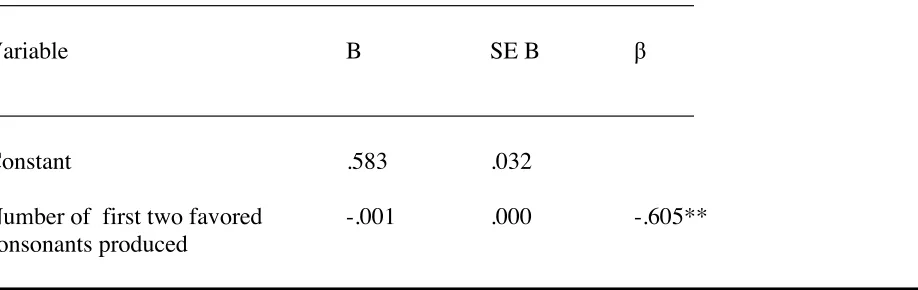
time, we ran a simple linear regression using consonant counts in the session preceding the HPP
test. Since the design of the HPP test involved identifying each infantÕs practiced consonants we
used the number of each infantÕs Own-VMS consonant plus the second most practiced consonant
(for the 2 VMS infants this was the second VMS) as the predictor and the preference ratio as the
dependent variable (See table 4). There was a significant linear relationship between the total
production frequency of the two most practiced consonants and the infantsÕ preference for Own-
or Other-VMS (R=.605, p<.01).
Table 4 about here.
3.3 Analysis of the Infant Directed Speech
As mentioned above, what leads an infant to settle upon a practiced or ÔfavoriteÕ
consonant or VMS is unclear. It is possible that the speech directed to the infant has an effect on
the consonants produced and thus plays a role in the perceptual salience of those consonants. To
investigate this possibility we transcribed the infant-directed speech (IDS) of three mothers. We
chose mothers of infants who had multiple VMS since in this group at least one infant had
acquired each of the stop consonants (alveolar, velar, and bilabial). We transcribed both the
session in which the infant was credited with two VMS and the session preceding it. If there was
a problem identifying the consonant, the main transcriber consulted with a second transcriber to
arrive at a consensual decision. To assess reliability two independent researchers (not including
the second transcriber noted above) transcribed two of the 30-minute sessions, yielding
agreement on 90% of the VMS consonants. Agreement rose to 99% when ambiguous consonants
Figure 3 is a plot of the proportion of each VMS consonant in the IDS directed to the
infant. For ease of comparison, an asterisk indicates the VMS for each infant. It is clear from this
figure that although VMS consonant frequency from each motherÕs IDS was similar, the VMS
consonants developed by the infants are quite diverse. In particular, the infant in panel b
produced the two consonants with the least frequency in the input, while the infant in panel c
produced the two consonants that were most frequent in the IDS. A Chi-Square test comparing
the relative frequency in the infantsÕ production of the five VMS consonants (stops: alveolar,
velar, and bilabial, nasal: bilabial and alveolar) to the relative frequency in the mothersÕ IDS
4.0 Discussion
The profile of consonant use for the infants who completed the study was consistent with
that found by McCune and Vihman (2001). The most common initial VMS was identified as /t,d/
in both studies, although the 18 British-English infants were even more likely than the 20
American-English infants to start with this VMS (88% vs. 72%). After /t,d/, the remaining stops
and nasals were the most likely VMS in both studies. Of the stops, /k,g/ were the most likely to
be acquired last. These findings are consistent both with predictions of early consonant
development based on diary reports and markedness theory (Jakobson, 1941/68) and with later
accounts of perceptual salience and/or bio-mechanical constraints (Lindblom, 1992; Davis &
MacNeilage, 1995); they also agree with empirical findings reported for a wide range of
languages (Locke, 1983).
The results of the headturn experiments show that the infantsÕ looking times were
influenced both by their own consonant production experience (as indexed by the number of
VMS that they had acquired) and by whether or not they produced the particular consonant
featured in the nonwords embedded in the passages. This finding confirms our hypothesis that
looking times would be influenced by the infantsÕ production patterns and accordingly supports
the postulation of an articulatory filter. The lack of any relationship between three individual
infantÕs production patterns and the IDS they were exposed to strongly suggests that this finding
is not due to the frequency of consonants used in the input.
The difference in looking times between the single- and multiple-VMS infants was
unexpected. The multiple-VMS infants displayed longer looking times in response to the passage
that featured the consonant that they were not yet consistently producing, while infants with a
between the groups was revealed in the significant interaction between Own- and Other-VMS
and VMS number as well as in a t-test comparing the preference ratio between the single- and
the multiple-VMS groups (using the preference ratio effectively reduced the ÔnoiseÕ in the
paradigm). The same type of relationship was also evident when production experience was
measured continuously, in the correlation and regression that showed that the amount of
production experience an infant has with one or two consonants can predict their pattern of
preference for the test passages. These results suggest that production advances may
incrementally alter the manner in which infants attend to aspects of the speech signal.
It is worth emphasizing that the presence of a novelty effect in the multiple VMS group
can occur only if the Other passage stands out as different from the Own passage (novel). In this
case the it is likely that the Own passage introduces overly familiar sounds, making the Other
passage, with its novel sounds, more interesting. This is consistent with Hunter and Ames
(1988), who showed that greater attention to a familiar stimulus will eventually be replaced by
greater attention to the novel stimulus.2 It is likely that the infants who are more practiced at consonant production (as indexed by VMS in this study) will be the ones tending to exhibit a
novelty (versus familiarity) effect to a comparison of produced versus unproduced consonants.
The discovery of this novelty effect was serendipitous, as had the study been carried out
with single-VMS infants only, as originally planned, we would have been unaware that the
transition from one to two VMS indexes a change in looking times. This raises the question, why
Interestingly, a change from engagement with familiar to engagement with unfamiliar stimuli
can sometimes even be seen to occur for individual infants across experiments (Roder,
Bushnell, & Sasseville, 2000) as well as in the course of a single experiment (Vihman et al.,
should the move from producing one to two stable consonants change the infantsÕ response to the
Other passages? One possibility is that acquiring a second stable consonant (or VMS) indexes
cognitive advance, as suggested by McCune and Vihman,2001 (see introduction for a more
detailed description). In addition, DePaolis, Keren-Portnoy, and Vihman (1997) found that
10-month-old infants who had acquired two VMS were significantly more variable in their looking
times to familiar words on a headturn task than infants who had not acquired two VMS. Both of
these results support the notion that reliably producing two stable consonants affects the way that
infants process consonants.
Another interpretation is that the change in looking times is not necessarily dependent
upon the infants producing two consonants to VMS criterion, but simply reflects the fact that
they are producing large numbers of consonants. For example, from figure 1 it is clear that the
infants with the largest consonant counts are the ones most likely to show a preference for the
ÔOtherÕ passages. This interpretation is also supported by the simple regression, in which the
count of the two highest consonants produced is a significant predictor of the preference ratio.
Although this interpretation is plausible, since 8 of the 11 infants who show a preference for the
ÔOtherÕ passage are producing two consonants to VMS criterion, it is likely that both ways of
operationalising practice in consonant production are really complementary: Infants who produce
many consonants seem to be producing many tokens of perhaps only a few consonant types.
Therefore, it is hard to disentangle the role of the specific consonants produced from that of
sheer amounts of consonant production. It is probable that both these things combine to influence
infantsÕ preference for what is familiar vs. what is novel.
We included the Non-VMS condition to test the contrasting hypothesis that production
revealing only if no difference had been found between the Own- and the Other-VMS passages.
However, this study did reveal a significant difference between looking times to Own-VMS and
Other-VMS. Given that finding, along with the fact that both groups looked equally to the
Non-VMS consonant passages (see Fig. 2) and showed no significant difference in looking times to
Non-VMS vs. the other types of passages, the results from the Non-VMS passage can be taken to
simply reflect the spectral salience of fricatives versus stops.
Two methodological concerns arose in the course of the study. The first was the balance
of consonants used in the headturn test. Since each infantÕs production pattern necessarily
dictated the consonants to be presented, the overall profile of consonants could not be planned in
advance. The most common Own-VMS consonant was /t,d/; it was presented as Own consonant
in 13 of the 18 infant headturn tests (for eight of the single- and five of the multiple-VMS
infants), which raises the possibility that infantsÕ looking patterns could be due to their having a
preference or dispreference for the specific consonant /t,d/ rather than to their individual
production history. However, of these 13 infants for whom /t,d/ was Own VMS, eight preferred
the /t,d/ passage and five did not, and this difference, using a binomial test, is not significant.
This effectively rules out the possibility that a general preference (or dispreference) for /t,d/
among those infants who produce that segment might explain our findings. In addition,
considering the 14, 9, and 13 times that passages featuring /t,d/, /p,b/, and /k,g/ were presented in
all 18 of the headturn tests as either Own- or Other-VMS (see Table 3), the preference that the
infants showed for each of these passages was no greater than chance (defined as a preference for
The single-VMS group could also conceivably have a different pattern of preference or
dispreference for alveolars from the multiple-VMS group, and these group-dependent
preferences could be the primary factor responsible for the pattern of results that we found. For
example, the prevalence of alveolars in the input, or some signal-based aspect of alveolars (the
high frequency emphasis of the burst, for example), could be driving the results, with different
effects in the two groups. However, the data fail to support the idea that alveolars were
systematically either preferred or dispreferred in either group (see Table 3 for the preference for
Own- versus Other-VMS). In the single-VMS group, five infants showed a preference for
alveolars over velars (3) or bilabials (2). On the other hand, three showed a preference for the
velar that was contrasted with the alveolar stop. In the multiple-VMS group dispreference for
Own VMS is limited to no one place of articulation: We see a dispreference for alveolars in five
infants (of whom three showed a preference for velars and two for bilabials), for bilabials in two
infants (both showing a preference for velars instead), and for velars (preferring bilabials) in one
infant. The pattern of preference appears to be random and convincingly rules out input
frequency or signal-based attributes of alveolars as a possible explanation.
The second concern was the age of the participants at the time of the HPP test. Three
infants in the single-VMS group were considerably older than the rest of the infants in the study.
The age discrepancy was an unintended consequence of our testing infants as soon as we could
identify either one or more VMS. The inclusion of these infants is developmentally sound since
longitudinal samples of infant consonant production typically include small numbers of later
developing infants (for example see McCune & Vihman, 2001). It could be argued that these
infants have considerably more experience in processing speech, so their results deserve closer
patterns while one did not (preference ratios of .54, .63 and .44). Removing these three infants
from the ANOVA reduces the power from .709 to .563 and changes the interaction from
significant (p=.024) to nearly significant (p=.056). The significance of the t-test comparing the
single-VMS to the multiple-VMS group on their preference ratio for own versus other VMS does
not change when these three infants are removed (p=.012 for all infants and p=.018 with three
infants removed). Thus, the behavior of these infants does not change the basic pattern of results.
The fact that this interaction of production and perception is significant with 18 infants
suggests that it is highly robust. A preference for own sounds was found in six out of nine infants
in the single-VMS group, and a preference for othersÕ VMS was found in eight of nine infants in
the multiple-VMS group. Note that, of the four infants who did not show this pattern, three were
in the single-VMS group. Due to the fact that our samples were limited to a 30-minute recording
once a week at most, it is likely that some of these infants were producing additional consonants
that failed to be recorded. To guard against this problem we provided caregivers with a detailed
questionnaire to be completed after each session, but it was apparent that parents often
misidentified consonants. Thus, while the multiple-VMS infants can be confidently said to have
had at least two VMS, it is possible that some infants identified as having only a single VMS
were actually producing a second VMS, or were in transition.
Our results suggest the possibility that production initiates shifts in the way that the infant
processes input speech. Since the transition from one to two VMS typically occurs in a matter of
weeks at most, the infantsÕ preferential shift to a passage featuring a consonant that they are
about to produce is noteworthy and suggests that the interplay of familiarity and novelty in early
It is worth noting that this shift, as indexed by production operationalized as the transition
from one to two VMS, could be a by-product of an underlying cause not identified in this
study.For example, it is possible that the perceptual salience of stops in speech directed to the
infant is the underlying cause of the results. According to this rationale, the salience of a stop is
both the reason for an infant developing that stop as a VMS and the cause of the difference in
preferential looking times. This explanation is consistent with the data since the single VMS
infants looked longer at their Own VMS (although the difference was not significant). In
addition, even though the multiple VMS infants did show a preference for the Other VMS, this
could be due to their decreased interest in the stop consonant which had commanded their
attention earlier, leading to an increased salience of the stop consonant not yet being produced.
However, the comparison of the frequency of consonants in individual infantsÕ input to
their own produced consonants does not favor such an interpretation. There was no clear
relationship between input frequency and choice of VMS for production. In addition, the
similarity among mothers in the frequency of consonants in their speech makes this an unlikely
source for the differences among infants in the identity of the first consonants used stably in
babble. Indeed, the lack of an effect of the mothersÕ speech on the phonetic output of the infant
has been reported previously in a larger sample of French, Swedish and American infant-mother
dyads (Vihman, Kay, de Boysson-Bardies, Durand, & Sundberg, 1994). The data in this
experiment do not provide a definitive answer to the Ôchicken and eggÕ dilemma of how a
favorite consonant emerges, but they do suggest that a parsimonious explanation of the results is
that the pattern of results reflects a bi-directional influence of production on perception.
Since infants appear to ÔnoticeÕ often produced phonetic segments in continuous speech,
years ago Ferguson and Farwell (1975, p. 433f.) noted that Ôat an early stage in which a contrast
is absentÉthe adult words chosen by the child will be highly discriminatoryÕ Ð i.e., ÔselectedÕ for
their sound patterns. Following up on this insight, Vihman (1993) suggested that rather than
avoiding words or sounds that they cannot produce (as suggested in Menn, 1983, for example),
infants ÔselectÕ their first words based on implicit matching of their existing babble to words
consisting largely of sounds that they can produce (cf. also Vihman & Croft, 2007).
If infants could count on hearing words in isolation, this fact would be unremarkable, but
at least one study has found that words are not consistently produced in isolation (Aslin,
Woodward, LaMendola & Bever, 1996 Ð but see Brent & Siskind 2001). In the absence of
exposure to isolated words, how does an infant extract the word from continuous speech in order
to pattern the output after the input? Based upon the results of this study, infants should be
predisposed to notice in the ongoing speech stream words that contain sounds that they are just
starting to produce. This is consistent with the notion of an articulatory filter (Vihman, 1993,
1996). It could be that, in typically developing children, the ability to effectively process
continuous speech in the prelinguistic period is augmented by the formation of a consistently
reproducible phonetic pattern in babble.
This is the first study to report evidence for a link between what an infant produces in
babble and how that infant processes speech (although see Vihman & Nakai, 2003). The impact
of this link beyond the preference or dispreference for favorite consonants is an open question
and should be explored further. For example, future work could examine how the relationship
between production and perception affects the ability to attach meaning to word forms that either
do or do not contain preferred production patterns (see Keren-Portnoy et al., 2010, for a study
incorporate proprioceptive feedback into the developmental trajectory of consonant and vowel
categorization (for examples see models by Kent, 1981, and Westermann & Miranda, 2004).
Most importantly, the findings of this study suggest the possibility that babble channels infantsÕ
sensitivity to phonetic aspects of the speech stream that are important for early language
Acknowledgements
Correspondence should be addressed to Rory DePaolis at [email protected].
We thank Nicola Williams for help with transcription of the infants, Naomi Craig for running the
headturn experiments, and both Sarah McKain and Caitlin Baird for transcription of the IDS.
This work was supported by a Marie-Curie Incoming International Fellowship from the
European Commission and an Educational Leave from the College of Integrated Science and
Technology at James Madison University.
References
Aslin, R. N., Woodward, J. Z., LaMendola, N. P., & Bever, T. G. (1996). Models of word
segmentation in fluent maternal speech to infants. In J. L. Morgan & K. Demuth (Eds.),
Signal to Syntax: Bootsrapping from speech to grammar in early acquisition. Mahwah, NJ:
Lawrence Erlbaum Associates.
Boysson-Bardies, B. de & Vihman, M. M. (1991). Adaptation to language: Evidence from
babbling and first words in four languages. Language, 67, 297-319.
Boysson-Bardies, B. de, Halle, P., Sagart, L. & Durand, C. (1989). A crosslinguistic
investigation of vowel formants in babbling. Journal of Child Language, 16, 1-18.
Brent, M. R., & Siskind, J. M. (2001). The role of exposure to isolated words in early vocabulary
development. Cognition 81, B33-B44.
Campos, J. J., Anderson, D. I., Barbu-Roth, M. A., Hubbard, E. M., Hertenstein, M. J., &
Witherington, D. (2000). Travel broadens the mind. Infancy, 1, 149-219.
Davis, B. L. & MacNeilage, P. F. (1995). The articulatory basis of babbling. Journal of Speech
and Hearing Research, 38, 1199-1211.
DePaolis, R. A., Keren-Portnoy, T., & Vihman, M. M. (1997). Dynamic interactions between
perception and production. Talk presented at the Biennial Meeting of the Society for Research
in Child Development (Boston).
Elbers, L. (1997). Output as input: A constructivist hypothesis in language acquisition. Archives
de Psychologie, 65, 131-140.
Ferguson, C. A. (1975). Fricatives in child language acquisition. In L. Hellmann (ed.),
Ferguson, C. A. & Farwell, C. B. (1975). Words and sounds in early language acquisition.
Language, 51, 419-439.
Hunter, M. A. & Ames, E. W. (1988). A multifactor model of infant preferences for novel and
familiar stimuli. Advances in Infancy Research, 5, 69-95.
Jakobson, R. (1941/68). Child Language, Aphasia, and Phonological Universals. The Hague:
Mouton. Eng. tr. of Kindersprache, Aphasie und allgemeine Lautgesetze. Uppsala, 1941.
Jusczyk, P. W. (1993). From general to language-specific capacities: The WRAPSA model of
how speech perception develops. Journal of Phonetics, 21, 3-28.
Jusczyk, P. W. & Aslin, R. N. (1995). Infants' detection of the sound patterns of words in fluent
speech. Cognitive Psychology, 29, 1-23.
Jusczyk, P. W., Houston, D. M. & Newsome, M. (1999). The beginnings of word segmentation
in English-learning infants. Cognitive Psychology, 39, 159Ð207.
Kemler Nelson, D. G., Jusczyk, P. W., Mandel, D. R., Myers, J., Turk, A., & Gerken, L. (1995).
The Head Turn Preference Procedure for testing auditory perception. Infant Behavior and
Development, 18, 111-116.
Kent, R. D. (1981). Sensorimotor aspect of speech development. In Aslin, R. N., Alberts, J. R. &
Petersen, M. R. (eds). Development of Perception. Academic Press, New York, New York.
Kent, R. D. & Read, C. (2002). The Acoustic Analysis of Speech. San Diego: Singular.
Keren-Portnoy, T., Vihman, M. M., DePaolis, R. A., Whitaker, C. J., & Williams, N. M. A.
(2010). The role of vocal practice in constructing phonological working memory. Journal of
Lindblom, B. (1992). Phonological units as adaptive emergents of lexical development. In C. A.
Ferguson, L. Menn, & C. Stoel-Gammon (eds). Phonological Development. Timonium,
Maryland: York Press.
Locke, J. L. (1983). Phonological Acquisition and Change. New York: Academic Press.
Locke, J. L. (1993). The Child's Path to Spoken Language. Cambridge, MA: Harvard University
Press.
Macken, M. A. (1980). Aspects of the acquisition of stop systems: A cross-linguistic perspective.
In G. Yeni-komshian, J. F. Kavanagh & C. A. Ferguson (eds.), Child Phonology, I:
Production. New York: Academic Press.
McCune, L. & Vihman, M. (2001). Early phonetic and lexical development: A productivity
approach. Journal of Speech, Hearing and Language Research, 44, 670-684.
Menn, L. (1983). Development of articulatory, phonetic, and phonological capabilities. In B.
Butterworth (ed.), Language Production, vol. 2. London: Academic Press.
Nazzi, T., Iakimova, G., Bertoncini, J., FrŽdonie, S., & Alcantara, C. (2006). Early segmentation
of fluent speech by infants acquiring French: Emerging evidence for crosslinguistic
differences. Journal of Memory and Language, 54, 283-299.
Nazzi, T., Jusczyk, P. W., & Johnson, E. K. (2000). Language Discrimination by
English-Learning 5-Month-Olds: Effects of Rhythm and Familiarity. Journal of Memory and
Language, 43, 1-19.
Oller, D. K. (2000). The Emergence of the Speech Capacity. Mahwah, NJ: Lawrence Erlbaum.
Piaget, J. (1952). The Origins of Intelligence in the Child. International Universities Press, New
Roder, B., Bushnell, E., & Sasseville, A. (2000). Infants' preferences for familiarity and novelty
during the course of visual processing. Infancy, 1, 491-507.
Shi, R., & Werker, J. F. (2001). Six-month-old infants' preference for lexical words.
Psychological Science, 12, 70-75.
Soderstrom, M., Kemler-Nelson, D. G. & Jusczyk, P.W. (2005). Six-month-olds recognize
clauses embedded in different passages of fluent speech. Infant Behavior & Development, 28,
87-94.
Soderstrom, M., Seidl, A., Kemler-Nelson, D. G. & Jusczyk, P. W. (2003). The prosodic
bootstrapping of phrases: Evidence from prelinguistic infants. Journal of Memory and
Language, 49, 249-67.
Thelen, E. (1991). Motor aspects of emergent speech: A dynamic approach. In N. A. Krasnegor,
D. M. Rumbaugh, R. L. Schiefelbusch & M. Studdert-Kennedy (Eds.), Biological and
Behavioral Determinants of Language Development. Hillsdale, N.J: L. Erlbaum.
Thelen, E. & Smith, L. B. (1994). A Dynamic Systems Approach to the Development of
Cognition and Action. MIT Press, Cambridge.
Tincoff, R., & Jusczyk, P. W. (1999). Some beginnings of word comprehension in 6-month-olds.
Psychological Science, 10, 172-175.
Vihman, M. M. (1993). Variable paths to early word production. Journal of Phonetics, 21,
61-82.
Vihman, M. M. (1996). Phonological Development: The origins of language in the child.
Oxford: Blackwell.
Vihman, M. M. & Croft, W. (2007). Phonological development: Toward a ÔradicalÕ templatic
Vihman, M. M. & Nakai, S. (2003). Experimental evidence for an effect of vocal experience on
infant speech perception. In M. J. Sol, D. Recasens & J. Romero (eds.), Proceedings of the
15th International Congress of Phonetic Sciences, Barcelona (pp. 1017-1020).
Vihman, M. M., Macken, M.A., Miller, R., Simmons, H. & Miller, J. (1985). From babbling to
speech: a reassessment of the continuity issue. Language, 61, 395-443.
Vihman, M. M., Nakai, S., DePaolis, R. A., & HallŽ, P. (2004). The role of accentual pattern in
early lexical representation. Journal of Memory and Language, 50, 336-353.
Vihman, M., Kay, E., de Boysson-Bardies, B., Durand, C., & Sundberg, U. (1994). External
sources of individual differences? A cross-linguistic analysis of the phonetics of mothers'
speech to one-year-old children. Developmental Psychology, 30, 651-662.
Westermann, G. & Miranda, E. (2004). A new model of sensorimotor coupling in the
development of speech. Brain and Language, 89, 393-400.
Whalen, D. H., Levitt, A. G., & Wang, Q. (1991). Intonational differences between the
reduplicative babbling of French- and English-learning infants. Journal of Child Language,
Table 1
IPA transcriptions of nonwords used in the passages.
k & g p & b t &d v & f
Table 2
Carrier passages with open slots for the nonwords in Table 1. Passage 1 was recorded with /t,d/,
passage 2 with /p,b/, passage 3 with /k,g/; all three passages were recorded with /v,f/ so that each
infant would hear a different passage for each consonant.
Passage 1
So, who should _____ the ____ away? I can ____ the ____ now.
But ____ go ____ for a while. This ____ does a ____ for you. Will you ____ to me?
Passage 2
Wow, my ____ is a ____ one. Did the ____ go ____ below? We ____ call ____ a lot.
Are your ____ too ____ over there? I see the ____ here.
Passage 3