reporting of cost-effectiveness analyses : second panel on cost-effectiveness in health and
medicine
.
White Rose Research Online URL for this paper:
http://eprints.whiterose.ac.uk/105455/
Version: Published Version
Article:
GD, Sanders, PJ, Neumann, A, Basu et al. (13 more authors) (2016) Recommendations
for conduct, methodological practices, and reporting of cost-effectiveness analyses :
second panel on cost-effectiveness in health and medicine. JAMA. pp. 1093-1103. ISSN
1538-3598
https://doi.org/10.1001/jama.2016.12195
[email protected]
https://eprints.whiterose.ac.uk/
Reuse
Items deposited in White Rose Research Online are protected by copyright, with all rights reserved unless
indicated otherwise. They may be downloaded and/or printed for private study, or other acts as permitted by
national copyright laws. The publisher or other rights holders may allow further reproduction and re-use of
the full text version. This is indicated by the licence information on the White Rose Research Online record
for the item.
Takedown
If you consider content in White Rose Research Online to be in breach of UK law, please notify us by
Recommendations for Conduct, Methodological Practices,
and Reporting of Cost-effectiveness Analyses
Second Panel on Cost-Effectiveness in Health and Medicine
Gillian D. Sanders, PhD; Peter J. Neumann, ScD; Anirban Basu, PhD; Dan W. Brock, PhD; David Feeny, PhD; Murray Krahn, MD, MSc; Karen M. Kuntz, ScD; David O. Meltzer, MD, PhD; Douglas K. Owens, MD, MS; Lisa A. Prosser, PhD; Joshua A. Salomon, PhD; Mark J. Sculpher, PhD; Thomas A. Trikalinos, MD; Louise B. Russell, PhD; Joanna E. Siegel, ScD; Theodore G. Ganiats, MD
IMPORTANCESince publication of the report by the Panel on Cost-Effectiveness in Health and Medicine in 1996, researchers have advanced the methods of cost-effectiveness analysis, and policy makers have experimented with its application. The need to deliver health care efficiently and the importance of using analytic techniques to understand the clinical and economic consequences of strategies to improve health have increased in recent years.
OBJECTIVETo review the state of the field and provide recommendations to improve the quality of cost-effectiveness analyses. The intended audiences include researchers, government policy makers, public health officials, health care administrators, payers, businesses, clinicians, patients, and consumers.
DESIGNIn 2012, the Second Panel on Cost-Effectiveness in Health and Medicine was formed and included 2 co-chairs, 13 members, and 3 additional members of a leadership group. These members were selected on the basis of their experience in the field to provide broad expertise in the design, conduct, and use of cost-effectiveness analyses. Over the next 3.5 years, the panel developed recommendations by consensus. These recommendations were then reviewed by invited external reviewers and through a public posting process.
FINDINGSThe concept of a “reference case” and a set of standard methodological practices that all cost-effectiveness analyses should follow to improve quality and comparability are recommended. All cost-effectiveness analyses should report 2 reference case analyses: one based on a health care sector perspective and another based on a societal perspective. The use of an “impact inventory,” which is a structured table that contains consequences (both inside and outside the formal health care sector), intended to clarify the scope and boundaries of the 2 reference case analyses is also recommended. This special
communication reviews these recommendations and others concerning the estimation of the consequences of interventions, the valuation of health outcomes, and the reporting of cost-effectiveness analyses.
CONCLUSIONS AND RELEVANCEThe Second Panel reviewed the current status of the field of cost-effectiveness analysis and developed a new set of recommendations. Major changes include the recommendation to perform analyses from 2 reference case perspectives and to provide an impact inventory to clarify included consequences.
JAMA. 2016;316(10):1093-1103. doi:10.1001/jama.2016.12195
Editorialpage 1049
Supplemental content
CME Quizat
jamanetworkcme.com
Author Affiliations:Author affiliations are listed at the end of this article.
Corresponding Author:Gillian D. Sanders, PhD, Duke Clinical Research Institute, 2400 Pratt St, Durham, NC 27705 ([email protected]).
I
n 1993, the US Public Health Service convened a panel of 13 nongovernment scientists and scholars with expertise in eco-nomics, clinical medicine, ethics, and statistics to review the state of cost-effectiveness analysis and to develop recommenda-tions for its conduct and use in health and medicine (a glossary of terms appears in theBox).1The primary goals were to improve thequality of cost-effectiveness analyses and promote comparability across studies.
In 1996, the original Panel on Cost-Effectiveness in Health and Medicine published its findings in a series of articles inJAMA,2-4and
in a book.1The panel emphasized that the growing field of
cost-effectiveness analysis provided an opportunity to rationalize health policy if the technique and its application were well understood and implemented.
During the 20 years since the release of the panel’s report, the number of published cost-effectiveness analyses has increased substantially. Moreover, the field has advanced in many ways such as by strengthening its theoretical foundations; improving meth-ods for evidence synthesis, modeling, and uncertainty analysis; considering more closely the ethical issues surrounding the use of cost-effectiveness analysis; and standardizing requirements for the reporting of results. During the same period, health care also has experienced substantial changes in terms of its use of techno-logical advances and the organization, financing, cost, and delivery of care. New uses of cost-effectiveness analysis have also emerged in the United States and abroad. Examples from the United States include the use of cost-effectiveness analysis by the Advisory Committee for Immunization Practices, which establishes national immunization policy recommendations on behalf of the US Cen-ters for Disease Control and Prevention.5A prominent example in
the United Kingdom is the use of cost-effectiveness analysis by the National Institute of Health and Care Excellence, which is a nondepartmental public body created in 1999 that serves England and Wales.6
The need to deliver health care efficiently and the importance of using analytic techniques to understand the clinical and eco-nomic consequences of strategies to improve health have only increased. Health care spending in the United States comprised 13% of gross domestic product in 1995; in 2014, it approached 18%.7For these reasons, an update of the original panel’s efforts
is important.
Methods
In 2011, members of the original panel began planning for an update to the 1996 recommendations. Over the next year, a leader-ship group was formed that included the eventual co-chairs (G.D.S. and P.J.N.) of the Second Panel on Cost-Effectiveness in Health and Medicine and coauthors of this article (L.B.R., J.E.S., and T.G.G.). This leadership group convened a new panel during the fall 2012 and developed a process for updating the original report.
The 13 individuals invited to join the Second Panel were in-vited by the leadership group (after consultation with members of the first panel and other advisors) and selected on the basis of their experience in the field to provide broad expertise in the design, conduct, and use of cost-effectiveness analyses. Three international members (D.F., M.K, and M.J.S.) reflected the
per-spectives and experiences of other countries that have used cost-effectiveness analysis. The group met as a full panel through regu-lar teleconferences beginning in early 2013 and held 5 in-person meetings over the next few years to update the recommendations. The Second Panel has updated and expanded the recommen-dations of the original panel in numerous ways. The panel consid-ered each of the original recommendations and the need to modify
Box. Glossarya
Cost-benefit analysis:An analytic tool for estimating the net social benefit of a program or intervention as the incremental benefit of the program minus the incremental cost, with all benefits and costs measured in US dollars.
Cost-effectiveness analysis:An analytic tool in which the costs and effects of a program and at least 1 alternative are calculated and presented in a ratio of incremental cost to incremental effect. Effects are health outcomes, such as cases of a disease prevented, years of life gained, or quality-adjusted life-years, rather than monetary measures as in cost-benefit analysis.
Disaggregated measures:Attribution of total costs or quality-adjusted life-years to intermediate categories associated with specific cost categories (eg, intervention-specific vs relating to the care of the condition, health care sector vs other sector) or intermediate health outcomes. A typical breakdown of costs into disaggregated measures would report intervention-specific and condition-related costs, along with more detailed categories as relevant (eg, hospitalization, outpatient visits). Other categories may be relevant depending on the decision context.
Discounting:The process of converting future dollars and future health outcomes to their present values.
Health care sector perspective:A viewpoint for conducting a cost-effectiveness analysis that includes formal health care sector (medical) costs borne by third-party payers and paid out-of-pocket by patients. These third-party and out-of-pocket medical costs include current and future costs, related and unrelated to the condition under consideration.
Incremental cost-effectiveness ratio:The ratio of the difference in costs between 2 alternatives to the difference in effectiveness between the same 2 alternatives.
Net health benefit:Linear combination of costs and effects, expressed in effectiveness units.
Net monetary benefit:Linear combination of costs and effects, expressed in US dollars.
Perspective:The viewpoint from which a cost-effectiveness analysis is conducted.
Quality-adjusted life-year:A measure of health outcome that assigns a weight to each period (ranging from 0 to 1), corresponding to the health-related quality of life during that period, in which a weight of 1 corresponds to optimal health, and a weight of 0 corresponds to a health state judged equivalent to death; these are then aggregated across periods.
Reference case:A set of standard methodological practices that all cost-effectiveness analyses should follow to improve comparability and quality.
Societal perspective:A viewpoint for conducting a cost-effectiveness analysis that incorporates all costs and health effects regardless of who incurs the costs and who obtains the effects.
a
or expand them based on changes in the field. For new topic areas (decision modeling, evidence synthesis, ethics), panel members drafted recommendations de novo. Throughout the process, draft recommendations were circulated first among chapter authors and then more broadly among the panel as a whole for email, telecon-ference, and in-person discussion and consensus. If consensus was not possible, the plan was for the panel to vote, with an 80% majority required to pass and with the option for a minority report. Consensus was reached relatively easily on most recommenda-tions. Two exceptions were recommendations about perspectives for the reference case (whether to recommend 1, 2, or more per-spectives and how to define them) and on productivity (whether to include it in the numerator or denominator of the incremental cost-effectiveness ratio). After further discussion, consensus was reached on these and all other issues without the need for a formal vote and without any minority reports.
The Second Panel benefited from the active participation of some members of the original panel, and from review of its work by experts in the field through both an external review process and a public comment period (participants of this process are listed in the additional contributions section at the end of the article).
The objectives were to review the state of the field and pro-vide recommendations to improve the quality and promote the com-parability of cost-effectiveness analyses. The intended audiences are, in addition to students and researchers, government policy mak-ers, public health officials, health care administrators, paymak-ers, busi-nesses, clinicians, patients, and consumers.
The landscape and the set of challenges to cost-effectiveness analysis have changed since 1996. Cost-effectiveness analysis is no longer a nascent approach, and variation in published studies cannot be ascribed to the newness of its concepts or methods. Compared with the original panel, the Second Panel had the advantage of drawing on 2 decades of methodological and policy advances. However, the Second Panel also had the challenge of sifting through and trying to make sense of the diverse and some-times contrasting opinions about and experiences with cost-effectiveness analysis.
Key Recommendations
Overview
Cost-effectiveness analysis can help inform decisions about how to apply new or existing tests, therapies, and preventive and public health interventions so that they represent a judicious use of resources. It also can help to fill gaps in the evidence about the estimated popu-lation-level public health effect of such interventions, and can sup-port decisions to disinvest in older interventions for which there are more cost-effective alternatives. Cost-effectiveness analysis pro-vides a framework for comparing the relative value of different inter-ventions, along with information that can help decision makers sort through alternatives and decide which ones best serve their program-matic and financial needs.
The full set of recommendations are included in the eAppen-dix in theSupplement. The complete report will be published in book form in October 2016.8This Special Communication summarizes key
recommendations regarding the reference case and study perspec-tives, as well as other important aspects of the report.
Reference Cases
The original panel recommended a reference case, which is a set of standard methodological practices that all cost-effectiveness analy-ses should follow to improve comparability and quality.1It further
recommended that reference case analyses take a societal per-spective to reflect the perper-spective of a decision maker whose intention is to make decisions about the broad allocation of resources across the entire population. In a cost-effectiveness analysis conducted from a societal perspective, the analyst consid-ers all parties affected by the intervention and counts all significant outcomes and costs that flow from it, regardless of who experi-ences the outcomes or bears the costs. The original panel also noted that, to address specific decision contexts, analysts might also include narrower perspectives, such as that of the health care sector, to reflect the view of a decision maker whose responsibility rests only within that sector. The Second Panel endorses the refer-ence case concept for the purposes originally intended, namely to improve the quality of cost-effectiveness analyses and promote comparability across studies.
Societal Perspective: Experience Since the Original Panel Since publication of the original panel’s recommendations in 1996, there has been a substantial increase in the number of published cost-effectiveness analyses, and many have not used a societal per-spective as defined by the original panel.9-12One study found, for
example, that only 341 (29%) of 1163 cost per quality-adjusted life-year (QALY) analyses published through 2005 adopted a societal perspective.11Even when analysts have stated that they have used
a societal perspective, they have often omitted potentially impor-tant elements, such as costs related to patient and caregiver time, or to transportation or non–health care sectors (eg, education), so that the perspective of the analysis is essentially a narrower one.11,13-15Moreover, since 1996, decision-making bodies primarily
in Europe, Australia, and Canada have formally incorporated cost-effectiveness analysis into health technology assessment pro-cesses to inform coverage and reimbursement decisions, but gen-erally have not adopted a societal perspective, preferring instead a more focused health system perspective. Others have highlighted the theoretical challenges associated with aggregating the costs and effects that fall on different sectors and individuals in a way that reflects a consensus position on social welfare.16,17
Panel’s Reference Case Recommendations
The following recommendations are important to promote qual-ity and comparabilqual-ity, while also recognizing (1) the different pref-erences, types of interventions, needs, and authorities of decision makers, (2) the importance of preserving flexibility for analysts in accommodating those factors, and (3) the value that stems from illustrating the consequences of decisions from different viewpoints.
Recommendation 1: Reference Cases and Perspectives
in terms of QALYs. Standardizing methods and components within a perspective is intended to enhance consistency and com-parability across studies.
Recommendation 2: Health Care Sector Reference Case
Results of the health care sector reference case analysis should be summarized in the conventional form as an incremental cost-effectiveness ratio. Net monetary benefit or net health benefit may also be reported, and a range of cost-effectiveness thresholds should be considered. In addition, the health care sector perspective should include formal health care sector (medical) costs reim-bursed by third-party payers or paid out-of-pocket by patients. Both types of medical costs include current and future costs both re-lated and unrere-lated to the condition under consideration.
Recommendation 3: Societal Reference Case
Recommendation 3A: Inclusion of an Impact Inventory|Evaluation of the broader effects of interventions designed to improve health is strongly recommended. The societal reference case analysis
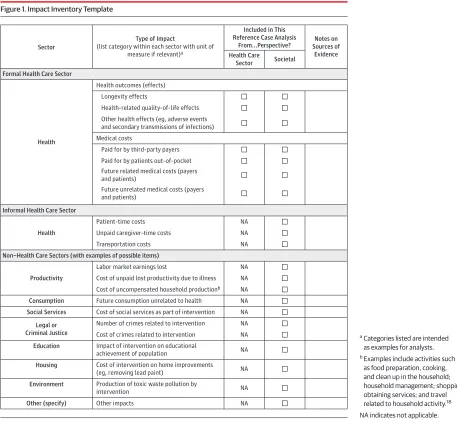
should include medical costs (current and future, related and unre-lated) borne by third-party payers and paid out-of-pocket by pa-tients, time costs of patients in seeking and receiving care, time costs of informal (unpaid) caregivers, transportation costs, effects on fu-ture productivity and consumption, and other costs and effects out-side the health care sector. To make this evaluation more explicit and transparent, inclusion of an “impact inventory” that lists the health and nonhealth effects of an intervention should be considered in a societal reference case analysis (described in more detail below and in theFigure 1). The main purpose of the impact inventory is to en-sure that all consequences, including those outside the formal health care sector, are considered regularly and comprehensively, which has generally not been the case to date.
[image:5.612.67.524.64.485.2]Recommendation 3B: Quantifying and Valuing Nonhealth Compo-nents in the Impact Inventory|Analysts should attempt to quantify and value nonhealth consequences in the impact inventory unless those consequences are likely to have a negligible effect on the re-sult of the analysis.
Figure 1. Impact Inventory Template
Sector
Type of Impact
(list category within each sector with unit of measure if relevant)a
Formal Health Care Sector
Health
Health outcomes (effects)
Informal Health Care Sector
Included in This Reference Case Analysis
From…Perspective?
Notes on Sources of
Evidence Health Care
Sector Societal
Longevity effects
Health-related quality-of-life effects
Other health effects (eg, adverse events and secondary transmissions of infections)
Medical costs
Paid for by third-party payers
Health
Patient-time costs NA
Non−Health Care Sectors (with examples of possible items)
Productivity
Labor market earnings lost NA
Consumption Future consumption unrelated to health NA
Social Services Cost of social services as part of intervention NA
Education Impact of intervention on educational
achievement of population NA
Housing Cost of intervention on home improvements
(eg, removing lead paint) NA
Environment Production of toxic waste pollution by
intervention NA
Other (specify) Other impacts NA
Legal or Criminal Justice
Number of crimes related to intervention NA
Unpaid caregiver-time costs NA
Cost of crimes related to intervention NA
Cost of unpaid lost productivity due to illness NA
Cost of uncompensated household productionb NA
Transportation costs NA
Paid for by patients out-of-pocket
Future related medical costs (payers and patients)
Future unrelated medical costs (payers and patients)
aCategories listed are intended
as examples for analysts.
b
Examples include activities such as food preparation, cooking, and clean up in the household; household management; shopping; obtaining services; and travel related to household activity.18
Recommendation 3C: Summary and Disaggregated Measures|It would be helpful to inform decision makers through the quantification and valuation of all health and nonhealth effects of interventions, and to summarize those effects in a single quantitative measure, such as an incremental cost-effectiveness ratio, net monetary benefit, or net health benefit. However, there are no widely agreed on meth-ods for quantifying and valuing some of these broader effects in cost-effectiveness analyses. Analysts should present the items listed in the impact inventory in the form of disaggregated consequences across different sectors. It is also recommended that analysts use 1 or more summary measures, such as an incremental cost-effectiveness ratio, net monetary benefit, or net health benefit, that include some or all of the items listed in the impact inventory. Ana-lysts should clearly identify which items are included and how they are measured and valued, and provide a rationale for their method-ological decisions.
Recommendation 4: Reporting the Reference Cases and Other Perspectives
Recommendation 4A: Stating the Perspective|Analysts should clearly state the perspective of every analysis reported.
Recommendation 4B: Presenting Other Perspectives|When spe-cific decision makers have been identified, such as a particular pub-lic or private payer, analysts may want to present results from that decision maker’s perspective in addition to the 2 reference case per-spectives. In these cases, analysts should indicate who the primary decision makers were whose deliberations are intended to be in-formed by the analysis.
Recommendation 4C: Importance of Transparency and Sensitivity Analysis|The items included in a cost-effectiveness analysis and the manner in which they are valued involve numerous choices. Analysts should be transparent about how they have conducted the analyses, and convey how the results change with alternative assumptions. Sensitivity analysis should describe the assump-tions to which the results for different perspectives are sensitive.
Other Recommendations Regarding the Design
and Conduct of Cost-effectiveness Analyses
It is important to focus on relevant research questions, maintain the focus as the study progresses, and avoid analytic pitfalls. A written protocol at the outset of an analysis that details key aspects of the design and conduct of the cost-effectiveness analysis is recom-mended (eg, the study objective; the intervention, comparators, and populations under consideration; the time horizon; sources of data; a list of key assumptions).
In terms of valuing health outcomes, the Second Panel (in agree-ment with the original panel) recommends that (1) the reference case cost-effectiveness analyses should measure health effects in terms of QALYs (including QALYs accruing to patients and to any other af-fected parties such as caregivers); (2) quality weights should be pref-erence based and interval scaled; and (3) community prefpref-erences for health states are the most appropriate source of preferences for reference case analyses. The use of generic preference-based mea-sures is recommended to enhance comparability across studies, but
it is emphasized that the instrument used should be fit for purpose in the sense that its measurement properties are adequate to mea-sure the differences and changes in health across the interventions under consideration. Although generic preference-based mea-sures should be used for the reference case analyses, analysts may also want to present estimates based on scores obtained from pa-tients or from other sources.
In a departure from the original panel, the Second Panel ob-serves that, in general, effects on productivity are unlikely to have been captured by most preference-based measures, and that evi-dence is not definitive that the effects of morbidity on leisure are necessarily reflected in the utility scores or quality-of-life weights.19-25
Therefore, it is recommended that the productivity consequences related to changes in health status be reflected in the numerator of cost-effectiveness ratios for reference case analyses conducted un-der the societal perspective, while recognizing the possibility that the uncertainty about how productivity and the effects of morbid-ity on leisure activities are captured in preference-based measures could lead to double counting. Research recommendations are made to develop improved quality-of-life weights that would avoid such double counting.
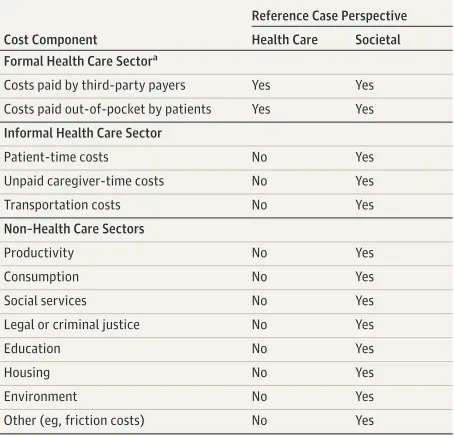
[image:6.612.317.544.90.309.2]In terms of estimating costs for cost-effectiveness analyses, a key departure from the original panel is the consideration of cost cat-egories from the 2 reference case perspectives. It is now recom-mended that some components (eg, current and future medical costs and patients’ out-of-pocket costs) should be included in both per-spectives, while others (eg, time costs for patients and caregivers, transportation costs, productivity benefits, consumption costs, and other non–health-care sector costs) should be included only in the societal reference case perspective (Table 1). The new recom-mendations also suggest inclusion of future costs (ie, that cost-effectiveness analyses account for related or unrelated health care
Table 1. Cost Components Included in the 2 Recommended Reference Case Perspectives
Cost Component
Reference Case Perspective
Health Care Societal
Formal Health Care Sectora
Costs paid by third-party payers Yes Yes
Costs paid out-of-pocket by patients Yes Yes
Informal Health Care Sector
Patient-time costs No Yes
Unpaid caregiver-time costs No Yes
Transportation costs No Yes
Non–Health Care Sectors
Productivity No Yes
Consumption No Yes
Social services No Yes
Legal or criminal justice No Yes
Education No Yes
Housing No Yes
Environment No Yes
Other (eg, friction costs) No Yes
aIncludes current and future costs related and unrelated to the condition under
costs that occur during the additional life-years produced by an in-tervention). The original panel discussed this issue but did not reach consensus (noting that analysts could use their discretion) due to the lack of a developed theoretical basis for including future costs at the time of its report.26-34
It is important to interpret, adjust, and synthesize evidence in a cost-effectiveness analysis, drawing on recent guidance regard-ing systematic reviews and meta-analyses. Among the recommen-dations, analysts should (1) provide a qualitative description and cri-tique of the evidence base, (2) be explicit about whether and how bias in each study and across studies in the evidence was handled, (3) produce bias-corrected estimates, and (4) be explicit about whether and how estimates were adjusted for transferability.
Costs and health effects should be discounted at the same rate in cost-effectiveness analyses. Furthermore, given available data on real economic growth and corresponding estimates of the real con-sumption rate of interest and to promote comparability across studies, 3% is the most appropriate real discount rate for cost-effectiveness analyses. However, the panel recommends conduct-ing sensitivity analyses that allow for a reasonable range of rates, along with more research on the topic of using different discount rates for costs and health effects in cost-effectiveness analyses.
Recommendations Regarding Reporting
and Interpreting Cost-effectiveness Analyses
Organization and clarity in reporting cost-effectiveness analyses35
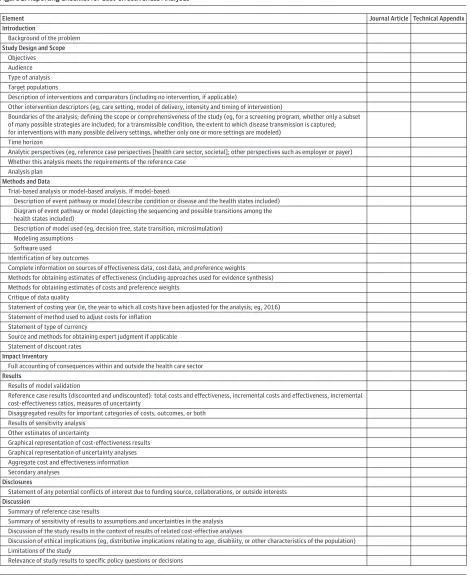
are important and there are expanded recommendations to im-prove and standardize reporting (Figure 2). Analysts should docu-ment cost-effectiveness analyses in both a journal article and in a technical appendix.
All of the elements included in the reporting checklist should be briefly covered in the journal article, with additional detail provided within the technical appendix. There are no specific recommenda-tions on which elements are of the highest priority because this may depend to some extent on the specifics of the analysis. Typical ele-ments often covered primarily in the technical appendix include detailed reporting of intermediate outcomes and disaggregated re-sults, uncertainty and secondary analyses, modeling assumptions, evi-dence synthesis, model validation, and information on sources of data regarding effectiveness, cost, and preferences.
Inclusion of a structured abstract for journal articles, incorpo-ration of an impact inventory to aid analysts in providing a com-plete and transparent account of the reference cases, reporting of intermediate end points and disaggregated results, and disclosure of potential conflicts of interest are recommended.
Structured Abstract
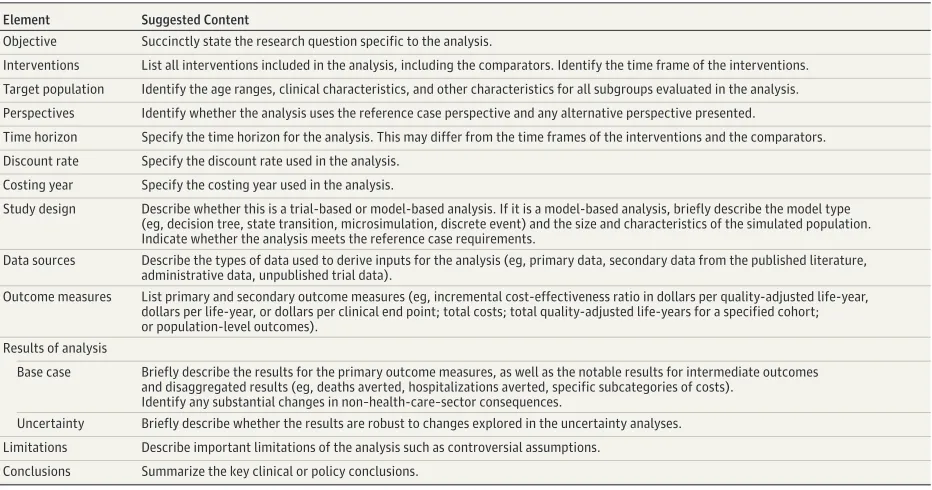
Although each journal may have its own requirements, it is recom-mended that a structured abstract specifically designed for cost-effectiveness analyses should be included in the journal article when-ever possible (Table 2).
Impact Inventory
As noted, the new reference case recommendations mean report-ing of results from both the health care sector perspective and the so-cietal perspective. Analysts should clearly delineate the results from
the 2 reference case perspectives and identify differences using the impact inventory (Figure 1). Analysts should consider the decision con-text when determining if one reference case perspective is to be pre-sented in greater detail than the other. The discussion section of the journal article should address qualitative and quantitative differ-ences between the 2 reference case perspectives. It is important to highlight the components of the impact inventory most affected by the condition or those that differ between the 2 perspectives.
For interventions that have substantial effects beyond the for-mal health care sector, such as those that address public health pro-grams or children’s health, it is important to highlight differences be-tween the health care sector and societal perspectives. If a sector or consequence within a sector is identified but excluded from a cost-effectiveness analysis, analysts should provide a brief rationale in the accompanying text or in the “Notes on Sources of Evidence” section of the impact inventory. The impact inventory should be completed and reported for all analyses, even those restricted to the health care sector to highlight any effects or costs not fully addressed.
For all analyses, the impact inventory should identify the tors affected and list the specific types of impacts within each sec-tor. If the results in the societal reference case differ substantially from those in the health care sector reference case, all identified ef-fects should ideally be quantified, valued if possible, and reported in the results section. Items in categories not estimated quantita-tively should be named in the impact inventory and addressed in the discussion section, the technical appendix, or both. Analysts should initially consider the elements of the impact inventory as part of the design exercise for an analysis and then include the completed im-pact inventory in the journal article (or in the technical appendix if space limitations preclude inclusion in the journal report).
Reporting of Intermediate End Points and Disaggregated Results
Incremental cost-effectiveness ratios provide a concise summary of the results. The panel recommends that information on intermedi-ate outcomes and disaggregintermedi-ated results should also be included in the journal article with more detail provided in the technical appen-dix. Intermediate outcomes such as diagnoses, test outcomes, health events, or hospitalizations provide readers with an opportunity to assess the effectiveness of the interventions in more familiar terms, and to compare the results with other analyses that may have used similar outcomes. The reporting of disaggregated results, which re-fers to the attribution of total costs or QALYs to specific categories, can help audiences understand the different magnitudes of eco-nomic and health consequences.
Interpreting Results for Decision Makers
Because few decision makers in the United States or elsewhere use strict cost-effectiveness thresholds for decision making, conclu-sionsaboutthecost-effectivenessofaninterventionshouldbeframed with respect to the decision context and how the specific set of re-sults can aid and inform decision making.36Comparison with 1
spe-cific threshold should be avoided (unless appropriate for the deci-sion context); analysts should instead highlight how clinical or policy recommendations might change with consideration of a range of thresholds.37
Disclosure of Potential Conflicts of Interest
Disclosure policy for authors of cost-effectiveness analyses should follow the standards formulated by the International Committee of Medical Journal Editors.
Worked Examples
Within the full report of the Second Panel,82 new worked
examples (one focusing on alcohol use disorders and another on end-of-life care) are included. These worked examples
demon-Figure 2. Reporting Checklist for Cost-effectiveness Analyses
Introduction
Element Journal Article Technical Appendix
Background of the problem
Study Design and Scope
Methods and Data
Objectives Audience Type of analysis Target populations
Description of interventions and comparators (including no intervention, if applicable)
Time horizon
Other intervention descriptors (eg, care setting, model of delivery, intensity and timing of intervention)
Analytic perspectives (eg, reference case perspectives [health care sector, societal]; other perspectives such as employer or payer)
Trial-based analysis or model-based analysis. If model-based:
Identification of key outcomes
Impact Inventory
Full accounting of consequences within and outside the health care sector
Results
Results of model validation
Disclosures
Statement of any potential conflicts of interest due to funding source, collaborations, or outside interests
Discussion
Summary of reference case results
Summary of sensitivity of results to assumptions and uncertainties in the analysis Discussion of the study results in the context of results of related cost-effective analyses
Limitations of the study
Relevance of study results to specific policy questions or decisions
Discussion of ethical implications (eg, distributive implications relating to age, disability, or other characteristics of the population) Reference case results (discounted and undiscounted): total costs and effectiveness, incremental costs and effectiveness, incremental cost-effectiveness ratios, measures of uncertainty
Disaggregated results for important categories of costs, outcomes, or both Results of sensitivity analysis
Other estimates of uncertainty
Graphical representation of cost-effectiveness results Graphical representation of uncertainty analyses Aggregate cost and effectiveness information Secondary analyses
Description of event pathway or model (describe condition or disease and the health states included) Diagram of event pathway or model (depicting the sequencing and possible transitions among the health states included)
Description of model used (eg, decision tree, state transition, microsimulation) Modeling assumptions
Software used
Complete information on sources of effectiveness data, cost data, and preference weights Methods for obtaining estimates of effectiveness (including approaches used for evidence synthesis) Methods for obtaining estimates of costs and preference weights
Critique of data quality
Statement of costing year (ie, the year to which all costs have been adjusted for the analysis; eg, 2016) Statement of method used to adjust costs for inflation
Statement of type of currency
Source and methods for obtaining expert judgment if applicable Statement of discount rates
Whether this analysis meets the requirements of the reference case Analysis plan
[image:8.612.77.548.75.653.2]strate how to report results for both reference case perspectives, use of the impact inventory, sample methods for displaying cost-effectiveness analysis results, uncertainty analyses, sensitivity analyses, and examples of intermediate outcomes and disaggre-gated results.
Discussion
The goal of the Second Panel was to promote the continued evolu-tion of cost-effectiveness analysis and its use to support judicious, efficient, and fair decisions regarding the use of health care re-sources. Comparability across cost-effectiveness analyses is highly desirable if the technique is to help decision makers evaluate tradeoffs. Inclusion of standardized components, and standardiza-tion of methods within a perspective, is intended to enhance con-sistency and comparability across studies.
Differentiating between the health care sector perspective and the societal perspective will provide more clarity to consumers of cost-effectiveness analyses than has been the case in recent years. The common practice of presenting an analysis from the health care sector perspective and labeling it a societal perspective has cre-ated the impression that these 2 perspectives are the same when they are not. Clarity about perspective is further emphasized by the recommendations that analysts should identify any specific deci-sion maker whose decideci-sions are intended to be influenced by the analysis, and conduct additional analyses from perspectives spe-cific to that decision maker if those analyses will provide useful in-formation. Many challenges remain, such as valuation of effects out-side the health care sector and coordination with other methods already used to evaluate those effects, such as cost-benefit analy-sis. Addressing these challenges will continue to provide opportu-nities to advance the field of cost-effectiveness analysis.
These reporting recommendations highlight the reference case perspectives and delineation of the impact inventory. A review of existing reporting recommendations was conducted and included a discussion of the possible adoption of the Consolidated Health Eco-nomic Evaluation Reporting Standards (CHEERS)38for
endorse-ment (one of the panel members and one of the leadership group were involved with the Delphi process for the CHEERS guidelines). However, specific reporting requirements for the reference case pre-cluded the direct adoption of CHEERS or other available reporting guidelines. The recommendations from the Second Panel share many elements with the CHEERS recommendations, which, in turn, re-flect elements of the original panel’s recommendations.
Substantial attention has been focused on ethical issues in cost-effectiveness analyses, reflecting the importance of the topic and developments in the field. Consideration of the opportunity cost of an intervention is ethically justified. Without such consideration, de-cision makers would not know if there were better uses of the re-sources at hand. These recommendations also reaffirm the prin-ciples that cost-effectiveness analysis is not by itself a sufficient decision-making standard and that it does not capture all relevant concerns. Maximizing the total quantity of health benefits will rarely be the only concern for decision makers. Who receives the benefits— the distributive concern—also matters. Such decisions involve tradeoffs between effects and costs for some patients vs different effects and costs for other patients.
[image:9.612.69.535.79.324.2]The use of QALYs in cost-effectiveness analysis raises possible ethical and other concerns. A key advantage of QALYs is that they reflect effects on both morbidity and mortality and provide a basis for broad comparisons of the health effects of various interven-tions and policies. But there are a number of disadvantages associ-ated with the QALY framework. For instance, QALYs may not accu-rately reflect the burden of short-lived but intense experiences. Thus the benefits of interventions that reduce the incidence of such
Table 2. Elements Recommended for Inclusion in a Structured Abstract for Cost-effectiveness Analyses
Element Suggested Content
Objective Succinctly state the research question specific to the analysis.
Interventions List all interventions included in the analysis, including the comparators. Identify the time frame of the interventions.
Target population Identify the age ranges, clinical characteristics, and other characteristics for all subgroups evaluated in the analysis.
Perspectives Identify whether the analysis uses the reference case perspective and any alternative perspective presented.
Time horizon Specify the time horizon for the analysis. This may differ from the time frames of the interventions and the comparators.
Discount rate Specify the discount rate used in the analysis.
Costing year Specify the costing year used in the analysis.
Study design Describe whether this is a trial-based or model-based analysis. If it is a model-based analysis, briefly describe the model type (eg, decision tree, state transition, microsimulation, discrete event) and the size and characteristics of the simulated population. Indicate whether the analysis meets the reference case requirements.
Data sources Describe the types of data used to derive inputs for the analysis (eg, primary data, secondary data from the published literature, administrative data, unpublished trial data).
Outcome measures List primary and secondary outcome measures (eg, incremental cost-effectiveness ratio in dollars per quality-adjusted life-year, dollars per life-year, or dollars per clinical end point; total costs; total quality-adjusted life-years for a specified cohort; or population-level outcomes).
Results of analysis
Base case Briefly describe the results for the primary outcome measures, as well as the notable results for intermediate outcomes and disaggregated results (eg, deaths averted, hospitalizations averted, specific subcategories of costs).
Identify any substantial changes in non–health-care–sector consequences.
Uncertainty Briefly describe whether the results are robust to changes explored in the uncertainty analyses.
Limitations Describe important limitations of the analysis such as controversial assumptions.
experiences may be undervalued. Furthermore, in the standard ap-proach to estimating QALYs, the QALYs gained due to an interven-tion that generates marginal gains for many people may be approxi-mately equal to the QALYs gained by an intervention that generates substantial gains for a small number of people, yet society may fa-vor the latter. Similarly, some have argued that treating those who initially experience highly impaired health is more valuable than treat-ing those with good baseline health. These and other issues are ex-plored further in the forthcoming book.
Numerouspolicyquestionsrelatedtotheuseofcost-effectiveness analysis were considered. Even though cost-effectiveness analy-ses have been published widely in the United States, and have been used to inform policy in selected areas, the application of cost-effectiveness analysis has also encountered resistance. For example, the Medicare program is barred from considering cost-effectiveness analysis in its decisions about whether to pay for new therapies and diagnostics. Notably, the Patient Protection and Affordable Care Act39prohibited the Patient-Centered
Out-comes Research Institute from developing or using a dollars-per-QALY metric as a threshold to establish what type of health care is cost-effective or recommended, and stated that the “Secretary shall not utilize such an adjusted life year (or such a similar mea-sure) as a threshold to determine coverage, reimbursement, or in-centive programs….”
Reasons for the resistance to cost-effectiveness analysis are likely multifaceted and complex but suggest an inclination on the part of many individuals in the United States to minimize the un-derlying problem of resource scarcity and the consequent need to explicitly ration care. Experience shows that when policy makers have incorporated cost-effectiveness analysis into decision-making pro-cesses, they have not applied it as the sole decision criterion.40,41
In practice, multiple factors are brought to bear on resource alloca-tion decisions. Cost-effectiveness is only 1 element among many, in-cluding patient’s expectations; legal, ethical, equity, cultural, and po-litical concerns; and pragmatic issues of logistics and feasibility. Most health organizations involved in resource allocation decisions give
the greatest weight and deepest consideration to the clinical evi-dence. Cost-effectiveness analysis can play an important role, how-ever, particularly when it is recognized that costs are effectively op-portunities for health improvement that other patients forgo.
Updating the original panel’s work provided an opportunity to reflect on the evolution of cost-effectiveness analysis and to de-velop guidance for the next generation of practitioners and con-sumers. Similar to any consensus panel, these recommendations re-flect an effort by a selected group of individuals to achieve a sensible and workable arrangement. Other groups may have developed dif-ferent recommendations.
Some key areas for future research include (1) the use of multi-criteria decision analysis and group decision making; (2) the use of cost-effectiveness analysis in value-based pricing; (3) estimation of effectiveness thresholds; (4) the link between cost-effectiveness analysis and incentives for innovation; (5) the role of cost-effectiveness analysis within health plans or guideline develop-ment; and (6) the effect of the 2 recommended reference case per-spectives on the cost-effective analysis and its findings. The field would also benefit from further research on QALYs, including topics such as whether and to what extent respondents consider productivity ef-fects in their evaluations of health states, the relationship of commu-nity preferences to patient preferences for different health states, the elicitation of preference scores for path states, the sequence of states that patients experience, and the methods for measuring health-related quality-of-life effects on family members of ill individuals (fam-ily spillover effects).
Conclusions
The Second Panel reviewed the current status of the field of cost-effectiveness analysis and developed a new set of recommenda-tions. Major changes include the recommendation to perform analy-ses from 2 reference case perspectives and to provide an impact inventory to clarify included consequences.
ARTICLE INFORMATION
Author Affiliations:Duke Clinical Research Institute, Duke University, Durham, North Carolina (Sanders); Center for the Evaluation of Value and Risk in Health, Institute for Clinical Research and Health Policy Studies, Tufts Medical Center, Boston, Massachusetts (Neumann); Pharmaceutical Outcomes Research and Policy Program, Department of Pharmacy, and Departments of Health Services and Economics, University of Washington, Seattle (Basu); Division of Medical Ethics, Social Medicine, Harvard Medical School, Boston, Massachusetts (Brock); Department of Economics, McMaster University, Hamilton, Ontario, Canada (Feeny); Leslie Dan Faculty of Pharmacy, University of Toronto, Toronto, Ontario, Canada (Krahn); Toronto Health Economics and Technology Assessment Collaborative, Toronto General Research Institute, University Health Network, Toronto General Hospital, Toronto, Ontario, Canada (Krahn); Institute of Health Policy, Management and Evaluation, University of Toronto, Toronto, Ontario, Canada (Krahn); Division of Health Policy and Management, School of Public Health, University of Minnesota, Minneapolis
(Kuntz); Departments of Medicine and Economics, Harris School of Public Policy Studies, and Center for Health and the Social Sciences, University of Chicago, Chicago, Illinois (Meltzer); VA Palo Alto Health Care System, Palo Alto, California (Owens); Center for Health Policy/Center for Primary Care and Outcomes Research, Stanford University, Stanford, California (Owens); Child Health Evaluation and Research Unit, Department of Pediatrics and Communicable Diseases, University of Michigan Medical School, Ann Arbor (Prosser); Department of Health Management and Policy, University of Michigan School of Public Health, Ann Arbor (Prosser); Department of Global Health and Population, Harvard T. H. Chan School of Public Health, Boston, Massachusetts (Salomon); Centre for Health Economics, University of York, York, England (Sculpher); Department of Health Services, Policy and Practice, School of Public Health, Brown University, Providence, Rhode Island (Trikalinos); Department of Economics and Institute for Health, Rutgers University, New Brunswick, New Jersey (Russell); Patient-Centered Outcomes Research Institute, Washington, DC (Siegel); Department of Family Medicine and Community Health, Miller
School of Medicine, University of Miami, Miami, Florida (Ganiats).
Author Contributions:Drs Sanders and Neumann had full access to all of the data in the study and take responsibility for the integrity of the data and the accuracy of the data analysis.
Study concept and design:Sanders, Neumann, Basu, Feeny, Krahn, Kuntz, Meltzer, Owens, Prosser, Salomon, Sculpher, Trikilanos, Russell, Siegel, Ganiats.
Acquisition, analysis, or interpretation of data:
Sanders, Neumann, Brock, Krahn, Meltzer, Owens, Ganiats.
Drafting of the manuscript:Sanders, Neumann, Basu, Meltzer, Prosser, Sculpher.
Critical revision of the manuscript for important intellectual content:Neumann, Basu, Brock, Feeny, Krahn, Kuntz, Meltzer, Owens, Prosser, Salomon, Trikilanos, Russell, Siegel, Ganiats.
Statistical analysis:Basu, Kuntz, Owens.
Obtaining funding:Sanders, Neumann, Ganiats.
Administrative, technical, or material support:
Neumann, Krahn, Ganiats.
Conflict of Interest Disclosures:The authors have completed and submitted the ICMJE Form for Disclosure of Potential Conflicts of Interest. Dr Neumann reported serving on advisory boards for Merck, Bayer, Pacira, Novo Nordisk, Shire, Amgen, and the Congressional Budget Office; serving as a consultant to Boston Health Economics, Purdue, Vertex, and Precision Health Economics; and receiving funding from the CEA Registry sponsors. Dr Feeny reported having a proprietary interest in Health Utilities Incorporated, which owns the copyright to the Health Utilities Index. Dr Meltzer reported serving on a formulary committee for CVS. Dr Sculpher reported serving as a consultant on the methods of cost-effectiveness for various pharmaceutical and medical device companies. The Second Panel will not be receiving royalities from the book. No other disclosures were reported.
Funding/Support:Funding was provided by the Robert Wood Johnson Foundation and the Bill and Melinda Gates Foundation to support in-person meetings, the services of a medical editor (Rebecca Gray, DPhil), and research for 2 new worked examples (one focusing on alcohol use disorders and another on end-of-life care), which will appear inCost-Effectiveness in Health and Medicine.8
In addition, the panel received a conference grant from the Agency for Healthcare Research and Quality, which funded a 3-day in-person meeting in spring 2014 and parts of 2 subsequent meetings; support from the University of California, San Diego, Health Services Research Center, which funded part of the first in-person panel meeting; and in-kind support from the Society for Medical Decision Making.
Role of the Funder/Sponsor:The funders played no role in the design and conduct of the study; collection, management, analysis, and
interpretation of the data; and preparation, review, or approval of the manuscript or decision to submit the manuscript for publication. Some material from this article and the complete report from the Second Panel on Cost-Effectiveness in Health and Medicine will appear inCost-Effectiveness in Health and Medicine.8
Disclaimer:The individual contributions to this article are expressed in a personal capacity and are not presented on behalf of or as the views of the individual parties’ employers.
Additional Contributions:We acknowledge the support and guidance of members of the original panel throughout the process of producing this update: Norman Daniels, PhD, Dennis G. Fryback, PhD, Alan M. Garber, MD, PhD, Marthe R. Gold, MD, David C. Hadorn, MD, PhD, MA, Mark S. Kamlet, PhD, Joseph Lipscomb, PhD, Bryan R. Luce, PhD, MBA, Jeanne S. Mandelblatt, MD, PhD, Willard G. Manning Jr, PhD, Kristine L. McCoy, MPH, Donald L. Patrick, PhD, Louise B. Russell, PhD (co-chair), Joanna E. Siegel, ScD, George W. Torrance, MBA, PhD, and Milton C. Weinstein, PhD (co-chair). We also thank Rebecca Gray, DPhil (Duke Clinical Research Institute, Duke University, Durham, North Carolina), for editorial assistance; Julie Lannon, BS (Center for the Evaluation of Value and Risk in Health, Institute for Clinical Research and Health Policy Studies, Tufts Medical Center, Boston, Massachusetts) for logisitical support; and David Kim, PhD (University of Washington, Seattle), and Ba’ Pham, MSc, PhD (University of Toronto, Toronto, Ontario, Canada), for their efforts on
the worked examples. The efforts of Dr Gray, Ms Lannon, Dr Kim, and Dr Pham were supported through the grant funding listed in the Funding/ Support section. No other participants (including the panel members or leadership group) received compensation for their work on this project. We also acknowledge the following individuals who reviewed 1 or more chapters of the book, which provided the template for this summary report: Paul Barnett, PhD (VA Palo Alto Health Care System), Andrew Briggs, DPhil (University of Glasgow), Karl Claxton, PhD (University of York), Joshua T. Cohen, PhD (Tufts Medical Center), Phaedra Corso, PhD (University of Georgia), Michael Drummond, PhD (University of York), Nir Eyal, DPhil (Harvard University), Dennis Fryback, PhD (University of Wisconsin), William Furlong, MSc (McMaster University), Afschin Gandjour, MD, PhD (Frankfurt School of Finance and Management), Louis Garrison, PhD (University of Washington), Marthe Gold, MD (City University of New York), Dan Greenberg, PhD (Ben-Gurion University of the Negev), Scott Grosse, PhD (US Centers for Disease Control and Prevention), James Hammitt, PhD (Harvard T. H. Chan School of Public Health), Neil Hawkins, PhD, MBA (University of Glasgow), Mark Helfand, MD (Oregon Health & Science University), Don Husereau, BScPharm (Institute of Health Economics), Emmett Keeler, PhD (RAND), Paul Krabbe, PhD (University of Groningen), William Lawrence, MD, MS (Patient-Centered Outcomes Research Institute), Joseph Lipscomb, PhD (Emory University), Daniel Mullins, PhD (University of Maryland), Erik Nord, PhD (University of Oslo), James O’Mahony, PhD (Trinity College Dublin), Donald Patrick, PhD (University of Washington), Mike Paulden, MSc (Toronto Health Economics and Technology Assessment Collaborative), A. Simon Pickard, PhD (University of Illinois at Chicago), Michael Pignone, MD, MPH (University of Texas at Austin), Daniel Polsky, PhD (University of Pennsylvania), K. V. Ramanath, MBA (SAC College of Pharmacy), Dennis Revicki, PhD (Evidera), Mark Roberts, MD, MPP (University of Pittsburgh), Lisa Robinson, MPP (Harvard T. H. Chan School of Public Health), Steven Teutsch, MD, MPH (University of California, Los Angeles), George Torrance, PhD, MBA (McMaster University), Joel Tsevat, MD, MPH (University of Cincinnati), Todd Wagner, PhD (Stanford University), Evelyn Whitlock, MD, PhD (Patient-Centered Outcomes Research Institute), Milton Weinstein, PhD (Harvard T. H. Chan School of Public Health), John Wong, MD (Tufts Medical Center), and Beth Woods, MSc (University of York). We are grateful to several dozen individuals who commented on the publicly posted draft chapters during fall 2015.
REFERENCES
1. Gold MR, Siegel JE, Russell LB, Weinstein MC, eds.Cost-Effectiveness in Health and Medicine. New York, NY: Oxford University Press; 1996.
2. Russell LB, Gold MR, Siegel JE, Daniels N, Weinstein MC; Panel on Cost-Effectiveness in Health and Medicine. The role of cost-effectiveness analysis in health and medicine.JAMA. 1996;276 (14):1172-1177.
3. Siegel JE, Weinstein MC, Russell LB, Gold MR; Panel on Cost-Effectiveness in Health and Medicine. Recommendations for reporting cost-effectiveness analyses.JAMA. 1996;276(16):1339-1341.
4. Weinstein MC, Siegel JE, Gold MR, Kamlet MS, Russell LB. Recommendations of the Panel on Cost-Effectiveness in Health and Medicine.JAMA. 1996;276(15):1253-1258.
5. Advisory Committee on Immunization Practices (ACIP). ACIP: guidance for health economics studies.http://www.cdc.gov/vaccines/acip /committee/guidance/economic-studies.html.
Accessed May 22, 2015.
6. National Institute for Health and Care Excellence. Guide to the methods of technology appraisal, 2013: PMG9.https://www.nice.org.uk /process/pmg9/chapter/1-foreword. Accessed August 16, 2016.
7. Centers for Medicare & Medicaid Services. National health expenditures; aggregate and per capita amounts, annual percent change and percent distribution: calendar years 1960-2014.http://www.cms.gov/research -statistics-data-and-systems/statistics-trends -and-reports/nationalhealthexpenddata /nationalhealthaccountshistorical.html.Accessed July 22, 2016.
8. Neumann PJ, Sanders GD, Russell LB, Siegel JE, Ganiats TG, eds.Cost-Effectiveness in Health and Medicine. 2nd ed. New York, NY: Oxford University Press; 2016.
9. Daigle ME, Weinstein AM, Katz JN, Losina E. The cost-effectiveness of total joint arthroplasty: a systematic review of published literature.Best Pract Res Clin Rheumatol. 2012;26(5):649-658.
10. Diaby V, Tawk R, Sanogo V, Xiao H, Montero AJ. A review of systematic reviews of the
cost-effectiveness of hormone therapy, chemotherapy, and targeted therapy for breast cancer.Breast Cancer Res Treat. 2015;151(1):27-40.
11. Neumann PJ. Costing and perspective in published cost-effectiveness analysis.Med Care. 2009;47(7)(suppl 1):S28-S32.
12. Garrison LP Jr, Mansley EC, Abbott TA III, Bresnahan BW, Hay JW, Smeeding J. Good research practices for measuring drug costs in
cost-effectiveness analyses: a societal perspective: the ISPOR Drug Cost Task Force report—part II.
Value Health. 2010;13(1):8-13.
13. Brettschneider C, Djadran H, Härter M, Löwe B, Riedel-Heller S, König HH. Cost-utility analyses of cognitive-behavioural therapy of depression: a systematic review.Psychother Psychosom. 2015; 84(1):6-21.
14. Kokorowski PJ, Routh JC, Nelson CP. Quality assessment of economic analyses in pediatric urology.Urology. 2013;81(2):263-267.
15. Stone PW, Chapman RH, Sandberg EA, Liljas B, Neumann PJ. Measuring costs in cost-utility analyses: variations in the literature.Int J Technol Assess Health Care. 2000;16(1):111-124.
16. Brouwer WB, Culyer AJ, van Exel NJ, Rutten FF. Welfarism vs extra-welfarism.J Health Econ. 2008;27(2):325-338.
17. Drummond MF, Sculpher MJ, Claxton K, Torrance GW, Stoddart GL.Methods for the Economic Evaluation of Health Care Programmes. 4th ed. Oxford, England: Oxford University Press; 2015.
19. Krol M, Brouwer W, Sendi P. Productivity costs in health-state valuations: does explicit instruction matter?Pharmacoeconomics. 2006;24(4):401-414.
20. Meltzer D, Johannesson M. Inconsistencies in the “societal perspective” on costs of the Panel on Cost-Effectiveness in Health and Medicine.Med Decis Making. 1999;19(4):371-377.
21. Meltzer DO, Weckerle CE, Chang LM. Do people consider financial effects in answering quality of life questions?Med Decis Making. 1999;19(3):517.
22. Sculpher MJ, O’Brien BJ. Income effects of reduced health and health effects of reduced income: implications for health-state valuation.
Med Decis Making. 2000;20(2):207-215.
23. Sendi P, Brouwer WB. Is silence golden? a test of the incorporation of the effects of ill-health on income and leisure in health state valuations.
Health Econ. 2005;14(6):643-647.
24. Shiroiwa T, Fukuda T, Ikeda S, Shimozuma K. QALY and productivity loss: empirical evidence for “double counting.”Value Health. 2013;16(4):581-587.
25. Tilling C, Krol M, Tsuchiya A, Brazier J, Brouwer W. In or out? income losses in health state valuations: a review.Value Health. 2010;13(2): 298-305.
26. Bleichrodt H, Quiggin J. Life-cycle preferences over consumption and health: when is
cost-effectiveness analysis equivalent to cost-benefit analysis?J Health Econ. 1999;18(6): 681-708.
27. Feenstra TL, van Baal PH, Gandjour A, Brouwer WB. Future costs in economic evaluation: a comment on Lee.J Health Econ. 2008;27(6): 1645-1649.
28. Garber AM, Phelps CE. Economic foundations of cost-effectiveness analysis.J Health Econ. 1997;16(1):1-31.
29. Lee RH. Future costs in cost effectiveness analysis.J Health Econ. 2008;27(4):809-818.
30. Meltzer D. Accounting for future costs in medical cost-effectiveness analysis.J Health Econ. 1997;16(1):33-64.
31. Meltzer D. Future costs in medical cost-effectiveness analysis. In: Jones AM, ed.
The Elgar Companion to Health Economics. Cheltenham, England: Edward Elgar Publishing Ltd; 2006:447-454.
32. Meltzer D. Response to “future costs and the future of cost-effectiveness analysis”.J Health Econ. 2008;27(4):822-825.
33. Nyman JA. Should the consumption of survivors be included as a cost in cost-utility analysis?Health Econ. 2004;13(5):417-427.
34. Weinstein MC, Manning WG Jr. Theoretical issues in cost-effectiveness analysis.J Health Econ. 1997;16(1):121-128.
35. Husereau D, Drummond M, Petrou S, et al; CHEERS Task Force. Consolidated Health Economic Evaluation Reporting Standards (CHEERS) statement.Cost Eff Resour Alloc. 2013;11(1):6.
36. Russell LB.The Science of Making Better Decisions About Health: Cost-Effectiveness and Cost-Benefit Analysis, September 2015. Rockville, MD: Agency for Healthcare Research and Quality; 2015.
37. Neumann PJ, Cohen JT, Weinstein MC. Updating cost-effectiveness—the curious resilience of the $50,000-per-QALY threshold.N Engl J Med. 2014;371(9):796-797.
38. Husereau D, Drummond M, Petrou S, et al; ISPOR Health Economic Evaluation Publication Guidelines-CHEERS Good Reporting Practices Task Force. Consolidated Health Economic Evaluation Reporting Standards (CHEERS)—explanation and elaboration: a report of the ISPOR Health Economic Evaluation Publication Guidelines Good Reporting Practices Task Force.Value Health. 2013;16(2):231-250.
39. Patient Protection and Affordable Care Act, 42 USC §18001 et seq (2010).
40. PausJenssen AM, Singer PA, Detsky AS. Ontario’s formulary committee: how
recommendations are made.Pharmacoeconomics. 2003;21(4):285-294.