SUPERVISOR’S ENDORSEMENT
“ I hereby declare that I have read through this report entitle “Development of vision-based anomaly detection system in a dynamic environment using background subtraction” and found that it has comply the partial fulfillment for awarding the degree of Bachelor of Electrical Engineering (Mechatronics)”
Signature : ……….
Supervisor’s Name : ASSOCIATE PROFESOR DR MUHAMMAD FAHMI BIN MISKON
DEVELOPMENT OF VISION-BASED ANOMALY DETECTION SYSTEM IN A DYNAMIC ENVIRONMENT USING BACKGROUND SUBTRACTION
ZAKARYA MOHAMMED NASSER SALEH MOTEA
A report submitted in partial fulfilment of the requirements for the degree of Mechatronics Engineering
Faculty of Electrical Engineering
UNIVERSITI TEKNIKAL MALAYSIA MELAKA
iii
STUDENT’S DECLERATION
I declare that this report entitle“Development of vision-based anomaly detection system in a dynamic environments using background subtraction” is the result of my own research except as cited in the references. The report has not been accepted for any degree and is not concurrently submitted in candidature of any other degree.
Signature:
Name : ZAKAYA MOHAMMED NASSER SALEH MOTEA
iv
ACKNOWLEDGEMENT
A great appreciation for all those provided me the opportunity to complete Final Year Project successfully. A special gratitude goes to UTeM University represented by BEKM coordinators at FKE faculty who exerted their full efforts on guiding me and generously giving their advices when referring to them. In preparing this report, I was in contact with many people, researchers, academicians and practitioners. They have contributed towards my understanding and thought. In particular, I wish to express my sincere appreciation to my main project supervisor, ASSOCIATE PROFESOR DR MUHAMMAD FAHMI BIN MISKON for encouragement, guidance critics and friendship. Without his continued support and interest, this project would not have been same as presented here. Also I would like to thank my panels PN. NURUL FATIHA BINTI JOHAN and DR. MUHAMMAD HERMAN BIN.
v
ABSTRACT
vi
ABSTRAK
vii
viii
TABLE OF CONTENTS
CHAPTER TITLE PAGE
1
2
ACKNOWLEDGEMENT ABSTRACT
ABSTRAK
TABLE OF CONTENTS LIST OF TABLES LIST OF FIGURES LIST OF SYMBOLS
LIST OF TERMINOLOGY LIST OF APPENDICES
INTRODUCTION 1.1 Project motivation 1.2 Problem statement 1.3 Objectives
1.4 Scope
LITERATURE REVIEW 2.1 Introduction
2.1.1 Fundamentals of image processing
2.1.1.1 Digital image processing key stages 2.1.2 Gaussian Mixture Model
2.2 The state of the art
2.2.1 Discussion on the state of the art
ix
3
4
2.3 Summarized evaluation of the state of the art 2.3.1 Clarification
2.3.2 Hypothesis
METHODOLOGY
3.1 The objective of the experiment
3.2 Equipment and materials for the experiment 3.3 Flowchart of the project and the methodology 3.4 Simulation Setup
3.5 The procedure of the simulation process 3.5.1 Processing stored image sequence 3.5.2 Processing stored videos
3.5.3 Processing video stream from a camera 3.5.4 Object tracking
3.6 Validity of the test procedure
RESULT AND DISCUSSION 4.1 Evaluation of the detection
4.1.1 Results from processing image sequences 4.1.1.1 MoG algorithm
4.1.1.2 MoG2 algorithm
4.1.1.3 MixtureOfGaussianV1BGS 4.1.2 Processing stored videos
4.1.2.1 MoG algorithm 4.1.2.2 MoG2 algorithm
4.1.2.3 MixtureOfGaussianV1BGS
4.1.3 Processing real-time videos streaming from a camera
4.1.3.1 MoG algorithm 4.1.3.2 MoG2 algorithm
4.1.3.3 MixtureOfGaussianV1BGS
x
5
4.1.4 Sumarry 4.2 Object tracking
CONCLUSION AND RECOMMENDATIONS 5.1 Conclusion
5.2 Recommendations
52 59
61 61 62
REFERENCES APPENDICES
xi
LIST OF TABLES
TABLE TITLE PAGE
2.1 2.2 4.1 4.2 4.3 4.4 4.5 4.6 4.7 4.8 4.9 4.10 4.11 4.12 4.13 4.14
Some of the background subtraction algorithms available in the BGSLibrary.
The summary matrices, the number of stars is proportional to the efficiency.
Performance matrices of learning phase (MoG), BMC dataset. Performance matrices of evaluation phase (MoG), BMC dataset. Performance matrices of Light switching sequence.
Performance matrices of learning phase (MoG2), BMC dataset. Performance matrices of evaluation phase (MoG2), BMC dataset. Performance matrices of MoG2 using Light switching sequence.
Performance matrices of learning phase using MixtureOfGaussianV1BGS, BMC dataset.
Performance matrices of MixtureOfGaussianV1BGS using Light switching sequence.
Performance matrices of evaluation phase using MixtureOfGaussianV1BGS, BMC dataset.
Performance matrices of MoG on real videos. Performance matrices of MoG2 on real videos.
Performance matrices of MixtureOfGaussianV1BGS on real videos. Speed and memory requirements for each algorithm.
A sample record of the position trajectory of a bouncing object.
xii
LIST OF FIGURES
FIGURE TITLE PAGE
1.1 2.1 2.2 2.3 3.1 3.2 3.3 3.4 3.5 3.6 3.7 3.8 3.9 3.10
Percentage of respondents to SDM's 2006 forecast
The work-flow of video surveillance system, indicate the position of BS in the process.
Flow diagram of Background Subtraction algorithm. Digital image processing fundamental steps.
Flow chart of the whole project. Flowchart of image processing flow Simulation Setup
Example of datasets provided by BMC dataset: Input image (Top row); ground truth image (lower row). Original image taken from BMC dataset.
Comparison between the results obtained from the algorithm with ground truth image.
(a) Input image. (b) Ground truth image. (c) Mask generated by MOG. Different types of environment events; (a) cloudy without noise; (b) cloudy with noise; (c) sunny with noise; (d) foggy with noise; (e) windy.
Different types of environment events (a) switching light (on) and (b) switching light (of). Original image from SABS dataset.
Different types of environment events with dynamic backgrounds; (a) waves of water and (b) with existence of Fountains.
The first row, from the left, the ball before it has been tracked (highlighted with black block), then when it is tracked, the second row; the generated mask of the ball
xiii 4.1 4.2 4.3 4.4 4.5 4.6 4.7 4.8 4.9 4.10 4.11
Cloudy without noise; (left) MOG result; (right) ground truth image. The range of f-measure values for a set of data.
Result from foggy sequence (a) ground truth image; (b) algorithm result. The first row shows the input frames, the second row shows the ideal mask of the input frames and the third row shows the generated masks by the algorithm; the first column are frames just before switching the light off, the second column is the frame when the light was turned off and the third column is the frame after turning the light on again. From the left; the original frame, the ground truth image, the mask of the foreground without shadow and the mask of the foreground with shadow.
The first row represent the first frame (original, GT and the result generated by the algorithm with shadow and without shadow), the second row represent the second frame (original, GT and the result generated by the algorithm with and without shadow)
The first row represent the first frame (original, GT and the result generated by the algorithm with shadow and without shadow), the second row represent the second frame (original, GT and the result generated by the algorithm with and without shadow).
From the left; the original frame, the ground truth image, the mask generated by MixtureOfGaussianV1BGS.
From the left; the background, the foreground object and the mask generated by the intrusion of the foreground object using MoG.
The first row is the foreground objects and the second row is the masks generated using MoG from the left, the first column when the light still on, second column when the light is switched off, the third column the light still off, the fourth column when the light is switched on back and the last column one frame after switching the light on back.
From the left; the background, the foreground object and the mask generated by the intrusion of the foreground object using MoG2.
xiv 4.12 4.13 4.14 4.15 4.16 4.17 4.18 4.19 4.20 4.21
The first row is the foreground objects and the second row is the masks generated using MoG2. From the left, the first column when the light is still on, second column when the light is switched off, the third column the light still off, the fourth column when the light is switched on back and the last column one frame after switching the light on back.
From the left; the background, the foreground object and the mask generated by the intrusion of the foreground object using MixtureOfgaussianV1BGS.
The first row is the foreground objects and the second row is the masks generated using MixtureOfGaussianV1BGS. From the left, the first column when the light is switched off, second column the light still off, the third column when the light is switched on, the fourth column one frame after switching the light on and the last column when the light is switched off back.
Results from different videos with different challenges; the columns from up to down show (original frame, truth ground, MoG result, MoG2 results without shadow detection, MoG2 results with shadow detection and MixtureOfGaussianV1BGS result).
Performance of algorithms during sudden change in illumination. Performance of algorithms during learning phase.
Performance of algorithms during evaluation phase. Performance of algorithms for processing real videos. Sample of tracking results.
An object being tracked in a sequence of frames.
xv
LIST OF SYMBOLS
N Wi 𝜇 Σ TP TN FP FN Si(j) m S n Lux PSNR - - - - - - - - - - - - - -
Number of Gaussians. The weight of Gaussian. The mean.
The covariance matrix. True positive.
True negative. False positive. False negative.
The jth pixel of image i. Size.
Sequence. Length.
xvi
LIST OF TERMINOLOGY
BGSLibrary
BCM
Ground truth image Frames
Learning sequence Evaluation sequence Real videos
F-measure PSNR Fps KBpf
-
-
- - - - - - - - -
An open source library that contains a list of background subtraction algorithms.
A dataset that provide sequences of images and videos which are used by all researchers to test their algorithms.
A binary mask of the original image.
A single capture of a video, simply, it is an image. The full sequence of a video being framed. Several frames selected from the full sequence. Short videos contains various weather conditions.
The harmonic mean between the precision and recall values. Peak signal to noise ratio.
xvii
LIST OF APPENDICES
APPENDIX
TITLE PAGE A
B C D
Results for Mog2 when the shadow detection is enabled. Methodology sheet.
The representation of BMC scenes. Gantt Chart.
CHAPTER 1
INTRODUCTION
Recently, surveillance systems have received a great interest from various users throughout the world. These systems started using traditional framing cameras then using video cameras which are able to observe the activities in progress. Some of these systems so far have been able to track the ongoing activity, however the small view and the high rate of data still technical challenges. Vision based anomaly detection system is a system that monitors and provides content-based images and videos recording of objects’ motion in a dynamic environment. This report is organized to present the steps that have been undergone in order to complete the project. Benchmarking with the previous projects done by other researchers [1]–[5] were reviewed. This was ended with a hypothesis which is shown in the methodology section and the results are discussed and presented in the results section.
2
1.1 Project Motivation
Since the existence of people on this planet they try to invent any possible techniques to secure their lives and make it better and comfortable or to solve any problem that disturbs their normal lives. Nowadays, vast variety of applications implement vision based surveillance systems in different ways, however, there still a need for more convenient system which can be used for anomaly objects detection in dynamic environments. The demands to this vision based monitoring system may varies from an application to another, however, it still brings a general common advantage. These applications include security, industrial automation, traffic management, military usages, entertainment parks and medical diagnosis. Therefore, in my opinion this project is one of the best projects among all the other areas of experts in engineering. Besides that, it will form the first step towards a comprehensive understanding of the vision-based systems also will establish a solid foundation for further studies in this field in the future.
The impact of surveillance systems in term of public safety, according to [6] the analysis found that these systems were more effective in parking lots where their use resulted in 51% decrease in crimes,7% decrease in city centers and in public housing communities, and a 23% drop in public transit systems. The same trend is observed in the other fields of applications, however, these levels of achievements are not yet satisfying. Therefore, this project is motivated by that fact and it is a consideration and reflection from the projects and researches that have been done on vision based systems.
The development of vision based applications is growing then this lead to a need for sophisticated techniques that can be used for segmentation, object detection, object tracking, object classification and so on. According to SDM [52] which is the number one security channel media, the responds of surveillance systems’ users and dealers when asked to predict the potential market of surveillance system in the future, then their responses were as shown in Figure 1.1. Since then, some methods have been proposed for the development of vision based systems.
3
[image:20.612.126.520.232.490.2]moving objects. The object is tracked and based on that a suitable reaction is to be made according to the application being implemented. This system is able to detect moving objects in certain scenes using background subtraction technique at witch many filters and functions can be used based on the field of usage. Moreover, the reaction of this system also will vary in multiple forms based on the user setting, therefore this will bring a valuable assistance for human to monitor wider areas with less efforts.
Figure 4.1: Percentage of respondents to SDM's 2006 forecast [52].
As mentioned earlier, the development of this system would bring direct advantage to the aerial surveillance applications and security applications. In addition, the success achieved in this project will have a positive impact on the overall vision based system that may use background subtraction for object recognition and classification.
29%
36% 25%
9% 1%
Predection of surveillance systems potential market
4
1.2 Problem statement
The security is necessary matter for our lives in all aspects because without achieving the safety and security; the development cannot be achieved. Therefore, researchers and institutes gave an attention to this issue and have started to develop new techniques that can reduce dangers and can monitor wider areas. There are many surveillance systems that are currently built with affordable prices, however there still a need for a complete system with higher sensitivity and precision and faster processing times with less complexity and less memory occupancy as well as to be able to detect, recognize and then track moving objects at real time.
In such scenarios there are some challenges and specifications that form constraints against the development in certain applications. The surveillance system should be able to cope with different types of challenges including the variation in illumination, the blur caused by bad weather conditions, presence of shadow and the multimodal scenes. This project is a reflection to what have been done in this field which consider all the aspects and components required to resolve the problem with affordable costs.
To what extent the background subtraction using Gaussian Mixture Model can achieve the desired performance in a dynamic environment?
It is hypothesized that GMM algorithms are able to segment the foreground objects from background scenes and able to detect abnormal objects in dynamic environments which qualify it to be implemented for aerial surveillance systems and other similar systems.
1.3 Objectives
5
1.4 Scope
The focus of this project is on detecting and tracking anomaly objects moving in a dynamic scene. The method used is background subtraction which mainly subtract the foreground body from the background scene. This is done using C++ language which is usually linked with Open Computer Vision library (OpenCV) as it contains various programming functions that are used for image processing. In this project Gaussian Mixture Model (GMM) also known as Mixture of Gaussian algorithm (MOG) is used. GMM was chosen here to be used after conducting a comprehensive comparison between the algorithms that suit the parameters of this application. The final three algorithms were run on visual studio software which were fed by image sequences, videos and videos streaming from a camera. These images and videos have all the challenging conditions which simulate the real surveillance systems.
CHAPTER 2
LITERATURE REVIEW
2.1 Introduction
Vision based anomaly detection system is a vision system that monitor and provide content-based images and videos recording from objects motion in a dynamic environment. Anomaly detection is a significant issue that has a profound effect on success of various applications; therefore it has been discussed for years in multiple fields. Anomaly detection is widely known issue and has been covered in many fields including discrete sequence data [8], and temporal data
[9]. However, anomaly detection in dynamic environment is barely touched in [8], [10].
7
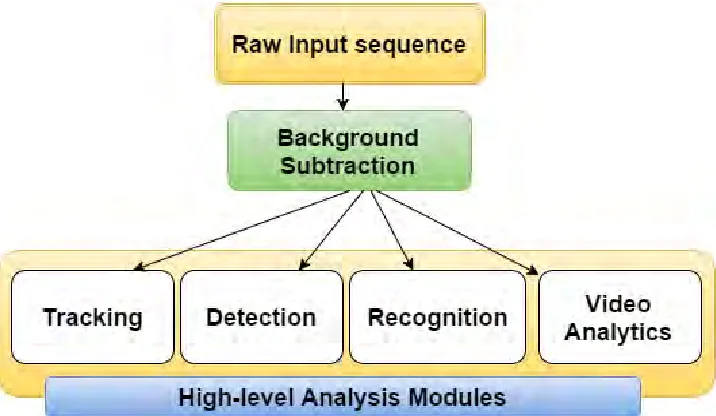
Figure 2.1: The work-flow of video surveillance system, indicate the position of BS in the process
As shown in Figure 2.1 the process starts by the operation on the raw video received from the camera or storage device then separating the background part from the foreground part, the foreground part is the unexpected moving body. This is followed by high-level modules at which the video contents will pass through several techniques. For example, in the tracking module the concentration will be on the anomaly objects which means that the algorithm will send back instructions to the camera which may be driven by a motor to let it follow the motion of that object. In the detection module, in the same manner the task it focused on the foreground objects; locations and motion. Next is recognizing the shape of the anomaly object and eventually the video analytics are conducted thus the system react and response based on the instructions set by the user.
2.1.1 Fundamentals of image processing
![Figure 4.1: Percentage of respondents to SDM's 2006 forecast [52].](https://thumb-us.123doks.com/thumbv2/123dok_us/78228.7365/20.612.126.520.232.490/figure-percentage-respondents-sdm-s-forecast.webp)