0022-538X/96/$04.0010
Copyrightq1996, American Society for Microbiology
A Gene Transfer Vector-Cell Line System for Complete Functional
Complementation of Adenovirus Early Regions E1 and E4
DOUGLAS E. BROUGH,* ALENA LIZONOVA, CHI HSU, VICTORIA A. KULESA,ANDIMRE KOVESDI
GenVec Inc., Rockville, Maryland 20852
Received 3 April 1996/Accepted 14 June 1996
The improvements to adenovirus necessary for an optimal gene transfer vector include the removal of virus gene expression in transduced cells, increased transgene capacity, complete replication incompetence, and elimination of replication-competent virus that can be produced during the growth of first-generation adeno-virus vectors. To achieve these aims, we have developed a vector-cell line system for complete functional complementation of both adenovirus early region 1 (E1) and E4. A library of cell lines that efficiently complement both E1 and E4 was constructed by transforming 293 cells with an inducible E4-ORF6 expression cassette. These 293-ORF6 cell lines were used to construct and propagate viruses with E1 and E4 deleted. While
the construction and propagation of AdRSVbgal.11 (an E12/E42vector engineered to contain a deletion of the
entire E4 coding region) were possible in 293-ORF6 cells, the yield of purified virus was depressed
approxi-mately 30-fold compared with that of E12vectors. The debilitation in AdRSVbgal.11 vector growth was found
to correlate with reduced fiber protein and mRNA accumulation. AdCFTR.11A, a modified E12/E42vector
with a spacer sequence placed between late region 5 and the right inverted terminal repeat, efficiently expressed
fiber and grew with the same kinetic profile and virus yield as did E12 vectors. Moreover, purified
AdCFTR.11A yields were equivalent to E12vector levels. Since no overlapping sequences exist in the E4 regions
of E12/E42vectors and 293-ORF6 cell lines, replication-competent virus cannot be generated by homologous
recombination. In addition, these second-generation E12/E42vectors have increased transgene capacity and
have been rendered virus replication incompetent outside of the new complementing cell lines.
Adenovirus vectors are promising tools for in vivo gene transfer. These viruses can infect a wide variety of cell types and tissues, can effect gene transfer and expression of the transgene at a high level in quiescent and proliferating cells, and can be grown to high titers in complementing cell lines. Early versions of adenovirus gene transfer vectors were based on early region 1 (E1) and/or E3 deletions. Subsequent ver-sions of adenovirus vectors have disabled E2A (7) or E4 (24, 42, 44) in addition to E1 or E3. By altering the expression of these virally encoded regions, the gene transfer vector is ex-pected to show increased transgene persistence and decreased inflammatory responses because of the reduction in the num-ber of viral antigens.
The adenovirus E4 constitutes;10% of the viral genome,
and genetic analysis has demonstrated that E4 products are essential for productive virus infection. A complex set of phe-notypes has been demonstrated by deletion analysis of E4, showing that E4 products play vital roles in viral infection. E4 proteins are involved in several levels of regulation of cellular and viral gene expression, viral DNA replication, late viral RNA accumulation, viral protein synthesis, host shutoff, virus assembly, E2 expression, and adeno-associated virus helper function (9, 13, 36, 43). Several sets of differentially spliced mRNAs are generated from the E4 region during viral infec-tion (6, 8, 40, 41). Of the possible open reading frame (ORF) products encoded by the E4 region, only one, either ORF3 or ORF6, is absolutely required for viral growth in tissue culture (2, 10, 13, 18).
The regulatory proteins of E4 interact and antagonize cel-lular and viral targets. ORF3 and ORF6 have been shown to
control late viral mRNAs at a posttranscriptional level by in-creasing the nuclear stability of pre-mRNAs transcribed from the major late promoter (29, 30, 32, 37). The interaction of ORF6 with the E1B 55-kDa protein leads to the inhibition of p53-mediated transcriptional activation and to selective cyto-plasmic accumulation of mRNA (33, 45). E4 products are also involved in controlling the crucial cellular transcription factor E2F in adenovirus-infected cells (25). The E4-ORF4 gene product is involved in controlling the phosphorylation status of cellular and viral proteins (19, 27). In addition, a transforming function has been linked to E4-ORF1 from human adenovirus type 9 (Ad9) (15–17).
The removal of these viral products that modulate trans-duced cells in the subsequent generations of gene transfer vectors is highly desirable. We have constructed a vector-cell line system in which adenoviruses with deletions in both E1 and E4 can be dually complemented, easily constructed, and grown to the same high levels as first-generation adenovirus vectors. The new 293-based complementing cell lines were engineered to express a single E4 product, ORF6, from the inducible metallothionein promoter. Since no overlapping se-quences between the new cell lines and the genome of the vector with E4 deleted exist, no generation of replication-competent virus by homologous recombination will occur. The deletion of both E1 and E4 further cripples virus replication in transduced cells. The deletion of E1, E3, and E4 in these transfer vectors allows for increased transgene capacity to 10 kb. Moreover, by using E1, E3, and E4 regions for transgene placement, a single adenovirus vector can be used for multi-transgene expression.
Construction of 293-ORF6 cell lines.To functionally
com-plement for E4, the Ad5 E4-ORF6 gene (Ad5 bp 33190 to 34084) was cloned by PCR with specific primers containing flanking PacI restriction enzyme sites into the metal-inducible metallothionein promoter expression cassette plasmid
pMT-* Corresponding author. Mailing address: GenVec Inc., 12111 Parklawn Dr., Rockville, MD 20852. Phone: (301) 816-0396, ext. 200. Fax: (301) 816-0440.
6497
on November 9, 2019 by guest
http://jvi.asm.org/
puro (GenVec Inc., Rockville, Md.) to generate E4-ORF6. 293 cells were transfected with ScaI-linearized pMT-E4-ORF6, and transformed cells were selected for growth in
the presence of puromycin (Puror). Selection for Puror
in-cluded the addition of 0.5mg of puromycin (Sigma Chemical
Co., St. Louis, Mo.) per ml to the growth medium (Dulbecco’s modified Eagle’s medium supplemented with 10% dialyzed
fetal calf serum, 100mg of streptomycin per ml, and 100mg of
penicillin per ml; all components were from Life Technologies, Gaithersburg, Md.). Transformation, propagation, and isola-tion of transformants were done as previously described for dominant selectable markers (3, 21). Colonies remaining after 2 weeks of growth under selection conditions were isolated and
passaged for 8 weeks to ensure stability with respect to Puror.
A total of 42 independent cell lines were established.
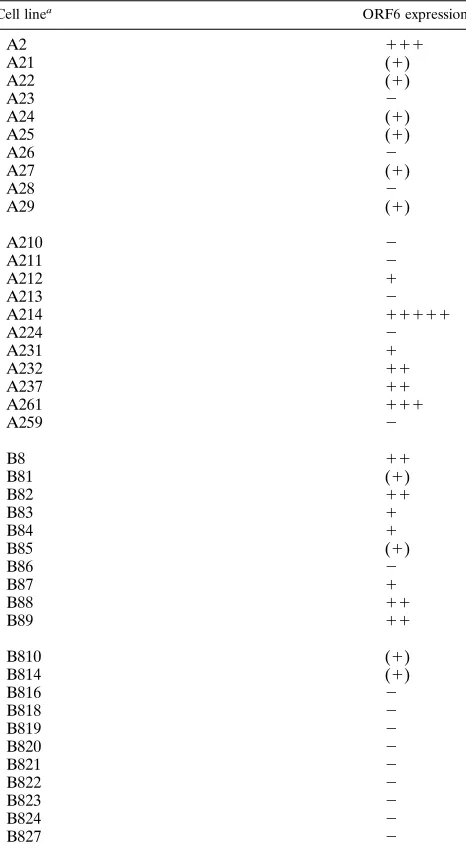
The 42 Puror cell lines were screened for the ability to
express E4-ORF6 (ORF61). Northern mRNA analysis (Table
1) showed that 24 of the 42 Purorcell lines (57%) also
induc-ibly expressed E4-ORF6. Ten of the ORF61 cell lines
ex-pressed only low levels, 13 exex-pressed moderate levels, and 1 expressed high levels of E4-ORF6. The moderate- to high-level E4-ORF6-expressing cell lines were screened for the ability to complement deletion virus growth. All of the 293-ORF6 cell
lines retained the ability to functionally complement the E12/
E4wtvirus AdRSVbgal.10. However, these 293-ORF6 cell lines
complemented the growth of E1wt/E42virus H5dl366 to
vari-ous levels and this complementation did not directly correlate with the level of induced ORF6 expression. The removal of these 293-ORF6 cell lines from selection conditions for more than 10 months has not changed their ability to complement
the growth of E12, E42, or E12/E42virus.
Construction of E12/E42virus.To determine the utility of
these 293-ORF6 cell lines for the construction and
propaga-tion of E12/E42vectors, a complete deletion of E4 was
engi-neered in the E12virus AdRSVbgal.10. Virus construction
relied on a single in vivo recombination within the overlapping regions between left and right fragments of the genome (39).
The E12/E42virus AdRSVbgal.11 (Fig. 1) was constructed by
transfecting 293-ORF6 cells with the left genome fragment, 0 to 75 map units (m.u.) of SrfI and SpeI restriction
enzyme-digested viral DNA, from AdRSVbgal.10 DNA and a right
genome fragment provided from a plasmid containing adeno-virus m.u. 59.5 to 100 (BamHI and SalI restriction enzyme digested) into which a full deletion of the E4 coding sequence
had been introduced. This plasmid, pGBSDE4, is a version of
a pGem-based plasmid (Promega, Madison, Wis.) that con-tains Ad5 m.u. 59.5 to 100 cloned at respective BamHI-to-SalI restriction sites, pGBS (GenVec Inc.). To construct the E4 deletion (Ad5 bp 32830 to 35566) in pGBS, a PacI site was generated at Ad5 bp 32830. A PacI-SalI fragment that encodes Ad5 bp 35564 to 35935 was prepared by PCR and cloned into
the respective restriction sites to generate pGBSDE4.
AdRSVbgal.11 plaque isolates were screened by PCR for the
presence of the E4 deletion with primers that spanned Ad5 bp 32792 to 35879. The purity of the virus stock after two sequen-tial plaque isolations was confirmed by PCR and restriction enzyme analysis of viral DNA. Virus plaque isolation, propa-gation, and analysis of growth properties were done as previ-ously described (3, 4, 20, 21), with the modification that the final quantitation of virus yield was determined on 293-ORF6 cell lines by either PFU, focus-forming units (FFU) with a polyclonal antibody directed against the entire adenovirus cap-sid, or FFU with a monoclonal antibody directed against the adenovirus DNA-binding protein (5). Viral DNA was isolated by digesting infected-cell lysates or purified virus with protein-ase K in the presence of sodium dodecyl sulfate.
AdRSVbgal.11 characterization.The production of purified
AdRSVbgal.11 was approximately 30-fold depressed
com-pared with that of AdRSVbgal.10 (Table 2). To understand
the reason for this debilitation, virus growth characterization
of AdRSVbgal.11 was performed. The kinetics of
AdRSVbgal.10 and AdRSVbgal.11 growth on 293 cells (data
not shown) and the 293-ORF6 cell line A2 (see Fig. 4) were
compared. The growth of AdRSVbgal.10 on either 293 or A2
cells was the same. AdRSVbgal.11 virus growth and the
ex-pression of late capsid protein were detected only in 293-ORF6 cell lines, not in infected 293, HeLa, or A549 cells (data not
shown). AdRSVbgal.11 growth was delayed in infected
293-ORF6 cells, and the plateau of virus yield was significantly
reduced compared with that of AdRSVbgal.10 and did not
[image:2.612.61.294.82.507.2]increase even up to 7 days postinfection.
TABLE 1. Inducible expression of E4-ORF6 in 293-ORF6 cell lines
Cell linea ORF6 expressionb
A2 111
A21 (1)
A22 (1)
A23 2
A24 (1)
A25 (1)
A26 2
A27 (1)
A28 2
A29 (1)
A210 2
A211 2
A212 1
A213 2
A214 11111
A224 2
A231 1
A232 11
A237 11
A261 111
A259 2
B8 11
B81 (1)
B82 11
B83 1
B84 1
B85 (1)
B86 2
B87 1
B88 11
B89 11
B810 (1)
B814 (1)
B816 2
B818 2
B819 2
B820 2
B821 2
B822 2
B823 2
B824 2
B827 2
aCells were grown in the presence of puromycin to maintain selection.
bEstablished monolayers from independent clonal isolates were induced with
100mM ZnCl2for 24 h, and the expression of the ORF6 gene was detected by
Northern (RNA) blotting. The relative levels of expression from lowest [(1)] to highest (11111) are noted.2, no expression.
on November 9, 2019 by guest
http://jvi.asm.org/
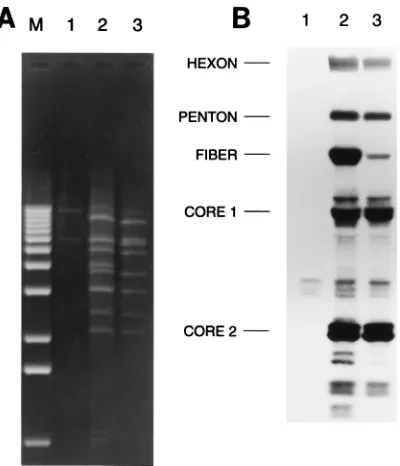
The delay and reduction in virus growth in AdRSVb gal.11-infected 293-ORF6 cells were not due to reduced viral DNA replication. Figure 2A shows similar levels of viral DNA
accu-mulation in AdRSVbgal.10- and AdRSVbgal.11-infected A2
cells at 24 h postinfection. In addition, the AdRSVbgal.10 and
AdRSVbgal.11 DNA synthesis levels, as determined by the
incorporation of [3H]thymidine at 16 h postinfection, were
similar (data not shown). These results suggest that 293-ORF6 cell lines provide all the E1 and E4 functions necessary for
DNA replication of E12/E42viruses.
The reduction in AdRSVbgal.11 virus production correlated
with a reduction in the accumulation of the late protein fiber (Fig. 2B and Fig. 3). The methods used for protein evaluation have been previously described (1, 3, 4). While the level of fiber accumulation was depressed, the amount of fiber found
on purified AdRSVbgal.11 capsids was not affected (data not
shown). Fiber was the only major capsid protein whose levels
FIG. 1. (A) Schematics of E12/E42viruses. Only the pertinent E1 and E4 regions are represented. (B) Schematics of E4 regions. SV40, simian virus 40; E4pr, E4 promoter.
[image:3.612.150.457.94.362.2]FIG. 2. (A) Viral DNA replication in AdRSVbgal.10- and AdRSVb gal.11-infected A2 cells. A2 cells were gal.11-infected at a multiplicity of infection of 10. Viral DNA accumulations were compared by harvesting low-molecular-weight DNA (12, 35) from infected cells at 24 h postinfection and digesting an equal fraction of each DNA preparation with KpnI before electrophoresis on a 0.8% agarose gel. Lane M, size markers; lane 1, mock-infected cells; lane 2, AdRSVb gal.10-infected cells; lane 3, AdRSVbgal.11-infected cells. (B) Viral late protein ex-pression in A2 cells. At 36 h postinfection at a multiplicity of infection of 5, cells were harvested and the level of late protein accumulation was detected by immunoblotting using a polyclonal antibody directed against the adenovirus capsid. Lane 1, mock-infected cells; lane 2, AdRSVbgal.10-infected cells; lane 3, AdRSVbgal.11-infected cells.
TABLE 2. Purified-vector production yieldsa
Vector Cell line Active particles (FFU)/cellb
AdRSVbgal.10 293 615
AdCFTR.10 293 650
AdRSVbgal.11 A2 22
AdCFTR.11A A2 720
aVectors were purified from infected cells at 2 or 3 days postinfection by three
freeze-thaw cycles followed by three successive bandings on cesium chloride gradients. The purified vector was dialyzed in 10 mM Tris (pH 7.8)–150 mM NaCl–10 mM MgCl2–3% sucrose, aliquoted, and stored at2808C.
bActive particle determinations were performed on 293-ORF6 cells with an
anti-DNA-binding protein monoclonal antibody.
on November 9, 2019 by guest
http://jvi.asm.org/
[image:3.612.337.537.392.625.2] [image:3.612.57.299.612.677.2]were reduced in AdRSVbgal.11-infected A2 cells, and its lower accumulation correlated with a reduction in virus growth. However, as can be seen in Fig. 2B, the level of the
minor capsid protein pVIII was also reduced in
AdRSVbgal.11-infected A2 cells. The level of pVIII reduction
did not directly correlate with a reduction in virus growth. While mature pVIII is critical in the formation of capsids (38),
the importance of its reduction in AdRSVbgal.11-infected A2
cells is not known. The reduction in fiber protein accumulation directly correlated with reduced cytoplasmic accumulation of late region 5 (L5) mRNA (data not shown). These results suggested that the deficiency in virus production was due to altered L5 mRNA expression. Taken together, the results im-plied that either the 293-ORF6 cell lines were deficient in a key function necessary for proper L5 mRNA expression or that the
E4 deletion in AdRSVbgal.11 somehow altered L5 mRNA
expression.
Construction and characterization of AdCFTR.11A.If the
E4 deletion in AdRSVbgal.11 altered L5 mRNA expression,
the debilitation was most likely caused by destabilization of the L5 mRNA. To test this hypothesis, an expression cassette with a strong stop and polyadenylation signal was placed within the deleted E4 region, which spaced the L5 region from the right inverted terminal repeat (ITR).
AdCFTR.11A (Fig. 1) was constructed by cotransfecting the left genome fragment (0 to 90 m.u.) from AdCFTR.ORF6 (2a) and the linearized transfer plasmid pNSE4Gus. To facilitate manipulation of the E4 region, Ad5 bp 31089 to 35935
(NdeI-SalI fragment) was subcloned from pGBSDE4 into pUC19 to
generate pNSDE4. pNS11A was constructed by introducing
first a polylinker region (SmaI, KpnI, and EagI sites) between
the MunI and PacI sites of pNSDE4 and then an EagI-SmaI
fragment from pAdCMVbGlu (GenVec Inc.) that contained
the glucoronidase gene (gus) and the simian virus 40 polyade-nylation signal between the fiber and E4 polyadepolyade-nylation stop sites and the ITR. Plaques of AdCFTR.11A appeared within 10 days and were stained blue by the addition of X-Gluc
(5-bromo-4-chloro-3-indolyl-b-D-glucuronic acid) substrate to
the medium. Secondary plaques of AdCFTR.11A were puri-fied and analyzed to ensure the purity of the virus stock as
described above for AdRSVbgal.11.
The levels of fiber protein accumulation for AdRSVbgal.10,
AdRSVbgal.11, and AdCFTR.11A were compared in
293-ORF6 cells (Fig. 3) to determine if the new E4 deletion con-struct in AdCFTR.11A corrected the defect in L5 expression.
The amount of fiber accumulation in AdCFTR.11A-infected A2 cells was equal to that obtained with the wild-type E4 virus
AdRSVbgal.10, while the amount of fiber accumulation
re-mained low, as expected, in AdRSVbgal.11-infected cells. The
removal of all of the E4 coding sequences in AdRSVbgal.11
appears to be the reason for the reduction in the cytoplasmic mRNA levels of L5. It is feasible that a critical L5 mRNA signal was deleted, but since no known L5 signal exists within the sequences removed, this is unlikely. It is more probable that the juxtaposition of the ITR and E4 promoter elements next to the L5 region generated the destabilization of the L5 message. The correction of L5 mRNA expression in AdCFTR.11A-infected cells by the inclusion of a transcrip-tional cassette between the ITR and L5 supports this idea. There are several possible mechanisms for L5 mRNA desta-bilization. These include possible important distance or spac-ing requirements for efficient L5 expression, improper termi-nation of the L5 message, or the generation of antisense L5 RNA from the E4 promoter. Additional experiments are un-der way to decipher the mechanism.
The kinetics of AdCFTR.11A virus growth in A2 cells mir-rored that of AdCFTR.10 (Fig. 4). In addition, the production of triple cesium chloride gradient-purified AdCFTR.11A virus in A2 cells was at a level similar to that seen with first-gener-ation vectors in 293 cells (Table 2). The ratios of total particles to active particles obtained with AdCFTR.11A preparations were in ranges similar to those obtained with first-generation viruses (20 to 40 total particles per FFU).
The results indicate that these 293-ORF6 cell lines provide all the necessary E1 and E4 functions and confirm that E4-ORF6 is sufficient for full complementation of E4 function. It is interesting that E4-ORF6/7 is not required for full E4 complementation, given the key role E4-ORF6/7 plays in E2 transactivation (14, 26, 28, 31, 34) through the cellular tran-scription factor E2F (22, 23). This observation is in agreement
with those of Hemstro¨m et al. (11) and suggests that full
[image:4.612.323.545.67.301.2]activation of the E2 promoter by E4-ORF6/7 is not required
[image:4.612.115.239.68.205.2]FIG. 3. Fiber protein accumulation in A2 cells. A2 cells were infected at a multiplicity of infection of 5. At 20 h postinfection, protein was extracted and the amount of fiber was detected by immunoblotting using a polyclonal antibody directed against fiber. Lane 1, mock-infected cells; lane 2, AdRSVb gal.10-in-fected cells; lane 3, AdRSVbgal.11-infected cells; lane 4, AdCFTR.11A-infected cells.
FIG. 4. Kinetics of AdCFTR.10, AdCFTR.11A, and AdRSVbgal.11 virus production. Infected A2 cells were harvested at the indicated times postinfection, and the amounts of virus in cell lysates (in FFU) were determined.
on November 9, 2019 by guest
http://jvi.asm.org/
for virus growth in tissue culture. While it is possible that full activation of the E2 promoter can be accomplished through other mechanisms in these 293-ORF6 cell lines, it is interesting to speculate that the activation of E2F via E4-ORF6/7 and the subsequent activation of the E2 promoter may play an impor-tant function for virus growth in vivo.
The vector-cell line system described here provides the nec-essary tools for the construction and high-level production of
E12/E42 vectors. We have built a library of
E1/E4-comple-menting cell lines that have proven to be extremely useful in
the construction of E12/E42vectors. By using this vector-cell
line system purified E12/E42virus can be produced at E12
vector levels. Moreover, we have shown a system in which E4 alterations can be designed, cloned, and moved into virus by a similar methodology and with similar efficiency as are
first-generation E12vectors. In addition, the design and
construc-tion of AdCFTR.11A show the potential of using multiple transgenes housed in different regions within the same vector.
We thank Angela Appiah and Lou Cantolupo for excellent technical assistance and Joe Bruder, Duncan McVey, and Tom Wickham for critical reviews of the manuscript.
REFERENCES
1. Anderson, K. P., and D. F. Klessig. 1984. Altered mRNA splicing in monkey cells infected with human adenovirus may be responsible for inefficient synthesis of the virion fiber polypeptide. Proc. Natl. Acad. Sci. USA 81:4023– 4027.
2. Bridge, E., and G. Ketner. 1989. Redundant control of adenovirus late gene expression by early region 4. J. Virol. 63:631–638.
2a.Brough, D. E., C. Hsu, A. Lizonova, and I. Kovesdi. Unpublished data. 3. Brough, D. E., V. Cleghon, and D. F. Klessig. 1992. Construction,
charac-terization, and utilization of cell lines which inducibly express the adenovirus DNA-binding protein. Virology 190:624–634.
4. Brough, D. E., G. Droguett, M. S. Horwitz, and D. F. Klessig. 1993. Multiple functions of the adenovirus DNA-binding protein are required for efficient viral DNA synthesis. Virology 196:269–281.
5. Cleghon, V., A. Piderit, D. E. Brough, and D. F. Klessig. 1993. Phosphory-lation of the adenovirus DNA-binding protein and epitope mapping of monoclonal antibodies against it. Virology 197:564–575.
6. Dix, I., and K. N. Leppard. 1993. Regulated splicing of adenovirus type 5 E4 transcripts and regulated cytoplasmic accumulation of E4 mRNA. J. Virol. 67:3226–3231.
7. Engelhardt, J. F., X. Ye, B. Doranz, and J. M. Wilson. 1994. Ablation of E2A in recombinant adenoviruses improves transgene persistence and decreases immune response in mouse liver. Proc. Natl. Acad. Sci. USA 91:6196–6200. 8. Freyer, G. A., Y. Katoh, and R. J. Roberts. 1984. Characterization of the major mRNAs from adenovirus 2 early region 4 by cDNA cloning and sequencing. Nucleic Acids Res. 12:3503–3519.
9. Halbert, D. N., J. R. Cutt, and T. Shenk. 1985. Adenovirus early region 4 encodes functions required for efficient DNA replication, late gene expres-sion, and host cell shutoff. J. Virol. 56:250–257.
10. Hemstro¨m, C., K. Nordqvist, U. Pettersson, and A. Virtanen.1988. Gene product of E4 of adenovirus type 5 modulates accumulation of certain viral polypeptides. J. Virol. 62:3258–3264.
11. Hemstro¨m, C., A. Virtanen, E. Bridge, G. Ketner, and U. Pettersson.1991. Adenovirus E4-dependent activation of the early E2 promoter is insufficient to promote the early-to-late-phase transition. J. Virol. 65:1440–1449. 12. Hirt, B. 1967. Selective extraction of polyoma DNA from infected mouse cell
cultures. J. Mol. Biol. 26:365–369.
13. Huang, M. M., and P. Hearing. 1989. Adenovirus early region 4 encodes two gene products with redundant effects in lytic infection. J. Virol. 63:2605– 2615.
14. Huang, M. M., and P. Hearing. 1989. The adenovirus early region 4 open reading frame 6/7 protein regulates the DNA binding activity of the cellular transcription factor, E2F, through a direct complex. Genes Dev. 3:1699– 1710.
15. Javier, R., K. Raska, Jr., G. J. Macdonald, and T. Shenk. 1991. Human adenovirus type 9-induced rat mammary tumors. J. Virol. 65:3192–3203. 16. Javier, R., K. Raska, Jr., and T. Shenk. 1992. Requirement for the
adeno-virus type 9 E4 region in production of mammary tumors. Science 257:1267– 1271.
17. Javier, R. T. 1994. Adenovirus type 9 E4 open reading frame 1 encodes a transforming protein required for the production of mammary tumors in rats. J. Virol. 68:3917–3924.
18. Ketner, G., E. Bridge, A. Virtanen, C. Hemstro¨m, and U. Pettersson.1989. Complementation of adenovirus E4 mutants by transient expression of E4
cDNA and deletion plasmids. Nucleic Acids Res. 17:3037–3048. 19. Kleinberger, T., and T. Shenk. 1993. Adenovirus E4orf4 protein binds to
protein phosphatase 2A, and the complex down regulates E1A-enhanced junB transcription. J. Virol. 67:7556–7560.
20. Klessig, D. F. 1977. Isolation of a variant of human adenovirus serotype 2 that multiplies efficiently in monkey cells. J. Virol. 21:1243–1246. 21. Klessig, D. F., D. E. Brough, and V. Cleghon. 1984. Introduction, stable
integration, and controlled expression of a chimeric adenovirus gene whose product is toxic to the recipient human cell. Mol. Cell. Biol. 4:1354–1362. 22. Kovesdi, I., R. Reichel, and J. R. Nevins. 1986. E1A transcription induction:
enhanced binding of a factor to upstream promoter sequences. Science 231:719–722.
23. Kovesdi, I., R. Reichel, and J. R. Nevins. 1986. Identification of a cellular transcription factor involved in E1A trans-activation. Cell 45:219–228. 24. Krougliak, V., and F. L. Graham. 1995. Development of cell lines capable of
complementing E1, E4, and protein IX defective adenovirus type 5 mutants. Hum. Gene Ther. 6:1575–1586.
25. La Thangue, N. B. 1994. DRTF1/E2F: an expanding family of heterodimeric transcription factors implicated in cell-cycle control. Trends Biochem. Sci. 19:108–114.
26. Marton, M. J., S. B. Baim, D. A. Ornelles, and T. Shenk. 1990. The adeno-virus E4 17-kilodalton protein complexes with the cellular transcription factor E2F, altering its DNA-binding properties and stimulating E1A-inde-pendent accumulation of E2 mRNA. J. Virol. 64:2345–2359.
27. Mu¨ller, U., T. Kleinberger, and T. Shenk.1992. Adenovirus E4orf4 protein reduces phosphorylation of c-Fos and E1A proteins while simultaneously reducing the level of AP-1. J. Virol. 66:5867–5878.
28. Neill, S. D., C. Hemstro¨m, A. Virtanen, and J. R. Nevins.1990. An adeno-virus E4 gene product trans-activates E2 transcription and stimulates stable E2F binding through a direct association with E2F. Proc. Natl. Acad. Sci. USA 87:2008–2012.
29. Nordqvist, K., and G. Akusja¨rvi.1990. Adenovirus early region 4 stimulates mRNA accumulation via 59introns. Proc. Natl. Acad. Sci. USA 87:9543– 9547.
30. Nordqvist, K., K. O¨ hman, and G. Akusja¨rvi. 1994. Human adenovirus en-codes two proteins which have opposite effects on accumulation of alterna-tively spliced mRNAs. Mol. Cell. Biol. 14:437–445.
31. Obert, S., R. J. O’Connor, S. Schmid, and P. Hearing. 1994. The adenovirus E4-6/7 protein transactivates the E2 promoter by inducing dimerization of a heteromeric E2F complex. Mol. Cell. Biol. 14:1333–1346.
32. O¨ hman, K., K. Nordqvist, and G. Akusja¨rvi. 1993. Two adenovirus proteins with redundant activities in virus growth. Virology 194:50–58.
33. Pilder, S., M. Moore, J. Logan, and T. Shenk. 1986. The adenovirus E1B-55K transforming polypeptide modulates transport or cytoplasmic stabiliza-tion of viral and host cell mRNAs. Mol. Cell. Biol. 6:470–476.
34. Raychaudhuri, P., S. D. Bagchi, S. Neill, and J. R. Nevins. 1990. Activation of the E2F transcription factor in adenovirus-infected cells involves E1A-dependent stimulation of DNA-binding activity and induction of cooperative binding mediated by an E4 gene product. J. Virol. 64:2702–2710. 35. Rice, S. A., and D. F. Klessig. 1984. The function(s) provided by the
adeno-virus-specified, DNA-binding protein required for viral late gene expression is independent of the role of the protein in viral DNA replication. J. Virol. 49:35–49.
36. Richardson, W. D., and H. Westphal. 1981. A cascade of adenovirus early functions is required for expression of adeno-associated virus. Cell 27:133– 141.
37. Sandler, A. B., and G. Ketner. 1989. Adenovirus early region 4 is essential for normal stability of late nuclear RNAs. J. Virol. 63:624–630.
38. Stewart, P. L., R. M. Burnett, M. Cryklaff, and S. D. Fuller. 1991. Image reconstruction reveals the complex molecular organization of the adenovi-rus. Cell 67:145–154.
39. Stowe, N. D. 1981. Cloning of a DNA fragment from the left-hand terminus of the adenovirus type 2 genome and its use in site-directed mutagenesis. J. Virol. 37:171–180.
40. Tigges, M. A., and H. J. Raskas. 1984. Splice junctions in adenovirus 2 early region 4 mRNAs: multiple splice sites produce 18 to 24 RNAs. J. Virol. 50:106–117.
41. Virtanen, A., P. Gilardi, A. Na¨slund, J. M. LeMoullec, U. Pettersson, and M. Perricaudet.1984. mRNAs from human adenovirus 2 early region 4. J. Virol. 51:822–831.
42. Wang, Q., X.-C. Jia, and M. H. Finer. 1995. A packaging cell line for propagation of recombinant adenovirus vectors containing two lethal gene-region deletions. Gene Ther. 2:775–783.
43. Weinberg, D. H., and G. Ketner. 1986. Adenoviral early region 4 is required for efficient viral DNA replication and for late gene expression. J. Virol. 57:833–838.
44. Yeh, P., J. F. Dedieu, C. Orsini, E. Vigne, P. Denefle, and M. Perricaudet. 1996. Efficient dual transcomplementation of adenovirus E1 and E4 regions from a 293-derived cell line expressing a minimal E4 functional unit. J. Virol. 70:559–565.
45. Yew, P. R., X. Liu, and A. J. Berk. 1994. Adenovirus E1B oncoprotein tethers a transcriptional repression domain to p53. Genes Dev. 8:190–202.