International Journal of Innovative Technology and Exploring Engineering (IJITEE) ISSN: 2278-3075, Volume-8 Issue-9, July 2019
Abstract: The paper presents a proposal for selecting the appropriate waste treatment method for Misurata, reviewing key criteria for such a decision. Many countries use modern methods of solid waste treatment, which can be transformed from the source of pollution into an economic commodity. Libya continues to suffer from solid waste management processes in terms of aggregation, transport or treatment. This paper deals with an approach in the field of solid waste treatment in terms of the nature of these wastes and their methods of management. It also addresses environmental problems related to the subject of solid waste using different treatment methods. It also reviews some studies on this subject. The study concluded that the environmental standard criteria are the most important when making the decision, followed by the technical criteria. At the level of the proposed technique, the study showed that the anaerobic digestion technique is the most appropriate. For the purpose of selecting the best method for solid waste management, the swing weighting method was developed using Ms-Excel.
Index Terms: Solid wastes, technique, environmental standard, Decision criteria, Swing Weighting.
I. INTRODUCTION
Solid waste can be defined as the sum of waste materials thrown out of homes and institutions comprising of food, bags, cans, cleaning tools, bottles, paper, old clothes, household items, etc. These wastes do not include hazardous sanitary, industrial, and chemical waste, which should be disposed of scientifically and properly according to their characteristics. Household and municipal wastes consist of organic materials such as food waste and inorganic waste such as glass and metal objects. According to the Arab Regional Strategy for Sustainable Consumption and Production, about 50 to 60 percent of municipal solid waste is organic, about 10 percent is paper, 7 percent is plastic, 4 percent is glass, and 4 percent is textiles [1]. The quantity and composition of waste vary from one country to another and from one region to another within the same country, depending on the standard of living, socio-economic conditions and the urban level. According to the UNEP Environment Outlook for the Arab Region, the Arab individual produces between 0.5 kg to 1.75 kg of waste per day [2]. What distinguishes municipal solid waste is its moisture content (about 30 to 40 percent), leaving the thermal value of burning.
Revised Manuscript Received on July 05, 2019.
Hüseyin Gökçekuş, Civil Engineering Department, Near East University, Nicosia, Cyprus.
Youssef Kassem, Mechanical Engineering Department, Near East University, Nicosia, Cyprus.. Qussai Omari, Mechanical Engineering Department, Near East University, Nicosia, Cyprus.
The thermal value changes with the economic and social conditions between 750 kcal and 5000 kcal per kg of waste [1]. In some countries of the ESCWA region, the proportion of waste left without collection may be close to 50 percent, especially in remote and rural areas [1]. This waste poses an environmental hazard because they lead to the production of methane and to its diffusion into the air when organic matter decomposes. In some countries of the region, primitive methods are also being used to dispose of these wastes by burning them in the open air or throwing them into the sea and waterways. The process of waste management is different from one place to another, some of which depend on old methods that are harmful to the environment; the use of modern techniques and techniques that reduce pollution. Solid waste management requires a preliminary screening to recycle some of them or produce fertilizers, and what remains of them is collected in open areas or in a sanitary landfill or burned1. The collection of waste in open spaces represents an environmental hazard of the spread of odors, insects and harmful microbes in neighboring areas. The sanitary landfill, which collects waste in areas treated with condoms to prevent the leakage of liquid pollutants into groundwater, is considered less polluting than open dumps. The treatment of waste reduces the pollution of the environment and the emission of buried raids, and has many benefits, including the following [1]:
1. Mitigating the use of natural resources through the reuse and recycling of some waste such as paper, cardboard, plastic, glass, metals, and others.
2. Reduce the need for larger areas of landings or assembly sites.
3. Reduce the proliferation of harmful insects and microbes that exist and multiply with waste.
4. Reduction of environmental pollution and the release of carbon dioxide and methane gas.
5. Reduce air pollution and unpleasant odors around landfills and assembly sites.
6. Mitigating climate change through the use of waste in energy production.
II. PREVIOUSSTUDIES
There are few studies on the subject of solid waste management in Libya, Ramadan Mohamed conducted a study to estimate the amount of household waste, analyze its components, and conduct an engineering feasibility study for the disposal of these solid wastes. The result of the study shows that the average per
capita production of household waste in
Selection the Best Technique for Solid Waste
Management at Misurata City, Libya
Ghadames is about 0.5 kg per day, and the total production of the city is approximately 2,000 tons per year while 62% of the generated solid waste composed of organic matter [2]. In his study, Mohamed conducted a study in Benghazi to know the types and components of solid waste in the city [2]. The study dealt with the process of solid waste management in the city, methods of dealing with them at the site, storage, sorting and aggregation methods and finally how the waste is transported for recycling. The study found that the solid waste product of an individual in the city of Benghazi reaches about 0.5 kg per day, approximately 182 kg per year. The study also pointed out that the vast majority of these wastes are organic materials, which account for 80% of the total solid waste [3]. Gali study the factors that lead to the accumulation of household solid waste in the city of Jaghbub, the role of the citizens and the authorities responsible for dealing with these wastes and proper ways to get rid of waste in the city using questionnaire survey, as well as interviews with some officials in the public hygiene company. The results showed that the lack of equipment and mechanisms for waste collection, lack of environmental awareness among the citizens and good means to collect household waste is one of the main reasons for the accumulation of waste in the city. He also found that the wastes are burnt in an open landfill, which is environmentally unsafe [4]. Ibtisam Al-Bireh conducted a field study to evaluate the status of household waste in the city of Misurata and found household characteristics and financial status to be the major factors determining the quantity and quality of solid waste. The study concluded that the production per capita of household solid waste is 1.6 kg out of which 37.2% is organic materials. Salem also studied the solid waste pollution from household and its environmental effects, in the city of Tripoli [5]. The study also referred to Tripoli plant for organic fertilizer and found that the production of Tripoli city of waste in 2006 swallowed 1275 tons per day [6]. Through the review of previous studies, it is noted that most studies dealt with the problem of waste in terms of types and calculation of ratios and methods of dealing with them and how to get rid of them. The present study deals with another aspect of waste management which is the choice of the best technique for solid waste management in Misurata.
III. CURRENTSITUATIONOFMISURATA The city of Misurata is located in northwest Libya, on the northwestern tip of the Gulf of Sirte, to the east of the city of Tripoli by 210 km, bordered by the Mediterranean Sea on both sides of the north and east and the length of its coastline about 130 km, and the area of Misrata to the west Zlatin region, east Ben Waleed and south-east Sirte region, the Misurata region is located between 330: 310 and 320: 230 North and between 360: 140 and 220: 150, with an area of 3637 square kilometers. The production of waste and solid waste in the city of Misurata is about 450 tons per day, transporting about 60 tons per day to the compost plant in the city. The rest of the solid waste is transported to the assembly point located in the Al-Ghiran area and from there to the final landfill [7]. The method of the landfill is one of the methods used in the disposal of waste, but this method has two dimensions, either a dump in a sanitary landfill or an
[image:2.595.315.551.255.364.2]unhealthy landfill, and the last is the method used in the city of Misratah, where garbage is collected, transported and unloaded in the landfill. The disposal of these wastes from time to the time and covering them with soil. It is noted that the burial area is considered a land unsuitable for agriculture and that it is about 40 km away from the city center. After collecting the waste at the assembly point in the Al-Sikat area, it is transported by large trucks to the landfill area and dumped in unhealthy and unspoiled soil in open areas, resulting in the release of volatile substances and odors resulting to air pollution. Figure 1 shows a map of the city of Misurata showing the current collection and filling areas. The population of the city is about 343,502 noting that the areas of Al-Ghiran and Qasr Ahmad represent about 35% of the city's area5, 8. Table 1 shows the population of each area of the city [8].
[image:2.595.323.533.368.537.2]Fig.1. Map showing the current collection and filling areas of the city.
Table 1. The population of each area of the city
No. Region Population
1 Tomina 24,148
2 Dafnya 16,370
3 Qasar Ahmed 19,208
4 Alzaroq 32,288
5 Alghiran 32,924
6 9 July 41,179
7 Ras Altoba 29,500
8 Zawyat Almahjop 30,027
9 Dat Alrimal 37,531
10 Alshwahid 52,326
Total 343,502
International Journal of Innovative Technology and Exploring Engineering (IJITEE) ISSN: 2278-3075, Volume-8 Issue-9, July 2019
Fig.2. Percentage of items in the municipal solid waste
Logistics is a key element in the process of waste management, as it takes time, as well as the acquisition of an essential part of the cost, with the cost of logistics to 40% of the total cost of power generation in some countries. Although the cost of fuel in Libya is low, it is characterized by large areas, which requires large distances for the purpose of transporting waste. The current landfill is about 40 kilometers from the city center, and the landfill is unhealthy, with the garbage being collected and left to accumulate. Currently, there are two assembly points, the first in Al-Sikat area and the second in the Skirat area. Garbage is collected from houses, shops, hospitals - and other points - and transported to these two points and then use cars with a capacity of approximately 35 m3 (about 10 tons) to transport the waste to the final landfill7. There is also an organic fertilizer plant with a production capacity of 80 tons/day that takes advantage of some of the waste by converting it to compost. 15 workers were employed for separating the waste manually in the factory. Currently, there are about 148 vehicles of different sizes. There are two types of boxes, the first one is 1.1 cubic meters, the second is 7 cubic meters, and the capacity of the tanker trucks is increasing7.
− 5 cubic meters of pressure for the collection and transport of garbage from residential neighborhoods to the interim assembly stations.
− 7-9 cubic meters and 19 cubic meters of pressure for the collection and transport of garbage from the streets and the city's two miners to the interim assembly station or to the final disposal site.
− 35-50 m3 compressor for the transport of garbage from the interim collection stations to the final disposal site. Many countries that use waste in power generation follow the method of separating waste at the source, which requires a high degree of awareness and cooperation of citizens, but this approach to waste management is not currently followed in Libya. There are three dumps in the city of Misurata to collect garbage to be transferred to the landfill are as follows: A. The landfill No. (1)
It is located near the island of Al-Muqush on a width of 320: 230 North and a 50: 150 "east line; and receives the garbage, construction waste and furniture coming from the houses. The cars transport at least twice a day to the final landfill. The company also sprays the pesticides on the site to ensure that the pests do not flow from the landfill. The disadvantage of this landfill is that it is near the city center, as well as near the vegetable market and the absence of a fence to reduce the
spread of waste is increasing, this landfill has been recently locked at the beginning of 2015, and Figure 3 shows this landfill.
Fig.3. Landfill (1)
B. Landfill No. (2)
The landfill is located behind the headquarters of Daewoo company on the width of 320: 200 east, longitude 150: 70 east, and away from the center of the city about 7 km distance. The fenced landfill site is rented by the General Company for cleanliness to collect garbage in the area of about 2 Square kilometers, this site is no less important than the first site, Figure 4 shows this landfill [7].
Fig.4. Landfill (2)
C. Landfill No. (3)
This landfill is located in the Ghiran area on a width of 190: 320 North and longitude "0: 15 West, 8 km away from the city center about, and the garbage is in preparation for transfer to the final landfill, no safety measures were installed at the landfill, only fenced, and Figure 5 shows this landfill. The construction of interim assembly stations depends on several factors, the most important of which are the following:
− The distance from the assembly site to the final disposal site.
− The time required for the arrival of the truck to the final disposal site.
Fig.5. Landfill (3)
D. Final landfill
The final landfill is located in the east of Misurata, 40 km away from the city center. The garbage is transported by the citizens and the company
and settles as well, then the cars of the contractors and the water come from the waste of the industrial operations, the process is repeated on a daily basis, And waste is disposed-off without sorting, and the earth absorbs various fluids from this wastes [7]. Table 2 shows the amount of garbage entering the final landfill during the period 2009-2013.The following important points should be noted in the city's waste management process:
1. Waste is disposed of indiscriminately without attention to the interstitial dimension and failure to follow the proper method of burial.
2. Lack of waste filling leads to the spread of unpleasant odors and burning emits smoke in the air in the areas surrounding the site.
3. Lack of modern scientific methods in waste management where industrial wastes or hazardous wastes are not separated from household waste. Therefore, health risks are large and difficult to address.
Table 2. Quantity of garbage entering the final landfill Year Quantity / Ton
2009 21682
2010 Not Available
2012 19003
2013 26454
E. Final landfill
The factory was started in 1984. The plant started in 1986 with a design capacity of 120 tons/ day, equivalent to the waste products of Misurata city as at that time. At present, due to the length of this plant and its depletion, its production capacity has decreased to about 80 tons per day, which is considered a small figure compared to the current 450 tons of waste produced/day [7].
IV. MATERIALANDMETHODS
In this section, we will review the most important techniques used in solid waste management and solid waste treatment. A. Landfill
The aim of this method is to reduce the environmental damage by reducing the volume of waste to as little as possible and put it in the lowest possible space by burying it daily. The landfill method can be applied in two ways: Trench method: where trenches are separated from each other, the waste is distributed, and then covered with soil that was extracted during the drilling process, taking into account that the depth of the trench must not affect the groundwater. The method of the area: In this method, a certain area deeper than the trench drilled, filled with waste and then covered at the end of the day. This method requires less space than the trench to get rid of the same volume of waste [8]. These methods contribute to the pollution of the environment, and therefore it is necessary to use the method of the landfill, which depend on the modern methods and technologies in terms of choosing a site that must take into account the service of the residents of the region for their health and safety. There are several factors to consider in the landfill method which include [9]:
Cost: Establishing the site entails a very high cost in terms of land purchase, drilling, and processing, so the cost of
establishing the landfill must be economical.
Acceptance by the local residents: the importance of the residents' acceptance of the site should not is ignored, so they should be informed when choosing the site. It is preferable to distance the site from the nearest residential community at least 5 kilometers away; It affecting aircraft. In the landfill method, a hole is dug in the ground. Its depth and capacity depend on the nature of the area and the amount of waste. The area required for every 25,000 inhabitants is estimated at about one hectare per year5. In order to know the size of the site, it is necessary to know the quantity and density of the waste. The density of the solid waste depends on the quality of the equipment used in the spraying process. After completion of the drilling process, the hole shall be isolated from the groundwater with an insulating layer placed on the base and sides of the hole in order to reduce its permeability and preparing it with networks for collecting gases for the following reasons:
1. Benefit from methane as an energy source. 2. Limit or prevent self-ignition of the landfill.
3. Prevent the leaking of gases from the landfill to neighboring areas.
Land filling is a very old process, yet it is one of the most widely used waste disposal techniques, but most landfills do not have the equipment to produce energy. It is the most common and cheapest method. This process is done by digging a ditch or hole in the ground, then lining with a layer of cement, asphalt, or plastic. The lining must withstand high temperatures and be resistant to chemicals and organic decomposition so that harmful waste does not seep into groundwater. Burial drilling is also provided with a wastewater drainage system, where more than 90% of household waste is drained. One of the disadvantages of this method is that the land where the garbage is buried is soft and cannot be used for construction and erection of structures [10].
B. Anaerobic digestion
International Journal of Innovative Technology and Exploring Engineering (IJITEE) ISSN: 2278-3075, Volume-8 Issue-9, July 2019
Fig.6. Anaerobic digestion steps for waste
C. Anaerobic digestion
The process of waste incineration is aimed at reducing the volume of waste and eliminating epidemics. At present, waste incineration plants are trying to reduce the volume of waste to as little as possible and to convert the thermal energy used in various fields. The process of incineration is carried out by weighing the solid waste coming to the plant to know the number of materials available for burning, and then emptying it into the waste collection tank of the subsidiary. Waste collection tank must be equipped with special specifications, the most important of which are the following [11]:
1. The large volume which ensures the operation of the burning station 24 hours a day and throughout the year because if the plant stops burning, the contractions and extensions that occur lead to cracks and damage in the burning chamber.
2. Prevent dust and leaves from flushing, as well as the spread of bad odors from rotting waste. Incineration is the process of thermal waste treatment, where raw materials and untreated materials are used as feedstock. The idea of waste incineration dates back to 1876 in Britain, and this method has an adequate amount of air to oxidize the fuel. The waste is burned at 850 ° C, where the waste at this stage turns into carbon dioxide, water, and non-combustible materials as solid deposits called bottom ash, which always contains a small number of carbon deposits. The weight after burning is reduced by about two-thirds of its actual weight and 90% of the actual size. This technique uses a kettle to maintain and transform the electricity and steam heat, as well as comprehensive air pollution control systems that clean up the burning gases so that the permitted emission rates do not exceed the number of emissions allowed into the air by the chimney. These plants consume about 50- 300 thousand tons of feedstock annually. The outputs of these factories are as follows [12]:
1. Electricity, heat, or both in the case of combined heat and power plant.
2. Bottom ash, the residual ash after the combustion process, can be used to manufacture cement or as a material used as an initial layer of the road12. If the metal is not removed before combustion, it can be recycled after combustion.
3. Pollution control devices collect this ash.
Figure 7 shows a plan for a waste power plant using burning technology, where the waste is transferred to
[image:5.595.304.552.109.247.2]pre-combustion chambers, after slag and ashes. After that, the gas is purified with water or any combustion produced another purification method. In the end, clean air is emitted from the chimney to the atmosphere.
Fig.7. A scheme to generate energy using burning technology
[image:5.595.313.546.634.836.2]The electrical efficiency of combustion plants can reach between 0.4 and 0.7 MW/h using 1 ton of solid waste [9]. The thermal efficiency of burning 1 ton of solid waste is approximately 2 MW/h. However, incineration plants have environmental impacts. When solid waste is burned, carbon dioxide, nitrogen, sulfur dioxide and other organic and inorganic gas are produced by air emissions. Fly ash and bottom ash also have environmental impacts. Ashes represent up to 20% Which are burned9. Fly ash is more dangerous than bottom ash because fly ash contains high levels of heavy metals such as lead, cadmium, copper, and zinc as well as small amounts of toxic substances [9]. The types of combustion techniques in the commercial application are rotary kiln and moving wheel. The conveyor belt is designed for typical combustion of the municipal solid waste incinerator. Where the waste is received by the crane or the treadmill on the moving walk, which moves it to the combustion chamber and then moves down to dump the burned waste in the ash complex on the other side of the walk and the Holocaust is a porous metal medium that allows the main combustion air to flow from the bottom. With top-wheel nozzles, complete combustion is facilitated by turbulent disturbance. This type has a secondary combustion chamber connected after the incinerator where the secondary combustion air is supplied to ensure that sufficient time is available to maintain a high temperature to decompose toxic organic pollutants. Figure 8 shows a plan for the mobile holocaust.
D. Pyrolysis and gas conversion (gasification)
Pyrolysis is a thermal break-up of waste in the absence of air to produce gas (composite gas), liquids (crude oil) or solids (coal, mostly ash and carbon). Pyrolysis usually occurs at temperatures ranging from 1000-1400 °C. Gasification occurs at temperatures above 1000-1400 ° C and with a specific amount of oxygen. The gas product contains carbon dioxide, carbon monoxide, hydrogen gas, methane gas, and water. Waste disposal processes based on pyrolysis and gasification, in particular, reduce and prevent corrosion and emissions by maintaining alkali and heavy metals. There is a decrease in the number of sulfur dioxide emissions and the resulting primary particles in pyrolysis processes and gasification. But emissions of NOx, VOCs and dioxins may be similar to other waste treatment techniques, usually referred to as advanced heat treatment, gasification and pyrolysis plants treat heat fuels without allowing sufficient oxygen to burn completely. These plants are usually smaller and more flexible than incinerators and consume about 25- 150 thousand tons of waste a year, although some can have a consumption of 350 thousand tons per year11. The Process of pyrolysis and gasification should be noted that the materials used in the fuel industry in this technique are as follows:
1. Fuel from solid domestic waste.
2. Fuel from commercial and industrial waste. 3. Fuel derived from waste or solid waste fuel.
4. Fuel is not derived from waste, for example, wood, and other forms of biomass (plants and animals).
Through this technique, the following outputs can be obtained:
1. Electricity or heat or both in the case of a combination of heat and power plant.
2. The gas collection, which can be purified for the production of biogas, biofuels, chemicals, and hydrogen.
3. Raw materials used in chemical industries that allow the use of biomass instead of oil when producing plastics, for example, bottom ash, coal, and metal slag, which are by-products that can be used for useful purposes such as the cement industry and the primary road layer industries. Industrial gas consists mainly of carbon dioxide, the first oxidation of carbon, hydrogen, methane, and water vapor. Choosing the best technique from the alternatives described above is a complex process. The standards used are numerous, so the decision-making stage goes through several steps. The first step is to set standards. The second step is to evaluate each of these criteria, though experts and specialists in this field. For the purpose of evaluation, the swing weighting method was used.
1) Create a matrix of weights of standards: This matrix consists of the alternatives to be compared and the criteria to be considered and the weights of the criteria are given to all the alternatives.
2) Convert weights given in the previous matrix to values ranging from (0-1). In this step, the value (1) is given to the alternative that obtains the highest weight, the value (0) is given to the alternative that receives the lowest weight, and the other alternatives give values between 0-1.
3) Create a matrix that contains the Benchmark element. In this step, a new matrix is created that contains the standard element, which represents the worst value that all the parameters can obtain. It repeats the content of the standard
element for all the criteria except the standard to be weighed. If we assume three criteria and the best values for the expressions are (60, 800, 100), respectively, and the lowest values of the criteria are (30, 40 and 50) respectively, weights are given as shown in Table 3.
4) Rank the criteria according to their importance: In this step, the criteria are ranked as important so that the most important criterion is ranked first and the least important criterion (benchmark) is obtained in the last order.
5) Score for each criterion: Each standard is awarded a score of 0-100, where the most important criterion is 100, and the least important criterion (benchmark) is 0.
6) Calculate of the percentage of each criterion: The percentage is calculated by dividing the degree obtained by the criterion on the total number of grades.
7) Compare the alternatives: Calculate the strength and importance of each alternative by multiplying the percentage obtained by the standard in the matrix of standard values, and then combining the values obtained for each alternative.
Fig.9. The steps of the Swing Weighting method.
Table3. Standard element matrix
criterion Standard(a) Standard(b) Standard(c)
Benchmark 50 40 30
Standard(a) 100 40 30
Standard(b) 50 80 30
Standard(c) 50 40 60
V. RESULTSANDDISCUSSION
International Journal of Innovative Technology and Exploring Engineering (IJITEE) ISSN: 2278-3075, Volume-8 Issue-9, July 2019
Table 4. Criteria used in the evaluation
The main criterion Sub-criteria
Environmental criteria Air and water pollution, Use the ground
, Minimize waste noise and dust
Social criteria Acceptance of people, laws, and policies
Technical standards Experience of local workers, Local systems of generation, Capacity, Expansion capacity And Ability to continue Economic criteria Cost of construction, Value of
investment
Maintenance and operation costs, Creating jobs.
And Outlays
For the purpose of reaching the selection decision, the steps in the previous item have been followed as follows:
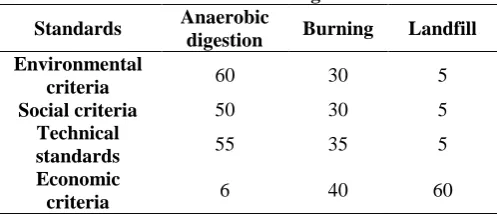
[image:7.595.310.545.59.125.2]Step 1: In this step, a matrix of columns was created, representing the three technologies that will be differentiated (i.e., landfill, anaerobic digestion, and burning). The rows represent the main criteria that have been taken into consideration. Table 5 shows the standard weights matrix. The weights of these standards have been awarded by experts in the field of waste management. The gradient from green to red represents the values of the largest to the smallest, taking into account that the first three criteria are profit criteria while the last criterion is the cost criterion.
Table 5. The standard weights matrix Standards Anaerobic
digestion Burning Landfill Environmental
criteria 60 30 5
Social criteria 50 30 5
Technical
standards 55 35 5
Economic
criteria 6 40 60
Step 2: In this step, the weights given by the experts were converted to standard values ranging from 0-1, and the technique that received the lowest weight was given zero, while the technique that received the highest weight of one, the standard value is given to the other techniques fluctuates between 0-1 and Table 6.formatting of your paper is limited in scale, you need to position figures and tables at the top and bottom of each column. Large figures and tables may span both columns. Place figure captions below the figures; place table titles above the tables. If your figure has two parts, include the labels “(a)” and “(b)” as part of the artwork. Please verify that the figures and tables you mention in the text actually exist. Do not put borders around the outside of your figures. Use the abbreviation “Fig.” even at the beginning of a sentence. Do not abbreviate “Table.” Tables are numbered with Roman numerals. Include a note with your final paper indicating that you request color printing.
Table 6. Standard values granted to standards Standards Standard values Environmental criteria 1 0.5 0
Social criteria 1 0.6 0 Technical standards 1 0.5 0 Economic criteria 0 0.6 1
Step 3: The objective of this step is to arrive at a ranking of the criteria in order of their importance. This was done by creating a new matrix in which the criteria used for each column and row are placed with the addition of a new standard element representing the worst value obtained by each standard. This element is called the element benchmarking. The content of this standard element was repeated for all criteria, replacing the value of the standard with its best value. By adding two new cells to the first box, each standard is granted a score of 0-100, where the most important criterion is obtained at 100 and the lowest criterion of importance is 0 (in this case the Benchmark). The second box is awarded. Ranking of the criteria according to their importance, where the most important criterion is ranked first and the least important criterion is obtained in the last order (the reference standard and the other criteria are ranked according to their importance. Step 4: The purpose of this step was to calculate the percentage represented by the importance of each of the criteria, by dividing the rate obtained by the standard on the total number of degrees. The column of points represents the score obtained by the criterion and column 2 represents the percentage obtained by each criterion. Table 7 shows the calculation of the weighted weights of the criteria for the case study.
Table7. Calculation of the weighted weights of the criteria
Standards Weight swings
points weights
Environmental criteria 100 36%
Social criteria 70 25%
Economic criteria 80 29%
Economic criteria 30 11%
Step 5: The purpose of this step was to compare the different alternatives by calculating the strength and importance of each alternative by multiplying the percentage obtained by the standard in the standard values matrix, and then collecting the values of the first row in Table 8 obtained for each alternative Alternatives. The third alternative (anaerobic digestion) is shown on the value of (36). It is the result of multiplying the percentage by 36% in value 1. Table 8 shows the importance of each alternative.
[image:7.595.44.293.426.533.2]After completing the calculation of the importance of each criterion for all alternatives, the values obtained by each alternative are collected. The first alternative is 0.11, the second alternative is 0.54, and the third alternative is 0.90. It can be said that the third alternative is anaerobic digestion, as shown in Figure10.
Fig.10. Percentage of alternatives
VI. CONCLUSION
This paper examined the process of solid waste treatment in terms of nature and methods of management, and also addressed the environmental problems related to the subject of solid waste using different treatment methods. It also reviewed some Arab and international experiences on this subject, and the paper presents a proposal to choose the appropriate way to treat solid waste in Misrata. This proposal includes four main criteria and seventeen sub-criteria. Therefore, the optimal technique for solid waste management was selected using the swing weighted method by constructing a model using the Excel program. The study concluded that environmental standards are most important in decision making, followed by technical standards. At the level of the proposed technique, the study showed that the anaerobic digestion technique is most appropriate in the management of solid waste in Misurata.
REFERENCES
1. Rita P, Chimendra S, Masato Y. Waste Generation, Composition and Processing Data, IPCC Guidelines, 2006.
2. Ashraf A, Chukwunonye E, Jamal K. Estimating Construction and Demolition (C&D) Waste Arising in Libya. Research gate. April 2016 3. Lamah MA. Pollution of Solid Waste in Benghazi City, Master Thesis
Presented to the Department of Geography, Journal of the Faculty of Arts. University of Garyounis. 1990.
4. Tarek H, Abdulhakim A, Yousif H, John S. Solid waste as renewable source of energy: current and future possibility in Libya. Case Studies in Thermal Engineering. 28 September 2014.
5. ABDUSSALAM A S. The suitability of the Libyan soils for use as engineered landfill liners, Master Thesis Presented to Loughborough University. March 2005.
6. Omran A, Salahalddin A, Maria G. Municipal solid waste management in Bani Walid City, Libya: Practices and challenges. Journal of Environmental Management and Tourism. January 2011.
7. Abdelnaser O. Examining the Practice of Solid Wastes Recycling in Libya. Journal of Environmental Management and Tourism. October2016.
8. Population of Libya. www.trading
economics.com/Libya/population-growth-annual percent-wb-date.html. Date accessed: 20/11/2018
9. National Environment Report. Al-Bayan Newspaper.2015 10. Naeem BA, Principles of Ecology. Solid waste management.2014
11. Parnell G, Trainor T. Using the Swing Weight Matrix to Weight Multiple Objectives. Proceedings of the INCOSE International Symposium. Singapore. July 19‐23, 2009