Electrical and Computer Engineering Publications
Electrical and Computer Engineering
2011
Dependence of magnetomechanical performance
of CoGaxFe2−xO4 on temperature variation
Cajetan Ikenna Nlebedim
Iowa State University, [email protected]
Y. Melikhov
Cardiff University
J. E. Snyder
Cardiff University
N. Ranvah
Cardiff University
A. J. Moses
Cardiff University
See next page for additional authors
Follow this and additional works at:
http://lib.dr.iastate.edu/ece_pubs
Part of the
Electromagnetics and Photonics Commons
The complete bibliographic information for this item can be found at
http://lib.dr.iastate.edu/
ece_pubs/24
. For information on how to cite this item, please visit
http://lib.dr.iastate.edu/
howtocite.html
.
Dependence of magnetomechanical performance of CoGaxFe2−xO4 on
temperature variation
Abstract
The temperature dependence of the magnetoelastic properties of the CoGaxFe2−xO4system (for x = 0.0, 0.2,
and 0.4) has been studied. It has been shown that increase in temperature resulted in reduced
magnetostrictive hysteresis. For both CoGa0.2Fe1.8O4and CoGa0.4Fe1.6O4, the measuredmagnetostriction
amplitudes were higher at 250 K than at 150 K. It was also shown that the temperature stability of
magnetostriction in CoGa0.2Fe1.8O4is higher than that of the other compositions studiedwhich is important
for sensor applications. The highest strain sensitivity was obtained for CoGa0.2Fe1.8O4at 250 K. Results
demonstrate the possibility of tailoring magnetomechanical properties of the material to suit intended applications under varying temperature conditions.
Keywords
Ames Laboratory, Ferrites, Magnetostriction, Cobalt, Temperature measurement, Crystal structure
Disciplines
Electromagnetics and Photonics
Comments
The following article appeared inJournal of Applied Physics109 (2011): 07A908 and may be found at
http://dx.doi.org/10.1063/1.3540662.
Rights
Copyright 2011 American Institute of Physics. This article may be downloaded for personal use only. Any other use requires prior permission of the author and the American Institute of Physics.
Authors
Cajetan Ikenna Nlebedim, Y. Melikhov, J. E. Snyder, N. Ranvah, A. J. Moses, and David C. Jiles
Dependence of magnetomechanical performance of CoGaxFe2xO4 on temperature
variation
I. C. Nlebedim, Y. Melikhov, J. E. Snyder, N. Ranvah, A. J. Moses, and D. C. Jiles
Citation: Journal of Applied Physics 109, 07A908 (2011); doi: 10.1063/1.3540662
View online: http://dx.doi.org/10.1063/1.3540662
View Table of Contents: http://scitation.aip.org/content/aip/journal/jap/109/7?ver=pdfcov
Published by the AIP Publishing
Articles you may be interested in
Stress-mediated magnetic anisotropy and magnetoelastic coupling in epitaxial multiferroic PbTiO3-CoFe2O4 nanostructures
Appl. Phys. Lett. 102, 132905 (2013); 10.1063/1.4800069
Deposition of epitaxial BiFeO3/CoFe2O4 nanocomposites on (001) SrTiO3 by combinatorial pulsed laser deposition
Appl. Phys. Lett. 100, 092901 (2012); 10.1063/1.3690957
Study of uniaxial magnetism and enhanced magnetostriction in magnetic-annealed polycrystalline CoFe2O4
J. Appl. Phys. 110, 043908 (2011); 10.1063/1.3624661
Effect of temperature variation on the magnetostrictive properties of CoAl x Fe 2 x O 4
J. Appl. Phys. 107, 09A936 (2010); 10.1063/1.3357404
Investigation of Ga substitution in cobalt ferrite ( Co Ga x Fe 2 x O 4 ) using Mossbauer spectroscopy
J. Appl. Phys. 103, 07E508 (2008); 10.1063/1.2834721
Dependence of magnetomechanical performance of CoGa
xFe
22xO
4on temperature variation
I. C. Nlebedim,1,2,a)Y. Melikhov,1J. E. Snyder,1N. Ranvah,1A. J. Moses,1and D. C. Jiles1,3 1
Wolfson Centre for Magnetics, School of Engineering, Cardiff University, CF24 3AA, Cardiff, United Kingdom 2
Ames Lab of US DoE, Iowa State University, 345 Durham Centre, Ames, Iowa 50011, USA 3
Electrical and Computer Engineering, 2215 Coover, Ames, Iowa 50011, USA
(Presented 16 November 2010; received 22 September 2010; accepted 5 November 2010; published online 22 March 2011)
The temperature dependence of the magnetoelastic properties of the CoGaxFe2xO4 system (for
x¼0.0, 0.2, and 0.4) has been studied. It has been shown that increase in temperature resulted in reduced magnetostrictive hysteresis. For both CoGa0.2Fe1.8O4and CoGa0.4Fe1.6O4, the measured
magnetostriction amplitudes were higher at 250 K than at 150 K. It was also shown that the temperature stability of magnetostriction in CoGa0.2Fe1.8O4 is higher than that of the other compositions
studied which is important for sensor applications. The highest strain sensitivity was obtained for CoGa0.2Fe1.8O4 at 250 K. Results demonstrate the possibility of tailoring magnetomechanical
properties of the material to suit intended applications under varying temperature conditions.
VC 2011 American Institute of Physics. [doi:10.1063/1.3540662]
I. INTRODUCTION
Cobalt ferrite and its derivatives are very promising mate-rials for stress sensor and actuator applications. The need to control the magnetostrictive properties has resulted in several studies including the influence of vacuum sintering,1 anneal-ing and quenchanneal-ing heat treatment,2metal bonding,3and cation substitutions.4–7Of these, cation substitution has been found very useful for improving the strain response of cobalt ferrite to applied magnetic field. Substitution of nonmagnetic cations alters the exchange coupling in the ferrite and the site occu-pancy of the Co2þ and thereby alters the magnetocrystalline anisotropy and magnetostrictive properties. As a result, the desired properties for specific magnetomechanical applica-tions can be controlled by selectively tailoring exchange cou-pling and cation site occupancy via cation substitution.
The influence of temperature variation on the properties of CoGaxFe2xO4for magnetomechanical applications is reported.
At room temperature, CoGaxFe2xO4 has over 145% higher
magnetomechanical sensitivity than CoFe2O4(Ref.6) but little
is known about how the response varies with temperature. In all reported cation substitution studies on CoFe2O4for
magne-tostrictive applications, the highest strain sensitivity at room temperature was obtained for CoGaxFe2xO4.7 Since devices
based on CoGaxFe2xO4 would need to work under varying
temperature conditions, understanding the dependence of performance on temperature is crucial. This study therefore reports on the dependence of the magnetostrictive properties of CoGaxFe2xO4on both cation composition and temperature.
II. EXPERIMENTAL DETAILS
Samples were pressed, calcined twice at 1000C and sin-tered at 1350C for 24 h in air. The crystal structures were
studied by x-ray diffractometry (XRD). To investigate the microstructures of the samples, backscattered electron micro-graphs were obtained using an analytical scanning electron microscope equipped with an x-ray analyzer for energy dis-persive x-ray spectroscopy (EDX). Magnetostriction (k) was measured parallel to the applied field using resistive strain gauges attached to the samples, over a temperature range 50– 350 K using a physical property measurement system. The derivative of thek-H curve with respect to field (dk/dH) was used to determine the strain sensitivity of the materials.
III. RESULTS AND DISCUSSIONS
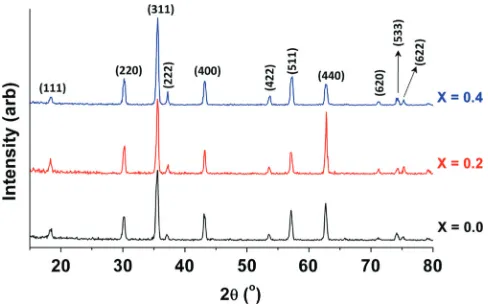
X-ray diffraction patterns of the samples are shown in Fig.1. The patterns have peaks which are consistent with the cubic spinel phase. They are not shifted relative to the unsub-stituted (x¼0) sample as was the case of CoAlxFe2xO4.8
This indicates that the lattice parameters of the
FIG. 1. (Color online) XRD patterns of the CoGaxFe2xO4 samples (x¼0.0, 0.2, and 0.4).
Author to whom correspondence should be addressed. Electronic addresses [email protected] and [email protected].
0021-8979/2011/109(7)/07A908/3/$30.00 109, 07A908-1 VC2011 American Institute of Physics
[image:4.612.317.561.558.711.2]CoGaxFe2xO4group of samples were similar or even
identi-cal and therefore not sensitive to changes in chemiidenti-cal com-position. The lattice parameter of all samples was found to be 8.38 A˚ . The preservation of the lattice parameter for CoGaxFe2xO4 in contrast with the CoAlxFe2xO4 system
arises because the ionic radii of Ga3þin tetrahedral and octa-hedral positions (rA¼0.47 A˚ , rB¼0.62 A˚ ) are quite similar
to those of Fe3þ(rA¼0.49 A˚ , rB¼0.65 A˚ ). Therefore,
sub-stituting Ga3þfor Fe3þis expected to have little effect on the lattice parameter compared with the substitution of the Al3þ with much smaller ionic radii (rA¼0.39 A˚ , rB¼0.54 A˚ ).
From EDX, the sample compositions were shown to be Co1.02Fe1.98O4(for x¼0), Co1.04Ga0.2Fe1.74O4(for x¼0.2),
and Co1.03Ga0.39Fe1.58O4(for x¼0.4).
Figure2shows the backscattered electron images of the samples. The uniformity in contrast observed for all the sam-ples further confirms that all had a single phase crystal struc-ture. They also appear to be of uniform composition because the image contrast in a backscattered electron image is a function of composition.
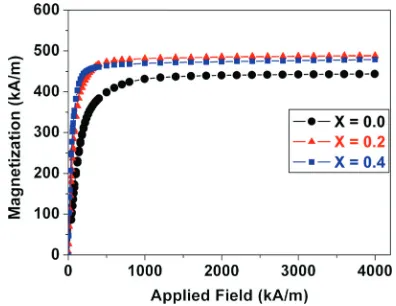
The variation of room temperature magnetization with applied magnetic field is shown in Fig. 3. In contrast with Al3þsubstitution,7 the saturation magnetization of the Ga3þ substituted cobalt ferrite initially increased at x¼0.2 and later decreased at x¼0.4. The saturation magnetization at x¼0.4 is also higher than that at x¼0.0. The increase in saturation magnetization with Ga3þ substitution is in agreement with Ga3þhaving tetrahedral site preference. In spinel ferrites the moments of the octahedral and tetrahedral sites couple anti-parallel.9,10The net magnetization (Ms) therefore is the
differ-ence in magnetization (M) of the sites: Ms¼MoctMtet.
Substituting nonmagnetic Ga3þ for Fe3þ in the tetrahedral
sites of cobalt ferrite will decrease the net magnetization of the tetrahedral site and at the same time increase the overall net magnetization. Moreover, the more Ga3þ is substituted, the lower the Curie temperature becomes6such that at higher Ga3þ concentrations, the room temperature becomes signifi-cant compared to the Curie temperature. This should also result in lower permeability and lower technical saturation magnetization at higher Ga3þconcentration.
As shown in Fig. 4(a) for unsubstituted cobalt ferrite samples, peak to peak magnetostriction amplitude decreased with increase in the measurement temperature. In the substi-tuted samples, the slope of the high field region of the mag-netostriction curve was initially low at 50 K, increased at 150 and 250 K, then decreased further with increase in mea-surement temperatures. The easy and hard magnetization directions in cobalt ferrite areh100iandh111i, respectively. It has large negativek100and smaller positivek111
contribu-tions to its magnetostriction amplitude.11 The initial part of the curve represents a region in which the contribution of k100 is dominant. It continues until all magnetic domains
align parallel to the easy axesh100i. The contribution ofk111
is observed if the magnetic field is further increased. In this study, the contribution of k111to the resultant
magnetostric-tion increased with increase in measurement temperature. It can also be seen from all the results that increase in tempera-ture resulted in reduced magnetostrictive hysteresis. This can be explained in terms of the effect of increase in temperature on anisotropy and coercive field. A previous study12 shows that increase in temperature results in lower anisotropy and coercive field which was expected to lead to less magneto-strictive hysteresis as observed.
In both CoGa0.2Fe1.8O4 [Fig. 4(b)] and CoGa0.4Fe1.6O4
[Fig.4(c)], measurement at 250 K resulted in higher magneto-striction amplitude than at 150 K. A similar result was obtained for the magnetostriction of CoAlxFe2xO4at x¼0.5
and 0.7.8This result shows that the substitution of Ga3þfor Fe3þalters both magnetostriction and its variation with tem-perature as shown in Fig. 4(d). It could also be seen in Fig.
4(d)that under temperature variations, the magnetostriction of CoGaxFe2xO4 is more stable than that of CoFe2O4 which
could be essential for sensor applications. In Fig. 4(e), it appears that the magnetostriction of CoGa0.2Fe1.8O4 is more
stable with temperature variation than CoGa0.4Fe1.6O4.
Figure4(f)shows the variation of (dk/dH)maxof CoGa
x-Fe2xO4 with temperature. At all temperatures studied
except 250 and 300 K, (dk/dH)maxdecreased with increase in
gallium concentration. As in the case of Al3þ substituted cobalt ferrite,8 at 250 K, (dk/dH)max initially increased
from x¼0.0 to 0.2 and decreased afterwards. This is
FIG. 2. (Color online) Backscattered scanning electron micrographs for the CoGaxFe2xO4system (x¼0.0, 0.2, 0.4).
FIG. 3. (Color online) Variation of room temperature magnetization as a function of applied field for Ga3þconcentrations x¼0.0, 0.2, and 0.4.
07A908-2 Nlebedimet al. J. Appl. Phys.109, 07A908 (2011)
[image:5.612.54.412.59.160.2] [image:5.612.74.272.582.735.2]similar to the observation at 300 K except that the maximum (dk/dH)max was at x¼0.4 rather than 0.2. A similar trend
was observed in previous studies on cation substituted cobalt ferrite samples in which the (dk/dH)maxinitially increased at
lower concentrations of the substituted cations (x0.2) and finally decreased at higher cation concentrations.4 The figure also shows that with suitable cation substitution, the maximum strain sensitivity is in the temperature range 250–300 K. These results demonstrate the capability to alter magnetomechanical performance to suit intended ap-plications by adjusting cation concentration at different temperatures.
IV. CONCLUSION
The study shows that magnetostrictive properties of cobalt ferrite can be altered by cation substitution. It was observed from XRD and SEM investigations that substitu-tion of Ga3þdoes not result in any observable changes in the crystal structure or microstructure of the material. On the other hand, magnetic and magnetostrictive properties have shown strong dependence on Ga3þsubstitution. The highest strain sensitivity (dk/dH) was observed for CoGa0.2Fe1.98O4
in the region 250–300 K.
ACKNOWLEDGMENTS
This research was supported by the UK EPSRC (Grant No. EP/057094) and by the US NSF (Grant No. DMR-0402716).
1
I. C. Nlebedim, N. Ranvah, P. I. Williams, Y. Melikhov, F. Anayi, J. E. Snyder, A. J. Moses, and D. C. Jiles,J. Magn. Magn. Mater.321, 2528 (2009).
2
I. C. Nlebedim, N. Ranvah, P. I. Williams, Y. Melikhov, J. E. Snyder, A. J. Moses, and D. C. Jiles,J. Magn. Magn. Mater.322, 1929 (2010). 3Y. Chen, J. E. Snyder, C. R. Schwichtenberg, K. W. Dennis, R. W.
McCal-lum, and D. C. Jiles,IEEE Trans. Magn.35, 3652 (1999). 4
C. C. H. Lo,IEEE Trans. Magn.43, 2367 (2007). 5
N. Ranvah, C. I. Nlebedim, Y. Melikhov, J. E. Snyder, D. C. Jiles, A. J. Moses, P. I. Williams, F. Anayi, and S. H. Song,IEEE Trans. Magn.44, 3013 (2008).
6
S. H. Song, C. C. H. Lo, S. J. Lee, S. T. Aldini, J. E. Snyder, and D. C. Jiles,J. Appl. Phys.101, 09C517 (2007).
7I. C. Nlebedim, N. Ranvah, Y. Melikhov, P. I. Williams, J. E. Snyder, A.
J. Moses, and D. C. Jiles,IEEE Trans. Magn.45, 4120 (2009). 8
I. C. Nlebedim, N. Ranvah, Y. Melikhov, P. I. Williams, J. E. Snyder, A. J. Moses, and D. C. Jiles,J. Appl. Phys.107, 09A936 (2010)
9D. J. Craik,Magnetic Oxides(Wiley, London, 1975), Part 1, p. 30. 10
V. Kuncser, G. Schinteie, B. Sahoo, W. Keune, D. Bica, L. Vekas, and G. Filoti,J. Phys.: Condens. Matter19, 016205 (2007)
11
R. C. O’Handley,Modern Magnetic Materials(Wiley, New York, 2000), p. 225.
12
N. Ranvah, Y. Melikhov, D. C. Jiles, J. E. Snyder, A. J. Moses, P. I. Wil-liams, and S. H. Song,J. Appl. Phys.103, 07E506 (2008)
FIG. 4. (Color online) Magnetostriction curves of the CoGaxFe2xO4system (a) x¼0.0, (b) x¼0.2, and (c) x¼0.4. Variation of magnetostriction amplitude with (d) temperature, (e) Ga3þcomposition, and (f) variation of strain derivative with temperature.
[image:6.612.53.559.58.362.2]