Abstract: In this paper, the behavior of a lead induced Ti-6Al-4V alloy has been studied using wire electrical discharge machine (WEDM). The machining process parameters such as peak current (A), pulse-on-time (B), spark gap voltage (C) and pulse-off-time (D) are to be optimized. Taguchi’s L27 Orthogonal Array (OA) has been chosen for design and conduction of experiments. Material removal rate (MRR) and surface roughness (SR) are the multiple performance measures which are to be measured. Zinc-coated brass wire is used as electrode wire material. Analysis of variance (ANOVA) technique has been utilized to understand the effects, contribution, and significance of machining process parameters. The experimental results observes that the performance measure were highly influenced by peak current with a contribution of 81.34 % to material removal rate and 58.79 % to surface roughness. The optimal parametric combination for MRR were A3B3C1D1 and A1B1C1D1 for SR. Optimum machining parameters will be identified by composite desirability grade which will be obtained from desirability function analysis (DFA).
Keywords: Lead induced Ti-6Al-4V alloy, WEDM, MRR, SR, Taguchi technique, Desirability function analysis.
I. INTRODUCTION
In the present studygrade 5 Titanium alloy (Ti-6Al-4V) has been considered for experimentation. Generally, Titanium alloys were widely used in various medical applications, automotive and aerospace industry [1]. They have outstanding properties like heat resistivity, corrosion resistivity, low weight and high strength [2].
The addition of refractory elements such as lead compounds to Titanium alloys increases ductility and enhances the mach inability characteristics of the alloy [3]. Such lead added Titanium alloy machined parts find applications in compressor assemblies which can improves engine performance by reducing the engine knocks. However, refractive elements induced titanium alloys and the products made by them which are to be machined by a conventional machining process is a continues problem. [4]J Barryet al have investigated that severe plastic deformation and thicker distributed layer on machined surfaces for rough machining of Ti-6Al-4V alloy.
Revised Manuscript Received on April 10, 2019.
A.V.S Ram Prasad, Koneru Lakshmaiah Education Foundation, Guntur, India
Koona Ramji, Andhra University, Vishakhapatnam, India
Arth Verma, Koneru Lakshmaiah Education Foundation, Guntur, India
J Pavan Kumar, Koneru Lakshmaiah Education Foundation, Guntur, India
S Kesava Rao, Koneru Lakshmaiah Education Foundation, Guntur, India
It was also observed that the hardness of the distributed layer of the machined surface increased significantly, when continues machining was carried out with higher flank wear. Not only did the tool life affect but also the original characteristics of these alloys get changed because of the heat generated during conventional machining processes[5]. Hence, unconventional machining processes such as Water Jet Machining (WJM), Ion Beam Machining (IBM) and electrochemical polishing can be used successfully to machine difficult to cut material to overcome the above said problems.
Wire electrical discharge machining (WEDM) is a type of unconventional machining process which was used to generate difficult profile on difficult to machine material like Titanium and its alloy [6].
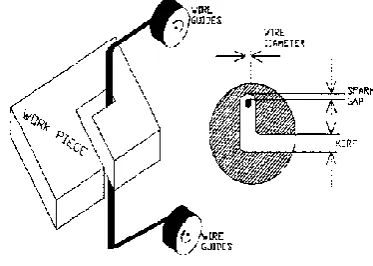
[image:1.595.331.518.413.546.2]Fig. 1, illustrate the working principle of wire electrical discharge machining process. It works on the principle of electro-thermal mechanism to machine any work piece material which is good conductor of electricity.
Fig. A.1 WEDM basic working principle
Wire electrical discharge machining is an unconventional machining process which works with electrical and non electrical parameters. It has more number of process parameters, selection of good process parameter combination is always a difficult task[7]. Many researchers have conducted number of experiment to analyze the effect of machining parameters on performance measures in WEDM process[8].JB Saedon [9] conducted experiment on Titanium alloy while machining with wire electrical discharge machining process. In his experimentation he has adopted Taguchi orthogonal array for conduction of experiment followed by grey relational analysis(GRA). Muhammad Azam [10] performed experiment on HSLA steel material and studied about recast layer formed on the
Optimization of Material Removal Rate, Surface
Roughness in Wire-EDM by using Desirability
Function Analysis
surface of the machined surface. Process parameters namely pulse on time, pulse ratio, discharge current, spark gap and wire speed rate were varied during the machining process. G Ugrasen[11] used molybdenum wire for machining process. The process parameters namely pulse on time , pulse off time, current and bed speed were considered. In order to find the response of each factor on the objective function, analysis of variance (ANOVA) was used. G Rajyalakshmi [12] has developed utility concept in conjunction with PCA for her experimental work. Material removal rate, surface roughness and spark gap were investigated by considering many of machining parameters on WEDM. KP Rajurkar [13] in his paper presented about adaptive control system which optimizes on line sparking frequency. Sanjeev K Garg [14] has characterized the wire electric discharge machine of Al/10 ZrO2 metal matrix composite. The input process parameter such as pulse width, time between pulses, servo control and mean reference voltage, short pulse time, wire feed and wire mechanical tension were considered. Mechanical properties says successful machining of material can be used on aerospace industries. S S Mahapatra [15] [16] has been employed on rough cutting operation in wire electric discharge machining is a challenging task with some combination factor in process parameter such as discharge current, pulse duration, pulse frequency, wire speed, wire tension, and dielectric flow optimized performance can be observed.
II. EXPERIMENTAL STUDY
[image:2.595.311.544.381.827.2]In this paper experiments were performed on Grade 5 Titanium plate which is of 11mm thickness. A CNC operated Ultracut–S1 4-axiswire-EDM(Electronica Machine Tools Ltd, India) was used for conducting the experiments. The electrode material utilized used was zinc coated brass wire of 0.25 mm diameter, whose wire tension is 1300 g. The nominal chemical composition of lead induced grade 5Ti-6Al-4V is represented in Table A.1.
Table. A.1 Nominal chemical composition of Grade 5 Ti-6Al-4V
Element
Al V Pb Fe Other
Elements Ti(remainder)
Wt % 6.61 4.20 1.09 0.11 0.06 Balance
Four parameters such as, peak current, pulse on time, spark gap voltage and pulse off time were considered as the machining parameters. Three level of process parameters are listed in Table A.2. An orthogonal array L27 has been adopted to accommodate all the above machining factors at their respective levels.
Table. A.2 WEDM process parameters
S No. Machining
parameters Levels 1 Levels 2 Levels 3
A Peak current (Amp) 10 11 12
B Pulse-on-time (µs) 105 110 115
C Spark gap
voltage(SV) 40 50 60
D Pulse-off-time (µs) 50 55 60
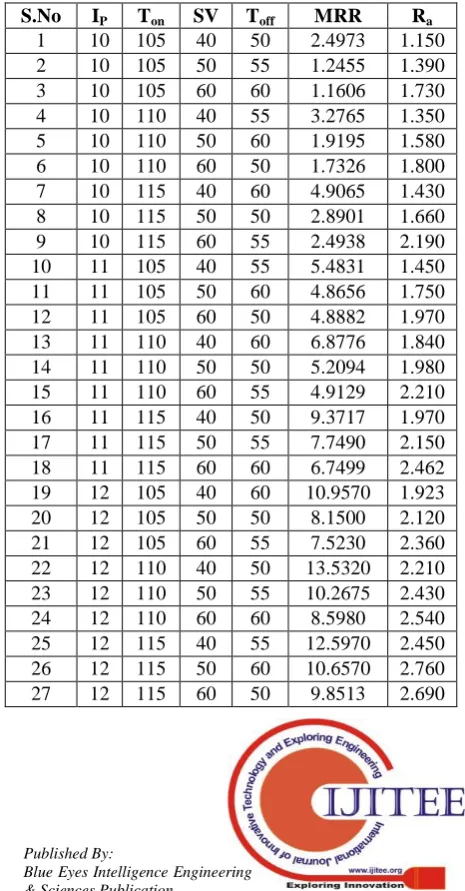
Grade 5 Titanium alloy plate of 11mm thickness were machined as per the combination of process parameters as shown in Table A.3. The material removal rate (MRR) is calculated using the under mentioned formula:
M R R = Cutting speed X Width of cut(w) X Height of the work piece(h) (mm3/min)…(1)
Taylor Hobson made surface roughness testerat 0.8 mm cut-off value was utilized to check the average surface roughness of each machined sample. The surface roughness value on the machined sample was taken at twelve different locations and their average was taken as surface roughness Ra value.
III. RESULTS AND DISCUSSION
In order to analyze values of experimentally observed data and to assess the significance of each parameter, analysis of variance (ANOVA) was used on the material removal rate and surface roughness. Taguchi suggested signal-to-noise (S/N) ratio as the objective function for matrix experiments and classified the objective functions are larger the better, smaller the better and nominal the best type. Table 3 shows the Taguchi orthogonal array and results obtained from the experimental plan of material removal rate and surface roughness.
Table. A.3 Taguchi L27 Orthogonal array and their experimental value
S.No IP Ton SV Toff MRR Ra
1 10 105 40 50 2.4973 1.150
2 10 105 50 55 1.2455 1.390
3 10 105 60 60 1.1606 1.730
4 10 110 40 55 3.2765 1.350
5 10 110 50 60 1.9195 1.580
6 10 110 60 50 1.7326 1.800
7 10 115 40 60 4.9065 1.430
8 10 115 50 50 2.8901 1.660
9 10 115 60 55 2.4938 2.190
10 11 105 40 55 5.4831 1.450
11 11 105 50 60 4.8656 1.750
12 11 105 60 50 4.8882 1.970
13 11 110 40 60 6.8776 1.840
14 11 110 50 50 5.2094 1.980
15 11 110 60 55 4.9129 2.210
16 11 115 40 50 9.3717 1.970
17 11 115 50 55 7.7490 2.150
18 11 115 60 60 6.7499 2.462
19 12 105 40 60 10.9570 1.923
20 12 105 50 50 8.1500 2.120
21 12 105 60 55 7.5230 2.360
22 12 110 40 50 13.5320 2.210
23 12 110 50 55 10.2675 2.430
24 12 110 60 60 8.5980 2.540
25 12 115 40 55 12.5970 2.450
26 12 115 50 60 10.6570 2.760
[image:2.595.41.299.513.578.2]A. Effect on material removal rate
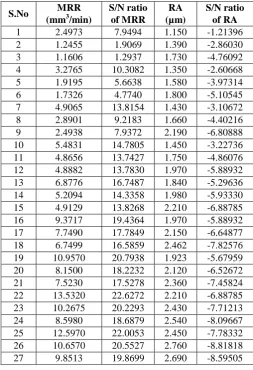
The S/N ratio values of the experimental responses namely material removal rate and surface roughness are represented in Table A.4. In order to identify the effect of each and every individual process parameters and interaction between them, we go for the use of ANOVA. The average value of the material removal rate and their respective levels in Fig A.2.
Table. A.4 Experimental and S/N ratio values for MRR and RA
S.No MRR
(mm3/min)
S/N ratio of MRR
RA (µm)
S/N ratio of RA
1 2.4973 7.9494 1.150 -1.21396
2 1.2455 1.9069 1.390 -2.86030
3 1.1606 1.2937 1.730 -4.76092
4 3.2765 10.3082 1.350 -2.60668
5 1.9195 5.6638 1.580 -3.97314
6 1.7326 4.7740 1.800 -5.10545
7 4.9065 13.8154 1.430 -3.10672
8 2.8901 9.2183 1.660 -4.40216
9 2.4938 7.9372 2.190 -6.80888
10 5.4831 14.7805 1.450 -3.22736
11 4.8656 13.7427 1.750 -4.86076
12 4.8882 13.7830 1.970 -5.88932
13 6.8776 16.7487 1.840 -5.29636
14 5.2094 14.3358 1.980 -5.93330
15 4.9129 13.8268 2.210 -6.88785
16 9.3717 19.4364 1.970 -5.88932
17 7.7490 17.7849 2.150 -6.64877
18 6.7499 16.5859 2.462 -7.82576
19 10.9570 20.7938 1.923 -5.67959
20 8.1500 18.2232 2.120 -6.52672
21 7.5230 17.5278 2.360 -7.45824
22 13.5320 22.6272 2.210 -6.88785
23 10.2675 20.2293 2.430 -7.71213
24 8.5980 18.6879 2.540 -8.09667
25 12.5970 22.0053 2.450 -7.78332
26 10.6570 20.5527 2.760 -8.81818
27 9.8513 19.8699 2.690 -8.59505
Fig A.2. shows the effect of machining process parameters on the performance characteristic namely material removal rate. It is observed from the figure that material removal rate is increased linearly with increase in process parameters namely peak current. When pulse on time increases from 105 to 115s, material removal rate increases. This is because of more discharge energy which is caused because of increase in pulse on time. Similarly, as spark gap voltage increases from 40 to 60, material removal rate start decreasing. As Pulse off time exceed from 50 to 60s material removal rate initially decreases because of number of discharges within a certain period of time become smaller. Finally the S/N ratio response graph which is shown in Fig. 2 states that optimal combination of WEDM process parameters which maximizes MRR of WEDM on Grade 5 Titanium alloy were as follows: higher value of peak current (A3), higher value of pulse-on-time (A3), lower value of spark gap voltage (C1) and lower value of
pulse-Fig. A.2 S/N response graph for MRR B. Analysis of Surface Roughness
Fig. A.3 shows the effect of process parameters on surface roughness. Increase in surface roughness was shown Fig 3(A). With increase in peak current and with increase in discharge energy results high melting of molten metal, resolidified and more debris is formed.
Fig.A.3 S/N response graph for SR
From Fig 3(B) it was observed that surface roughness increases with increase in pulse on time. When pulse on time increases larger discharge energy was produced between wire electrode and workpiece material. It was observed from Fig 3(C) that at lower value of servo voltage surface roughness value tends to be poor. Fig. A.3 demonstrates that the optimal combination levels of machining parameters that minimized SR were as follows: lower value of peak current (A1), lower value of pulse-on-time (B1), lower value of spark gap voltage (C1) and lower value of pulse-off-time (D1).
IV. MULTI OBJECTIVE OPTIMIZATION: DESIRABILITY FUNCTION ANALYSIS A. Desirability function approach
[image:3.595.314.542.52.219.2] [image:3.595.41.295.185.556.2] [image:3.595.315.543.312.477.2]B. Desirability Function Analysis Optimization Step Step 1: To calculate the individual desirability index(di) for each responses using the formula
a) When output character is “Larger-is-better” X<xmin
, xmin<x<xmax, r >0….(1) X>xmin
here, di=Single desirability index;
Xmin and Xmax are the lowest and highest values of x; R= Weight.
b) When output character is “smaller-is-better” X<xmin
,xmin<x<xmax, r >0….(2) X>xmax
Step 2: By using the following equation the overall desirability grade (Dg) of each process parameters has been combined to give performance characteristic of grade 5 Titanium alloy.
Dg=(d w1
*dw2*dw3*……*dwi)1/w….(3) where,
di= Single desirability index ;
wi= weight assigned to individual response respectively; w = sum of all individual weights.
Highest Dg value is reflected as ideal setting of respective process parameters.
Step 3: To identify the optimal performance parameters of the matrix and their level. Most of the desirability value better the performance. Therefore on the basis of desirability grade we can get the performance characteristics.
Step 4: Taguchi based ANOVA has been performed for process parameter values and it produces a relative performances.
[image:4.595.303.552.47.200.2]Step 5: Optimum design process parameter characteristics has been calculated and then the performance characteristic has been determined.
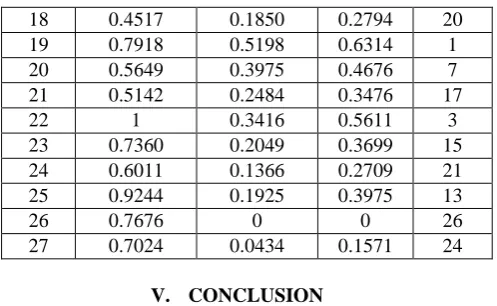
Table. 5.A Evaluated individual desirability, desirability grade and rank
S.No Individual desirability
of MRR
Individual desirability
of SR
DG Rank
1 0.1096 1 0.3599 16
2 0.0068 0.8509 0.0913 25
3 0 0.6397 0 26
4 0.1710 0.8757 0.4116 11
5 0.0622 0.7329 0.2344 22
6 0.3027 0.5962 0.4358 10
7 0.3027 0.8260 0.5194 5
8 0.1397 0.6832 0.3280 18
9 0.1077 0.3540 0.2042 23
10 0.3493 0.8136 0.5504 4
11 0.2994 0.6273 0.4456 8
12 0.3013 0.4906 0.3916 14
13 0.4621 0.5714 0.5179 6
14 0.3272 0.4844 0.4040 12
15 0.3033 0.3416 0.3233 19
16 0.6637 0.4906 0.5641 2
17 0.5325 0.3788 0.4433 9
18 0.4517 0.1850 0.2794 20
19 0.7918 0.5198 0.6314 1
20 0.5649 0.3975 0.4676 7
21 0.5142 0.2484 0.3476 17
22 1 0.3416 0.5611 3
23 0.7360 0.2049 0.3699 15
24 0.6011 0.1366 0.2709 21
25 0.9244 0.1925 0.3975 13
26 0.7676 0 0 26
27 0.7024 0.0434 0.1571 24
V. CONCLUSION
The effects of process parameters on MRR and SR of machined components by WEDM of grade 5 Ti-6Al-4V have been investigated experimentally. Based on experimental results obtained and analysis done on the results, following conclusions were drawn. It is observed that main responsible parameter is peak current and the significant factors are pulse-on-time and spark gap voltage. When the WEDM process was used to machine lead induced grade 5 Ti-6Al-4V alloy, the MRR increased with increased peakcurrent. The optimum condition for MRR is higher value of peak current (12A), higher value of pulse-on-time (115 µs), lower value of spark gap voltage (40 V) and lower value of pulse-off-time (50 µs).
REFERENCES
1. Xiaoping Yang & C. Richard Liu (1999): MACHINING TITANIUM AND ITS ALLOYS, Machining Science and Technology: An International Journal, 3:1, 107-139:
http://dx.doi.org/10.1080/10940349908945686.
2. C. Veiga, J.P. Davim& A.J.R. Loureiro (2012): PROPERTIES AND APPLICATIONS OF TITANIUM ALLOYS: A BRIEF REVIEW: Rev.adv.Mater.Sci.32(2012) 14-34:
https://www.researchgate.net/publication/283863116.
3. Y. Liu , L.F. Chen , H.P. Tang , C.T. Liu , B. Liu & B.Y. Huang (2006): Design of powder metallurgy titanium alloys and composites: Materials Science and Engineering A 418 (2006) 25–35: doi:10.1016/j.msea.2005.10.057.
4. J. Barry, G. Byrne & D. Lennon (2001): Observations on chip formation and acoustic emission in machining Ti–6Al–4V alloy: International Journal of Machine Tools & Manufacture 41 (2001) 1055–1070.
5. S. Keith Hargrove &Duowen Ding (2007): Determining cutting parameters in wire EDM based on workpiece surface temperature distribution: Int J Adv ManufTechnol (2007) 34: 295–299: DOI 10.1007/s00170-006-0609-0.
6. Raymond Magabe, Neeraj Sharma, Kapil Gupta& J Paulo Davim (2019): Modeling and optimization of Wire-EDM parameters for machining of Ni55.8Ti shape memory alloy using hybrid approach of Taguchi and NSGA-II : The International Journal of Advanced Manufacturing Technology: https://doi.org/10.1007/s00170-019-03287-z.
7. Bijo Mathew, Benkim& J Babu (2014): Multiple process parameter optimization of WEDM on AISI304 using Taguchi Grey Relational Analysis: Procedia Materials Science 5 (2014) 1613 – 1622 : doi:10.1016/j.mspro.2014.07.349.
9. J.B. Saedon, Norkamal Jaafar, Mohd Azman Yahaya,NorHayati Saad &Mohd Shahir Kasim (2014): Multi-objective optimization of titanium alloy through orthogonal array and grey relational analysis in WEDM: Procedia Technology 15 (2014) 832 – 840:
doi:10.1016/j.protcy.2014.09.057.
10. Muhammad Azam, Mirza Jahanzaib, Junaid Ali Abbasi, Musharaf Abbas, Ahmad Wasim& Salman Hussain (2016): Parametric analysis of recast layer formation in wire-cut EDM of HSLA steel: Int J Adv ManufTechnol:DOI 10.1007/s00170-016-8518-3.
11. G.Ugrasen, H.V.Ravindra, G.V.Naveen Prakash &R.Keshavamurthy (2014): Process optimization and estimation of machining performances using artificial neural network in wire EDM: Procedia Materials Science 6 (2014) 1752 – 1760:
doi:10.1016/j.mspro.2014.07.205.
12. G. Rajyalakshmi (2018): Optimization of WEDM Process using Taguchi Utility Analysis: Indian Journal of Science and Technology, Vol 11(23), DOI: 10.17485/ijst/2018/v11i23/114377, June 2018. 13. K.P. Rajurkar , W. M. Wang & W. S. Zhao (1997): WEDM-Adaptive
Control with a Multiple Input Model for lndentification of Workpiece Height: Annals of the ClRPVol. 46/1/1997.
14. Sanjeev K. Garg, Alakesh Manna, Ajai Jain (2012): An Investigation on Machinability of Al/10 % ZrO2(P)-Metal Matrix Composite by WEDM and Parametric Optimization Using Desirability Function Approach: DOI 10.1007/s13369-013-0941-2
15. S.S.Mahapatra , Amar Patnaik (2007): Optimization of wire electrical discharge machining (WEDM) process parameters using Taguchi method: Int J Adv ManufTechnol (2007) 34:911–925: DOI 10.1007/s00170-006-0672-6.