Scholarship@Western
Scholarship@Western
Electronic Thesis and Dissertation Repository
2-2-2016 12:00 AM
Parametric Study of Vertical Ground Loop Heat Exchangers for
Parametric Study of Vertical Ground Loop Heat Exchangers for
Ground Source Heat Pump Systems
Ground Source Heat Pump Systems
Abdelrahman S. Ramadan
The University of Western Ontario
Supervisor
Dr. Karman Siddiqui
The University of Western Ontario
Graduate Program in Mechanical and Materials Engineering
A thesis submitted in partial fulfillment of the requirements for the degree in Master of Engineering Science
© Abdelrahman S. Ramadan 2016
Follow this and additional works at: https://ir.lib.uwo.ca/etd
Recommended Citation Recommended Citation
Ramadan, Abdelrahman S., "Parametric Study of Vertical Ground Loop Heat Exchangers for Ground Source Heat Pump Systems" (2016). Electronic Thesis and Dissertation Repository. 3521.
https://ir.lib.uwo.ca/etd/3521
This Dissertation/Thesis is brought to you for free and open access by Scholarship@Western. It has been accepted for inclusion in Electronic Thesis and Dissertation Repository by an authorized administrator of
Abstract
We report on a numerical study conducted to investigate the effect of various parameters
on the heat exchange inside a vertical ground loop heat exchanger (VGLHE) for a
ground-source heat pump (GSHP) system. The simulations were conducted for three
piping configurations of the ground loop which were U-Tube, Concentric pipes and
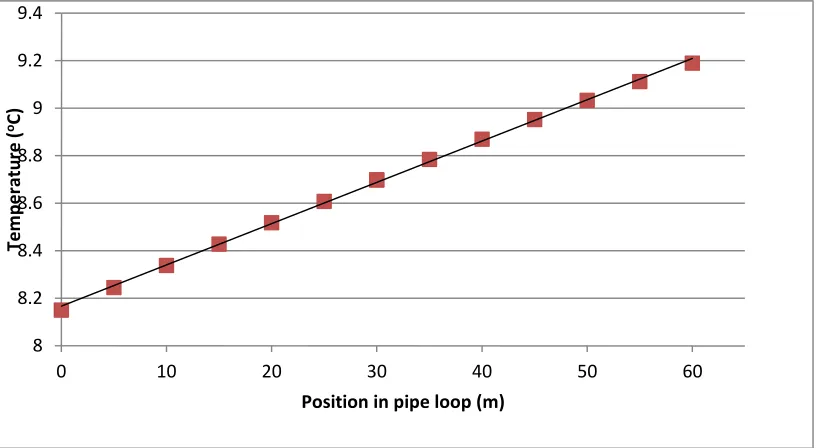
Spiral. The results show a linear temperature rise along the pipe length for the U-Tube
configuration. The concentric pipes configuration shows two distinct linear trends for the
temperature rise; a slow temperature rise during the downward flow through the inner
pipe and a higher temperature rise during the upflow through the annulus. The spiral
configuration shows a steeper slope for the temperature rise in the spiral section and
almost a flat slope for the temperature rise in the straight vertical section of the pipe. The
research also examines a simulation case of integrating a VGLHE inside a micro-pile
foundation system.
Keywords
Ground source heat pumps, vertical ground loop heat exchanger, numerical modelling,
computational fluid dynamics, ANSYS FLUENT, micro-pile, geothermal, parametric
Statement of Originality
This is to certify that, to the best of my knowledge, the content of this thesis is my own
work. This thesis has not been submitted for any degree or other purposes.
I certify that the intellectual content of this thesis is the product of my own work and that
all the assistance received in preparing this thesis and sources have been acknowledged.
Acknowledgments
I would like to express my gratitude and appreciation for both my supervisor Dr. Kamran
Siddiqui and co-supervisor Dr. Hesham El-Naggar for their guidance, support and, above
all, patience to help me complete my research and thesis. I’m grateful to their efforts in
enhancing my knowledge and research skills as well as giving me the chance to
participate in various technical conferences which added to my graduate experience.
I’m extremely thankful to my whole family who supported and motivated me in every
step of the way of this long journey, especially my father.
Finally, and most importantly, I’m indebted to my wife Dima for her encouragement,
support, quiet patience and unending love. I dedicate all my work to you and to our new
Table of Contents
Abstract ... ii
Statement of Originality ... iii
Acknowledgments... iv
Table of Contents ... v
List of Tables ... viii
List of Figures ... x
List of Symbols ... xiv
List of Abbreviations ... xvi
Chapter 1 : INTRODUCTION... 1
1 Introduction ... 1
1.1 Background ... 1
1.2 Ground Source Heat Pump (GSHP) Systems ... 4
1.2.1 Components of a GSHP System ... 5
1.2.2 Vertical Ground Loop Heat Exchanger (VGLHE) ... 8
1.2.3 Relevant Parameters and Factors: ... 9
1.2.4 Heat transfer modes in boreholes ... 11
1.3 Energy Piles – Fundamentals ... 13
1.3.1 Pile foundations - Background... 14
1.3.2 Energy Piles ... 18
1.4 Literature Review... 20
1.5 Motivation and Objectives ... 23
1.6 Thesis Format and Layout ... 24
Chapter 2 : NUMERICAL MODEL ... 25
2.1 Modelling Process ... 25
2.2 Exclusion of Soil Modelling ... 26
2.3 Numerical Model Development and Formulation ... 27
2.3.1 Continuity and Momentum Equations ... 27
2.3.2 Turbulence Model ... 29
2.3.3 Energy and Convective Heat Transfer Modelling ... 31
2.3.4 Energy Modelling in Solid Regions ... 32
2.3.5 Conjugate Heat Transfer ... 33
2.3.6 Boundary Conditions ... 34
2.3.7 Solution Methods and Initialization ... 35
2.4 Geometry... 36
2.5 Mesh Generation and Dependency Test ... 39
2.6 Model Validation ... 43
2.6.1 Description of the experimental data ... 44
2.6.2 Simulation and results ... 46
Chapter 3 : PARAMETRIC STUDY ... 49
3 Parametric Study ... 49
3.1 Geometrical Parameters ... 49
3.1.1 U-Tube Piping Configuration ... 50
3.1.2 Concentric Piping Configuration ... 61
3.1.3 Spiral (Helical) Piping Configuration ... 68
3.1.4 Comparison and Discussion ... 73
3.2 Parametric analysis of Thermophysical Properties and Operational Parameters . 75 3.2.1 Thermal Conductivity of the pipe ... 75
3.2.3 Flow Rate of Heat Transfer Fluid ... 80
3.2.4 Concentric VGLHE in an “Energy Micro-Pile” ... 83
Chapter 4 : CONCLUSIONS ... 91
4 Conclusions ... 91
4.1 Recommendations for future work ... 95
References: ... 97
Appendix A ... 101
Appendix B ... 103
Appendix C ... 104
List of Tables
Table 2-1: Geometrical dimensions of 3D model ... 39
Table 2-2: Properties of different mesh sizes used for mesh dependency test ... 41
Table 2-3: Boundary conditions used in mesh dependency test ... 41
Table 2-4: Thermophysical properties of material used in simulation ... 41
Table 2-5: Outlet temperature for different mesh sizes ... 42
Table 2-6: Physical dimensions of experimental borehole ... 45
Table 2-7: Thermophysical properties of materials used in the experiment ... 45
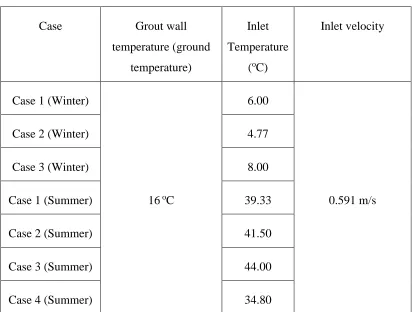
Table 2-8: Operating conditions and properties for thermal response test ... 46
Table 3-1: Thermophysical properties of material used in simulation ... 51
Table 3-2: Boundary conditions used [Adopted from Esen et al. 2009] ... 51
Table 3-3: Area-weighted average surface heat flux values for different pipe sections ... 55
Table 3-4: Calculated thermal resistances of individual VGLHE components ... 59
Table 3-5: Boundary conditions used [Adopted from Esen et al. 2009] ... 62
Table 3-6: Boundary conditions used [Adopted from Esen et al. 2009] ... 69
Table 3-7: Summary of simulation results for three different piping configurations ... 74
Table 3-8: Summary of simulation results for different pipe materials in concentric pipe configuration. ... 76
Table 3-10: Summary of simulation results for concentric piping configurations with
varying volume flow rate of heat transfer fluid ... 81
Table 3-11: Parameters and dimensions of micro-pile used in simulation ... 86
List of Figures
Figure 1.1: World energy consumption in quadrillion Btu, 1990-2040 [EIA 2013] ... 2
Figure 1.2: World energy consumption by fuel type, 1990-2040 (quadrillion Btu) [EIA
2013] ... 2
Figure 1.3: Total US energy consumption by sector in 2013 [US DOE 2013] ... 3
Figure 1.4: Percentage distribution of solar energy [Omer 2008] ... 4
Figure 1.5: Depth dependence of annual range of ground temperatures in Ottawa, Canada
[Williams and Gold 1976] ... 5
Figure 1.6: Work and heat flow balance for a heat pump [NRC 2005] ... 6
Figure 1.7: Refrigeration cycle of a typical heat pump unit [NRC 2005] ... 6
Figure 1.8: Typical GHE loop configurations for GSHP systems. a) Vertical closed GHE
configuration, b) Horizontal closed GHE configuration and c) Open loop groundwater
configuration. [NRC 2005] ... 7
Figure 1.9: Top view and side view of a single pipe U-Tube piping configuration in a
VGLHE. ... 9
Figure 1.10: Cross section of a U-tube borehole and corresponding thermal circuit ... 11
Figure 1.11: Typical side views of a) End Bearing Pile and b) Friction Pile [Beardmore
2012] ... 15
Figure 1.12: Typical hollow bar micro-pile (Drbe et al. 2013) ... 17
Figure 1.13: Photo of a typical reinforcement cage for a foundation pile integrated with
high density polyethylene piping [BINE IS, 2010] ... 19
Figure 1.14: Photo of the integrated reinforcement cage inserted inside the pile borehole
Figure 2.1: A schematic diagram showing horizontal and vertical cross sections of a
vertical U-tube GHE (Development of a numerical model for the simulation of vertical
U-tube ground heat exchangers) ... 26
Figure 2.2: Section view of simulated components and type of heat transfer ... 33
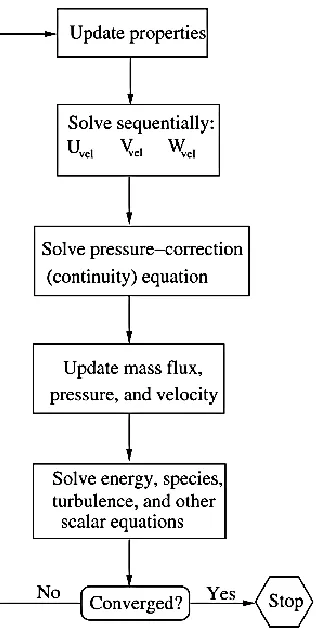
Figure 2.3: Algorithm illustrating steps of a Pressure-Based solution ... 36
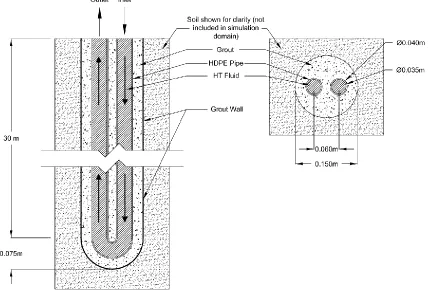
Figure 2.4: Top view and side view of U-Tube piping geometry domain used in simulation. ... 37
Figure 2.5: Top isometric view of the vertical ground loop 3D geometry ... 37
Figure 2.6: Bottom isometric view of the vertical ground loop 3D geometry ... 38
Figure 2.7: Top isometric view of generated mesh ... 40
Figure 2.8: Plot of wall y+ along depth of pipe (top 0.5m) ... 42
Figure 2.9: Entrance length for fluid flow for mesh #4 ... 43
Figure 2.10: Schematic of an in-situ test setup (adapted from Esen et al [2009]) ... 44
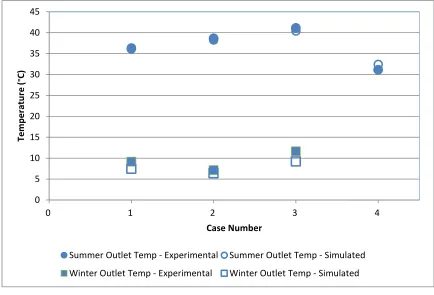
Figure 2.11: Comparison between experimentally measured and numerically simulated fluid outlet temperatures ... 47
Figure 3.1: Top view and side view of U-Tube piping geometry domain used in simulation. ... 50
Figure 3.2: Temperature of fluid along the pipe ... 52
Figure 3.3: Temperature distribution in the borehole horizontal plane at depths of (a) 0 m, (b) 10 m, (c) 20 m, (d) 30 m . The colour bar represents the temperature in degree Celsius. ... 54
Figure 3.5: Temperature profile of fluid at different depths of down-flow pipe ... 57
Figure 3.6: Sketch indicating the location of temperature data points ... 58
Figure 3.7: Normalized temperature profile of fluid at different depths of down-flow pipe
... 58
Figure 3.8: (a) Temperature and (b) velocity contours of the bottom bend of pipe ... 60
Figure 3.9: Top view and side view of concentric piping geometry domain used in
simulation. ... 62
Figure 3.10: Area-averaged temperature of fluid along the pipe ... 63
Figure 3.11: Temperature distribution in the borehole horizontal plane at depths of (a) 0
m, (b) 10 m, (c) 20 m, (d) 29 m. The colour bar represents the temperature in degree
Celsius. ... 65
Figure 3.12: : Temperature distribution in the fluid horizontal plane at depths of (a) 0 m,
(b) 10 m, (c) 20 m, (d) 29 m. The colour bar represents the temperature in degree Celsius.
... 66
Figure 3.13: (a) Temperature and (b) velocity contours in the bottom section of the
concentric pipe ... 67
Figure 3.14: Isometric view of 3D model of spiral piping configuration simulated ... 69
Figure 3.15: Average temperature of fluid along the length of loop ... 70
Figure 3.16: Temperature distribution in the borehole horizontal plane at depths of (a) 0
m, (b) 2 m, (c) 4 m, (d) 6 m, (e) 8 m, (f) 10 m. The colour bar represents the temperature
in degree Celsius. ... 71
Figure 3.17: Temperature distribution in the fluid horizontal plane at depths of (a) 0 m,
(b) 2 m, (c) 4 m, (d) 6 m, (e) 8 m, (f) 10 m. The colour bar represents the temperature in
Figure 3.18: Temperature of fluid at different positions of the pipe for three different
piping configurations ... 74
Figure 3.19: Average fluid temperature along full length of concentric piping for four
cases with different piping materials. ... 77
Figure 3.20: Temperature of fluid along full length for three concentric piping
configurations with changing grout thermal conductivity values ... 80
Figure 3.21: Temperature of fluid along full length for three concentric piping
configurations with changing fluid volume flow rates values ... 82
Figure 3.22: Typical hollow bar micro-pile (Drbe et al. 2013) ... 84
Figure 3.23: Top view and side view of energy micro-pile geometry domain used in
simulation. ... 85
Figure 3.24: Ground temperature profile for the Goderich area in south western Ontario
(Markle, 2011) ... 87
List of Symbols
c
oC
Specific Heat Capacity, J/kg K
Celsius Degree
C1𝜖 Constant (experimentally determined)
C2 Constant (experimentally determined)
COPh/c Design Heating/Cooling Coefficient of Performance
DH Hydraulic Diameter, m
E Total Energy Transported, J
Fh/c Part load factor (full load hours to total number of hours in design month)
𝑔⃗ Gravitational Acceleration Constant, m/s2
Gb Generation of turbulence kinetic energy due to buoyancy
Gk Generation of turbulence kinetic energy due to the mean velocity gradient
k Turbulence Kinetic Energy
Keff Effective Thermal Conductivity, W/(m°K)
Le Entrance Length, m
𝑚̇
p
Mass Flow Rate, kg/s
Pressure, Pa
Prt Prandtl number
QC Heat extracted from the cold reservoir, kW
QH Heat added to the hot reservoir, kW
Re Reynolds Number
Rp Pipe Thermal Resistance, °K/W
Rs Soil Thermal Resistance, °K/W
S Modulus of the mean rate-of-strain tensor
Tewt,min/max Minimum/Maximum design entering water temperature, °C
Tg,min/max Minimum/Maximum undisturbed ground temperature, °C
TI Turbulent Intensity
Ti Temperature data point in the mid vertical plane, oC
Tinlet Fluid Inlet Temperature, oC
Toutlet Fluid Outlet Temperature, oC
𝑣⃗ Velocity, m/s
W Work input, kW
x Cartesian x coordinate
y Cartesian y coordinate
YM Contribution of the fluctuating dilatation in compressible turbulence to the
overall dissipation rate
z Cartesian z coordinate
Greek Symbols
µt Turbulent Viscosity
ϵ Dissipation Rate
μ Dynamic Viscosity, kg/m·s
ρ Density, kg/m3
σk Turbulent Prandtl numbers for k (Turbulence Kinetic Energy)
σϵ Turbulent Prandtl numbers for ϵ (Dissipation Rate) 𝜏̿̅ Stress Tensor
List of Abbreviations
CFD Computational Fluid Dynamics
COP Coefficient of Performance
EIA Energy Information Administration
GHE Ground Heat Exchanger
GSHP Ground Source Heat Pump
HDPE High Density Poly Ethylene
HT Fluid Heat Transfer Fluid
SIMPLE
TRT
Semi-Implicit Method for Pressure-Linked Equations
Thermal response Test
UDF User Defined Function
USDOE US Department of Energy
Chapter 1 : INTRODUCTION
1
Introduction
1.1
Background
The 2013 International Energy Outlook published by the U.S. Energy Information
Administration (EIA) projected a continuous increase in the world energy consumption
levels over the next few decades [EIA 2013]. As shown in Figure 1.1, it is estimated that
the world energy consumption will grow by approximately 56% between 2010 and 2040.
Different energy sources will be required to meet this increasing demand and as can be
seen by Figure 1.2, fossil fuels (oil, coal and gas) are predicted to account for
approximately 75% of the world energy consumption by 2040 [EIA 2013]. This fossil
fuel dependency outlook is most certainly reinforced by the recent drop in crude oil
prices globally. The heavy reliance on fossil fuels combined with the fact that burning
fossil fuels produces greenhouse gases such as nitric oxide and carbon dioxide, has
generated growing concerns related to the environmental impacts of these fuels. It is
estimated that the world energy-related carbon dioxide emissions will increase by
approximately 36% by 2040 (due mainly to non-OECD countries) [EIA 2013]. This
massive global energy consumption has always demanded engineers, scientists and
designers to explore other renewable resources and more efficient systems.
The largest energy consuming sector in the U.S. is the building sector (consisting of
residential and commercial buildings). As shown in Figure 1.3, it is estimated that
approximately 40%of total U.S. energy consumption in 2013 (97.4 Quadrillion Btu) was
utilized by buildings, which was higher than each of the other two remaining sectors,
transportation and industrial [US DOE 2013]. Approximately 50% of the total energy
consumed by buildings is used for space heating and air conditioning [EIA 2013]. This
presents a major potential opportunity for utilizing renewable energy sources for space
heating and cooling, which reduces the use and current dependency on fossil fuels and
Figure 1.1: World energy consumption in quadrillion Btu, 1990-2040 [EIA 2013]
Figure 1.3: Total US energy consumption by sector in 2013 [US DOE 2013]
One of these potential renewable energy sources is the earth’s ground energy, which is
utilized via a Ground Source Heat Pump (GSHP) system with considerable economic
advantages and cost savings. The GSHP system operates on the basis of using ground as
a heat source for heating purposes in winter and as a heat sink for cooling purposes in
summer. It is argued that geothermal heating systems can be more efficient than electric
resistance heating, gas or oil-fired heating systems and air-source heat pumps [Omer
2008].
Although GSHP systems could be viewed as attractive and feasible from the energy cost
point of view, the installation costs associated with the drilling of the boreholes
containing the ground heat exchangers could be prohibitive and could act as a barrier for
increasing the use and installation of beneficial GSHPs. Nonetheless, relatively novel
methods have been explored in order to reduce this premium installation cost and one of
these methods is the “Energy Pile” system where it utilizes the building structural
foundation piles as ground heat exchangers.
In the next sections a background for GSHP and energy pile systems will be presented as
1.2
Ground Source Heat Pump (GSHP) Systems
It has been well established that the main source of energy on earth is solar radiation
[Phillips 1995], which also serves as the source for many global energy sources available
to us including solar energy, wind energy, petrochemical and more importantly
geothermal and earth-energy systems. Considering that almost half of the sun’s solar
energy gets absorbed by earth as shown in Figure 1.4, it seems logical to utilize this
abundant storage of renewable energy that is readily available on site all year long.
Figure 1.4: Percentage distribution of solar energy [Omer 2008]
With that solar energy being stored underground as thermal energy, the soil also acts as
an insulator between the ambient air above ground and the earth below. This insulation
produces a constant ground temperature below a certain depth all year round that is
independent of the above ground air temperatures that fluctuate due to seasonal variations
as shown in Figure 1.5. The temperature of the ground at shallower depths may not be
constant; however, their fluctuations are greatly reduced when compared to the ambient
Therefore, the temperature of the ground below a certain depth is warmer than the
ambient air in winter and is cooler than the ambient air in summer. This is the basis of
operation for ground source heat pump systems (GSHP) where heat can be absorbed from
the relatively warm ground in winter and rejected into the relatively cool ground in the
summer through the use of ground source heat pumps.
1.2.1 Components of a GSHP System
Ground source heat pump systems consist of three main components:
1- Heat pump machine:
The ideal heat pump “pumps” heat from a cold source to a hot reservoir through the
application of work as shown in Figure 1.6 below (opposed to the natural flow of heat
from hot to cold). This cycle is known as the vapour compression refrigeration cycle and
is typical for any heat pump whether ground-source, water-source, or air-source as shown
in Figure 1.7.
Figure 1.6: Work and heat flow balance for a heat pump [NRC 2005]
Figure 1.7: Refrigeration cycle of a typical heat pump unit [NRC 2005]
The function of the heat pump in a GSHP system is to transfer the heat between the earth
connection and the heating/cooling distribution system. The most common kind of
GSHPs is the “water-to-air” where the heat carried by the fluid from and to the earth
connection is ultimately transferred to and from the air distribution system within the
building. If the distribution system is hydronic (heating/cooling water loop) then the
All of the heat pump components shown are usually contained in one enclosure and the
enclosure itself is placed indoors in a furnace room or a mechanical room. Typical
capacities for GSHPs range from 3.5kW to 35kW [NRC 2005].
2- Heating/Cooling distribution system:
This is the distribution system which delivers heating or cooling to the building of
interest. The distribution system is usually the conventional air duct or hydronic (hot
water) piping distribution system.
3- Earth connection:
The earth connection is the ground loop piping system that acts as the heat exchanger
between the ground and the GSHP system. There are two ground heat exchanger (GHE)
systems; closed loop and open loop systems. Within each system there are different
configurations of the underground piping loop layouts: vertical, horizontal, coiled,
surface water and open system wells. Some examples are shown in Figure 1.8 below.
Figure 1.8: Typical GHE loop configurations for GSHP systems. a) Vertical closed GHE configuration, b) Horizontal closed GHE configuration and c) Open loop groundwater configuration. [NRC 2005]
In the closed loop systems, the GSHP system circulates a heat transfer fluid, usually
water or an antifreeze glycol mixture from the heat pump machine to the ground loop and
water from the designated well or aquifer to the heat pump and then returns it back to the
environment through injection wells.
In the present research, the type of GHE of interest is the vertical closed loop type,
hereinafter referred to as “Vertical Ground Loop Heat Exchanger” or “VGLHE”, and
therefore more related information will be presented here.
1.2.2 Vertical Ground Loop Heat Exchanger (VGLHE)
A typical Vertical Ground Loop Heat Exchanger (VGLHE) consists of three key
components, as shown in the single pipe U-tube configuration in Figure 1.9:
1- Heat Transfer Fluid
2- Piping
3- Grout material
The depth and diameter of the boreholes containing the VGLHE vary from case to case
depending on many specific factors, such as the peak heating load, peak cooling load,
number of VGLHEs in a system, thermal properties of the soil and others. However, the
diameter and depth of the borehole generally range from 100 mm to 150 mm and from 15
m to 120 m, respectively [GSHPA 2007].
The piping material commonly used in GSHP installations is High Density Polyethylene
(HDPE) and the pipe nominal sizes typically range from 20 mm 40 mm. The function of
the piping is to convey the heat transfer fluid, typically water or an anti-freeze mixture, to
circulate into and out of the VGLHE from and back to the heat pump equipment. There
are different configurations of the piping other than the common single pipe U-tube
configuration, such as the concentric piping, spiral piping and the double pipe U-tube
Figure 1.9: Top view and side view of a single pipe U-Tube piping configuration in a VGLHE.
The third component surrounding the piping is the grout. The grout prevents the ground
water from the risk of contamination and provides a thermal connection to the
surrounding soil. It is for the latter reason that the grout material is preferable to a have a
high thermal conductivity value. Typical geothermal grout material is a bentonite grout
mixture.
1.2.3 Relevant Parameters and Factors:
The efficiency of any heat pump including GSHPs is measured by a parameter called the
coefficient of performance (COP). The COP is the ratio of change in heat at the reservoir
of interest to work input in the process. Generally ground source heat pumps have heating
COPs ranging from 2.4 to 5.0 and cooling COPs ranging from 3.1 to 8.8 [Rafferty et al
Heating and cooling COPs are calculated using the following equations:
𝑄𝐻= 𝑊 + 𝑄𝐶 Eq. 1-1
𝐶𝑂𝑃𝐻𝑒𝑎𝑡𝑖𝑛𝑔 = 𝑈𝑠𝑒𝑓𝑢𝑙 𝐻𝑒𝑎𝑡𝑖𝑛𝑔 𝑒𝑛𝑒𝑟𝑔𝑦
𝐶𝑜𝑚𝑝𝑟𝑒𝑠𝑠𝑜𝑟 𝑎𝑛𝑑 𝐹𝑎𝑛 𝑎𝑛𝑑 𝑃𝑢𝑚𝑝 𝐸𝑛𝑒𝑟𝑔𝑦 =
𝑊 + 𝑄𝐶
𝑊 Eq. 1-2
𝐶𝑂𝑃𝐶𝑜𝑜𝑙𝑖𝑛𝑔 =
𝑈𝑠𝑒𝑓𝑢𝑙 𝐶𝑜𝑜𝑙𝑖𝑛𝑔 𝑒𝑛𝑒𝑟𝑔𝑦
𝐶𝑜𝑚𝑝𝑟𝑒𝑠𝑠𝑜𝑟 𝑎𝑛𝑑 𝐹𝑎𝑛 𝑎𝑛𝑑 𝑃𝑢𝑚𝑝 𝐸𝑛𝑒𝑟𝑔𝑦 =
𝑄𝐶
𝑊 Eq. 1-3
Where:
𝑄𝐶 is the amount of heat extracted from the cold reservoir
𝑄𝐻 is the amount of heat added to the hot reservoir
𝑊 is the work input
Another important objective when designing for a GSHP system is the proper sizing of
the GHE length. This is a critical consideration since the capital costs of GSHP system
are higher than conventional systems. Below are the relevant equations from a simplified
method from the International Ground Source Heat Pump Association (IGSHPA)
[IGSHPA 1988]:
Sizing based on the heating load: 𝐿ℎ = 𝑞𝑑,ℎ𝑒𝑎𝑡[
(𝐶𝑂𝑃ℎ− 1)
𝐶𝑂𝑃ℎ (𝑅𝑝+ 𝑅𝑠𝐹ℎ)
𝑇𝑔,𝑚𝑖𝑛− 𝑇𝑒𝑤𝑡,𝑚𝑖𝑛
] Eq. 1-4
Sizing based on the cooling load: 𝐿𝑐 = 𝑞𝑑,𝑐𝑜𝑜𝑙[
(𝐶𝑂𝑃𝑐 − 1)
𝐶𝑂𝑃𝑐 (𝑅𝑝+ 𝑅𝑠𝐹𝑐)
𝑇𝑒𝑤𝑡,𝑚𝑎𝑥− 𝑇𝑔,𝑚𝑎𝑥
] Eq. 1-5
Where:
COPh/c is the design heating/cooling coefficient, respectively
Tg,min/max is the minimum/maximum undisturbed ground temperature
Tewt,min/max is the minimum/maximum design entering water temperature
Rs is the soil thermal resistance
Fh/c is the part load factor (full load hours to total number of hours in design month)
The design entering water temperatures are estimated using the following equations
[Kavanaugh et al 1997]:
𝑇𝑒𝑤𝑡,𝑚𝑖𝑛 = 𝑇𝑔,𝑚𝑖𝑛− 15𝑜𝐶 Eq. 1-6
𝑇𝑒𝑤𝑡,𝑚𝑎𝑥 = 𝑚𝑖𝑛 (𝑇𝑔,𝑚𝑎𝑥+ 15𝑜𝐶, 43𝑜𝐶) Eq. 1-7
1.2.4 Heat transfer modes in boreholes
In a borehole, the heat exchange takes place between the soil and the heat transfer fluid
which serve as the temperature nodes. The heat flows between these two nodes from the
higher temperature node to the lower temperature node. During its passage from one node
to the other, the heat flow experiences resistances, which influence the magnitude of the
heat transfer rate. These resistances which are also termed as “thermal resistances”
depend on the material properties as well as the flow behaviour (when present).
The thermal resistance of a borehole at a 2D section can be represented through a thermal
circuit as shown in Figure 1.10.
Tf1 and Tf2 are the temperatures of the heat transfer fluid in pipe 1 and pipe 2,
respectively.
Rf1 and Rf2 are the convective thermal resistances between the flowing fluid and the pipe
within pipe1 and pipe 2, respectively.
Tp1,i and Tp2,i are the temperatures of the inner surface of pipe1 and pipe 2, respectively.
Rp1 and Rp2 are the wall conductive thermal resistances of pipe 1 and pipe 2, respectively.
Tp1,o and Tp2,o are the temperatures of the outer surface of pipe1 and pipe 2, respectively.
Rg is the conductive thermal resistance within the grout body.
Tg is the average wall temperature of borehole’s grout wall.
Rs is the conductive thermal resistance of the surrounding soil.
Ts is the average temperature of the surrounding soil.
The figure shows a 2D heat transfer process and two heat fluxes, q1 and q2. q1 is the heat
transferred between the soil and the fluid in pipe 1, and q2 is the heat transferred between
the soil and the fluid in pipe 2.
For the purposes of this research the simulation domain has been selected to include only
the fluid, piping, and grout. The research excluded the soil effect or behaviour as
described later in section 2.2. Based on that, the soil temperature, Ts, and soil thermal
resistance, Rs, will be excluded from this analysis.
As shown in Figure 1.10, the total thermal resistance between the fluid nodes and the
grout wall consists of conductive and convective resistances. These thermal resistances
are defined by the following equations.
The resistance of the fluid is calculated using the following equation [Drake et al 1972]:
R
f1=
12𝜋𝑟1𝑖ℎ1
,
R
f2=
1
2𝜋𝑟2𝑖ℎ2 Eq. 1-8
Where,
h1 and h2 are the convective heat transfer coefficients of the fluid inside pipe 1 and pie 2, respectively
The resistance of the pipe is calculated using the following equation [Drake et al 1972]:
𝑅
𝑝1=
𝑙𝑛(𝑟1𝑜
𝑟1𝑖)
2𝜋𝑘
,
𝑅
𝑝2=
𝑙𝑛(𝑟2𝑜𝑟2𝑖)
2𝜋𝑘
,
Eq. 1-9
Where,
k is the thermal conductivity of the pipe
r1o and r2o are the outside radii of pipe 1 and pipe 2, respectively
The thermal resistance of the grout involves 2D heat transfer consideration since the
source/sink is embedded within the grout. This calculation requires the computation of
the conduction shape factor, which is based on the configuration and dimensions of the
heat source/sink (Incropera 2007). Rg could also be calculated from the average
temperature profile at the wall of the borehole and the surface of the U-tube pipes using
the following equations [Hellström, 1991]:
𝑅
𝑔=
𝑇
𝑔− 𝑇
𝑝1,𝑜𝑞
1=
𝑇
𝑔− 𝑇
𝑝2,𝑜𝑞
2 Eq. 1-10The overall heat transfer rates q1 and q2 can then be described using the following equations:
𝑞1= 𝑇𝑔− 𝑇𝑓1
𝑅𝑔 + 𝑅𝑝1 + 𝑅𝑓1 Eq. 1-11
𝑞2 = 𝑇𝑔− 𝑇𝑓2
𝑅𝑔+ 𝑅𝑝2+ 𝑅𝑓2
Eq. 1-12
1.3
Energy Piles – Fundamentals
As mentioned earlier, Energy Piles systems are basically thermal foundation piles which
serve both as a structural foundation for the building and as a ground energy heat
exchanger for GSHP systems. This section provides the background description on
1.3.1 Pile foundations - Background
Pile foundations are deep building foundations that transfer the structural load from the
building to the soil layers below, which can provide the required load bearing capacity.
They generally consist of long, slim and columnar elements installed into the ground. A
pile foundation is different from a shallow foundation and typically has a depth that is
more than three times its width [Atkinson 2007]. Piles are commonly constructed from
reinforced concrete, steel or timber and are usually used for large building structures or in
situations where the shallow soil is just not suitable for a shallow foundation structure.
Based on the functions of the pile foundations, they could be classified into two types as
shown in Figure 1.5 below:
1- Friction pile foundation: The load bearing capacity of each pile is provided by
the shear stresses developed by the contact between the sides of the piles and
the soil.
2- End bearing pile foundation: The majority of the load bearing capacity is
developed at the bottom “toe” of the pile.
The ultimate load-carrying capacity of a pile, Qu, is given by the equation [Atkinson 2007]:
𝑄𝑢 = 𝑄𝑝+ 𝑄𝑠 Eq. 1-13
Where:
Qp is the load-carrying capacity of the pile’s bottom “toe”
Qs is the frictional resistance derived from soil-pile interface
The end-bearing capacity, Qp, is given by the following equation [Atkinson 2007]:
Where:
Ap is the area of pile tip
c’ is the cohesion of the soil supporting the pile tip
qp is the unit point resistance
q’ is the effective vertical stress at the level of the pile tip 𝑁𝑐∗,𝑁𝑞∗ are the bearing capacity factors
Figure 1.11: Typical side views of a) End Bearing Pile and b) Friction Pile [Beardmore 2012]
The frictional, or skin, resistance of the pile is given by the following equation [Atkinson
2007]:
𝑄𝑠 = ∑ 𝑝∆𝐿𝑓 Eq. 1-15
Where:
p is the perimeter of the pile section
Load Pile Cap
Pile
Friction
∆L is the incremental pile length over which p and f are taken to be constant
f is the unit friction resistance at any depth z
The installation and construction of foundation piles can be broken down to two methods:
1- Driven piles: The steel or concrete pile structure is delivered to site and then
vertically driven into the soil through the action of a driving hammer machine
(falling weight impact on the top of the pile).
2- Bored piles: In this installation method, the soil is extracted (bored) out of the
ground first and then the concrete mixture is poured into the hole. Other variants
include extraction of the soil out of the ground and pouring and pumping of the
concrete mixture simultaneously [O'Sullivan, 2001].
The selection of the pile installation method depends on many site specific factors, such
as the soil conditions, type of building structure, cost and available area of construction.
1.3.1.1
Micro-Pile System
One specific pile foundation type of system, the Micro-Pile, will be given more attention
in this section as it will be used in a computational fluid dynamics (CFD) case simulation
in later chapters.
Micro-Piles in general are deep foundation piles that typically have small diameters (less
than 300 mm) [Wynne 1988]. They were initially conceived to underpin historic
buildings and monuments but they have evolved ever since to become a common
foundation option for new construction projects as well. They have a main advantage
over other deep foundation systems when installation sites have limited access or low
headroom due to the smaller installation and drilling equipment required.
As shown in Figure 1.12, a typical hollow bar micro-pile consists mainly of a sacrificial
drill bit at the bottom, a threaded steel hollow bar (the pile body itself), couplers to extend
the overall length of the micro-pile and the grouting around the steel pile to provide the
As the ground hole or pile shaft is being drilled by the sacrificial drill bit, the hollow core
bar is advanced into the required depth of the drilled hole. High strength grouting
material is then pumped inside the hollow bar and after passing through one or more
nozzles in the sacrificial drill bit, it diffuses and fills up the gap between the pile and the
ground [Liew et al, 2003]. Although the function of the grouting around the pile is to bind
the outside surface of the threaded steel hollow bar to the adjacent soil, the typical end
product usually has the grouting inside of the hollow bar steel pile.
1.3.2 Energy Piles
Energy piles are basically foundation piles that incorporate a closed loop VGLHE system
within it to act as a heat sink in the heating season and a heat source in the cooling
season. The energy pile is ultimately connected to the GSHP system serving the building.
The main advantage of an energy pile system over a conventional GSHP system is that
the foundation structure that houses the ground heat exchanging system is already
required for structural purposes and the VGLHE does not need to be drilled or
constructed separately [Suryatriyastuti et al, 2012].
This structural and thermal multi-purpose feature of the energy pile system can eliminate
the prohibitive high installation cost associated with the drilling of dedicated boreholes
for the GHSP system and thus reducing the premium installation cost. Another advantage
of the energy pile system is the reduction of the land use which originally would have
been required for a conventional GSHP system.
1.3.2.1
Construction of Energy Piles
Historically, the structural components of a building to be utilized for ground heat
transfer applications were foundation slabs. Overtime, other types of structural
components such as bored piles, precast driven piles and diaphragm walls were
effectively developed to be used for heating and cooling applications [Thompson III,
2013]. The use of bored piles with large diameters has been increasing over the past
decade and is believed to have overtaken the use of prefabricated driven piles in these
heat transfer applications [Brandl, 2006].
Typical foundation piles are transformed to energy piles by retrofitting the inside of each
pile with one or more loops of high density polyethylene (HDPE) piping along its depth.
Regardless of the geothermal requirements, the length and diameter of the pile should be
sized and designed based on the applied structural load and the skin friction required to
resist.
The drilling and excavation of the soil in a bored energy pile is usually performed by
depth of the energy pile is achieved. The liquid concrete or grout is then pressurized and
pumped into the freshly drilled borehole through an outlet port on the tip of auger while it
is slowly being withdrawn and risen. This is done in order to ensure the structural
capacity of the pile is not compromised by vacancies in the pile.
The piping loops are typically attached and strapped onto the welded pile reinforcement
cage, shown in Figure 1.13, which is then inserted and lowered into the borehole
following the drilling and the removal of the soil, as shown in Figure 1.14. The
reinforcement cage can be inserted before or after the liquid concrete has been poured
into the borehole. The piping loops are usually internally pressurized before being
inserted into the liquid concrete filled borehole to protect the piping from damage and to
ensure the piping inner cross section is not crimped to allow for unrestricted flow for the
heat transfer fluid once put in operation.
Figure 1.14: Photo of the integrated reinforcement cage inserted inside the pile borehole [Skanska, 2011]
1.4
Literature Review
There are relatively few studies reported in the literature that investigated the heat
transfer in VGLHEs and due to the cost and logistics, mostly comprised of numerical
approaches. Furthermore, these studies were focused on a particular geometry or
condition and hence, there is a lack of comprehensive parametric studies investigating the
effects of main parameters (such as geometry, operational and thermo-physical
properties) on the performance of VGLHEs. Lenhard et al. [2013] performed a
Computational Fluid Dynamics (CFD) simulation on a double U-tube VGLHE utilizing
the k-ε turbulence model. The only parameter of comparison used in this study was the
depth of the VGLHE where the effects on the circulating fluid were analysed at different
depths ranging from 50 m to 147 m (mesh dependency test was not demonstrated in the
study). The simulation results showed that the total heat transfer rate inside the VGLHE
increased linearly with depth and at a higher rate than that of the soil temperature. He et
al. [2012] presented a numerical 3D modelling study of a single U-tube VGLHE in both
transient and steady-state stages. The study tested and evaluated the effect of the fluid
flow rates on the fluid outlet temperature and the total heat flux. They observed that the
depth, were linear at relatively high fluid flow rates and noticeably non-linear at
mid-range and low fluid flow rates. The study also looked at the inter-tube heat flux, also
called “short-circuit” heat flux, between the upward and downward fluids flowing in the
adjacent U-tube pipes and estimated it to be inversely proportional to the flow velocity.
The simulation, however, assumed a constant ground temperature along the depth of the
borehole.
Esen et al. [2009] conducted an experimental study analysing the effect of the borehole
depth on the overall COP of the GSHP system. The experimental work included an
in-situ Thermal Response Test (TRT) for a ground source heat pump system in Elazig,
Turkey. It used an above ground pump with a heater circulating heat transfer fluid
through the borehole piping while continuously measuring the fluid temperatures at the
inlet and outlet of the borehole. The experiment looked at both summer and winter modes
of operations. The study produced well documented data and readings applicable for
CFD simulations. The authors have also conducted other studies validating the results of
the presented experiments using Artificial Neural Network (ANN) and Adaptive
Neuro-fuzzy Inference System (ANFIS) models [Esen et al 2010].
Gustafsson et al. [2010] conducted numerical investigation of two different VGLHE
geometries, U-tube and concentric, using the ANSYS FLUENT software. The results of
the numerical simulations were compared with published laboratory experiments. Unlike
conventional U-tube borehole configuration, they modelled the U-tube immersed in the
groundwater (instead of the conventional grout) followed by the surrounding soil. The
study was primarily focused on the influence of the induced velocity flow in the
surrounding groundwater due to the temperature gradient and the resulting density
differences. They found that the induced natural convection in the groundwater
significantly decreased the thermal resistance of the borehole. The VGLHE models in
this study were only 3 metres deep and no direct comparison of the performances
between the two different geometries was performed.
Bidarmaghz et al. [2013] studied the effects on the heat extraction rate of a VGLHE
piping configuration and geometry. The piping configurations that were simulated were
the single U-tube, double U-tube and double cross U-tube. The results showed that the
magnitude of the heat extraction rate increased at a high rate as the flow rate of the fluid
was increased within the laminar regime (low Reynolds numbers). However, above a
certain flow rate and when the flow became turbulent, the magnitude of the heat
extraction rate increased at a slower rate compared to that in the laminar regime. As for
the effect of the piping configuration, the results showed that the double U-tube piping
configuration achieved between 40% to 90% higher extraction rate when compared to the
single tube piping configuration of the same depth. The double and the double cross
U-tube piping configurations showed very similar heat extraction rates when the fluid flow
was in the laminar and transitional flow regimes, however, in the turbulent flow regime,
the double U-tube piping configuration resulted in a 23% increase in the heat extraction
rate.
Recently, Gashti et al. [2014] performed a 3D numerical simulation for heating/cooling
operations of a ground heat exchanger incorporated within a steel pile foundation (energy
pile). The results of the simulation were compared with those of a 20 m deep
experimental energy pile with two different types of piping configurations (single U-tube
and double U-tube) under different fluid flow rates. The study showed good agreement
between the simulated and experimental performance of the energy pile which validated
the simulation model. Analysis of the results indicated that an increase in the number of
piping loops inside of the energy pile is more efficient than increasing the diameter of the
pipes themselves (double U-tube systems performed better than single U-tube systems).
This improved performance ranged from 10% to 60% depending of the fluid flow rate.
The study also revealed that systems with small differences between tube inlet and
ground temperatures had little difference in their power output and implied that higher
temperature differences between the inlet fluid and ground temperature are required to
achieve tangible differences in the power output.
Zarrella et al. [2014] used the equivalent thermal resistance and capacitance circuit
approach to model heat transfer in an energy pile. The model was validated with field
between helical and a triple U-tube configuration inside the energy pile was conducted.
The results showed that helical-pipe energy piles performed better thermally than the
conventional tube configuration. In addition, the performance of a standard double
U-tube borehole heat exchanger was compared with the modelled two energy pile
configurations. As expected, the thermal performance of the double U-tube heat
exchanger was lower than both energy pile configurations (30% lower than the
helical-pipe energy pile and 13% lower than the triple U-tube one).
Cvetkovski [2014] conducted a detailed numerical study and simulation on the fluid flow
and heat transfer behaviour at the bottom 180o bend of a U-tube VGLHE. The study
investigated the effect of Reynolds and Dean Numbers on the fluid flow and heat
transfer. It utilized the ANSYS FLUENT software package and the realizable k-ϵ
turbulence model to solve the associated flow and heat transfer equations. The results
were validated with the values provided from experimental testing. The study concluded
that in additional to redirecting the fluid flow back up, the 180o bend generated Dean’s
vortices which enhanced the heat transfer significantly overall and particularly in that
location. Decreasing the fluid flow velocity was found to decrease the resident time for
heat transfer at the bend and hence a reduction in the outlet temperature.
1.5
Motivation and Objectives
The motivation for this research is to better understand and ultimately optimize the
performance of Ground Source Heat Pump systems especially when these systems are
integrated in an energy pile structure. There are many geometrical, thermo-physical, and
operational parameters that could highly affect the heat exchange process between the
VGLHE and the soil and hence, the COP of the whole system. For instance, there are
several piping loop configurations that could be installed inside a VGLHE or an energy
pile such as the U-tube, concentric and the spiral piping configuration with each
configuration producing different fluid outlet temperatures and total heat transfer rates.
As the above literature review shows, there is a lack of detailed parametric study to
investigate the effects of these parameters on the heat transfer process. The understanding
of these effects is vital in order to improve the design and selection process for GSHPs
Objectives
The main objectives of this proposed study are:
1- To develop a numerical 3D CFD model simulating the heat transfer process inside
a Vertical Ground Loop Heat Exchanger (VGLHE) for a Ground Source Heat
Pump (GSHP) system.
2- To conduct a parametric study using the developed numerical 3D model to further
understand the heat transfer process and draw comparisons for different piping
configurations, materials of construction and fluid flow rates.
1.6
Thesis Format and Layout
This thesis consists of four chapters. Chapter 1 provides an introduction and background
information on the Ground Source Heat Pump (GSHP) system and Energy Piles,
literature review, and motivation and objectives for this research. Chapter 2 describes the
3D numerical model that was developed including the modelling process, geometry,
mesh generation and validation. Chapter 3 presents the detailed parametric study along
with the comparison and discussion of its results. Finally, Chapter 4 presents the
Chapter 2 : NUMERICAL MODEL
2
Numerical Model
This chapter describes the 3D numerical model that was developed in order to simulate
the proposed heat exchange processes in a Vertical Ground Loop Heat Exchanger
(VGLHE) system. The specifics and geometry for the model are based on typical
VGHLEs. This chapter begins with a description of the geometry of interest followed by
the description of governing mathematical equations and models utilized for simulations.
The chapter will then present the mesh dependency test results, followed by the model
validation.
2.1 Modelling Process
As mentioned in the previous chapter, the main focus of this research is the vertical
ground loop heat exchanger (VGLHE) component of the ground source heat pump
system. This is where the heat transfer occurs between the ground and the GSHP system
and has the direct impact on the heat pump system performance. The ground heat transfer
process occurs within four main components that make up a typical VGLHE (shown in
Figure 2.1):
1- Surrounding soil
2- Grout
3- Piping
Figure 2.1: A schematic diagram showing horizontal and vertical cross sections of a vertical U-tube GHE (Development of a numerical model for the simulation of vertical U-tube ground heat exchangers)
2.2 Exclusion of Soil Modelling
A complete soil model analysis would need to include the following effects:
1- Impact of thermal cycling on the bond strength between the grout and the
surrounding soil. As the operational mode of the system switches between cooling
and heating every year and due to thermal expansion and contraction, it’s
expected that the bond strength between the grout and the soil will be impacted.
This is more relevant for energy pile applications where the pile’s structural strength is dependent on its “skin” friction.
2- Impact of water content or ground water in the soil on the thermal conductivity of
the grout material. As the overall size of the borehole may change (due to thermal
expansion) there’s the possibility of the grout absorbing some of the water content
in the surrounding soil over time. This would affect the thermal conductivity of
For the purposes of this research the simulation domain has been selected to include only
the fluid, piping, and grout. The research excluded the soil effect or behaviour on the
performance of the VGLHE. This assumption was used to focus on the effects of varying
internal VGLHE parameters, such as geometric, thermophysical and operational
parameters on the overall performance while maintaining the exterior ground conditions
unchanged. In addition, the work in this thesis focuses on the individual performance of
the VGLHE and not the group effect; hence, the soil model could be neglected since it’s
more relevant when evaluating the interactions between multiple VGLHEs. This
exclusion also reduces the large computation time and resources required.
A wall temperature boundary condition was set for the model on the outer grout wall to
simulate the temperature of the surrounding soil.
2.3 Numerical Model Development and Formulation
The physical modelling and meshing were constructed using the default ANSYS
modeller and mesher while the simulations were solved using FLUENT 14.0.
FLUENT is a numerical solver with modelling capabilities for incompressible and
compressible, transient and steady-state, laminar and turbulent fluid flow problems
[FLUENT 2010]. It’s very versatile in the way it allows the user to easily change
boundary conditions and parameters while producing accurate simulation results.
In this section the governing mathematical equations, models and numerical assumptions
implemented in the developed model are described.
2.3.1
Continuity and Momentum Equations
All CFD simulations are founded on the solution of governing equations which describe
the behaviour of the flow. The CFD solver numerically solves the mass (Continuity) and
momentum conservation (Navier-Stokes) equations along with other additional transport
equations depending on the complexity of the flow (e.g. energy conservation, species
mixing or reactions, turbulent flow). The turbulence and heat transfer governing
equations and other related terms presented in this Chapter that provide the model
description are obtained from the FLUENT user manual [FLUENT 2010].
The conservation of mass equation, or continuity equation, has the following general
form:
𝜕𝜌
𝜕𝑡 + ∇ ∙ (𝜌𝑣⃗) = 𝑆𝑚 Eq. 2-1
For incompressible (ρ ~ constant) and steady state flow as in the present case, the first term on the left in Eq. (2.1) can be neglected. Likewise, the source term on the right side
of the equation, Sm, can be neglected since no mass is being added from a dispersed phase to another continuous phase. Thus, in the present case, this equation reduces to:
∇ ∙ (𝑣⃗) = [𝜕𝑣𝑥
𝜕𝑥 +
𝜕𝑣𝑦
𝜕𝑦 +
𝜕𝑣𝑧
𝜕𝑧] = 0 Eq. 2-2
Where 𝑣⃗𝑥 , 𝑣⃗𝑦 and 𝑣⃗𝑧 are the velocity components of the fluid in x, y and z, directions, respectively.
The conservation of momentum equation, in an inertial (non-accelerating) reference
frame, is described as follows:
𝜕
𝜕𝑡(𝜌𝑣⃗) + ∇ ∙ (𝜌𝑣⃗𝑣⃗) = −∇p + ∇ ∙ (𝜏̅̿) ∙ 𝜌𝑔⃗ Eq. 2-3
Where p is the static pressure, 𝜌𝑔⃗ is the gravitational body force and 𝜏̅̿ is the stress tensor
defined as:
𝜏̅̿ = 𝜇 [(∇𝑣⃗ + ∇𝑣⃗𝑇) −2
3∇ ∙ 𝑣⃗𝐼] Eq. 2-4
2.3.2
Turbulence Model
The fluid flow regime inside the piping of ground source heat pump systems is turbulent
in nature due to the high Reynolds number, Re, which is defined as
𝑅𝑒 =𝜌𝑣(𝐷𝐻)
𝜇 Eq. 2-5
Where DH is the hydraulic diameter which is equal to the physical pipe diameter for a circular pipe, v is the mean velocity of the fluid, ρ is the density of the fluid and µ is the dynamic viscosity of the fluid.
The Reynolds number for a given fluid flow is used to classify the flow regime. The flow
is considered to be laminar if the Reynolds Number is lower than 2,000 and turbulent if it
is higher than 5,000. Between these two limits, the flow regime would be considered in a
transitional phase [White 2002]. In the base case for which we are initially applying the
geometrical and operational parameters from an experimental VGLHE testing apparatus
[Esen et al 2009], the Reynolds Number was calculated to be 11,270. This calculation
considered a density of 1017 kg/m3, an inlet velocity of 0.591 m/s, a hydraulic diameter
(pipe inner diameter) of 30 mm and a dynamic viscosity of 0.0016 𝑘𝑔 𝑚∙𝑠.
FLUENT offers three main categories for turbulent flow simulation methods. These are:
DNS – Direct Numerical Simulation
SRS – Scale Resolving Simulations
RANS – Reynolds Averaged Navier-Stokes Simulations
The first two categories, DNS and SRS, are usually best fit for unsteady flow conditions
and complex flow patterns. The RANS turbulence models are the only meddling
approach for steady stage simulation of turbulent flows and they provide the required
Within the RANS category, FLUENT further provides an array of models for the steady
state calculations. These models are generally divided between “one-equation” and “two-
equations” models. Of these steady state models, the realizable k-ε model is selected. The
k-ε model is considered to be one of the simplest “complete models” of turbulence where the solution of two separate transport equations allows the turbulent velocity and length
scales to be independently determined. Due to its robustness and reasonable accuracy, it
has become commonly used in industrial flow and heat transfer simulations since it was
proposed by Launder et al. (1972).
The realizable k-𝜖 turbulence model has also been utilized for very similar VGLHE simulations by other researchers [Cvetkovski 2014, Congedo et al. 2014] with accurate
results. It is a recent development from the standard k-ε model which is a semi-empirical model based on the solution of two separate transport equations for the turbulence kinetic
energy (k) and the energy dissipation rate (𝜖). The realizable model differs from the standard one in the way it formulates the turbulent viscosity (µt) and it also has a new transport equation for the energy dissipation rate (𝜖).
The main two transport equations used to obtain the turbulence kinetic energy (k) and its rate of dissipation (ε) are:
𝜕 𝜕𝑡(𝜌𝑘) + 𝜕 𝜕𝑥𝑗(𝜌𝑘𝑢𝑗) = 𝜕 𝜕𝑥𝑗[(𝜇 + 𝜇𝑡 𝜎𝑘) 𝜕𝑘
𝜕𝑥𝑗] + 𝐺𝑘+ 𝐺𝑏− 𝜌𝜖 − 𝑌𝑀 Eq. 2-6
𝜕 𝜕𝑡(𝜌𝜖) + 𝜕 𝜕𝑥𝑗 (𝜌𝜖𝑢𝑗) = 𝜕 𝜕𝑥𝑗 [(𝜇 +𝜇𝑡 𝜎𝑘 ) 𝜕𝜖 𝜕𝑥𝑗
] + 𝜌𝐶1𝑆𝜖− 𝜌𝐶2 𝜖
2
𝑘 + √𝑣𝜖+ 𝐶1𝜖
𝜖
𝑘𝐶3𝜖𝐺𝑏 Eq. 2-7
Where,
𝐶1 = 𝑚𝑎𝑥 [0.43, 𝜂
𝜂 + 5] , 𝜂 = 𝑆
𝑘
𝜖, 𝑆 = √2𝑆𝑖𝑗𝑆𝑖𝑗 Eq. 2-8
In the above transport equations:
Gk is the generation of turbulence kinetic energy due to the mean velocity gradient
YM is the contribution of the fluctuating dilatation in compressible turbulence to
the overall dissipation rate.
C1εand C2 are constants that are experimentally determined and have the
following values: C1ε=1.44, C2=1.9
S is the modulus of the mean rate-of-strain tensor
σk and σε are the turbulent Prandtl numbers for k and ϵ, respectively. They are
experimentally determined and have the following values: σk=1.0, σε=1.2
µt is the turbulent viscosity, defined as 𝜇𝑡 = 𝜌𝐶𝜇𝑘2
𝜖 where 𝐶𝜇 = 1
𝐴0+𝐴𝑠𝑘𝑈∗𝜖
where 𝑈∗ =̅ √𝑆
𝑖𝑗𝑆𝑖𝑗+ Ω̃𝑖𝑗Ω̃𝑖𝑗
and Ω̃𝑖𝑗 = Ω𝑖𝑗 − 2𝜖𝑖𝑗𝑘𝜔𝑘
Ω𝑖𝑗 = Ω̅𝑖𝑗 − 𝜖𝑖𝑗𝑘𝜔𝑘
Ω̅𝑖𝑗 is the mean rate-of-rotation tensor in a rotating reference frame with angular
velocity ωk.
A0 and As are constants: 𝐴0 = 4.04 and 𝐴𝑠 = √6𝑐𝑜𝑠𝜙 where
𝜙 =1
3𝑐𝑜𝑠
−1(√6𝑊), 𝑊 =𝑆𝑖𝑗𝑆𝑗𝑘𝑆𝑘𝑖
𝑆̃3 , 𝑆̃ = √𝑆𝑖𝑗𝑆𝑖𝑗, 𝑆𝑖𝑗 =
1 2( 𝜕𝑢𝑗 𝜕𝑥𝑖+ 𝜕𝑢𝑖 𝜕𝑥𝑗)
2.3.3
Energy and Convective Heat Transfer Modelling
Due to the presence of heat transfer in our simulations, the turbulent model selected in
FLUENT also models the turbulent heat transport using the notion of Reynolds’
similarity to the turbulent momentum transfer. The energy equation used is given as
[FLUENT 2010]: 𝜕 𝜕𝑡(𝜌𝐸) + 𝜕 𝜕𝑥𝑖 [𝑢𝑖(𝜌𝐸 + 𝑝)] = 𝜕 𝜕𝑥𝑗
(𝑘eff 𝜕𝑇
𝜕𝑥𝑗
+ 𝑢𝑖(𝜏𝑖𝑗)
eff) + 𝑆ℎ Eq. 2-9
E is the total energy transported,
Sh is the defined volumetric heat source,
keff is the effective thermal conductivity and
(τij)eff is the deviatoric stress tensor defined as:
(𝜏𝑖𝑗)
eff= 𝜇eff (
𝜕𝑢𝑗
𝜕𝑥𝑖 +
𝜕𝑢𝑖
𝜕𝑥𝑗) −
2
3𝜇eff
𝜕𝑢𝑘
𝜕𝑥𝑘𝛿𝑖𝑗 Eq. 2-10
keff, the effective thermal conductivity in the above equation, is defined as
𝑘eff = 𝑘 +𝑐𝑝𝜇𝑡
Prt Eq. 2-11
Where, k represents the thermal conductivity of the material and Prt is Prandtl number.
2.3.4
Energy Modelling in Solid Regions
As the present case consists of two solid components, pipe and grout, the proposed model
will need to solve the energy equations in these solid regions. The energy transport
equation used by FLUENT is the following:
𝜕
𝜕𝑡(𝜌ℎ) + ∇ ∙ (𝑣⃑𝜌ℎ) = ∇ ∙ (𝑘∇T) + 𝑆ℎ Eq. 2-12
Where ρ = Density
h = Sensible Enthalpy, ∫𝑇𝑟𝑒𝑓𝑇 𝑐𝑝𝑑𝑇
k = conductivity
T = Temperature
Sh = Volumetric Heat Source
Since the flow being simulated is steady and incompressible (ρ ~ constant), the first term on the left in Eq. (2.9) can be neglected. The second term on the left, which represents the
be neglected since the pipe and grout solid components are motionless. This equation
simulates the conductive heat transfer in the solid regions.
2.3.5
Conjugate Heat Transfer
As the present modelling domain contains a fluid/solid interface involving heat transfer,
the solver will need to simulate it as a conjugate heat transfer problem. The FLUENT
solver computes the conduction of heat through solids, coupled with convective heat
transfer in the fluid. Generally, the Navier Stokes and the convective energy equations in
the fluid region (Heat Transfer Fluid) are solved first followed by the conductive heat
transfer equations in the solid regions (pipe and grout). Figure 2.2 outlines the locations
of each solid and fluid region as well as the fluid/solid interface wall.
The pipe/fluid wall is considered a “two-sided-wall” since it forms the interface between the two regions. It is there where a “shadow” zone is created so that each side of the wall
is a distinct wall zone. Then a “Coupled Thermal Condition” is applied and the solver
calculates the heat transfer directly from the solution in the adjacent cells. Pipe Grout
Fluid Flow
Grout Wall Grout/Pipe Wall
Pipe/Fluid Coupled Wall (Solid/Fluid) Conductive
Convective
At the boundary condition definition stage, the walls are selected to be “coupled” and any
resistance parameter set for one side of the wall will automatically be assigned to its
shadow wall zone.
2.3.6
Boundary Conditions
A critical component of any CFD simulation is the setting up of appropriate thermal and
physical parameters on the physical boundaries of the model. FLUENT provides a range
of boundary condition types and this section describes those that were selected for this
model.
2.3.6.1
Inlet and outlet boundary conditions
A velocity inlet boundary condition was selected at the pipe inlet. The magnitude and
direction of velocity, fluid temperature, hydraulic diameter and turbulent intensity are the
variables required to fully define the inlet velocity boundary condition. All of these
variables are provided by the model’s physical properties except for the turbulent
intensity, TI, which is related to the Reynolds number, Re, in the following manner [FLUENT 2010]:
𝑇𝐼 = 0.16 𝑅𝑒−1/8
The boundary type at the pipe outlet in the model was selected to be a pressure outlet
boundary condition with turbulent intensity factor and hydraulic diameter variables
identical to those considered for the inlet boundary conditions.
2.3.6.2
Walls
The fluid adjacent walls were set as stationary with no-slip conditions. The external grout
walls were set with a constant temperature boundary condition representing the
temperature of the soil.
Also, it must be noted that all of the simulations in this research were considered to be
conjugate heat transfer problems due to the interface between the fluid region (heat
selecting the “Coupled” option for the two-sided walls in the thermal conditions setting
within the software.
2.3.7
Solution Methods and Initialization
Based on previous research and simulations conducted by other researches on similar
types of flow problems, the FLUENT solver selected for this model was the
pressure-based solver, which is intended for low-speed incompressible flows [FLUENT 2010].
The segregated pressure-based scheme SIMPLE, Semi-Implicit Method for
Pressure-Linked Equations, was used which utilizes the relationship between velocity and pressure
corrections to impose the mass conservation (continuity) and find the pressure field. The
steps used in the algorithm are illustrated in Figure 2.3. The convergence criterion was set
at 10-3 for the continuity equation, 10-4 for the axial velocity, 10-4 for k and ε, and 10-5 for the energy (temperature) equation. The criterion for each parameter has been selected and
evaluated based on the steady behaviour of the resultant residual plot.
The gradients were computed according to the “Least Squares Cell Based” method. The
spatial discretization scheme used to evaluate pressure, momentum, turbulent kinetic
energy, turbulent dissipation rate, and energy quantities was the “Second Order Upwind”
scheme. This scheme produces higher order accuracy through a Taylor series expansion
[FLUENT 2010]. Standard initialization was used with the steady state flow and
![Figure 1.1: World energy consumption in quadrillion Btu, 1990-2040 [EIA 2013]](https://thumb-us.123doks.com/thumbv2/123dok_us/7735092.1266640/18.612.182.461.337.553/figure-world-energy-consumption-quadrillion-btu-eia.webp)
![Figure 1.4: Percentage distribution of solar energy [Omer 2008]](https://thumb-us.123doks.com/thumbv2/123dok_us/7735092.1266640/20.612.156.497.242.484/figure-percentage-distribution-solar-energy-omer.webp)
![Figure 1.7: Refrigeration cycle of a typical heat pump unit [NRC 2005]](https://thumb-us.123doks.com/thumbv2/123dok_us/7735092.1266640/22.612.273.412.75.258/figure-refrigeration-cycle-typical-heat-pump-unit-nrc.webp)