Abstract: Group Technology (GT) has developed as a critical innovation in manufacturing engineering to adapt to the quick changing industrial demands. Development of effective cell is a demanding activity which requires point by point examination of different constraints. The fundamental aspect of this paper is to take a shot at different Cell Formation (CF) procedures for the structure of cell fabricating framework. The problem of CF is considered as the utmost important criteria in the design of CMS in order to minimize Exceptional Elements (EE) and idle time of machines to maximize Machine Utilization and Cell Efficiency. This paper targets to discuss various cell formation techniques using Squared Euclidean Distance Matrix (SEDM) and Sheep Flock Heredity Algorithm (SFHA). In addition an examination between the proposed strategies and surely understood conventional methodologies Rank Order Clustering (ROC) and ROC-2 has been conducted using Performance Measures such as Rate of Exceptional Elements, Machine Utilization, Cell Efficiency and Grouping Efficacy. A Case study taken from literature is solved using proposed strategies as well as conventional methodologies and results will infer that the proposed strategies are efficient. MATLAB and Java Code is produced for Proposed procedures which will deal with any size of CF issue inside portion of seconds.
Index Terms: Group Technology, Cell Formation, Machine Utilization, Cell Efficiency
I. INTRODUCTION
Since numerous years a great deal of concentrate has been done on the Cell Formation techniques in the Cellular Manufacturing. The main purpose of Group Technology is Cellular Manufacturing from which identical parts are identified which is clustered in one to have advantage of its identical views in the Manufacturing and Design. Cellular Manufacturing is most similar to the terms such as cell system, cellular production system, group technology. In Cellular Manufacturing machines are isolated into cells and parts are separated into required amount of part families. This division is done so that every one of the segments in every family can be totally prepared by a specific cell. There are three stages in design in Cellular Manufacturing (CM) namely arrangement of parts and components into cells, allotting areas within shop floor to the machine cell and machines layout within each cell. There are many heuristic algorithms
Revised Manuscript Received on April 06, 2019.
K. V. Durga Rajesh, Research Scholar, Department of Mechanical Engineering, Koneru Lakshmaiah Education Foundation, Vaddeswaram, A.P., India.
P. V. Chalapathi, Professor & Principal, MVR College of Engineering and Technology, Paritala, Krishna District, A.P., India.
in cellular manufacturing regarding cell formation out of which Squared Euclidean Distance Matrix and SFHA are discussed in this paper.
II. LITERATURESURVEY
In the Past, the techniques utilized in CM predominantly based on grouping and coding (Mitrofanov, 1966), Production Flow Analysis (Burbidge, 1971). After that numerous new strategies are narrated for dealing with Cell Formation Problems (CFP). Those ways to deal with forming cells are Exhibit-based bunching techniques, similitude concept based methodologies, hereditary calculation based methodologies, neural system based methodologies, numerical programming based methodologies and heuristic based methodologies [1]. Out of these strategies similitude concept based methodologies are highly adaptable than different techniques. The objective of similitude concept based methods is to calculate the similitude concept within machine couples and part groups, at that point based of most astounding similarity find the machines and parts into groups [2]. From long back numerous persons utilized and suggested distinctive techniques dependant on likeness and disparity constants are considered [3] and Various Meta Heuristics in Cellular manufacturing are also studied [4]. Recently Dipak Laha and Manash Hazarika proposed a heuristic approach based on EDM [5]. In general, different types of Euclidean distance matrices [6] are available. From that we took Squared Euclidean Distance Matrix and we applied to Cell Formation Problems to design cells.
SFHA is initially suggested by K. Nara, T. Takeyama, & H. Kim [7]. In a research article by Chandramouli Anandaraman, ArunVikram, Madurai Sankarand and Ramaraj Natarajan [8] one can get some knowledge regarding scheduling optimization using two different algorithms in which SFHA is one, which has been concluded saying SFHA shows best results. By performing change in the traditional SHFA there two referred articles published by G. Vijay Chakaravarthy, S. Marimuthu, S.G. Ponnambalam and G.Kanagaraj [9] and G. Vijaychakaravarthy, S. Marimuthu, A. Naveen Sait [10]. In another article loop layout problems are optimized using SFHA by M. Saravanan & S. Ganesh Kumar [11]. A text book „Innovative Computational Intelligence - A Rough Guide to 134 Clever Algorithms [12] was referred to know about the
Performance Analysis of Enhanced Cell
Formation Techniques in a Manufacturing
Industry – A Case Study
Study
SFHA and another text book „Operations Management Research and Cellular Manufacturing Systems‟ [13] are also referred for details of SFHA.
The remaining paper is clarified as pursues. Section-III suggests methodology by solving a case study problem taken from literature [14] using conventional methodologies like ROC [15], ROC-2 and heuristic algorithms like Squared Euclidean Distance Matrix (SEDM) and Sheep Flock Heredity Algorithm (SFHA). Section-IV shows performance of existing and proposed heuristics based on Rate of Exceptional Elements, Machine Utilization, Cell Efficiency and Grouping Efficacy taken from literature. And lastly, Results and Conclusion was made in Section-V and VI.
III. METHODOLOGY
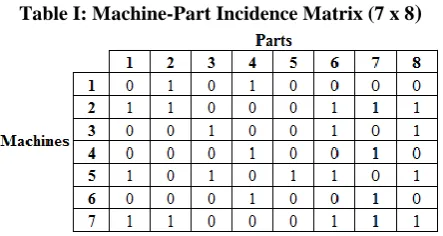
[image:2.595.307.543.73.193.2]This paper deals with four techniques for Cell Formation (CF), the first technique is well known approach Rank Order Clustering, the second technique is another well known approach ROC-2, the third technique is proposed Squared Euclidean Distance Matrix (SEDM) and the fourth technique is proposed Sheep Flock Heredity Algorithm (SFHA). The present case study information is gathered from a main assembling organization delivering assortments of parts. Out of which just 8 primary parts are produced in plant under 7 machines. From that Machine Part Incidence Matrix is prepared, it is a twofold Machine-Part matrix includes (void-entry) sections. Where the section one alludes to a particular part requires work on explicit machine while void generally. A case study problem with the size (7M x 8P) suggested by V. Sateesh Kumar et al [14] has been selected (see Table I).
Table I: Machine-Part Incidence Matrix (7 x 8
)
Applying four CF techniques to a case study data set is exhibited beneath beginning from ROC to SFHA. Under each technique Re-masterminded Machine Part Incidence Matrix i.e., Block Diagonal Form (BDF) acquired will be exhibited.
A. Rank Order Clustering (ROC) Technique
ROC is best among exhibit based bunching strategies provided to make machine cells and relating part families at the same time reliant on weights got for the two lines and sections. Relegate weights and figure weights for the two lines and sections. At that point orchestrate matrix in dropping request of weights acquired for the two lines and segments. By applying ROC to Table I, Block Diagonal Form (BDF) acquired is (see Table II).
Table II: BDF Obtained using ROC Technique
From above BDF, it is observed that two cells are formed with 6 Exceptional Elements (EE).
B. ROC-2 Technique
In ROC-2, the lines & segments are modified to form the bunched matrix. Begin from the last segment of Machine Part Incidence Matrix and complete line ordering by going effectively to first segment. Begin from the last line of Machine Part Incidence Matrix and complete segment ordering by going effectively to initial line. By applying ROC-2 to Table I, Block Diagonal Form (BDF) acquired is (see Table III).
Table III: BDF Obtained using ROC-2 Technique
From above BDF, it is observed that two cells are formed with 8 Exceptional Elements (EE).
C. Squared Euclidean Distance Matrix Technique
A distance matrixis a table that shows
the distance between pairs of objects. Standardized the Machine Part Incidence Matrix. In SEDM, distance between two machines state for machine x and machine y will be find using the equation (1).
D
xy=
(1)At that point Cluster the machines up to required number of cells. Two machines are assembled which have the least Euclidean distance and the framed machine cell is considered as a solitary element when moves for various machines. Distance matrix obtained for 7 machines of Table I is shown in Table IV.
[image:2.595.305.546.346.452.2] [image:2.595.58.280.461.579.2]Rehash the above strides for parts as well. Distance matrix obtained for 8 Parts of Table I is shown in Table V.
Table V: Distance Matrix for Parts
[image:3.595.303.551.316.475.2]MATLAB Code is developed to find distance matrices for both machines and parts to reduce time of finding distance matrices manually. Table VI and VII Shows distance matrices for both machines and parts in MATLAB.
Table VI: Distance Matrix for Machines in MATLAB
Table VII: Distance Matrix for Parts in MATLAB
By applying SEDM to Table I, Block Diagonal Form (BDF) acquired is (see Table VIII).
Table VIII: BDF Obtained using SEDM Technique
From above BDF, it is observed that two cells are formed with 3 Exceptional Elements (EE).
D. Sheep Flock Heredity Algorithm
This algorithm was started to tackle vast scale issues on planning over a period of a few continuous years. Than basic
hereditary calculation it is referred as staggered hereditary activities can acquire great results. This method was commonly depends on the general change in sheep in the herd. For the most part, sheep will live inside their herd under the control of shepherds. Along these lines, a wide range of hereditary legacy occur inside the herd in a manner of speaking. We can likewise say that a portion of the exceptional properties in any one flock are created inside a similar group just because of heredity marvel, and the sheep of higher wellness properties will breed in their condition. The Steps associated with SFHA are initializing the number of inhabitants in sheep Flock, after that Performing Sub Chromosomal Crossover for the parent issue, then Perform Inverse and Pair-wise Mutation. In the wake of Performing Chromosomal Crossover for the parent issue, Perform Inverse and Pair-Wise Mutation. Checking the state of end.
JAVA Code is developed to find machine and component orders with a objective to minimize Exceptional Elements and to maximize Grouping Efficacy. Table IX Shows developed Test Screen using JAVA to display Optimum machine and component orders with the objective.
Table IX: Best Machine and Component orders in JAVA with minimum Exceptional Elements and Maximum
Grouping Efficacy
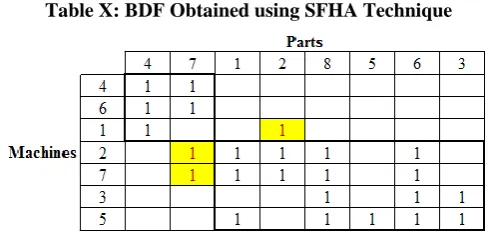
[image:3.595.302.547.528.644.2]By applying SFHA to Table I, Block Diagonal Form (BDF) acquired is (see Table X).
Table X: BDF Obtained using SFHA Technique
From above BDF, it is observed that two cells are formed with 3 Exceptional Elements (EE).
[image:3.595.49.290.583.714.2]Study
A. Rate of Exceptional elements (REE)
In the assembling, integrity of grouping will be registered by EE, the REE is gotten like pursues, equation (2) proposed by (Chandrasekharan and Rajagopalan, 1986).
REE = (2)
Here, EE is count of uncommon components (entries outside the blocks), UE is the quantity of activities (entries) in whole network.
B. Machine Utilization (MU)
MU alludes to the level of time the machines inside the blocks are utilized in the creation. MU can be estimated by equation (3) proposed by (Chandrasekharan, and Rajagopalan, 1986a).
MU = (3)
Here, N1 is total count of entries inside the BDF, Mk is count of machines in kth cell, Ck is count of parts in kth cell.
C. Cell Efficiency (CE)
CE demonstrates the proportion of voids in BDF to add up to total voids in the issue ought to be low & the proportion of entries in BDF to add up to count of tasks ought to be more. CE can be processed by equation (4) proposed by (Nagendra Parashar and Somasundar, 1998d).
CE = (4)
Where, α is whole count of tasks inside the BDF / whole count of activities and β is whole count of zeros within the BDF / whole count of zeros in the whole framework.
D. Grouping Efficacy (GE)
GE considers the quantity of tasks and zero components in and out of BDF into thought may be registered by equation (5) proposed by kumar and chandrasekharan (1990).
T = (5)
Where, Ø is count of zeros in the block / Total count of tasks in whole grid and Ψ is count of tasks out of the block / Total count of activities in whole framework.
In the wake of processing the previously highlighted four Performance Execution parameters for arrangements of every one of the four existing and proposed techniques, the solutions got are recorded underneath in Table XI.
Table XI: Performance Parameters for 4 techniques
V. RESULTSANDDISCUSSIONS
The quantity of EE acquired for ROC technique are 6, ROC-2 strategy are 8 and for both proposed SEDM and SFHA are 3. It is seen that, count of EE is decreased around half in developed strategies contrasted with ROC technique and count of EE is diminished about 62.5% in developed techniques contrasted with ROC-2 strategy which thus limits intercellular movements and idle time of machines. Further, it expands machine usage and profitability which prompts fruitful execution of CM in any industry.
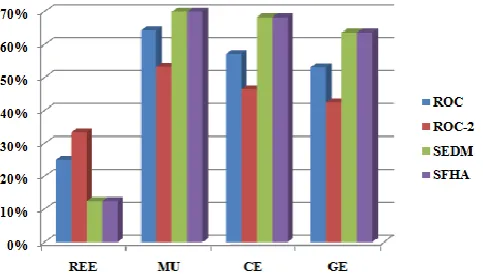
[image:4.595.319.561.376.513.2]For solutions acquired for both proposed and conventional techniques referenced in Table II, III, VIII and X, four Performance parameters such as Rate of Exceptional Elements, Machine Utilization, Cell Efficiency and Grouping Efficacy are processed and recorded underneath in Table XI. From Table XI, it is observed that REE is diminished to 12.5%, MU is expanded to 5.7%, CE is expanded to 11.16% and GE is expanded to 10.43% for proposed strategies SEDM and SFHA contrasted with ROC technique. From Table XI, it is additionally seen that REE is diminished to 20.83%, MU is expanded to 16.7%, CE is expanded to 21.93% and GE is expanded to 21.23% for proposed strategies SEDM and SFHA contrasted with ROC-2 technique.
Fig. 1: Correlation among conventional and proposed techniques
Fig. 2: Graphical portrayal of correlation among conventional and proposed techniques
In CMS constantly EE, REE ought to be as least as could reasonably be expected, at that point just inter cellular movements and Material
decreased. Machine Utilization, Cell Efficiency & Grouping Efficacy are as greatest as conceivable then just the destinations of CM like More Boost of Machine Utilization, Production Rate, Output and Profits, Minimization of Lead time and Throughput time will be accomplished. The examination demonstrates that proposed strategies are effective and superior to anything conventional techniques referenced in Fig. 1 and 2.
VI. CONCLUSION
This paper concentrated on use of four techniques to shape cells in CM environment. In this paper, the reaction enhancement in the industry on manufacturing of 8 primary parts under 7 machines utilizing cellular manufacturing frameworks has been analyzed. Rate of Exceptional Elements, Machine Utilization, Cell Efficiency and Grouping Efficacy performance parameters were utilized to assess the Conventional Techniques to be specific ROC, ROC-2 and Proposed Techniques specifically SEDM, SFHA. SEDM and SFHA brought about fewer Exceptional Elements of 3, Higher Machine Utilization of 70%, Higher Cell Efficiency of 68.3% and Higher Grouping Efficacy of 63.63%. The aftereffects of proposed techniques show that SEDM and SFHA are more successful than ROC and ROC-2 dependent on the dissected performance parameters. By MATLAB Code produced for SEDM and JAVA Program created for SFHA, any kind of Cell Formation Problem can be unraveled in portion of less than a minute and calculation schedule likewise diminished.
REFERENCES
1. P. K Arora, A Haleem and M K Singh, “Recent development of cellular manufacturing systems”, Indian Academy of sciences, vol. 38, 2013, pp. 421-428.
2. Yong Yin and Kazuhiko Yasuda, “Similarity coefficient methods applied to the cell formation problem: A taxonomy and review”, International journal of Production Economics, vol. 101, 2006, pp. 329-352.
3. Yong Yin and Kazuhiko Yasuda, “Similarity coefficient methods applied to the cell formation problem: A comparative investigation”, Computers & Industrial Engineering, vol. 48, 2005, pp. 471-489. 4. Ghosh.T, Sengupta.S, Chattopadhyay.M and Dan P.K, “Meta-heuristics
in cellular manufacturing: A State-of-the-art review”, International Journal of Industrial Engineering Computations, vol. 2 (1), 2011, pp. 87-122.
5. Dipak Laha and Manash Hazarika, “A heuristic approach based on Euclidean distance matrix for the machine-part cell formation problem”, Materials Today: Proceedings, vol. 4, 2017, pp. 1442–1451.
6. Euclidean Distance Matrix and types, Wikipedia.
7. Nara K., Takeyama T. and Kim H, “A new evolutionary algorithm based on sheep flocks heredity model and its application to scheduling problem”, IEEE International Conference on Systems, Man, and Cybernetics, vol. 6, 1999, pp. 503-508.
8. Chandramouli Anandaraman, Arun Vikram and Madurai Sankarand Ramaraj Natarajan, “Evolutionary approaches for scheduling a flexible manufacturing system with automated guided vehicles and robots”, International Journal of Industrial Engineering Computations, vol. 3, 2012, pp. 627-648.
9. G. Vijay Chakaravarthy, S. Marimuthu, S.G. Ponnambalam and and G. Kanagaraj, “Improved sheep flock heredity algorithm and artificial bee colony algorithm for scheduling m-machine flow shops lot streaming with equal size sub-lot problems”, International Journal of Production Research, vol. 52, 2013, pp. 1509-1527.
10. Vijaychakaravarthy, S. Marimuthu and A. Naveen Sait, “Comparison of Improved Sheep Flock Heredity Algorithm and Artificial Bee Colony Algorithm for lot streaming in m-Machine Flow Shop Scheduling”,
Arabian journal for Science and Engineering, vol. 39, 2014, pp.4285-4300.
11. M. Saravanan and S. Ganesh Kumar, “Design and optimisation of loop layout problems flexible manufacturing system using sheep flock heredity algorithm”, The International Journal of Advanced Manufacturing Technology, vol.77, 2014, pp. 1851-1866.
12. Bo Xing and Wen-Jing Gao, “Innovative Computational Intelligence A Rough Guide to 134 Clever Algorithms”, Intelligent Systems Library, 2014.
13. Vladimir Modrak and R. Sudhakara Pandian, “Operations Management Research and Cellular Manufacturing Systems”, Hershey PA: Business Science Reference, 2012.
14. V. Satheesh kumar, K. Karthikeyan, C.J. Thomas Renald, V. Jagadeesh, R. Silambarasan and C. Bhagyanathan, “ Evaluation of Cell Formation Algorithms and Implementation of MOD-SLC Algorithm as An effective Cellular Manufacturing System in a Manufacturing Industry”, International Journal of Current Engineering and Technology, vol.2, 2014, pp. 183-190.
15. J.R King, “Machine-component grouping in production flow analysis: an approach using a rank order clustering algorithm”, International Journal of Production Research, vol. 18, 1980, pp. 213-232. 16. K. V. Durga Rajesh, P. V. Chalapathi, M. Nageswara Rao, Ch. Eshwar
Krishna, K. Anoop and Y. Neeraj, “An Efficient Sheep Flock Heredity Algorithm for the Cell Formation Problem”, ARPN Journal of Engineering and Applied Sciences, vol.12, 2017, pp. 6074-6079. 17. K. V. Durga Rajesh, D. Mukesh, M. Harshavardhan, R. Jaganadha
Swamy, G. Suresh Krishnasai and K.Gopi, “Squared Euclidean Distance Matrix: A Heuristic Based Approach for Cell Formation Applications”, International Journal of Applied Engineering Research, vol. 11, 2016, pp. 7044-7048.
18. K. V. Durga Rajesh, G. Krishna Akhil, A. Teja Kumar, K. Vivek and
B. Radha Krishna, “An Effective Similarity Based Sheep Flock
Heredity Algorithm to Anticipate Number of Cells”, Journal of Advanced Research in Dynamical and Control Systems, vol. 9, 2018, pp. 2720-2726.
19. K.V.Durga Rajesh, M.Mani Krishna, Md.Abid Ali and P.V.Chalapathi, “A Modified Hybrid Similarity Coefficient Based Method for Solving the Cell Formation Problem in Cellular Manufacturing System”, Materials Today: Proceedings, vol. 4, 2017, pp. 1469–1477.
20. K.V. Durga Rajesh, Md. Abid Ali and P.V. Chalapathi, “Voids Based Approach for Solving Cell Formation Problems”, Materials Today: Proceedings, vol. 5, 2018, pp. 27185–27192.
AUTHORSPROFILE
K.V. Durga Rajesh, working as Assistant Professor in the Department of Mechanical Engineering from 2011 onwards in Koneru Lakshmaiah Education Foundation and doing research in the area of Cellular Manufacturing. He has obtained B.Tech degree in Mechanical Engineering from JNTU Kakinada and M.Tech degree in Computer Integrated Manufacturing from K L University. He has Published 8 Research papers in International Journals.
Dr. P.V. Chalapathi, working as principal in MVR College of Engineering and Technology. He had worked as Principal for 3 years [2015-2018]. He had 15 years of teaching experience in K L University and
worked in various administrative positions
[2000-2015]. He has obtained B.Tech degree in Mechanical Engineering from Nagarjuna University (1994), M.Tech degree in Industrial Engineering from R.E.C. Calicut (1996) and Ph.D in
Mechanical Engineering from Osmania University (2011). He has Published