International Journal of Innovative Technology and Exploring Engineering (IJITEE) ISSN: 2278-3075, Volume-8 Issue-5S March, 2019
Abstract: Over the last decade, the market for vegetarian food and consumers‘ demand for functional food has been growing along with the rising health awareness. Chia seeds with profound nutritional benefits are getting more recognized due to their high alpha-linolenic acid, high dietary fiber and high protein. They have the potential to be food additive for industrial uses due to their water holding capacity and amazing gelling properties. In this study, vegetable balls incorporated with chia seeds were developed using allergen-free plant-derived ingredients as the base, while eggplant and chia seeds were used as the major binder. Chia seeds gel was incorporated at 0% (control), 10% (F1), 20% (F2) and 30% (F3) to substitute eggplant in the vegetable balls. The effects of chia seeds incorporation on the proximate composition (moisture, protein, fat, ash, carbohydrates and dietary fiber), cooking characteristics (cooking yield and moisture retention) and physical properties (texture, colour, pH and water activity) of vegetable balls were then investigated. Results indicated that F3 had significantly lower moisture content (59.85%), higher protein (5.89%), fat (2.99%) and ash content (3.19%) in comparison to the control. Total dietary fiber of F3 (14.5%) was higher than control (12.3%). There were no statistical differences in cooking yield, moisture retention, pH and water activity. Texture of F3 was significantly softer, less springy, more cohesive and adhesive than control, associated with the water holding capacity of the seeds. For colour, F3 had significantly higher L* value than control. F3 could represent a healthy and nutritional snacks food to the existing food industry and vegetarian market.
I. INTRODUCTION
Over the last decade, people‘s concern on health has been growing steadily since more diseases are trending among younger generation. In a recent review, Béjot, Delpont and Giroud [1] observed that the incidence of ischemic stroke is on the rise in young adults. The demand for novel functional food is also rising as consumers are expecting maximum nutritional benefits from the food they consume. A functional food is believed to offer physiological benefits and disease risk reduction beyond basic nutrition through regular consumption
Revised Manuscript Received on March 08, 2019.
Mok Kaie Yan, Food Science with Nutrition, Faculty of Applied Sciences, Technology & Built Environment, UCSI University, No. 1, Jalan Menara Gading, UCSI Heights (Taman Connaught), Cheras 56000 Kuala Lumpur, Malaysia
Carolyn Loong Yook Lean, Food Science with Nutrition, Faculty of Applied Sciences, Technology & Built Environment, UCSI University, No. 1, Jalan Menara Gading, UCSI Heights (Taman Connaught), Cheras 56000 Kuala Lumpur, Malaysia
due to the nutritional content such as vitamin,mineral, fibers and phytochemicals [2].For example, fruits such as berries, vegetables, mushroom and whole grains are generally termed as functional food due to the functional components they provide.
During the past few years, chia seeds are getting more recognition with its good nutritional benefits and useful functional properties. The largest contributor to health within this small seed is the alpha-linolenic acid (ALA) which comprises 60% of the oil content. Due to this fatty acid content, chia seeds are related to the reduction in the risk of coronary heart disease and other cardiovascular diseases, which is proven through extensive studies in animals. Decreased serum triglycerides and increased high-density lipoprotein (HDL) content [3]; reversed impaired insulin level and improved lipid metabolism [4]; lipid redistribution associated with hepatoprotection and cardioprotection [5]; reversion of dyslipidemia, improved glucose homeostasis and normalization of systolic blood pressure level [6] were observed in rats. Apart from ALA, chia seeds are also significant sources of dietary fiber, protein, vitamin and minerals which make them a functional ingredient. Hence, it is highly recommended to include chia seeds as part of the diet and since they are neutral in flavour, they can be added into a wide range of food as a health booster.
Chia seeds have the potential to be food additive for industrial uses, due to the amazing gelling properties. In dry form, chia seeds do not form gel. Only when chia seeds are soaked in water, they are termed as chia seeds gel due to the exudation of mucilaginous gum around the seed coat that makes it becomes thick. This gum was shown to have fat absorption capacity and good water holding capacity up to 27 times its weight [7]. Hence, it is believed that chia seeds can act as a stabilizer, emulsifier and thickener for the future food industry. Future prospects of chia seeds still remains a great interest for science, technology and food engineering.
Therefore, this study incorporates the chia seeds into vegetable balls to develop a meat-free and allergen-free food that only utilizes plant-based ingredients. As meatballs are usually made of beef, pork and egg, its ingredients make it unsuitable for the consumption of vegetarian and people with allergic condition. According to Lee, Thalayasingam, and Lee
Product Development of Chia Seeds Enriched
Vegetable Balls: Effects on the Physicochemical
Properties
[8], egg is one of the most common allergen reported in Malaysia and the prevalence of egg allergy predominates over cow‘s milk in children below 5 years old in most parts of Asia. Hence, to maximize the pleasure of eating for vegetarian and people with allergic condition, the idea of formulating delicious yet nutritious vegetable balls was generated. Loaded with all the nutritious ingredients such as eggplant, gluten-free oat bran, carrot, red bell pepper, onion, garlic and potato in one small mass, vegetable ball enriched with chia seeds is a
potential healthy snack or complimentary dish for vegan, vegetarian and other peoples of all ages. In this study, the vegetable balls are developed with varying concentrations of chia seeds gel. The effects of different concentrations of chia seeds on the physicochemical properties including proximate composition (moisture, protein, fat, ash, carbohydrates and dietary fiber), cooking characteristics (cooking yield and moisture retention) and physical properties (texture, colour, pH and water activity) was investigated.
II. METHODOLOGY
Product Preparation
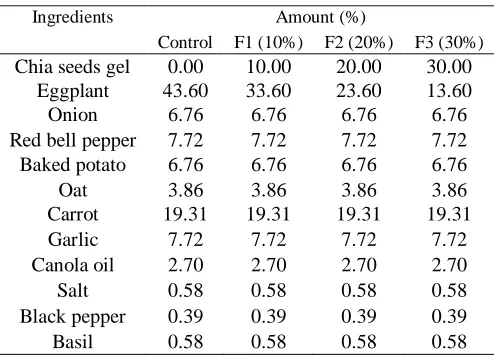
[image:2.612.183.431.302.481.2]Four formulations of vegetable balls had been developed as shown in Table 1. The formulation was generated with reference to the existing vegetable balls in the market and finalised after several times of trials. The chia seeds were classified as follow. Control= Vegetable balls without chia seeds, F1= Vegetable balls with 10% chia seeds gel, F2= Vegetable balls with 20% chia seeds gel, F3= Vegetable balls with 30% chia seeds gel. Chia seeds gel was incorporated at 0% (control), 10% (F1), 20% (F2) and 30% (F3) of vegetable balls, with subsequent reduction in the eggplant amount. Out of so many types of vegetables, eggplant was chosen as the main ingredient due to its ability to bind the other ingredients in order to form a ball shape. Then, chia seeds gel which has similar binding effects was used to substitute the eggplant. The general processing steps of vegetable balls were designed according to meatballs making recipe.
Table. 1 Formulation of vegetable balls enriched with chia seeds
Moisture, rotein,fat,ash and carbohydrate Content
Moisture content was analysed using oven drying method as adopted from National Forage Testing Association (NFTA) 2.2.2.5 [9]. The loss of weight after the heating process of food sample represents the moisture content [10].With reference to AOAC Method 981.10, Kjeldahl method was applied for protein determination as it is a universal method proven with high accuracy. This method measures the nitrogen content of a sample which can be converted into protein content by using a ratio of protein to nitrogen of a specific food [11].Fat content was determined using Soxhlet method in accordance to AOAC International Method 991.36. This method provides soaking effect to the sample and does not cause channelling, a condition in which the solvent may take preferential routing through the sample and results in inefficient extraction [10].Ash content was determined using
dry ashing method (AOAC 920.153).The carbohydrates content was determined by computing difference.
Dietart fiber content
AOAC 985.29 enzymatic-gravimetric method was used for analysis of dietary fiber, 100g of homogenized sample from control and Formulation 3 (30% chia seeds gel) as it was the most preferred sample based on the results of hedonic test. Only two samples were sent to Permulab Sdn. Bhd due to financial constraints
Caloric Value, Cooking yield and moisture retention
Total calories in vegetable balls were estimated using Atwater coefficients corresponding to the Atwater values for fat (9 kcal/g), protein (4 kcal/g) and carbohydrate (4 kcal/g) [2] as shown in the Equation 1:
Ingredients Amount (%)
Control F1 (10%) F2 (20%) F3 (30%)
Chia seeds gel 0.00 10.00 20.00 30.00
Eggplant 43.60 33.60 23.60 13.60
Onion 6.76 6.76 6.76 6.76
Red bell pepper 7.72 7.72 7.72 7.72
Baked potato 6.76 6.76 6.76 6.76
Oat 3.86 3.86 3.86 3.86
Carrot 19.31 19.31 19.31 19.31
Garlic 7.72 7.72 7.72 7.72
Canola oil 2.70 2.70 2.70 2.70
Salt 0.58 0.58 0.58 0.58
Black pepper 0.39 0.39 0.39 0.39
International Journal of Innovative Technology and Exploring Engineering (IJITEE) ISSN: 2278-3075, Volume-8 Issue-5S March, 2019
Caloric value (kcal 100 g-1) = (g of protein*4) + (g of lipids*9) + (g of carbohydrates*4) (1). Cooking yield was calculated using Equation (2) [12]:
Cooking yield (%) = Weight of cooked vegetable ball /Weight of raw vegetable ball x 100% (2)
Moisture retention value represents the amount of moisture retained in the cooked product per 100 g of sample and was determined according to the equation by Verma et al. [13] who studied about chicken meatball. Calculation of moisture retention was done by Equation (3).
Moisture retention (%) = % cooking yield × % moisture in cooked vegetable balls / 100 (3)
Texture, color, pH and water activity
Brookfield CT3 Texture Analyzer was used to analyse the texture profile of cooked samples by measuring the mechanical properties such as hardness, springiness, cohesiveness and adhesiveness (Brookfield Engineering Laboratories, Inc. n.d).Color analysis of vegetable balls surfaces was carried out by using HunterLab Colorflex EZ and the pH was analyzed using pH meter.Water activity of food sample was determined by AquaLab Pre Water Activity Meter. This machine works based on the chilled mirror dewpoint technique (Decagon Devices, Inc. 2012)
Statistical analysis
For each parameter, mean and standard error were calculated. Data were analysed by One-way ANOVA using Statistical Package for Social Science (SPSS) Version 22 computer software. The statistical significance was set at P-value <0.05. Post-hoc tests were done using Tukey‘s Honest Significance Difference (HSD). Triplicates samples were drawn for proximate analysis and cooking characteristics analysis. Duplicate samples were drawn for physical tests, and the experiment was repeated twice.
III. RESULT AND DISCUSSION Effect of chia seeds incorporation on the proximate composition of vegetable balls
The results of proximate analysis indicating the moisture, protein, fat, ash and carbohydrates contents of different formulations of vegetable balls are shown in Table 2. All samples were evaluated in the form of ground state. There were significant differences (p<0.05) between the evaluated fractions in proximate composition profile.
Table. 2 Proximate composition of vegetable balls incorporated with different concentration of chia seeds gel
Components Mean (%)* ± Standard Deviation
Control F1 F2 F3
Moisture content 63.56 ± 1.13 a 64.20 ± 1.12 a 61.89 ± 0.73 ab 59.85± 1.59 b
Protein content 3.62 ± 0.37 c 4.38 ± 0.61 bc 4.96 ± 0.1 ab 5.89 ± 0.27 a
Fat content 1.66 ± 0.33 c 1.88 ± 0.18 bc 2.22 ± 0.19 b 2.99 ± 0.01 a
Ash content 2.60 ± 0.22 b 2.76 ± 0.18 ab 3.05 ± 0.12 ab 3.19 ± 0.19 a
Carbohydrates content 28.56 ± 1.29 a 26.78 ± 0.64 a 27.88 ± 0.60 a 28.08 ± 1.18 a
*Value is the mean, where n=3
Control= Vegetable balls without chia seeds gel F1= Vegetable balls with 10% chia seeds gel F2= Vegetable balls with 20% chia seeds gel F3= Vegetable balls with 30% chia seeds gel
a - c Mean values with different superscript in the same row indicate significant difference (p<0.05)
Mositure content
Results showed that F3 which had the highest incorporation of chia seeds gel contained the lowest moisture content (59.85%), which was statistically different to control (63.56%) and F1 (64.20%). The decreasing trend of moisture when more chia seeds were added was similar to a study by Rendón-Villalobos et al. [14] which had a significant reduction in
whether in both soluble and insoluble forms, which absorb and retain water by forming hydrogen bond between the free hydroxyl groups and water. It is known that chia seeds can absorb water up to 27 times their weight in a short period of time.
Protein content
In this experiment, the crude protein content of vegetable balls followed a linear increasing trend, with control containing the least amount of protein (3.62%) and F3 containing the highest amount of protein (5.89%). Control was significantly different at P-value< 0.05 from F2 and F3. In another study which investigated the effect of wheat flour substitution with chia flour in cookies, the protein was significantly improved due to the high nutritional contents of chia flour [15].
Fat content
The fat contents of vegetable balls in ascending order is control (1.66%), F1 (1.88%), F2 (2.22%) and F3 (2.99%) as represented by vegetable balls incorporated with different percentage of chia seeds gel. Significant differences at P-value < 0.05 were found between control, F2 and F3, but not in between control and F1 and between F1 and F2.The results went well with prediction since chia seeds being significant sources of essential fatty acid, more fats will be obtained when more chia seeds gel was incorporated. These results are consistent with the study in which tortilla supplemented with 20% chia seeds had shown a 200% increase in fat contents due to the high amount of oil content of chia seeds [14].
Ash and carbohydrate content
As expected, the ash content of vegetable balls also showed increment when higher percentage of chia seeds was added, as shown by the data of control (2.6%), F1 (2.76%), F2 (3.05%) and F3 (3.19%). Significant difference at P-value< 0.05 was found between control and F3.In the absence of chia seeds (control formulation), the ingredients such as eggplant, red bell pepper, potato and carrot had contributed to 2.6% ash content. Then, gradual incorporation of chia seeds had raised the ash content up to 3.19%. The results from this study corroborated with the study by Oliveira et al. [16], who incorporated chia flour for developing pasta that was initially made with wheat flour. Proportional increase was observed when more wheat flour was substituted by chia flour. 0.44% ash content in the control formulation rose to 1.53% when 30% of wheat flour was replaced by chia flour. This implies that chia seeds incorporation supplies more minerals into food due to its high mineral profile.As shown in the results, though all of the chia seed groups contained lower carbohydrate contents than control which noted the highest value (28.56%), none of the differences was statistically significant when tested at P-value <0.05.
Dietary fiber content
According to Table 3, F3 which contained the highest percentage (30%) of chia seeds gel was analysed to have 14.5% of dietary fiber while the control consisted of 12.3% of
[image:4.612.321.555.133.171.2]dietary fiber, implying that 30% addition of chia seeds gel had added 2.2% or 1.2 times more dietary fiber to the control formulation. Hence, the analysis result clearly shows that the addition of chia seeds had increased the dietary fiber of the vegetable balls.
Table. 3 Dietary fiber contents of vegetable balls
Formulat.ion Dietary fiber value (%)
Control 12.3
F3 14.5
Caloric value
[image:4.612.327.543.349.412.2]Calories represent the energy value contained within a food in the unit of kilocalories (kcal). One gram of carbohydrate and protein give out 4 kcal each while lipid provides 9 kcal per gram of calories. As shown in Table 4, F3 was noted with the highest caloric value since it had the highest content of fat (2.99%). Nevertheless, the consumption of 100g of F3 vegetable balls only contributed about 9.1% of daily energy intake based on 2000 calories diet. Vegetables balls of all four formulations are considered as moderate calories food as the calories around 100 kcal [17].
Table . 4Caloric value per 100g for vegetable balls incorporated with different concentration of chia seeds gel
Formulation Caloric value per 100g (kcal)
Control 143.66
F1 141.56
F2 151.34
F3 162.79
Effects of chia seeds incorporation on the cooking Characteristics of vegetable balls
The effects of chia seeds incorporation on the cooking characteristics of vegetable balls which are cooking yield and moisture retention are outlined in Table 5. No significant differences (p<0.05) were observed between the evaluated fractions for both cooking yield and moisture retention.
Table. 5.Caloric value per 100g for vegetable balls incorporated with different concentration of chia seeds gel
Componen ts
Mean (%)* ± Standard Deviation
Control F1 F2 F3
Cooking yield
60.39 ± 1.21a
63.04 ± 2.20 a
61.85 ± 1.70 a
61.65 ± 1.31 a Moisture
retention
38.48 ± 1.29 a
40.56 ± 2.06 a
38.29 ± 1.41 a
36.91 ± 1.67 a
[image:4.612.311.571.547.631.2]International Journal of Innovative Technology and Exploring Engineering (IJITEE) ISSN: 2278-3075, Volume-8 Issue-5S March, 2019
retention was calculated as the product of multiplication of cooking yield percentage and moisture content percentage in vegetable balls. Luna et al. [19] proposed that the moisture was retained due to delayed starch retrogradation through the interaction between fiber and starch.
Physical properties of vegetable balls such as texture, colour, pH and water activity were analysed for vegetable balls incorporated with different concentration of chia seeds
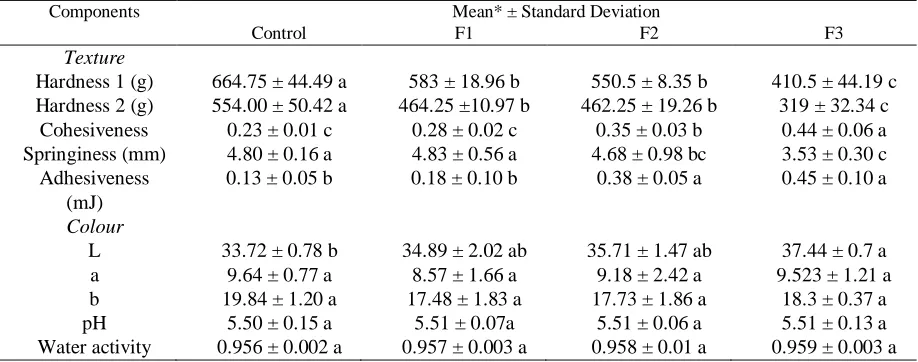
[image:5.612.79.538.170.351.2]gel as shown in Table 6. Ground vegetable balls were used for the analysis of pH and water activity while whole vegetable balls were used for the analysis of colour and texture. There were significant differences (p<0.05) between the evaluated fractions in texture profile and colour.
Table. 6 Physical properties of vegetable balls incorporated with different concentration of chia seeds gel
Components Mean* ± Standard Deviation
Control F1 F2 F3
Texture
Hardness 1 (g) 664.75 ± 44.49 a 583 ± 18.96 b 550.5 ± 8.35 b 410.5 ± 44.19 c
Hardness 2 (g) 554.00 ± 50.42 a 464.25 ±10.97 b 462.25 ± 19.26 b 319 ± 32.34 c
Cohesiveness 0.23 ± 0.01 c 0.28 ± 0.02 c 0.35 ± 0.03 b 0.44 ± 0.06 a
Springiness (mm) 4.80 ± 0.16 a 4.83 ± 0.56 a 4.68 ± 0.98 bc 3.53 ± 0.30 c
Adhesiveness (mJ)
0.13 ± 0.05 b 0.18 ± 0.10 b 0.38 ± 0.05 a 0.45 ± 0.10 a
Colour
L 33.72 ± 0.78 b 34.89 ± 2.02 ab 35.71 ± 1.47 ab 37.44 ± 0.7 a
a 9.64 ± 0.77 a 8.57 ± 1.66 a 9.18 ± 2.42 a 9.523 ± 1.21 a
b 19.84 ± 1.20 a 17.48 ± 1.83 a 17.73 ± 1.86 a 18.3 ± 0.37 a
pH 5.50 ± 0.15 a 5.51 ± 0.07a 5.51 ± 0.06 a 5.51 ± 0.13 a
Water activity 0.956 ± 0.002 a 0.957 ± 0.003 a 0.958 ± 0.01 a 0.959 ± 0.003 a
According to Huda et al. [20], lower hardness values were observed in meatballs with higher fat content, which corroborates with our results as shown from control to F3, the fat content increased gradually, causing the reduction in hardness values. In a study that explored the effect of replacement of poppy seed with chia seeds in lemon muffin, the force needed to puncture became lesser when more chia seeds were added. Although it was not significant, the tendency of decreasing firmness in products added with chia ingredients was clearly emphasized in another study [21]. The reason was due to the water holding capacity of chia seeds which retained moisture within the muffin, resulting in a moist and tender texture as compared to the control [22].
Cohesiveness refers to the strength of internal bonds within a food that allows them to stay together after a deformation. When more chia seeds were incorporated, the cohesiveness of vegetable balls increased. Statistical difference was found in all formulation except among control and F1. According to Timilsena et al. [23], chia seeds polysaccharides such as hemicellulose and lignin behave like cross-link gel with intermolecular hydrogen bonds that allow the structure to remain intact at low amplitude oscillation. To support this statement, restructured-ham incorporated with chia seeds observed a slightly higher cohesiveness as compared to the control group [18].
Springiness is the rate at which a deformed structure returns to its original form when the external force is removed. In ascending order, the sequence of springiness of vegetable balls incorporated with different percentage of chia seeds is F3, F2, control and F1, with F3 significant differed from control and F1 at significant level P-value< 0.05. The decrease of
springiness is attributed to the decrease in amount of eggplant across the formulations since eggplant has a spongy and springy texture.
Adhesiveness parameter describes the work needed to pull a food from surfaces such as teeth, tongue and palate This parameter has the similar increasing trend with cohesiveness of the vegetable ball. Ramos et al. [24] who studied the rheological behavior of chia flour gel noted that at high temperature of cooking, the denaturation of protein within high protein and carbohydrate chia flour gel had induced gelation of the structure, leading to increasing gel adhesiveness. Hence, when more chia seeds were added into vegetable balls, gelation occurs more extensively as compared to the control group under high temperature baking, resulting in increasing forces needed to overcome the attractive force between vegetable ball and the texture analysis probe.
In terms of a*, the value increased as more chia seeds were incorporated but still lower than the control. Similar trend occurred with the b* values. Nevertheless, both a* and b* values showed no statistical difference within all four formulation, implying that chia seeds addition did not change the redness and yellowness of vegetable balls. This results agreed with the study by Belakovich, Huber and Lacayo[22] as in their study, the replacement of poppy seeds by chia seeds at 50% and 100% in lemon muffin did not bring any significant effect in both a* and b* value.
As shown from the result, the pH of vegetable balls had no significant difference regardless of the different concentration of chia seeds gel incorporated, indicating that the gradual incorporation of chia seeds did not render variation in the acidity of vegetable balls. The main ingredients eggplant, carrot and red bell pepper have overall slightly acidic pH ranging from pH 4.5 to 5.3. In a study which incorporated chia seeds powder into Sulgidduk (rice cake) for the inspection of antioxidant activity, the pH of chia seed groups (5.41 – 5.45) were significantly lower than the control group (5.6), but non-significant differences were noted among the chia seeds groups [25].
Gradual incorporation of chia seeds into vegetable balls did not affect the water activity as the results were not statistically significant. According to Felisberto et al. [26], the replacement of vegetable fat with chia seeds mucilage gel in pound cake did not cause a significant change in water activity though a small fluctuation between 0.87 and 0.91 was observed. The formulation with 100% replacement of chia mucilage gel had recorded the highest water activity due to the greatest amount of water added into the formulation.Since the range of water activity of vegetable balls was from 0.956 to 0.959 which is similar to most of the vegetable and other perishable fresh food such as meats, fish and milk, these all four formulations presented a conducive environment to the growth of the potential microorganisms.
IV. CONCLUSION
The objectives of this project were achieved, as new product which are vegetable balls incorporated with different concentration of chia seeds gel of 0%, 10%, 20% and 30% were successfully developed. Then, analysis of the proximate composition, cooking characteristics and physical properties of vegetable balls were conducted accordingly. The proximate analysis showed that F3 offers a more nutritional choice of formulation as compared to control due to the significantly higher amount of protein, fat and ash content. Apart from that, F3 contained less moisture compared to control and F1 with significant differences spotted at P-value< 0.05. Dietary fiber of F3 was 1.2 times higher than control since chia seeds are rich in fiber. In terms of caloric value, F3 contributed the greatest energy value due to its greatest amount of chia seeds and fat contents. For cooking characteristics, incorporation of chia seeds did not cause any significant changes in both
cooking yield and moisture retention. Chia seeds incorporation had led to a softer, more cohesive, less springy and more adhesive texture in vegetable balls with significant difference showed in all parameters between control and F3. For colour aspect, only F3 was found to be significantly different from control group in terms of L* (lightness) as an increasing trend was spotted across the formulation. Chia seeds were found to have no effect in a* and b* values of vegetable balls. The results also indicated unchanged values of pH and water activity despite the increasing amount of chia seeds incorporated. In conclusion, this study provided insight that chia seeds can be incorporated into vegetable balls for formulation of healthy and nutritious food which is growing on demand in this century.
REFERENCES
1. B. YANNICK, D. BENOIT, AND G. MAURICE, J. AM. HEART ASSOC. 5, E003661 (2018).
2. M.S. Coelho and M.M. Salas-Mellado, J. Food Nutr. Res. 2, 263 (2014). 3. R. Ayerza Jr and W. Coates, Ann. Nutr. Metab. 51, 27 (2007).
4. M.E. Oliva, M.R. Ferreira, A. Chicco, and Y.B. Lombardo, Prostaglandins, Leukot. Essent. Fat. Acids 89, 279 (2013).
5. H. Poudyal, S.K. Panchal, J. Waanders, L. Ward, and L. Brown, J. Nutr. Biochem. 23, 153 (2012).
6. A. Creus, M.R. Ferreira, M.E. Oliva, and Y.B. Lombardo, J. Clin. Med. 5, 18 (2016).
7. M.R. Segura-Campos, N. Ciau-Solís, G. Rosado-Rubio, L. Chel-Guerrero, and D. Betancur-Ancona, Int. J. Food Sci. 2014, (2014). 8. A.J. Lee, M. Thalayasingam, and B.W. Lee, Asia Pac. Allergy 3, 3
(2013).
9. B. Shreve, N. Thiex, and M. Wolf, (2006).
10. S.S. Nielsen, in Food Anal. Lab. Man. (Springer, 2010), pp. 47–53. 11. H.T. Lawless and H. Heymann, Sensory Evaluation of Food: Principles
and Practices (Springer Science & Business Media, 2010).
12. N. Huda, Y.H. Shen, Y.L. Huey, and R.S. Dewi, Pakistan J. Nutr. 9, 1183 (2010).
13. A.K. Verma, V. Pathak, V.P. Singh, and P. Umaraw, J. Appl. Anim. Res. 44, 409 (2016).
14. R. Rendón-Villalobos, A. Ortíz-Sánchez, J. Solorza-Feria, and C.A. Trujillo-Hernández, Czech J. Food Sci. 30, (2012).
15. V.A. Barrientos, A. Aguirre, and R. Borneo, Int. J. Food Stud. 1, (2012). 16. M. Rodrigues Oliveira, M. Ercolani Novack, C. Pires Santos, E. Kubota,
and C. Severo da Rosa, Semin. Ciências Agrárias 36, (2015).
17. P. Walters and J. Byl, Christian Paths to Health and Wellness (Human Kinetics, 2013).
18. Y. Ding, H.-W. Lin, Y.-L. Lin, D.-J. Yang, Y.-S. Yu, J.-W. Chen, S.-Y. Wang, and Y.-C. Chen, J. Food Drug Anal. 26, 124 (2018).
19. P.L. Pizarro, E.L. Almeida, N.C. Sammán, and Y.K. Chang, LWT-Food Sci. Technol. 54, 73 (2013).
20. N. Huda, Y.H. Shen, Y.L. Huey, R. Ahmad, and A. Mardiah, Am. J. Food Technol 5, 13 (2010).
21. E. Iglesias-Puig and M. Haros, Eur. Food Res. Technol. 237, 865 (2013). 22. S.R. Knowles and A.A. Mikocka-Walus, Psychological Aspects of
Inflammatory Bowel Disease: A Biopsychosocial Approach (Routledge, 2014).
23. Y.P. Timilsena, R. Adhikari, S. Kasapis, and B. Adhikari, Int. J. Biol. Macromol. 81, 991 (2015).
24. S. Ramos, P. Fradinho, P. Mata, and A. Raymundo, J. Sci. Food Agric. 97, 1753 (2017).
25. H. Oh, B.B. Choi, and Y.S. Kim, J. Korean Soc. Food Sci. Nutr. (2017). 26. M.H.F. Felisberto, A.L. Wahanik, C.R. Gomes-Ruffi, M.T.P.S. Clerici,