Biogeosciences, 15, 1795–1813, 2018 https://doi.org/10.5194/bg-15-1795-2018 © Author(s) 2018. This work is distributed under the Creative Commons Attribution 4.0 License.
Species composition and forest structure explain the temperature
sensitivity patterns of productivity in temperate forests
Friedrich J. Bohn1, Felix May2, and Andreas Huth1,2,3
1Helmholtz Centre for Environmental Research – UFZ, Permoserstr. 15, 04318 Leipzig, Germany 2German Centre for Integrative Biodiversity Research (iDiv) Halle-Jena-Leipzig, Deutscher Platz 5e,
04103 Leipzig, Germany
3University of Osnabrück, Barbarastr. 12, 49076 Osnabrück, Germany
Correspondence:Friedrich J. Bohn ([email protected]) Received: 28 July 2017 – Discussion started: 22 August 2017
Revised: 12 February 2018 – Accepted: 13 February 2018 – Published: 26 March 2018
Abstract. Rising temperatures due to climate change influ-ence the wood production of forests. Observations show that some temperate forests increase their productivity, whereas others reduce their productivity. This study focuses on how species composition and forest structure properties influence the temperature sensitivity of aboveground wood production (AWP). It further investigates which forests will increase their productivity the most with rising temperatures. We de-scribed forest structure by leaf area index, forest height and tree height heterogeneity. Species composition was described by a functional diversity index (Rao’sQ) and a species dis-tribution index (AWP).AWP quantified how well species
are distributed over the different forest layers with regard to AWP. We analysed 370 170 forest stands generated with a forest gap model. These forest stands covered a wide range of possible forest types. For each stand, we estimated an-nual aboveground wood production and performed a climate sensitivity analysis based on 320 different climate time se-ries (of 1-year length). The scenarios differed in mean annual temperature and annual temperature amplitude. Temperature sensitivity of wood production was quantified as the relative change in productivity resulting from a 1◦C rise in mean an-nual temperature or anan-nual temperature amplitude. Increas-ingAWPpositively influenced both temperature sensitivity
indices of forest, whereas forest height showed a bell-shaped relationship with both indices. Further, we found forests in each successional stage that are positively affected by tem-perature rise. For such forests, largeAWP values were
im-portant. In the case of young forests, low functional diversity and small tree height heterogeneity were associated with a
positive effect of temperature on wood production. During later successional stages, higher species diversity and larger tree height heterogeneity were an advantage. To achieve such a development, one could plant below the closed canopy of even-aged, pioneer trees a climax-species-rich understorey that will build the canopy of the mature forest. This study highlights that forest structure and species composition are both relevant for understanding the temperature sensitivity of wood production.
1 Introduction
Climate change alters wood production by modifying the rates of photosynthesis and respiration rates of trees (Barber et al., 2000; Luo, 2007; Peñuelas and Filella, 2009; Reyer et al., 2014). Changes in forest productivity have been ob-served in past decades all over the world (Nemani et al., 2003; Boisvenue and Running, 2006; Seddon et al., 2016). The carbon stock of forests and their role as carbon sinks are therefore changing. These findings have stimulated dis-cussions about whether forest management strategies can be adapted to reduce forest vulnerability to climate change, sup-port recovery after extreme events and foster the carbon sink function of forests (Spittlehouse and Stewart, 2004; Spittle-house, 2005; Bonan, 2008).
Wood production is influenced by several factors, such as CO2fertilization, nitrogen deposition, precipitation and
tem-perature (Barford et al., 2001). For instance, rising CO2
which could compensate negative effects of climate change on European forest growth (Reyer et al., 2014). Another im-portant process is fertilization (De Vries et al., 2006, 2009). Due to depositions of nitrogen in the second half of the last century, wood production had increased in European forests (Solberg et al., 2009). However, temperature modifies photo-synthesis, respiration and growth rates of trees (Dillon et al., 2010; Piao et al., 2010; Wang et al., 2011; Jeong et al., 2011; Heskel et al., 2016). In the temperate biome, positive effects on wood production (e.g. Bontemps et al., 2010; Delpierre et al., 2009; Pan et al., 2013; McMahon et al., 2010) as well as negative ones have been found (e.g. Barber et al., 2000; Jump et al., 2006; Charru et al., 2010). However, it remains unclear why forests react differently to temperature change.
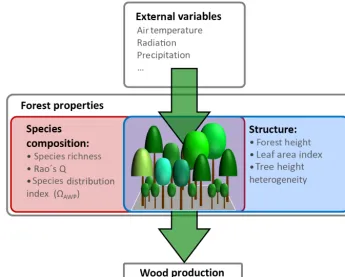
In addition to the influence of climate variables, wood pro-duction is also affected by internal forest properties. These properties can be grouped into two types: properties which describe forest structure and those which describe species composition (Fig. 1). For instance, changes in productivity can result from changes in basal area (Vilà et al., 2013), in leaf area index (Asner et al., 2003) or in the heterogeneity of tree heights within a forest (Bohn and Huth, 2017). Further-more, wood production often increases with the increasing number of species (Zhang et al., 2012; Vilà et al., 2007).
Forest stands, which differ in their forest properties, might respond differently to the same climate change (Huete, 2016). For instance, the positive effect of increasing ature on wood production fades with forest age in temper-ate deciduous forest (e.g. McMahon et al., 2010; Bontemps et al., 2010), and Morin et al. (2014) showed that higher di-versity buffers the effect of inter-annual variability on wood production. However, these studies include only a few for-est properties and rarely include properties related to both species composition and forest structure. Hence, it is un-clear how these forest properties influence wood production change due to temperature rise and which forests will benefit from rising temperatures.
As far as we know, there is no data set available that cov-ers forests, differing in structure and divcov-ersity, under almost identical climatic conditions. Even if a larger number of for-est stands were available, it would be difficult to manipu-late, for instance, temperature while keeping all other climate variables constant. Forest simulation models offer an alterna-tive to the analysis of field experiments. Such models are able to estimate wood production under different climate condi-tions (e.g. Lasch et al., 2005; Bohn et al., 2014). For instance, Reyer et al. (2014) investigated the effect of climatic change on forests by simulating 30-year time slices of a range of dif-ferent future climates for 135 inventoried forest stands. There are also model-based studies, which systematically analysed the effect of species diversity on productivity and stability over long periods (Morin et al., 2011, 2014). However, dis-turbed or managed forest stands and the influence of climate change have not been included in these analyses.
In this study, we therefore propose a new simulation-based approach. First, we generate a large number of forest stands covering various forest structures and species compositions (for up to eight temperate tree species). Annual aboveground wood production (AWP) is then calculated for all forest stands based on climate time series. These time series differ in the mean annual temperature and the intra-annual temper-ature amplitude. We aim to analyse how productivity of for-est stands (AWP) is influenced by (i) increasing mean annual temperature and (ii) increasing intra-annual temperature am-plitude. Furthermore, we address the question of which forest stands will benefit most from rising temperatures.
2 Method
To analyse the effect of temperature on the productivity of forest stands, we applied the “forest factory” model ap-proach (Bohn and Huth, 2017). The forest factory generated 370 170 different forest stands (see Sect. 2.1) and allowed the estimation of AWP under various climate time series (see Sect. 2.2). The 320 scenarios differed in mean annual tem-perature and annual temtem-perature amplitude. Finally, we cal-culated the forest-stand-specific sensitivity of productivity to temperature change as the relative change of wood produc-tion per temperature change of 1◦C (see Sect. 2.2). To relate these sensitivities to forest structure and species composition, we characterized every forest stand with five properties (see Sect. 2.4). We analysed the influence of the five forest proper-ties on temperature sensitivity using boosted regression trees (see Sect. 2.5). Finally, we analysed which combination of forest properties resulted in the highest sensitivity values for different successional stages (see Sect. 2.6). All analysed data are available in the Supplement to this manuscript. 2.1 The forest factory approach
The forest factory creates forest patches based on different stem size distributions and species mixtures. We used 15 stem size distributions covering a gradient from young to old and disturbed to undisturbed forests. Species mixtures included all 256 possible combinations ofPinus sylvestris,
Picea abies, Fagus sylvatica, Quercus robur,Fraxinus ex-celsior,Populus x canadensis,Betula pendula andRobinia pseudotsuga. We used the species parameter set and algo-rithms of the FORMIND model version for temperate forests within the forest factory (Bohn et al., 2014; Fischer et al., 2016). A total of 100 forest patches of each combination were built.
F. J. Bohn et al.: Temperature sensitivity patterns of productivity in temperate forests 1797
Figure 1.Overview of drivers influencing wood production. External variables in this study are temperature, radiation and precipitation. Forest properties are divided into two groups: species composition properties (e.g. Rao’sQas a measure of functional diversity and species distribution indexAWP) and forest structure properties (e.g. forest height, leaf area index and tree height heterogeneity).
productivity under its environmental conditions (light, tem-perature, water).
We used climate time series from the year 2007, mea-sured at Hainich National Park, central Germany. We as-sumed this time series to be a typical example for a temper-ate year (in principle, it is possible to use climtemper-ate data from any other location). In contrast to an artificially generated climate, this climate is perfectly physically consistent (with regard to light, air temperature and precipitation).
In a few cases, not all species of the mixture could be placed within a patch by the algorithm, so we rejected such forests. We ended up with 370 100 forest stands. For more details regarding the forest factory, see Bohn and Huth (2017).
2.2 Wood production
The calculation of AWP of trees was based on algorithms of the model FORMIND (Bohn et al., 2014; Fischer et al., 2016). In this model, the wood production of a single tree is calculated as the difference between climate variables driven respiration rates and photosynthesis. The photosynthesis rate (Ptree) results from the crown size, self-shading within the
crown and available light at the top of the tree. The avail-able light depends on the radiation above the canopy, re-duced by the shading of larger trees within the forest stand.
Furthermore, productivity can be limited due to air temper-ature and available soil water, which is expressed by the photosynthesis-limiting factor φ for each tree (Gutiérrez, 2010; Fischer, 2013; Bohn et al., 2014). Available soil wa-ter within the stand results from precipitation, inwa-terception and evapotranspiration of trees and runoff.
One part of the photosynthesis production of a tree (Ptree)
is allocated to its maintenance respiration (and to non-wood tissues;Rm). Maintenance respiration depends on tree
biomass and temperatureψ(Piao et al., 2010). The remain-ing organic carbon is transformed into newly grown above-ground wood (AWPtree) and a proportional growth
respira-tion (rg).
AWPtree=(φPtree−ψ Rm)(1−rg) (1)
AWPtree was summed over all trees to obtain the
produc-tivity of the modelled forest stand – AWP (for a more detailed description of growth processes, see Bohn et al., 2014; Bohn and Huth, 2017).
2.3 Climate sensitivity
air temperature (see Appendix A1, Fig. A1). We separated these time series into five distinct time series of 1-year length. First, we increased or decreased the mean annual temperature of each year by adding or subtracting 0.5◦C steps between −1.5 and+2◦C. Second, we changed the amplitude of the annual temperature cycle for these time series variation of each year. To do so, we modified the standard deviation of each year by 4 % steps between−12 and+16 %. We ended up with five sets of climate time series (of 1-year length) that differ in temperature, precipitation and radiation. Each of these five sets includes 64 time series, which differ only in temperature (see Appendix A1, Fig. A2). Temperature change was quantified using two indices: (i) mean annual temperature and (ii) annual temperature amplitude, which de-scribed the 95 % interquartile range of all daily temperature values of a given year. We did not model the effects of ni-trogen and CO2 fertilization (as both do not vary strongly
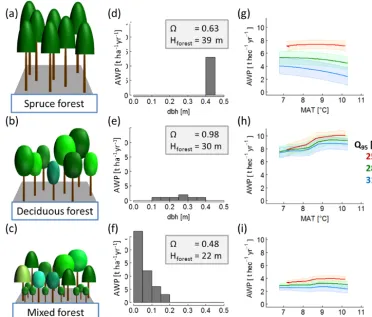
within 1 year) or extreme anomalies (e.g. pathogen attacks) on wood production. Figure 2a–c show the AWP for different annual temperatures for three different forest stands.
We analysed the sensitivity of every forest stand to temper-ature change following the approach of Piao et al. (2010). For every forest stand, a general linear model was fitted relating wood production mean annual temperature (MAT) and intra-annual temperature amplitude (Q95), as well as the nuisance parameter year.
AWP=αxMAT+βxQ95+γ xyear+ (2)
For every forest, we calculated the relative change of pro-ductivity resulting from an increase of 1◦C:
SIMAT= α
AWP (3)
SIQ95= β
AWP. (4)
In our analysis, we excluded all forests stands for which AWP turns negative if the temperature rises by 1◦C (this oc-curs in 2 % of all stands).
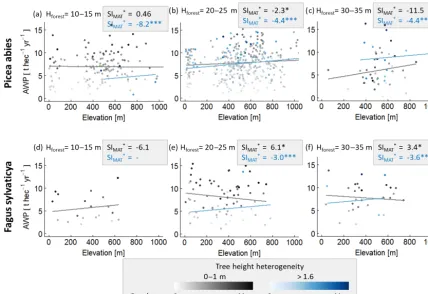
We also determined the sensitivity of forests to temper-ature change using the German forest inventory to validate our results. However, the inventory does not include leaf area index (LAI) measurements. We therefore assumed the basal area as a proxy for LAI, and we selected subsam-ples of forests stands with similar structure (basal area, tree height heterogeneity, forest height and same species mix-tures). In addition, we used elevation as a proxy for mean an-nual temperature, assuming temperature changes of 0.65◦C per 100 m on average (Foken and Nappo, 2008). Only in the case of spruce and beech monocultures did we find enough data to calculate SIMAT values for several forest structures
(for more details, see Appendix A3, Fig. A3).
The comparison between the SIMAT estimation based on
the German forest inventory with SIMAT values of
corre-sponding forests from the forest factory showed quite good
agreement (R2=0.65). However, the simulated SIMAT
val-ues of the forest factory slightly overestimated the sensitivity compared to the inventory-based values (Fig. 3). This might be explained by the difference in the methods used because, in the case of the inventory, we used basal area instead of LAI and altitude instead of temperature. Another explanation could be that in our approach the climate time series showed relatively high and regular precipitation. In the German for-est inventory, warmer sites might be more frequently exposed to water stress, which then reduced the SIMATvalues.
2.4 Five forest properties to describe forest stands
We used three indices to describe the forest structure: LAI, maximum forest height (Hforest), which corresponds to the
height of the largest tree in a forest stand, and tree height heterogeneity (θ), which was quantified by the standard de-viation of the tree heights. To describe species composition, we used Rao’s Q and species distribution index (AWP).
Rao’s Q quantified functional diversity based on species abundances and differences in species traits (Botta, 2005, for details, see Appendix A2).AWPanalysed the optimal
loca-tion of species within the forest structure.AWPis defined as
the ratio of the forest’s productivity to the maximum possi-ble productivity of the forest without changing tree sizes or number (Bohn and Huth, 2017). Hence, the maximum pro-ductivity can be obtained by varying only the species iden-tities of trees in the forest stand. We changed the assigned species of each tree until we found the optimal species for each individual tree and its specific environmental condition. All five indices were nearly uncorrelated for the investigated forest stands (Appendix A2, Table A1).
2.5 Boosted regression trees
We applied boosted regression trees to quantify the influence of the five forest properties on SIMATand SIQ95. Boosted
re-gression trees are a machine learning algorithm using multi-ple decision (or regression) trees. It is able to address uniden-tified distributions (De’Ath, 2007; Elith et al., 2008). Each model was fitted in a forward stage-wise procedure to predict the response of the dependent variable on (SIMATor SIQ95) to
multiple predictors (tree height heterogeneity, forest height, LAI, Rao’s Qand AWP). To omit an overfitting with
F. J. Bohn et al.: Temperature sensitivity patterns of productivity in temperate forests 1799
Figure 2.Overview of forest properties and resulting temperature sensitivity of AWP of three exemplary forests:(a)old even-aged spruce forest;(b)mature deciduous forest;(c)a quite young mixed species forest. The middle (panelsd,eandf) shows the corresponding stem size distributions and provides information on the highest tree in the forest (Hforest) and species distribution indexAWP(which quantifies the
suitability of a species distributed within the forest structure with regard to AWP). Each forest is treated with 320 climate time series; the last column (panelsg,handi) shows the AWP as a function of mean annual temperature (MAT). The colours indicate different inter-annual temperature amplitudes (Q95) of the used time series. (The coloured bands show the standard deviation due to the variability of the five different time series that exist for each combination of mean annual temperature and intra-annual temperature amplitude.)
We used a quarter of the data (randomly sampled) for the machine learning procedure. To get the best model, we varied the following four parameters of the boosted regression tree algorithm: learning rates (0.1, 0.05 and 0.01), the bag frac-tions (0.33, 0.5 and 0.66), the interaction depths (1, 3 and 5) and the cross validation (3-, 6- and 9-fold) assuming a Gaussian error structure (the default setting). The best-fitted boosted regression tree for both SIMAT and SIQ95 showed
a learning rate of 0.1, a bag fraction of 0.66, an interaction depth of 5 and a 3-fold cross validation. These two models were used for all further analyses. The remaining 75 % of the data were used to validate the fitted boosted regression tree algorithm.
2.6 Finding the forest stands for different successional stages that benefit the most increasing
temperatures
Here, we assumed forest height as a proxy for the succes-sional stage of a forest. In every height class, we selected those 5 % of forests that showed the highest sensitivity val-ues (SIMATand SIQ95). We removed the forest height classes
between 10 and 14 m, as they only contained only 15 forests. For all other classes, we analysed the relationship between height class and the forest properties (AWP, Rao’sQ, LAI
and tree height heterogeneity).
3 Results
Figure 3.SIMATvalues of seven different forest types derived from the analysis of the German forest inventory vs. SIMATvalues
de-rived from corresponding forest types of the forest factory. Only those SIMATvalues of the field data are analysed which showedp
values smaller than 0.05.
tree height heterogeneity (θ), forest height class and LAI). The annual AWP was estimated for each forest stand us-ing 320 different climate time series. We then quantified the changes in productivity resulting from changes in mean annual temperature (SIMAT) and intra-annual amplitude
(SIQ95). For the analysed forest stands, the average SIMATis
1.5 %◦C−1and the average SIQ95is−5.4 %◦C−1(see also
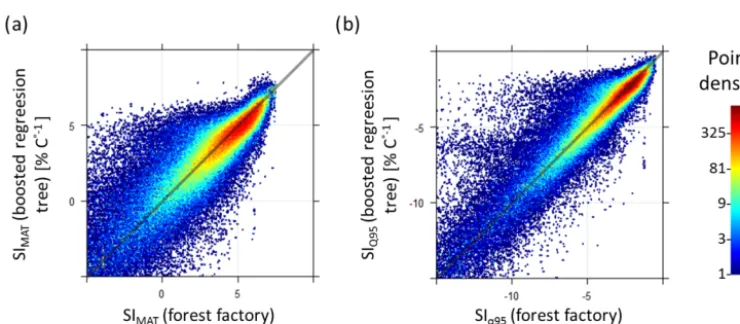
the frequency distribution in Appendix B1, Fig. B1). With a boosted regression tree algorithm, we analysed how the five forest properties influence the temperature sensitiv-ity of forests. To validate the fitted boosted regression tree algorithm, we compared SI values, which are not used for the fitting, with the SI value predicted by the boosted re-gression tree algorithm (Fig. 4). The sensitivities to mean an-nual temperature change (SIMAT) correlated very well (R2of
0.84) and showed a low root mean squared error (RMSE) of ±2.9 %◦C−1(see Appendix B2, Fig. B3). The RMSE even decreased to±1.5 %◦C−1if a subset of the forest stands was analysed that showed SIMAT values larger than−5 %◦C−1
(90 % of the data). The accuracy of the sensitivities to tem-perature amplitude change (SIQ95) was even slightly better.
In addition, a subset that included SIQ95 values larger than −15 %◦C−1 (93 % of the data) showed a RMSE of only ±1.1 %◦C−1(see Appendix B2, Fig. B4).
According to boosted regression tree analysis,AWPwas
the most relevant forest property to explain temperature sen-sitivities (relative influence of 87 % for SIMATand 89 % for
SIQ95; see also Appendix B2, Fig. B2). However, the
influ-ence of AWP on temperature sensitivity flattened out for
highAWP levels (Fig. 5). The second relevant forest
prop-erty was forest height (Hforest). Forests with heights between
25 and 30 m benefited the most from increasing mean annual temperatures. The other three properties (LAI, Rao’sQand tree height heterogeneity) had a low influence on SIMAT.
Both sensitivity indices showed similar relationships to the five forest properties. However, an increase in annual tem-perature amplitude always reduced productivity, whereas in-creasing mean annual temperature could result in a positive effect on wood production. To detect those stands that ben-efit the most from increasing temperature, we selected the 5 % of forest stands that showed the highest SIMAT values
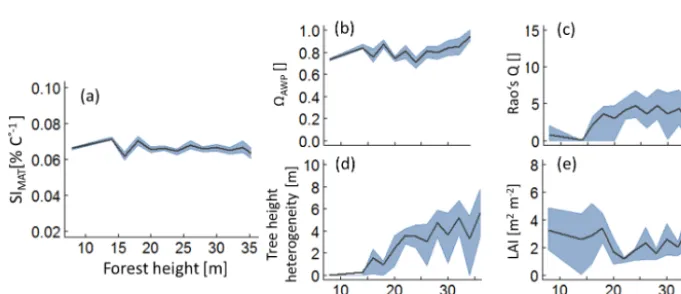
in each forest height class (Fig. 5). In all forests classes, we found forest stands that would benefit from increasing tem-peratures. Analyses of their forest properties revealed that theAWPlevels were always high. Young forests (low forest
height), which had a positive temperature sensitivity, showed low functional diversity and low tree height heterogeneity (θ). For older forests (of intermediate and high forest height) with positive temperature sensitivity, we found an intermedi-ate level of functional diversity. Interestingly, for three vari-ables (Rao’sQ, tree height heterogeneity and LAI), the rela-tionships changed their character between young and inter-mediate forest heights. We obtained similar simulation pat-terns for SIQ95(Appendix B3, Fig. B5).
3.1 Understanding the patterns
3.1.1 The influence of forest structure on temperature sensitivity
Forest structure affects the wood production of single trees in two ways. First, it determines the amount of light available to each individual tree, and second, the size of trees influences their photosynthesis and respiration rates (Fig. B6). Hence, based on the height of a tree and the amount of light available to it, it was possible to calculate its SI values (for a detailed discussion of these calculations, see Appendix B4).
In even-aged forests, all trees have the same height and receive full light (e.g. Fig. 6; forest C). In our study, such forests showed a bell-shaped relationship between forest height and temperature sensitivity (Fig. 6; SI values for 100 % available light depending on tree height).
F. J. Bohn et al.: Temperature sensitivity patterns of productivity in temperate forests 1801
Figure 4.Partial dependency plots of the five forest properties –AWP(species distribution index), forest height class, Rao’sQ(functional
diversity), tree height heterogeneity and LAI (leaf area index) – for SIMAT(sensitivity to changes in the mean annual temperature) and SIQ95
(sensitivity to changes in annual temperature amplitude). Relative importance (RI) compares the influence of different input variables on the variability of a target variable. Histograms show the frequency of forest property values in the analysed data set. Note thatAWPis the
ratio of the current AWP of a forest and the highest possible AWP obtained by shuffling only species identities without changing the forest structure.
Figure 5.Analysis of those forests that show the highest 5 % of the SIMATvalues depending on forest height. Lines indicate mean values of
the forest subsamples which include the best 5 % with regard to SIMATof each hight class. The grey band indicates the interquartile range.
Panel(a)shows temperature sensitivity of aboveground wood production over forest height, analysing only the best the forest subsample. Panels(b)to(e)show the change of the remaining forest properties within the forest subsamples (AWPis the optimal species distribution;
LAI is the leaf area index; Rao’sQquantifies functional diversity).
In forest B (Fig. 6), SI values of the shaded trees can be similar (or even higher) than the SI value of the largest trees in the forest (SI values of tree 1 show similar levels to trees 2, 3 and 4 in forest B; Fig. 6). Hence, if maximal SI values were passed, increasing tree height heterogeneity resulted in similar (or even more positive) temperature sensitivity levels compared to even-aged forest trees (an even-aged forest con-sisting only of trees similar to tree 1 of forest B in Fig. 6). These general considerations explain the change from low
levels of height heterogeneity in young forests to a more het-erogeneous structure in the analysis of those forests, which will benefit from increasing temperature (see Fig. 5d). 3.1.2 The effect of species composition on temperature
sensitivity
In this study, we use the newAWPindex called the species
distribution index (Bohn and Huth, 2017).AWP is the
[image:7.612.127.468.373.520.2]Figure 6.Analysis of the sensitivity index of AWP against mean annual temperature (SIMAT) values of single trees within three different
forests. The diagram shows the calculated SIMATvalue of individual trees for every combination of tree height and available light (forPinus sylvestrisbetween SIMATlevels of 6.5 and−6.5; other species show similar patterns). The dots indicate the different trees of the three forest
examples. The white dots belong to trees with the corresponding number of forest A, grey dots belong to the trees of forest B, and dark grey dots belong to forest C. Note that, in the case of forest C, all trees have the same height and the same light, so that all three dots are at the same place in the diagram.
the forest which can be reached due to shuffling of species identities. Its huge importance for forest temperature sensi-tivity might be illustrated by the following considerations. If species are unfavourably distributed within the forest (low AWP), the AWP of the forest is low.
Increasing functional diversity (Rao’s Q) stabilized the forests’ sensitivity to temperature. This corresponds to re-sults of Morin et al. (2014) and the theoretical considera-tion of Yachi and Loreau (1999). The analysis of the single species can give additional insight into the mechanisms be-hind those species that benefited the most from temperature increase, which were deciduous trees under most conditions. This is reasonable as warmer regions host more deciduous species than needleleaf species. The highest functional diver-sity (Rao’sQ), on the other hand, occurred in mixtures of de-ciduous and needleleaf trees (Appendix B5, Fig. B7). As only two needleleaf species were considered here in the species pool, low Rao’s Q values were dominated by mixtures of deciduous trees. Such deciduous tree mixtures mostly bene-fited from temperature increases. In contrast, mixtures with high Rao’sQvalues, which mostly included both functional types, reacted more poorly (Fig. 4; Appendix B5, Fig. B7).
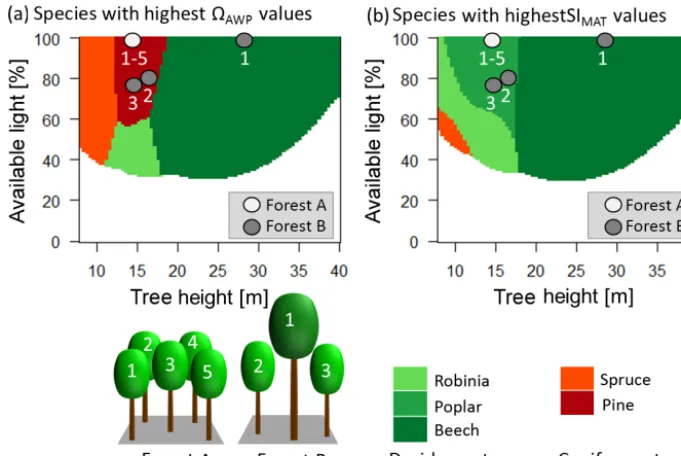
We developed two diagrams that show the species with the highest temperature sensitivity and with the highest pro-ductivity for different conditions (available light and height of a tree) (Fig. 7). Interestingly, the species with the high-est productivity differed from the species that benefit most from rising temperatures in many cases. This has important implications. The highest benefit due to increasing temper-atures was obtained by forests with high but not maximal AWP(Fig. 5). Additionally, deciduous trees benefited more
than coniferous trees from rising temperatures (Fig. 7, Ap-pendix B5, Fig. B7). Hence, young forests should consist of
deciduous trees (compare Figs. 6 and 7; forest A), although the highest productivity values are found for coniferous trees (Fig. 7; forest A). Forests including large trees obtained the highest sensitivity values if intermediate-sized trees differed in their species identity from the largest trees (Fig. 7).
4 Discussion
4.1 The study design
F. J. Bohn et al.: Temperature sensitivity patterns of productivity in temperate forests 1803
Figure 7.Panel(a)shows which species have the highest productivity (AWPvalue of 1) under the current climate for different heights and
different light conditions. Panel(b)shows which species show the highest increase in productivity due to rising temperatures for different heights and different light conditions. Red colours indicate coniferous trees, whereas green colours indicate deciduous trees. Darker colours indicate late successional species, whereas lighter colours indicate pioneers. The dots indicate the different trees of the two forest examples (A and B). The white dots belong to trees with the corresponding number of forest A. Note that all trees have the same height and the same light, so all five dots are at the same place in the diagram. Grey dots belong to the corresponding trees with the same number of forest B.
An advantage of the forest factory approach is the huge set of various forests stands that can be analysed. The data set includes forest stands that often occur in temperate forests (even-aged spruce, pine and beech stands). However, it also includes hypothetical ones that could occur through alterna-tive forest management or disturbances (fire, bark beetles, etc.). Hence, our data set of forest stands covers a much larger variety of forest property combinations compared to long-term forest simulations with the focus on natural forests in their equilibrium state (e.g. Morin et al., 2011) or on mono-cultures (e.g. Reyer et al., 2014). Long-term simulations with ecosystem models, which process modelled climate projec-tions, face a trade-off between cascade uncertainty and path dependency (Wilby and Dessai, 2010; Reyer et al., 2014). The accumulations of model uncertainties over such a pro-cess chain result in increasing uncertainty. Our study design tries to minimize this uncertainty and omit path dependen-cies by including only those processes that might be relevant for the research question. In this study, for instance, we omit the effect of climate change on regeneration and mortality. Furthermore, using several climate variables as model inputs but only analysing the effect of one variable might lead to in-correct interpretations of its effect. For example, temperature and radiation often correlate, and both might increase pro-ductivity. Therefore, in this study, we only vary one variable in all five sets of time series. This guarantees that there are
no relationships between the target climate variable and the remaining climate variables.
As an increase in global mean temperature of 1.5 to 2◦C can hardly be avoided, even under the Representative Concentration Pathway (RCP) 2.6 climate scenario (IPCC, 2013), this study focuses on temperature change. This RCP scenario predicts only small changes in annual precipitation levels for temperate regions. Hence, our approach focuses only on the effect of temperature change on wood produc-tion. However, this might be critical for the analysis of strong temperature changes (e.g. RCP8.5) which will result in an increased incidence of drought and changes in the annual temperature cycles and a strong change in CO2. Such more
complex scenarios should be analysed in future studies. Fur-ther, we neglect the effect of time lags (e.g. bud building in the previous year). However, it is possible to extend the used time series to analyse the behaviour of the forest over longer time periods and study not only productivity but also effects on regeneration or mortality.
To characterize the annual temperature cycles, we used two variables: mean annual temperature and intra-annual temperature amplitude. Both variables can be varied inde-pendently. In the case of higher mean annual temperature, we observe an elongation of the vegetation period. This leads to higher forest productivity (if other resources are not lim-iting (Luo, 2007) and explains why SIMATis often positive.
decline in wood production due to an increase in respiration. In the case of increasing intra-annual temperature amplitude, more days with extreme temperatures will occur in a year. Thus, an increase of 1◦C−1of intra-annual temperature am-plitude will increase respiration more strongly compared to an increase of 1◦C−1 of mean annual temperature. Hence, the increase of intra-annual temperature amplitude normally has negative effects on the productivity (negative SI values). The temperature sensitivity values obtained here are in the same range as those found for temperate ecosystems in heat-ing experiments (Lu et al., 2013, 4.4±2.2 %◦C−1). Within the 16 analysed studies reviewed by Lu et al. (2013), the ex-perimental plots show almost identical environmental con-ditions (soil, radiation and precipitation) and species com-position. To heat the plots, greenhouses or infrared heaters were used. Another study, based on natural forest stands in New Zealand, found an AWP increase of between 5 and 20◦C−1 for forests, assuming no change in forest structure
and species composition (Coomes et al., 2014). The anal-ysed plots were spread throughout New Zealand, and warmer temperatures coincided with higher radiation (Mackintosh, 2016). Hence, the analysed temperature effect also includes the influence of radiation. In our setting, however, the influ-ence of temperature is independent of radiation (Lu et al., 2013, as in). We also found a good correlation between SI values derived from growth measurements of the German forest inventory and simulated SI values based on the forest factory (Fig. 3, Appendix A3, Fig. A3).
4.2 Implications for forest management
Our findings might be relevant for future management strate-gies for temperate forests. Specifically, our new understand-ing of which species benefit most from risunderstand-ing temperatures (Fig. 6) suggests possible strategies, e.g. replacing spruce monocultures with mixtures of deciduous trees. Further, based on the analysis of which forest structure benefits most from rising temperatures (Figs. 4, 5, 6), early-stage even-aged forests should include mainly pioneer species. In the mature stage, we predict a positive effect of temperatures on wood production for a mixture of climax species including different tree sizes. These climax species could be planted below the canopy of the pioneer species in young forests. In our approach, we do not simulate the establishment of very young trees. However, during the conversion between these two forest types, one big challenge might be the removal of the pioneer trees without damaging the young trees that will build the mature forest.
4.3 Implications for global vegetation modelling Most global vegetation models represent vegetation as frac-tional cover of different plant funcfrac-tional types within a grid cell (e.g. Lund–Potsdam–Jena (LPJ); Sitch et al., 2003). Only a few global vegetation models include a more detailed rep-resentation of vegetation structure and functional diversity (Sato et al., 2007; Scheiter et al., 2013; Sakschewski et al., 2016). It would be interesting to perform the analysis pre-sented here with global vegetation models which include structure to better understand the mechanisms driving forest systems’ sensitivity to climate change.
Besides the global vegetation models, forest gap models, which have been restricted to local stands, are now able to simulate forest dynamics in regions or even entire continents (Seidl and Lexer, 2013; Rödig et al., 2017a). Studies using global vegetation models or large-scale forest gap models simulate natural succession. Our analysis indicates that nat-ural and managed (or disturbed) forest systems, which differ in forest structure, might react differently to climate change. Hence, we suggest considering forest structure in future anal-yses of global vegetation. Such information on forest struc-ture might be derived from remote sensing.
5 Conclusions
The temperature sensitivity of wood production in temperate forests is influenced by forest structure and species diversity as our study showed. The species distribution index (AWP)
and forest height seem to be the most important forest prop-erties influencing temperature sensitivity.
Temperate forests that benefit most from temperature rise are those which consist of even-aged deciduous pioneer species in the case of young forests; mature forests benefit most if tree height heterogeneity is large and the forest in-cludes different deciduous climax species.
This study also attempts to explain why certain forest types will decrease their productivity and others will not. Our findings highlight the importance of forest structure for future studies investigating wood production under climate change.
F. J. Bohn et al.: Temperature sensitivity patterns of productivity in temperate forests 1805 Appendix A: Additional information regarding methods
and validation A1 Climate data
[image:11.612.127.470.235.561.2]The construction of the 320 climate time series is based on measured climate time series of the eddy flux Hainich station in central Germany (Knohl et al., 2003) for the years 2000– 2004 (Fig. A1). Mean annual temperature of these 5 years does not correlate with the annual precipitation sum, nor with the mean annual radiation (Fig. A2). Radiation and pre-cipitation within these years correlate quite well (Pearson’s r=0.73).
A2 Forest properties
We use three forest properties to describe forest structure (tree height heterogeneity (θ), forest height class and LAI) and two properties to describe species diversity (Rao’sQ de-scribes functional diversity andAWP describes suitability).
[image:12.612.52.283.195.358.2]The calculation of Rao’sQis based on 12 species-specific parameters which are relevant for productivity (AWP) and species abundance (based on crown area). None of the prop-erties correlate (Table A1).
Figure A2.Mean annual temperature, annual precipitation sum and mean annual radiation of the five climate time series measured at Hainich station from 2000 to 2004.
Table A1.Coefficient of determination (R2) between all used inter-nal forest properties for 370 170 stands of the forest factory.θis the tree height heterogeneity; LAI is the leaf area index;AWPis the
species distribution index.
Variables Rao’sQ θ Forest height LAI class
AWP 0 0.02 0 0.2
LAI 0 0.23 0.06
Forest height class 0.01 0.2
θ 0.02
A3 Validation with the German forest inventory We analysed the influence of forest structure on temperature sensitivity within the German forest inventory (beech mono-cultures and spruce monomono-cultures. Tree height was used to calculate forest height (Hforest) and tree height heterogeneity
(θ). We replaced LAI, which is not measured, by basal area (both properties correlate quite well in the forest factory data set;R2=0.74). The forest stands of each species were clas-sified into six structure classes: three classes which are based on the height of the largest tree in the forest stand (10–15, 20– 25 and 30–35 m) and two classes representing different tree
height heterogeneities (0–1 and>1.6 m). Only plots that are located on flat terrain (slope of less than 15 %) and have a maximum stem diameter of 0.5 m) were analysed. A linear model was fitted to the data of every class using basal area and elevation as input variables to predict AWP.
Appendix B
B1 Frequency distribution of sensitivity values
The analysed forest stands show a large range of temperature sensitivity levels, which reach up to 8.5 %◦C−1in the case of SIMAT (Fig. B1a). This means that one forest increases
its productivity by 8.5 % due to an increase in the mean an-nual temperature of 1◦C. In the case of the annual temper-ature amplitude, the best forest reduces its productivity by −0.5 %◦C−1(Fig. B1b). The mean SIMATis 1.5 %◦C−1and
the interquartile range (iqr) ranges from 1.6 to 5.2 %◦C−1. The mean SIQ95 is −5.4 %◦C−1 and the iqr ranges from −5.2 to−2.2 %◦C−1.
B2 Analysis with boosted regression trees
Boosted regression trees provide information about the un-derlying relationship between input variables (here forest properties) and output variables (here SI values). Several techniques were developed to visualize and interpret the high-dimensional relationship of input and target variables (Friedman, 2001). The comparisons between SI values of the forest factory and predicted SI values (based on the five prop-erties as input), show a very high agreement (Figs. B2 and B3). The obtained vertical patterns for SIMat (0) and SIQ95
(−6 %◦C−1) are probably artefacts of the boosted regression tree algorithm.
Other commonly used visualizations of the relationship of input and target variables are partial dependency plots (Fig. 4). These plots show the influence of an input vari-able on the target varivari-able considering the influence of all input variables which have higher relative importance. In our study, the most important variable isAWP; hence, the first
plot shows the relationship between suitability and SI values. The second relationship (forest height and SI values) is based on the residuals of the first relationship (here between SI val-ues andAWP; Becker et al., 1996). Although a collection
of such plots can seldom provide a comprehensive analysis of the boosted regression trees, it can often produce helpful hints, especially if variables show very low correlations, as in this study.
B3 Forest stand properties with highest SIQ95values
over a forest height gradient
[image:12.612.49.286.479.558.2]F. J. Bohn et al.: Temperature sensitivity patterns of productivity in temperate forests 1807
Figure A3.Analysis of the influence of forest structure on the relationship between elevation and AWP. Panels(a)–(c)are based on spruce monocultures and(d)–(f)on beech monocultures. For each species, forest stands were classified into three forest height classes which were based on the largest tree (Hmax) in a forest stand. These forest stand classes were additionally separated into two tree height heterogeneity
classes (0–1 m in grey and>1.6 m in blue). Intensities of the colours indicate the ratio between basal area of the stand and maximal basal area found within one class. Lines show the results of the linear model with mean basal area. The amount of stars behind the SI values indicates the significance of the slope within a linear model:∗∗∗indicates apvalue below 0.001, and (∗) indicates apvalue between 0.01 and 0.05. Absence of stars indicatespvalues above 0.1. The unit of SI∗MATis %◦C−1.
Figure B1.Frequency distribution of SIMATvalues(a)and SIQ95values(b)of all forest stands.
the same pattern as the identical analysis of SIMAT(compare
Fig. B4 with Fig. 5).
B4 SI values of single trees
To understand the origin of the SI values, we make the fol-lowing assumptions. An increase of 1 %◦C−1always results in an increase of 8.6 % of the respiration rate in the model (Fig. B5b; Piao et al., 2010). The positive effect of a
[image:13.612.138.453.465.568.2]Figure B2.Comparisons of temperature sensitivity (SIMATand SIQ95) based on the forest factory and boosted regression tree model. Colours
indicate point density. Diagonal is the 1:1 line.
Figure B3.Comparison of temperature sensitivity calculations (SIMATand SIQ95) based on the forest factory and boosted regression tree
model. Colours indicate point density. Diagonal is the 1:1 line. Panel(a)contains 90 % of the forest factory data set and(b)contains 93 % of the forest factory data set.
photosynthesis under full light in Fig. B6b), the positive ef-fect of temperature on photosynthesis causes an increase of AWP in some simulated years. If both rates show the same magnitude (ratio of maintenance respiration to photosynthe-sis under full light is close to 1 in Fig. B6b), higher tem-peratures increase respiration more than photoproduction (in most years), which results in a decrease of AWP.
B5 Functional diversity and temperature sensitivity To analyse the effect of functional diversity on temperature sensitivity, we first calculated SIMAT for every species
de-pending on tree height and light availability (as done for pine trees in Fig. 6). Then, we calculated a mean SIMATvalue for
each species mixture for all light–height combinations. Fi-nally, we averaged those SI values which were larger than −7.5 %◦C−1(SIMAT) and calculated the Rao’sQof the
mix-tures (based on equal abundances). The highest SIMATvalues
were found for deciduous forests (Fig. B7). Mixed forests
[image:14.612.114.484.269.431.2]F. J. Bohn et al.: Temperature sensitivity patterns of productivity in temperate forests 1809
Figure B4.Analysis of those forests which lie above the 95 % percentile of SIQ95, depending on forest heightHforest. Lines indicate mean
values of the subsamples and the grey bands indicate the interquartile range. Panel(a)shows the temperature sensitivity of productivity to forest height, analysing only values above the 95 % percentile;(b)to(e)show the change of the remaining forest properties within the subsamples.
[image:15.612.126.471.375.655.2]Figure B6. (a)Photosynthesis (green line –Ptree) and maintenance respiration (red line –Rm) rates of a single beech tree over stem diameter (dbh) under full light.(b)The ratio between maintenance respiration and photosynthesis of the same beech tree.
Figure B7.Rao’sQ(with equal abundances) against SIMATvalues of all possible species mixtures (from the forest factory). The SIMAT
values are the average over all SIMATvalues for all light–height combinations and with values larger than−7.5 %◦C−1. For mixtures, we
assumed equal abundances and calculated the mean over the SIMATvalues of all species within the mixture. Green dots indicate forests that
[image:16.612.132.466.449.592.2]F. J. Bohn et al.: Temperature sensitivity patterns of productivity in temperate forests 1811
Supplement. The supplement related to this article is available online at: https://doi.org/10.5194/bg-15-1795-2018-supplement.
Author contributions. FJB, FM and AH conceived of the study. FJB implemented and analysed the simulation model and wrote the first draft of the manuscript. AH and FM contributed to the text. All authors gave their final approval for publication.
Competing interests. The authors declare that they have no conflict of interest.
Acknowledgements. We thank Edna Rödig, Franziska Taubert, Nikolaj Knapp, Rico Fischer and Kristin Bohn for providing many helpful suggestions and comments. We also thank the Department of Bioclimatology of the University of Göttingen and the Max Planck Institute of Biogeochemistry for providing climate data and the administration of Hainich National Park for permission to conduct research there.
The article processing charges for this open-access publication were covered by a Research
Centre of the Helmholtz Association.
Edited by: Sebastiaan Luyssaert
Reviewed by: Christopher Reyer and one anonymous referee
References
Asner, G. P., Scurlock, J. M., and A Hicke, J.: Global synthesis of leaf area index observations: implications for ecological and remote sensing studies, Global Ecol. Biogeogr., 12, 191–205, https://doi.org/10.1046/j.1466-822X.2003.00026.x, 2003. Barber, V. A., Juday, G. P., and Finney, B. P.: Reduced
growth of Alaskan white spruce in the twentieth century from temperature-induced drought stress, Nature, 405, 668–673, https://doi.org/10.1038/35015049, 2000.
Barford, C. C., Wofsy, S. C., Goulden, M. L., Munger, J. W., Pyle, E. H., Urbanski, S. P., Hutyra, L., Saleska, S. R., Fitzjarrald, D., and Moore, K.: Factors controlling long-and short-term seques-tration of atmospheric CO2in a mid-latitude forest, Science, 294, 1688–1691, https://doi.org/10.1126/science.1062962, 2001. Becker, R. A., Cleveland, W. S., and Shyu, M.-J.: The visual design
and control of trellis display, J. Comput. Graph. Stat., 5, 123– 155, 1996.
Bohn, F. J. and Huth, A.: The importance of forest structure to biodiversity-productivity relationships, Roy. Soc. Open Sci., 3, 160521, https://doi.org/10.1098/rsos.160521, 2017.
Bohn, F. J., Frank, K., and Huth, A.: Of climate and its resulting tree growth: Simulating the productiv-ity of temperate forests, Ecol. Model., 278, 9–17, https://doi.org/10.16/j.ecolmodel.2014.01.021, 2014.
Boisvenue, C. and Running, S. W.: Impacts of climate change on natural forest productivity–evidence since the middle of the 20th century, Glob. Change Biol., 12, 862–882, https://doi.org/10.1111/j.1365-2486.2006.01134.x, 2006.
Bonan, G. B.: Forests and Climate Change: Forcings, Feedbacks, and the Climate Benefits of Forests, Science, 320, 1444–1449, https://doi.org/10.1126/science.1155121, 2008.
Bontemps, J.-D., Hervé, J.-C., and Dhôte, J.-F.: Dominant radial and height growth reveal comparable historical variations for common beech in north-eastern France, Forest Ecol. Manag., 259, 1455–1463, https://doi.org/10.1016/j.foreco.2010.01.019, 2010.
Botta-Dukát, Z.: Rao’s quadratic entropy as a measure of func-tional diversity based on multiple traits, J. Veg. Sci., 16, 533–540, https://doi.org/10.1111/j.1654-1103.2005.tb02393.x, 2005. Charru, M., Seynave, I., Morneau, F., and Bontemps, J.-D.:
Re-cent changes in forest productivity: an analysis of national forest inventory data for common beech (Fagus sylvatica L.) in north-eastern France, Forest Ecol. Manag., 260, 864–874, https://doi.org/10.1016/j.foreco.2010.06.005, 2010.
Coomes, D. A., Flores, O., Holdaway, R., Jucker, T., Lines, E. R., and Vanderwel, M. C.: Wood production response to climate change will depend critically on forest compo-sition and structure, Glob. Change Biol., 20, 3632–3645, https://doi.org/10.1111/gcb.12622, 2014.
De’Ath, G.: Boosted trees for ecological modeling and pre-diction, Ecology, 88, 243–251, https://doi.org/10.1890/0012-9658(2007)88[243:BTFEMA]2.0.CO;2, 2007.
Delpierre, N., Soudani, K., Francois, C., Köstner, B., Pontailler, J.-Y., Nikinmaa, E., Misson, L., Aubinet, M., Bernhofer, C., Granier, A., Heinesch, B., Longdoz, B., Ourcival, J.-M., Ram-bal, S., Vesala, T., and Dufrên E.: Exceptional carbon up-take in European forests during the warm spring of 2007: a data–model analysis, Glob. Change Biol., 15, 1455–1474, https://doi.org/10.1111/j.1365-2486.2008.01835.x, 2009. De Vries, W., Reinds, G. J., Gundersen, P., and Sterba, H.: The
impact of nitrogen deposition on carbon sequestration in Euro-pean forests and forest soils, Glob. Change Biol., 12, 1151–1173, https://doi.org/10.1111/j.1365-2486.2006.01151.x, 2006. De Vries, W., Solberg, S., Dobbertin, M., Sterba, H.,
Laub-hann, D., Van Oijen, M., Evans, C., Gundersen, P., Kros, J., Wamelink, G., Reinds, G. J., and Sutton, M. A.: The impact of nitrogen deposition on carbon sequestration by European forests and heathlands, Forest Ecol. Manag., 258, 1814–1823, https://doi.org/10.1016/j.foreco.2009.02.034, 2009.
Dillon, M. E., Wang, G., and Huey, R. B.: Global metabolic impacts of recent climate warming, Nature, 467, 704–706, https://doi.org/10.1038/nature09407, 2010.
Elith, J., Leathwick, J. R., and Hastie, T.: A working guide to boosted regression trees, J. Anim. Ecol., 77, 802–813, https://doi.org/10.1111/j.1365-2656.2008.01390.x, 2008. Fischer, R.: Modellierung der dynamic afrikanischer Tropenwälder,
Ph.D. thesis, Universität Osnabrück, 2013.
Fischer, R., Bohn, F., de Paula, M. D., Dislich, C., Groen-eveld, J., Gutiérrez, A. G., Kazmierczak, M., Knapp, N., Lehmann, S., Paulick, S., Pütz, S., Rödig, E., Taubert, F., Köh-ler, P., and Huth, A.: Lessons learned from applying a for-est gap model to understand ecosystem and carbon dynam-ics of complex tropical forests, Ecol. Model., 326, 124–133, https://doi.org/10.1016/j.ecolmodel.2015.11.018, 2016. Foken, T. and Nappo, C. J.: Micrometeorology, Springer Science &
Friedman, J. H.: Greedy function approximation: a gradient boost-ing machine, Annals of statistics, 1189–1232, 2001.
Gutiérrez, A. G.: Long-term dynamics and the response of temper-ate rainforests of Chiloé Island (Chile) to climtemper-ate change, Ph.D. thesis, München, Techn. Univ. Diss., 2010, 170 pp., 2010. Gutiérrez, A. G. and Huth, A.: Successional stages
of primary temperate rainforests of Chiloé Island, Chile, Perspect. Plant Ecol. Evol. Syst., 14, 243–256, https://doi.org/10.1016/j.ppees.2012.01.004, 2012.
Haxeltine, A. and Prentice, I. C.: BIOME3: An equilibrium terrestrial biosphere model based on ecophysiological con-straints, resource availability, and competition among plant functional types, Global Biogeochem. Cy., 10, 693–709, https://doi.org/10.1029/96gb02344, 1996.
Heskel, M. A., O’Sullivan, O. S., Reich, P. B., Tjoelker, M. G., Weerasinghe, L. K., Penillard, A., Egerton, J. J., Creek, D., Bloomfield, K. J., Xiang, J., Sinca, F., Stangl, Z., Martinez-de la Torre, A., Griffin, K. L., Huntingford, C., Hurry, V., Meier, P., Turnbull, M., and Atkin, O. K.: Convergence in the tem-perature response of leaf respiration across biomes and plant functional types, P. Natl. Acad. Sci. USA, 113, 3832–3837, https://doi.org/10.1073/pnas.1520282113, 2016.
Horn, J. E. and Schulz, K.: Identification of a general light use ef-ficiency model for gross primary production, Biogeosciences, 8, 999–1021, https://doi.org/10.5194/bg-8-999-2011, 2011. Huete, A.: Ecology: Vegetation’s responses to climate
variabil-ity, Nature, 531, 181–182, https://doi.org/10.1038/nature17301, 2016.
IPCC: Climate Change 2013: The Physical Science Basis. Contri-bution of Working Group I to the Fifth Assessment Report of the Intergovernmental Panel on Climate Change Status and Trends in Sustainable Forest Management in Europe, Tech. Rep., Inter-governmental Panel on Climate Change, IPCC, 2013.
Jeong, S.-J., HO, C.-H., GIM, H.-J., and Brown, M. E.: Phenology shifts at start vs. end of growing season in temperate vegetation over the Northern Hemisphere for the period 1982–2008, Glob. Change Biol., 17, 2385–2399, https://doi.org/10.1111/j.1365-2486.2011.02397.x, 2011.
Jump, A. S., Hunt, J. M., and Penuelas, J.: Rapid climate change-related growth decline at the southern range edge of Fagus sylvatica, Glob. Change Biol., 12, 2163–2174, https://doi.org/10.1111/j.1365-2486.2006.01250.x, 2006. Keenan, T. F., Hollinger, D. Y., Bohrer, G., Dragoni, D.,
Munger, J. W., Schmid, H. P., and Richardson, A. D.: In-crease in forest water-use efficiency as atmospheric car-bon dioxide concentrations rise, Nature, 499, 324–327, https://doi.org/10.1038/nature12291, 2013.
Knohl, A., Schulze, E.-D., Kolle, O., and Buchmann, N.: Large carbon uptake by an unmanaged 250-year-old deciduous for-est in Central Germany, Agr. Forfor-est Meteorol., 118, 151–167, https://doi.org/10.1016/S0168- 1923(03)00115-1, 2003. Lasch, P., Badeck, F.-W., Suckow, F., Lindner, M., and Mohr, P.:
Model-based analysis of management alternatives at stand and regional level in Brandenburg (Germany), Forest Ecol. Manag., 207, 59–74, https://doi.org/10.1016/j.foreco.2004.10.034, 2005. Lu, M., Zhou, X., Yang, Q., Li, H., Luo, Y., Fang, C., Chen, J.,
Yang, X., and Li, B.: Responses of ecosystem carbon cycle to experimental warming: a meta-analysis, Ecology, 94, 726–738, https://doi.org/10.1890/12-0279.1, 2013.
Luo, Y.: Terrestrial carbon-cycle feedback to climate warming, Annu. Rev. Ecol. Evol. S., 38, 683–712, https://doi.org/10.1146/annurev.ecolsys.38.091206.095808, 2007.
Mackintosh, L.: Overview of New Zealand’s climate, https://www.niwa.co.nz/education-and-training/schools/ resources/climate/overview, last access: 19 December 2016. McMahon, S. M., Parker, G. G., and Miller, D. R.: Evidence for a
recent increase in forest growth, P. Natl. Acad. Sci. USA, 107, 3611–3615, https://doi.org/10.1073/pnas.0912376107, 2010. Morin, X., Fahse, L., Scherer-Lorenzen, M., and Bugmann, H.:
Tree species richness promotes productivity in temperate forests through strong complementarity between species, Ecol. Lett., 14, 1211–1219, https://doi.org/10.1111/j.1461-0248.2011.01691.x, 2011.
Morin, X., Fahse, L., Mazancourt, C., Scherer-Lorenzen, M., and Bugmann, H.: Temporal stability in forest productivity increases with tree diversity due to asynchrony in species dynamics, Ecol. Lett., 17, 1526–1535, https://doi.org/10.1111/ele.12357, 2014. Nemani, R. R., Keeling, C. D., Hashimoto, H., Jolly, W. M.,
Piper, S. C., Tucker, C. J., Myneni, R. B., and Running, S. W.: Climate-driven increases in global terrestrial net pri-mary production from 1982 to 1999, Science, 300, 1560–1563, https://doi.org/10.1126/science.1082750, 2003.
Pan, Y., Birdsey, R. A., Phillips, O. L., and Jackson, R. B.: The structure, distribution, and biomass of the world’s forests, Annu. Rev. Ecol. Evol. S., 44, 593–622, https://doi.org/10.1146/annurev-ecolsys-110512-135914, 2013. Peñuelas, J. and Filella, I.: Phenology feedbacks on climate change,
Science, 324, 887–888, 2009.
Piao, S., Luyssaert, S., Ciais, P., Janssens, I. A., Chen, A., Cao, C., Fang, J., Friedlingstein, P., Luo, Y., and Wang, S.: Forest annual carbon cost: a global-scale analysis of autotrophic respiration, Ecology, 91, 652–661, https://doi.org/10.1890/08-2176.1, 2010. Reyer, C., Lasch-Born, P., Suckow, F., Gutsch, M., Murawski, A.,
and Pilz, T.: Projections of regional changes in forest net primary productivity for different tree species in Europe driven by cli-mate change and carbon dioxide, Ann. Forest Sci., 71, 211–225, https://doi.org/10.1007/s13595-013-0306-8, 2014.
Ridgeway, G.: Generalized boosted regression models, Documen-tation on the R Package gbm, version 2.1.1, http://cran.r-project. org/web/packages/gbm/gbm.pdf (last access: 20 October 2016), 2015.
Rödig, E., Cuntz, M., Heinke, J., Rammig, A., and Huth, A.: Spa-tial heterogeneity of biomass and forest structure of the Amazon rain forest: Linking remote sensing, forest modelling and field inventory, Global Ecol. Biogeogr., 26, 1292–1302, 2017a. Rödig, E., Huth, A., Bohn, F., Rebmann, C., and Cuntz, M.:
Esti-mating the carbon fluxes of forests with an individual-based for-est model, Forfor-est Ecosyst., 4, 1–11, 2017b.
Sakschewski, B., Von Bloh, W., Boit, A., Poorter, L., Peña-Claros, M., Heinke, J., Joshi, J., and Thonicke, K.: Resilience of Ama-zon forests emerges from plant trait diversity, Nature Climate Change, 6, 1032–1036, 2016.
F. J. Bohn et al.: Temperature sensitivity patterns of productivity in temperate forests 1813
Scheiter, S., Langan, L., and Higgins, S. I.: Next-generation dy-namic global vegetation models: learning from community ecol-ogy, New Phytol., 198, 957–969, 2013.
Seddon, A. W. R., Macias-Fauria, M., Long, P. R., Benz, D., and Willis, K. J.: Sensitivity of global terrestrial ecosystems to climate variability, Nature, 531, 229–232, https://doi.org/10.1038/nature16986, 2016.
Seidl, R. and Lexer, M.: Forest management under climatic and so-cial uncertainty: trade-offs between reducing climate change im-pacts and fostering adaptive capacity, J. Environ. Manag., 114, 461–469, https://doi.org/10.1016/j.jenvman.2012.09.028, 2013. Sitch, S., Smith, B., Prentice, I. C., Arneth, A., Bondeau, A.,
Cramer, W., Kaplan, J. O., Levis, S., Lucht, W., Sykes, M. T., Thonicke, K., and Venevsky, S.: Evaluation of ecosystem dynam-ics, plant geography and terrestrial carbon cycling in the LPJ dy-namic global vegetation model, Glob. Change Biol., 9, 161–185, https://doi.org/10.1046/j.1365-2486.2003.00569.x, 2003. Solberg, S., Dobbertin, M., Reinds, G. J., Lange, H., Andreassen,
K., Fernandez, P. G., Hildingsson, A., and de Vries, W.: Anal-yses of the impact of changes in atmospheric deposition and climate on forest growth in European monitoring plots: a stand growth approach, Forest Ecol. Manag., 258, 1735–1750, https://doi.org/10.1016/j.foreco.2008.09.057, 2009.
Spittlehouse, D. L.: Integrating climate change adaptation into forest management, Forest. Chron., 81, 691–695, https://doi.org/10.5558/tfc2014-134, 2005.
Spittlehouse, D. L. and Stewart, R. B.: Adaptation to cli-mate change in forest management, J. Ecosyst. Manage., 4, https://doi.org/10.1186/s40663-017-0091-1, 2004.
Vilà, M., Vayreda, J., Comas, L., Ibáñez, J. J., Mata, T., and Obón, B.: Species richness and wood production: a positive association in Mediterranean forests, Ecol. Lett., 10, 241–250, https://doi.org/10.1111/j.1461-0248.2007.01016.x, 2007. Vilà, M., Carrillo-Gavilán, A., Vayreda, J., Bugmann, H.,
Frid-man, J., Grodzki, W., Haase, J., Kunstler, G., Schelhaas, M., and Trasobares, A.: Disentangling biodiversity and cli-matic determinants of wood production, PLoS One, 8, e53530, https://doi.org/10.1371/journal.pone.0053530, 2013.
Wang, X., Piao, S., Ciais, P., Li, J., Friedlingstein, P., Koven, C., and Chen, A.: Spring temperature change and its impli-cation in the change of vegetation growth in North America from 1982 to 2006, P. Natl. Acad. Sci. USA, 108, 1240–1245, https://doi.org/10.1073/pnas.1014425108, 2011.
Wilby, R. L. and Dessai, S.: Robust adaptation to climate change, Weather, 65, 180–185, https://doi.org/10.1002/wea.543, 2010. Yachi, S. and Loreau, M.: Biodiversity and ecosystem
pro-ductivity in a fluctuating environment: the insurance hypothesis, P. Natl. Acad. Sci. USA, 96, 1463–1468, https://doi.org/10.1073/pnas.96.4.1463, 1999.