Using participatory action research to develop science
communication material for a community group
Charlotte Ellen-May Keller U4001917
April 2005
Acknowledgements
I would like to acknowledge the assistance of the following people Tony Femside, Kim Wells, Alan Brown, Erika Leslie, my work colleagues and the ‘tippling’ people for both their support and interest in my work and arboreta in the ACT.
I would also like to especially thank Sue Stocklmayer and lecturers at the Centre for the Public Awareness of Science for teaching me new skills and understanding.
Lastly, I would like to thank Mike Dennis and my parents for their support and patience during this time.
Declaration
I declare that this sub-thesis is my own work and all sources have been acknowledged. I certify that this thesis does not incorporate without acknowledgement any material previously submitted for a degree or diploma at any university, and that to the best of my knowledge and belief it does not contain any material previously published or written by another person except when due reference is made in the text.
Abstract
To develop science communication material for a community group can be a complex process, especially if there are a large number of people that need to be involved. This sub-thesis follows a participatory action research journey to develop a model to do this. Also provided is a revised model to assist other community groups to use participatory action research when developing their science communication material.
Participatory action research involves a number of iterative cycles between action, discussion and reflection and the model developed includes several reflection times, time for discussion with interested parties and individual research, and consultation with the interested parties so that the work is incorporated into other organizations. The resulting products have resulted in the “ownership” of the work by the community group. Not only will the resulting work showcase the community group, it should encourage communication between the interested parties, which results in the meshing of ideas and the development of new ideas.
The key findings of this sub-thesis are that:
• participatory action research can be time consuming
• there needs to be a clear procedure in all correspondence and meetings • flexibility should be maintained for the duration of the research
• communication channels should be maintained • expectations need to be managed
Contents
Acknowledgements i
Declaration i
A b stract... ii
G lo ssa ry ... vii
Overview o f four arboreta in the A C T ...viii
Chapter 1: Introduction... 1
Overview 1 Background 2 Research aim 6 Assumptions 6 Resulting products 6 Approach 6 Chapter 2: Review o f related literature... 8
Arboreta 8 Science communication 17 Chapter 3: Understanding participatory action research... 27
Introduction 27 The research model 33 Chapter 4: Reflections on the process o f P A R ...38
Discussion of the process of PAR 47 Issues surrounding the research methodology 48 Key findings 50 Refining the PAR process 53 Conclusions 54 Chapter 5: The Communication/ Interpretation plan for Bendora Arboretum and Hut ... 56
Summary...56
Acknowledgements...57
Overview... 58
Stakeholders... 58
Stakeholder hierarchy 58 Communication methods to stakeholders 59 Target audience... 60
Interest groups... 60
Potentially interested groups 60 Communication channels with interested parties 62 Key communication issues for Bendora Arboretum and Hut... 63
Branding 66
Sign about ‘Arboreta and the ACT’ 67
Major signage at Bendora Arboretum and Hut 67
Self-guided walk 69
Brochures 70
Maps 71
Guided walk 72
Signage detailing species 72
Website 75
School activities 75
Displays 76
FACTA talks 77
Postcards and posters 78
Surveys and feedback forms 79
Staging the interpretation p la n ...79 Media a v e n u e s ... 80
Television 81
Radio 81
Newspaper articles and notices 81
News segment for television, radio and newspaper 82
Magazine articles 83
Website 83
Communication through affiliations and netw orks... 84 Public awareness e v e n ts ... 86 C onstraints... 86
Resources 86
Location and access 87
Vandalism 87
Amenities 88
Summary of key recom m endations...88 Information sources...89 Attachments for Interpretation/Communication Plan for Bendora Arboretum and Hut... 91
Location of Bendora Hut and Arboretum 91
Communication avenues 92
Website basic set up design 94
DRAFT wording for sign ‘Arboreta in the ACT’ 95
DRAFT wording for ‘Bendora Arboretum’ sign 96
Self-guided walk information and species list 97
Draft FACTA sheet 102
Display 103
Terms of reference 105
Sub-thesis references...107 Sub-thesis appendices... 112
Appendix 1: Field notes from meetings with stakeholders 112
Appendix 2: Field trip notes from 16 April 2003 115
Appendix 3: Minutes from FACTA meeting 118
Figures
Figure 1: Map of ACT arboreta...3
Figure 2: The framework for participatory action research praxiology... 29
Figure 3: The action research cycle... 31
Figure 4: The reflection, action and discussion/ observation cycle of PAR...35
Figure 5: Participatory action research model to develop science communication m aterial... 36
Figure 6: Arboreta of the ACT display as presented at the April World Forestry Day 2004 dinner, hosted by The Institute of Foresters of Australia... 45
Figure 7: The six FACTA postcards, produced through FACTA... 46
G lossary
Arboretum (pi arboreta) a collection of living woody plants for the purposes of scientific research, conservation, display, education, recreation and enjoyment.
FACTA Friends of ACT Arboreta. A community group formed after the Canberra 2003 bushfires.
Interpretation Strategy for Bendora Arboretum
Communication/ Interpretation Strategy for Bendora Arboretum and Hut.
Lowland These arboreta are generally in the Tower’ areas of the ACT, i.e. urban Canberra. Some of these arboreta form part of Walter Burley Griffin’s original plan for Canberra. The lowland arboreta include Westboume Woods, Lindsay Pryor National Arboretum and the newly announced International Arboretum.
Overview of four arboreta in the ACT
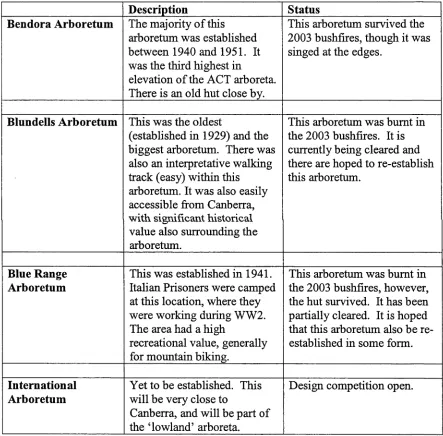
[image:9.541.67.510.211.647.2]Throughout this sub-thesis I have referred to four main ACT Arboreta, and for reference, a b rief description is provided below (Table 1).
Table 1: Overview of four arboreta in the ACT
D escrip tio n S tatus
B en d o ra A r b o r e tu m The majority o f this
arboretum was established between 1940 and 1951. It was the third highest in
elevation o f the ACT arboreta. There is an old hut close by.
This arboretum survived the 2003 bushfires, though it was singed at the edges.
B lu n d ells A r b o r e tu m This was the oldest
(established in 1929) and the biggest arboretum. There was also an interpretative walking track (easy) within this arboretum. It was also easily accessible from Canberra, w ith significant historical value also surrounding the arboretum.
This arboretum was burnt in the 2003 bushfires. It is currently being cleared and there are hoped to re-establish this arboretum.
B lu e R an ge A rb o retu m
This was established in 1941. Italian Prisoners were camped at this location, where they were working during WW2. The area had a high
recreational value, generally for mountain biking.
This arboretum was burnt in the 2003 bushfires, however, the hut survived. It has been partially cleared. It is hoped that this arboretum also be re established in some form.
In te r n a tio n a l A rb o retu m
Yet to be established. This will be very close to
Canberra, and will be part o f the ‘lowland’ arboreta.
Bendora Arboretum
Along the track to Bendora Arboretum the smell of eucalyptus is strong.
A lyrebird scuttles past, in a rush. It is oblivious to me. The surrounding bush still bears the burnt bark of the fires in 2003. A tin structure, Bendora Hut, emerges from the bush. It is a reminder of the old forestry days in the Brindabella’s. The arboretum is nearby.
Fifty metres from the hut you are transported from Australia around the world. The pines from the USA beckon. Two gang-gangs fly past.
The sugar pine, which have their long cones covered in sap, give the appearance of being large sweets, covered in sugar.
A beautiful European larch, along with its Japanese cousin, are also present. They are whimsical and dance in the wind. Appropriate descriptive terms would be ‘dainty’ and ‘beautiful’.
:;';A
There are many different cypress species which come from different countries. I crush their leaves and smell the beautiful aroma - it is powerful and rich.
An avenue of trees from around the world commands my presence. Here I can sit and reflect on the many trees of similar age, all different heights and shapes. They all have different uses, some for timber, some were originally for ship masts in their country of origin, others were used for oil. Now which one was which?
As I wander through Bendora Arboretum, my foot hits something big in the grass, and I expect a rock. I see a huge pine cone with talons on it lying on the ground. It is a very large, spiky and heavy cone from the Coulter pine.
I find my favourite pine cone-the cone from the Himalayan pine. It is very attractive and its design was definitely one from nature’s books.
There are many more trees in this small arboretum, and after many hours of watching and listening I meander back out and into the eucalypts once more. A kookaburra laughs at me for being so enthralled.
Chapter 1: Introduction
Overview
Community groups are collections of people who have a common interest. Often this common interest has a range of stakeholders who need to be involved in the
development of the community group’s information.
This sub-thesis is a case study that explores my interaction with a community group to develop an interpretation plan for an arboretum. The community group, Friends of ACT Arboreta (FACTA), emerged from the ashes of a devastating bushfire that engulfed the Canberra region in January 2003. FACTA seeks to foster the
management and appreciation of arboreta in the Canberra Region. Many members are, or have been, involved in forestry, botanic gardens, historical societies or similar professions. They are knowledgeable and dedicated people.
In early January 2003 there were 19 “upland” arboreta in the ACT. After January 20th 2003, there was only one upland arboretum left-Bendora Arboretum. Of the 18 burnt arboreta, two are currently being discussed for re-establishment / rejuvenation. The rest have been, or are about to be cleared.
With all other upland arboreta no longer able to be used, Bendora Arboretum has become, by default, the principal “upland” arboretum for teaching and recreation purposes. It also is of significant heritage value and was placed on the ACT Heritage Interim Register in September 2004.
Background
In 1930 a Bill was passed in parliament to establish a Forestry Bureau. One of the newly formed Forestry Bureau’s main functions was to establish experimental stations for the study of silviculture, forest management and forest protection (Carron, 1985). In 1929, on the foot slopes of Mt Coree, the first upland arboretum was established- Blundells Arboretum. Over 30 more arboreta were established, as an attempt to find a species that could be used as an alternate timber source in Australia. Most of the species planted were conifers. For more than 30 years, these upland arboreta were measured and recorded. Data were held at CSIRO Forestry and Forest Products at Yarralumla (ACT). These arboreta became a ‘series’ for the comparison of different species (though not all the same species were planted at each of the arboreta) right across the Brindabella topography.
Arboreta are valuable because they provide scientific data on tree responses against various geographical factors. These factors include climatic variations, growth at different aspects, different elevations and a range of soils. They are a resource for tree identification as well as showing differences between tree sources and their response to competition from other trees. Arboreta can provide a source of plant material for ongoing research, such as cloning, through the propagation of the trees.
The potential to use arboreta as teaching resources is increasing. They provide a unique experience where students can identify and study many unusual trees. ACT Arboreta are particularly useful to the Australian National University Forestry course and the University of Canberra Landscape Architecture course, due to the region’s arboreta being well established, their wide variety of trees and their location within the ACT. Many people also utilise arboreta for personal study, walking, birdwatching, fungi collecting or similar pursuits.
NSW
GUNG/MAJURA
m ^ ^ r y / '
b m
jm
m k Z
-STROMLINSW
» * 4 S g .
\ 0 BLUNDELLS FARM X 0 REIDS PINCH NORTH - V 0 REIDS PINCH SOUTH I 0 PICCADILLY CIRCUS
/ o “ .
■; 0 s t o c y a r o c r e e k
O BLUE BANGE . A ! 0 BLUE..RANGE <B! I <£) BLUE RANGE (C) I © V.O'JLCAAN VIEW <£> BLUE RANGE (D) - zT yA - >
© BIERCES CREEK f «ALLS BLOCK .A)
( D LAUREL CAMP - PIERCES CREEK <£) WE STBOURNE WOODS 0 HALLS BLOCK (B)
iiiliil § W
w
'w
u* .
® BLUE RANGE IE) © WOMBAT CREEK © NEDS BLOCK
; 0 PA8RAL BLOCK URIARRA © y a r r a m u n d i r e a c h
f WEST0N AR80RETUM
^ EUCALYPTUS ARBORETUM 0 COTTER ARBORETUM . . 0 CORK OAK PLANTATION
<£)' CORK . PLANTATION <B) 1 ■■ 0 > - 'ALL'CO REDWOODS
A
ARBORETA IN THE A.C.T
: I 1 Ü
Figure 1: Map o f ACT arboreta
[image:14.541.67.506.55.713.2]The arboreta were measured continuously for over 30 years. The last measurement was in 1974, followed by a comprehensive review undertaken by Feamside and Lee in
1984. The 2003 fires also provided a catalyst for their final measurement, before the burnt arboreta were felled.
Bendora Arboretum, the survivor, has been identified as being of significant heritage value. Not only is it the only upland arboretum to survive intact, but it is also provides a heritage link for Namadgi National Park, which lost many huts and other cultural artefacts in the 2003 bushfire.
FACTA
FACTA formed in February 2003. A couple of foresters who were passionate about arboreta were devastated by the outcome of the fires. Immediately they formed a ‘Friends o f group. One of the members, knowing a bit of my background, asked me if I was interested.
At this point I should reveal a little about myself. I studied Amenity Horticulture at Charles Sturt University, before furthering my education and studying Forestry at the Australian National University. After these studies, I worked in the outdoor education industry. I found teaching many outdoor activities to young students to be enjoyable, so I returned to study, and leam about science communication. My involvement in FACTA started as a helping hand, and evolved into more.
Currently the FACTA group is small. There are about 10 people that are active members - attending meetings, writing letters and organising and attending field trips.
Overall, there are about 30 members of FACTA on the newsletter mailing list who receive information about upcoming events and they too participate in field trips. There is also a large number of people who, though not members, attend FACTA field trips and are interested in Bendora Arboretum and other arboreta.
Communication about ACT arboreta
The current state of communication information about ACT arboreta is relatively small. In my literature survey only six publications relate directly to the ACT upland arboreta. Of these, the early publications, between 1954 and 1974 specifically relate to scientific information and the growth rates of the trees in the arboreta. From the 1980s the main scientific value of the arboreta was largely fulfilled and there was a shift to encourage the public to use the arboreta. The publication “The guide to arboreta in the ACT” (Chapman and Varcoe, 1984) included information of how to get to various arboreta, activities and interesting tree information.
Often the 1980 information identified Blundells Arboretum as an important
recreational arboretum due to its age, proximity to Canberra and its ambiance. It was recognised through the development of interpretation signage, a self guided walk and regular conducted walks. One of the lowland arboreta (Westboume Woods) has very limited signage, though there are regular walks every month. Many of the other arboreta were not maintained for regular public use.
At the April 2003 FACTA meeting, (Appendix 2) it was decided that there was a management and communication issue with the ACT arboreta and that there would be an investigation into funding sources.
FACTA soon decided that both an interpretation and a management strategy were required for Bendora Arboretum. These strategies would:
• provide guidance to the recognised landholders of the arboreta • identify the issues surrounding arboreta management
• recognise that there are other arboreta in the ACT and try to maintain the link between them
• add value to the heritage value of the arboreta
• promote Bendora Arboretum for its educational and scenic values.
Research aim
To use participatory action research to develop science communication material for a community group.
Assumptions
Several assumptions were made when developing this science communication material. The assumptions were that:
• due to Bendora Arboretum being listed on the Interim Heritage Places register, everyone will want to know about it
• there will be a difference in communication levels between foresters and public • there is an assumed target audience for the interpretation material generated.
Resulting products
Through my involvement in FACTA, and as part of this sub-thesis, a number of products for use by FACTA have resulted. These include:
• a Communication/ Interpretation Strategy for Bendora Arboretum and Hut (Interpretation Strategy for Bendora Arboretum)
• an “Arboreta of the ACT” display • Postcards.
Approach
product- the entire Bendora Arboretum Communication/ Interpretation Plan. The appendices include my field notes and FACTA meeting notes.
Chapter 2: Review of related literature
This chapter reviews literature relating to arboreta and science communication, within the context of informing participatory action research.
The literature review of arboreta revolved around the following questions: • What is an arboretum and why are arboreta important?
• How did arboreta evolve?
• How much knowledge is there about ACT arboreta? • What is the current interpretation status of ACT arboreta?
Science Communication is reviewed under the following headings: • What is science communication?
• Importance of science communication
• What are the methods of science communication? • How can you gauge learning?
• Interpretation and communication
Arboreta
In the arboreta literature review, I define the meaning of arboreta, relate some of their history and discuss their importance. I have also documented information about arboreta in the ACT.
What is an arboretum and why are arboreta important?
Arboreta and Botanic Gardens have very similar meanings. Wyse Jackson and Sutherland (2000) from the International Agenda for Botanic Gardens in Conservation developed the following definition of a botanic garden:
To research the term Arboretum, two dictionaries were consulted. The Oxford English Dictionary (1989) 2ndEdition, (I- Bazouki):
Arboretum (pi -a) a place devoted to the cultivation and exhibition of rare trees; a botanical tree-garden.
Collins English Dictionary (1998)
Arboretum (pi -a) a place where trees or shrubs are cultivated for their scientific or educational interest.
Both of these dictionaries refer to trees. One mentions rare trees, and the other specifically mentions science and education. The Encyclopaedia of American Forest and Conservation History (Davis, 1983) states that:
The main distinction between arboretums and botanical gardens lies in the fact that an arboretum emphasizes the growing of woody plants while in a botanical garden all types of plants are grown, (p.23)
This American source emphasizes that woody plants are grown in arboreta and that both the arboretum and the botanical garden are very closely associated. The article also identifies the aim of a botanic garden/ arboretum as:
Serving as a natural conservancy as well as a field station dedicated to research, and a scientific, educational and intellectual institution. Each of these aims
complements and reflects the needs of the others. Among their many functions can be listed careful documenting, labelling, and detailed recording of the collections; testing plant materials and growing conditions; developing new and improved varieties; introducing new species; providing the public with both education and information; conducting taxonomical research; sponsoring botanical explorations; maintaining slide photograph, and library collections as well as the numerous specimens, grounds, and greenhouses, (p.23)
This reference has expanded the aim arboreta so it has a scientific purpose, it can be used by the public for education and information as well as being available for other pursuits such as photography.
Botanic Gardens are primarily scientific institutions established to collect, study, exchange and display plants for research, education and enjoyment. Arboreta are essentially Botanic Gardens in which the collections are limited to woody plants, especially trees, whose growth may be individually recorded, (pi)
This definition confirms the importance of science in arboreta and identifies arboreta as a type of botanic garden, but it has a more science related purpose (“individually recorded”).
The Encyclopaedia of American Forest and Conservation History (Davis, 1983) highlighted that science and education were part of an arboretum.
In keeping with its educational aims, many varieties of trees and shrubs are labelled and carefully documented. As with the other arboreta(ums) and botanical gardens in the country, the (National) Arboretum seeks to blend both aesthetically and artistically the natural and the artificial, the wild and the cultivated, the native and the foreign. (p24)
It introduces the idea of landscaping and meshing the old and the new, in an ordered or an unordered fashion.
Banks (1995) highlights the definition of an arboretum as
...in effect, a tree museum. They are quite simply grown for themselves, their beauty and for people to admire and respect, (p.22)
This statement emphasises the science aspect as well as introducing the recreational features of an arboretum. It suggests that arboreta have also been planted for their aesthetic value and gives the main focus to trees.
Summing up all the literature, an encompassing definition could be - an arboretum is a collection of living woody plants for the purposes of scientific research, conservation, display, education, recreation and enjoyment.
How did arboreta evolve?
also be noted that Arbor is latin for tree and an arboretum relates to a planting of trees, which is likened to forests, which in turn relates to forestry.
In early times, gardens were regarded as spiritual places. People could identify a place as the supposed “Garden of Eden”.
When it turned out that neither East nor West Indies contained the actual Garden of Eden, men began to think, instead, in terms of bringing the scattered pieces of the creation together into a Botanic Garden, or new Garden of Eden. (Prest, 1981, p.9) They could have been regarded as a place to worship as they could contain many different parts (plants) of the world.
By the sixteenth century, “Physick gardens” had emerged. Their role was to encompass culinary requirements and plants for medicine and they were associated with universities - the places of learning. There was also the belief that gardens contained plants that were important to life. Physick gardens were a place where:
All plants were believed to contain ‘virtues’ or healing powers, and in the garden into which plants had been gathered from all over the world there would be no hurt without a heal. (Prest, 1981, p.57)
Over time, towns expanded and landscaping was introduced to towns, it “became acceptable to combine beauty with science” (McCracken, 1997). The public became more aware of the unusual plants that the newly discovered countries offered and they wanted to see them in a garden. In fact,
.... although the great voyages of global discovery had occurred 200 years earlier, it was not really until the eighteenth century that the general public became fascinated with the treasures of other lands...the new botanic gardens did not merely thrill the pioneer botanists; perhaps more significantly it stirred the lay public’s curiosity about the plant kingdom and heralded the birth of gardening for the ordinary person. (P-1)
The botanic gardens had developed into places where plant collectors could nurture rare and unusual plants.
was foremost in botanical history for economic, scientific and social reasons. Arboreta were first planted in Britain as plant collectors returned with many unusual plants and trees from distant countries. These have since been described as “tree museums” and were “jealously protected” (Banks, 1995. p.22).
Arboreta were now growing. They had the important role of containing trees that could possibly grow in the area and test their purpose - whether as a resource or a feature. Over time, an arboretum became a site to examine many different tree species from around the world, all in the one place.
McCracken, (1997), suggested that:
...one of the most important but least appreciated functions of (colonial) botanic gardens was their impact on forestry. In many respects, looking at the imperial botanic network as a whole, the production and distribution of saplings eclipsed work done on any other variety of economics. Trees were mainly produced for their fruit or for the silk industry, but they also had a host of other uses for a young colony, (p. 141)
McCracken continues to discuss the establishment of trees for timber and firewood, for distributing tree species for windbreaks, shelter and resources. For example Black wattle, (Acacia mearnsii) was used for tannin in the 19th Century. Forestry, as a profession, began with the first forestry school being established in Germany in 1789 (Kanowski 2001). So, by this time, foresters were encouraged to plant many different trees to beautify areas and to create a “healthier town”, and so the botanic garden network began to advance the cause of forestry as well.
The development of botanic gardens began in a modest style with the discovery of new countries and new plants. From this beginning, botanic gardens and arboreta made an impact on forestry, landscape design and horticulture.
How much knowledge is there about ACT arboreta? What is the current interpretation status of ACT arboreta?
One of the first articles about ACT arboreta appeared in the 1954 papers that were presented at the first conference of the Institute of Foresters of Australia. This paper is crucial to the understanding of why arboreta were first established in the ACT.
The purpose of the Arboreta programme is to determine the best species, varieties and strains of trees for forest planting in the southern highlands of eastern Australia and to provide material for breeding special strains of trees, (adapted from Fielding and Nicholson, 1954, p.2)
This paper provides a substantial outline of the ACT Arboreta, notes the species and then presents the findings of the work that was conducted at the various Arboreta. Importantly it clearly identifies Pinus radiata as the species most suited as a fast growing timber in the ACT region. Even though by this time, forestry areas of southern Australia were already planted with Pinus radiata the ACT arboreta confirmed its suitability and its capability especially when compared to many other potential trees.
The Forestry and Timber Bureau published a technical note about Arboreta in the ACT in 1974 (Rout and Doran, 1974). This technical note provides a valuable snapshot of the progress in growth of arboreta at that time. It confirms that Pinus radiata “will remain the preferred species for commercial plantations” (Rout and Doran, 1974 p.4). The note also compares other species found in the arboreta and their potential as a timber tree must be comparable in growth and utilisation potential” (p.3). Rout and Doran state that the ACT arboreta have fulfilled their main role as trial plots:
The arboreta have largely fulfilled their role as species trials and there are no plans for continuing the introduction of substantial numbers of new species, (p.4)
The ACT arboreta are often located within pine plantations and Namagi National Park. The Australian Department of Agriculture (1975) described the role of the ACT plantations shifting from landscaping and catchment protection purposes with a view to commercial production. It was stated that:
Although this shift towards public use generally refers to the ACT pine plantations as a whole, it can also be interpreted to include the ACT arboreta.
Now that the arboreta had fulfilled their initial role, it was another ten years before the ACT arboreta were discussed in publications.
In 1984 “A guide to arboreta in the Australian Capital Territory” was published (Chapman and Varcoe, 1984). This publication presented a concise description of the ACT arboreta, and drew on their objectives-scientific, education, historic, recreational and National Heritage. It emphasised that the arboreta had a direct impact on
Canberra:
The garden city concept for Canberra, in which trees play a major role in landscape design, required intensive comparative studies of both exotic and native plant species, (p.5)
Many trees planted in the ACT arboreta were also identified as being suitable to plant around Canberra in gardens and along streets.
Also mentioned in this guide, is that some of the arboreta were falling into disrepair and that they were being managed by different landholders:
Few of the arboreta are currently managed for their original purpose and may have been abandoned. Responsibility for the arboreta now rests with the Commonwealth Department of Territories, ACT Parks and Conservation Service. Most urban sites are managed by the City Parks Section of the Land Management Branch and rural sites are managed by ACT Forests and the Regional Land Management Section. (Chapman and Varcoe, 1984, p.5)
This guide also mentions that the rural arboreta are managed by ACT Forests and a number of research organisations are using them.
It would have been the CSIRO measuring the trees, the Australian National University using the arboreta as a teaching resource and the ANBG as a part of their botanic garden network.
Arboreta were also considered a community resource and the report “Arboreta as a Community Resource” by Barton, Goodwin and Stephenson (1985) discussed the option of utilising one of Canberra’s rural arboreta. This publication explored the possibility of developing one of the arboreta to include interpretation features as well as its potential to become a popular destination for Canberra people.
The development of Blundell’s Flat in this way is seen as the first step in bringing all the arboreta to the community’s notice, (p.iv)
This was a significant step in encouraging the public to utilise Blundells Arboretum.
Blundells Arboretum was recognised as the arboreta with the most potential (p,6) as it: • was the oldest arboretum in rural ACT
• was the largest arboretum in rural ACT
• was one of the largest collections of exotic tree species outside of the Botanic Gardens of Australia
• has attractive healthy stands of mature trees including large diameter Pinus radiata.
The subject of this sub-thesis is Bendora Arboretum, and it should be noted that Barton, Goodwin and Stephenson (1984), commented that Bendora features included (p.6):
• well stocked and healthy trees
• a display of the adaptability of Pinus radiata (Monterey Pine) to unfamiliar and marginal conditions
• an excellent plot of Pseudotsuga menziesii (Douglas Fir) • many species that were not represented in other ACT Arboreta.
Barton, Goodwin and Stephenson (1984) also provided a start for student assignments. Students, such as Terry (1993) drew on ideas that were provided for Blundells
Student activities. The importance of Terry’s paper is that Blundells Arboretum was thought to be a valuable tree-interpretation resource as well as of interest to the general public.
By 1994, work had been done on the collection of native plants in Australian botanic gardens and arboreta. It was recognised that there was an inadequate approach to the management of Australian botanic gardens and arboreta, and that a coordinated national program should be initiated because it had social, economic and scientific benefits. This work began by listing botanic gardens and arboreta in Australia that contained native plants and became a precursor to the “Directory of Australian botanic gardens and arboreta” (Fagg and Wilson, 1994). This publication listed all gardens and arboreta around Australia, and presented additional information including the percentage of native species that are planted in all the gardens and arboreta and statistics on the people who actually visited gardens. However, none of the ACT arboreta was listed in this publication, although the National Botanic Garden was. In more recent times the directory has become available on the website and Blundells Arboretum was included (ANBG website, 2004). However more recently, Blundells Arboretum has been removed from the directory (ANBG website, 2005) as the arboretum was burnt.
In 2004, FACTA recognised the heritage, cultural and natural importance of Blundells Flat. In response they produced a report “Blundells Flat area ACT: Management o f Natural and Cultural Heritage Values. Background Study fo r the Friends o f ACT
Arboreta” (Butz, 2004). This document captured information on the Blundells Flat area in am effort to consolidate the areas importance.
Summary
An arboretum is a collection of living woody plants for the purposes of scientific research, conservation, display, education, recreation and enjoyment. This definition follows the history of arboreta as being established for scientific research and
conservation for plant collections and identifying tree uses. Arboreta became a display of trees for people to view, especially those from “foreign lands.” They are an
educational resource, used to teach people about unusual or foreign trees. Arboreta also serve a recreational function and are also for personal enjoyment.
ACT arboreta were established to determine the best species, varieties and strains of trees for forest planting in the southern highlands of eastern Australia and to provide material for breeding special strains of trees (Fielding and Nicholson, 1954). By 1974 they had essentially fulfilled the research role and by 1984 there was a new use for the ACT arboreta. They had become more of a destination, than a scientific measuring plot.
Science communication
What is science communication?
Science communication has been defined many times and three recent definitions are as follows:
Sainsbury and Dexter (2000) defined science communication. It is communication between
• groups within the scientific community, including those in academia and industry
• the scientific community and the media • the scientific community and the public
• the scientific community and the Government or others in positions of power and/ or authority
• the scientific community and the Government, or others who influence policy
• industry and the public
• the Government and the public, (p. 12)
This definition essentially has captured all the possible markets with whom to communicate science. It encompasses the whole of human society and its various aspects. It is about a relationship between science and society.
Burns, O’Connor and Stocklmayer (2003) defined science communication as
the development, application or study of various skills, media and activities with the purpose of making meaning of a message. The message relates to science, and the opportunities and constraints for the meaning-making process are provided by
communication theory and practice, (p. 194)
This definition delves more into the methods of science communication and what the actual science message is for. It is a medium to communicate a science message.
In 2003, Bryant, defined Science Communication as
the processes by which the scientific culture and its knowledge become incorporated into the common culture, (p.357)
This suggests that science communication should be embedded into everyday events.
From these three definitions, it could be considered that science communication is about a relationship between science and society, it is a medium to communicate a science message as well as a process that involves science being part of everyday life. Science communication hopes to raise the awareness of science in society.
Communication has been defined by Cribb and Hartomo (2002), as the
sharing of ideas and meaning...in which messages, opinions and information come from all sides, are received, considered and discussed until a common understanding of what they mean is attained, (p. 16)
Communication is an interactive process of learning through discussions, exchange of ideas, and awareness of an issue. Through this process, better informed decisions should be made.
decisions, not necessarily because they fully understand the science, but because they are more aware of the science.
As Shortland and Gregory (1991) wrote
On the whole, scientists are no better and no worse at communication with the public than any other group of highly qualified specialists; but they now face a new and urgent challenge: the public is suddenly very interested to hear what scientists have to say. In the past, some scientists’ attempts at communication have turned out like a garden cultivated by neglect: the flowers are in there somewhere, but the public has to fight its way through a tangle of weeds in order to see them. The public’s need for accessible, succinct and reliable information means that scientists must cut a way through the tangle and keep the paths clear, (p.l)
Science communication fulfils the need that scientists need to communicate their information to the public and others, because of interest in the science aspect. The best way is to achieve this is through keeping the communication channels open.
Importance of science communication
Why is science communication required? Why should scientists make society aware of their science? There are a number of reasons that have been described by many different authors.
To quote Cory Dean, a senior journalist from the New York Times, three main reasons for science communication are:
1. “Public accountability, because most research is funded by tax dollars 2. Providing scientific information with which the public can make important
decisions about matters which impact on the life of the community.
3. The need for a scientifically literate workforce.” (Martonovich, 1998 p.46)
Shortland and Gregory (1991) support these three points.
Blum and Knudson (1997) also confirm Martonovich’s points:
... at the same time, organizations are increasingly recognizing how important their various constituents are to their own well- being and survival. So they develop special programs and publications- research magazines, newsletters and
newspapers, brochures to keep those constituents informed about their activities and to generate interest and involvement, (p.214)
Science communication is about sharing science. It has evolved from the necessity of the public and colleagues wanting information, to ensure that public money is spent appropriately and to ensure future scientific research is supported. Importantly, science communication informs the public and other colleagues about current and relevant research.
Methods of science communication
If science communication is important to encourage support, further research and knowledge, then a key element of science communication is to ensure that the science message is targeted appropriately.
Science communication activities have always recognised that there is more than one ‘public’ dividing audiences into different ages and socioeconomic groups. This research shows that attitudes to life influence attitudes to science, which may be helpful in bringing science communication messages to as wide an audience as possible. (Sainsbury and Dexter, 2000, p.66)
Science communication must be targeted to the respective audiences. Different people will be more interested in information relevant to them. Targeting also ensures that their needs are met.
Stocklmayer (2001) emphasised that it is important to “know the audience and to tailor the communication expressly for them.” Ways to do this include:
• getting rid of as much mathematics and formulae as possible • keeping the language as straightforward as possible
• keeping it simple • keeping it simple and • keeping it simple, (p. 19)
Even the most complex science should be communicated in a simple and easy to understand manner. However, over-simplifying information may be seen as “talking down”.
Of the identified methods, the “hook” is a very important. Sainsbury and Dexter (2000) identified that:
...while stimulating and informing an inclusive debate involves the dissemination of scientific information, it also requires the identification ‘hooks’ which link in with people’s everyday lives and concerns- so that their attention is attracted and information retained. This will allow people to develop an awareness of the role of science in their everyday lives, and provide them with the information and
confidence to contribute to national debates about science policy, (p. 13)
Not only will a “hook” grab the attention of the intended audience, but it should also identify the relevance of the science to the ordinary life. It should provide a familiar association of a useful or everyday event for the recipient. The report also states that information about the sociodemographics, media usage and leisure interests of the target audience need to be seriously considered.
‘Hooks’ can be identified that will attract people to take a more active interest in science and scientific issues. (Sainsbury and Dexter, 2000, p.66)
There is no set medium to communicate science information. For the communication of pure scientific results it is common practice to publish these in a specific journal, which is often peer reviewed. However, the public are very important to the scientist. They need information in a variety of ways. Cribb and Hartomo (2002, p.l 10-114) list a range of communication methods that are effective for engaging the public in a dialogue about science and technology issues and developments. Methods to engage the public are through:
• Lay members of science committees • The web
• Public opinion research
• Media analysis and journalists’ workshops • Consensus conferences and citizens’ juries • Foresight projects
• Industry seminars • Newsletters • Labelling • Radio and video
• Open days and open laboratories • Specialist media
• Shopping centre displays
• Museums, science centres, galleries • Science circus and drama
• Teacher conferences • Politicians
• Religious institutions
• Non-government organisations • TV chat shows.
Many of these media are of an informal nature-there is often no peer review involved. Many are activities that ordinary people do, therefore, these media can often reach a wide range of people rather than a particular group of people that read a particular science journal. These methods should not detract from the normal scientific protocol of publishing in journals and having work peer reviewed. They should enhance the communication dialogue.
Explaining a problem will not lead to an understanding unless the learning has an internal scheme that maps onto what a person is hearing. Learning is the product of self-organization and reorganisation. (Yager, 1991, p.55)
Yager, (1991) stated that knowledge is not acquired passively and that the
Constructivist model is based around local issues and local resources. The model has the:
.... emphasis on the learner, we see that learning is an active process occurring within and influenced by the learner as much as the instructor and the school, (p.53)
Constructivist learning entails actively engaging the participant in their learning process and it is often used in informal science communication. Stocklmayer (2001) identified important aspects in Yager’s paper in relation to informal science
communication: These are:
• Using open-ended questions
• Encouraging participants to suggest causes for particular events and predictions of consequences
• Encouraging the testing of the participants’ own ideas • Encouraging participants to challenge conceptions and ideas • Using cooperative strategies that emphasis collaboration, respect,
individuality and use division of labour
• Encouraging adequate time for reflection and analysis, respecting all ideas • Encouraging self-analysis, collection of real evidence to support ideas, and
re-formulation in the light of new experiences
• Encouraging the use of alternative sources of information, both in written materials and in the use of experts. (Stocklmayer, 2001, p.9 and Yager,
1991, p.56)
These aspects challenge the learner to organise their thoughts and truly understand their subject. They encourage exploration of a topic, seeking further information and finding similarities and differences between old and new information. There is no single solution to learning, however constructive principles should also guide
As quoted by Shortland and Gregory, 1991,
Communication is not a science: there is no single ‘correct’ way to get your message across. What is required is practice, and that means hard work, making mistakes, recognizing your mistakes and putting them right, (p.4)
Gauging learning
Is it possible to gauge the learning effectiveness of communication? Is it possible to define how much people learn from science communication?
For communication to be regarded as effective, it must be an interactive process. Cribb and Hartomo, (2002) identified measures of successful communication as:
Measures of success can range from evidence of greater awareness among certain audiences, to customer satisfaction rating, increased adoption of advice or
technology, and greater public and political consensus on a way forward, (p.34) Success in communication cannot be measured in a tangible manner such as through how many presentations were done.
Bryant (2003) supports this statement, referring to science awareness as implying: .... that an affective change has taken place in the observer, that he or she feels comfortable with science, may even have a sense of ownership and pride in it. It emphasises the importance of participation, (p.361)
Sometimes the recipient of the science communication can feel that they have contributed to the science in some manner- it has generated a sense of ownership.
Actually measuring how effective science communication is can be quite difficult. Success tends to be measured by numbers attending and quality of the experience, rather than by the impact or effect of the activity, especially in the long term. (Sainsbury and Dexter, 2000, p.66)
Interpretation
Interpretation can be seen as a method of science communication. Interpretation aims to:
.... stimulate, facilitate and extend people’s understanding of place so that empathy towards heritage, conservation, culture and landscape can be developed. (Stewart, Hayward, Devlin and Kirby, 1998, p.257)
This aim is a form of science communication. It tries to achieve understanding from the participant or visitor, through displays or information. They include the
interpretation of geography, geology, ecology and other sciences. Stewart, Hayward, Devlin and Kirby, (1998, p.257) explained:
Interpretation is a process, which aims to reveal meanings of places, to provoke thought about places and to essentially to make the link between people and places.
It is the process of communicating the significance of a place to visitors, so they can understand its importance. It can influence people’s attitudes to the environment, provide insight to the location and enhance their visit.
Interpretation which generates empathy with, or of, a place was a valuable theoretical contribution.
The overriding message from this study to interpretive planners, providers and researchers is that if the development for a field of care ‘sense of place’ can be enhanced for visitors by interpretation, then interpretation, if executed well at this and other places could have a cumulative effect encouraging the desired
development of empathy for conservation, heritage, culture and landscape. (Stewart, Hayward, Devlin and Kirby, 1998, p.265)
The more common methods of interpretation include displays, signs/ labels, visitor centres, leaflets and tours.
A report on the Collection of Native Plants in Australian Botanic Gardens and Arboreta (Royal Australian Institute of Parks and Recreation, 1984) describes a
Great variation exists between gardens in the standard of public display and the degree of interpretation provided. Labelling of plants in many gardens and arboreta is extremely poor and at times old or incorrect names are used in error, (p. 15)
Labelling in this quote should also include displays and signage. From this quote it is recognised that interpretation in the garden environment is important, yet at the time of the article it was often inadequate. The level of vandalism that the signs or labels may receive also has an impact on the level of interpretation used. Interpretation also includes other methods than labelling.
Other interpretative programs such as displays, publications, guided tours and children’s activities are used to varying degrees by essentially as yet only by the major gardens. ((Royal Australian Institute of Parks and Recreation, 1984, p. 15)
Summary
Science communication is a two-way learning process. It fulfils the need for science to be accountable, share knowledge with the public and gain further information and funding. Through the use of a “hook” and a range of media, there can be a
‘conversation’ between society and science. However, because of this conversation between science and society, it does not necessarily mean that information is learnt or is correct. People will need to relate information to the way that they learn. Knowing this, targeting information wisely can influence this process.
Chapter 3: Understanding participatory action research
Introduction
An important part of an arboretum is that it can be used by a wide number of people. Banks (1995) stated that:
An Arboretum should belong to the whole community and that the members of that community should be encouraged to feel a part of this living growing medium. (P-23)
With the community having an important role in the Communication/Interpretation Strategy for Bendora Arboretum and Hut, participatory action research was chosen for this project.
Research can involve qualitative and quantitative methods, or a mix of both. As I was producing communication material, I decided to use qualitative information, obtained through a case study of Bendora Arboretum. This case study is a real situation, which happened between April 2003 and October 2004. There are three direct outcomes from this work with the main one being the Communication/Interpretation Strategy for Bendora Arboretum and Hut.
Action research, participant observation and case study are all social research methods that contribute to participatory action research (PAR). They all differ in various aspects, yet they are very similar in their requirements. In this research, I have made brief notes on each of the mentioned research methods and their relationship with participatory action research.
Participatory action research
Participatory action research (PAR) is an evolving approach to research and the production of knowledge (Smith, 1997, p 173).
.... the participants’ questions belong to them-they develop ownership over what is pursued and how. In PAR, research questions take on many forms; they can be written down or remain oral, be formally or informally worded, and be simple or complex. They are not predetermined; no one person or sub-group enters the process with the major question(s) already specified on behalf of the group. The groups’ questions can change with experience over time as new, more relevant queries are discovered. Experience will be the significant teacher; as the group members gain experience, their work together will mature. (Smith, 1997, p.211)
Participatory action research is about individuals and groups researching their personal beings, social-cultural settings, and experiences. They reflect on their values, shared realities, political resistances, and collective meanings, needs and goals (Willms, 1997, p.7). PAR is a journey, as it is about movement:
.... movement from the way things are to the way things could be. It is about transformation on both personal and social levels. At the heart of this
transformation is a research process which involves investigating the circumstances of place; reflecting on the needs, resources, and constraints of the present reality; examining the possible paths to be taken; and consciously moving in new
directions. (Smith, Willms and Johnson, 1997, p.8)
PAR is an evolving approach to research and the production of knowledge. Smith (1997) conducted research over several countries with the result of strengthening their commitment to a meaningful way of life, such as for liberation. The information that is gained can also be applied in general and environmental research, such as through the work of by Carberry, Hochman, McCown, Dalgleish, Foale, Poulton, Hargreaves, Hargreaves, Cawthray, Hillcoat and Robertson, (2002) through FARMSCAPE. FARMSCAPE uses participatory action research as an approach to integrate decision support to farmers, through iterative cycles of action, reflection and re-design over a 10-year period.
Participatory action research is a combination of both action research and participant observation achieved through a case study. It is a reflection and action cycle, which is sparked by people’s needs. It is ever-changing and ongoing, having no clear
Ottosson (2003) states that the researcher is also a participant and this distinguishes it from action research. The principles of PAR are (adapted from Smith, 1997, p. 183) that it should:
• intend liberation
• develop a compassionate culture
• participate in cohesively dynamic processes of action-reflection (praxis) • value what people know and believe by using their present reality as a starting
point and building on it
• collectively investigate and act • consciously produce new knowledge.
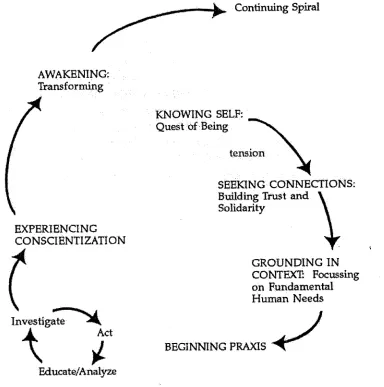
Smith, 1997 provided a more complex framework for PAR (Figure 2).
Continuing Spiral
AWAKENING: Transforming
KNOWING SELF: Quest of Being
SEEKING CONNECTIONS: Building Trust and
Solidarity tens
EXPERIENCING CONSCIENTIZATION
Act
BEGINNING PRAXIS
GROUNDING IN CONTEXT: Focussing on Fundamental Hum an Needs
Educate/A nalyze
Figure 2: The framework for participatory action research praxiology
[image:40.541.99.483.322.709.2]PAR is an evolving approach to research and the production of knowledge (Smith, 1997, p. 173).
The underlying values of PAR remain essentially the same:
1. All people have the capacity to think and work together for a better life
2. Current and future knowledge, skills and resources are to be shared in equitable ways that deliberately support fair distributions and structures
3. ‘Authentic commitment’ is required from external and internal participants. (Smith, 1997, p. 177)
Action research
Action research, as defined by McNiff, (1988) is often educational research. It is a form of self-reflective enquiry often used in school, where the teacher becomes a participant in their own educational process. “The action of action research, whether on a small or large scale, implies change in people’s lives, and therefore in the system in which they live” (McNiff, 1988, p.3).
The most widely accepted definition is:
Action research is a form of self-reflective enquiry undertaken by participants (teacher, students or principals, for example) in social (including educational) situations in order to improve the rationality and justice of
(a) their own social or educational practices, (b) their understanding of these practices, and
(c) the situations (and institutions) in which these practices are carried out. (Carr and Kemmis, 1986 as quoted in McNiff, 1988, p 2)
McNiff (1988) also describes action research as “a self-reflective spiral of planning, acting, observing, reflecting and re-planning” (p.7). It is an evolving research method which attempts to improve circumstances.
Action research is a process in which the researcher is not solving a problem for the other/s but with the others in joint learning. The knowledge is the action.
(Ottosson, 2003, p.92)
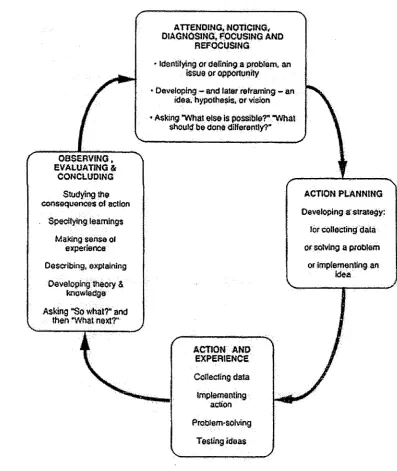
[image:42.541.76.473.245.716.2]Cherry, 1999 describes the Action research cycle as “a continuous cycle of planning, action and review of the action” (Cherry, 1999). Experiences are continuously recycled through reflection, planning and the injection of ideas. This is shown in Figure 3.
OBSERVING , EVALUATING &
CONCLUDING
Studying the consequences of action
Specifying learnings
Making sen se ol experience
Describing, explaining
Developing theory & knowledge
Asking “So what?" and then “What next?"
ATTENDING. NOTICING. DIAGNOSING. FOCUSING AND
REFOCUSING
* Identifying or defining a problem, an issue or opportunity
■ Developing - and later reframing - an idea, hypothesis, or vision
Asking “What else is possible?" "What should be done differently?“
ACTION AND EXPERIENCE Collecting data implementing action Problem-solving Testing ideas
ACTION PLANNING
Developing a strategy:
for collecting data
or solving a problem
or implementing an idea
Figure 3: The action research cycle
Participant observation
The method of participant observation aims to generate practical and theoretical truths about human life grounded in the realities of daily existence. There are seven features identified by Jorgensen (1989, p. 13):
1. a special interest in human meaning and interaction as viewed from the
perspective of people who are insiders or members of particular situations and settings
2. location in the here and now of everyday life situations and settings as the foundation of inquiry and method
3. a form of theory and theorizing stressing interpretation and understanding of human existence
4. a logic and process of inquiry that is open-ended, flexible, opportunistic, and requires constant redefinition of what is problematic, based on facts gathered in concrete settings of human existence
5. an in-depth, qualitative case study approach and design
6. the performance of a participant role or roles that involves establishing and maintaining relationships with natives in the field
7. the use of direct observation along with other methods of gathering information.
Participatory action research uses all seven of the identified participant-observation features.
It is about everyday experiences of the ordinary, usual, typical, routine, or natural environment of human existence of which participant observation will note. The methodology of participant observation, however, generally is practised as a form of
case study (Jorgensen, 1989, p. 19).
Case studies
According to Yin, (1994, p.80), there are six sources of evidence that can be sought for case study research. These are
1. documentation 2. archival records 3. interviews
4. direct observations 5. participant-observation 6. physical artefacts.
Case studies are flexible and multipurpose. They may be descriptive, exploring providing portraits of little known entities. They may also be selectively pursuing more richly detailed accounts of processes at work. They may also be designed to achieve a form of experimental isolation of selected social factors within real life context (Shaw, 1999, p.135).
Participatory action research utilises the case study approach, by researching one circumstance thoroughly.
The research model
Through being a member of FACTA, I could participate in meetings as well as develop science communication material. The process of developing the resulting material was documented to aid further processes and research.
Once the science communication material was developed I could then relate the process to a form of exploratory research whether it is action research, participant observation, case study, or participatory action research.
PAR is a mix of social research methods
• draws on the cyclic nature of action research, through the use of planning, action and review of the action.
• contains elements of participant observation, such as being a special interest in human meaning, and an everyday situation.
• utilises the case study approach by studying one topic.
There are no pre-determined questions in PAR research. It is continuously changing and adapting to the surrounding issues-it is about discovery.
Developing my PAR model
Having identified the similarities between the social research methods of action research, participant observation, case studies and participatory action research, the next step was to develop a PAR model that I could use for this sub-thesis. Initially I needed to accept the fundamental principles, which were those identified by Smith
(1997).
develop a compassionate culture
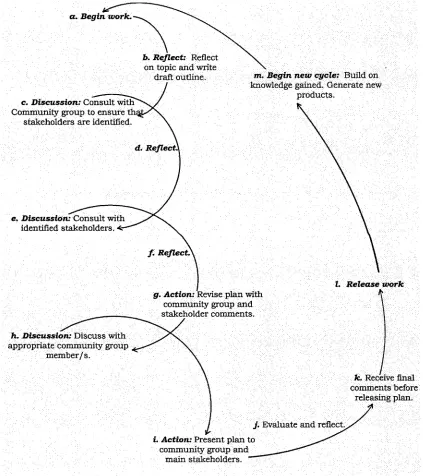
I chose to modify my knowledge and base my research on the basic action research continuous cycle of reflection, action, discussion /observation cycle (Figure 4).
\
Discussion/ observation
Figure4: The reflection, action and discussion/observation cycle of PAR
1. B e g in w o rk .
3. A c tio n : W rite
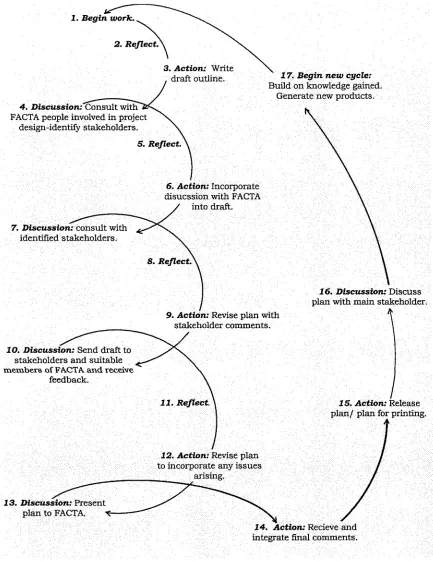
Figure 5: Participatory action research model to develop science communication material
[image:47.541.76.509.59.620.2]noted and are included in Appendix 1. The main question discussed was what they (the stakeholder) would like to have happen at Bendora Arboretum and Hut.
Ethics
Due to this work being social research, ethics approval was sought and approved (approval number 2004/201) (Appendix 4). The original intent for this approval was to conduct recorded interviews with each of the stakeholders as the final part of the PAR process, contributing to the discussion at stage 16 (Figure 5). However, the formal interview phase was not conducted due to the amount of data already obtained.
The research grant
A research grant of $5,200 (including GST) from the ACT Heritage Unit for the
Conservation o f Bendora Arboretum and Hut was approved in October 2003 (Grant no
HG 03/13). The objectives of this research grant were to:
1. collect information necessary for the management / conservation of the arboretum
2. prepare a conservation management plan
3. prepare an awareness/ interpretation plan to include site and individual species labelling and a descriptive brochure.
My research was concerned with the third objective, guided by the FACTA (Interim) Committee developed into the Communication/Interpretation plan for Bendora arboretum and hut. I was paid a total of $1,444.90 to cover travelling, printing and writing costs (see Appendix 2). The main cost was associated with the display and its development. The expenditure of the research grant funds, were decided through FACTA meetings, in consultation with the ACT Heritage Unit.
Chapter 4: Reflections on the process of PAR
In previous chapters, this sub-thesis discussed the topics of arboreta, science
communication and participatory action research. The research method used in this sub-thesis was participatory action research in order to develop science communication material for a community group.
Following through the method presented in Chapter 3 (Figure 5) the method for each aspect of the research was as follows. This chapter, in accordance with the process of PAR, records my personal actions from December 2003 to December 2004.
1. Begin work
Date: December 2003
I received the information that allowed me to proceed with the development of the interpretation plan in late December 2003. The grant from ACT Heritage Unit had been approved, and my current position had come to an end, allowing me time to work on the interpretation plan.
2. Reflect
The last two weeks in December 2003 was the first reflection time. It included time to organise, and start to work out the approach for gathering information.
3. Action: Write draft outline
Between December 2003 and January 2004,1 had time to reflect on what I knew, what was wanted and how to proceed. I tried to identify the main stakeholders, my aim and my purpose for the document.
4. Discussion: Consult with FACTA people involved in project design- identify
stakeholders
Date: January 2004
Heritage Unit. We discussed the possible stakeholders and meetings that should be held and information that would need to be sought.
The main points raised at this discussion were
• drawing up a ‘matrix’ to work out communication methods • drawing up a ‘matrix’ to identify key stakeholders
• ‘staging’ the plan for implementation.
5. Reflect
This reflection time was shorter. It allowed me to think about the future strategy, to meet with the stakeholders and to consider whether any others should be involved.
6. Action: Incorporate discussion with FACTA into draft
Date: January 2004
At this time a very rough draft had been assembled, and possible structure and headings were identified.
By now the draft included information on • identified stakeholders
• key communication issues
• an outline for labelling and other interpretative means and signage plan. • potential interest groups
• arboretum communication affiliations and networks • key communication issues
• postcards.
7. Discussion: Consult with identified stakeholders
Date: January 2004
I then met with a representative of ACT Forests (with a FACTA member present) and then with two ANU Forestry lecturers who use Bendora Arboretum for teaching purposes.
ACT Forests are considered to be a stakeholder as they manage many of the other arboreta, which were part of the original “series” of arboreta, though now burnt. If some of the other arboreta were to be re-established, then it would be ideal for ACT Forests to know that this work was going on and that the ‘series’ look and feel could be used.
I also met with the ACT Heritage Unit, as they were giving FACTA money to complete this work.
Last, I also spoke with a Canberra historian who knew the history of the area well.
Several issues were repeatedly raised: • Heritage week
• Signage • Vandalism • FACTA’s role • Bendora Hut.
See Appendix 1 for my field notes with each of the stakeholders.
8. Reflect
Reflecting a third time enabled me to arrange my thoughts and resulting information from the interviews, into a more logical order. Ideas that I identified as important from these interviews were:
• signage • catchphrase