Int. J. Electrochem. Sci., 7 (2012) 12045 - 12053
International Journal of
ELECTROCHEMICAL
SCIENCE
www.electrochemsci.org
Chitosan Based Heterogeneous Membrane Sensor for pH – A
Prototype
Illyas Md Isa1,*,Mohd Hizuan Hamzah1 , Intan Safarinaz Sabian2, Sulaiman Ab Ghani 2
1
Jabatan Kimia, Fakulti Sains dan Matematik, Universiti Pendidikan Sultan Idris, 35900 Tg. Malim, Perak, Malaysia
2
Pusat Pengajian Sains Kimia, Universiti Sains Malaysia, 11800 USM Pulau Pinang, Malaysia *E-mail: [email protected]
Received: 28 September 2012 / Accepted: 22 October 2012 / Published: 1 December 2012
A heterogeneous membrane pH sensor based on chitosan, polyvinyl chloride (PVC) and a suitable plasticizer was developed. The best overall performance was shown by a membrane with composition ratio of chitosan (ionophore) : PVC (binder) : 2-nitrophenyl octylether (2-NPOE) (plasticizer) at 20 : 30 : 30 (% w/W) respectively. The potentiometric responses was linear within pH 2 to 9, limit of detection at pH 9.5, slope 56 mV decade-1 at 25 ± 1 oC and response time of 20 ± 5 s. A life time of more than 3 months was obtained. The sensor established good selectivity and reproducibility towards hydrogen ion in the presence of other cations. Results were in good agreement with a commercial pH electrode for pH measurement in fruit juice samples.
Keywords: Chitosan, Heterogeneous membranes, pH sensor, Potentiometry
1. INTRODUCTION
Measurement of acidity (pH) of an aqueous solution is very important for various applications. Glass electrode is by far the best mean for this purpose. Nonetheless, it has its limitation like unable to provide accurate pH values at the extreme end of pH scale, limited shape and also cannot be used in fluoride solution [1]. Some more, it is always in need of frequent calibration before and after use. Its fragility hinders it being miniaturized for biological purposes. Hence, it is a challenge to researchers to overcome these drawbacks. Better still if the substitute is robust, cheap, reliable and green.
and also in medical science for monitoring pH in blood. But its drawbacks are fluctuations in light source intensity of the instrument, photo-bleaching of the pH sensitive reagent, drifts in the optoelectronic setup and also background fluorescence. Lately, a number of optical pH sensors have been studied and developed [19-24]. The fiber optic, the main item used in its fabrication, has many advantages over glass e.g. small size, flexibility, low propagation loss, no risk of electric shock on in vivo measurement and no electromagnetic interference [25].However, the limitations for this type of sensor are complex removal process of cladding layer and the fragility of unclad fibre.
Over the years pH sensors based on polymeric membranes have attracted more attentions than others [26-39]. The attraction being that they are easy to manufacture in any desired shape and size. Besides, these sensors are, typically, rugged and reliable. While several polymeric matrices have been used in the manufacturing of ion selective electrodes (ISE) polyvinyl chloride (PVC) remains one of the best choices [35]. The heterogeneous polymeric membrane is, mainly, a blend of PVC, ionophore, plasticizers and in some instances, a lipophilic anion. Ionophores like calyx[4]arene [28],1– octadecanoyl–4–methylpiperazine, 1-octadecanoyl–4–(2–pyridyl)–piperazine, N–octadecylmorpholine and octadecylisonicotinate [29], p–tert–butylcalix[4]arene–oxacrown–4 [38], amine [39-42], hexabutyl-tri-amidophosphate [43], azobenzenes [44] and phenoxazine derivatives [45] have been studied. The influence of plasticizer in the polymeric membrane blend such as to increase the membrane polarity to facilitate partition of ions [46] and to help improve capacity of the ionophore [47] have been highlighted. It is reported 2-NPOE is the best membrane plasticizer in polymeric pH sensor using macrocyclic compounds [38]. In another report [48] the diocthylphenylphosphonate(DOPP) has, however, been blamed of responding towards analyte. These polymeric membranes appear to be promising besides trivial problems like sluggish pH readings.
Chitosan, a polysaccharide, has been reported to be promising polymer not only in the biological field, but also in various industrial applications [49]. Up to date there has been no report yet on the application of chitosan as ionophore in the polymeric membrane of pH sensor. However, earlier report has indicated that chitosan membrane is sensitive towards pH changes [4]. The polymeric heterogeneous chitosan membrane electrodes have been used to measure iron (III) [50] and glutamate [51].This paper reports on the study carried out to get the alternative pH sensor by making use of chitosan, a non toxic biodegradable material, as the active material or ionophore.
2. EXPERIMENTAL
2.1. Reagents
(Germany). All solutions were prepared using distilled deionised water from EASYpure LF, Barnstead (USA). The stock solutions of defined pH were, freshly, prepared using analytical grade boric acid, acetic acid, sodium sulphate of Sigma-Aldrich and phosphoric acid of Fluka Chemika (Switzerland).
2.2. Preparation of electrode
Chitosan of various quantities was mixed with a fixed quantity of PVC (initially dissolved in 2 ml THF). The membrane was, then, blended with various plasticizers. The blend was placed in a glass ring (35 mm i.d.) resting on a glass plate. After overnight solvent evaporation, the resulting membrane was peeled off from the glass mould and a disc (6 mm i.d.) was cut out. The membrane disc was mounted to one end of Pyrex® glass tube with Araldite®. The 0.1 M HCl internal filling solution was added into the tube. Electrical contact between inner solution and the pH meter was accomplished through Ag/AgCl pseudo-reference electrode. The assembly was conditioned in 1.0 × 10⁻³ M HCl solution for 12 h. The polymeric membrane was rinsed with water prior to various tests to get the membrane with optimum performance.
2.3. Potential measurements
The pH and emf of solutions were measured using Orion 720A plus meter of Thermo Electron Corp. (USA). A glass pH electrode 915600 of Orion Research Inc. (USA) was used to determine the pH of solutions. This was used as standard with prior calibration using standard buffer pH 4.01, 7.00 and 10.01 of Orion Research Inc. (USA). An Ag/AgCl (3M KCl) of Bioanalytical System (USA) was used as external reference electrode. The electromotive force (emf) measurements were performed at 25 ± 1 o
C. The experimental solution was stirred by a magnetic stirrer bar HI 200M of Hanna (Singapore). All measurements were carried out with the following cell scheme;
Ag, AgCl│0.1 M HCl │membrane│ sample solution ││ KCl (3M) │ AgCl, Ag
3. RESULTS AND DISCUSSION
3.1. The characterizations of the membrane
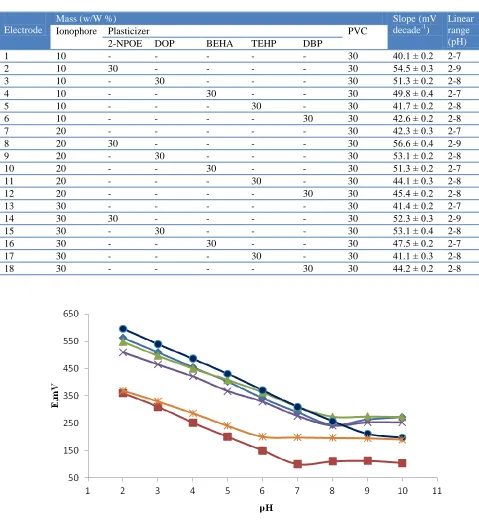
solution (pH 2 – 12) with 0.1 M Na2SO4 are investigated. The characteristics of these sensors are
[image:4.596.55.534.178.698.2]tabulated (Table 1). The overall result indicates that electrode no. 8 with composition ratio of chitosan (20%), PVC (30%) and 2-NPOE (30%) performs near to Nernstian, linear range from pH 2 to 9 and limit of detection pH 9.5 (Fig. 1).
Table 1. Effect of membrane compositions on the slope of membrane electrodes based on chitosan.
Electrode
Mass (w/W %) Slope (mV
decade-1)
Linear range (pH)
Ionophore Plasticizer PVC
2-NPOE DOP BEHA TEHP DBP
1 10 - - - 30 40.1 ± 0.2 2-7
2 10 30 - - - - 30 54.5 ± 0.3 2-9
3 10 - 30 - - - 30 51.3 ± 0.2 2-8
4 10 - - 30 - - 30 49.8 ± 0.4 2-7
5 10 - - - 30 - 30 41.7 ± 0.2 2-8
6 10 - - - - 30 30 42.6 ± 0.2 2-8
7 20 - - - 30 42.3 ± 0.3 2-7
8 20 30 - - - - 30 56.6 ± 0.4 2-9
9 20 - 30 - - - 30 53.1 ± 0.2 2-8
10 20 - - 30 - - 30 51.3 ± 0.2 2-7
11 20 - - - 30 - 30 44.1 ± 0.3 2-8
12 20 - - - - 30 30 45.4 ± 0.2 2-8
13 30 - - - 30 41.4 ± 0.2 2-7
14 30 30 - - - - 30 52.3 ± 0.3 2-9
15 30 - 30 - - - 30 53.1 ± 0.4 2-8
16 30 - - 30 - - 30 47.5 ± 0.2 2-7
17 30 - - - 30 - 30 41.1 ± 0.3 2-8
[image:4.596.51.545.187.453.2]18 30 - - - - 30 30 44.2 ± 0.2 2-8
From the Nernst equation;
Ecell = E0 ± (2.303RT/nF) log a (i)
The theoretical Nernstian slope, S = 2.303RT/nF, for a monovalent ion at 25 oC is 59.1 mV decade-1. It is apparent that the best polymeric pH sensor with plasticizer 2–NPOE has nearly ideal slope at 56 mV decade-1 as compared with the other plasticizers. The 2–NPOE as the preferred plasticizer for monovalent ions ISE has been highlighted elsewhere [38, 58]. The presence of plasticizer in the binder matrix acts as a fluidizer, allowing homogeneous dissolution and diffusion mobility of the ion-pair inside the membrane [59]. The slope value of each of the added plasticizer polymeric membrane decreased in the order of 2–NPOE > DOP >BEHA > DBP> TEHP ≈ without plasticizer.
3.2. Response time and lifetime of the electrode
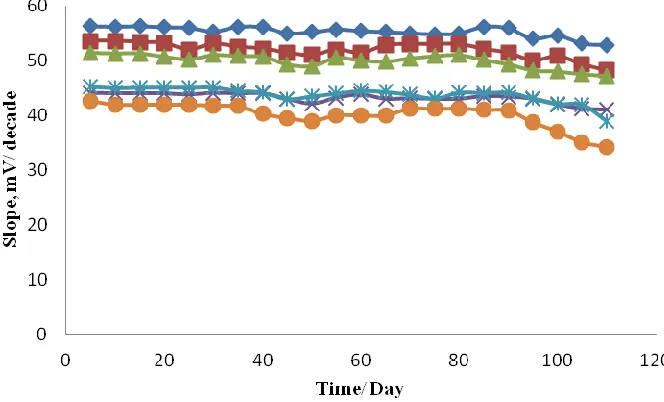
The response time of an ISE is important in analytical applications and it depends slightly on the concentration change. Therefore, it is determined by recording the elapsed time to reach a stable potential value after the electrode and the reference electrode were immersed in calibration solutions from low to high H+ concentrations. The response time of the proposed pH sensor (linear range pH 2 - 9) is in the region of 20 ± 5 s. This is comparable to, or even shorter than, those reported in literature [39, 60]. However, the response is slightly longer in the basic region 30 ± 5 s. The exchange of anion OH- is harder due to formation of inorganic salt. This indicates that in acidic medium Donnan equilibrium is more favourable as the proton, H+, in the quaternary ammine is easily detachable from the tertiary amine functional group of the ionophore and is later exchanged with the proton in solution . The possible mechanism involved in the generation of the emf response is shown (eqn (ii)).
Ø—NH2 H+ + H+ ↔ Ø—NH2 H+ + H+ (ii)
(membrane) (solution) (membrane) (solution)
The repeatability of pH measurements is studied by performing several runs from pH 1 to 12 and vice versa. There is no drift observed during the measurements indicating that sensitivity, reversibility and repeatability of this pH sensor are excellence. Throughout the measurement no hysteresis is observed either.
Figure 2. The lifetime of the pH electrode: ( ) NPOE, ( ) DOP, ( ) BEHA, (×) TEHP, (×) DBP as plasticizer and ( ) without plasticizer.
3.3. The selectivity of the electrode
[image:6.596.140.457.537.704.2]The selectivity coefficient, Kpot, of the pH sensor towards other ions is also investigated. This is the most important characteristic of any ion sensor. Kpot determines the extent to which a sensor can be employed in the analysis of real samples [61]. In order to get the Kpot for the developed polymeric membrane as near as possible to real situation the mixed solution method is used. The concentration of interference cations e.g. potassium, sodium, lithium, calcium, barium, copper, magnesium, cobalt, zinc and iron(III) were fixed at 10-1 M.
Table 2. Selectivity coefficients of chitosan membrane sensor towards various interfering ions.
Interference Kpot
Na+ 2.5 x 10⁻¹¹
Li+ 6.3 x 10⁻¹¹
Cu2+ 6.3 x 10⁻¹¹
K+ 1.0 x 10⁻¹²
Co2+ 7.9 x 10⁻¹²
Mg2+ 1.0 x 10⁻¹³
Ca2+ 1.0 x 10⁻¹³
Zn2+ 1.0 x 10⁻¹³
Fe3+ 1.0 x 10⁻¹³
Ba2+ 1.0 x 10⁻¹³
proposed pH sensor is not sensitive to the cations tested, especially, the alkali metal ions. Thus, it can be used, conveniently, for pH measurements in media containing these cations e.g. environmental waters. The interfering effect of the cations is in the following order: Na+ > Li+ ≈ Cu2+ > K+ > Co2+ > Mg2+ ≈ Ca2+ ≈ Zn2+ ≈ Fe3+ ≈ Ba2+ which is, apparently, an anti-Hofmeister Series.
3.4. The analytical applications of the electrode
[image:7.596.58.539.389.468.2]The proposed pH sensor is used to determine the acidity of some fruit juice samples. Table 3 shows the results obtained by the proposed pH sensor and that of conventional glass electrode. It appears that both set of results are in good agreement with each other with correlation coefficient, R2, 0.981. The slight difference in values is presumably due to (i) differences in kinetic of exchange equilibria achieved by the proposed and glass electrodes and (ii) complexation of ionophore (chitosan) membranes with metal ions in complex sample matrices [62]. Nonetheless, the proposed pH sensor is, definitely, viable to be used as the alternative pH electrode in place of glass electrode.
Table 3. pH determination of fruit juice samples using proposed and glass electrode.
Samples Proposed pH sensor Glass electrode
Peel fresh orange (Marigold) 3.15 ± 0.08 3.20 ± 0.10
Orange juice (Marigold) 3.20 ± 0.10 3.42 ± 0.09
Orange juice (Sunkist) 3.20 ± 0.10 3.05 ± 0.09
Apple juice (Marigold) 3.50 ± 0.10 3.40 ± 0.10
*
All the values were the mean of triplicate measurements (n = 3).
4. CONCLUSIONS
Chitosan can be used, successfully, as an ionophore in polymeric membrane pH sensor. The plasticiser 2–NPOE has to be included to get better response. The developed sensor is not sensitive towards most available cations in environmental waters especially alkaline metal ions. At the moment it is only a prototype but since it is robust, eco-friendly and performs equally well it is expected to be able to replace glass electrodes once its assembly is perfected.
ACKNOWLEDGEMENTS
We gratefully acknowledge the financial support of Ministry of Science, Technology and Innovation, Malaysia grant 06-01-11-SF0003, Universiti Pendidikan Sultan Idris and Universiti Sains Malaysia short term research grant 304/227/PKIMIA/637063.
References
2. S. A. M. Marzouk, Anal. Chem., 75 (2003) 1258.
3. R. G. Du, R. G. Hu, R. S. Huang, C. J. Lin, Anal. Chem.,78 (2006) 3179.
4. E. Gill, K. Arshak, A. Arshak, O. Korostynska, Microsyst. Technol., 14 (2008) 499. 5. J. P. N. Epoy, E. Lesniewska, J. P. Guicquero, Anal. Chem., 79 (2007) 7560.
6. S. Park, H. Boo, Y. Kim, J. H. Han, H. C. Kim, T. D. Chung, Anal. Chem., 77 (2005) 7695. 7. J. Hendrikse, W. Olthuis, P. Bergveld, Sens. Actuators, B, 53 (1998) 97.
8. K. Arshak, E. Gill, A. Arshak, O. Korostynska, Sens. Actuators, B, 127 (2007) 42. 9. T. R. Martz, J. F. Carr, C. R. French, M. D. DeGrandpre, Anal. Chem., 75 (2003) 1844. 10.P. G. Boswell, C. Szijjarto, M. Jurisch, J. A. Gladysz, J. Rabai, P. Buhlmann, Anal. Chem., 80
(2008) 2084.
11.C. G. Niu, X. Q. Gui, G. M. Zeng, A. L. Guan, P. F. Gao, P. Z. Qin, Anal. Bioanal. Chem., 383 (2005) 349.
12.F. R. Zaggout, A. E. A. Qarraman, S. M. Zourab, Mater. Lett.,61 (2007) 4192. 13.F. Gao, L. Tang, L. Dai, L. Wang, Spectrochim. Acta Part A, 67 (2007) 517. 14.M. A. Ronnie, C. Kjell, L. Anders, B. Hjalmar, Anal. Biochem.,283 (2000) 104.
15.A. J. Marshall, J. Blyth, C. A. B. Davidson, C. R. Lowe, Anal. Chem., 75 (2003) 4423. 16.G. Liebsch, I. Klimant, C. Krause, O. S. Wolfbeis, Anal. Chem., 73 (2001) 4354. 17.A. Hakonen, S. Hulth, Anal. Chim. Acta., 606 (2008) 63.
18.N. Saleh, Y. A. Al-Soud, W. M. Nau, Spectrochim. Acta Part A, 71 (2008) 818-812. 19.A. S. Kocincova, S. M. Borisov, C. Krause, O. S. Wolfbeis, Anal. Chem., 79 (2007) 8486. 20.A. Seki, H. Katakura, T. Kai, M. Iga, K. Watanabe, Anal. Chim. Acta, 582 (2007) 154.
21.M. H. Noire, C. Bouzon, L. Couston, J. Gontier, P. Marty, D. Pouyat, Sens. Actuators, B, 51 (1998) 214.
22.L. Yang, S. S. Saavedra, Anal. Chem., 67 (1995) 1307.
23.A. B. Ganesh, T. K. Radhakrishnan, Sens. Actuators, B, 123 (2007) 1107.
24.J. Goicoechea, C. R. Zamarreno, I. R. Matias, F. J. Arregui, Sens. Actuators, B, 138 (2008) 613. 25.S. A. Grant, R. S. Glass, Sens. Actuators, B, 45 (1997) 35.
26.B. Lakard, O. Segut, S. Lakard, G. Herlem, T. Gharbi, Sens. Actuators, B, 122 (2001) 101. 27.W. S. Han, S. J. Yoo, S. H. Kim, T. K. Hong, K. C. Chung, Electroanalysis, 19 (2003) 357. 28.D. Kuruoglu, E. Canel, S. Memon, M. Yilmaz, E. Kilic, Anal. Sci., 19 (2003) 217.
29.U. Oesch, Z. Brzozka, A. Xu, B. Rusterholz, G. Suter, H. V. Pham, D. H. Welti, D. Ammann, E. Pretsch, W. Simon, Anal. Chem., 58 (1986) 2285.
30.S. M. Marxer, M. H. Schoenfisch, Anal. Chem.,77 (2005) 848.
31.V. V. Cosofret, M. Erdosy, J. S. Raleigh, T. A. Johnson, M. R. Neuman, R. P. Buck, Talanta, 43 (1996) 143.
32.O. Segut, B. Lakard, G. Herlem, J. Y. Rauch, J. C. Jeannot, L. Robert, B. Fahys, Anal. Chem. Acta, 597 (2007) 313.
33.C. Slim, N. Ktari, D. Cakara, F. Kanoufi, C. Combellas, J. Electroanal. Chem., 612 (2008) 53. 34.P. Anker, D. Ammann, W. Simon, Mikrochim. Acta [Wein], I (1983) 237.
35.V. V. Cosofret, M. Erdosy, J. S. Raleigh, T. A. Johnson, M. R. Neuman, R. P. Buck, Talanta, 43 (1996) 143.
36.B. R. Panda, A. Chattopadhyay, J. Colloid Interface Sci., (2007) 962. 37.S. Dong, M. Luo, G. Peng, W. Cheng, Sens. Actuators, B, 129 (2008) 94.
38.A. Demirel, A. Dogan, E. Canal, S. Memon, M. Yilmaz, E. Kilic, Talanta, 62 (2004) 123. 39.D. H. Cho, K. C. Chung, S.S. Jeong, M. Y. Park, Talanta, 51 (2000) 761.
40.W. S. Han, M. Y. Park, K C. Chung, D. H. Cho,T. K. Hong, Talanta, 54 (2001) 153. 41.C. E. Torre, M. E. Meyerhoff, Anal. Chem., 67 (1995) 3108.
45.E. Lindner, T. Rosatzin, J. Jeney, V. V. Cosofret, W. Simon, R. P. Buck, J. Electroanal. Chem., 352 (1993) 309.
46.M. M. G. Antonisse, D. N. Reinhoudt, Electroanalysis, 11 (1999) 1035.
47.M. de los Arada Perez, L. P. Martin, J. C. Quintana, M. Yazdani-Pedram, Sens. Actuators, B, 89 (2003) 262.
48.M. Watanabe, K. Toko, K. Sato, K. Kina, Y. Takahashi, S. Liyama, Sensor Mater., 10 (1998) 103. 49.K.C.Gupta, K.M.N.V.Kumar, Polym. Int., 49 (2000) 141.
50.Z. A. Hasan, W. S. W. Ngah, S. Ab Ghani, Malays. J. Anal. Sci., 2 (1996) 105. 51.I. M. Isa, S. Ab Ghani, Talanta, 71 (2007) 452.
52.V.K. Gupta, A.K. Sigh, B. Gupta, Anal.Chim.Acta, 583 (2007) 340. 53.N. Tavakkoli, M. Shamsipur, Anal. Lett., 29 (1996) 2269.
54.F. G. Sanchez, A. F. Guttierrez , C. C. Blanco, Anal. Chim. Acta, 306 (1995) 313. 55.V. K. Gupta, R. Mangla, S. Agarwal, Electroanalysis, 14 (2002) 1127.
56.S. K. Srivastava, V. K. Gupta, S. Jain, Anal. Chem., 68 (1996) 1272.
57.V. K. Gupta, A. K. Jain, L. P. Singh, U. Khurana, Anal. Chim. Acta, 355 (1997) 33. 58.V.K. Gupta, R. Jain, M.K. Pal, Int. J. Electrochem. Sci., 5 (2010) 1164.
59.P. Norouzi, H. Rashide, A. Alipour, F. Faridbod, S.J.Shahtaheri, M.R. Ganjali, Int. J. Electrochem. Sci., 6 (2011) 2312.
60.A. Seki, H. Katakura, T. Kai, M. Iga, K. Watanabe, Anal. Chim. Acta, 582 (2007) 154. 61.V.K. Gupta, A.K. Jain, P. Kumar, Sens. Actuators, B, 120 (2006) 259.