With Particular Reference to the Role of Imagery
by
BRIAN SMITHThesis submitted for the Degree of Doctor of Philosophy in the Australian National University
This thesis is ray own work written while I was a research scholar in the Philosophy Department of the Research School of Social Sciences at the Australian National University.
SYNOPSIS Chapter Chapter Chapter Chapter Chapter Chapter
I DOUBTING THE AUTHORITY OF OUR MEMORIES 1. The ’sceptical’ approach
2. The initial authority of memory 3. The causes of doubt
4. Being unable to doubt a memory II WHAT DO WE MEAN BY ’REMEMBERING * ?
1. Various attempts to frame a definition 2. Remembering: distinctions and
classifications III KINDS OF MEMORY
1. Classification by subjects of memory 2. Classification by modes of remembering IV MEMORIES AND MEMORY-CLAIMS
1. The distinction between remembering and claiming to remember
2. The accuracy of memories and memory- claims
3. Public and private objects of memory 4. Negative remembering or remembering
by default
5. Testing memory-claims V REMEMBERING HOW TO
1. The case against the existence of a 'mental directive’
2. Causes for reservations
3. Intelligence and intelligent behaviour 4. Conclusions
VI IMAGES - THE SUBJECTS OF IMAGERY 1. Kinds of imagery
2. Imageability
C h a p te r V I I IMAGES ( C o n t ’ d ) - THE FUNCTION OF IMAGERY 2 2 4
1 . A re im a g e s i n s p e c t a b l e s ? 2 2 4
2 . Im a g ery and r e c o g n i t i o n 232
3 . I m a g e s , s i g n s and s y m b o ls 241
4 . The n e e d f o r im a g e r y 247
5 . The a c t u a l c h a r a c t e r i s t i c s o f m em ory- 257 im a g er y
C h a p te r V I I I CONCLUSIONS 269
1 . R e c a p i t u l a t i o n 269
2 . The p a s t 279
3 . The v e r i f i c a t i o n o f m em o ries 29 9
I commence this essay with the question - ’How is it that memory is in fact reliable?’ - because, as we all know, memory ms, in general, reliable. My first question is therefore, ’Why should any problem arise at all?’, and the answer to this question - ’Because sometimes memory does let us down; our deceptive memories seem, on the face of things, to be in no way distinguishable from our correct ones. All memories have at least an initial authority.
In Chapter I I list and consider the ways in which specific memories can fail us, and show that all these specific failures
simply underline the general problem - no memory can ever be self- guaranteed; no single 'kind' of memory is wholly immune from error.
I therefore put forward the suggestion - at this stage very tentatively - that error may arise, when it does, from the interpre tation of our memories rather than from our 'actual remembering’.
In Chapter II I show that all attempts to provide rigid definitions of memory must prove fruitless because we are in fact operating with two distinct criteria, neither of which we can reasonably abandon: the present 'memory-experience' and the past state of affairs. I therefore suggest a loose 'neo-ostensive' definition based upon three independent criteria, any one of which qualifies an instance for consideration as memory: (l) 'initial
authority', the feeling of belief which accompanies (or forms part of)
the thought; (2) the ability to perform in certain ways which are
dependent upon a knowledge of past events or knowledge gained in the
past; and (3) the factual truth (as supported by independent evidence)
of what is claimed to be remembered* Whether the 'ultimate criterion'
of memory is the present experience or the past states of affairs I
leave an open question, and I turn my attention to the analysis of
memory as defined in this loose 'neo-ostensive' way.
Firstly I make a distinction between distinctions. I call those
distinctions which apply to memory but are not peculiar to memory
'primary' and those distinctions which 'lie within' memory 'secondary',
and I make the point, important for my subsequent argument, that the
disposition/occurrence distinction is of the first (or primary) kind.
In Chayjter III I consider the relationships between remembering
events, remembering individuals, and remembering qualities of
individuals. I attempt to show that these distinctions are dependent
upon our points of interest rather than upon anything in the memories
themselves; they are distinctions in what we are claiming to remember
rather than in what or how we are remembering. I then consider the
relationships between remembering propositions and remembering
sentences, and the connection of these with the memory of events
and of individuals. I go on to make the distinction, central to my
subsequent argument, between reii?embering propositions and remembering
in propositions. I raise the question - 'Can we remember without
Finally, I consider the distinction between recognition and recall and conclude that recognition involves memory but is not strictly a form of memory.
I suggest that to remember an event is something over and above remembering any number of propositions about that event. Therefore the question whether or not some event was remembered correctly cannot rest solely upon the accuracy of the claims made about that event.
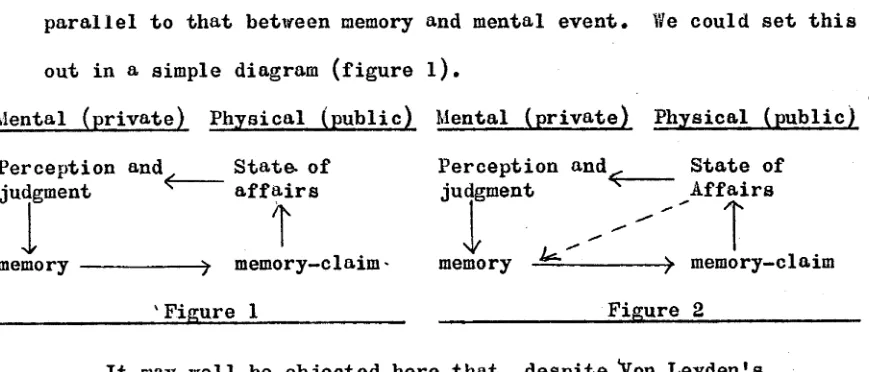
In Chapter IV I examine the relationships between (a) the public event which is remembered (b) the perception of that event (c) the
’remembering state of m i n d ’ and (d) the memory-claims about the event. I suggest, for consideration, this 'model': Memory-claims refer
directly to past public events; they are based upon current memories (the present remembering state of mind) and these memories are of private events - our own past perceptual states.
To forestall a likely objection I argue that even in the case of ’negative memory' (memory that something was not the case) there is a positive element which makes the memory/claim distinction possible.
Wherever there is interpretation there is the possibility of re-interpretation and I claim, therefore, that so long as there exists occurrent memory-imagery, the checking of memory-claims by
introspection alone is possible. I then raise the question whether the imagery itself is merely a representative of past perceptual
In Chapter V I diverge from the main argument to consider the relationship, if any, between remembering events and remembering how to do things. After considering the reasons for claiming that 'how to do things’ is one kind of remembering which defies all attempts to reduce it to, or explain it in terms of, occurrent memories of past events, I argue that there is a distinction we all understand between 'remembering how to' and 'being able to' and attempt to show that the former must depend upon occurrent memories. I base my argument upon the analysis of various uses of 'intelligent', seeking to show that tne only use of that word which serves to distinguish intelligent
performances (instances of 'remembering how to') both from automatic performances and from accidental performances is that use in which it means 'thought-directed' or 'memory-directed'. I also argue that in our performances we actualize both mental dispositions to remember and physical dispositions to act in certain ways, both actualizations being essential to an 'intelligent performance', and that 'remembering an event' need not involve the specific recollection of any instance we should refer to as 'an event' in normal every-day life.
do in fact decide this: ’firmness’ of the imagery, its controllability, and the ’expansion’ of the image context.
I next consider the ’organic origins' of imagery, the relation ship of imagery to sensation, and the possible 'subjects’ of imagery, and conclude that only appearances, as presented to us by the objects we perceive, can be re-presented to us in imagery. Two points, both very important for my argument, emerge from this enquiry: (1) there is no logical reason why the occurrence of any image should exclude the simultaneous occurrence of any other image; and (2) sensations can be distinguished from images by the manner of their presentation alone.
In Chapter VII I put the question ’What is it to have images?' -and consider the case for the 'entity' view of imagery. I reject
this view on the grounds that nothing in our memory-experience in any way demands the existence of any such ’entity’. I then define imagery as our way of remembering past appearances, and challenge the argu ment to show that recognition could not entail occurrent imagery (an
'infinite regress' argument) by making three distinctions: between recognising images and recognising by means of images; between
I
consider an alternative way of remembering events - by verbaldescriptions - and show the limitations of this method. By it we can
only ever know ’that
A
wasB
’; in imagery we know ’howA
w a s ’ (orhow
A
appeared to us).I
suggest that the denial by some men thatthey have imagery at all results from a mistaken idea of what imagery
is, and
I
claim that some remembering is possible only in terms ofhow things appeared - and this is the actual remembering of past events.
I examine ’generic imagery' in the light of my analysis and
definition and conclude that it must be either a multiplicity of
specific images (or imagings) £r a concept (not imagery at all)
arising out of, or supported and exemplified by, imagery.
In my final chapter
I
restate the problem and summarise myarguments and conclusions.
I
claim that in imagery we are actuallypresented with a past event in the same way and to the 3ame extent
as we are presented with a present event in perception.
I
supportthis claim by arguing that the distinction between perceiving,
remembering and imagining is one of degree only; that sensation is
not a different kind of ’evidence’ from imagery for the events which
occur - it is simply the ideal limit of ’firm imagery’.
And
froma consideration of the ’specious present’
I
argue that only on myview can we account for the continuity which characterises our
experience.
As
a natural outcome of my argumentI
define ’the past’I then deal with temporal location of remembered events and conclude that in remembering any event, we remember, however indeter minately, a contextual setting which extends up to the present
moment.
I conclude that since all memory can be reduced to memory of events, and in imagery we are 'given* the appearances presented by the events themselves, no error in a memory-claim is irredeemable. Perceiving is simply a sub-species of remembering, and therefore our perception-claims are no less fallible than our memory-claims.
DOUBTING THE AUTHORITY OF OUR MEMORIES
1 . The ’ s c e p t i c a l * ap p ro a c h
N e a r ly e v e ry w ork on R em em b erin g ' in t r o d u c e s u s t o th e ' s c e p t i c '
whose t a s k i t i s t o show u s n o t o n ly t h a t memory p la y s u s f a l s e , b u t
t h a t o u r m e m o ries, how ever e s s e n t i a l th e y a r e t o t h e e v e ry d a y c o n d u c t
o f o u r a f f a i r s , s h o u ld n e v e r be t r u s t e d s in c e n o th i n g can e v e r
c o n c l u s i v e l y p ro v e t h a t any g iv e n memory i s n o t f a l s e . We can r e p l y
t o t h i s s c e p t i c t h a t t h e same k in d o f a rg u m e n ts a s h e u s e s c o u ld e q u a l ly
w e ll be em ployed t o show t h a t we c a n n o t p ro v e c o n c l u s i v e l y t h a t a g iv e n
memory i s n o t t r u e , t h a t by s e e k in g l o g i c a l c r i t e r i a f o r w hat i s
e s s e n t i a l l y an e m p ir ic a l q u e s ti o n he i s s e t t i n g h i m s e l f a l o g i c a l l y
im p o s s ib le t a s k . 1 b e l i e v e t h e r e f o r e t h a t t h e i n t r o d u c t i o n o f t h i s
s c e p t i c , w h i l s t i t may be a u s e f u l d e v ic e f o r r a i s i n g q u e s t i o n s , may
w e ll be h a rm fu l t o t h e e n q u iry in t h a t i t s u g g e s ts t o u s t h a t a s c e p t i
c a l o r t e n t a t i v e a t t i t u d e t o a l l o f o u r m em ories can be a r e a s o n a b le
p o s i t i o n t o h o ld . C le a r ly i t i s n o t . We a l l o f u s an sw er q u e s t i o n s
a b o u t o u r p a s t e x p e r ie n c e s w ith o u t any h e s i t a t i o n o r d o u b t, we s i t on
c h a i r s w ith t h e u tm o st c o n f id e n c e t h a t t h e y w i l l s u p p o r t u s , we w alk
a lo n g f a m i l i a r r o a d s w ith co m p le te c e r t a i n t y t h a t th e y w i l l le a d u s
t o w here we w ish t o g o .
I t may be o b je c te d t h a t t h e s c e p t i c d o es n o t in f a c t d o u b t t h e
a u t h o r i t y o f a l l h i s m em ories, he o n ly i n s i s t s t h a t memory i s a lw ay s
logically open to doubt, that though in fact many memories are reliable,
and are known to be reliable, it is still logically possible that none
of them is. But if this is all he claims he is a poor sort of sceptic,
for few if any people would wish to disagree with him. Being sceptical
involves rejecting, or holding strong reservations about, some view
seriously put forward by its adherents. A man may be sceptical about
the virtues of socialism or the truth of the Christian doctrines. In
these cases some idea is put forward for his consideration, which has
not, or need not have been, previously entertained at all.
But when we first come to consider the credentials of memory we
have already tacitly accepted them, have taken memory for granted,
trusted it implicitly, and experienced surprise and alarm when it has
proved unworthy of that trust. It is not the ordinary function of
memory, but its capacity for giving us unpleasant surprises, that first
leads us to enquire into its workings. The natural question which
presents itself is not 'How is it that memory can be informative?'
-but - 'How is it that memory is sometimes misinforraative?'. The
proper formulation of our problem, therefore, is not - ’why should
we trust our memories?' — but — 'Why may we be led sometimes to doubt
them?'•
2. The initial authority of memory
I say we are led sometimes to doubt them. It is certain that we
do not always, or even often, doubt them* Our memories have an
to the contrary is very strong we are inclined to stand by the
authority of our own memories* A book is not where I remember leaving it* I ask who has moved it* Everyone assures me that he has not* Yet I am quite confident that somebody must have done so. I find the reply, fYou must have made a mistake1 a quite unconvincing answer to my insistence that 1 remember putting it there.
Perhaps 1 have made a mistake. Perhaps I came back and moved it myself 'unthinkingly'. Perhaps I left it there yesterday, not today. Certainly, assuming that nobody is lying, somebody is mis- remembering. The saving fact is that if such a question is pursued long enough, the misrememberer nearly always finds himself out. For other people this 'finding out* will simply amount to the recall of something which had been temporarily forgotten. For the agent it may be a matter of revising or repudiating what he had regarded as his memory of the event.
What I have called the initial authority of memory - the belief about the past which is quite independent of any outside evidence -
is inseparable from whatever we accept as remembering. We would not regard ourselves as remembering otherwise. But it is present in varying degrees, so that sometimes it is possible for us to 'back
external counter-evidence. But at other times ve feel absolutely sure, on the authority of the memory experience alone, that we are not mistaken.
The great difficulty here is deciding what it is to be ’absolutely sure'. Frequently two people claim to be absolutely sure of incompatible things. And which of them has the better right to be sure cannot be decided wholly according to which of them happens in fact to be right. If, for instance, one savage believes the earth to be flat because he has observed that unsupported bodies always fall, whilst another believes it to be globular simply because this seems to him a more satisfactory shape, then the second happens to be right in his belief, but the first seems to have the better right to hold his belief. In the case of direct remembering, however, there seems to be at least a prima-facie case for allowing the one who is in fact right the right to be sure.
But, whilst ’head-on collisions' do sometimes occur between initially authoritative memories, they are comparatively rare. For every irreconcilable 'memory* there are countless others that fit easily and naturally into the general scheme of known fact. Our strongly authoritative memories are rarely challenged, either by the memories of other people or by the facts as presented to us. Our
less strongly authoritative memories can usually be made to dovetail with the testimony of other people and with the facts as we find
) I
memories have both ‘strong* and 'weak* parts. If 1 'remember* coming
to work at 9.30 a.m. yesterday, and I am told by my neighbour lhat he
saw me at home at 9.45, I am quite happy to reconsider my 'memory*.
Had he claimed that he saw me at home all day my reaction would have
been quite different. I remember very definitely that I went to work,
but much less definitely that it was at 9.30 a.m.
Nevertheless the whole of the original 'memory' had some degree
of initial authority, the weakness of which became apparent only
when my claim was challenged. In fact it is generally only when any
memory is challenged by presented facts, or by the testimony of other
people, or by subsequent memories of one's own, that the question of
the degree of its initial authority arises at all. And because it is
so easy to say, after a successful challenge - 'No, I wasn't remem
bering that at all' or 'Of course, that was the day before' or 'It
certainly happened; it doesn't much matter where', we are apt to
overlook the fact that all our memories come to us in the first place
with the same kind, if not the same degree, of initial authority. We
are apt to overlook it, that is, until a discrepancy of the 'head-on'
kind forces us to wonder just what sort of authority a memory can
ever really have.
3. The causes of doubt
The question, 'Wherein does the authority of memory lie?' is
not just a 'philosopher's puzzle', it is a problem which must present
remember something quite clearly but discovers that he must be
mistaken is bound to ask Himself - 'What is peculiar about this case? How is it that my memory, usually so reliable, has let me down this time?'. And when the only peculiar thing he can find is that his memory gave him the wrong answer, he must inevitably wonder how many of his memories which happen not to have been challenged have been equally false, and how he can ever know that he is not being deluded»
Moreover, the errors of memory are by no means all of the same kind. There does not seem to be any situation, or group of situations, in which we can say 'Here I must be on my guard against delusion', or 'Here I am completely safe'. Why then are we so confident and unhesi- tant about our memories? Is it simply a matter of a beneficial
stupidity as some pragmatically inclined philosophers have suggested? Or is there a secure and indubitable basis of memory that justifies our belief that whatever errors of remembering we may make, further remembering can eventually set matters right for us; that doubt, though it can exist, cannot go on forever?
It does not seem enough to say that our memories are more often found to be right than wrong, that we are comparatively rarely
that lightning is not. We seem to have some ground for assurance
more fundamental than the mere averaging of instances. The guarantee
that I get with my watch does not ensure that it will not go wrong,
only that if it does the makers will replace it with another - and if
necessary another again - until I have one which is reliable. They
are in a position to give such a guarantee because, in addition to
their observation that their watches do not in fact generally go wrong,
they have a knowledge of their design and structure which satisfies
them that the watches ought not to go wrong. Therefore if one of them
does so it must be as the result of some accidental departure from that
design and structure. We feel that if we had some analogous insight
into the structure of memory itself, we should be able to understand
why, and not only how, particular memories are false. We should be
able to guarantee our memories in the way that the watchmaker guarantees
his watches. But when we turn from the specific failures of memory
to the business of remembering in general we find that eacn specific
failure seems to have its counterpart in a general problem. Let us,
then, first consider in detail the particular ways in which memory
can play us false, and then go on to look at the general doubts which
these errors raise about the authority of memory,
a ) Specific Errors of memory
i • Errors of Omission
Whatever can be remembered can also, ipso facto, be forgotten.
Forgetting, i.e. failing to remember what we are in a position to
a. Total forgetting. This can take the form of a complete failure to recollect some past experience. Of course, since the fact that I am not now recollecting a certain experience does not entail that I never again shall do so, the only occasions when I can be said to be totally forgetting are those when the temporary total forgetfulness is made apparent; when I am asked wnat I did on a certain day and am quite unable to answer, or I am asked how I enjoyed the film I saw on the
previous evening and I look blank and ask 'What film?1. The question of forgetting can only arise when the assumption is mane that something is, or should be, remembered.
Other forms of total forgetting are the failure to recognise and the inability to perform once mastered tasks. A house in which I know that I once lived looks quite unfamiliar to me; a man who appears to be a total stranger shows by nis benaviour that I ought to know him; I am surprised to hear that a new coat I have bought is 'exactly like' one I had some years ago. I mount a bicycle after many years of driving a car and fail off because 1 simply cannot balance; or when I am asked to work out the square root of a number by simple arithmetic I find that 1 have forgotten where to start. In all these cases, as in the first, the failure of memory is apparent only as the result of other knowledge, not itself direct memory.
man's face but cannot remember his name; I remember, however, that
I have heard it. I distinctly remember a certain cricket match but
cannot remember who was wicket keeper, though I remember remarking
how good he was. Such omissions of memory we find particularly irri
tating. For memory tells us enough, as it were, to make us feel that
it should tell us more; it supplies the blanks but refuses to fill them,
c. Omission as error. In all these cases we are not so much doing
something as not doing something. And it may be felt, therefore, that
whilst tney are omissions, they are not strictly errors. We do not
say that the boy who has not even attempted the examination question
has got it wrong, but tnis boy gets no more marks, and may even get
less, than the boy who has attempted it and got it wrong. And consider
the case where we are confident that only three people were present at
a meeting we attended, not because we did not notice the fourth at
the time - we may nave spoken to him - but simply because, quite
unaccountably, we do not remember nim. A three-man conference is
clearly a different thing from a four-man conference. Omissions, though
not themselves errors of memory, are certainly a source of such errors,
i i . Errors of commission
jfe now turn to the positive case, less frequent perhaps, but by
no means infrequent. I 'remember* locking the door, but when I come
home it is not locked. I am asked what colour my friend's car is
and I immediately reply 'Blue'. I 'see it quite plainly' - but when
he arrives it is brown, and it has not been re-painted. The dis
tressing thing is that, although I must accept the evidence in such
cases, and sometimes am able to say ’Of course - it is Bill's car
that is blue', or ’It was yesterday that I locked the door’, there
are other times when the original 'memory* seems to persist as
strongly authoritative as ever, and I must simply allow myself to
remain mystified for fear of becoming a bore on the question,
iii. The ’George IV ca s e 1.
So called because George IV is alleged to have 'remembered'
leading a charge at Waterloo, this type of error is sometimes regarded
simply as an extreme case of error of commission. But we may well
feel that the difference from the cases cited above is not only one
of degree. Those cases seem to rest upon the misplacement rather
than the sheer invention of a memory. 1 have locked doors and have
seen blue cars, but George IV never led a charge anywhere. The
difference seems parallel in many ways to that between illusion and
hallucination: the one has a basis in fact which the other has not.
It is true, of course, that there was in fact a Battle of Waterloo
which did not include George IV, just as there are elephants which
are not pink; even an hallucination must be relatable to actual fact
in order to carry the conviction which it does. Nevertheless the
distinction between being relatable to fact in this way and being
based on fact in the manner of a misplaced memory or misinterpreted
visual experience should be quite clear. I shall therefore call such
extreme cases ’mnemic hallucinations'. These are not to be confused
perfectly veridical and in no way deceptive. But the somewhat
grandiose term 'hallucination* must not mislead us into thinking that something like a charge at Waterloo must be involved. A man is doing the same kind of thing as George IV, though less spectacularly, if, having seen his colleagues at school with boils on their necks, and having vividly imagined how unpleasant such a boil would feel, he subsequently 'remembers' having a boil on his own neck as a boy.
Both ii. and iii. deal with 'remembering' what in fact is not the case, but ii. is the insertion of a memory into the wrong context, iii. is the taking of imagination for memory.*
iv. Memory not recognised as such
We now consider the reverse positions what is in fact memory is sometimes taken to be mere imagination. A man awakes in the morning after a wild night out, quite dispassionately he contemplates the
picture of his friends and himself climbing lampposts, breaking windows, being apprehended by the police - and suddenly he realises that it
all really happened. We might say here that his drunken state had given a dream-like quality to his experiences so that the recall of them felt at first more like imagining than remembering. But there is no reason why this same error should not occur under perfectly normal
conditions, and ample evidence that it sometimes does. A composer may be dismayed to hear played on the radio the very melody which he 1
himself had just ’composed’, and realise that he must have been
remembering, not imagining, as he wrote. It is very hard to be certain of the complete originality of one's own work. I have, for instance, a shrewd suspicion that my example of the boil on the neck in the
preceding paragraph is something I read once, though I cannot say where or when. Nor is this error confined to what we might call 'creative activity'• A friend of mine recently showed surprise at finding a full packet of cigarettes in his pocket. I asked him if he did not remember buying them and he replied that he 'supposed he did*. He had been aware, he said, in some way, of having gone into the shop for them, but he had not thought it had really happened,
v. Unexplained familiarity - de.ja v u .
Most of us have at some time experienced the rather uncanny feeling that some incident, some view, some group of words or sounds, was
/
sense of familiarity. But, since this also seems to be all we can
say when we are asked what it is like to recognise something, and
since some epistemologists have regarded this same sense of familia
rity as the feature which distinguishes memory from imagination, when
something feels familiar we like to know why it feels familiar. If,
in the de.ja vu case, we can have a sense of familiarity for no reason
that we or anybody else can discover, what right have we to regard
this same sense of familiarity as the hallmark of recognition and
recollection?
v i . Conflicting memory
Perhaps the greatest confidence shaker of all is the conflict
which arises between our own memories. I am describing some event
I have experienced - ’Last Saturday afternoon - no, morning - I ’m
sorry, Sunday morning, a fellow got out of a black car - no, it was
a green utility and walked straight into a puddle without looking,
-wait,
1
remember now, he did see it but...' and so on.A
fairlynormal reconstruction, we may say, by the time-honoured method of
trial and error. But why the error; why the need for trial? Why
did the wrong answers come up in the first place? And if one
correction is necessary how do we know another is not - and another?
For these changes are not always simply modifications or elaborations,
they are often downright contradictions.
The extent of the problem is seen more clearly when the
contradictions are spaced out, as it were, in time, when we remember
they do not tally. We are frequently obliged to correct one memory- claim in the light of another later memory of the same event. There is the further difficulty that even when one memory-version has given place to another, this does not mean that it is vanquished for all time. Wnen we are climbing hills, it often happens that just before we reach what we have been taking to be the peak another 'peak1 comes into view. This can happen many times in the same climb. But when we do reach the real peak there can be no further doubt about it. Conflicting memories are not like this? there is no simple set of fixed criteria for distinguishing the true from the false.
Each of the specific failures of memory brings its own contri bution to our suspicion about the validity of memory as a whole - not just an empty suspicion that 'it could always be otherwise', but a real suspicion that 'it always may be otherwise*. We now turn to the more general difficulties which seem to confirm this suspicion,
b) General problems of memory i . Unaccountabi1ity
memory just as he can lose his eyesight, but whereas in the latter
case we can tell by physically examining him that he is incapable of
seeing, in the former case all we can know is that he does not in
fact remember anything prior to a certain time. Or, with a different
kind of loss or failure of memory, we know that he is very poor at
remembering things. Seeing and hearing and smelling and tasting and
touching are all in some way like each other; there is a uniformity
about them; we can in certain enquiries predict discoveries about one
from the observation of another. But memory does not seem to be
like anything else. We seem driven to allow that our ability to
remember things is a quite unaccountable 'brute fact' which defies any
attempt at 'structural analysis',
i i . The independence of knowledge of the past
We might say that even if memory is totally unlike perception
from a physiological or organic standpoint, at least it is like it
from a functional standpoint; memory provides us with knowledge of the
past just as perception provides us with the knowledge of the
present. But this will not do. Whilst it might well help to
convey to a child how the word 'remember' is used, it can cast no
light upon what remembering is, nor is it strictly true. Both per
ception and memory are needed for our knowledge of both the past and
the present. That we could not know the past without memory is true
only because we could not know anything without memory, in the
ordinary sense of 'know'• That I know about some past event is no
it in a book. And, because this is so, the fact that I am able to relate some incident that I did in fact witness is no proof that I am actually remembering it at the time. My inability to relate an incident may prove that I am not remembering it (allowing that I have no language difficulty'), but my ability to relate it is no more than a fair indication that I am remembering. It is sometimes very hard indeed to sort out our actual memories from knowledge acquired by other means. This is amply illustrated by what Von Leyden has called 'the childhood test case'.*
iii. The 'childhood test case' - its general applicability
This is, in effect, the general problem arising out of errors of commission as such, and 'mnemic hallucinations' in particular. Most of us have some favourite memories of our own childhood: our first visit to the seaside; or the time we climbed on to the back of the
pony and were thrown off. Not uncommonly such memories are accompanied by quite vivid visual imagery. It is alarming, therefore, when we discover, on revisiting the seaside place, that it is simply nothing like our 'memory' of it, or we learn from a visiting uncle that it was not ourselves at all but our brothers who were thrown from the pony. On reflection we realise that we were, in any case, far too young to remember so clearly. We guess, rightly no doubt, that our
images were built up in our imaginations by stories we heard our
1
parents and their friends tell, and that these images became so familiar to us that they felt like memories - and still do feel like memories. In a sense, perhaps they are; they are the memories of our earlier imaginings. But this is not what we took them to be.
We may then begin to wonder how many more of our childhood
memories are memories only in this derivative sense. The real problem is not those that are plainly false but those that are substantially true. After all, if our uncle had confirmed instead of denying that we were thrown by the pony, we should still think we remembered the
incident itself though our 'memory' would not be one whit different. And why only childhood memories? If there is nothing save counter
evidence to show us the difference between our remembered experiences and our remembered imaginings, and if we are capable - as clearly we are - of imagining situations involving ourselves as they are reported to us, then how can we ever know what we are really remembering and what we only seem to be remembering?
iv. The 'subjective element1 in factual memory
Closely allied to this is another difficulty arising out of the free play of our imaginations. When we remember a state of affairs we remember it as it appeared to us. This is quite natural, right and proper, so long as we always remain capable of distin
voice. If I were to meet him again it is not improbable that I should
find him a charming gentleman. I remember the annual fair on Gretham
village green as a much more grand affair than any such local fairs are
nowadays, yet it seems unlikely that it really was so. Everyone can
supply examples of this kind of distortion from his own experience.
Some time ago the name of a lad I was at school with came up in
conversation and I immediately had a clear visual image of him. But
on reflection I realised that the image was of a man my own age, not
of a boy at all, almost as if the memory had grown up with me.
Because I had always thought of him as my contemporary I remembered
him as my contemporary.
Now, suppose I make an ordinary perceptual error; I think that it
is Black and not White that has won the race I am watching. 1 then
see my error and know that the winner is White. Notwithstanding this
there is no small chance that I will subsequently 'remember' seeing
Black win. I have quite genuinely thought this, seen what I took to
be this, why should 1 not remember this? Samual Alexander may
perhaps have overstated the case when he wrote: 'Though we do not
often attend to our past mental states, we never remember a past
object without some consciousness however faint of the past state',*
but there can be little doubt that our feelings and attitudes and
interpretations frequently do intrude into our recollections of past
'Space, Time and Deity’, Vol. I, p.125.
events we have witnessed, and that, within the memory, the event and the attitude ^the subjective colouration of it) are very hard to separate.
v. No memory can guarantee its own permanence
When we ask ‘Do you remember the night the bomb fell?' we may be told ’Yes - and I'm not likely to forget it', or even 'Yes, I shall never forget it*. But this last is a somewhat reckless claim;
'permanent memories', like permanent waves, are not always permanent. There is no intrinsic difference between those memories which last a lifetime and those which soon disappear forever. Even the fact that I remember having 'remembered' sometning every day for the past year, cannot guarantee that I shall ever remember it again. Nor can
it guarantee that, if I do remember it again, I shall not misremember it in some way. We may say with some justification that the fact that I have remembered it correctly many times in the past makes it induc tively probable that I shall remember it correctly again, but this
is to assume that my remembering of my previous memory is accurate. And it always ij3 a matter of assuming; the only checking available to us is to think again. This brings me to the last and greatest difficulty.
v i • The problem of confirming memories
confirms this. And my memory that I have promised to take my wife to
the theatre is surely confirmed by the fact that she has just entered
dressed in her best clothes. Certainly these occurrences do not
specifically establish that the events I claim to remember did occur,
but when the initial authority of my memories has already provided the
hypotheses all that is required is that these be strengthened.
All this is true. Indeed it would be a bad look-out for us if
it were not. But there are a number of reasons why it can only relieve,
cannot solve, the problem we are faced with.
a. Adequate cause/effect evidence is not always available. At best
cause/effect evidence tells in favour of this or that memory. If it
always told in favour no problem would arise. But, as we have seen,
all too often the evidence points to our having misremembered. The
successful confirmation of one memory, therefore, does not necessarily
increase the probability of the truth of another. I grant that we may
discover from experience that we tend to remember more reliably in
dealing with one type of question than in dealing with another type.
But the value of such a discovery rests upon our ability to Classify*
questions, and can never be more than a useful rule of thumb. Each
individual memory may stand or fall quite independently of any others
without detriment to such a 'rule*. The point is that it is not
always obvious how we can confirm a memory in the way that it ijs
I
obvious how we must verify a perception. If it were obvious the cross
may remember very clearly that I saw a man pedal down the road on a bicycle at 5 a.m., but how could I possibly prove it, even to myself?
Even if independent supporting evidence were always available, it would be quite impossible in practice to confirm every memory by it; tftere simply would not be time* Only when we have already cause to doubt do we seek confirmation to allay that doubt* We seek it in further memories, in the testimony of other people, and in present conditions as we perceive tnem, Wbat evidence we are able to find is an empirical question, dependent upon the circumstances of the case* And whether or not it aoes in fact allay our doubts is ultimately a
psychological question* The expression 'reasonable doubt* may be used in the law. But what constitutes reasonable doubt cannot be laid down oy the law or by any other source of decisions,
b* 'Cause/effect' is dependent upon memory, riven wnen independent evidence does support a particular memory, such evidence can never be conclusive* For, no matter what form it takes, it always presupposes the accuracy of some other memory or memories. If I remember that the vicar called, and then support this memory by remembering that my wife remarked how shabby his coat was and that my daughter spilled tea over his trousers, I may well be satisfied that my original memory is correct. But it is hanging, so to speak, by a sky-hook; the
the vicar did call that day — then I am only adding their memories
to my own to give it extra weight. If I find his hat left in the
hall I must remember that it
ia_
his hat, and even if it has his callingcard inside it marked with the date of his visit, 1 can take this as
conclusive evidence of his visit only on the assumption that such
objects do not materialise in such places of their own accord. And
this assumption, arising as it does out of our ability to associate
observed instances with similar previously observed instances, pre
supposes the validity of memory. Furthermore, even when the assumption
has become an accepted maxim it can be retained, as a maxim, only by
memory. Even an established inductive rule can be forgotten. Under
strong emotional stress men have been known to try to walk through
walls, and children are notoriously capable of forgetting that eggs
break when dropped on the floor.
c. The impossibility of direct comparison. Memory is concerned
with the past - and simply because the past is past it cannot therefore
be held up for present comparison. It is as if some object lay on the
other side of a high wall and we could see it only with the aid of
a mirror held aloft. We may complain that the mirror reverses what
we see, and overcome this difficulty by using two mirrors periscope
fashion. We may suspect that part of what we see is a fault in the
mirror itself and demand a better mirror, or a whole battery of
mirrors to enable us to compare the reflections. But if we ask how
we can know that the mirrors do in fact show us what is on the other
Nov, suppose all the mirrors were slightly distorted and each
showed a slightly different picture; and suppose also that they were
flexible and liable therefore to change the nature of their distortions
when directed to a new object, thus making it impossible to check them
by comparing the reflections they showed with any visible object.
#e might well feel then that we could never know exactly how the thing
on the other side of the wall looked. The only really satisfactory
course would be to climb the wall and see for ourselves the thing as
it actually is. But the 'wall* we are concerned with is time, and
this by its nature can be ’climbed* only from one side,
d. The need to remember the remembering. There is a further diffi
culty which is not always fully realised. Not only is it impossible
to compare our memories with the events of which they are the memories;
but because the present is, as it were, always slipping away from us
into the past we cannot even compare our memories with what purport
to be the effects of the original events (or, more properly, with
our inferences from those ’effects'). For what I am comparing must
always be, not the memory itself, by my memory of that memory.
Suppose that today I remember building, a short while ago, a
castle in the sand. Tomorrow I go to the beach and there it is. I
say, 'Yes, just as I remembered it yesterday'. But how do I then
know it is just as I remembered it yesterday? The sight of the sand
castle itself may well influence my memory of my previous remembering.
memory and notice that they make a number of errors and omissions. When they are finished I say nothing; I just hand the book back to them and they read it again for themselves. They may well be quite satisfied that they got it exactly right. Of course, if they had written the poem instead of just saying it their errors would have been there to be seen, and in any case they generally believe me when I assure them that they did say this or that wrong. But in most cases when we wish to confirm a memory we have neither record of, nor independent witness to, our actual 'act of remembering*,
vii. The apparent impossibility of 'credentials'.
It seems that at every stage a further question can be asked, a further doubt raised. It is not merely that no memory carries within itself its own credentials; it does not even seem possible to know what such credentials would be like.
What if a true memory always felt different from a false one? But then there would just not be any false ones. Nothing could then
The only sort of ’feeling different' we seem able to conceive
is in our own degree of confidence - the initial authority of the
memory itself. And this, as we have seen, far from preventing errors
of memory, is the very thing which promotes them,
4. Being unable to doubt a memory
Nevertheless, we say, there must be some memories which we
simply cannot doubt; the sceptic, after all, is just a device, not
a real man. Our task now is to discover what, in view of all that
we have said, this inability to doubt can amount to. Initially
there are two quite distinct possibilities: 'I cannot doubt' could
refer simply to an empirical or psychological fact, or it could mean
that it would be logically self-contradictory to doubt,
a) Psychological indubitability
It is simply a matter of fact that I cannot seriously doubt,
(which means that 1 cannot doubt), that I am now in Canberra, that
I had bacon and eggs and tomatoes for lunch today, that I have a wife
and two children. I could be misremembering I could be dreaming
-but 1 happen to know that I am not. These are plain facts, and,
however hard they may be to reconcile with some philosophical theories,
to deny them is to be guilty either of frivolity or of blatant false
hood. Nor do I need to justify, in any ordinary sense of that word,
these and other similarly certain beliefs.
But our concern is not to justify particular memories but to
are self-justifying. And if we reject the 'beneficial stupidity1 thesis, we seem bound to allow that the psychological certainty we are aware of must rest in some way upon logical certainty or at least strong logical probability - else what can ’rational grounds for believing' mean?
b) Logical indubitability
We may say that it is logically demonstrable that some memories are true - for otherwise the question of the truth of falsity of any given memory could not arise at all. Our only grounds for doubting one memory are, or at least include, our assumption of the reliability of others. Here it may be protested that the incompatibility of two
’memories' proves only that at least one is false - not that the
other is true. But the very notion of incompatibility can derive only from the assumption that memory is reliable. If our experience were other than it is we should not hold the same pairs of instances incom patible, but wnen we say that our experience is such and sucn we are presupposing that we remember it (in general) correctly.*
But it is not enough to establish that there are true memories? we must also be able to identify them, to distinguish them from false ones as they arise. And, as we have seen, every attempt to achieve 1
this distinction by logical demonstration must fail since the demon
stration always assumes part of what it seeks to prove.
There is, however, another possibility. To say that in the case
of a particular class of memories it is logically indubitable that what
I remember actually occurred may mean that this particular class of
memories is of the wrong logical type for doubt to apply to,
I cannot climb Everest; I am neither trained nor fit enough, I
cannot at once both climb and descend (except perhaps by walking up
the 'down* escalator;; this is logically contradictory. And I
cannot climb the floor; this is simply inapplicable - floors are not
things to be climbed. Now, propositions, judgments and inferences are
the sort of things it makes sense to doubt. Events, entities,
qualities, are not the sort of things it makes sense to doubt; we can
only doubt something about them. The categorical difference between
those things we can doubt, in the normal sense of that word, and those
things we simply cannot, may be made plainer by the following distinction.
When we say a proposition is false we are saying something about
the proposition itself. But, when we apply the term 'false', as in
common speech we often do, to such things as teeth and hair and the
bottoms of suitcases, we are really saying that these things are
designed (or simply happen) to make us think that they are something
other than they are and so lead us to formulate false propositions,
to make false inferences; we are saying that they are, in some way,
to what extent anything is misleading is a contingent empirical
question - whether and to what extent it does in fact mislead somebody. It is important also to realise that a thing is not necessarily mis leading because it is false. The message on the old m a n ’s placard -
’The end of the world is at hand1, is almost certainly false; but it is misleading only if somebody takes it seriously and starts repenting.
There is another way in which this could be misleading and that is if the natural inference that the old man bearing it is a religious crank is in fact not true - he may be a spy or a detective. The
placard is tuen a sign for most of us of something which is not the case it is a misleading sign. And, conversely, a true statement at the
literal level can be grossly misleading, as Macbeth discovered to his cost.* If I say ’I didn’t give the chocolate to the baby' when in fact 1 had put it on the table and watched him take it, then I am being both truthful and misleading at the same time. This is why inflections play so large a part in everyday speech.
The importance of this distinction is that, whereas what is false is simply false and that is all there is to it, that anything is
misleading is contingent upon someone’s being misled by it. A sign is always of something for somebody. It is always possible therefore that some other person will be ’rightly led' by the same sign, or that 1
'And be these juggling fiends no more believed, That palter with us in a double sense;
That keep the word of promise to our ear,
the one originally misled will correct his error although the object
wnich operated as a sign remains unaltered. Examination may show
that a great deal of what we call ’remembering1 lies at the sub-inferential level. Therein we may find the warrant we are looking
for to justify tne psychological certainty we do in fact achieve about
most of our memories. Our task now is to discover what kinds or
parts of memory, if any, can be properly said to be true or false,
and what kinds or parts, if any, can properly be said, at worst, to
WHAT DO WE MEAN BY '
RSM&i
BERING'
?
1. Various attempts to frame a definition
Before going any further we must try to decide just what is to
count as memory. We must remember, however, that we are discovering,
not legislating about, what memory is, and give an equal hearing,
therefore, to every claimant that seems to be an instance of remem
bering. Various 'definitions of memory' have been advanced by
philosophers but they all seem to be either too restrictive, begging
the point at issue by an arbitrary dismissal of inconvenient facts
and awkward experiences, or too wide, embracing a good deal that does
not even seem to be memory - and thus failing to define,
a) The standard restrictive definition
William James defines^ 'memory' thus: 'It is the knowledge of an
event or fact, of which meantime we have not been thinking, with the
additional consciousness that we have thought or experienced it before'.
He is very definite in his view that the mere occurrence of an image
in the mind without this additional consciousness does not constitute
a memory, even though the image may be a faithful representation of
some previous experience. 'Such a revival is obviously not a memory,
whatever else it may be; it is simply a duplicate, a second event,
T
Principles of Psychology, Vol. 1, p.648. (His italics).
h a v in g a b s o l u t e l y no c o n n e c t i o n w i t h t h e f i r s t e v e n t e x c e p t t h a t i t
h ap p e n s t o r e s e m b le i t . ’ The same view - t h a t t o be remembering we
must know we a r e rem em bering - seems t o be i m p l i c i t i n B e r t r a n d
R u s s e l l ' s c l a i m : * ' I f we a r e t o know - a s i t i s su p p o se d we do - t h a t
im ages a r e " c o p i e s " , a c c u r a t e o r i n a c c u r a t e , o f p a s t e v e n t s , so m eth in g
more t h a n t h e mere o c c u r r e n c e o f im ages must go t o c o n s t i t u t e t h i s
k n o w led g e. For t h e mere o c c u r r e n c e , by i t s e l f , would n o t s u g g e s t
any c o n n e c t i o n w i t h a n y t h i n g t h a t had happened b e f o r e ' • The i d e a t h a t
t o remember i s a lw ay s t o r e f e r b a c k , c o n s c i o u s l y , t o t h e p a s t commends
i t s e l f t o common s e n s e and seems g e n e r a l l y t o a c c o r d w i t h common u s a g e .
But i t r a i s e s c e r t a i n d i f f i c u l t i e s ,
i . ' M em ories' and 'r e m e m b e r in g *
I f e e l t h a t we must d i s t i n g u i s h t h e memories which we h av e from t h e
rem em bering which we d o . I f I s p eak o f a memory I am h a v in g t h e n
c l e a r l y I must be c o n s c i o u s l y aw are o f some h ap p e n in g a s b e l o n g in g t o
t h e p a s t . Jfet i t d o es make s e n s e , I b e l i e v e , t o s ay o f some o t h e r man
t h a t he i s rem em bering c e r t a i n p a s t e v e n t s even th o u g h t h a t man i s n o t
t h e n c o n s c i o u s o f t h e s e e v e n t s a s p a s t . I t i s enough t h a t h e i s a b l e
t o r e l a t e , r e c o g n i s e , p e rfo rm o r v e r i f y b e c a u s e he h a s i n f a c t had a
c e r t a i n e x p e r i e n c e i n t h e p a s t , w h e th e r o r n o t he i s aware a t t h e tim e
o f t h e c o n n e c t i o n b etw een t h a t p a s t e x p e r i e n c e and h i s p r e s e n t a c t i v i t y .
Thus J a m e s ' d e f i n i t i o n , w h i l s t i t may w e ll be a p p l i c a b l e t o t h o s e
1
particulars we call memories, cannot be applied to remembering as an activity. We can speak, quite properly and normally, after the event of having remembered, even though the particular memories in question were not recognised as such.
I
may, for instance, make an assertion of fact and, whenI
am asked howI
know, reply, after some consideration, thatI
remember it. Under these circumstances it would seem very odd to say that i started to remember it only when replying to the question - especially as my reply shows that, since my knowledge is based upon my own past experience, 1 must have been remembering it already,i i , The assumption of reflexiveness
Prima-facie, remembering is one way of knowing things. It has been strenuously denied by some writers1 that remembering is a way of getting to know things, but it would seem simply perverse to deny that it is a way of actually knowing something here and now.
Now, if 1 could not know that a bird is sitting on that chimney pot without also knowing that I know that a bird is sitting there, then
I
could not know this without knowing thatI
know it - and so on ad infinitum. It follows thatI
need not be (thoughI
may be; aware that I know something in order to know it.And if the 'knowing* in question is remembering, whereas
I
might know thatI
am remembering a certain event,I
could remember itperfectly well without any 'additional consciousness' at all. Russell
is quite right when he says that something more than the mere occurrence
of an image is necessary; it is also necessary that we recognise it,
that is, see it as> something. But it is a further, and usually quite
unnecessary, step to see ourselves as seeing it as something.
iii. Real memory - imagined imagining
One of the problems we considered in chapter I* is simply ruled
out by the present definition. If to remember is to know that we
remember, we could not remember something and think ourselves to be
only imagining it. To preserve the definition we should have to say that
remembering commences only when we realise that we are remembering,
notwithstanding that nothing else is changed thereby. And if, as is
certainly possible, we never do realise this, we should never have re
membered the event at all. We should have imagined it, even though
every detail is in fact a representation to us of our own past
experience.
iv. Intermediate stages of remembering and d i s c arded candidates*
Whether we are deliberately trying to remember something or simply
allowing our memories to ’wander', the arrival at a particular piece of
remembered information may be the culmination of quite a long process,
2
involving, as we saw in the previous chapter, the consideration and
rejection of various propositions and images. Suppose, for example, that
—
1
See p.ll.