executions
.
White Rose Research Online URL for this paper:
http://eprints.whiterose.ac.uk/136601/
Version: Accepted Version
Proceedings Paper:
Doherty, S., Dongol, B., Wehrheim, H. et al. (1 more author) (2018) Making linearizability
compositional for partially ordered executions. In: Furia, C. and Winter, K., (eds.)
Integrated Formal Methods. IFM 2018, 05-07 Sep 2018, Maynooth, Ireland. Lecture Notes
in Computer Science, 11023 . Springer Verlag , pp. 110-129. ISBN 9783319989372
https://doi.org/10.1007/978-3-319-98938-9_7
The final publication is available at Springer via
https://doi.org/10.1007/978-3-319-98938-9_7
[email protected] https://eprints.whiterose.ac.uk/ Reuse
Items deposited in White Rose Research Online are protected by copyright, with all rights reserved unless indicated otherwise. They may be downloaded and/or printed for private study, or other acts as permitted by national copyright laws. The publisher or other rights holders may allow further reproduction and re-use of the full text version. This is indicated by the licence information on the White Rose Research Online record for the item.
Takedown
If you consider content in White Rose Research Online to be in breach of UK law, please notify us by
Partially Ordered Executions
Simon Doherty1, Brijesh Dongol2, Heike Wehrheim3, and John Derrick1
1
University of Sheffield, UK
2
Brunel University London, UK
3
University of Paderborn, Germany
Abstract. In the interleaving model of concurrency, where events are totally ordered, linearizability is compositional: the composition of two linearizable objects is guaranteed to be linearizable. However, lineariz-ability is not compositional when events are only partially ordered, as in the weak-memory models that describe multicore memory systems. In this paper, we present a generalisation of linearizability for concur-rent objects implemented in weak-memory models. We abstract from the details of specific memory models by defining our condition using Lam-port’s execution structures. We apply our condition to the C11 memory model, providing a correctness condition for C11 objects. We develop a proof method for verifying objects implemented in C11 and related mod-els. Our method is an adaptation of simulation-based methods, but in contrast to other such methods, it does not require that the implemen-tation totally orders its events. We apply our proof technique and show correctness of the Treiber stack that blocks on empty, annotated with C11 release-acquire synchronisation.
1
Introduction
Linearizability [24, 23] is a well-studied [16] condition that defines correctness of a concurrent object in terms of a sequential specification. It ensures that for each history (i.e., execution trace) of an implementation, there is a history of the specification such that (1) each thread makes the same method invocations in the same order, and (2) the order of non-overlapping operation calls is preserved. The condition, however, critically depends on the existence of a total order of memory events (e.g., as guaranteed bysequential consistency (SC) [31]) to guar-antee contextual refinement [20] and compositionality [24]. Unfortunately, most modern execution environments can only guarantee a partial order of memory events, e.g., due to the effects of relaxed memory [3, 5, 8, 34]. It is known that a naive adaptation of linearizability to the partially ordered setting of weak memory is problematic from the perspective of contextual refinement [18]. In this paper, we propose a generalisation of linearizability to cope with partially ordered executions, which we show satisfies compositionality.
To motivate the problem consider the following. Figs. 1 and 2 show two examples4of multi-threaded programs on which weak memory model effects can
4
Init:x= 0, y= 0
Process 1 Process 2 1 :x:= 1; 1 :if(y= 1)
2 :y:= 1; 2 : assert(x= 1);
Fig. 1.Writing to shared variables
Init:S=hi,S′=hi
Process 1 Process 2
1 :S.Push(1); 1 :if(S’.Pop= 1) 2 :S’.Push(1); 2 : assert(S.Pop= 1);
Fig. 2.Writing to shared stacks
be observed. Fig. 1 shows two threads writing to and reading from two shared variablesxandy. Under SC, theassertin process 2 never fails: ifyequals 1,x must also equal 1. However, this is not true in weak memory models like C11 [8, 28]: if the writes to xand y are relaxed, process 2 may observe the write toy, yet also observe the initial valuex(missing the write to xby process 1).
Such effects are not surprising to programmers familiar with memory mod-els [8, 28]. However, programmer expectations for linearizable objects, even in a weak memory model like C11, are different: if the two stacksSandS′
in Fig. 2 are linearizable, the expectation is that theassertwill never fail since lineariz-able objects are expected to be compositional [24, 23], i.e., any combination of linearizable objects must itself be linearizable. However, it is indeed possible for the two stacks to be linearizable (using the classical definition), yet for the pro-gram to generate an execution in which the assert fails, i.e., the composition of the two stacks is not linearizable. The issue here is that linearizability, when naively applied to a weak memory setting, allows too many operations to be considered “unordered”.
Failure of compositionality is repaired by strengthening the requirements of linearizability on partial orders. Namely, we require the ability to infer enough order in an execution to ensure that the method callS.Push(1)precedes S.Pop, forcing S.Popto return 1, whenever S’.Push(1) precedesS’.Pop.
The contributions of this paper are as follows.
– Our main contribution is the development of a new compositional notion of correctness; we call this conditioncausal linearizability.
– We establish two meta-theoretical properties of causal linearizability. First, we show that, as expected, causal linearizability reduces to linearizability when the underlying memory model is totally ordered. Second, we show that that causal linearizability is the weakest possible strengthening of lin-earizability that guarantees compositionality, i.e., any correctness condition stronger than linearizability that is also compositional must imply causal linearizability.
– We present a new inductive simulation-style proof technique for verifying causal linearizability of weak memory implementations of concurrent objects, where the induction is over linear extensions of the happens-before relation. This is the first such proof method for weak memory, and one of the first that enables refinement-based verification, building on existing techniques for linearizability in SC [36, 16, 13].
the standard Treiber Stack under C11, we identify a synchronisation pitfall when using only release-acquire synchronisation.
Causal linearizability is so called because it takes into account the causal relationship between events in a way that is relevant to weak memory models. There is an earlier definition of a condition also called “causal linearizability” introduced by Doherty and Derrick in [11]. However, this earlier definition con-siders causality at the level of (interleaved) sequences and only applies to memory models such as TSO, that satisfy certain operational properties.5 In contrast,
the definition in this paper (Definition 6) considers causality directly over partial orders, making it applicable to a wider range of memory models.
The definition of causal linearizability in this paper is built on the same concerns as the earlier definition in [11], but is not a generalisation of it in a technical sense. Thus Definition 6 does not reduce to the condition in [11], or vice versa, although both reduce to classical linearizability [24]. All mentions of “causal linearizability” in this paper refers to Definition 6. Further comparisons to related correctness conditions are given in Section 8.
Causal linearizability is defined in terms of anexecution structure[32], tak-ing two different relations over operations into account: a “precedence order” (describing operations that are ordered in real time) and a “communication re-lation”. Execution structures allow one to infer the additional precedence orders from communication orders (see Definition 3(A5)). Applied to Fig. 2, for a weak memory execution in which the assert fails, the execution restricted to stack
S would not be causally linearizable in the first place (see Section 3 for full details). Execution structures are generic, and can be constructed for any weak memory execution that includes method invocation/response events. We develop one such scheme for mapping executions to execution structures based on the happens-before relation of the C11 memory model.
This paper is structured as follows. We present our motivating example, the Treiber Stack in C11 in Section 2; describe the problem of compositionality and motivate our execution-structure based solution in Section 3; and formalise causal linearizability and compositionality in Section 4. Causal linearizability for C11 is presented in Section 5, and verification of the stack described in Section 6. Section 7 describes a synchronisation pitfall.
2
Treiber Stack in C11
The example we consider (see Algorithm 1) is the Treiber Stack [40] (well-studied in a SC setting, but not in a weak memory one), executing in a recent version of the C11 [30] memory model. In C11, commands may be annotated, e.g., R
(for release) and A (for acquire), which introduces extra synchronisation, i.e.,
additional order over memory events [8, 28]. We assume racy read and write accesses that are not part of an annotated command are unordered or relaxed,
5
Algorithm 1Release-Acquire Treiber Stack
1: procedureInit
2: Top := null;
3: procedurePush(v) 4: n := new(node) ; 5: n.val := v ; 6: repeat
7: top :=A Top ;
8: n.nxt := top ;
9: untilCASR(&Top, top, n)
10: functionPop
11: repeat
12: repeat
13: top :=A Top ;
14: untiltop6= null ; 15: ntop := top.nxt ;
16: untilCASR(&Top, top, ntop)
17: returntop.val ;
i.e., we do not consider the effects of non-atomic operations [8]. Full details of the C11 memory model are deferred until Section 5.
Due to weak memory effects, the events under consideration, including method invocation and response events are partially ordered [5, 28, 14, 30, 6]. As we show in Section 3, it turns out that one cannot simply reapply the standard notion of linearizability in this weaker setting; compositionality demands that we use modified correctness condition, causal linearizability, that additionally requires “communication” across conflicting operations.
In Algorithm 1, all accesses to Top are via an annotated command. Thus, any read of Top (lines 7, 13) reading from a write to Top (lines 9, 16) induces happens-before order from the write to the read. This order, it turns out, is enough to guarantee invariants that are in turn strong enough to guarantee6
causal linearizability of the Stack (see Section 6).
Note that we modify the Treiber Stack so that thePopoperation blocks by spinning instead of returning empty. This is for good reason - it turns out that the standard Treiber Stack (with a non-blockingPopoperation) isnotnaturally compositional if the only available synchronisation is via release-acquire atomics (see Section 7).
3
Compositionality and Execution Structures
This section describes the problems with compositionality for linearizability of concurrent objects under weak execution environments (e.g., relaxed memory) and motivates a generic solution usingexecution structures[32].
Notation. First we give some basic notation. Given a set X and a relation r ⊆ X ×X, we say r is a partial order iff it is reflexive, antisymmetric and transitive, and a strict order, iff it is irreflexive, antisymmetric and transitive.
6
A partial or strict orderr is atotal order on Xiff either (a, b)∈r or (b, a)∈r for all a, b ∈ X. We typically use notation such as <, ≺, to denote orders, and write, for example, a < b instead of (a, b)∈ <. We let X∗ denote the set of all finite sequences over X, let hi denote the empty sequence and use ◦ as a concatenation operator on sequences. For a sequence w, we let w be the (total) order on its elements:e we′ ifw=w1◦ hei ◦w2◦ he′i ◦w3.
Fix a set ofinvocationsInvand a set ofresponses Res. A pair fromInv×Res represents anoperation. Each invocation includes both amethod nameand any arguments passed to the method; each response includes any values returned from the method. For example, for a stackSof natural numbers, theinvocations of the stack might be represented by the set{Push(n)|n∈N} ∪ {Pop}, and theresponsesbyN∪ {⊥,empty}, and the set of operations of the stack is
ΣS={(Push(n),⊥),(Pop, n)|n∈N} ∪ {(Pop,empty)} .
In an execution, an occurrence of an invocation, response, or operation will take the form of an event. In a full treatment, events would have the form e = (l, t, g), where l is a label of type Inv ∪Res (for executions of a concrete implementation) or Inv×Res (for executions of an abstract specification),t is a thread identifier t from some given set of threads (or processes) T id and g is a tag uniquely identifying the event in the execution. However, for clarity of presentation, we omit tags in this paper. Furthermore, for uniformity, we assume that all invocations, responses and operations are indexed by thread identifiers. For example, the invocations are now given by the set {Pusht(n),Popt | t ∈ T∧n∈N}. We only make thread ids explicit when necessary. We lettid(e) be the thread identifier of event e. For a sequence or partial order of eventsw, we letw⇂tbe the restriction ofwto eventsewithtid(e) =tonly.
The standard notion of linearizability is defined for a concurrent history, which is a sequence (or total order) ofinvocationand responseevents of opera-tions. Since operations are concurrent, an invocation of an operation may not be directly followed by its matching response in this sequence, and hence, a history induces a partial order on operations (through the total order on events). For lin-earizability, we focus on theprecedenceorder (denoted ), where, for operations oando′
, we say o o′
in a history iff the response of operationooccurs before the invocation of operationo′
in the history. A concurrent implementation of an object is linearizable if the precedence order ( ) forany history of the object can be extended to a total order that islegal for the object’s specification [24]. It turns out that linearizability in this setting iscompositional [24, 23]: any history of a family of linearizable objects is itself guaranteed to be linearizable.
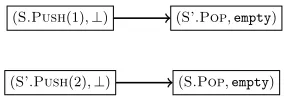
Example 1. Consider an execution of Fig. 2 where the operations are only or-dered by a happens-before relation, which is a relation present in many weak-memory models [5, 3, 34, 8]. Since we do not have a global notion of time, we say operationoprecedeso′ (denotedo o′) if the response ofohappens before the invocation ofo′ (also see [18]). For the C11 memory model, happens-before includes program order, and hence, the progam in Fig. 2 may generate the fol-lowing execution, where operations executed by the same thread are precedence ordered.
(S.Push(1),⊥) (S’.Push(1),⊥)
(S’.Pop,1) (S.Pop,empty)
If we restrict the execution above toSonly, we can obtain a legal stack behaviour by linearizing (S.Pop,empty) before (S.Push(1),⊥) without contradicting the precedence order in the diagram above. Similarly, the execution when re-stricted toS′ is linearizable. However, the full execution is not linearizable: or-dering the pop ofSbefore its push, and the push ofS’before its pop contradicts
the precedence order . ⊓⊔
A key contribution of this paper is the development of a correctness condition, causal linearizability, that recovers compositionality of concurrent objects with partially ordered histories. Our definition is based on two main insights.
Our first insight is that one must augment the precedence order with addi-tional information about the underlying concurrent execution. In particular, one must introduce information about thecommunication between operations, e.g., when one operation sees the effects of another one. In our example, a pop would see the effect of a push; in the Treiber algorithm it would specifically see the change of Top. Causal linearizability states that the ordering we impose during linearization has to (a) preserve the precedence order of operations and (b) has to be consistent with the communication order. We represent communication by a relation .
Example 2. Consider again the partial order in Example 1. For stackS, we must linearize pop before push, and for stackS’, push before pop. Causal linearizabil-ity mandates the existence of alogical order that contains such that all linear extensions of the logical order are legal w.r.t. the specification object. Moreover, it requires that this logical order is contained within the communication rela-tion. Hence, in Example 1, neitherS nor S’ is causally linearizable: for S, the only valid logical order is S.Pop before S.Push(1), but there is currently no communication fromS.PoptoS.Push(1). Thus, the execution in Example 1 is not a counterexample to compositionality of causal linearizability. Now consider changing the example by introducing communication as follows:
(S.Push(1),⊥) (S’.Push(1),⊥)
Here, communication is introduced in a manner consistent with the logical order, which requires that (S.Pop,empty) is linearized before (S.Push(1),⊥) and that (S’.Push(1),⊥) is linearized before (S’.Pop,1). So far, we would consider this to be a valid counterexample to compositionality. We describe why this cannot
be the case below. ⊓⊔
Our second insight is that the operations (taken as events) together with the precedence order and the communication relation must form anexecution structure [32].
Definition 3 (Execution structure). If E is a finite7 set of events, and
, ⊆E×E are relations overE (theprecedence orderandcommunication relation), an execution structure is a tuple (E, , ) satisfying the following axioms fore1, e2, e3∈E.
A1 The relation is a strict order.
A2 Whenevere1 e2, thene1 e2 and¬(e2 e1). A3 If e1 e2 e3 or e1 e2 e3, thene1 e3.
A4 If e1 e2 e3 e4, thene1 e4. ⊓⊔
Example 4. We apply Definition 3 to Example 2. The requirements of an execu-tion structure, in particular axiomA4necessitate that we introduce additional precedence order edges as follows.
(S.Push(1),⊥) (S’.Push(1),⊥)
(S’.Pop,1) (S.Pop,empty)
For example, the edge (S’.Pop,1) (S’.Push(1),⊥) is induced by the combina-tion of edges (S.Push(1),⊥) (S’.Push(1),⊥) (S’.Pop,1) (S.Pop,empty) together with axiom A4. However, this structure now fails to satisfy axiomA2
and is thus no longer a proper execution structure. ⊓⊔
Hence, for our running example, compositionality no longer fails. We conclude that for causally linearizable stacks, the assert in Fig. 2 always holds if it is executed.
4
Causal Linearizability
Causal linearizability extends linearizability to cope with partially ordered exe-cutions. Next, we will formally define it and its compositionality property.
Like ordinary linearizability, causal linearizability is defined by comparing the behaviour of concurrent executions tolegalsequential ones. The comparison typ-ically proceeds by bringing concurrent operations in sequence under some given constraints. This basic principle is kept for the partially ordered case. Legality is defined by asequential object specification, which we define operationally.
7
Definition 5. A sequential object is a 4-tuple (Σ, Γ,init, τ), where Σ is a set of labels,Γ is a set of states, init∈Γ is an initial state, andτ ⊆Γ ×Σ×Γ is a transition relation.
The setΣ ⊆Inv ×Res consists of pairs of invocations and responses. For our stack example,Γ =N∗
,init=hiand
τ={(s,(Push(n),⊥),hni ◦s)|n∈N} ∪ {(hni ◦s,(Pop, n), s)|n∈N}
∪ {(hi,(Pop,empty),hi)}
We write s opτ s′ for (s, op, s′)∈τ. For a sequencew∈Σ∗, we write s w
τ s′ iff either w=hiands =s′
, orw=hopi ◦w′
and there exists an s′′
such that
s opτ s′′ands′′ w′
τ s′. The set oflegal histories of an objectS= (Σ, Γ,init, τ) is given bylegalS={w∈Σ
∗| ∃
s∈Γ.init wτ s}.
In general, executions of concurrent processes might invoke operations on more than one object. To capture this, we define a notion of an object product. If S1= (Σ1, Γ1,init1, τ1) and S2 = (Σ2, Γ2,init2, τ2) are two sequential objects with Σ1∩Σ2 = ∅, the object product of S1 and S2 is defined by S1 ⊗S2 =
(Σ1∪Σ2, Γ1×Γ2,(init1,init2), τ1⊗τ2), where
τ1⊗τ2={((s1, s2), op1,(s′1, s2))|op1∈Σ1∧(s1, op1, s′1)∈τ1}
∪ {((s1, s2), op2,(s1, s′2))|op2∈Σ2∧(s2, op2, s′2)∈τ2}.
Clearly, this construction can be generalised to products of more than two ob-jects, provided their sets of actions are pairwise disjoint. We abstain from such a treatment here since a compositionality result for two objects is sufficient to ensure compositionality over multiple objects.
Causal linearizabilty compares the concurrent execution given by an exe-cution structure to the legal sequential behaviour. The constraint on this se-quentialization is that the precedence and the communication order of execution structures provide lower and upper bounds for the allowed ordering. More pre-cisely, we use a partial order < that contains all orders necessary to ensure legality, i.e., there is no linear extension of<that is not legal. Causal lineariz-ability requires (a) the precedence order of execution structures to be preserved by this order, and (b) this order to be contained in the communication rela-tion. We say a strict partial order<is a logical order of an execution structure E= (E, , ) iff <⊆E×E and ⊆<⊆ . For concurrent objects, one possible instantiation of a logical order is given in [12], where the logical order corresponds to a conflict-based notion of causality.
For a partial order<⊆E×E, we letLE(<) ={w∈E∗|<⊆
w} be the set oflinear extensions of<.
Causal linearizability guarantees compositionality, i.e., the composition of causally linearizable concurrent objects is causally linearizable. More formally, for an exe-cution structureE= (E, , ) and eventsX ⊆E, we letE⇂Xbe the execution structure restricted toX, i.e., (X, ∩(X×X), ∩(X×X)).
Theorem 7 (Compositionality). If S1 = (Σ1, . . .) and S2 = (Σ2, . . .) are sequential objects with Σ1∩Σ2 =∅ and E= (E, , )is an execution
struc-ture, then E⇂Σ
1 is causally linearizable w.r.t.S1 and E⇂Σ2 causally linearizable
w.r.t.S2 iffEis causally linearizable w.r.t.S1⊗S2. ⊓⊔
Standard linearizability as introduced by Herlihy and Wing [24] is defined on executions (histories) which are totally ordered sequences of invocations and responses of operations, i.e. a historyhis an element of (Inv∪Res)∗. Note that this allows executions in which operations are concurrent because invocation and response events are now separated. Histories are required to bewell-formedand complete8, which means that the projection of a history onto one thread forms
a sequence of invocations and corresponding responses.
A strict order≺onInv∪Res is well-formed and complete iff for all threads t ∈ T id, ≺⇂t is sequential, i.e., forms an alternating total order of invocations and responses starting with an invocation. Invocations and responses thus form matching pairsas defined by a functionmp. For a strict order≺such thati≺r, (i, r)∈mp(≺) ifftid(i) =tid(r) and there is no eventesuch thati≺e≺rand tid(e) =tid(i). This allows us to derive an execution structure from any strict order and thus also from a historyhby using its ordering h.
Definition 8. Let ≺ be a well-formed and complete strict order on Inv∪Res. We say exec(≺) = (E, , )is the execution structure corresponding to≺if
E = mp(≺),
= {((i1, r1),(i2, r2))∈E×E|r1≺i2},
= {((i1, r1),(i2, r2))∈E×E|i1≺r2}.
Note that this construction guarantees asaturationproperty: for two eventse, e′ , we either havee e′
ore′ e.
The classical definition of linearizability only employs the precedence ordering of an execution structure. That is, (E, , ) is linearizable w.r.t. a sequential object S iff there exists a sequencehs∈legalS such that (i) ⇂t= hs⇂t for allt∈Tid(threads execute the same sequence of operations) and (ii) ⊆ hs (precedence ordering between operations is preserved). We say that a strict order
≺is linearizable iffexec(≺) is linearizable and that a historyhis linearizable iff h is linearizable.
Theorem 9. Suppose h is a history and S a sequential object. Then h is lin-earizable w.r.t. Siff exec( h)is causally linearizable w.r.t.S. ⊓⊔
8
We now provide an adequacy result for causal linearizability, i.e., show that causal linearizability is, in fact, the weakest possible strengthening of lineariz-ability that is compositional. The technical exposition is formalised in terms of correctness conditions that guarantee linearizability. Here, we regard a correct-ness condition to be a function mapping a sequential object to the set of all well-formed strict orders onInv∪Res accepted as being correct for the object, where the mapping is closed under renaming of the operations.
We letS be the set of all possible sequential objects and H the set of all possible well-formed complete strict orders on Inv ∪Res. To formalise closure under renaming, we assume a bijection b : X → Y between sets X and Y. If S = (X, Γ,init, τ) is a sequential object, define b[S] = (Y, Γ,init, b[τ]), where b[τ] ={(s, b(x), s′
)| (s, x, s′
)∈ τ} and ifw ∈ X∗
, define b[w] ∈ Y∗
to be the sequence obtained fromwby replacing eachwi byb(wi).
Definition 10. We say a function∆:S →2H
is a correctness conditioniff∆ is closed under renaming of operations, i.e., for all bijective functionsb:Σ→Σ′ and for allS= (Σ, . . .)∈ S, we have≺ ∈∆(S)iffb[≺]∈∆(b[S]).
Definition 11. We say∆:S →2H
guarantees linearizability iff for allS∈ S, each ≺ ∈∆(S)is linearizable w.r.t. S.
Our adequacy result for causal linearizability is defined for well-formed strict orders that have exactly one possible legal linearization. Formally, for a correct-ness condition ∆and sequential object S, we say≺ ∈∆(S) isstrongly synchro-nisediff it is linearizable w.r.t. exactly onehs∈legalS.
Theorem 12. Let ∆ be a compositional correctness condition, and let S be a sequential object. Then for any strongly synchronised strict order ≺ ∈ ∆(S), exec(≺)is causally linearizable.
Strong synchronisation may always arise for some specifications, e.g,. a data structure such as a stack or a counter object that only provides a fetch-and-increment operation. In general, the execution of any object may be strongly synchronised due to interactions with other objects or a client (see [18]), causing additional precedence order to be introduced. For example, a client thread of a concurrent object may introduce precedence order via program order, inserting fences between operation calls, or calling objects that induce additional order [18, 6]. Thus for typical sequential objects, a correctness condition that prohibited strongly synchronized executions would be overly restrictive. Theorem 12 ensures that, for such executions, if the correctness condition is compositional then it is at least as strong as causal linearizability.
5
C11 Executions
ignore various features of C11 not needed for our discussion, including non-atomic operations and fences. For a more complete explanation see e.g. [28]
The C11 memory-model. The memory model specifies how read and write operations access shared state. Let Lbe a set of such sharedlocations (ranged over by x, y) and let V be a set of values (ranged over by u, v). Our model employs a set of memory events, which can be partitioned into read events, R, write events, W, and update (read-modify-write) events, U. A read event would e.g. take the form rd(x,0). An update event occurs for instance when a CAS operation is executed: a shared location is read, compared to a local variable and then possibly written to. We letMod =W∪U be the set of events that modify a location, and Qry = R∪U be the set of events that query a location. For any memory evente, letloc(e) be the event’s accessed location and Loc(x) ={e|loc(e) =x} the set of events accessing locationx. For any query event letrval(e) be the value read; and for any modification event letwval(e) be the value written. An event may carry a synchronisation annotation, which (in our restricted setting) may either be a release,R, or an acquire,A, annotation,
and we letann(e) be an event e’s annotation.
Definition 13. A C11 execution is a tuple D= (D,sb,rf,mo), whereD is a set of events, and sb,rf,mo ⊆D×D define the sequenced-before,reads-from andmodification order relations, respectively.
We say a C11 execution is validwhen it satisfies the following constraints:
(V1)sbis a strict order, such that, for each processp, the projection ofsbonto p is a total order; the reads-from relation specifies the write a particular read event reads-from:rf ⊆Mod×Qry and(V2)for all (w, r)∈rf,loc(w) =loc(r) and wval(w) =rval(r) as well as(V3) for all r∈D∩Qry, there exists some w∈D∩Mod such that (w, r)∈rf; the modification order relates writes to the same location and these writes are totally ordered: (V4)for all (w, w′) ∈mo, loc(w) = loc(w′); and (V5) for all w, w′ ∈ Mod such that loc(w) = loc(w′), (w, w′
)∈mo or (w′
, w)∈mo.
Other relations can be derived from these basic relations. For example, as-sumingDR and DA denote the sets of events with release and acquire
annota-tions, respectively, thesynchronises-withrelation,sw =rf ∩(DR×DA), creates
interthread ordering guarantees based on synchronisation annotations. The an-notationsRandAcan thus be used by programmers to achieve certain visibility
effects of their write events. Thefrom-readrelation,fr= (rf−1;mo)\Id, relates
each query to the events in modification orderafterthe modification that it read from. Our final derived relation is the happens beforerelationhb= (sb∪sw)+,
which formalises causality. We say that a C11 execution isconsistentif (C1)hb is acyclic, and(C2)hb; (mo∪rf ∪fr) is irreflexive.
program order in C11 is consistent with happens-before order, and hence, invo-cation and response events can be introduced here in a straightforward manner. The only additional requirement is that validity also requires (V6)sb for each process projected restrictedInv∪Res must be an alternating sequence of invo-cations and matching responses, starting with an invocation. In any execution of a well-formed program, this condition is naturally satisfied.
From C11 executions to execution structures. A C11 execution with method invocations and responses naturally gives rise to an execution structure. First, for a C11 executionDand IR=Inv∪Res, we lethbir =hb∩(IR×IR), i.e., the happens-before relation ofD restricted to the invocation and response events. By (V6), hbir is well-formed and complete. Thus, we can apply the construction defined in Section 4 to build an execution structure exec(hbir).
Definition 14. We say that a C11 executionDis causally linearizablew.r.t. a
sequential object if exec(hbir)is. ⊓⊔
Compositionality of causal linearizability thus naturally carries over to C11 executions. Finally, we say that a data structure (like the Treiber stack) is causally linearizable on C11 when all its C11 executions are. Thus, we will in the following investigate how we can prove such a property.
6
Verification
We now describe an operational method for proving that a given C11 execution is causally linearizable w.r.t. a given sequential object. Our method is based on a simulation-based proof rule described in Section 6.1. We illustrate our technique on the Treiber Stack (Section 6.2), which is often used as an exercise in the verification literature [16]. Unlike these existing verifications, we consider weak memory, and hence, the stack in Algorithm 1 generates more behaviours than in a standard sequentially consistent setting. The proof in Section 6.2 below is the first to verify that the stack under C11 satisfies causal linearizability. Moreover, our proof technique, which considers simulation over a happens-before relation, is novel to this paper.
6.1 A simulation relation over happens-before
For the remainder of this section, fix a C11 execution D= (D,sb,rf,mo), and a sequential object S = (Σ, Γ,init, τ). We describe a method for proving that D is causally linearizable w.r.t. S. In what follows, we write e hb e′
when (e, e′
)∈hbD.
presentation, we require that our linearizations be injective.9 Recall from the
previous section that the operations in the execution structure exec(hbir) are elements of matching pairs from the set mp(hbir). To recover the abstract or-der of operations corresponding to a linearization, we use<lp={((i, r),(i′, r′))|
lp(i) hblp(i′)∧(i, r),(i′, r′)∈mp(hbir)}.
Definition 15. We say lp is alinearizationiff for eachi∈D∩Inv, and match-ing responser,i hblp(a) hbr. Furthermore, we say lp is alegal linearization
iff LE(<lp)⊆legalS.
Note that, for a legal linearization, we require thateverylinear extension of<lp
yields a legal history under the linearization functionlp. Of course, if hb were
total, this would reduce to essentially the standard notion of linearization point, and thus our proof technique is a generalization of a standard technique.
The existence of a legal linearization is sufficient to prove causal linearizability of the C11 execution.
Theorem 16 (Legal linearizations guarantee causal linearizability). If there is a legal linearization lp, then D is causally linearizable w.r.t.S.
The key difficulty in using Theorem 16 is showing that a given linearization function is legal. To this end, we extend the standard simulation method to prove legality of a linearization function [16].
In the usual setting, a simulation relation relates states of the implementation to states of the specificiation, and this relation encodes an induction hypothesis for an induction on the executions of the specification. In our current setting, the simulation relation (which we denote ρ, below) relates sets of low-level actions to abstract states. The simulation relation encodes an induction hypothesis for an induction on the linear extensions of the hb-relation. Thus, at each stage of the induction we can assume ρ(Z, γ) for some set of events Z ⊆ D and state γ∈Γ, whereZ is downwards-closed with respect to thehb order. The setZ is the set of low-level actions already considered by the induction. In order to be a simulation, the relation ρ must satisfy the conditions given in the following definition.
Definition 17 (hb-simulation). Suppose lp is a linearization. Anhb-simulation is a relation ρ⊆2D×Γ such that:
1. ρ(∅,init), and (initialisation)
2. for all Z ⊆D, events e∈D\Z and γ∈Γ, if∀e′ ∈D. e′
hbe⇒e′ ∈Z
andρ(Z, γ)then
(a) ife /∈ranlp, then ρ(Z∪ {e}, γ), and (stutter step) (b) ife=lp(i)for somei∈D∩Inv,
then, letting r be the matching response of iin D,(γ,(i, r), γ′
)∈τ and ρ(Z∪ {e}, γ′
)for someγ′ ∈
Γ. (linearization step)
9
Condition 1 ensures that the initial states match up: at the concrete level this is the empty set and at the abstract level, this is the initial state. The induction considers the low-level actions inhb order, the low-level action under consider-ation must be an element of D\Z such that all its hb predecessors are already inZ. For each such evente, there are two possibilities: eithereis a stutter step (in which case the abstract state is unchanged), or e linearizes the operation invoked byi(in which case the abstract system takes a step). In either case, the event eis added to the set Z, and we must show that the simulation relation is preserved.
The existence of anhb-simulation guarantees thatlp is a legal linearization. This fact is captured by the next theorem.
Theorem 18 (hb-simulation guarantees legal linearization). If lp is a linearization and ρ is an hb-simulation with respect to lp, then lp is a legal linearization.
Thus, if we can exhibit a linearization lp and an hb-simulation ρ, then D is causally linearizability w.r.t.S.
6.2 Case Study: The Treiber Stack
We now describe a linearization function lp and an hb-simulation relation ρ, demonstrating causal linearizability of the Treiber stack. We fix some arbitrary C11 executionD= (D,sb,rf,mo) that contains an instance of the Treiber stack. That is, the invocations in D are the stack invocations, and the responses are the stack responses (as given in Section 3). Furthermore, the low-level memory operations between these invocations and responses are generated by executions of the operations of the Treiber stack (Algorithm 1). As before, we writee hbe′
when (e, e′)∈hb D.
The linearization function lp for the Treiber stack is completely standard: referring to Algorithm 1 on page 4, each operation is linearized at the unique update operation generated by the unique successful CAS at line 9 (for pushes) or line 16 (for pops).
The main component of our simulation relationρguarantees correctness of the data representation, i.e., the sequence of values formed by following next pointers starting with &T op forms an appropriate stack, and we focus on this aspect of the relation. As is typical with verifications of shared-memory algo-rithms, there are various other properties that would need to be considered in a full proof.
In a sequentially consistent setting, the data representation can easily be obtained from the state (which maps locations to values). However, for C11 executions calculating the data representation requires a bit more work. In what follows, we define various functions that depend on a setZof events, representing the current stage of the induction.
We define thelatest write inZ to a locationxas
and thecurrent valueof a locationxin some setZascvalZ(x) =wval(latestZ(x)), which is the value written by the last write toxin modification order. It is now straightforward to construct the sequence of values corresponding to a location asstackOfZ(x) =v·stackOfZ(y), wherev=cvalZ(x.val) andy =cvalZ(x.nxt). Now, assuming that s is a state of the sequential stack, our simulation re-quires:
stackOfZ(cvalZ(&T op)) =s (1)
Further, we require that all modifications of &T opare totally ordered by hb:
∀m, m′
∈Z∩M od(&T op). m hbm′∨m′ hbm (2)
to ensure that any new read considered by the induction sees the most recent version of &T op.
In what follows, we illustrate how to verify the proof obligations given in Definition 17, for the case where the new event e is a linearization point. Let e be an update operation that is generated by the CAS at line 9 of the push operation in Algorithm 1. The first step is to prove that every modification of &T opin Z is happens-before the update evente. Formally,
∀m∈Z∩Mod∩Loc(&T op). m hbe (3)
Proving this formally is somewhat involved, but the essential reason is as follows. Note that there is an acquiring readrto &T opexecuted at line 7 ofe’s operation and sb-prior to e. r reads from some releasing update u. Thus, by Property 2, and the fact the hb containssb, eis happens after u, and all prior updates. If there were some update u′ of &T op such that (u′, e) ∈/ hb, then (u′, u) ∈/ hb so by Property 2, u hb u′. But it can be shown in this case that the CAS
that generated e could not have succeeded, because u′ constitutes an update intervening between rande. Therefore, there can be no suchu′.
Property 3 makes it straightforward to verify that Condition 2b of Definition 17 is satisfied. To see this, note that every linearization point of every operation is a modification of &T op. Thus, if (i′, r′) is some operation such thatlp(i′)∈Z (so that this operation has already been linearized) then lp(i′)
hbe.
Using Property 3 it is easy to see that both Property 1 and Property 2 are preserved. We show by contradiction that latestZ′(&T op) = e. Otherwise, we have (e, latestZ′(&T op)) ∈ mo. Therefore (latestZ′(&T op), e) ∈/ hb, but latestZ′(&T op) is a modification operation, so this contradicts Property 3.
(S.Push(1),⊥) (S’.Pop,empty)
[image:17.612.236.378.113.163.2](S’.Push(2),⊥) (S.Pop,empty)
Fig. 3.Read-only operations without communication (not compositional)
7
A Synchronisation Pitfall
We now describe an important observation regarding failure of causal lineariz-ability of read-only operations caused by weak memory effects. The issue can be explained using our abstract notion of an execution structure, however, a solu-tion to the problem is not naturally available in C11 with only release-acquire annotations. Note that this observation does not indicate that our definition of causal linearizability is too strong, but rather that release-acquire annotations cannot guarantee the communication from a read-only operation to a writing operation necessary for compositionality.
Consider the Treiber Stack in Algorithm 1 that returns empty instead of spinning; namely where the inner loop (lines 12-14) is replaced by code block
top :=A Top ;iftop = nullthen return empty
Such an implementation could produce executions such as the one in Fig. 3 which, like the examples in Section 3, is not compositional. Recovering compo-sitionality requires one to introduce additional communication edges from the pops returning empty to the corresponding push operations. In the C11 mem-ory model, these correspond to “from-read” anti-dependencies from a read to a write overwriting the value read. However, release-acquire synchronisation is not adequate for promoting from-read order in the memory to happens-before.
One fix would be to disallow read-only operations, e.g., by introducing a release-acquire CAS operation on a special variable that always succeeds at the start of each operation. However, such a fix is somewhat unnatural. Another would be to use C11’sSCannotations, which can induce synchronisation across
from-read edges. However, the precise meaning of these annotations is still a topic of active research [30, 7].
8
Conclusion and Related Work
Although causal linearizability has been presented as a condition for concurrent objects, it is possible to extend this condition to cover, for example, transactional memory.
Causal linearizability is closely related to causal hb-linearizability defined in [18], which is a causal relaxation of linearizability that uses specifications strengthened with a happens-before relation. The compositionality result there requires that either a specification is commuting or that a client is unobstructive (does not introduce too much synchronisation). Our result is more general as we place no such restriction on the object or the client. In previous work (see also Section 1), we have defined a correctness condition that is only compositional when the client satisfies certain constraints [11]; in contrast, the treatment in this paper achieves a full decoupling between the client and object. Furthermore, that condition is only defined when the underlying memory model is given op-erationally, rather than axiomatically like C11. Early attempts, targeting TSO architectures, used totally ordered histories but allowed the response of an oper-ation to be moved to a corresponding “flush” event [21, 10, 39, 17]. Others have considered the effects of linearizability in the context of a client abstraction. This includes a correctness condition for C11 that is strictly stronger than lineariz-ability under SC [6]. Although we have applied causal linearizlineariz-ability to C11, causal linearizability itself is more general as it can be applied to any weak memory model with a happens-before relation. Causal consistency [4] is a re-lated condition, aimed at shared-memory and data-stores, which has no notion of precedence order and is not compositional.
There exists a rich body of work on the semantics of weak memory mod-els, including semantics for the C11 memory model [26, 30, 7, 35, 5, 8, 3]. This has been used as a basis for program logics [14, 38, 29, 22, 15, 25] and given rise to automated tools for analysis of weak memory programs [37, 1, 2, 27]. These logics and associated verification tools however, are typically not designed to reason about simulation and refinement as is essential for proofs of (causal) linearizability of concurrent data structures [16]. There are several existing au-tomated techniques for checking (classical) linearizability [41, 9, 33, 19] that use simulation-based techniques. We anticipate that such techniques could be ex-tended to verify hb-simulation and causal linearizability, however, leave such extensions as future work.
References
1. Abdulla, P.A., Aronis, S., Atig, M.F., Jonsson, B., Leonardsson, C., Sagonas, K.: Stateless model checking for TSO and PSO. Acta Inf.54(8), 789–818 (2017) 2. Abdulla, P.A., Atig, M.F., Bouajjani, A., Ngo, T.P.: Context-bounded analysis for
POWER. In: TACAS (2). LNCS, vol. 10206, pp. 56–74 (2017)
3. Adve, S.V., Gharachorloo, K.: Shared memory consistency models: A tutorial. IEEE Computer29(12), 66–76 (1996)
5. Alglave, J., Maranget, L., Tautschnig, M.: Herding cats: Modelling, simulation, testing, and data mining for weak memory. ACM Trans. Program. Lang. Syst.
36(2), 7:1–7:74 (2014)
6. Batty, M., Dodds, M., Gotsman, A.: Library abstraction for C/C++ concurrency. In: Giacobazzi, R., Cousot, R. (eds.) POPL. pp. 235–248. ACM (2013)
7. Batty, M., Donaldson, A.F., Wickerson, J.: Overhauling SC atomics in C11 and OpenCL. In: POPL. pp. 634–648. ACM (2016)
8. Batty, M., Owens, S., Sarkar, S., Sewell, P., Weber, T.: Mathematizing C++ con-currency. In: Ball, T., Sagiv, M. (eds.) POPL. pp. 55–66. ACM (2011)
9. Bouajjani, A., Emmi, M., Enea, C., Mutluergil, S.O.: Proving linearizability using forward simulations. In: CAV (2). LNCS, vol. 10427, pp. 542–563. Springer (2017) 10. Burckhardt, S., Gotsman, A., Musuvathi, M., Yang, H.: Concurrent library cor-rectness on the TSO memory model. In: Seidl, H. (ed.) ESOP. LNCS, vol. 7211, pp. 87–107. Springer (2012)
11. Doherty, S., Derrick, J.: Linearizability and causality. In: SEFM. LNCS, vol. 9763, pp. 45–60. Springer (2016)
12. Doherty, S., Derrick, J., Dongol, B., Wehrheim, H.: Causal linearizability: Compo-sitionality for partially ordered executions. CoRRabs/1802.01866(2018) 13. Doherty, S., Groves, L., Luchangco, V., Moir, M.: Formal verification of a practical
lock-free queue algorithm. In: FORTE. LNCS, vol. 3235, pp. 97–114. Springer (2004)
14. Doko, M., Vafeiadis, V.: A program logic for C11 memory fences. In: VMCAI. LNCS, vol. 9583, pp. 413–430. Springer (2016)
15. Doko, M., Vafeiadis, V.: Tackling real-life relaxed concurrency with FSL++. In: ESOP. pp. 448–475 (2017)
16. Dongol, B., Derrick, J.: Verifying linearisability: A comparative survey. ACM Com-put. Surv.48(2), 19:1–19:43 (2015)
17. Dongol, B., Derrick, J., Smith, G.: Reasoning algebraically about refinement on TSO architectures. In: ICTAC. LNCS, vol. 8687, pp. 151–168. Springer (2014) 18. Dongol, B., Jagadeesan, R., Riely, J., Armstrong, A.: On abstraction and
com-positionality for weak-memory linearisability. In: VMCAI. LNCS, vol. 10747, pp. 183–204. Springer (2018)
19. Doolan, P., Smith, G., Zhang, C., Krishnan, P.: Improving the scalability of auto-matic linearizability checking in SPIN. In: ICFEM. LNCS, vol. 10610, pp. 105–121. Springer (2017)
20. Filipovic, I., O’Hearn, P.W., Rinetzky, N., Yang, H.: Abstraction for concurrent objects. Theor. Comput. Sci.411(51-52), 4379–4398 (2010)
21. Gotsman, A., Musuvathi, M., Yang, H.: Show no weakness: Sequentially consistent specifications of TSO libraries. In: Aguilera, M.K. (ed.) DISC. LNCS, vol. 7611, pp. 31–45. Springer (2012)
22. He, M., Vafeiadis, V., Qin, S., Ferreira, J.F.: Reasoning about fences and relaxed atomics. In: PDP. pp. 520–527. IEEE Computer Society (2016)
23. Herlihy, M., Shavit, N.: The art of multiprocessor programming. Morgan Kaufmann (2008)
24. Herlihy, M., Wing, J.M.: Linearizability: A correctness condition for concurrent objects. ACM TOPLAS12(3), 463–492 (1990)
26. Kang, J., Hur, C., Lahav, O., Vafeiadis, V., Dreyer, D.: A promising semantics for relaxed-memory concurrency. In: Castagna, G., Gordon, A.D. (eds.) POPL. pp. 175–189. ACM (2017)
27. Kokologiannakis, M., Lahav, O., Sagonas, K., Vafeiadis, V.: Effective stateless model checking for C/C++ concurrency. PACMPL2(POPL), 17:1–17:32 (2018) 28. Lahav, O., Giannarakis, N., Vafeiadis, V.: Taming release-acquire consistency. In:
Bod´ık, R., Majumdar, R. (eds.) POPL. pp. 649–662. ACM (2016)
29. Lahav, O., Vafeiadis, V.: Owicki-Gries reasoning for weak memory models. In: ICALP (2). LNCS, vol. 9135, pp. 311–323. Springer (2015)
30. Lahav, O., Vafeiadis, V., Kang, J., Hur, C., Dreyer, D.: Repairing sequential con-sistency in C/C++11. In: PLDI. pp. 618–632. ACM (2017)
31. Lamport, L.: How to make a multiprocessor computer that correctly executes mul-tiprocess programs. IEEE Trans. Computers28(9), 690–691 (1979)
32. Lamport, L.: On interprocess communication. part I: basic formalism. Distributed Computing1(2), 77–85 (1986)
33. Liu, Y., Chen, W., Liu, Y.A., Sun, J.: Model checking linearizability via refinement. In: FM. LNCS, vol. 5850, pp. 321–337. Springer (2009)
34. Manson, J., W.Pugh, Adve, S.V.: The Java memory model. In: POPL. pp. 378–391. ACM (2005)
35. Nienhuis, K., Memarian, K., Sewell, P.: An operational semantics for C/C++11 concurrency. In: Visser, E., Smaragdakis, Y. (eds.) OOPSLA. pp. 111–128. ACM (2016)
36. Schellhorn, G., Derrick, J., Wehrheim, H.: A sound and complete proof technique for linearizability of concurrent data structures. ACM Trans. Comput. Log.15(4), 31:1–31:37 (2014)
37. Summers, A.J., M¨uller, P.: Automating deductive verification for weak-memory programs. In: TACAS (1). LNCS, vol. 10805, pp. 190–209. Springer (2018) 38. Svendsen, K., Pichon-Pharabod, J., Doko, M., Lahav, O., Vafeiadis, V.: A
sepa-ration logic for a promising semantics. In: ESOP. LNCS, vol. 10801, pp. 357–384. Springer (2018)
39. Travkin, O., Wehrheim, H.: Handling TSO in mechanized linearizability proofs. In: HVC. LNCS, vol. 8855, pp. 132–147. Springer (2014)
40. Treiber, R.K.: Systems programming: Coping with parallelism. Tech. Rep. RJ 5118, IBM Almaden Res. Ctr. (1986)
A
Proofs of Section 4
Proof of Theorem 7. The implication from right to left is straightforward. For the other direction, let<1 (resp.<2) be the logical order witnessing causal
linearizability of E⇂Σ
1 (resp. E⇂Σ2). We abbreviate E⇂Σi, i = 1,2, as Ei. As
the logical order <witnessing causal linearizability ofE we take the transitive relation defined by
<= ( ∪<1∪<2)+
We show below that <is acyclic, and is therefore a strict partial order. Given this fact, consider an arbitrary total order ⊇<, i.e., an element ofLE(<). We prove that ∈legalS
1⊗S2. Note that ⇂Σ1(that is, restricted to the actions
of S1) is a linear extension of <1, and that ⇂Σ2 is a linear extension of S2.
Thus, because every linear extension of<1(resp.<2) is inlegalS
1 (resp.legalS2),
⇂Σ1 (resp. ⇂Σ2) is in legalS
1 (resp. legalS2). It is easy to check from the
definition of the sequential product⊗that because ⇂Σ
1 and ⇂Σ2 are both
legal w.r.t. their respective sequential objects, is inlegalS
1⊗S2. Because was
chosen arbitrarily,LE(<)⊆legalS
1⊗S2. Thus,Eis causally atomic, as required.
We show that < is acyclic by contradiction. Suppose < contains a cycle. Pick P = e1 < e2 < . . . < en to be the minimal cycle (here, e1, . . . , en are operations). Since is acyclic, and each of<1, <2 is acyclic, the cycleP must
contain accesses to both objects. Without loss of generality, assume e1 and e2
to access different objects, i.e., e1’s label is inΣ1 and e2’s in Σ2. Since each of
<1, <2only orders events of its own object, we must havee1 e2. Observe that
P must be of length greater than two, i.e., it cannot be of the forme1< e2< e1
since we would then havee1 e2 e1, which contradicts the assumption that
is a partial order.
Hence P must contain a third (distinct) element e3. Note that e2 6 e3,
because otherwise we could shorten the cycle P, using the transitivity of . Thuse2, e3 are from the same object (which isS2as e2is labelled overΣ2) and
thus e2 <2 e3. By the causal linearizability of E2, we must have e2 e3. Let
e be the element of P following e3 (so possibly e = e1). Note that e3 6<2 e,
because otherwise we could shorten the cycle P, using the transitivity of <2.
Thus,e3 e, so we have
e1 e2 e3 e
By the execution structure axiomA4, we havee1 e, and hence there exists a
cyclee1< e <· · ·< e1 contradicting minimality ofP. ⊓⊔
Proof of Theorem 9. We need to show two implications to hold.
⇒ Leth be a linearizable history with exec( h) = (E, , ). By definition there exists somehs ∈legal(S) representing the sequential reordering of h. Take the logical ordering<for causal linearizability to be hs. Note that hsis a total order on operations, and thusLE(<) ={hs}and hence a subset oflegal(S). By definition of linearizability, ⊆ hsand hence ⊆<. For the requirement on communication order, suppose thate < e′. Thuse
⇐ Letexec( ) be causally linearizable. Thus there exists a legal ordering<in between and . Take an arbitraryhs∈LE(<). This witnesses lineariz-ability ofh: (i) since ⊆<andhs is legal, we get ⊆ hsand (ii) by (i) and since is total on threads (by well-formedness) and included in , h⇂t=hs⇂t for all threadst.
Proof of Theorem 12 In what follows, aWCSOis a well-formed, complete, strict order onInv∪Res.
Assume that∆is a compositional correctness condition andS= (Σ, . . .) is a sequential object. Assume for a contradiction that there is some WCSO≺such thatexec(≺) isnotcausally linearizable w.r.t.S. LetE=exec(≺) = (E, , ) (as defined in Definition 8). Let k be the unique sequence such thatk ∈legalS and that is a linearization of ≺. Note that k cannot be a logical order w.r.t. E, or elseEwould be causally linearizable. Becausekis a linearization of≺, we have ⊆ k, and thus (because k is not a logical order) k6⊆ . That is, there exist eventse, e′ in Esuch thate
ke′ and¬(e e′). Let (i, r) =eand (i′, r′) =e′.
The idea of the remainder of the proof is to useE, eande′ to show that∆ is not compositional. Suppose Σx, Σy are disjoint sets and letfx:Σ→Σx, fy : Σ→Σybe bijections. Let Sx=fx[S] andSy =fy[S]. Note thatSx andSyhave disjoint alphabets. We also define
– ≺x=fx(≺)∈∆(Sx) and≺y=fy(≺)∈∆(Sy) to be renamings of≺, and
– Ex = exec(≺x) = (Ex, x, x) to be the execution structure of ≺x and similarlyEy=exec(≺x) = (Ey, y, y).
For eachz∈ {x, y}andir∈Σ, letirz∈fz(ir) be the element corresponding to ir inΣz. Thus, for example,ix=fx(i) andrx=fx(r). Note thatix6≺xrx′ and iy 6≺y ry′ by construction and thus ¬(ex xe′x) and¬(ey ye′y).
Define the relation≺′= (≺
x∪ ≺y∪{(rx′, iy),(r′y, ix)})+(we are adding prece-dence order edges frome′
xtoeyande′ytoex). We must prove that≺′is a WCSO. Completeness of≺′follows from the completeness of≺. To show that it is a strict order, it is enough to show that
≺x∪ ≺y∪{(r′x, iy),(r′y, ix)} (4)
is acyclic. First, note that≺x and ≺y are disjoint orders and thus ≺x ∪ ≺y is acyclic. Second, (≺x∪ ≺y)+does not relate the pairr′x, iy(as they are operations on different objects), and thus ≺x ∪ ≺y ∪{(rx′, iy)} is acyclic (since adding an edge to unrelated pairs in an acyclic relation yields a cyclic relation). We now show that (≺x∪ ≺y ∪{(rx′, iy)})+ (denote this relationR) does not order (ix, r′y) and thus we can add the edge (r
′
y, ix) to obtain the final acyclic relation. Assuming that
(ix, r′y)∈(≺x∪ ≺y∪{(rx′, iy)})+
and given that
the path from ix tor′y in the larger relation Rmust go through the pairr ′ x, iy. But then ix ≺x r′x and iy ≺y r′y, contrary to the hypothesis that ≺ was not causally linearizable.
It is easy to see that≺′ satisfies the following properties:
≺′
⊆Σx∪Σy (5)
≺′ ⇂Σ
x =≺x (6)
≺′
⇂Σy =≺y (7)
and thus
≺′
⇂Sx∈∆(Sx) (8)
≺′
⇂Sy ∈∆(Sy) (9)
Therefore, because∆ is compositional,≺′∈
∆(Sx⊗Sy).
Finally, we show that there is nokxy ∈legalSx⊗Sy that linearizes ≺ ′
, which contradicts the hypothesis that ∆ is a correctness condition. Because ≺x is strongly synchronised, kx=kxy⇂x∈legalSx is the unique such sequence that is consistent with≺x, and likewise fory. Thus, we have the following cycle
e′ x
′
ey kye
′ y
′
ex kxe
′ x
And lettingE′ =exec(≺′) = (E′, ′, ′) be the execution structure associated with≺′, we have:
e′ x
′
ey kxye
′ y
′
ex kxy e
′ x
sokxy cannot linearizeE′ or ≺′. ⊓⊔
B
Proofs of Section 6
Proof of Theorem 16.Fix a sequential object S = (Σ, Γ,init, τ) and a C11 execution D = (D,sb,rf,mo). Let F = (F, , ) be the execution structure derived fromDas described in Section 5. First, define≺=<lp⊆ΣS×ΣS. We prove that≺is a logical order overF. Observe that for all (i, r),(i′, r′)∈mp(hbir)
(i, r) (i′ , r′
) ⇐⇒ r hbi′ (10)
=⇒ lp(i) hblp(i
′
) (11)
⇐⇒ (i, r)≺(i′ , r′
) (12)
so ⊆≺. Further, for all (i, r),(i′ , r′
)∈mp(hbir)
(i, r)≺(i′, r′) ⇐⇒ lp(i)<lp(i′) (13) =⇒ i hblp(i) hblp(i′) hbr′ (14)
=⇒ i hbr
′
(15) =⇒ (i, r) (i′
, r′
so≺ ⊆ .
Next, we must prove that every linear extension of≺is inlegalS. But≺=<lp
and by hypothesis,LE(<lp)⊆legalS, so we are done. ⊓⊔
Proof of Theorem 18.Fix a sequential object S = (Σ, Γ,init, τ) and a C11 executionD= (D,sb,rf,mo). Let lp be the linearization function andρ is the simulation relation. Let ≺=<lp⊆ΣS×ΣS.
Let be any linear extension of hb. We show by induction that ∈
legalS. We perform an induction on the indexes of . Leten be the nth event in order, indexing from 0. Let n be the prefix of of lengthn. Thus
0=ǫ
and n+1 = n◦e
n (that is,en is added after everything in n). Letkn (a sequence of abstract operations) be n.
We show by induction that there is a partial functionrepthat maps eachn toΓ, such thatρ( n, rep(n)) and (rep(n), k
n) is a move. Setrep= [07→init], which clearly satsifies our hypothesis whenn= 0 ( 0=ǫandρ(ǫ,init) follows
from Definition 17).
Note that for alle hben there is somei < nsuch thate=ei (or else would not be a linear extension of hb). Therefore, for allnand for alle′∈E, if
e′
hben thene′∈ n. Furthermore, becauseem=en =⇒ m=n,en∈/ n. Thus, when we consider the induction step, the hypotheses of Definition 17, Property 2 are satisfied, so we can employ the properties given in [stutter step] and [linearization step].
For the induction step, there are two cases. Ifenis not a linearization point (so thatlp(in)6=en), wherein is the most recent invocation insb-order beforeen), then setrep(n+ 1) =rep(n). Becauseen is not a linearization pointkn+1=kn. The stutter step of Definition 17 ensures that ρ( n+1, rep(n+ 1) = rep(n)).
(rep(n+ 1), kn+1) is a move iff (rep(n), kn) which is true by hypothesis. The second case is whenlp(in) =en. Setrep(n+1) =γ′, whereγ′is the state ofSwhose existence is guaranteed by Definition 17 in this case. Now,kn+1=kn◦ (in, rn) (wherern isin’s matching response). We know that (γ,(in, rn), γ′)∈τ, so (rep(n+ 1), kn+1) is a move. Finallyρis preserved by [linearization step].
So, we have shown that whenn=len( ), (rep(n), kn) is a move and thus kn= is legal. And we have done this for an arbitrary total order ∈LE(<lp